Walking the City of London

Category: Wartime Page 14 of 16

The Tower Hill Memorials – wars and executions

Trinity Square Gardens outside Tower Hill underground station is home to a number of memorials, one of which relates to events going back centuries.

In the south east corner and in the foreground of this picture is a circular granite sundial which has a cast iron anchor in the centre which acts as a gnomon …
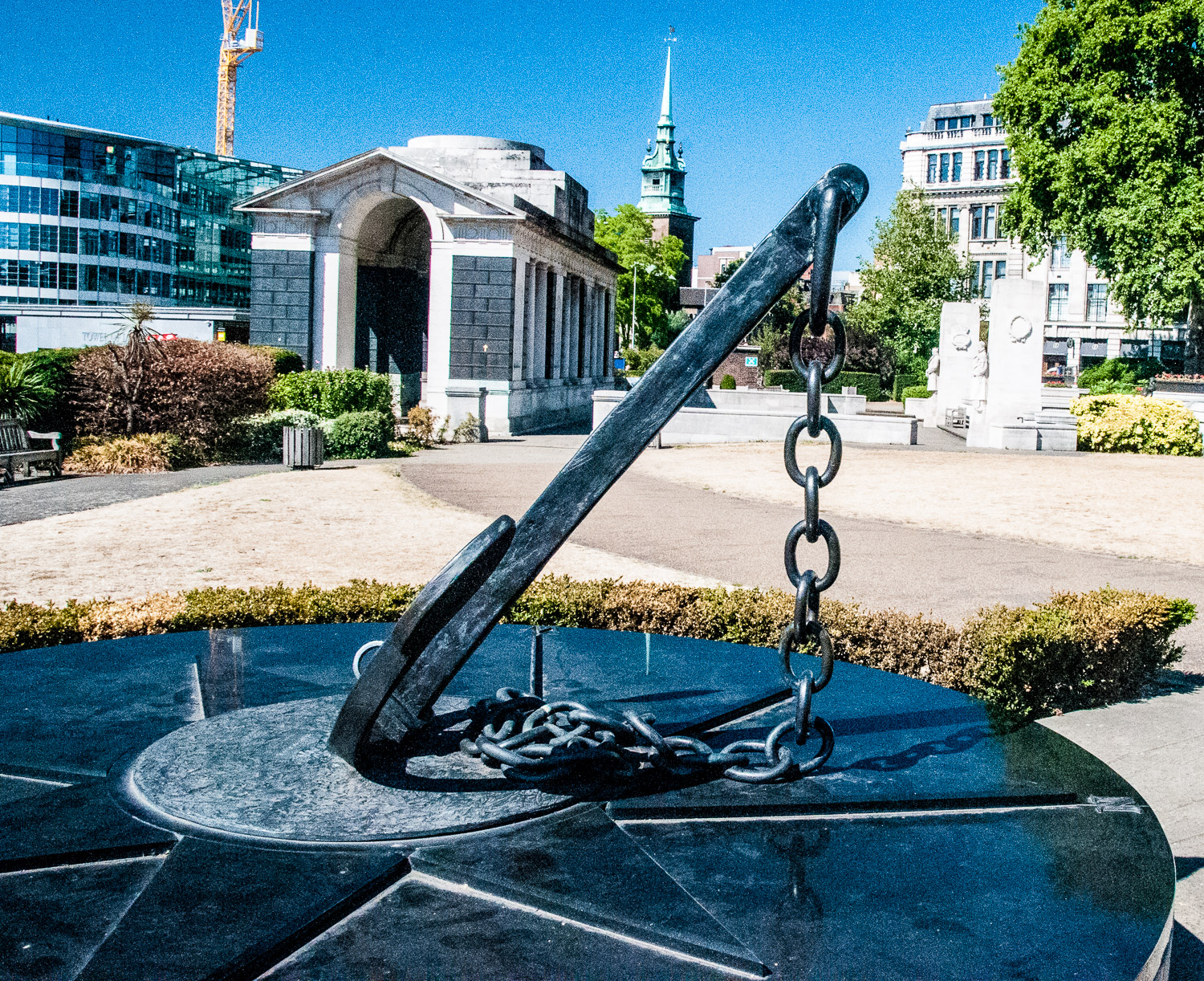
The Falklands War Memorial. Designed by Gordon Newton of War Memorial Limited (2005).

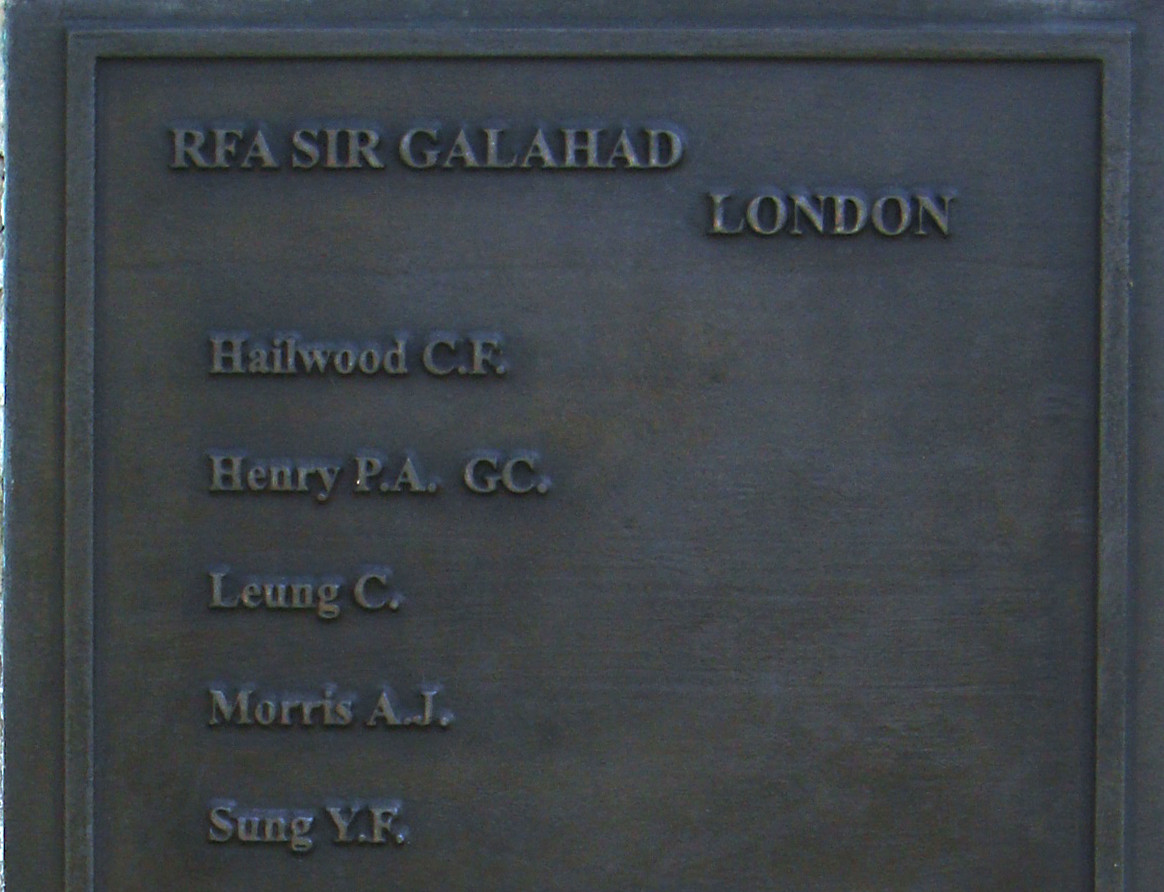
On 2 April 1982, Argentine forces landed in and captured the Falklands Islands. A task force was dispatched in order to retake the territory and this was accomplished when the occupying forces surrendered on 14 June that year. Nine members of the Merchant Navy and eight members of the Royal Fleet Auxiliary were killed in the conflict and their names are recorded here beneath those of their ships …
In the main photograph’s background you can see two other memorial structures. On the left are commemorated the 12,000 men of the merchant navy and fishing fleets who lost their lives in the the First World War ‘who have no grave but the sea’ …
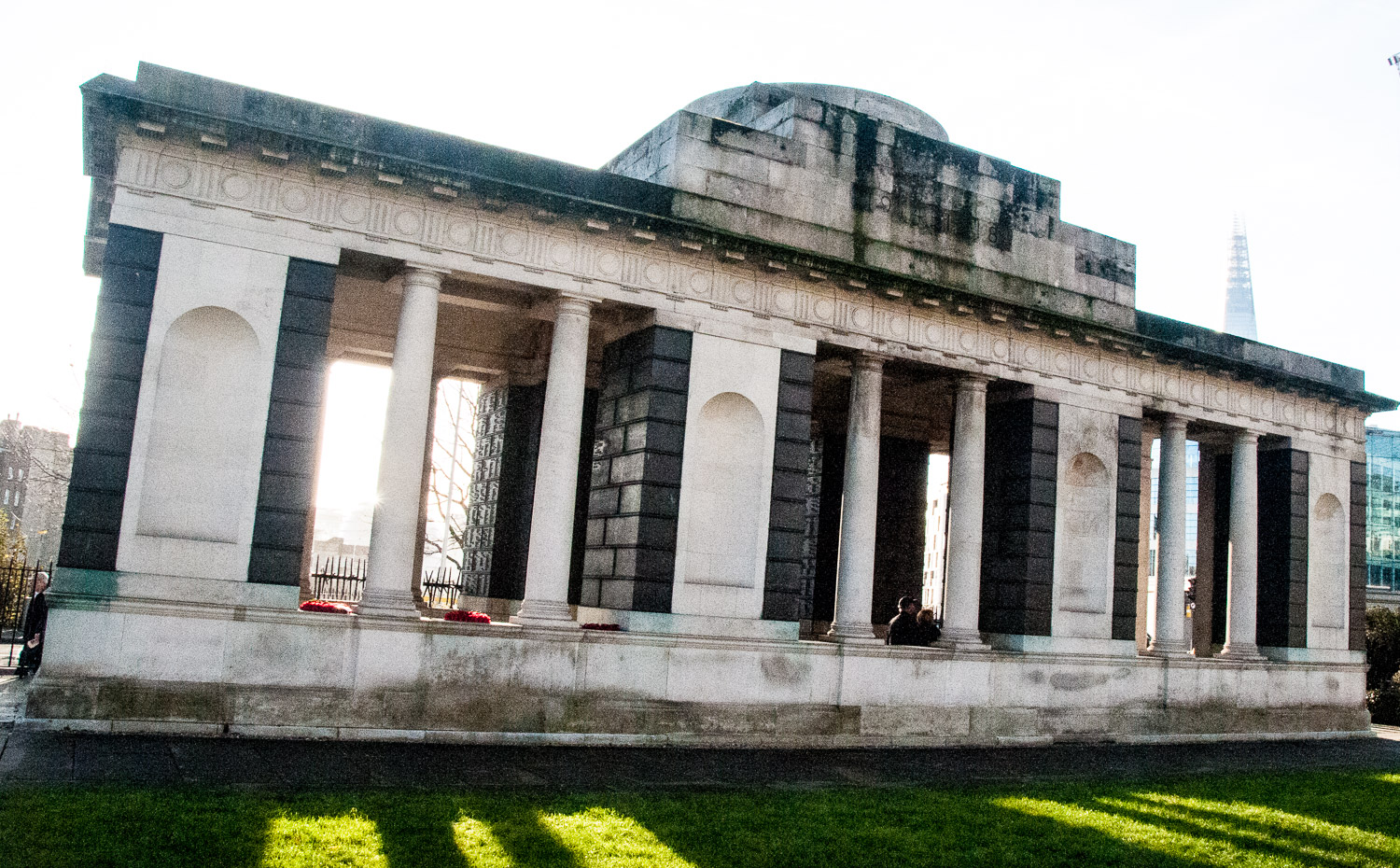
Sculptor: William Reid Dick   Architect: Sir Edwin Lutyens.

Made of Portland stone, the walls are covered with bronze panels with the names of the dead arranged alphabetically under their ships with the name of the Master or Skipper first in each case if they were among the lost.

On visiting a few years ago it was clear than many of those unfortunate mariners were still being remembered by family descendants …
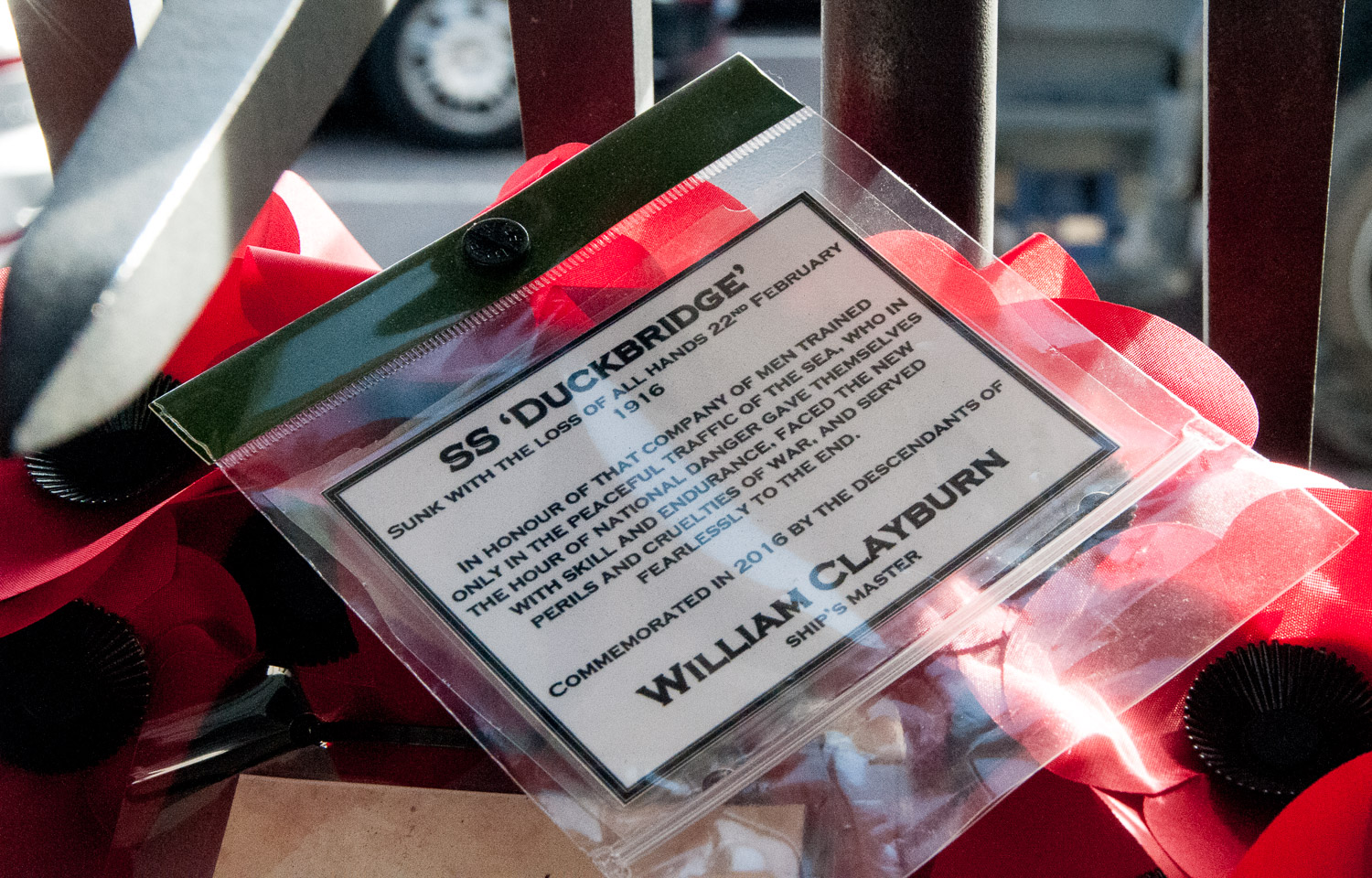
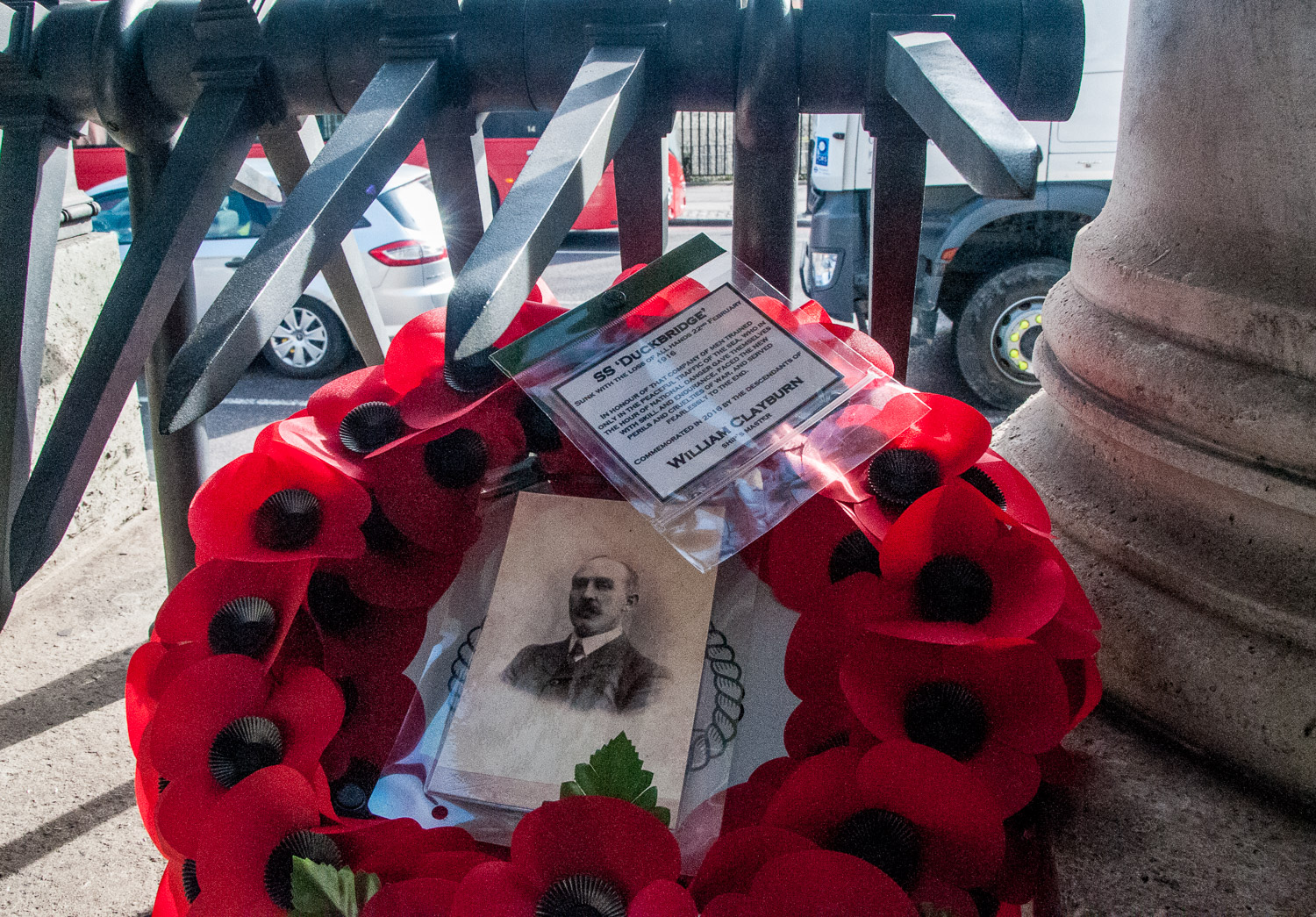
When I first looked really closely at the panels I noticed something strange in one section of the memorial, see if you do too …
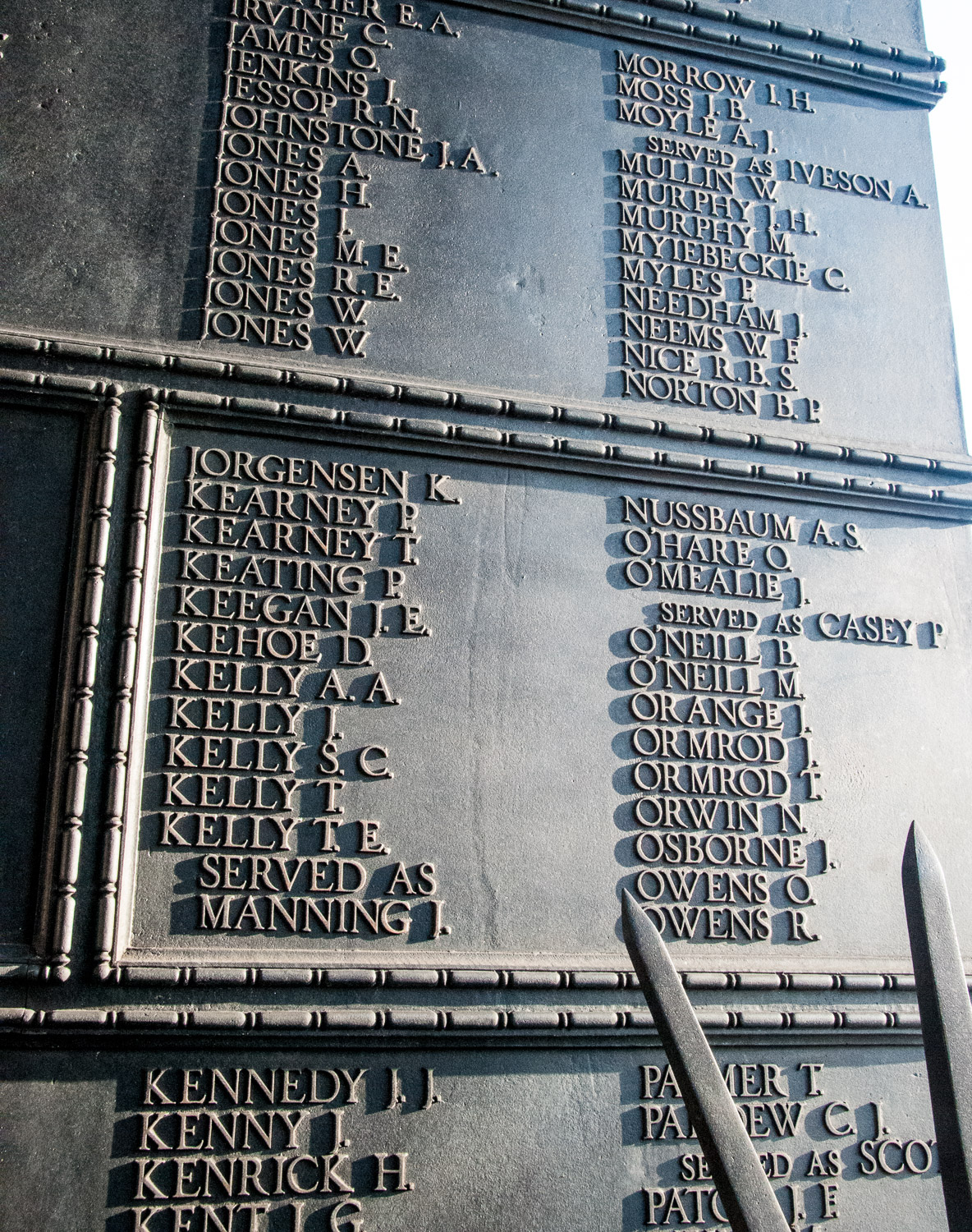
At least four of the men, Moyle A.J., O’Mealie J., Kelly T.E. and Pardew C.J. served under names other than those that were registered at their birth. I am trying to research their stories and will hopefully have something to report in my next blog. There is also a ship recorded here that was actually lost in the Second World War – something also for a future blog.

Just to the north is the Second World War memorial to the further 24,000 men lost between 1939 and 1945 …
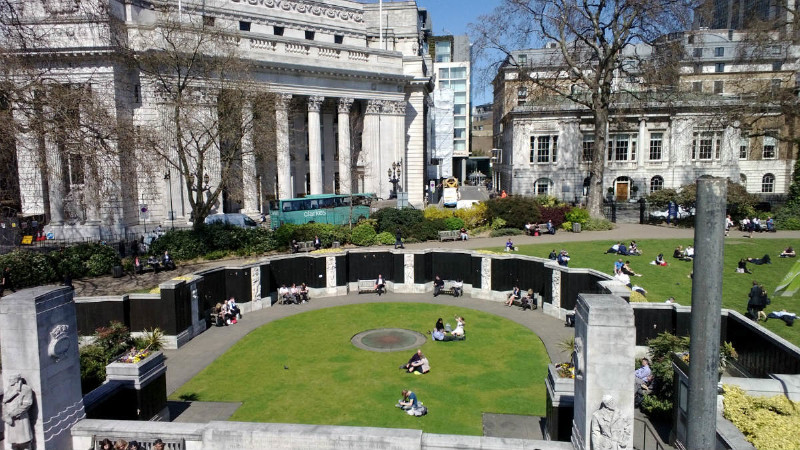
Sculptor: Charles Wheeler   Architect: Edward Maufe.

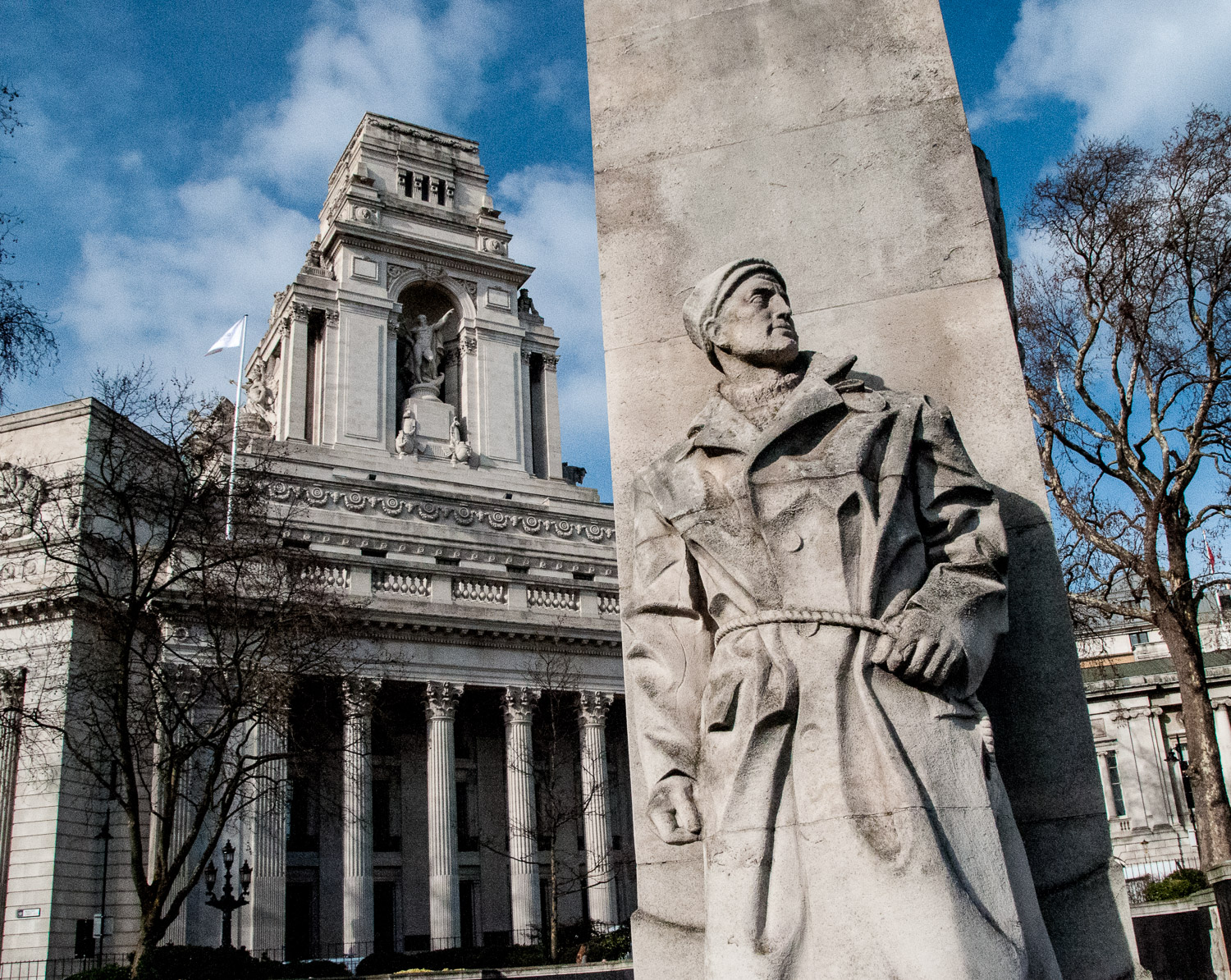
It is a sunken garden with the steps leading down to it flanked by a Mercantile Marine officer …
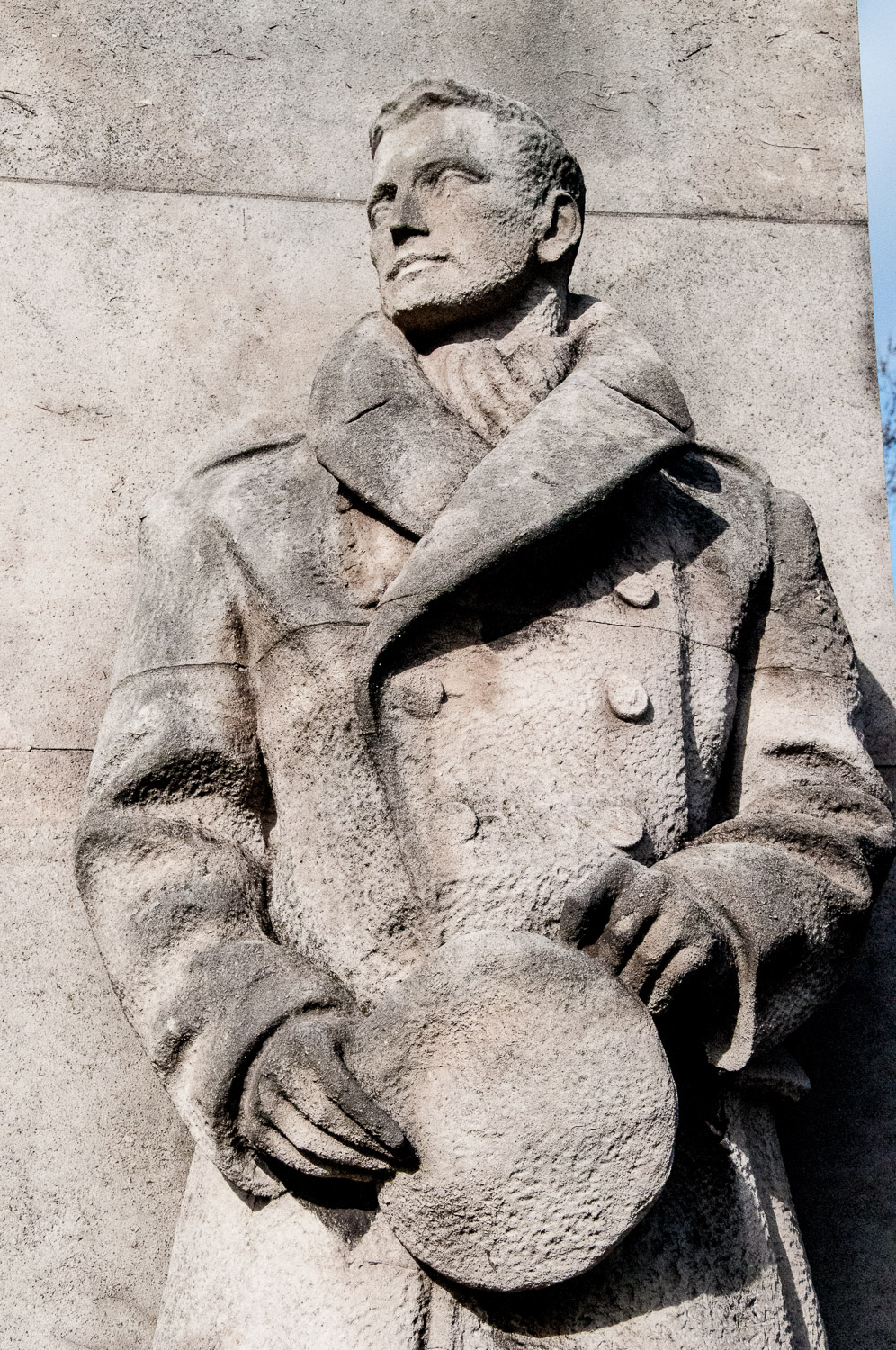
… and a seaman of the Merchant Service. Behind him, in his eyrie above what was once the Port of London Authority building, Father Thames points towards the sea …
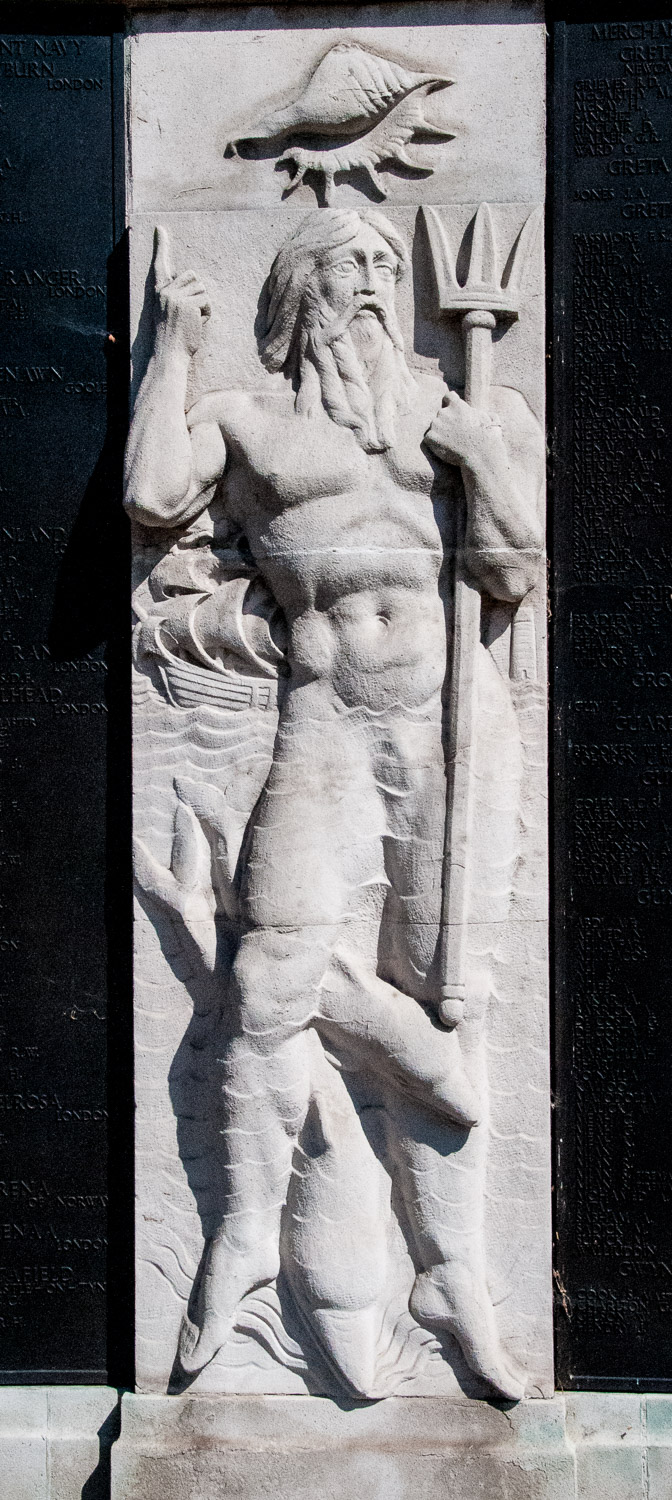
Within the garden the walls are overlaid with bronze plaques on which the names of the men and their ships are inscribed in relief. At regular intervals, between the inscription panels, are allegorical figures representing the Seven Seas. Here is one of them, Neptune with his trident …
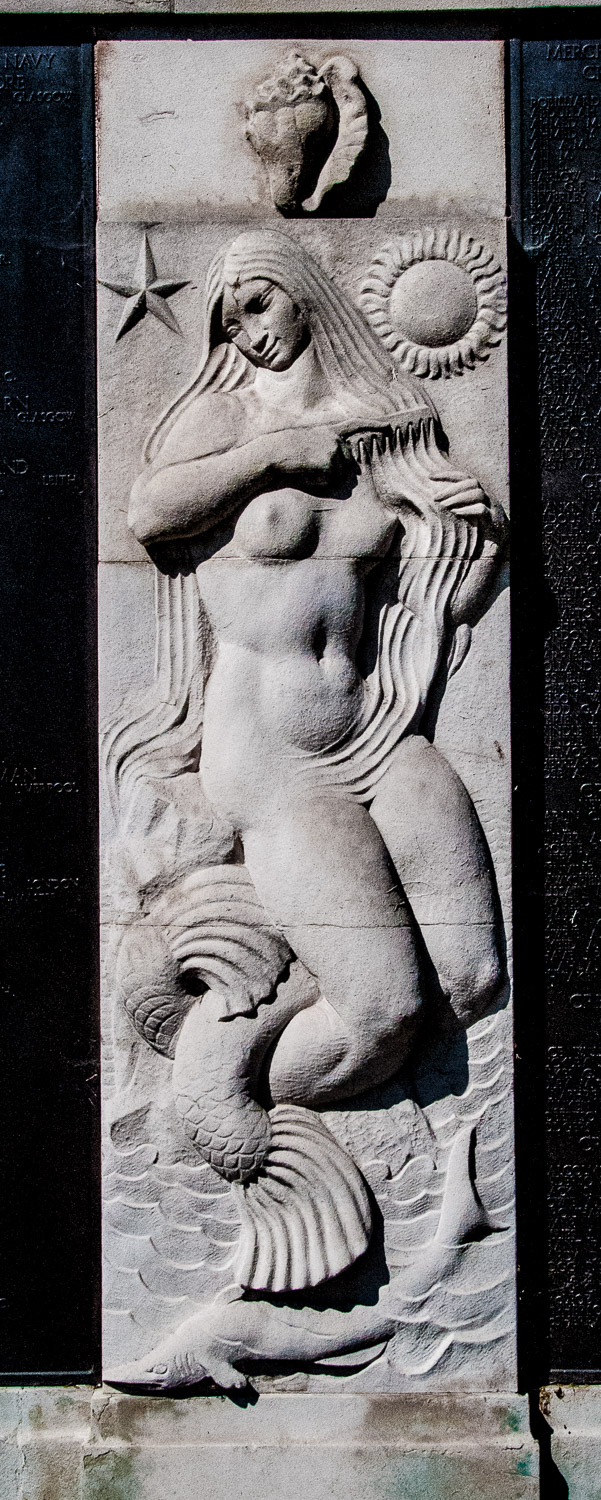
And another, a mermaid combing her hair …
One can’t write about Tower Hill without some mention of its gruesome history as a place of execution …
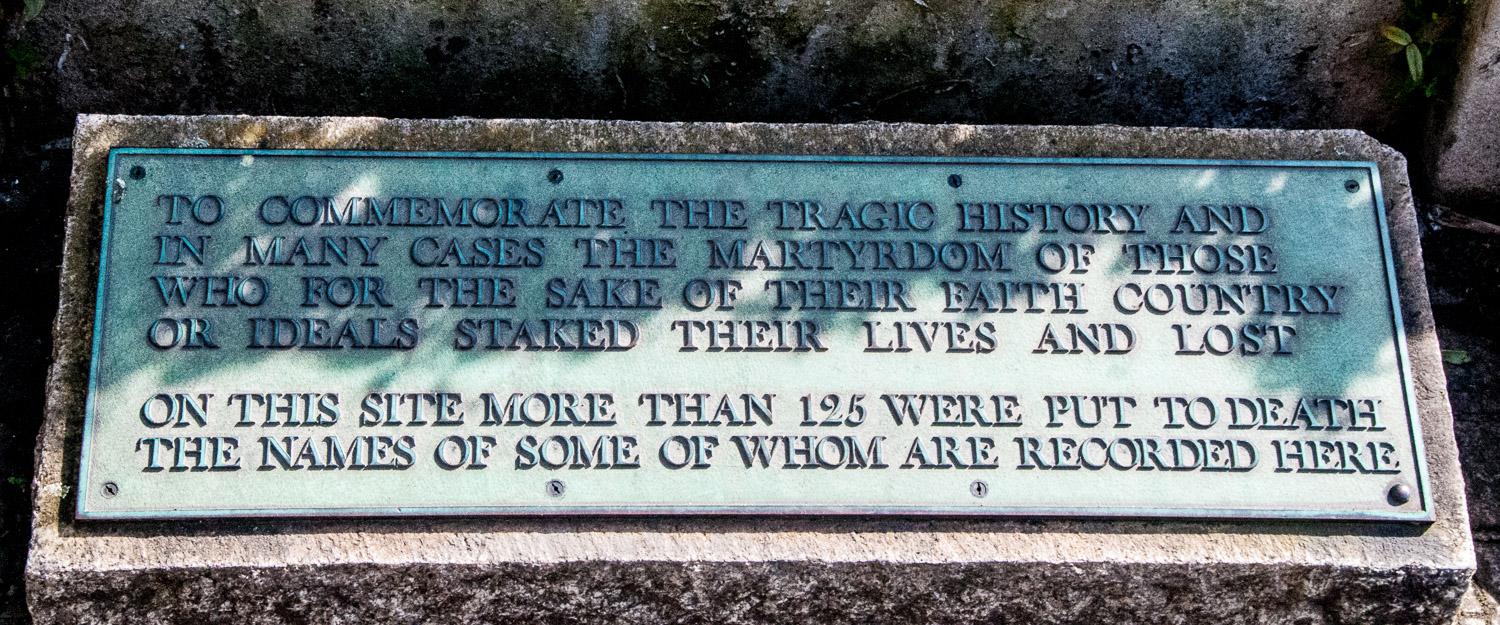
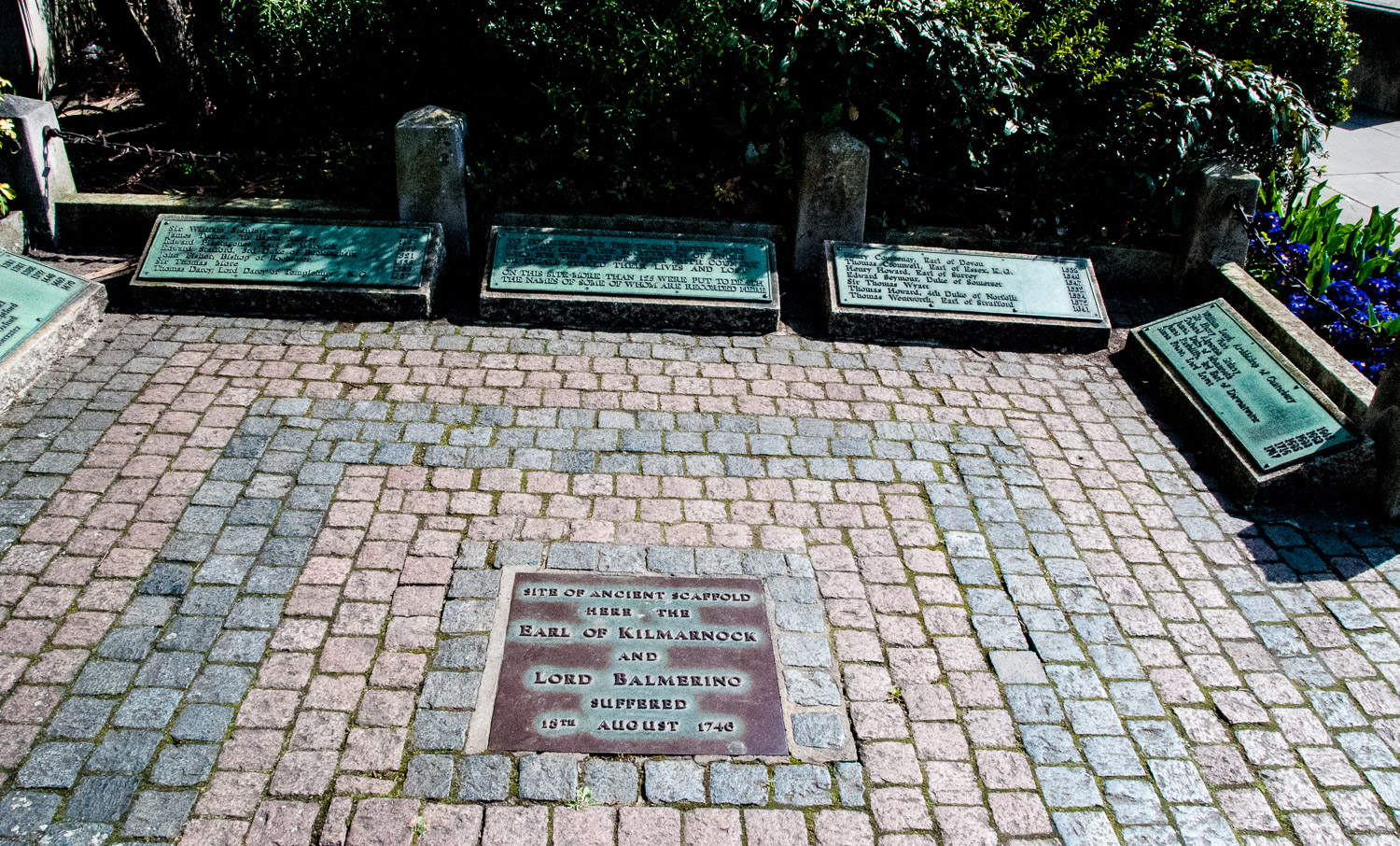
This memorial is located on the approximate site of public executions. Nearby, within the walls of the Tower of London, is Tower Green, where people such as Henry VIII’s unwanted Queens were disposed of more discretely. On 19 May 1536 Anne Boleyn was beheaded there, the deed carried out by a swordsman which ensured a speedy death.

Her old adversary Thomas Cromwell watched her decapitation, but was to end his days on the public gallows a mere four years later on 28 July 1540. The executioner being drunk, his end was a nasty, botched affair. On the same day Henry married his fifth wife, Catherine Howard, but the marriage only lasted a few years until she too was executed at the Tower.

Records are incomplete but the known execution tally for both locations is well over 100 ranging from the first (Sir Simon Burley on 5 May 1388) to the last (three Gordon rioters hanged on 11 July 1780). Two of the Jacobite ‘Rebel Lords’ beheaded for high treason have a special plaque …

Site of the ancient scaffold where the Earl of Kilmarnock and Lord Balmerino suffered 18th August 1746.

In this 1746 etching of their execution, the scaffold on the left is surrounded by horse and foot guards, holding back the throng of spectators, who also watch from tiers erected for the purpose. The executioner is raising the axe above his head …
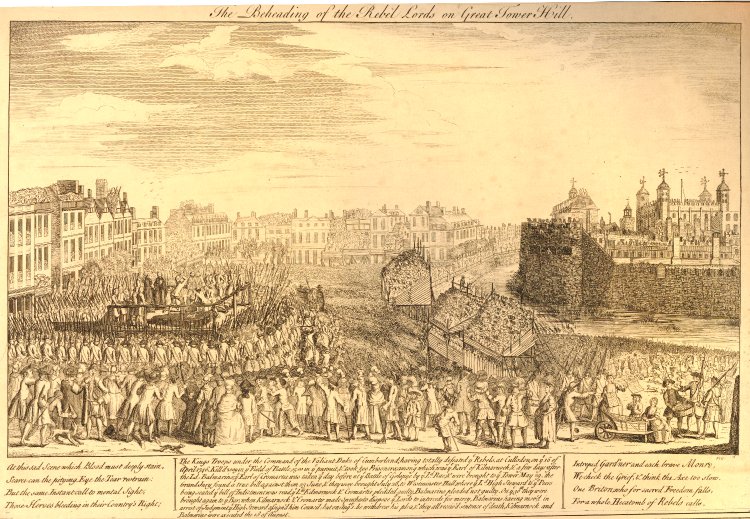
Copyright Trustees of the British Museum.
 

War Memorials in the City

The aftermath of the First World War saw tens of thousands of memorials erected across the country. This reflected not only the huge impact on individual communities but also the official policy of not repatriating the dead: the memorials provided the main focus of the grief felt at the loss of three quarters of a million British lives.

As we approach the centenary of the end of the First World War, I thought it would be appropriate to take a look at some of the many City memorials that commemorate those who made the ultimate sacrifice serving King and Country. I am particularly fascinated by the different approaches taken by sculptors and the allegories they chose to use.

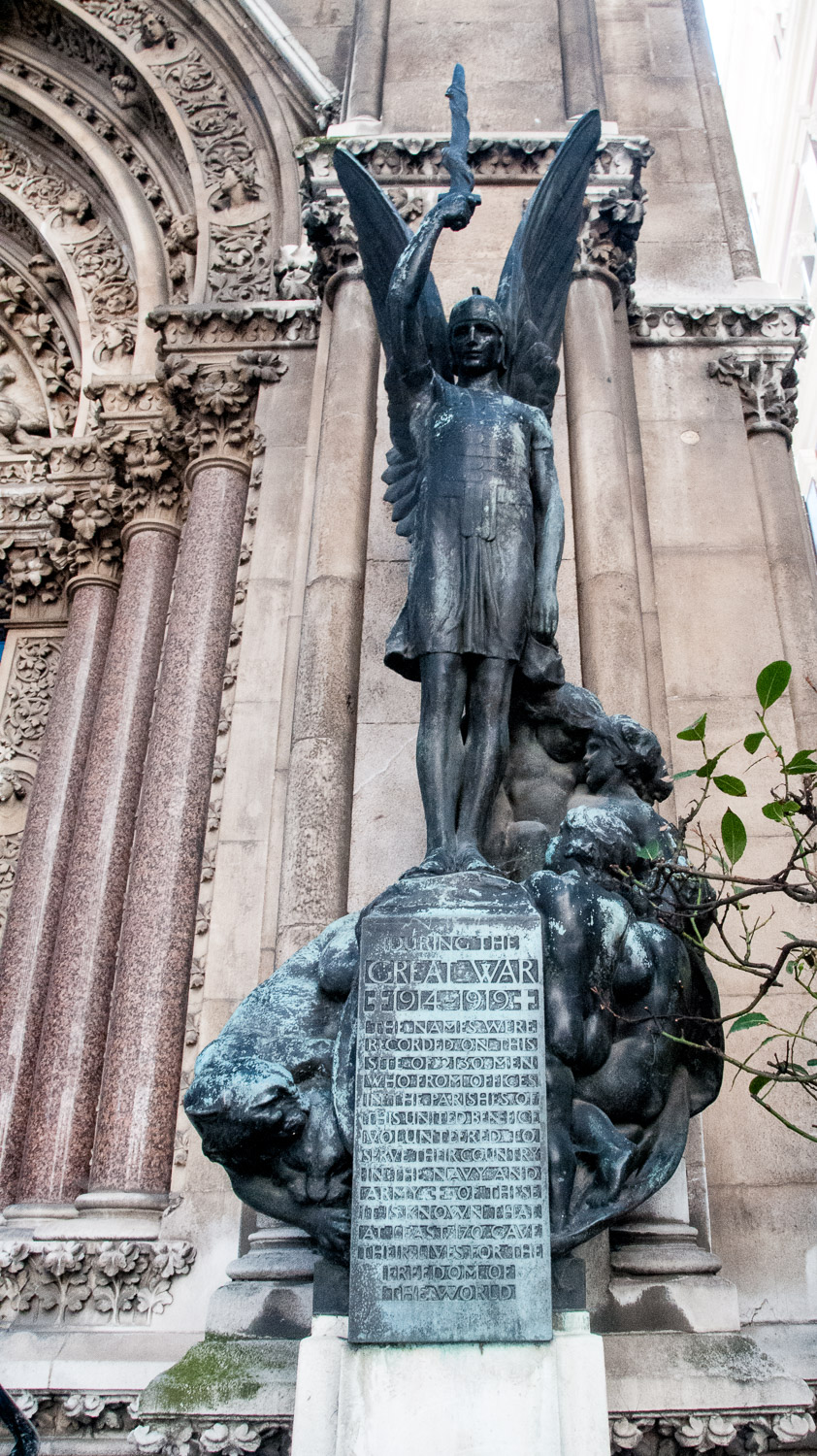
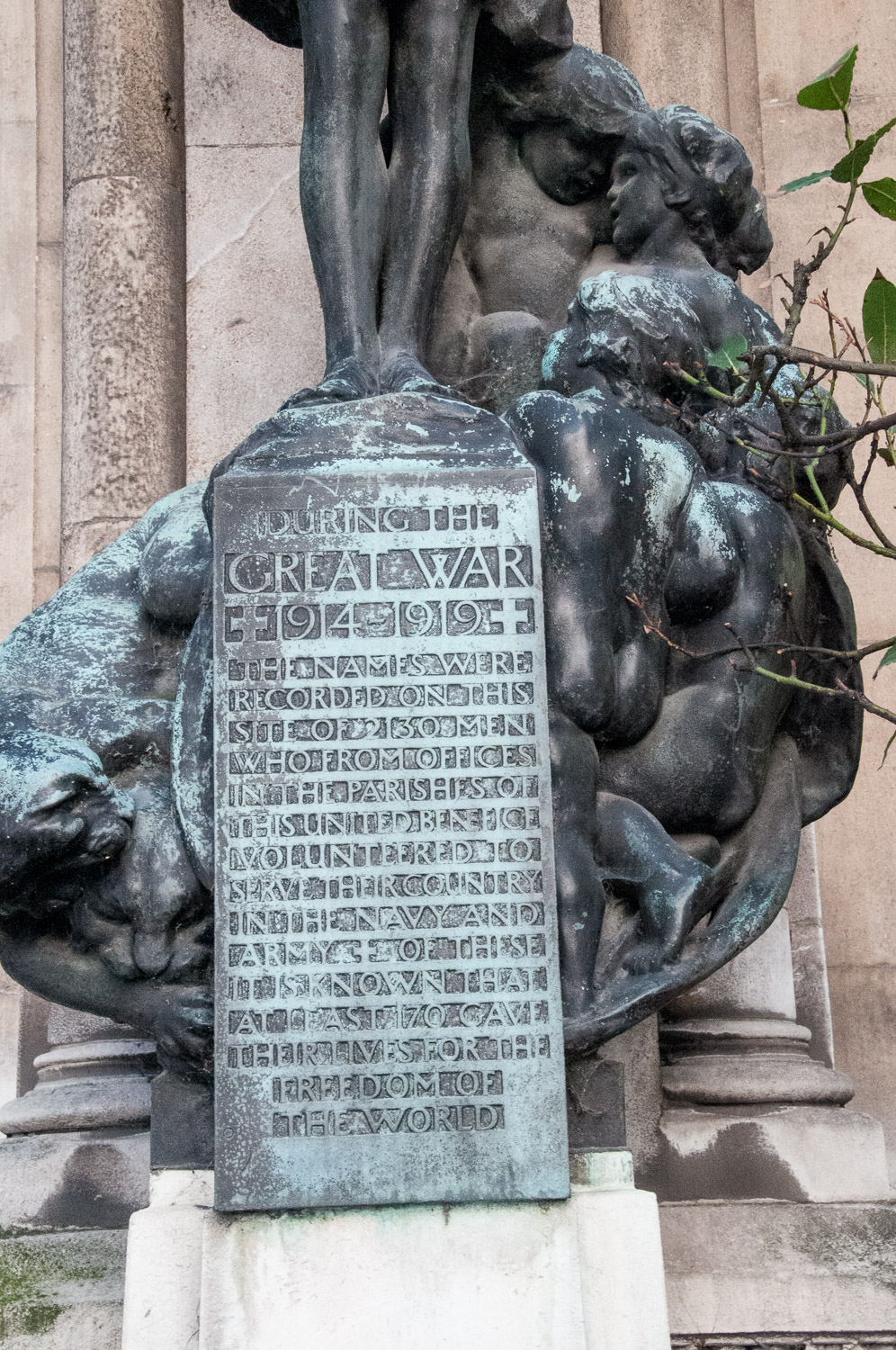
Firstly, I revisited St Michael Cornhill and this sculpture by Richard Reginald Goulden. The memorial commemorates 2,130 men from three parishes  who served in the War of whom about 170 died ‘for the freedom of the world’ …

Allegorical figures surround the base as St Michael with his flaming sword stands steadfastly above …

On the left, the quarreling beasts typify war, but are ‘sliding slowly but surely from their previously paramount position. Life, in the shape of young children, rises with increasing confidence under the protection of the champion of right’.

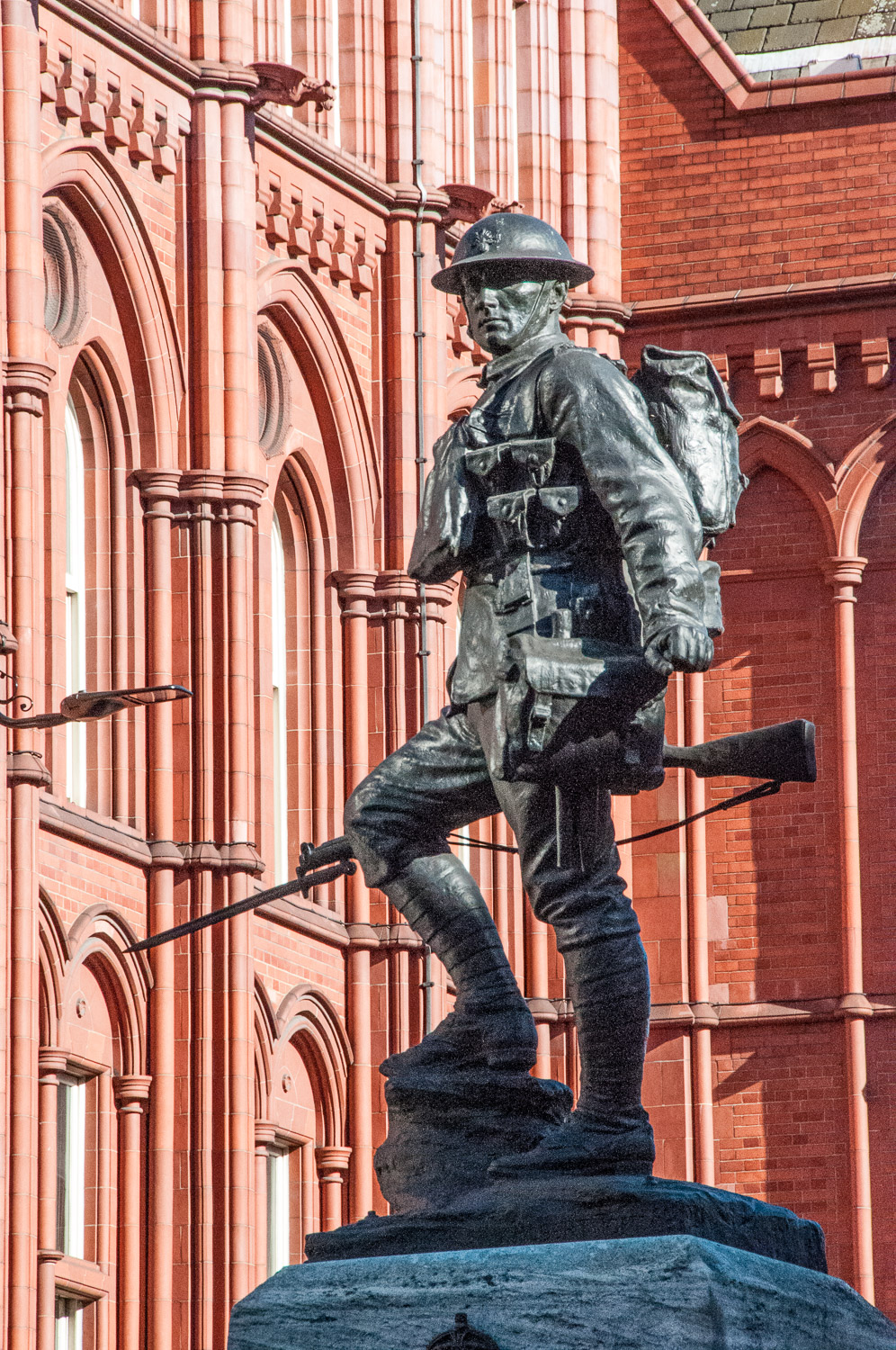
And now to Holborn and this work by Albert Toft. Unveiled by the Lord Mayor in 1922, the inscriptions read …

To the glorious memory of the 22,000 Royal Fusiliers who fell in the Great War 1914-1919 (and added later) To the Royal Fusiliers who fell in the World war 1939-1945 and those fusiliers killed in subsequent campaigns.


Toft’s soldier stands confidently as he surveys the terrain, his foot resting on a rock, his rifle bayoneted, his left hand clenched in determination. At the boundary of the City, he looks defiantly towards Westminster. The general consensus on the internet is that the model for the sculpture was a Sergeant Cox, who served throughout the First World War.

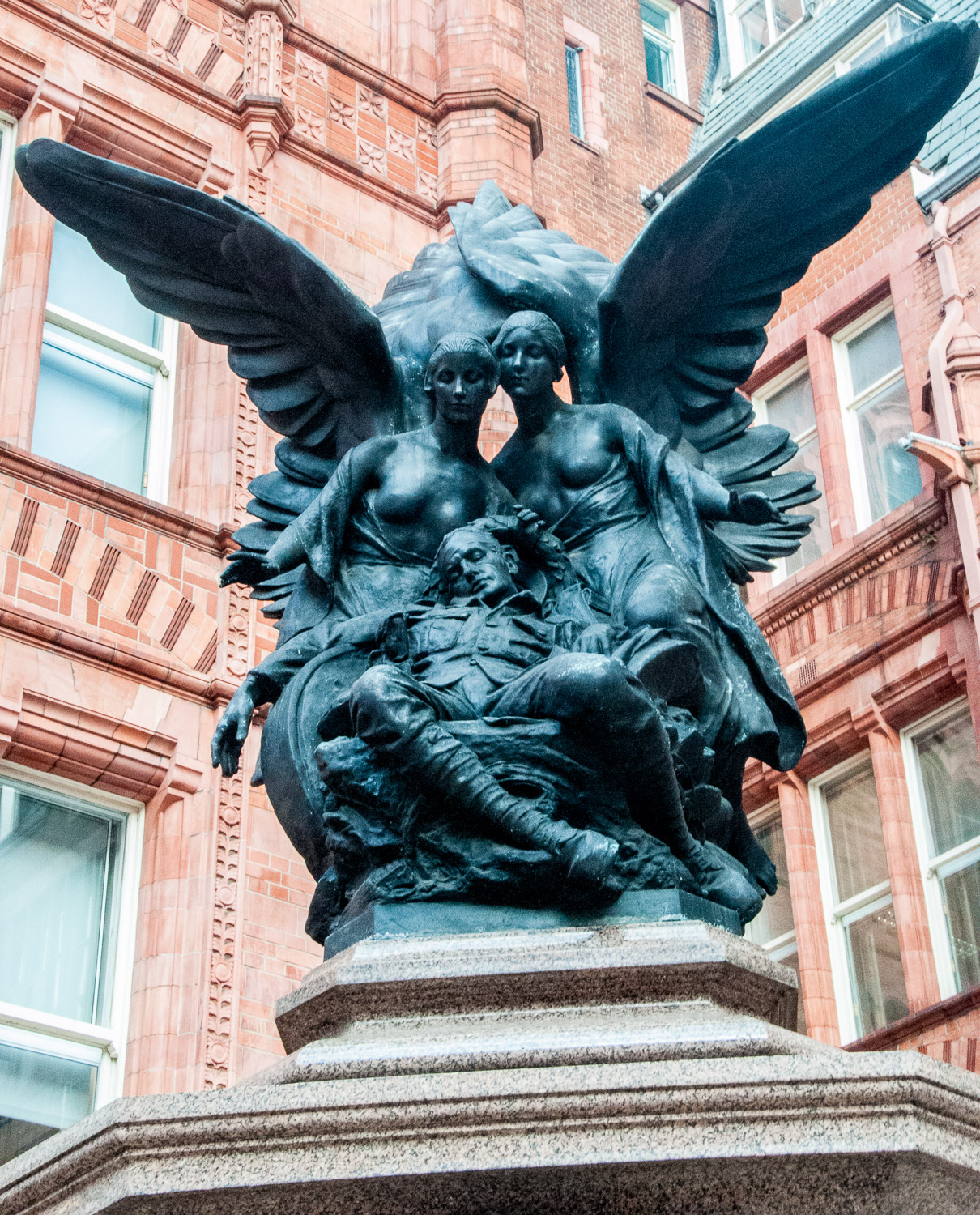
Behind him is the magnificent, red terracotta, Gothic-style building by J.W. Waterhouse, which once housed the headquarters of the Prudential Insurance Company. Walk through the entrance arch to the courtyard and you will see the work of a sculptor who has chosen to illustrate war in a very different fashion. The memorial carries the names of the 786 Prudential employees who lost their lives …

The sculptor was F.V. Blundstone and the work was inaugurated on 2 March 1922. All Prudential employees had been offered ‘the opportunity of taking a personal share in the tribute by subscribing to the cost of the memorial’ (suggested donations were between one and five shillings).

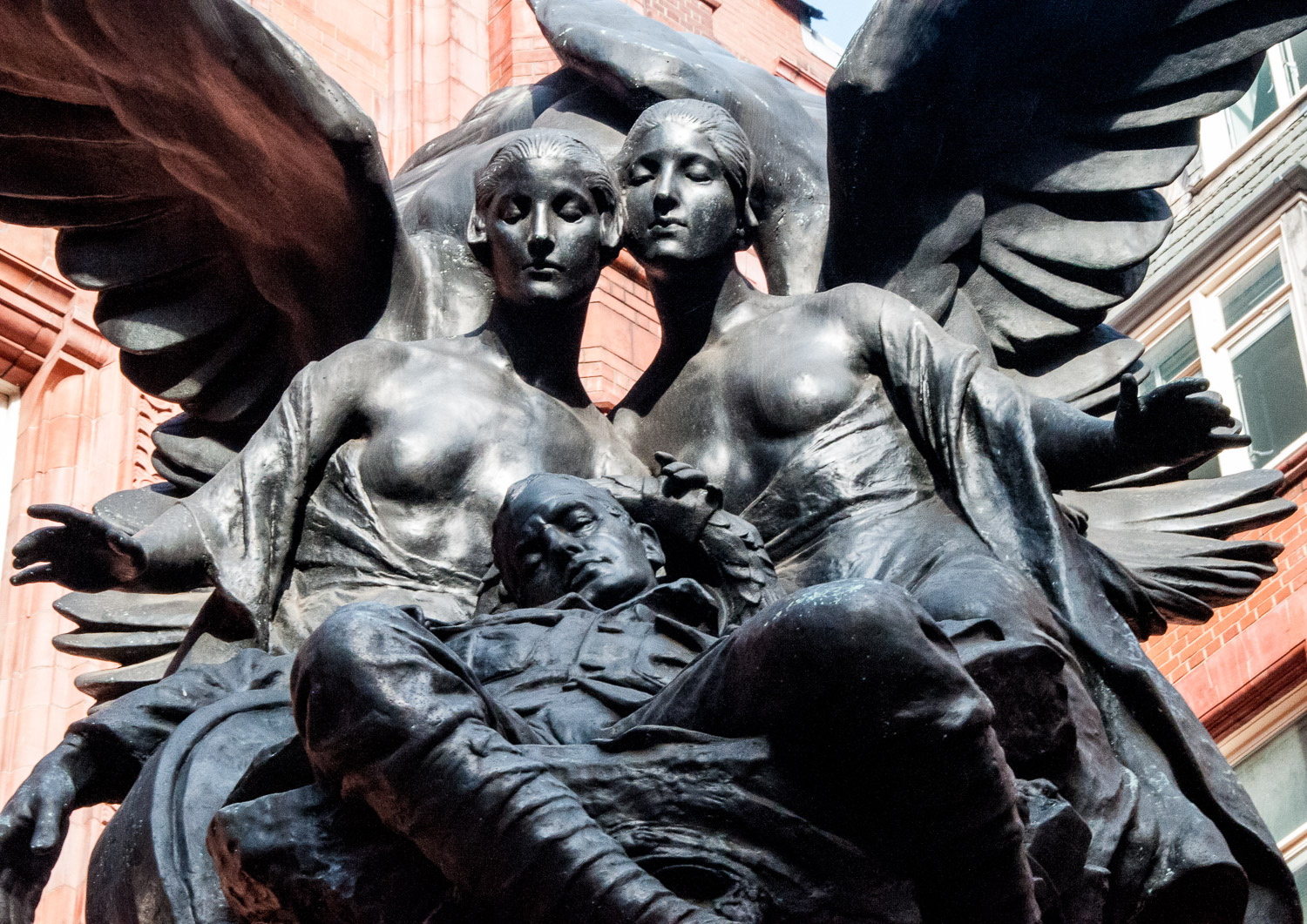
The main group represents a soldier sustained in his death agony by two angels. He is lying amidst war detritus with his right arm resting on the wheel of some wrecked artillery piece. His careworn face contrasts with that of the sombre, beautiful girls with their uplifted wings. I find it incredibly moving.

I have written about angels in the City before and they are usually asexual, but these are clearly female.

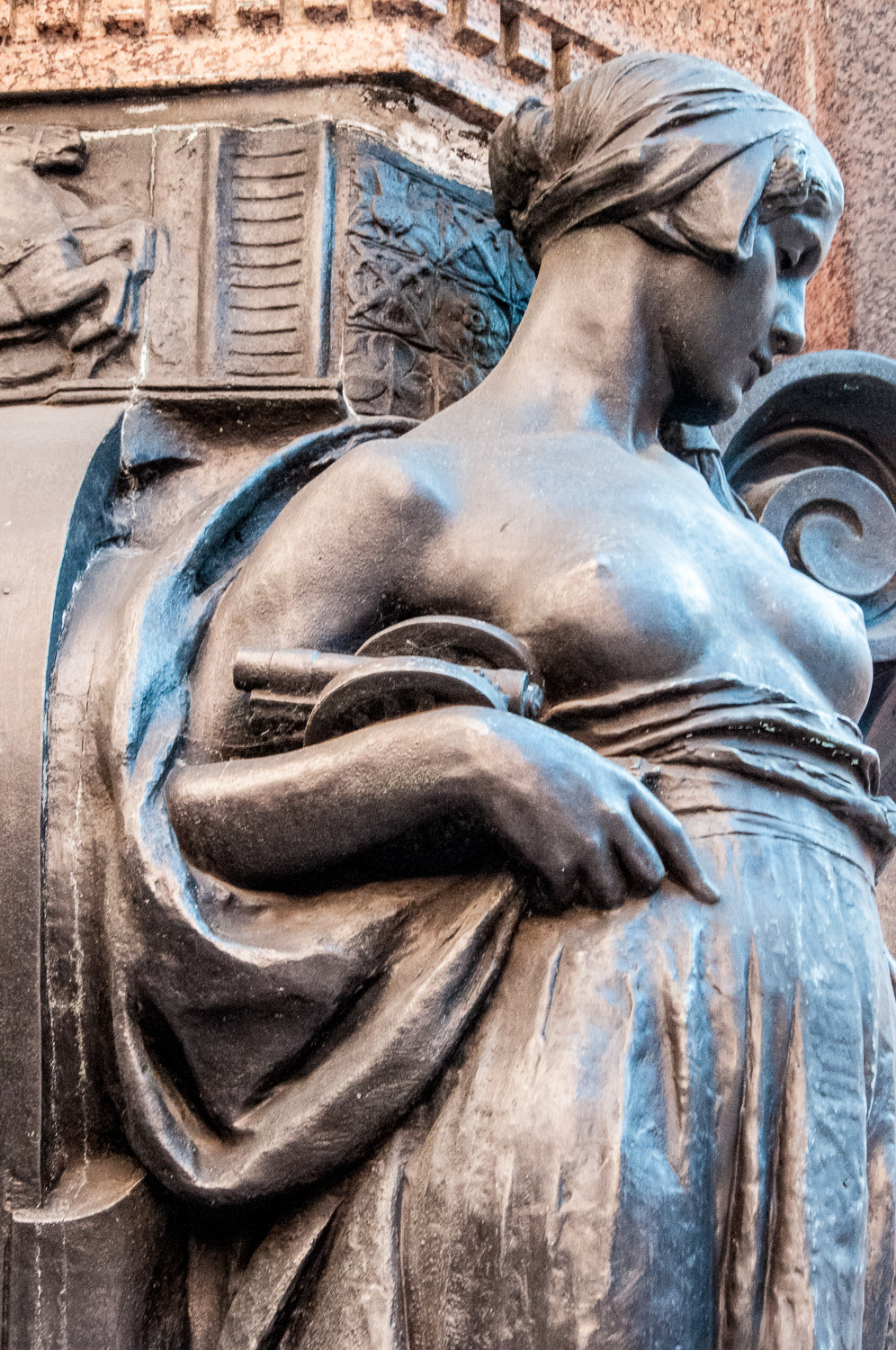
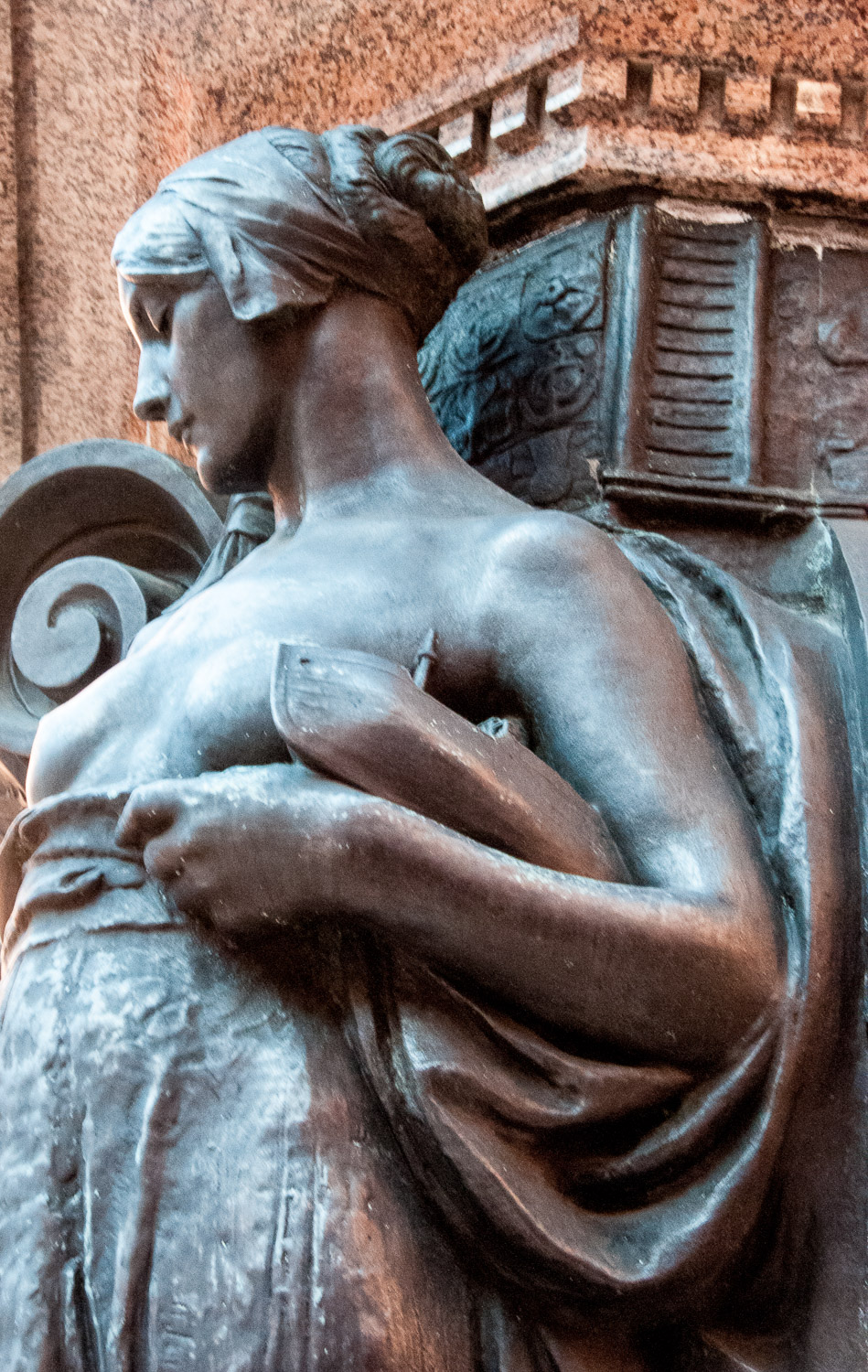
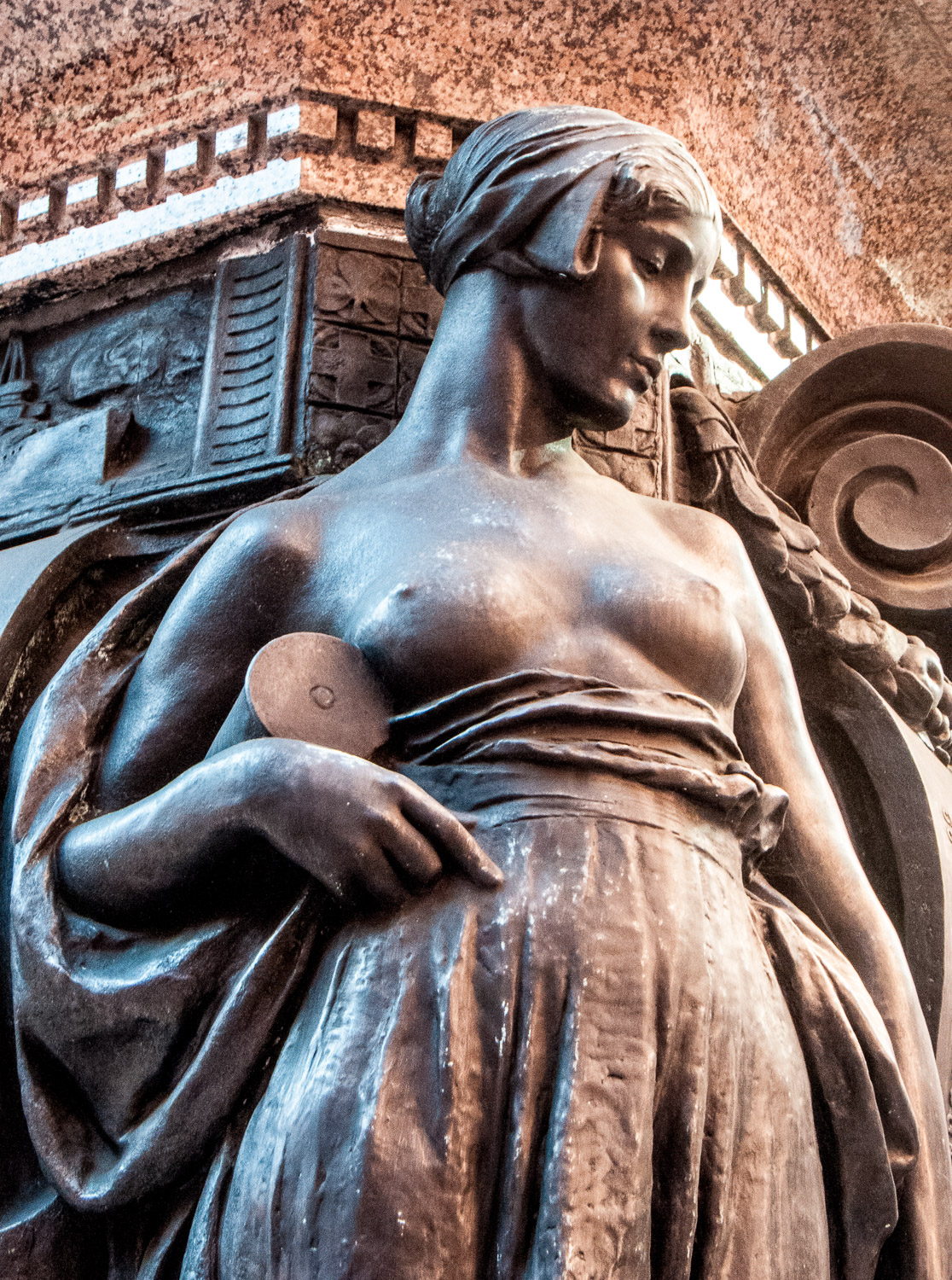
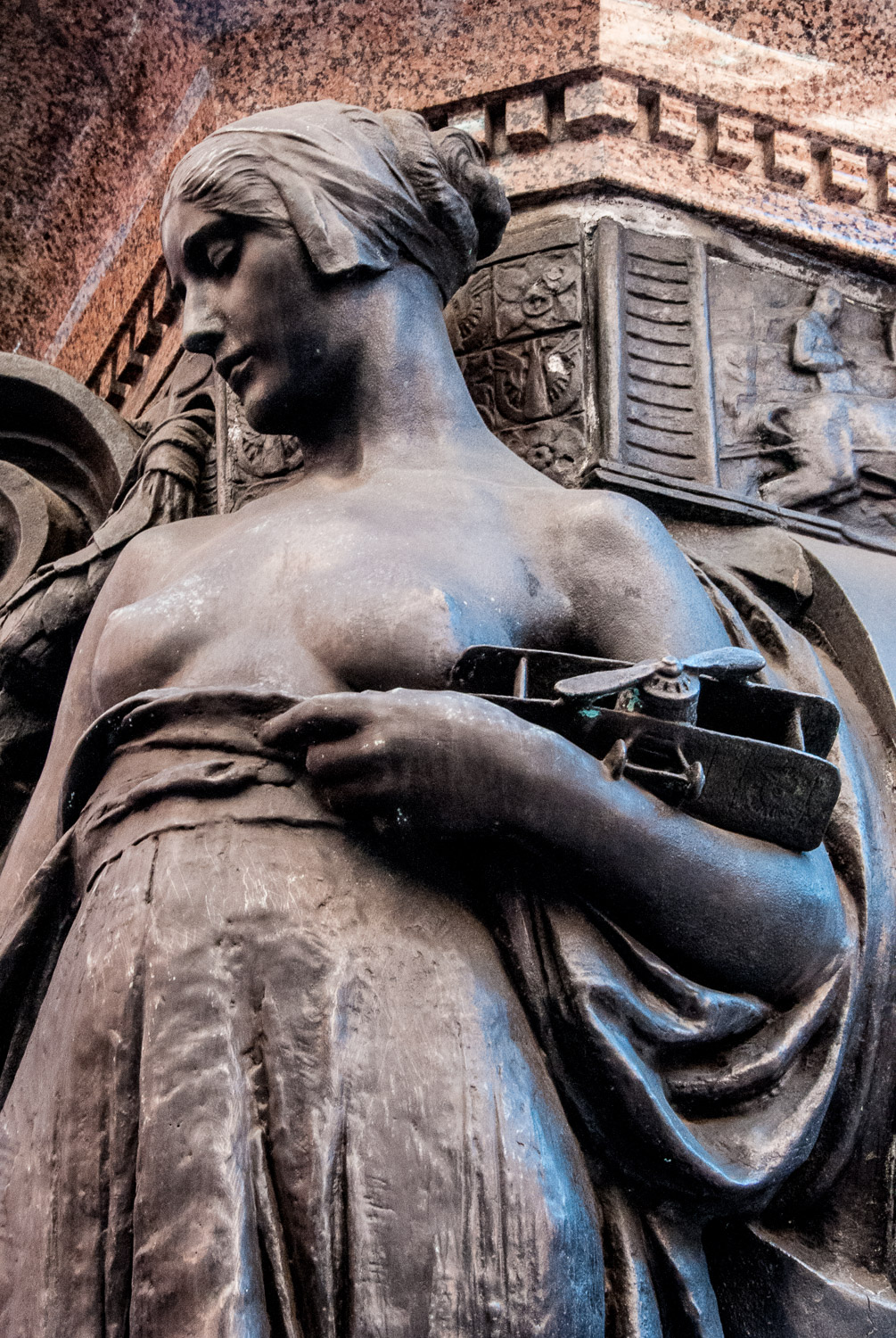
At the four corners of the pedestal stand four more female figures.

One holds a field gun and represents the army …

One holds a boat representing the navy …

At the back is a figure holding a shell representing National Service …

The fourth lady holds a bi-plane representing the air force …

The work is tucked away in the building’s courtyard, Waterhouse Square (EC1N 2SW), and I am sure that most of the thousands of people who walk along Holborn every day have no idea it is there.

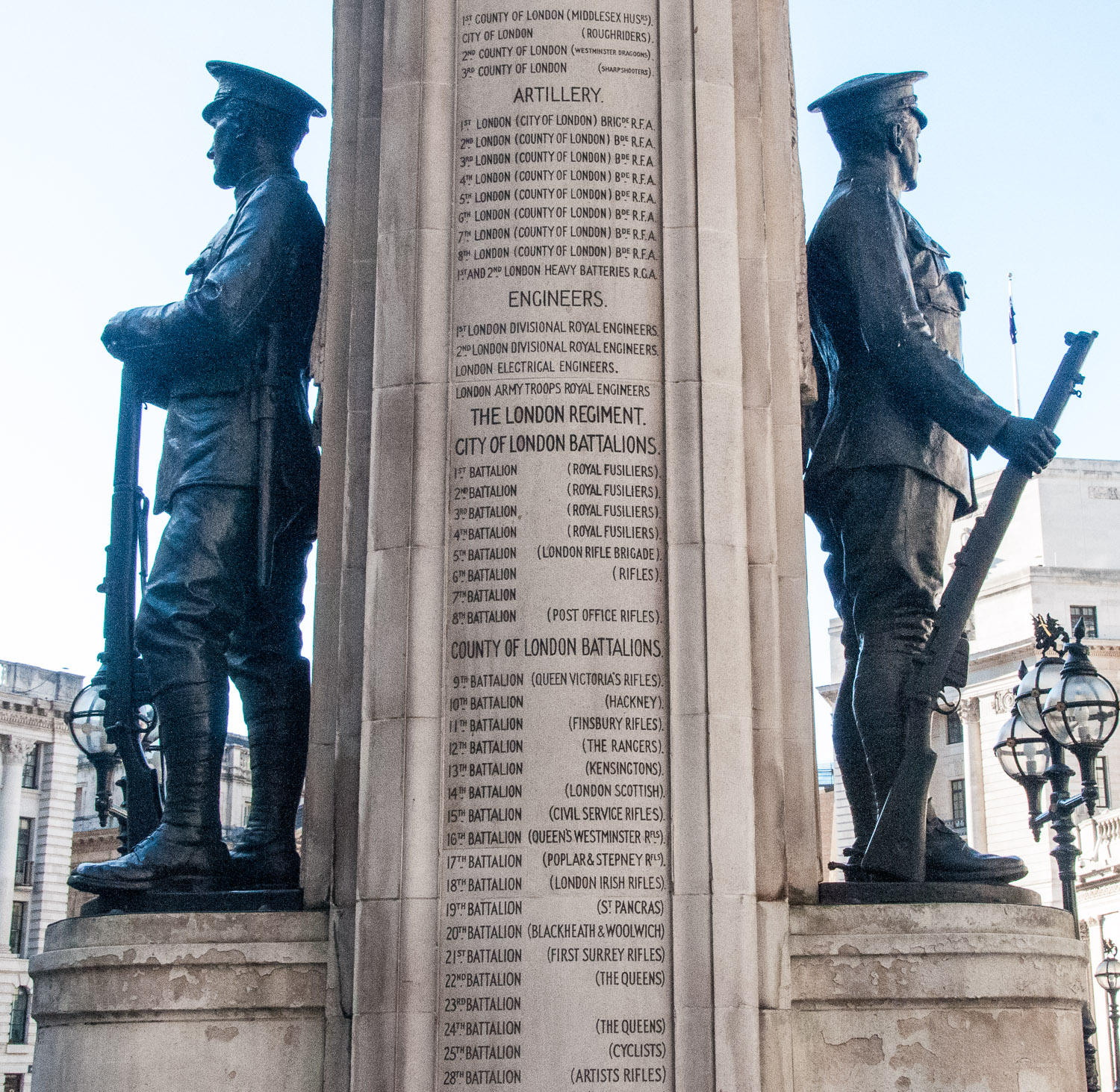
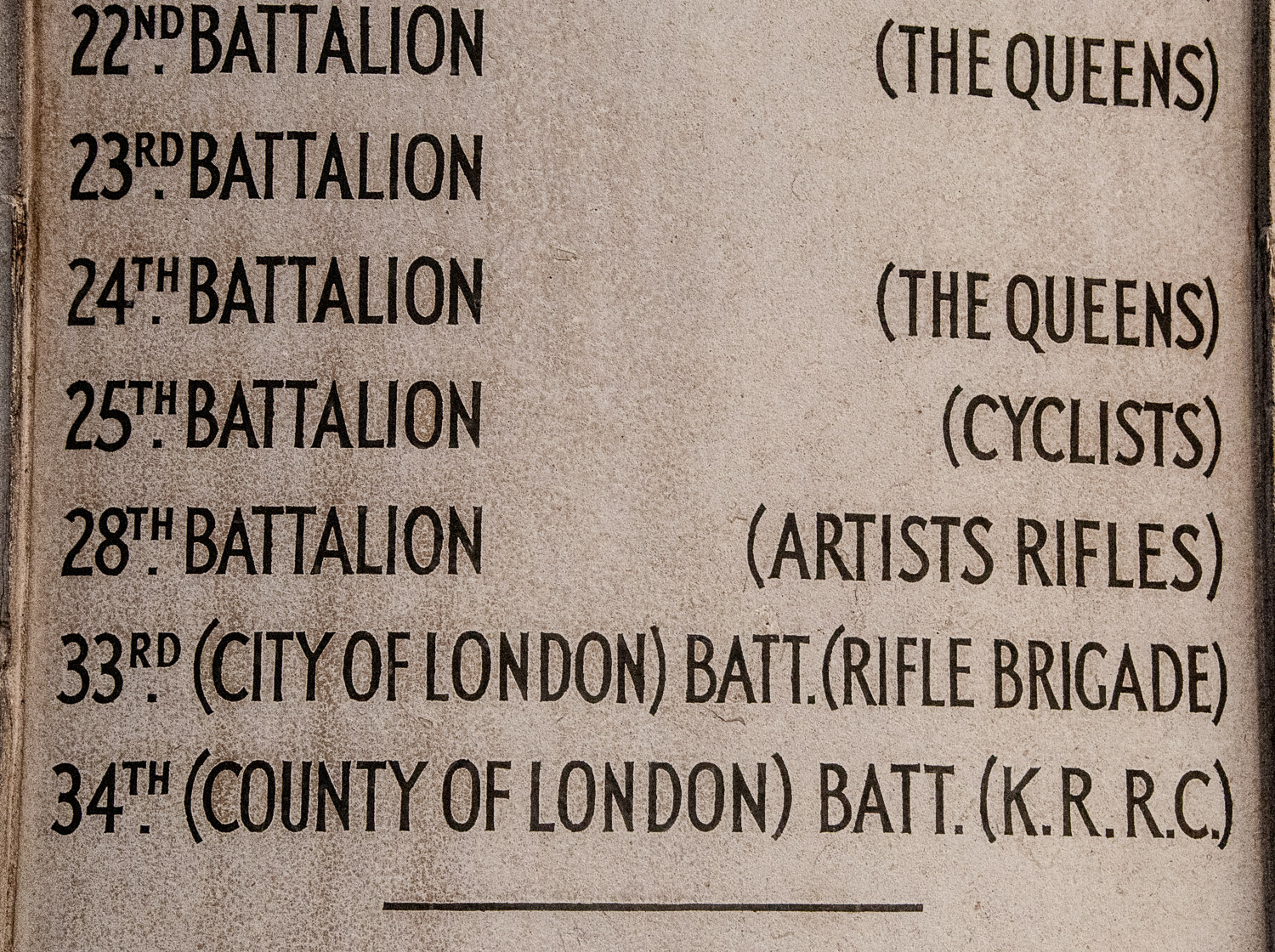
And finally, I looked again at the War Memorial to London Troops outside the Royal Exchange …

At the bottom of the list of battalions, two in particular caught my eye …

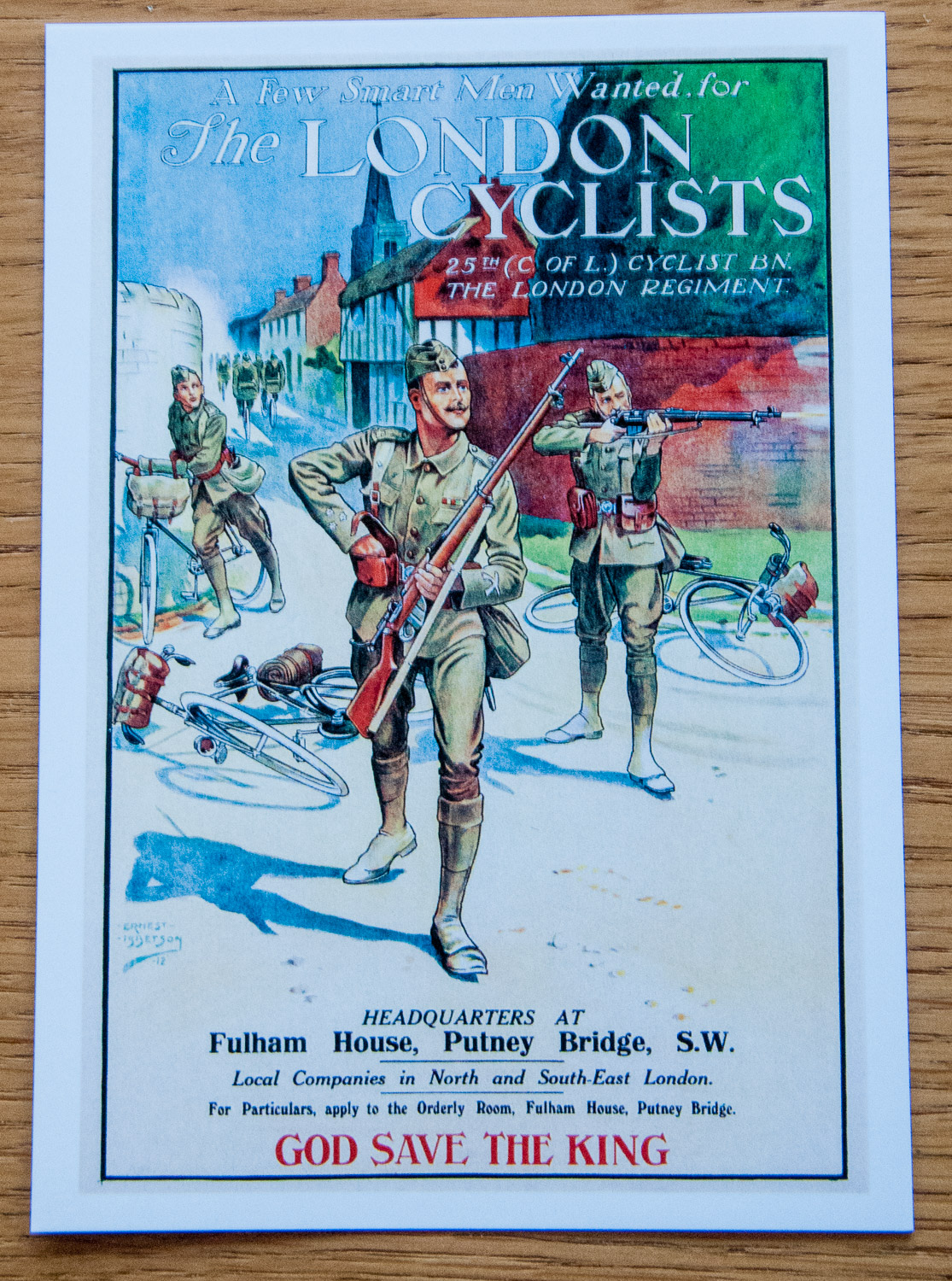
I am going to do further research on the Artists Rifles and the London Cyclists and hopefully include the results in a later blog.

As luck would have it, I visited the Imperial War Museum last week and came across a postcard of this splendid recruitment poster from 1912. It is poignant to look at this picture with its pretty village setting and then think of the industrial age war and slaughter that was soon to follow …

I will continue writing about war memorials for the next few weeks.


Sir Thomas Gresham and The Royal Exchange

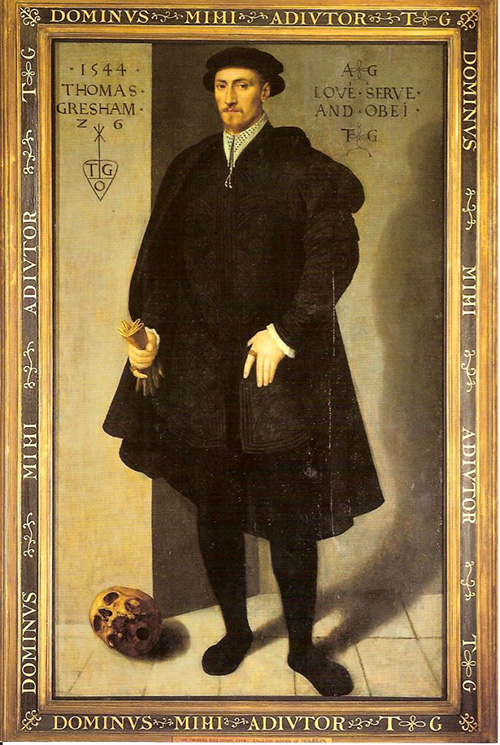
The Royal Exchange will forever be associated with Sir Thomas Gresham (1519-1579). Here he is, portrayed as a confident young man in his mid-twenties:

Portrait – Gresham College.

Apprenticed for seven years in the Mercer trade, he spent much of his time on the continent, learning French and Flemish in the process. His astuteness with finance came to the attention of Thomas Cromwell who started putting royal work his way, and Gresham’s connection with royalty continued under Elizabeth I. As well as managing his family’s trading interests (primarily clothing, guns and ammunition) as a royal agent he was charged with reducing the royal debt held by Antwerp merchants. When he took over this task the debt stood at £250,000 but by 1565, applying a combination of shrewd trading and interest rate speculation, he had reduced it to only £20,000 (earning himself a knighthood). These skills increased his own wealth considerably as well, and this was further enhanced on the death of his father.

By the late 1560s he was reputed to be the richest commoner in the country. Having no heir (his only son died in 1564), in his later years he used some of his vast wealth to produce two lasting legacies – Gresham College and the first Royal Exchange. The College was established at his house in Bishopsgate where lectures were given on a wide range of subjects including astronomy, geography, medicine and music. The College still offers lectures today at its Holborn premises. The Royal Exchange, based on the Antwerp model, was his gift to the City’s merchant negotiators who up to that time ‘had done their business in the wind and weather of the public street’.

Queen Elizabeth formally opened the Exchange on 23 January 1571, giving the building its Royal title along with a licence to sell alcohol. The building was lost in the Great Fire of 1666 and its successor also burned down in 1838. The third building which stands today was opened in 1844 with much ceremony by Queen Victoria herself, Prince Albert having laid the foundation stone two years earlier.

In this blog I will be looking at some of the features of the present building that perpetuate Gresham’s memory and I will deal with other aspects in a later blog.

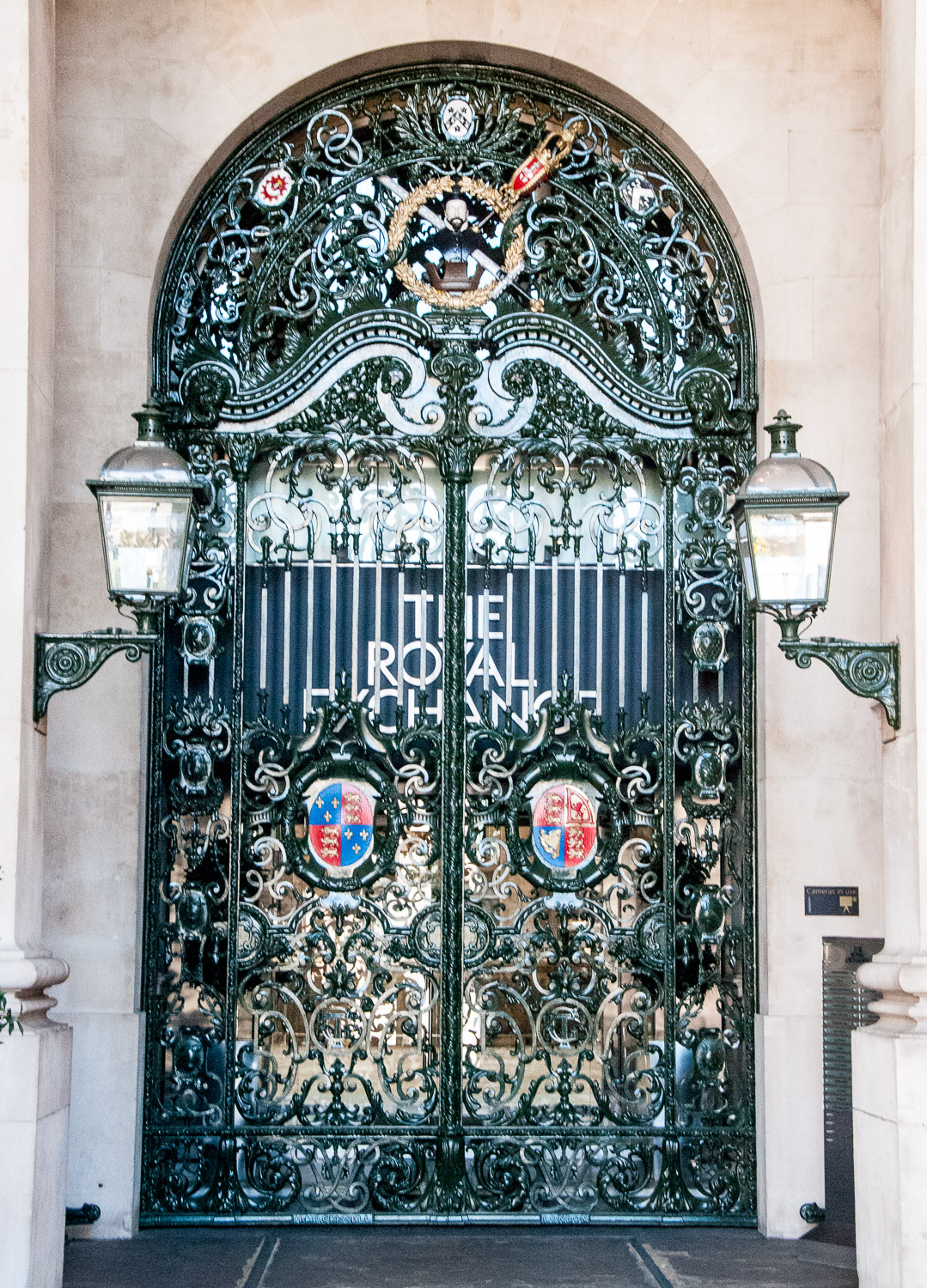
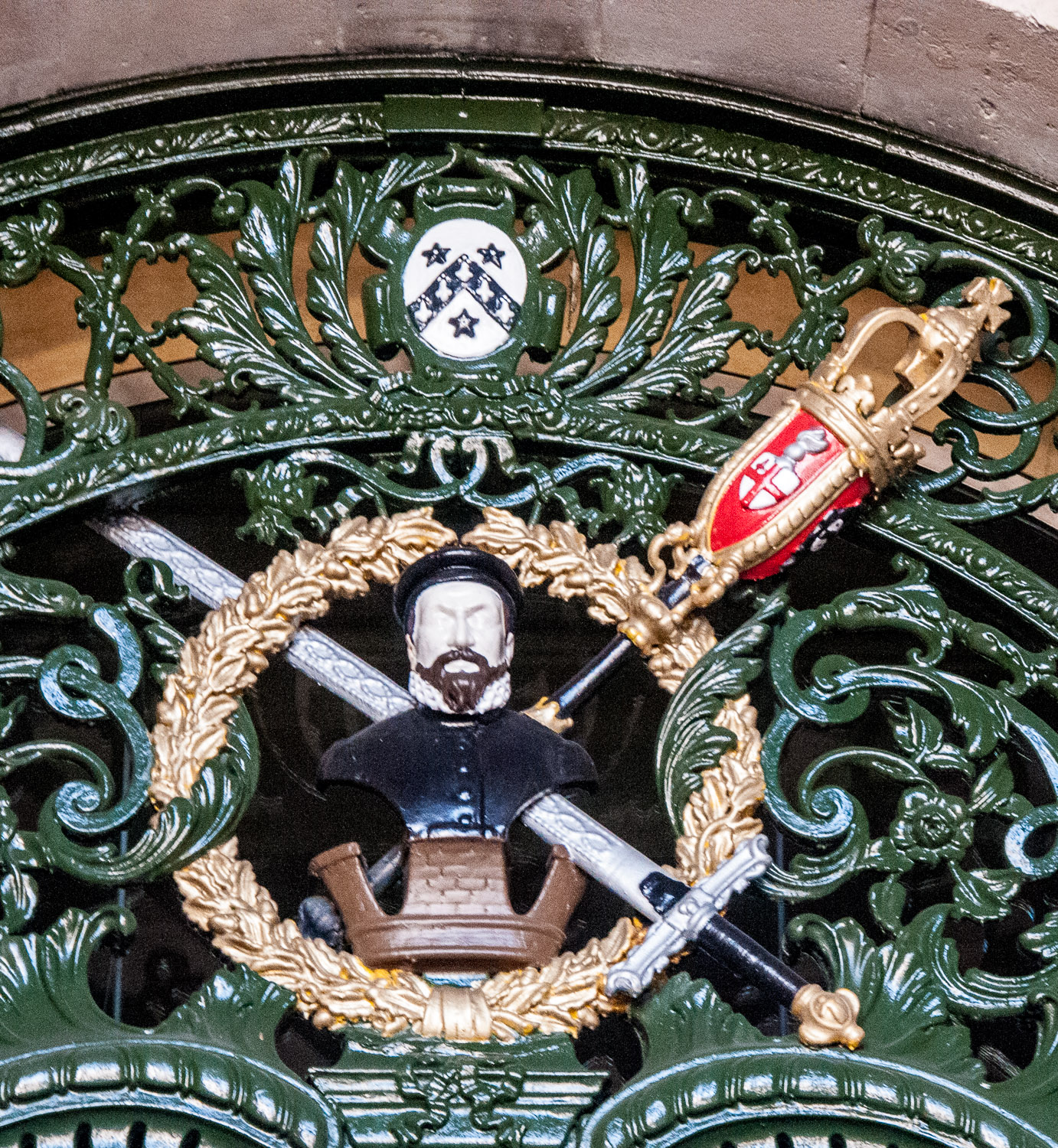
Let’s start with the main gates that face Bank junction …

Best observed when closed, they incorporate an image of the great man himself. Above his head are the arms of Gresham College with the sword and mace representing the City …

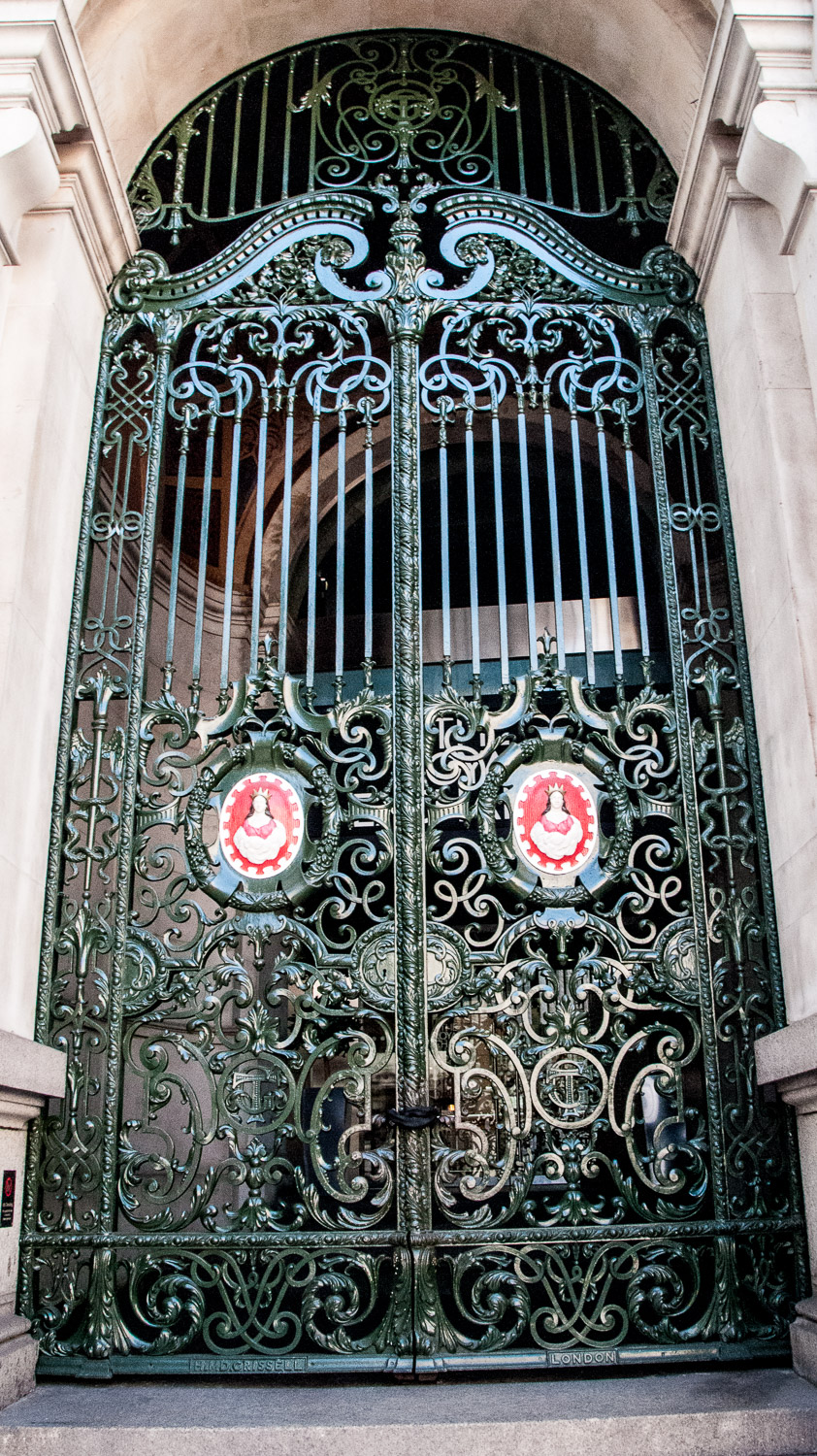
The gates were supplied by the firm of H. and M.D. Grissell whose foundry also produced the railings for Buckingham Palace and the British Museum. Henry Grissell (nicknamed ‘Iron Henry’) was famous not only for the quality of his work but also his attention to detail, evident here in the entrance to the Exchange in Threadneedle Street …
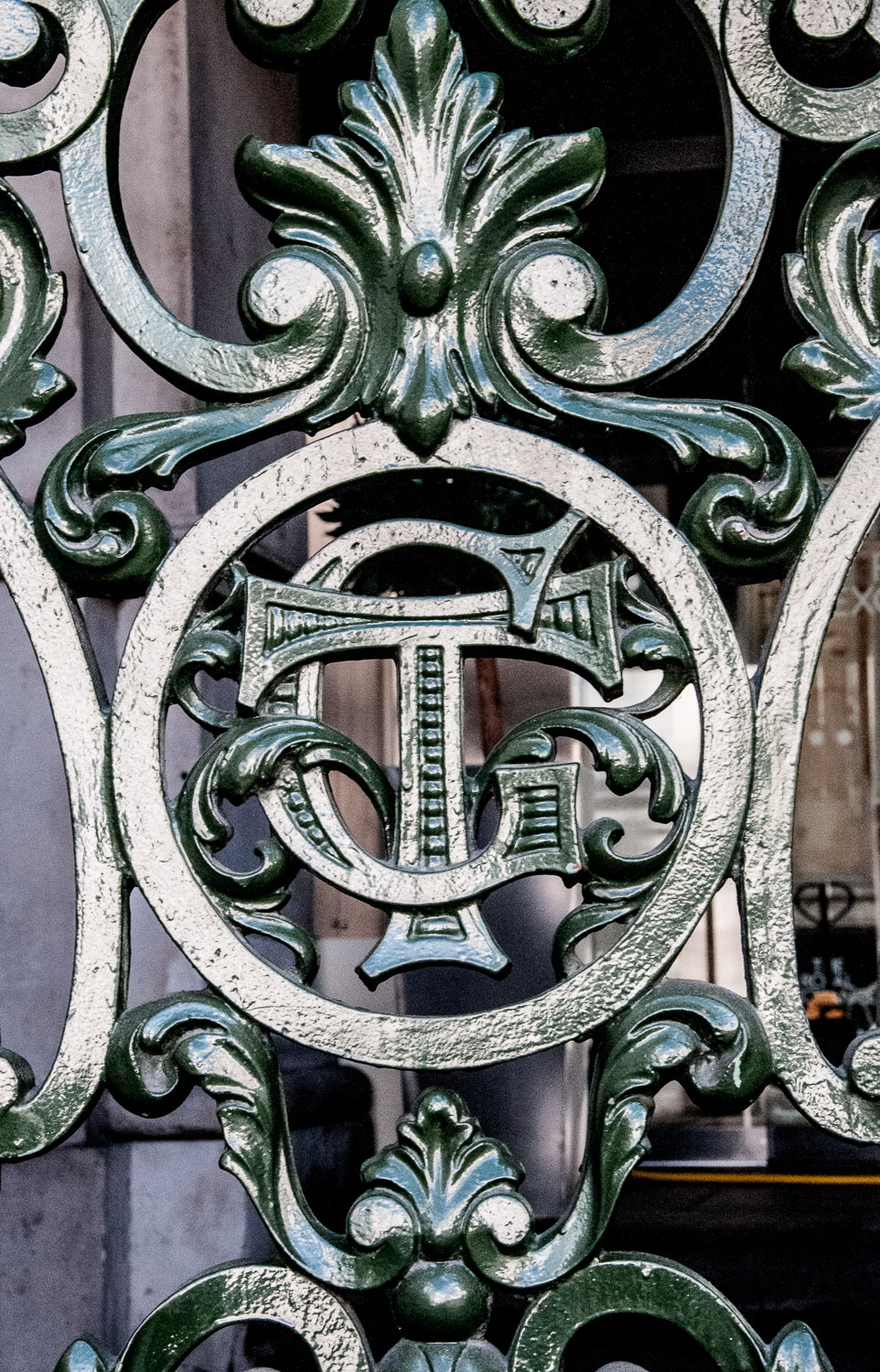
If you look closely you will see that the ironwork incorporates Gresham’s initials:

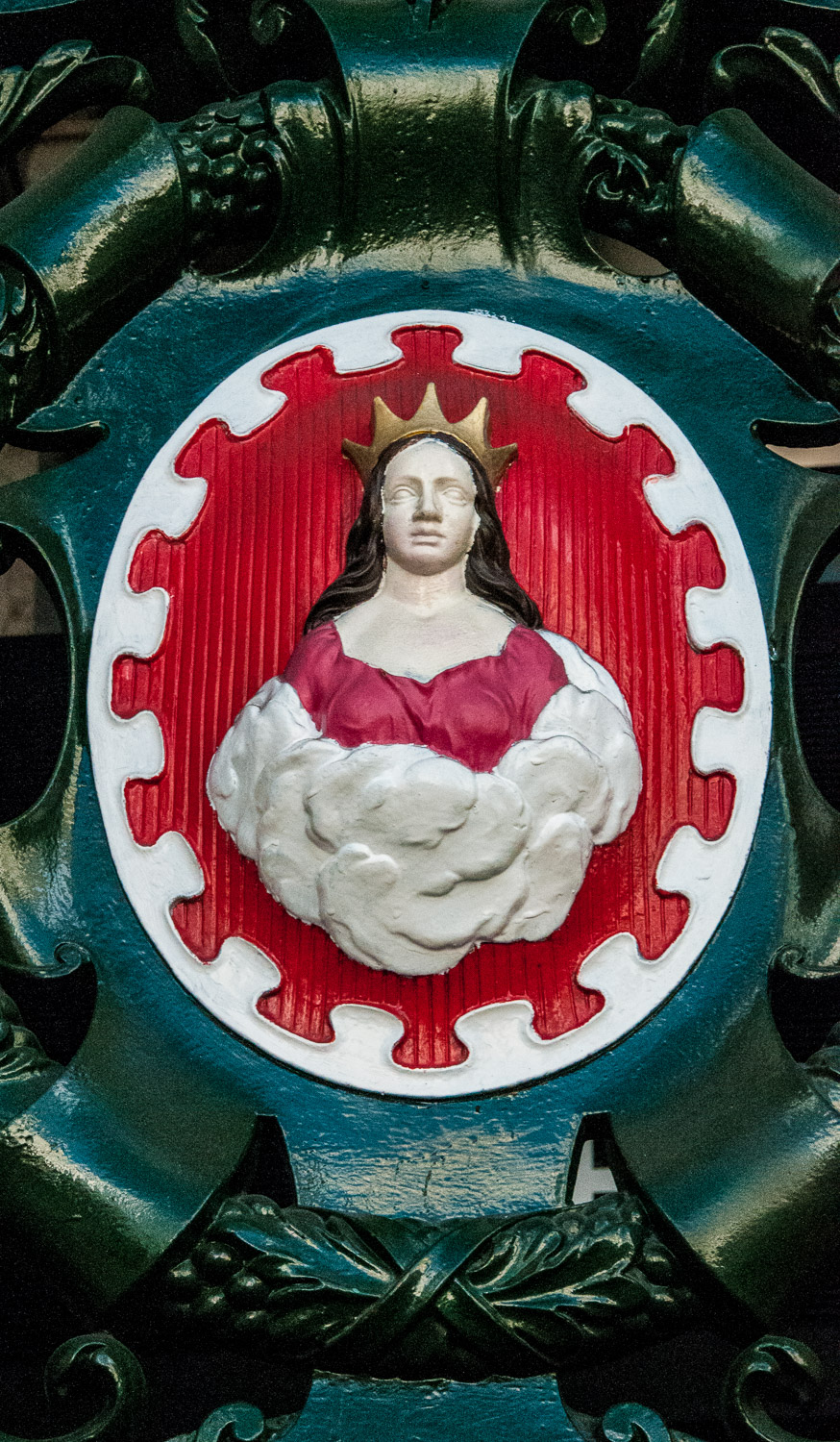
Along with a Mercer Maiden …

I have written about the Maidens in more detail in an earlier blog and their use as a symbol denoting property owned by the Worshipful Company of Mercers of which Gresham was a member. They still own the land on which the Exchange stands.

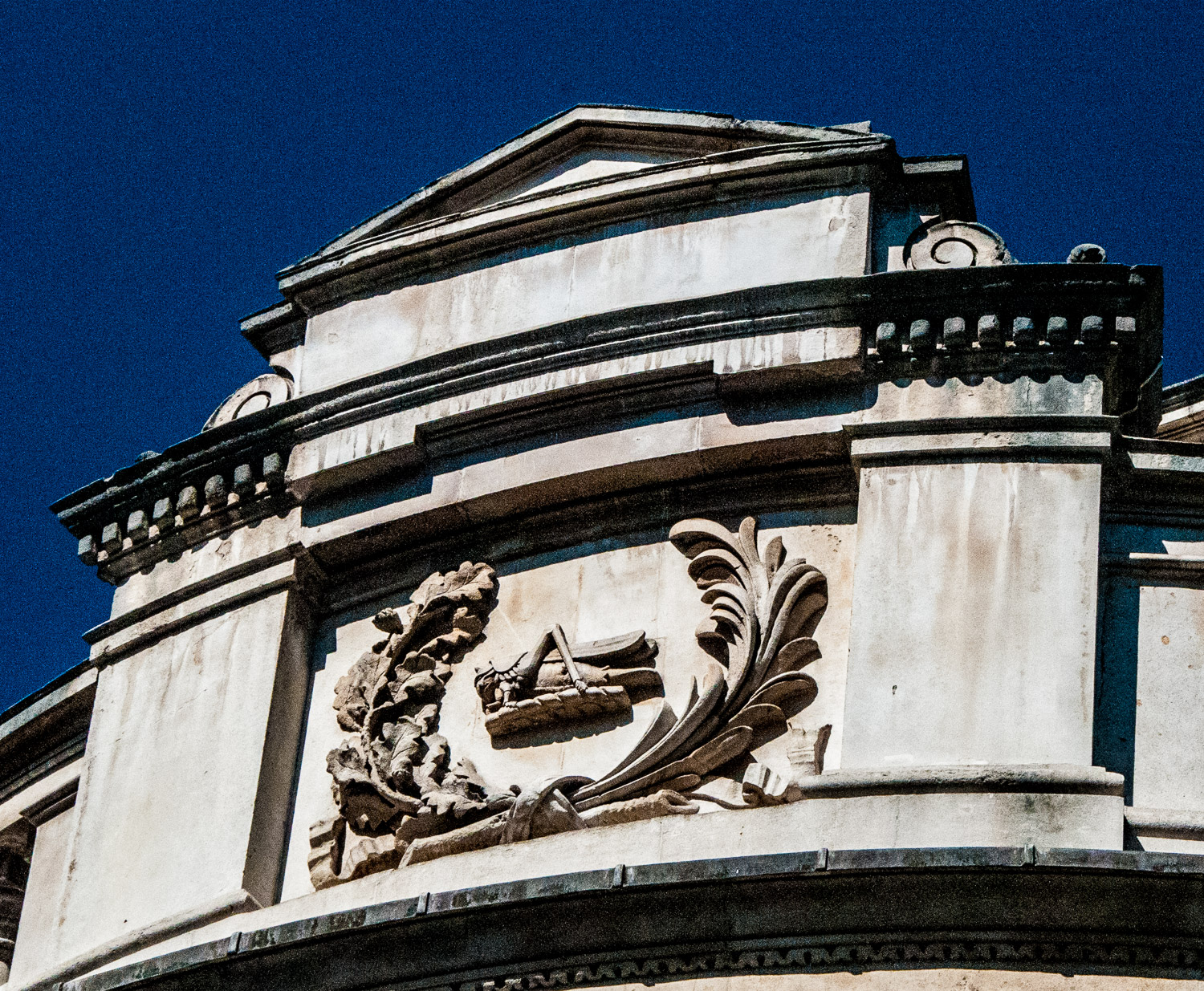
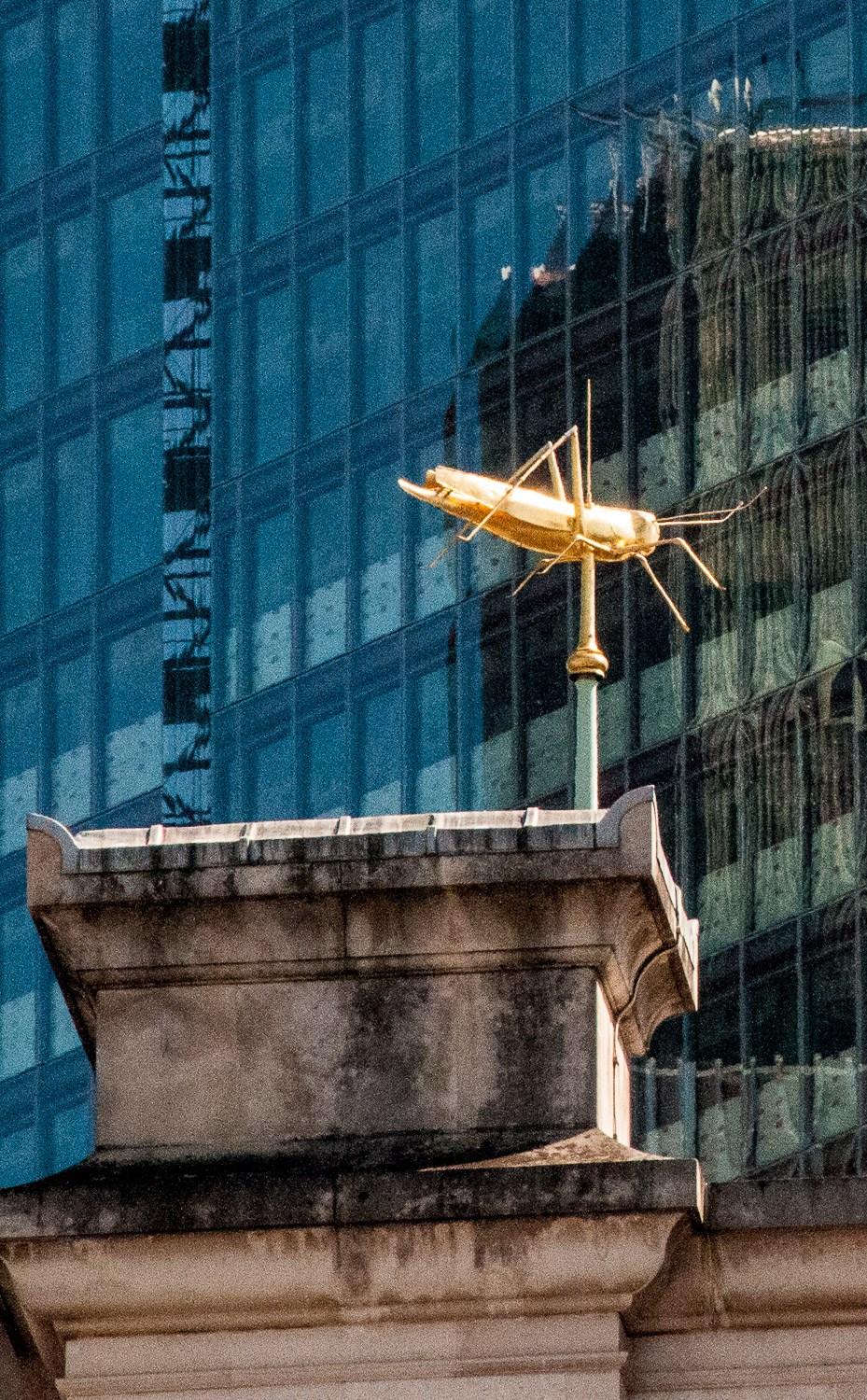
Look up at the Exchange and you will see several grasshoppers, the symbol of the Gresham family …

Facing Threadneedle Street.

And the weathervane on the roof, which was saved from the fire that destroyed the second Exchange in 1838 …

The story goes that one of Thomas’s ancestors, Roger de Gresham, was abandoned as an infant in the marshlands of Norfolk and would have perished had not a passing woman been attracted to the child by a chirruping grasshopper. Heraldic spoilsports assert that it is more likely a ‘canting heraldic crest’ playing on the sound ‘grassh’ and ‘gresh’.

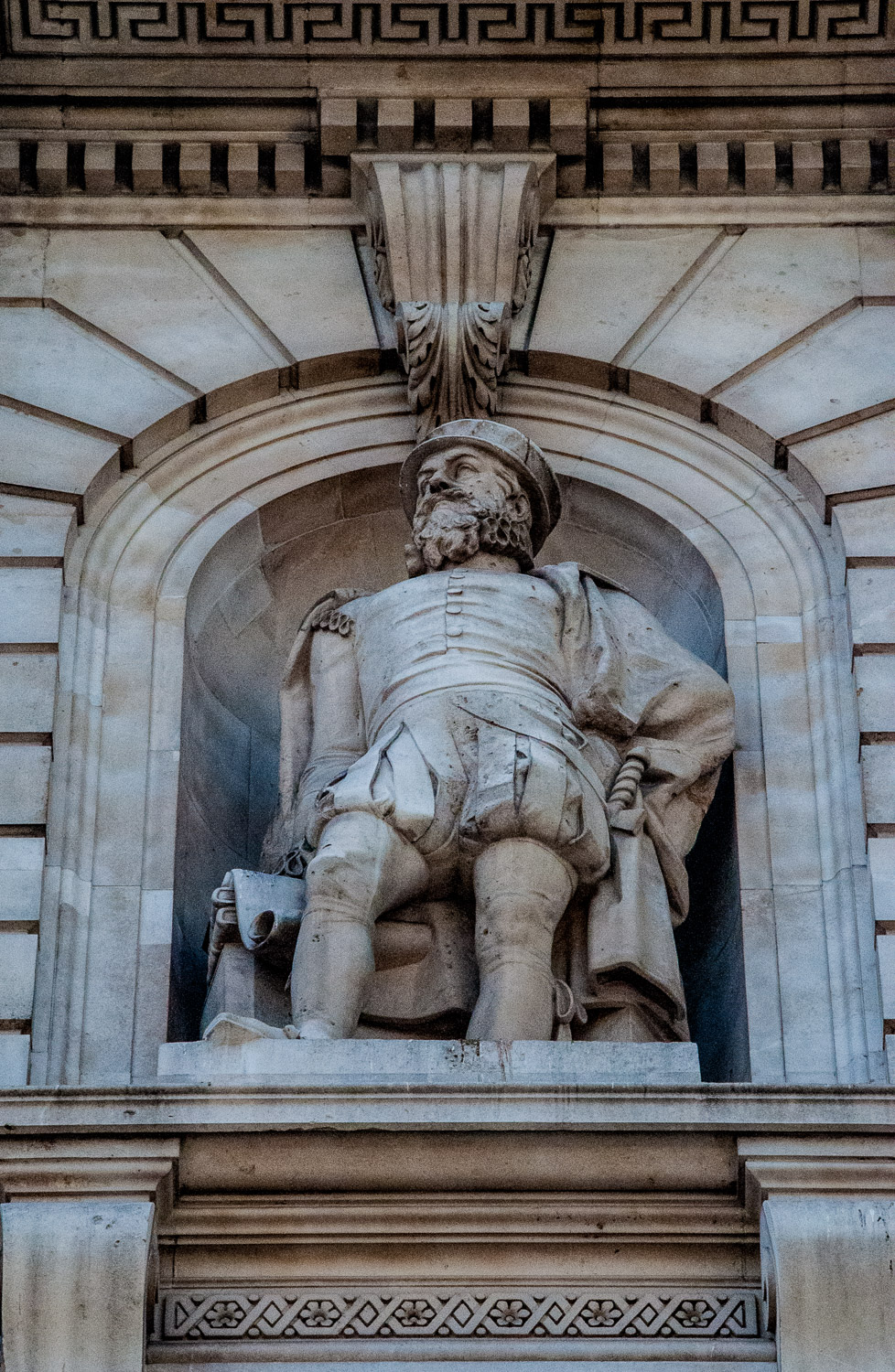
There is, course, also a statue of Gresham himself on the building but it is so high up you can only view it from practically underneath …

The Ornamental Passions’ website tells us the following about the sculptor William Behnes. He was, apparently …

… a half-English Irish-educated artist whose financial profligacy had reduced him to penury. He was declared bankrupt half way through the commission but he successfully completed it and was paid £550 (roughly £50,000 today).

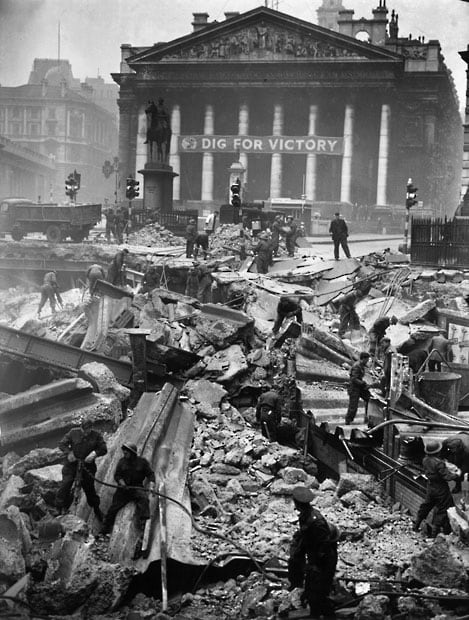
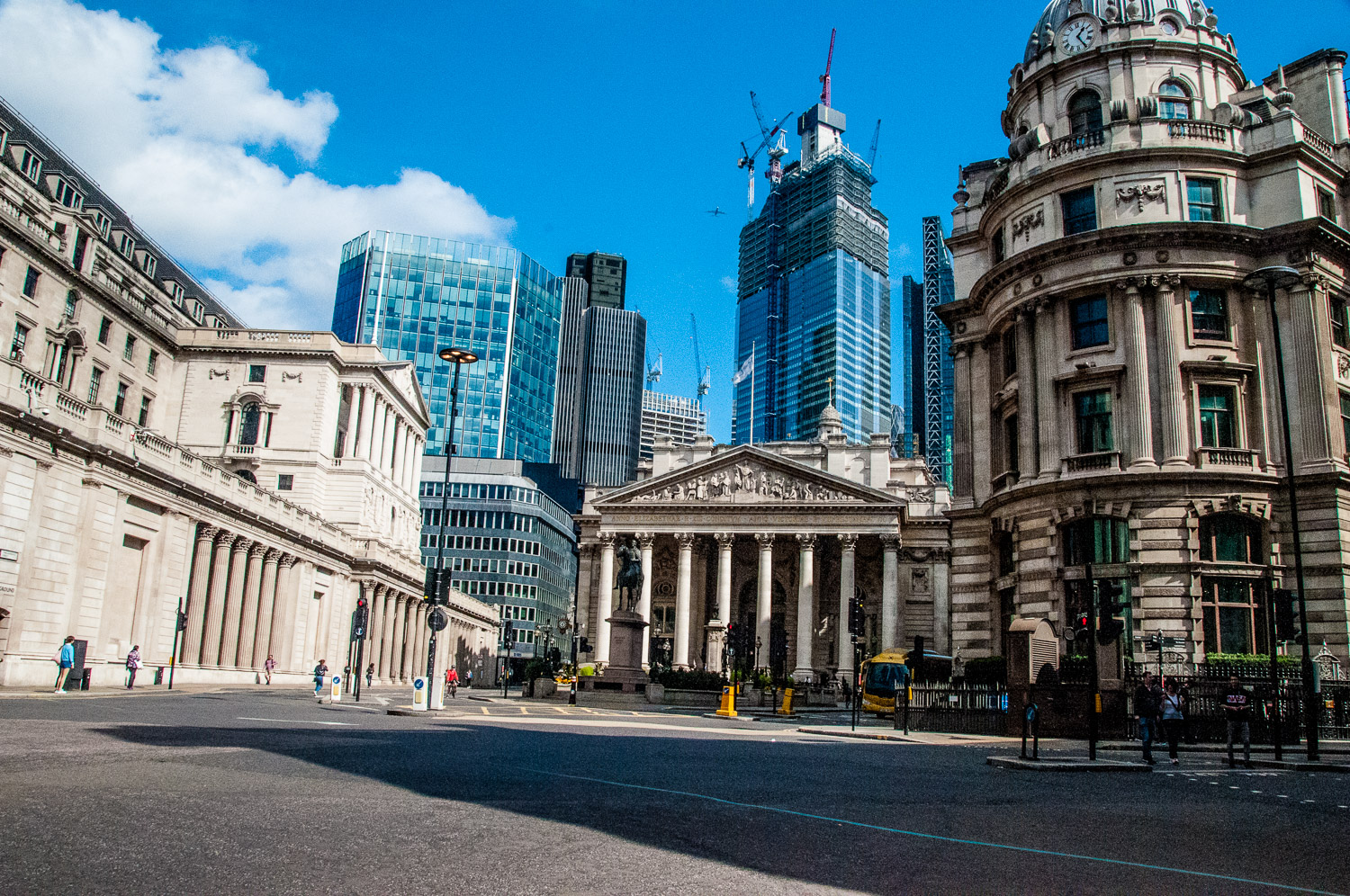
Incidentally, the Exchange was lucky to survive the wartime bombing especially when, on 11 January 1941, a direct hit on Bank Station killed 111 people. These pictures show the aftermath then and the view today …


The view at Bank on a quiet Sunday.


Page 14 of 16

Powered by WordPress & Theme by Anders Norén

Symbols & Secrets
Privacy Overview

This website uses cookies so that we can provide you with the best user experience possible. Cookie information is stored in your browser and performs functions such as recognising you when you return to our website and helping our team to understand which sections of the website you find most interesting and useful.