What better way to start a blog with a poem to make you smile.

Charles Cowper Ross (1929-1985) presented many plays and revues, the best known of which being Toad of Toad Hall (1964 and successive years) …

Who’s Who in the Theatre listed his recreations as squash, golf and starting businesses!

The epitaph on his grave marker shows a man with a great sense of humour (and a realist). He describes himself as ‘A Man of the Theatre’ and there follows this poem …

What will be said
When I am dead
Of what I used to do?
They liked my smile?
I failed with style?
Or, more than likely: “Who?”

Well, Charles, we know who you are now. And quite right too!

Nearby is the grave of an immensely popular performer …

Matilda Alice Victoria Wood (12 February 1870 – 7 October 1922), professionally known as Marie Lloyd, was an English music hall singer, comedian and musical theatre actress. She was best known for her performances of songs such as “The Boy I Love Is Up in the Gallery“, “Don’t Dilly Dally on the Way” and “Oh Mr Porter What Shall I Do“. She received both criticism and praise for her use of innuendo and double entendre during her performances.

My favourite example is when complaints were made about her song She sits among the cabbages and peas she changed the lyrics to She sits among the cabbages and leeks.

The image usually used in articles about her …

On stage in the 1890s …

By 1891 Lloyd was a household name, pulling in large crowds at halls across Britain, and starring in the Theatre Royal at Drury Lane’s Christmas pantomimes alongside stars such as Dan Leno. As her star continued to rise, her agent reported that Lloyd was fully booked up for years at the best houses across the UK, and that her salary ran from £250-£300 a week, sometimes as much as £700 a week at the height of her career. 

Despite her successes, Lloyd had a troubled personal life. She was married three times, and experienced domestic abuse during two of them. She married Percy Charles Courtenay in 1887, but the marriage was unhappy, and filled with violence, drunkenness and jealousy. The couple divorced in 1894, after Courtenay discovered that Lloyd had started an affair with fellow performer Alec Hurley. Hurley and Lloyd married in 1906, however the pair were effectively separated by 1910 after they had consistent marital problems. Lloyd began an open and passionate affair with Bernard Dillon, a jockey. Hurley initiated divorce proceedings in 1911. Sadly the relationship between Lloyd and Dillon was not a happy one, marred by Dillon’s jealousy, heavy drinking, and gambling addiction. Despite this they married in 1914. He was violent and abusive throughout the rest of Lloyd’s life.

In the later years of her life, Lloyd was in financial trouble (in part due to Dillon’s gambling debts) and needed to work in order to get by. Her drinking and ill health made her less and less reliable, sometimes only performing for a fraction of the time that she was scheduled. She began to forget her lines and would sometimes stumble on the stage, so much so that stagehands would be asked to be on call to help her if she became unsteady. In order to save money, in early 1922 she moved in with her sister Daisy, and by the time of her death Lloyd was virtually penniless. She died at her residence in Golders Green, 7th October 1922 at the age of 52.

Lloyd’s funeral was held at Hampstead Cemetery on 12 October, 1922. More than 50,000 people turned out on the streets of Hampstead to watch her funeral cortège. It was estimated that 120,000 people visited her grave in the following weeks, with queues stretching out from the cemetery gates.

Many newspapers and fellow performers paid tribute to Lloyd in the days after her death. T.S. Eliot wrote a moving tribute to her in The Criterion of January 1923. He said of Lloyd…

“Marie Lloyd was the greatest music hall artist in England: she was also the most popular… It is evidence of the extent to which she represented and expressed that part of the English nation which has perhaps the greatest vitality and interest… Whereas other comedians amuse their audiences as much and sometimes more than Marie Lloyd, no other comedian succeeded so well in giving expression to the life of that audience, in raising it to kind of art.” 

Sadly, the inscription on her tomb is now almost illegible, but reads:

IN LOVING MEMORY OF OUR DARLING SISTER
MARIE LLOYD
BORN FEB. 12th 1870
DIED OCT. 7th 1922
DAUGHTER OF JOHN AND MATILDA WOOD

TIRED SHE WAS, AND SHE WOULDN’T SHOW IT.
SUFFERING SHE WAS, AND HOPED WE DIDN’T KNOW IT.
BUT HE WHO LOVED HER KNEW, AND, UNDERSTANDING ALL,
PRESCRIBED LONG REST, AND GAVE THE FINAL CALL.

I expected to see some eminent people in this cemetery but wasn’t expecting a three-time Prime Minister of Australia. This is the tomb of Andrew Fisher (1862-1928) …

He was the fifth Prime Minister of Australia and one of the most important early leaders of the Australian Labor Party. Born in Crosshouse, Scotland, Fisher began working in coal mines when he was only ten years old. He later became involved in trade union activities before migrating to Queensland, Australia, in 1885. There he became a prominent miners’ leader and entered politics.

He was elected to the Queensland Parliament in 1893 and later became a member of the first Australian Federal Parliament in 1901, representing Wide Bay in Queensland. He became leader of the Labor Party in 1907 and served as Prime Minister three times: from 1908–1909, 1910–1913, and 1914–1915.

Fisher’s second period as Prime Minister was particularly important. His government introduced many reforms and passed more than 100 pieces of legislation. It established the Commonwealth Bank, introduced maternity allowances, improved pensions, and provided workers’ compensation for Commonwealth employees. His government also helped develop Australia’s defence forces, transport system and federal administration. Fisher strongly supported the development of Canberra as Australia’s national capital.

The Parliament House portrait of Fisher by E. Phillips Fox, 1913 …

Fisher became Prime Minister for the third time in 1914, shortly after the outbreak of the First World War.

His government organised Australia’s early military contribution to the war, including sending Australian troops overseas. However, the pressures of wartime leadership affected his health, and he resigned as Prime Minister in October 1915.

After leaving politics, he became Australia’s High Commissioner in London …

He died in London on 22 October 1928, aged 66.

If a Prime Minister was a surprise, so was finding the tomb of the grandson of Tsar Nicholas I of Russia, Grand Duke Michael Mikhailovich, and his wife Sophy, Countess de Torby …

Also surprising was its very plain design.

He was raised in the Caucasus, where he lived between 1862 and 1881 with his family, was educated by private tutors and, as Romanov tradition demanded, he follow a military career.

Grand Duke Michael (on the right) with his eldest brother Nicholas, Baden, 1876 …

He served in the Russo-Turkish War in 1877, became a Colonel and was adjutant at the Imperial court. In 1891 he contracted a morganatic marriage with Countess Sophie von Merenberg, a morganatic daughter of Prince Nicholas William of Nassau and a granddaughter of the Russian poet Alexander Pushkin. His punishment was severe. For contracting this marriage without permission, Emperor Alexander III of Russia stripped him of his military titles and banished the couple from the Russian Empire.

For some years he lived in Wiesbaden, Nassau and in Cannes (as you do) before settling permanently in England in 1900, leasing Keele Hall in Staffordshire.

Grand Duke Michael and family on the steps of Keele Hall …

This image of Michael and his children, also at Keele, is taken from The Good Grave Guide to Hampstead Cemetery, so it’s a photo of a photo and not very clear, but it’s such a wonderful pose I had to include it …

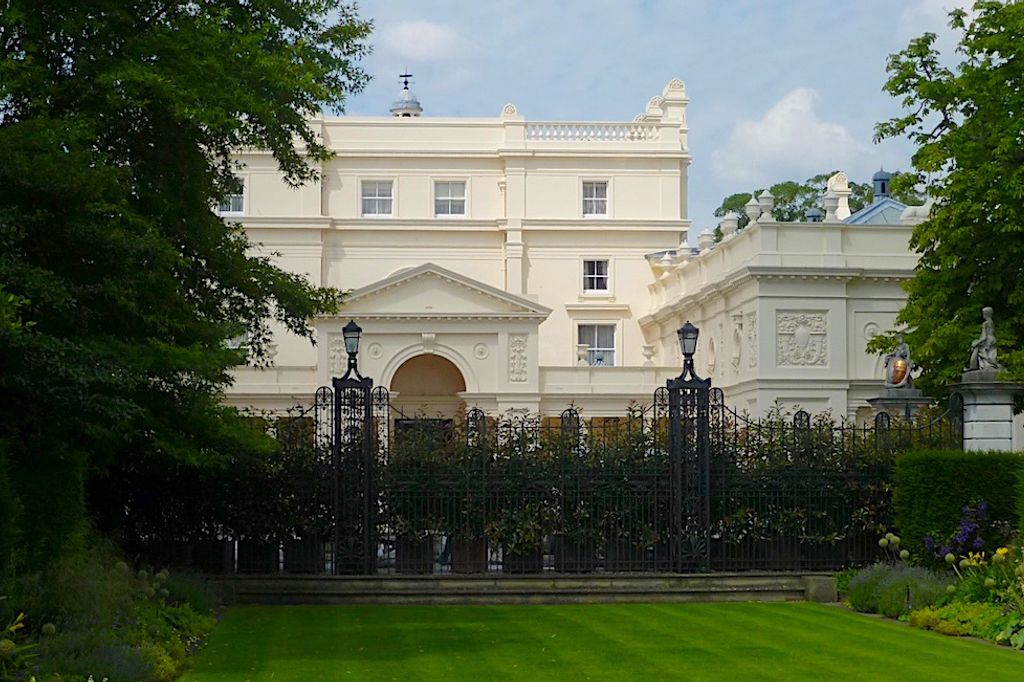
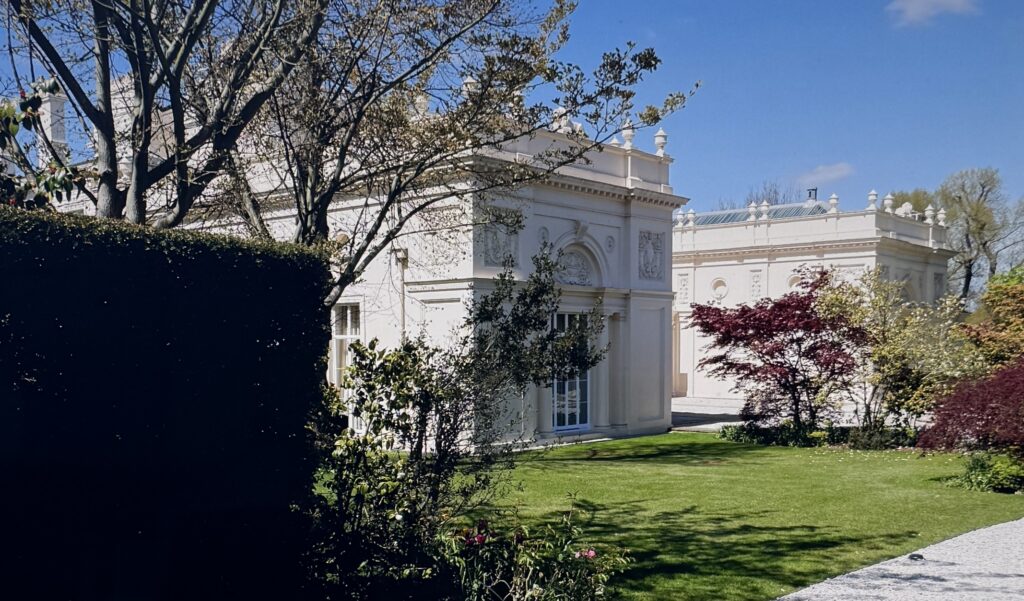
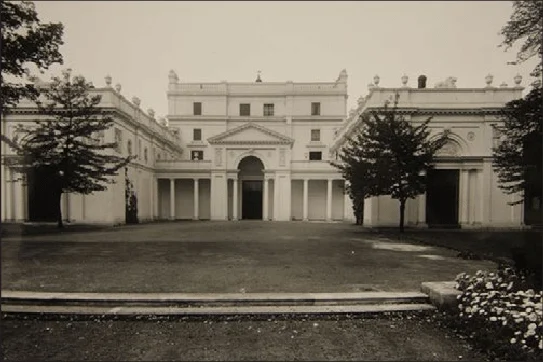
After leaving Keele, they rented Kenwood House from the Earl of Mansfield from 1910 to 1917 at an annual rent of £2,200 (about £210,000 in today’s money) and shared the property with their three children Nadeja (Nada), Anastasia (Zia) and Michael, plus numerous dogs. The Grand Duke in 1910 …

They carried out extensive renovations to Kenwood, including electric lights along the drive, and entertained lavishly. One such dinner and ball was reported by the Ham & High newspaper just before the outbreak of War, where it was noted that the drives and grounds were brilliantly illuminated and the rooms – already luxuriously furnished – were filled with plants and flowers whilst a Viennese orchestra played in the Orangery. Supper was served in a marquee hung with pink and green draperies outlined with gold
mouldings on the South Terrace, overlooking the lake.

A similar event held in 1914 was attended by the King and Queen, who came again two years later to attend the wedding of Nada to Prince George of Battenberg (later Mountbatten), the Marquis of Milford Haven.

A year later Kenwood hosted another glittering gathering, when Zia married Major Harold Wernher, who inherited Luton Hoo in Bedfordshire …

Michael and his wife were well known for their philanthropy. In 1913 he donated a motor ambulance to Hampstead Hospital, and in 1914 he started a movement to supply the troops at the front with warm gloves. A year later he allowed Kenwood to be used as the barracks for the newly established Royal Naval Anti Aircraft Brigade, organised by the Admiralty.

The Grand Duke and the Countess at home …

A keen sportsman, he built a golf course and cricket pitch in the grounds and also opened a high diving board at Highgate Ponds in the hope that it could be used to train Olympic divers. However, the only evidence that remains of his residence a Kenwood are the headstones of two of the family dogs, Bill and Mac.

The Russian Revolution in 1917 took a heavy toll on the family’s fortunes. Their income had been derived from the Borjomi mineral water plant on the family estates in Georgia, which after modernisation was producing a third of a million bottles a year by 1913. Following the confiscation of the estates by the Bolsheviks, the Grand Duke was left virtually penniless and had to rely on the charity of his wealthy son-in-law. The family was obliged to leave Kenwood in 1917 and move to a (comparatively) modest house at Cambridge
Gate, Regent’s Park.

The loss of many relatives – three of his brothers were murdered by the Bolsheviks – and his straitened circumstances appeared to take their toll on the Grand Duke’s spirits and he is reported to have become troublesome and short-tempered with his wife and with servants. In September 1927, his wife died aged fifty-nine. King George V wrote a letter of condolence and the
Prince of Wales attended the funeral. The Grand Duke survived her by less than two years and died of influenza in 1929.

Another image of the Grand Duke with all his children including their only son Count Michael …

Michael was subject to bouts of depression but found some success as a painter mostly of still lifes and luxuriant garden landscapes, a far cry from the developing avant-garde movements of the family’s native Russia. He was also active as a theatrical and fashion designer. He died unmarried in Roehampton in 1959 and was buried beside his parents.

Resting near to one another are members of the Forte family …

Famous as hoteliers and restaurateurs, they originally came from Montforte, a hilltop village in Italy. Rocco Forte married Maria Luigia in 1908 and in 1911 he emigrated to Scotland, opening a café in Alloa. His wife and son Charles followed two years later. Charles subsequently returned to school in Italy, but decided he wanted to follow his father’s business. He studied book-keeping, started a café in Weston-super-Mare and opened his first London premises, a ‘Milk Bar’ in Upper Regent Street in 1935. The successful business expanded to include the Café Royal and the Waldorf Hotel, and became Trusthouse Forte, a worldwide catering empire.

Charles was knighted in 1970 and became Baron Forte of Ripley in Surrey in 1982. He died aged 98 on 28 February 2007.

Charles Forte in 1977 …

What about this Grade II listed monument? The Hampstead Cemetery Good Grave Guide describes it as ‘a stone figure of a woman in flowing robes balancing on a globe reaching up to touch a flower-filled urn on a column. Symbolically the pose indicates a rejection of worldly pleasures’ … …

And an intriguing inscription …

A short notice in the Daily Mail of 24 August 1928 gives a few more details …

Here is a report from the New York Time of 25 August 1928 headed :

‘ARDATH DE SALES, DANCER, DIES AT SEA; Seattle Girl Was on Her Way to London to See Her Sister Appear in a New Revue.

LONDON, Aug. 24 (P).—Ardath De Sales, American actress from Seattle on her way from New York to England to see her sister, Miss Adrienne Ash, take part in the first performance tomorrow night of a new revue, died today on the steamer Homeric. Death followed an operation for appendicitis.

Miss De Sales was an accomplished toe dancer, and she had appeared with Pavlova at the Metropolitan Opera in New York. Here in London she was known for her work in “Mercenary Mary” and in “Princess Charming.”

She was apparently in excellent health when she boarded the liner in New York last Saturday, but was taken ill the following evening. Her sister was in the midst of a rehearsal when news of the death was telephoned to her.’

Some of the online images of Miss De Sales …

Unfortunately, I have not been able to discover who commissioned and paid for her beautiful monument.

I paused at the war memorial to both World Wars and the individual graves beyond …

So many young lives lost …

I am sure readers will have noticed by now that Hampstead Cemetery offers almost endless opportunities for blogging, but I have reminded myself that am supposed to be concentrating on the City of London! So that’s what I shall try and do next week.

If you want to explore Hampstead Cemetery yourself I cannot recommend more highly the Good Grave Guide …

It is packed with information about the residents along with great maps based on aerial photographs …

You can buy it here from the Camden History Society.

Finally, I’ll leave you with a selection of Hampstead angels …

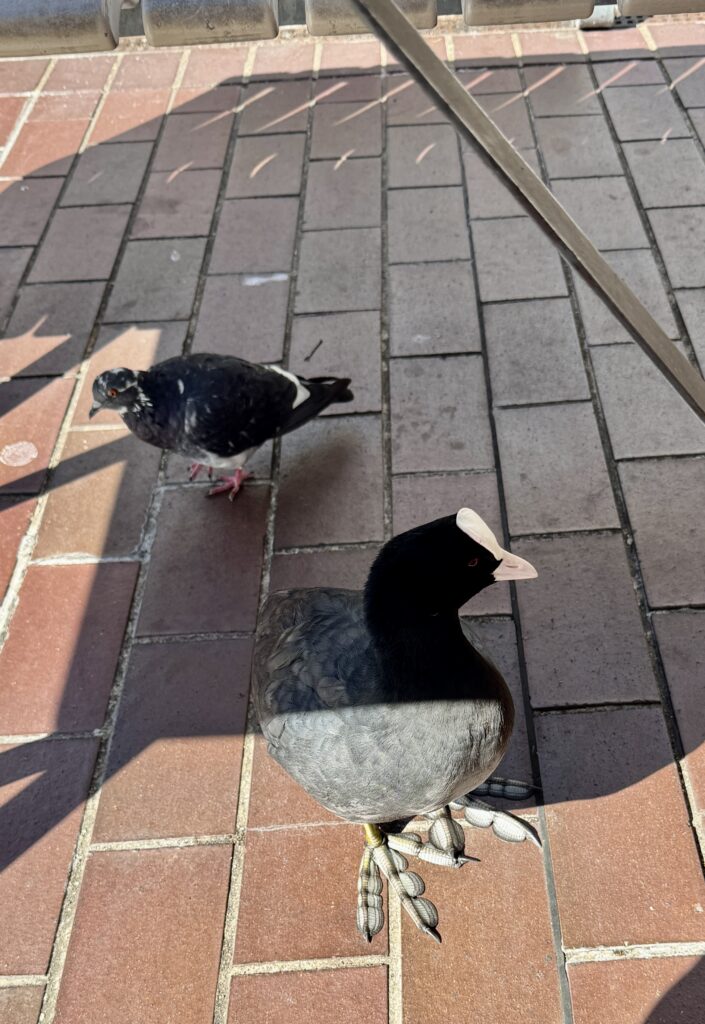
In other news, Barbican denizens.

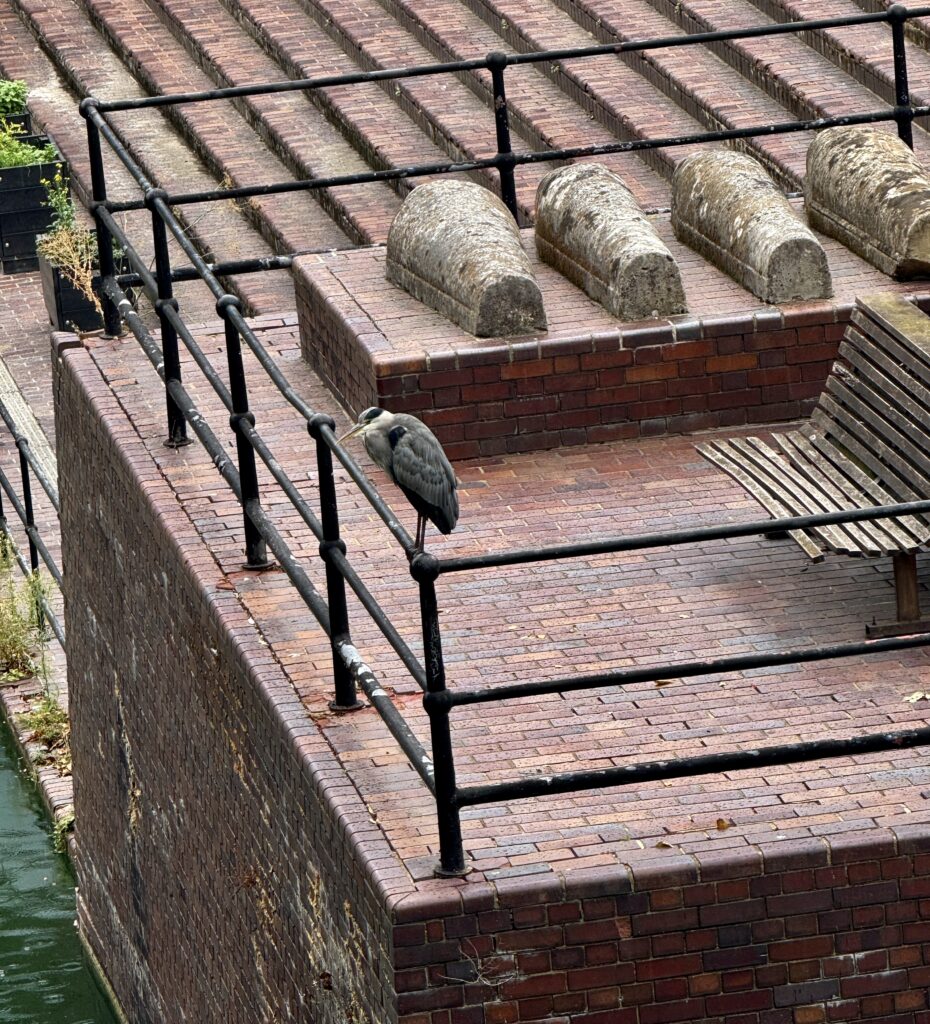
Loitering with intent …

Watching the world go by …

He actually climbed into the bin but was out before I could photograph him inside …

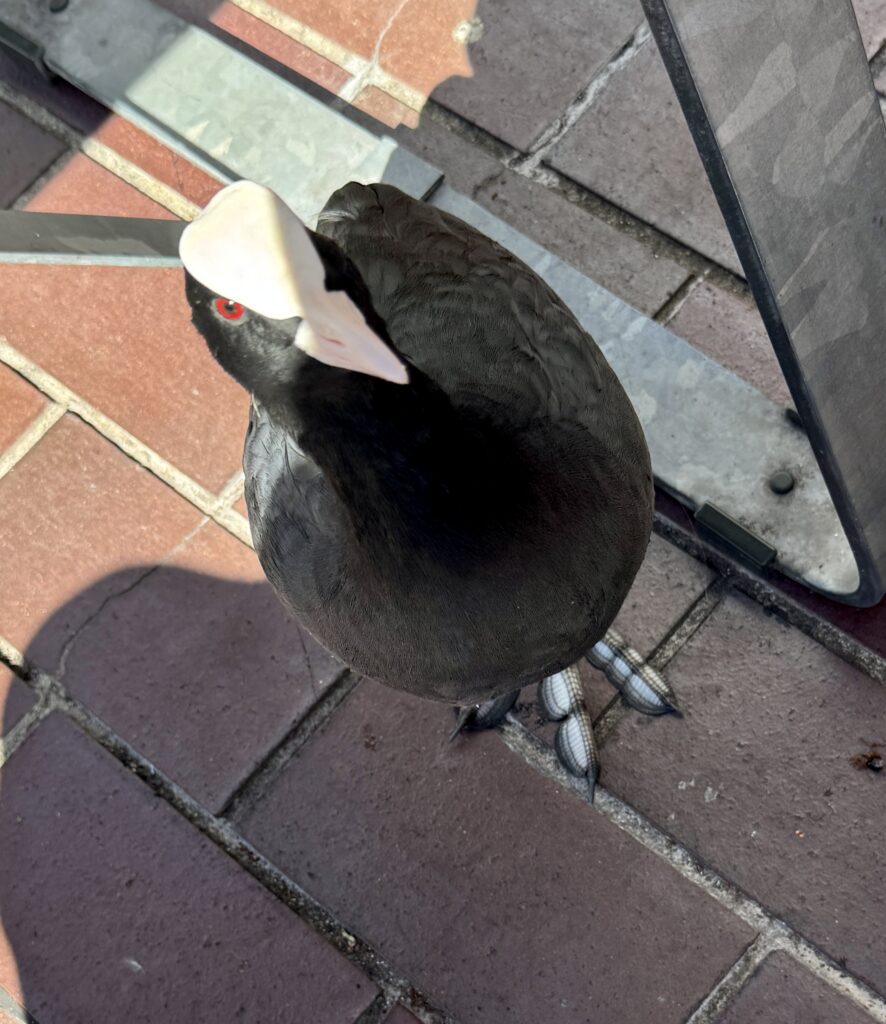
Something I didn’t know before, coots actually eat the reeds on the lake (or appear to) …

Algae is definitely more accessible …

But you have to share space with the ducks …

And now City of London denizens, a gathering outside Guildhall with many robes in evidence …

If you would like to follow me on Instagram here is the link …
https://www.instagram.com/london_city_gent