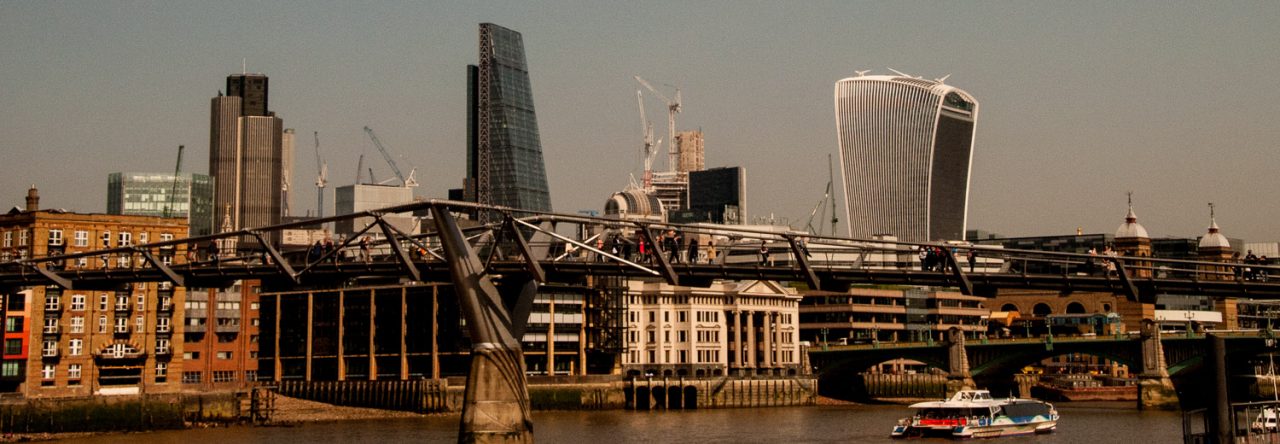
I always enjoy a visit to this museum since an extra special treat is ‘driving’ the Docklands Light Railway train all the way to Canary Wharf …

Plus, near the museum, there are often glimpses of Thames wildlife, in this case cute young swans and their mum taking a nap …

The foreshore of the Thames is an internationally important archaeological site. Millions of prople have lived in and passed through London, leaving traces of their lives in the river mud. The mud is anaerobic (oxygen-free) and therefrore preserves objects in excellent condition. The exhibition showcases over 350 mudlarked objects, including personal items and historical relics, and explores the history of mudlarking from its origins as a means of survival to its modern-day practice as a hobby and form of historical exploration.
So I knew a visit would give me something to really get my teeth into …
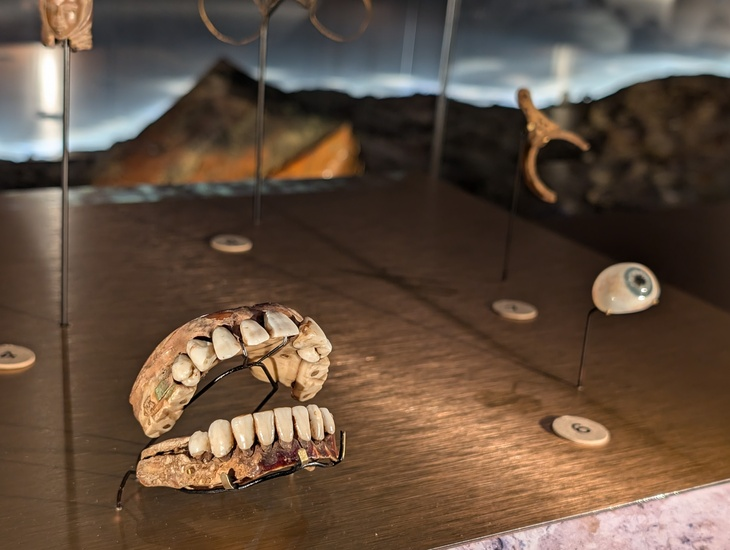
Apologies for that!
The gnashers illustrated above date from the 1700s and are made from real human teeth, probably collected from the dead. A goldsmith or watchmaker would have set them into ivory plates, held in place with gold pins. They were bespoke, made to fit a wealthy client’s mouth. And imagine what it must have been like to see the false eye on the right peering up at you out of the mud.
Here are some further examples of what is on show.
The early accounts of mudlarks describe them as mostly children aged 8 to 15, older women and sometimes also men. They lived in poverty and scavenged to earn whatever money they could. In 1851 Henry Mayhew, a journalist and author, wrote three books on London’s poor. This is an illustration of a mudlark he met who used his hat to carry his finds …

Peggy Jones, the ‘Well known Mud Lark’, is illustrated here in a book published in 1805. Aged around 40 with red hair, she dressed in short, ragged petticoats and went barefoot. She wore a strong apron folded like a bag around her …

Peggy would wade waist-deep into the water and use her feet to feel for lumps of coal to collect in her apron. She disappeared without a trace around February 1805. You can read more about her and her sad life here.
Large scale works in the 1800s to construct river walls and bridges, alongside dredging of the Thames, led to remarkable discoveries. This is a modern replica of the head of a statue of Hadian, 117-138 CE …

The Waterloo Helmet is from the Iron Age, 150-50 BCE. It was discovered by workers dredging the Thames near Waterloo Bridge …

It is the only Iron Age helmet found in southern England, and the only one with horns ever found in Europe. It is made from bronze with a scrolling decoration and red enamel around the cap. When new, the bronze would have shone like the Sun, clearly telling everone nearby about the status of the person wearing it.
The Battersea Shield (Iron Age again) was found by a labourer at Battersea in 1857 …

It was made more than 2,000 years ago by many different craft specialists in Britain. Originally strenthened with wood, it protected from weapon blows and could also be used to push back, choke or bruise.
Onward to the 800s when the Vikings battled the Saxons to seize their wealth, enslave their people, control resources and access river routes.
This Viking battle axe has a distinctive shape with a curving blade. A number have been found in the river …

This tiny silver pendant was worn around a Viking neck. It is a mini version of Thor’s hammer. Thor was the god of war and fertility. He could control thunder and lightning, had unparalleled physical strength and owned a magical hammer called Mjolnir …

For centuries ship’s orders were communicated using a boatswain’s whistle. This example is decorated with a lion …

The boatswain, a senior crewman, could communicate a lot of information by varying the pitch and length of the notes. The tone could be heard across the ship over the sound of wind and waves.
The three tiny shoes were lost hundreds of years apart, one perhaps kicked off by a Victorian baby (17). The other two (18) were possibly lost by chilren on the foreshore in the 1400s and 1500s. The miniature pair from a badge (19) shows the 1300s trend for extremely long pointed toes, while the gentlemen’s shoe (20) from the 1600s is heeled and decorated with hearts and crescent moons …

“Am I not a man?’ – 1787-1830. By the 1800s an increasing number of voices campaigned against the British trade in enslaved Africans. Campaign imagery was placed onto many products including sugar pots and tobacco pipes to make consumers more aware of the enslaved lives that were feeding their habit.

This tobacco pipe shows an enslaved African. It copied a medallion with the inscription ‘Am I not a man and brother?’ produced by Josiah Wedgwood for the Society for the Abolition of Slavery in 1787.
These lead badges were worn on hats and coats and carried rude hidden messages (1300-1500) …

The badge in the middle portrays a purse with a phallus tucked inside. Purses were a symbol of good fortune and a metaphor for a vagina. Cockerel badges, like the one on the left, were worn by young male Londoners to advertise their virility, the cock being recognised as a symbol for lust. The badge shaped like a hair comb is decorated with dancing phalluses.
More sinister is this ball and chain (1600s-1700s) …

Ball and chains, also known as leg irons, were used in England from the late 1600s on some people convicted of a criminal offence. The weight of the ball and the long spike on the lock hindered movement and helped prevent escape.
Pottery abounds …


There is also a tribute to two enterprising mudlarks, Willam Smith and Charlie Eaton, known fondly as Billy and Charlie, who were forgers of small artifacts who did their sneaky work between the years of 1845 and 1870. You can read more about these two scoundrels here and see some of their work displayed in the exhibition …

The Visit London blog review concludes: Just when you think you’ve seen it all, the exhibition hits you with a showstopper – a glowing, giant moon suspended in the dark, echoing the glow that once guided night-foraging mudlarks. Luke Jerram’s Museum of the Moon closes the exhibition on a breathtaking finale. I was completely struck by its scale, bathed in a celestial light that quietly reminds us of the moon’s vital role in a mudlark’s life.
And here it is …

Mudlarking is strictly regulated by the Port of London Authority (PLA), which issues permits to would-be treasure hunters. With interest soaring, the PLA has paused new licence applications – over 10,000 people are currently on the waiting list.
I am very fortunate in that my very good friend Penny is one of the few who possess a licence and she kindly shared some of her treasured finds with me this week. At some point in the future I will write about them in more detail …

The item of pottery on the top right retained the finger impressions of the person who created it centuries ago. Holding it sent a shiver down my spine.
You can read more about the London Museum Docklands here.
If you would like to follow me on Instagram here is the link …