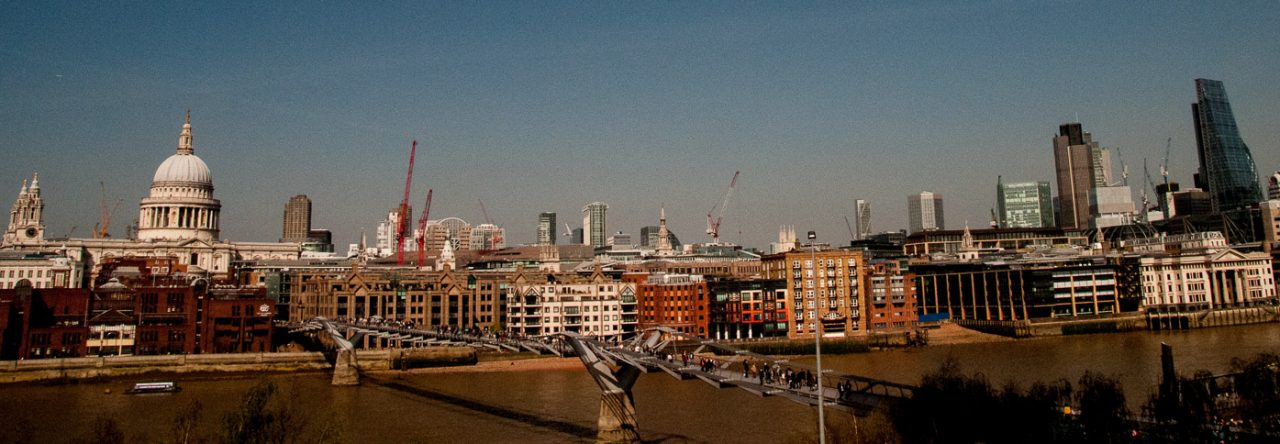
Lately I’ve become fascinated with the Barbican area at dusk and have been wandering around catching images on my smartphone.
See what you think of them.
This made me think of a giant cruise ship …
Watch out tonight for Vibrance at Salters’ Garden. I watched them setting up yesterday evening and the experience will also include the old church tower of St Elsyng Spital on London Wall. Lights at a rehearsal yesterday evening …
Some illuminations being tested in Salters’ Garden …
If you would like to follow me on Instagram here is the link …
I often visit the Gallery since it is nearby and always cheers me up! When I write about it I usually cover the splendid art on display but today I’m going to concentrate on the sculptures.
Outside there are four monumental busts of men from London’s history …
Carved from Portland stone, the same material as the Gallery itself, the busts depict Samuel Pepys, Oliver Cromwell, William Shakespeare and Christopher Wren at one and a half times life size. They were created by Tim Crawley in 1998, in time for the Guildhall Art Gallery’s opening in 1999.
There is also a full size sculpture of Dick Whittington …
Just as in the legend, he stands on Highgate Hill pondering whether to return to London having heard the bells of St Mary-le-Bow ring out ‘Turn, turn, turn again Whittington, thrice Mayor of London’.
He is, of course, accompanied by his loyal cat …
But if you look at rear of the carving there is a more sinister figure, a rather unpleasant rat ..
Born in 1955, Tim Crawley went to Manchester University, where he studied Art History, specialising in medieval architecture and graduating in 1977. After further studies at the City & Guilds of London Art School and a number of freelance jobs as a stone carver, his career came to a crossroads in the mid 1980s. Presumably concerned that stone carving would not provide a suitable long term career, he secured a place on a teacher training course. However, stone carving had other ideas for him.
He says on his website, “Just before I was due to start [teacher training] the offer came to carve this exquisite little bestial frieze for an Edwardian mansion in Henley.” The work entailed restoration work to Edwardian Gothic stone carvings at a country house called Friar Park. This happened to be the Henley home of George Harrison.
Crawley would not have been able to perform the commission and also take up his place at teacher training college. Unable to resist the offer, he cancelled his place and did the work for the former Beatle in 1986. Among the many things for which the world should be grateful to The Beatles are the stone carvings of Tim Crawley.
One of my favourites inside the building is this head of the actor and comedian Terry Thomas (1911-1990). The sculptor, Ronald Moody (1900-1984), was a personal friend and you can read more about him here.
Terry-Thomas was a distinctive English actor and comedian, best remembered for his flamboyant screen persona, impeccable comic timing, and trademark gap-toothed grin. Born Thomas Terry Hoar Stevens in London in 1911, he reinvented himself as “Terry-Thomas,” complete with hyphen, to project an air of upper-class eccentricity that became central to his appeal.
He rose to prominence in the 1950s, excelling in radio, television, and film. Terry-Thomas often portrayed charmingly arrogant “cads” or pompous authority figures, characters he skewered with wit rather than cruelty. His exaggerated diction, raised eyebrows, and knowing asides made him instantly recognizable and his performances captured the changing social attitudes of postwar Britain, gently mocking class pretensions and establishment figures.
Tragically he died almost destitute having spent most of his money trying unsuccessfully to find a cure for his Parkinson’s Disease.
Do take a moment to inspect the David Wynne 1969 sculpture of Prince Charles as he then was …
He just doesn’t look happy, does he? Maybe he wasn’t too keen on the rather spiky modern version of a coronet that he is wearing here at his 1969 Investiture as Prince of Wales. It was designed by a committee chaired by his auntie Princess Margaret’s husband, Antony Armstrong-Jones (later Lord Snowdon). The globe and cross at the top was originally intended to be solid gold but the committee concluded that this would be far too heavy. The solution was to use a gold plated ping-pong ball – which is why I always smile at this portrayal of the Prince preparing for the ceremony (and possibly why he doesn’t appear to have ever worn the item again).
There are fine busts of King Edward VII (1841-1910) and Queen Alexandra (1844-1925) …
Alexandra was a strikingly beautiful woman …
The sculptor was Walter Merrett (c. 1855–1918) who was renowned for his marble busts of prominent figures.
Born Walter Merrett Lack in Bethnal Green, Middlesex (now part of London), Merrett was the son of a cheesemonger and his second wife, Louisa Eleanor Merrett (1828–1886). Active professionally from around 1873 to 1911, Merrett specialized in portraiture, working independently as an “artist sculptor” and exhibiting extensively at major venues.
In addition to King Edward’s, there are a number of other fine beards on display. This is Sir Francis Wyatt Truscott who was Lord Mayor in 1879 …
The sculptor was Charles Bell Birch (1832-1893) who was also reponsible for the fabulous, fearsome dragon that marks original site of Temple Bar. The beast holds in its forepaws a shield showing the cross of St George, part of the City’s coat of arms …
Tucked away at the back of the cloakroom near the Ladies’ loo is another work by Birch …
Upstairs in the Gallery Alfred Lord Tennyson (1809-1892) surveys the scene …
The sculptor was Francis John Williamson (1833-1920). His 1887 Jubilee Bust of the Queen was a highly successful commemoration of her Golden Jubilee. Numerous replicas were distributed across the British Empire, showcasing his skill in capturing royal likeness and detailed textures like lace and fabric. It established his status as one of Victoria’s favourite sculptors (this is not on display in the Gallery) …
I really enjoy good political cartoons. In this one of 1892 depicts Williamson’s statue of John Skirrow Wright stepping off its plinth to beat Joseph Chamberlain.
This beautiful bust is by Sir George J Frampton RA (1860-1928) and was completed between 1902 and 1903. Frampton was a leading member of the New Sculpture movement in his early career when he created sculptures with elements of Art Nouveau and Symbolism, often combining various materials such as marble and bronze in a single piece. While his later works were more traditional in style, Frampton had a prolific career in which he created many notable public monuments, including several statues Queen Victoria and later, after World War I, a number of war memorials. These included the Edith Cavell Memorial in London, which, along with the Peter Pan statue in Kensington Gardens are possibly Frampton’s best known works.
Finally, this is the Actor-Manager Sir Henry Irving playing Hamlet …
It’s by Edward Onslow Ford (1852-1901). Much of Ford’s early success came with portrait heads or busts. These were considered extremely refined, showing his subjects at their best and led to him receiving a number of commissions for public monuments and statues, both in Britain and overseas. Ford also produced a number of bronze statuettes of free-standing figures loosely drawn from mythology or of allegorical subjects. These ‘ideal’ figures became characteristic of the New Sculpture movement that developed in Britain from about 1880 and of which Ford was a leading exponent.
These are by no means all the sculptures on display, so I will return to the subject in a later blog.
For those of you who are interested, the Whitecross Street Christmas trees look like becoming a long-term feature …
One of them, on the other side of the road, has even acquired some protection …
If you would like to follow me on Instagram here is the link …
The Tides We Share is a dynamic group exhibition presented by the Persephone Collective, a group dedicated to uniting and promoting female artists. This exhibition brings together eight artists from diverse cultural backgrounds whose practices converge around themes of memory, identity, resilience, and transformation.
Rooted in an awareness of our interconnectedness with the natural world, their work also reflects a deep sensitivity to the environment – the cycles of earth, water, and body that shape both personal and collective experience. Through processes that engage organic forms and ecological metaphors, the artists invite viewers to consider how the body and the landscape mirror one another in states of flux, endurance, and renewal.
Through painting, mixed media, photography, installation, and poetry, The Tides We Share creates a powerful interplay between the tactile and the emotional, the personal and the universal. It offers a space where viewers can confront questions about how we frame and reframe our histories, identities, and relationships to the world around us. How do we reconcile the forces of preservation and change? How can we transform pain, memory, and identity into beauty and connection?
Here’s a selection of some of the works on display. I visited feeling fed up on a miserable, cold, wet day and came out smiling!