Walking the City of London

Category: Wartime Page 13 of 16

Post War plans for the City

My subjects are often inspired by what other bloggers have published and one of my blogging heroes is the author of the blog A London Inheritance. The author inherited a photographic archive from his father showing London scenes before, during and after the war. In the blog he follows up what those locations look like now along with beautifully illustrated stories of London’s history.

Recently he wrote about this Report published on behalf of the Corporation of London in 1951. It deals in detail with plans conceived by consultants in 1947 for the reconstruction of the City …
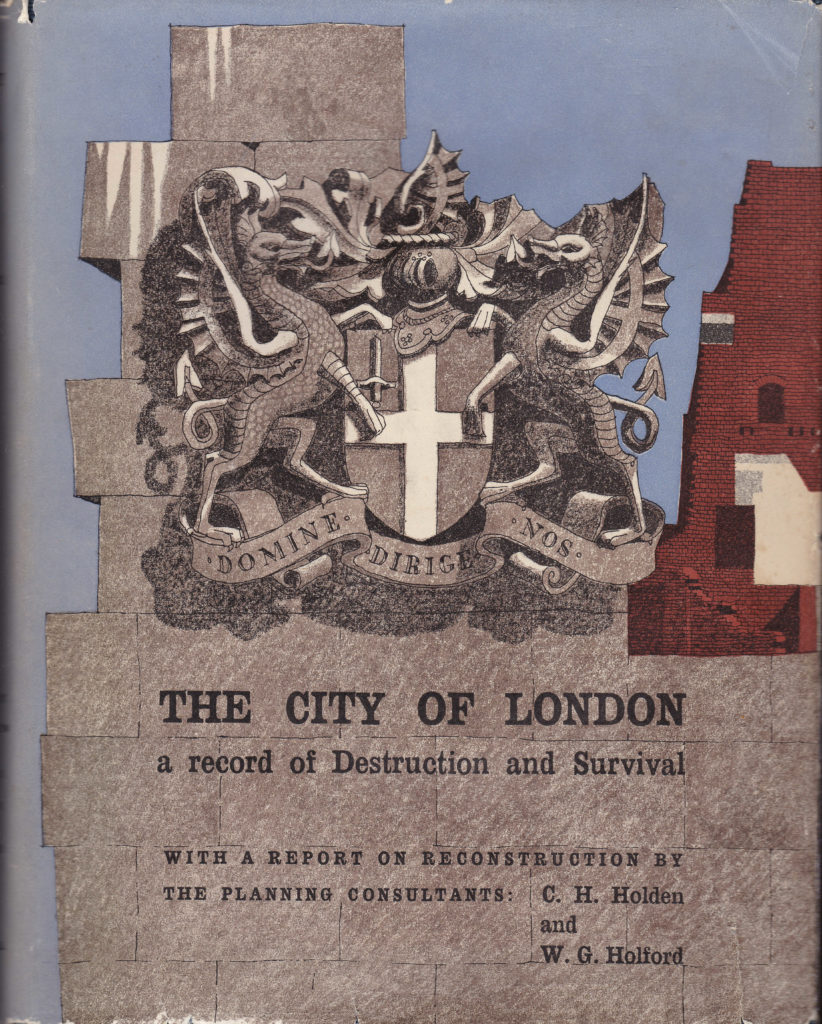
Published by the Architecture Press

I have taken some extracts from it that I found particularly fascinating but if you want to read the entire blog (and I recommend it highly) here is a link.

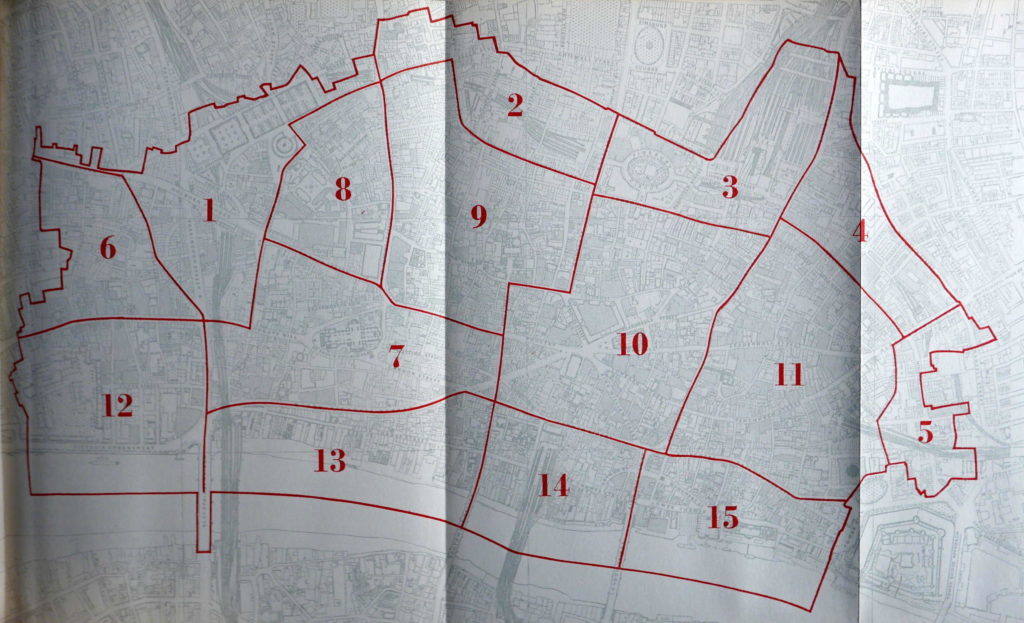
The first illustration that interested me was this Inventory of Accommodation within the City. The present day Barbican Estate falls firmly into section 9 …
The report then goes on to illustrate in this table the total floor space in 1939 along with the percentage destroyed during the War …
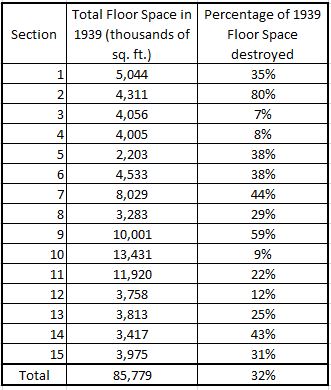
As you can see, the map highlights the considerable amount of damage caused by the early raids of 1940 / 41 when incendiaries caused significant fire damage in the areas around and to the north of St. Paul’s Cathedral as shown by the high percentage figures for blocks 2,7 and 9.

New roads and high and low level separation of pedestrians and vehicles was seen as the way forward for the City. The Barbican Highwalk is a present day example of what the new ‘pedways’ above the traffic might have looked like and there is an interesting article on the subject here.

The following drawing shows the proposed high level road in Lower Thames Street with the ground level occupied by a service road and a pedestrian area …
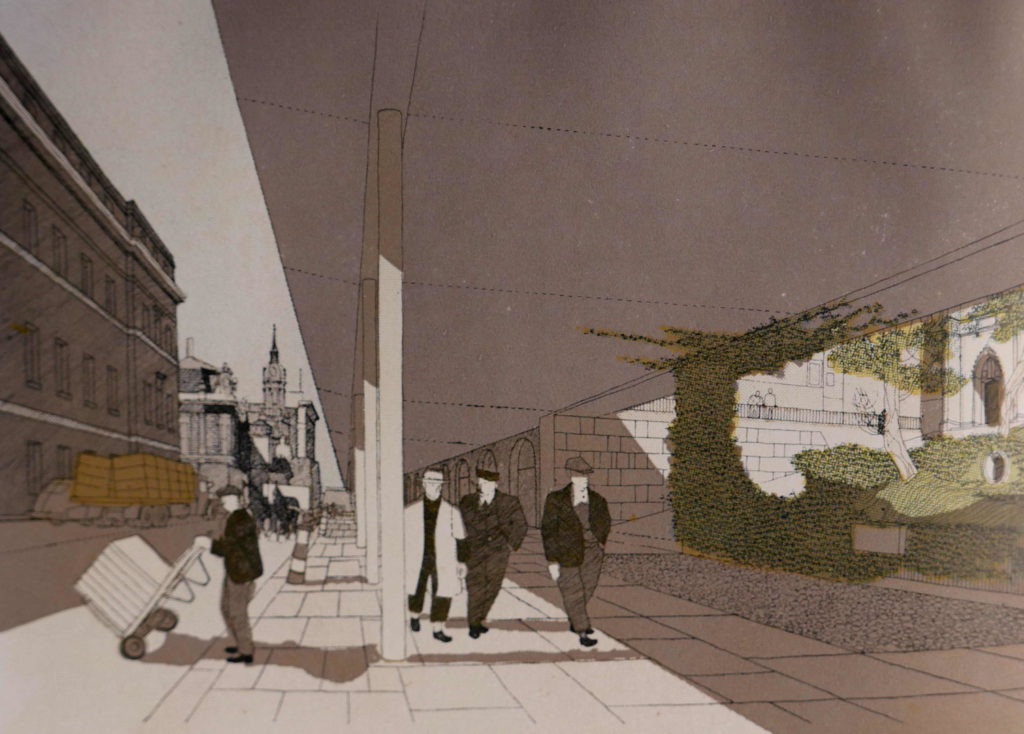
Lower Thames Street is not very nice to walk along nowadays, but the proposed high level road would probably not have had enough capacity

This drawing is of the proposed low level concourse at London Bridgehead, just to the west of the Monument …
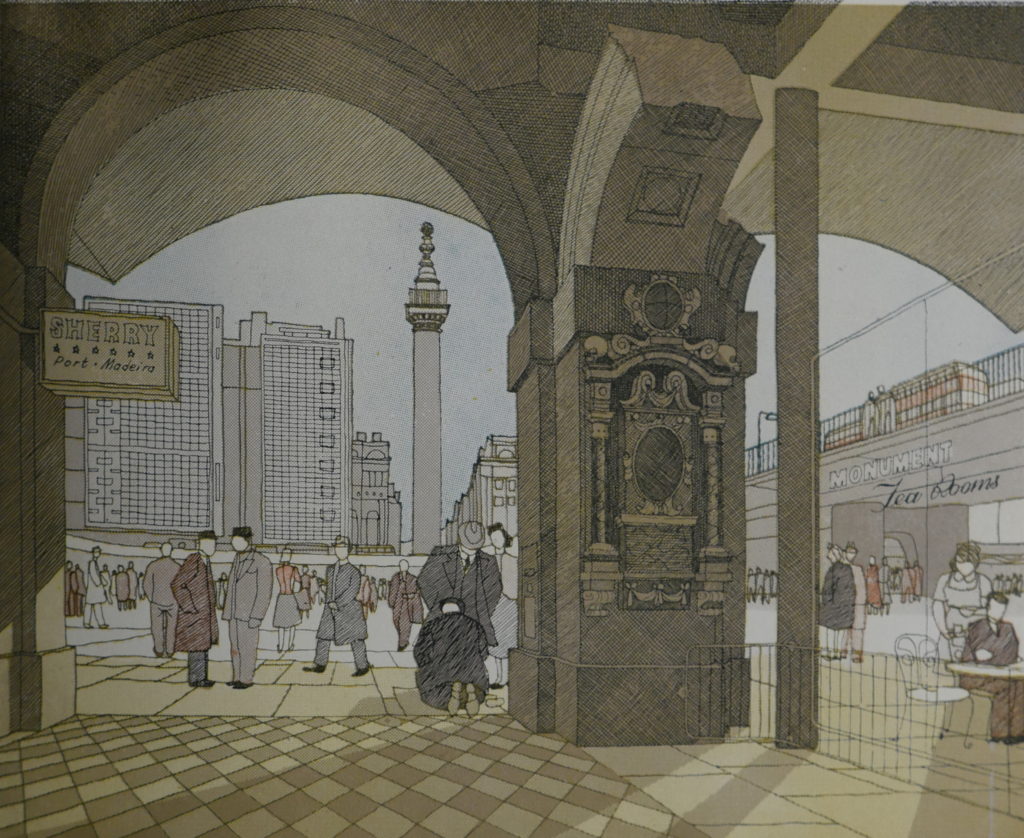
I like the man getting a shoeshine and the Monument Tea Rooms

This is a clever piece of anticipation if you just swop the Sherry, Port and Madeira bar for a Wine bar and the Tea Rooms for a Cafe Nero. And nowadays men seem to be wearing hats again.

The following impression, also of the proposed London Bridgehead, is again (apart from the clothes) rather modern …
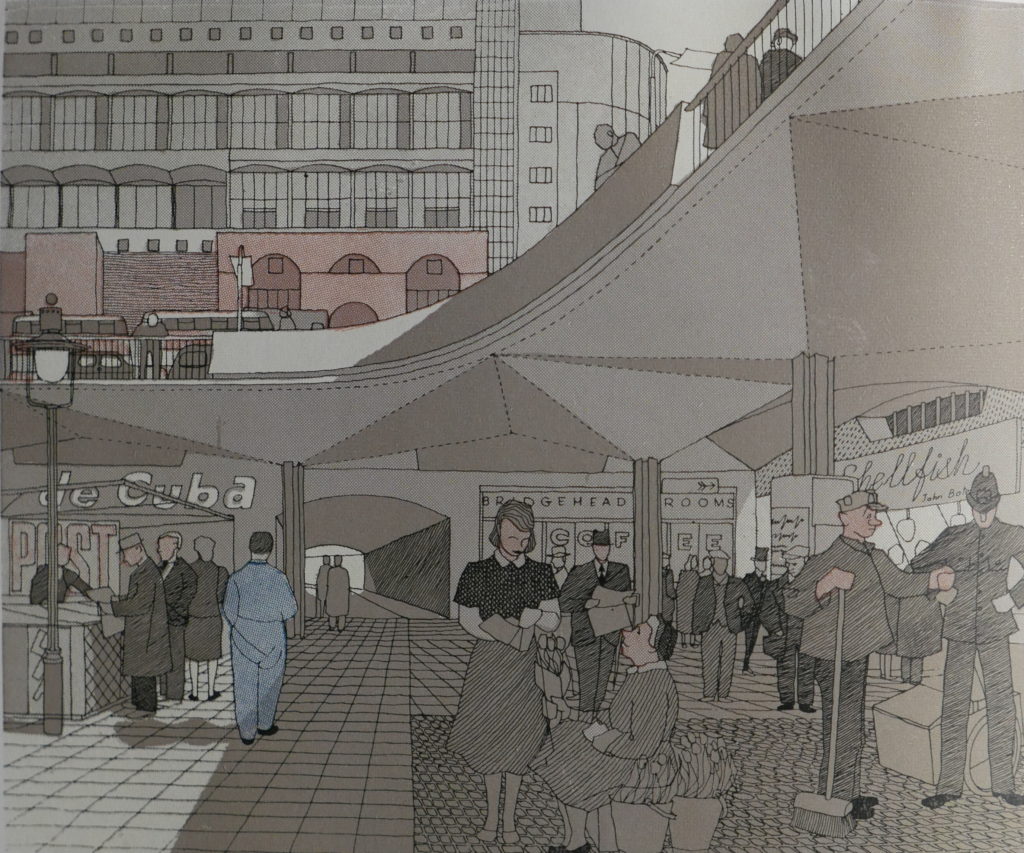
The report notes that the City is ‘chronically short of places to eat’ so no doubt the authors would be pleased to see how that situation has drastically improved.

The high level separation of traffic can be seen here as part of the large circulatory road system on the northern end of London Bridge …
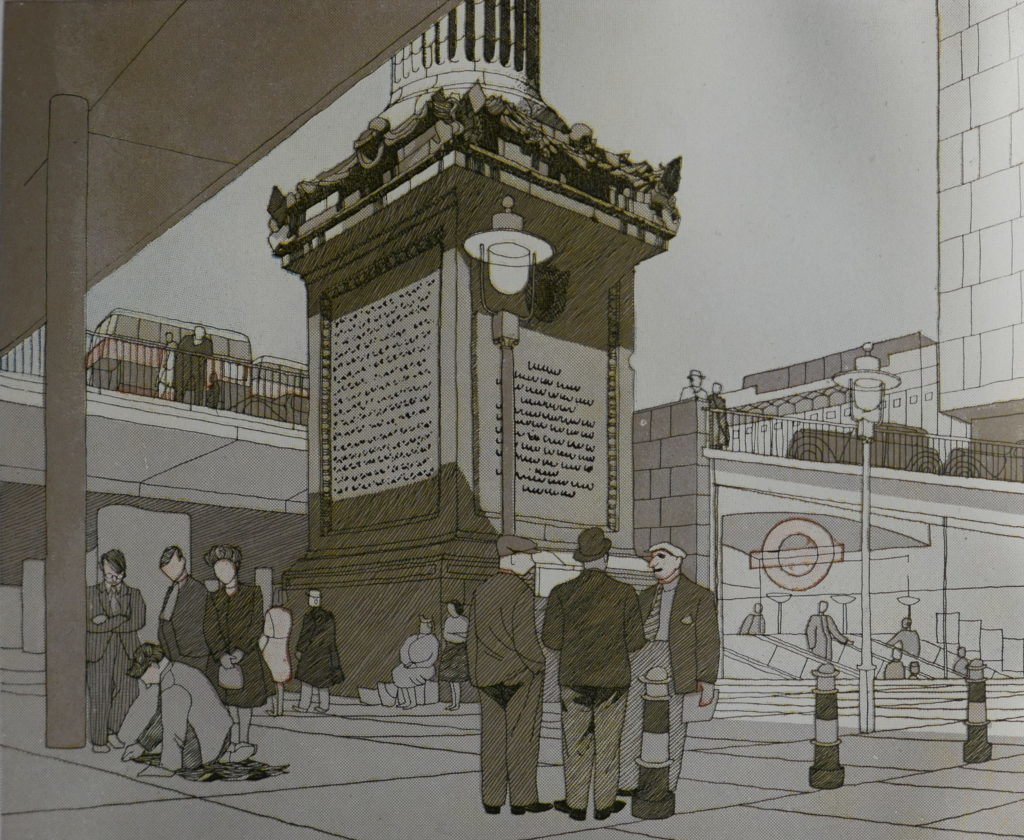
Interesting that a pavement artist has been included

To the right is a glass sided entrance to the Monument Underground Station with the London Transport roundel on the side. This would have replaced the entrance on Fish Street Hill which today is an entrance directly on the ground floor of an office building rather than this rather nice, glass sided descent by escalator. I have to keep reminding myself that these ideas were being put forward over 70 years ago.

I really had to do a double-take when I saw this drawing entitled ‘An impression of a possible treatment of the proposed new approach to St. Paul’s from the river.’
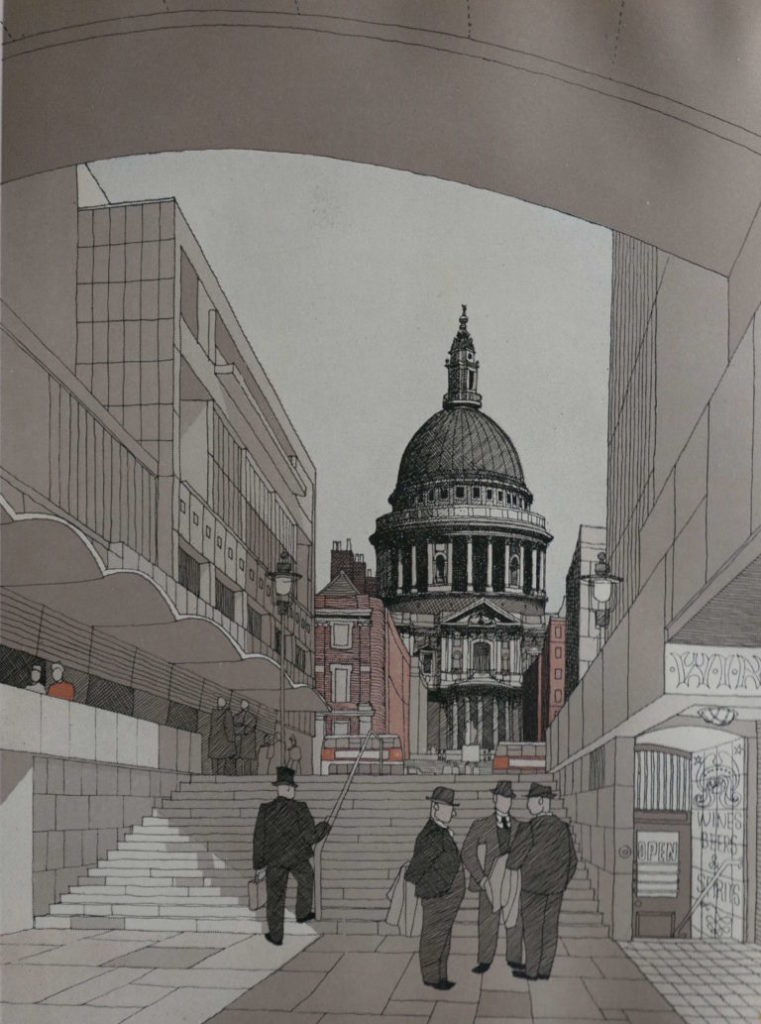
What a great vision

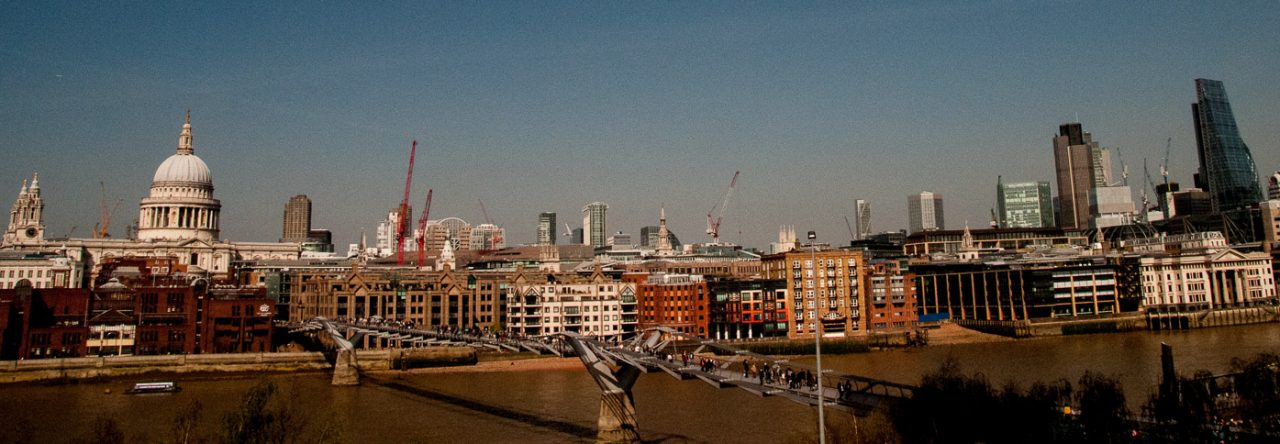
And now we have a similar view after we cross the Millennium Bridge (however we are unlikely to spot a man in a top hat).

Just to show that not all the recommendations were attractive, a picture entitled ‘An impression of the suggested Cheapside Underpass, a proposal which has been postponed on grounds of cost.’
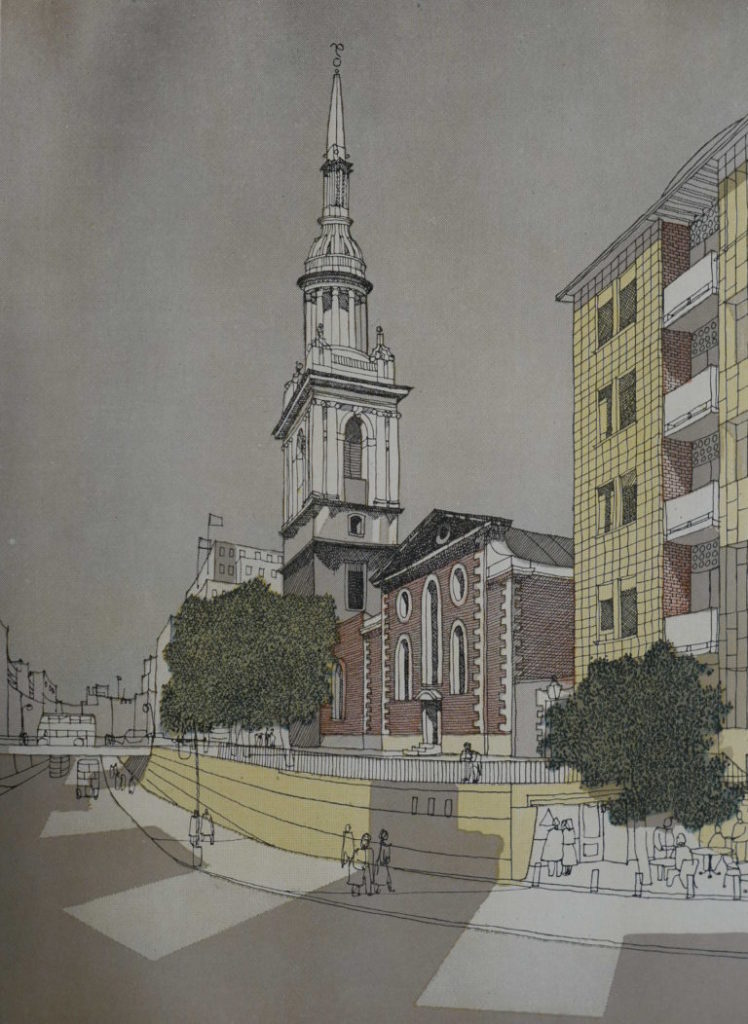
That’s the church of St Mary-le-Bow on the right

I think we had a lucky escape there.

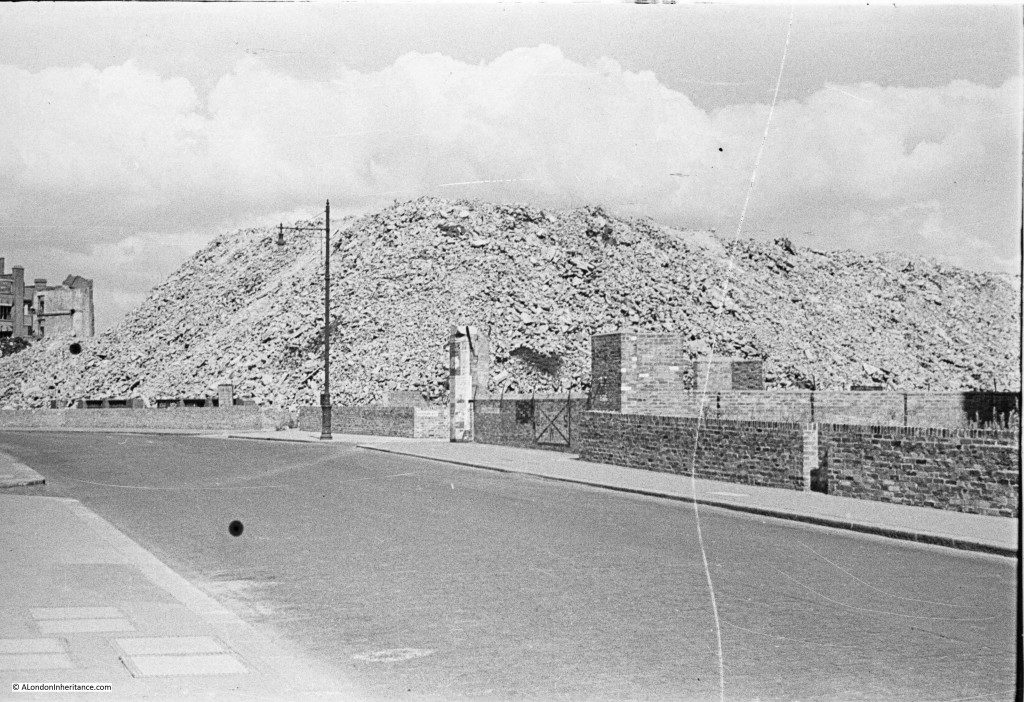
And finally, a reminder of the utter destruction the War brought to some parts of the City. A photograph taken by the blogger’s father showing a very large pile of rubble following the demolition of bombed buildings in Aldersgate …
I hope you enjoyed today’s blog – apologies to those of you who already subscribe to the London Inheritance blog and have therefore seen these images before. If you don’t subscribe and are interested in London’s history I can’t recommend it more highly.
Adding life stories to names

Often when I look at war memorials I think about the life stories behind the names, some of which will obviously have been lost forever as memories fade and family members die. Sometimes, however, very detailed personal records have been accurately preserved for reasons other than just family history.

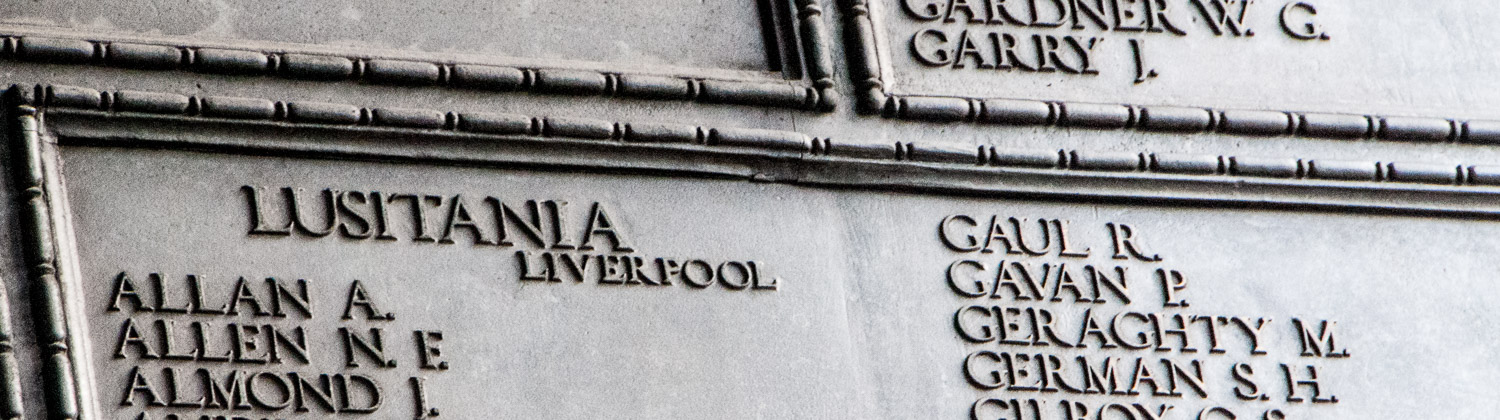
Such was the case for this vessel that departed Pier 54 in New York on 1st May 1915 bound for Liverpool. Her name is recorded here on the Mercantile Marine Memorial on Tower hill …

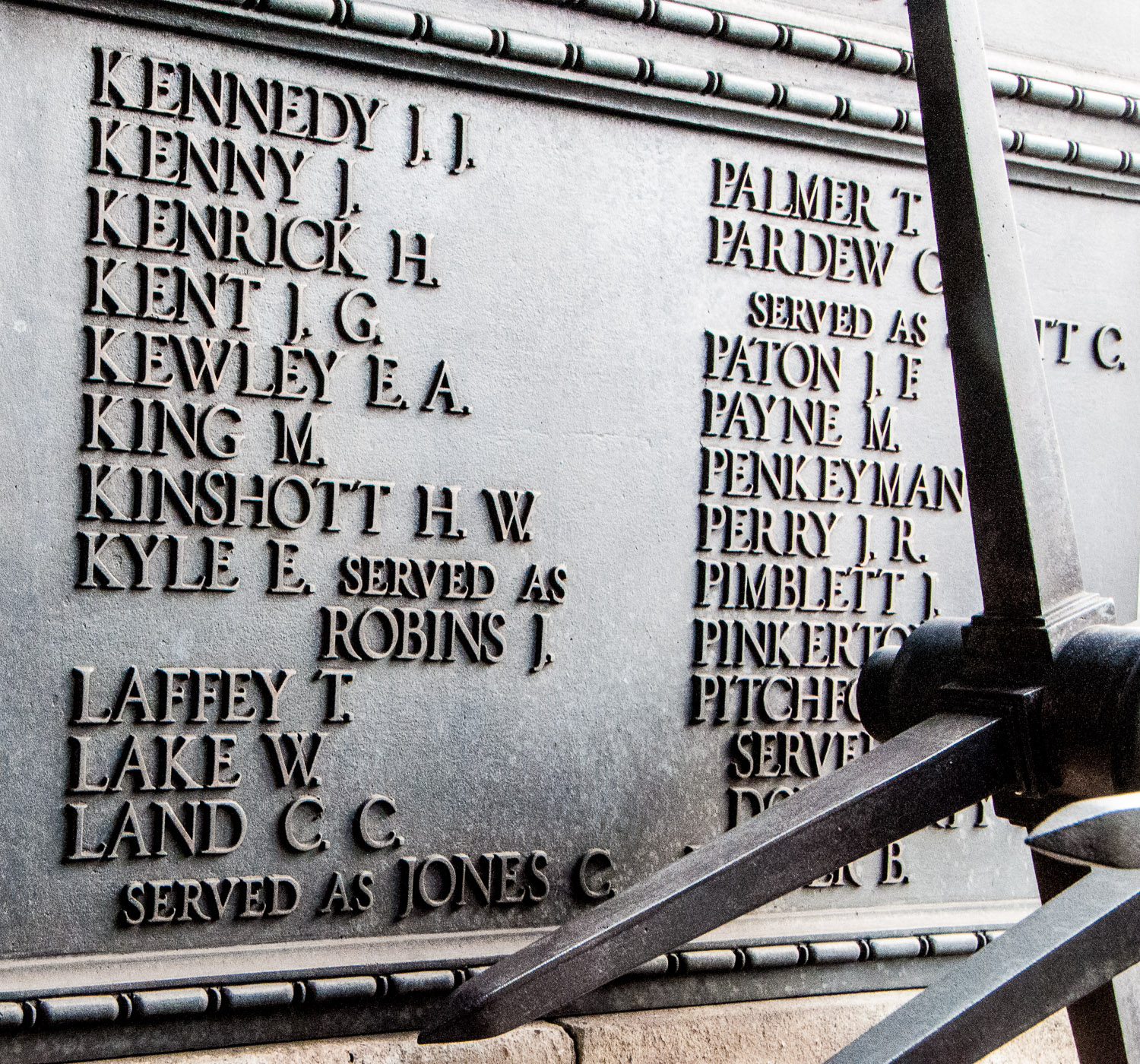
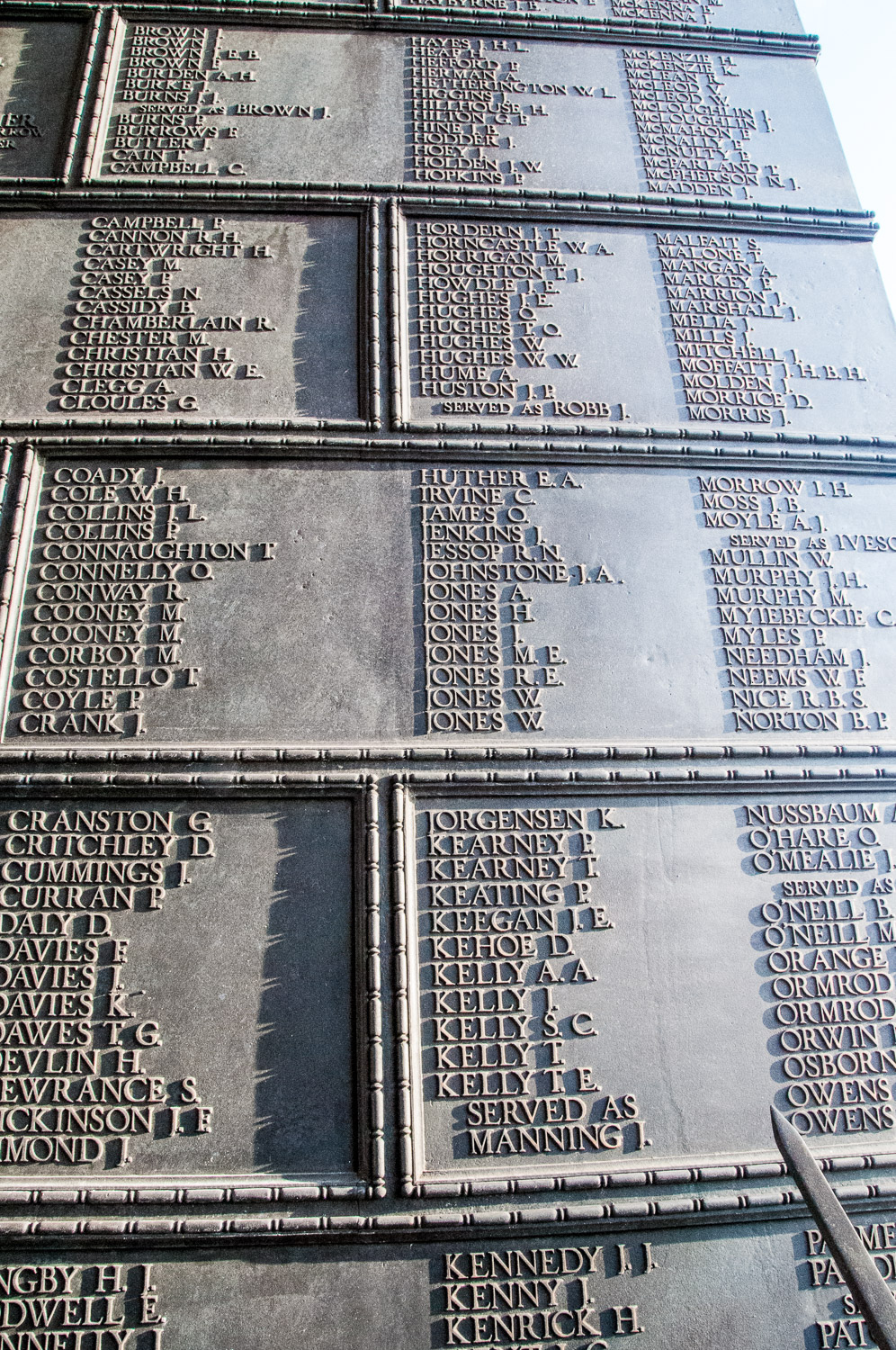
Below the name, as is the practice on the memorial, the names of the crew who were lost and whose bodies were never recovered are listed in alphabetical order …

Some of the tablets listing the Lusitania crew.

In total 1,193 people perished when the ship was sunk by a torpedo fired by the German U Boat U 20 on 7th May 1915 off the coast of Ireland. The number of crew lost was 402.

As I mentioned in an earlier blog, I was intrigued by men who chose to serve under names other than the name on their birth certificate and have researched many of them using the invaluable Merseyside Maritime Museum Lusitania database. One of the reasons this exists is that, since the crew were employees of the Cunard Line, insurance, pensions and the balance of their wages had to be distributed to their families, and so research was necessary to ensure the correct beneficiaries were identified.

On the tablet below are inscribed the names of three men in this ‘served as’ category – Kyle, Land and Pardew. Edward Kyle was 44 when he died and we don’t know why he chose to serve under the name of Robins. Similarly, we don’t know why Cann Cooper Land chose the name Jones when he signed up as a ‘Second Butcher’ on 12 April 1915 (although after his death the local paper stated ‘he was always known as Charlie Jones’). We do know he was 27 years old but gave his age as 25. In August 1915 his family was given the balance of his wages.

Much more is known about Charles Pardew who served as Charles John Scott …

Charles had been engaged as a fireman in the engineering department on a wage of six pounds ten shillings a month (£6.50). In July 1915 his widow Sarah swore an affidavit (supported by a lifelong friend called Fennell) that Charles had used the alias Scott since 1894. Apparently he had once sailed from Australia in a ship named the Charles Scott and decided to adopt that as his service name. For some reason he had also claimed he was 60 when in fact he was 57. Sarah received £300 compensation from the company and in August The Liverpool & London War Risks Insurance Association Limited granted her a monthly pension of one pound six shillings (£1.30).

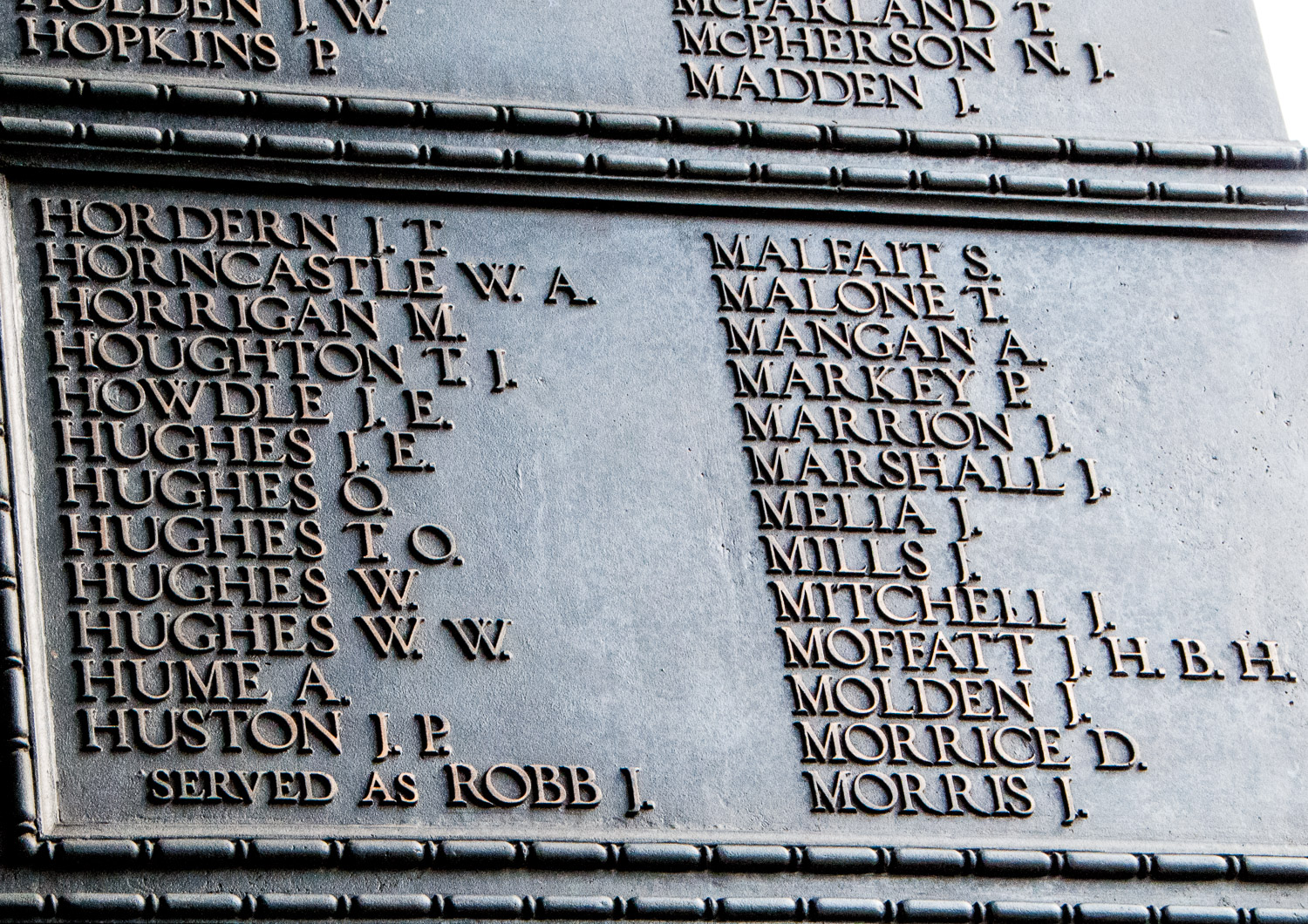
There is someone on the memorial who shouldn’t be there at all …

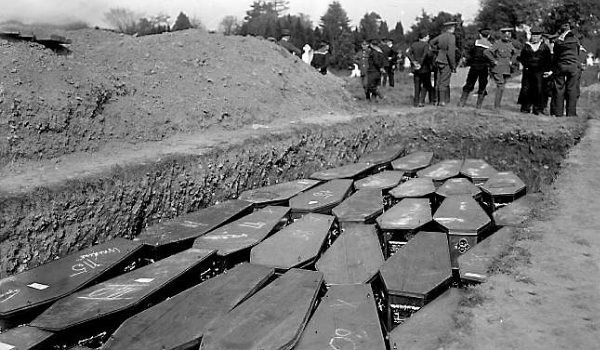
We don’t know why Joseph Patrick Huston engaged as an able seaman under the name of Joseph Robb. His body was one of the first to be recovered, but for some reason the Commonwealth War Graves Commission was not aware of this, so his body was listed among the missing. He was 24 when he died and was buried in the Old Church Cemetery, Queenstown, County Cork on 10th May 1915.

The Lusitania mass burial ceremony. Joseph Huston’s body was among those recovered.

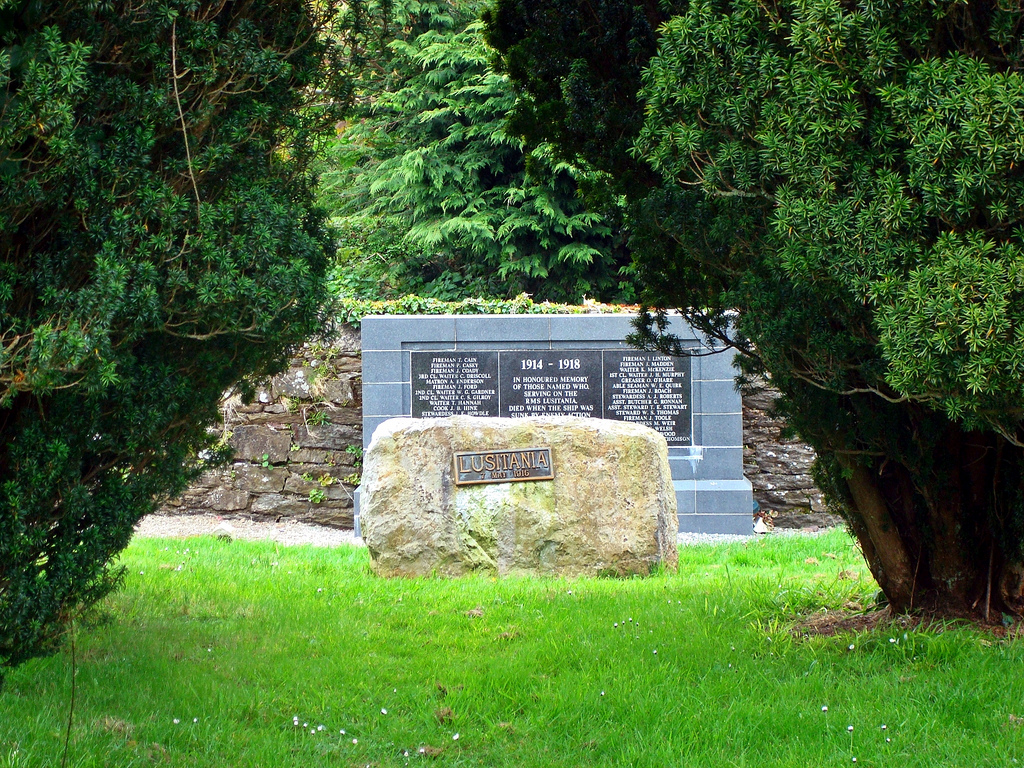
The memorial now …

I will carry on researching the Lusitania crew and will report back on any more interesting facts I come across.

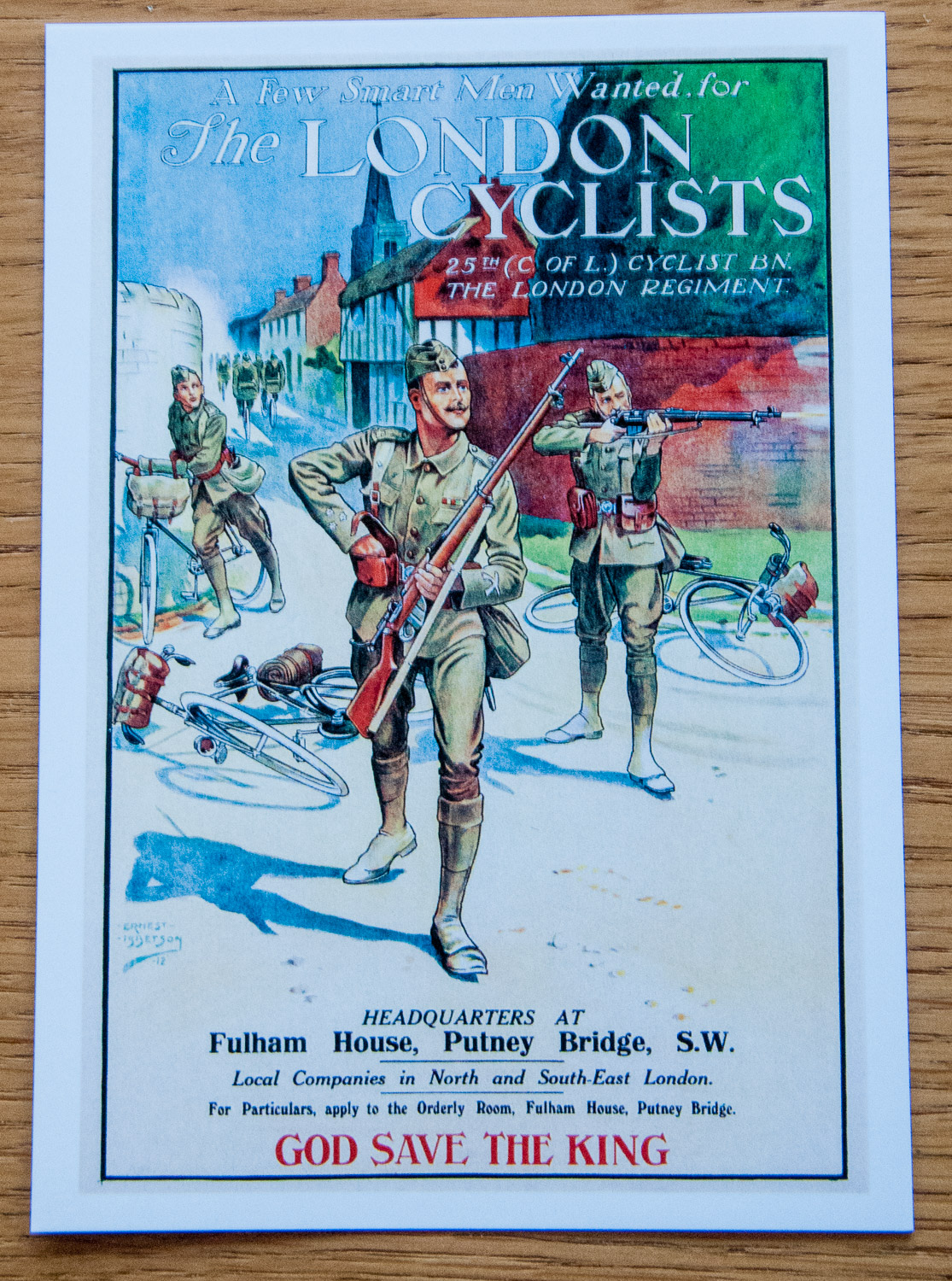
You may remember that in my blog of 25th October I mentioned the London Cyclists Battalion …

A recruitment poster from 1912.

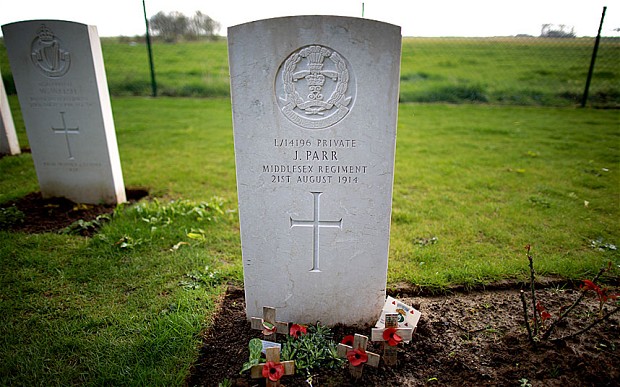
It was therefore quite a coincidence that, on 9th November this year, Theresa May laid wreath at the grave of a cyclist, John Parr, the first UK soldier to be killed in the First World War on 21 August 1914. He was 15 when he signed up in 1912 but claimed to be eighteen years and one month. His comrades nicknamed him ‘Ole Parr’, which suggests that everyone knew he was much younger than he claimed, especially since on joining he was only 5 foot 3 inches tall and weighed just 8.5 stone!

John Henry Parr’s grave at St Symphorium Military Cemetery, Mons, Belgium.

Parr was a reconnaissance cyclist in the 4th Battalion of the Middlesex Regiment and died on the outskirts of Mons, Belgium. Bicycles were commonly used in the War, not only for troop transport, but also for carrying dispatches. Field telephones were also limited by the need for cables, and ‘wireless’ communications were still unreliable. So cyclists – and runners, motorbike riders, pigeons and dogs – were frequently preferred by both the Allies and the German army. There is an interesting article on the subject by Carlton Reid in Forbes magazine 

I want to end this week’s blog with a story that moved me greatly when I reported it before in my blog about the City’s Little Museums.

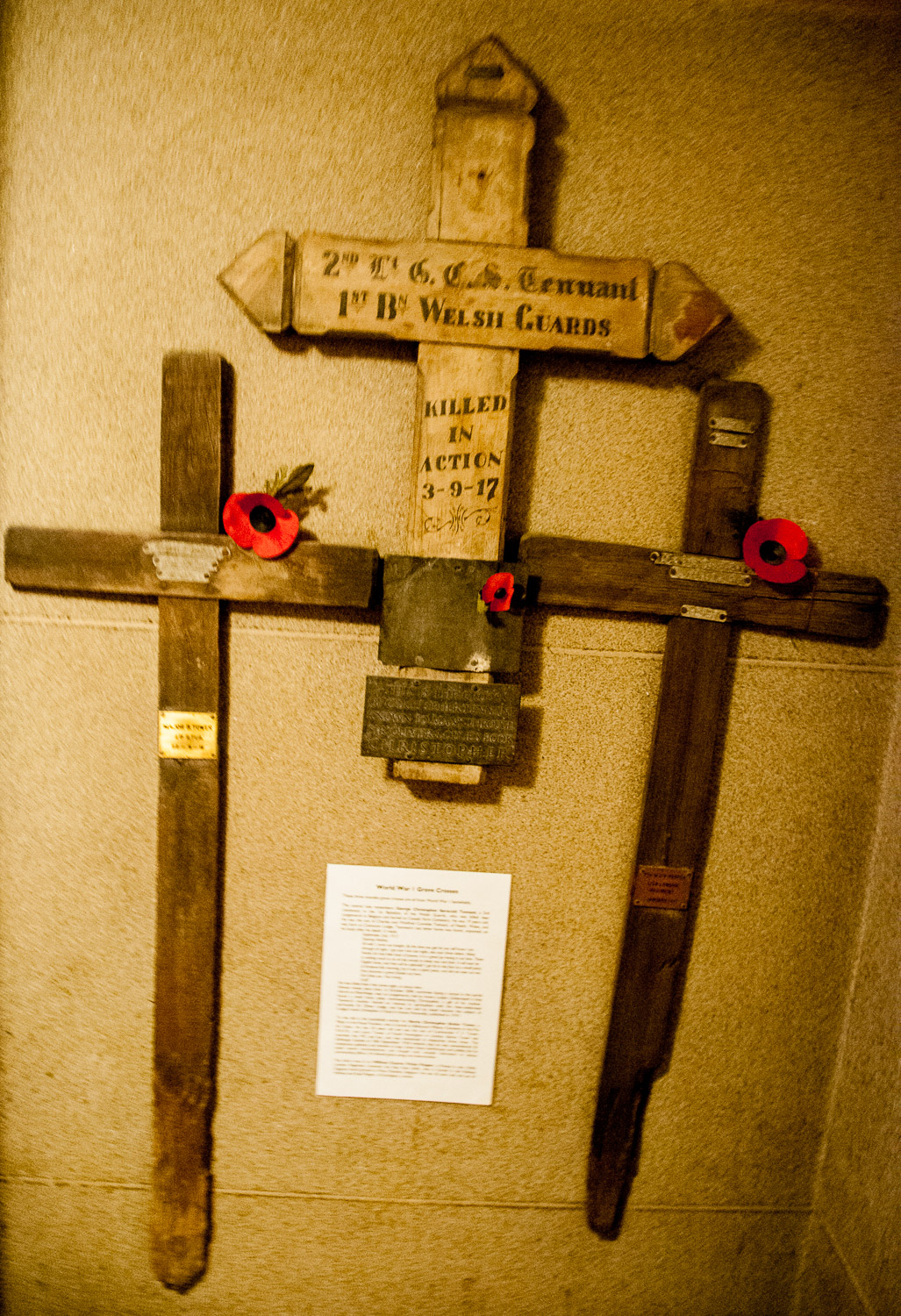
These three battlefield crosses can be found in the crypt museum in All Hallows-by-the-Tower and I wrote in detail about the one in the centre …

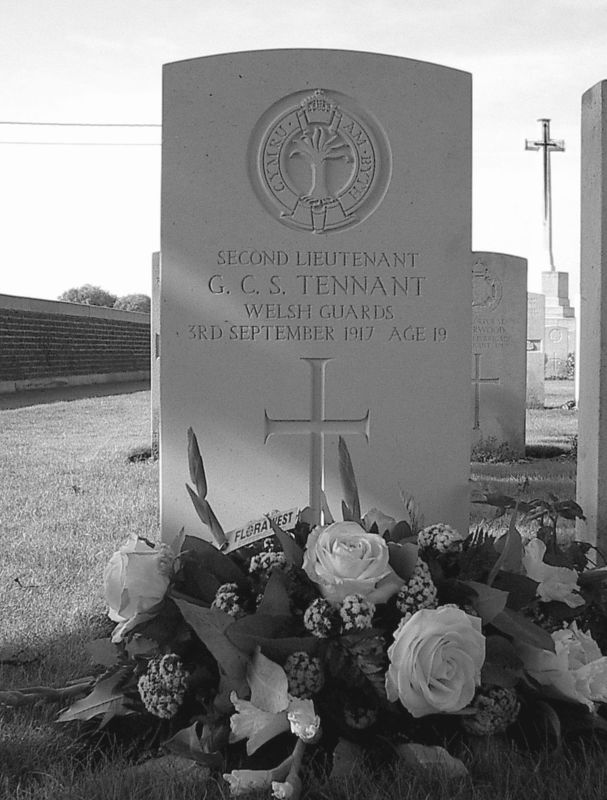
This marked the grave of 2nd Lt. G.C.S Tennant. His last letter home was found unposted on his body after his death. It reads:

Sept. 2nd 1917.

Dearest Mother,

All well I come out tonight. By the time you get this you will know I am through all right. I got your wire last night, also your three letters. Many thanks for that little book of poems. It is a great joy having it out here. There is nothing much to do all day except sleep now and then. It will soon be English leave, and that will be splendid! I got hit in the face by a small piece of shrapnel this morning, but it was a spent piece, and did not even cut me. One becomes a great fatalist out here.

God bless you, your loving Cruff.

He was killed later that night, at about 4.00 am, and is now buried at Canada Farm Cemetery. He was 19 years old.

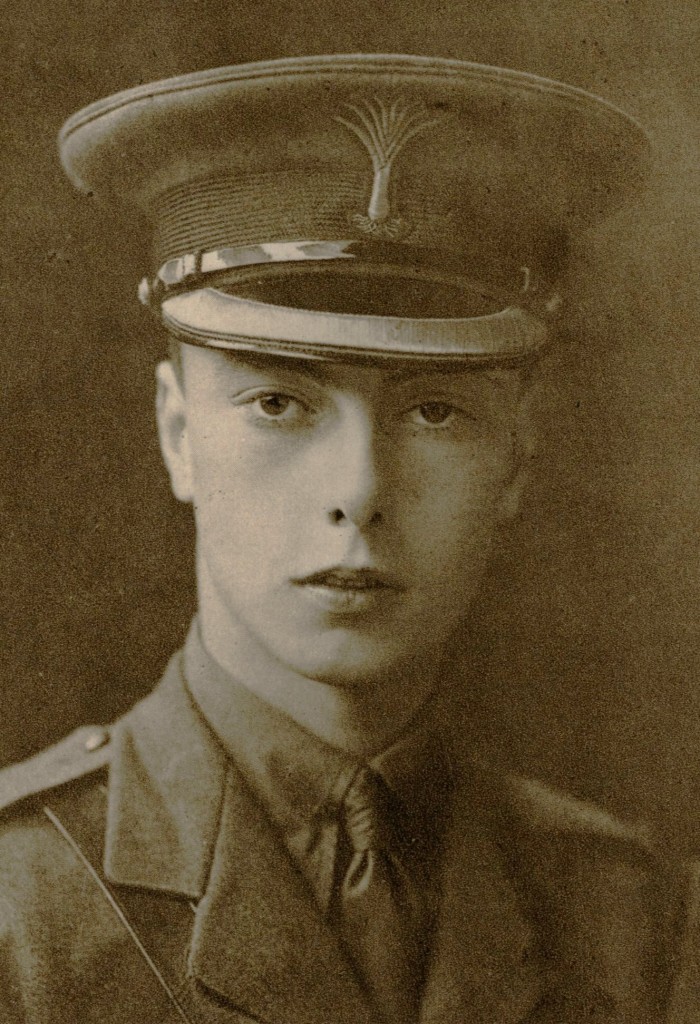
George Christopher Serocold Tennant (1897-1917).

After his death one of his men attested:

‘He was specially loved by us men because he wasn’t like some officers who go into their dug-outs and stay there, leaving the men outside. He had us all in all day long … The men would have done more for him than for many another officer because he was so friendly with them and he knew his job. He was a fine soldier, and they knew it.’

Incidentally, there is also a lovely tribute to the 83 men commemorated on the memorial outside Christ Church Spitalfields. It includes biographical details and a map of where they lived and surrounding areas. It was published in the Spitalfields Life blog and can be accessed here.


A moving discovery at Tower Hill – and two more City war memorials

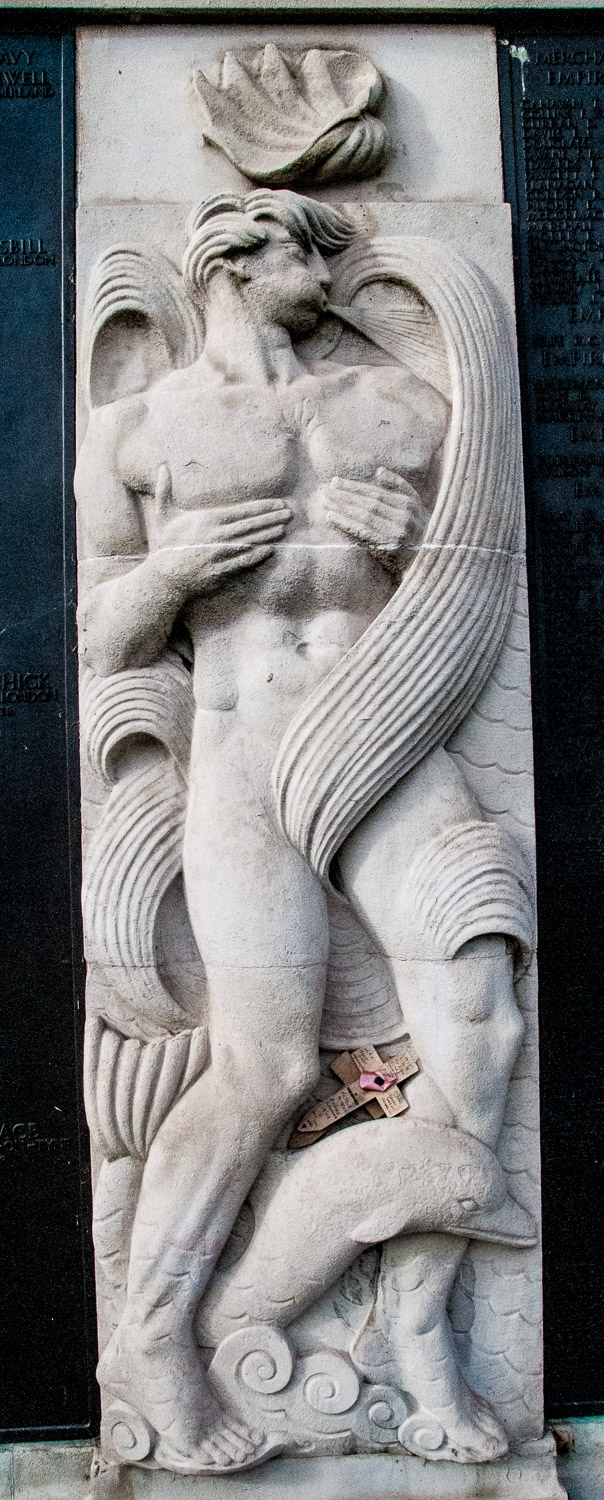
I was walking through the Tower Hill memorial garden last Sunday when I noticed a small cross resting on one of the allegorical figures, just above the dolphin’s head …

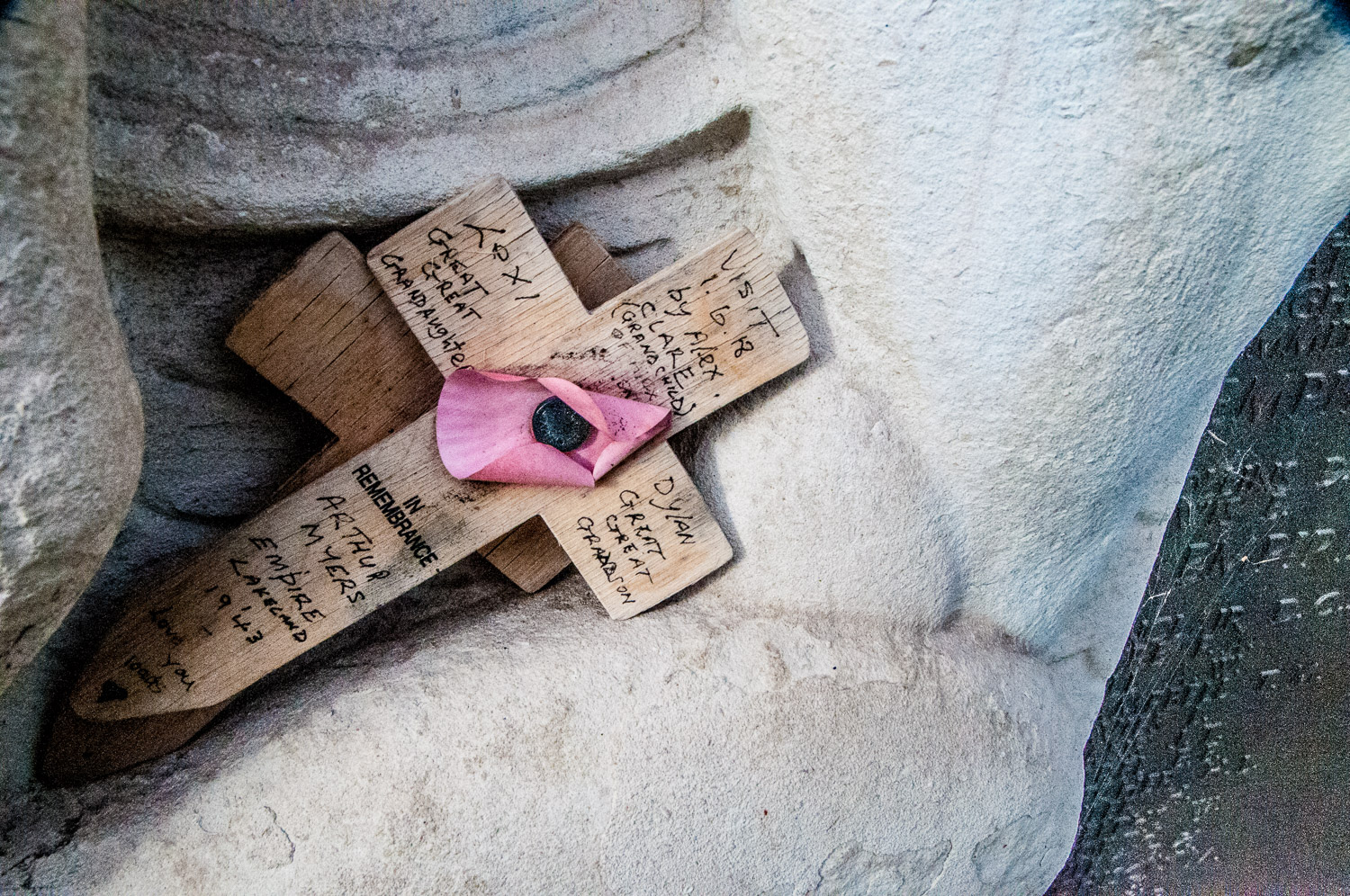
Here it is in close up …

How wonderful. Arthur Myers remembered by a grandchild and two great, great grandchildren. His ship, the Empire Lakeland, was sunk by a U Boat on 11 March 1943.

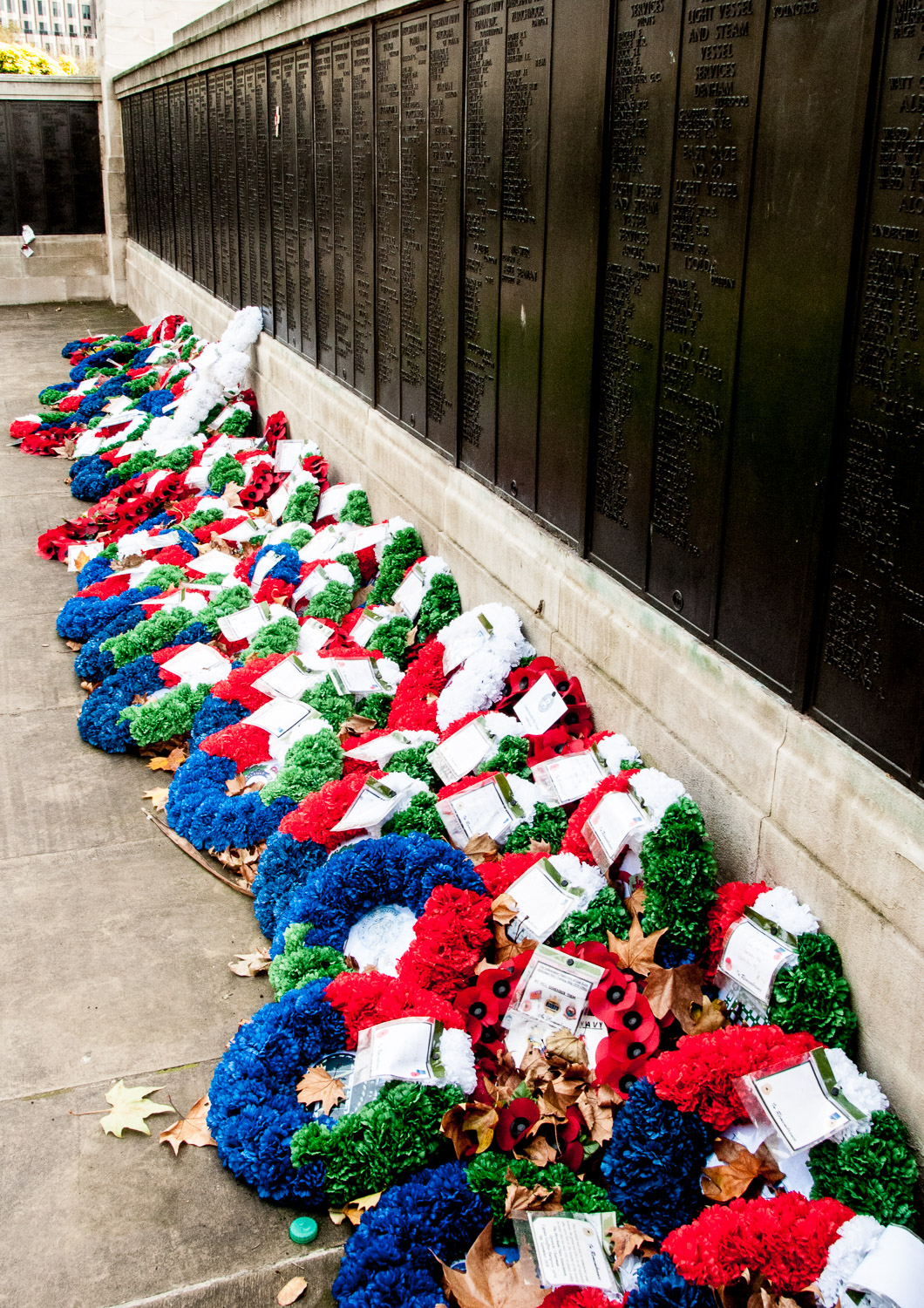
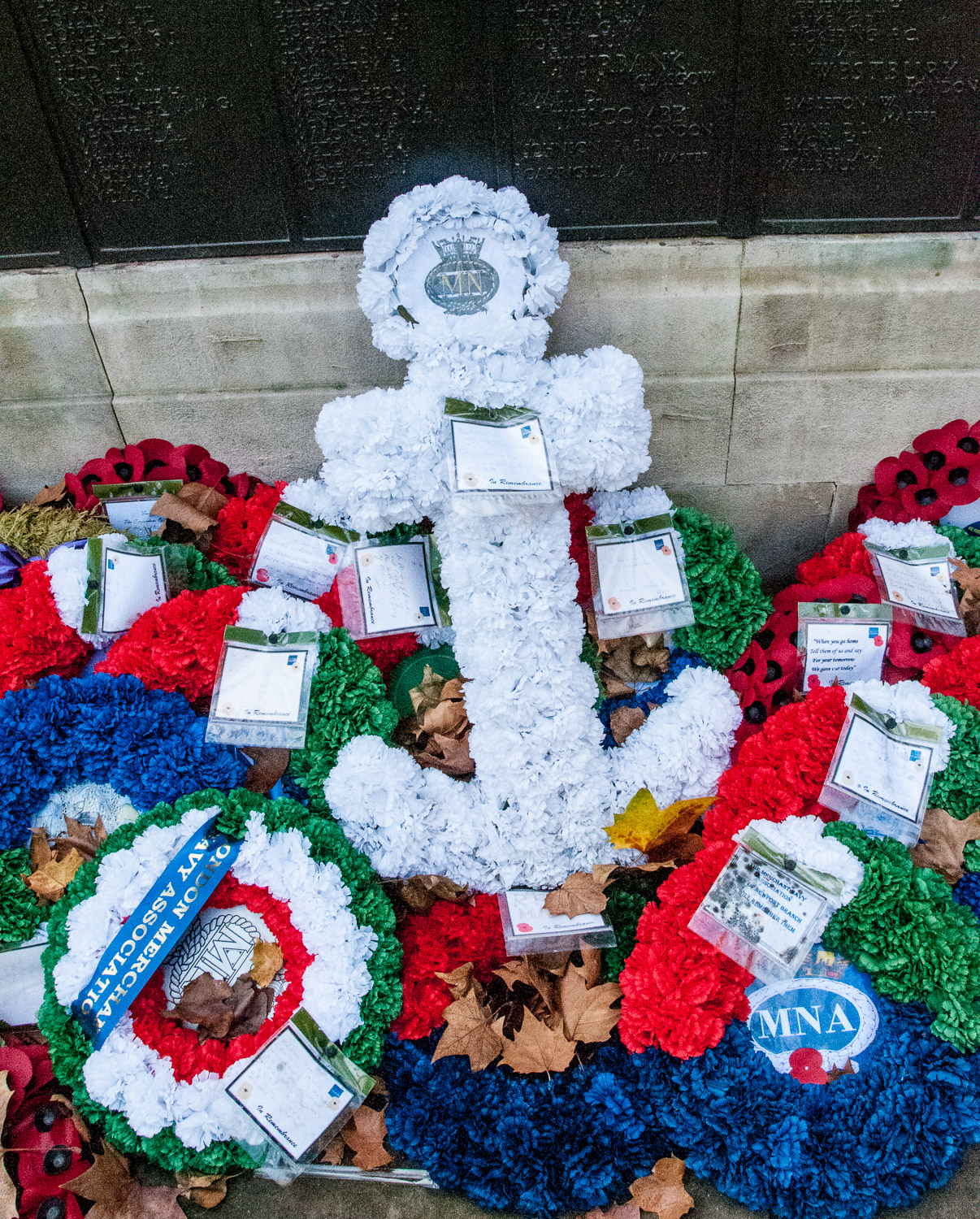
I also noticed when I was there that, with Remembrance Sunday approaching, wreaths and other little crosses are beginning to appear.

Many are from institutions …

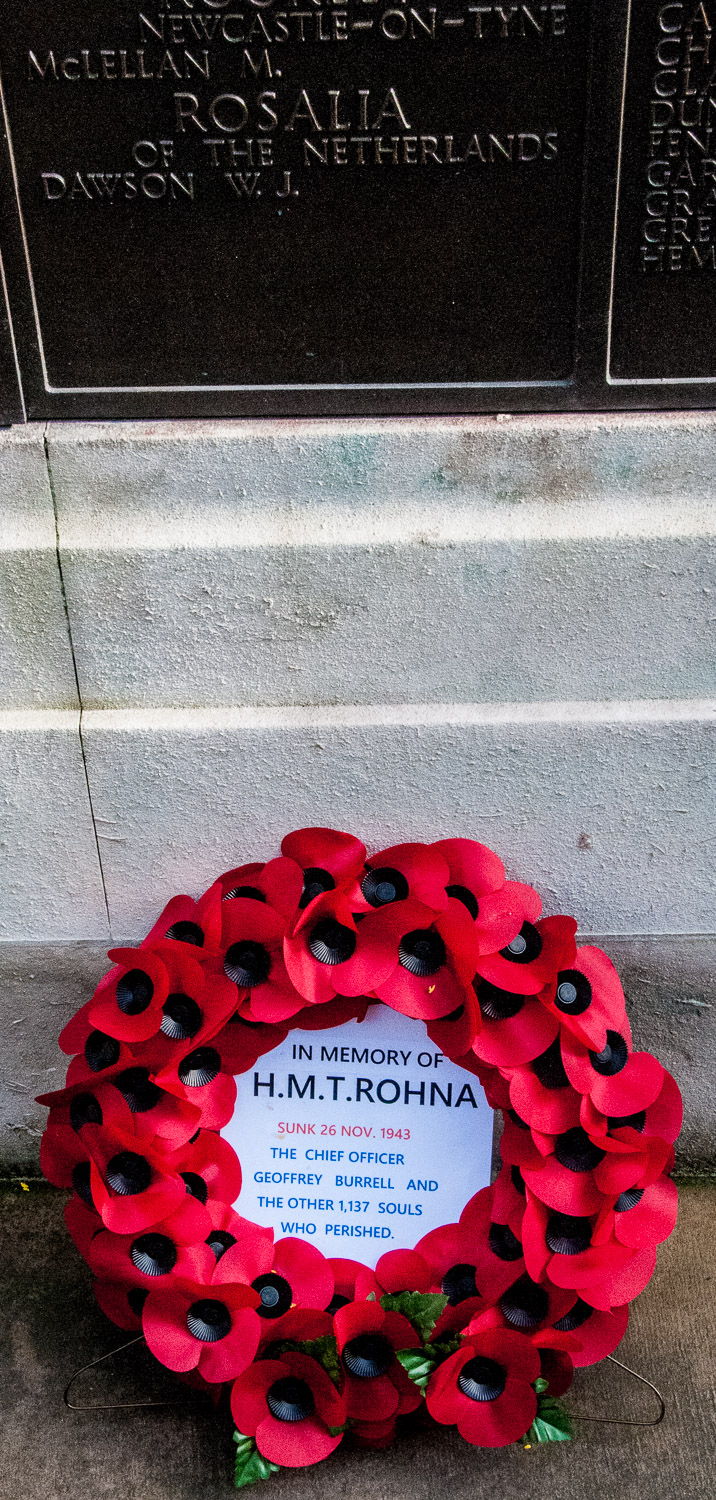
… and some in respect of just one vessel …

HMT stands for His Majesty’s Transport. The Rohna was requisitioned as a troop ship in 1940 and sunk in the Mediterranean in November 1943. Most of those killed were American troops.

And so on to my next two memorials, the first being the National Submarine War Memorial on Victoria Embankment (EC4Y 0HJ). Although able to hide when submerged, once struck the vessels were often unable to rise to the surface and became effectively underwater coffins. In the First World War fifty four boats were lost and with them the lives of 138 officers and 1,225 men. At the inauguration in 1922 Rear Admiral Sinclair, the Chief of the Submarine Service, reminded those present that, during the Great War …

The number of those killed in the Submarine Service was greater in proportion to its size than any other branch of His Majesty’s fighting forces … one third of the total personnel.

In November 1959 new panels commemorating Second World war losses were unveiled by Rear Admiral B W Taylor.

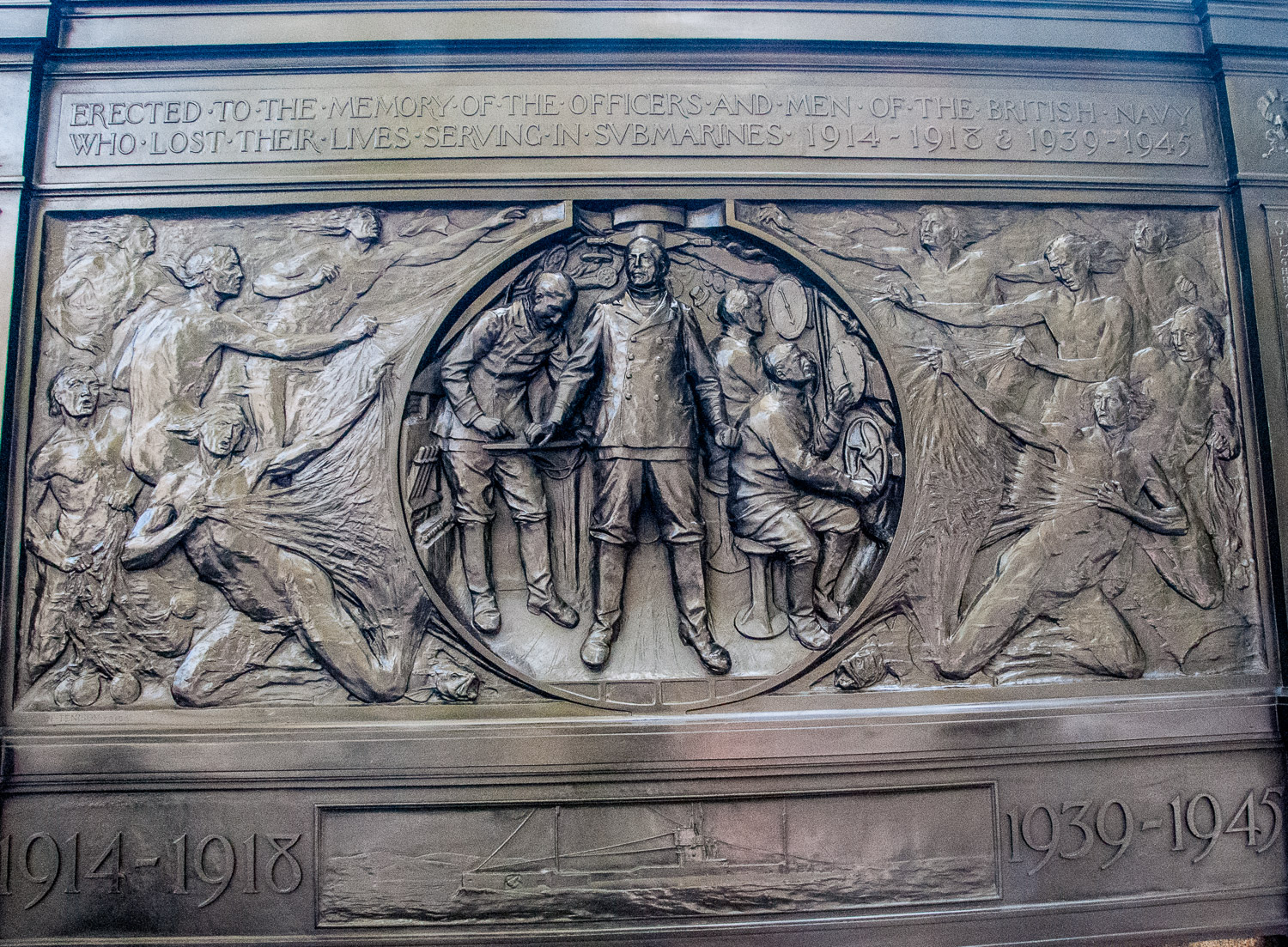
Wright and Moore, writing for the 20th Century Architecture website, describe the memorial as a complex mixture of narrative and symbolism …

Sculptor: F B Hitch Architect: A H R Tenison Founder: E J Parlanti

The central figures recreate the scene set inside the submarine exaggerating it into a small, claustrophobic tunnel. The crew use charts and follow dials, the captain is braced at the centre with the periscope behind his head. Around the vessel a shallow relief depicts an array of sea creatures or mermen appearing to trap and haul the submarine in fishing nets, reminding us that the submarines were as much prey to the tempestuous elements as they were to the enemy.

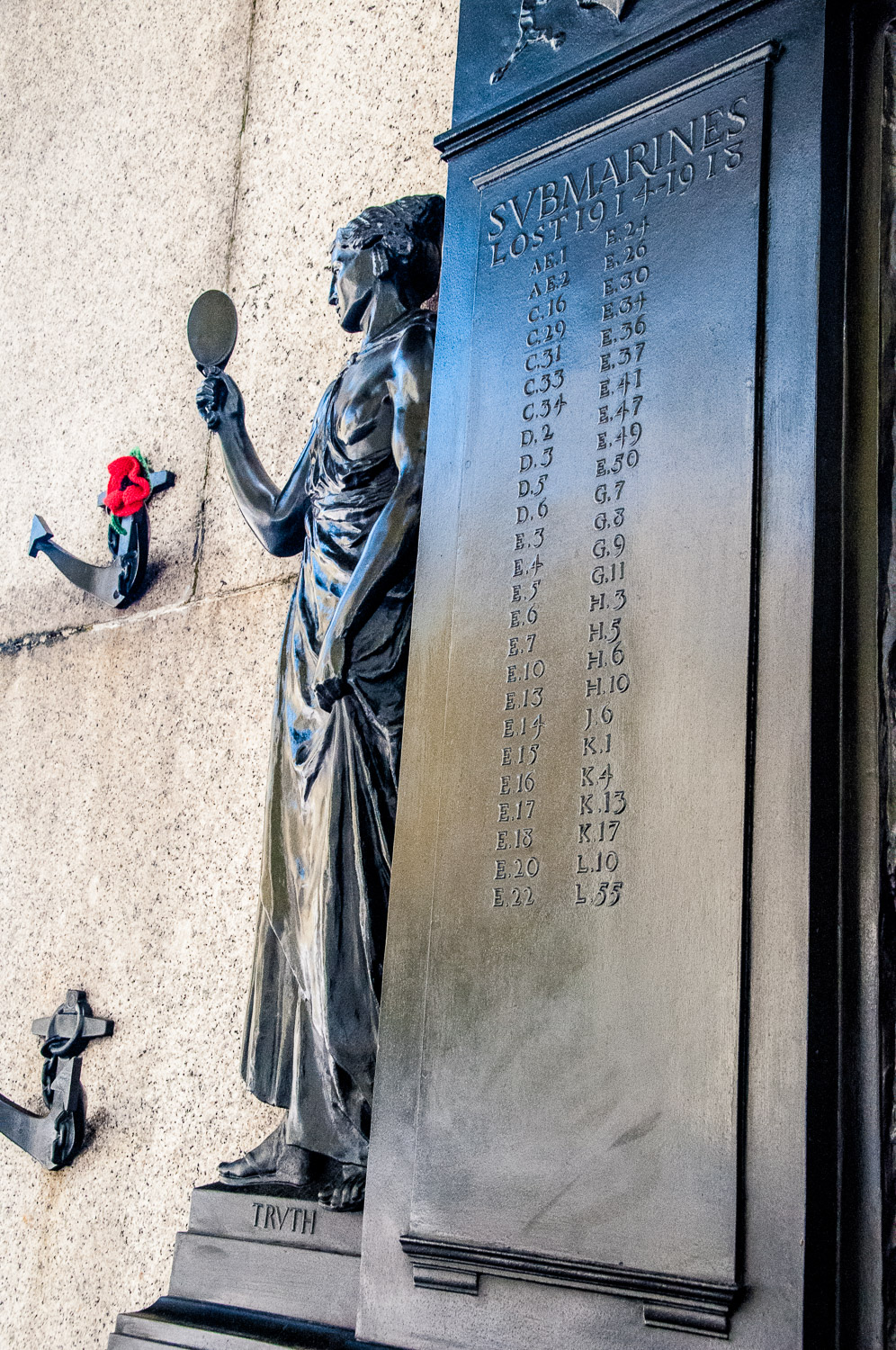
On both corners are allegorical figures. Next to the list of vessels lost between 1914 and 1918, Truth holds up her mirror. Just further to the left in the picture are two of the 40 bronze wreath hooks in the form of anchors …

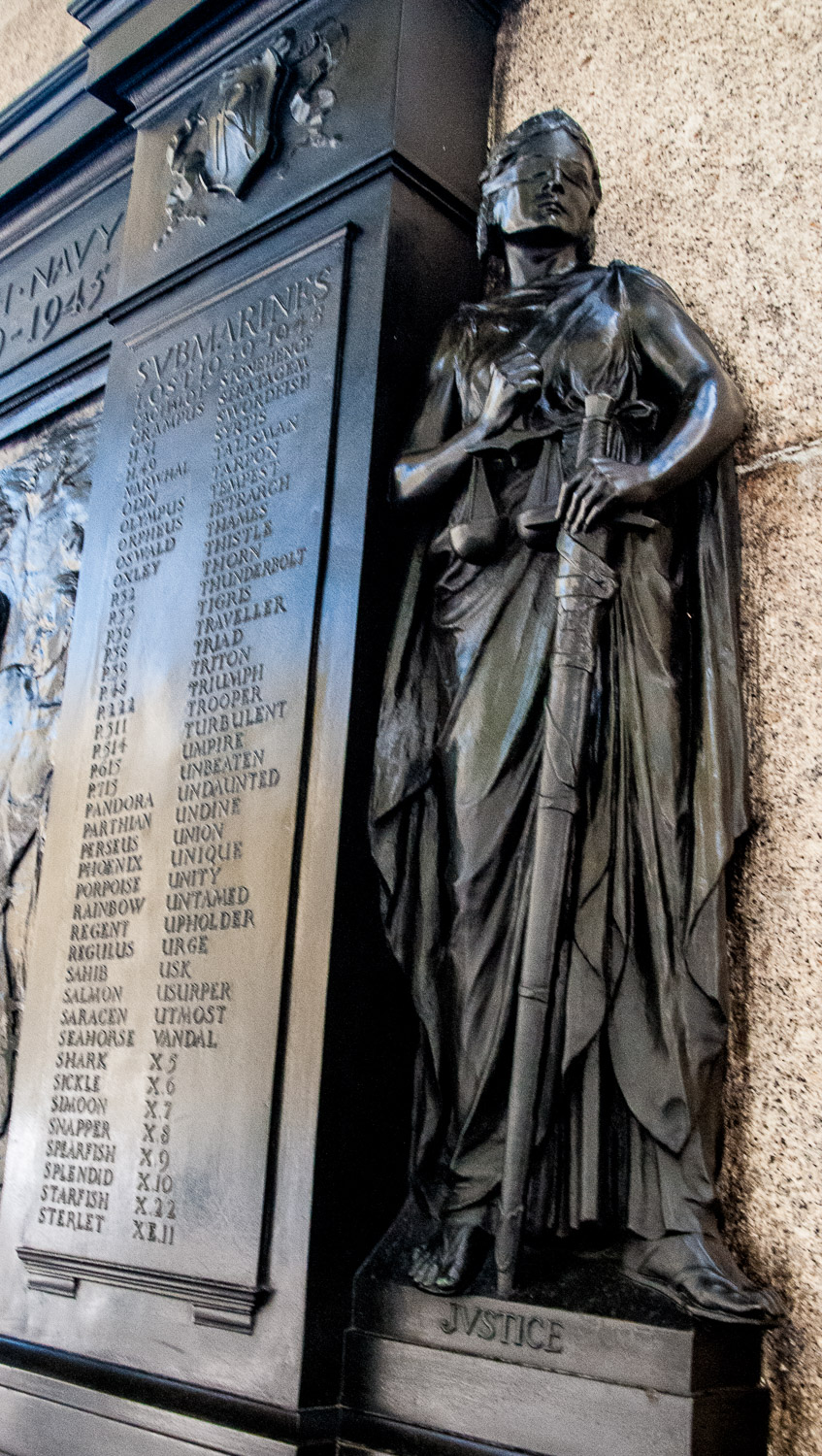
On the right, next to the vessels lost in the Second World War, Justice wears a blindfold and as usual holds a sword and scales …

I have written about Justice and other representations in the City of the cardinal virtues in an earlier blog which you can find here.

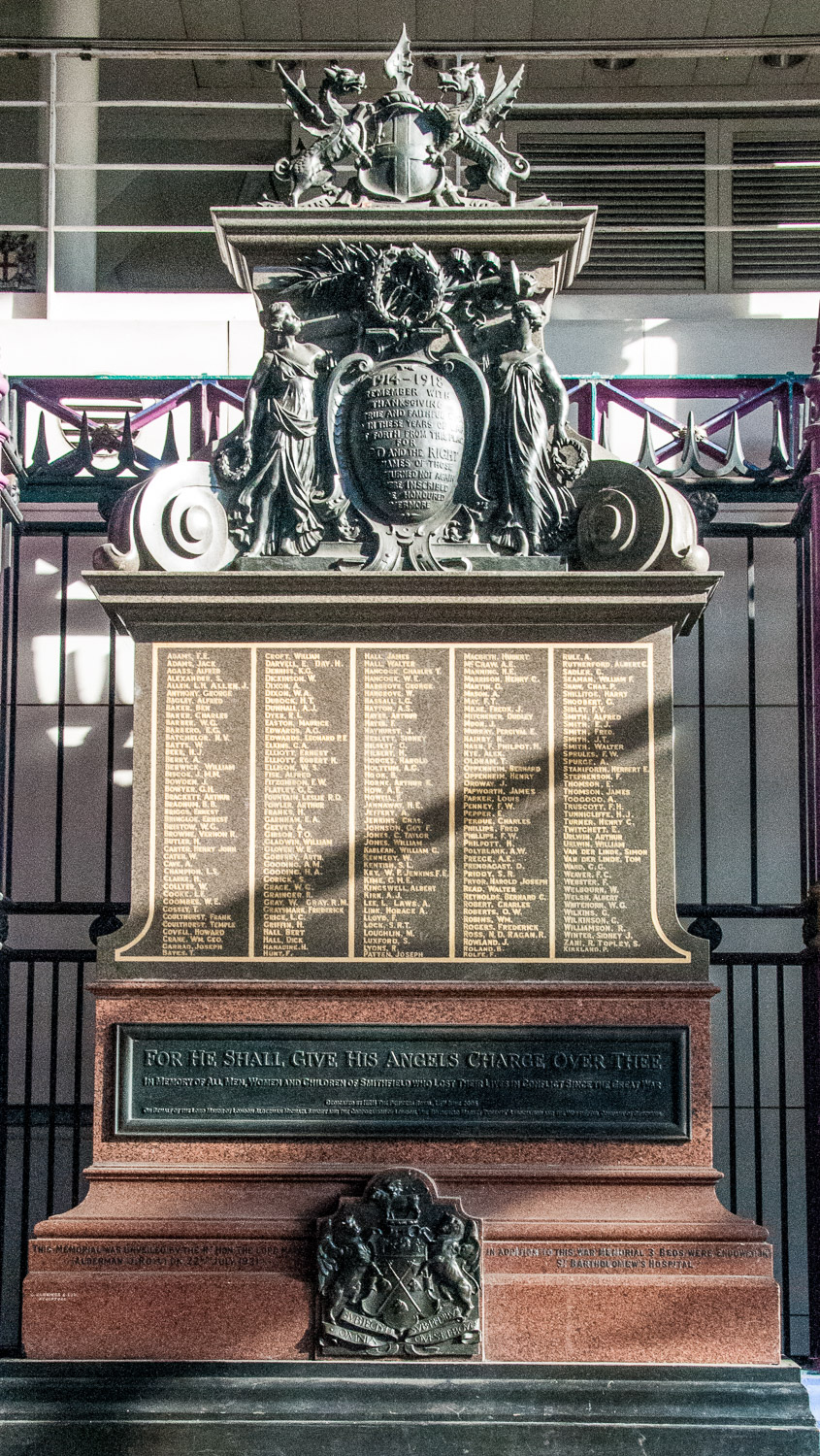
And now to the Grand Avenue, Central Markets, Smithfield (EC1A 9PS) and this monument commemorating men, women and children who perished both overseas and nearby …

The original memorial (above the red granite plinth) is by G Hawkings & Son and was unveiled on 22  July 1921. 212 names are listed.

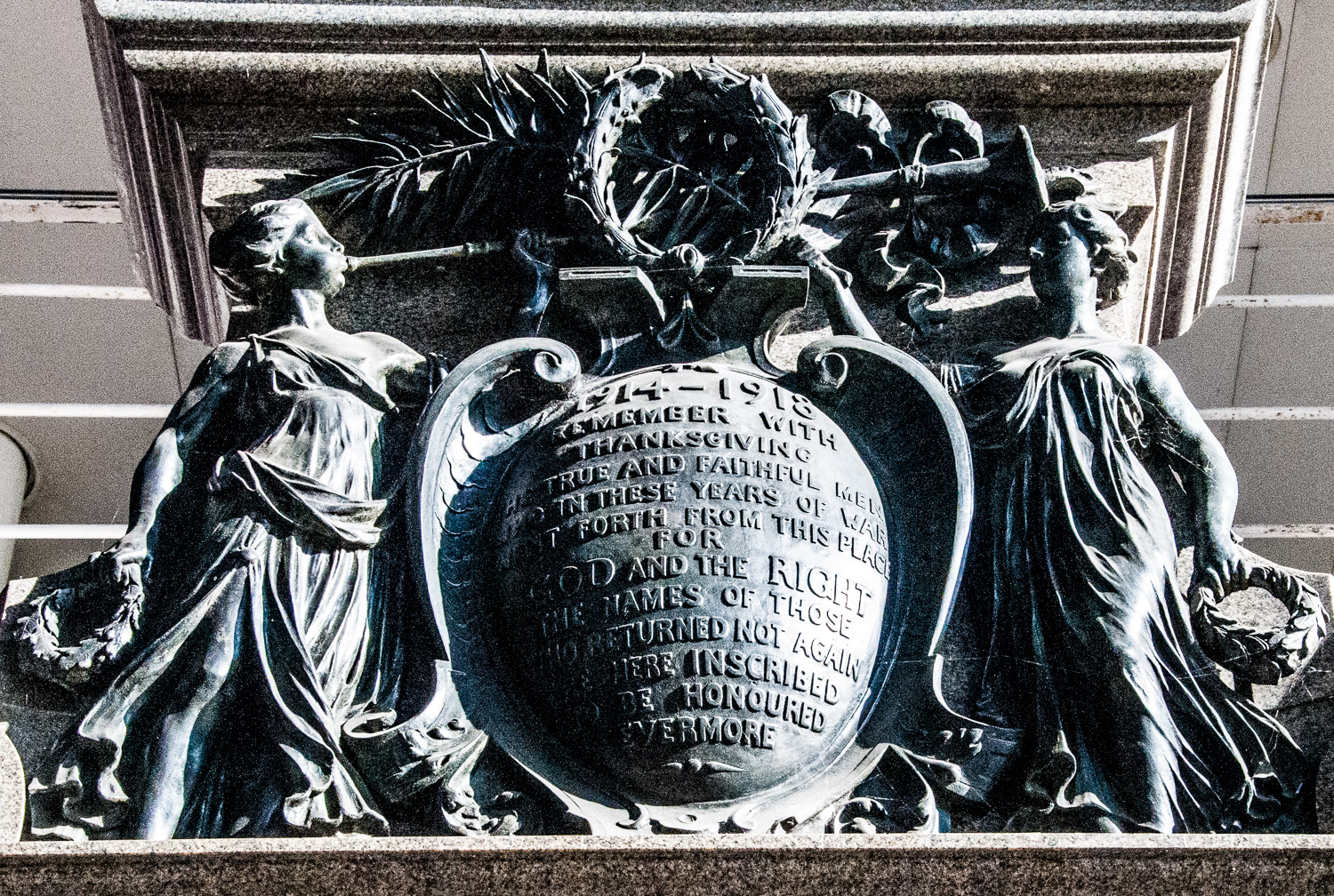
Between Fame and Victory holding laurel wreaths, the cartouche at the top reads …

1914-1918 Remember with thanksgiving the true and faithful men who in these years of war went forth from this place for God and the right. The names of those who returned not again are here inscribed to be honoured evermore.

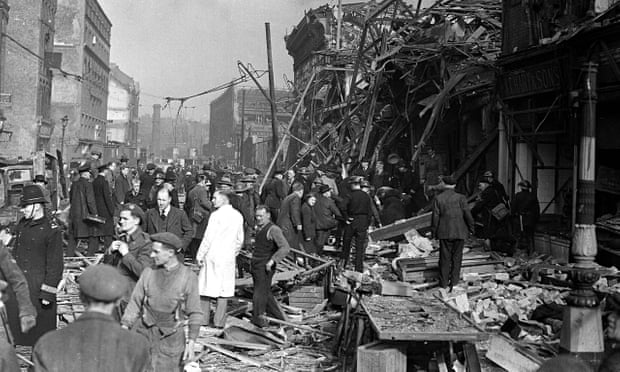
At 11:30 in the morning on 8th March 1945 the market was extremely busy, with long queues formed to buy from a consignment of rabbits that had just been delivered. Many in the queue were women and children. With an explosion that was heard all over London, a V2 rocket landed in a direct hit which also cast victims into railway tunnels beneath – 110 people died and many more were seriously injured.

The aftermath.

The monument was refurbished in 2004/5 and unveiled on 15 June 2005 by the Princess Royal and Lord Mayor Savory. The red granite plinth had been added and refers to lives lost in ‘conflict since the Great War’. On it mention is made of the women and children although the V2 event is not specifically referred to.

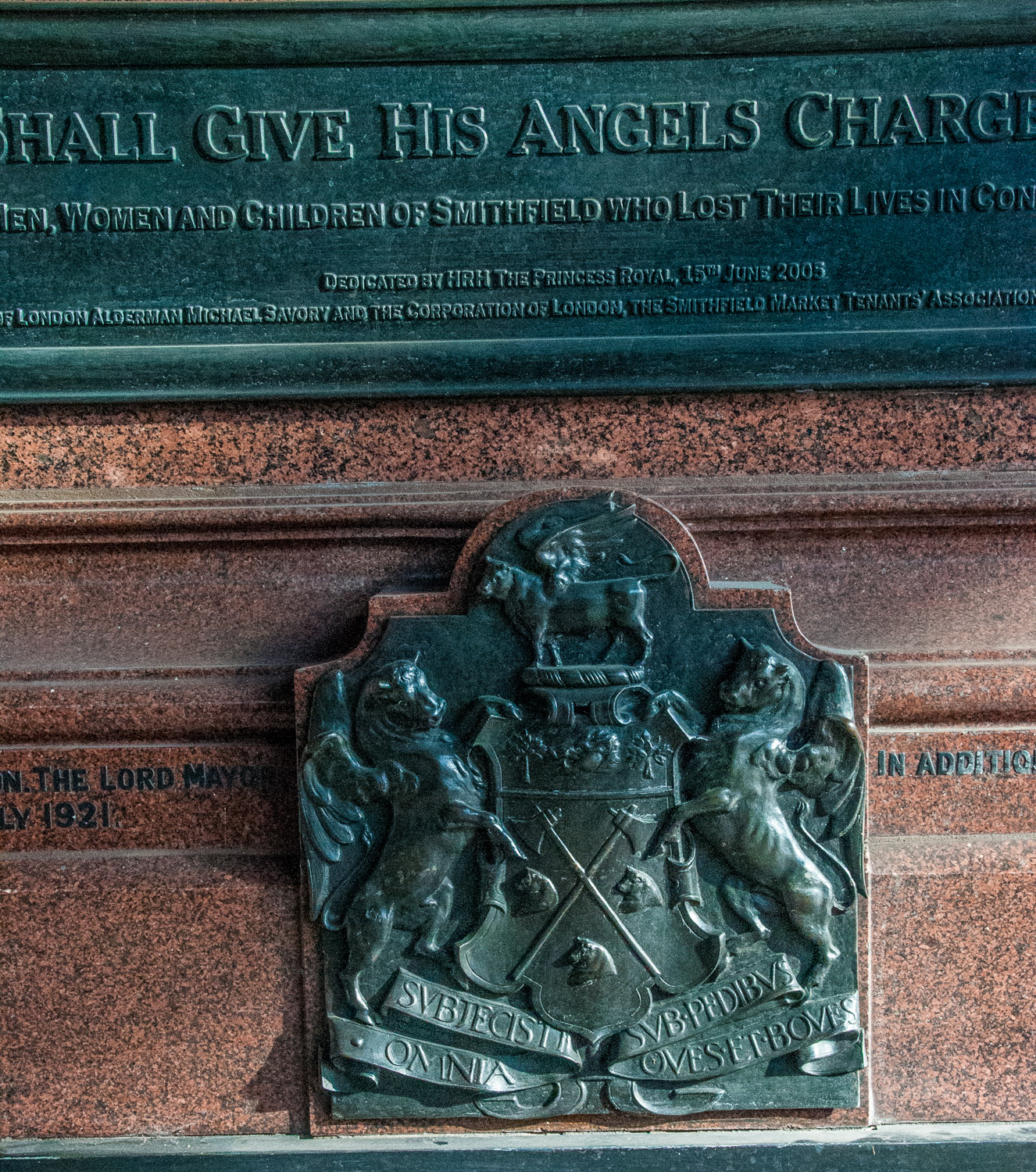
‘Thou hast put all things under his feet, all Sheep and Oxen’.

At the base is the coat of arms of the Worshipful Company of Butchers who helped to fund the refurbishment, along with the Corporation of London and the Smithfield Market Tenants’ Association.

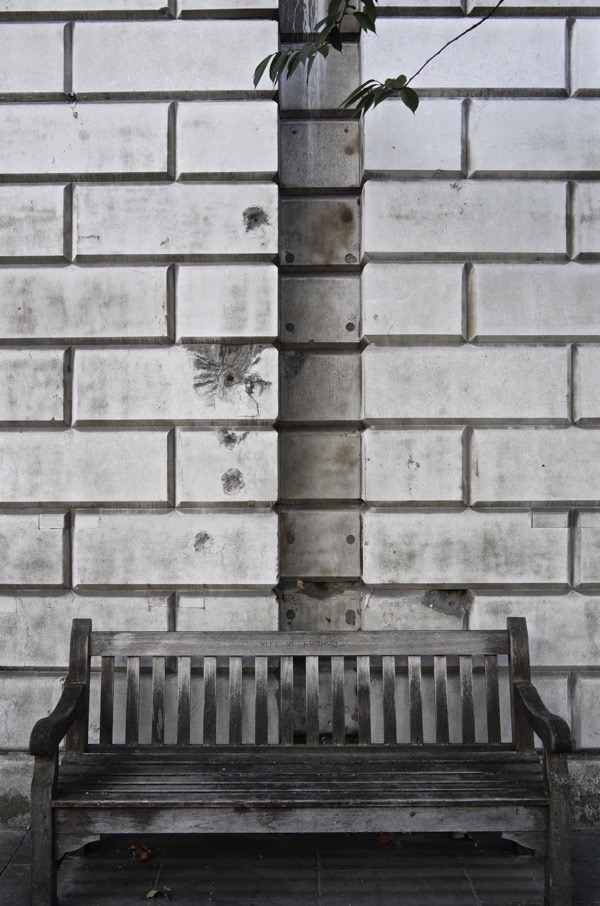
Incidentally, the market was also hit by bombs dropped from a Zeppelin in the First World War – you can still see the shrapnel marks nearby on the walls of St Bartholomew’s Hospital …

I have written about these and other scars of war that can be found around the City in an earlier blog: Bombs and Boundaries.


Page 13 of 16

Powered by WordPress & Theme by Anders Norén

Symbols & Secrets
Privacy Overview

This website uses cookies so that we can provide you with the best user experience possible. Cookie information is stored in your browser and performs functions such as recognising you when you return to our website and helping our team to understand which sections of the website you find most interesting and useful.