Walking the City of London

Category: Sculpture Page 34 of 41

Looking skywards

I spend a lot of time looking up as I wander around the City, which is another reason why I tend to take photographs at the weekend. That way I won’t be obstructing bustling City folk going about their business and get tutted at when I stop abruptly.

I hope you find this miscellaneous collection interesting. Some have appeared in blogs already but I have included them again because I just like them.

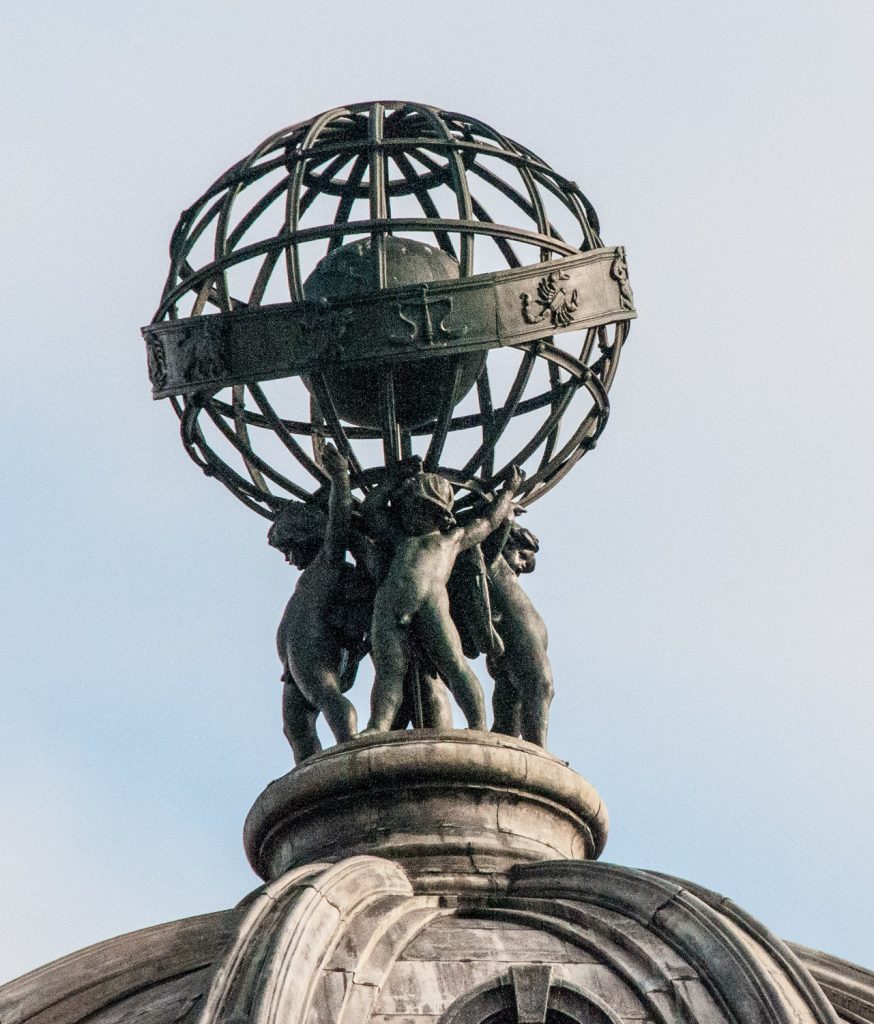
This globe sits on top of the London Metropolitan University building on Moorgate (EC2M 6SQ) …

I had never noticed before that it is encircled by the signs of the Zodiac.

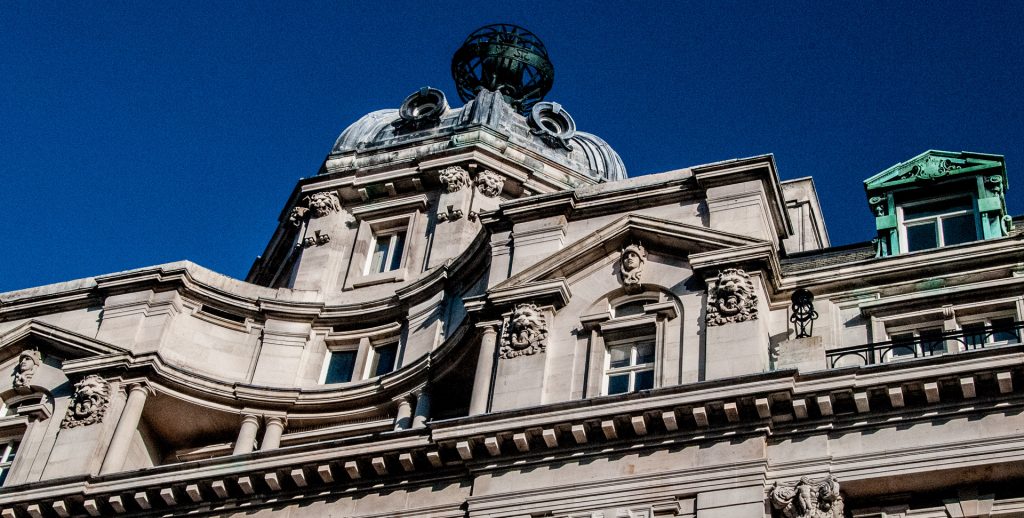
Here’s what it looks like at street level with the Globe Pub sign in the foreground …

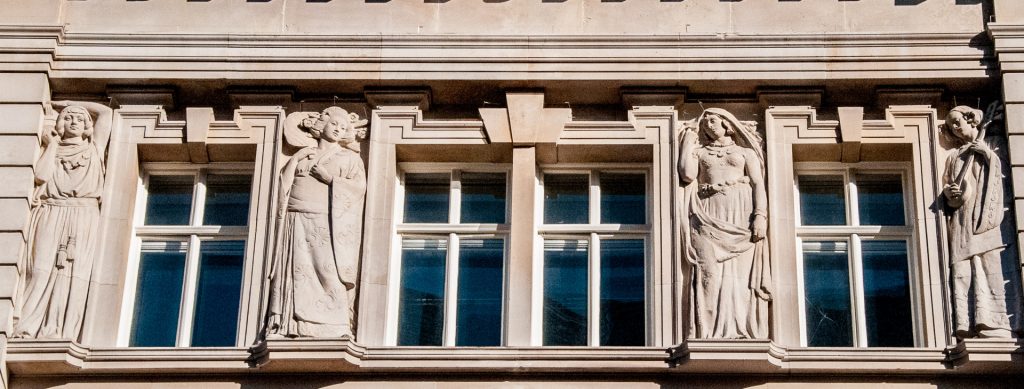
Whilst on the subject of Zodiacs, there are some attractive figures around the door of 107 Cheapside (EC2V 6DN) …

They were sculpted by John Skeaping, Barbara Hepworth’s first husband …

Sagittarius – November 22nd to December 21st.

Pisces – February 19th to March 20th.
Aquarius January 20th to February 18th.

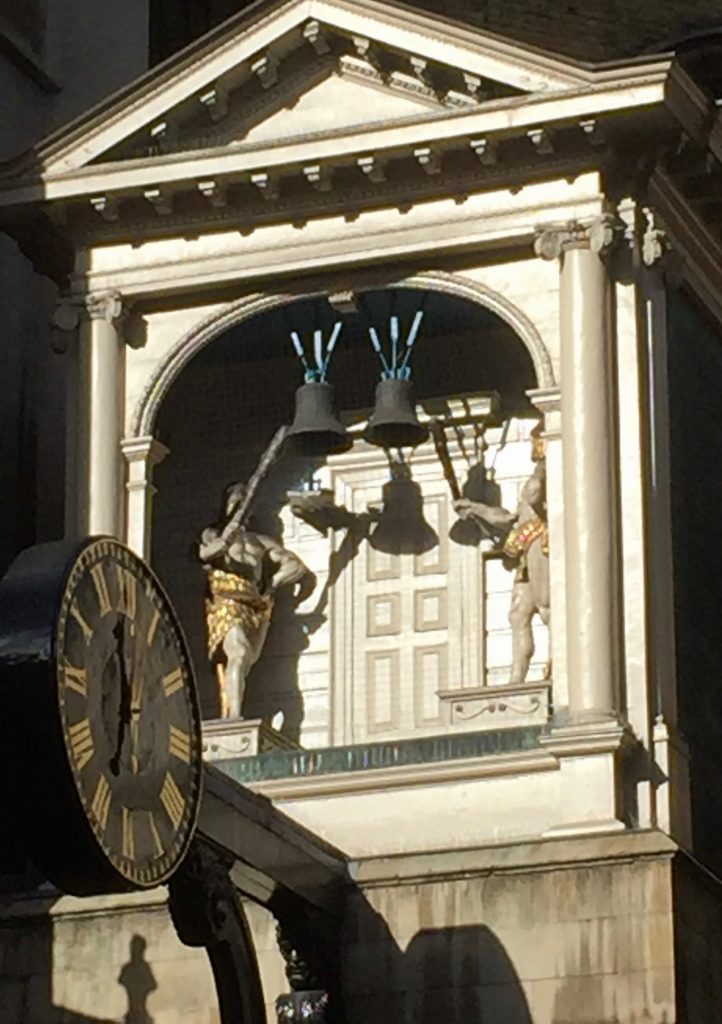
And in Cheapside there is another globe, this time supported by a straining Atlas balanced on top of a clock …

It was once the headquarters of the Atlas Assurance Company. The entrance was in King Street and above the door is another depiction of Atlas hard at work. I like the detail of his toes curled around the plinth (EC2V 8AU) …

Across the road is Kings House sporting a magnificent crown …

Above it is a very pretty Mercer Maiden dating from 1938 …

This wise old owl watches commuters as they flow back and forth over London Bridge. He was located outside what was once the Guardian Insurance Company headquarters (EC4N 7HR) …

Look up as you walk down Eastcheap and you will see the remains of a dead camel …

Constructed between 1883 and 1885, the building at 20 Eastcheap was once the headquarters of Peek Brothers & Co, dealers in tea, coffee and spices, whose trademark showed three camels bearing different shaped loads being led by a Bedouin Arab. The firm was particularly well known for its ‘Camel’ brand of tea. When Sir Henry Peek (son of one of the original founders) commissioned this building he wanted the panel over the entrance to replicate the trademark, right down to the dried bones of the dead camel lying in the sand in the foreground.

Admire the leopard’s head symbol of the Goldsmith’s Company over the entrance to the old churchyard of St Zachary on Gresham Street (EC2V 7HN) …

Guardian angels are still resting on their swings opposite St Paul’s Underground Station …

This fearsome dragon on Fleet Street guards the western entrance to the City on the site of the old Temple Bar. He looks like something straight out of a Harry Potter story …

I love spotting the wide variety of weather vanes that populate the skyline even in a City crowded with new skyscrapers. This one referencing the horrific death of a martyr sits atop St Lawrence Jewry (EC2V 5AA) …

St Lawrence was executed in San Lorenzo on 10 August 258 AD in a particularly gruesome fashion, being roasted to death on a gridiron. At one point, the legend tells us, he remarked ‘you can turn me over now, this side is done’. Appropriately, he is the patron saint of cooks, chefs and comedians.

The church of Anne and St Agnes also stands in Gresham Street and is unmistakable by its letter ‘A’ on the weather vane on top of the small tower. It is named after Anne, the mother of the virgin Mary and Agnes, a thirteen year old martyr (EC2V 7BX) …

Now compare and contrast these two war memorials.

In Holborn is this work by Albert Toft. Unveiled by the Lord Mayor in 1922, the inscriptions read …

To the glorious memory of the 22,000 Royal Fusiliers who fell in the Great War 1914-1919 (and added later) To the Royal Fusiliers who fell in the World war 1939-1945 and those fusiliers killed in subsequent campaigns.

Toft’s soldier stands confidently as he surveys the terrain, his foot resting on a rock, his rifle bayoneted, his left hand clenched in determination (EC1N 2LL).

Behind him is the magnificent, red terracotta, Gothic-style building by J.W. Waterhouse, which once housed the headquarters of the Prudential Insurance Company. Walk through the entrance arch to the courtyard and you will see the work of a sculptor who has chosen to illustrate war in a very different fashion. The memorial carries the names of the 786 Prudential employees who lost their lives in the First World War …

The sculptor was F V Blunstone and the main group represents a soldier sustained in his death agony by two angels. He is lying amidst war detritus with his right arm resting on the wheel of some wrecked artillery piece. His careworn face contrasts with that of the sombre, beautiful girls with their uplifted wings. I find it incredibly moving.

I have written about angels in the City before and they are usually asexual, but these are clearly female.

And finally, as I walked along Cornhill one day I glanced up and saw these rather sinister figures silhouetted against the sky…

Closer inspection shows them to be devils, and rather angry and malevolent ones too …

They look down on St Peter upon Cornhill and are known as the Cornhill Devils (EC3V 3PD). The story goes that, when plans were submitted for the late Victorian building next to the church, the rector noticed that they impinged slightly on church land and lodged a strong objection. Everything had to literally go back to the drawing board at great inconvenience and expense. The terracotta devils looking down on the entrance to the church are said to be the architect’s revenge with the lowest devil bearing some resemblance to the cleric himself.

If this resembles the rector he must have been a pretty ugly guy!

Happy New year!

Do remember that you can follow me on Instagram :
https://www.instagram.com/london_city_gent/

Fleet Street Ghosts

Although I have written about Fleet Street in an earlier blog, I always find something new to write about when I walk there.

How about these impressive gates incorporating the words ‘Serjeant’s Inn’ …

This image has an empty alt attribute; its file name is DSC_5809-609x1024.jpg

What caught my eye, however, was the dove perched on a twisted serpent and the words Prudens Simplicitas (Prudent Simplicity). This was the motto of the Amicable Society which was based here from 1838 and was the world’s first mutual life insurance company. The unusual choice of creatures may refer to a biblical quotation in which Jesus exhorted followers to be ‘wise as serpents, gentle as doves’. Lost during building works, the gates were rediscovered in a scrapyard in 1937 and returned to their original position here in 1970.

The arms were officially granted on 9 February 1808 to the Amicable Society for a Perpetual Assurance Office and re-granted 14 April 1938 to the Norwich Union Life Insurance Society after the two organisations merged. You can see the dove and serpent in the Norwich Union coat of arms …

Arms of Norwich Union Life Insurance Society
Esto Perpetua means ‘Be everlasting’.

There is more information about the coat of arms and its fascinating symbolism here, the connection with Aviva here, and my blog about Insurance Company ghosts here.

How sad that the venerable Thomas Cook travel agency has gone into compulsory liquidation. Cook started organising leisure trips in the summer of 1841 when he arranged a successful one-day rail excursion at a shilling a head from Leicester to Loughborough. During the next three summers Mr Cook put together a succession of trips, taking passengers to Leicester, Nottingham, Derby and Birmingham. Four years later, he organised his first trip abroad, taking a group from Leicester to Calais. This was followed in the 1860s by trips to Switzerland, Italy, Egypt and America …

Italy and Switzerland were popular early destinations

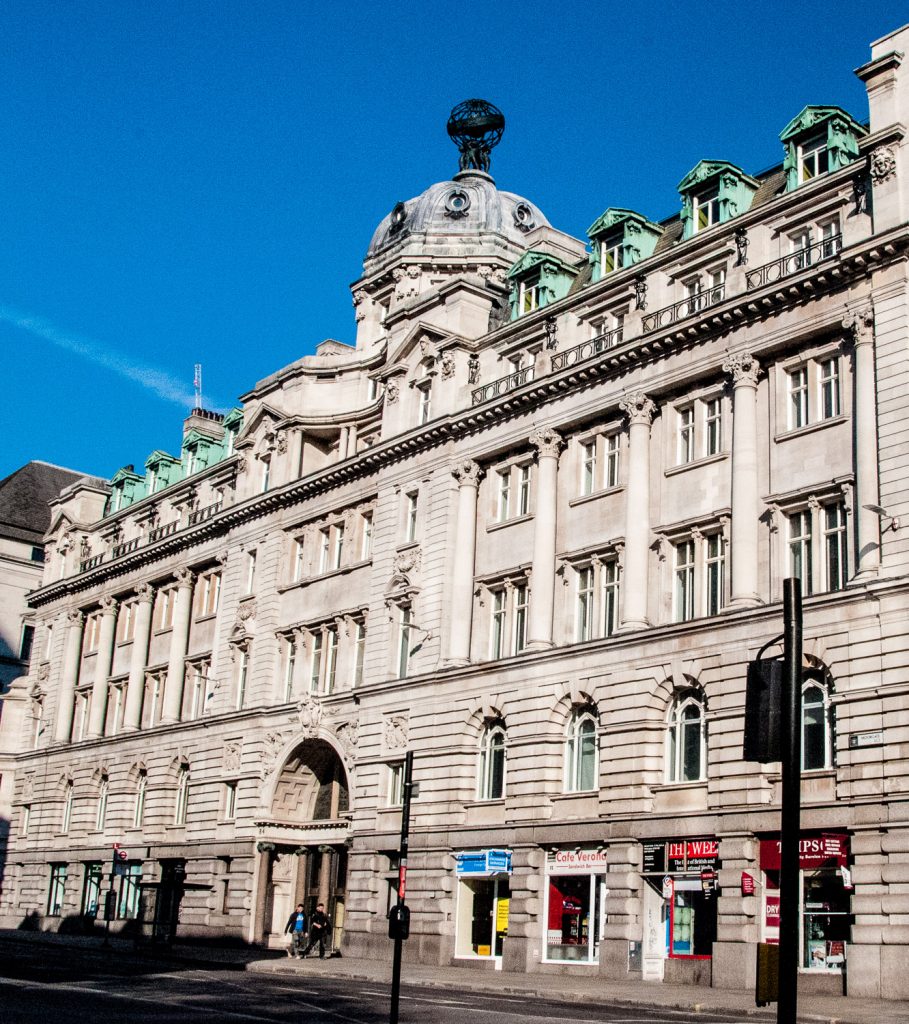
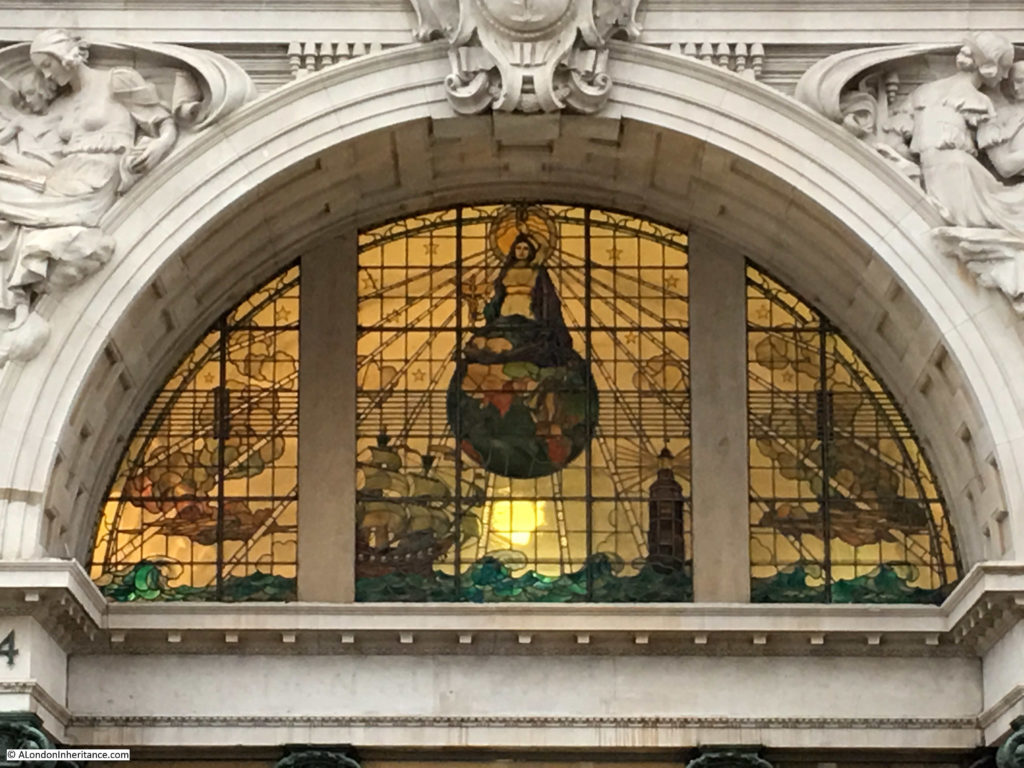
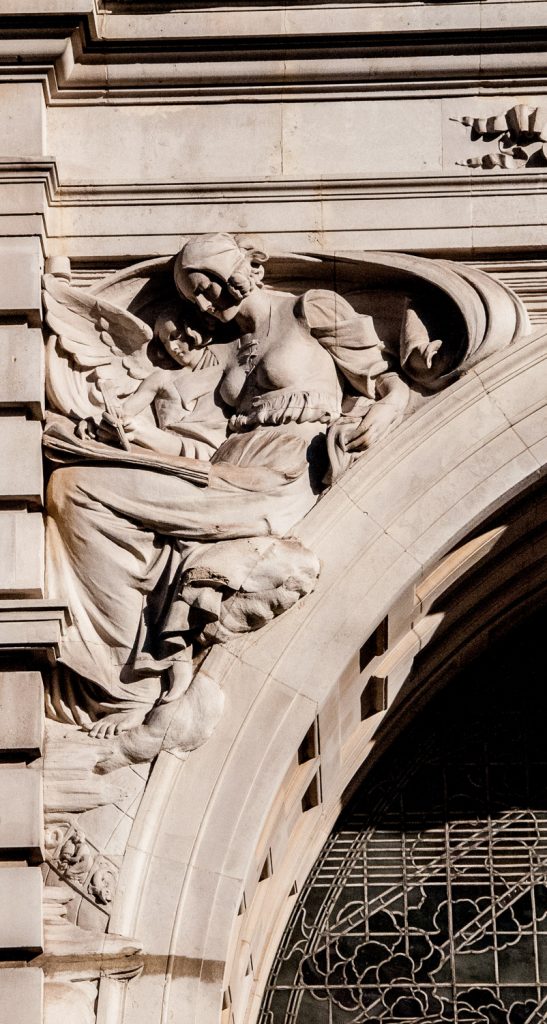
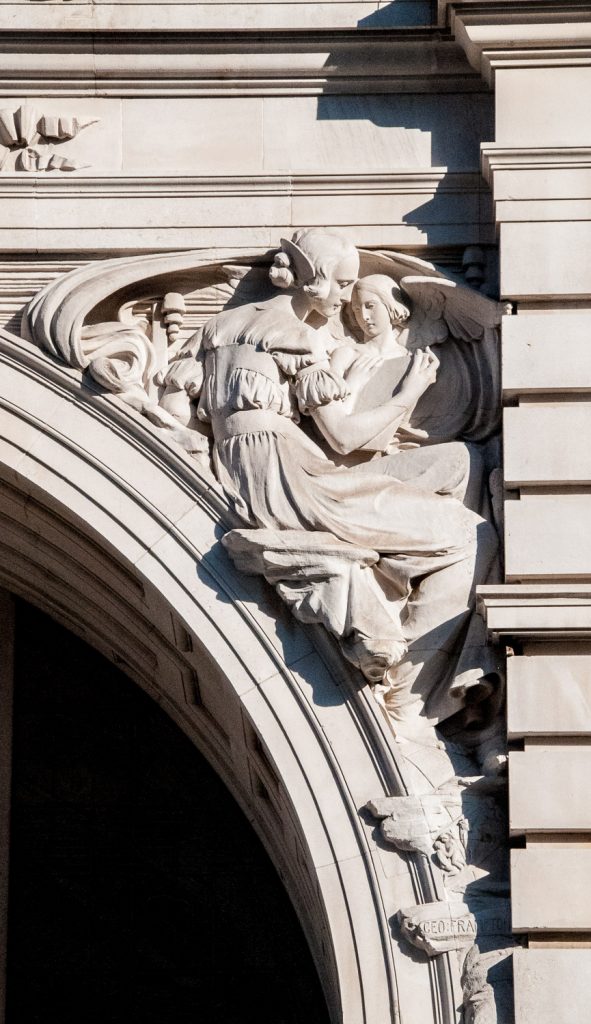
In partnership with his son, John Mason Cook, he opened an office in Fleet Street in 1865. In accordance with his beliefs, Mr Cook senior and his wife also ran a small temperance hotel above the office. You can still see the office now. It is graced with numerous globes and cherubs …

This image has an empty alt attribute; its file name is 20170409-DSC_1790-1024x576.jpg

Hundreds of cherubs live in the City – you can find many of them pictured in my blog Charming Cherubs.

The Cook family sold the business in 1928 and the Thomas Cook brand has just been saved from obscurity after the Chinese owner of Club Med said it would buy the name for £11m. There is a nice potted history of the company here.

Once the beating heart of newspaper journalism, Fleet Street’s printing past survives only in some commemorative plaques and old signage.

Many of the alleys and courtyards contain plaques at their entrances. This one recalls a dramatic event as reported by The Sun newspaper …

This image has an empty alt attribute; its file name is DSC_4691-1024x614.jpg

Computerisation is represented, a bit bizarrely I think, by the electronic Pac-Man game …

This image has an empty alt attribute; its file name is DSC_3344-1024x620.jpg

And some old signage is still clear …

This image has an empty alt attribute; its file name is DSC_5865-680x1024.jpg

Child’s Bank has traded from the same Fleet Street site since 1673. Its impressive Grade II* listed premises, designed by eminent architect John Gibson, were opened here in 1880 …

I really like the following story. When the founder’s grandson, Robert Child, died in 1782 without any sons he refused to leave his interests in the Bank to his daughter because she had eloped earlier that year with the Earl of Westmoreland. Child didn’t want the Earl to get hold of the Child family wealth so he left it in trust to his daughter’s second surviving son or eldest daughter. This turned out to be Lady Sarah Sophia Fane who was born in 1785. There must have been a great supply of Earls at the time because she married the Earl of Jersey in 1804 thereby becoming a Countess. Here she is in a painting by Alfred Edward Chalon …

Sarah Sophia Child Villiers, Countess of Jersey (née Fane)

Upon her majority in 1806 she became senior partner in the Bank and exercised her rights personally until her death in 1867. She was known by the nickname ‘Silence’, which was ironic since, famously, she almost never stopped talking. The memoirist Captain Gronow, who disliked her, called her ‘a theatrical tragedy queen’, and considered her ‘ill-bred and inconceivably rude’.

And now two memorials to real Queens …

Mary looks down on Pret’s customers as they buy their lunch at 143-144 Fleet Street.

Mary Queen of Scots House was built in 1905 for a Scottish insurance company. The statue was the idea of one of the developers, Sir John Tollemache Sinclair, Bart, MP, who was a big fan of the ill-fated lady.
The architect was one R.M. Roe, who concocted ‘a facade as frilly as a doily with lashings of French Flamboyant tracery’.

Her nemesis is commemorated nearby …

She looks young, doesn’t she?

This statue of Queen Elizabeth I is nearby in a niche at St Dunstan-in-the-West and its history is rather complex. Some current thinking is that the Queen dates from 1670-99 despite a date on the base of 1586, which would have made it the only statue carved in her lifetime. It is now thought that, rather than the date of sculpture, this date was inscribed on it when the statue was placed on a restored Lud Gate in 1670 after the Great Fire and is merely making reference to the original gate. When the gate was demolished in 1760 she was moved to a previous St Dunstan’s but this was torn down in 1829-33 to be replaced by the current building. Meanwhile it seems that the statue spent the time in the basement of a nearby pub. It was only when that too was demolished in 1839 that the statue was rediscovered and put in its current niche on St Dunstan’s. Millicent Fawcett, the prominent suffragist, left £700 in her will for the statue’s upkeep and the funds are managed by the Society for the Protection of Ancient Buildings.

I have written about Fleet Street and its features many times but I have no doubt that I will be doing so again!

Don’t forget you can follow me on Instagram:

https://www.instagram.com/london_city_gent/

A wander around St Paul’s (again)

I find myself continually drawn to the area around the Cathedral. There is always the constant background noise of tourist chatter but there is also something wonderful about walking around in the shadow of Sir Christopher Wren’s sublime masterpiece.

And there is also a lot to see.

This old Parish Pump, dated 1819, bears the name of St Faith’s Parish despite the fact that the church after which it was named was demolished in 1256 (yes, over 700 years ago) to allow for the eastern expansion of St Paul’s.

This image has an empty alt attribute; its file name is DSC_6732-524x1024.jpg

From the 1250s until the reign of Edward VI, the parish known as St Faith under St Paul’s literally worshiped beneath St Paul’s Cathedral, using a space the end of the west crypt under St Paul’s Quire. After the Great Fire of 1666 the parish was united with St Augustine Watling Street. The pump was once situated against railings of St Paul’s Churchyard close to St Paul’s Cross, but was moved to its present position in 1973.

The old parish still has a boundary marker on the wall of St Paul’s Cathedral School …

You can read more about Parish Markers here.

Emily Young FRBS is one of the country’s foremost stone sculptors and you can enjoy her work in the form of Angels I to V in the courtyard opposite the Cathedral’s main entrance. I never tire of looking at them …

I have written an entire blog about City Angels and Devils and you can access it here.

Now climb up the steps to the imposing West Door and admire, if that’s the right word, the elegant cursive script of the 18th century ‘vandals’ who scratched their names in the stonework …

Some of it is very high up which leads me to believe the marks were made by workmen using sharp implements whilst standing on a scaffold …

This image has an empty alt attribute; its file name is DSC_4029-467x1024.jpg

In the gardens you will find this pretty little drinking fountain …

An extraordinary coincidence occurred during the Cathedral’s rebuilding. Whilst staking out the foundations in the newly cleared site, Sir Christopher needed to mark a particular spot and asked a labourer to fetch a stone. The man came back with a fragment of a broken tombstone on which was carved 0ne word, RESURGAM – I shall rise again. Wren’s son later wrote that the architect never forgot that omen and it was an incident from which he drew comfort when the obstacles that arose during the long years of rebuilding seemed insuperable.

If you look up at the pediment of the south porch this is what you will see …

This image has an empty alt attribute; its file name is DSC_4045-1024x950.jpg

The sculptor Caius Gabriel Cibber was instructed to portray a phoenix rising from the ashes. This would not only be a fitting symbol for the Cathedral but would also include the one word that had cheered Wren two decades earlier.

In Paternoster Square there is this unusual sundial …

This image has an empty alt attribute; its file name is DSC_6739-730x1024.jpg

I took this picture on 28th September.

Opposite the Cathedral on Ludgate Hill is a nice double aperture pillar box …

It was cast in 1996 …

At that time Machan Engineering were the only foundry in the UK to make the traditional cast-iron pillar boxes. The company had supplied Royal Mail since the 1980s and used to get 150 orders a year but in 2014 they only received 20 orders and in 2015 they had just one. Sadly the business closed later that year.

I have written a blog devoted to City postboxes and you can find it here.

And finally, look closely at limestone wall which supports the signage for the London Stock Exchange Group. You will see a great collection of bivalves – oyster shells from the Jurassic period when dinosaurs really did walk the earth …

Read more about the City’s fossils in my blog Jurassic City.

Do remember that you can follow me on Instagram :
https://www.instagram.com/london_city_gent/

The great man himself portrayed in stained glass at the church of St Lawrence Jewry

Page 34 of 41

Powered by WordPress & Theme by Anders Norén

Symbols & Secrets
Privacy Overview

This website uses cookies so that we can provide you with the best user experience possible. Cookie information is stored in your browser and performs functions such as recognising you when you return to our website and helping our team to understand which sections of the website you find most interesting and useful.