Walking the City of London

Category: Sculpture Page 19 of 41

Experiments in black and white – people and places.

Usually I shoot images in colour but sometimes wonder whether black and white would be more effective.

This week I have been experimenting and here are the results starting with some people commemorated at St Giles-without-Cripplegate.

John Milton (1608-1674) the poet and republican is perhaps the most famous former church parishioner and his statue stands by the south wall of the church. It is made of metal, which means it is one of the few memorials in the church that survived the bombing in the Second World War. It’s the work of the sculptor Horace Montford (c1840-1919) and is based on a bust made in about 1654 …

There is also a bust under the organ gallery by the sculptor George Frampton which clearly indicates Milton’s later life blindness …

Oliver Cromwell, the military and political leader, who was Lord Protector of England, Scotland and Ireland from 1653 to 1658, was married in St Giles in 1620, aged 21. His wife, Elizabeth Bouchier, was the daughter of a Cripplegate leather merchant, and the couple had nine children. The St Giles bust follows his ‘warts and all’ instruction …

Here he is again (looking fierce) at the Guildhall Art Gallery …

He died in 1658 and his death mask is on display in the Museum of London …

After the Restoration, Charles II had Cromwell’s body was exhumed from Westminster Abbey on 30 January 1661, This was the the 12th anniversary of the execution of Charles’ father and Cromwell’s remains were subjected to a posthumous execution at Tyburn. After the body had been hanged in chains it was thrown into a pit with the head set on a spike outside Parliament.

Controversially, a statue was subsequently erected to him outside Parliament in 1899 …

I’m quite fond of this chap …

I smile when I see him because he looks like a man who enjoyed his food. Despite starting life as a bricklayer’s labourer, he amassed a vast fortune and, even though he remained virtually illiterate, he was eventually elected Lord Mayor of London. Here is his 1800 portrait by William Beechey …

He built nine houses for aged or infirm workmen and tradesmen who had fallen on hard times. No doubt remembering his own upbringing, he made sure that there was ‘nothing to distinguish them from the other dwelling-houses, and without ostentatious display of stone or other inscription to denote the poverty of the inhabitants’. That’s why I like him.

Highgate Cemetery is the last resting place of many famous and infamous individuals and Bruce Reynolds is one of them …

Bruce Richard Reynolds (1931 – 2013) was an English criminal who masterminded the 1963 Great Train Robbery. At the time it was Britain’s largest robbery, netting £2,631,684, equivalent to £58 million today. Reynolds spent five years on the run before being sentenced to 25 years in 1969. You can read his obituary here.

St Peter’s Hill runs north alongside the College and at the top you will find the Firefighters Memorial. On its octagonal bronze base are the names of the 997 men and women of the fire service who lost their lives during the conflict. The sculpture features two firemen ‘working a branch’, with their legs spread to take the strain of the hose …

You can read more about it in my March 2022 blog.

The War Memorial in Wesley’s Chapel

It’s hard not to take an atmospheric picture at the Bunhill Burial Ground …

At the Inns of Court …

You can probably guess what this alley was originally known as …

You can read about its history here.

Narrow thoroughfares can look quite spooky …

As can old ruins like the church of St Dunstan-in-the-East, gutted by bombing in the Second World War …

I like The Cottage at number 3 Hayne Street, just off Charterhouse Square …

Read more about it here.

Images of architecture seem to respond well to the black and white approach. New buildings dwarf Leadenhall Market …

The Duke of Wellington at Bank Junction – a glass monster pierces the sky behind the Royal Exchange.

Tower 42 …

The Lloyd’s building …

At the Barbican (with colour images for contrast) …

.

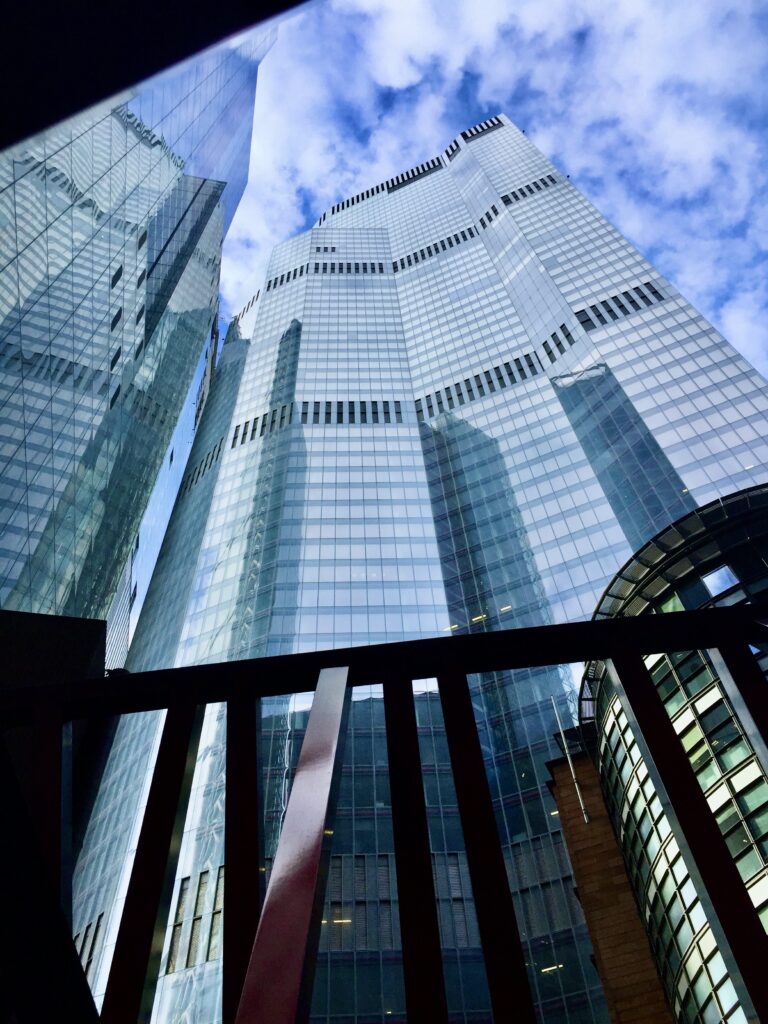
However, I think some images definitely work better in colour. Especially if there is some blue sky and fluffy clouds …

Here are a few quirky choices to finish.

The East Window in St Martin in the Fields. You can read all about it here.

Chicago car park …

Spitalfields knockers

I think this exercise has convinced me to use more black and white images in future blogs.

If you would like to follow me on Instagram here is the link …

https://www.instagram.com/london_city_gent/

More City Animals.

I love my City Animals collection and I have gathered so many images now I can start to put them into little categories and that’s what I’ve done today.

For example, in the ‘faithful friends’ category would be the following.

Dr Johnson’s cat Hodge …

Here in Gough Square he sits proudly on top of his master’s famous dictionary having just enjoyed a tasty oyster snack. Johnson was immensely fond of him (‘A very fine cat indeed!’) and personally bought oysters for him rather than ask the servants to. He was (probably justifiably) concerned that the staff would resent this and take their annoyance out on poor Hodge.

He looks towards the house where they both lived at the time and where the dictionary was written …

The House is open to the public …

Now two dogs.

Philip Thomas Byard Clayton (1885-1972), popularly known as ‘Tubby’ Clayton, served as a priest during the First World War, and opened and maintained a place of rest near Ypres, an Everyman’s Club, much frequented by officers and men alike. This became the TocH movement which continues to this day but has, sadly, struggled in recent years.

Tubby became Vicar of All Hallows by the Tower in 1922 and remained there for forty years, until his retirement in 1962. His effigy in the church is one of the last works by Cecil Thomas, the ‘soldier sculptor’, and Tubby’s dog Chippy sits on a tasselled cushion at his feet …

Clayton owned a succession of Scottish Terriers, one of them a gift from the Queen Mother. All of them were called Chippy.

King Charles II was very fond of his spaniels. Here one runs alongside his horse as they parade down Cheapside …

The terracotta frieze was saved from a Victorian building that previously occupied the site. It’s now displayed on the north side of 1 Poultry.

Whilst on Poultry look up and you’ll see a reference to the old poultry market that once stood here, a boy struggling to hold a goose …

The goose was a suggestion by the architect Sir Edwin Lutyens. The building is now a private club and restaurant, called The Ned in Sir Edwin’s honour.

My collection contains many water creatures.

At the incredibly moving memorial to the men of the Merchant Navy lost at sea during the two World Wars a boy rides a dolphin surrounded by fishes and sea horses …

These two dolphins on The Ship pub in Hart street look rather miserable despite being Grade II listed like the building itself …

Mr Grumpy …

There are some nicely carved fishes in Cheapside, part of a Zodiac motif …

Not surprisingly, there are lots of fishy folk along the Thames Walk, both on and near what was once Billingsgate Market …

I’m told that could be a Herring Sky in the background – very appropriate …

This one looks like he’s poking his tongue out at us …

I also have a fine collection of insects.

Bees in Fleet Street …

Bees in Pope’s Head Alley …

And a solitary bee in Cheapside …

There’s a flea in the Seething Lane Garden

And numerous grasshoppers celebrating the philanthropy of Thomas Gresham …

And finally, a few slightly quirky ones – two from London and two from a recent trip to Malta.

A beaver referencing the Hudson’s Bay Company …

A ram at the entrance to an old wool warehouse …

And the Maltese selection:

A crane disguised as a giraffe …

And a colourful cat …

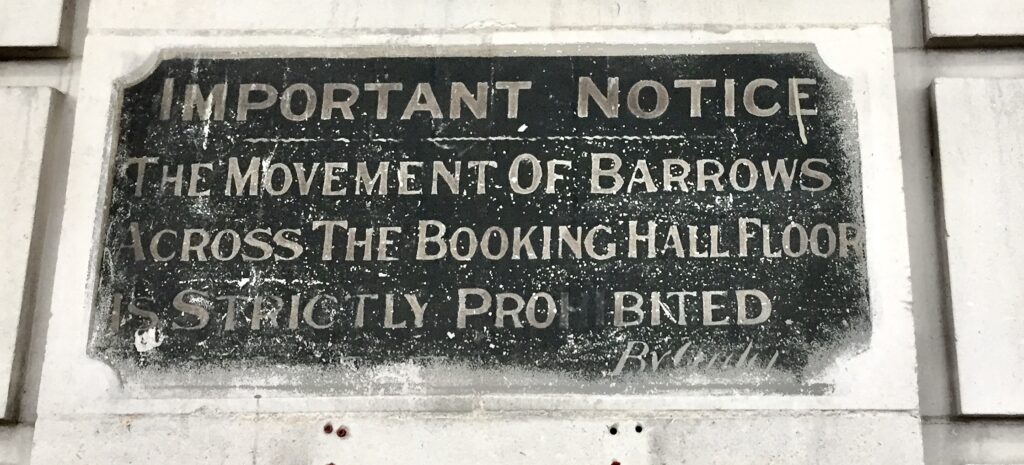
Incidentally, when I do a blog on ‘weird signage’ I shall definitely include this one …

The temptation to leave a footprint was almost irresistible.

If you would like to follow me on Instagram here is the link …
https://www.instagram.com/london_city_gent/

Mythical creatures, famous Londoners and the City gardeners’ campaign against thoughtless smokers.

Isn’t it nice when the sun is out! I decided it was time for another wander around the City and from the Barbican Highwalk I spotted an old friend who it seems has at last found a permanent resting place …

The Minotaur was made by Michael Ayrton. The creature in the sculpture has been described as ‘looking powerful and muscular. It stands hunched over when on his plinth, but he looks ready to take off running at any moment. It has the body of a man, with heavy muscles in his legs and chest, and two cloven feet. It has the head of a bull with two pointed horns and large, hunched shoulders. Its body is hairy, and its hair moves even though it is made of metal’ …

The myth of Theseus and the Minotaur is one of the most tragic and fascinating myths of the Greek Mythology and you can read more about it here.

Onward to Lombard Street.

I took a walk down the shadowy and rather mysterious Change Alley and came across a building that once housed the Scottish Widows insurance company along with its magnificent crest. At the centre is the mythical winged horse, Pegasus, symbol of immortality and mastery of time. A naked figure, the Greek hero Bellerophon, is shown grasping its mane.  In mythology, Bellerophon captured Pegasus and rode him into battle. This explains the motto ‘Take time by the forelock’, or ‘seize the opportunity’. Presumably time could be tamed by taking out a Scottish Widows policy to make provision against the uncertainties of the future …

I next headed down King William Street.

Rising from the flames and just about to take off over the City is the legendary Phoenix bird and from 1915 until 1983 this was the headquarters of the Phoenix Assurance Company (EC4N 7DA). One can see why the Phoenix legend of rebirth and restoration appealed as the name for an insurance company …

Incidentally, have you ever paused to admire the Duke of Wellington statue at Bank junction? And do you think, like I once did, that it was there to celebrate his prowess as a military commander? Well, actually, it’s to commemorate the fact that he helped to get a road built!

It was erected to show the City’s gratitude for Wellington’s help in assisting the passage of the London Bridge Approaches Act 1827 which led to the creation of King William Street. The government donated the metal, which is bronze from captured enemy cannon melted down after the Battle of Waterloo.

A gardener labours diligently at the rear of Brewers’ Hall (EC2V 7HR) …

Philip Ward-Jackson, in his book Public Sculpture of the City of London, tells us of the Trees, Gardens and Open Spaces Committee of the Corporation which was chaired by Frederick Cleary. In his autobiography Cleary recorded that Jonzen’s figure below was intended as a tribute to the efforts of his committee but Ward-Jackson feels that ‘it might have been better described as a symbol of the ‘greening’ of the City in the post-war period’. Most appropriately, Mr Cleary has a garden named after him, and you can read about it in my earlier blog about City gardens generally.

Apparently Jonzen, on being given the subject by the Corporation …

… decided on a kneeling figure of a young man, who, having planted a bulb, was gently stroking over the earth.

There are several other works by Jonzen in the City.

This one, Beyond Tomorrow (1972), is in Basinghall Street, behind the Guildhall …

Sited opposite is this pretty glass fountain by Allen David …

It was commissioned by Mrs Gilbert Edgar, wife of Gilbert H. Edgar CBE, who was a City of London Sheriff between 1963-4. It was unveiled by the Lord Mayor of London on 10th December 1969.

Another work by Jonzen, in the Seething Lane Gardens, is of one of my favourite Londoners, Samuel Pepys. It was commissioned and erected by The Samuel Pepys Club in 1983 …

It contains musical notes, so of you can read music you can not only see Sam but also ‘hear’ his voice …

I thought the Guildhall looked nice against the blue sky …

A remarkably wart-free Oliver Cromwell looks fearsome outside the Guildhall Art Gallery with Samuel Pepys and Dick Whittington in the background (EC2V 5AE) …

Dick is on Highgate Hill and has just heard the bells of St Mary-le-Bow ring out ‘Turn again Whittington, thrice Lord Mayor of London’. He’s giving it some serious thought as his cat curls around his legs (note the tear in his leggings indicating that he has experienced hard times) …

Look closely at the elegant limestone facade of the building and you will see a great collection of bivalves – oyster shells from the Jurassic period when dinosaurs really did walk the earth …

Read more about more of the fossils on view in the City in my blog Jurassic City.

George Peabody was an American financier and philanthropist and is widely regarded as the father of modern philanthropy. Here he sits, looking pretty relaxed, at the northern end of the Royal Exchange Buildings …

Born in Baltimore he became extremely wealthy importing British dried goods and, after visiting frequently, became a permanent London resident in 1838. In retirement he devoted himself to charitable causes setting up a trust, the Peabody Donation Fund, to assist ‘the honest and industrious poor of London’. The Peabody Trustees would use the fund to provide ‘cheap, clean, well-drained and healthful dwellings for the poor’ with the first donation being made in 1862.

Peabody buildings are easily recognised by their attractive honey-coloured brickwork. This block is in Errol Street, Islington …

Immensely respected in later life, he was offered a baronetcy by Queen Victoria but declined it. After his death in 1869 his body rested for a month in Westminster Abbey after which, on the Queen’s orders, his body was returned to America for burial on the British battleship HMS Monarch.

Close to Peabody is a statue to another remarkable man – Paul Julius Reuter. The rough-cut granite sculpture by the Oxford-based sculptor Michael Black commemorates the 19th-century pioneer of communications and news delivery. It is a fitting place for the statue because the stone head faces the Royal Exchange which was the reason why Reuter set up his business in the City. He established his offices in 1851 to the east of the Royal Exchange building. The stone monument was erected by Reuters to mark the 125th anniversary of the Reuters Foundation. It was unveiled by Edmund L de Rothschild on 18 October 1976 …

The life of Reuter was most interesting. Having started his career as a humble clerk in a bank, he went on to ‘see the future’ of transmitting the news – regardless of whether it was financial or world news. If the ‘modern’ technology of telegraphy – also known then as Telegrams – was not in place, Reuter used carrier pigeons and even canisters floating in the sea to convey news as fast as possible. Such was his ambition to be the first with the news.

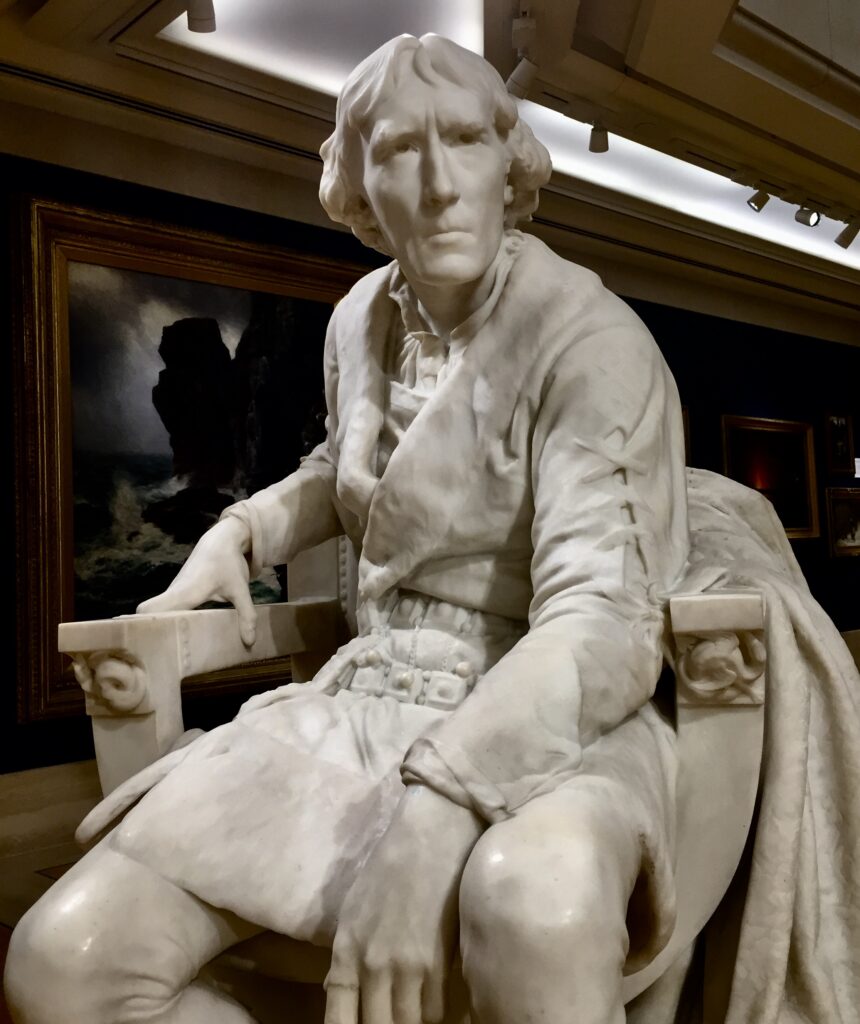
Sir John Soane stands on Lothbury wearing a full-length cloak and holding a bundle of drawings and a set square. The niche is decorated with the neo-Grecian motifs associated with his style. Sir John’s day job was as architect and surveyor to the Bank of England, and he held the position for 45 years. When he resigned in 1833, most of the Bank’s three-acre footprint had been remodelled in some way, and a number of spectacular set-piece facades inserted…

In the wake of the Great War, Britain’s national debt grew to such an extent that Soane’s bank was too small for the business to be transacted; unfortunately, this renovation was done by the architect Herbert Baker in a way that virtually erased Soane’s work.

Many are still angry at the destruction. Here is what the blogger at Ornamental Passions has to say:

‘The irony of placing a tribute to the architect actually on the sad ruins of his masterpiece was not lost on critics, especially as it is so close to Soane’s much loved Tivoli Corner which Baker had promised to preserve but actually totally rebuilt. He is lucky to have his back turned to an act of vandalism more brutal than anything the Luftwaffe achieved. Indeed, nothing illustrates the Nazi’s abysmal cultural values than that fact that the Bank was untouched in the blitz’. Wow!

Carrying her sword and scales, Lady Justice stands above the Ukrainian flag at the Institute of Chartered Accountants …

Around the corner, the building boasts the poshest letter box in the City …

Speak to any one of the wonderful team of City gardeners and they will tell you that one of the greatest threats to their work are smokers discarding cigarette butts in flower beds. Nicotine is poisonous to plants and is a component of many weed killers.

So the City is fighting back using humour …

The final paragraph on the accompanying sign made me laugh out loud …

If you would like to follow me on Instagram here is the link …
https://www.instagram.com/london_city_gent/

Page 19 of 41

Powered by WordPress & Theme by Anders Norén

Symbols & Secrets
Privacy Overview

This website uses cookies so that we can provide you with the best user experience possible. Cookie information is stored in your browser and performs functions such as recognising you when you return to our website and helping our team to understand which sections of the website you find most interesting and useful.