Walking the City of London

Category: Sculpture Page 20 of 41

Another visit to St Bride’s – lockable coffins and snoring churchgoers.

Walking down Ludgate Hill the other day I grabbed this quick picture of St Bride’s because there were also some nice fluffy clouds in the frame …

It occurred to me then that the church, with its famous ‘wedding cake’ steeple, had been extremely fortunate not to be now obscured by the extensive post-war development that took place in the City as it very gradually recovered from the War. Someone working in the City at the turn of the 20th century would have recognised both the church and the building in front of it.

This sent me in search of some other images. Here’s the view from a bit further up Ludgate Hill …

Here is a view from the hill in the 1940s from a postcard series called London Under Fire

I decided to visit St Bride’s again taking this picture as I approached the entrance door …

The church is surrounded by buildings so this print from 1753 is interesting since one can get a sense of its full scale as seen from the outside and its position relative to St Paul’s Cathedral …

I crossed St Bride’s Avenue, a narrow passageway that runs between the church and the buildings on the southern side of Fleet Street …

This is the view from the east end. The Old bell Tavern dates from the 1670s …

The church was gutted in the Blitz but was very sympathetically restored and reopened in 1957. Here are the ruins shortly after the bombing …

The interior we see today is loyal to Wren’s core design. Everything, however, including floor, all wooden structures, roof etc. is from the 1950s and later refurbishments …

Looking west, St Bride is commemorated in the statue on the left …

She was born in AD 453, a contemporary of St Patrick. The church’s association with St Bride (St Brigid of Kildare) may date back to the sixth century and is the only church on the east side of England to bear this dedication. She died on 1st February AD 525, and was buried with the remains of Ireland’s two other patron saints, Patrick and Columba. Her saint’s day continues to be celebrated on this date. You can read more about her and the church’s history here.

The royal arms weigh two tons and are carved from a block of Beer stone …

The eagle lectern was, according to tradition, rescued from the medieval church during the Great Fire of London in 1666 …

There are two ‘charity scholars’ tucked away in a corner . They originally stood outside St Bride’s Charity School in Bride’s Lane. …

Just above their heads is a small bust carved by Clare Waterhouse, replacing an earlier marble carving by Marjorie Meggit …

It represents Virginia Dare, the first recorded European child to be born in North America. Her parents had been married here before sailing to Roanoke in 1587 but what became of Virginia and the other colonists remains a mystery.

St Bride’s has a long association with the print trade and journalism, dating back to around 1500 when the printing press of Wynkyn de Worde was established near the church. This association grew with the rise of Fleet Street as a centre of journalism and the newspaper industry. There are a number of memorials to journalists killed, imprisoned or just missing in conflicts around the world and I have written more extensively about these in last week’s blog.

I headed downstairs to the fascinating museum in the crypt …

As I descended I remembered that the crowded burial chambers below the church were rediscovered by preparatory excavations in 1953. The crypts were found to contain the remains of 227 individually identified people interred since the 17th century, as well as an estimated 7000 human remains in the more communal charnel house, where bones removed from the cemetery during the Middle Ages (in order to make room for new burials) were arranged according to type (skulls with skulls, femurs with femurs, etc.) and laid out in a checkerboard pattern to an as-yet unknown depth …

There are guided tours to see the charnel house but I’ve decided to pass on that for the time being.

And so to the museum.

Until well into the 18th century the only source of corpses for medical research was the public hangman and supply was never enough to satisfy demand. As a result, a market arose to satisfy the needs of medical students and doctors and this was filled by the activities of the so-called ‘resurrection men’ or ‘body snatchers’. Some churches built watchtowers for guards to protect the churchyard, but these were by no means always effective – earning between £8 and £14 a body, the snatchers had plenty of cash available for bribery purposes.

One answer was a coffin that would be extremely difficult to open and such an invention was patented by one Edward Bridgman of Goswell Road in 1818. It was made of iron with spring clips on the lid and the coffin on display fulfils the patent …

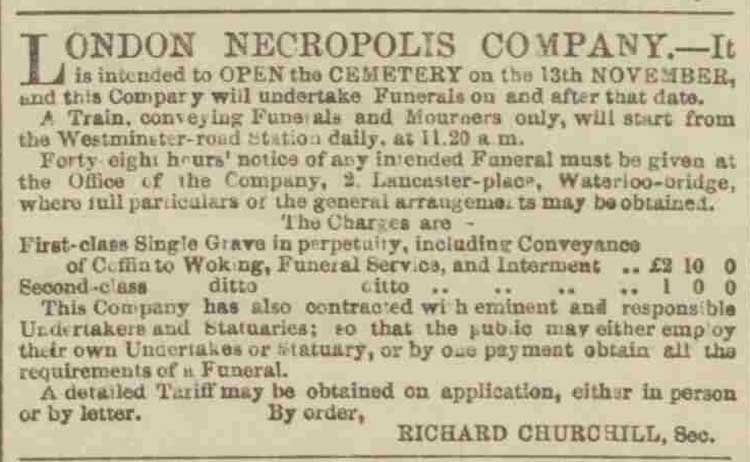
A contemporary advertisement – secure coffins were not cheap …

As a nearby information panel points out, the idea was not popular with the clergy and in 1820 the churchwardens at St Andrew’s Holborn refused churchyard burial to an iron coffin. The body was taken out and buried, which led to a law suit. The judgment was that such coffins could not be refused but, since they took so much longer than wooden ones to disintegrate, much higher fees could be charged. This no doubt contributed to the relatively short time iron coffining was used.

A collection of grave markers …

Early walls and foundations …

I think some of the explanatory panels are little works of art in their own right …

Terrifying times …

An amusing anecdote …

There are some interesting inscriptions at the east end of the church. 1702 was when the steeple was being completed …

Presumably these people are interred in the vaults below …

I hope you enjoyed today’s effort. I am indebted to the London Inheritance blog for some of the illustrations.

If you would like to follow me on Instagram here is the link …
https://www.instagram.com/london_city_gent/

St Olave’s memorials – from Samuel Pepys to the great sacrifices made by the employees of Wm Cory in both World Wars.

I love visiting St Olave Hart Street. It’s tiny and wonderfully atmospheric, being one of the few surviving Medieval buildings in London. It was badly damaged during the War but many of its treasures had been removed to safety and others have been beautifully restored.

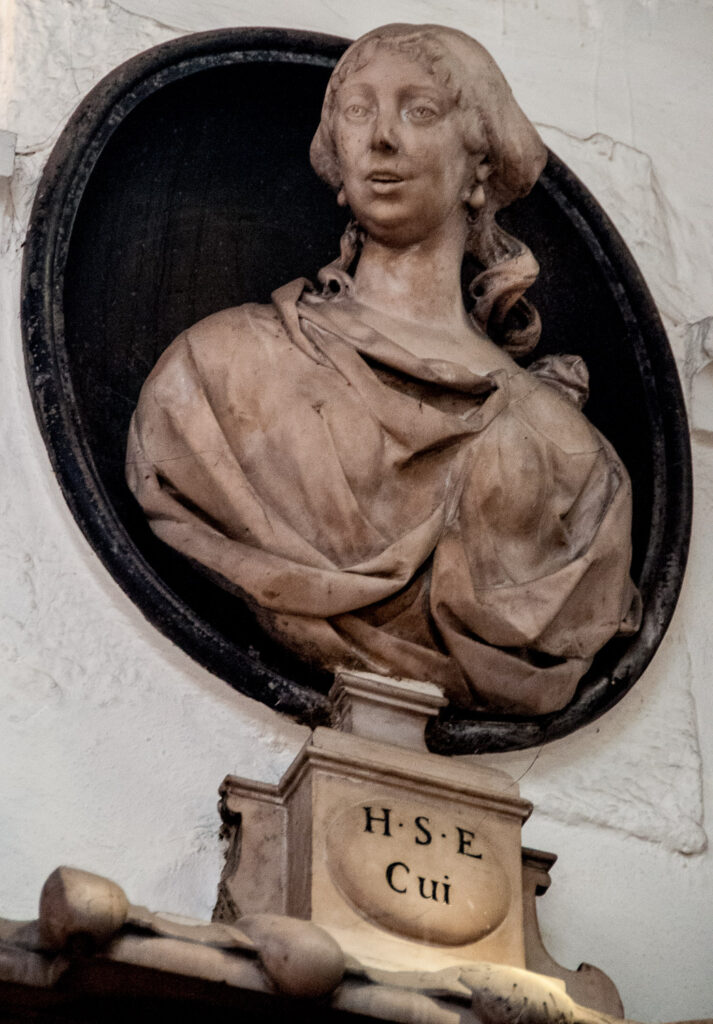
I first visited with my camera some years ago when I was writing about Samuel Pepys and I was immediately captivated by this sculpture of his wife Elizabeth. She died of typhoid fever at the age of 29 and, despite his dalliances with other women, Pepys was devastated by her death at such a young age. He commissioned this bust in white marble from the sculptor John Bushnell …

She is shown with her gaze directed towards the location of the Navy Office Pew where her husband would have sat, her mouth open as if in conversation.

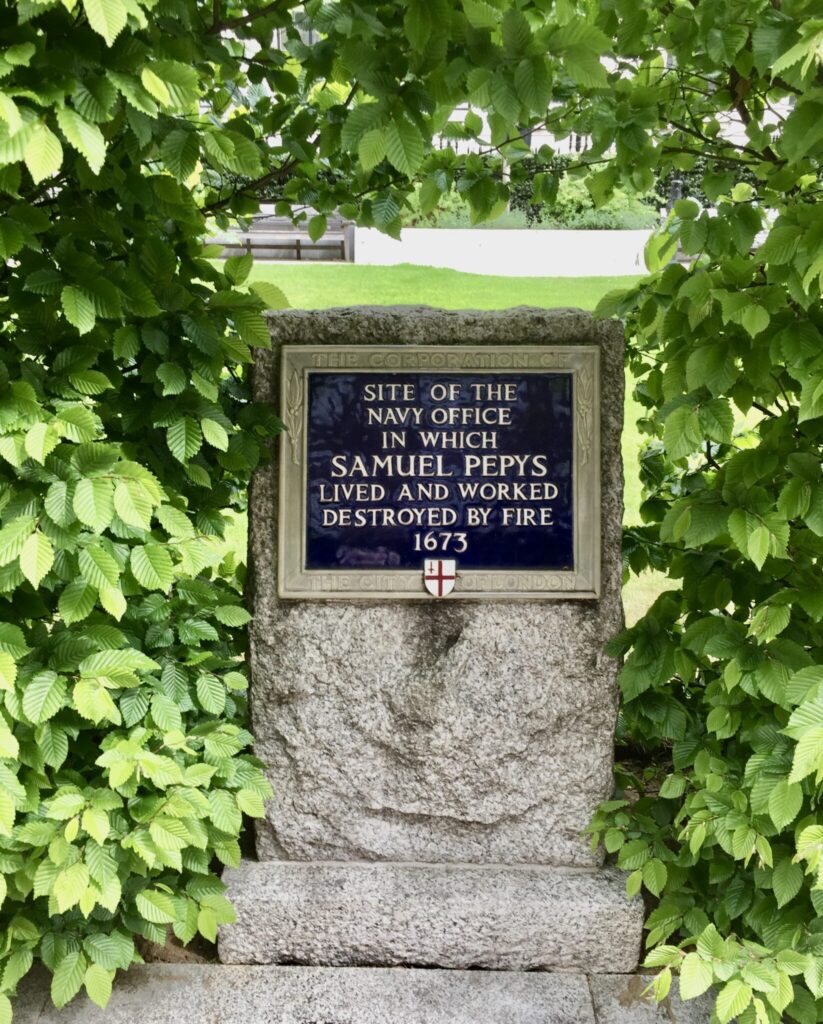
His pew was in the gallery he had had built on the south wall of the church with an added outside stairway from the Royal Navy Offices so that he could go to church without getting soaked by the rain. The gallery is now gone but a memorial to Pepys marks the location of the stairway’s door …

Pepys never married again and arranged to be buried in St Olave’s next to Christine. Now they face one another across the aisle for eternity.

Although small, the church is packed with other items of interest and I shall write about a few of them this week.

Sir James Deane has an impressive tripartite monument showing him and his three wives kneeling in prayer …

Two of the women carry skulls indicating that they died before their time. Three of his children died in infancy and their swaddled bodies are included in the monument with their little heads resting on skulls, again indicating mortality (images copyright Carole Tyrrell) …

Deane was knighted on 8 July 1604 and was a very wealthy man. He made his fortune as a merchant adventurer to India, China and the Spice Islands and was very generous to the poor in every parish in which he lived or owned property. He also built almshouses in Basingstoke that survive to this day …

There is a picturesque monument to two brothers, Andrew and Paul Bayning. They are shown in the red robes of Aldermen and were both closely involved with the Levant Company …

There are memorials with touching inscriptions. ‘Her noble soul and lovely body joined, were once the wonder and the joy of mankind’ …

Sir William Ogborne was ‘A most tender husband, loving parent and a sincere and kind friend’ …

In his will he left all his property (which included several houses) to his wife, Lady Joyce, along with his ‘coach, his chariot horses, plate, hay and corn’.

The pulpit came to St Olave’s from St Benet Gracechurch when it was demolished in 1868 …

Once thought to be the work of Grinling Gibbons, it is certainly a fine example of 17th century wood carving …

The monument of Dr Peter Turner. It was looted from the bombed out church in 1941 but was finally returned in 2011 having spent some time in the Netherlands! A curator at the Museum of London found out about an upcoming auction listing the statue in 2010, the Art Loss Register investigated, and the bust was removed from the sale …

He was an eminent physician and botanist.

All prewar windows were lost in the bombing and the new windows which replaced them were specially designed to take into account the tall buildings that were springing up in the rebuilding of the City.

Two other churches have parishes which have been joined with that of St Olave to form a united benefice and the Lady Chapel Window on the north side of the church has three lights representing them.

St Olave’s is in the centre and depicts the Virgin and Child. On the left, All Hallows Staining is represented by Queen Elizabeth I with the bells of the church at her feet …

Painstaking work was needed in order to create the gradient of colour from left to right across her dress.

On the right St Katharine of Alexandria represents the former parish of St Catherine Coleman …

Above, in the four tracery lights are depicted more modern types of Christian womanhood : Elizabeth Fry, Florence Nightingale, Josephine Butler and Edith Cavell

As I left by the north door this memorial reminded me of the tremendous sacrifices made during both World Wars by the employees of Wm Cory & Son …

At the outbreak of WW1 in 1914, Cory had a large workforce, many of them skilled as engineers, mechanics, bargees and physically fit labourers. Before conscription was introduced, Cory encouraged its workers to enlist in Kitchener’s Army – an all-volunteer force of the British Army – and guaranteed to keep their jobs open for them. The company also undertook to look after the family of anyone who joined up, setting aside a sum of £25,000 (equivalent to £3 million today) to care for the men and their dependents.

Within a few days of the appeal there were enough men to form the entire D Company of the 6th Battalion of the Buffs – also known as Cory’s Unit. Most of these men came from places like Greenwich, Erith and Plumstead.

There is a photograph of Cory’s Unit which was taken at Aldershot shortly before their departure for France on the 1st of June 1915. Within six months, so many of these young men would be a name on a memorial or buried in a battlefield grave in Belgium or France …

Cory also mobilised its boats in support of the war eff­­ort in both World Wars, losing 17 boats in WWI and 13 in WWII (usually due to German mines, submarine attacks or aerial bombardment).

There is a plaque on the Tower Hill Maritime Memorial relating to one of the boats lost in WW1 – the Sir Francis …

She was torpedoed 4 miles off Ravenscar, North Yorkshire, on a ballast run to the Tyne to pick up coal on 7 June 1917. You may be interested in the diversity of nationalities among the crew :

Wanless, A, master, whose place of birth, residence, and family is not recorded;

de Boer, J, seaman, born in Holland;

Jonsson, John, born in Iceland, resident in South Shields and married to an Englishwoman;

Kato, T, fireman, born in Japan;

Nishioka, B, fireman, also born in Japan;

Poulouch, N, fireman, born in Greece;

Sharp, Joseph, steward, of South Shields;

Talbot, Alfred, engineer’s steward, of Penarth;

Tippett, Albert, engineer, a Yorkshireman resident in Tyneside;

van der Pluym, Johannes Cornelis, seaman, a resident of Amsterdam.

A further 12 crew members survived.

Not all their names appear on the St Olave Memorial, presumably because not all of them were directly employed by the company.

You can read more about the Cory company’s involvement on both World Wars here and here. There is a great blog dealing with colliers and multi-national crews here – it’s also the source of my information about the crew of the Sir Francis.

If you would like to follow me on Instagram here is the link …
https://www.instagram.com/london_city_gent/

From Submariners to the Blitz Firefighters – a walk along Embankment towards St Paul’s.

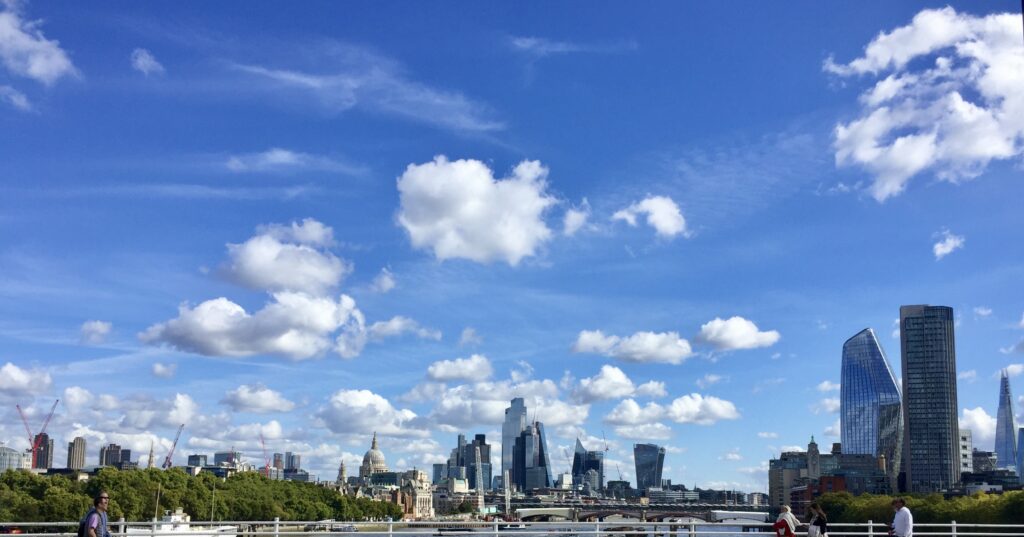
A lovely Sunny day last Saturday tempted me out for a walk.

The national Submarine Memorial Memorial on Victoria Embankment (EC4Y 0HJ) is, I think, one of London’s most moving.

Although able to hide when submerged, once struck the vessels were often unable to rise to the surface and became effectively underwater coffins. In the First World War fifty four boats were lost and with them the lives of 138 officers and 1,225 men. At the inauguration in 1922 Rear Admiral Sinclair, the Chief of the Submarine Service, reminded those present that, during the Great War …

The number of those killed in the Submarine Service was greater in proportion to its size than any other branch of His Majesty’s fighting forces … one third of the total personnel.

In November 1959 new panels commemorating Second World war losses were unveiled by Rear Admiral B W Taylor.

Wright and Moore, writing for the 20th Century Architecture website, describe the memorial as a complex mixture of narrative and symbolism …

Sculptor: F B Hitch Architect: A H R Tenison Founder: E J Parlanti

The central figures recreate the scene set inside the submarine exaggerating it into a small, claustrophobic tunnel. The crew use charts and follow dials, the captain is braced at the centre with the periscope behind his head. Around the vessel a shallow relief depicts an array of sea creatures or mermen appearing to trap and haul the submarine in fishing nets, reminding us that the submarines were as much prey to the tempestuous elements as they were to the enemy.

On both corners are allegorical figures. Next to the list of vessels lost between 1914 and 1918, Truth holds up her mirror. Just further to the left in the picture are two of the 40 bronze wreath hooks in the form of anchors …

On the right, next to the vessels lost in the Second World War, Justice wears a blindfold and as usual holds a sword and scales …

On a more lighthearted vein, walk east from the Memorial on the north side of the road and you’ll find this chap frantically trying to hail a taxi …

Taxi! by the American Sculptor J Seward Johnson is cast bronze and is now interestingly weathered. If you think the baggy trousers, moustache and side parting are erring on the retro, that’s because this particular office worker was transferred from New York in 2014. It was sculpted in 1983 and originally stood on Park Avenue and 47th Street.

I love this pair of ‘dolphin’ lamps (although they are actually sturgeon) ..

Neptune also makes an appearance …

Further east you can wave to the pretty mermaid who embellishes the Art Deco style Unilever Building …

Further along the lamps repay detailed study …

Across the road, a jolly friar looks down from the Blackfriar pub …

Carry on along Queen Victoria Street and admire the imposing College of Arms building …

… and its ornate gate …

St Peter’s Hill runs north alongside the College and at the top you will find the Firefighters Memorial. On its octagonal bronze base are the names of the 997 men and women of the fire service who lost their lives during the conflict. The sculpture features two firemen ‘working a branch’, with their legs spread to take the strain of the hose …

A sub-officer directs others to assist. There are clues to the identity of this figure scattered among the debris at the figures’ feet: the letters CTD for C.T. Demarne. At the unveiling, his colleagues from the fire service claimed that there was no need for such clues. One who was interviewed by the Telegraph stated: ‘You can tell it’s Cyril by the way he’s standing…he always waved his arms about like that when he was ordering us about’.

Officer Demarne in full flow.

By 1943 over 70,00 women had enrolled in the National Fire Service in the United Kingdom. This memorial commemorates those who lost their lives in the London bombings …

The lady on the left is an incident recorder and the one on the right a despatch rider.

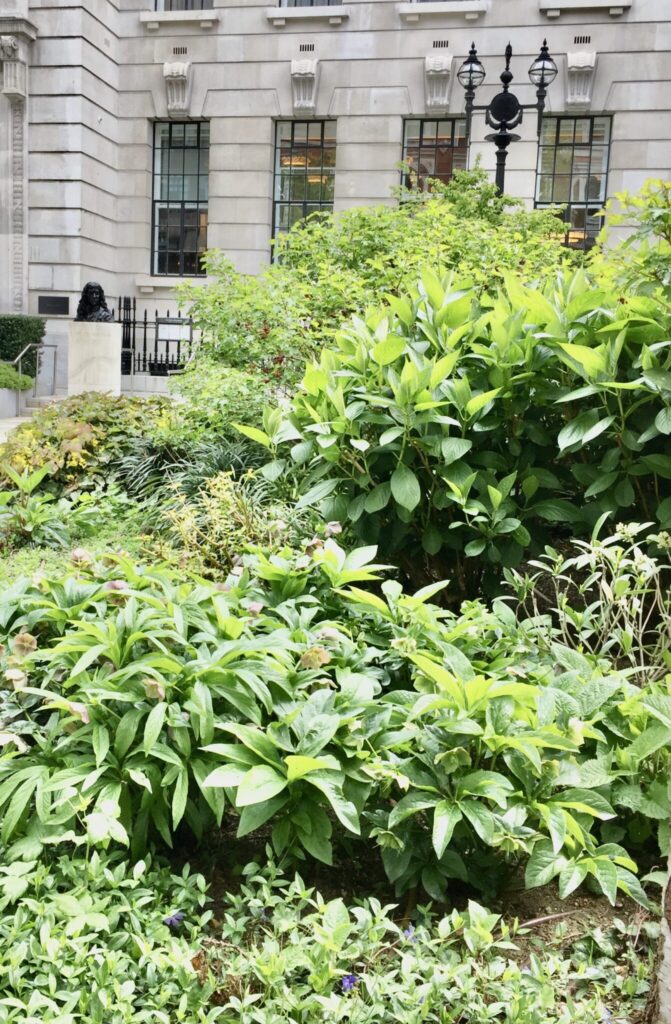
Across the road, just south of the Cathedral, is this rather handsome bearded gentleman …

John Donne 1572-1631 by Nigel Boonham (2012).

In 1617, two years after his ordination, Donne’s wife died at age 33 after giving birth to a stillborn child, their twelfth. Grief-stricken at having lost his emotional anchor, Donne vowed never to marry again, even though he was left with the task of raising his ten surviving children in modest financial circumstances. His bereavement turned him fully to his vocation as an Anglican divine and, on November 22, 1621, Donne was installed as Dean of St. Paul’s Cathedral. The power and eloquence of his sermons soon secured for him a reputation as the foremost preacher in the England of his day, and he became a favourite of both Kings James I and Charles I.

His bust points almost due west but shows him turning to the east towards his birthplace on Bread Street. The directions of the compass were important to Donne in his metaphysical work: east is the Rising Sun, the Holy Land and Christ, while west is the place of decline and death. Underneath the bust are inscribed words from his poem Good Friday – Riding Westward :

Hence is’t that I am carried towards the west, This day when my soul’s form bends to the east

The most familiar quotation from Donne comes from his Meditation XVII – Devotions upon Emergent Occasions published in 1624:

‘No man is an island, entire of itself; every man is a piece of the continent, a part of the main … and therefore never send to know for whom the bell tolls, it tolls for thee.’

Incidentally, if you walk around the east side of the Cathedral you will see scars from the Second World War bombing which illustrate just how close the building came to destruction …

If you would like to follow me on Instagram here is the link …
https://www.instagram.com/london_city_gent/

Page 20 of 41

Powered by WordPress & Theme by Anders Norén

Symbols & Secrets
Privacy Overview

This website uses cookies so that we can provide you with the best user experience possible. Cookie information is stored in your browser and performs functions such as recognising you when you return to our website and helping our team to understand which sections of the website you find most interesting and useful.