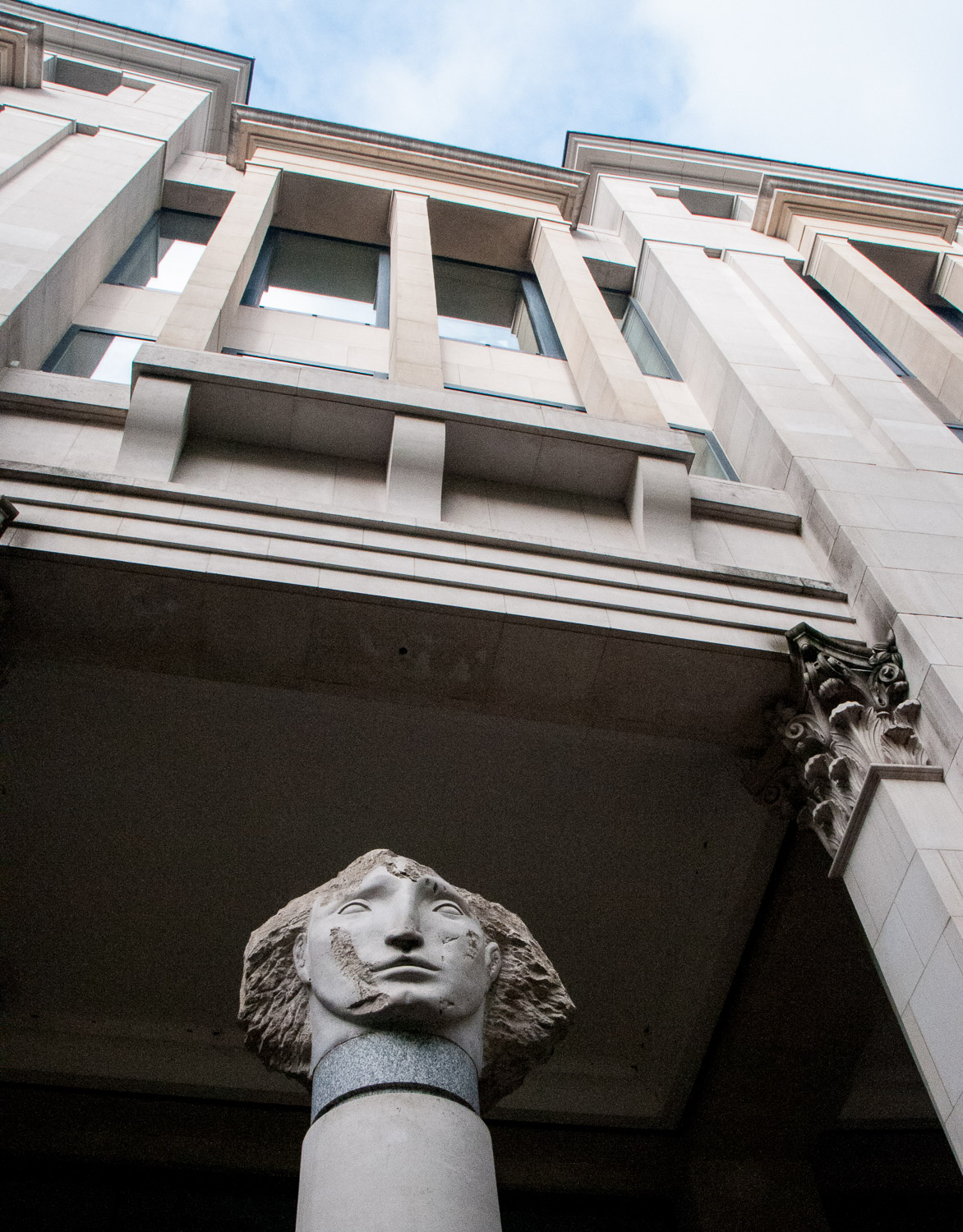
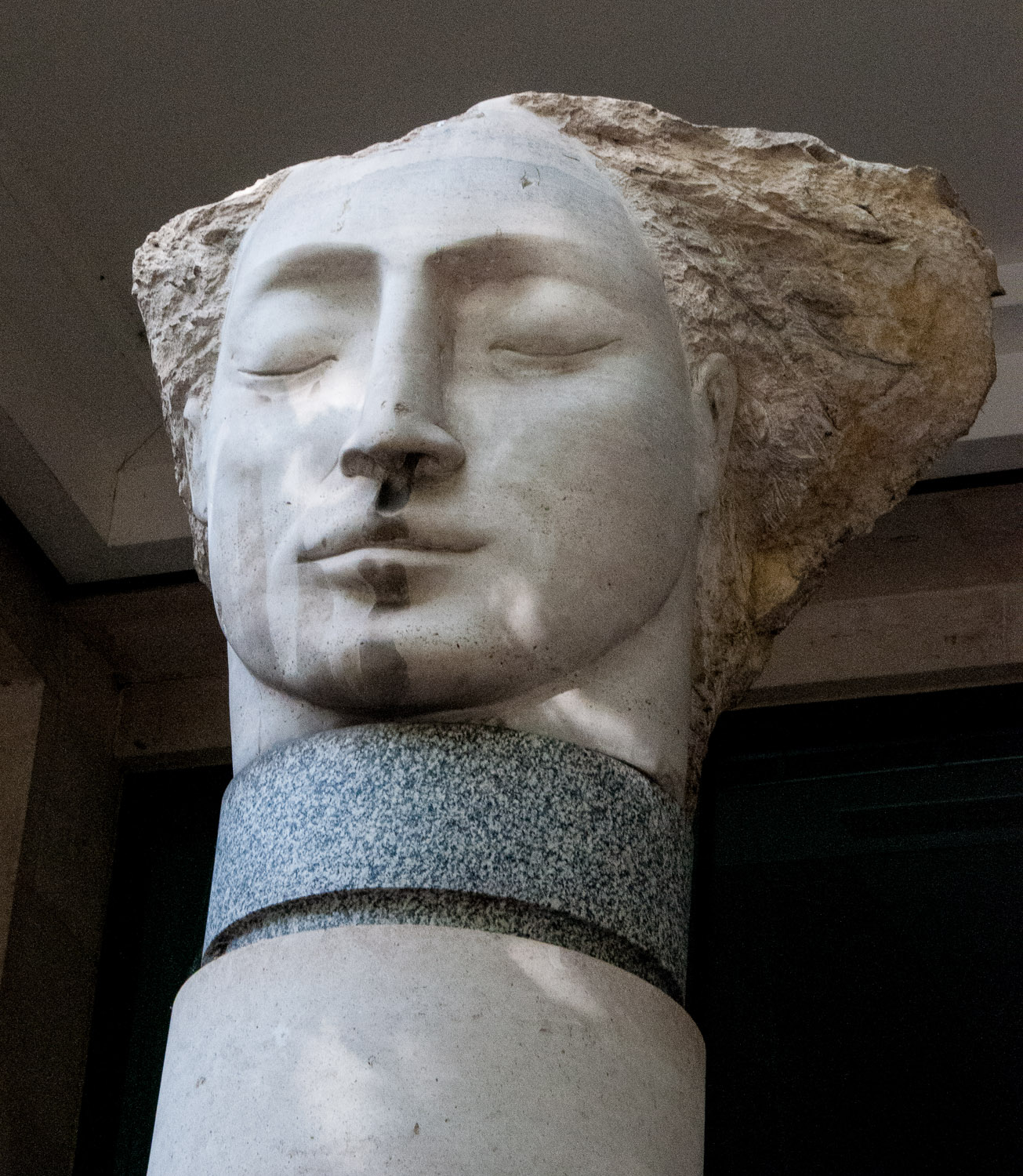
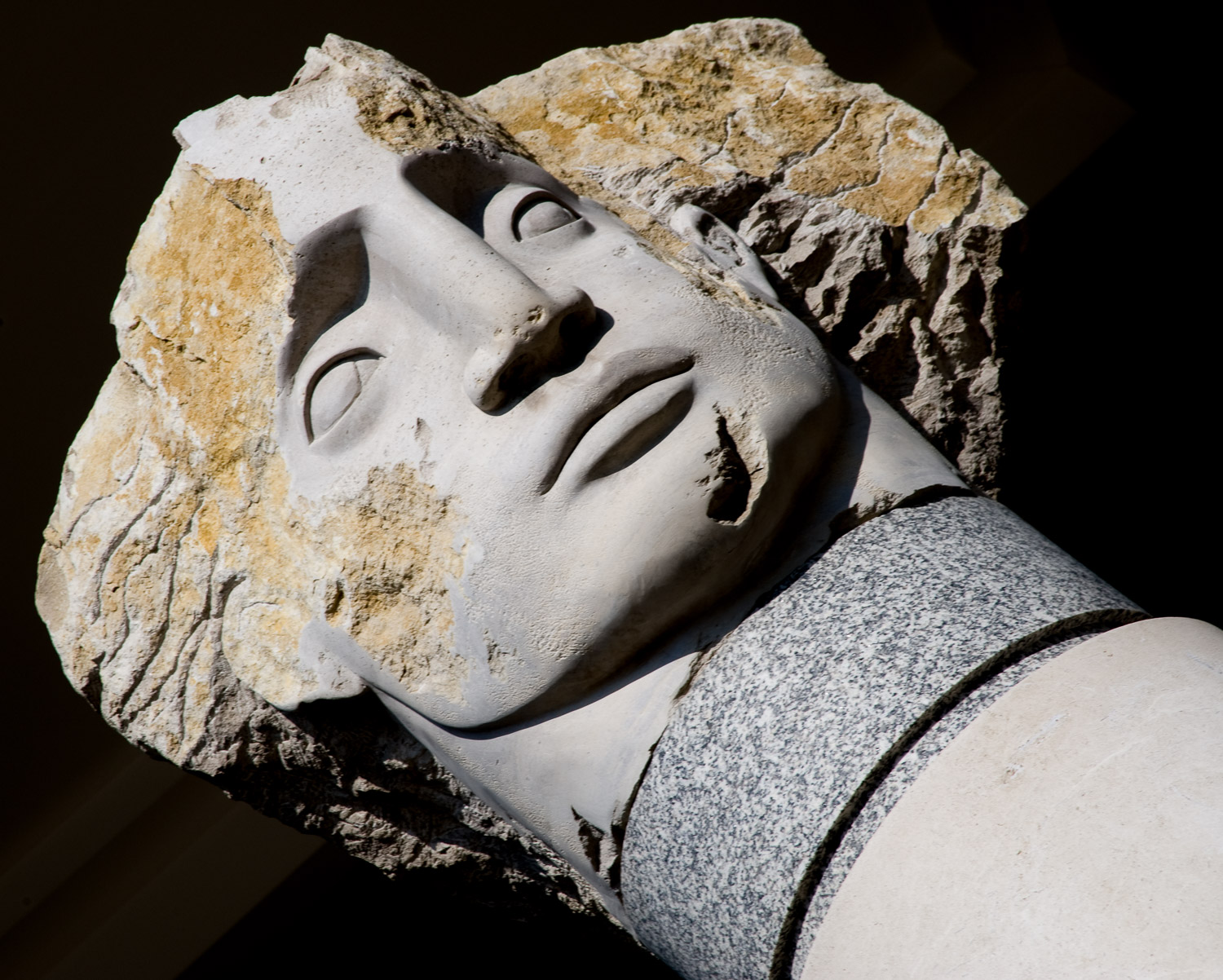
The 14th edition of Sculpture in the City is here and I have been wandering around looking at some of the exhibits.
Here are the ones I found, along with their location and a link to a detailed description. There are also some new arrivals outside the Barbican Library.
The churchyard of St Botolph-without-Bishopsgate EC2M 3TL ..
You can download a map and further details of the sculptures here.
On my way home on Sunday, I came across these interesting ceramics by Ebony Russell on display at 99 Bishopsgate …
You can read more about them here. Unfortunately the exhibition was scheuled to finish on August 26 but it might be worth checking to see if it has been extended.
Finally, new sculptures have been installed outside the Barbican Library …
Well, of course, any time is a good time to visit this wonderful building but this year marks 80 years since the end of the Second World War. Amidst devastating destruction around the City, St Paul’s remained standing, its iconic dome rising out of the surrounding rubble.
The secret to its survival was not luck, as is commonly thought, but rather the bravery and dedication of a group called the St Paul’s Watch, whose commitment to St Paul’s saved the Cathedral from the fate of its neighbouring buildings. Until October 2025, a free outdoor exhibition Saving St Paul’s: The Watch and the Second World War will honour the St Paul’s Watch and their heroic efforts to protect the Cathedral during the Blitz …
You’ll find a super YouTube video about the Blitz and the brave volunteers of The Watch on the wesite. It’s only 15 minutes long but tells the story brilliantly: https://www.stpauls.co.uk/savingstpauls
Why not make your visit a bit of an adventure! You could start with a nice cup of coffee at the Crypt restaurant and enjoy an added bonus of seeing some interesting memorials without having to pay for entry.
It was originally commissioned by Cardinal Wolsey (1473-1530) for his own use but he died in Leicester on his way to London to face treason charges brought by Henry VIII. Henry had his eye on the sarcophagus for his personal use but that didn’t happen and it remained in storage until 1805 when King George III donated it for Nelson’s funeral. Read a fuller history of the sarcophagus and see more images here.
The French Revolutionary Wars lasted from 1792 to 1802 only to be followed by the Napoleonic Wars from 1803 to 1815. In total 23 years of war with France in which Nelson played a major role. Also commemorated in the cafe are three of his fellow officers.
The Earl of St Vincent is recognised for winning the Battle of St Vincent in 1797. Nelson was his Commodore …
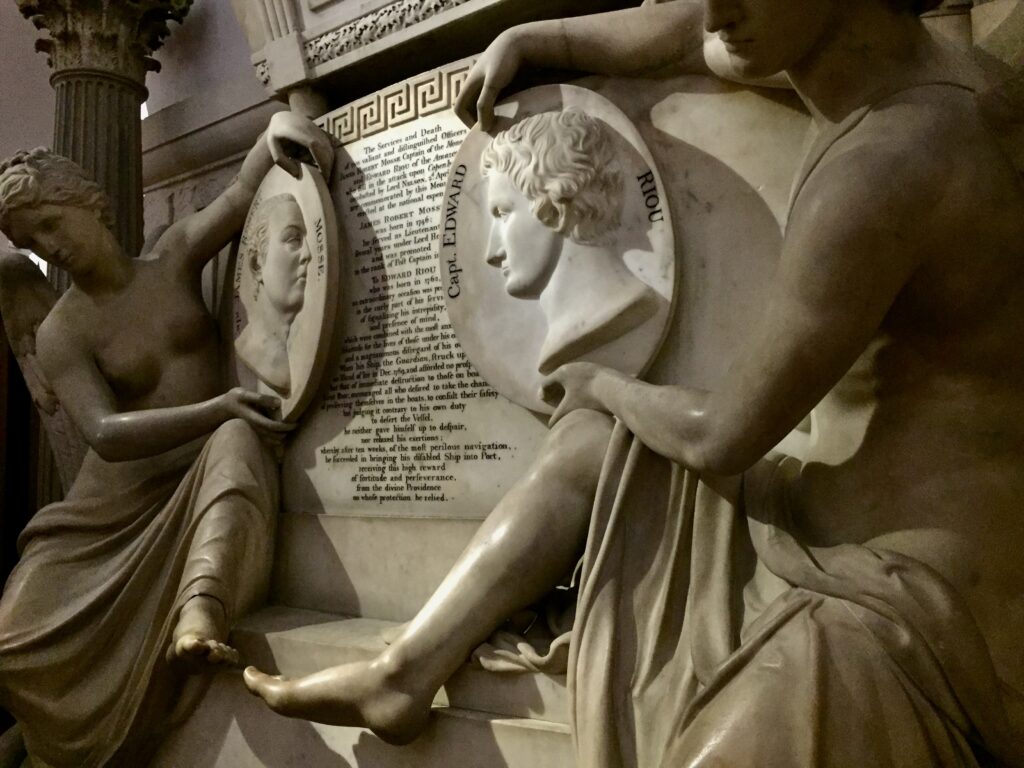
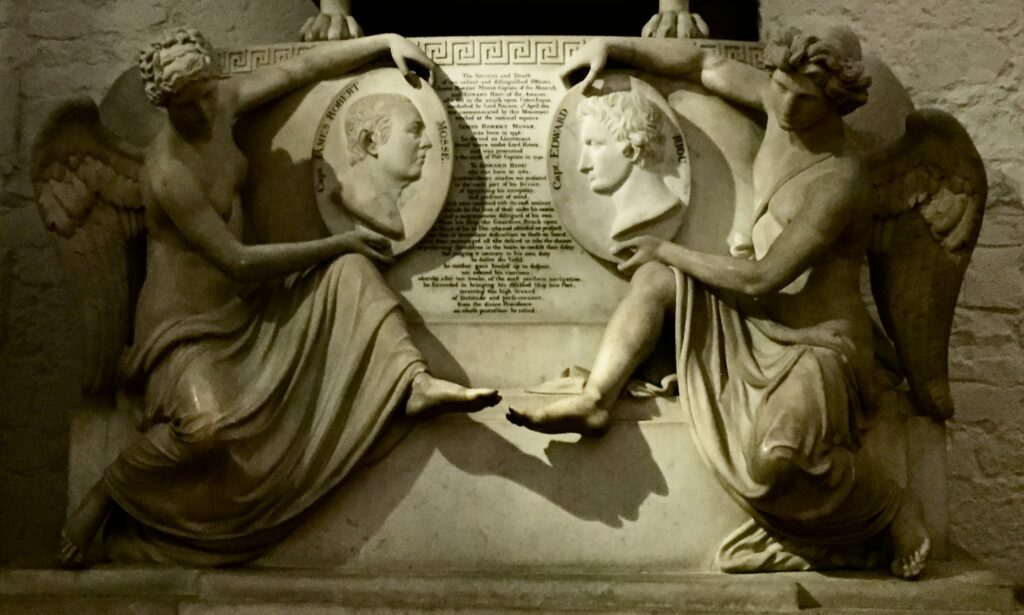
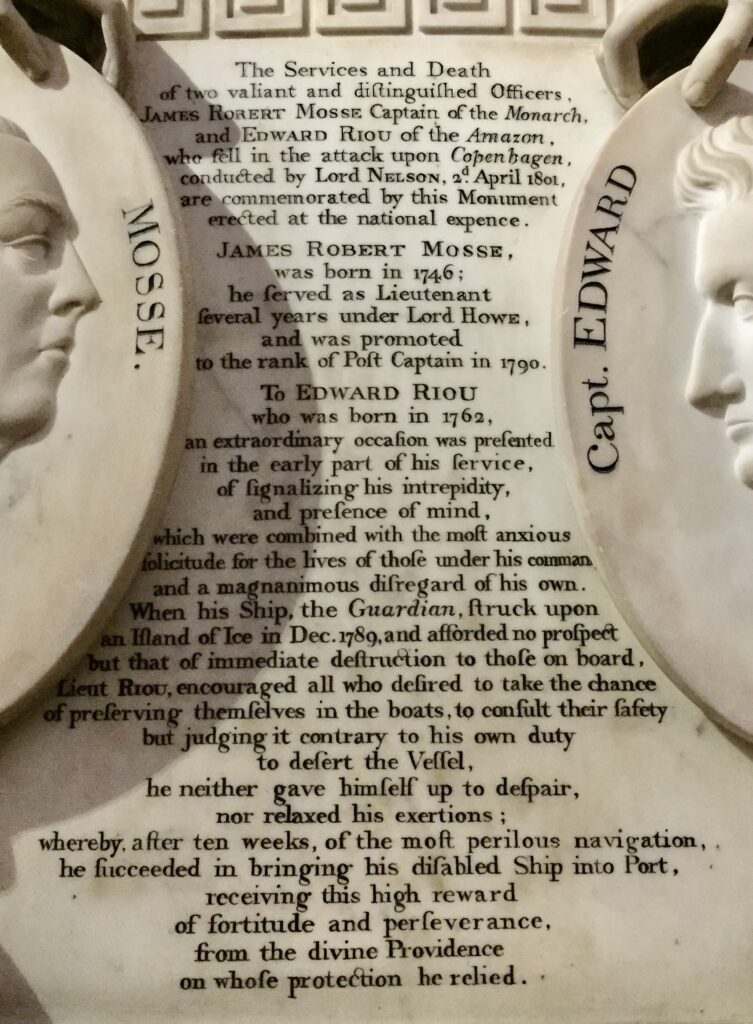
Nearby is this monument to two other Naval heroes who died under Nelson’s command, Edward Riou and James Robert Mosse …
Riou died in the 1801 Battle of Copenhagen. He ‘…was sitting on a gun, was encouraging his men, and had been wounded in the head by a splinter. He had expressed himself grieved at being thus obliged to retreat, and nobly observed, ‘What will Nelson think of us?’ His clerk was killed by his side; and by another shot, several marines, while hauling on the main-brace, shared the same fate. Riou then exclaimed, ‘Come, then, my boys, let us all die together!’ The words were scarcely uttered, when the fatal shot severed him in two’.
Mosse died in the Battle of Camperdown. In 1799 he was appointed Captain of HMS Monarch, also under the overall command of Admiral Nelson. Mosse took a leading role, sailing from one end of the line to the other, whilst both firing and receiving fire. He was killed soon after adopting his required position, his last orders being to ‘cut away the anchor’. Like Riou, he was buried at sea …
There is also this extraordinary monument to a soldier rather than a seafarer, Sir William Ponsonby. A winged Angel of Victory hovers over him holding a laurel wreath as a broken sword slips from his right hand …
He died at Waterloo, having advanced too far and becoming isolated when his horse got bogged down in the mud. He surrendered to the French but, suspecting a rescue attempt, they finished him off leaving him naked except for his bloodstained shirt. You can read more about his background along with the gripping story of his final battle on the Waterloo Association website.
As you leave the crypt you get a nice view of Temple Bar …
Pause also to admire the five beautiful Angels by Emily Young FRBS. Young (b. 1951) is one of the country’s foremost stone sculptors and you can enjoy her work in the form of Angels I to V in the courtyard opposite the Cathedral’s main entrance. I never tire of looking at them …
Incidentally, I have written an entire blog about City Angels and Devils and you can access it here.
Then head up the steps to the Cathedral West doors for a trip back a few hundred million years.
There are fossils embedded in the red limestone …
These are orthoceras cephalopods, an ancestor to the squid that lived up to 5oo million years ago. Orthoceras could float by filling the chambers of their shells with air and moved by squirting jets of sea water. When they died their shells accumulated on the ocean floor which then was covered by sediments and subsequently over the ages transformed into stone.
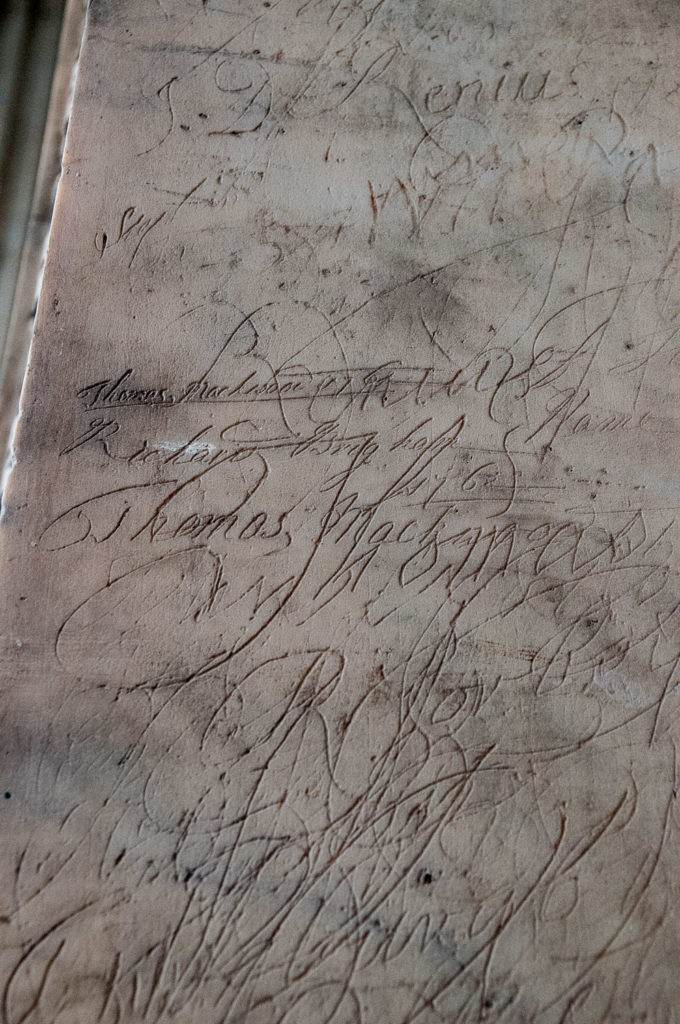
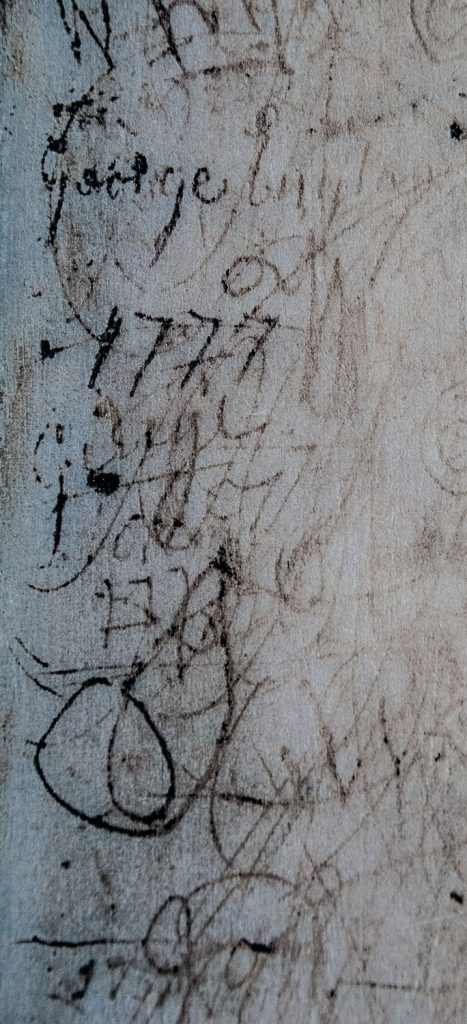
Now climb further up the steps to the magnificent West Door and admire, if that’s the right word, the elegant cursive script of the 18th century ‘vandals’ who scratched their names in the stonework …
Some of it is very high up which leads me to believe the marks were made by workmen using sharp implements whilst standing on a scaffold …
Opposite the West Door, Queen Anne stands on her pedestal and gazes imperiously towards Fleet Street. Wearing a golden crown, she has the Order of St George around her neck, a sceptre in her right hand and the orb in her left …
It was during her reign that the rebuilding of St Paul’s, after the 1666 Great Fire, was completed. The original statue was erected in 1712, an integral part of the design. It was damaged, deteriorated and was replaced with this copy in 1886.
It’s difficult not to feel sorry for Anne. Her personal life was marked by the tragedy of losing 18 children (including twins) through miscarriage, stillbirth and early death. Two of her daughters, Mary and Anne Sophia, died within days of each other, both aged under two years, of smallpox in 1687.
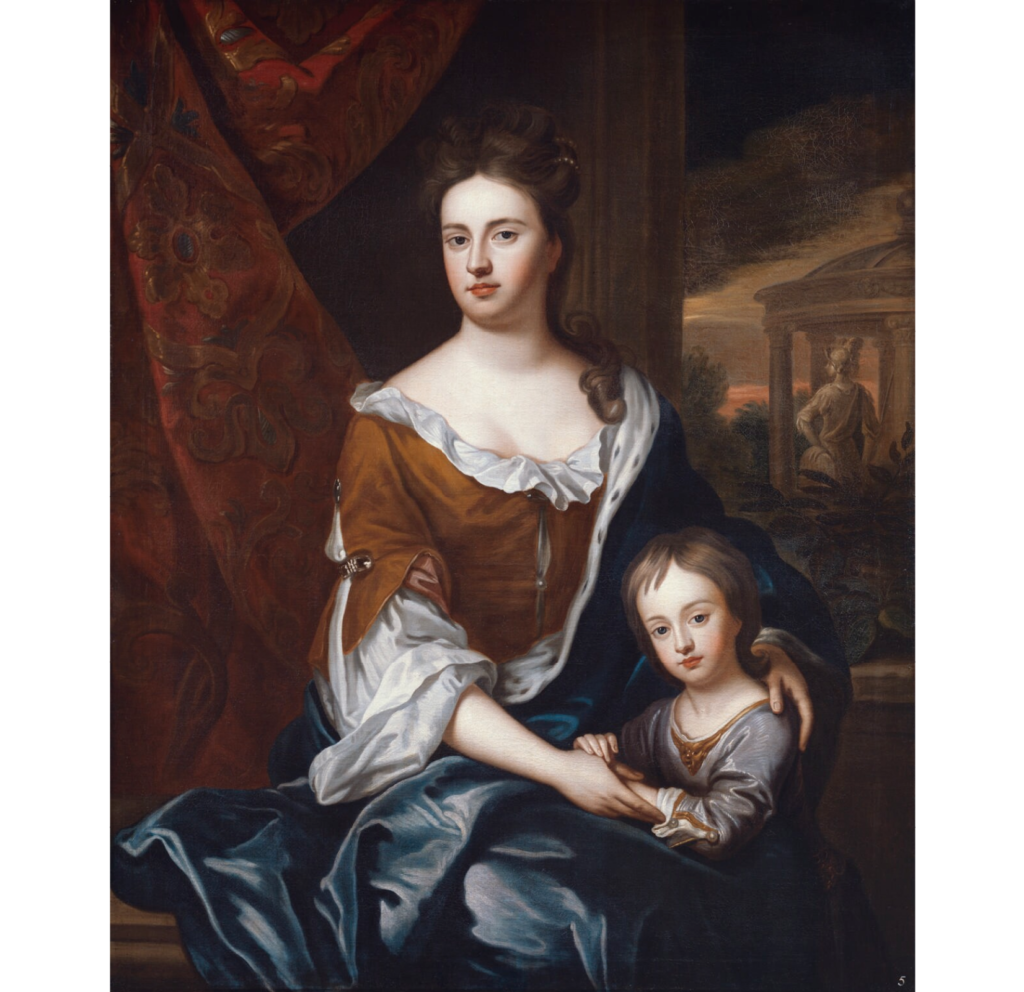
One little boy, William Duke of Gloucester, survived but within weeks it became clear that he was an ill child. He suffered from debilitating convulsions, struggled to walk and died in 1700 at the age of 11. Here is a touching portrait of them both …
The four allegorical ladies around the base of her statue represent England, France, Ireland and North America, as at that time Anne considered herself to be queen of them all …
With her left hand, Britannia supports a cartouche with the royal arms …
Holding a trident in her right hand she also wears Minerva’s breastplate adorned with a gorgon mask as if it were a sash. Minerva was the Roman Goddess of wisdom and the sponsor of arts, trade and strategic warfare.
France is seated with her eyes lowered and wearing a helmet with three fleurs-de-lis on the visor surmounted by a plume sweeping backwards …
Her right hand rests on a substantial truncheon and her left clasps a mural crown.
In my opinion America is the most interesting and I have written about her before …
She wears a feathered head-dress and skirt whilst her left hand grasps a metal bow. Her right hand may once have held an arrow.
What fascinates me, however, is the creature by her feet which resembles a rather angry Kermit the frog (alongside some poor chap’s severed head) …
In 1712, this is what the original sculptor Francis Bird imagined an alligator would look like. A contemporary description of the statue states …
There is an allegator creeping from beneath her feet; being an animal very common in some parts of America which lives on land and in the water.
A pretty young Ireland is seated at the back of the monument with a harp resting on her right thigh …
Anne was 37 years old when she became queen in 1702. At her coronation she was suffering from a bad attack of gout and had to be carried to the ceremony in an open sedan chair with a low back so that her six-yard train could pass to her ladies walking behind. Her medical conditions made her life very sedentary and she gradually put on a lot of weight. She died after suffering a stroke on Sunday 1st August 1714 at the age of 49.
In 1897 Queen Victoria celebrated her Diamond Jubilee and a service was held in the open air outside St Paul’s …
Due to her frailty she remained in her carriage throughout the ceremony where the clergy joined her, surrounded by dignitaries and troops from around the Empire …
You can just see, in the bottom left hand corner, the railings that surround Anne’s statue.
Its position is clearer in this photograph …
At one point when the celebrations were being planned it was suggested that Queen Anne’s statue be moved but Victoria was horrified …
‘Move Queen Anne? Most certainly not’ Victoria declared, ‘Why it might some day be suggested that my statue should be removed, which I should much dislike!’
Finally, you’ll find a sinister reminder of the Blitz if you walk around to the east side of the Cathedral. Shrapnel scars from the bombing …
If you would like to follow me on Instagram here is the link …
Once again I’m back at the Barbican Library for an extraordinary exhibition with very different but fascinating themes.
Alison Aye’s first work, entitled Exile Textiles, was started 31st March 2020 and finished on 29th September that year. It illustrates a horrendous period of her life as she cared for her mother, who had terminal cancer, and her father who suffered a stroke. She also lost her job during this period which, of course, coincided with the Covid lockdown. Also included are later pieces from Exile Textiles II: The New Normal and Exile Textile III: The Prequel.
Before you glance at my images I urge you to have a look at Alison’s blog which explains the works in more detail. I promise you it’s not all doom and gloom – it’s very funny in places. For example, do you remember YOU HAVE NO AUTHORITY HERE JACKIE WEAVER! Or Barbara Windsor as Peggy Mitchell yelling ‘Get outta my pub!’ Or Dominic Cummings allegedly calling Carrie Symonds, now Mrs Johnson, ‘Princess Nut Nuts’. I certainly do – and they are all referenced here.
Alison has the following to say about the other work on display, Civilisation:
‘In ‘Civilisation’, I’m questioning the bias of my early art education, which came mainly from Lord-Sir-Baron-Kenneth-Clark, born into a wealthy ‘textiles family’, and his popular television BBC programme/book, ‘Civilisation’. I’ve made stitched collages from said book (published by BBC/John Murray, this edition 1971), combined with discarded gallery (mainly Tate) magazines. Lord-Sir-Baron-Kenneth omitted female artists from his account, which is what started me off on these collages, but as the project progressed I have annoyingly fallen in love with the snobby bastard. I don’t agree with what he is saying a lot of the time, but his style of writing is superb and an utter joy to read.’
Images from Civilisation:
Alison’s history of Royal Academy submissions …
She finally made it into the Royal Academy Summer Show last year after 31 attempts …
The winning work (not on display at the Library) …