Walking the City of London

Category: Sculpture Page 7 of 41

The Port of London Authority building (plus a classic 1970s TV adventure series).

Just across the road from Tower Hill Underground Station is one of London’s finest architectural landmarks, the former Port of London Authority (PLA) building on Trinity Square.

It towers over Trinity Square Gardens, home of the Mercantile Marine Memorial to the Merchant Seamen who died in both world wars …

The old PLA headquarters harks back to the great days of Empire and global trade. The ‘Great and the Good’ gathered to lay commemoration stones a few years after building work commenced in 1912 …

The inauguration of the building by Prime Minister Lloyd George in 1922 was reported as an event of national importance. The creation of a unified Port Authority in 1909 had been facilitated by an Act of Parliament, the organisation being set up to Protect the Port of London from the increasingly destabilising effect of competition between rival dock companies …

The grand classical entrance features four Corinthian columns. It is three storeys high and topped by a massive tower with a giant figure that would have been clearly visible from the river…

Old Father Thames stands triumphantly, holding his trident and pointing
east, paying homage to the prosperity of trade between nations. The
trident, his lush beard and the anchor at his feet associates Old Father
Thames with Poseidon/Neptune – the Greek/Roman god of the sea – and
shows how classical symbolism was used to into the 20th century to
celebrate London’s influence over global maritime trade …

On the west side of the tower, within a galleon drawn through the waves by two sea horses, there stands a winged, nude male figure. He symbolises ‘Prowess’ and weilds a large antique oar …

On the east side is ‘Agriculture’, personified by a winged female figure with a flaming torch in her hand drawn in a triumphal chariot by two oxen. The beasts are lead along by a youthful male figure representing ‘Husbandry’ …

At street level is ‘Commerce’. A bearded male figure holds the scales of trade and a basket of merchandise. Before him is the lamp of truth …

‘Navigation’ is represented by a young woman with one hand on a ship’s wheel and the other holding a chart. Her foot rests on a globe and around her are the symbols of shipping …

Resting against elaborate lampposts outside the main entrance are two rather plump cherubs …

Inside the original building was a spectacular rotunda topped by a magnificent glass dome, created to emulate that of St. Paul’s Cathedral. This was totally destroyed in the World War II Blitz and I have only been able to find four images giving some idea of what it looked like …

The front of the building after the bombing …

In the 1970s, after the Port of London Authority moved to its current location in Tilbury, the building was renovated and the central courtyard was filled in with office space. It was then occupied by the European headquarters of the insurance broker Willis Faber Limited and continued to serve as offices until 2008. When Willis Faber moved on to a new location, the building lay vacant for several years.

It was purchased in 2010 by Reignwood, a Chinese investment company, and is now a Four Seasons Hotel. I must say, it really does look splendid.

Inside the main doors …

The rotunda has been reimagined …

It’s open to non-residents for drinks and snacks.

By the way, the 1946 reception of the first general assembly of the United Nations was hosted here in what is now known as the UN Ballroom. The occasion was attended by (among others) King Faisal of Saudi Arabia and US first lady Eleanor Roosevelt. From its second-floor location, the room’s windows overlook the Trinity Square Gardens and beyond to the Tower of London and Tower Bridge. It’s available to book for events …

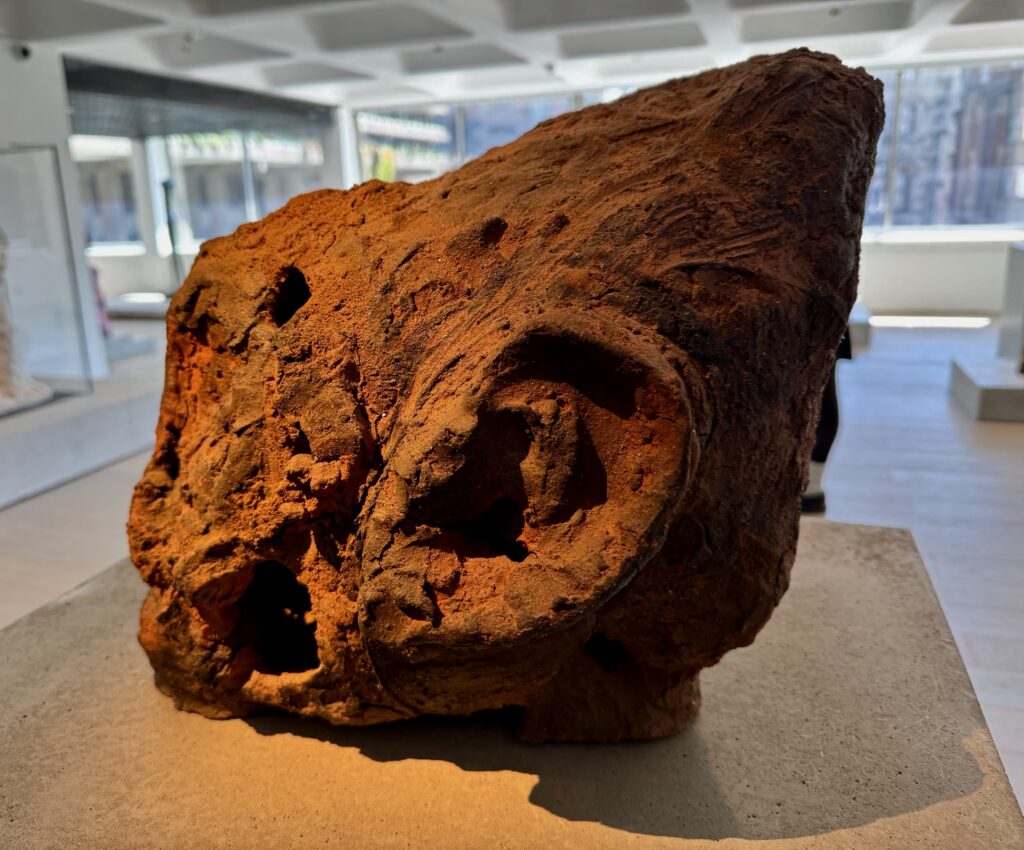
The Museum of London Archaeology practice were given access to the site during redevelopment and a selection of the artefects they discovered are on display in the reception area. These are just a few of the exhibits – it’s well worth popping in to the hotel to have a look …

Now something readers more my age will remember!

The Professionals was a TV series that ran from 1977 to 1983 featuring Bodie and Doyle, senior agents of the British intelligence service CI5 (Criminal Intelligence 5), and their handler George Cowley, fighting terrorism and similar high-level crimes. The PLA building appears in the opening sequence of the second series.

Watch it in full here, including music – volume up! : https://www.youtube.com/watch?v=55gpif0a0P8

Some stills from the sequence …

The famous railings they stride past are still there …

It’s worth walking round to the north side of the building which is also impressive …

You can just about make out a plinth in front of the building. It’s a bust of one of my heroes, the diarist and brilliant naval administrator Samuel Pepys …

The music carved on it is the tune of Beauty Retire, a song that Pepys wrote. The garden in which it stands in Seething Lane contains a number of paving stones representing his life and events that occurred during it. You can read more about them here and here. Just across the road is St Olave Hart Street. It’s tiny and wonderfully atmospheric, being one of the few surviving Medieval buildings in London.

Incidentally, it was exactly 67 years ago today that the terrible Smithfield Market fire of 1958 broke out. I have written about it in my recent blog Goodbye Smithfield Market – Special Edition.

If you would like to follow me on Instagram here is the link …
https://www.instagram.com/london_city_gent

‘Waddle into wonder’ with Penguins plus the Blitz and other observations from my recent walks.

I saw a giant colourful penguin outside the Blackfriar pub last week and had a quick Google last Sunday when I went for a walk. Here’s the publicity blurb: This Christmas, the Fleet Street Quarter is transforming into a winter wonderland with a magical FREE penguin parade sculpture trail in support of WWF. From Thursday 14th November, families and visitors are invited to embark on a fabulous festive adventure to discover 12 adorable penguin sculptures throughout the Quarter. Each penguin, decked out in unique festive finery designed by talented artists, will be perched in iconic spots adding a splash of Antarctic charm to the City. And each one has a QR code with lots of fun penguin facts. There’s a helpful map here.

And here are the five that I found.

Buddy the Elf outside the Blackfriar pub …

It’s penguining to look a lot like Christmas in St Bride’s Passage …

John Wilkes is unimpressed by The Forest at Christmas on Fetter Lane …

But Dr Johnson’s cat Hodge is happy to share a space with Snowy in Gough Square …

Tiffany here can be found down a little alley off Carter Lane called New Bell Yard …

There were lots of families following the trail when I took these images.

The Steve McQueen film Blitz has just been released and you can see an interesting display of clothes from the film at the Barbican Centre …

If you want to understand and explore the true, full story of Londoners and the Blitz I strongly recommend Jerry White’s book The Battle of London 1939-45.

Whilst on the subject of the Blitz, I recently walked past The National Firefighters Memorial on Peter’s Hill opposite the Tower of London where I often pause. It’s interesting to note the special plaque commemorating the 23 women members of the Auxiliary Fire Service who gave their lives protecting London and its inhabitants during the bombing …

The lady on the left is an incident recorder and the one on the right a despatch rider.

On the wall of the Leonardo Royal Hotel that fronts Carter Lane is this rather unusual plaque …

The Bell was demolished at the end of the 19th century to make way for the Post Office Savings Bank building referenced in the plaque by the mention of the Postmaster General. The Post Office building itself was demolished in the 1990s to make way for the hotel but the original late 19th century door surround to the Post Office building has been retained in New Bell Yard (right beside Tiffany, see above) …

You can see the letter the plaque refers to here.

A statue commemorating the poet John Keats has appeared just south of the entrance to Moorgate Station. It was sculpted by Martin Jennings and depicts a larger than life-size copy of a life mask of Keats taken aged 21. Keats was the son of an ostler at a nearby inn called The Swan and Hoop …

The bronze is mounted on a plinth above a slate base inscribed with words from Keats’ Ode on Indolence.

Thought I’d grab an image of this classic view from Fleet Street whilst the sun was out. Looking from the left you see 22 Bishopsgate, the Cheesegrater, the spires of St Mary-le-Bow and St Martin Ludgate and the dome of St Paul’s Cathedral …

Christmas light installations are beginning to appear …

Framed by the medieval remains of St Elsyng Spital

Interactive Trumpet Flowers at City Point …

Press the ‘buttons’ and the lights change colour as music plays …

Not surprisingly, children seem to love it!

City Point offices get in on the act …

Sadly, I couldn’t resist photographing my Yuzu Grand Macaron dessert at Côte Barbican …

An image from outside the City I’d like to share with you. This is on Finchley Road, about 10 minutes walk from the Underground station …

Definitely worth seeking out if you find yourself in that part of the world. I must have stared at it for a full 15 minutes. Read its story here in the excellent Londonist website.

A couple of super sunsets. I haven’t edited these images in any way so the colours are authentic …

And finally, the wonderful City gardeners are replanting the bed on Silk Street and I shall be tracking its progress over the coming months …

If you would like to follow me on Instagram here is the link …
https://www.instagram.com/london_city_gent

The brilliant, beautiful Blackfriar pub – an Art Nouveau masterpiece.

Last Saturday I visited what is, in my opinion, the most extraordinary pub in the City, the Blackfriar …

It’s a tall, narrow, wedge shaped treat of a building squeezed in between two roads and a railway bridge.

A jolly, corpulent friar embodies the name of the place …

He harks back to the Dominican monastery that once stood on the site before the Dissolution of the 16th century saw it sold off or leased to weathy merchants.

You get a sense of how extraordinary this pub is before you even enter. Here the cellarer carries wine along with the keys to his domain …

Inspecting the day’s catch whilst either side friars tuck in to pie and cheese…

More carvings to make you smile …

Intricate brass signage …

And all this before you even go in the door.

And when you do, what a sight awaits.

Friars going about their daily lives. Harvesting on Saturday afternoon …

Above the bar, a bronze bas-relief entitled Tomorrow will be Friday depicts them catching trout and eels …

Singing carols …

You can dine in the cosy Grotto which was excavated from the railway vault. There are various sayings and mottos to amuse and enlighten you. HASTE IS SLOW, FINERY IS FOOLERY …

And my two favourites, A GOOD THING IS SOON SNATCHED UP with a grinning friar pushing a pig in a wheelbarrow …

I also like DON’T ADVERTISE TELL A GOSSIP …

Note the two devils. There are four in each corner of the room amusing themselves with an entertaining pastime – these two are play-acting and painting.

Admire the mosaic ceiling and observe the friar on the left …

He’s stuffing his face with food thereby representing one of the seven deadly sins – gluttony …

Five more sins are represented but for some reason ‘lust’ has been omitted.

More monks work hard supporting lamp shades …

There’s a lovely stained glass window depicting a friar working at dawn in a sunlit garden. Many people comment on his pointy, Mr Spock-type ears …

You will find a very informative and interesting history of the pub and the craftsmen who helped create its unique environment here in the excellent Victorian Web blog. I also strongly recommend this article by Jane Peyton which points out other aspects of the decoration that I have not mentioned. Read more about the City monasteries and in particular the Blackfriars in my blog on the subject which you can find here.

I’ve eaten here in the Grotto many times over the years and the food (especially the fish and chips) has always been good. If you visit, raise a glass to Sir John Betjeman and others who campaigned to save this building from demolition in the 1960s. It is now Grade II* listed and so should be safe from future vandals.

If you would like to follow me on Instagram here is the link …
https://www.instagram.com/london_city_gent

Page 7 of 41

Powered by WordPress & Theme by Anders Norén

Symbols & Secrets
Privacy Overview

This website uses cookies so that we can provide you with the best user experience possible. Cookie information is stored in your browser and performs functions such as recognising you when you return to our website and helping our team to understand which sections of the website you find most interesting and useful.