Walking the City of London

Category: Memorials Page 31 of 36

City Animals 5

It has been quite a while since I sought out animals in the City and so last weekend I took advantage of the sunny weather and went on another safari.

I always like to visit the Tower Hill memorial to the merchant navy and fishing fleet seafarers who lost their lives in both World Wars and have no grave but the sea. It’s a peaceful place on a weekend as virtually all the visitors to London have their eyes focused on the Tower of London across the road.

There are two memorials alongside one another and these pictures come from the one commemorating the almost 24,000 casualties of the Second World War (Trinity Square EC3N 4DH).

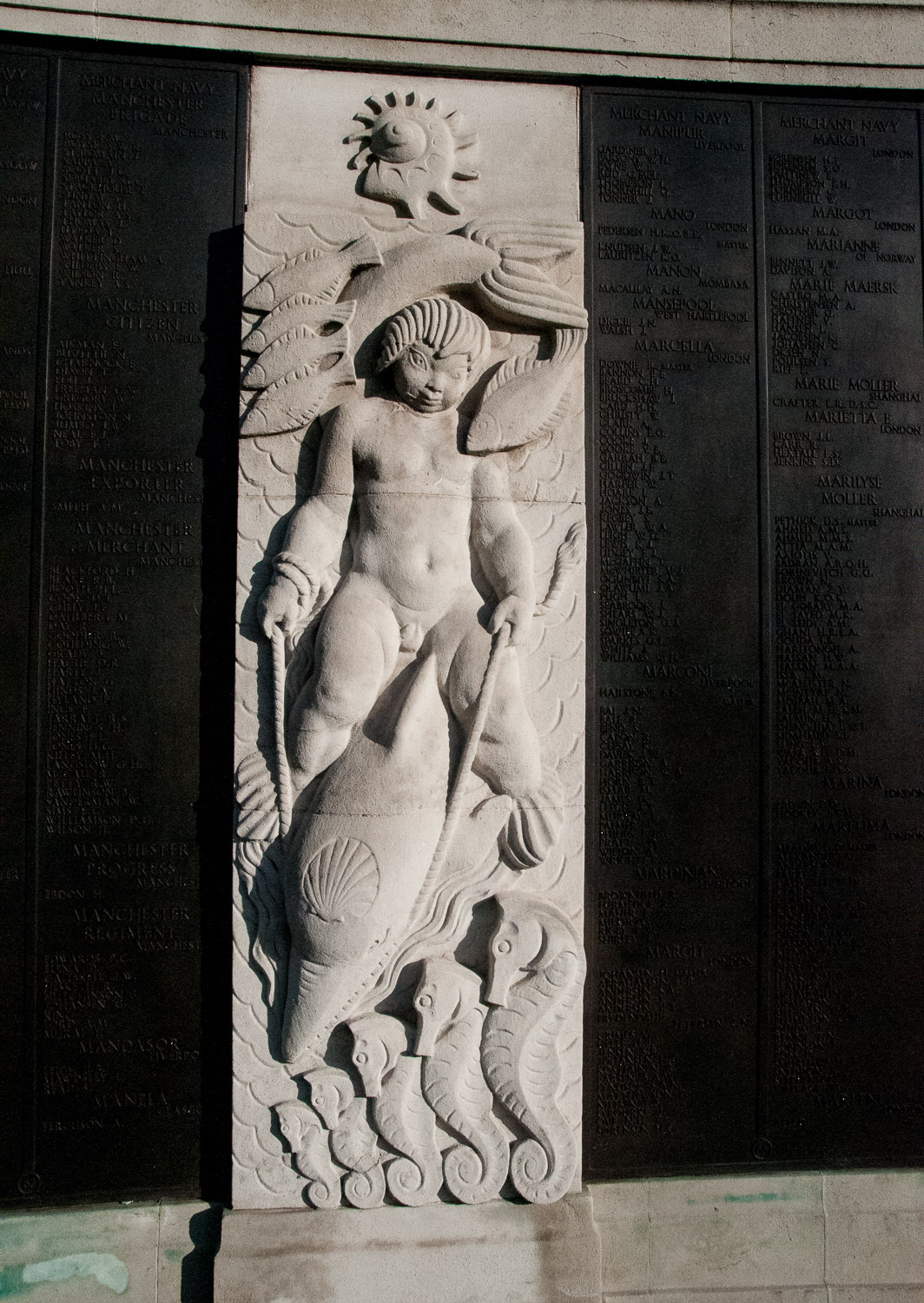
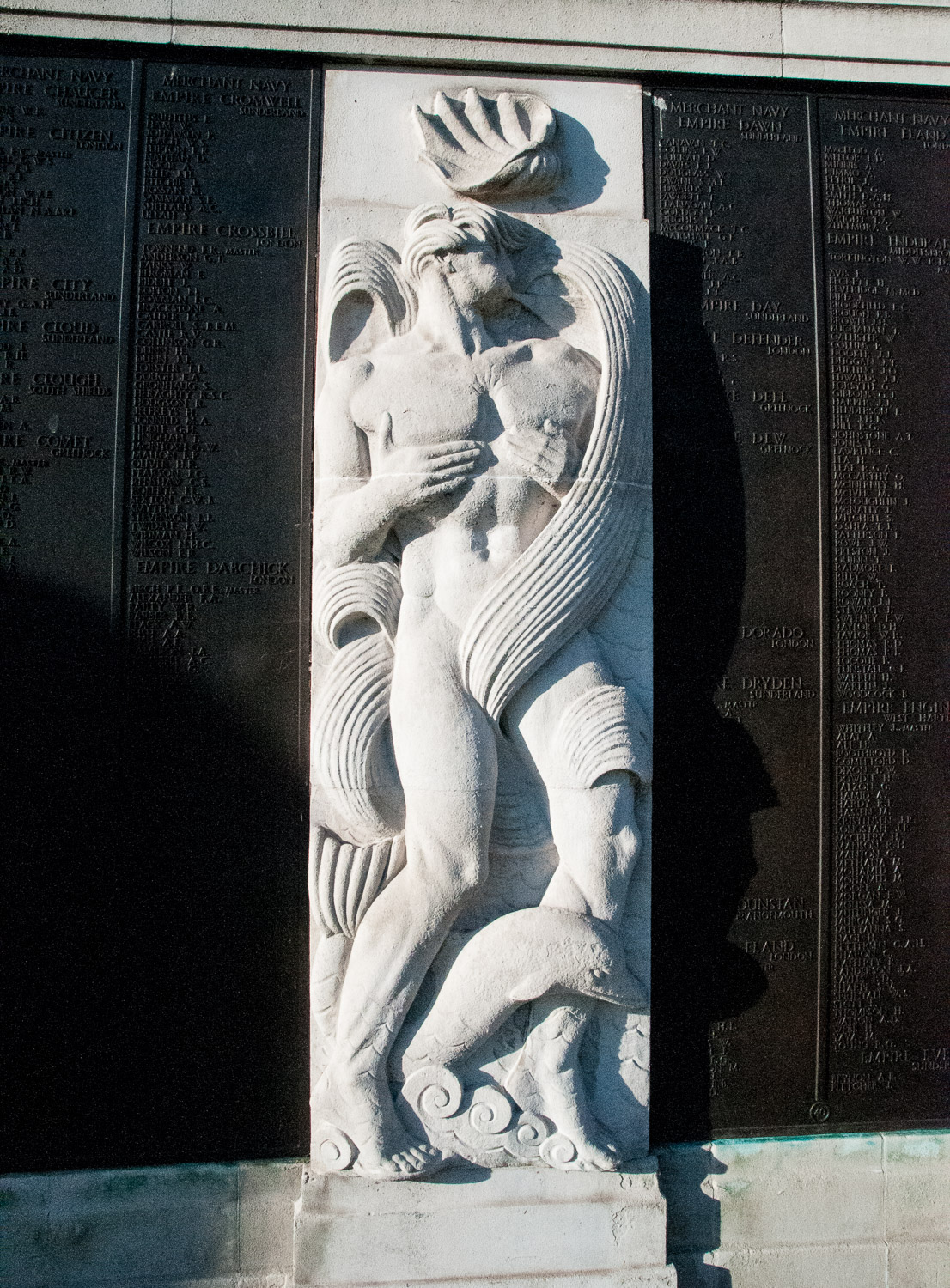
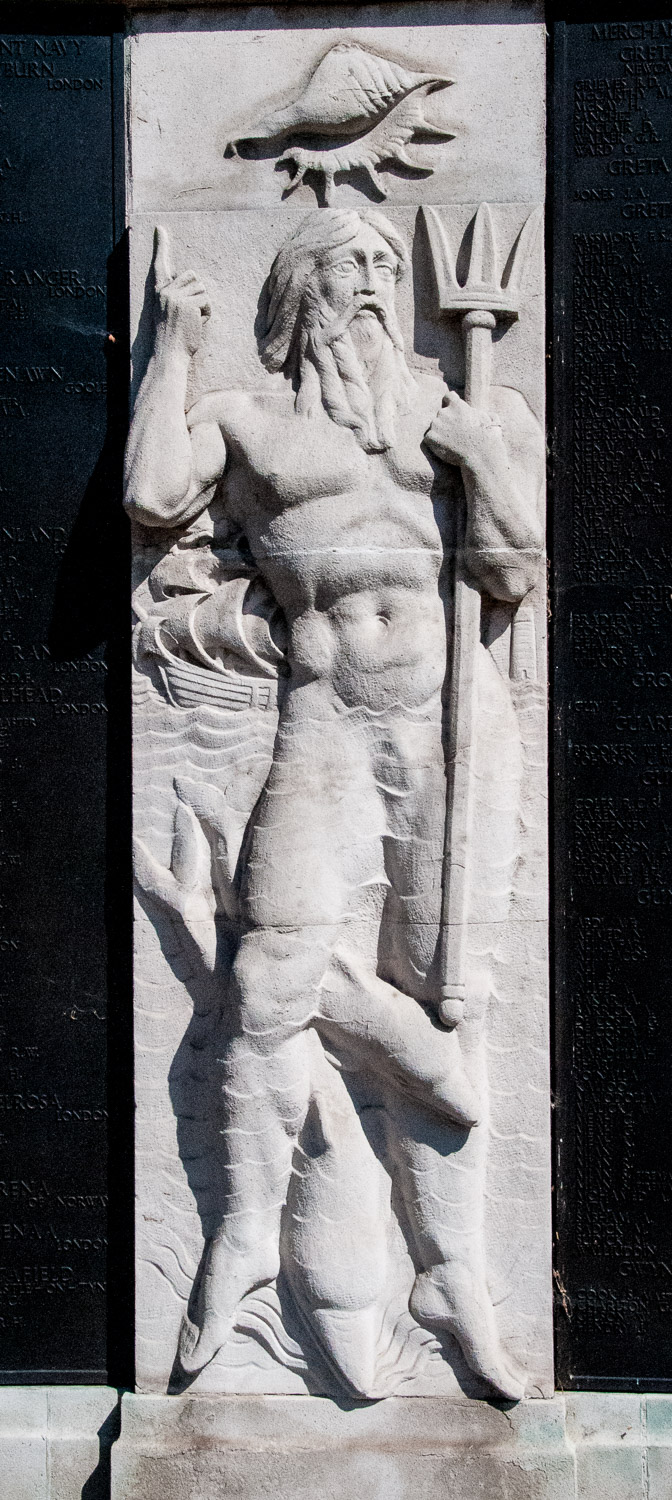
Dolphins feature highly in the allegorical sculptures by Sir Charles Wheeler representing the Seven Seas.

Here a boy is seen riding one surrounded by fishes and sea horses, above his head is a thorny snail …
A dolphin leaps through the legs of this figure who is creating the wind …
You can’t miss Neptune with a spider conch above his head and accompanied by another dolphin …
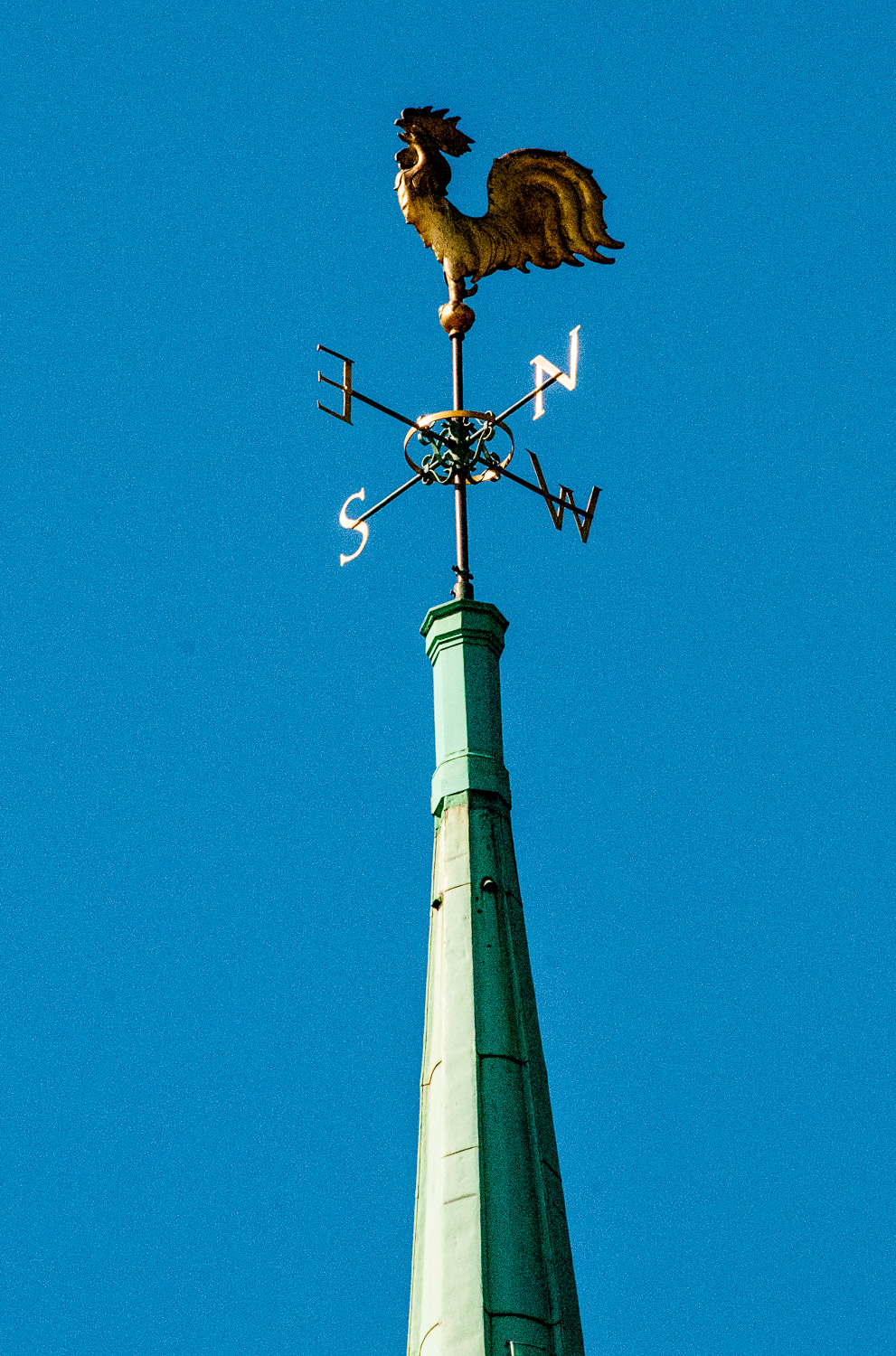
Across the road from Trinity Square is the church of All Hallows-by-the-Tower (EC3R 6BJ).

Substantially damaged in the War it was restored and reopened in 1957 with a new cockerel weathervane …
The beaver above 64 Bishopsgate (EC2N 4AW) is a reminder of the Hudson’s Bay company which once dominated the fur trade and was based nearby. Beaver fur was much sought after, particularly in the making of hats …
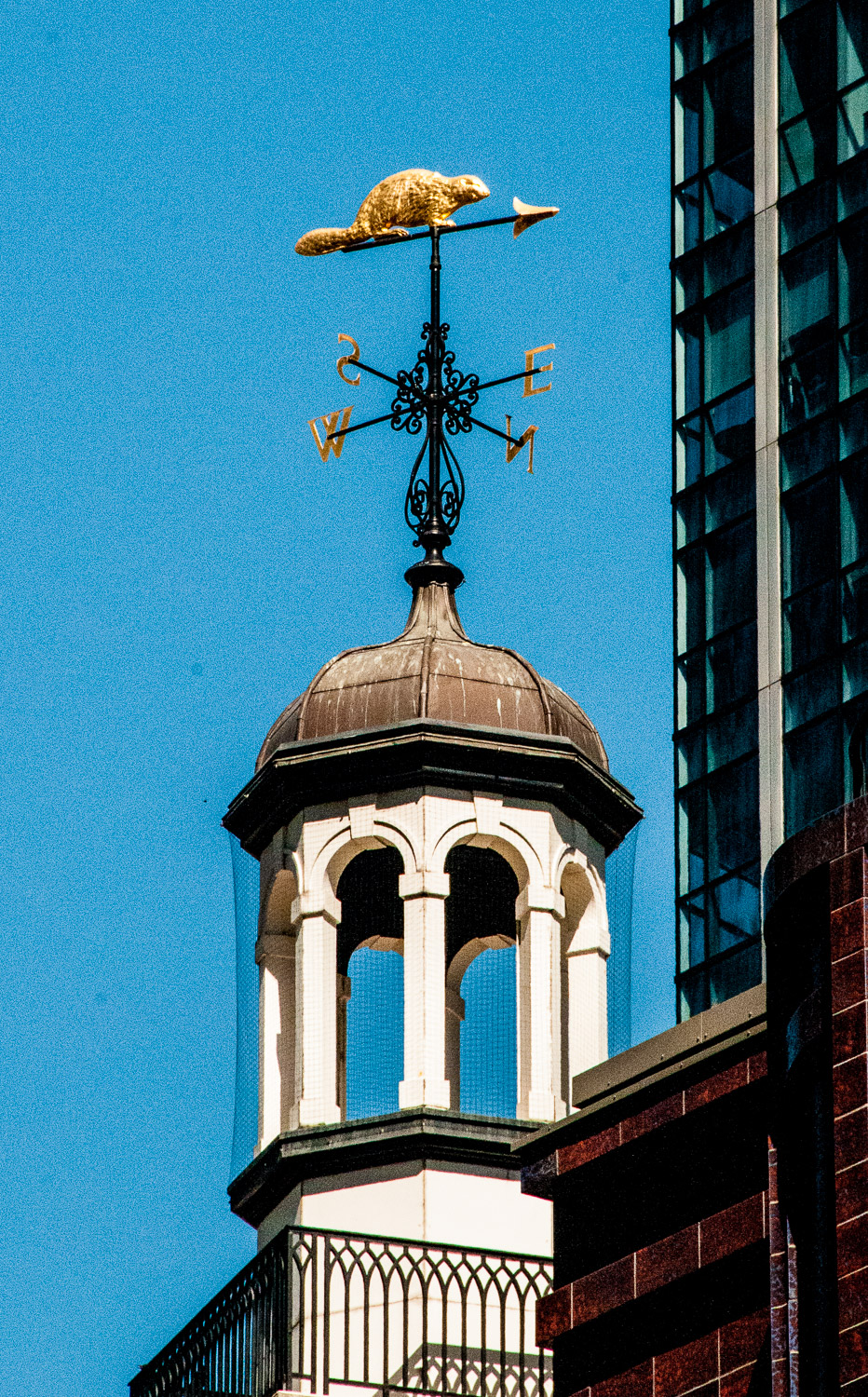
A golden rodent looks out across Bishopsgate.

Wander down to the end of New Street off Bishopsgate (EC2M 4TP) and you will find this ram over the gateway leading to Cock Hill …
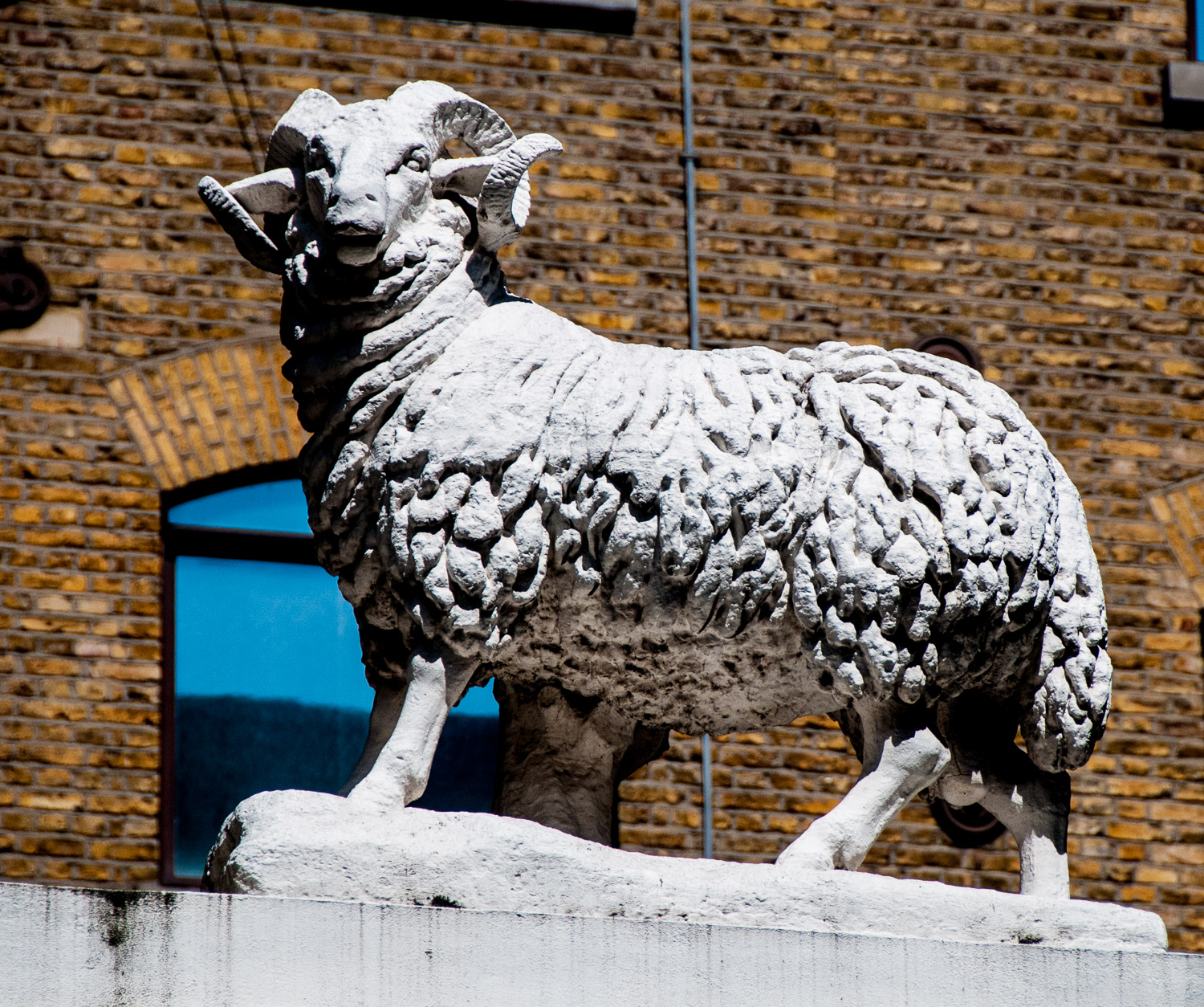
It’s by an unknown sculptor, dates from the 186os and used to stand over the entrance to Cooper’s wool warehouse.

Outside 68 Lombard Street there hangs an astonishing five foot long grasshopper (EC3V 9LJ) the insect being derived from the coat of arms of the Gresham family. Buildings in Lombard Street were not numbered until 1770 and so when the Greshams lived and worked there a similar sign would have been used to mark their residence …
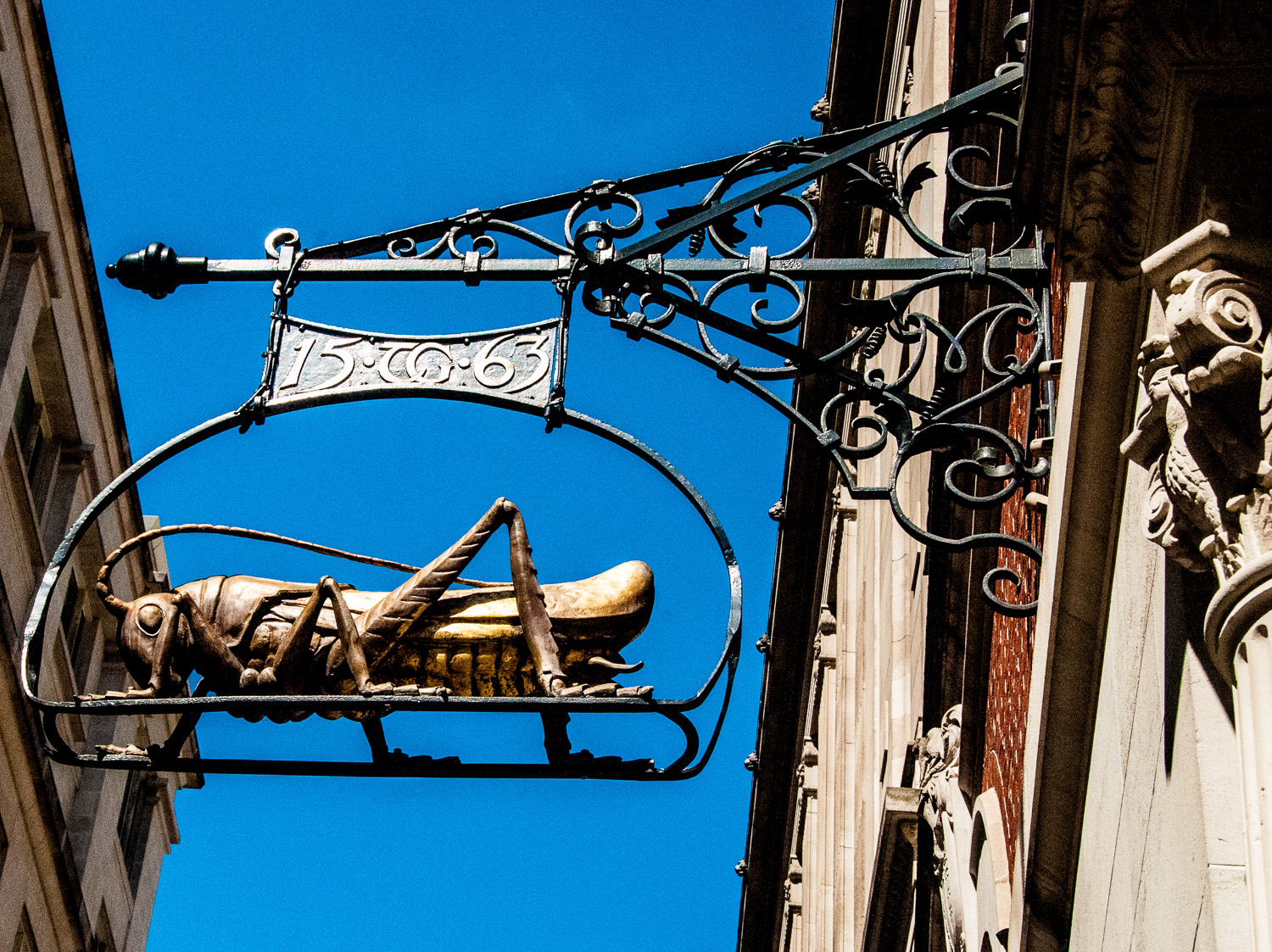
The year 1563 refers to the year Thomas Gresham (TG on the sign) set up his business here.

The present building dates from 1930 when it was destined to become the City office of Martin’s Bank (whose coat of arms included a grasshopper). The original family sign disappeared at the time of Charles II when such advertisements were banned after numerous serious accidents. They had a tendency to become detached in high winds and on one occasion pulled down the entire frontage of a building. This grasshopper dates from 1902 when a host of signs were recreated to celebrate the coronation of Edward VII.

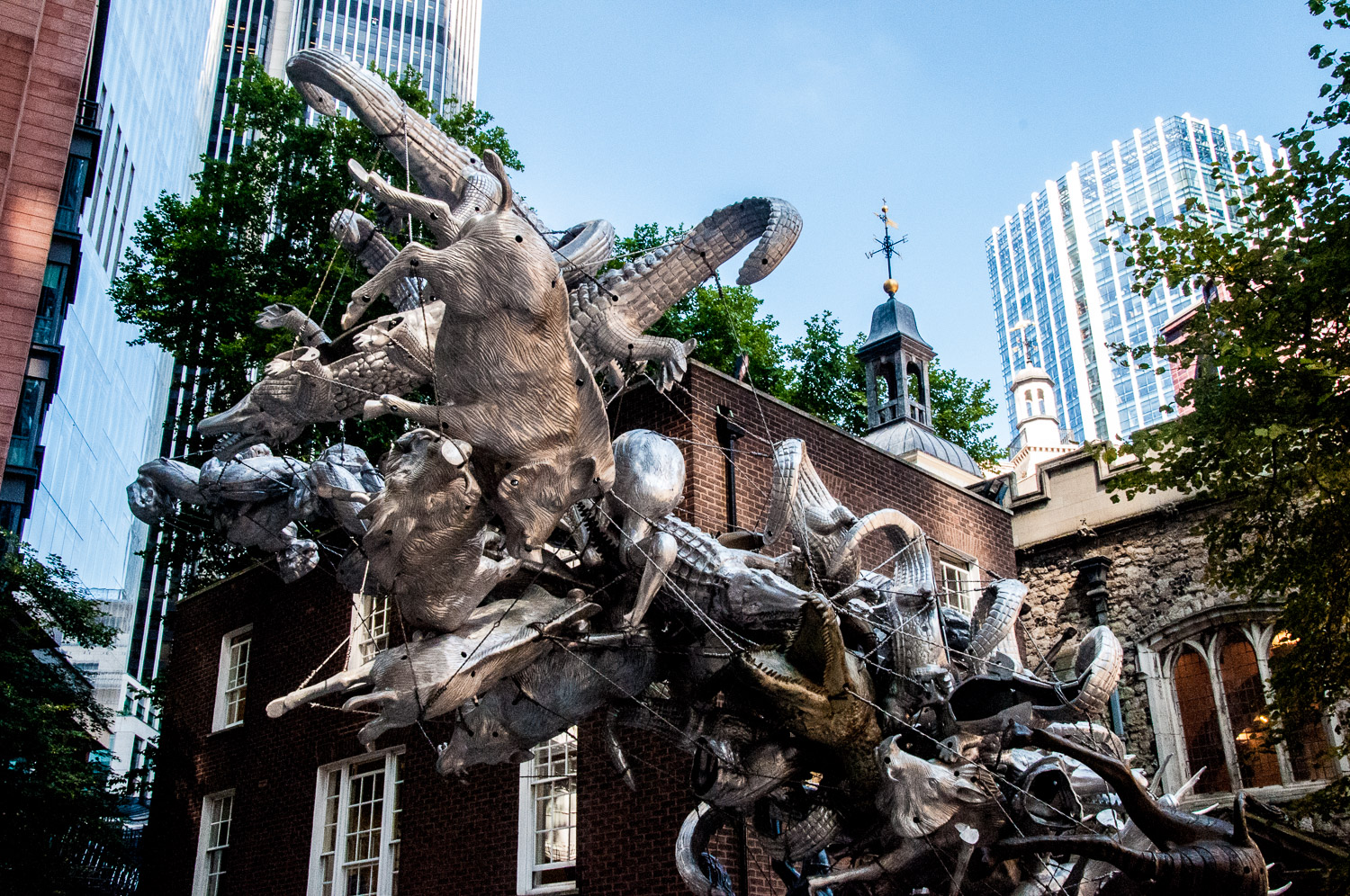
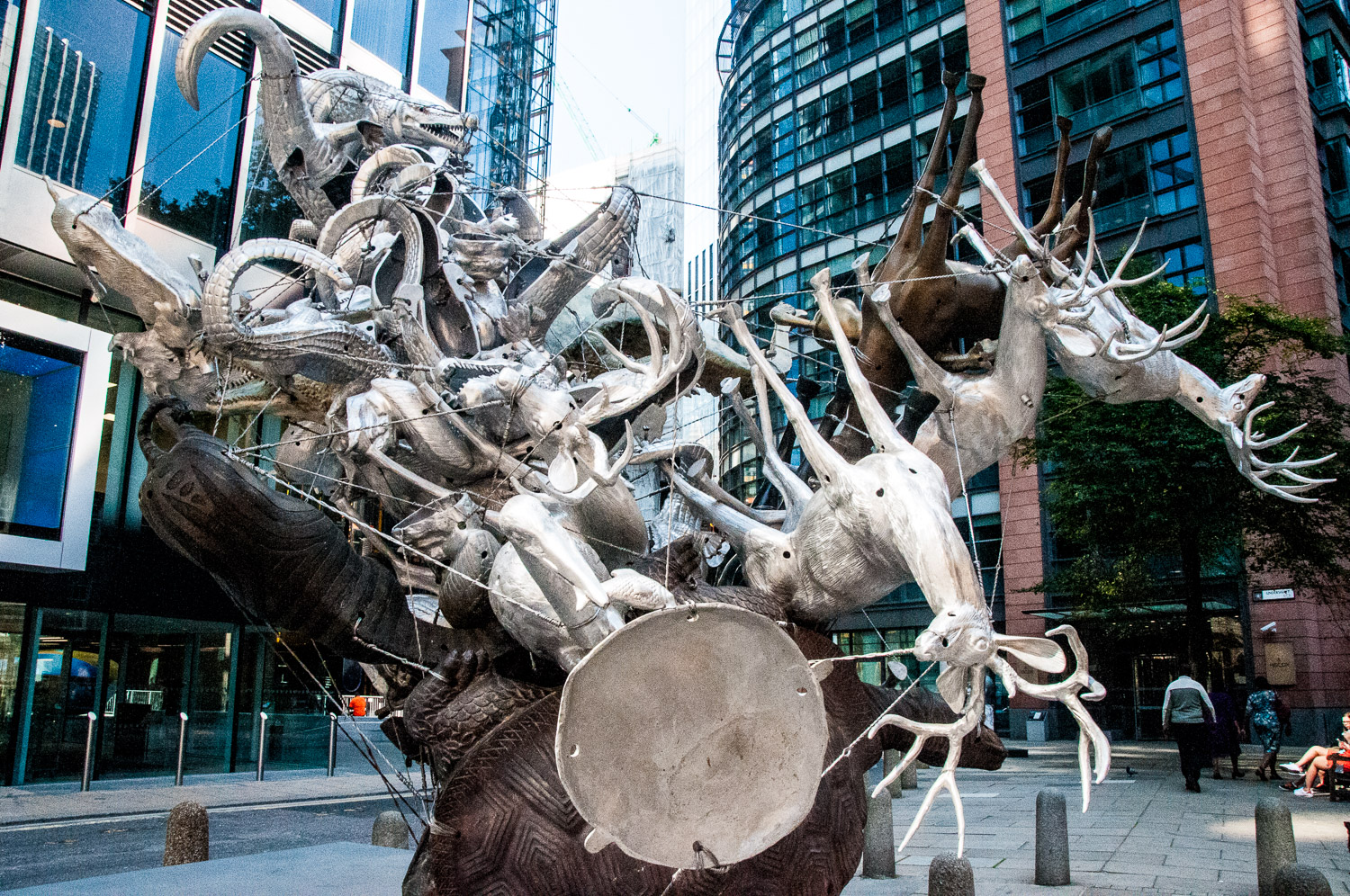
And finally, the Sculpture in the City event has brought us this extraordinary work by Nancy Rubins. It’s called Crocodylius Philodendrus and you can view it at 1 Undershaft (EC3A 6HX).

See how many animals you can spot …
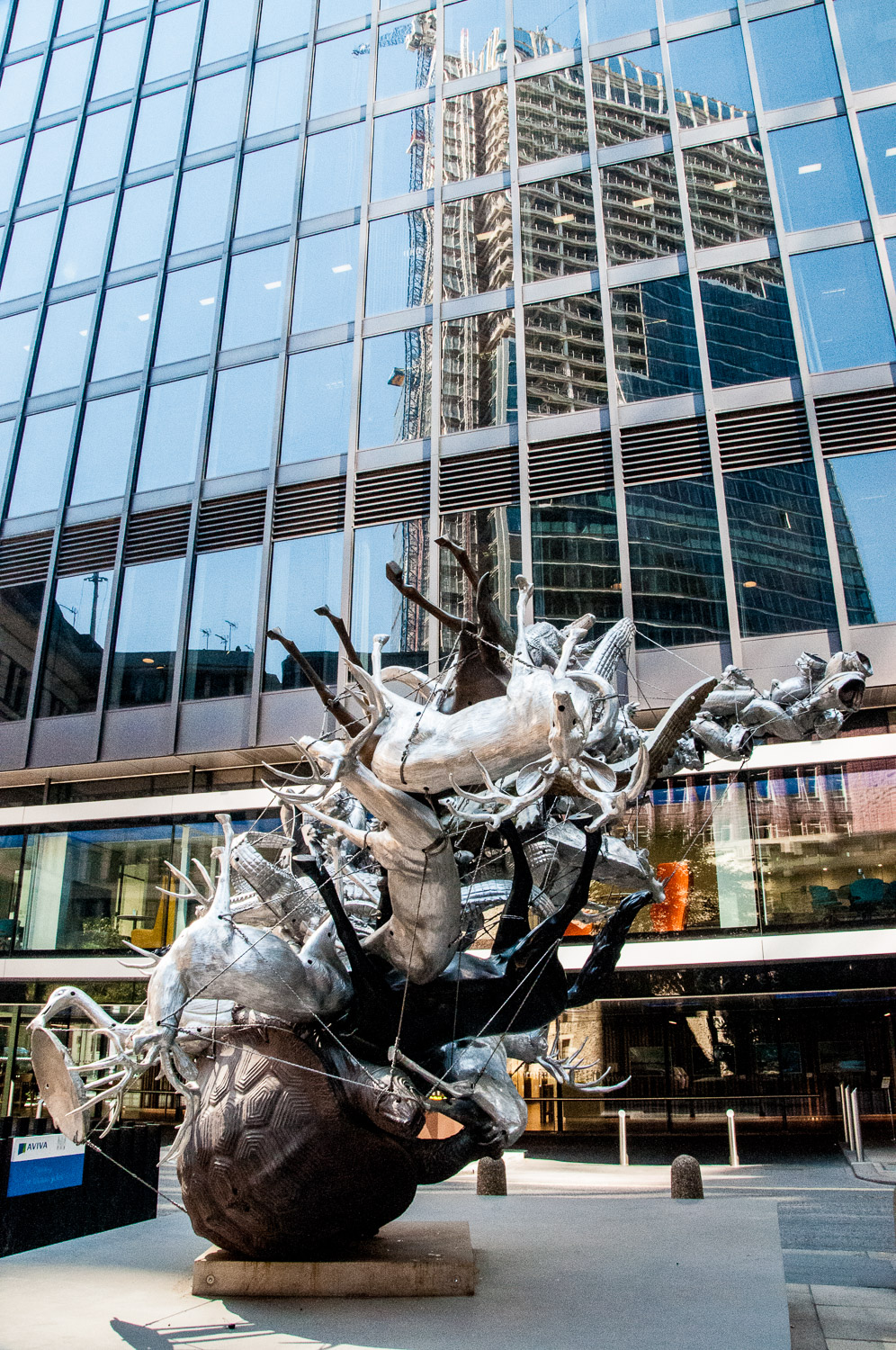
In there somewhere you will find crocodiles, hogs, deer, tortoises and a zebra.


City Churches – more unusual discoveries

Last week I thought it was time to take another stroll around the City churches to see what I would discover. After researching last week’s blog, I was particularly interested in artifacts that had been moved from one church to another and why.

I was very lucky in the first church I visited, St Martin within Ludgate, on Ludgate Hill (EC4M 7DE) inside which I found both a fascinating chandelier and a very unusual font. There is a large entrance lobby (designed to reduce traffic noise inside the church) and you then enter one of Sir Christopher Wren’s least altered interiors (1677-1686) with fine dark woodwork which largely escaped the Blitz.

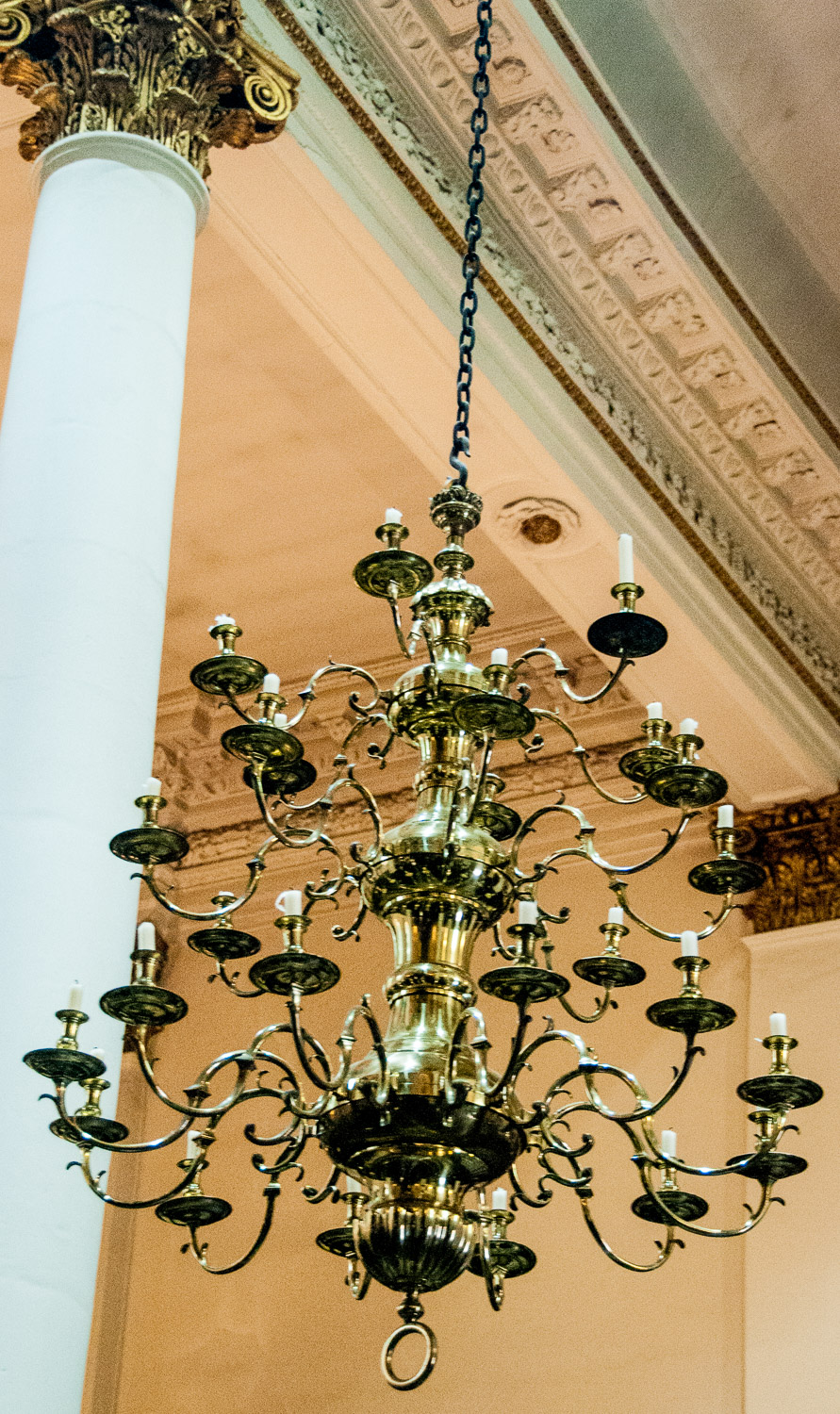
Look up and you will see this beautiful chandelier or candelabrum …

It’s still lit by candles.

As one commentator has noticed, it looks more like something you would find in a country house or a ballroom. The candles were not lit when I visited but I am sure that when they are, on a dark morning or evening, one must get a real feel for what it was like to worship here in earlier centuries. It came to the church via St Vincent’s Cathedral in the West Indies, probably in 1777: a reminder of the links between the City’s trading economy and the British Empire overseas.

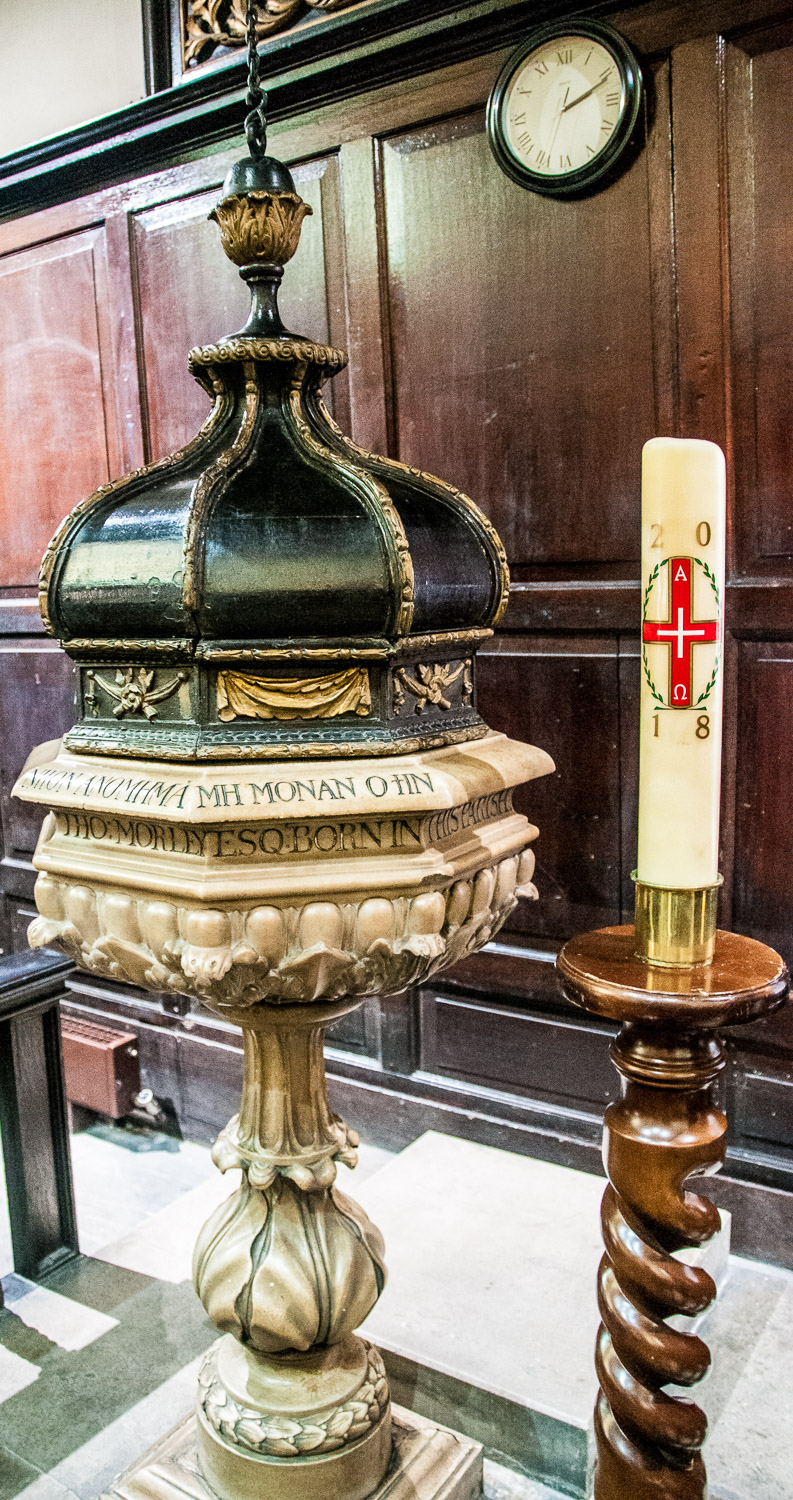
And now to the very unusual font …

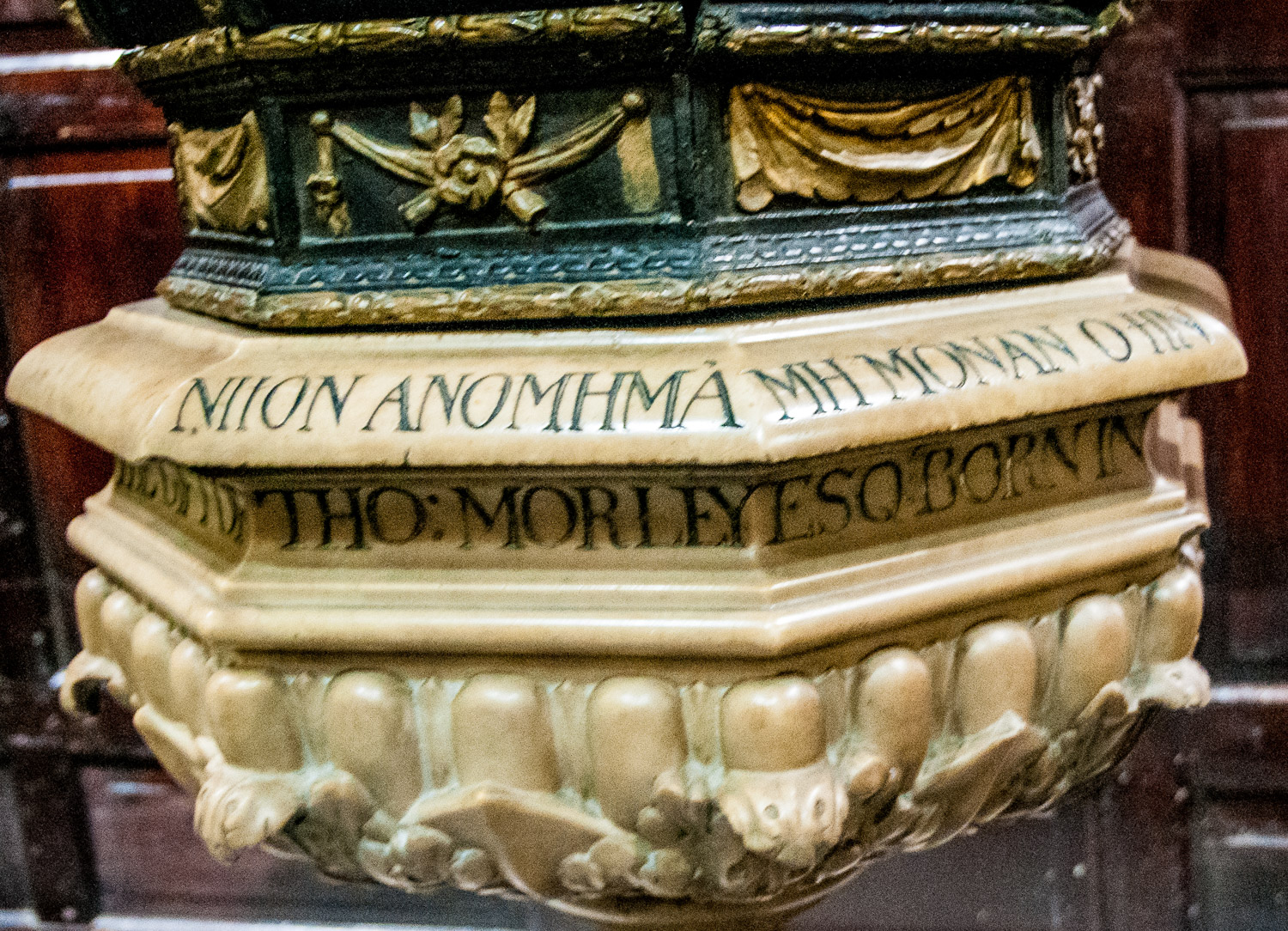
The bowl is white marble and the wooden supporting plinth is painted to look like stone. It dates from 1673, predating the church, and was previously located in a ‘tabernacle’ used by the congregation during the rebuilding.

It contains a Greek palindrome copied from the Cathedral of St Sophia in Constantinople:

Niyon anomhma mh monan oyin

(Cleanse my sin and not my face only)

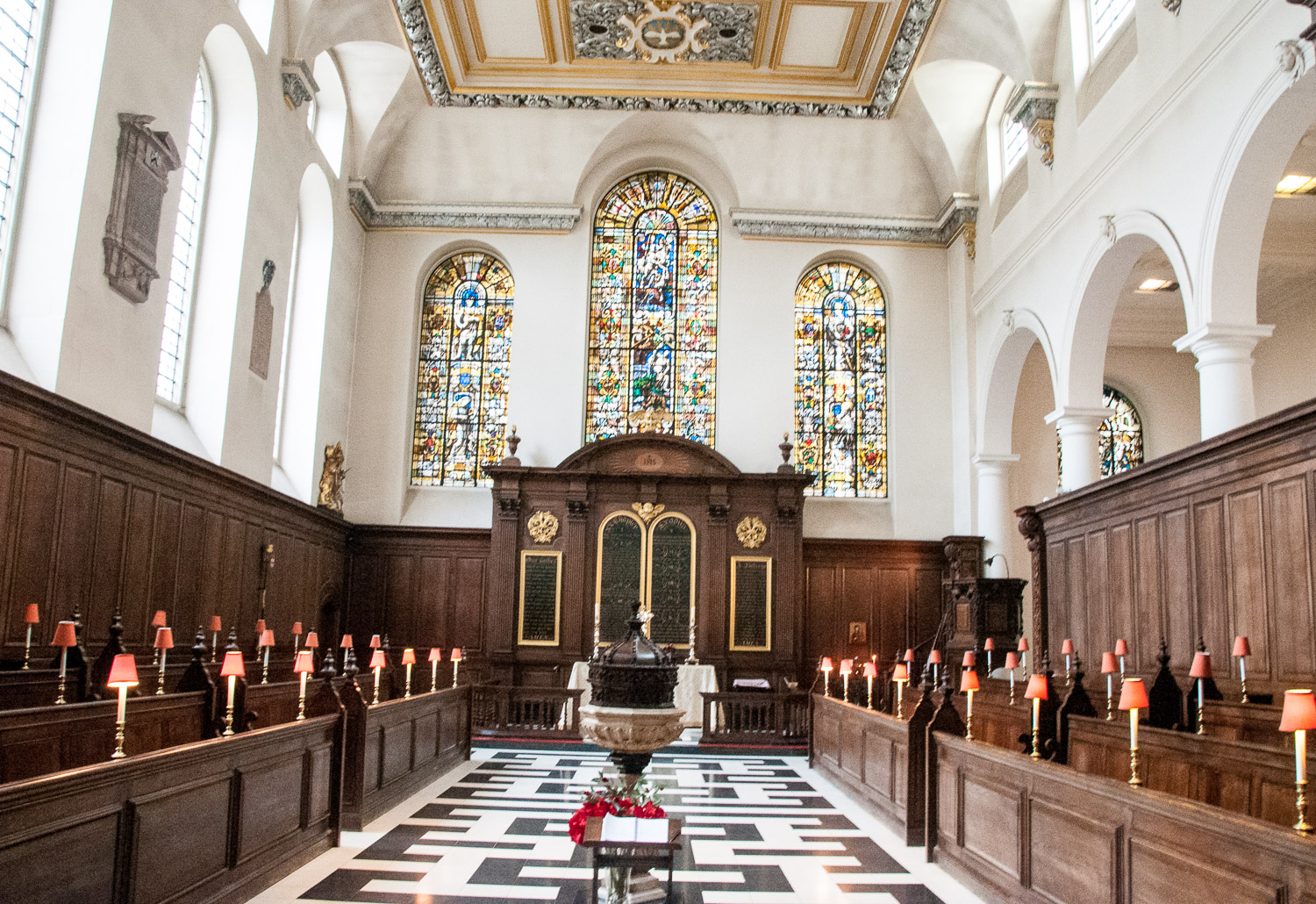
No church blog of mine would be complete if it didn’t contain a reference one of my favourite churches, St Vedast Foster Lane (EC2V 6HH) …

The interior looking east.

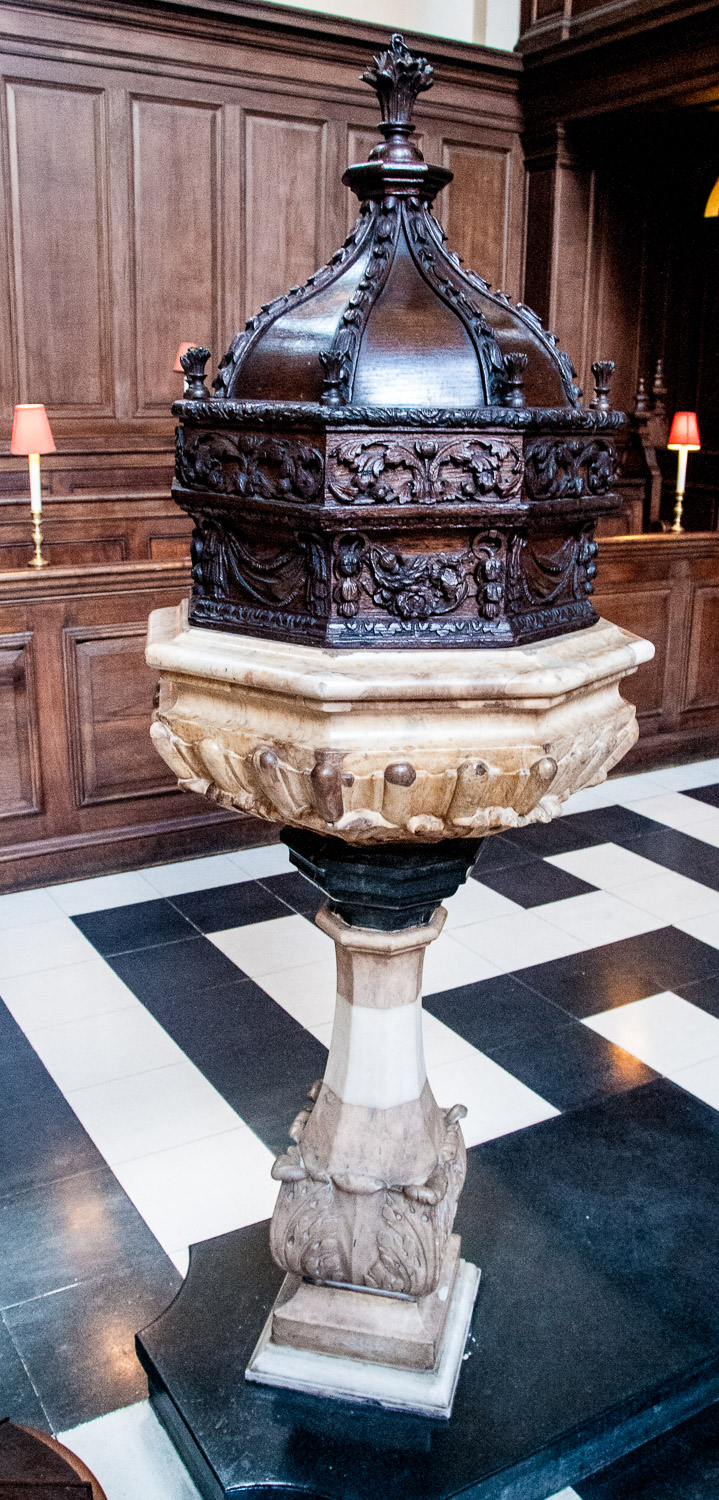
Here there are a few features that have come from other churches.

The font and its cover both date from the late 17th century. The font itself was designed by Christopher Wren and the cover is by the most celebrated woodcarver of the 17th century, Grinling Gibbons. Both were rescued from St Anne & St Agnes in Gresham Street after the Blitz.

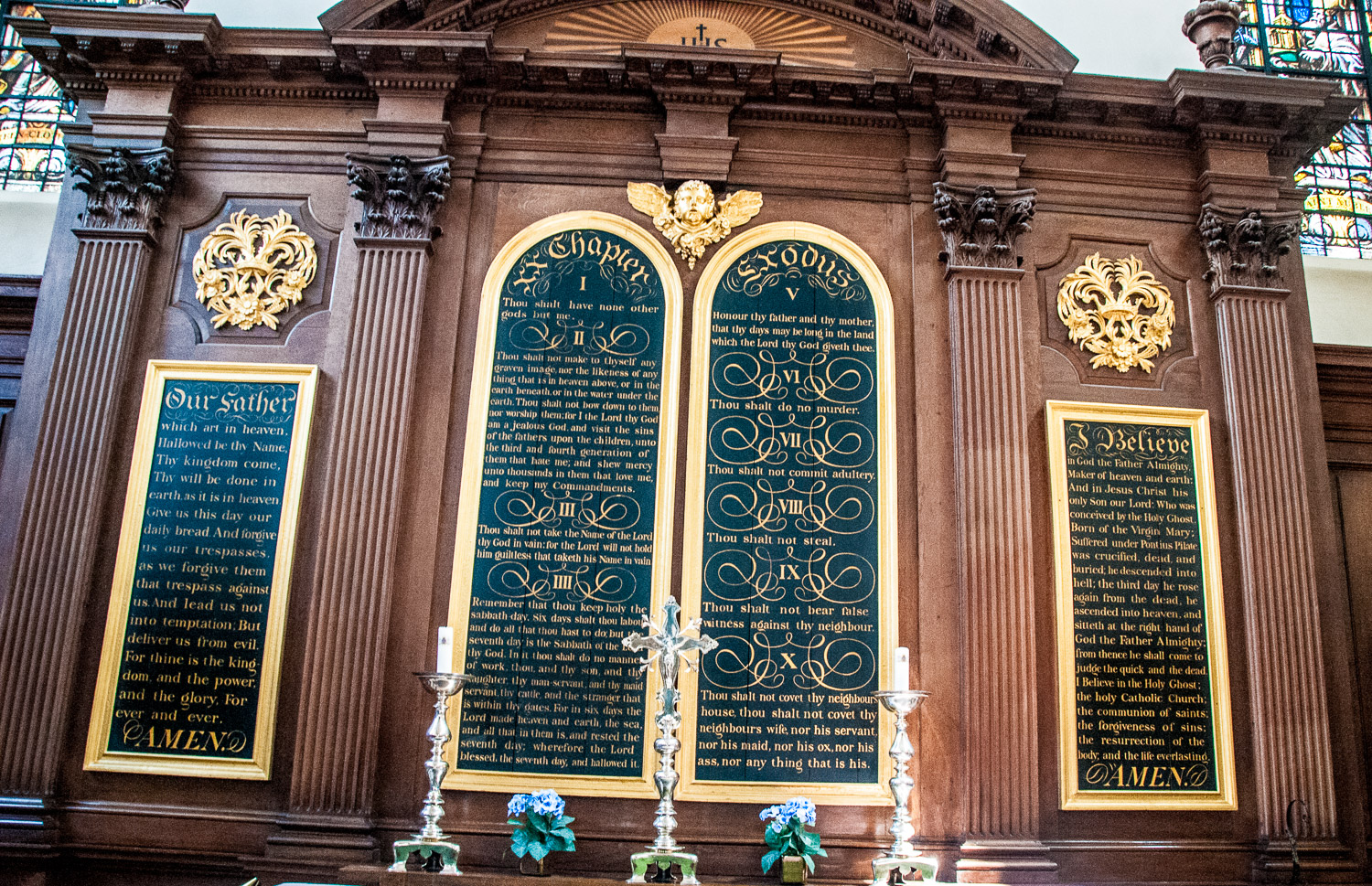
The reredos behind the altar came from the ‘lost’ church of St Christopher le Stocks …

The original St Christopher le Stocks was destroyed in the Great Fire, rebuilt by Wren in 1671 and situated in Threadneedle Street. During the 18th century, the Bank of England gradually bought up adjoining properties, extending its site into the parish. In 1781 it came to an agreement with the rector of St Christopher’s, and its patron, the Bishop of London, allowing it to demolish the church itself. This was not only motivated by a desire to build on the land, but also by a fear that rioters might use the church as a platform to attack the bank, a concern sparked by the Gordon Riots of 1780.

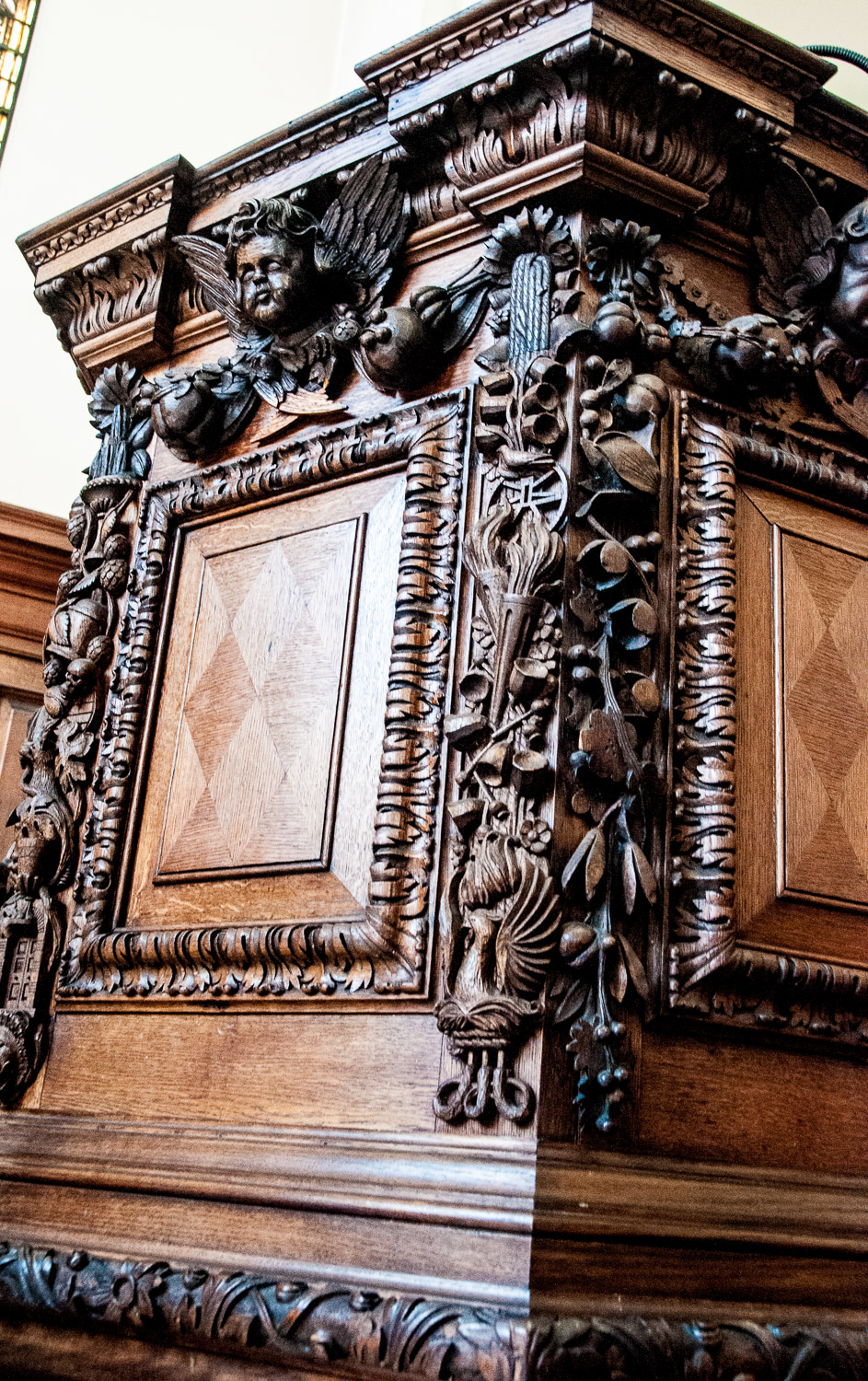
The richly carved pulpit came from All Hallows Bread Street, demolished in 1878 under the Union of Benefices Act 1860 which I also mentioned in last week’s blog

For my last visit of the day I thought I would take a look at St Anne & St Agnes (mentioned above) and see what I could find there (Gresham Street EC2V 7BX).

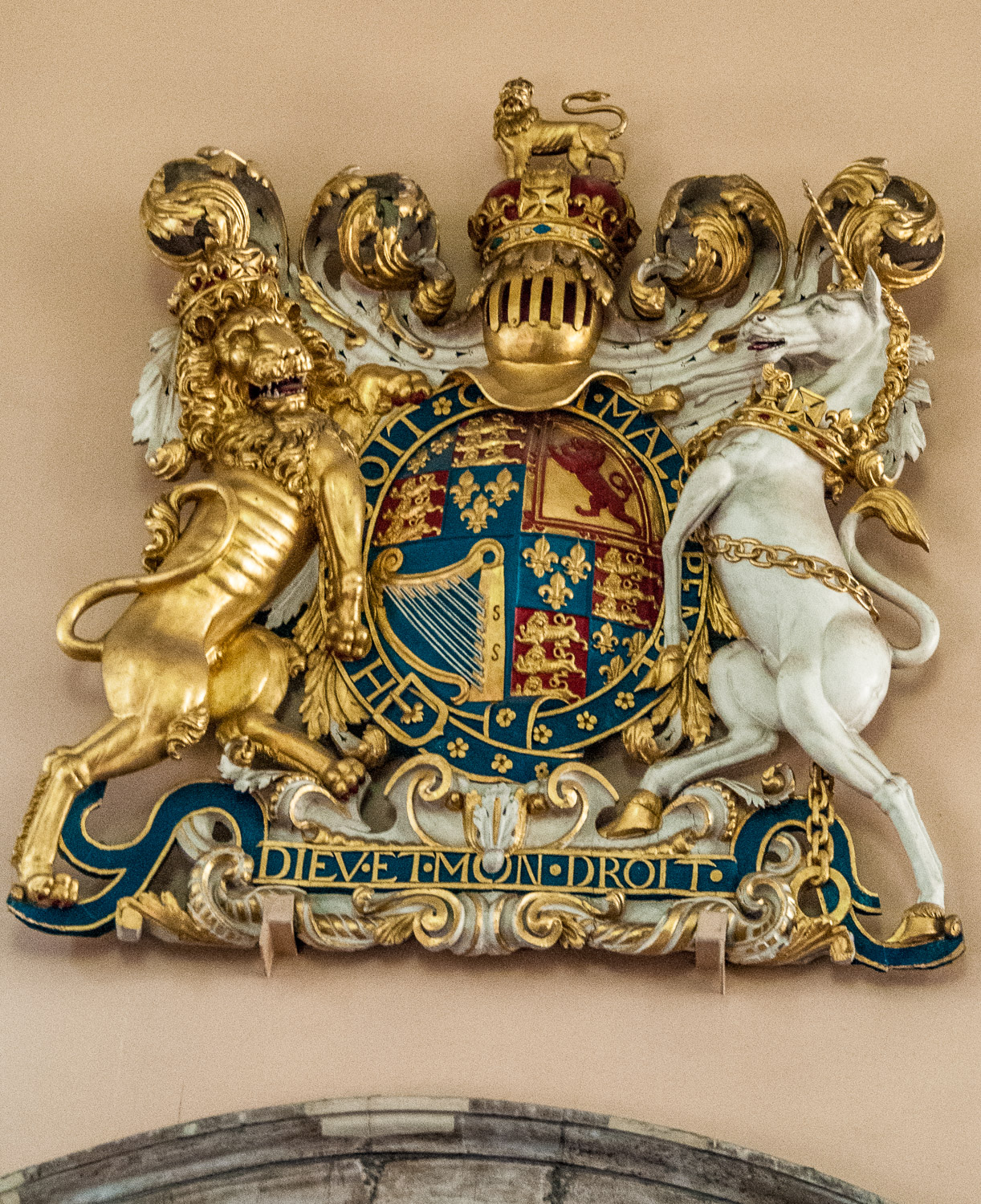
The Royal Arms of Charles II on the west wall is one of the best examples in England …

In 1649 the vicar was beheaded for protesting against the execution of King Charles I.

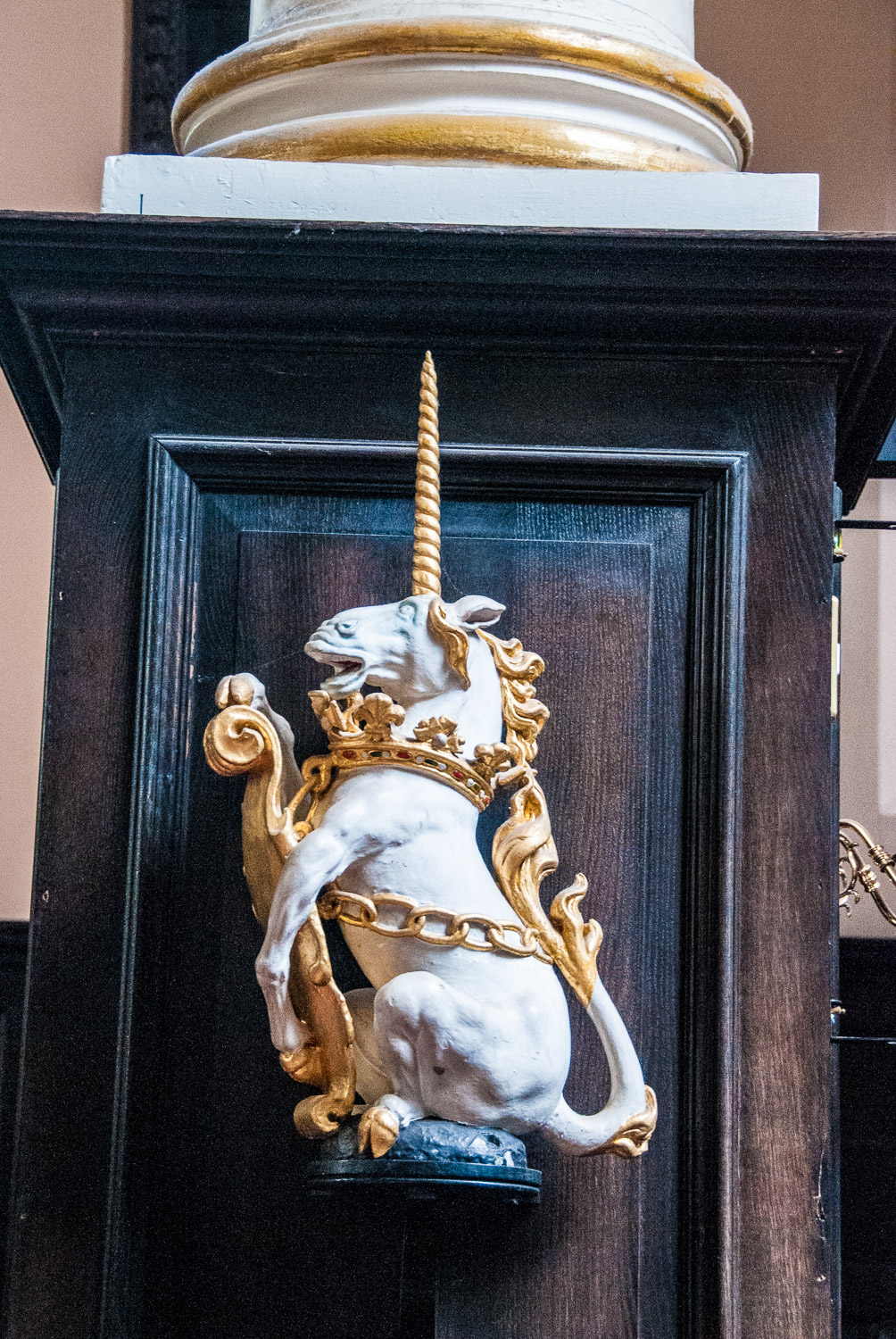
The central dome is supported by four handsome Corinthian columns two of which contain heraldic representations, one being this unicorn …

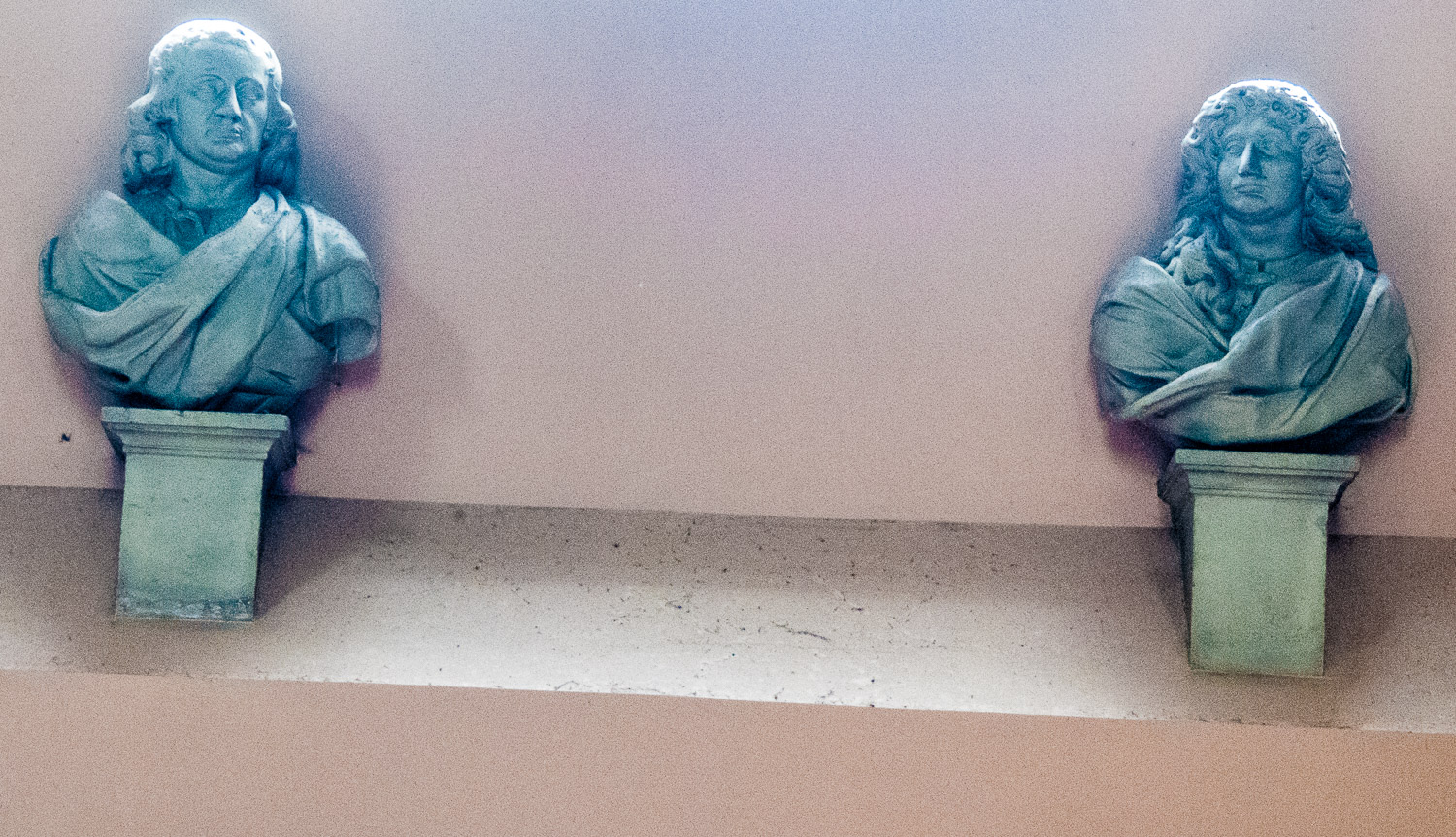
High up on the south wall are busts of Sir James Drax (died 1662) and his son John (died 1682). They come from the ‘lost’ church of St John Zachary which was destroyed in the Great Fire and not rebuilt …

The Drax family were pioneers of the sugar industry (and slavery) in Barbados and apparently Drax Hall Plantation in St George, Barbados is the oldest surviving Jacobean mansion in the western hemisphere.

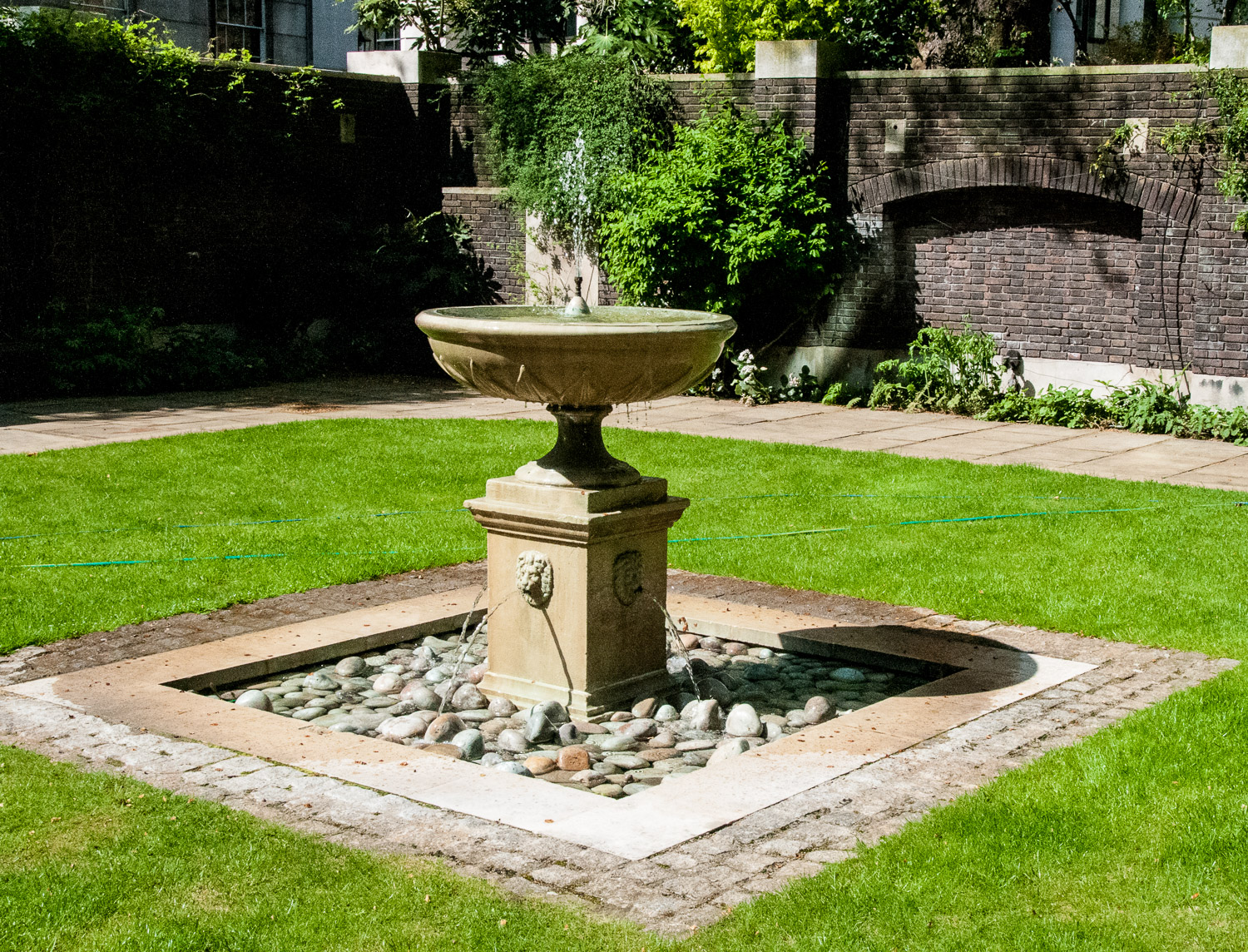
St John Zachary may be no more but there is now very attractive and quiet garden where the church used to stand …

You can read more about it here.


Unusual memorials

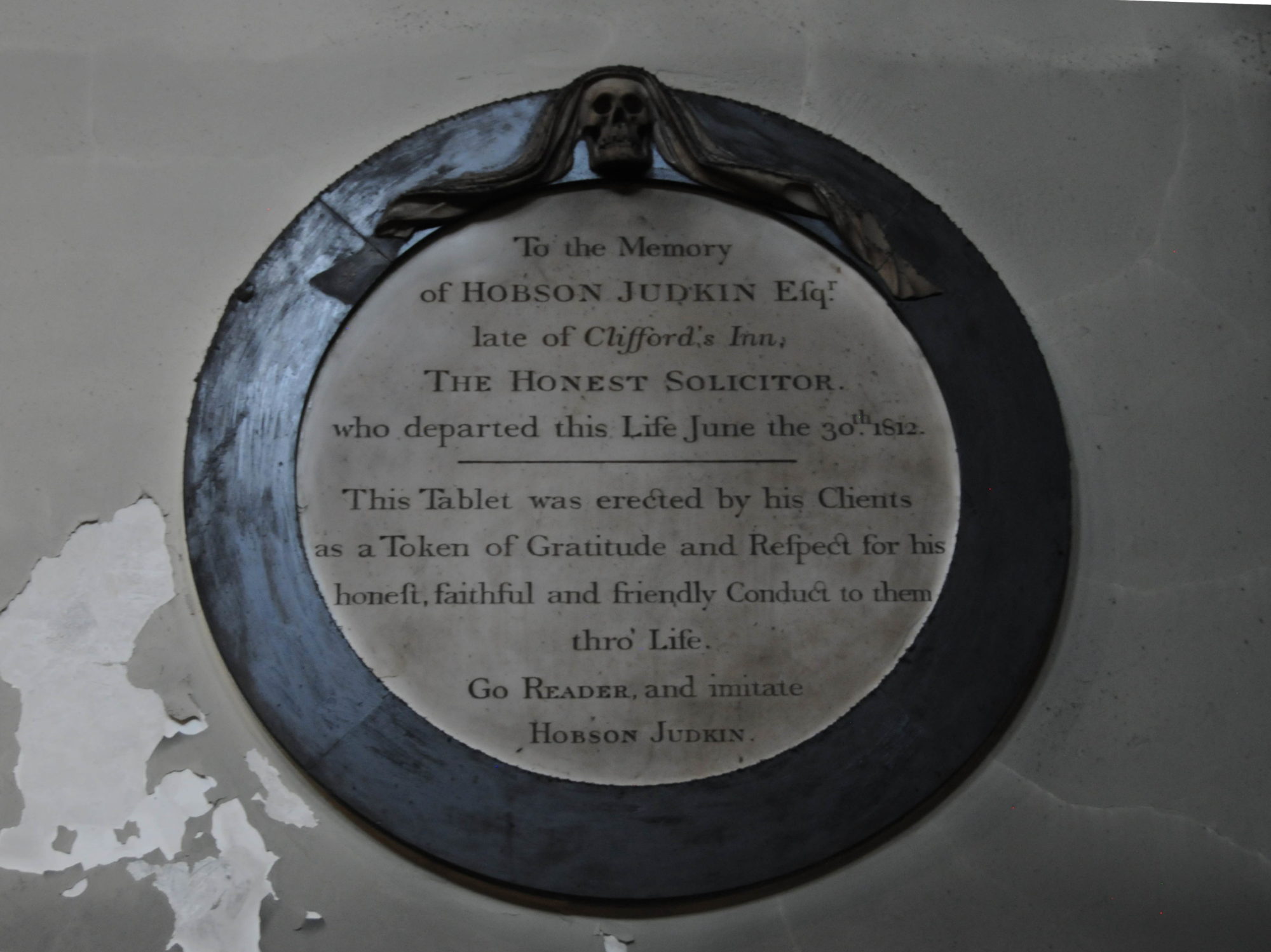
I am sure there are very few dishonest solicitors nowadays, but there seems to have been a time when an honest one was rather unusual, and this virtue was so exceptional that his clients paid for a memorial plaque saying so. It reads ‘Hobson Judkin, late of Clifford’s Inn, THE HONEST SOLICITOR who departed this life June 30th 1812’.

The plaque can be seen in St Dunstan-in-the West on Fleet Street.

‘Go reader’ we are told ‘and imitate Hobson Judkin’.

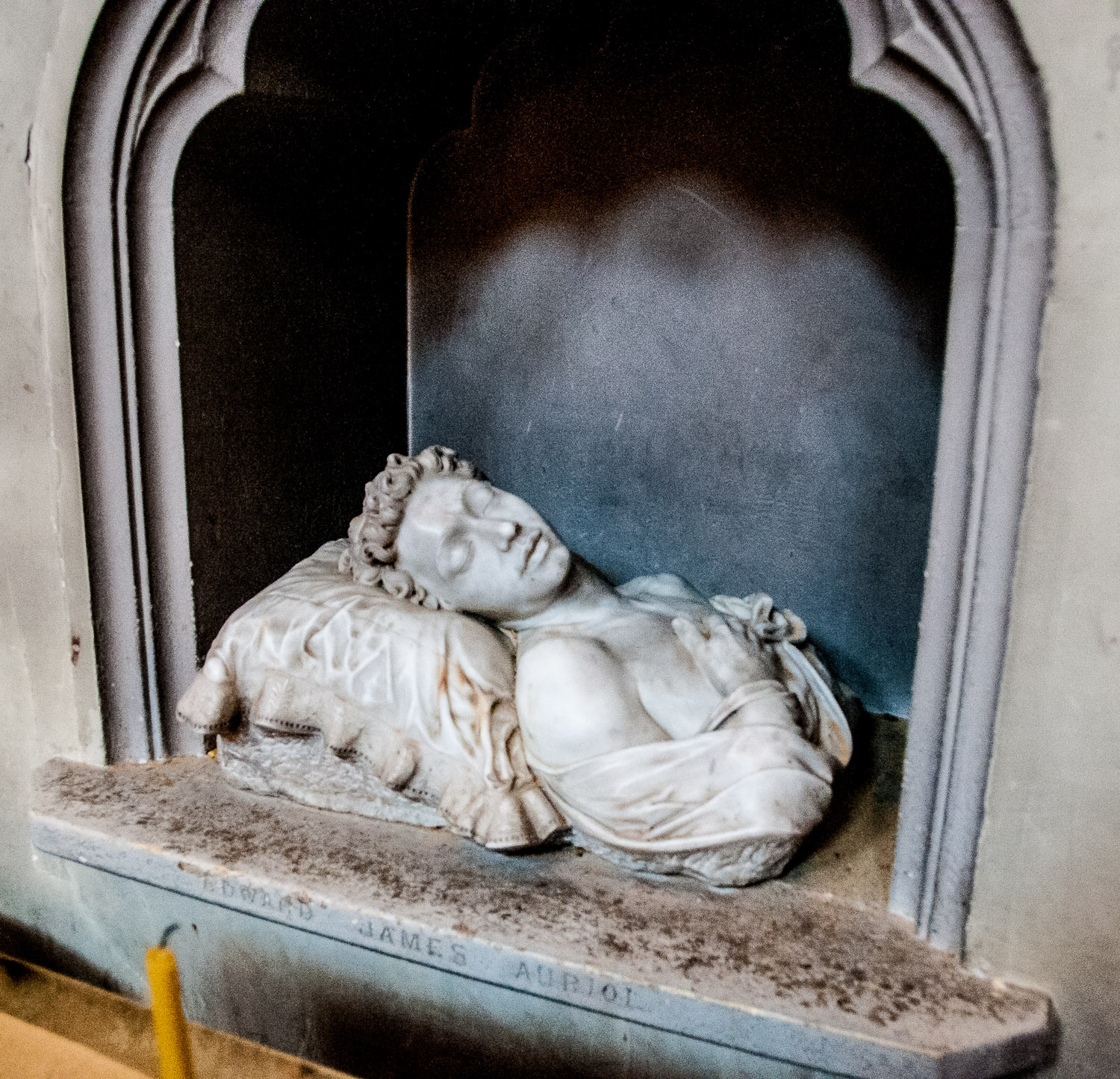
Also in the church is this figure of a young man, apparently asleep …

In fact, Edward James Auriol died tragically at the age of 17 when he drowned whilst swimming in the Rhône river in Geneva one bright morning on 19th August 1847. A student at Kings College London, he was the ‘tenderly beloved and only child’ of the Rector of St Dunstan’s Edward Auriol and his wife Georgiana.

St Bride’s Fleet Street was badly damaged in the War but has now been sympathetically restored. In it there is a memorial to a lady who has a special connection with the United States…

Virginia Dare by Clare Waterhouse (1999).

At some time in the early 1580s the wedding took place at St Bride’s between Eleanor White and the tiler and bricklayer Ananias Dare. Their daughter Virginia was to be the first English child born in North America on Roanoake Island on 18 August 1587 after being brought there in an expedition led by her father, John. Because ‘this childe was the first Christian borne in Virginia, she was named Virginia.’

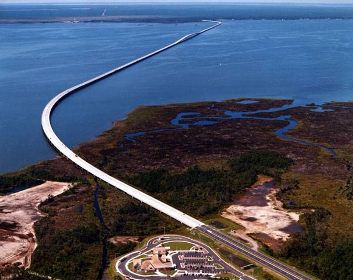
Roanoake turned out to be a bad choice. Previous settlers had fled in 1585 after little more than a year due to dwindling supplies and deteriorating relationships with the natives (they hitched a ride with Francis Drake, who fortunately happened to be passing). Similarly with the 1587 settlement, it soon became obvious that more supplies (and men) were needed and White set off again for England. He was unable to return speedily but eventually arrived back on Virginia’s third birthday. No trace remained of his daughter or of the other 114 men, women and children he had left behind – what happened to them has remained a mystery ever since. Virginia lives on though – in the name Dare County and the Virginia Dare Memorial Bridge.

The Virginia Dare Memorial Bridge – over 5 miles long and opened in 2002.

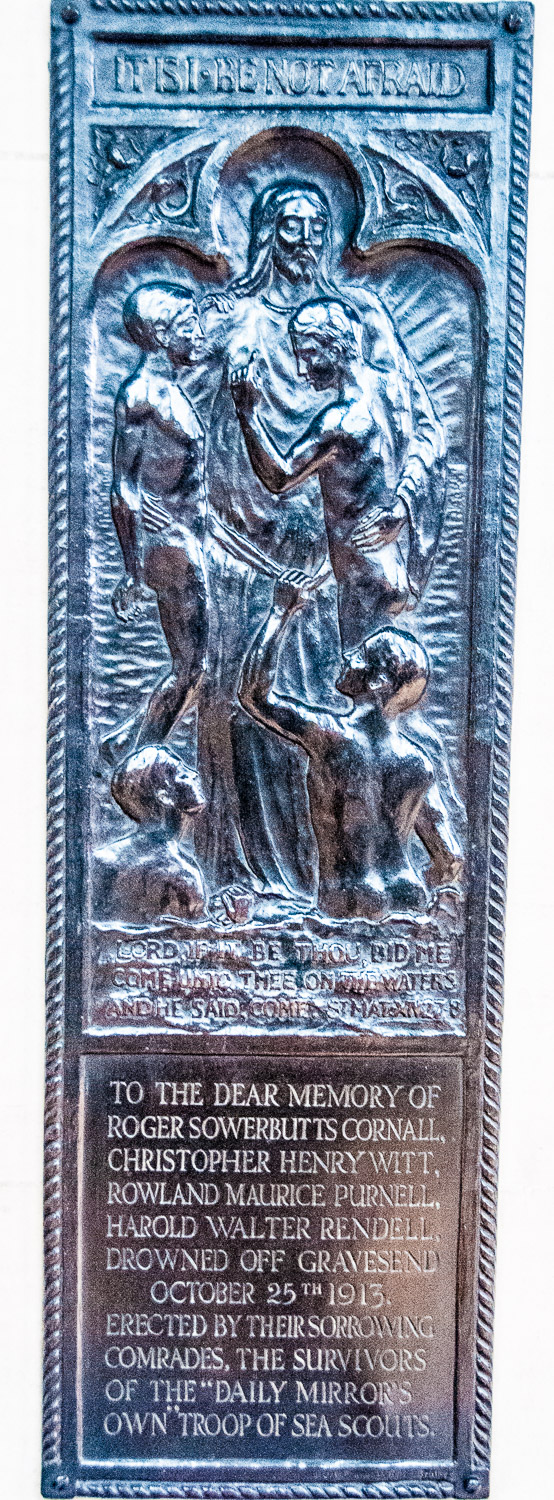
In All Hallows-by-the-Tower, a maritime accident is commemorated.

Jesus summons drowned Sea Scouts out of the water …

The inscription reads …

It is I, be not afraid.
Lord, if it be Thou, bid me come unto Thee on the waters.
And He said, ‘Come.’ St Matt. 14-27

Sea Scouting was a relatively new movement and in July 1912 the Daily Mirror newspaper presented them with a 50-ton Ketch, named the Mirror, equipped with the latest wireless equipment.

The evening of Saturday, October 25th, was a fine clear night and most of the Scouts turned in. The Mirror was tacking across the Thames between Gravesend and Tilbury having passed two steamers when a third, the Hogarth, loomed up, close to. Hogarth appeared to be making a turn to pass behind the Mirror, but crashed into her amidships sinking her.

For some time the yacht hung on the stem of the steamer and some boys managed to get up onto her. Ropes were thrown and four or five more were saved. Hogarth’s boat was promptly lowered and picked up three more boys from the water but four perished.

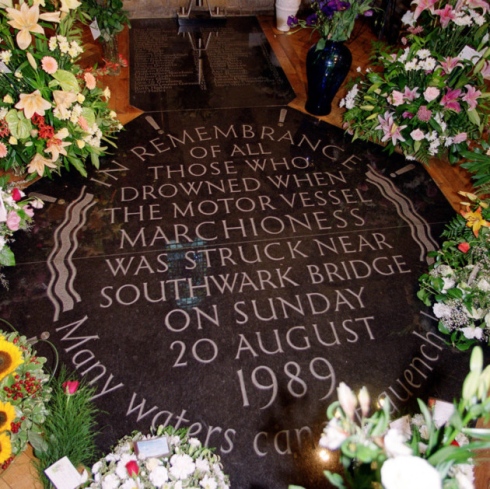
I found it difficult not to be reminded of the Marchioness disaster in 1989 – the commemorative plaque for those victims is in Southwark Cathedral …

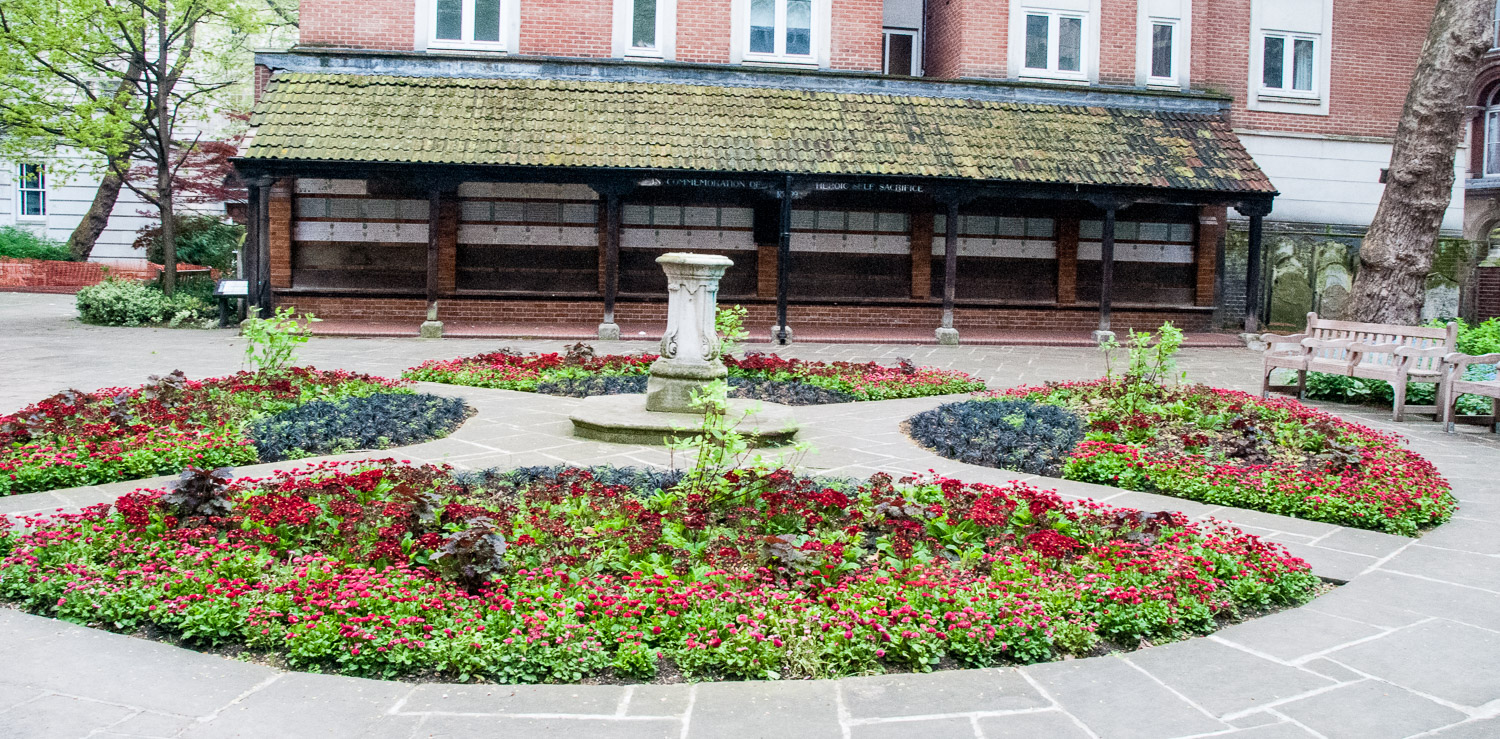
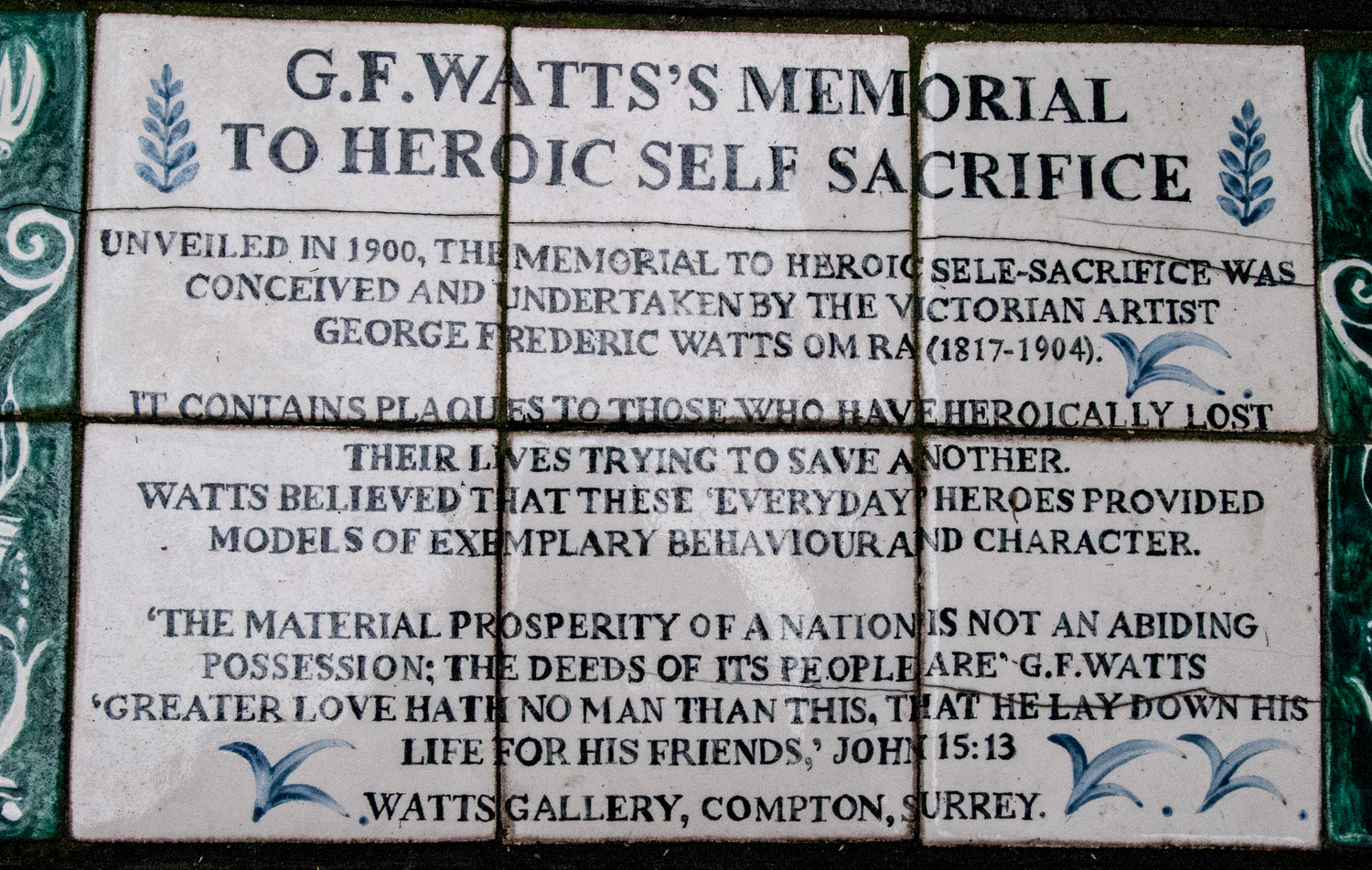
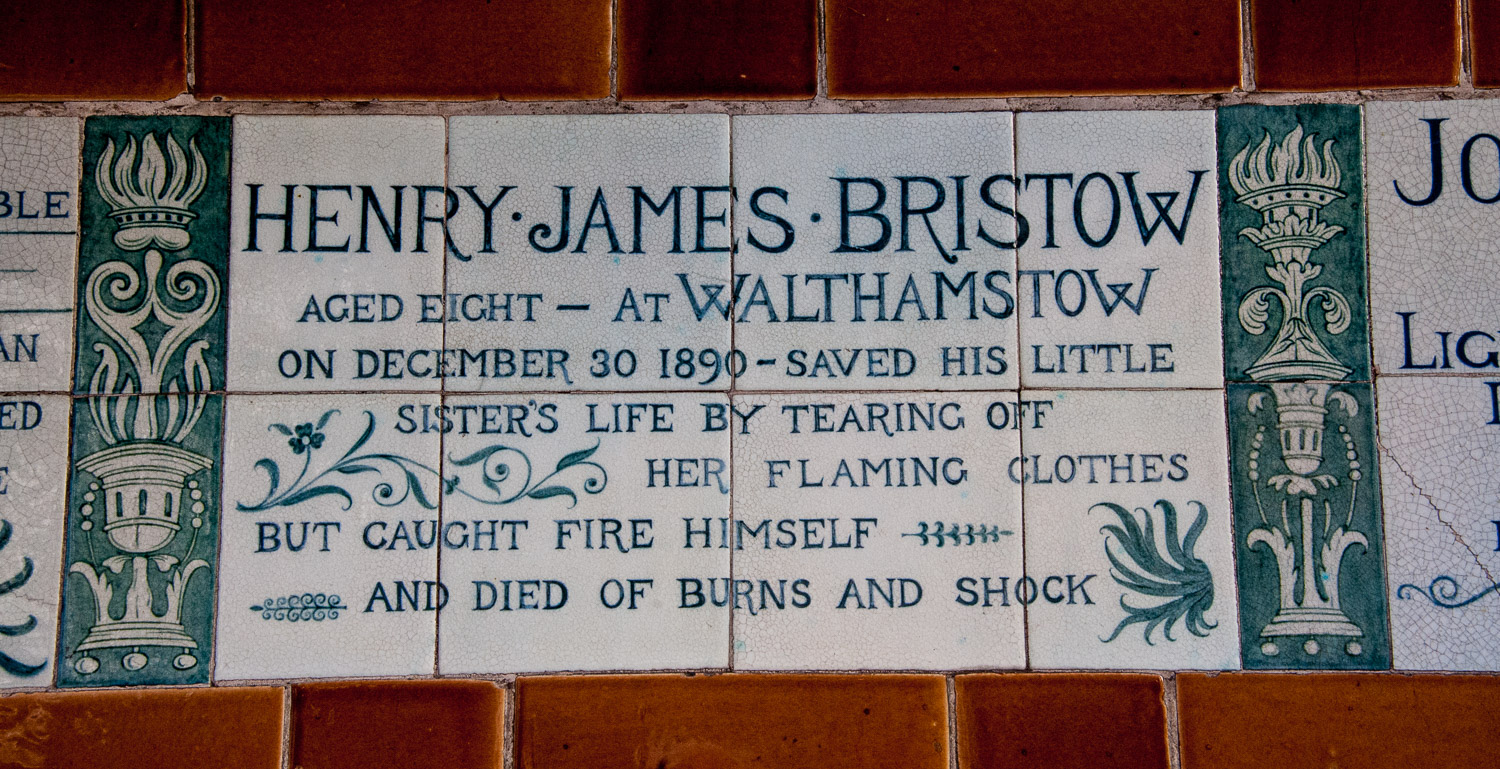
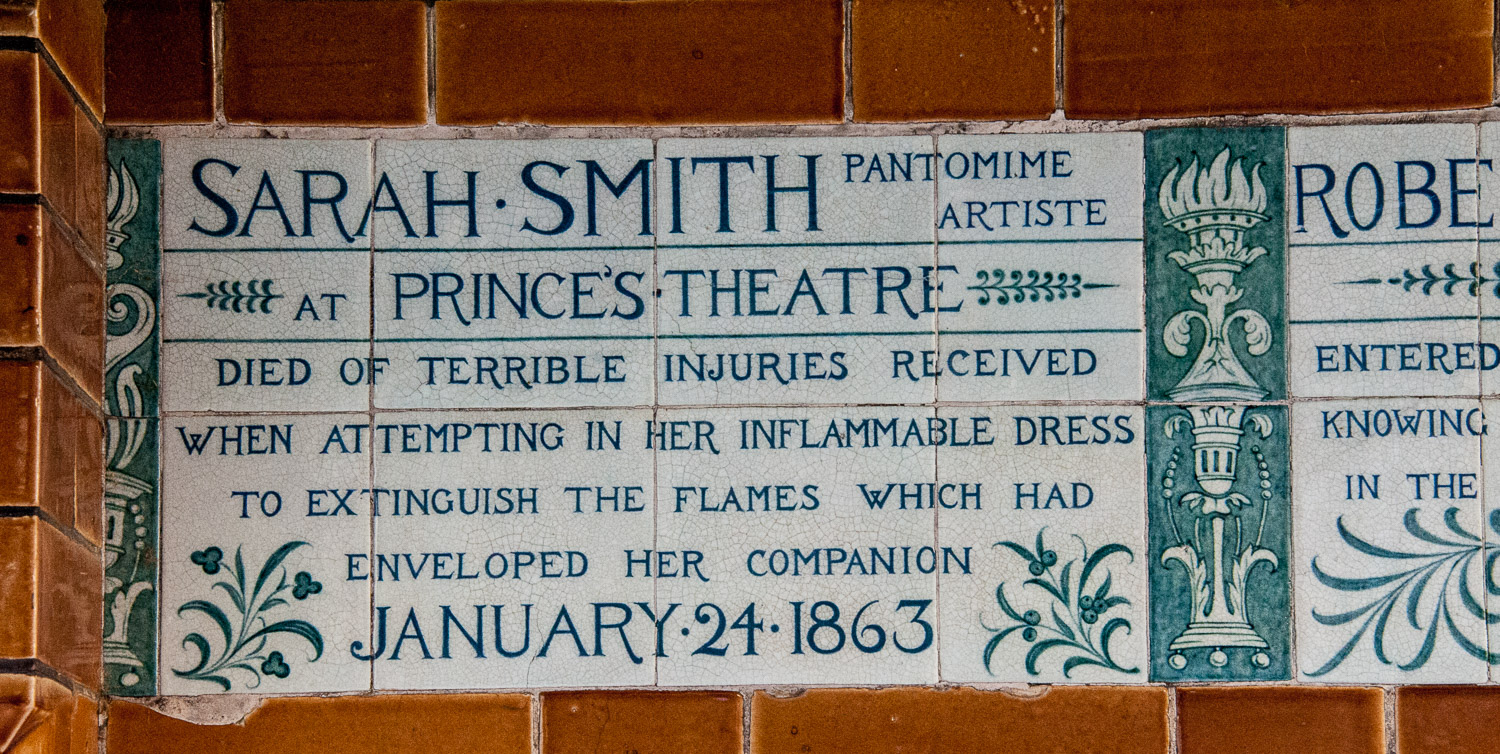
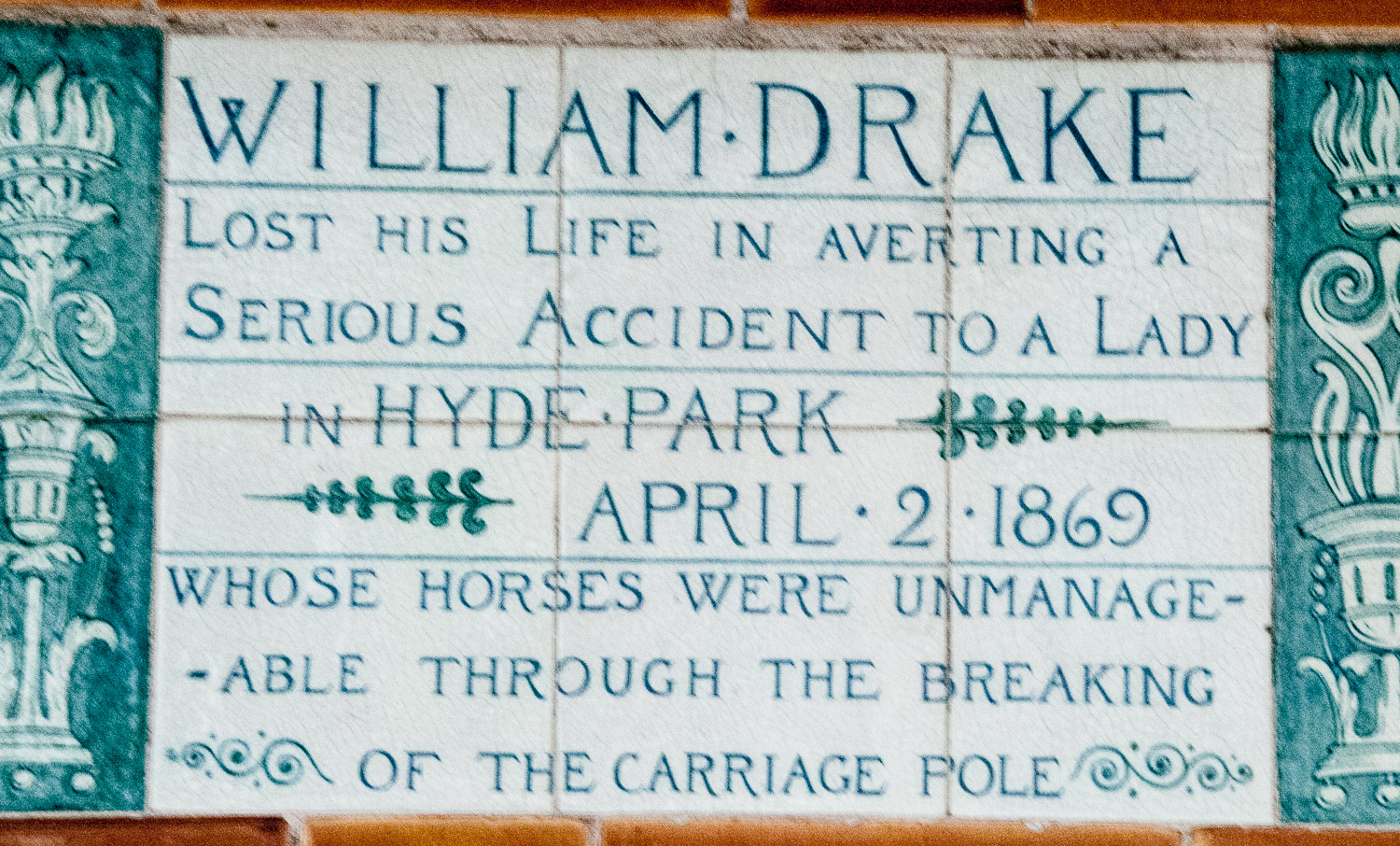
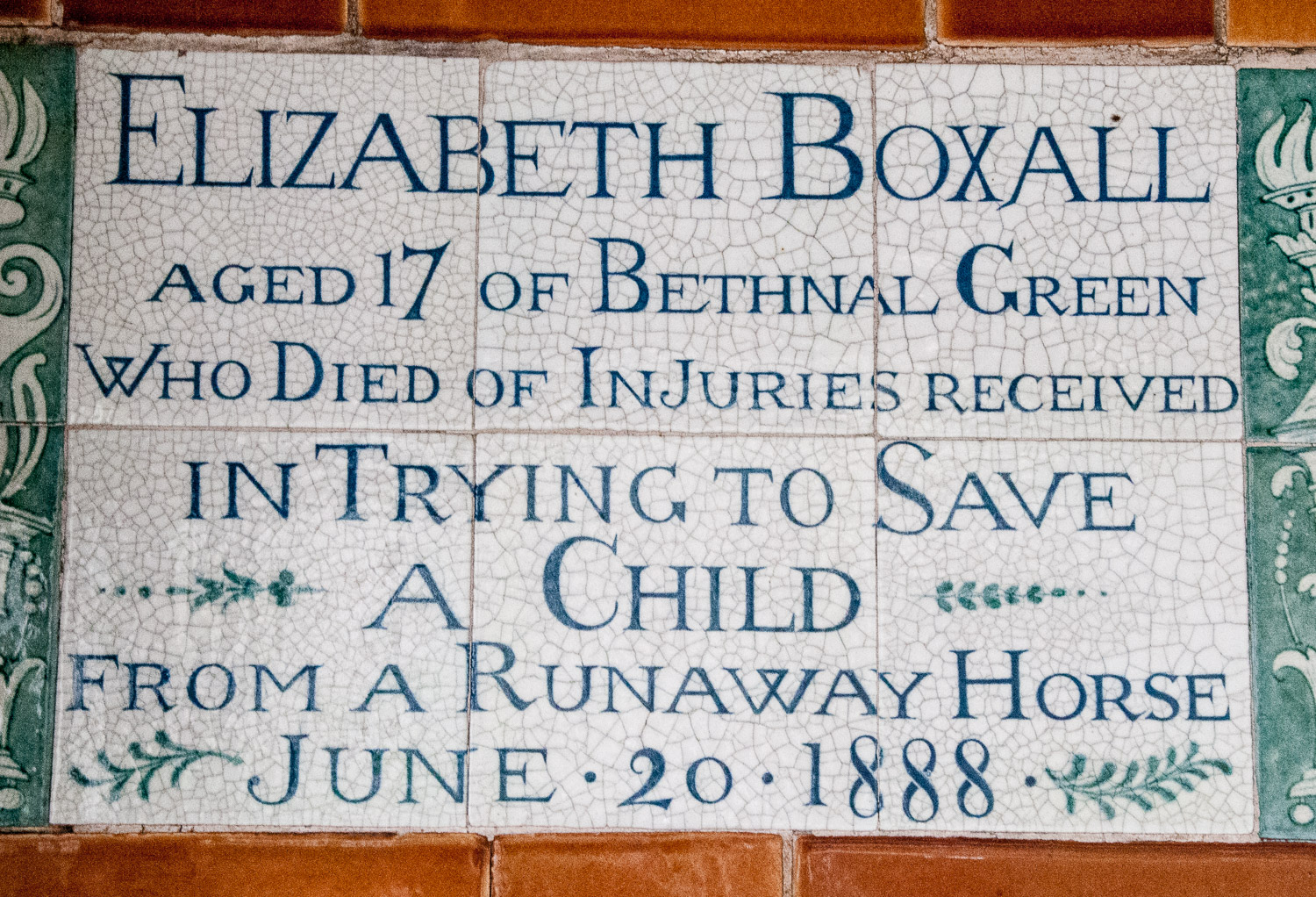
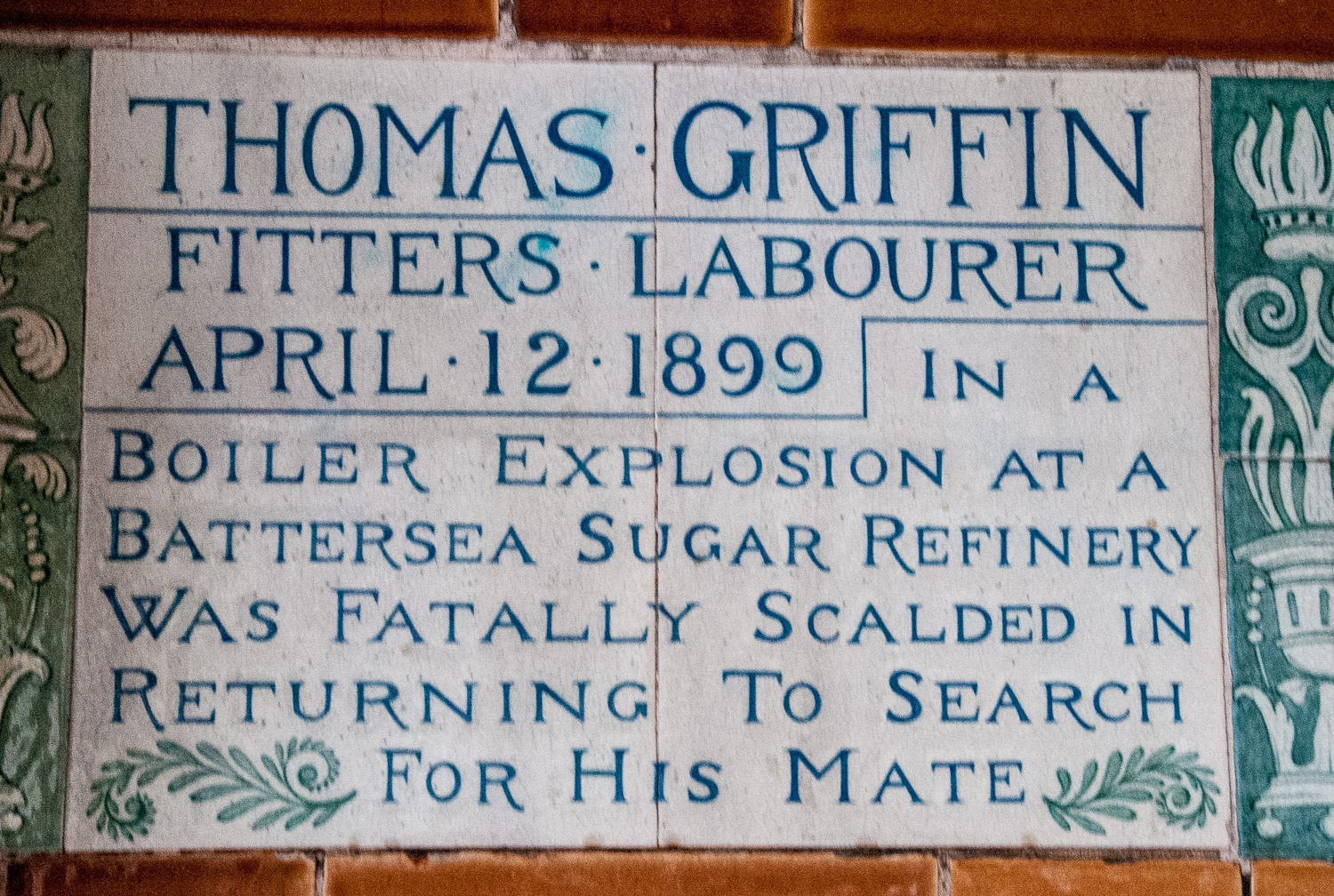
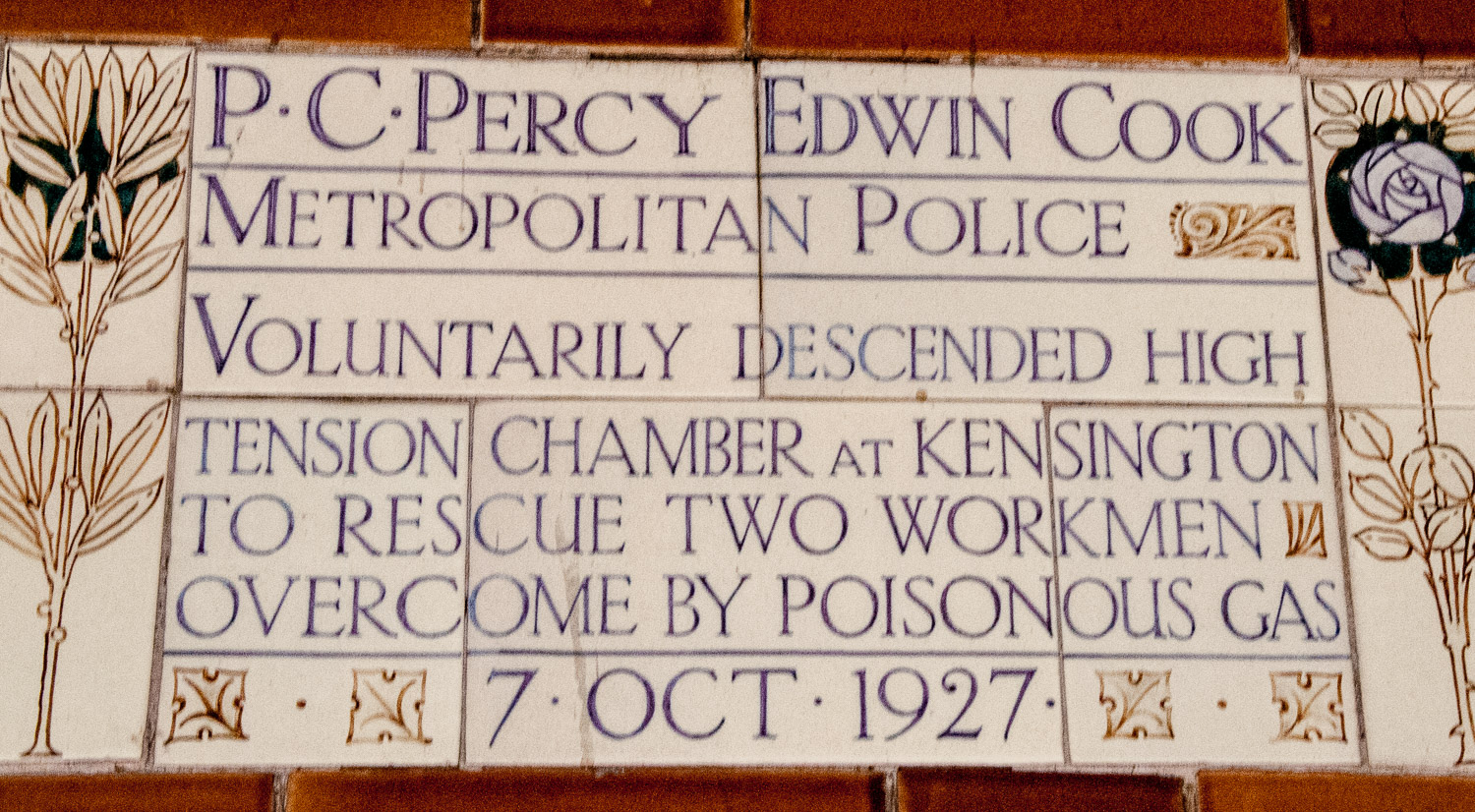
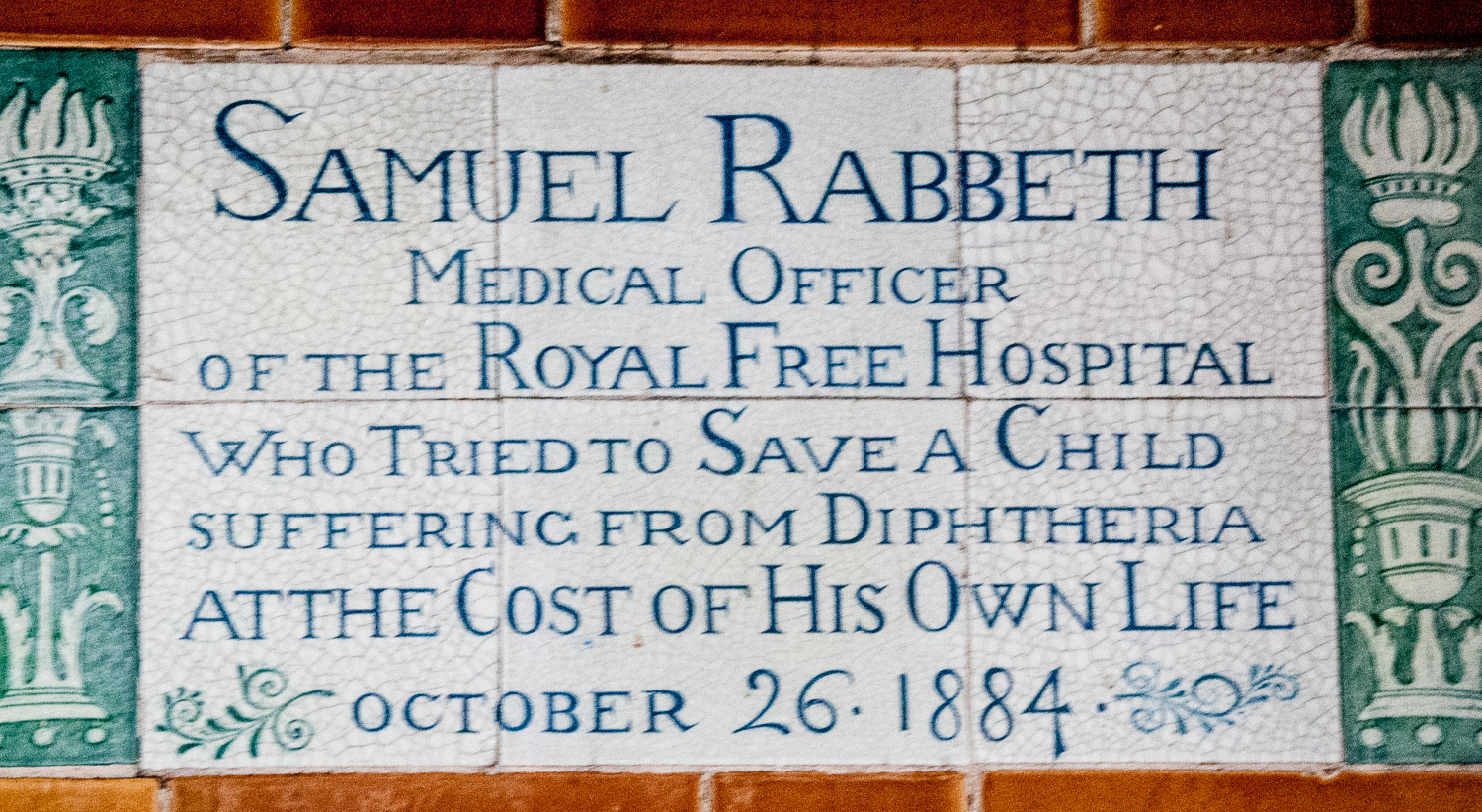
Finally, in Postman’s Park, behind St Botolph’s Aldersgate, can be found the Memorial to Heroic Self Sacrifice. The ceramic tablets (and there are 54 of them) were the idea of the Victorian artist Georg Frederic Watts and I shall be writing more about him and this memorial in a future blog.

In the meantime, it is interesting to see the tablets illustrate some of the dangerous features of the times.

These were days before consumer protection legislation when it came to product safety …


The dangers associated with a horse transport era are apparent …

Industrial accidents were commonplace …

The highly contagious nature of diptheria put doctors’ lives in danger during treatment …

The historian John Price has researched the lives of the people commemorated on the memorial and in a future blog I will be drawing on his work. He has published an excellent book on the subject which I recommend highly if you want to read more – Heroes of Postman’s Park by John Price – ISBN 978-0-7509-5643-7.


Page 31 of 36

Powered by WordPress & Theme by Anders Norén

Symbols & Secrets
Privacy Overview

This website uses cookies so that we can provide you with the best user experience possible. Cookie information is stored in your browser and performs functions such as recognising you when you return to our website and helping our team to understand which sections of the website you find most interesting and useful.