Walking the City of London

Category: Memorials Page 22 of 36

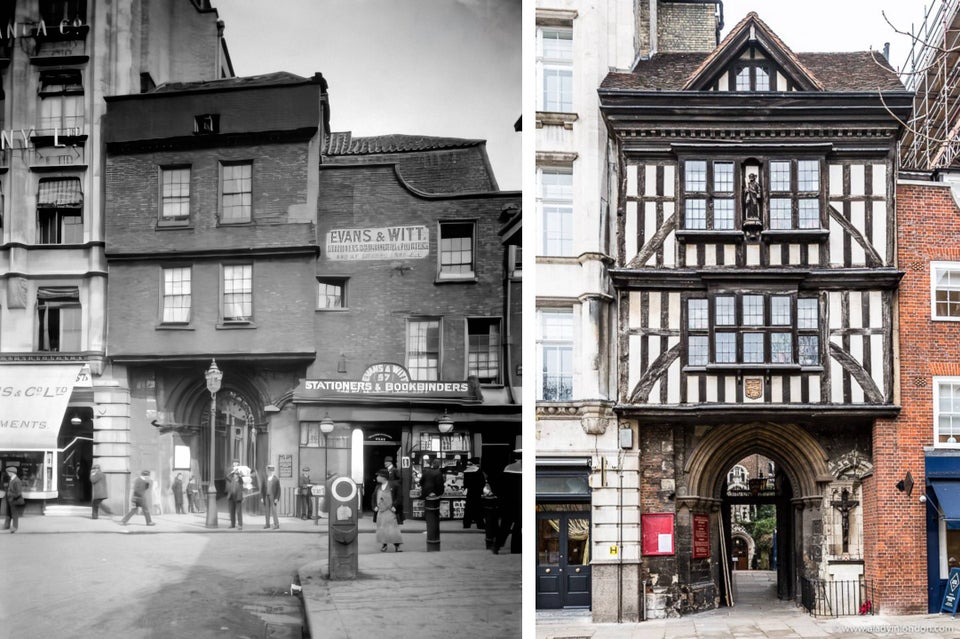
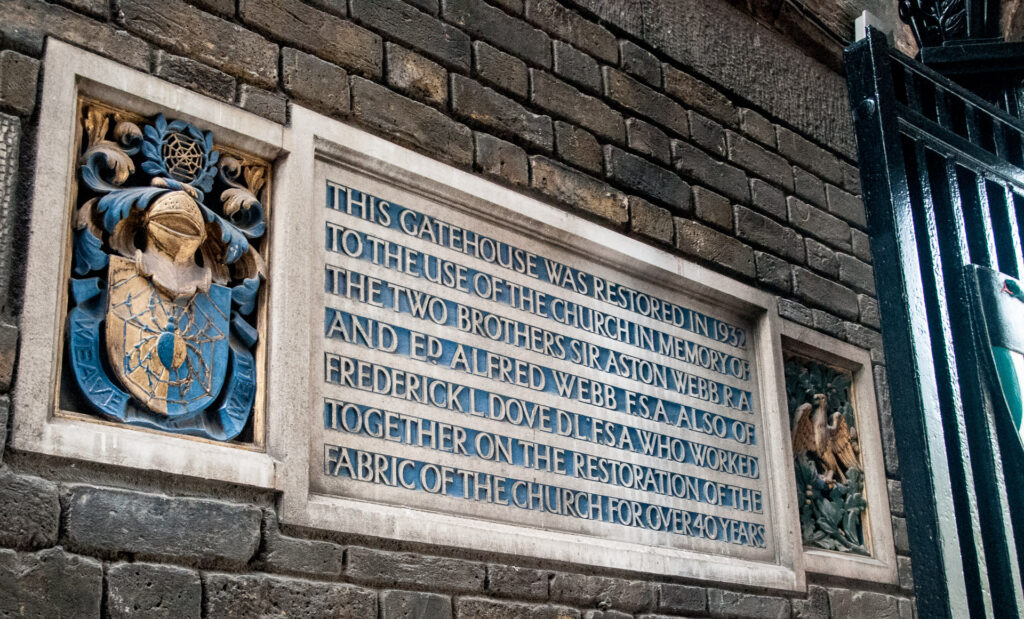
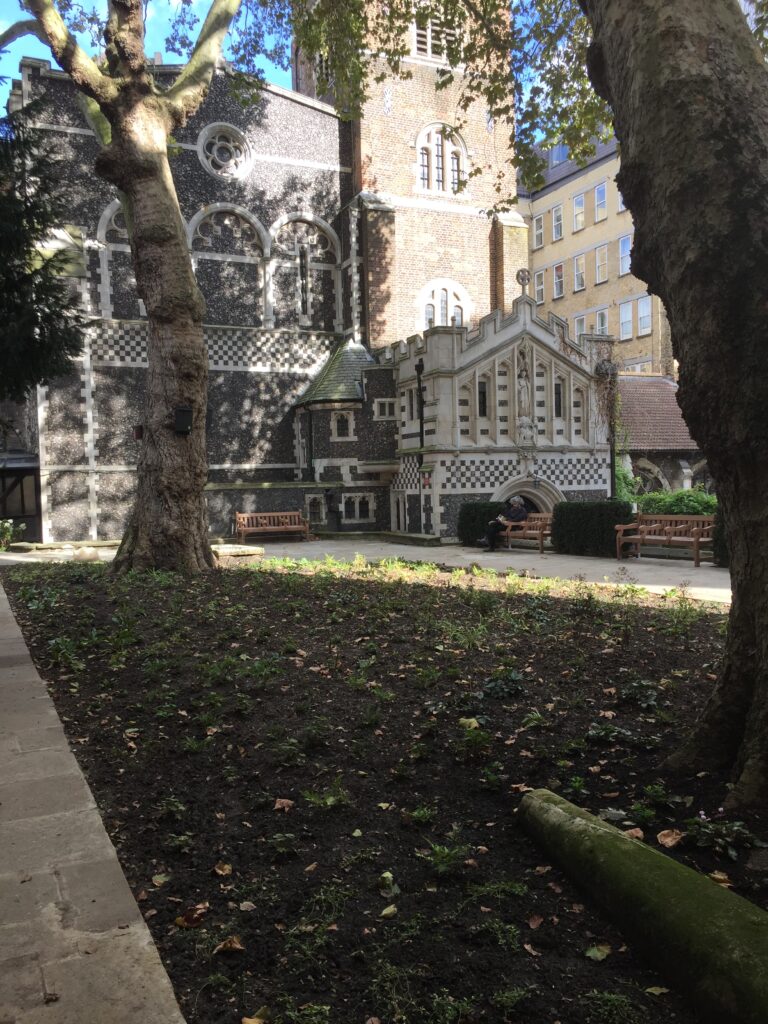
A famed swordsman, a tragic drowning and an honest lawyer – exploring St Dunstan-in-the-West

I had a great stroke of luck last Friday when I wandered into St Dunstan’s and met by chance two of the lady administrators who kindly took the trouble to show me around. The church is on Fleet Street (EC4A 2HR).

In a niche in one of the side chapels is a marble bust of a youth with fine features, Edward James Auriol lying on a pillow, hand on heart, as if asleep …
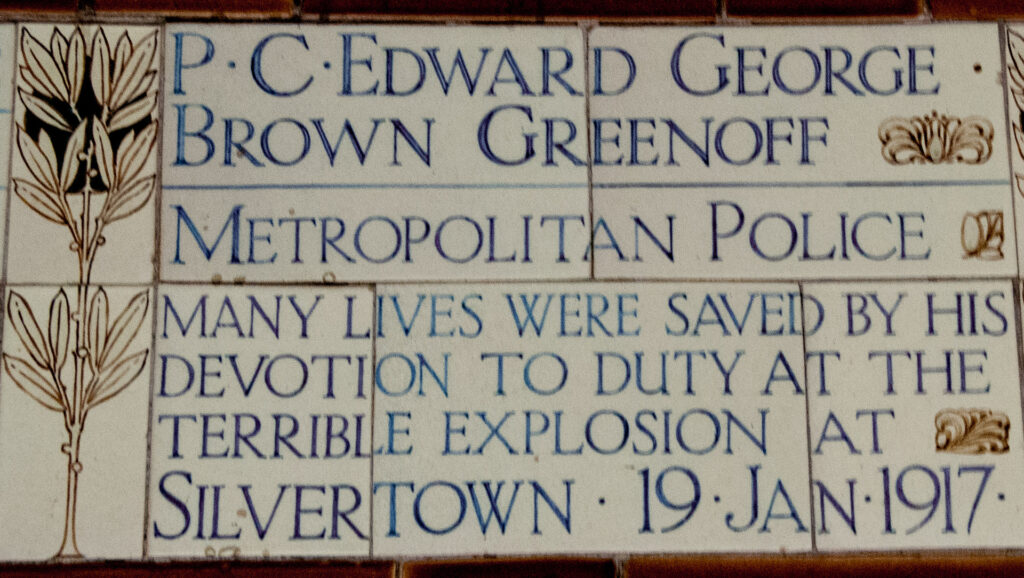
In fact, he died tragically at the age of 17 when he drowned in the Rhône river in Geneva one bright morning on 19th August 1847. A student at King’s College London, he was the ‘tenderly beloved and only child’ of the Rector of St Dunstan’s Edward Auriol and his wife Georgiana.

Nearby is this fascinating memorial to ‘ye fam’d swordsman’ Alexander Layton who died in 1679 and who rests ‘not far from this place’ …

Erected by a grateful scholar of Layton’s, ‘John Brewer of Grays Inn Road’, at the foot of the tablet are the following words suggesting Layton’s final opponent was death itself …

His thrusts like lightning flew, more skilful Death

Parried ’em all, and beat him out of breath.

There was nothing the ‘Master of Defence’ could do.

There’s a memorial bust to Cuthbert Fetherstone (1537-1615) …

He served as the Gentleman Usher to Queen Elizabeth I, and as such was her trusted friend. Cuthbert and his wife Katharine lived in London but the housing conditions in the city were poor and they eventually left their home in Chancery Lane. They purchased Hassingbrook Hall, an ancient manor near the banks of Hassinbrook at Stanford-le-Hope, twenty-five miles downstream from London. After Elizabeth’s death he became Usher and Crier to King James I.

Here he is, painted in oils around 1598 …

Copyright: National Trust Uppark House and Garden, West Sussex

The earliest monuments in the church are these two brass kneeling figures …

The plaque reads as follows …

Here lyeth buryed the body of Henry Dacres, Cetezen and Marchant Taylor and Sumtyme Alderman of London, and Elizabeth his Wyffe, the whych Henry decessed the … day of … the yere of our Lord God – and the said Elizabeth decessed the xxii day of Apryll the yere of our Lord God MD and XXX.

Elizabeth died in 1530 and Henry nine years later. His will tells us that the brass was already made before he died and ‘made at myn owne costes to the honour of almighty god and the blessed sacrament’. He also left 20 shillings to be used for the annual purchase of coal for the benefit of poor parishoners.

I am sure there are very few dishonest solicitors nowadays, but there seems to have been a time when an honest one was rather unusual, and this virtue was so exceptional that his clients paid for a memorial plaque saying so. It reads ‘Hobson Judkin, late of Clifford’s Inn, THE HONEST SOLICITOR who departed this life June 30th 1812’.

‘Go reader’ we are commanded ‘and imitate Hobson Judkin’.

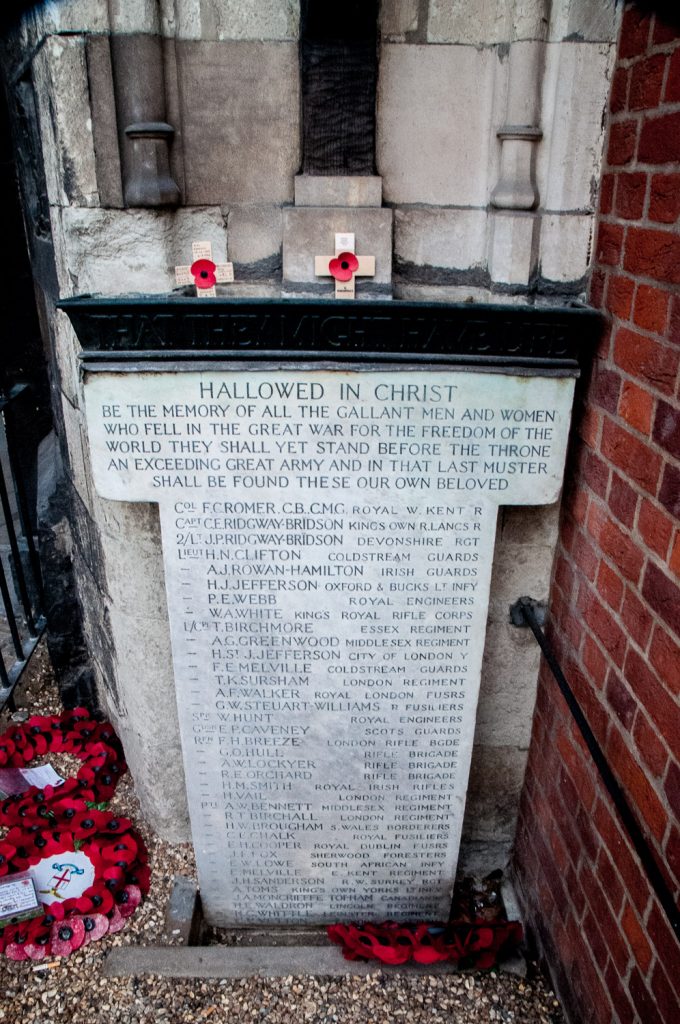
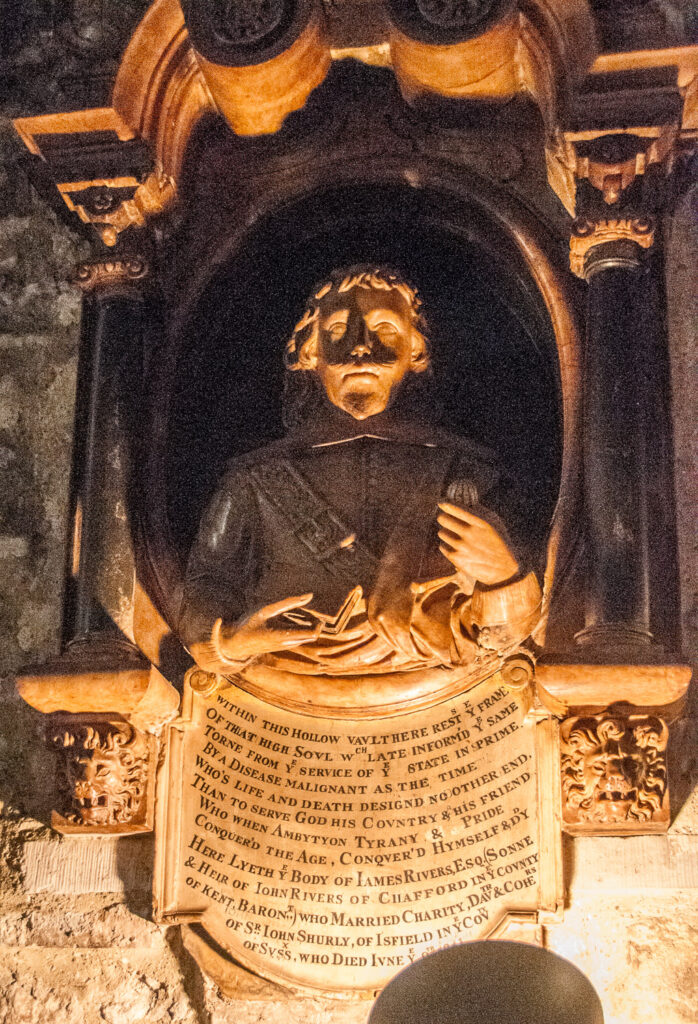
The kneeling figure next to the war memorial is said to represent Sir Roger North (1577-1651) …

This plaque celebrates the virtues and generosity of James Chambers, a ‘Citizen and Goldsmith … Eminent Banker … A man courteous to his neighbours … a Loving Husband, a Tender Father and a Sincere Friend’ …

He was also incredibly generous, being …

Very benificent to his Relations to whom he parted with upwards of £20,000 in his lifetime.

That would be getting on for two million pounds in today’s money.

The front right-hand pew has a seat reserved for the Lord Mayor, dramatically marked by an iron sword rest, dating from 1745, and commemorating the English victory over the Jacobite Young Pretender, Bonnie Prince Charlie, at Culloden. My photograph doesn’t really do it justice …

Sword rests, or sword stands, were originally installed in City churches to hold the Lord Mayor’s sword of state when he visited different churches every Sunday, a practice which ceased in 1883.

Dedicated to a Saxon Archbishop of Canterbury and Benedictine monk, St Dunstan’s survived the Great Fire but was demolished and rebuilt between 1830 and 1833. The octagonal interior is wonderfully atmospheric …

I took a close look at the remarkable Christian Orthodox screen (or iconostasis) which came from Romania in 1966 …

The screen is over 100 years old and was originally created for the Monastery of Antim in Bucharest. I also spotted various individual icons …

These and the screen are clues to the fact that, although this is a Church of England church, it also hosts Romanian Orthodox Church services.

There is more to see in St Dunstan’s and I intend to return. If you are interested in churches, this is definitely one to visit. It has just reopened for private prayer and you can find opening times on the website.

Remember you can follow me on Instagram :

https://www.instagram.com/london_city_gent/

Horses, mermaids and memorials – more City Ladies

My first stop was Unilever House where a lady, her head bowed, strains hard to control a gigantic horse (EC4Y 0DY) …

The sculpture, called Controlled Energy, dates from 1932 and the sculptor, William Reid Dick, had a real horse model for him. Dr Philip Ward-Jackson, in his book Public Sculpture of the City of London, tells us …

This was no ordinary horse. A light bay gelding called Victor, it was a little over 18 hands high and, when shown at Olympia, had been described as ‘the biggest horse in the world’. The sculptor later told a reporter ‘I am sorry to say it died shortly after I finished with it’.

There is a similar male figure at the other end of the building and, when asked why he had included female figures as well as male ones, this was the sculptor’s interesting reply …

These days women are controlling affairs nearly, if not quite, as much as men. They begin to take control in some respects … as soon as they are out of their cradles, and the idea would have been incompletely carried out if only men had been used.

There are a number of female head keystones …

… and a pretty mermaid sculpted by Gilbert Ledward …

Just in case you are not familiar with the building here it is, opposite Blackfriars Station …

Ledward’s sculpture reminded me of the mermaid combing her hair at the Merchant Navy Memorial on Tower Hill …

In last week’s blog I wrote about the numerous female figures decorating the Lloyd’s Register of Shipping’s offices in Fenchurch Street. Here a group of maidens hold models of ships …

In my 2nd April blog, Moorgate and the Goddess of Electricity, I wrote about the impressive building called Electra House. I didn’t, however, venture into the entrance hall. If I had I would have seen two allegorical panels by F.W. Pomeroy who did much work on the Central Criminal Court, including the statue of Lady Justice. Again, there is more in last week’s blog.

The panel to the left has a seated figure, which may be Britannia, holding a rudder in one hand and a loop of cable in the other …

The cable encircles a globe and the figure to the right holds up two batteries on a tray.

This is the panel opposite …

The female figure holds a distaff in one hand and a weaving shuttle in the other. Standing to her left is Mercury, holding his caduceus and a bag of money. The lady on the right writes in a ledger whilst in the background is a telegraph pole. The panel probably represents the advantages to trade and industry of the telegraph.

And now south, to Number 1 Moorgate which was once the Banco di Napoli. Created in the 1980s, the bronze doors portray two ladies in peasant costume …

The woman on the left is sowing seeds and the one on the right holds a sickle and a sheaf of cut corn.

Just off Aldermanbury and to the north of the Guildhall is this 1972 bronze by Karin Jonzen called Beyond Tomorrow

A young couple look expectantly towards the future.

During the Second World War almost a thousand firefighters sacrificed their tomorrows trying to save property and lives during the intense bombing. On Sermon Lane opposite St Paul’s Cathedral can be found The National Firefighters’ Memorial (1991). On the north side is this representation of the women members of the National Fire Service and a list of those killed whilst on duty …

The lady on the right is a Dispatch Rider and the one on the left an Incident Recorder. Although not meant to actually fight fires, a former wartime firefighter declared …

The reality … was that firewomen were more widely involved in active work than is generally acknowledged, and they could often be found in the midst of things during the blitz, whether helping out on the pumps, in control rooms close to the centre of the severest raids or delivering supplies to firefighters.

Twenty-one-year-old Gillian Tanner was awarded the George Medal for bravery when she delivered petrol to fire pumps around Bermondsey while the docks were being bombed during the height of the Blitz.

Their pay was set at two thirds of that of the men, the Home Office having turned down their union’s request for equal pay in 1943.

Four ladies adorn the memorial to the 786 employees of the Prudential Assurance Company who gave their lives in the First World War. It can be found in the courtyard outside their old headquarters in Holborn and you can read more about it here.

This lady holds a seagoing vessel, representing the Navy …

At the back is a figure holding a shell representing National Service …

The bi-plane represents the Air Force …

And this one holds a field gun and represents the Army …

I like the Queen’s Assurance sign from 1852 at 42-44 Gresham Street …

And finally, she may be the oldest City Lady I have found but she still looks beautiful and serene …

Dated 1669, she must have witnessed much of the rebuilding of the City after the great fire of 1666. She now resides in a sheltered spot in Corbet Court (EC3V 0AT). I have written about Mercer Maidens like her in an earlier blog entitled Dragons and Maidens.

Remember you can follow me on Instagram :

https://www.instagram.com/london_city_gent/

City children

Not all statues, pictures and memorials in the City are of the ‘great and the good’ – there are quite a few young people represented as well.

For a start, there are the charity school children who wore a striking uniform that confirmed their school’s charity status – hence the name Bluecoat Schools. Blue was chosen since it was once the cheapest dye available. The school buildings often displayed life-size representations of their pupils and these two can now be found outside the church of St Andrew Holborn (EC4A 3AF) …

They depict children attending St Andrew’s Parochial School, founded in 1696 and located in Hatton Garden since 1721. The statues once stood over the Cross Street entrance to the Hatton Street school but were moved here during the church’s restoration after WWII bombing damage.

Sir John Cass’s School at Aldgate also has its little boy and girl statues (C3A 5DE) …

This work outside Liverpool Street Station depicts children from the Kindertransport (EC2M 7PD). I think they are beautifully portrayed, appearing both curious and confident (and one piece of luggage is clearly a violin case) …

Photograph: Robin Coupland. Statue by Frank Meisler (2006).

In 1938 and 1939, nearly ten thousand unaccompanied Jewish children were transported to Britain to escape persecution in their hometowns in Germany, Czechoslovakia and Austria. These children arrived at Liverpool Street station to be taken in by British families and foster homes. Often they were the only members of their families to survive the Holocaust.

On a modern building in Giltspur Street (EC1A 9DD) a naked boy stands looking upwards with his arms crossed. He is often referred to as The Golden Boy of Pye Corner and he probably started life as a shop sign …

Now he commemorates one of the places where the Great Fire of 1666 was finally halted, and the inscription beneath refers to the belief by some at the time that God was punishing the City for the sin of gluttony. This was also evidenced by the fact that the conflagration started in Pudding Lane!

Despite the reference to gluttony, the little boy is not enormously fat but ‘healthily rotund’, as children or putti tended to be sculpted at that time. Pye (or Pie) Corner, on the other hand, was noted for food shops, particularly at the time of Bartholomew Fair. This annual celebration was finally suppressed in 1855 for ‘encouraging debauchery and public disorder’ and becoming a ‘school of vice which … initiated … youth into the habits of villainy’. The fair had also become one of the year’s great opportunities for pickpockets as well as for prostitutes, who might be found in tents coyly labelled ‘soiled doves’ or in a nearby street appropriately named Cock Lane.

But I digress.

Just behind the Royal Exchange is a work that caused some controversy, the Charity Drinking Fountain (also known as La Maternité) by Aimé-Jules Dalou (1877-9). (EC3V 3NL).

In his book Public Sculpture of the City of London, Philip Ward-Jackson describes the lady as follows:

Despite her casual garb she has a diadem or tiara on her head. With her left arm she enfolds a baby, who she is suckling, whilst with her right she draws to her knee a naked boy, who gazes up at her.

Nearby is a very relaxed George Peabody who I have written about in an earlier blog

Ward-Jackson tells us that the suckling lady’s very authentic exposed breast produced at least one letter of protest to the editor of The Globe. The correspondent urged that ‘common decency’ should be observed and went on …

Do you not think, Sir, that Mr Peabody’s chair should be turned, at least until the delicate operation of ‘lacteal sustenation’ be concluded … or the young woman and youngsters provided with the requisite clothing.

Living in the Appold Street entrance to Exchange Square are The Broad Family (EC2A 2BR) …

Look long enough and you will see mum, dad, a little girl with her ball and the family dog (well I did, anyway). It has just occurred to me that the dog resembles Dr Who’s companion K9.

The little girl’s shoes peep out tantalisingly …

These young folk striding out purposefully are part of the memorial to Christ’s Hospital School which was sited nearby before it relocated to Horsham in 1902 (EC1A 7BA). It shows the pupils developing from street urchins to smart, confident young adults …

I love the ragamuffins at the far end of the sculpture.They seem to be having enormous fun and sport the most extraordinary hairstyles …

As you approach the Bank junction from Cheapside look up and you will see two young boys at either end of the grand building that was once the City headquarters of Midland Bank (1935). The are both struggling with a rather angry looking Goose …

The sculptor was William Reid Dick.

Why a goose? A clue is the ancient name of the street and the goose was a suggestion by the architect Sir Edwin Lutyens to commemorate its original market function. The building is now a private club and restaurant, called The Ned in Sir Edwin’s honour.

In the Guildhall Art Gallery there is a pretty little girl attending her first sermon …

My First Sermon’ by John Everett Millais

She obviously knows this is an important occasion in her life and sits with her back straight, eyes attentively focused looking ahead. She is the artist’s 5 year old daughter Effie. On seeing it the Archbishop of Canterbury commented …

… our spirits are touched by the playfulness, the innocence, the purity, and … the piety of childhood

In 1864 the artist produced a sequel entitled ‘My Second Sermon’ …

The Archbishop, Charles Longley, was obviously a rather good sport, and when he saw the later picture commented …

… by the eloquence of her silent slumber, (she has) given us a warning of the evil of lengthy sermons and drowsy discourses. Sorry indeed should I be to disturb that sweet and peaceful slumber, but I beg that when she does awake she may be informed who they are who have pointed the moral of her story, have drawn the true inference from the change that has passed over her since she has heard her “first sermon,” and have resolved to profit by the lecture she has thus delivered to them.

I was reminded of this wonderful drawing of a Victorian congregation who are finding the sermon rather heavy going …

In 1995 a skeleton was discovered when excavations were taking place before the construction of 30 St Mary Axe, now often referred to as the Gherkin. The remains were of a young girl aged between 13 and 17 years – her arms were crossed over her body and pottery close by indicated a burial date of between AD 350 and 400.

Having been removed to the Museum of London, she waited patiently until 2007 when the developers of the Gherkin proposed that she be reburied on the site. So, in April of that year, there was a service at St Botolph’s church in Aldgate followed by a procession through the streets before her body was respectfully interred near where it was found. The Lady Mayoress of the City of London was there to spread rose petals on the gravesite, marked with a marble slab decorated with a laurel wreath.

We don’t know her name, or whether she was an original Londoner, but she now rests again 1,600 years after her death in the place that she would have called Londinium.

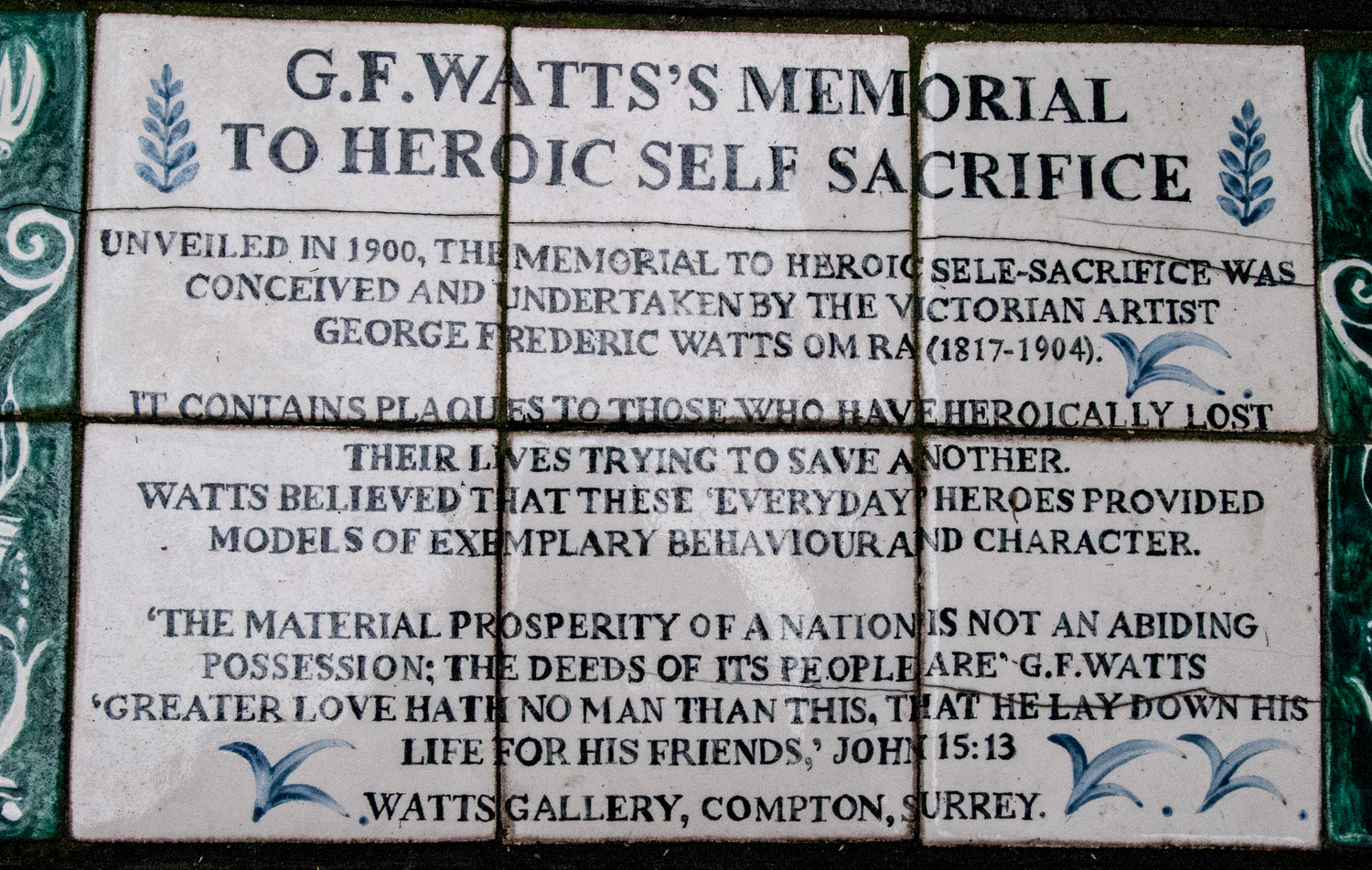
And finally to one of my favourite places, the Watts Memorial in Postman’s Park (EC1A 7BT). I have written before about three of the brave youngsters commemorated there – Alice Ayres, John Clinton and Elizabeth Boxall.

To them I will now add this young man …

While their mum was out running an errand Henry’s two-year-old sister Jessie, intrigued by the glow of a paraffin lamp, managed to clamber up a chair and reach out for it. Tragically, she overturned it and was enveloped in flaming paraffin. Henry rushed to help her, but in tearing off her clothes set fire to himself and both children received severe burns. Jessie survived but Henry died on 5th January – the coroner at his inquest commented ‘it is a sad case, the little fellow was quite a hero’.

That’s all for this week – I hope you enjoyed it even though I have written about some of these subjects before.

Remember you can follow me on Instagram :

https://www.instagram.com/london_city_gent/

Page 22 of 36

Powered by WordPress & Theme by Anders Norén

Symbols & Secrets
Privacy Overview

This website uses cookies so that we can provide you with the best user experience possible. Cookie information is stored in your browser and performs functions such as recognising you when you return to our website and helping our team to understand which sections of the website you find most interesting and useful.