Walking the City of London

Category: Memorials Page 17 of 35

Some mysteries, solved and unsolved … from strange street markings to wandering gravestones.

One of the best pieces of advice I was given when I began to write about the City was to continually look up and it’s true to say that I have often been surprised by what I have observed – from the Cornhill Devils to Mercer Maidens to a beautiful lighthouse on, of all places, Moorgate.

It’s also true to say, however, that looking down can be just as interesting.

Like me, you must have occasionally wondered what symbols like these painted on roads and pavements actually signify. I found this nice collection at the east end of Carter Lane …

Well, wonder no more, all the answers are here. For example …

Not surprisingly, and used in warning signs the world over, red paint denotes electricity. Thus red lines show where electricity cables run and mean that anyone digging there must do so with extreme caution.

White is like a little Post-It note for future contractors …

Blue is usually for water pipes …

Yellow refers to all things gas …

A growing hue in the pavement-marking business is green, the colour of cable communications, which includes town and city CCTV networks and cable television lines …

And finally some others in orange …

All are explained in this fascinating article entitled ‘What do those squiggles on the pavement actually mean? from which I have drawn extensively for this week’s blog.

Incidentally, whilst on Carter Lane I briefly looked up and was puzzled by the small plaque on the left of the parish boundary mark …

According to a document on the Essex Fire Brigade web site, FP stands for Fire Plug. Apparently in the early days of the fire service, and when many underground water pipes were made out of wood, firemen would dig down to the water main and bore a small, circular hole in the pipe to obtain a supply of water to fight the fire.

When finished, they would put a wooden plug into the hole, and leave an FP plate on a nearby wall to alert future firefighters that a water main with a plug already existed.

When wooden pipes were replaced by cast iron pipes in the 19th century, workmen would often bore a small hole in the pipe and fit with a wooden plug when they saw an FP plate. This would later be replaced with the Fire Hydrant method, which would be identified by a large H. Many thanks to the London Inheritance blog for this information.

Looking down can be a bit addictive and another puzzle it presented me with were these ‘V’- shaped incisions into kerb stones. I found a number of examples in EC1.

On Old Street …

Look carefully and you can see there are two of them.

And Dufferin Street …

And Roscoe Street …

Discovering what they might mean proved rather difficult and I entered a whole new world when I started my research. Look at this article entitled The World of Carvings and Stories and click on some of the useful links. I shall continue to look down and see if I encounter any more.

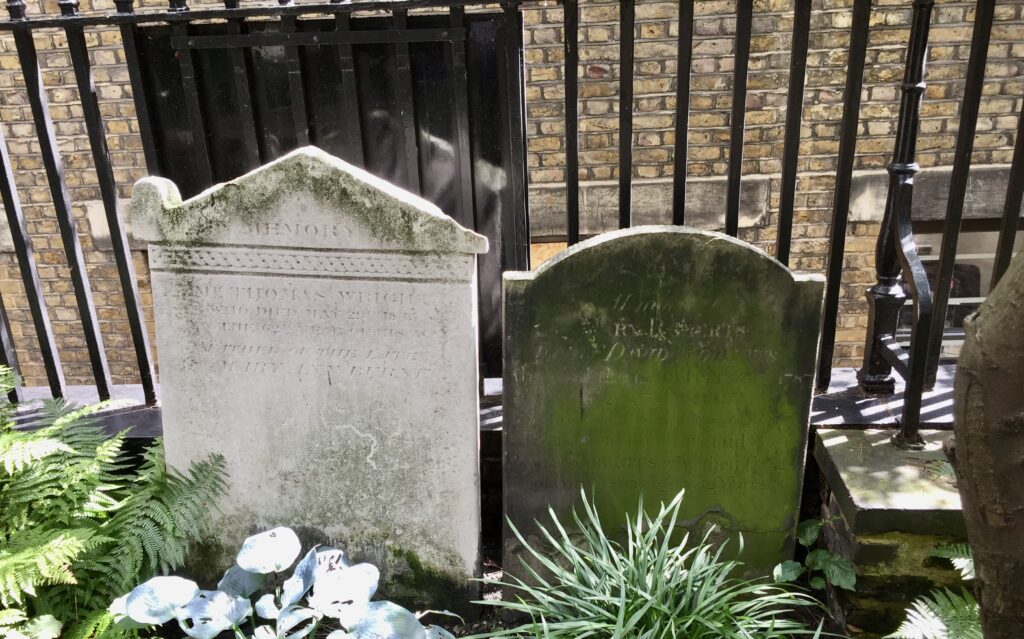
In last week’s blog I spoke of a mystery connected to these two gravestones in the old parish churchyard of St Ann Blackfriars in Church Entry (EC4V 5HB) …

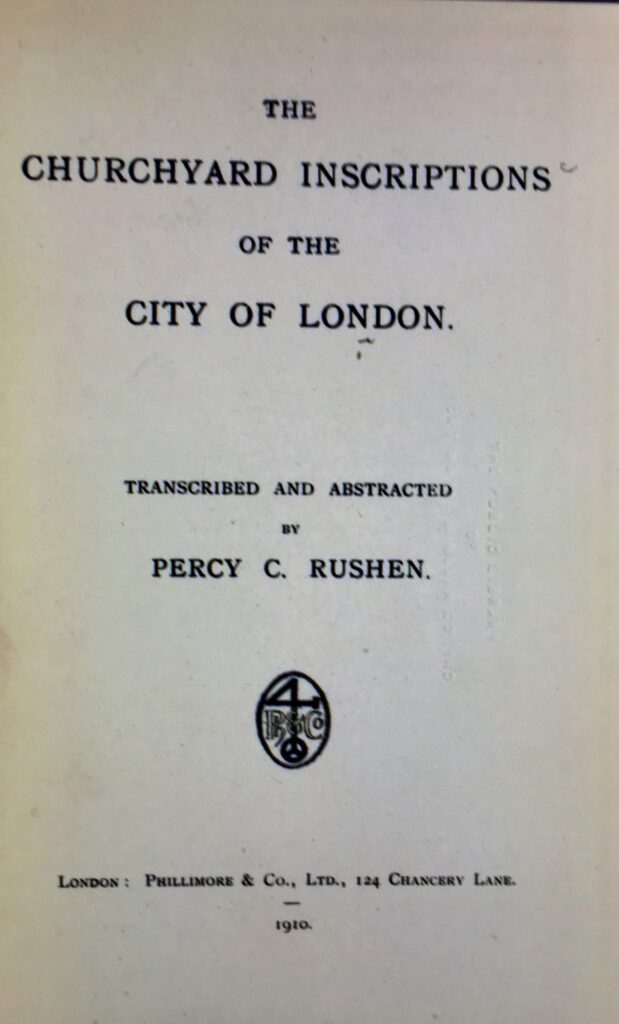
My ‘go to’ source of information when it comes to grave markers is the estimable Percy C. Rushen who published this guide in 1910 when he noticed that memorials were disappearing at a worrying rate due to pollution and redevelopment …

So when I came across the last two stones in this graveyard with difficult to read inscriptions I did what I normally do which is to consult Percy’s book in order to see what the full dedication was.

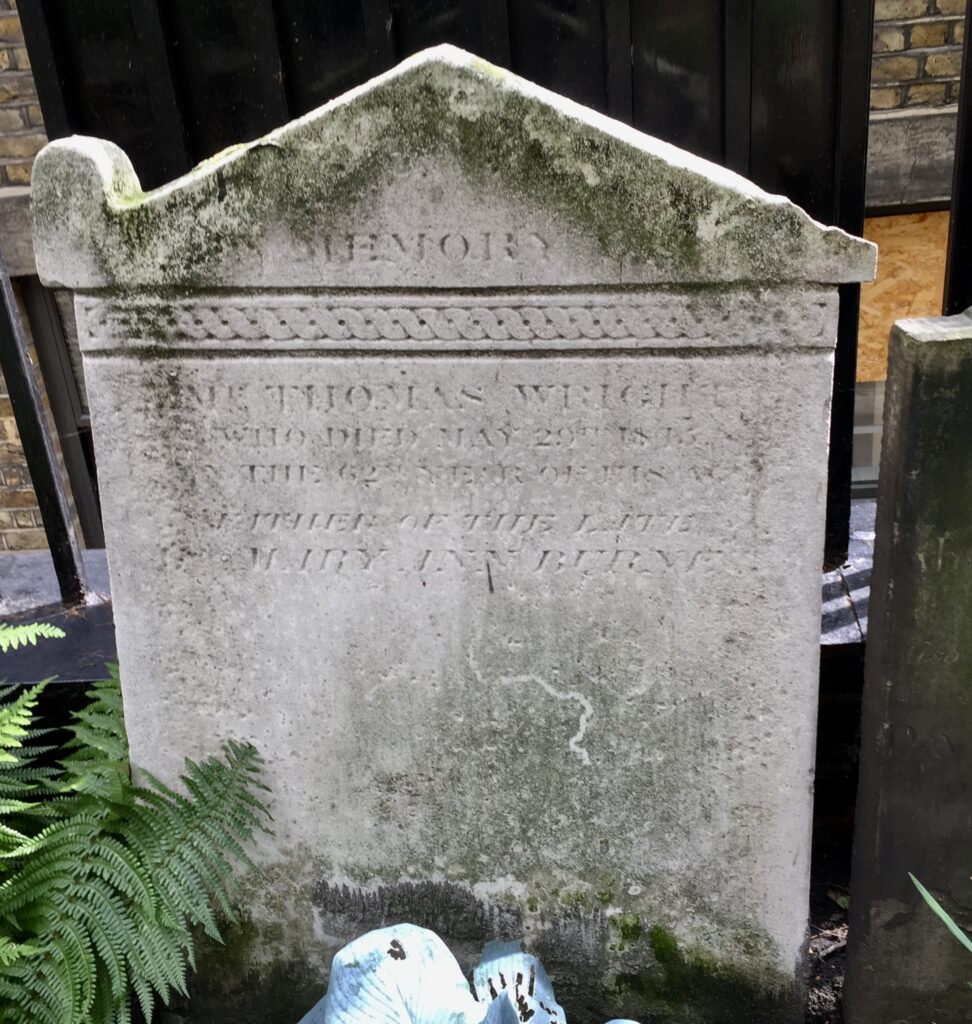
There was, however, a snag. Neither headstone is recorded in Percy’s list for St Ann Blackfriars. Let’s look at them one by one. This is the stone for Thomas Wright …

Fortunately, the book lists people in alphabetical order and, although there isn’t a Wright recorded at St Ann’s, there is one recorded at St Peter, Paul’s Wharf. It’s definitely the same one and reads as follows :

THOMAS WRIGHT, died 29 May 1845, father of the late Mrs Mary Ann Burnet.

The inscription of another stone recorded in the same churchyard reads …

CAROLINE, wife of JAMES BURNET , died 26 July 1830, aged 36.

MARY ANN, his second wife, died 12 April1840, aged 36.

JAMES BURNET, above, died … 1842, aged …3

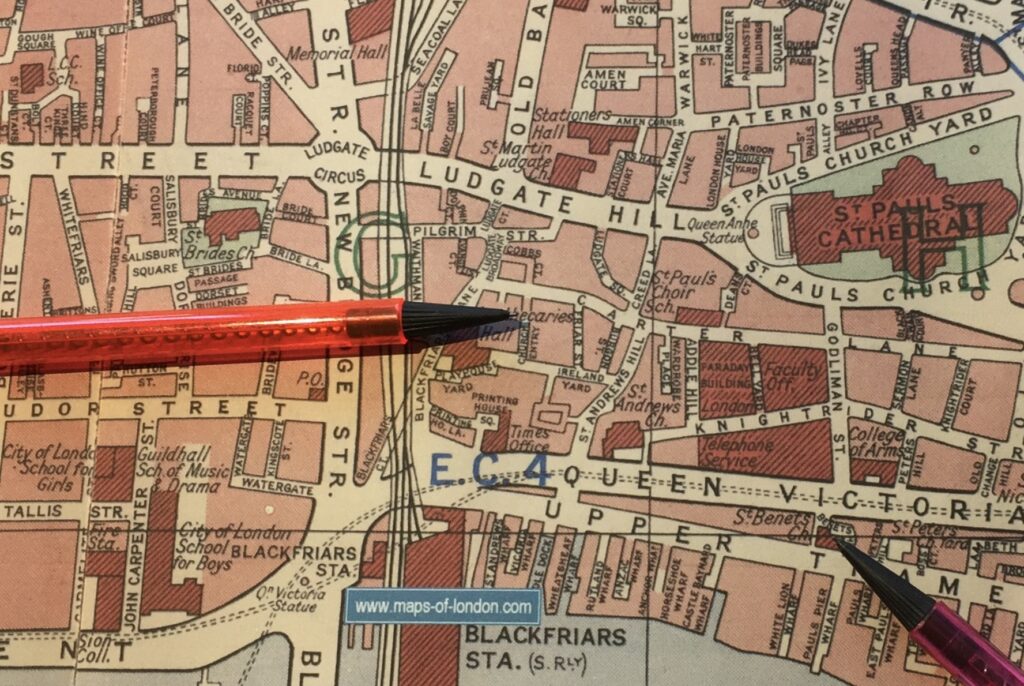
St Peter, Paul’s Wharf, was destroyed in the Great Fire of 1666 and not rebuilt but obviously its churchyard was still there in 1910. And it was still there in the 1950s as this map shows. I have indicated it in the bottom right hand corner with the other pencil showing the location of Church Entry and St Ann’s burial ground …

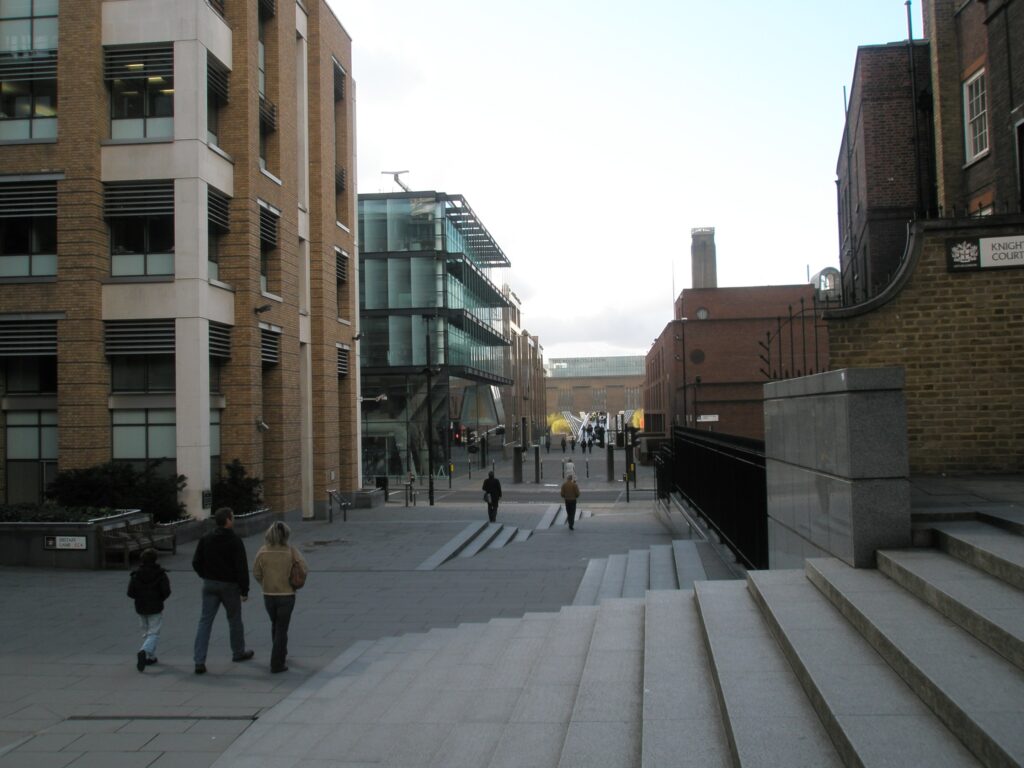
This is the present day site of Thomas Wright’s original burial place, now Peter’s Hill and the approach to the Millennium Bridge …

The stone must have been moved some time in the mid-20th century, but the question is, was Thomas moved as well? Have his bones finally come to rest in Church Entry? I have been unable to find out.

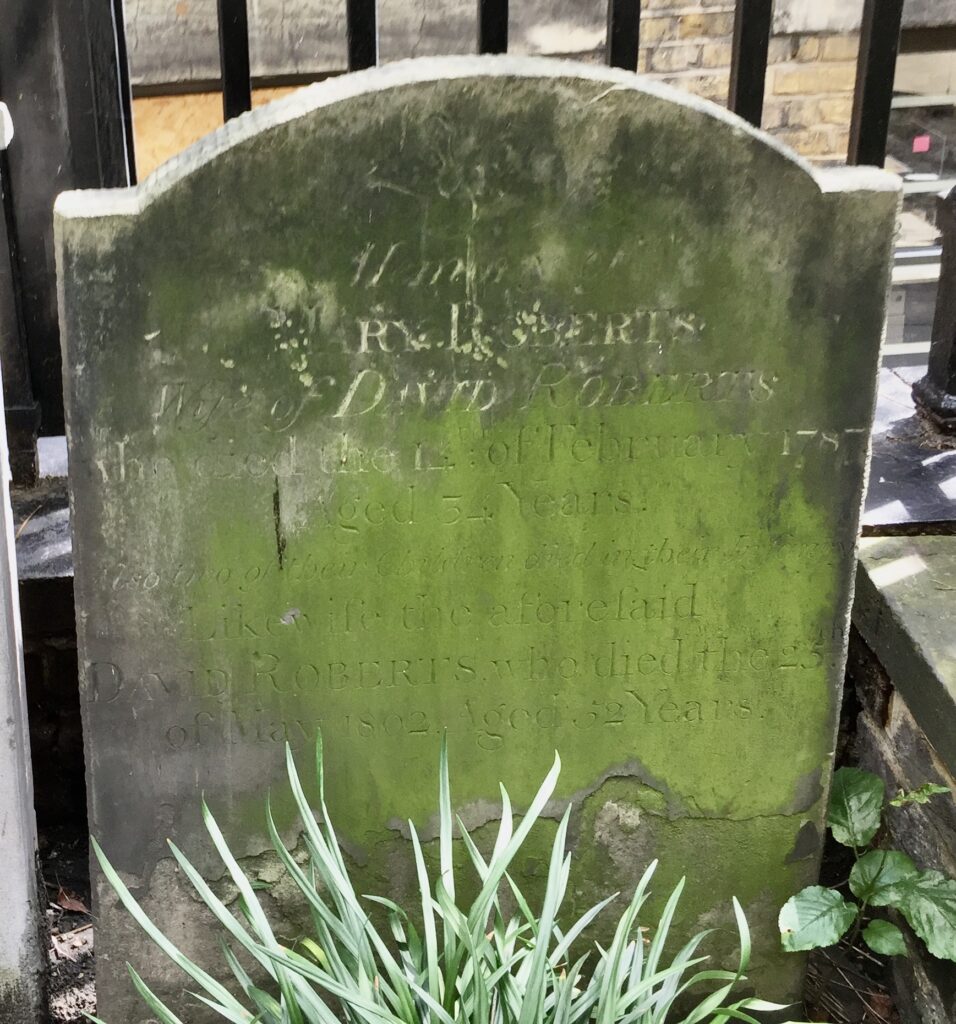
This is the headstone alongside Thomas’s …

It reads as follows …

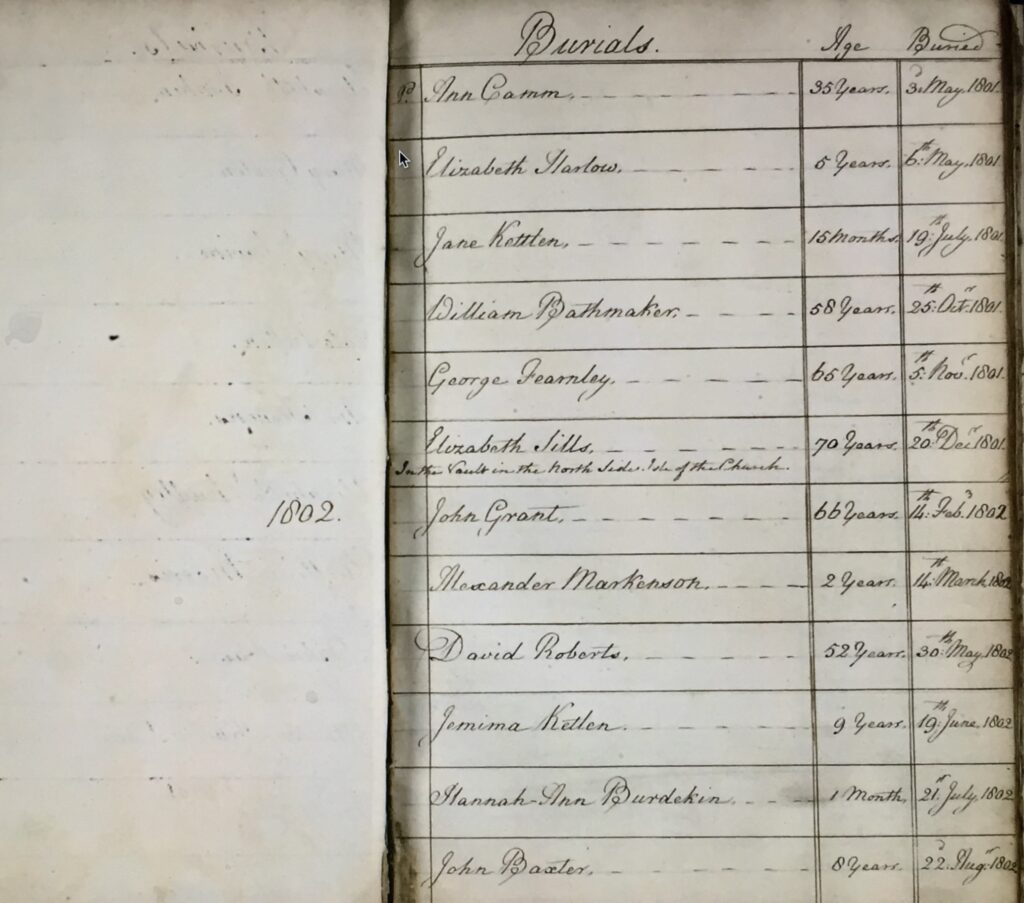
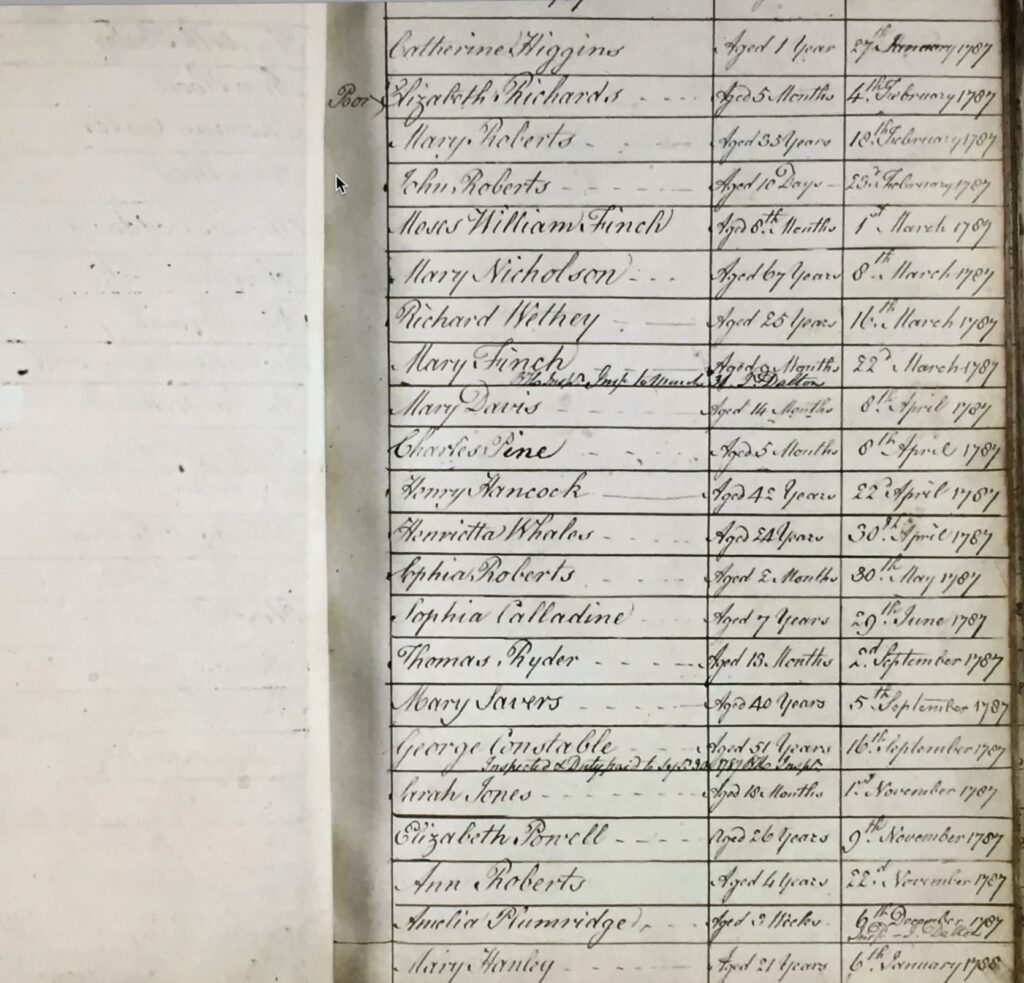
In Memory of MARY ROBERTS who died the 14th February 1787. Also two of their children who died in their infancy like the wife of the aforesaid DAVID ROBERTS who died the 25th May 1802, aged 52 years.

I have read this to mean that Mary died in childbirth – a terrible risk at the time. About one in three children born in 1800 did not make it to their fifth birthday and maternal deaths at birth have been estimated at about five per thousand (although that is probably on the low side). Just by way of comparison, in 2016 to 2018, among the 2.2 million women who gave birth in the UK, 547 died during or up to a year after pregnancy from causes associated with their pregnancy. The 1800 equivalent rate would have meant 11,000 deaths.

If you are interested to know more about maternal mortality, its history and causes, you’ll find this incredibly informative article in The Journal of the Royal Society of Medicine. Most disturbing is how doctors who discovered the underlying cause of many deaths were disbelieved and vilified by the medical profession as a whole, thus allowing unnecessarily high mortality to continue for decades.

The mystery surrounding this stone is that, although there are quite a few people called Roberts recorded in Percy’s memorial list, none of them are called Mary or David. So, assuming, the book is complete (and Percy was obviously very fastidious) I wonder where this marker comes from.

That’s all for this week – I shall continue to try to solve the mysteries I have written about.

If you would like to follow me on Instagram here is the link …
https://www.instagram.com/london_city_gent/

A trip to Highgate in search of a famous cat (and other animals).

Everyone knows the story of Dick Whittington and his cat. Poor young Dick has given up on his hopes of making a fortune in London and is heading back home. As he climbs Highgate Hill, faithful cat at his side, he hears the bells of St Mary-le-Bow Cheapside ring out the words ‘Turn again Whittington, thrice Lord Mayor of London!’. There are several representations of Whittington and his companion in the City.

The first is a stunning window by the artist and glass maker John David Hayward in St Michael Paternoster Royal on College Hill (EC4R 2RL) where Dick Whittington was buried in 1423. It depicts him on Highgate Hill …

He’s just heard the church bells and glances back …

It has been commented that he rather resembles a flat-capped Hoxton Hipster – maybe there is an iPad in that bag.

I love the expression on the cat’s face. Perhaps he has seen a mouse.

I only recently discovered this sculpture in the ambulatory to The Guildhall Art Gallery (EC2V 5AE). He looks very thoughtful, doesn’t he. Times have been hard (note his torn leggings) and a rather unpleasant creature is peeping out from his pile of clothes – ‘Shall I return to the City and try my luck one more time?’ The milestone indicates it’s three miles away …

The sculptor Lawrence Tindall has written : ‘My figure, in Portland stone, is carved in a style illustrative of children’s literature. It shows Dick and his cat at the point of turning again on hearing Bow Bells and — look behind him: there is a rat! My idea with this and the other figures was to lighten the atmosphere at the entrance of this impressive building and provide something for visiting children’.

The cat …

And a rat! …

Although the story is a total myth, it burned itself into folklore so deeply that the point on Highgate Hill where he supposedly heard the bells is also commemorated (and I knew exactly where it was). Take the Underground train to Archway, walk up Highgate Hill, and a hundred yards or so further on, you will encounter this charming little memorial …

Carved on the side of the stone facing the road are the dates of Whittington’s Mayoralties, the three Kings he served under and the year he was Sheriff …

It also records that the stone was restored by W Hillier in 1935.

You can read a comprehensive history of the stone and the cat here on the London Remembers website. I recall the cat (made from Irish limestone) being added in 1964 since I walked up the hill almost every day on my way to school. The cat also lives on in the signage of the nearby Whittington Hospital …

And the pub opposite the stone …

Knowing that I was going to be visiting Highgate I couldn’t resist the temptation to book a self-guided tour of the famous Cemetery.

To get there I walked further up the hill and turned left into Waterlow Park. I paused briefly to pay my respects to the wonderful philanthropist Henry Waterlow in the park that he donated to people who were ‘gardenless’ …

He’s prepared for inclement weather with hat, overcoat and neatly-furled umbrella.

The entrance to the Cemetery is opposite the west entrance to Waterlow Park and is in two sections separated by a road. Paid entry to the West part gets you free entry to the East and includes an excellent printed guide – what a fascinating experience it was. Regular readers will know that I am intrigued by the way animals are represented in sculptures and memorials and here are three from my visit.

Firstly a very loyal doggie, a huge black mastiff called ‘Lion’ …

Thomas ‘Tom’ Sayers (1826-65) was an English bare-knuckle prize fighter. There were no formal weight divisions at the time, and although Sayers was only five feet eight inches tall and never weighed much more than 150 pounds, he frequently fought much bigger men. In a career which lasted from 1849 until 1860, he lost only one of sixteen bouts. He was recognized as heavyweight champion of England in 1857, when he defeated William Perry (the ‘Tipton Slasher’).

‘Tom and his battles’, from The Police Gazette

On 17th April 1860 there took place what was claimed to be the first ‘international’ title fight. At 6ft 2in and 195lb John Carmel Heenan, the American contender, towered above Sayers’s 5ft 8in and 149lb as the first round started at 7.29 am. Each severely battered and bloodied, yet unbowed, they would finish, level pegging, tit for tat, their business unsettled as a draw and with all bets off, fully two hours 27 mins and 42 rounds later. The bout was halted when the Aldershot police, brandishing magistrates’ warrants, stormed the ring. This picture of the encounter was painted by a retired boxer called Jem Ward …

Tom in his prime circa 1860 …

Seriously ill from consumption (tuberculosis) aggravated by diabetes he died aged only 39 at No. 257 Camden High Street on 8 November 1865 in the presence of his father and two children. His funeral a week later attracted some 100,000 people. According to the Spectator magazine, the crowd that accompanied the coffin stretched for more than two miles in length and the bier was drawn by four sable-plumed horses. Lion, the mourner in chief, sat alone in a pony cart …

Tom’s Highgate Cemetery tomb.

A real lion called Nero rests, sleeping, on top of the tomb of George Wombwell (1777-1850) …

George became a household name as owner of three large travelling animal shows. His menagerie included an elephant, giraffes, a gorilla, a hyena, a kangaroo, leopards, six lions, llamas, monkeys, ocelots, ostriches, panthers, a rhino (billed as ‘the real unicorn of scripture’), three tigers, wildcats and zebras …

Sadly, because many of the animals were from hotter climes, lots of them died in the British climate. Sometimes Wombwell could profitably sell the body to a taxidermist or a medical school; other times he chose to exhibit the dead animal as a curiosity.

This poor horse on a pedestal looks old, tired and worn out …

Once upon a time this was taken to be the tomb of John ‘Jack’ Atcheler who claimed to be ‘Horse Slaughterer to Queen Victoria’, and is described as such in the guide. More research has revealed, however, that he is buried elsewhere although there is a John Atcheler beneath the monument. He is the famous man’s son, who died in 1853 aged twenty-two. The grave also holds Jack’s second wife, Sarah, and his son-in-law. The now faded inscription may contain a clue as to why there is a horse on the monument: ‘She’s gone; whose nerve could rein the swiftest steed’. Jack almost certainly paid for the grave and monument and no doubt intended that he would be buried there as well. You can read about Jack in this fascinating article from the Highgate Cemetery Newsletter.

If you visit the East Cemetery other famous people resting there include …

Malcolm McLaren – Better a spectacular failure than a benign success

The ‘Great Train Robber’ Bruce Reynolds. The inscription reads ‘C’est la vie’, the words that Reynolds uttered when he was finally arrested in 1968 in Torquay by Tommy Butler, the dogged detective who pursued him to the end …

A very moving sculpture marking the tomb of Philip Gould, one of the architects and strategists of New Labour …

There is also some humour – the book spine reads The final chapter

The painter and print-maker Patrick Caulfield (1936-2005) was a contemporary of David Hockney. Regarded as part of the Pop Art movement, and a Turner Prize nominee in 1987, Caulfield designed the memorial which now sits on his grave. Brutally frank! …

And finally, of course …

If you would like to follow me on Instagram here is the link …
https://www.instagram.com/london_city_gent/

Another visit to Southwark … ‘The outcast dead’.

After admiring the magnificent memorials in Southwark Cathedral, I wanted to visit the Cross Bones Graveyard Garden, which has a very different story to tell. It can be found at the junction of Redcross Way and Union Street (SE1 1SD) …

I also wanted to mark the connection between it and the remains of the Bishop of Winchester’s palace on Clink Street (SE1 9DN) …

A plaque outside the garden gives a very brief history …

Photo credit : Katy Nichols.

I found it a very moving place, even though the garden was closed when I visited. I caught a glimpse of several little shrines through the memorial ribbons and other tributes attached to the fence …

Some excavation work by Museum of London archaeologists in the 1990s resulted in the removal of 148 skeletons, over 60% of whom were children under five years of age. Overall it’s estimated that as many as 15,000 souls were buried here until the cemetery was closed in 1853 being ‘completely overcharged with dead’ and ‘inconsistent with due regard for the public health and public decency’.

So what was the connection with the Bishop of Winchester?

As the plaque tells us, in the late medieval period, the local prostitutes were known as ‘Winchester Geese’. They were not licensed by the City of London or Surrey authorities, but by the Bishop of Winchester who owned the surrounding lands, hence their namesake. The earliest known reference to the Graveyard was by John Stow in his Survey of London in 1598 …

I have heard ancient men of good credit report, that these single women were forbidden the rights of the Church, so long as they continued that sinful life, and were excluded from Christian burial, if they were not reconciled before their death. And therefore there was a plot of ground, called the single woman’s churchyard, appointed for them, far from the parish church.

Stow comments that their churchyard was ‘far from the parish church’. That church, St Saviour’s, became Southwark Cathedral in 1905 and you can just see the top of its tower on the right in my first photo above. Far indeed.

You can read more about Cross Bones here.

I just had to visit nearby Ayres Street (SE1 1ES) …

It is named after a brave girl who is also commemorated in the Watts Memorial in Postman’s Park …

The picture above shows Alice Ayres as portrayed by the Illustrated London News in 1885 (Copyright the British Library Board). Her commemorative plaque reads as follows and was the first to be installed …

It was 25-year-old Alice’s brave act that prompted Watts to write to the Times newspaper and suggest the creation of a memorial

That would celebrate the sacrifices made by ‘likely to be forgotten heroes’ by collecting ‘…a complete record of the stories of heroism in every-day life’.

Alice threw down a mattress from a burning building and successfully used it to rescue three children …

From The Illustrated Police News 2nd May 1885 Copyright, The British Library Board.

Alice eventually jumped herself but received terrible injuries and died two days later. Incidentally, if her name rings a bell with you it could be because, in the 2004 film Closer, one of the characters, Jane Jones, sees Alice’s memorial and decides to adopt her name.

This imposing building at 47 Union Street dating from 1907 was once known as the ‘Ragged School’, a charity set up to help disadvantaged children (SE1 1SG) …

According to the London Remembers blog, ‘the Work Girls Protection Society was founded in 1875 and began with premises in New Kent Road. It was renamed the St Mary’s Girls’ Club. In 1899 the Club lost the New Kent Road site so they acquired a lease at 85 Union Street, a former tin plate works. They then raised funds, bought the site to the left of the Mission site, and constructed a building there. In 1930 the Girl’s Club merged with the Acland Club to form the co-ed St Mary’s and Acland Club’ …

I couldn’t find out any more about this club and have no idea why the bottom part of the poster has been concealed.

I headed for Southwark Street and wandered east to Borough High Street, adding this ghost sign to my collection along the way …

This building, John Harvard House, caught my eye since its narrowness seems to reflect medieval building plot dimensions …

John Harvard was born in Southwark in 1607 and was baptized in St Saviour’s Church, the present Southwark Cathedral. His mother, Katherine, owned the Queen’s Head Inn, which stood on this site, and left it to John when she died in 1636. In the spring of the following year John and his wife made the voyage to Massachusetts and arrived at Charlestown. John died there of tuberculosis in 1638 and bequeathed to the recently established local college half his fortune and the whole of his library of about 400 books. In 1639 it was renamed Harvard College, first calling itself a university in 1780. John Harvard is commemorated in Southwark today by a library in Borough High Street and by a chapel in the cathedral.

I always enjoy exploring alleys and I investigated two that run off the High Street.

In Chapel Court I came across this building …

The building itself didn’t look all that old but some of the timbers used in its construction did …

One source states that they came from a very old building that was demolished in Essex and were then utilised here in the 1980s.

And finally, Mermaid Court has a fine collection of old bollards …

I really enjoyed my trips south of the River – might even go back again one day!

Incidentally, by way of local news, Mrs Duck was showing off her little family last week. Ahhhh!

If you would like to follow me on Instagram here is the link …
https://www.instagram.com/london_city_gent/

Page 17 of 35

Powered by WordPress & Theme by Anders Norén