Walking the City of London

Category: Wartime Page 10 of 16

A more cheerful wander around Smithfield

Last week’s blog was largely concerned with the rather gruesome events that took place in this historic area so I’m aiming to be a bit more lighthearted this week.

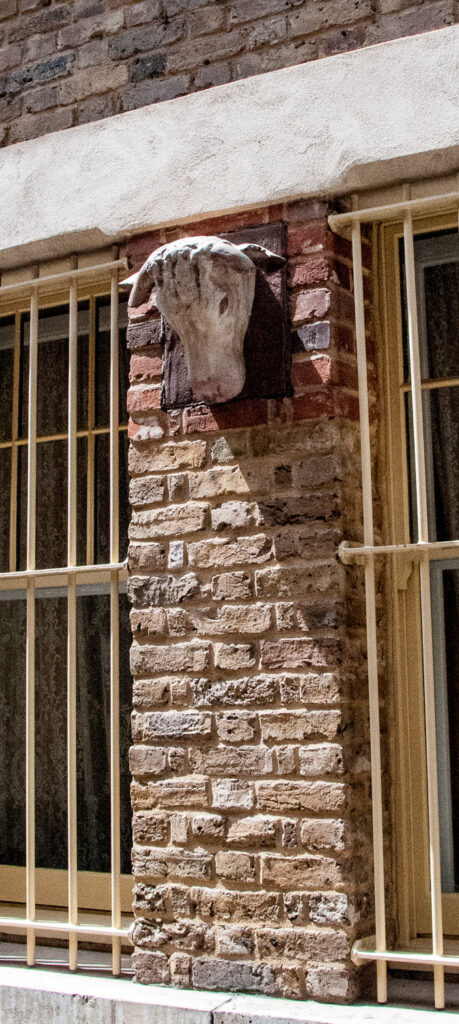
Looking up as you walk can be very rewarding. Just opposite Smithfield Central Market on Charterhouse Street I spotted this frieze at the top of one of the buildings …

Here is a close up of the panel on the left …

And here’s the one on the right …

Aren’t they wonderful! I’m pretty sure that’s a bull in the foreground.

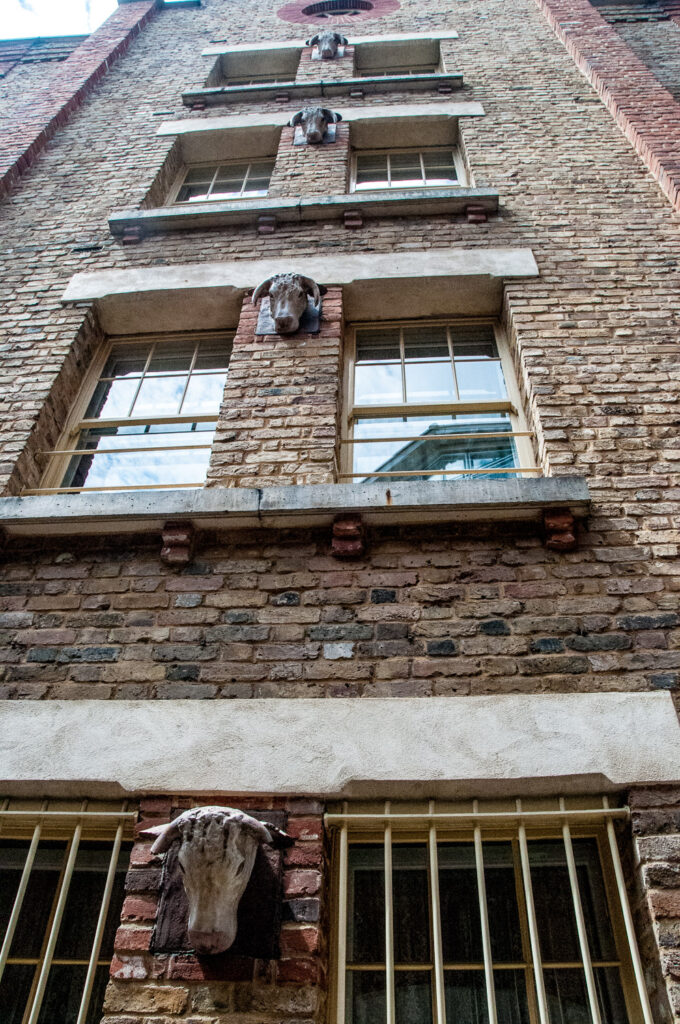
And, whilst in livestock mode, if you look just around the corner in Peter’s Lane you will encounter this sight (EC1M 6DS) …

Now look up …

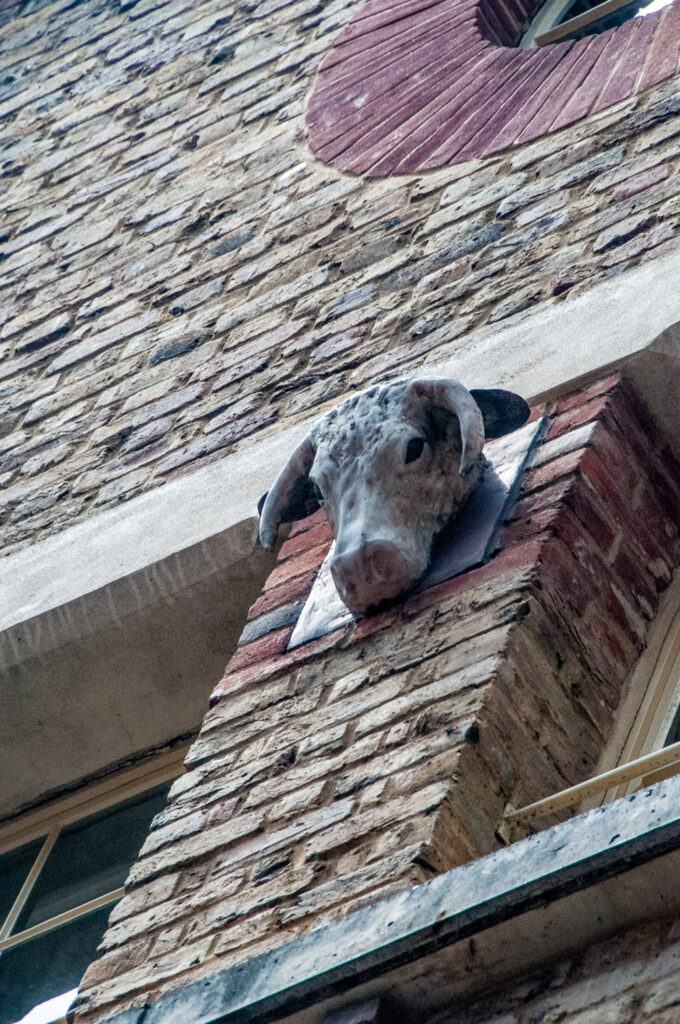
Here’s the bull at the very top …

Surprisingly, they only date from the mid-1990s and are made of glass reinforced resin. The bovine theme was used as a decorative motif because for centuries the appropriately named Cowcross Street was part of a route used by drovers to bring cows to be slaughtered. The tower forms part of The Rookery Hotel and also dates from the mid-1990s, although it looks much older due to the use of salvaged bricks.

I reckon this is a top class piece of sympathetic redevelopment by the architects Gus Alexander. Read all about how they approached the work here.

I’ll say a little about Smithfield’s history.

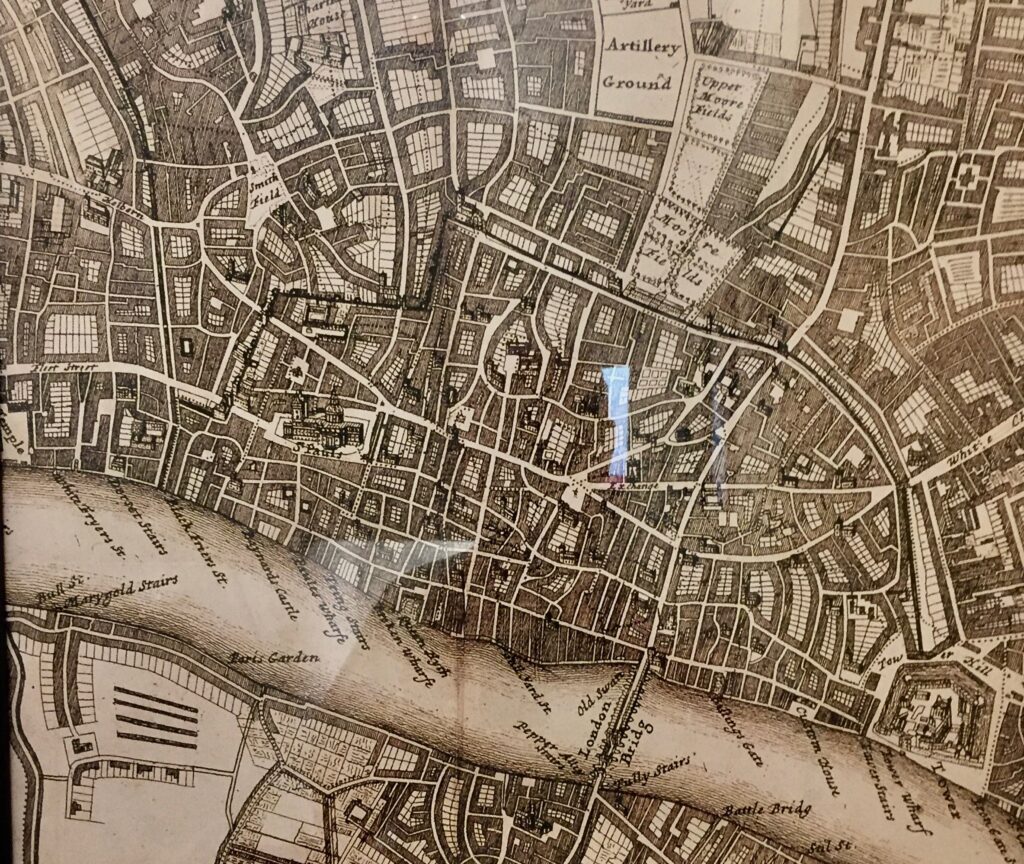
It appears on some old maps as Smooth Field …

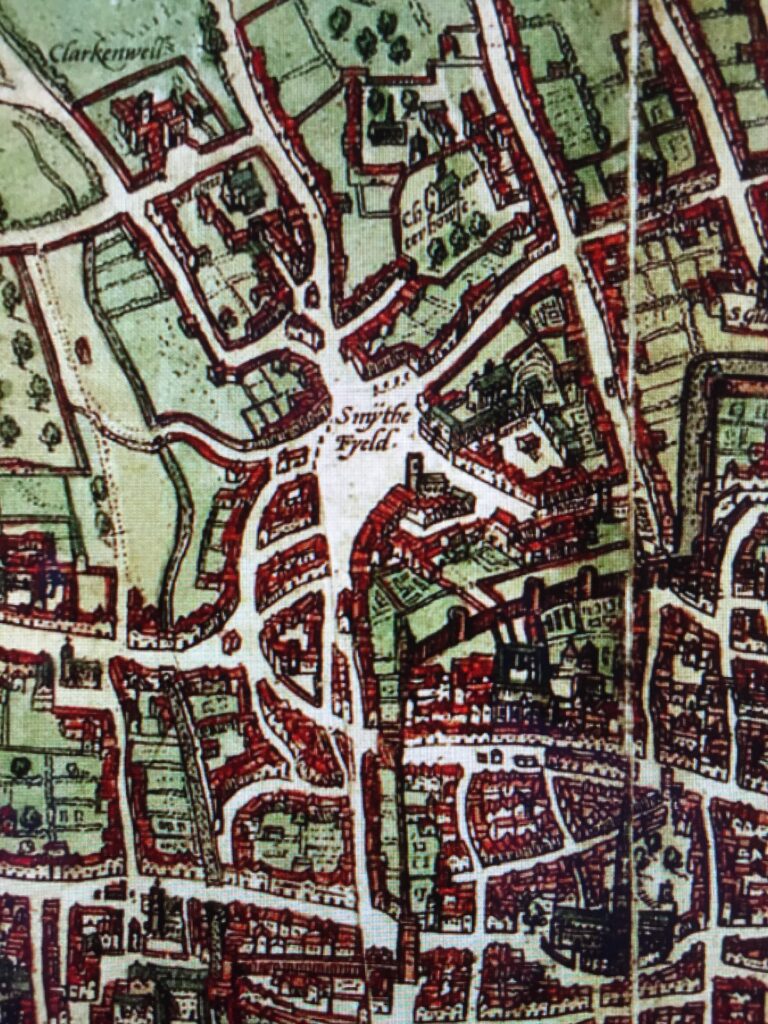
In the Braun and Hogenberg map of 1560/72 it’s Smythe Fyeld …

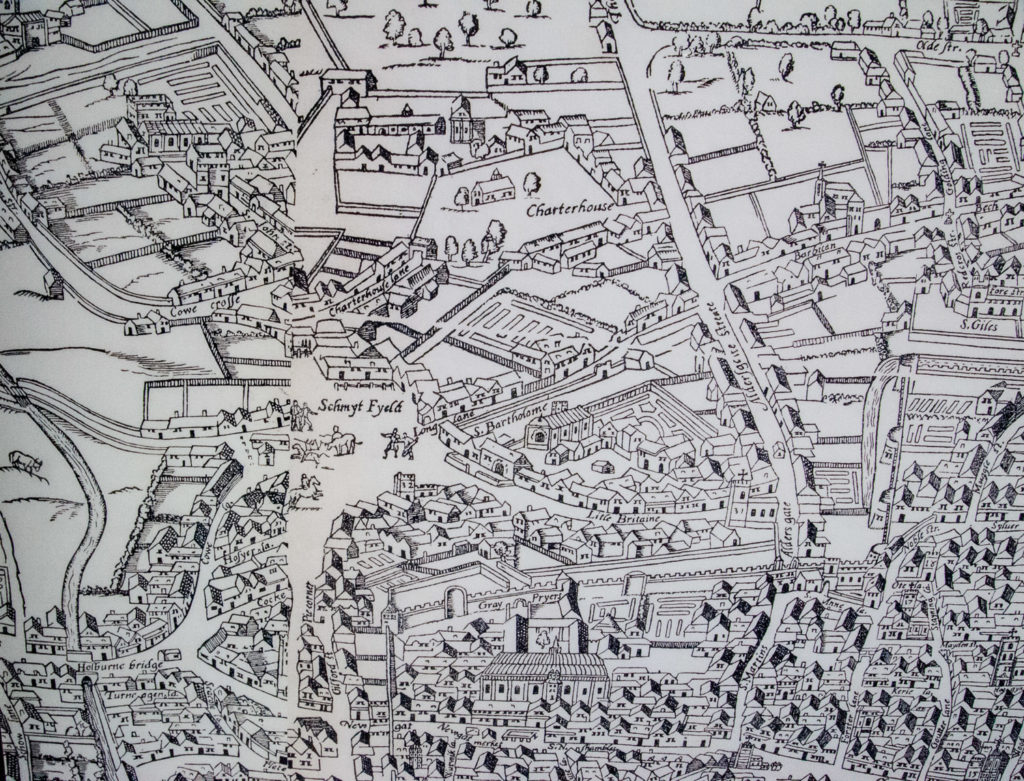
In the Agas Map of 1633 it’s Schmyt Fyeld …

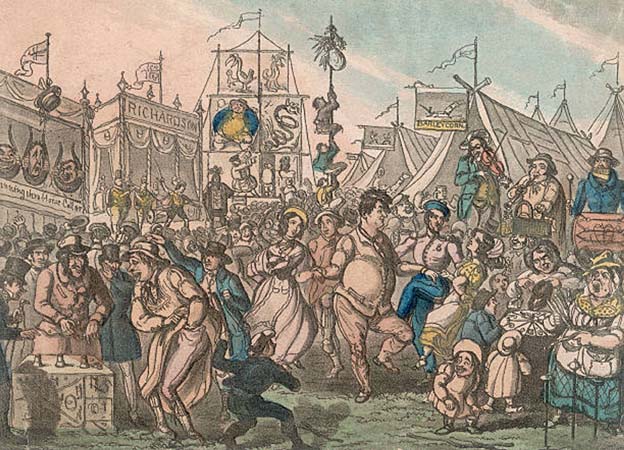
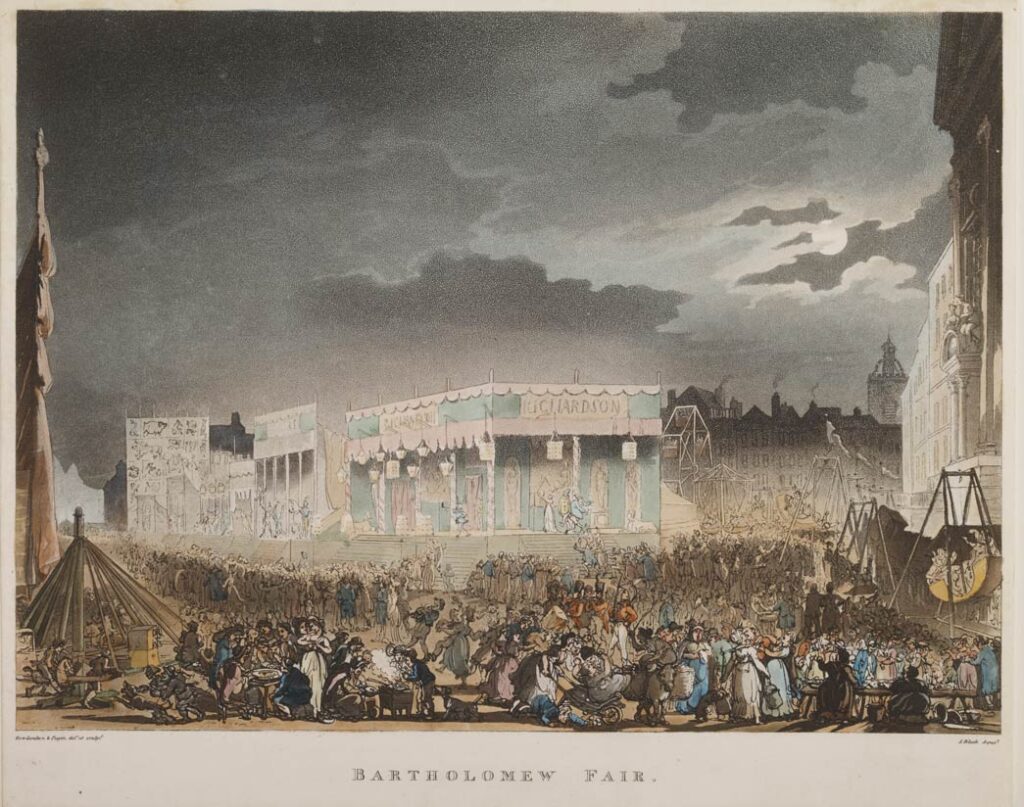
By the twelfth century, there was a fair held there on every Friday for the buying and selling of horses, and a growing market for oxen, cows and – by-and-by – sheep as well. An annual fair was held every August around St Bartholomew’s Day and was the most prominent and infamous London fair for centuries; and one of the most important in the country. Over the centuries it became a teeming, riotous, outpouring of popular culture, feared and despised like no other regular event by those in power… ‘a dangerous sink for all the vices of London’. This image gives a flavour of it …

In the foreground, a man digs deep into his pocket. It looks like he’s just about to place a bet on a ‘find the pea’ game – a notorious confidence trick being operated here by a distinctly dodgy looking character. In the background musicians play and people dance.

Here’s another view that captures the sheer exuberance of the event …

Bartholomew Fair by Augustus Pugin & Thomas Rowlandson, courtesy Bishopsgate Institute.

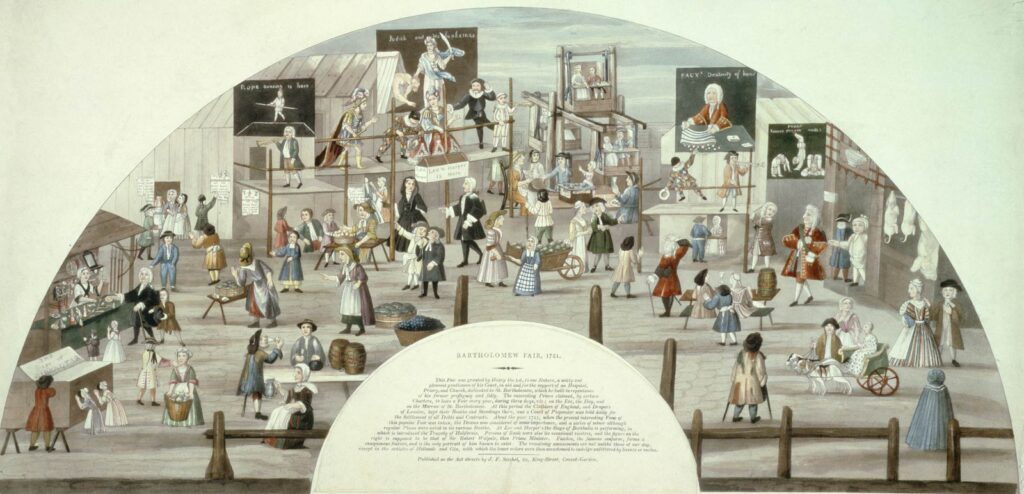
In this 1721 image the behaviour looks more sedate …

In 1815 Wordsworth visited the Fair and saw …

Albinos, Red Indians, ventriloquists, waxworks and a learned pig which blindfolded could tell the time to the minutes and pick out any specified card in a pack.

Alongside the entertainment of the Fair there was an undercurrent of trouble, violence and crime. In 1698 a visiting Frenchman, Monsieur Monsieur Sorbière, wrote …

I was at Bartholomew Fair… Knavery is here in perfection, dextrous cutpurses and pickpockets … I met a man that would have took off my hat, but I secured it, and was going to draw my sword, crying, ‘Begar! You rogue! Morbleu!’ &c., when on a sudden I had a hundred people about me crying, ‘Here, monsieur, see Jephthah’s Rash Vow.’ ‘Here, monsieur, see the Tall Dutchwoman’ …

After more than 700 years the Fair was finally banned in 1855 for being …

A great public nuisance, with its scenes of riot and obstruction in the very heart of the city.

As far as livestock trading was concerned it had always been a place of open air slaughter. The historian Gillian Tindall writes: ‘Moo-ing, snorting and baa-ing herds were still driven on the hoof by men and dogs through busy streets towards Smithfield, sometimes from hundred of miles away. Similarly, geese and ducks were hustled along in great flocks, their delicate feet encased in cloth for protection. They were all going to their deaths, though they did not know it – till the stench of blood and the sounds of other animals inspired noisy fear in them’.

In Great Expectations, set in the 1820s, young Pip comes across the market and refers to it as ‘the shameful place, being all asmear with filth and fat and blood and foam [which] seemed to stick to me.

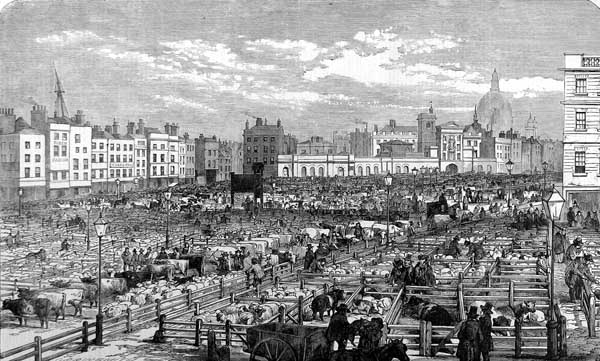
Eventually slaughtering was moved elsewhere and the open air market closed in 1855 …

Smithfield Market’s last day.

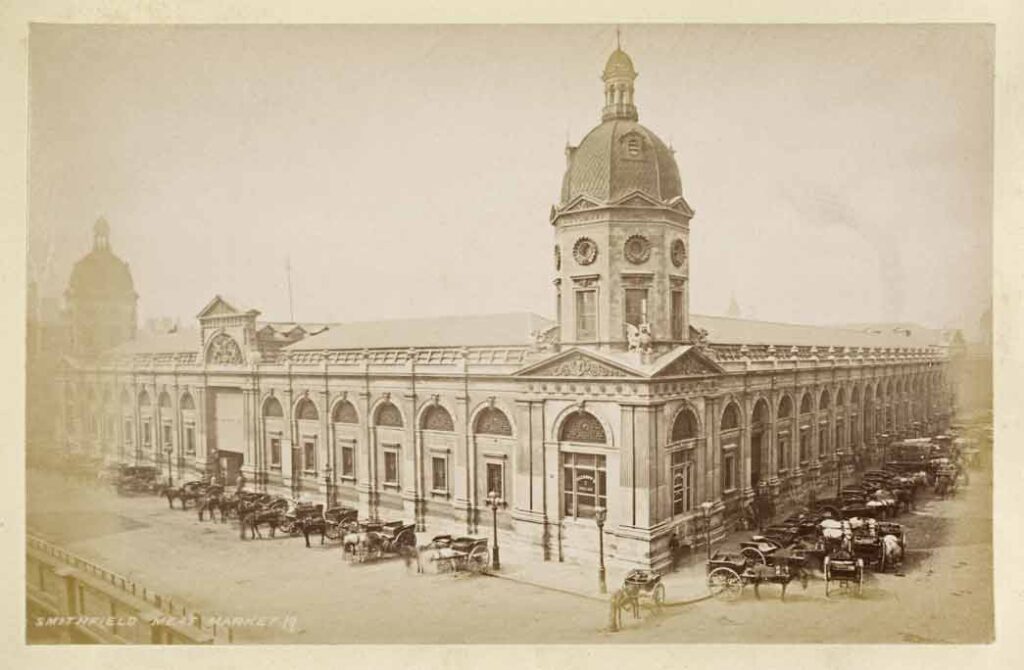
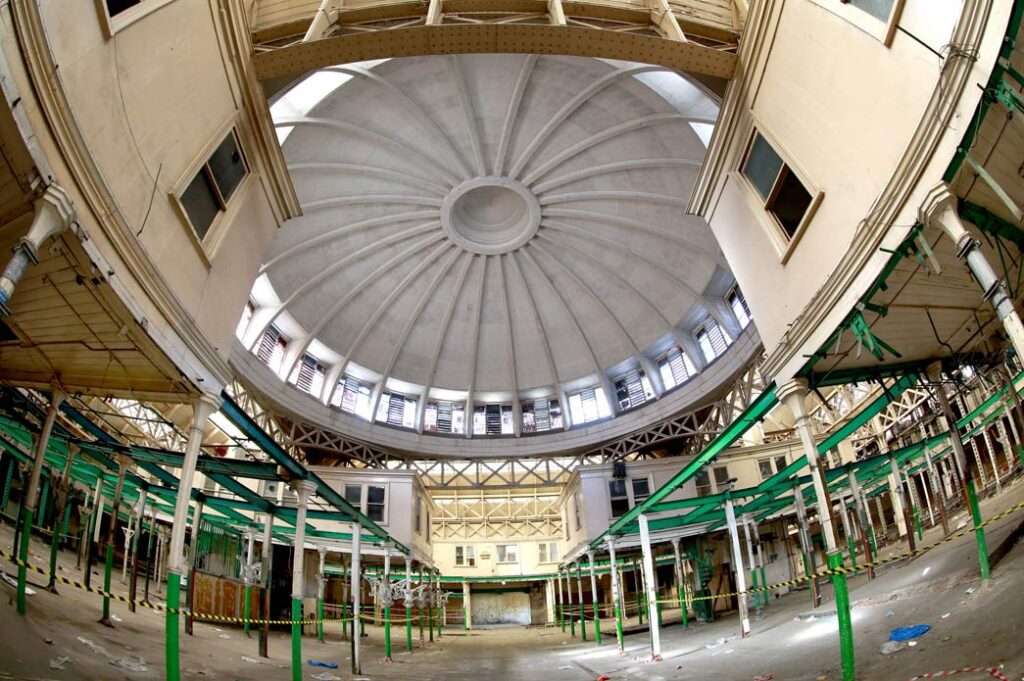
The present meat market on Charterhouse Street was established by an 1860 Act of Parliament and was designed by Sir Horace Jones who also designed Billingsgate and Leadenhall Markets. Work on Smithfield, inspired by Italian architecture, began in 1866 and was completed in November 1868. I think this picture was taken not long after construction …

The buildings were a reflection of the modernity of Victorian city. Like many market buildings of the second half the nineteenth century, they owed a debt to Sir Joseph Paxton’s Crystal Palace in their creative use of glass, timber and iron …

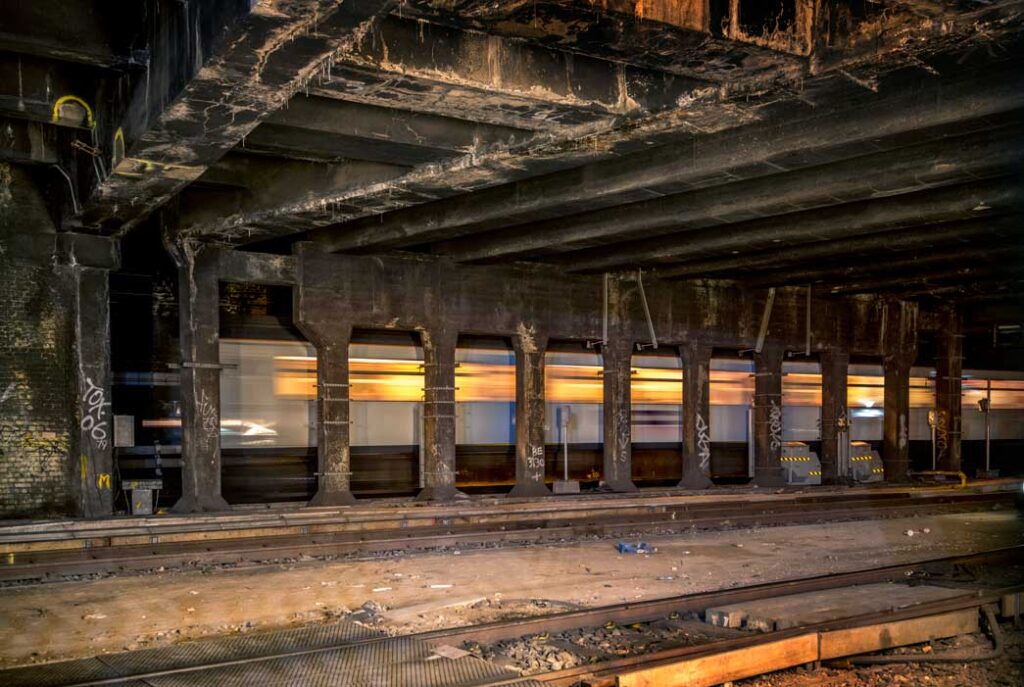
One aspect of the London Central Markets, as the Smithfield buildings were known, was particularly revolutionary, though largely hidden. All the buildings were constructed over railway goods yards. For the first time ever, meat was delivered by underground railway direct to a large wholesale market in the centre of a city. In this picture, an underground train whizzes past where the old tracks used to be …

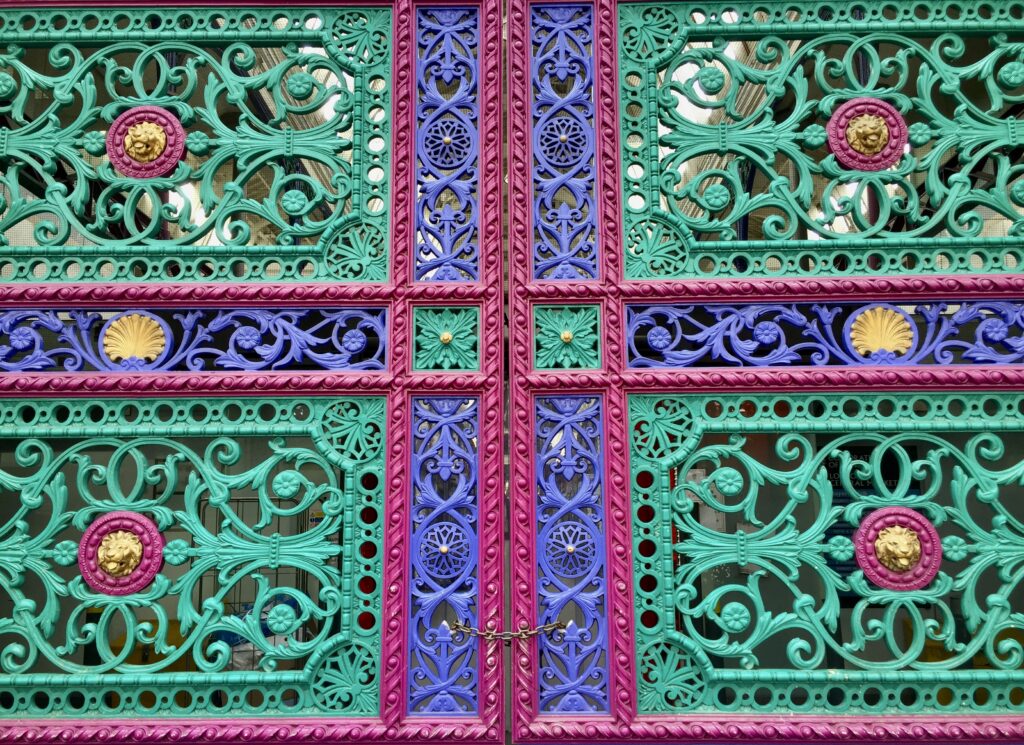
The spectacular colour scheme today replicates what it was when the market opened …

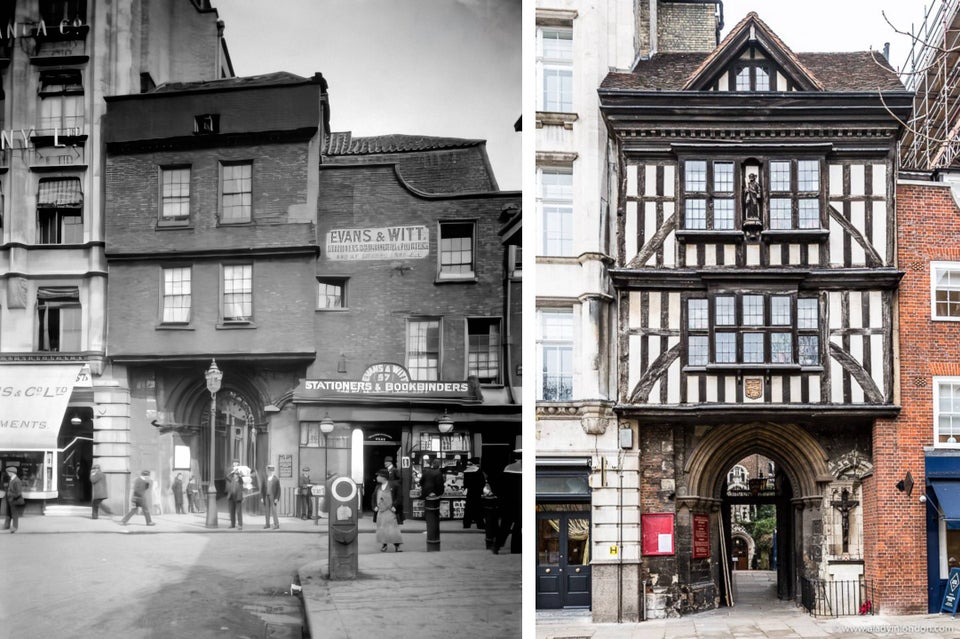
The church of St Bartholomew the Great is always worth a visit but today I’ll just mention the Gatehouse entrance. These pictures show the site before and after the first world war …

The Zeppelin bomb that fell nearby in 1916 partly demolished later buildings revealing the Tudor origins underneath and exposing more of the 13th century stonework from the original nave. By 1932 it was fully restored.

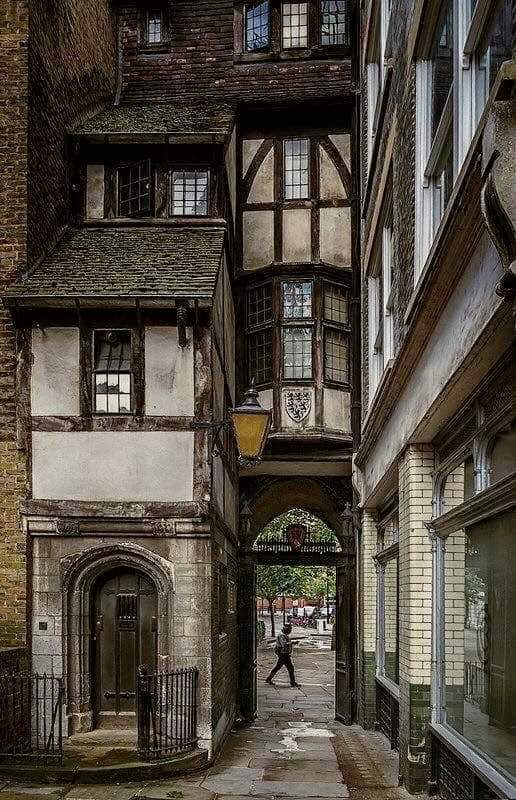
Looking out towards Smithfield you can see the 13th century arch topped by a Tudor building …

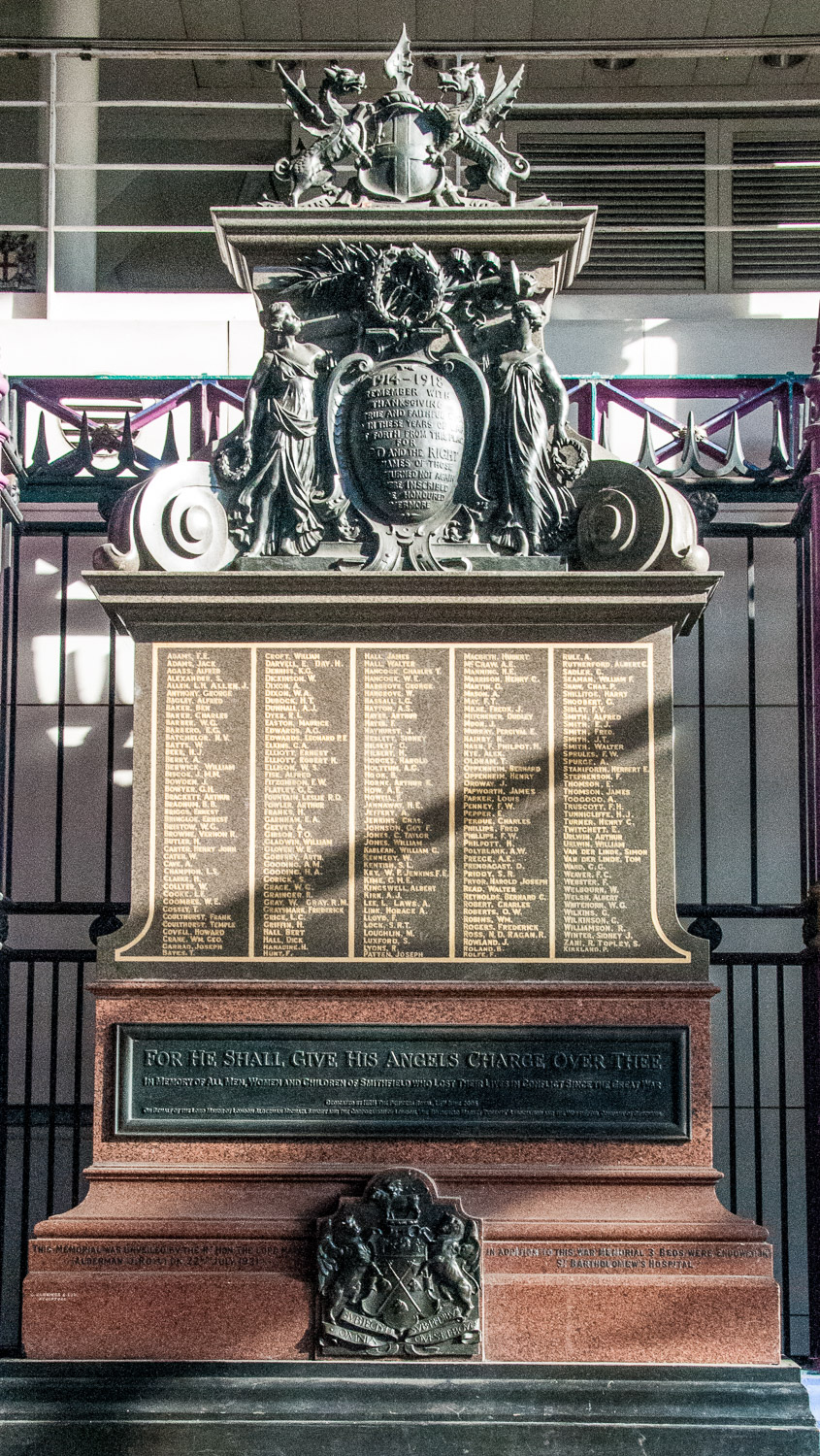
Finally, in the Great Avenue (EC1A 9PS), there is this monument commemorating men, women and children who perished both overseas and nearby …

The original memorial (above the red granite plinth) is by G Hawkings & Son and was unveiled on 22  July 1921. 212 names are listed.

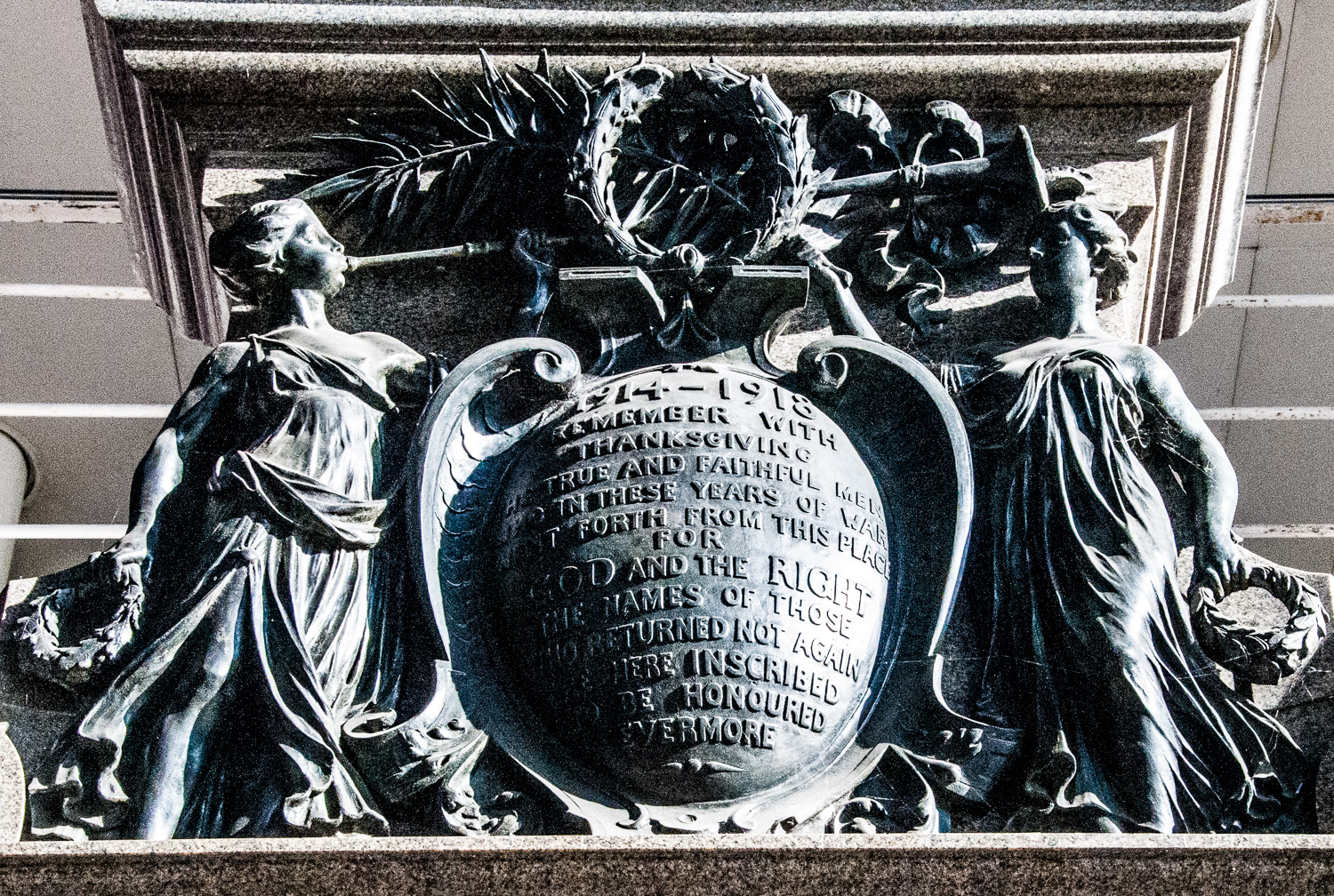
Between Fame and Victory holding laurel wreaths, the cartouche at the top reads …

1914-1918 Remember with thanksgiving the true and faithful men who in these years of war went forth from this place for God and the right. The names of those who returned not again are here inscribed to be honoured evermore.

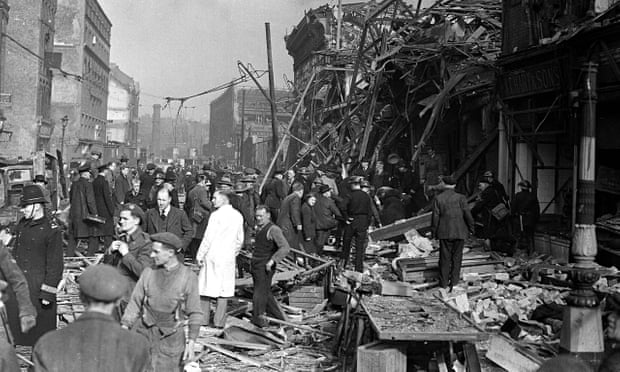
At 11:30 in the morning on 8th March 1945 the market was extremely busy, with long queues formed to buy from a consignment of rabbits that had just been delivered. Many in the queue were women and children. With an explosion that was heard all over London, a V2 rocket landed in a direct hit which also cast victims into railway tunnels beneath – 110 people died and many more were seriously injured. This picture shows some of the terrible aftermath …

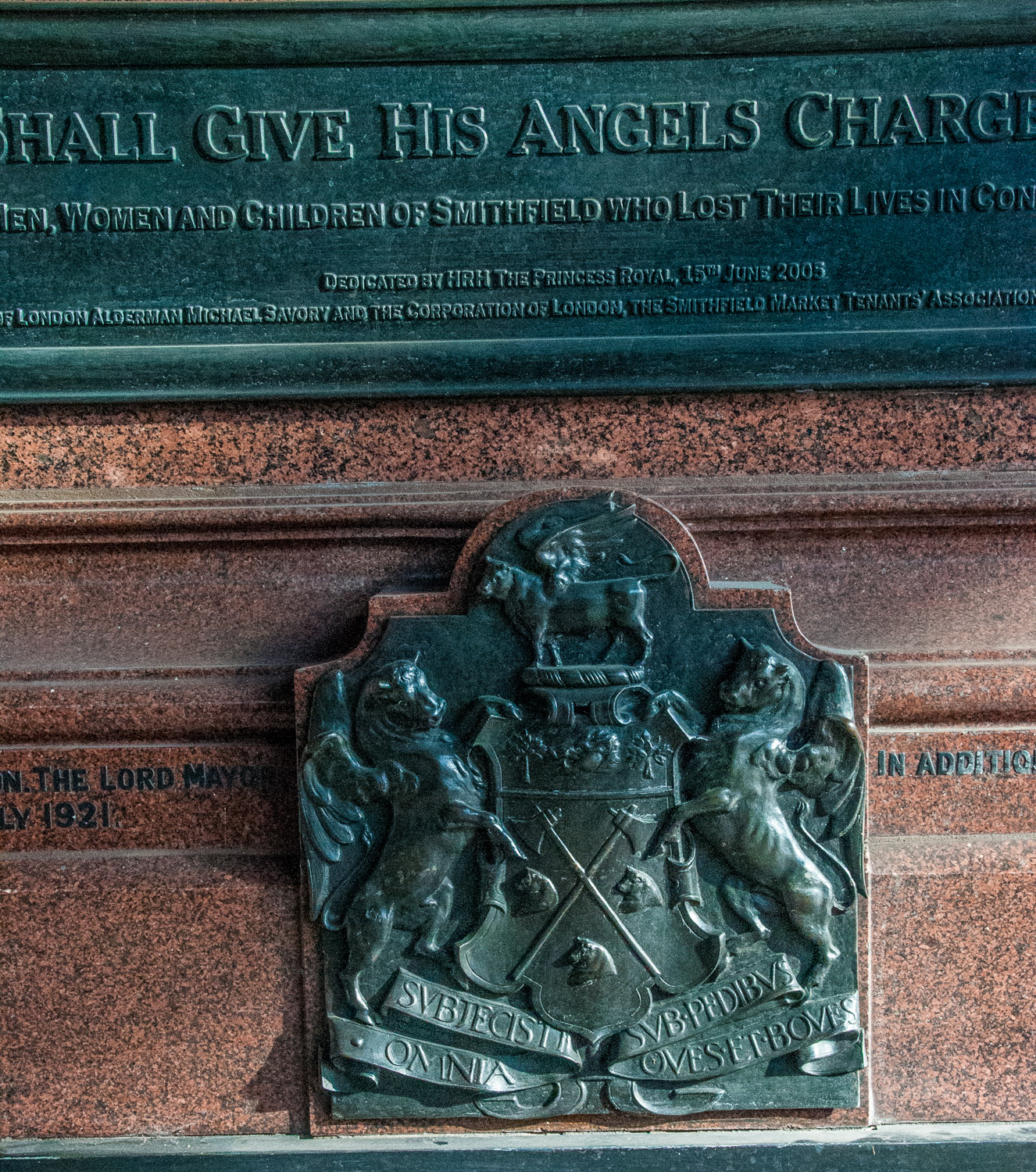
The monument was refurbished in 2004/5 and unveiled on 15 June 2005 by the Princess Royal and Lord Mayor Savory. The red granite plinth had been added and refers to lives lost in ‘conflict since the Great War’. On it mention is made of the women and children although the V2 event is not specifically referred to.

This is the coat of arms of the Worshipful Company of Butchers who helped to fund the refurbishment, along with the Corporation of London and the Smithfield Market Tenants’ Association.

The crest translates as : ‘Thou hast put all things under his feet, all Sheep and Oxen’.

Plans have been made for the market to be moved, along with Billingsgate and New Spitalfields markets, to Barking Reach power station, an abandoned industrial site at Dagenham Dock earmarked for redevelopment. The Museum of London will relocate to part of the old market site.

If you want to read more about Smithfield and its history, here is a link to some of my sources:

Smithfield’s Bloody Past by Gillian Tindall.

Today in London’s festive history – The opening of Batholomew’s Fair.

St Bartholomew’s Gatehouse | A rare survivor of 16th century London.

Underneath Smithfield Market – The Gentle Author.

If you would like to follow me on Instagram here is the link …

https://www.instagram.com/london_city_gent/

‘Smooth Field’ – a wander around Smithfield

Smithfield has a rather gruesome history.

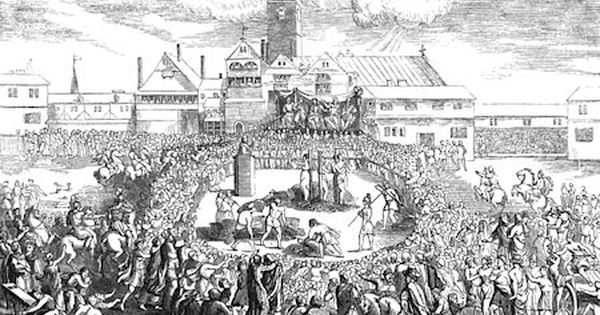
For example, on 16 July 1546 Anne Askew was burnt at the stake along with John Lascelles (a lawyer and Gentleman of the King’s Privy Chamber), John Hadlam (a tailor from Essex) and John Hemsley (a former Franciscan friar). A great stage was built at Smithfield for the convenience of Chancellor Wriothesley, other members of the Privy Council and City dignitaries, to watch the burning in comfort …

The execution of Anne Askew and her companions – 1563 woodcut from Foxe’s Book of Martyrs.

Anne herself, having been illegally broken on the rack, was unable to stand, and was chained to the stake in a sitting position. You can read more about this fascinating, brave lady here.

Every burning was different; if the fire ‘caught’, it could be over relatively quickly, but on damp days, or when the wind persisted in blowing the flames away from the body, it could take up to an hour for the condemned person to die, an hour of excruciating agony.

Their crime was heresy and of the 288 people estimated to have been burnt during the five year reign of Mary Tudor, forty eight were killed in Smithfield. ‘Bloody Mary’ was the daughter of Henry VIII and Katherine of Aragon and the burnings were part of her campaign to reverse the English Reformation.

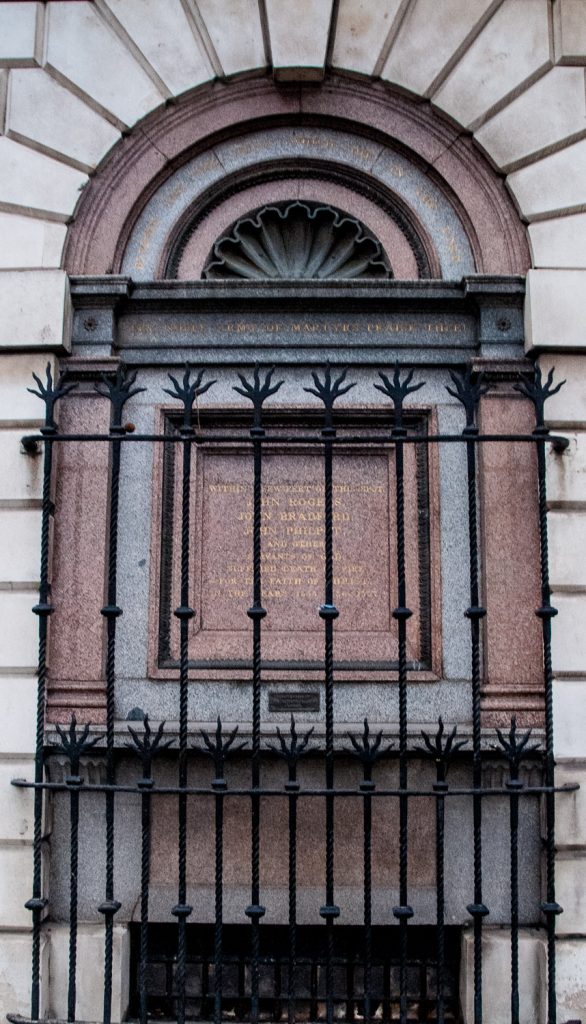
The ‘Marian Martyrs’ are commemorated with this plaque erected by the Protestant Alliance in 1870 …

The gilding is a little faded in this picture. It reads …

Blessed are the dead which die in the Lord. The noble army of martyrs praise Thee! Within a few feet of this spot,

John Rogers,

John Bradford,

John Philpot,

and other servants of God, suffered death by fire for the faith of Christ, in the years 1555, 1556, 1557

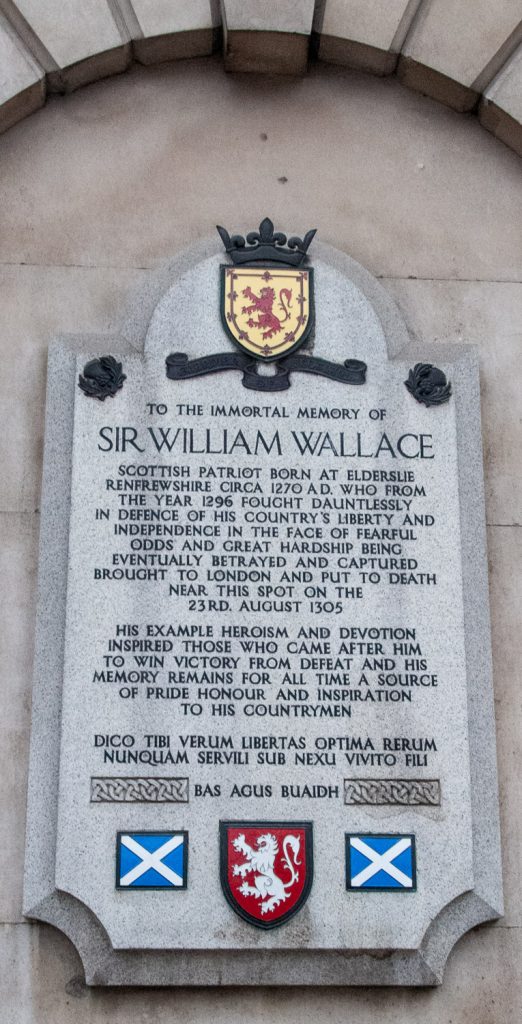
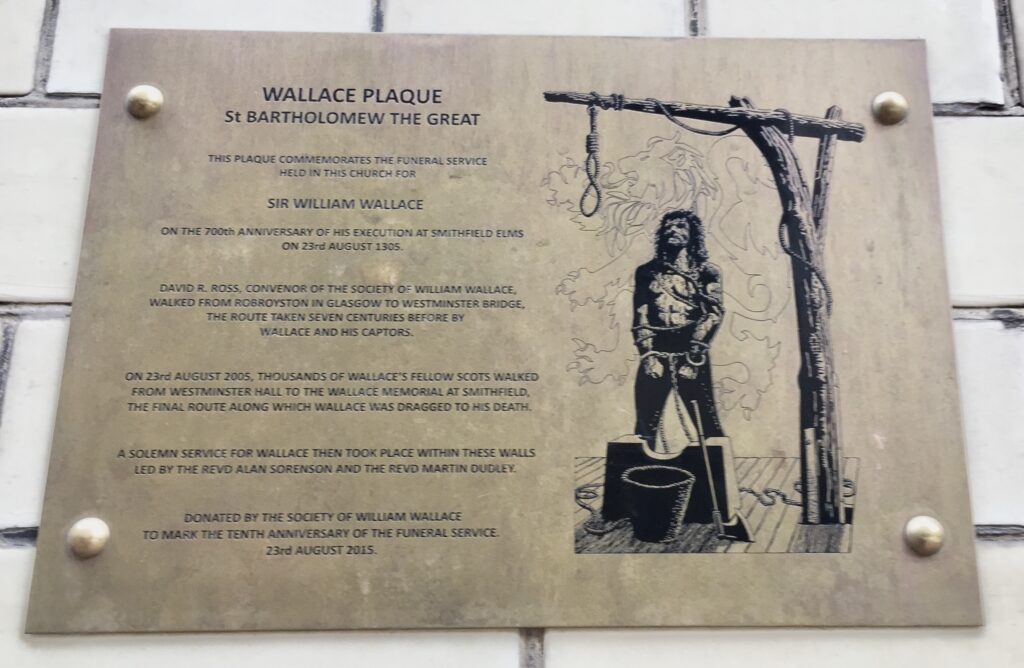
This had been a place of public execution for over 400 years; many witches and heretics had been burnt, roasted or boiled alive there. It was here that the Scottish hero and patriot, Sir William Wallace, was hanged, drawn and quartered in 1315 and has two memorials. This one in West Smithfield (EC1A 7AQ) …

There are often fresh flowers left here in his memory.

And another just inside the entrance to the St Bartholomew the Great churchyard …

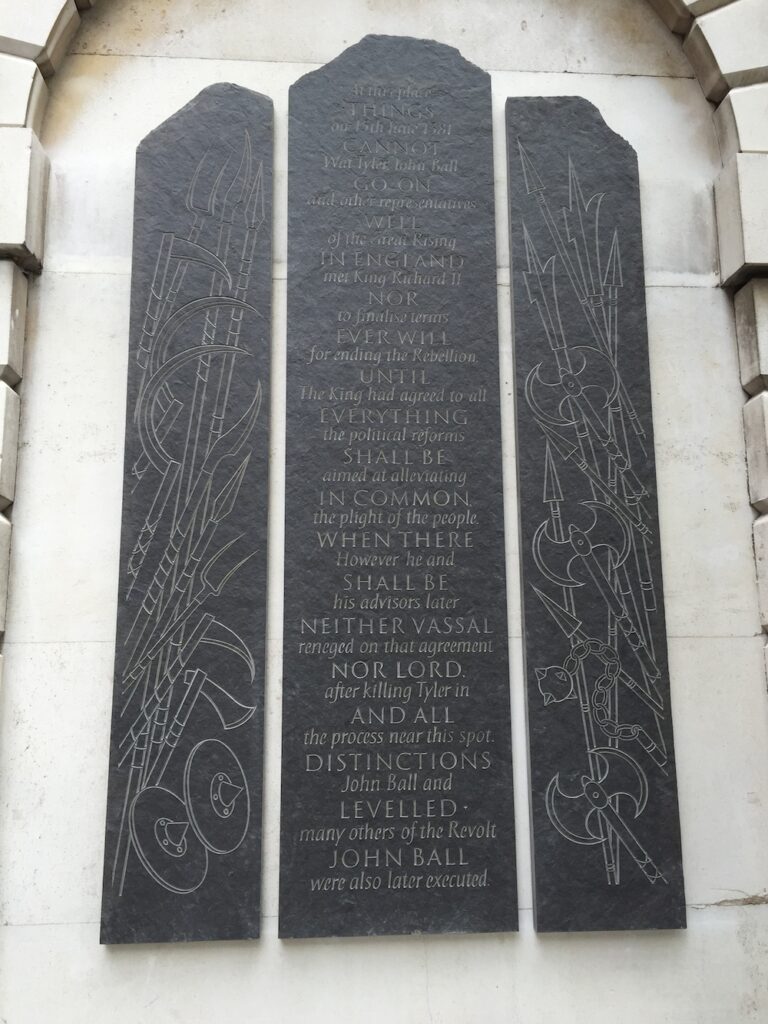
This slate triptych, also in West Smithfield,was unveiled by Ken Loach in July 2015 and commemorates the Great Rising of 1381 (more commonly known as the Peasants’ Revolt) …

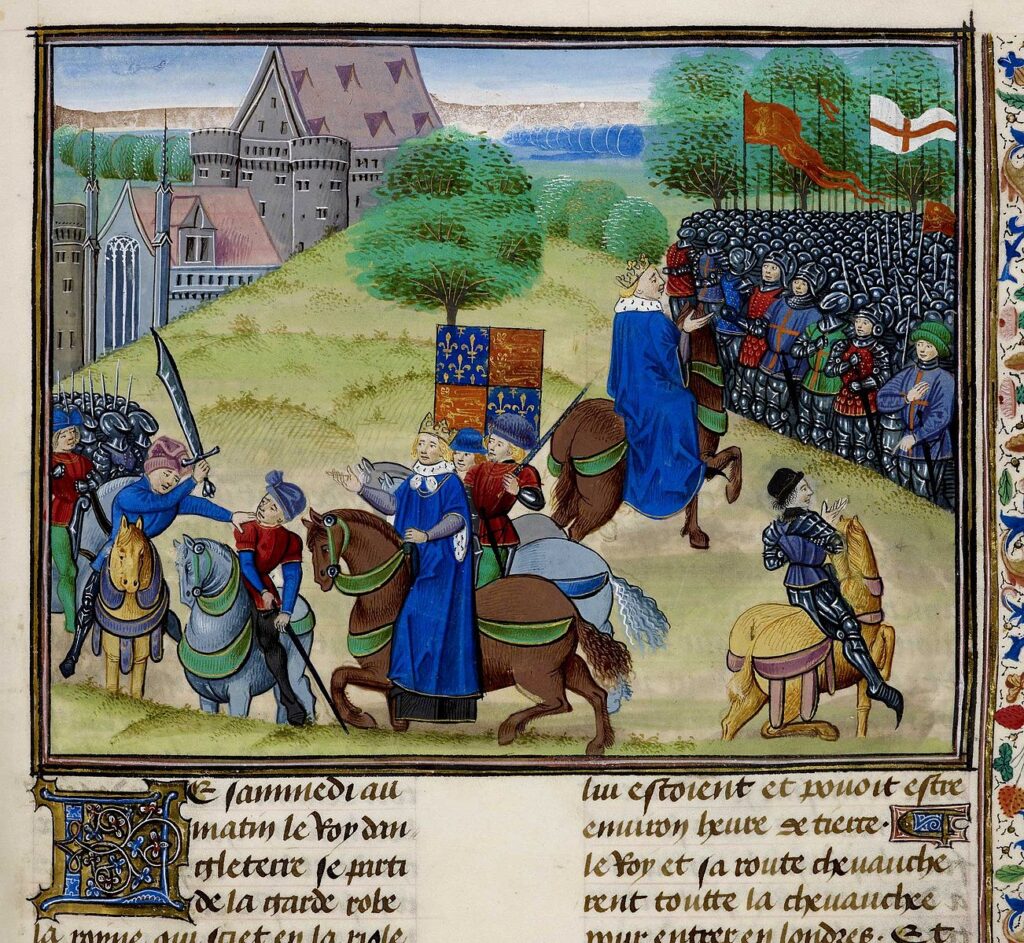
The Revolt was led by Wat Tyler and on June 15th 1381 he had the opportunity to speak directly to the 14-year-old king, Richard II. Accompanying the King was the Lord Mayor of London William Walworth and, for reasons that are not entirely clear, Walworth ran Tyler through with his sword. Badly wounded, Tyler was carried into nearby St Bartholomew’s Hospital but, rather unsportingly, Walworth had him dragged out and decapitated. Poll Tax protesters were dealt with very ruthlessly in those days!

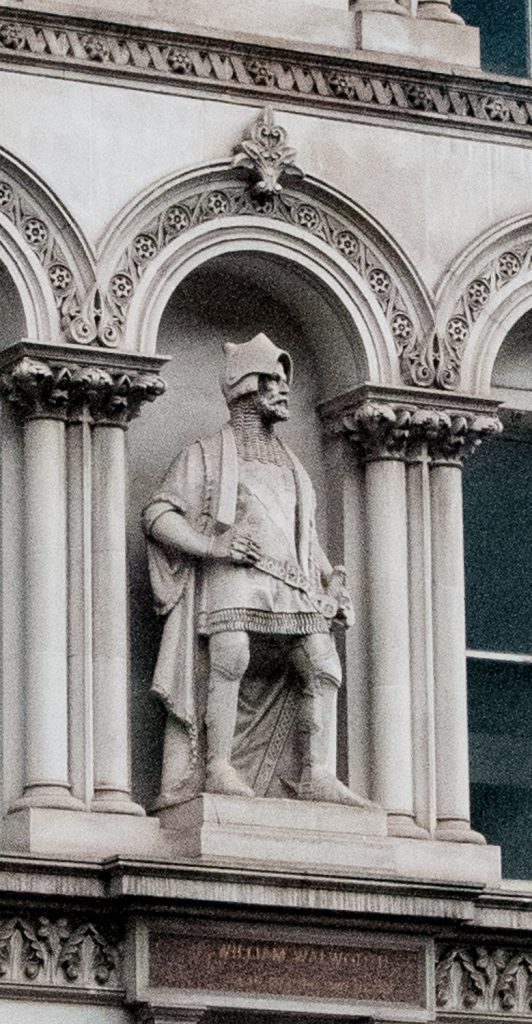
The Mayor is commemorated with a statue on Holborn Viaduct

His trusty sword is in a scabbard at his side.

Here is a 15th century depiction of Walworth in action …

The death of Wat Tyler. From a manuscript copy of the Chronicles of Jean Froissart, created in 1483.
Image from Wikimedia Commons.

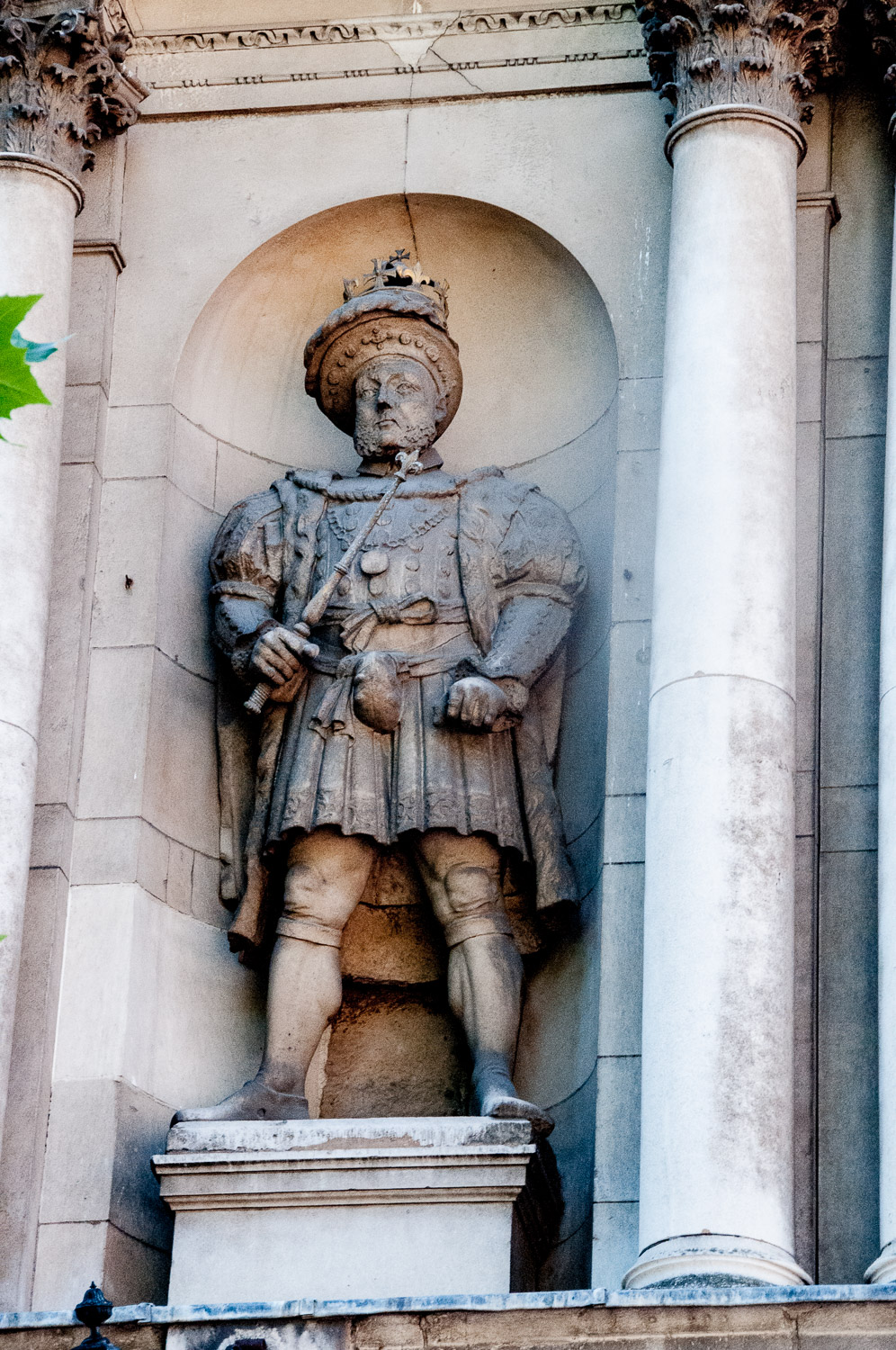
Queen Mary’s dad, Henry VIII, has a statue nearby over the main entrance to the hospital. If you have seen and admired the famous Holbein portrait, the king’s pose here is very familiar. He stands firmly and sternly with his legs apart, one hand on his dagger, the other holding a sceptre. He also sports an impressive codpiece …

Founded in 1331, the hospital was put seriously at risk in 1534, when Henry VIII commenced the Dissolution of the Monasteries. The nearby priory of St Bartholomew was suppressed in 1539 and the hospital would have followed had not the City fathers petitioned the king and asked for it to be granted back to the City. Their motives were not entirely altruistic. The hospital, they said, was needed to help:

the myserable people lyeing in the streete, offendyng every clene person passyng by the way with theyre fylthye and nastye savors.

Henry finally agreed in December 1546 on condition that the refounded hospital was renamed ‘House of the poore on West Smithfield in the suburbs of the City of London, of King Henry’s foundation’. I suspect people still tended to call it Bart’s. Henry finally got full public recognition when the gatehouse was rebuilt in 1702 and his statue was placed where we still see it today. The work was undertaken and overseen by the mason John Strong, who was at the same time working for Sir Christopher Wren on St Paul’s Cathedral. Such were the masons’ talents, no architectural plans were needed to complete the work.

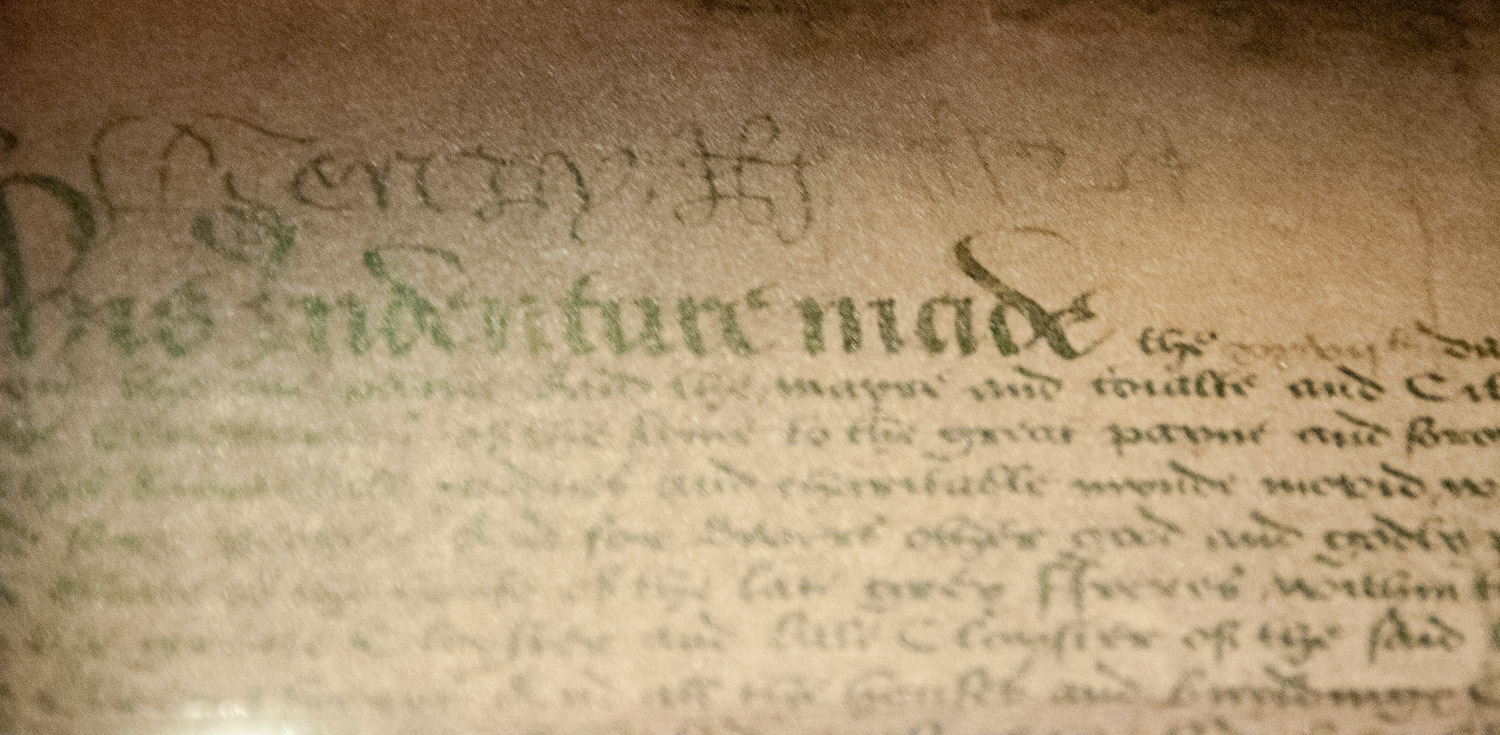
By the way, you can see the agreement, with Henry’s signature, at the lovely little St Bartholomew’s Museum when hopefully it reopens next year. Here’s a picture of the document I took a few years ago …

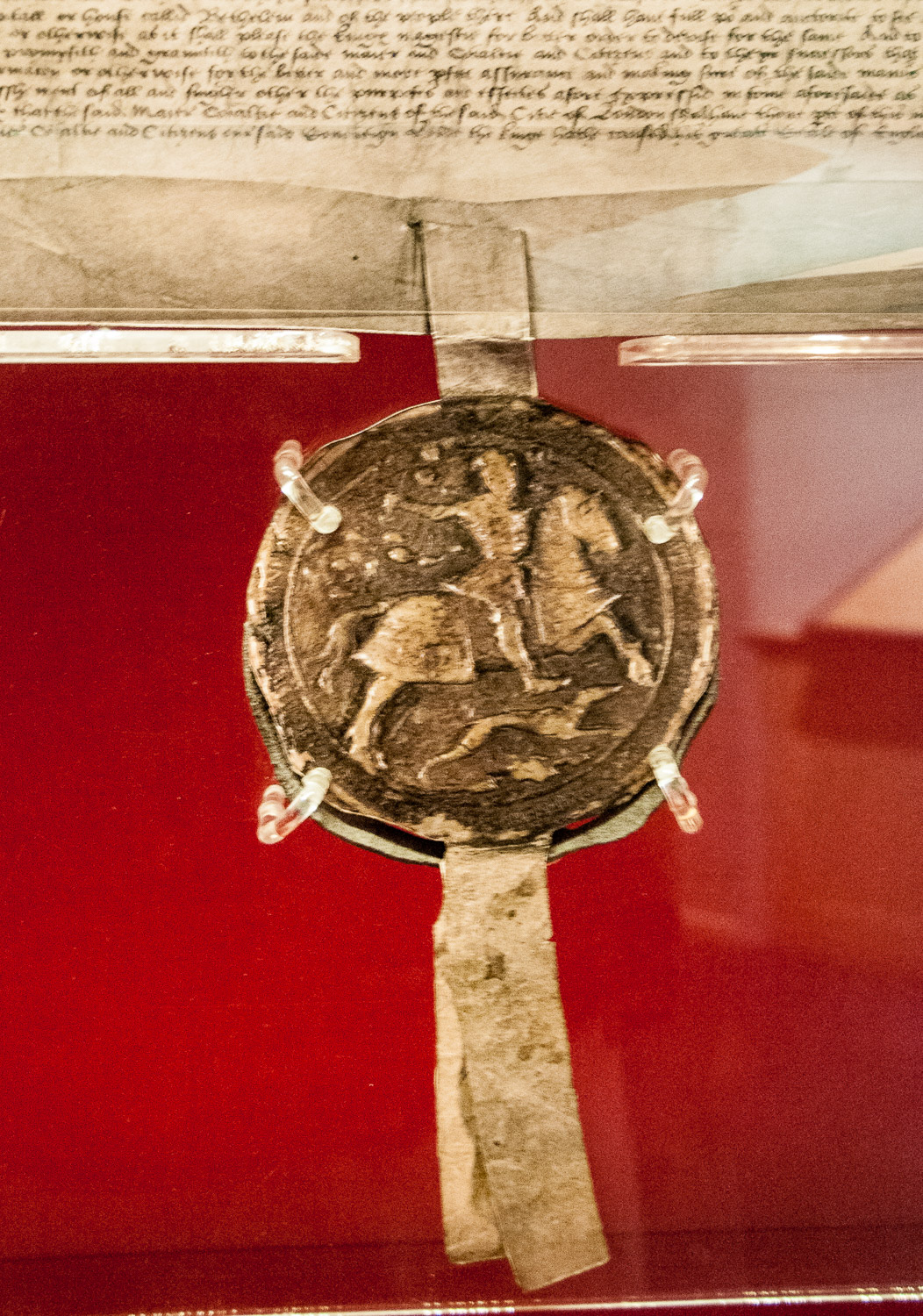
It also bears the Henry’s seal, the king charging into battle on horseback accompanied by a dog …

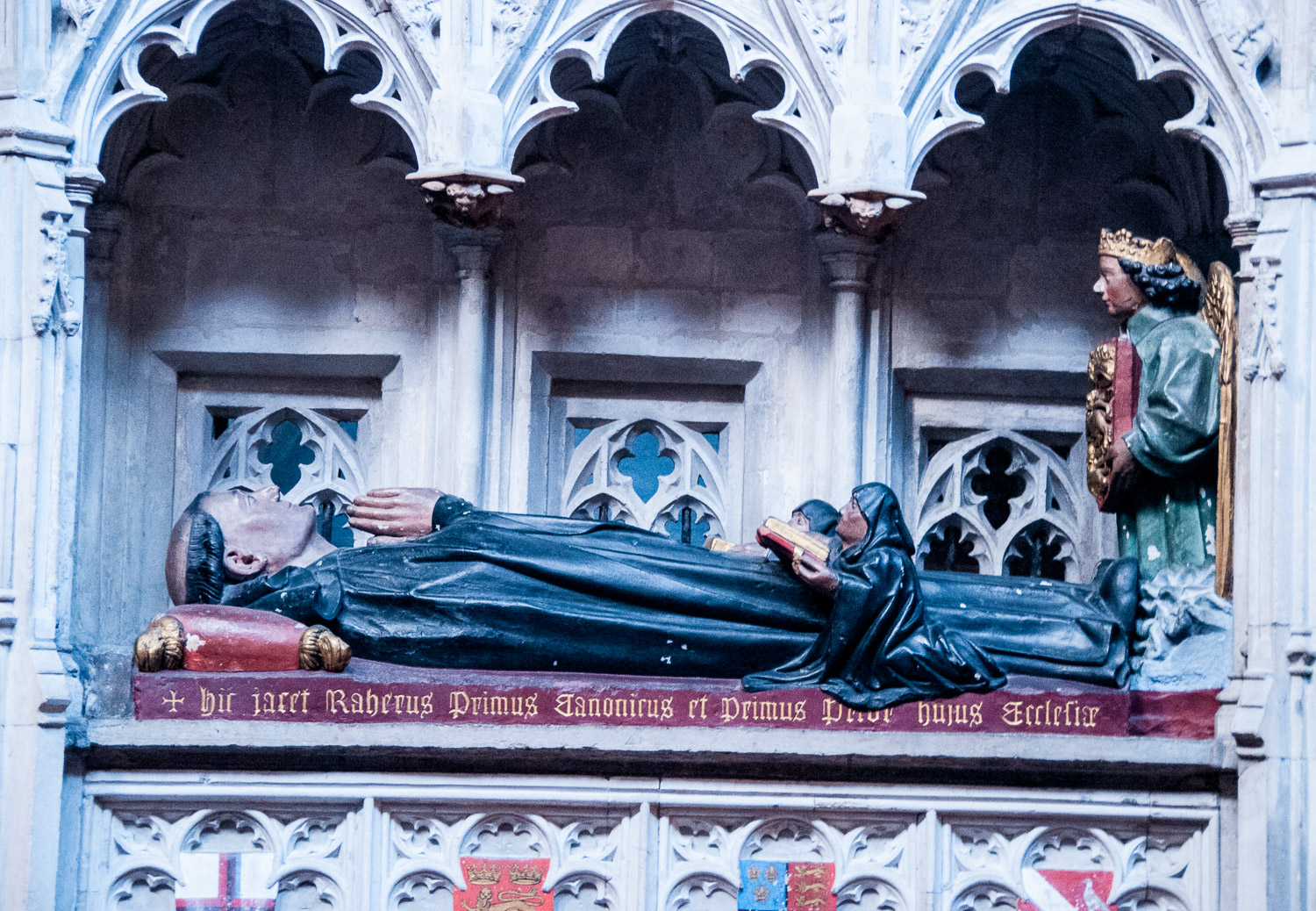
The hospital was founded, along with the Priory of St Bartholomew, in 1123 by Rahere, formerly a courtier of Henry I, and if you pop into the church of St Bartholomew the Great you can see his tomb …

Rahere died in 1143 and his tomb dates from 1405.

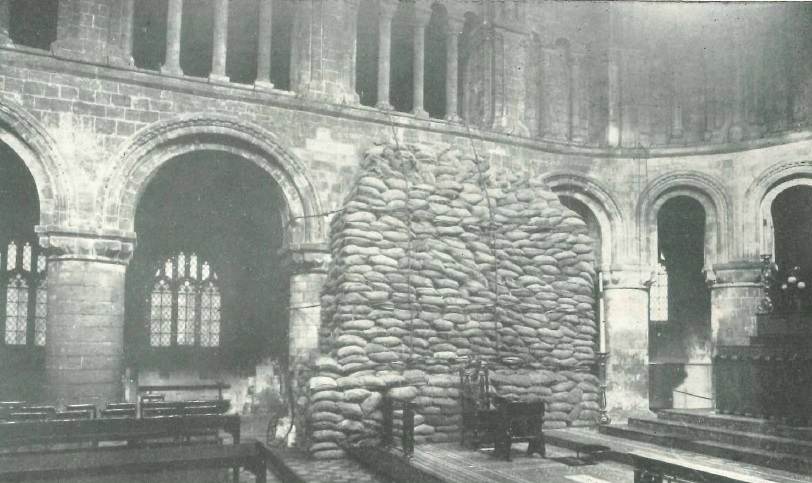
I found this great picture of how the tomb was protected from bomb damage during the First World War …

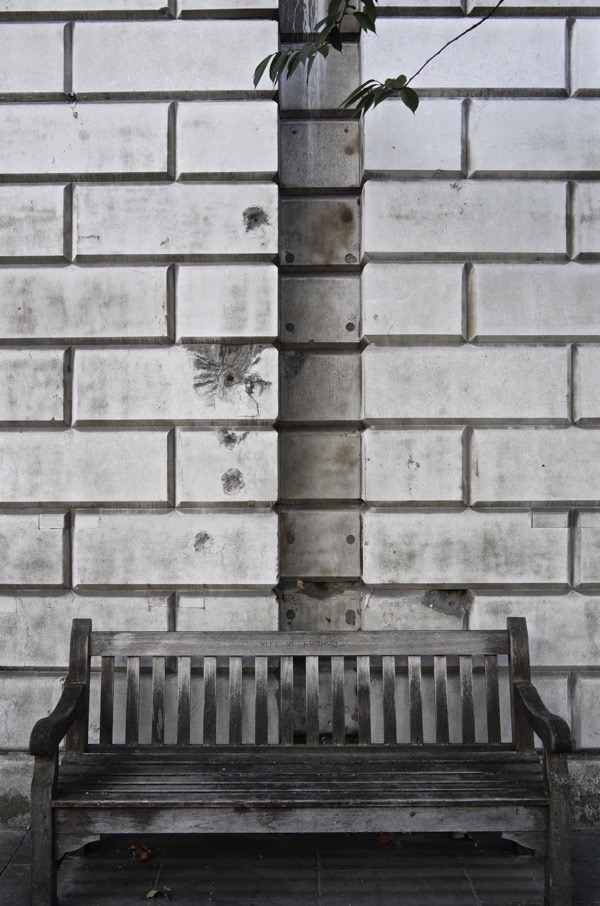
There were several near misses from bombs dropped by Zeppelin airships and you can still see shrapnel marks on the hospital’s walls …

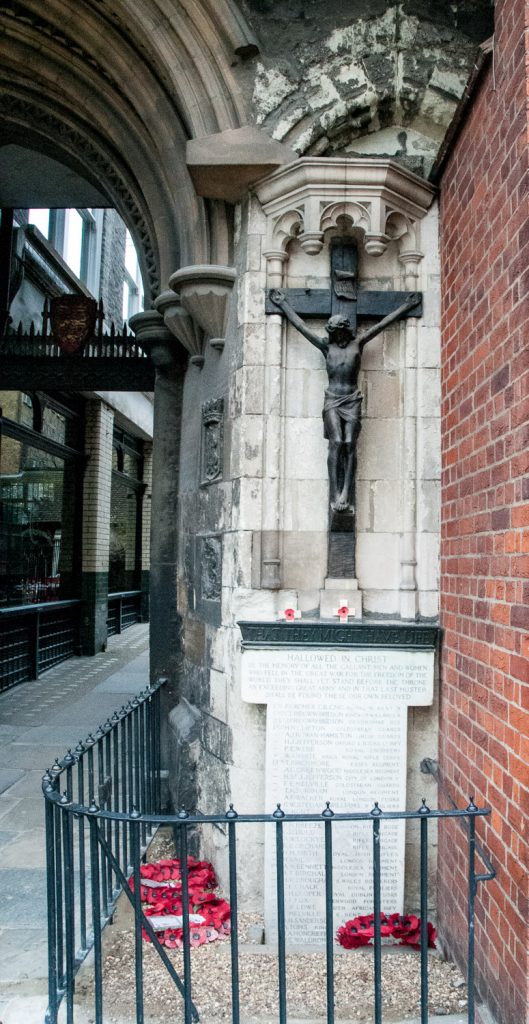
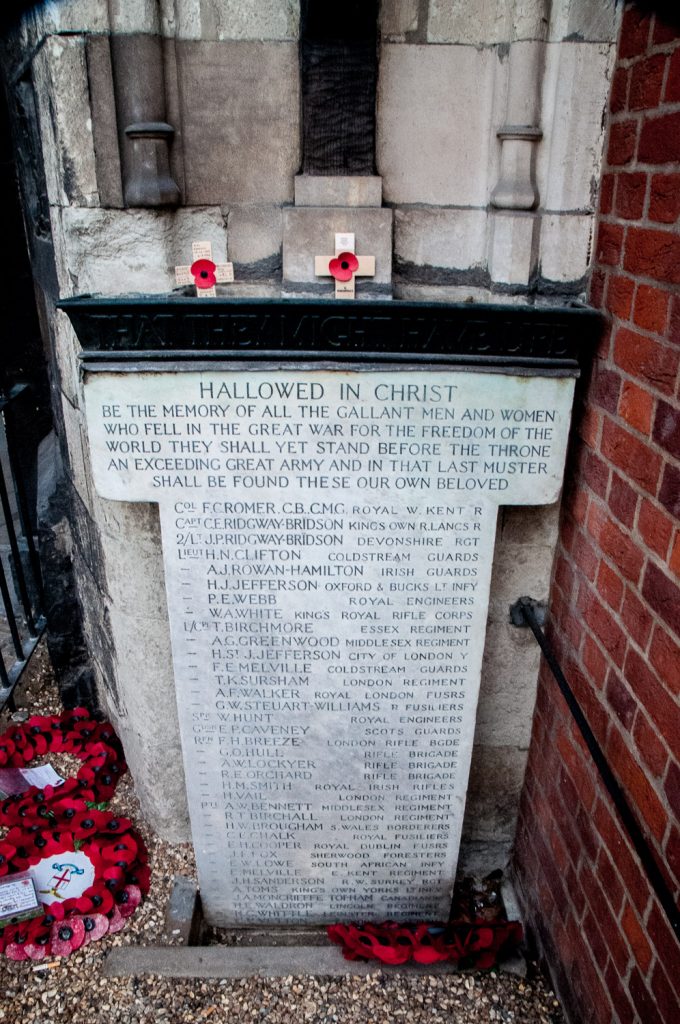
As you leave the hospital, pause for a few moments at the little War Memorial commemorating those who lost their lives in the ‘Great War’ . I took these pictures just after the Armistice Day ceremony …

This image has an empty alt attribute; its file name is DSC_7224-529x1024.jpg
This image has an empty alt attribute; its file name is DSC_7225-680x1024.jpg

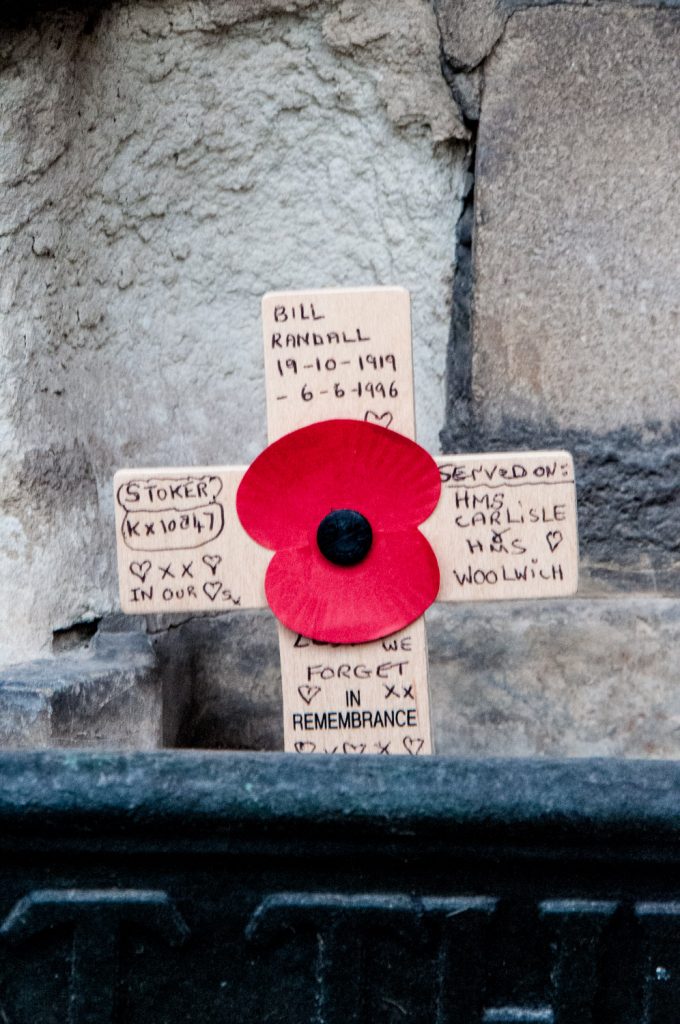
This touching message commemorates a Second World War sailor …

If you want to know more about the Smithfield burnings here is a link to one of my sources and a book entitled The Burning Time – The Story of the Smithfield Martyrs.

I have discovered a lot more to write about relating to Smithfield and will return there in a future blog.

If you would like to follow me on Instagram here is the link …

https://www.instagram.com/london_city_gent/

Rescued! Church artifacts saved from destruction (and a fascinating story of resurrection)

On the night of December 30th 1940, when Christchurch Newgate Street was a blazing inferno, an unknown postman rushed into the building, grabbed this font cover and carried it to safety …
Made of oak, it was created about 1690 and is typical of many such covers made for City churches after the Great Fire of 1666. You can admire its beautiful craftmanship if you visit St Sepulchre-without-Newgate where it rests on a new font, the original having been destroyed in the bombing (EC1A 2DQ).

Another survivor of the Blitz can be found in St Botolph Without Aldgate (EC3N 1AB). This intricately carved wooden panel depicts King David along with musical instruments …
It was created between 1713 and 1715 to grace the front of an organ gallery in the church of St Mary Matfelon, Whitechapel. When the church was destroyed by bombing on the 27th December 1940 the carving was saved and later restored …

St Giles Cripplegate was severely damaged during the Second World War and there was a direct hit on the north door in the summer of 1940. The following December the church was showered with so many incendiary bombs that even the cement caught alight. You can still see scorch marks …

All that remained was the shell, the arcade in the chancel, the outside walls and the tower and that these survived says much for the medieval architects. It wasn’t just bombing that resulted in church furniture being moved. When nearby St Luke’s was closed due to subsidence in 1959 St Giles was a beneficiary, acquiring the closed church’s pews …

Altar …

And a lovely 18th century font …

A tablet recording the Rectors of St Luke’s since 1733 also made the move …

St Swithun London Stone was also damaged in bombing but unfortunately was beyond repair and eventually demolished. It’s pulpit fortunately survived and is now used at All Hallows by the Tower …

It dates from around 1670 and is carved in the style of Grinling Gibbons. Above it is the tester, or sounding board, designed to represent three pilgrim shells associated with the pilgrimage of St James Compostella in Spain.

However, the greatest cause of church destruction after the Great Fire was not the Blitz but The Union of Benefices Act of 1860. In order to reflect the dramatic drop in the City’s population, it allowed the London diocese to sell churches and built new ones in the suburbs with the proceeds. This accounted for the loss of some 22 churches and the last of these – All Hallows Lombard Street – was demolished as late as 1938, despite the contemporary reverence for Wren.

I have been tracking where some of these churches’ belongings ended up.

The church of St Matthew Friday was demolished in 1888 but the Wren Pulpit found its way to St Andrew by the Wardrobe …

As did the font cover …

The baptismal font in St Margaret Lothbury, believed to be by Gibbons, came from St Olave, Old Jewry, after that church was partially demolished in 1887 except for the tower and west wall, which remain today. The font is a carved bowl with cherub heads at each corner and the four sides are decorated with Adam and Eve, the dove returning to the ark, the baptism of Jesus and the baptism of the Ethiopian eunuch by Philip …

One of my favourite churches, St Vedast-alias-Foster, has been particularly fortunate in its acquisitions (EC2V 6HH).

The Gibbons font cover came from St Anne and St Agnes after that church was damaged by bombing …

The exquisite 17th-century wineglass pulpit was made for All Hallows, Bread Street (demolished 1878). It’s also by Gibbons …

Legend has it that incorporating a peapod was one way that Gibbons ‘signed’ his work. If the peapod was open he had been paid – if it was closed he had not. If this is true, he was properly remunerated for his work on this pulpit …

The reredos came from St Christopher-le-Stocks (demolished in 1781 to make way for an extension to the Bank of England) …

And finally, a tale of resurrection.

St Mary the Virgin, Aldermanbury, was severely damaged and gutted in the Blitz …

After the war, however, it had the unique distinction of being taken apart, shipped to Fulton, Missouri in the USA in 1965, and rebuilt to mark the visit of Churchill to Westminster College in 1946. The church now sits above the National Churchill Museum. Westminster College was the location of Churchill’s speech that included the famous phrase ‘An iron curtain has descended across the continent’.

Here’s how it looks today …

You can read more about the church and the Museum here.

The old site of the church in Aldermanbury is now a garden …

Remember you can follow me on Instagram :

https://www.instagram.com/london_city_gent/

Page 10 of 16

Powered by WordPress & Theme by Anders Norén

Symbols & Secrets
Privacy Overview

This website uses cookies so that we can provide you with the best user experience possible. Cookie information is stored in your browser and performs functions such as recognising you when you return to our website and helping our team to understand which sections of the website you find most interesting and useful.