Walking the City of London

Category: Stained Glass Page 4 of 9

Non-religious stained glass.

I love looking at stained glass and not all of it in the City is religion-oriented even though it may be located in churches.

So here’s my selection. Some have appeared in previous blogs but I hope you enjoy seeing them again.

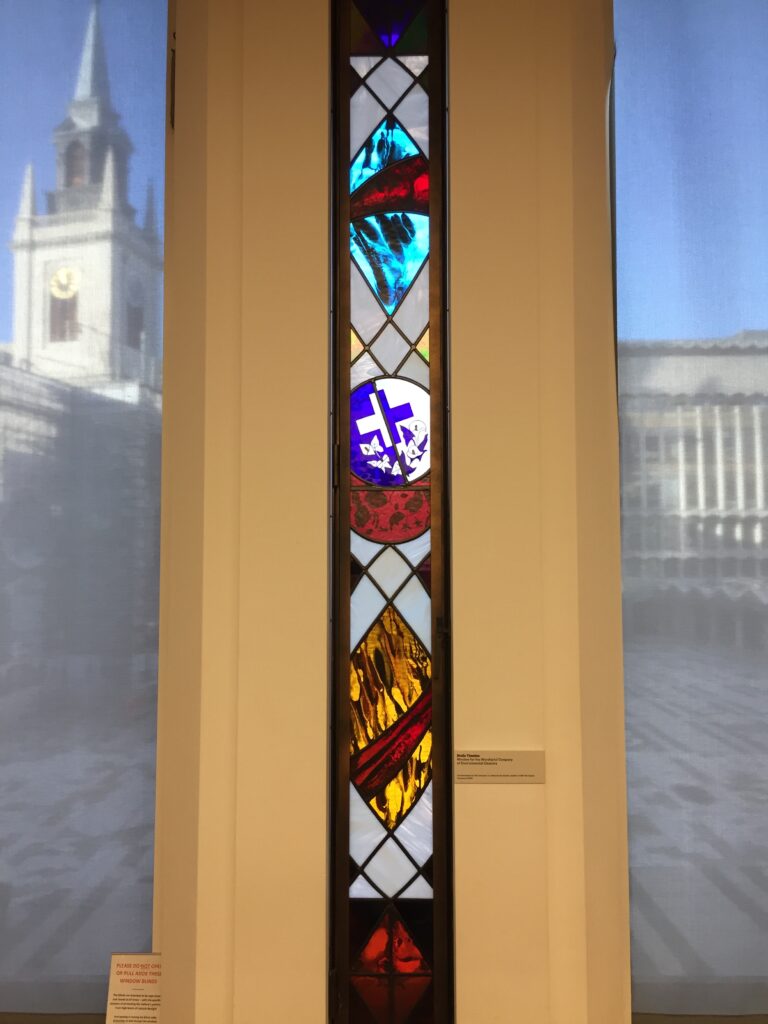
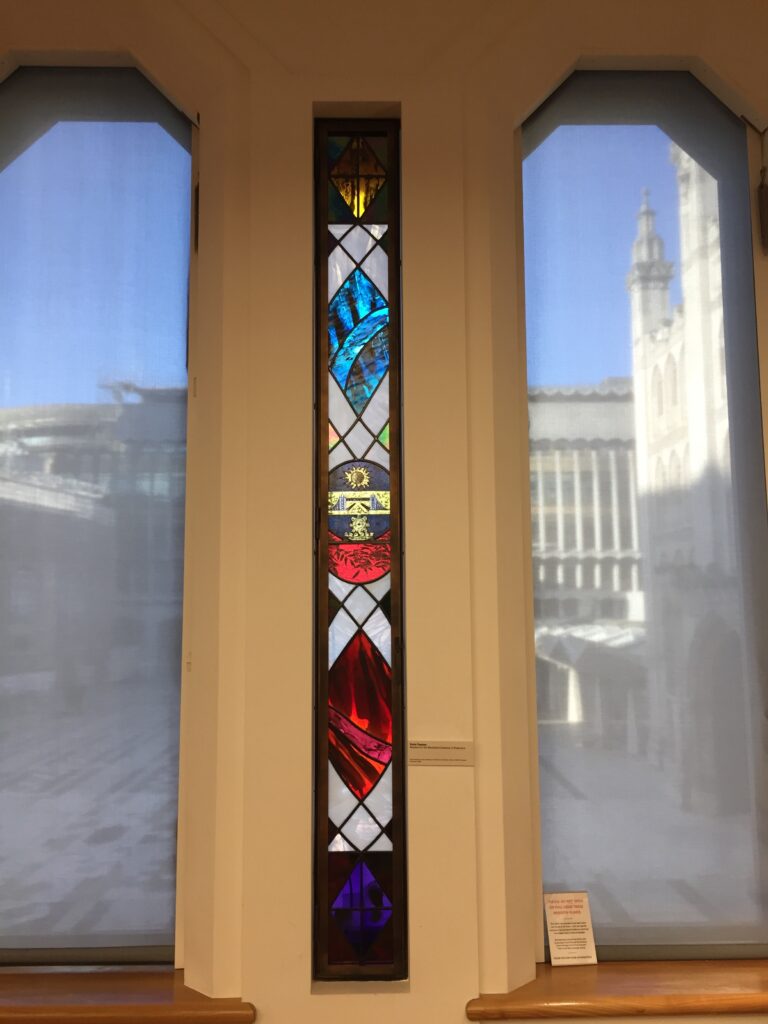
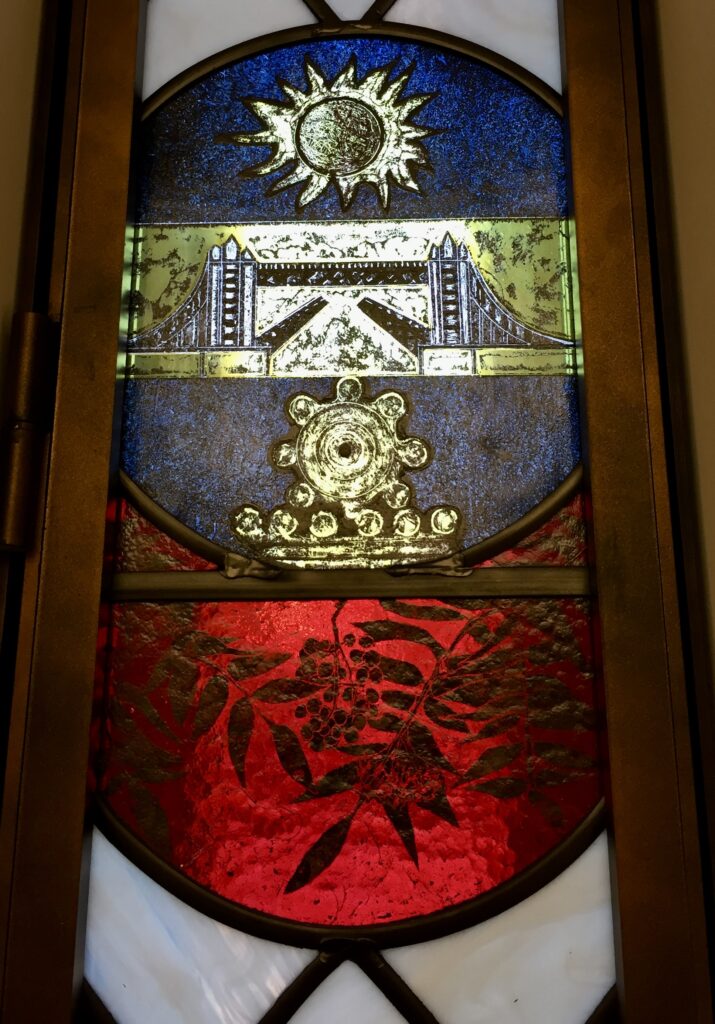
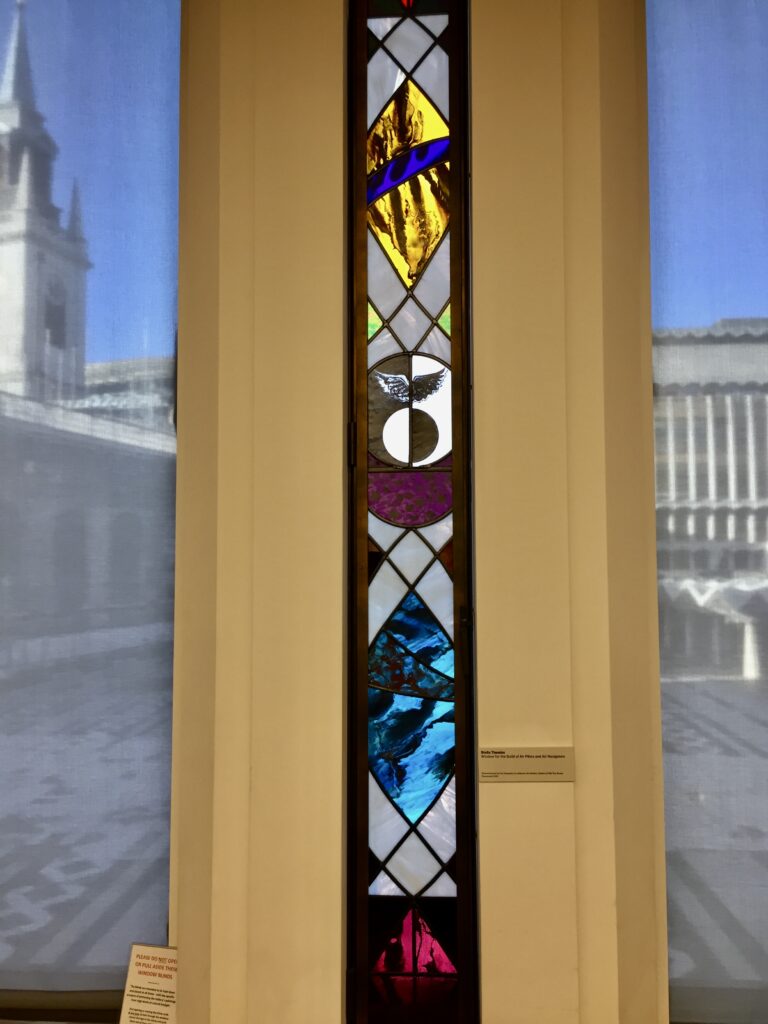
I’ll start with one of my favourite places, the Guildhall Art Gallery, where these examples appear at the west end. They all relate to City Livery Companies and were created by Stella Timmins to celebrate the Queen’s Golden Jubilee.

The Worshipful Company of Engineers …

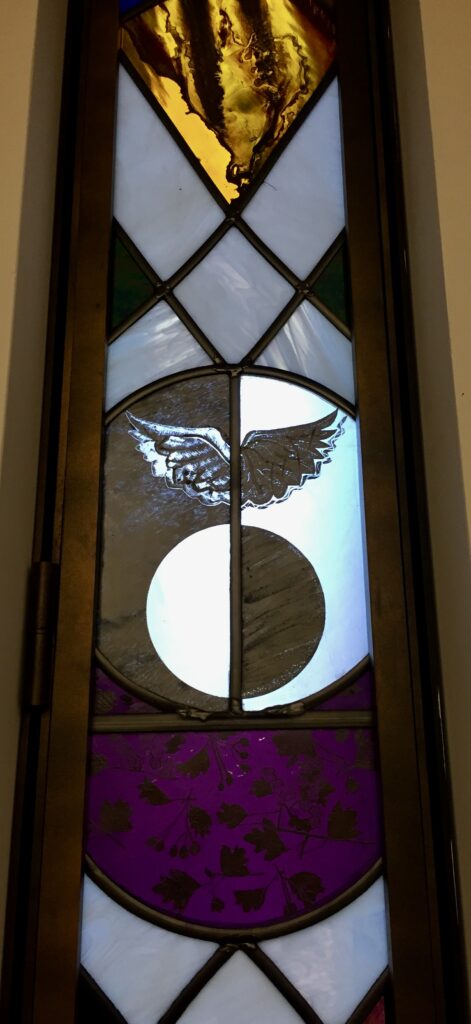
The Guild of Air Pilots and Air Navigators …

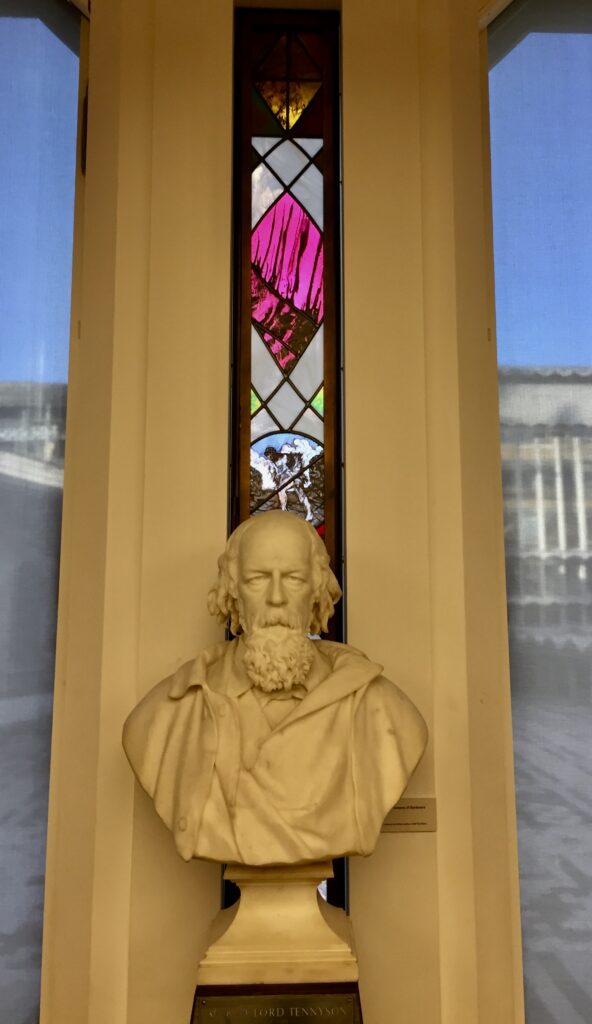
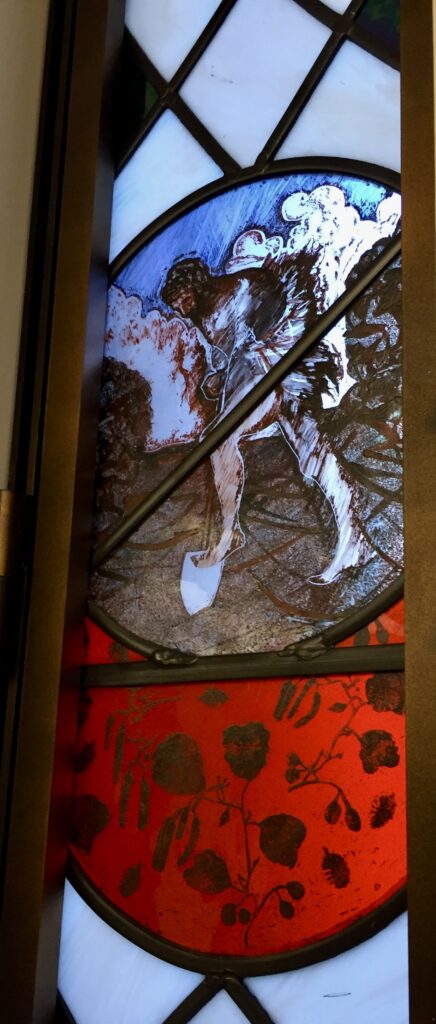
The Worshipful Company of Gardeners (with Alfred, Lord Tennyson!) …

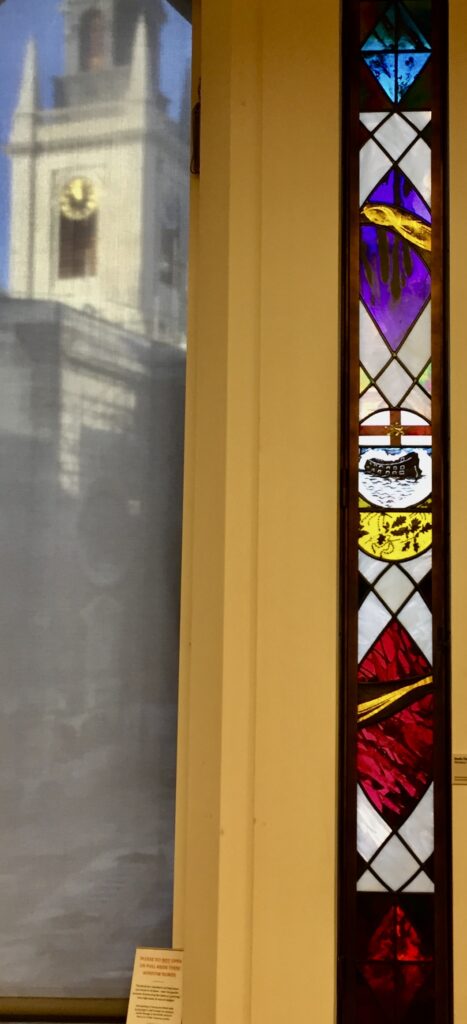
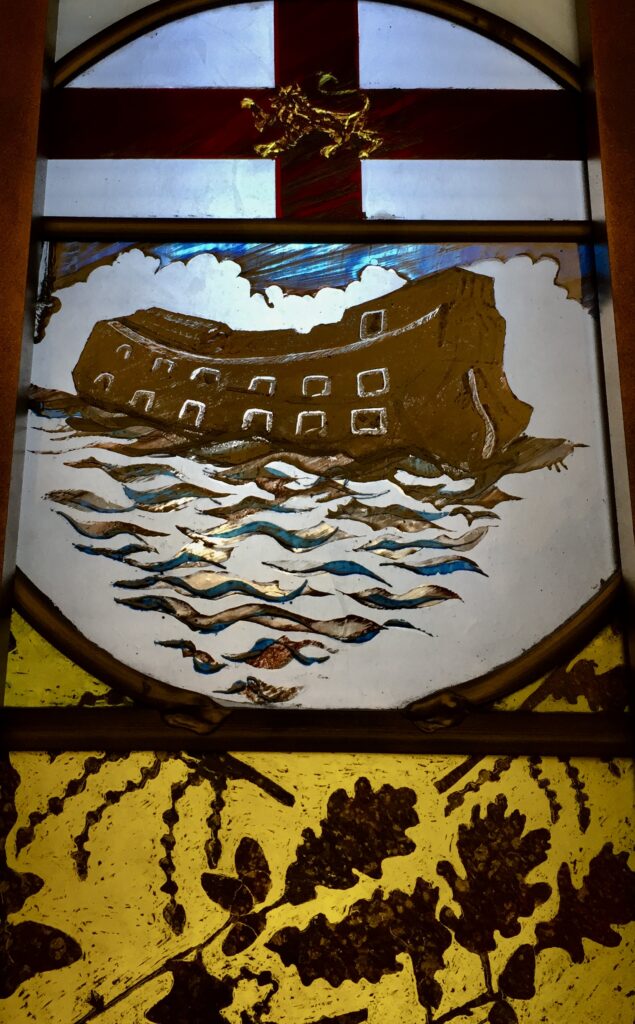
The Worshipful Company of Shipwrights …

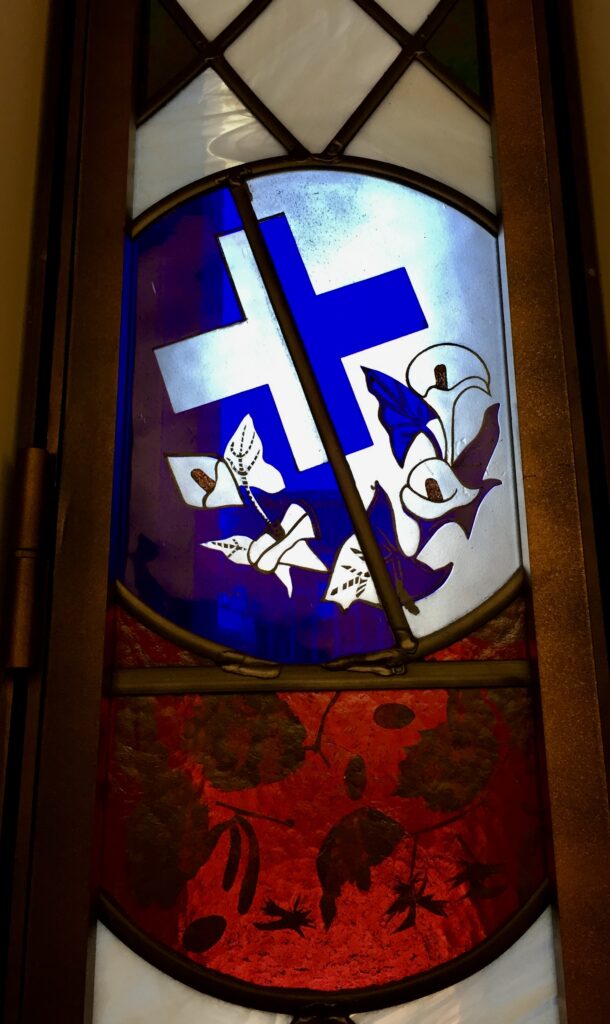
The Worshipful Copany of Environmental Cleaners …

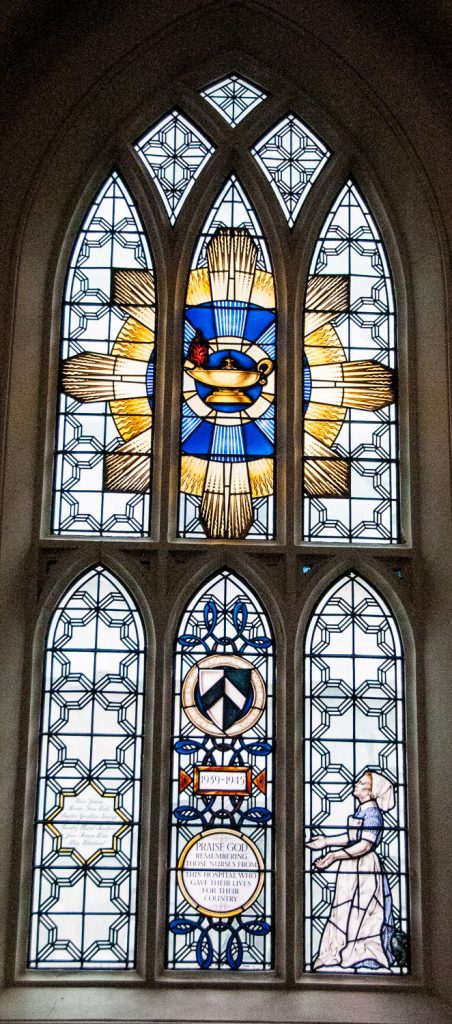
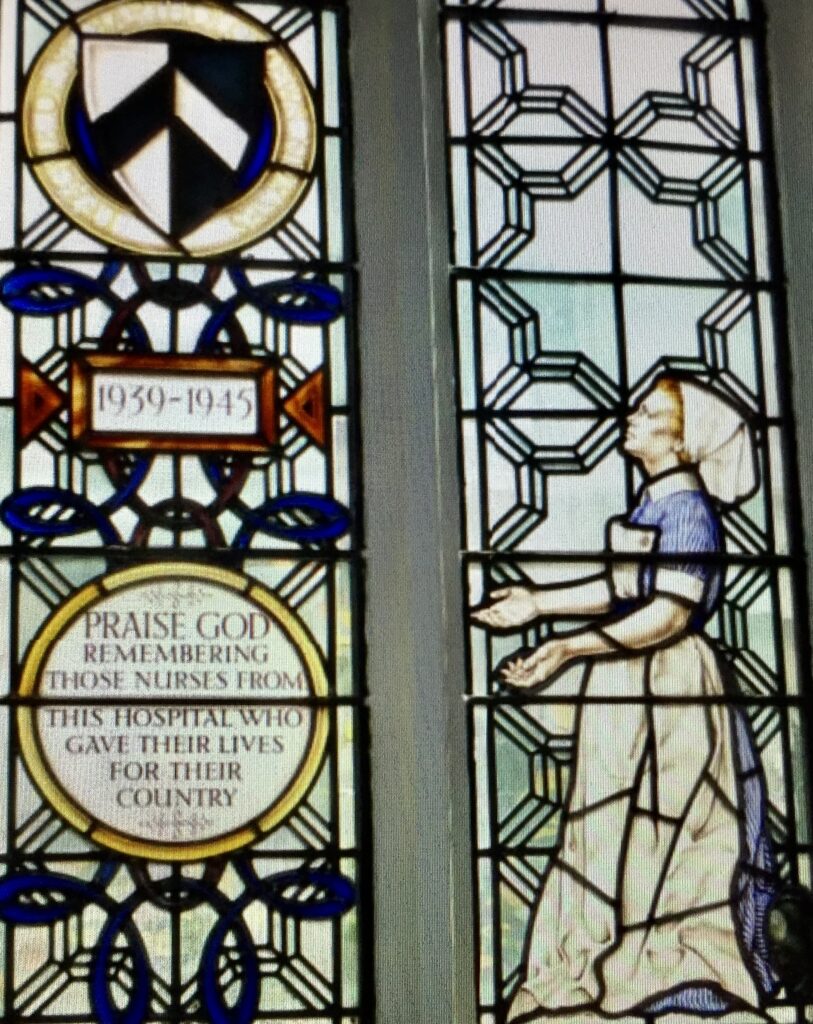
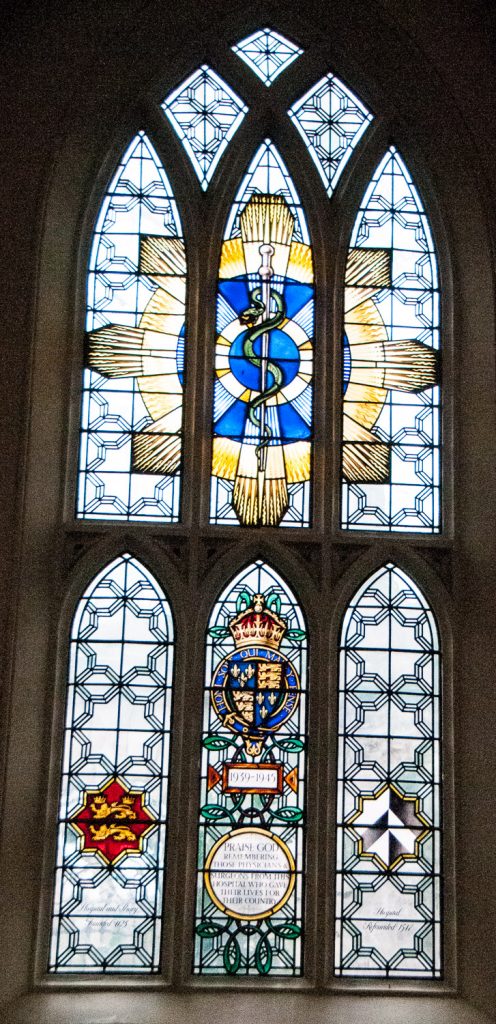
Doctors and nurses who gave their lives in wartime are commemorated in two lovely windows in the church of St Bartholomew the Less.

They were designed by Hugh Easton, following the loss of the earlier windows during World War Two. Easton was an eminent stained glass maker who also designed the Battle of Britain memorial window in Westminster Abbey. The design of the nurse in the window in Westminster Abbey is strikingly similar to that in the window here …

The doctors’ window …

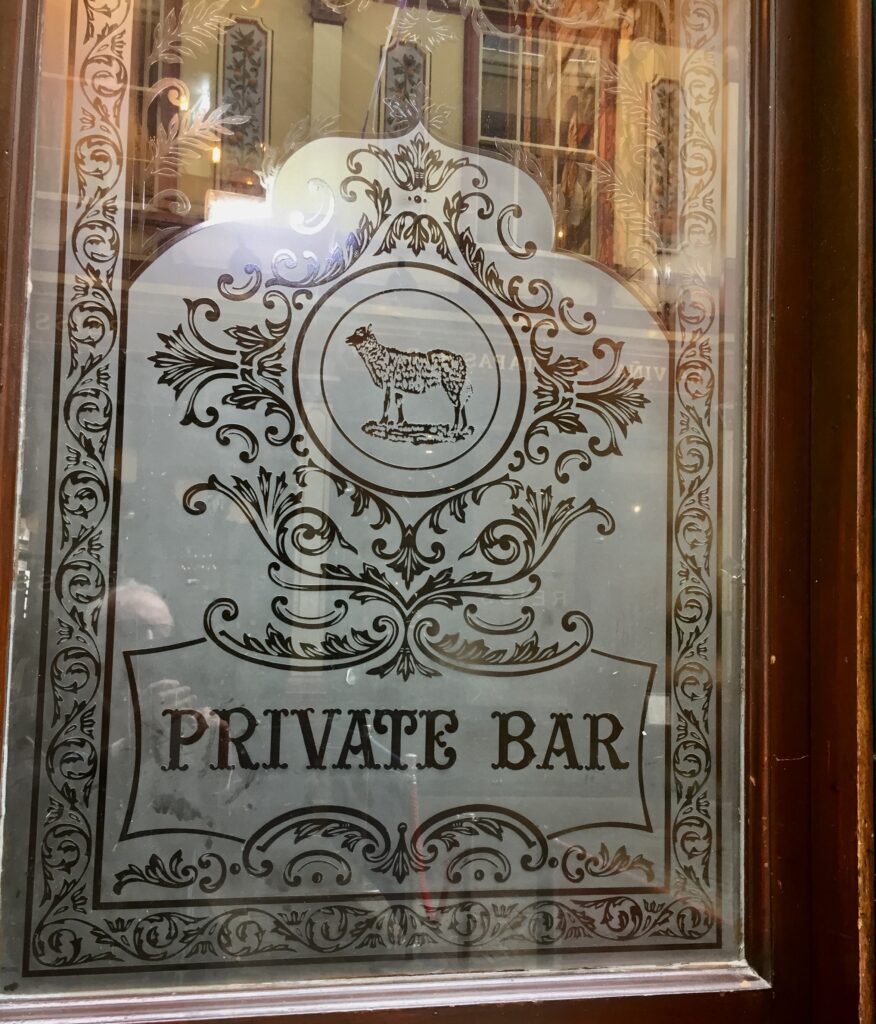
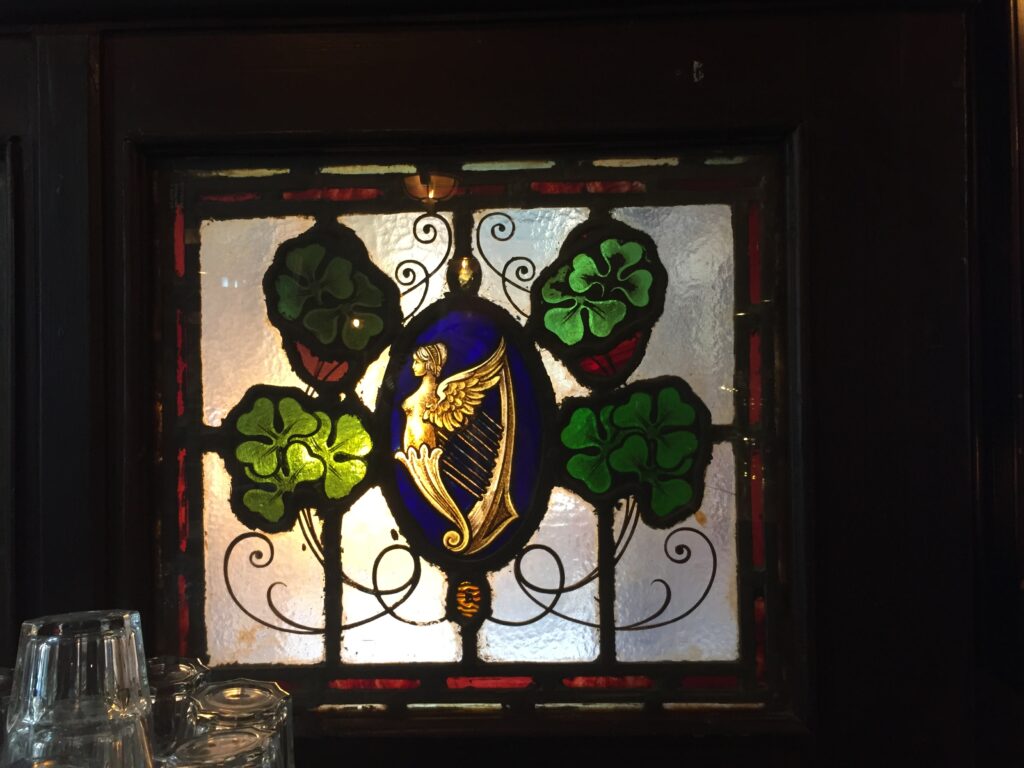
Traditional pub glass in the Lamb Tavern Leadenhall Market

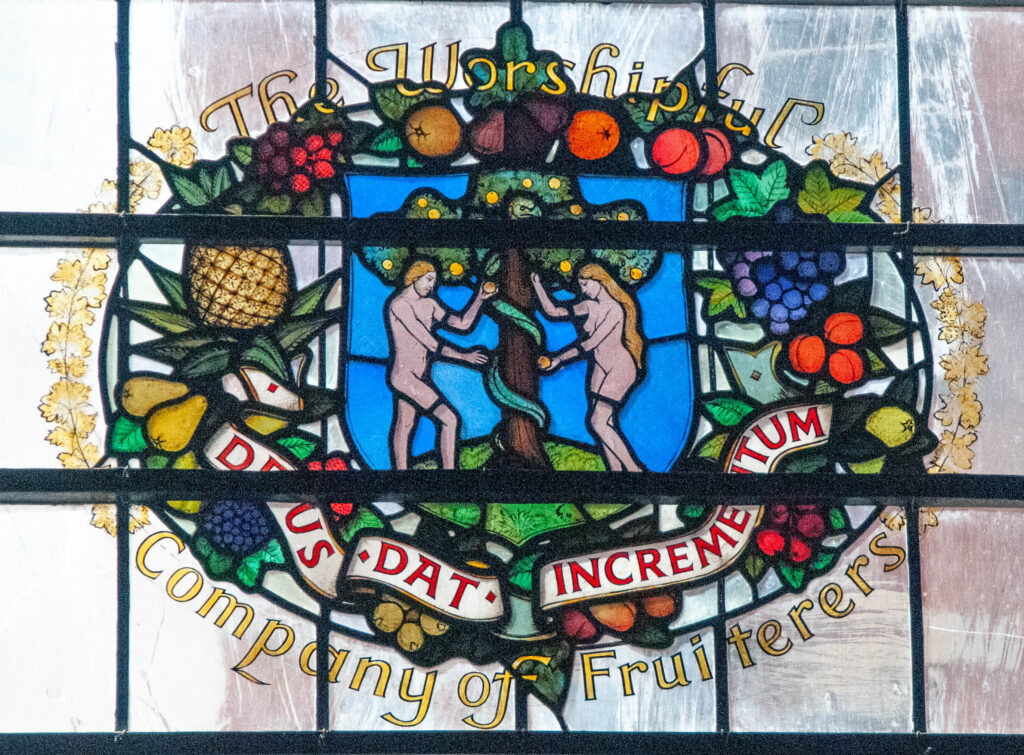
St Mary Abchurch’s connection with the Fruiterers Company is commemorated by this charming stained glass window …

The Worshipful Company of Glovers of London – True hearts and warm hands at St Margaret Lothbury

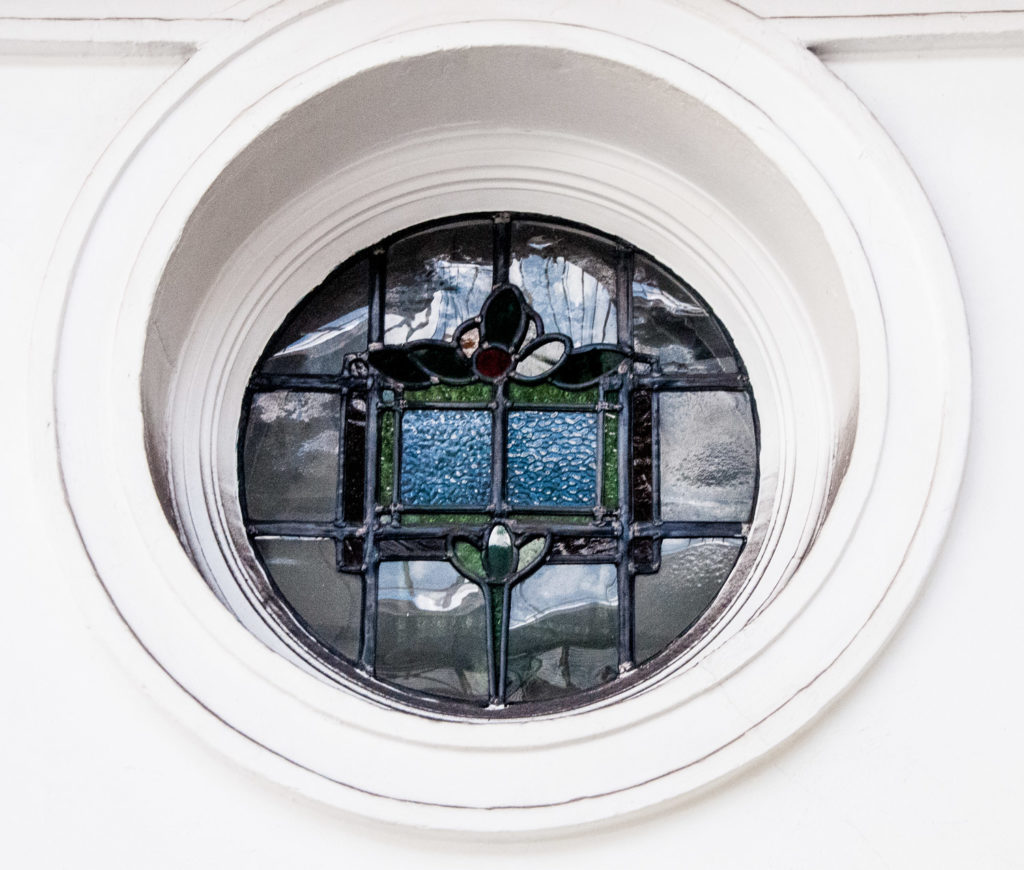
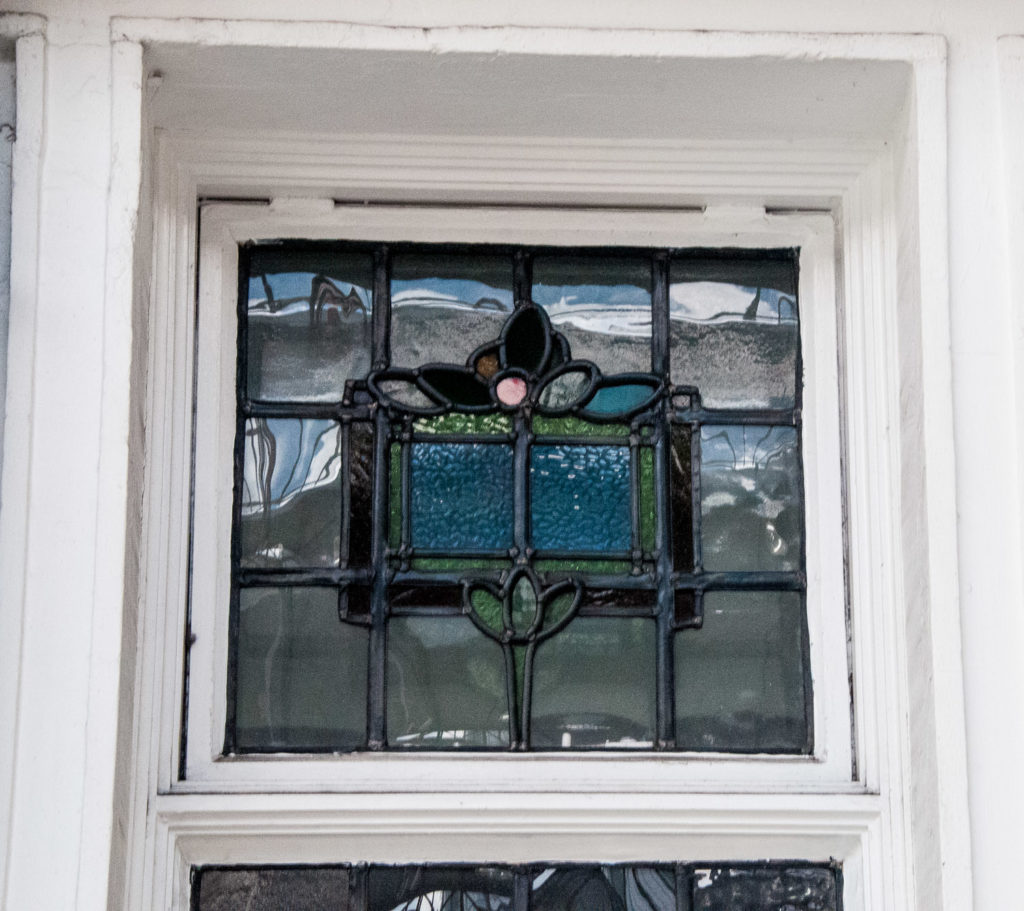
Stained glass windows which date from 1923 at Farringdon Station …

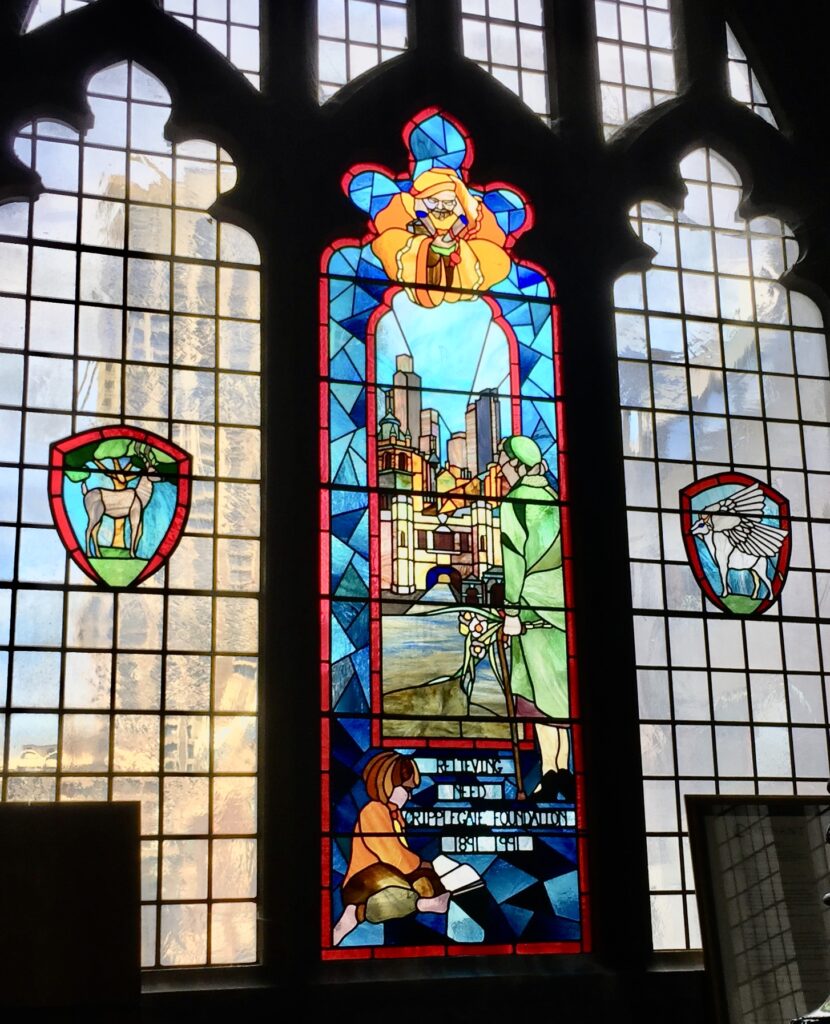
At St Giles Cripplegate there are a number of modern stained glass windows. In the baptistery is the Cripplegate Window, which celebrates the centenary of the Cripplegate Foundation www.cripplegate.org which gives grants, advice and support to local organisations. The Foundation was formally established in 1891 but its origins lie in gifts made to St Giles’ for the poor and the needy dating back centuries. John Sworder made the first recorded gift in his will, dated 2 April 1500, and the head at the top of the window represents him, the first of the pious donors of the parish that we know by name …

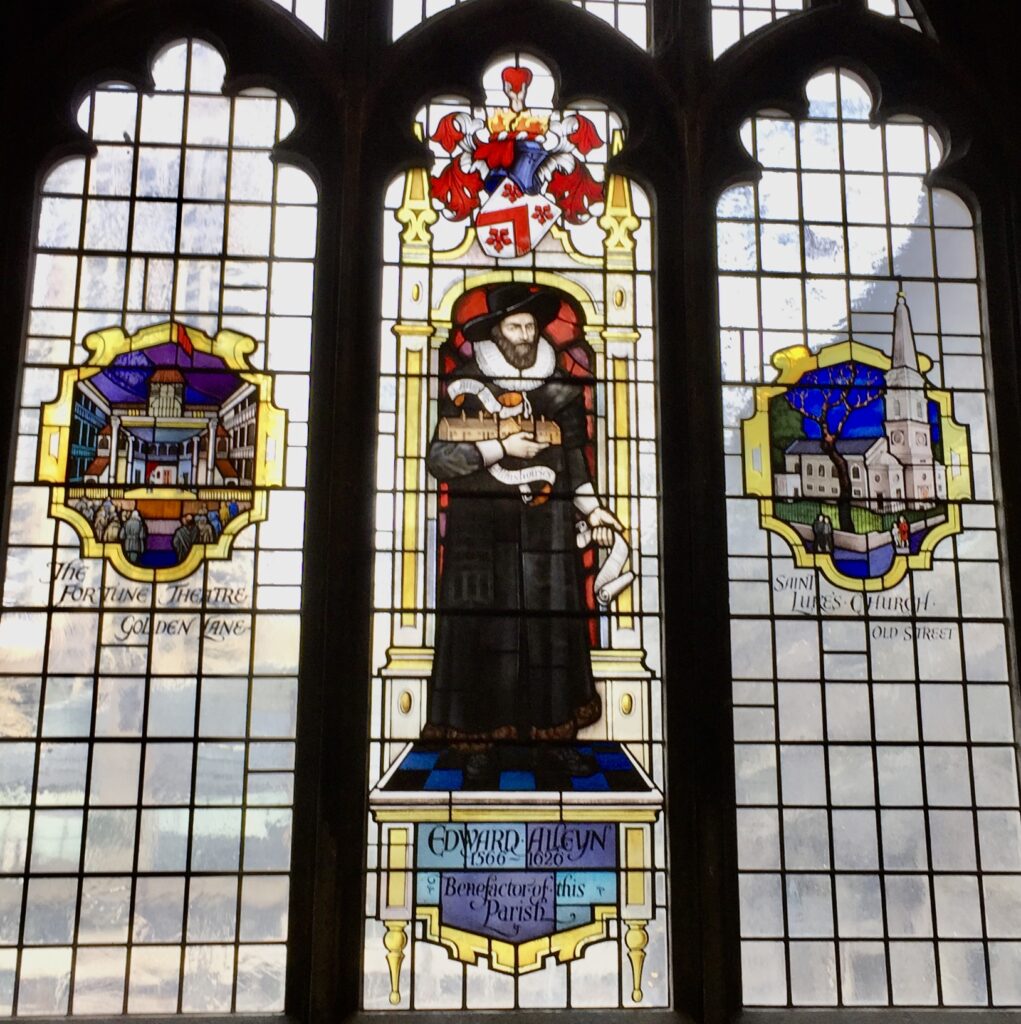
On the north wall is a memorial window to Edward Alleyn, the parish’s generous benefactor. The design is the work of John Lawson of stained glass studio Goddard & Gibbs and depicts Alleyn in the centre, as well as the Fortune Theatre (which he founded), almshouses (which he built in the parish and which were destroyed in the Second World War), and St Luke’s Church, Old Street …

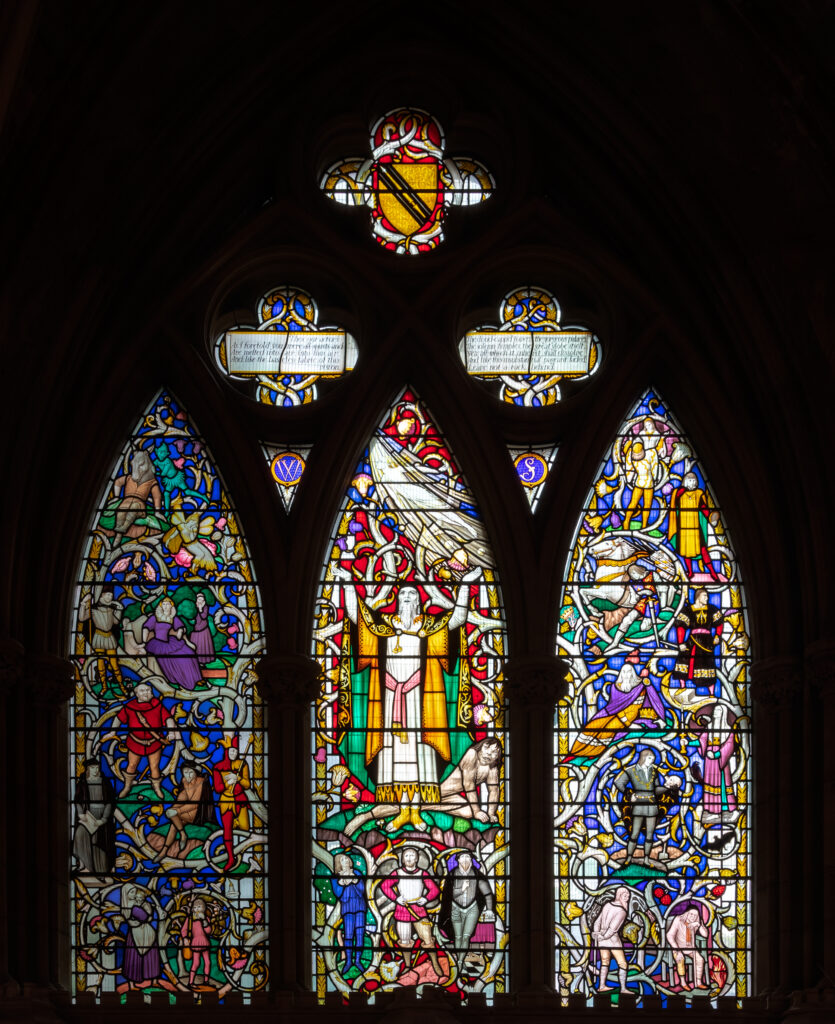
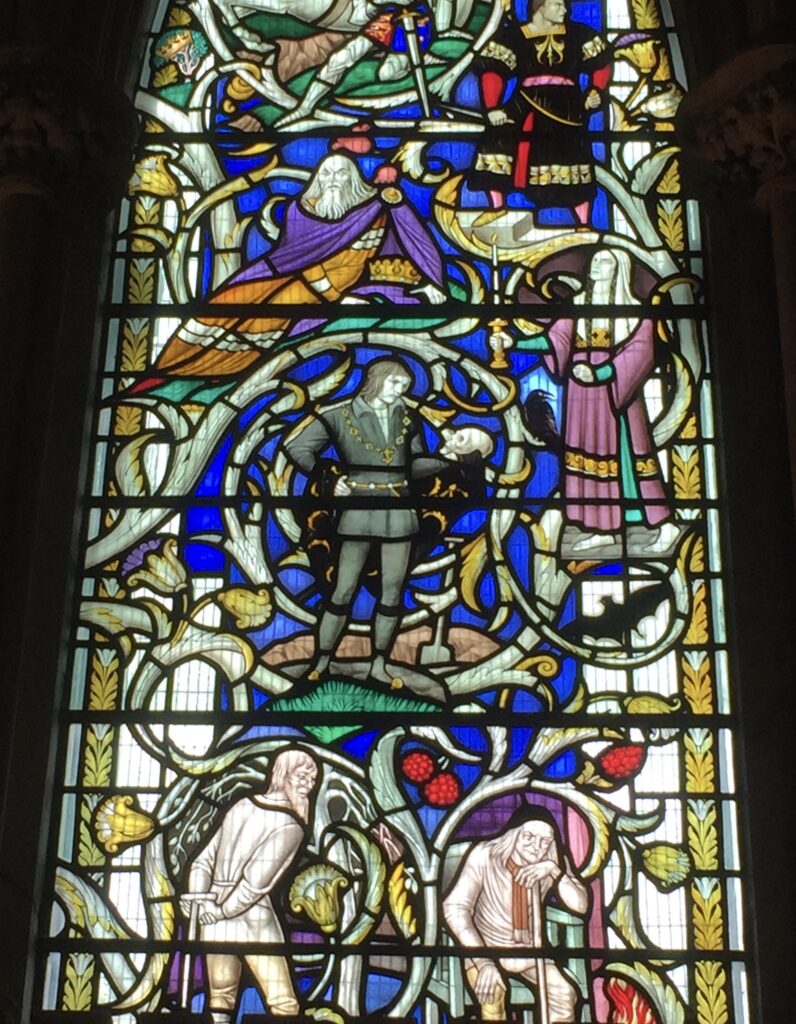
At Southwark Cathedral, a few feet from the door, is the magnificent Shakespeare Memorial Window, Designed by Christopher Webb, it was created in 1954 to replace another destroyed in enemy action. It shows characters from the Bard’s plays …

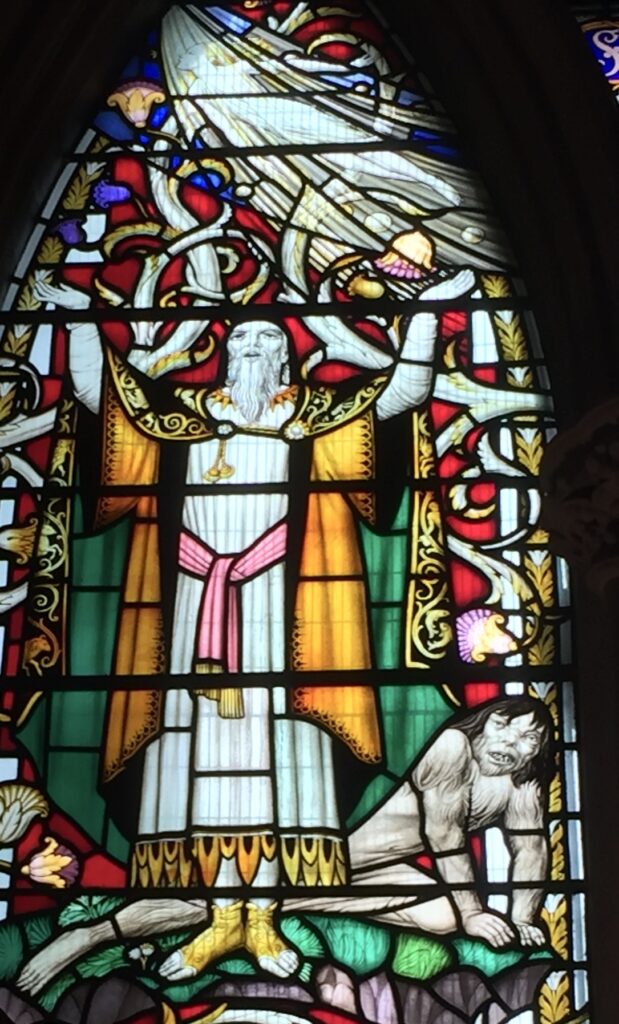
The design uses the concept of the Jesse Tree. Prospero in the central light forms the trunk, with Ariel above and Caliban at his feet …

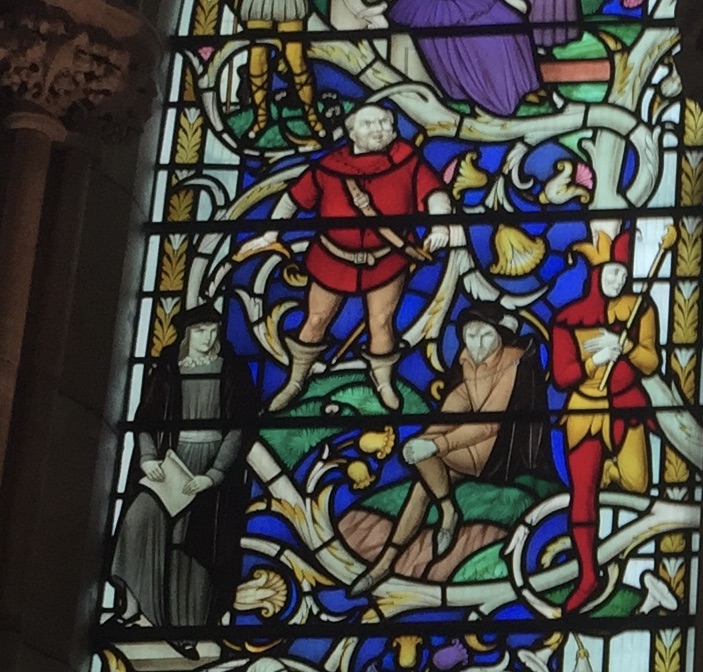
I’m sure you can spot Falstaff …

In the right hand window we find Lady Macbeth ,,,

Is this a dagger which I see before me, the handle toward my hand? Come, let me clutch thee …

and Hamlet …

Alas, poor Yorick! I knew him, Horatio: a fellow of infinite jest, of most excellent fancy …

At the base, the last two of the Seven Ages of Man … …

The sixth age slips into the lean and slippered pantaloon, with spectacles on nose … and his big manly voice turning again toward childish treble … Last scene of all, is second childishness … sans teeth, sans eyes sans everything.

All the characters portrayed in the window are identified in this short article.

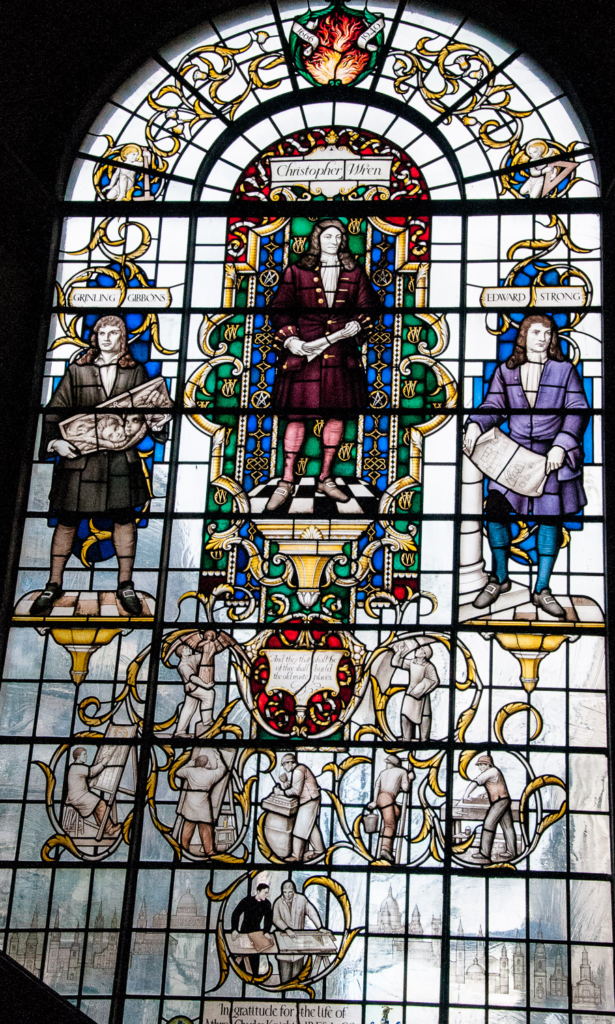
Since this year is the 300th anniversary of Sir Christopher Wren’s death, I think it’s very appropriate to reproduce this image of the beautiful ‘Wren window’ in St Lawrence Jewry. It was created in 1957 by Christopher Webb

The great man is flanked by the Master Carver Grinling Gibbons and the Master Mason Edward Strong. Below the three major figures the window shows various craftsmen at work – bricklayers, carpenters, plasterers, stonemasons and two of Webb’s own stained glass artists.

And below them are two more modern figures …

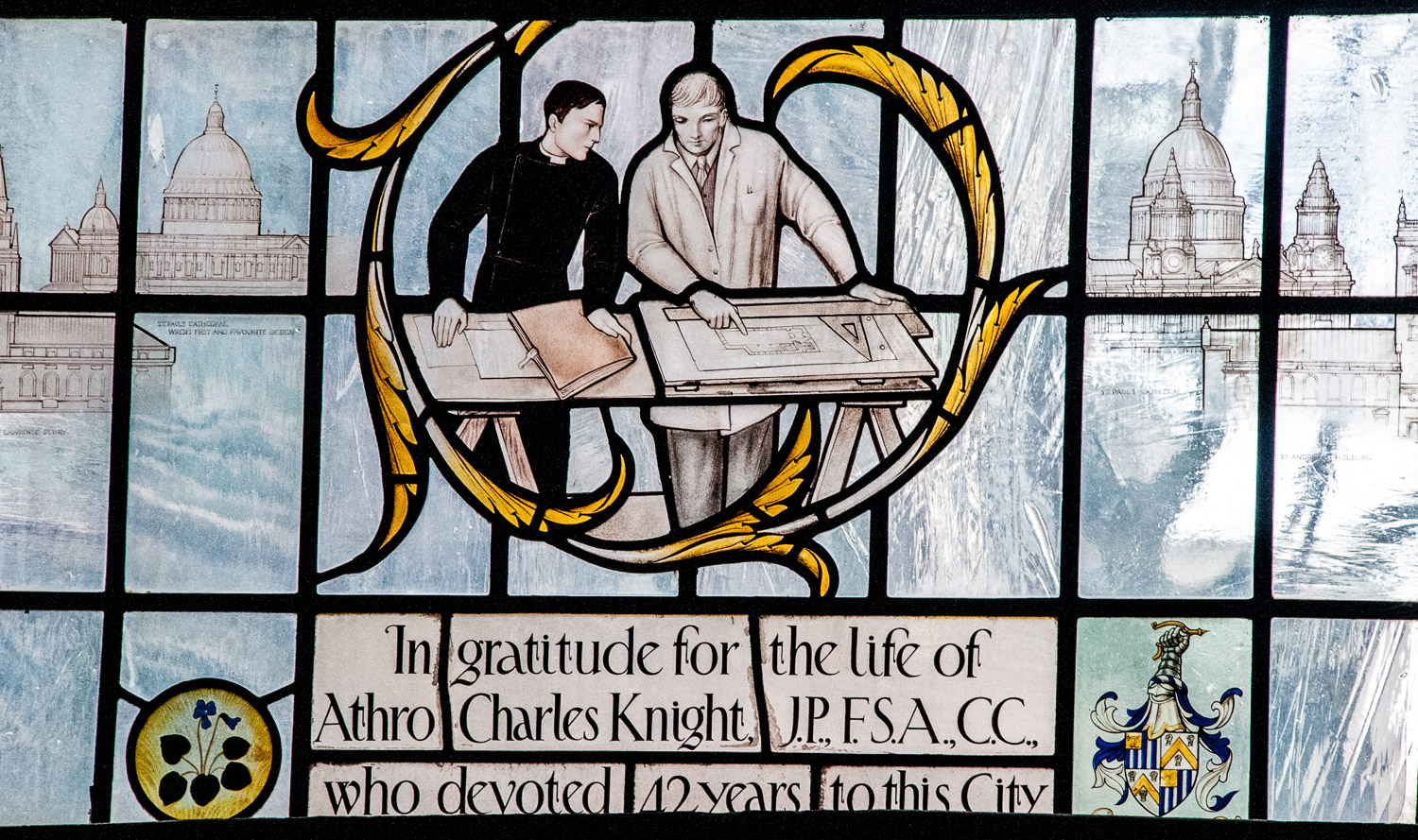
Cecil Brown and Reverend Frank Trimingham study the church plan, with the outline of the footprint of the church in front of them. On each side are the beautifully etched towers of many of the Churches Wren built, along with two different views of St Paul’s Cathedral.

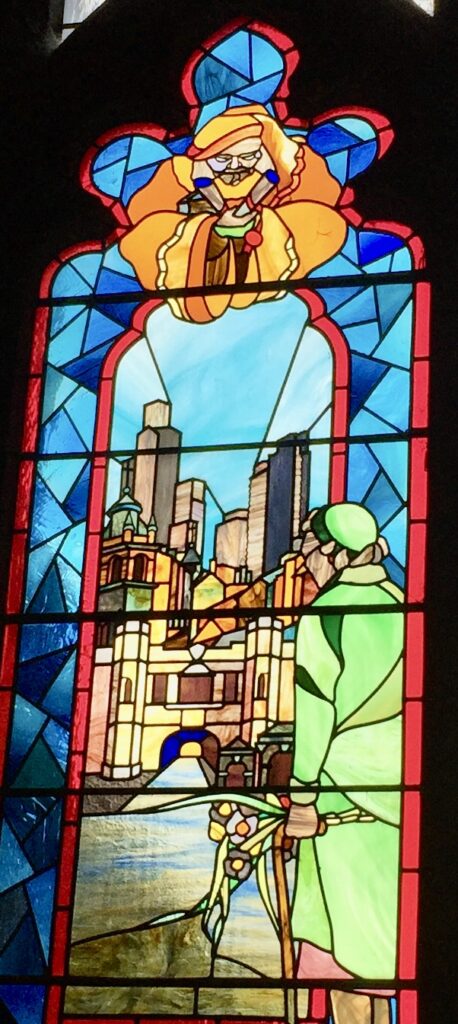
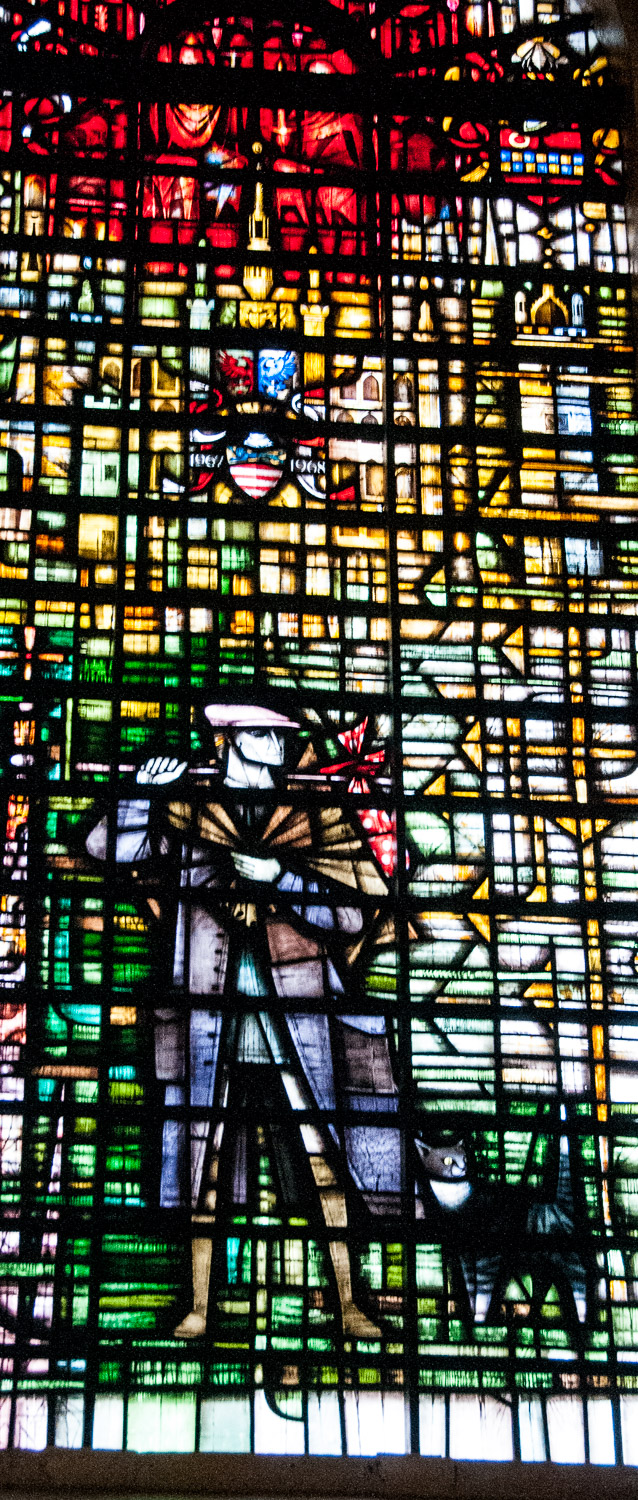
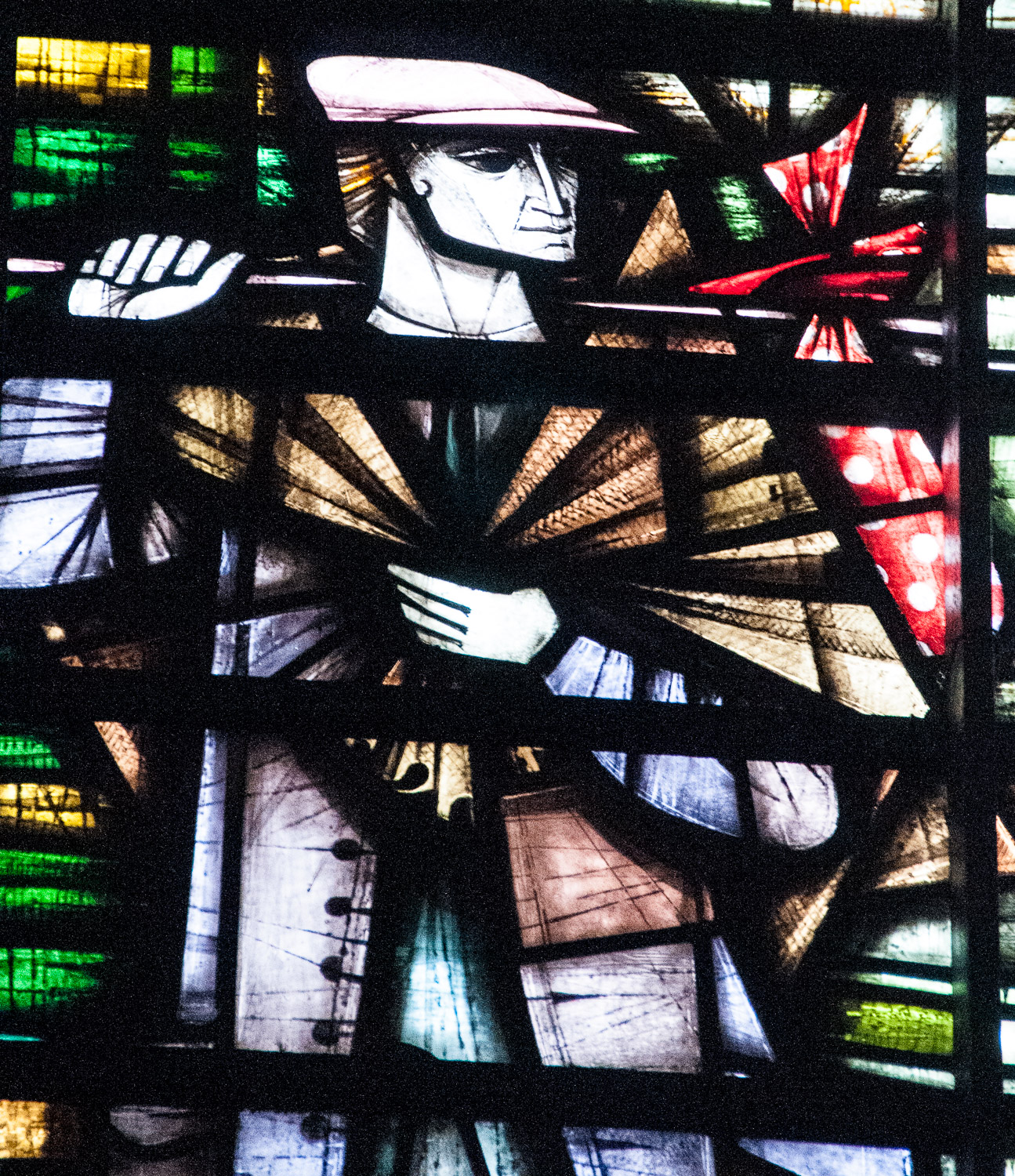
And finally an example of the stunning widows designed by the artist and glass maker John David Hayward in St Michael Paternoster Royal on College Hill EC4, where Dick Whittington was buried in 1423.

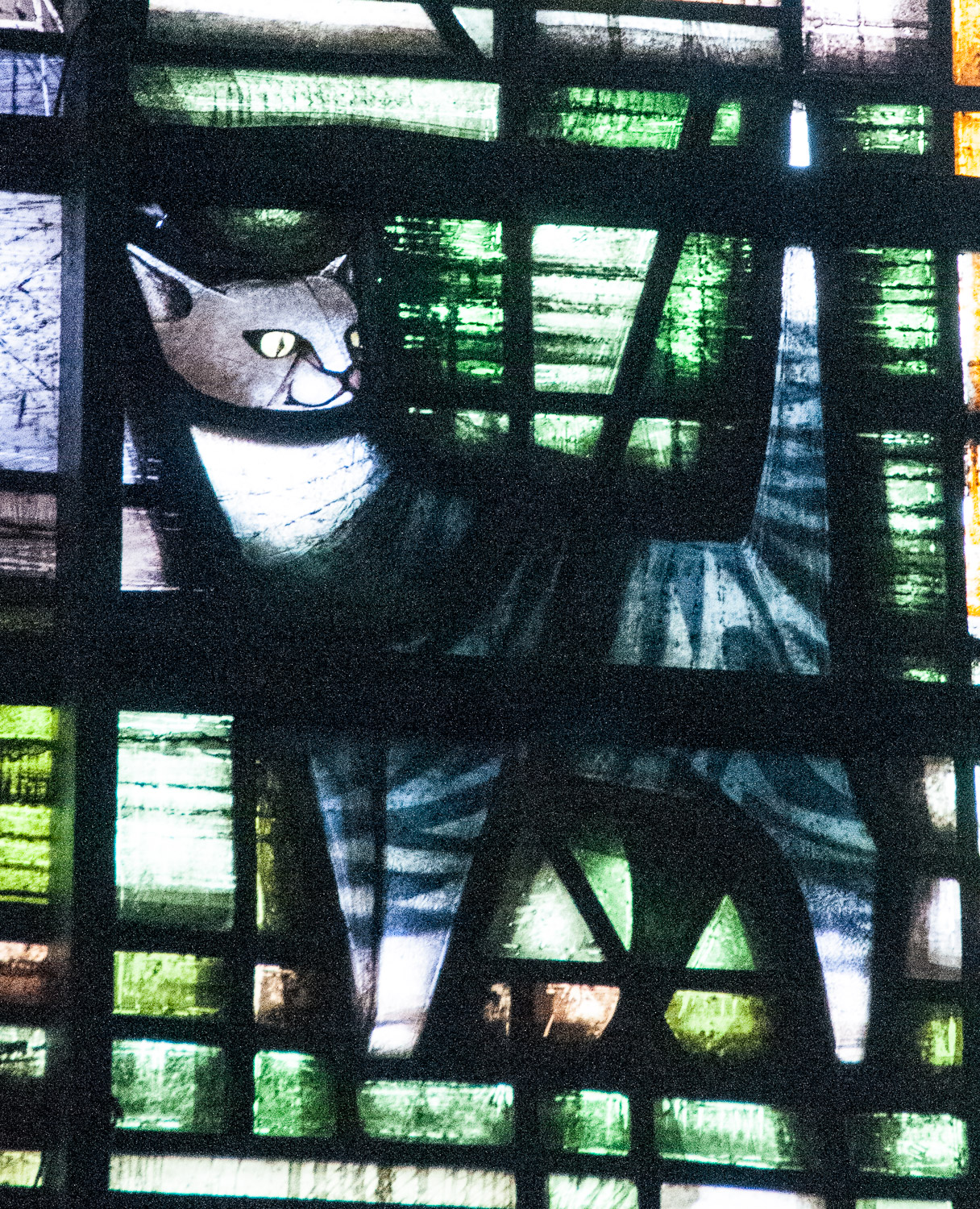
I’m sure everyone knows the Whittington legend. He had given up on making his fortune in London but, as he headed home with his faithful cat, he heard the bells of St Mary-le-Bow ring out the words:

Turn again Whittington, thrice Lord Mayor of London

Well, the bit about him being Lord Mayor is true, and it was four times rather than three, but two of the terms were consecutive.

Here Hayward shows that critical moment on Highgate Hill …

The church bells of St Mary-le-Bow ring out behind him.

One commentator has said he rather resembles a flat-capped Hoxton Hipster – maybe there is an iPad in that bag.

I love the expression on the cat’s face. Perhaps he has seen a mouse …

You can read more about the legend at the wonderful Purr ‘n’ Fur website.

If you would like to follow me on Instagram here is the link …
https://www.instagram.com/london_city_gent/

Random subjects I found interesting, from street animals to stained glass. And did Batman and Robin share a bed?

Having a camera on my phone is a great asset but also leads to me taking pics of all kinds of random subjects that don’t have a particular theme. The time then comes when I don’t have a blog theme in mind so I cop out by publishing examples of this miscellaneous collection.

This is one of those times and I hope you enjoy this occasionally quirky selection.

I’ll start with the street animals.

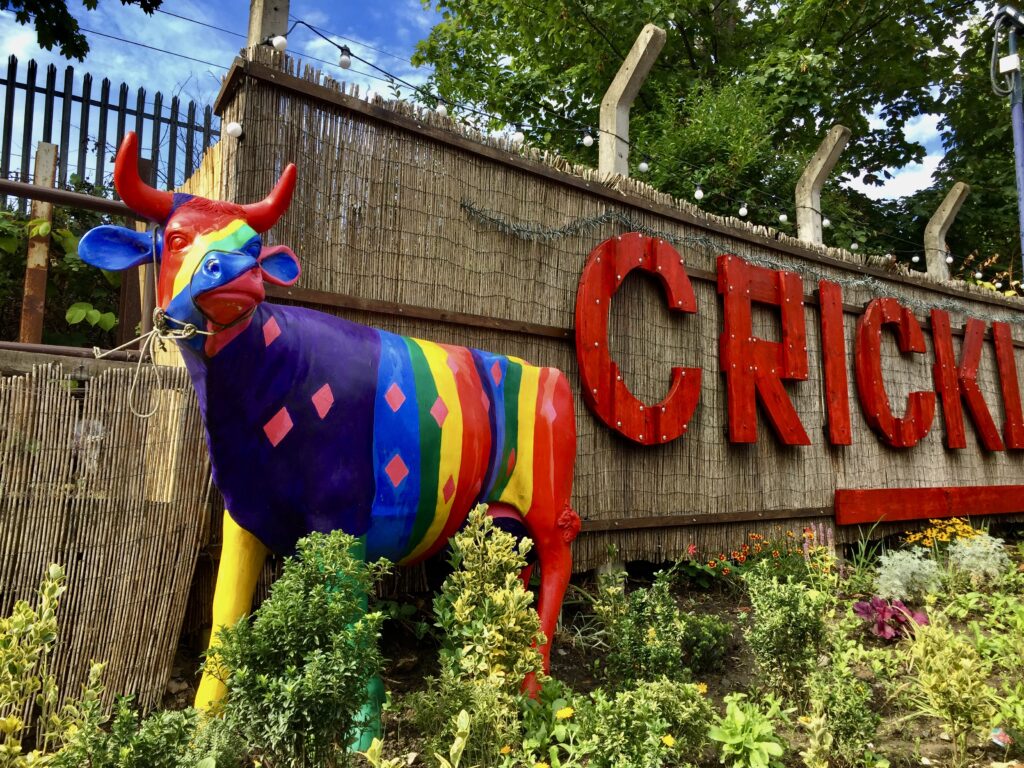
Cricklewood Station boasts a friendly multi-coloured cow …

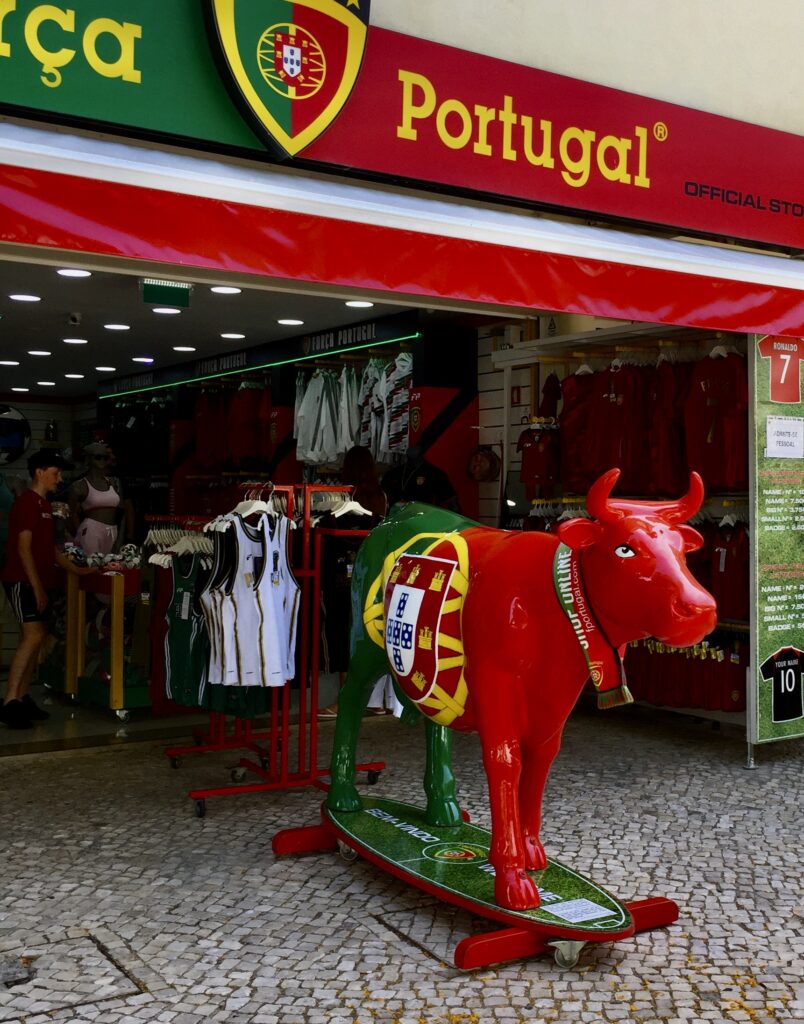
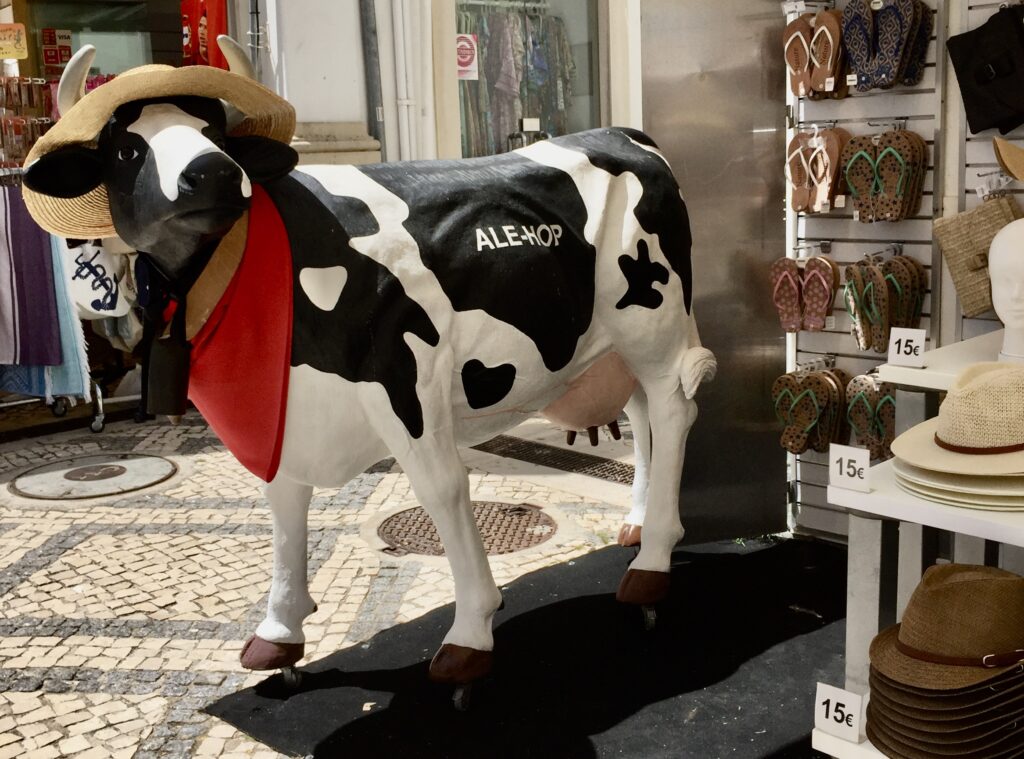
A cow painted in the red and green colours of the Portugal national football team stands outside a souvenir shop in the Algarve …

Same street – different cow …

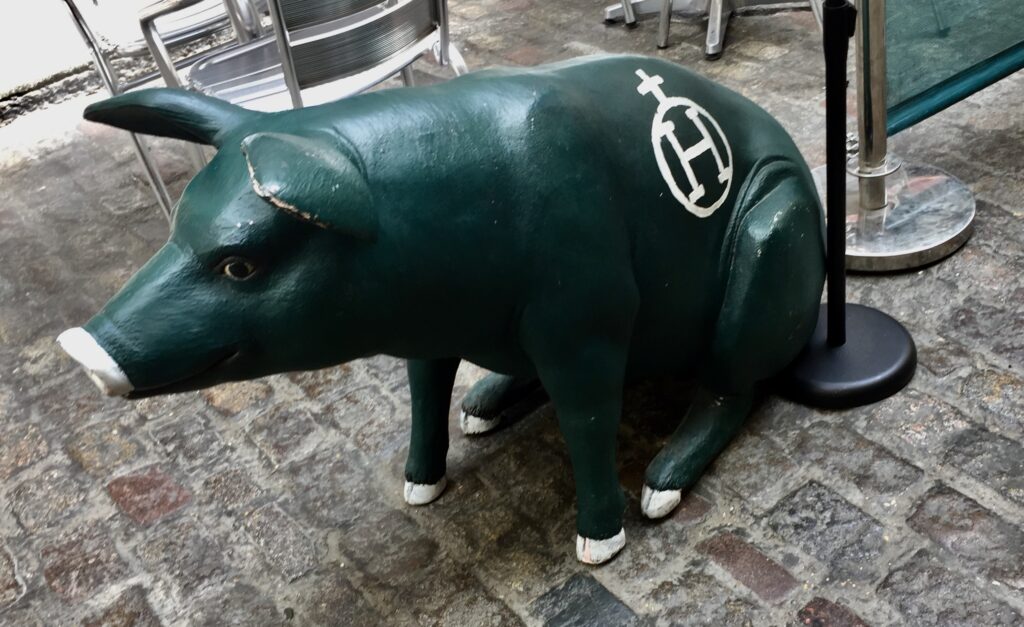
Leadenhall market porker …

Every year the Worshipful Company of Paviours bring an inflatable animal (known as a St Anthony’s pig) to the Lord Mayor’s Show …

In medieval times the London meat market at Smithfield released pigs that were unfit for slaughter into the streets to fend for themselves. They were identified by a bell around their neck and some prospered sufficiently to get fat enough to eat. Every now and then the paviours (who maintained the roads) rounded them up and delivered them to feed the poor and needy in the care of St Anthony’s Hospital.

Now, from pigs to swans.

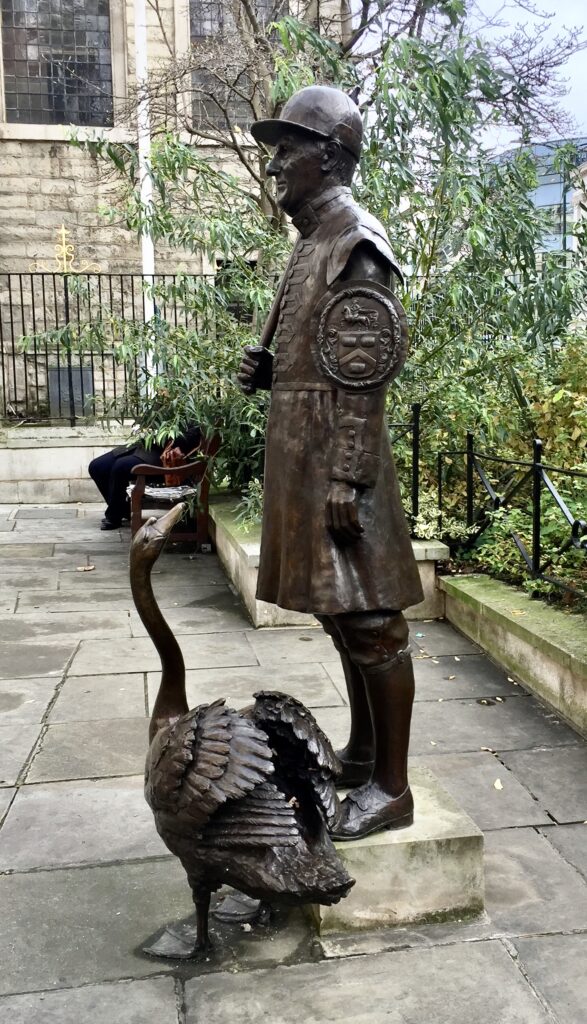
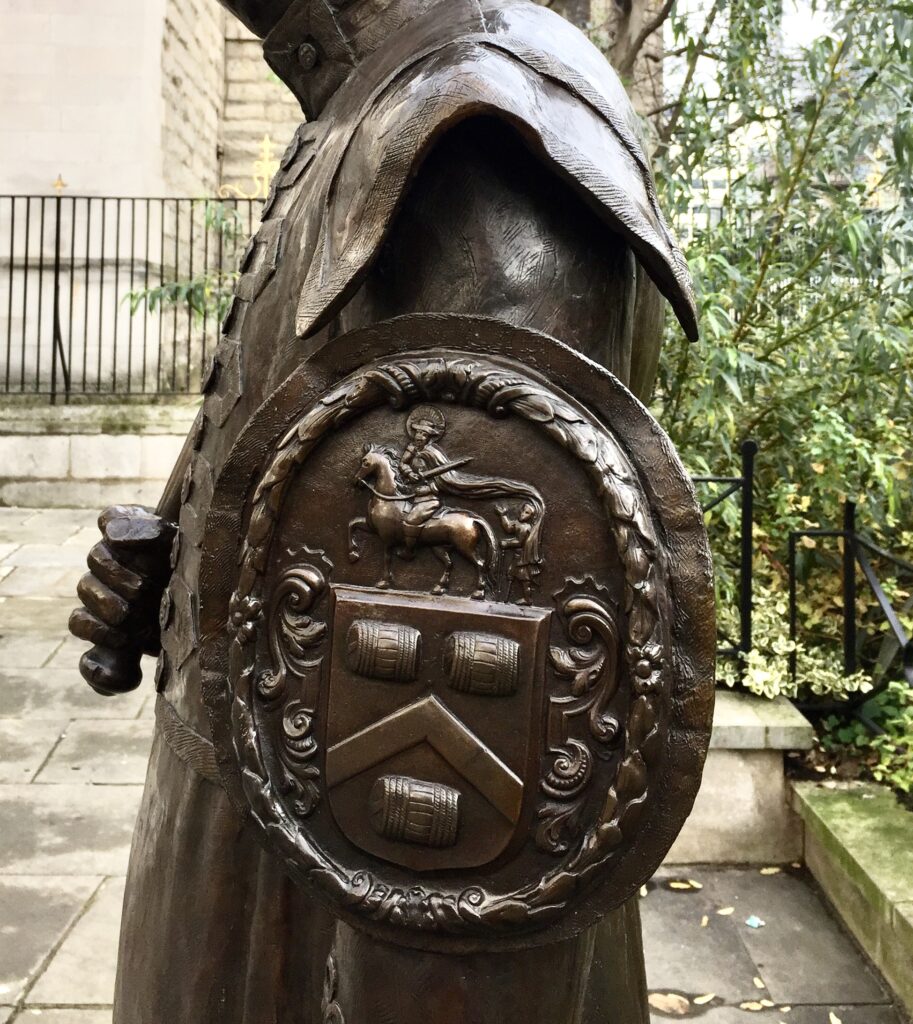
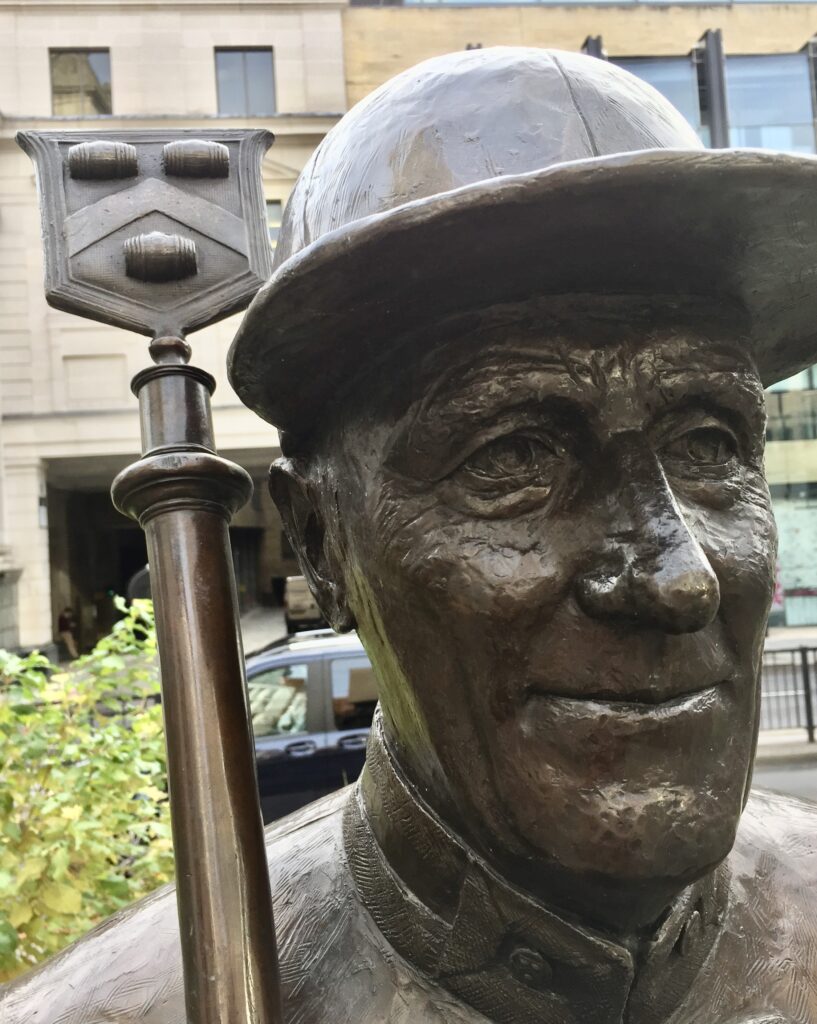
The Vintners and Dyers Companies share in the ownership of mute swans with the monarch and it is their job to catch and ring them in a ceremony known as ‘swan upping’ done each June. This man, the Swan Marker, is in charge of the Vintners’ Swan Uppers for the event, but also wears the uniform of Barge Master, dating back to the time when the Company owned a ceremonial barge on the Thames. Here he is with a feathered companion outside the church of St James Garlickhythe

The Barge Master badge …

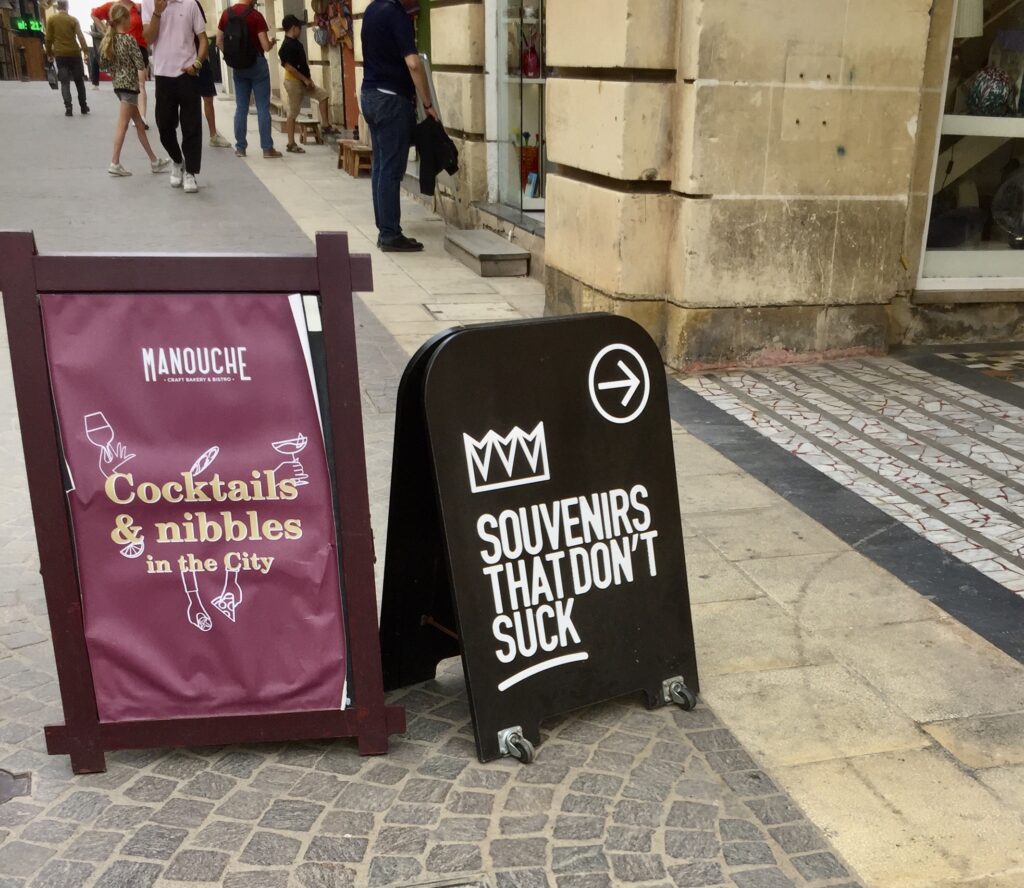
Clever advertising in Portugal …

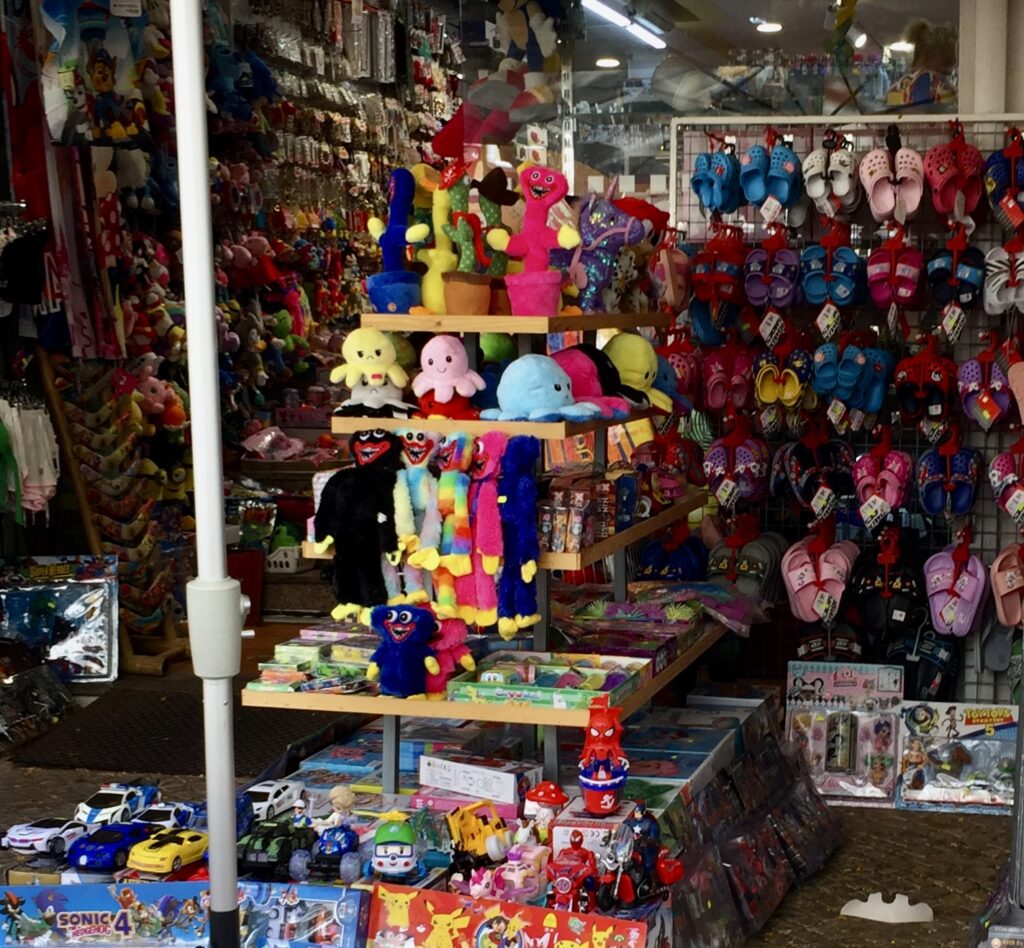
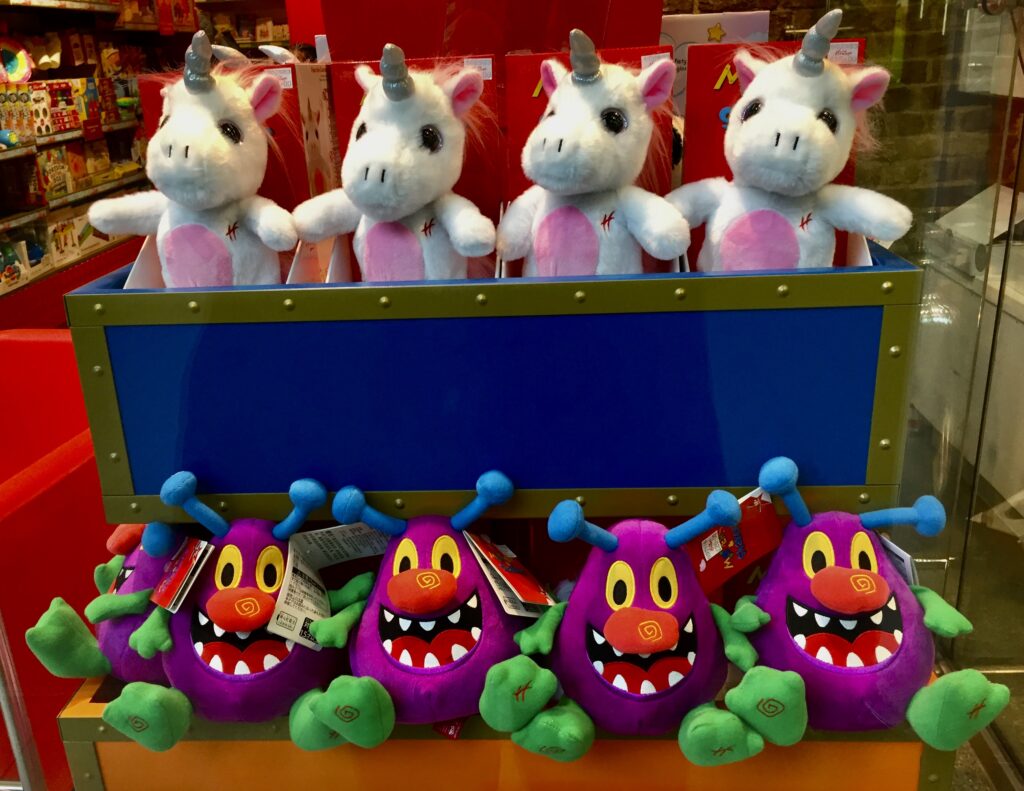
Gifts to take home from Portugal …

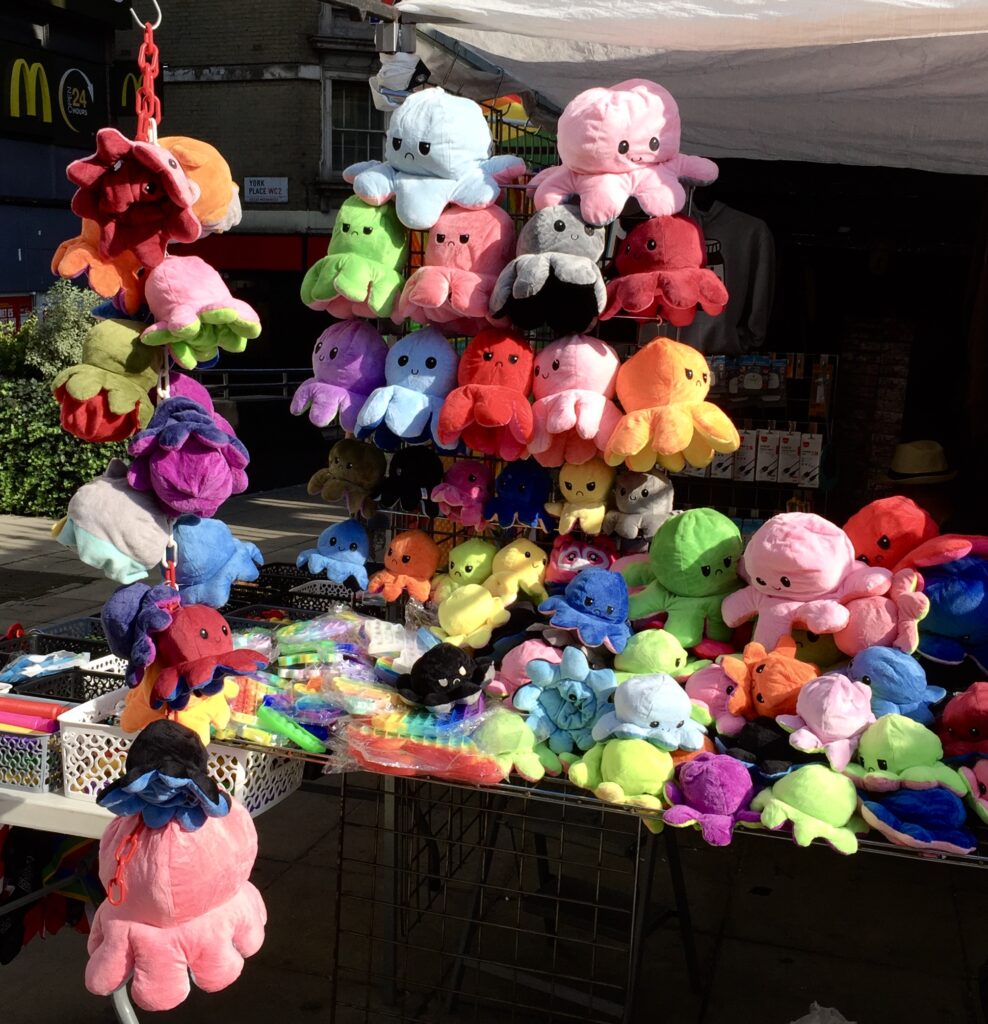
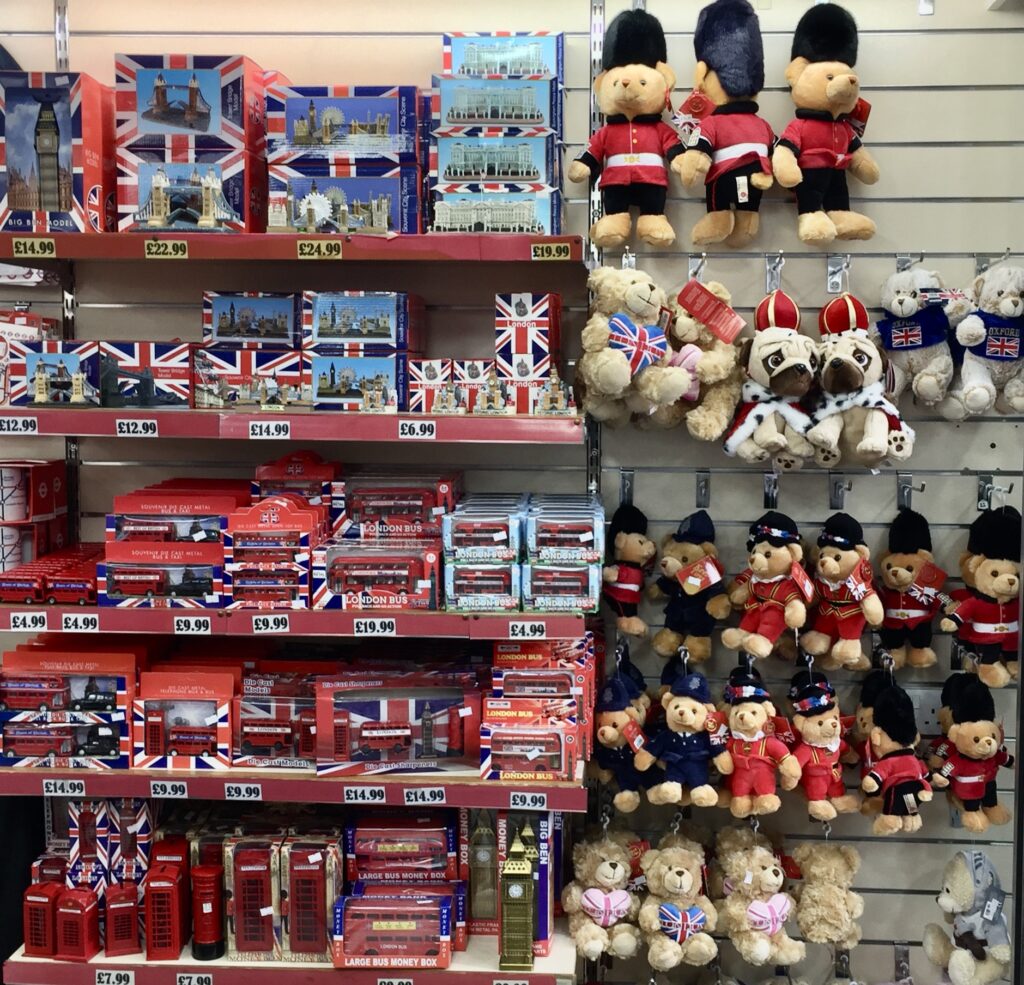
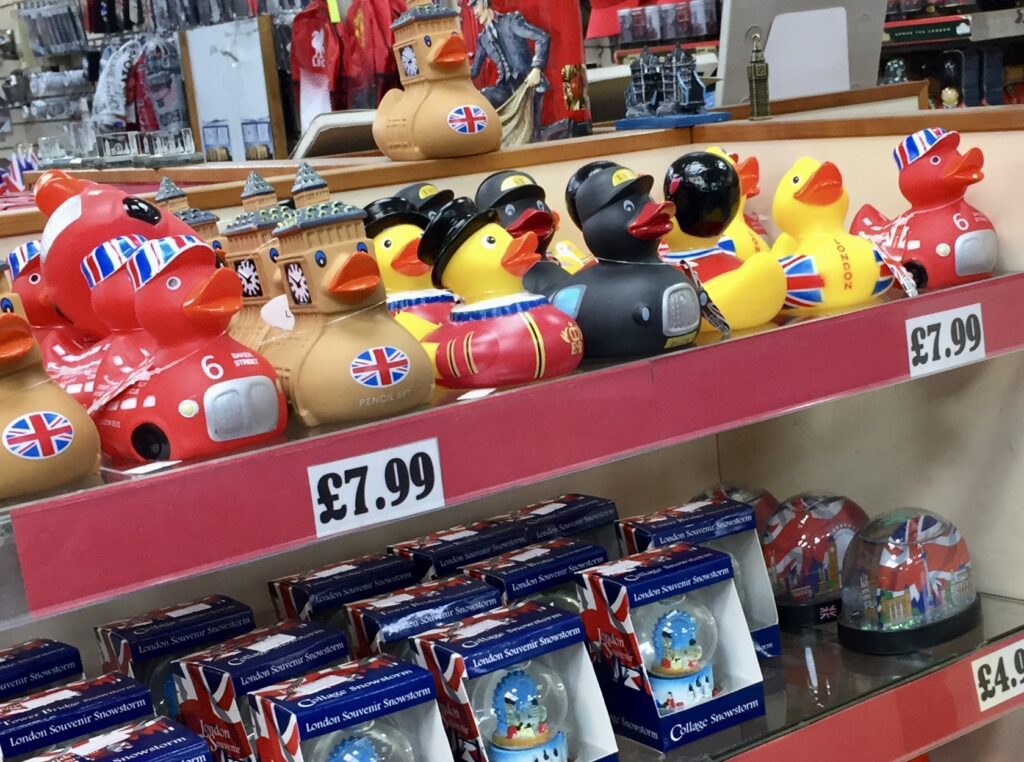
Gifts to take home from London …

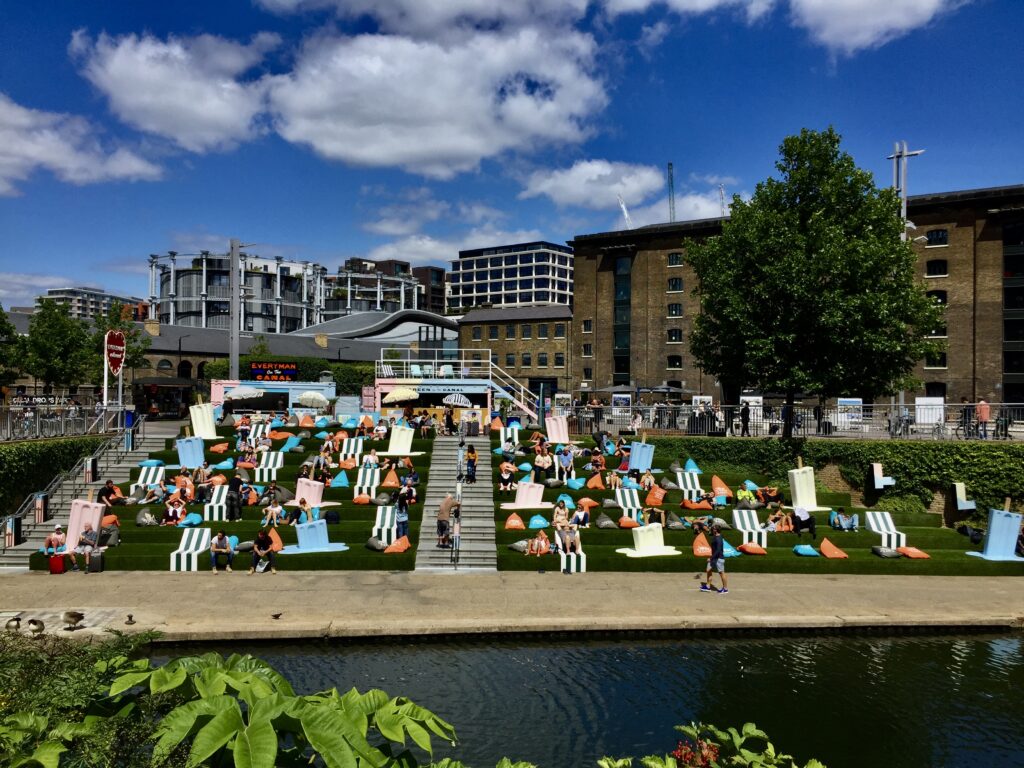
A sunny day at the Regent’s Canal, St Pancras …

I grabbed this image since the sky and clouds were so attractive. St Stephen Walbrook (1672) was Christopher Wren’s prototype for the dome of St Paul’s Cathedral. It was the first classical dome to be built in England at the time …

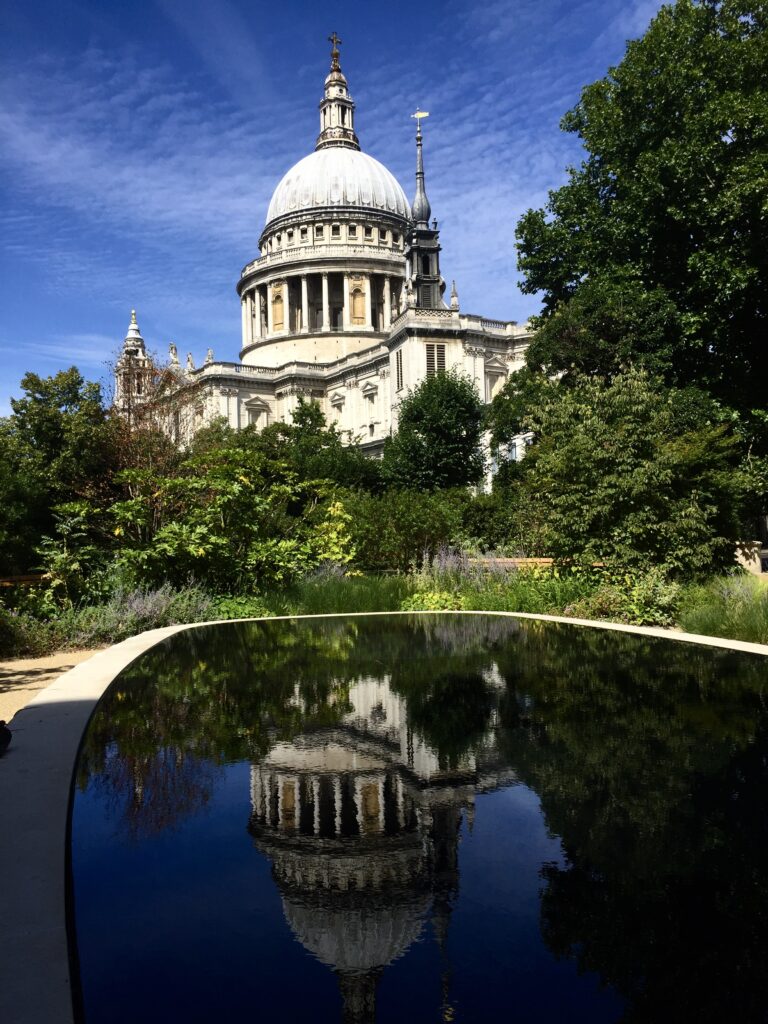
Whoever decided to place this pool here in Cannon Street was a genius …

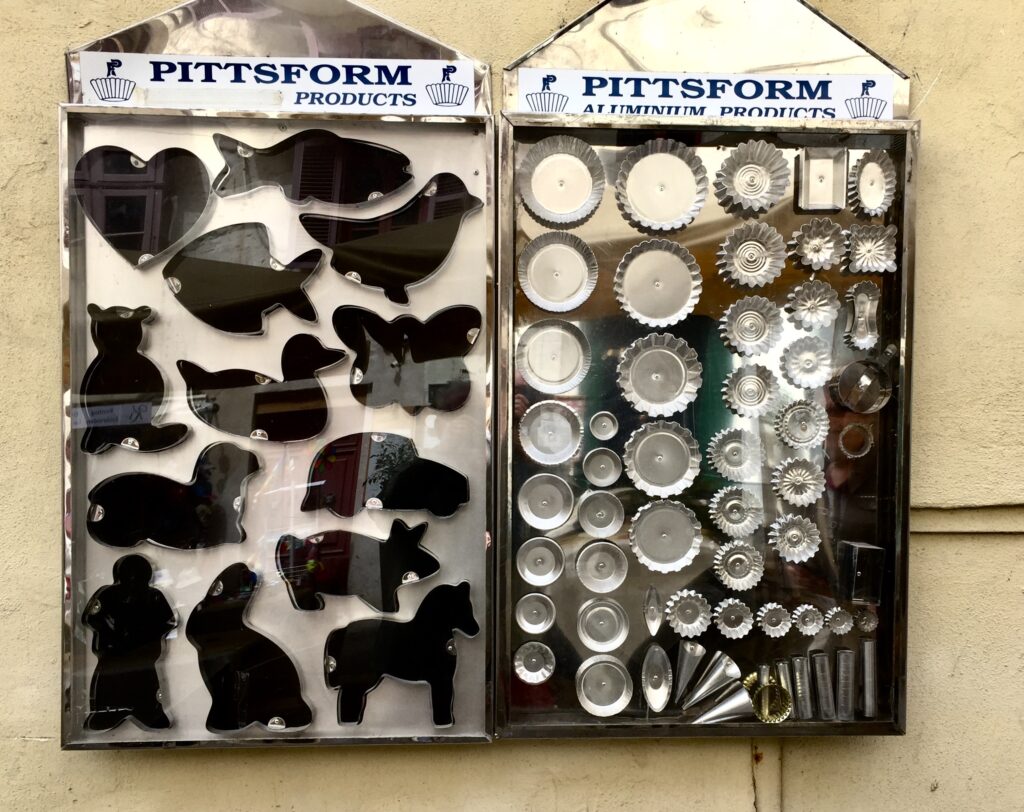
Lots of creative ideas for your pastry …

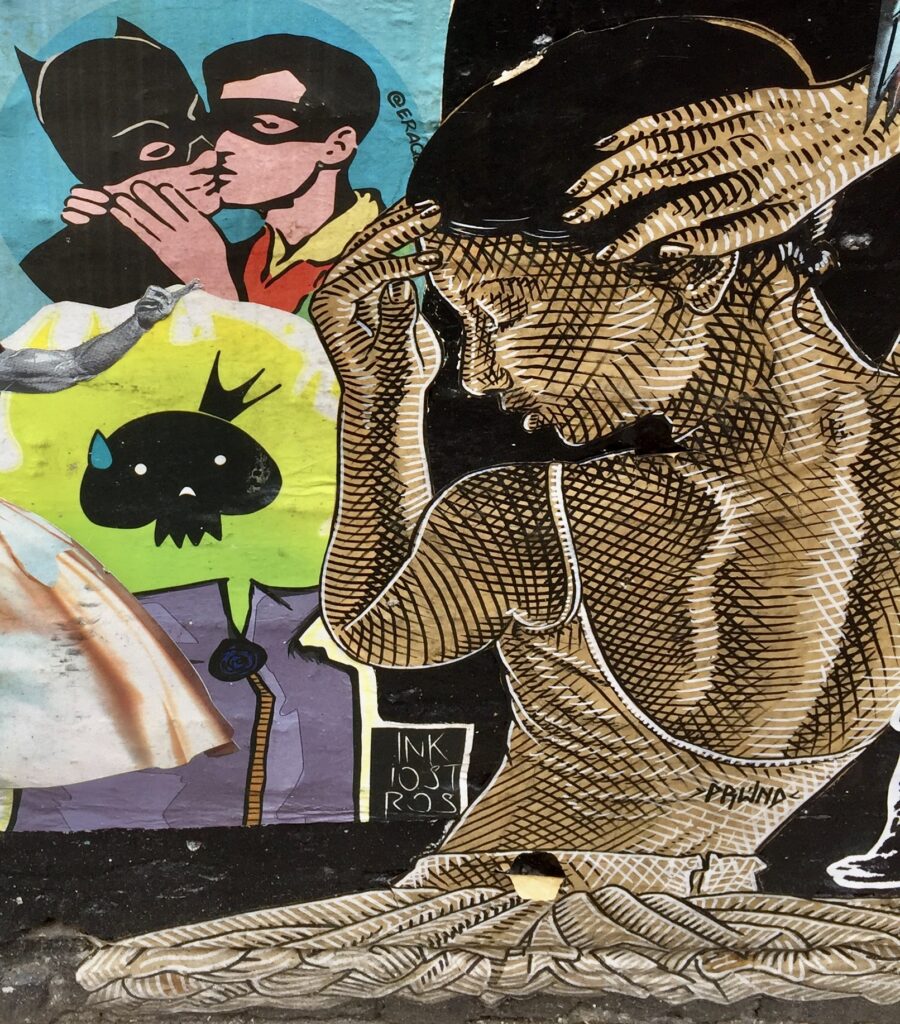
Batman and Robin street art snog …

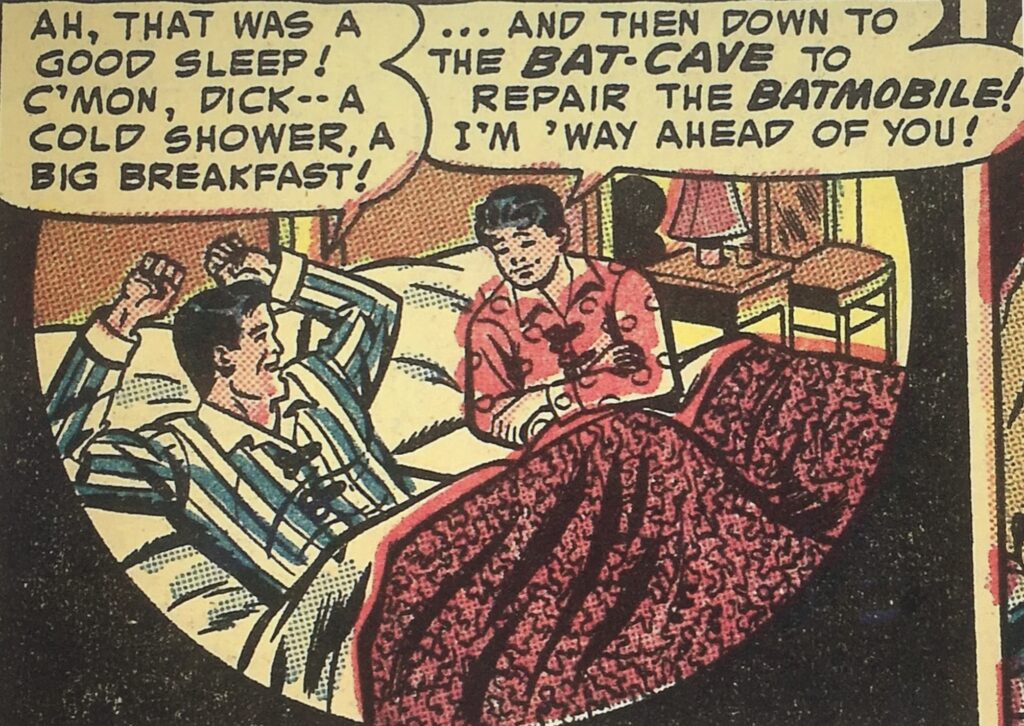
You may be surprised to know that in the early 1950s comics they seemed to share a bed …

When observations were made about this the publishers were quick to make a statement, and I quote it here :

‘It’s necessary to point out that, no — they’re not sharing a bed, as many mistakenly think. You can distinctly make out a gap in the backboard, meaning that, though they are sleeping unusually close together for an adult guardian and his teen ward, they’re not in bed together‘.

So that’s cleared that up!

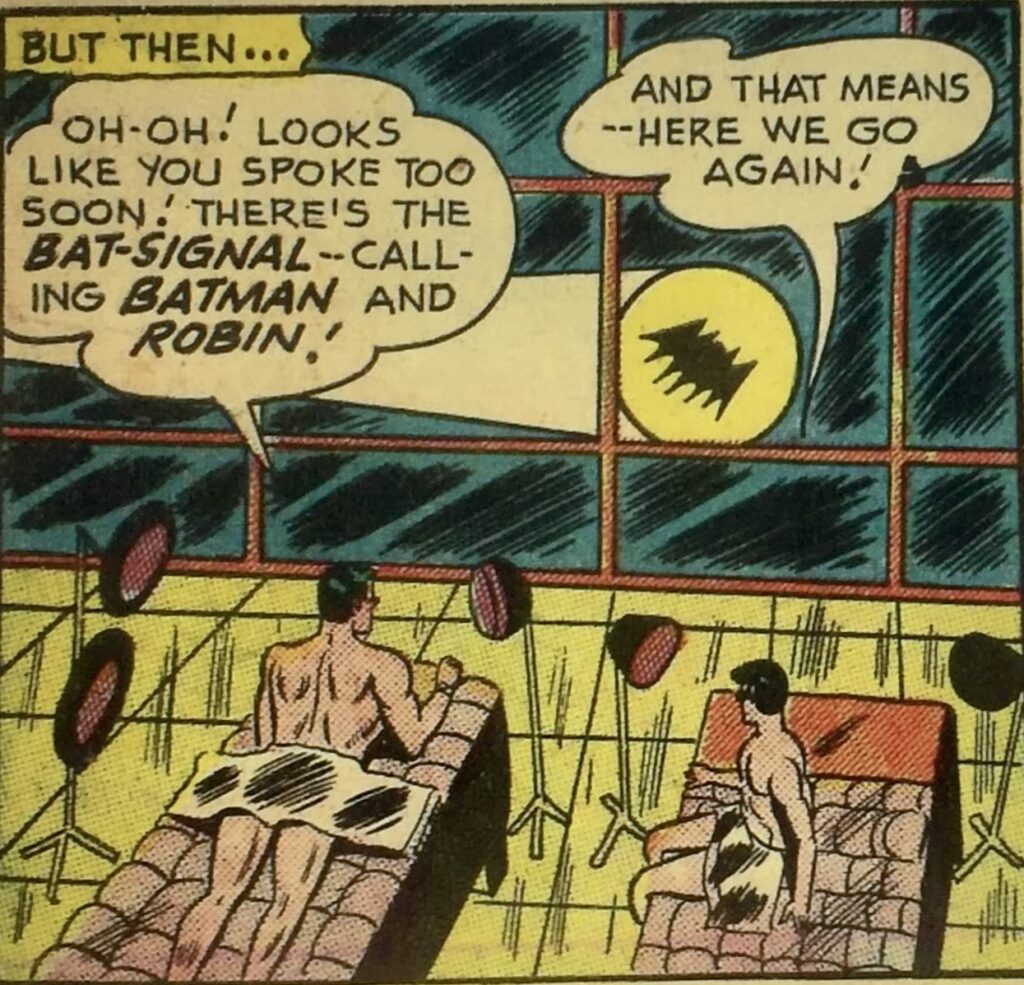
Nothing odd about a bit of nude sunlamp toning either, by the way …

Speculation as to the pair’s sexuality is discussed in The Slate article entitled, rather unfortunately, A Brief History of Dick.

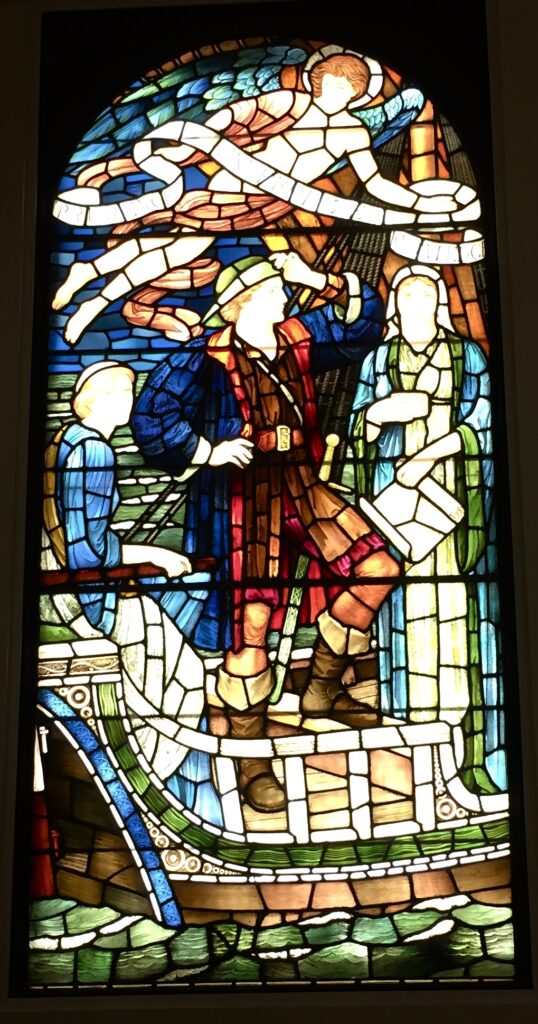
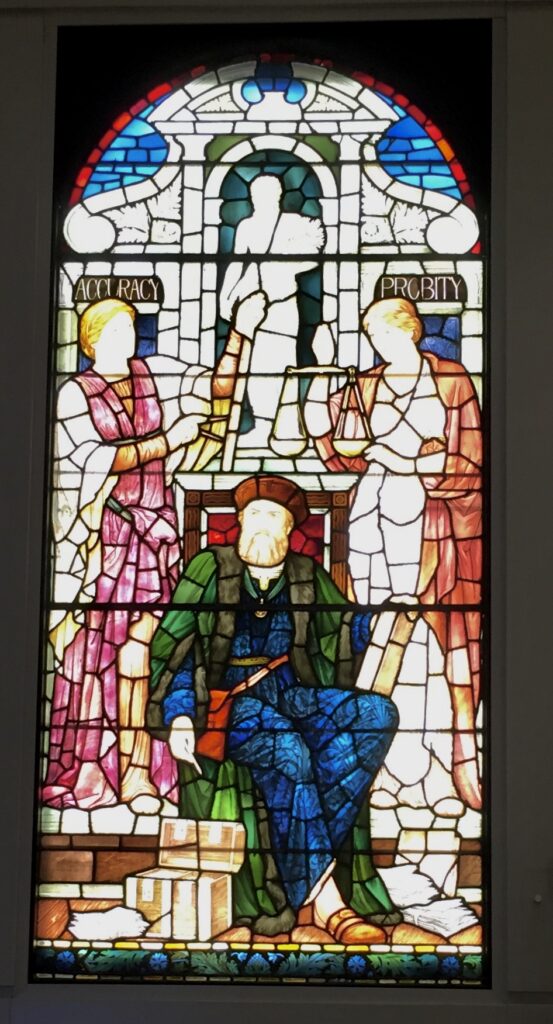
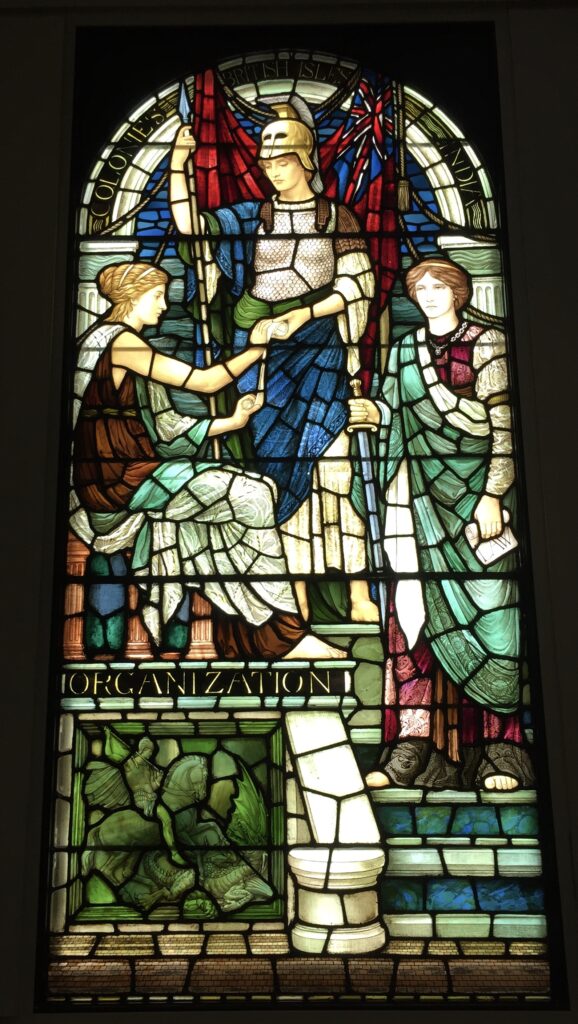
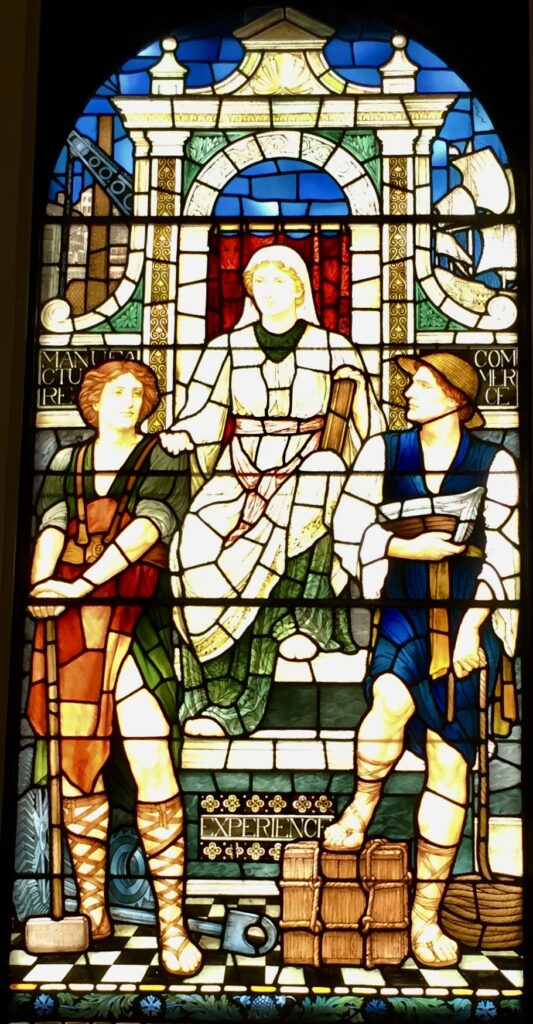
I was invited for lunch at the Institute of Chartered Accountants and so got to see some of their splendid stained glass …

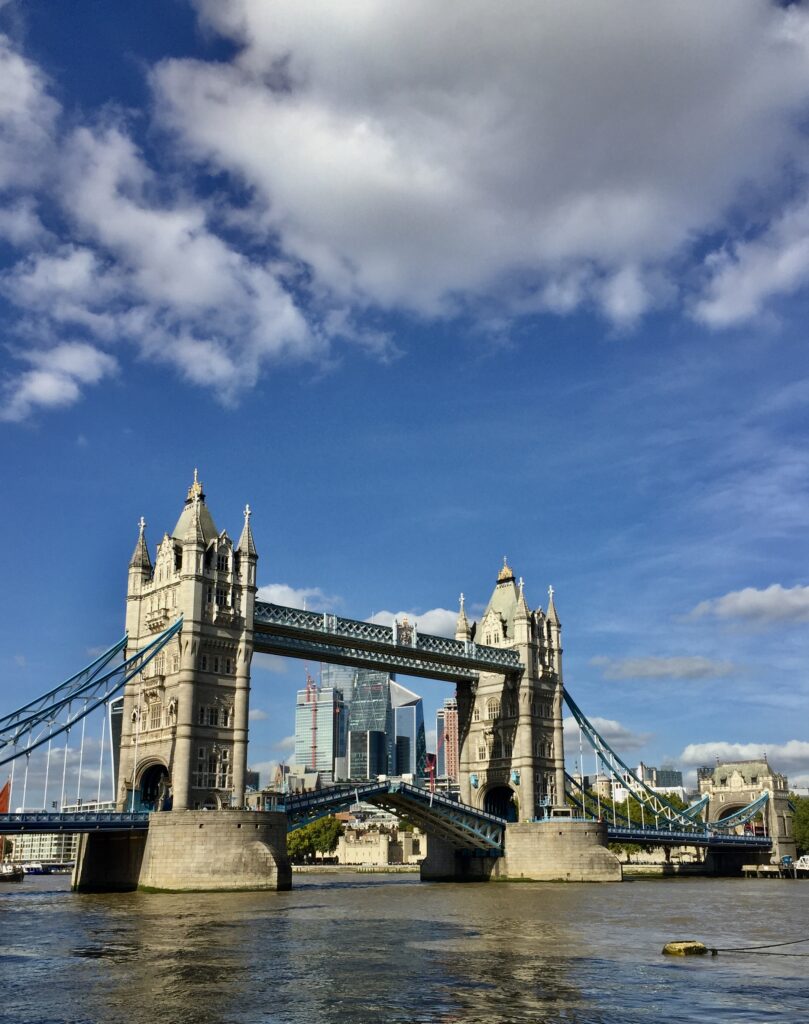
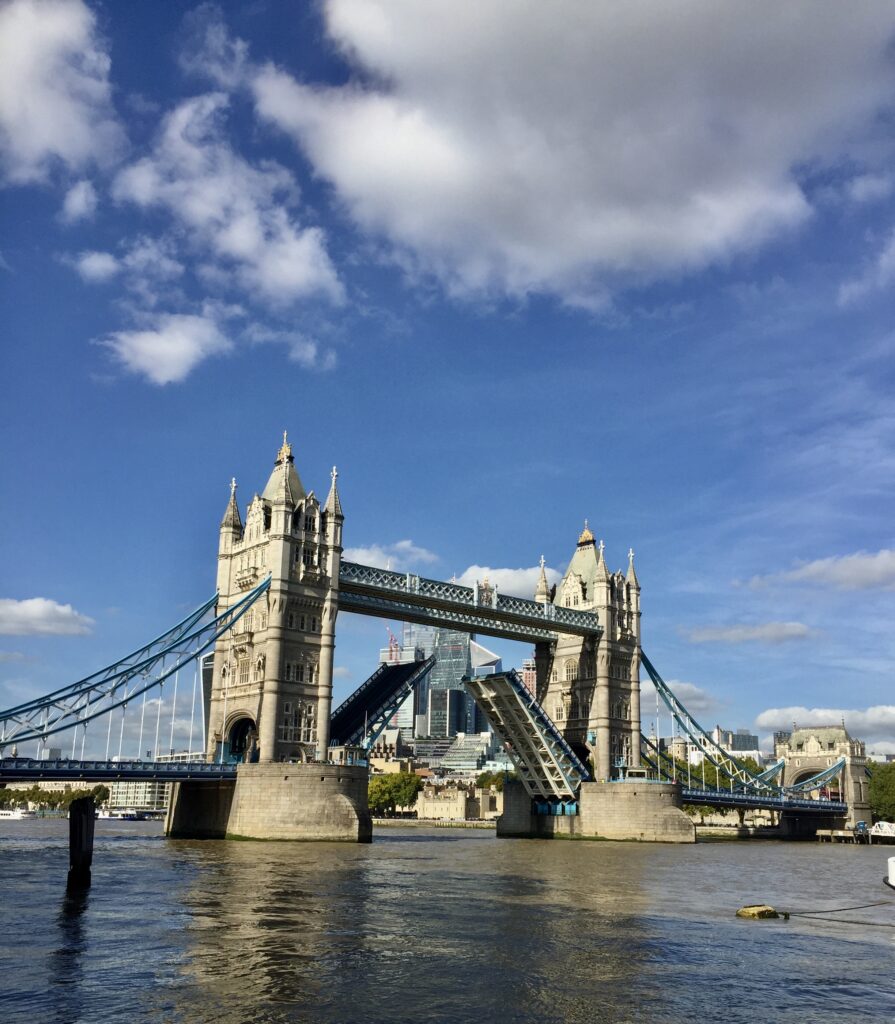
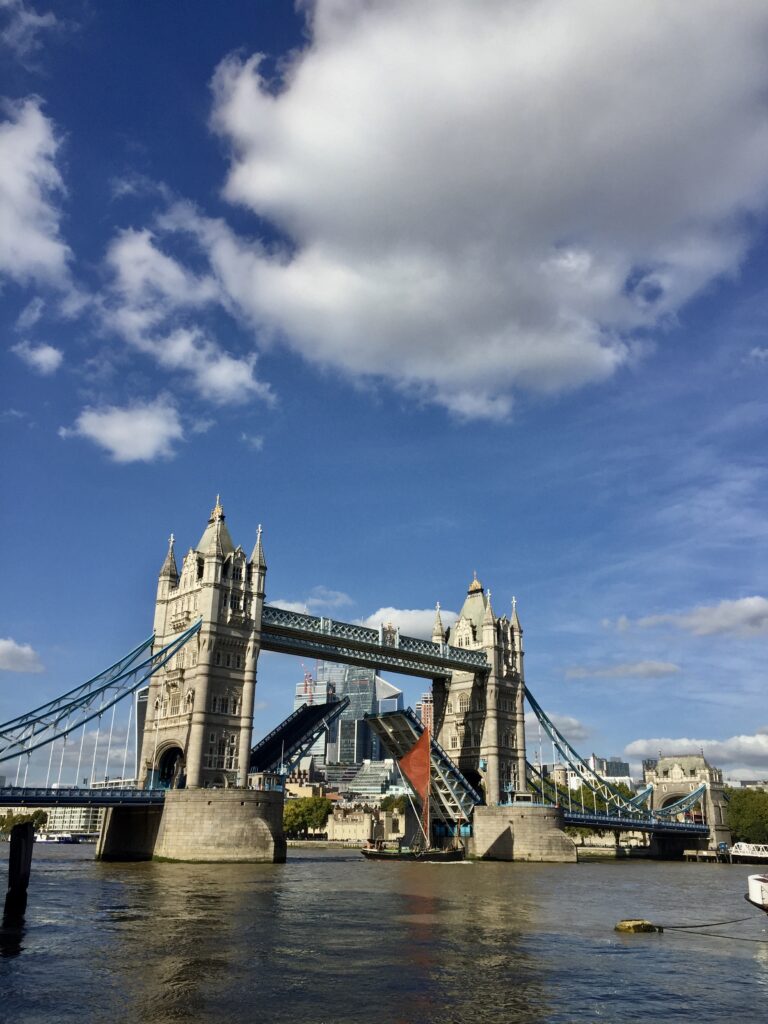
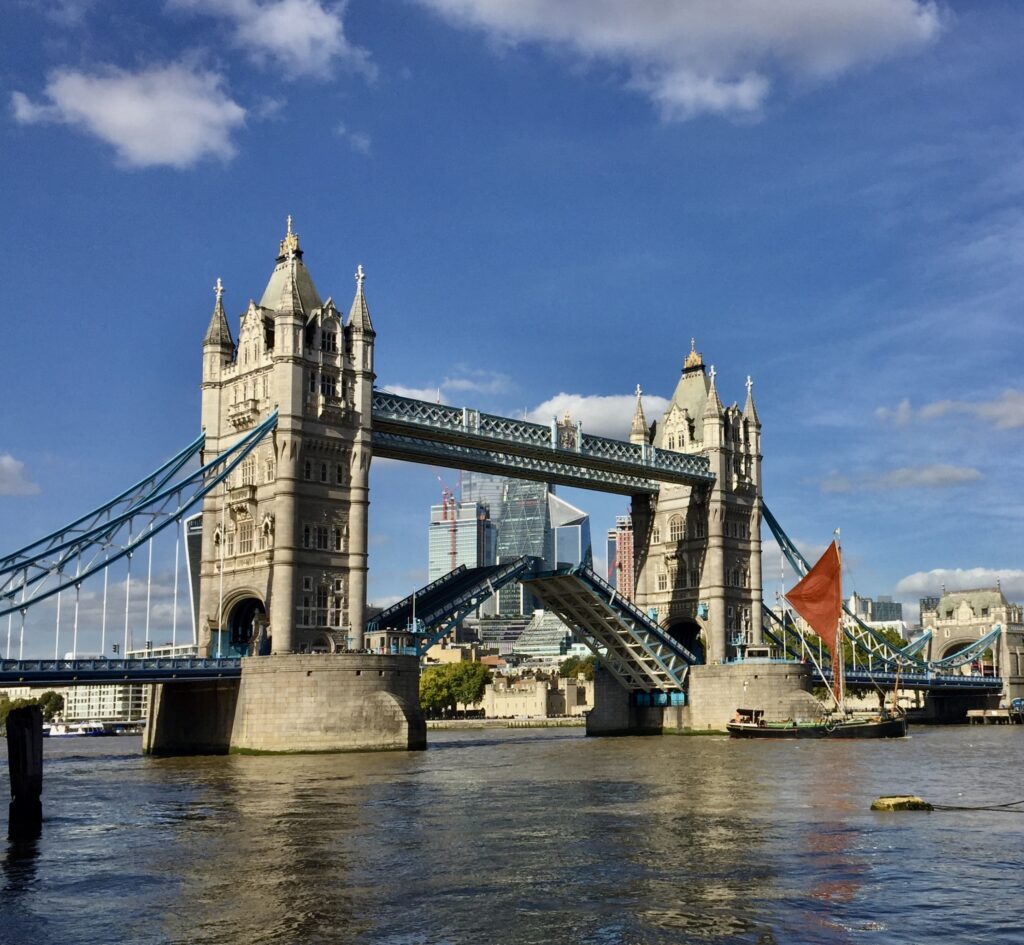
Another highlight of my year was seeing Tower Bridge raised. I have lived in London all my life and can’t recall witnessing this before in person rather than on TV …

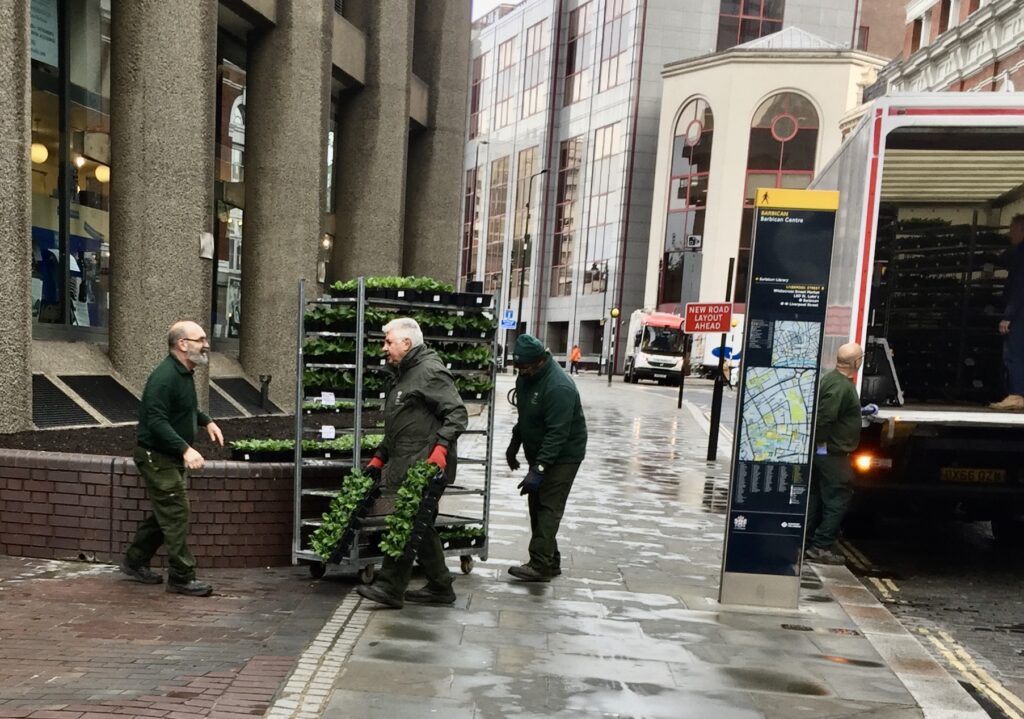
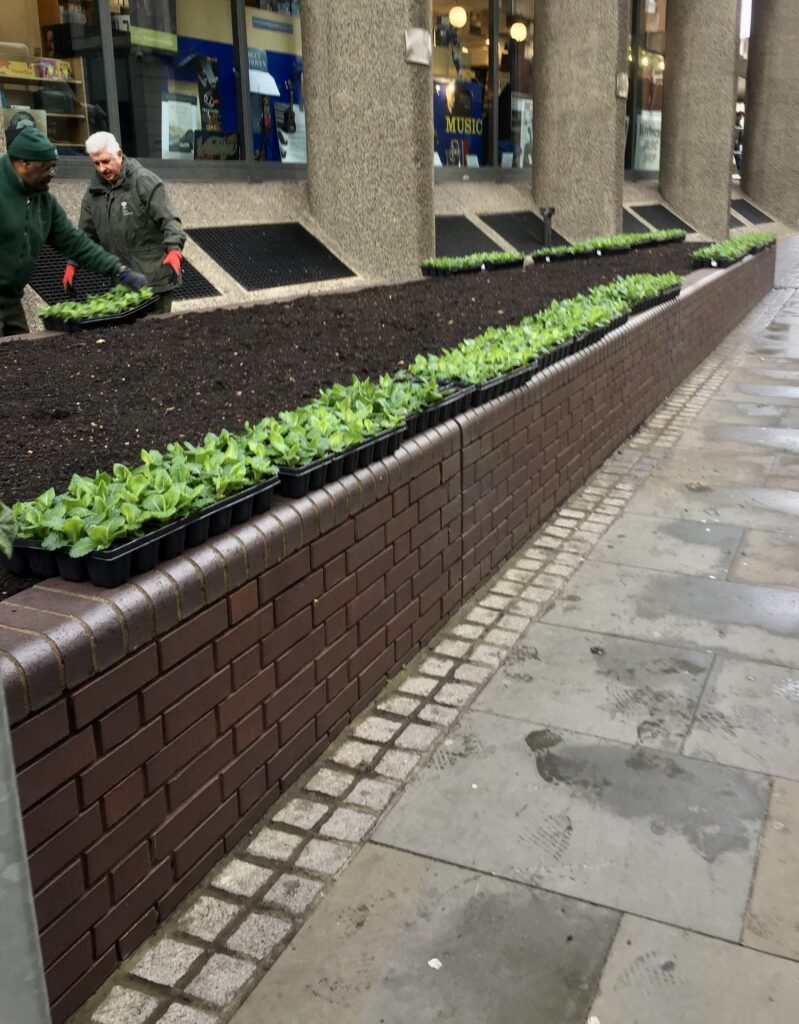
And finally, another big ‘thank you’ to our wonderful City of London gardeners who work so hard all year to keep the place looking fresh and green …

If you would like to follow me on Instagram here is the link …
https://www.instagram.com/london_city_gent/

A wander around Leadenhall Market – Christopher Wren, Harry Potter and a famous goose.

Situated in the centre of the City of London’s financial district, the current Grade II listed Market building, designed by Horace Jones, dates back to 1881. Its airy and light wrought iron and glass structure replaced the stone market previously created by Lord Mayor of London, Dick Whittington in the 15th Century. The ‘old’ market before demolition …

It now offers a spectacular Victorian setting with the roof, cobbles and buildings preserved. Crowning the many entrances are elaborate stone pediments carved with dragons, swags, shields and other devices, with a particular emphasis on City heraldry …

I have written about the City dragon emblem before in Dragons and Maidens.

It’s a very convivial place at lunchtime, especially popular with workers from nearby Lloyd’s …

The underwriters are right next door …

New buildings are still springing up despite the reported trend for more hot-desking and part-time commuting …

This exhibit, from the Sculpture in the City programme, is entitled symbols by Guillaume Vandame

A tasteful celebration of the Jubilee …

What is this bar’s name all about?

It commemorates the famous goose Old Tom. During the early 19th Century one of the most celebrated characters in the Market was Old Tom, a gander from Ostend who came to England by chance, due to his fascination with one of the lady members of his flock. It is recorded that over two consecutive days 34,000 geese were slaughtered in the Market – but Old Tom managed to escape execution. He became a great favourite in the Market and was a regular customer at the local inns where he was fed titbits. So famous was he that his obituary appeared in The Times on 19th March 1835, giving his age as 37 years, 9 months and 6 days.

The market in 1890 …

And in the 1960s. It looks like people are shopping for their traditional Christmas turkey or goose …

The hooks that produce was hung from are still there …

And now for some items of interest that not everyone is aware of.

Check out the Lamb Tavern and these these splendid tiles depicting Sir Christopher Wren. He is standing in front of The Monument (which still has scaffolding around it) holding up a drawing of how it will look when finished …

Just look at the characters gathered around him …

A lady holding a fan leans out of her carriage window to chat to the architect. A child (possibly her servant) stands nearby holding what looks like a pet King Charles spaniel. Some nearby gentlemen are also intrigued, but the chap with the red hat who looks like Errol Flynn might be more interested in the lady. Observe the elegant shoes of the man holding an eyeglass. Not really appropriate for the City’s muddy streets, so maybe he is her carriage companion. The carriage driver looks over his shoulder at the scene. The panel is by W.B. Simpson & Sons and is faintly dated 12th March 1882.

The pub also boasts some nice traditional glass …

Part of Harry Potter and the Philosopher’s Stone (the first film in the blockbuster series) was filmed in Leadenhall in 2000/2001. The Market was used to represent the area of London leading to the popular wizarding pub The Leaky Cauldron and was the inspiration for the magical shopping street Diagon Alley. Here, in a later film, Hadrig leads Harry through the pub door …

And here it is at 42 Bull’s Head Passage (EC3V 1LU) …

Finally, very often when I have visited the market I have noticed the shoe-shine men …

Read more about them here in the Spitalfields Life blog.

If you would like to follow me on Instagram here is the link …
https://www.instagram.com/london_city_gent/

Page 4 of 9

Powered by WordPress & Theme by Anders Norén