Firstly, another really interesting visit to the Heritage Gallery, housed in the same building as the Guildhall Art Gallery.
Stretching from the suburbs of East London to Epping in Essex, Epping Forest offers nearly 6,000 acres of ancient woodland and open heath for recreation, conservation, and enjoyment. I like this old map I found from about 100 years ago (not on display at the exhibition) …
The land has a long and layered history shaped by royal privilege, commoning traditions, and conservation efforts. Its roots go back to at least the early Middle Ages, when the area formed part of the vast Forest of Essex, a legally defined royal forest subject to forest law. These laws were designed not simply to protect trees, but to safeguard game animals, particularly deer, for royal hunting. From the Norman period, successive monarchs used it for sport and prestige.
From the thirteenth century onward, local people asserted customary rights such as grazing, collecting firewood, and foraging, contributing to a distinctive woodland landscape of pollarded trees and open glades. These traditions helped preserve the forest, even as other woodlands across England were cleared for agriculture.
By the nineteenth century, however, pressures from enclosure and private development threatened to fragment the forest. A crucial turning point came with the Epping Forest Act of 1878, championed by the City of London Corporation. The act ended enclosure, protected commoners’ rights, and placed the forest under the Corporation’s stewardship. Today, Epping Forest remains a rare ancient woodland, valued both for its biodiversity and its cultural heritage. On display at the Heritage Gallery are a selection of items showcasing this rich history.
The map on display …
It was drawn by local surveyor William D’Oyley and shows the boundaries and ownership of land in Epping Forest as reached by 1876. Oriented with west at the top, it highlights areas unlawfully enclosed. D’Oyley was appointed as the forest’s first (if temporary) Superintendent.
Queen Victoria visited Epping Forest in 1882 and formally dedicated it ‘to the use and enjoyment of my people for all time’. A decorative invitation to the event is on display along with one commemorating a visit by the Lord Mayor …
Management of the forest was entrusted by the City to the Superintendent and his team of Forest Keepers who enforced bye-laws, supported conservation efforts and enabled visitor access.
The keepers kept daily diaries to record patrols, seasonal changes and incidents. An example from 1903 is on display which describes the apprehension of a man with a catapult who is duly hauled off to the police station …
There is a 1912 report by Forest Keeper Sidney Butt concerning illegal bird trapping …
Seen in the photograph above, Sidney joined the service in 1894, following in the footsteps of his father who had been one of the original Keepers of 1876. A Forest Keeper until 1938, Sidney emboied the dedication of those who cared for the forest.
Uniforms such as the one in the photograph were a point of pride and discipline for Keepers while everyday attire had to be robust and practical for regular woodland patrols.
I like this correspondence from clothes outfitters Hyam & Co Limited regarding Forest Keeper Mutch who, between 1892 and 1894 had ‘got very much stouter’ …
There’s a section on visiting the forest …
… and some fascinating signage with a detailed background history …
It’s a terrific little exhibition and it’s always a pleasure to visit the Guildhall Art Gallery as well. Entry is free as are the regular, informative guided tours. You can also visit the beautiful works by Evelyn De Morgan but hurry because the event closes on 4th January next year. You can read more about it here.
There are also lots of nice things for sale in the Gallery shop. That little book in the middle of the top shelf looks interesting!
Finally, some sad news. Last week I was privileged to attend the launch of Gillian Tindall’s book Journal of a Man Unknown at Hatchards, Piccadilly. Gillian died on 1st October but, although tinged with sadness, it was also a joyous occasion with a speech by Colin Thubron and a reading from her novel. Click here for the eulogy which Thubron read at her memorial gathering held at Cecil Sharp House in Regent’s Park on Friday last week. Click here for her obituary in The Guardian newspaper.
If you have not read anything by Gillian before you are in for a treat. May I suggest two of my favourites: The House by the Thames and The Tunnel Through Time. She was also a regular guest author of Spitalfields Life and you can read one of her contributions (on the history of the underground railway) here.
If you would like to follow me on Instagram here is the link …
Welcome to my second blog about the Monument – I hope you enjoyed the first instalment.
Let’s get the basic data out of the way first. Built between 1671 and 1677, it’s a fluted Doric column standing 202 feet (61 metres) in height and 202 feet (61 metres) to the west of the spot where the Great Fire started on Pudding Lane. 311 spiral steps lead up to the public viewing platform, where visitors can get great views of London from 160 feet (48.7 metres) above ground. I doubted my fitness to climb it but, should you choose to do so, you will get a certificate as evidence of your intrepid character! If you want to see what the view is like, have a look at this excellent video. Despite all the new buildings that have sprung up after the Second World War the views from the Monument are still fantastic so highly recommended.
Here are a few images from the London Home Girl website to also whet your appetite …
A panorama posted in Wikipedia …
Bear in mind, though, the climb will be formidable if you’re not reasonably fit …
Let’s deal now with the ‘secret’ chamber beneath the column.
Robert Hooke and Christopher Wren, who collaborated to design the Monument, were serious scientists who saw the column as a fantastic opportunity to advance celestial knowledge and the intention was to install within it a Zenith Telescope. When the two hinged semi-circular iron doors at the top were opened, someone in the underground observation chamber at the base of the column could measure with a micrometer eyepiece the changes in position of an overhead star throughout the year. Hooke chose Gamma Draconis as his overhead star, but Gamma Draconis, while very bright, is also very far away: 900 million miles away in fact. Hooke was trying to measure a very small difference in position.
The initiative failed for a mundane reason – Fish Street Hill was the main roadway entrance to the phenominally busy London Bridge, the only bridge across the Thames in London until 1750. The vibrations from the traffic upset the delicate instrumentation needed for a Zenith telescope and the idea was abanoned. The busy approach to the bridge in the mid-18th century …
If you do reach the top remember, as you descend, that you are literally walking in Hooke’s footsteps when he conducted an experiment to see how atmospheric pressure varied between the top of the building and the bottom. This is why each step is exactly six inches deep.
The chamber below is not open to the public but you can read about a visit to both it and the space directly beneath the golden urn by the Londonist blogger here. Looking down the stairs to the laboratory …
Looking down from the urn at the top …
It was also visited by Professor Lisa Jardine and you can read her fascinating views on the subject if you Google The Medlicott Medal Lecture 2006. One image from her lecture is the view looking upwards from Hooke’s basement location …
Trivia fact: The Monument actually has 345 steps rather than 311 if you include the steps up from the laboratory.
In last week’s blog I dealt with the inscription on the west side of the building, time now to look at the other three sides.
The north side inscription is famous for the fact that a final sentence has obviously been erased …
In 1679, stories of a Popish plot caused panic in response to allegations of a Jesuit conspiracy to murder Charles II, restore the Roman Catholic faith as the state religion of England and establish a French-backed tyranny under the King’s brother James, Duke of York, whose Catholic and autocratic sympathies were well known. At the source of this totally untrue story was the rather unpleasant character Titus Oates …
You can read more about him here in an excellent article from History Today magazine. Wikipedia gives a much fuller description of his life and escapades here. You can just imagine the chaos he could probably cause today if he had access to social media.
In the anti-Catholic frenzy that followed the plot’s revelation, the Court of Common Council (the primary decision-making assembly for the City of London Corporation) decided to act. The City Comptroller, Joseph Lane, was ordered to emend the inscription so as to place the blame for the Great Fire firmly on the shoulders of Catholics. Accordingly, the following words were tacked on to the end of the north side inscription: SED FVROR PAPISTICVS, QVITAM DIRA PATRAVIT NONDVM RESTINGVITVR
Translated it reads: BUT THE PAPAL MADNESS THAT HAS ACCOMPLISHED SO MANY ABOMINATIONS IS NOT YET SNUFFED OUT.
Inserted in 1681, these additions were erased when the Catholic James II came to the throne in 1685, and then carved on again at the accession of William and Mary in 1689, only to be finally removed in 1831 following Catholic Emancipation. As Philip Ward-Jackson writes: ‘For a good part of a century and a half, the Monument was thus denatured and turned into a sectarian provovation’. This was certainly how the Catholic Alexander Pope saw it, writing in 1733, in his Epistle to Bathurst:
“Where London’s column, pointing at the skies, Like a tall bully, lifts its head, and lyes.”
The scraped out section (pigeons seem to find this part of the building really attractive to roost in) …
Here is a translation of the Latin inscription you see today:
In the year of Christ 1666, on the 2nd September, at a distance eastward from this place of 202 feet, which is the height of this column, a fire broke out in the dead of night, which, the wind blowing devoured even distant buildings, and rushed devastating through every quarter with astonishing swiftness and noise. It consumed 89 churches, gates, the Guildhall, public edifices, hospitals, schools, libraries, a great number of blocks of buildings, 13,200 houses, 400 streets. Of the 26 wards, it utterly destroyed 15, and left 8 mutilated and half-burnt. The ashes of the City, covering as many as 436 acres, extended on one side from the Tower along the bank of the Thames to the church of the Templars, on the other side from the north-east along the walls to the head of Fleet-ditch. Merciless to the wealth and estates of the citizens, it was harmless to their lives, so as throughout to remind us of the final destruction of the world by fire. The havoc was swift. A little space of time saw the same city most prosperous and no longer in being. On the third day, when it had now altogether vanquished all human counsel and resource, at the bidding, as we may well believe of heaven, the fatal fire stayed its course and everywhere died out.
The south panel is a detailed paen to Charles II, ‘Son of Charles the Martyr’, and all the work he supervised to bring the City safely back to life …
Translation: Charles the Second, son of Charles the Martyr, King of Great Britain, France and Ireland, defender of the faith, a most gracious prince, commiserating the deplorable state of things, whilst the ruins were yet smoking provided for the comfort of his citizens, and the ornament of his city; remitted their taxes, and referred the petitions of the magistrates and inhabitants of London to the Parliament; who immediately passed an Act, that public works should be restored to greater beauty, with public money, to be raised by an imposition on coals; that churches, and the cathedral of St. Paul’s, should be rebuilt from their foundations, with all magnificence; that the bridges, gates, and prisons should be new made, the sewers cleansed, the streets made straight and regular, such as were steep levelled and those too narrow made wider, markets and shambles removed to separate places. They also enacted, that every house should be built with party-walls, and all raised of an equal height in front, and that all house walls should be strengthened with stone or brick; and that no man should delay building beyond the space of seven years. Furthermore, he procured an Act to settle beforehand the suits which should arise respecting boundaries, he also established an annual service of intercession, and caused this column to be erected as a perpetual memorial to posterity. Haste is seen everywhere, London rises again, whether with greater speed or greater magnificence is doubtful, three short years complete that which was considered the work of an age.
The East Panel is formulaic in style, providing a list of names of London mayors that oversaw the building of the pillar, from the beginning to the end. The surnames of the mayors are the only words not Latinised: rather, they are in English …
But what of the man who was Lord Mayor at the time the Great Fire broke out? Sir Thomas Bludworth was unlucky enough to be in that position and gained immortality because of one particularly unfortunate phrase.
The fire began in the King’s Baker’s house on Pudding Lane. Rather than making fresh loaves for the King, baker Thomas Farynor produced the dry and bland biscuits called ‘hard tack’ that filled the bellies of sailors in the Royal Navy. In the early hours of Sunday 2 September 1666, the Farynor family woke to smoke coming from the bakery on the ground floor of their house. They escaped out of the upper floor window although their maid, too frightened to leave, perished. The long hot summer and the strong wind allowed the fire to spread rapidly.
Sir Thomas Bludworth was called. Afraid to order the pulling down of houses to make firebreaks, he ensured his place in the history books by exclaiming that the fire was so weak a ‘woman could piss it out’. He then returned to bed.
Samuel Pepys, returning from a meeting with King Charles, later encountered the Mayor in the street and reported:
At last met my lord mayor in Cannon Street, like a man spent, with a handkerchief about his neck. To the King’s message, he cried, like a fainting woman, ‘Lord, what can I do? I am spent: people will not obey me. I have been pulling down houses, but the fire overtakes us faster than we can do it’
Many believed poor Bludworth was a scapegoat and very unfairly criticised. You can read more about him, and his earlier and later, life here.
I’ve really enjoyed reading and researching the story of the Monument and hope you have enjoyed the two blogs that I have published as a result. Maybe one day I’ll feel fit enough to climb to the top as I last did with my Dad when I was 15!
If you would like to follow me on Instagram here is the link …
Although born in Stratford-upon-Avon, Shakespeare spent much of his working life in London and I’ve been searching for any traces of his time here that might still exist.
My interest was prompted by my chance visit to the site of the now-disappeared church of St Olave Silver Street (EC2V 7EE) …
There is a little font-like pool that I rather liked …
A 1540 Act of Parliament was most concerned with the professionalisation of surgeons, granting their Livery Company four bodies of executed criminals from Tyburn each year for the purpose of dissection for anatomical teaching. St Olave’s churchyard was notable as the place where the bodies of those dissected at the nearby Barber-Surgeons Hall would be buried.
There are three interesting plaques. This one displays a skull and crossbones and reads as follows: This was the parish church of St. Olave Silver Street, destroyed by the dreadfull fire in the year 1666 …
This one commemorates a road widening and reads: St. Olave’s Silver Street. This churchyard was thrown back and the road widened eight feet by the Commissioners of Sewers at the request of the Vestry Anno Dommini 1865. H.J. Cummings – Rector, F.A. Harris & C.E. Wilson – church wardens …
But this is the plaque that really caught my eye …
In May and June 1612, Shakespeare was a witness in a legal dispute involving the Mountjoys and the case has become famous because the legal documents contain his signature. Only six examples of his signature have so far been discovered and some of these are disputed. Here they are:
For more details on the Mountjoy case, have a look at the excellent London Inheritance blog which you will find here. For an academic discussion about the signatures’ authenticity (or otherwise) I refer you to the article entitled Six Shaky Signatures: What’s the Proof That Shakespeare Wrote Them? which you will find here in the Shakespeare Oxford Fellowship Newsletter of February 24th 2023.
The area around the old churchyard was utterly devastated in the Blitz. Here’s what it looks like now from the north side of London Wall …
And here’s what it looked like in the 1920s (an image from my latest treasured old book Wonderful London) …
Mountjoy’s house was on the corner of Silver Street and Monkwell Street – two streets that disappeared during the rebuilding of the area following the bombing of the last war. Here’s an image of The Coopers Arms – Silver Street to the right, Monkwell Street disappearing to the left. The road called London Wall now runs through this scene …
In nearby Noble Street, some remains of buildings destroyed in the war have been preserved – the St Olave garden is at the end of this road on the right …
Still on the subject of Shakespeare signatures, on 10 March 1613 he bought the Old Priory Gatehouse from Henry Walker ‘citizen and minstrel (musician)’ for £140. The deed for purchase with his signature still exists and the property is particularly significant because it is the only property he is known to have owned in London. Given its convenient proximity to the Blackfriars Playhouse and The Globe, Shakespeare may have intended to make it his home, yet no evidence suggests he lived here in the three years prior to his death in 1616.
The mortgage deed bearing his signature …
The Cockpit pub marks the approximate site of the Gatehouse …
I once owned a flat in the building on the right overlooking the pub so it truly was my ‘local’. It’s a terrific, authentic old-fashioned boozer designed inside to make reference to the popular medieval sport of cockfighting, with a gallery looking down on the ‘pit’. It is still great, check out the reviews on Tripadvisor …
Those were the days …
The Cockpit, by William Hogarth, November 1759.
Shakespeare’s Blackfriars Playhouse stood in Playhouse Yard …
The Playhouse is regarded as one of the most important sites in English Theatre History. Richard Burbage formed a syndicate with Shakespeare, Henry Condell and John Heminge, among others, and together they purchased the Playhouse in 1608. It is widely believed that The Winter’s Tale and Cymbeline were written with the Blackfriars Playhouse in mind. There’s more about Messrs Condell and Heminge later in this blog.
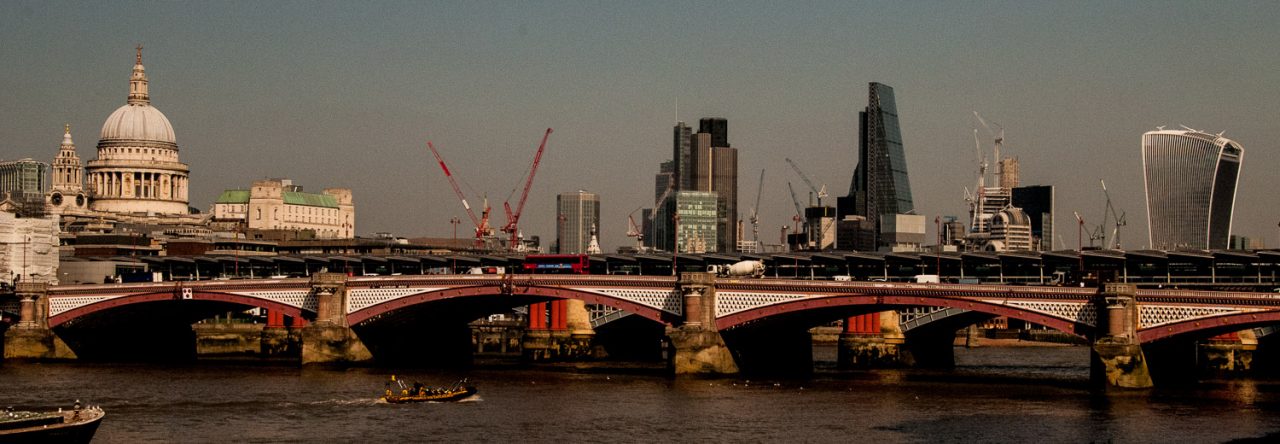
Blackfriars Priory was one of the most magnificent religious institutions in Medieval London. Henry VIII dissolved the monastery in 1538 and many of its buildings were pulled down or converted into expensive residential apartments. It’s rather sad, isn’t it, that these few bits of stone tucked away in an old churchyard in Ireland Yard are seemingly all that remain of the great priory itself …
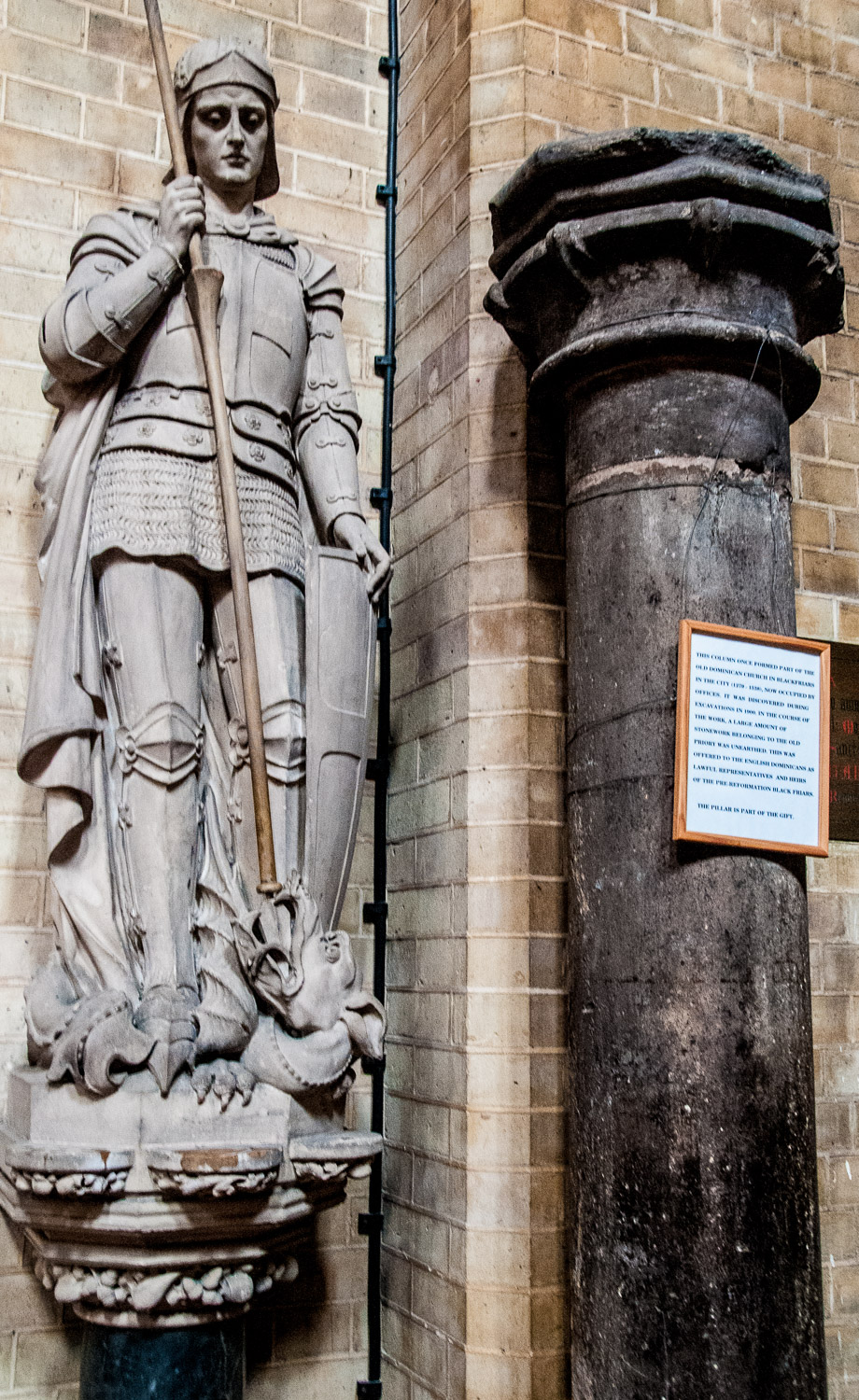
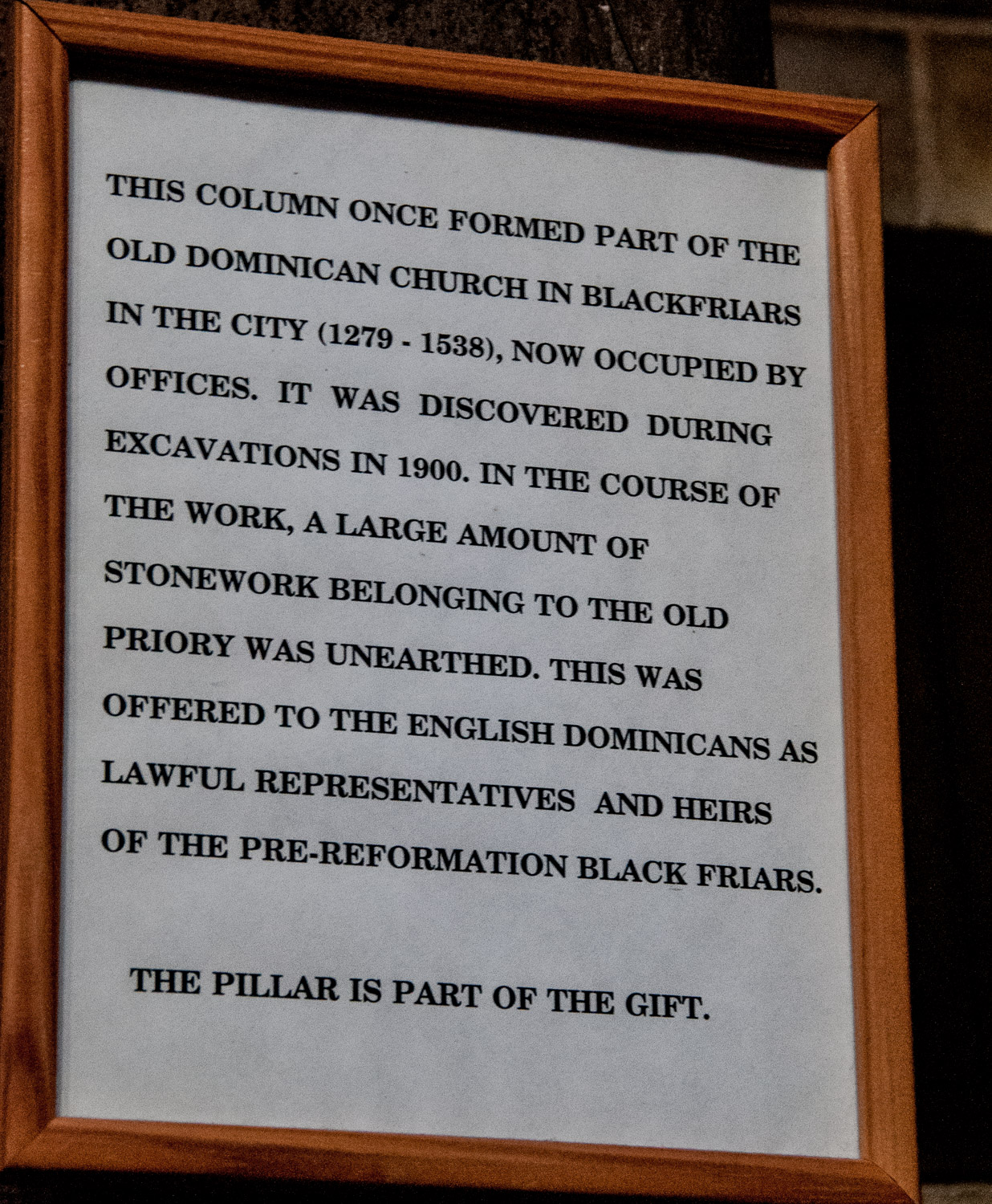
However, if you feel bold enough to venture out of the City, do visit St Dominic’s Priory Church in Belsize Park (NW5 4LB), one of the largest Catholic churches in England. Tucked away in the north west corner of the nave you will find this pillar next to a representation of St George slaying the dragon …
The notice attached to it tells its story …
Today the alley called Church Entry stands on the site of the entrance to the priory which was traditionally under the tower of the church. The view looking north up Church Entry …
As the notice says, the churchyard was closed for burials in 1849. You can see how full it was by the difference in height between the churchyard and the footpath …
On 2 February 1602, the first recorded performance of Twelfth Night took place in Middle Temple Hall. Sadly the Hall was severely damaged in the blitz as illustrated in this painting by Frank E. Beresford entitled Armistice Day 1940 …
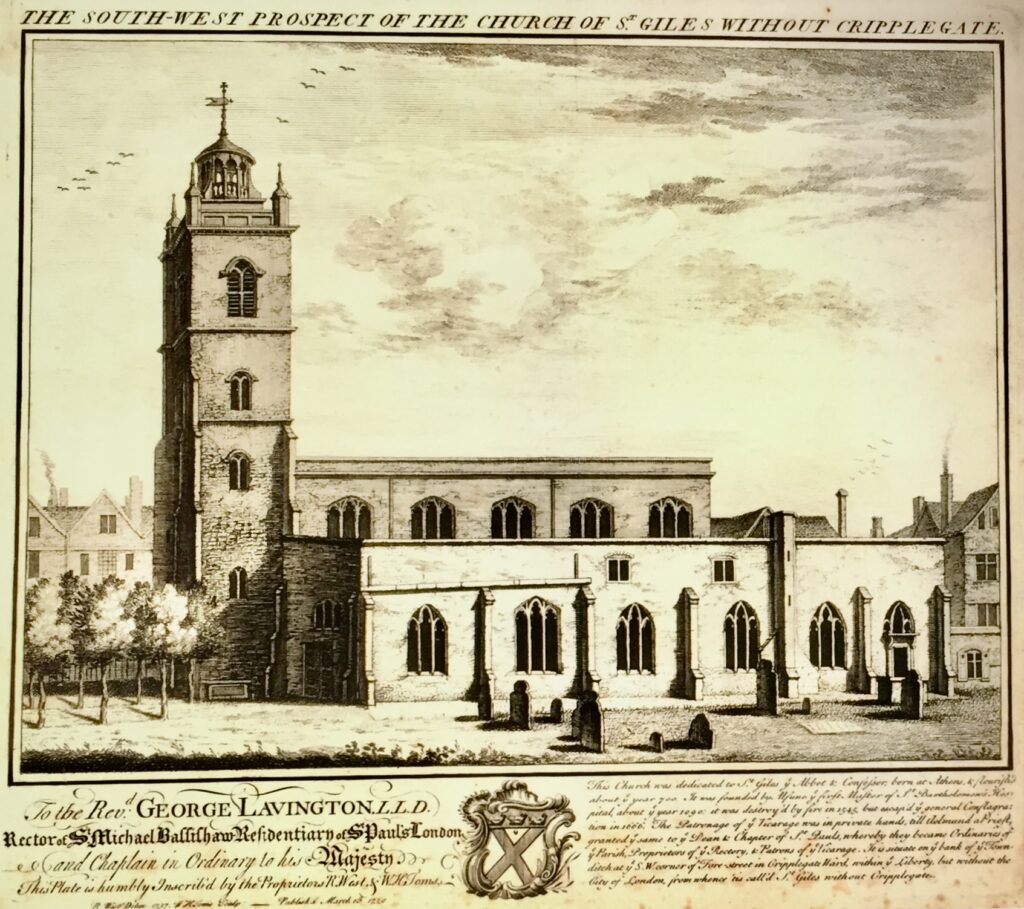
St Giles without Cripplegate survived the Great Fire and it is here where Edward, Shakespeare’s nephew and the illegitimate son of his brother Edmund, was buried in 1607.
Here it is in 1739 in a picture from the British Museum archive described as: View of the church from the graveyard;one of the churches to escape the Great Fire. 1739. Etching and engraving …
The church today …
The Fortune Playhouse once stood in the St Giles parish. In 1600 an Elizabethan entrepreneur, Philip Henslowe, and his leading actor, Edward Alleyn, decided to build a new outdoor Playhouse to the north of the river near Whitecross Street. Although square in shape, the Playhouse was otherwise modelled on the polygonal Globe and built by the same carpenter, Peter Street …
Reconstruction of the theatre, drawn by Walter Godfrey in 1911 based on the builder’s contract …
There is a commemorative plaque in Fortune Street, just off Whitecross Street …
On the north wall of the church is this splendid memorial window …
The design is the work of John Lawson of stained glass studio Goddard & Gibbs and depicts Alleyn in the centre, the Fortune Theatre and St Luke’s Church, Old Street. He holds in his right hand a model of the almshouses which he built in the parish and which were destroyed in the Second World War.
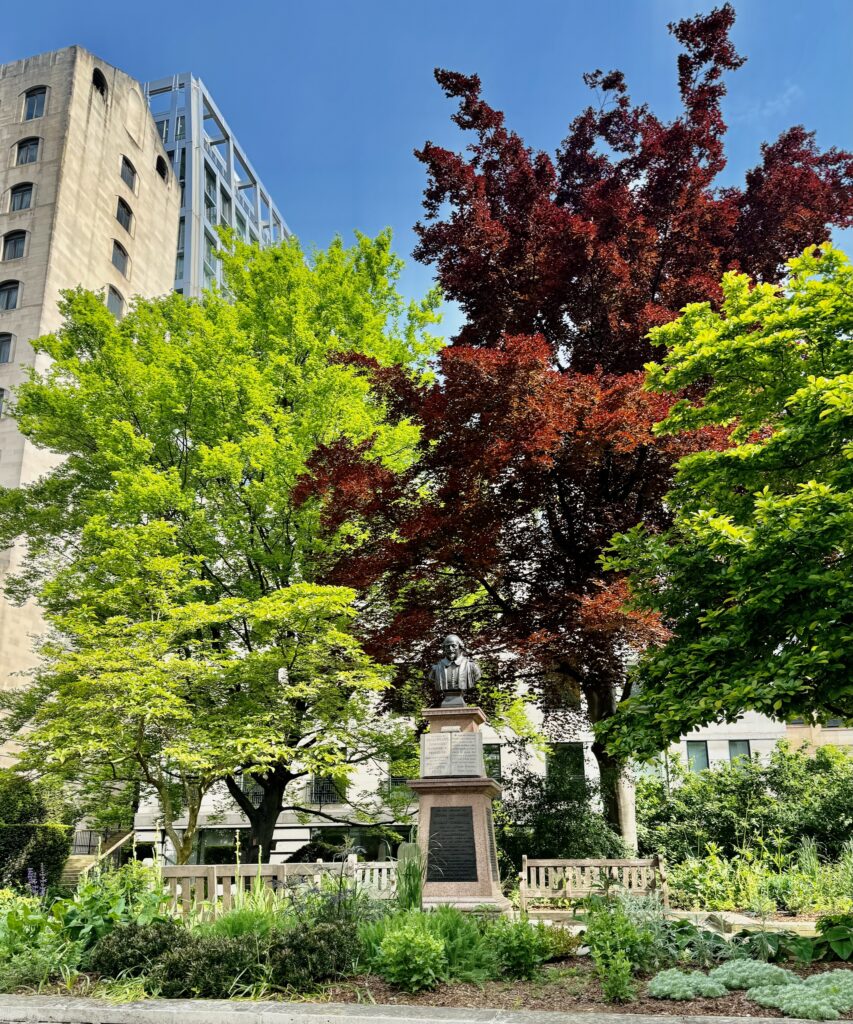
Now to the St Mary Aldermanbury garden (EC2P 2NQ) …
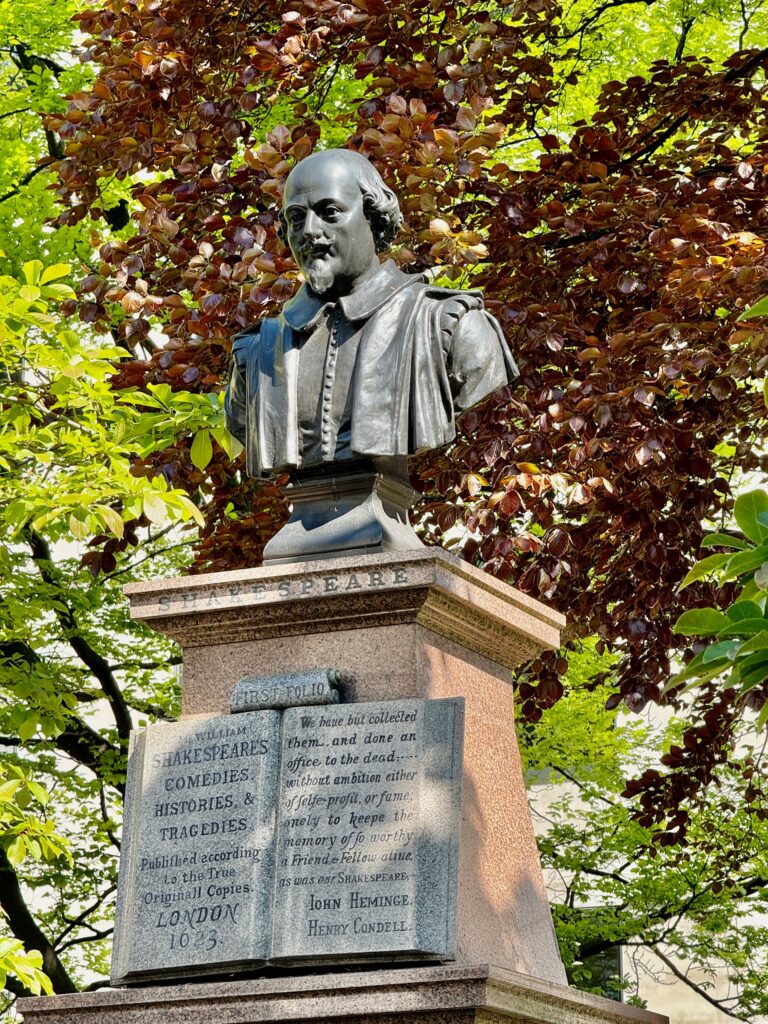
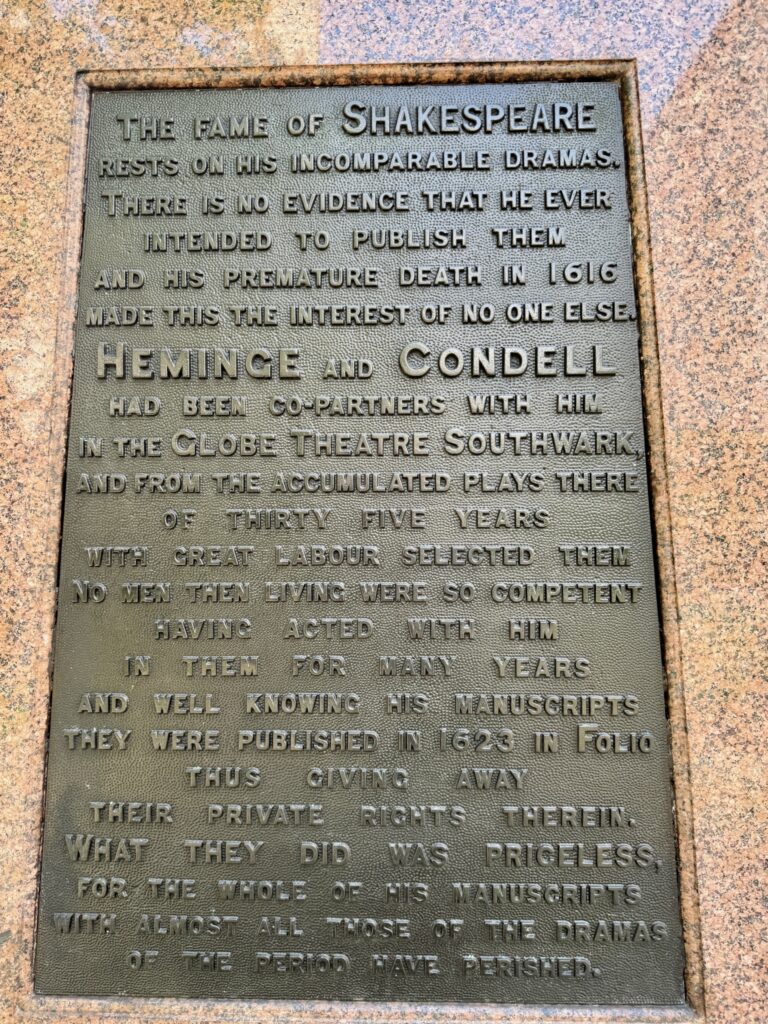
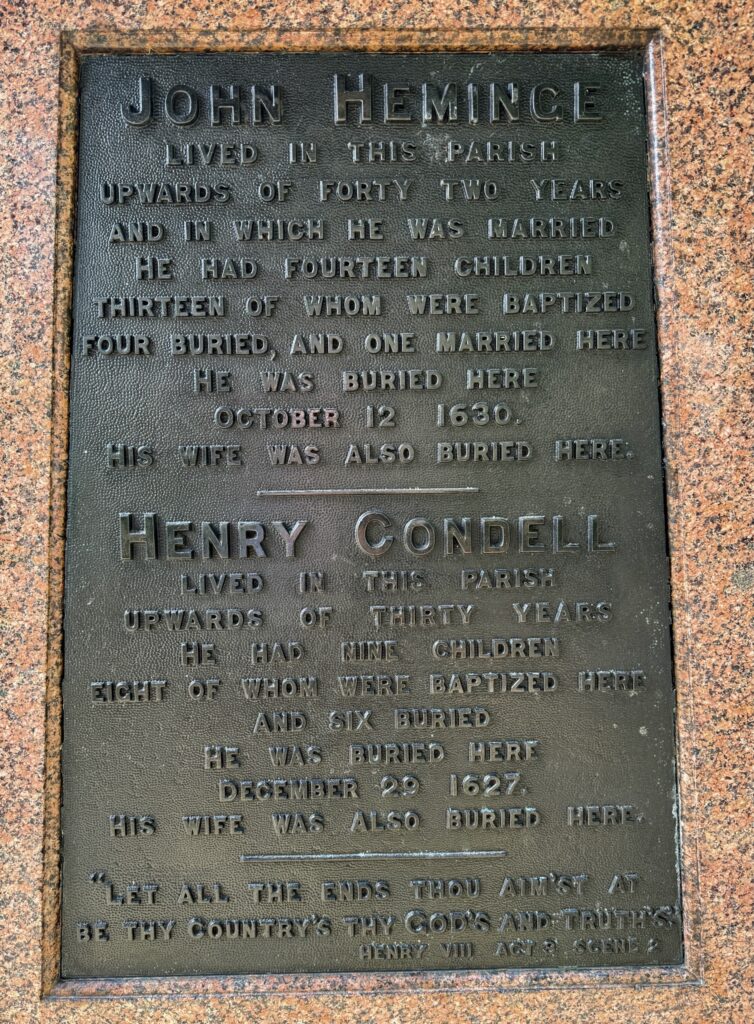
Constructed in 1896, this pink granite monument stands within the former churchyard of St Mary Aldermanbury. Its primary purpose is to honour the First Folio of Shakespeare’s plays, but it also serves as a tribute to Henry Condell and John Heminge, two associates of the Bard who worked with him at the Globe …
They played a cucial role in compiling and printing the First Folio after his death in 1616 …
Both lived nearby and were buried in this churchyard …
The church was gutted in the Blitz with only the walls remaining standing. The stones were subsequently transported to Fulton, Missouri in 1966 and rebuilt in the grounds of Westminster College as a memorial to Winston Churchill who had made his Sinews of Peace, “Iron Curtain” speech in the College gymnasium in 1946.
Finally, to Eascheap and this masterpiece of a building at numbers 33-35. Designed by R L Roumieu and built 1868, today the facade is grade II* listed …
Pevsner describes it as ‘one of the maddest displays in London of gabled Gothic’ and he quotes from Ian Nairn – architectural critic – who calls it ‘the scream that you wake on at the end of a nightmare’.
Look out for the boar’s head peeping out from the foliage …
The animal is a reference to The Boar’s Head Tavern in Eastcheap where Shakespeare set the meetings of Sir John Falstaff and Prince Hal in his Henry IV plays. And see if you can spot the medieval head representing the Prince …
If you want to explore Shakespeare’s London more fully you will find this City of London self-guided walk brilliant and comprehensive (much of this blog is based on it!)
If you would like to read more about the Medieval City Monasteries you can access my blog on the subject here. Similarly, here is my blog about St Giles without Cripplegate. An interesting history of St Olave Silver Street can be found on the Lost London Churches Project website.
If you would like to follow me on Instagram here is the link …