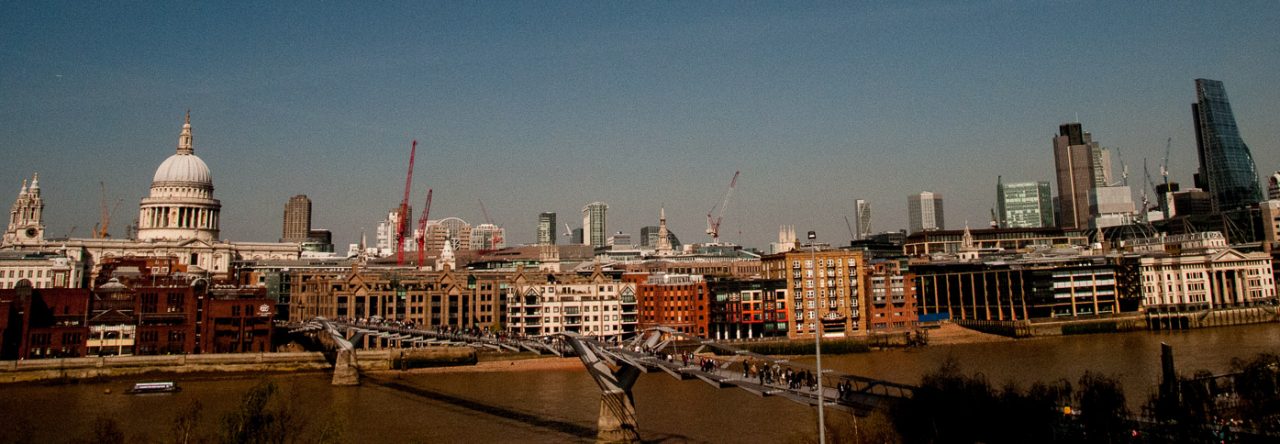
The Central Criminal Court of England and Wales, known the world over as the ‘Old Bailey’, has opened its doors to the public for guided tours this summer and I visited last Saturday. You can book your own visit here and I highly recommend it.
The tour was conducted by two City of London Guides and an Officer of the Court and they gave us a comprehensive history of the building and its location from its time as a prison dating from the 1100s to the present day.
The site was originally the location of the notorious Newgate gaol – a terrible place of disease, death and despair. Here it is circa 1810 … …

The artist Gustave Doré captured its ghastly atmosphere in this portrayal of the exercise yard in 1872 …

On view in the tour are some gruesome artifacts from that time …

In 1783 the site of London’s gallows was moved from Tyburn to Newgate. Public executions outside the prison – by this time, London’s main prison – continued to draw large crowds. This painting by Thomas Rowlandson shows a public execution at Newgate in the late 18th century …

In the centre of the picture three people have been hanged. The area is crammed full of people who have turned up to watch. They even hang out of the windows, and are on the roof of, the building on the left. On the far right a street seller takes advantage of the crowds and is selling his wares from a basket. In the very centre foreground a woman sits on a man’s shoulders in order to get a better look. The last public hanging there was in 1868 and the last one behind its firmly closed doors in 1902.
There were courtrooms attached to the prison but as trials lengthened and the number of those seeking to watch increased in the late nineteenth century the courthouse building became increasingly inadequate. In 1877 a fire forced the City of London to act and proposals were drawn up for a new building. Owing to the dilapidation of Newgate Prison next door, which by the 1860s no longer held long-term prisoners, it was decided to demolish everything on the site to make room for a larger building.
After many delays, the new building, designed in the neo-Baroque style by E. W. Mountford, was finally opened by King Edward VII in 1907. It was lavishly fitted out and adorned with symbolic reminders to the public of its virtuous purpose. On top of the 67 foot high dome a 12 foot gold leaf statue was placed of a ‘lady of justice’ holding a sword in one hand and the scales of justice in the other; she is not, as is conventional with such figures, blindfolded …

Over the main entrance to the building figures were placed representing Fortitude, the Recording Angel and Truth, along with the carved inscription, ‘defend the children of the poor and punish the wrongdoer’ …
The entrance in 1910 …

You enter for the tour via the extension to the building built in 1972 and are then escorted to the old building by the guides.
The first thing you notice is the grandeur of the architecture. This is the circulating area on the ground floor …


Some of my images didn’t turn out as well as I would have liked so the following three are from an excellent blog published by Bryan Jones.
The main staircase …

The dome …

And the stained glass window …

My image from a different angle …

The building was significantly damaged by wartime bombing and subsequently restored …

These lovely murals were one of the results of the restoration work.

In the one above, reference is made to Edmund Hillary and the conquest of Everest. Here he is in the background …

And, guess what, the artist Gerald Moira has included himself as well. He’s the bald headed chap at the back holding his palette …

King John sets his seal to Magna Carta …

And my favourite …
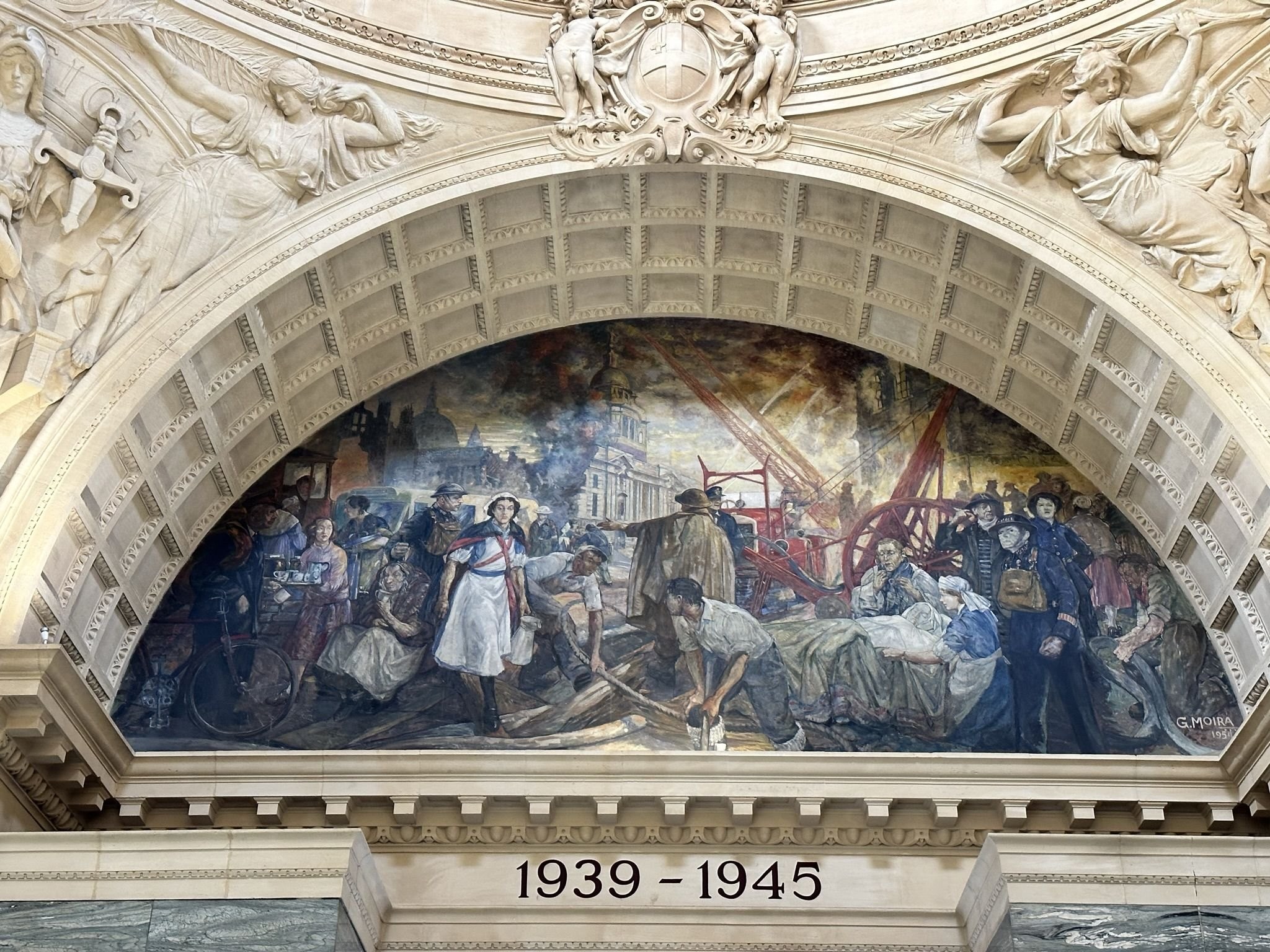
And Gerald is here again, disguised as an old lady clutching a cup of tea!

Elizabeth Fry the prison reformer is commemorated with this statue …

She was a major driving force behind new legislation to improve the treatment of prisoners, especially female inmates, and as such has been called the ‘Angel of Prisons’. She was instrumental in the 1823 Gaols Act which mandated sex-segregation of prisons and female warders for female inmates to protect them from sexual exploitation.
Also commemorated is one of the most important trial outcomes in Britain’s judicial history …

In what came to be known as Bushell’s Case, a landmark ruling ensured the future autonomy of English juries. It also had consequences for jurisprudence in North America, where Penn (incidentally a Quaker like Fry) inspired by the trial, incorporated Magna Carta into the laws of his new colony.
The highlight of the tour was, of course, a visit to the famous Court Number 1 followed by a trip to the cells …

It may be a courtroom but it is pure theatre, and remarkably small and intimate. Unfortunately, photographs are not allowed, but I found this image of the court in 1911. The general layout hasn’t change that much …

Whilst standing in the dock (on the right of the picture), which we were allowed to do, I found it difficult not to think of the disparate people it has temporarily housed over the decades – for example, Ian Huntley and Maxine Carr, Dennis Nilsen, Peter Sutcliffe, the Kray Twins, William Joyce and Dr Crippen. Also poor Timothy Evans, wrongly convicted of murder, hanged in 1950, but eventually pardoned. And tragic Ruth Ellis, the last woman to be executed in the UK in 1956 …

Nowadays, given the evidence available of the abusive relationship she was in, she would probably have only been accused of manslaughter at most.
Defendants access the dock via hidden steps that emerge out of the bowels of the building and descend the same steps at breaks in proceedings or if found guilty – ‘take him down!’ the Judge declares, in all the best movies when sentence has been delivered.
Our guides related some interesting stories regarding famous trials and then we were ‘taken down’ ourselves to the warren of cells below where again pictures were forbidden. We were warned not to press the red buttons on the wall which are used if there is an ‘affray’. It automatically closes and locks all the cell doors and seals off the area – and keys are not kept nearby!
As you walk down the steps oak pannelling gives way to white lavatorial tiles and then white painted walls – there is no doubt you are now in custody even though you are still a ‘defendant’ and not a ‘prisoner’. Not surprisingly, it is a very disturbing experience, even for a temporary visitor. We then went on to visit a more modern court in the 1970s extension – there are 19 courts in all.
If you decide to take the tour I strongly recommend you buy this book beforehand and just have a browse even if you don’t have the chance to read it all …

Moving, thrilling and occasionally very funny, it was one of my most enjoyable reads over the last year.
Also underground on the site is the route taken by condemned prisoners on their way to the gallows …

Known as ‘Dead Man’s Walk’ I did smile when we were told that it was not open to the public due to ‘Health and Safety issues’!
If you would like to follow me on Instagram here is the link …