Walking the City of London

Category: Religion Page 6 of 19

We are but shadows – City Sundials

I was browsing the British Sundial Society website (as you do) and it inspired me to look for examples of these elegant devices in the City. My research also took me on a bit of a journey around Spitalfields, which I hope you enjoy reading about.

Sundials measure local solar time, and were the only source of time for business and government before the invention of the clock, and even then were used to check clock accuracy whilst the mechanisms were still being perfected. The coming of the railways in the early 19th century meant that time needed to be consistently measured throughout the country, and this speeded up clock development. Sundials, however, survived in many places, and are still being manufactured today, serving both a practical purpose along with being aesthetically pleasing.

There are some fine examples in the City, measuring out the minutes using the shadow cast by the sun as it appears to move from east to west, reaching its zenith at mid-day.

On the corner of 107 Cheapside

Completed in 1958 for the Sun Life Assurance Society, the two dials incorporate the company’s sunburst logo.The south facing sundial has the letters GMT under the sun face and covers hours from 8:00 am to 6:00 pm. The west facing sundial also shows the letters GMT in the bottom right corner of the dial and covers the hours 2:00 in the afternoon until 7:00 in the evening.

The building will be familiar to any of you who have had a chance to look at the signs of the Zodiac arranged around its main entrance and described my earlier blog Looking at the Stars.

Sundial Court, Chiswell Street

Once part of the Whitbread Brewery, this dial is now behind locked security gates but is still visible from the road. It is made of wood, with its motto ‘Such is Life’, dating back to 1771. Around the sides it has the interesting inscription Built 1758, burnt 1773, rebuilt 1774.

There is a late 17th Century dial on St Sepulchre’s, Holborn Viaduct.

St Sepulchre-without-Newgate, junction of Snow Hill and Holborn Viaduct

The dial is on the parapet above south wall of the nave and is believed to date from 1681. It is made of stone painted blue and white with noon marked by an engraved ‘X’ and  dots marking the half hours. It shows Winter time from 8:00 am to 7:00 pm in 15 minute marks. I thought it was curious that the 4:00 pm mark is represented as IIII rather than IV – I have no idea why. Across the road is the Central Criminal Court (the Old Bailey) where once stood the notorious Newgate Prison. I wondered if the Newgate executioner might have taken the time from this dial to help him decide when to start the journey to Tyburn scaffold, along with his unfortunate condemned prisoners. (You can read about my recent tour of the Old Bailey here).

If you visit the church, do have a look at the corner of the churchyard where you will find London’s first public drinking fountain as described in another of my earlier blogs Philanthropic Fountains. You also get a good view of Lady Justice, atop the Old Bailey across the road.

Whenever I visit the Inns of Court I like to enter by one of the old gates in Fleet Street – it really is like stepping back in time, from the bustle of the City to the leafy, collegiate atmosphere of the Inns.

A Fleet Street entrance designed by Sir Christopher Wren. The Lamb and Flag is the emblem of Middle temple.

Lane leading from Fleet Street into the Inns

I read somewhere that Dr Johnson used to enjoy swinging round these supporting pillars when he was in an ebullient mood!

There are two fine sundials nearby.

Pump Court, Middle Temple

Reminding the lawyers of their mortality.

And in Fountain Court …

‘Learn justice you who are now being instructed’

The TWT refers to the Middle Temple Treasurer in 1684, William Thursby, a successful lawyer and later MP. He spoke of the study of law as ‘a rough and unpleasant study at the first, but honourable and profitable in the end … as pleasant (and safe and sure) as any profession’.

And now my two favourites.

The Jacobean church of St Katharine Cree in Leadenhall Street was built between 1628 and 1630 and survived the Great Fire of 1666. On the south wall is this wonderful dial, circa 1700, which is described as having ‘gilded embellishments including declining lines, Babylonian/Latin hours and Zodiac signs’. Its Latin motto Non Sine Lumine means Nothing without Light.

And finally, this dial in Fournier Street.

Once a Protestant church, then a Methodist Chapel, next a Jewish synagogue and now the Brick Lane Mosque

In the late 17th century some 40-50,000 French Protestants, known as Huguenots, fleeing persecution in France, arrived in England with around half settling in Spitalfields. They started a local silk-weaving industry and, incidentally, gave us a new word ‘refugee’ from the French word réfugié, ‘one who seeks sanctuary’. They flourished and established this church in 1743 naming it La Neuve Eglise (The New Church) and installed the sundial we can see today with the poignant inscription Umbra Sumus – ‘We are shadows’.

Typical weavers’ houses in Fournier Street

Driven out by the decline of the weaving trade and anti-French feeling, the Huguenots slowly dispersed and their church was for a while taken over by ‘The London Society for promoting Christianity among the Jews’. Not being very successful, they moved out after ten years and the next tenants were John Wesley’s Methodists, who refurbished the building.

From the 1880s onwards, the East End population underwent another significant upheaval as thousands of Jews arrived fleeing poverty, pogroms, war and revolution. Many settled  in Spitalfields and Whitechapel, close to where they arrived in the docks, setting up numerous businesses.

‘Ghost sign’ for Amelia Gold’s business, 42 Brushfield Street

Built in the 1780s, in the 1880s this shop was once the business premises of a Jewish immigrant from Hungary, a lady called Amelia Gold. Describing herself as a ‘milliner’ indicates that she was a very accomplished, professional maker of ladies’ hats rather than simply a retailer.

The famous entertainer Bud Flanagan was born nearby. His parents Wolf and Yetta (Kitty) Weintrop were Polish Jews who set off for New York in order to flee the pogroms. Sadly for them, a dishonest ticket agent sold them a ticket that only took them as far as London, where they eventually set up a barber shop and tobacconist.

12 Hanbury Street

By the late 19th Century the Methodists had left and the building became the Spitalfields Great Synagogue. However, as the 20th century wore on, many Jews were leaving the East End and the synagogue relocated to Golders Green in 1970. During the 1970s, the area became populated mainly by Bangladeshis who had come to Britain looking for work and often found it in factories and the textile trade. That growing community required a place of worship, and the building was bought and refurbished. In 1976, it reopened as a mosque, the London Jamme Masjid. Today, although it has been renamed, it still serves the Bangladeshi community as a mosque.

A while ago, The Economist ran an article about multicultural London and I would like to end with two quotes from it that I particularly liked since they reference the building.

Because it is a human entrepôt, Spitalfields remains one of London’s poorest and most conservative districts; but now, for the same reason, it is also among the hippest. When old men in traditional dress congregate beneath the mosque’s prophetic sundial, immodestly clad young women weave between them

And …

The mosque is a bricks-and-mortar correction to those Britons who think that immigration is a new and harmful phenomenon

Well said.

If you would like to follow me on Instagram here is the link …

https://www.instagram.com/london_city_gent/


A wander around Whitecross Street and Old Street (plus my old record collection!)

To start with I lingered among the street-food stalls that appear every weekday and seem to do a roaring trade now that City workers are back (even though many of them only come in Tuesdays to Thursdays).

My favourite stand …

Lots more to choose from …
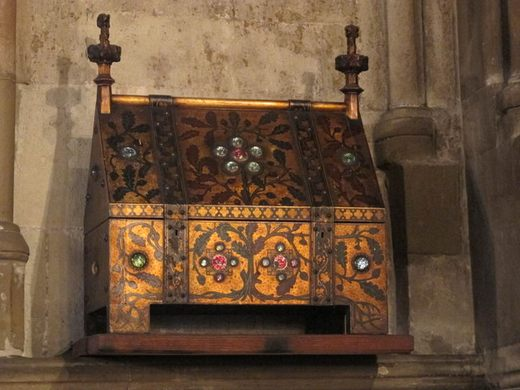
Some are award winners!

Spring by Jimmy C – nice to see this mural without cars parked in front of it …
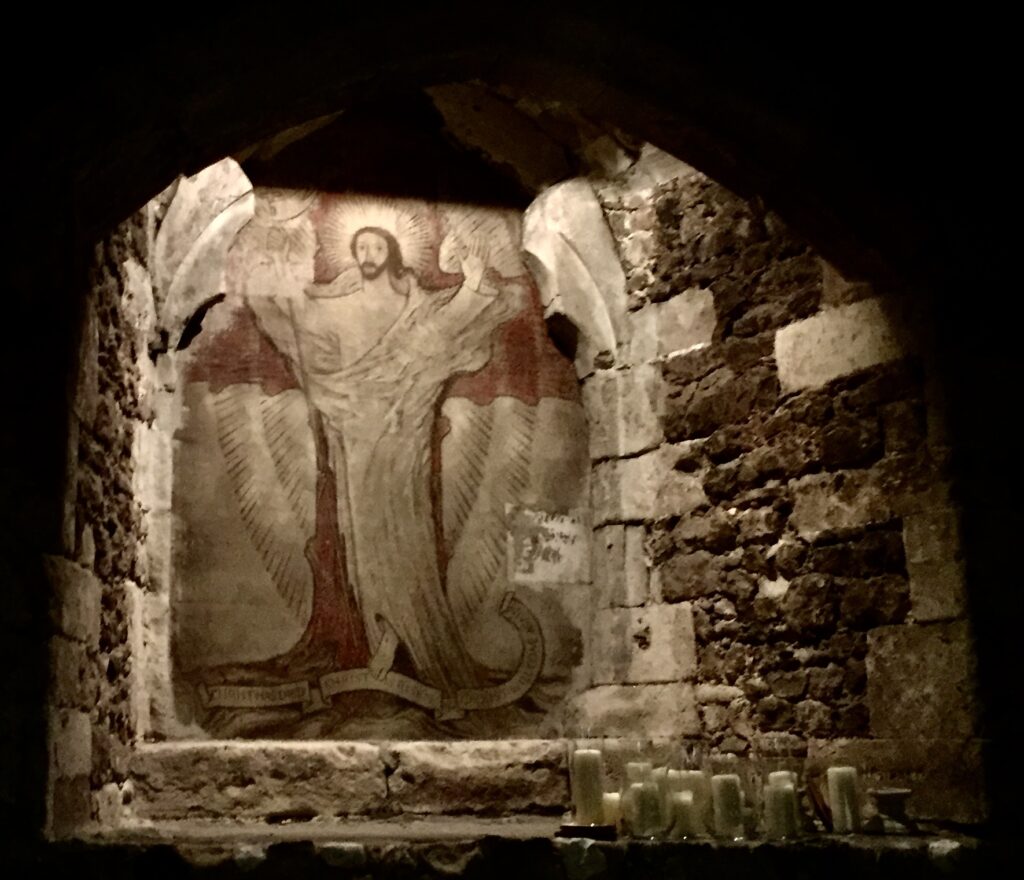
Miaow!

More street art …
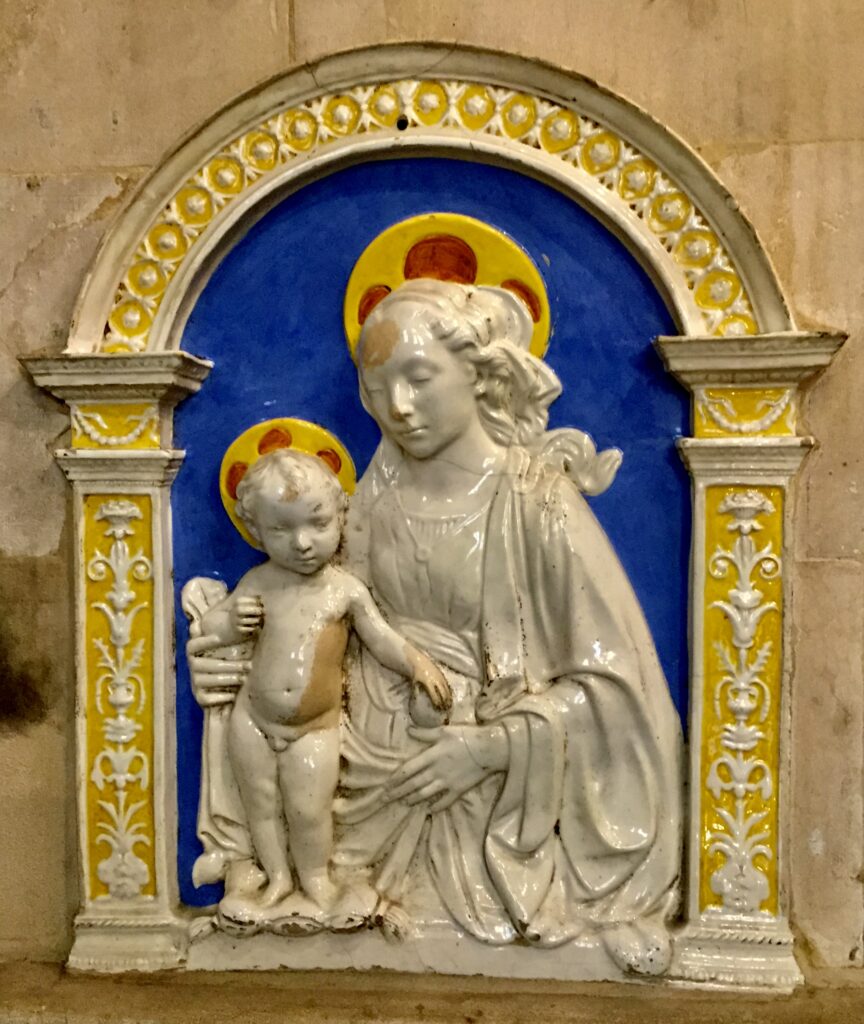
One of my favourites ..

Made me smile …

The following words in italics come from the St Luke’s Conservation area document. The images are mine.

Central and pivotal to the conservation area St. Luke’s Church, dating from
1733, designed by John James and Nicholas Hawksmoor, is one of London’s
most important churches.

The church is now refurbished as a rehearsal,concert and education centre for the London Symphony Orchestra. The unusual obelisk spire is a major local landmark, with important views downWhitecross Street.

Surrounding the church is the churchyard and burial ground, now a public open space, with fine plane trees, railings and tombs.

Fronting onto these spaces are several important groups of Georgian and Victorian buildings which are of architectural and historic interest and which contribute to the setting of the church.

There is a tomb in the churchyard which is often described as the family tomb of William Caslon (1692-1766) …

He was the first major letter founder in London and, nearly three centuries later, remains the pre-eminent letter founder this country has produced. Before Caslon, there was little letter founding in Britain and most type was imported – even Shakespeare’s First Folio was printed with French type. But Caslon’s achievement was to realise designs and produce type which have been widely used ever since. And it all happened here, around the eastern fringes of the City of London. The Caslon family tomb stood just yards from where William Caslon started his first letter foundry in Helmet Row in 1727.

Here is a specimen of his typefaces from 1734 …

There is a special edition of the Spitalfields Life blog devoted just to him – William Caslon, Letter Founder.

However, when I looked more closely at the tomb inscription, the name I saw was Thomas Hanbey …

A mystery!

But here’s a quote from The Typefoundry blog of December 2007 (my emphasis) …

‘T. B. Reed … wrote that the Caslon tomb was kept in repair by a bequest from Mary Hanbey, daughter of William Caslon I, who died in January 1797. In fact it is clear from her will that the present tomb, which she paid for, replaced the original monument of the Caslon family, and was dedicated to her husband Thomas Hanbey, who had been born in Sheffield and died in 1786. He was a Liveryman of the Ironmongers’ Company and Master of the Company in 1775 …’

In any event, hopefully the remains of the remarkable Mr Caslon are still there somewhere, so I shall keep my tribute to him in this blog.

The church spire was topped by an unusual weather vane depicting the head of a dragon with a fiery comet-like tail. Apparently this was misinterpreted locally as a louse, and by the mid-20th century had gained the church the nickname ‘lousy St Luke’s’ …

Parish Boundary bollard for ‘St Luke’s Middlesex’ …

Walking east along Old street, look up for the Salvation Army ghost sign …

‘Hostel for working men. Cheap beds and food’.

And finally, number 116, now appropriately renamed Stylus, used to be the Margolin Gramophone Company factory …

They manufactured the Dansette record player – a name very familiar to us baby-boomers …

I had a portable one just like this …

Cool!!!

In those days I could pop some of my vinyl collection into a handy little carrying case and take it when visiting friends. And, guess what, I still have it! …

And there are still records in it …

A small sample …
It was my mum who liked The Bachelors, honest.

This was a very controversial 1965 hit around the world …

Listen to it and you will see why. It was the time of the Vietnam War and the year when Martin Luther King organised a march from Selma to Birmingham, Alabama, which began on 7 March 1965 with around 600 marchers taking part. When the marchers reached the outskirts of Selma they were attacked by state troopers and local police.

Here’s a link to the recording along with video footage.

The Wikipedia link about the song can be found here.

If you would like to follow me on Instagram here is the link …

https://www.instagram.com/london_city_gent/

It’s Christmas decorations time – let’s get in the mood!

Yes, it’s that time when I go out and about trying to capture a bit of decorative joy before the Festive Season begins in earnest.

And what better place to start than the stunning display at the Leadenhall Building, fondly known by all as The Cheesegrater …

I love the arch through the tree …

It’s also home to Emma Smith’s neon artwork We (2019).

We are alone …

We are all one …

Read all about the thoughts behind its design here.

Whilst there I enjoyed a rather lovely lunch at Bob Bob Ricard which is situated on the third floor …

The view from the lift …

The Gherkin, my favourite modern City building …

Another beautiful piece of architecture, King’s Cross Station …

Outside the Station …

At The Landmark Hotel …

On London Wall …

Illumino at City Point …

Also at City Point …

At the Barbican …

Just off Bishopsgate …

And finally, something a bit bonkers near Great Ormond Street that made me smile …

Little aliens have landed on a post box …

If you would like to follow me on Instagram here is the link …

https://www.instagram.com/london_city_gent/

Page 6 of 19

Powered by WordPress & Theme by Anders Norén

Symbols & Secrets
Privacy Overview

This website uses cookies so that we can provide you with the best user experience possible. Cookie information is stored in your browser and performs functions such as recognising you when you return to our website and helping our team to understand which sections of the website you find most interesting and useful.