Walking the City of London

Category: Religion Page 5 of 19

St Bartholomew the Less – an arithmetical memorial and some very spectacular tights!

Poor St Bartholomew the Less has had a tough time (EC1A 9DS). Designated ‘the less’ to distinguish it from its better known namesake nearby, it has also had to be substantially rebuilt a number of times including the need to repair damage inflicted in the Blitz. Nonetheless, it is a fascinating place containing many interesting historical monuments.

To find its modest doorway you must enter the grounds of St Bartholomew’s hospital through the Henry VIII gates and look to your left. Inside a rather spooky white hand directs you up stairs to the main body of the church …

It was once a parish church in its own right, the parish boundary being the walls of the hospital. The parishioners were made up of the hospital staff and patients and at one time attendance at services was compulsory for all who were fit enough. It was the only parish of this nature in existence but since 2015, however, it has become part of the Parish of St Bartholomew the Great.

There are many features to admire but, for reasons of space, I have tried to pick some of the most interesting and will look at others in a future blog.

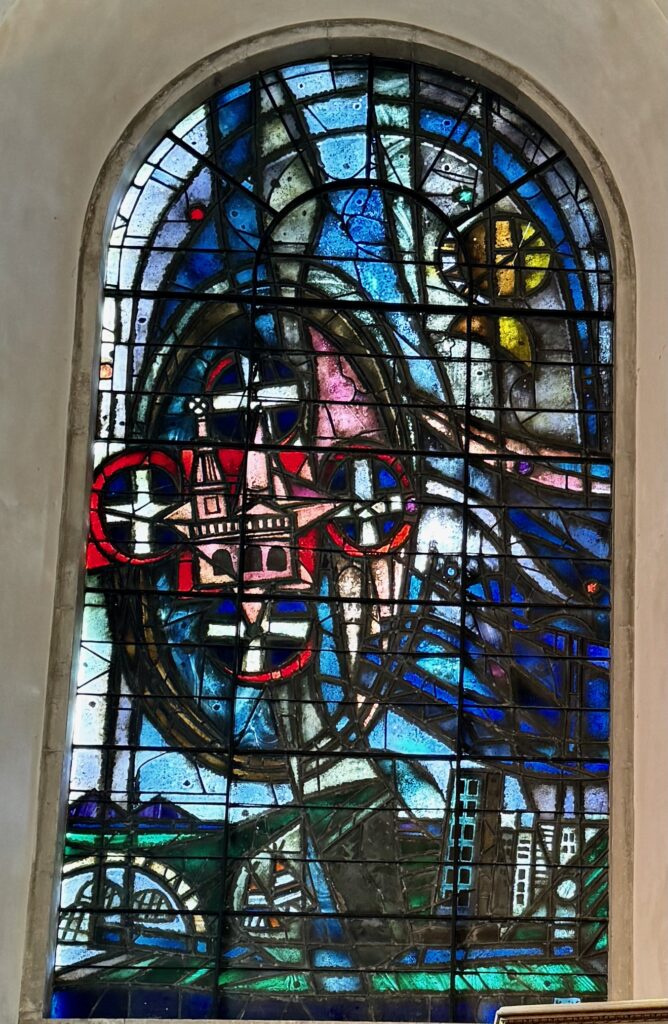
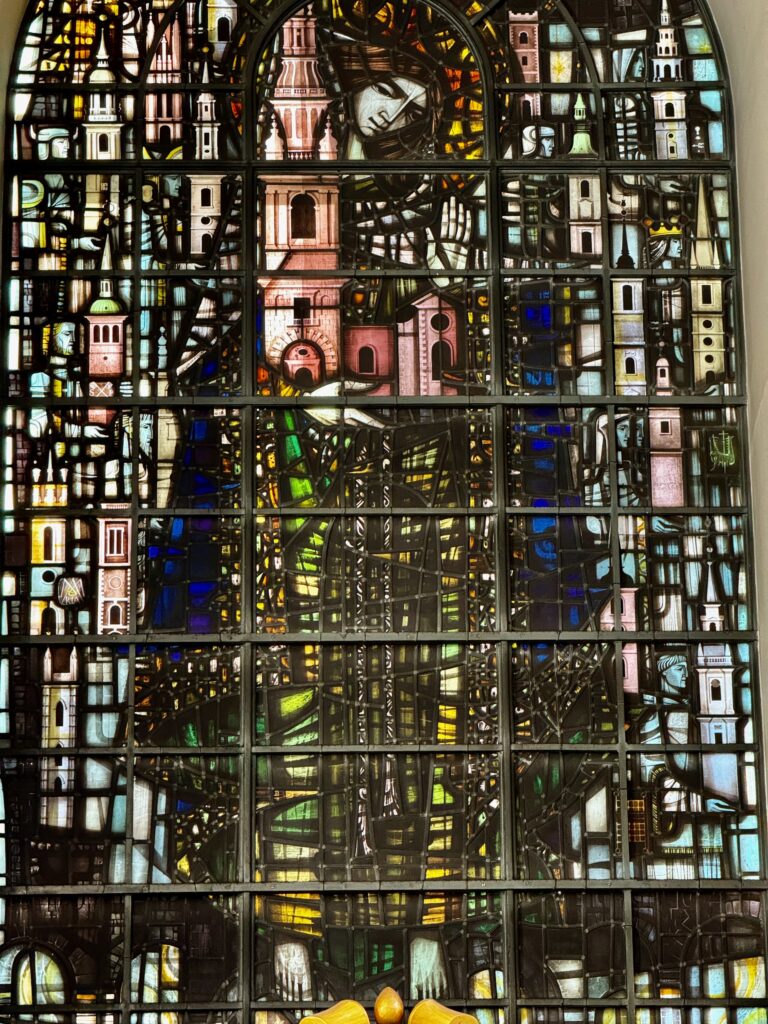
This stained glass commemorates the founding of he monastic complex of St Bartholomew in 1123. The person responsible was Rahere, a courtier to Henry I, who was inspired by a vision of the saint whilst recovering from a serious illness …

Rahere is shown kneeling and beneath his cassock is rather a surprise. He is wearing some very colourful tights, a reference to the fact that he’s often referred to as a minstrel or jester as well as a courtier …

High up on the south wall is the memorial to Robert Balthrope, Sergeant Surgeon to Queen Elizabeth I …

The inscription reads …

Here Robert Balthrope Lyes intombed,
to Elizabeth Our Queene
Who Sergeant of the Surgeons Sworne,
Neere Thirtye Yeeres Hathe Beene
He Died at Sixtye Nine of Yeeres,
Decembers Ninthe The Daye
The Yeere of Grace Eight Hundred Twice

Deductinge Nine A waye.
Let Here His Rotten Bones Repose
Till Angells Trompet Sounde
To Warne The Worlde of Present Chaunge
And Raise the Deade From Grounde.

He died in 1591, but the poet who devised this eulogy presumably had a problem getting 1591 to rhyme with anything. So he chose the frankly odd solution of asking the reader to do some mental arithmetic – ‘The Yeere of Grace Eight Hundred Twice’ (i.e. 800 x 2 = 1600) Deductinge Nine A waye (1600 – 9 = 1591).

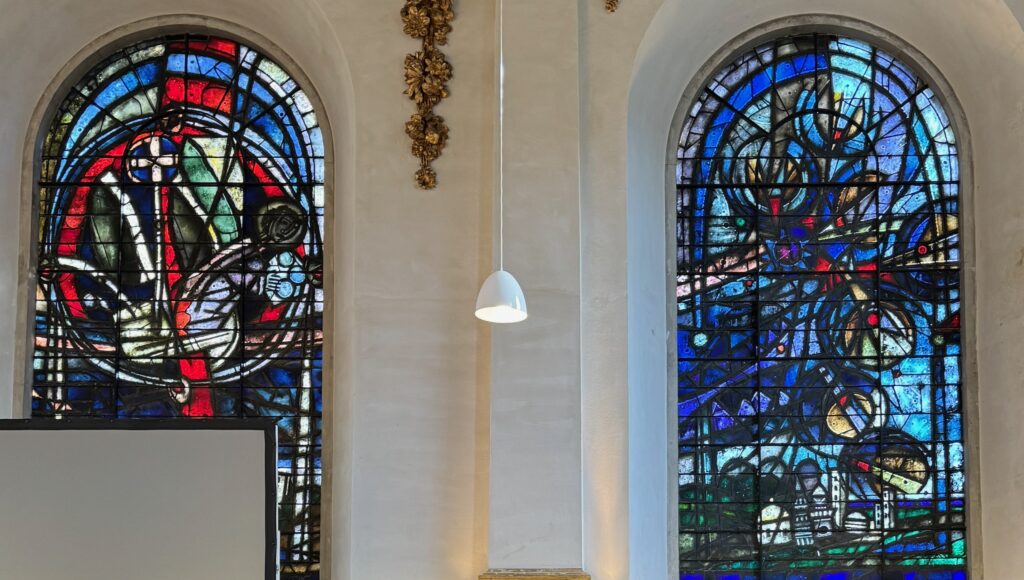
The current windows in the church were designed by Hugh Easton, following the loss of the earlier windows during World War Two. Easton was an eminent stained glass maker who also designed the Battle of Britain memorial window in Westminster Abbey. The design of the nurse in the window in Westminster Abbey is strikingly similar to that in the window here …

The doctors’ memorial window …

The mid-19th century alabaster pulpit depicts Christ healing the sick …

On the east wall is the poignant memorial plaque to Arthur Jermyn Landon …

The reflections make it difficult to read so here it is in full …

His former medical contemporaries at St Bartholomew’s Hospital have set up this tablet to keep in memory the bright example of ARTHUR JERMYN LANDON Surgeon Army Medical Department who, while continuing to dress the wounded amid a shower of bullets in the action on Majuba Hill, was in turn mortally wounded. His immediate request to his assistants “I am dying do what you can for the wounded” was characteristic of his unselfish disposition. His habitual life was expressed in the simple grandeur of his death. He was born at Brentwood Essex 29th June 1851. Died two days after the action at Mount Prospect South Africa 1st March 1881.

Here he is in an image of him dated 1881 held at the Wellcome Foundation …

The elaborate memorial to John and Mary Darker (Died 1784 and 1800) …

Before you leave, look to the right of the door and you will see the tomb of Surgeon John Freke (1688-1756) …

English History Online has the following to say …

… a remarkably curious tomb of the fireplace kind, most elaborately wrought. It is the tomb of Freke, the senior surgeon of St. Bartholomew’s Hospital, who wrote many works upon surgery, still to be found in its library. His bust is to be seen in the museum of the hospital, and he is represented by Hogarth, in the last plate of “The Stages of Cruelty,” presiding aloft over the dissecting-table, and pointing with a long wand to the dead “subject,” upon whom he is lecturing to the assembled students.

And here it is …

You can read more about Hogarth’s The Four Stages of Cruelty here.

Look back after leaving the church and observe the oldest parts of the building, the 15th-century tower and west end of the church …

Within the tower are three bells, the oldest being cast in 1380. The bells are hung in the original wooden frame thought to be the oldest in London.

Remember you can follow me on Instagram …

https://www.instagram.com/london_city_gent/

The oldest Catholic church in England (and do you know anyone called Audrey?)

Last week I mentioned my visit to St Etheldreda’s church in Ely Place and promised to return, which I duly did on a lovely sunny Monday morning this week.

Ely Place was until relatively recently considered to be a part of Cambridgeshire. For centuries, it was an enclave – an area of land physically located in the City of London but not under its jurisdiction. Instead, it was privately owned by the Bishops of Ely, and even today the street has its own gatehouse and beadles …

The houses date from the 1770s.

Tucked away down a narrow passage on the left is the quaint Ye Olde Mitre pub. When I first visited it back in the 1970s it kept shorter ‘Country’ rather than ‘City’ opening hours …

Further north along Ely Place the church of St Etheldreda is set back from the road …

The original name of the saint celebrated here was Æthelthryth and this eventually evolved into Etheldreda which, in turn, sometimes became pronounced Audrey (a girl’s name now somewhat out of fashion). This explains the naming of the late Victorian block of flats called Audrey House that nudge up against the church itself …

The Bishop of Ely once had a palace in London back in the 13th century. To get an idea of the extraordinary wealth of the church before the Dissolution of the Monasteries by Henry VIII, this is a section of the so-called Agas map of 1561 in which my fellow blogger London Inheritance has marked the streets that formed the boundaries to the Bishop’s land …

You can see the name Ely Place and St. Andrew’s church just to the right of where he has marked Holborn.

A private chapel was built alongside the palace dedicated to St Etheldreda, the nun who founded the first religious house in Ely in the 7th Century and is the saint to whom Ely Cathedral was dedicated. The chapel here dates from the late 13th Century and is one of the few buildings in London surviving from the reign of Edward I since it escaped the flames of the Great Fire in 1666 (although it was severely damaged following an air raid during the Second World War).

As soon as you enter you know you are in a rather special place …

Before descending into the crypt, there is an interesting feature just to the right of the door …

It was found when the site was excavated but its original purpose has never been established, although some have suggested it is the remains a Roman font.

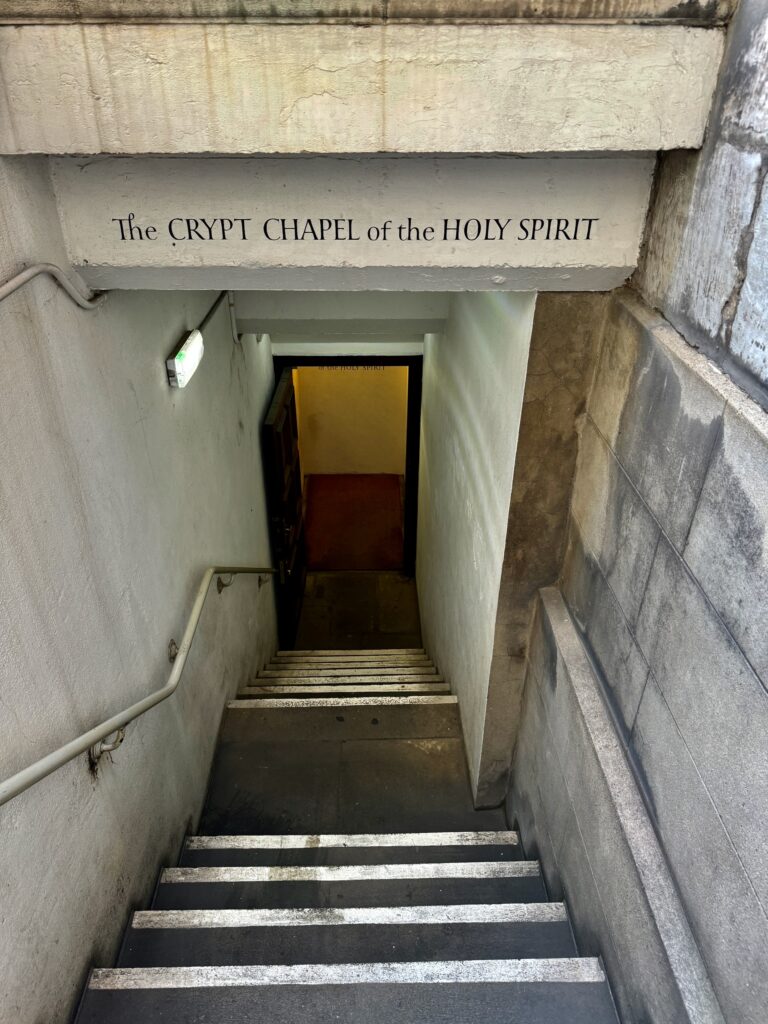
Down the steps into the crypt …

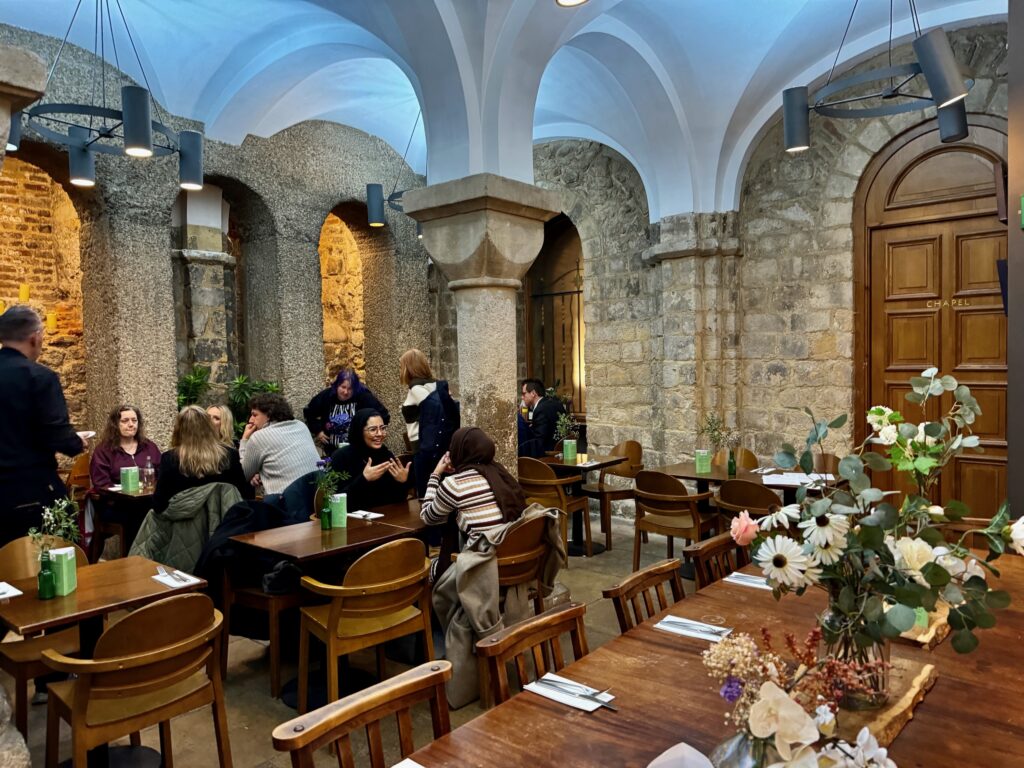
When I visited the space was laid out for a function of some kind …

Some of the niches surrounding the venue …

Back upstairs now to the upper church.

On the way you pass a Royal coat of arms which commemorates the reopening of the church after bomb damage repair on 2nd July 1952 …

Also this memorial to William Lockhart

The upper church is a beautiful, spiritual place with some stunning post-War stained glass …

In the centre of the east window is Christ whilst at the apex God the Father surmounts the choir of angels …

To the left of Mary, the Mother of God, stands St Etheldreda, holding an image of the monastery she founded …

The west window is dedicated to the English martyrs. Five martyrs, each holding a palm, stand underneath the Tyburn gallows …

Martyrs hang on the ‘Tyburn Tree’ prior to being ‘drawn and quartered’ …

They are also commemorated with statues standing on corbels along both sides of the upper church. Here are three of them, all executed at Tyburm.

Anne Line, a sempstress, martyred in 1601 …

John Roche, a Thames Waterman, martyred in 1588 …

Edward Jones, a Welsh gentleman, martyred 1590 …

Alas there was no sign of the reliquary containing part of the saint’s ‘uncorrupted’ hand that I mentioned in my last blog. Presumably it’s stored away for safe keeping.

Overall St Ethelreda’s is a calm, welcoming place – ideal for quiet contemplation away from the hustle and bustle of the city. I’d strongly recommend a visit both for that reason and for its historical importance.

If you want to read more about the church and the area go to the excellent London Inheritance blog. If you visit the church do purchase the guide book – it is very well written with excellent illustrations …

If you would like to follow me on Instagram here is the link …

https://www.instagram.com/london_city_gent/

Spooky special edition!

I know Halloween ended a few days ago but it did inspire me to look again at spooky aspects of the City and produce a special edition. I was also enthused by a quite extraordinary house I encountered in a trip to Hampstead which had totally embraced the Halloween spirit. Here’s a sample …

More later.

What better place to start in the City than Samuel Pepys’s ‘own church’, St Olave Hart Street.

It has a really gruesome but stunning churchyard entrance incorporating impaled skulls and crossed bones dated 11th April 1658. The Latin inscription, roughly translated, reads ‘Christ is life, death is my reward‘ and the central skull wears a victory wreath.

Charles Dickens called it ‘St Ghastly Grim’.

It’s even more disturbing becuse the banked-up surface of the churchyard is a reminder that it is still bloated with the bodies of plague victims, and gardeners still turn up bone fragments. Three hundred and sixty five were buried there including Mary Ramsay, who was widely blamed for bringing the disease to London. We know the number because their names were marked with a ‘p’ in the parish register.

Note how much higher the graveyard is than the floor at the church door.

The crypt of the ‘Journalists’ Church’, St Brides in Fleet Street, is home to a fascinating museum containing an extraordinary coffin …

Until well into the 18th century the only source of corpses for medical research was the public hangman and supply was never enough to satisfy demand. As a result, a market arose to satisfy the needs of medical students and doctors and this was filled by the activities of the so-called ‘resurrection men’ or ‘body snatchers’. Some churches built watchhouses for guards to protect the churchyard, but these were by no means always effective – earning between £8 and £14 a body, the snatchers had plenty of cash available for bribery purposes. A tempting advertisement …

The idea was not popular with the clergy and in 1820 the churchwardens at St Andrew’s Holborn refused churchyard burial to an iron coffin. The body was taken out and buried, which led to a law suit. The judgment was that such coffins could not be refused but, since they took so much longer than wooden ones to disintegrate, much higher fees could be charged. This no doubt contributed to the relatively short time iron coffining was used.

St Brides also contains a charnel house, only opened by special arrangement. As you walk around the crypt, bear in mind that there are quite a few old Londoners resting nearby …

The primary customers for fresh corpses were the trainee surgeons at St Bartholomew’s Hospital so it’s no surprise that the nearby church of St Sepulchre had its own watchhouse. Sadly this was destroyed in the Blitz but there is a charming replica that you can see today …

Just around the corner is the entrance to the church so do call in if you can and visit a grim reminder of the days of the notorious Newgate Gaol and public executions.

Carts carrying the condemned on their way to Tyburn would pause briefly at the church where prisoners would be presented with a nosegay. However, they would already have had an encounter with someone from the church the night before. In 1605, a wealthy merchant called Robert Dow made a bequest of £50 for a bellman from the church to stand outside the cells of the condemned at midnight, ring the bell, and chant as follows:

All you that in the condemned hole do lie, Prepare you, for tomorrow you shall die; Watch all and pray, the hour is drawing near, That you before the Almighty must appear; Examine well yourselves, in time repent, That you may not to eternal flames be sent: And when St. Sepulchre’s bell tomorrow tolls, The Lord above have mercy on your souls.

And you can still see the bell today, displayed in a glass case in the church …

About five minutes’ walk away is the beautiful church of St Bartholomew the Great inside which is what I think is one of the most disturbing sculptures in the City …

Entitled Exquisite Pain, as well as his skin St Bartholomew also holds a scalpel in one hand and a pair of scissors in the other. The second surprise, to me anyway, was that this work was by Damien Hirst, the modern artist known particularly for his spot paintings and the shark swimming in formaldehyde. St Bartholomew is the patron saint of Doctors and Surgeons and Hirst has said that this 2006 work ‘acts as a reminder that the strict demarcation between art, religion and science is a relatively recent development and that depictions of Saint Bartholomew were often used by medics to aid in anatomy studies’. He went on to say that the scissors were inspired by Tim Burton’s film ‘Edward Scissorhands’ (1990) to imply that ‘his exposure and pain is seemingly self- inflicted. It’s kind of beautiful yet tragic’. The work is on long-term loan from the artist …

There’s nothing like a nice relic – even if it’s not on open display.

This is St Ethelreda’s Roman Catholic church in Ely Place (a road strange in its own right since it is privately managed by its own body of commissioners and beadles) …

The building is one of only two surviving in London from the reign of Edward I and dates from between 1250 and 1290. It is dedicated to Aethelthryth or Etheldreda, the Anglo-Saxon saint who founded the monastery at Ely in 673. According to the story, sixteen years after she died of the plague her body was exhumed in 695 and was found to be pure and uncorrupted with even her clothes having miraculous properties. Although her body has been lost it is said that her uncorrupted hand still rests in a casket in this church.

Unfortunately, this reliquary is kept beside the high altar and I couldn’t gain access so we must make do with an online image …

Nevertheless, it wasn’t a wasted visit. The church is a fascinating place as can be seen from some of the images I did take …

So I shall be back.

And finally, the Hampstead house on Flask Walk that truly embraced the spirit of Halloween.

Disabling the burglar alarm …

Hilarious!

The gang’s all here …

Welcome!

If you would like to follow me on Instagram here is the link …

https://www.instagram.com/london_city_gent/

Page 5 of 19

Powered by WordPress & Theme by Anders Norén

Symbols & Secrets
Privacy Overview

This website uses cookies so that we can provide you with the best user experience possible. Cookie information is stored in your browser and performs functions such as recognising you when you return to our website and helping our team to understand which sections of the website you find most interesting and useful.