Walking the City of London

Category: Quirky Page 25 of 26

Things that made me smile!

One of the great pleasures of writing this blog is that I am constantly coming across things that make me smile. Since I am still in a lighthearted Christmas mood, I thought I would share some of them with you and hope you find them amusing too.

I wrote about the First World War Cyclist battalions in an earlier blog and then came across this recruitment poster for the S. Midland Divisional Cyclist Company.
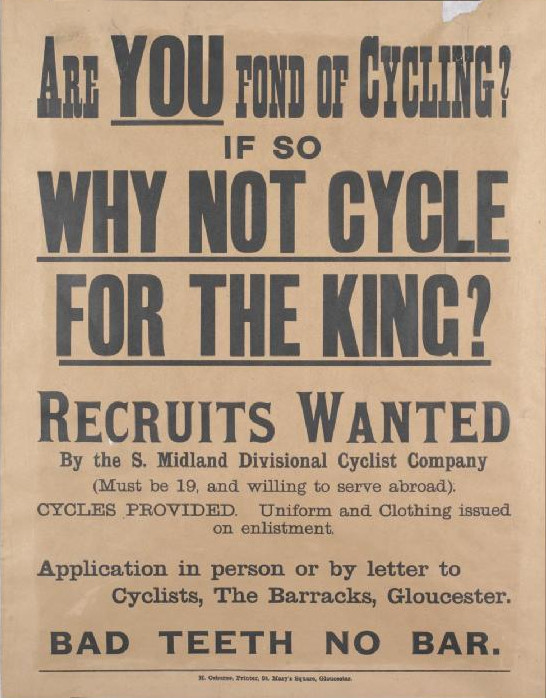
Dental hygiene was poor at the time and so it was obviously necessary to stress that you didn’t need a perfect set of gnashers to be accepted by the Company.

In Postman’s Park in the City is the Memorial to Heroic Self Sacrifice consisting of 54 plaques commemorating the bravery of ‘humble’ individuals who gave their lives to save others. No disrespect intended to the brave John Cranmer Cambridge, but I did smile when I noticed that his act was apparently more noble since he saved not only a stranger but also a ‘foreigner’.
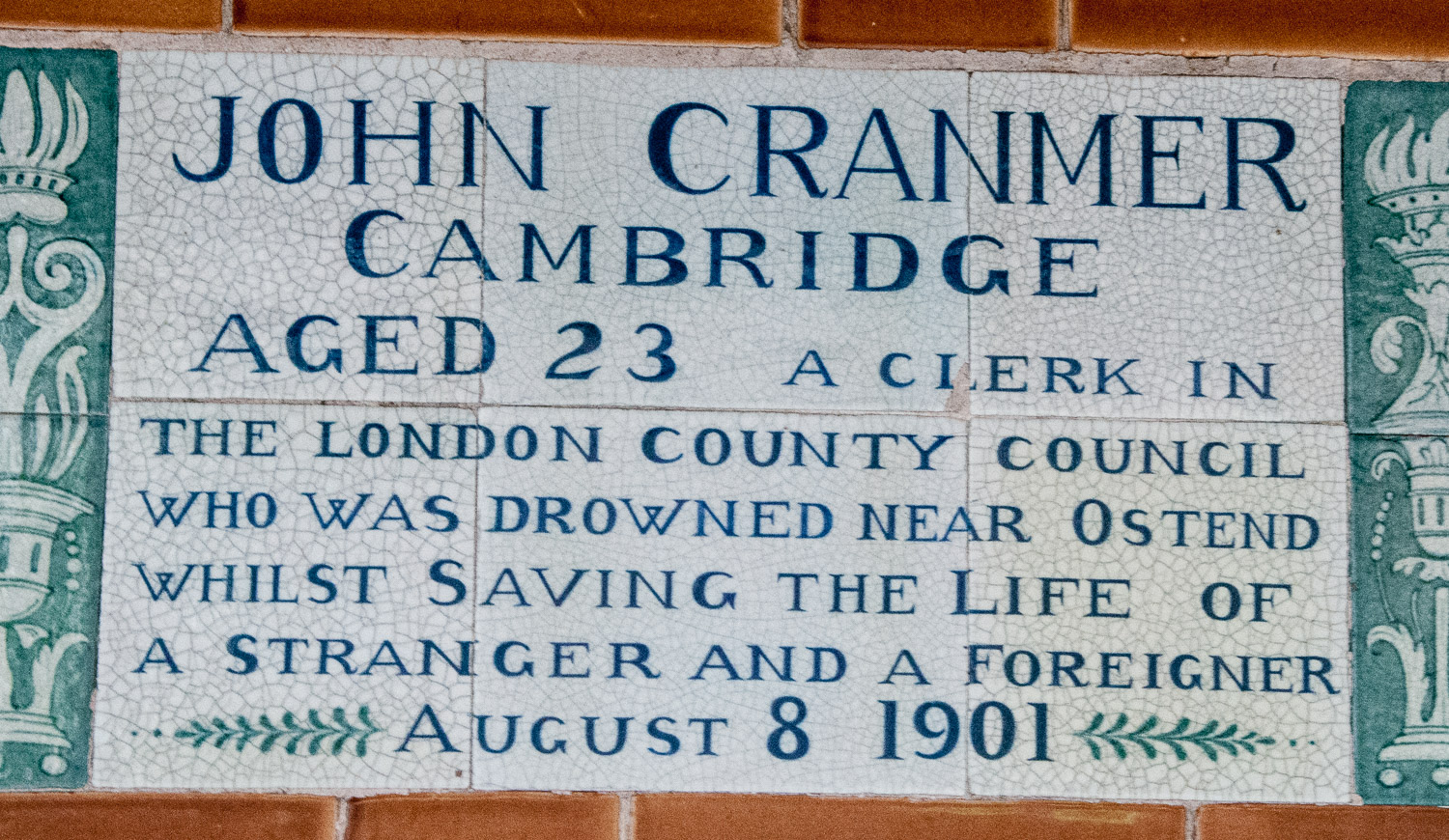
The plaques were the idea of the painter G.F. Watts and the wording on John Cambridge’s seems to reflect Watts’ firm belief in the superior character of the British. You can read more about Watts and the other heroes he sought to memorialise in John Price’s splendid book Heroes of Postman’s Park (ISBN 9780750956437).

One of these days when I visit this museum I will accept the slice of bread and drink this rather serious nun is offering. In the meantime I just smile and say ‘no thanks’.
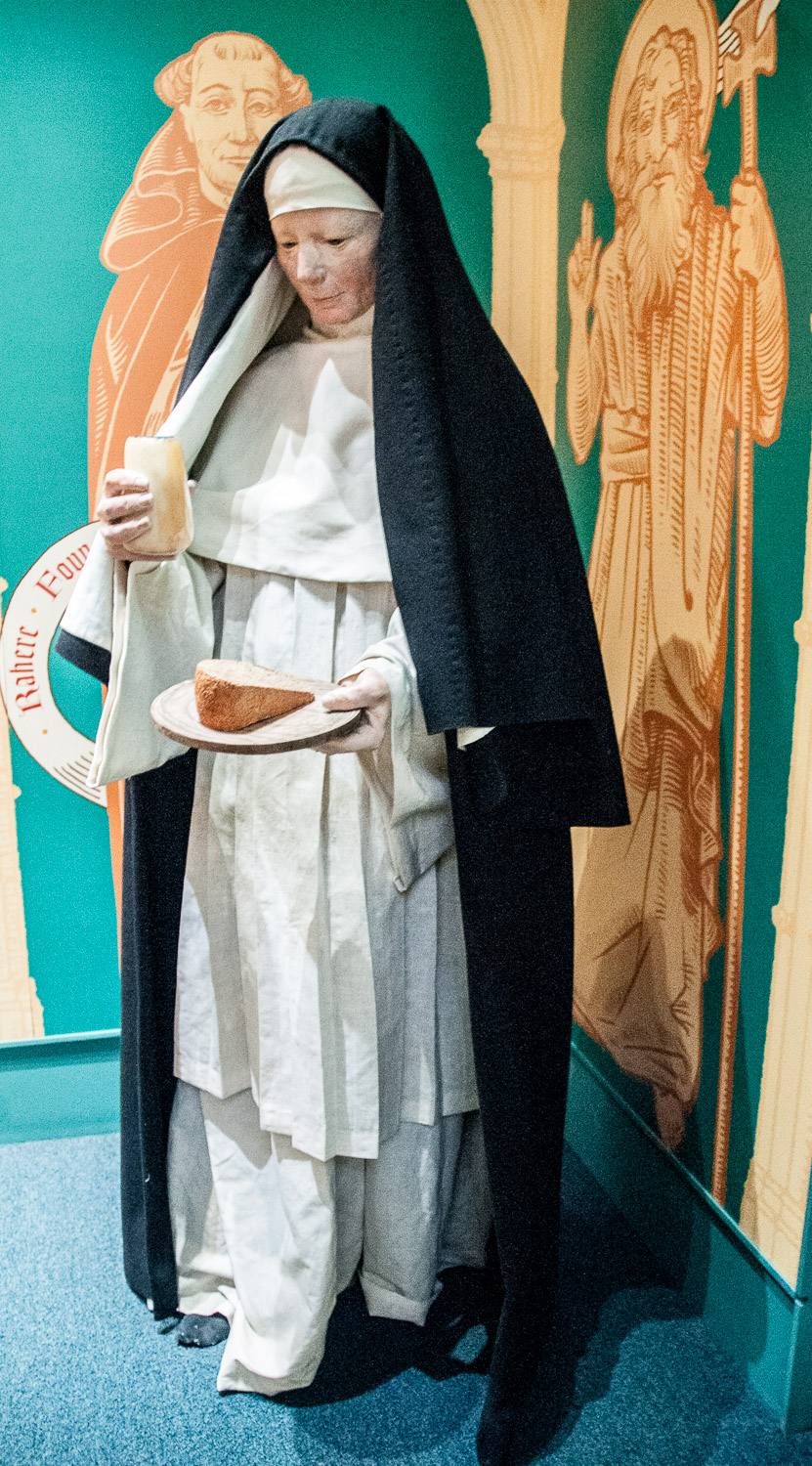
You will find her along with some absolutely fascinating artifacts in the St Bartholomew’s Hospital Museum including a document signed by Henry VIII only a month before he died.

Walking along Gresham Street I was surprised to find myself being stared at by a zebra …
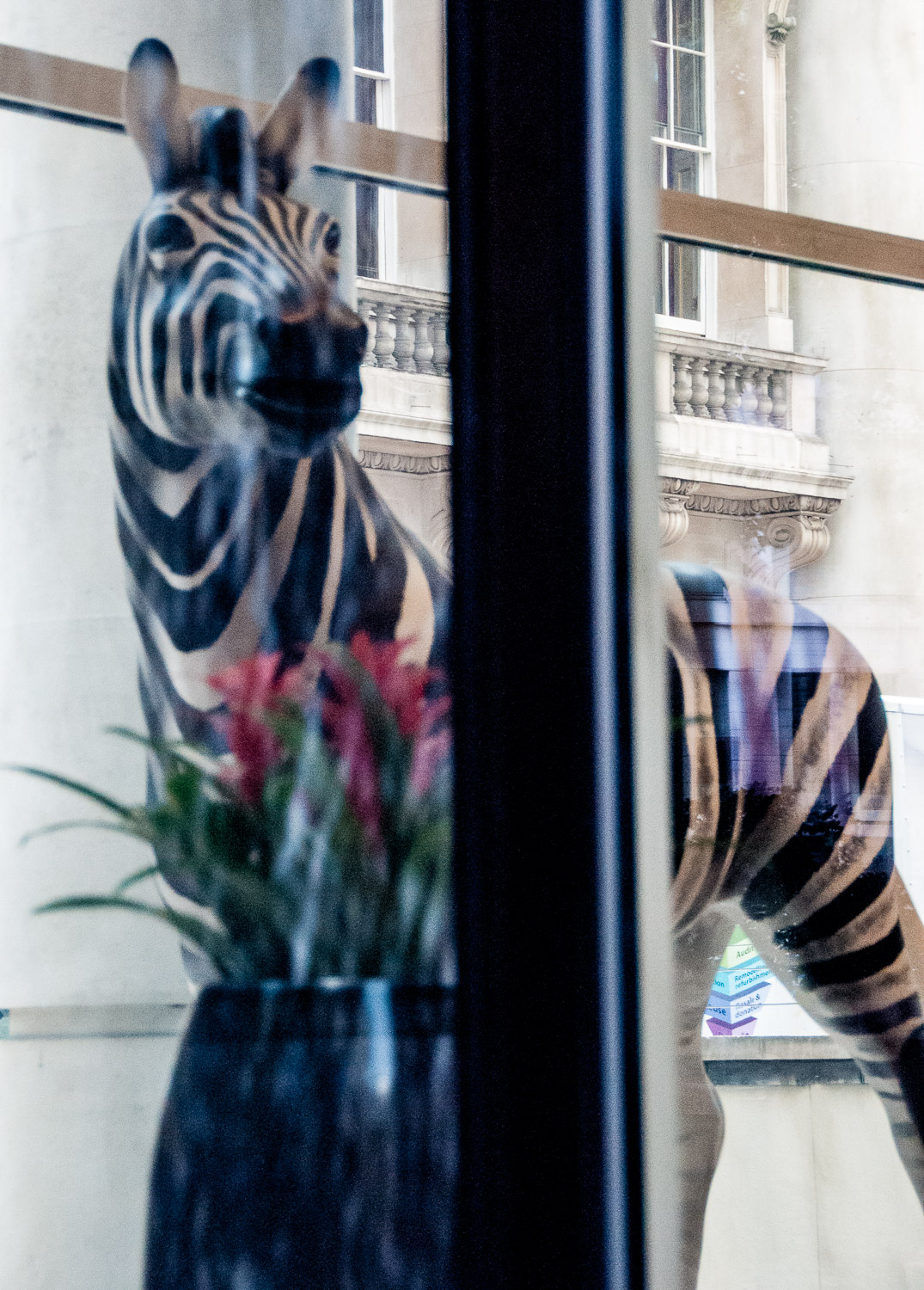
The zebra is part of the brand image of the Investec banking and asset management group whose offices are on Gresham Street. According to their Facebook page, they chose the zebra because it’s ‘a humble and modest creature, yet it surprises, delights and represents the distinctiveness that we strive for’. So now you know.

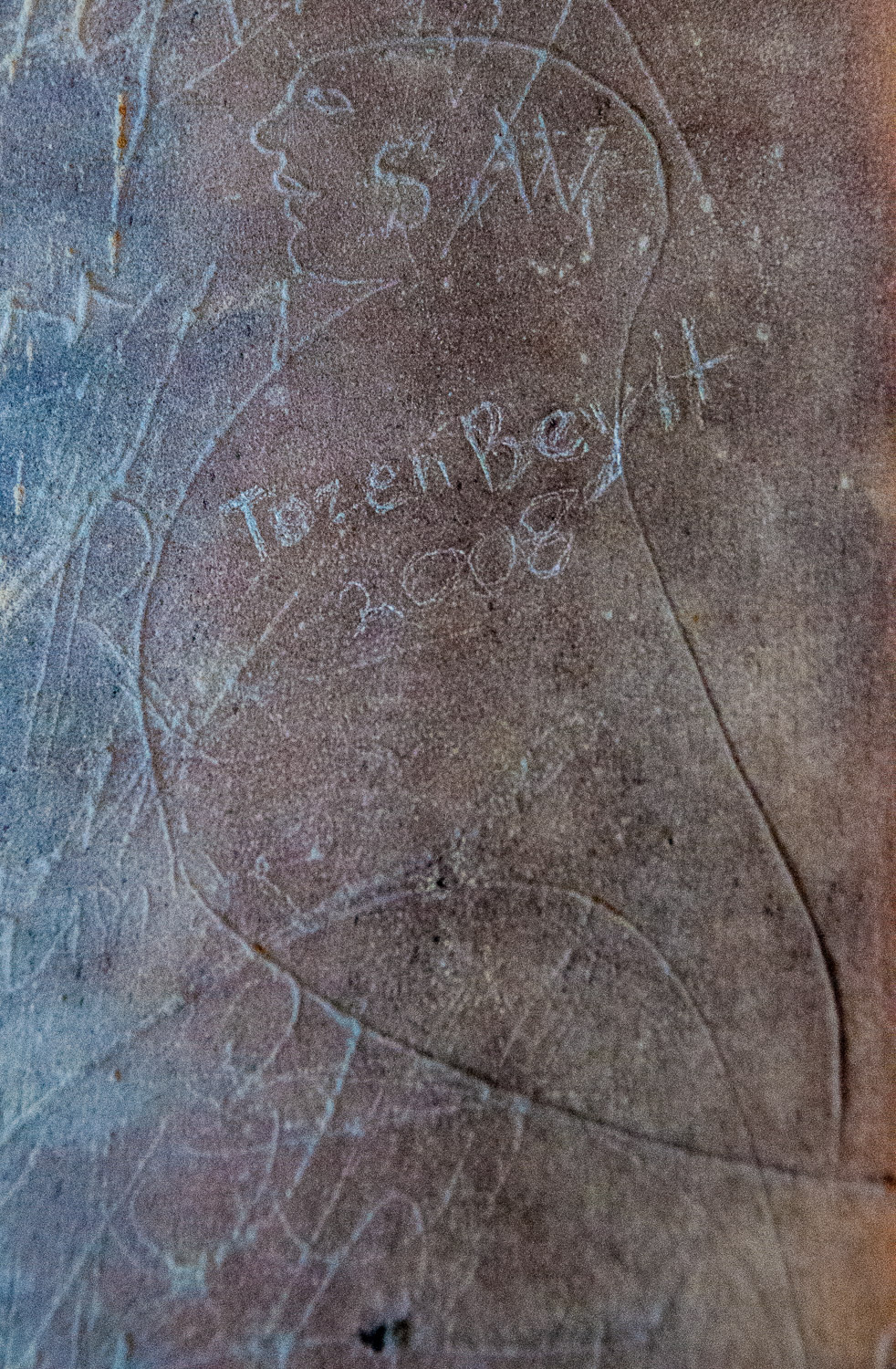
Men working on St Paul’s Cathedral in the 18th century left a plethora of graffiti around and near the west door. It includes this slightly pompous looking bald individual drawn to look like a pigeon puffing out its breast. Maybe he was a rather unpopular supervisor.
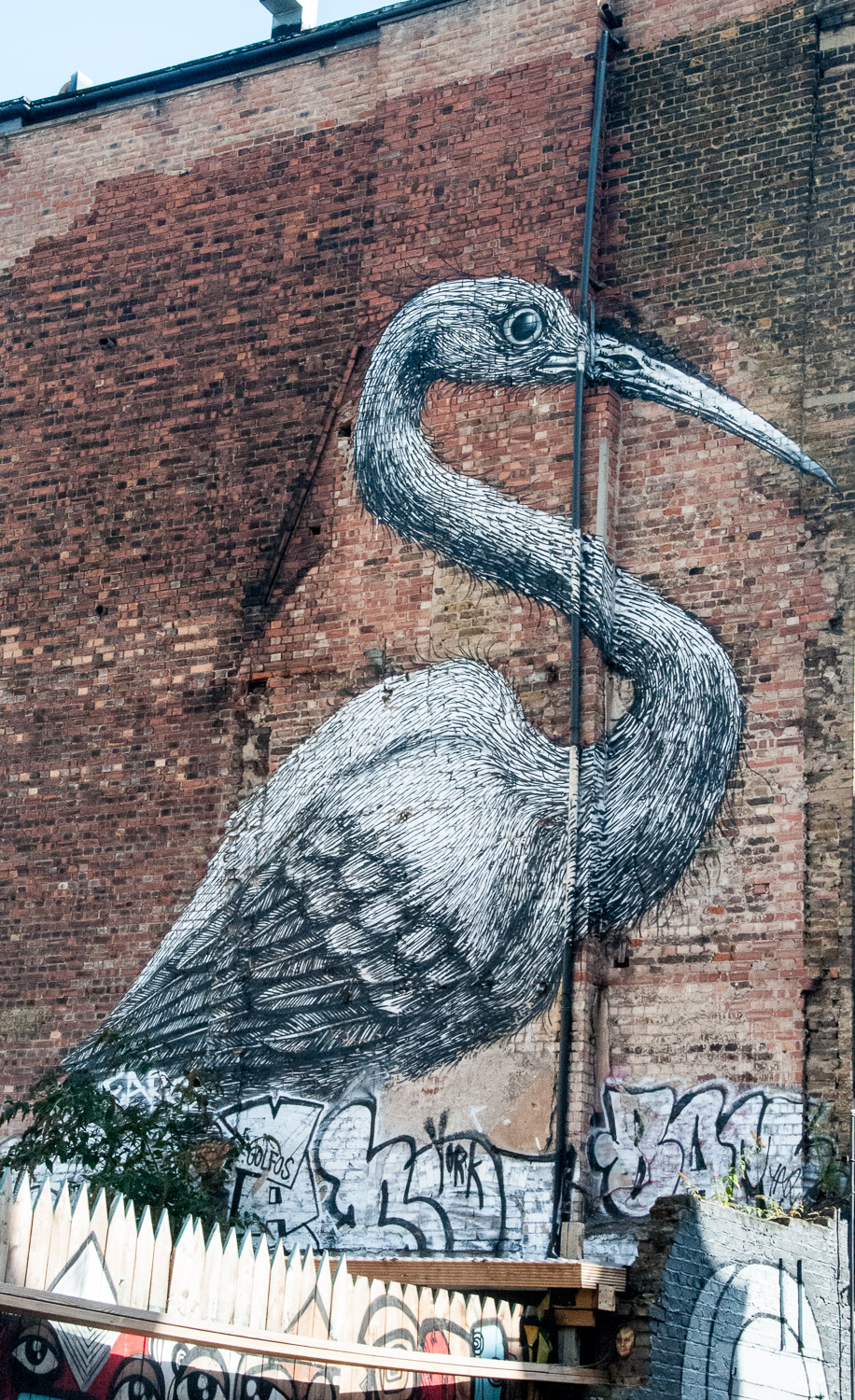
I did laugh when I saw this beady-eyed bird on a wall alongside Brick Lane …
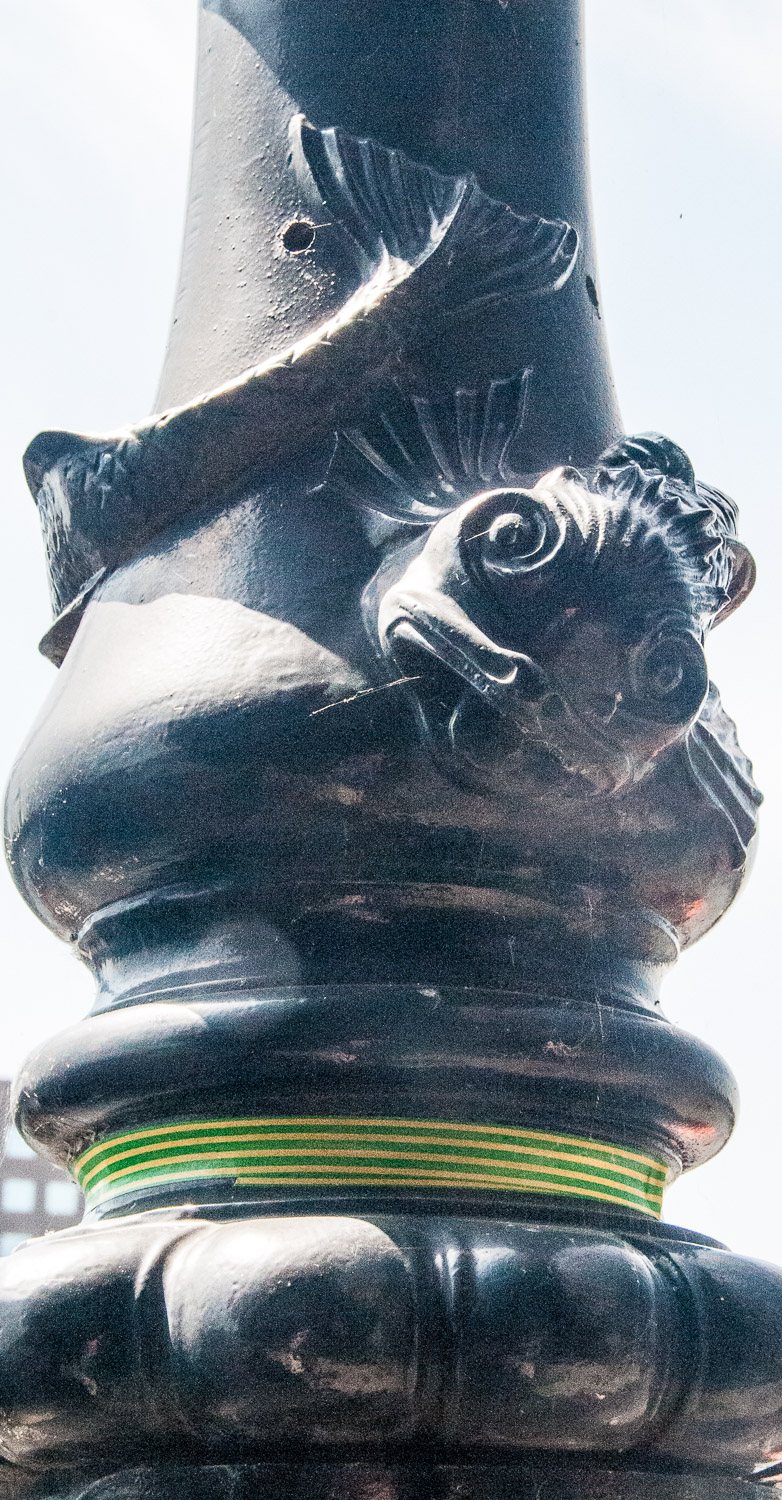
And I like this fish on the Embankment near Billingsgate who looks like he is sticking out his fishy tongue at passers by …
This happy, smiling, chubby Mr Sun always cheers me up …
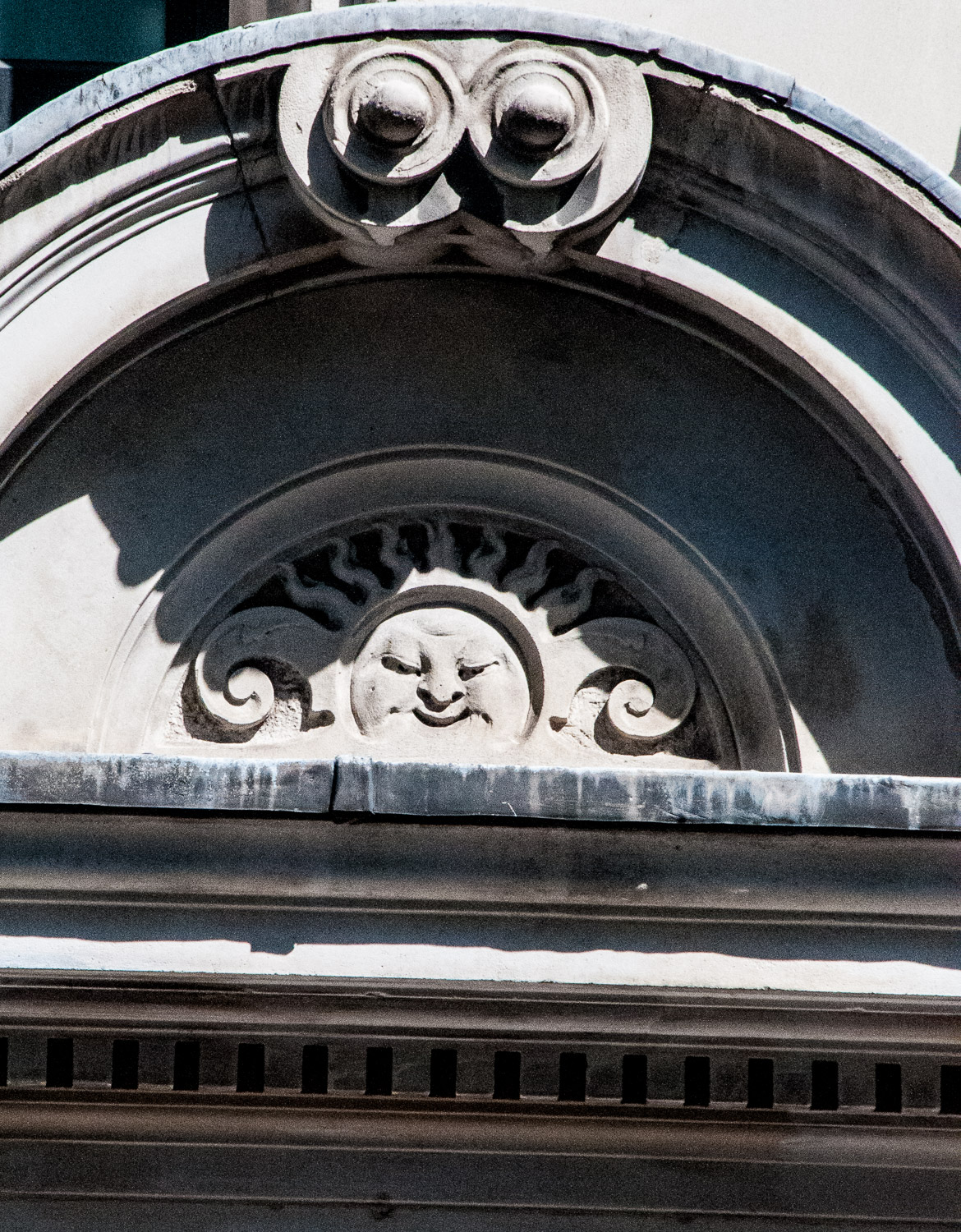
Especially as he is in Gresham Street above the oddly apostrophised St Martins’ House …
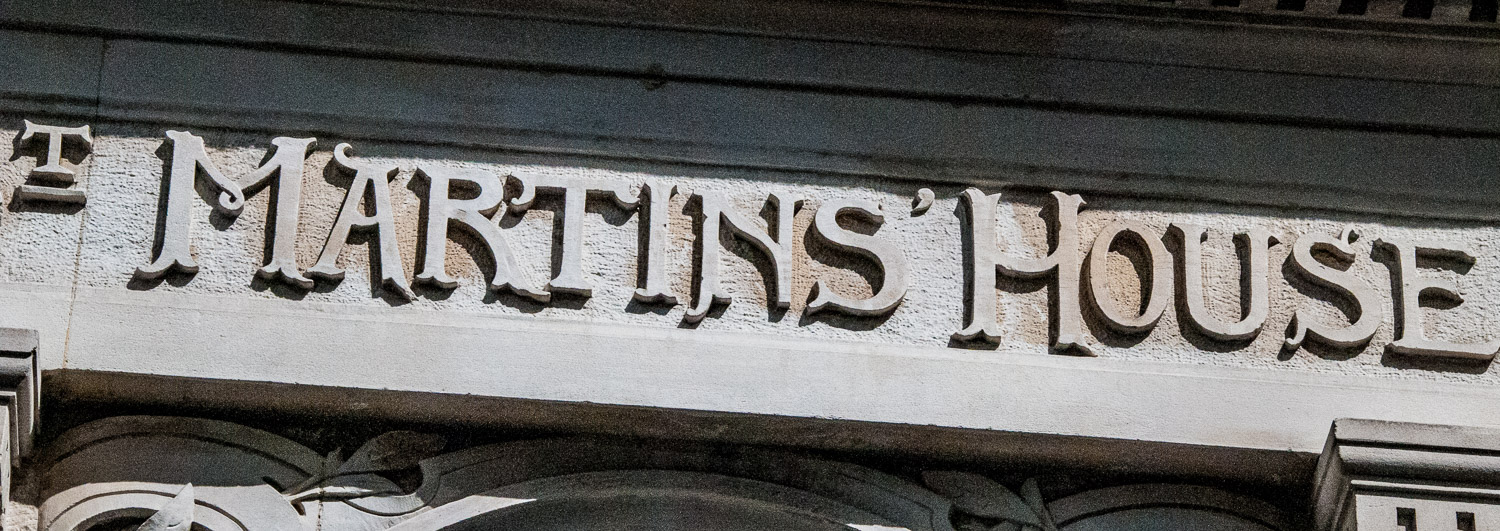
Surely is should be St Martin’s?

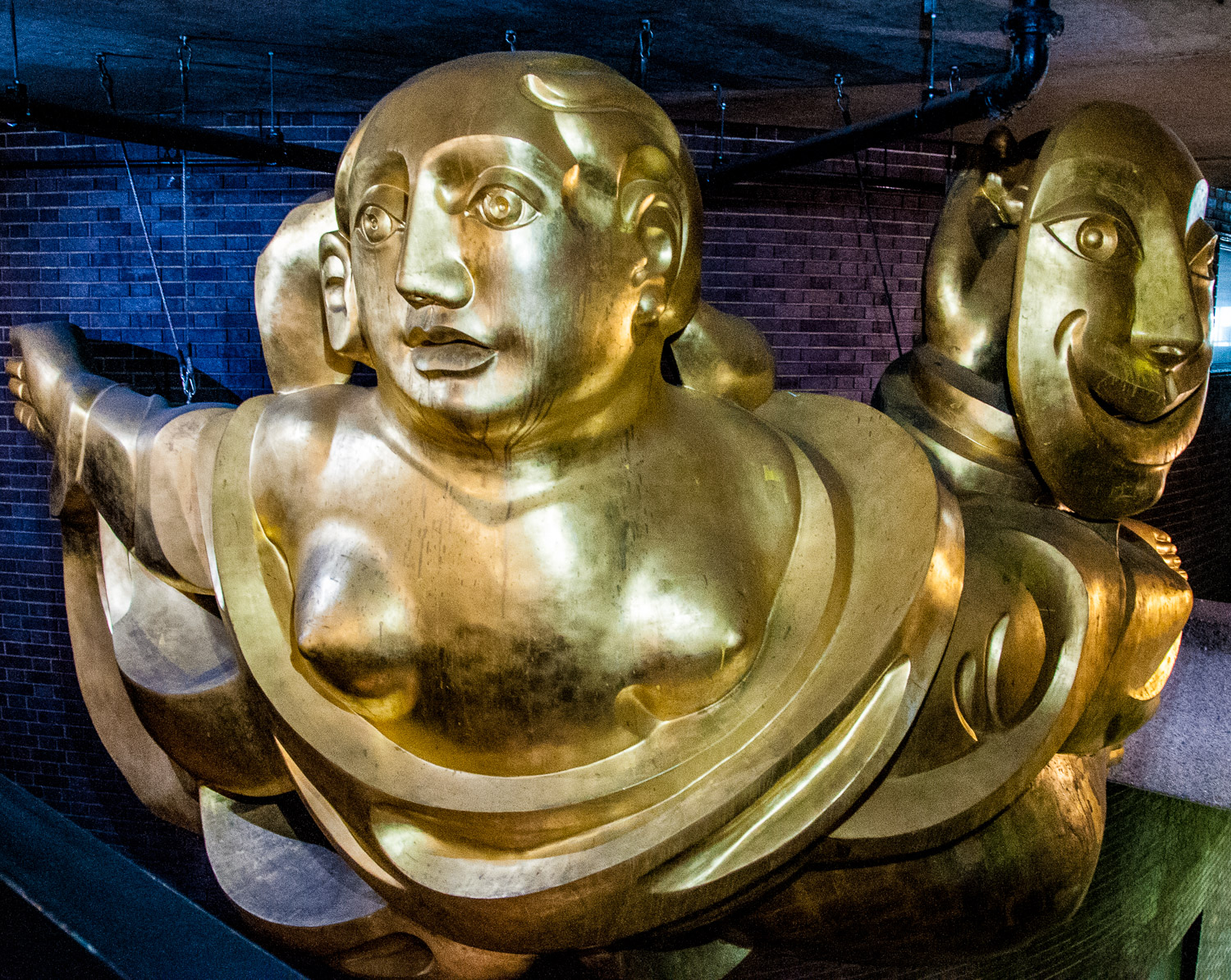
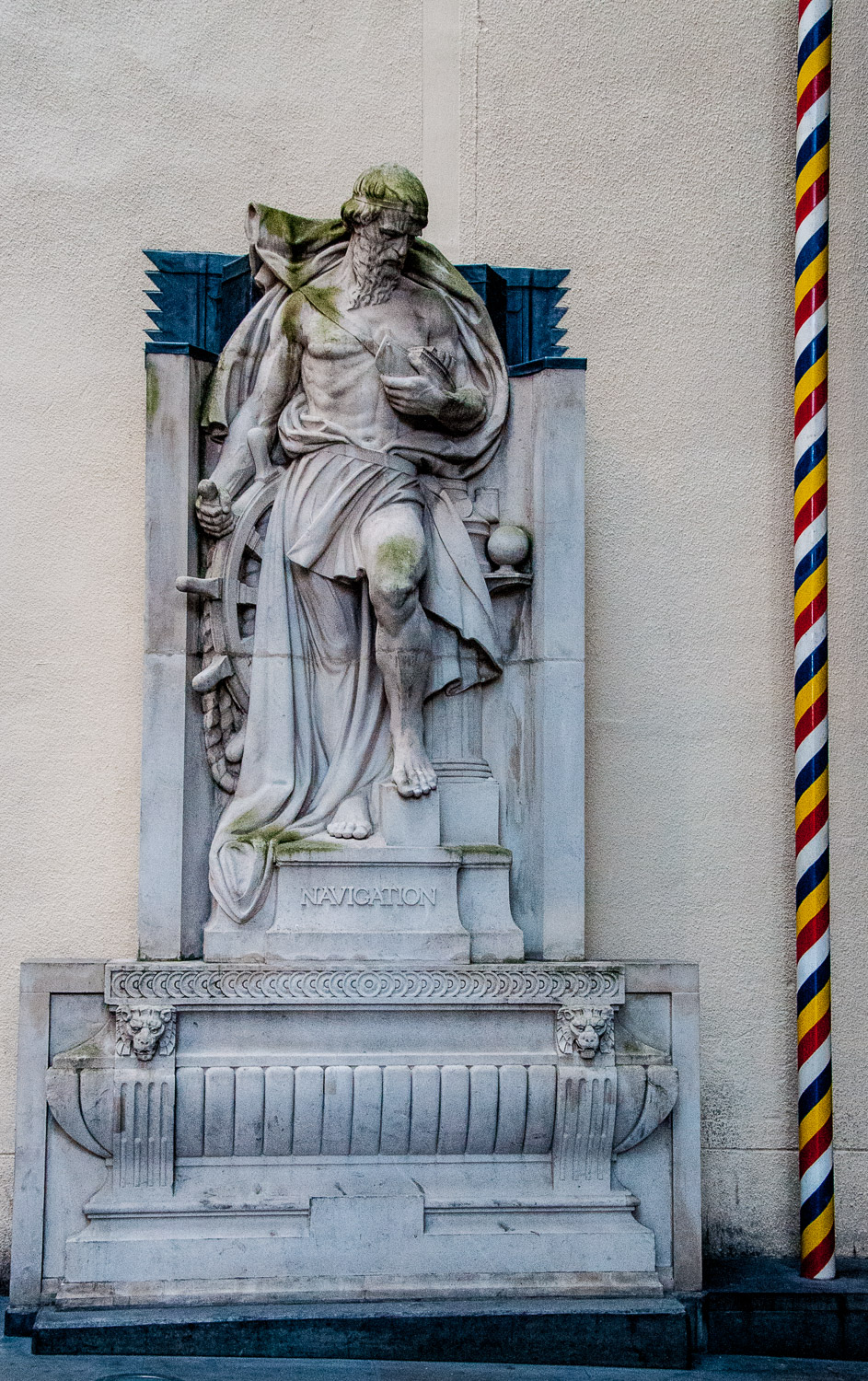
Outside the Cheesegrater building on Leadenhall Street, this Godlike figure entitled Navigation holds a passenger ship in his left hand and is flanked by a binnacle and a ship’s wheel. Originally owned by the P&O Banking Corporation, he once looked down from the facade of their building at the junction of Leadenhall Street and St Mary Axe. I smiled because he seems to be glancing rather suspiciously at the replica maypole that has been installed next to him …
It references the maypole that once stood nearby outside St Andrew Undershaft (so called because the maypole alongside it was taller than the church). The pole was set up opposite the church every year until Mayday 1517 when the tradition was suspended after the City apprentices (always a volatile bunch) rioted against foreigners. Public gatherings on Mayday were therefore to be discouraged and the pole was hung up nearby in the appropriately named Shaft Alley. In 1549 the vicar of St Catharine Cree denounced the maypole as a pagan symbol and got his listeners so agitated they pulled the pole from its moorings, cut it up and burned it.

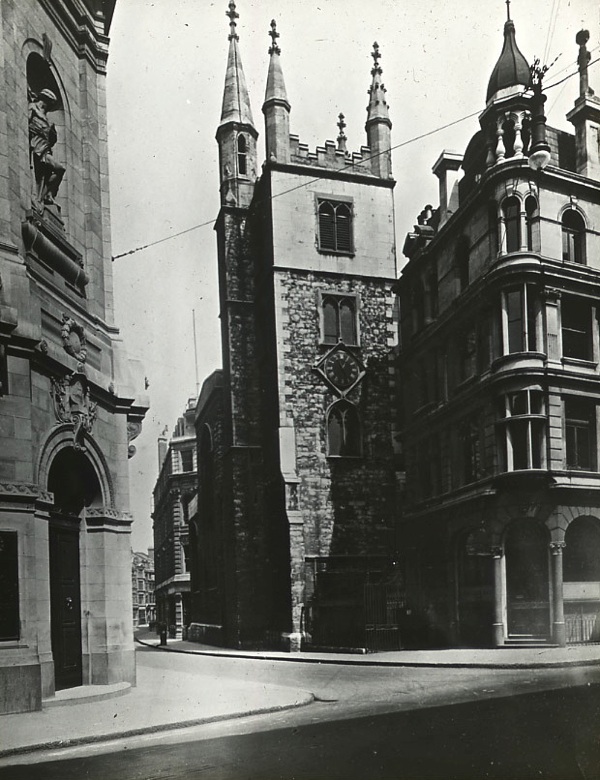
Here is a picture of the church around 1910. You can see the Navigation statue on the building on the left …
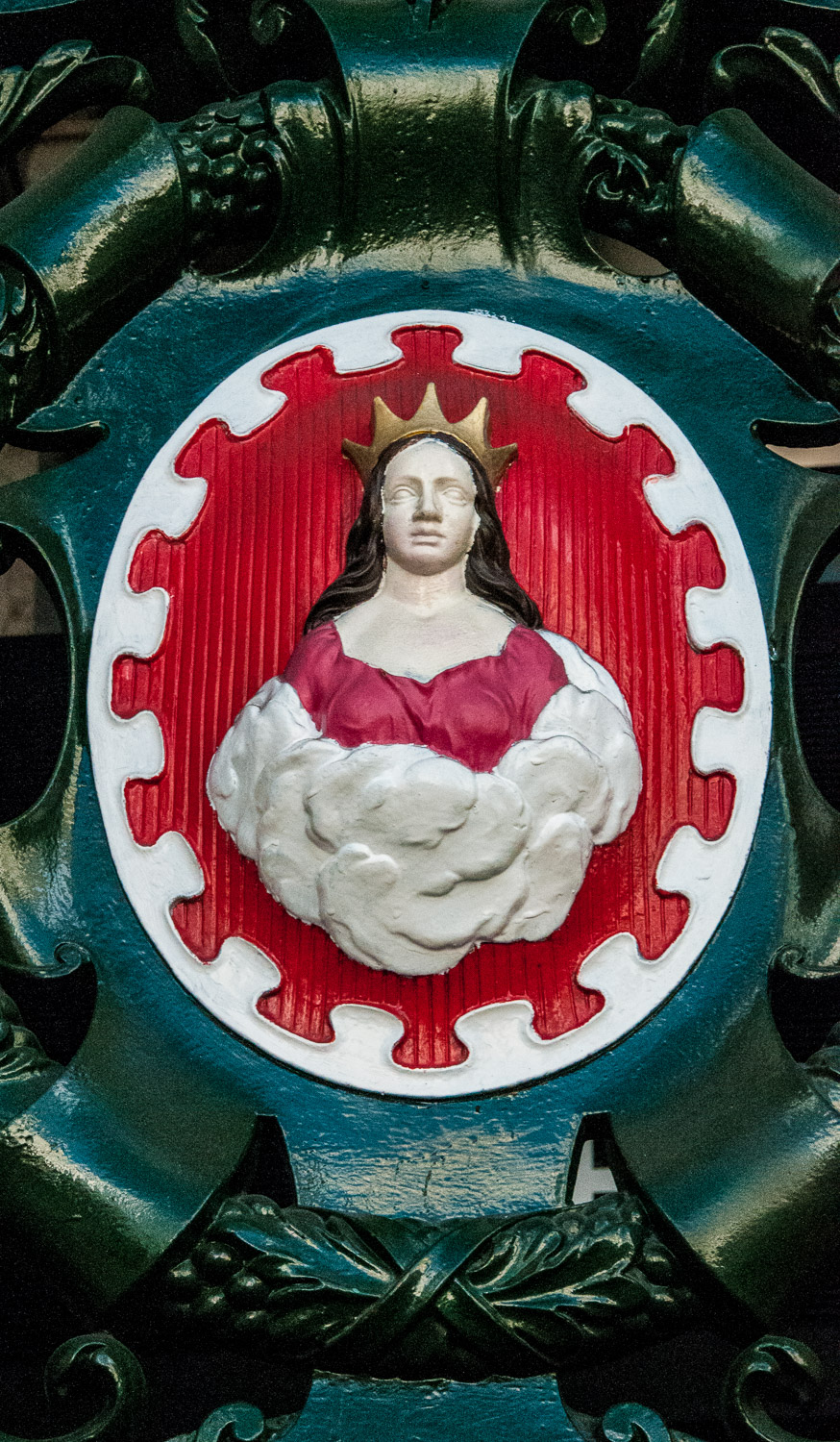
The Royal Exchange is built on land owned by the Mercer livery company whose ancient symbol is what’s known as a Mercer Maiden and she adorns many City buildings. The emblem appears on one set of Royal Exchange gates and I don’t mean to be rude, but do you think the image’s face looks a bit like Michael Portillo?
Then there is this David Wynne sculpture of Prince Charles in the Guildhall Art Gallery …
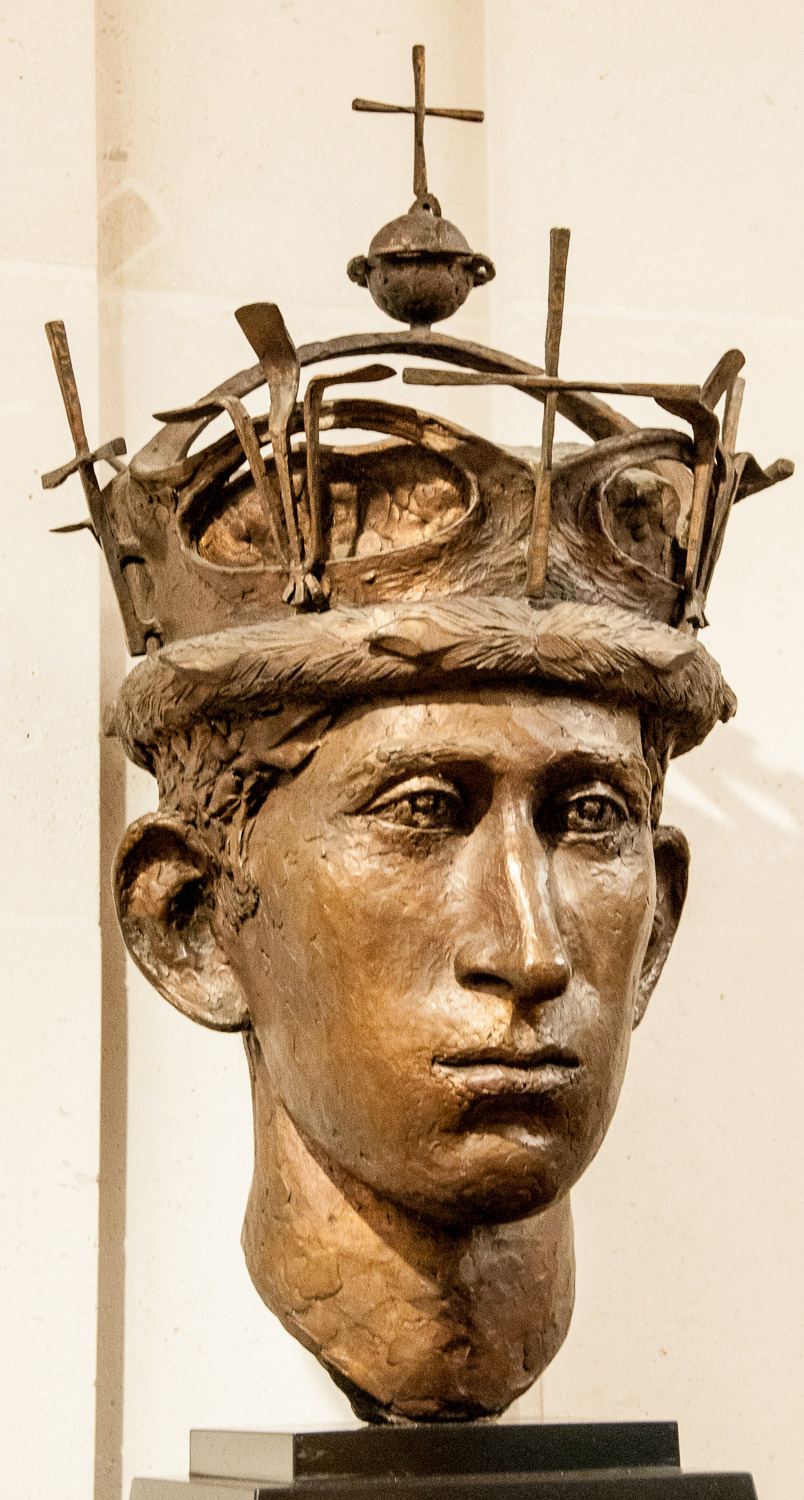
He just doesn’t look happy, does he? Maybe he wasn’t too keen on the rather spiky modern version of a coronet that he is wearing here at his 1969 Investiture as Prince of Wales. It was designed by a committee chaired by his auntie Princess Margaret’s husband, Antony Armstrong-Jones (later Lord Snowdon). The globe and cross at the top was originally intended to be solid gold but the committee concluded that this would be far too heavy. The solution was to use a gold plated ping-pong ball – which is why I always smile at this portrayal of the Prince (and possibly why he doesn’t appear to have ever worn the item again).

And finally …
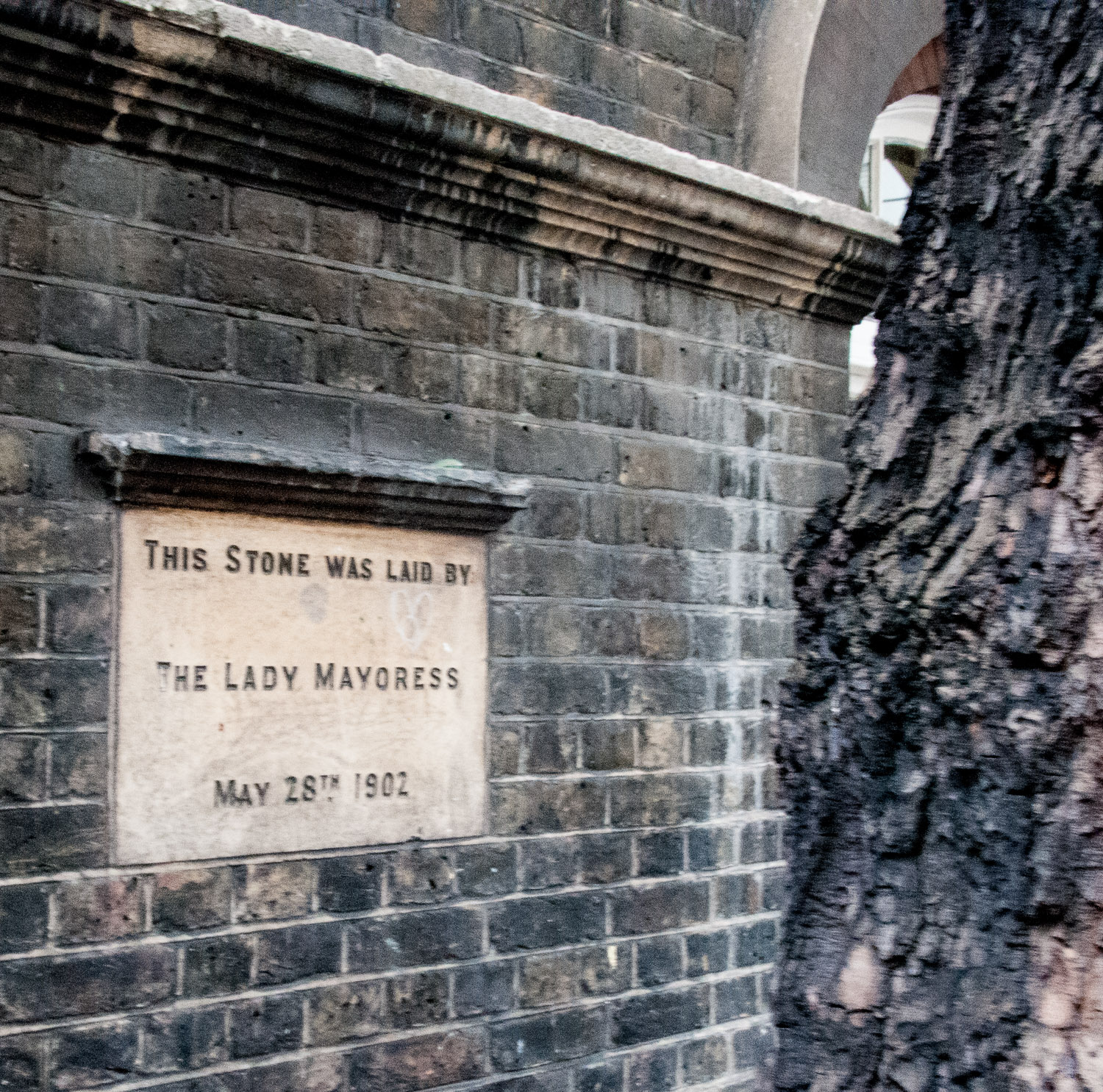
City pigeons just don’t believe it.
The Barbican Highwalk – dancers, gladiators and more

The Barbican Highwalk is the last significant remnant of the post War City ‘pedway’ dream – the ambitious plan to separate pedestrians from traffic using elevated ‘pavements in the sky’. The Highwalk, at first floor or Podium level, threads its way through the Estate, also embracing entrances to the Arts Centre, library and restaurants. City planners for a long time insisted that new developments had to include potential pedway access, which also explains why the main entrance to the Museum of London is at first floor level. The grand plan was gradually abandoned but exploring the Highwalk will give you a glimpse of the original vision, especially if you seek out the extension over London Wall Place.

Today, however, I am going to concentrate on some of the items that have found a home on the walkways since their construction, starting at the Museum of London.

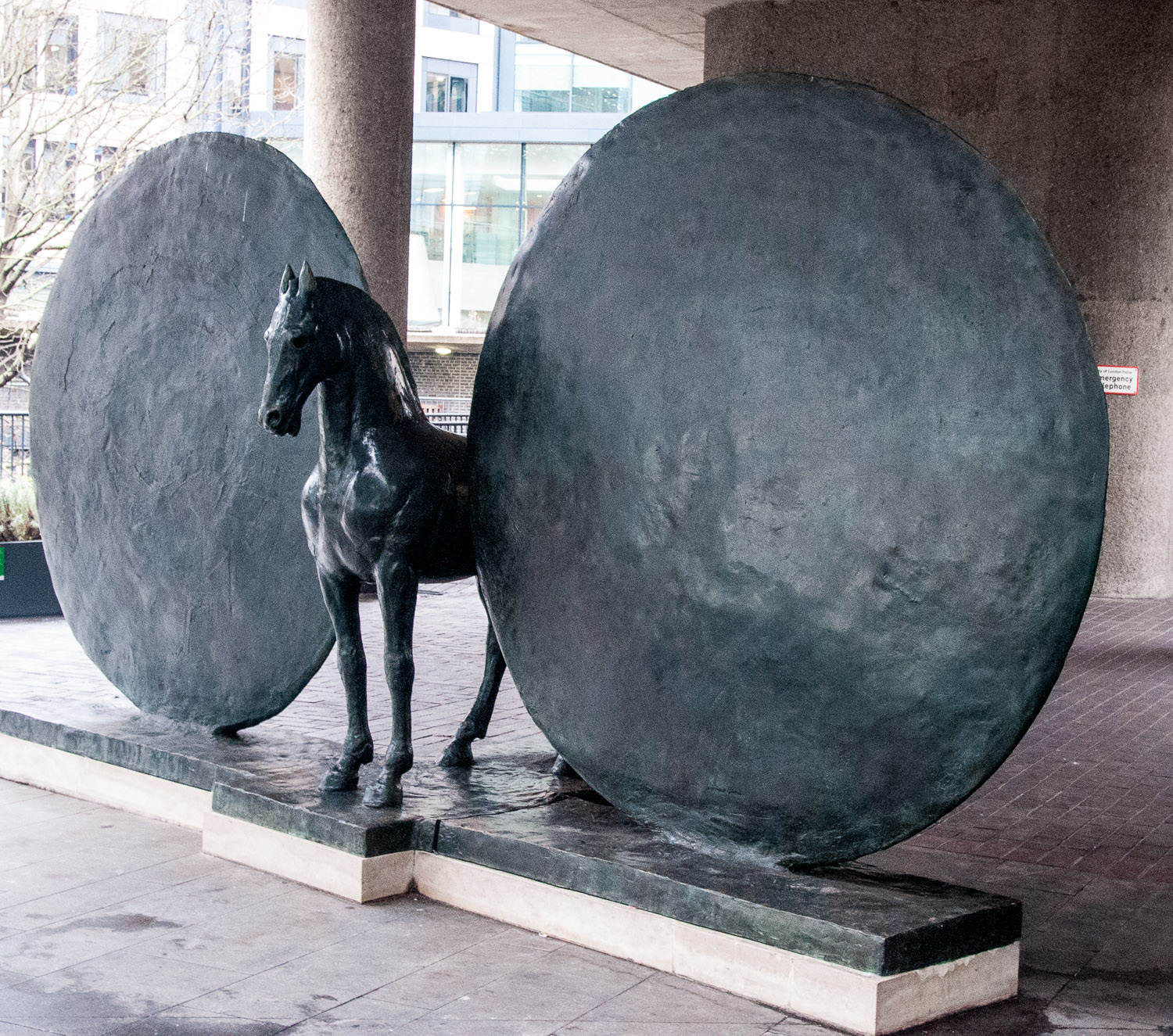
Outside the Museum entrance is Union – Horse with Two Discs by Christopher Le Brun (2001) …

In a note nearby the artist explains that to him it is important that horses and riders are ‘not seen as real (but) an entrance or key to the place that I want to enter. It’s as if “the horse” enables the journey rather than providing the final subject’.

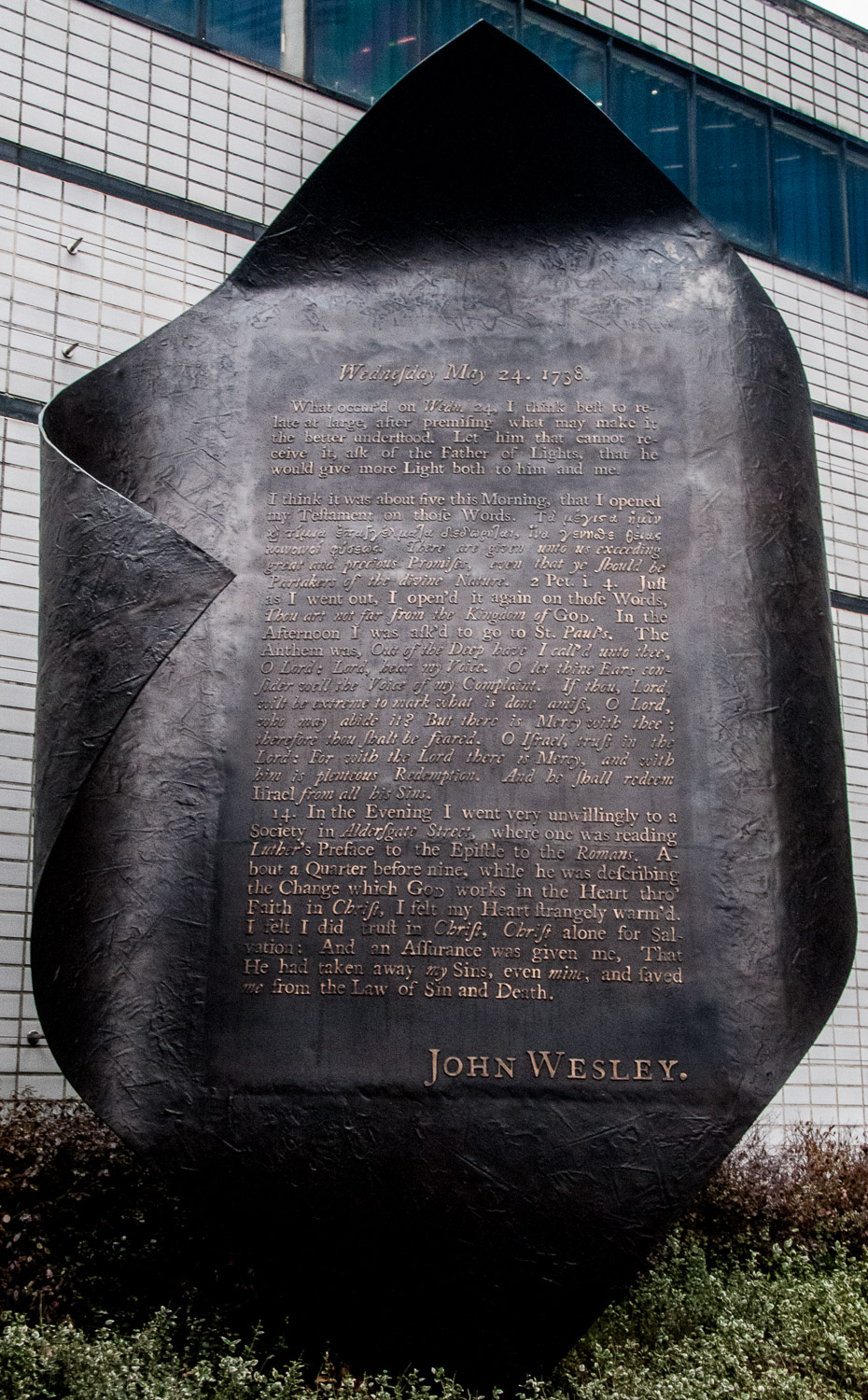
At the other side of the entrance is The Aldersgate Flame …

Placed here in 1981, it commemorates the approximate location at street level of John Wesley’s conversion on 24 May 1738 and consists of facsimile extracts from his Journal. From that day onward the founder of Methodism set out on a mission covering thousands of miles and delivering over 40,000 sermons -‘The world is my parish’. The monument, which is in bronze, has recently been restored and there is an interesting article about that work and its challenges here.

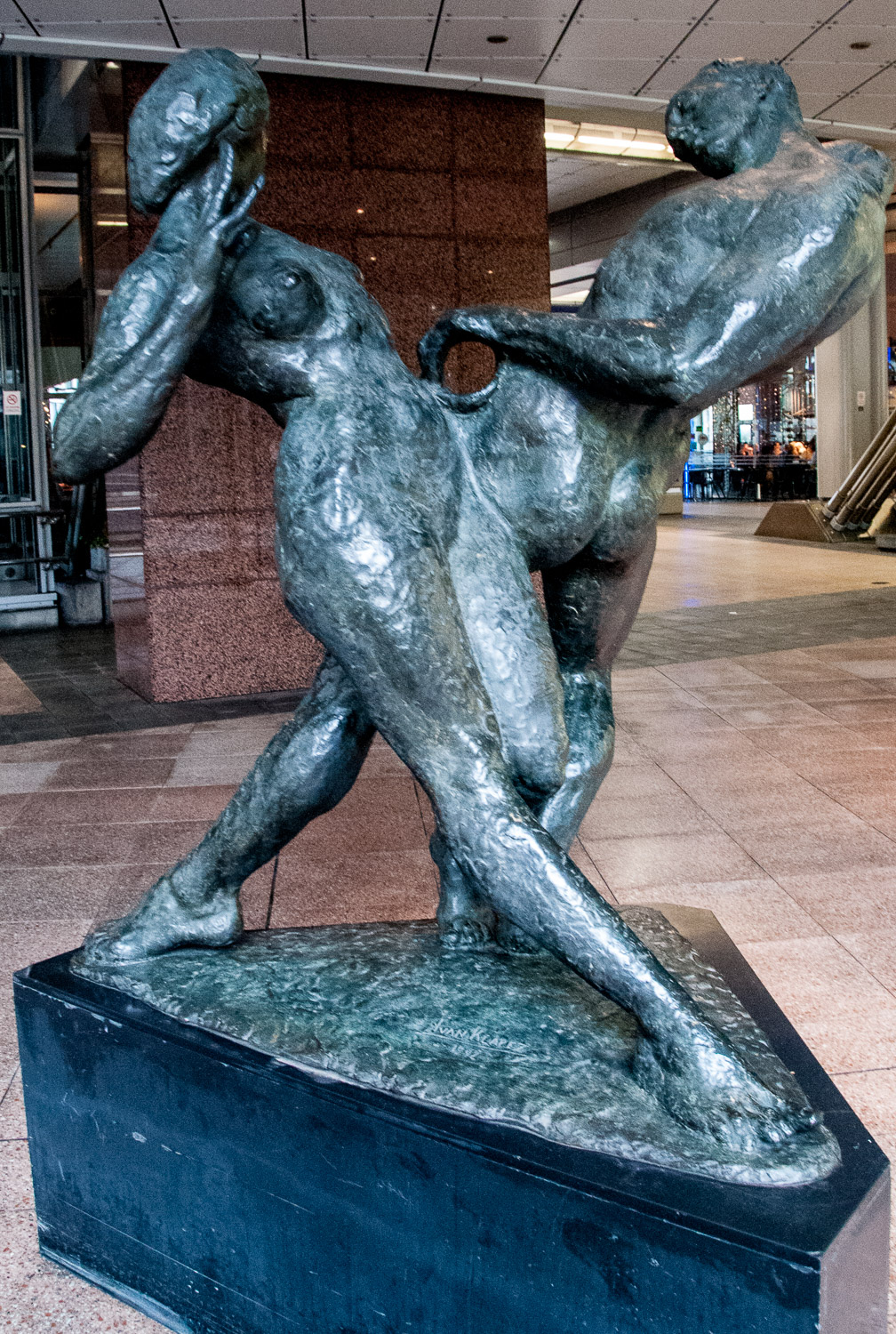
Crossing the Bastion Highwalk towards the bar and restaurant on Alban Gate you will encounter two naked writhing dancers. Quite often I have seen people pose for photographs whilst trying to mimic the figures’ movements – they have not found it easy …

The work, called Unity, is by the Croatian Sculptor Ivan Klapez. It was commissioned by the building developers MEPC in 1992 and marked a turning point is his career.

Follow the infamous yellow line on the pavement and you will be guided into the Barbican Centre itself where Zoe the Barbican Muse indicates the way in …

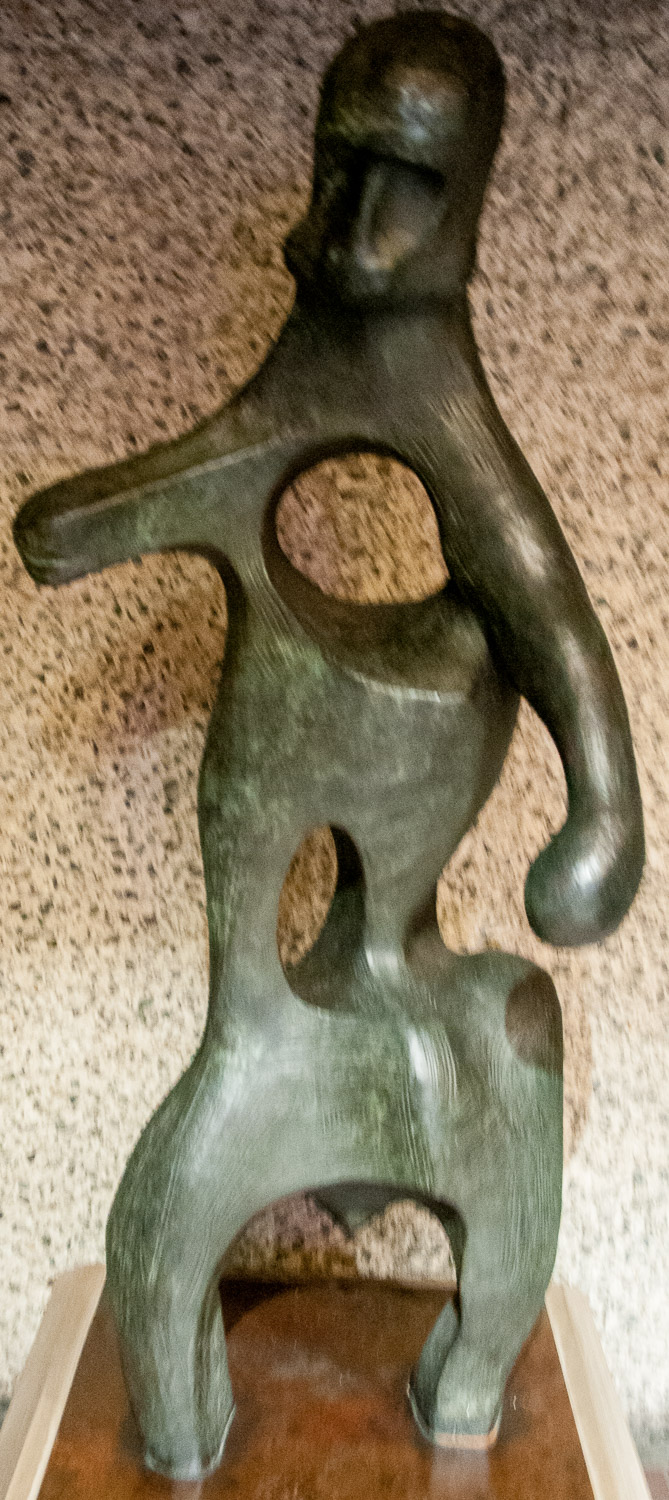
A little further ahead on the left is the Osteria restaurant and opposite, in a space that is rather poorly lit, is this figure …

Entitled Gladiator, it was presented by Lady Sarah Cohen in memory of her late husband Sir John Edward Cohen, the founder of Tesco. The work was created in 1973 by Canadian born Israeli sculptor Eli Elan (1928-1982).

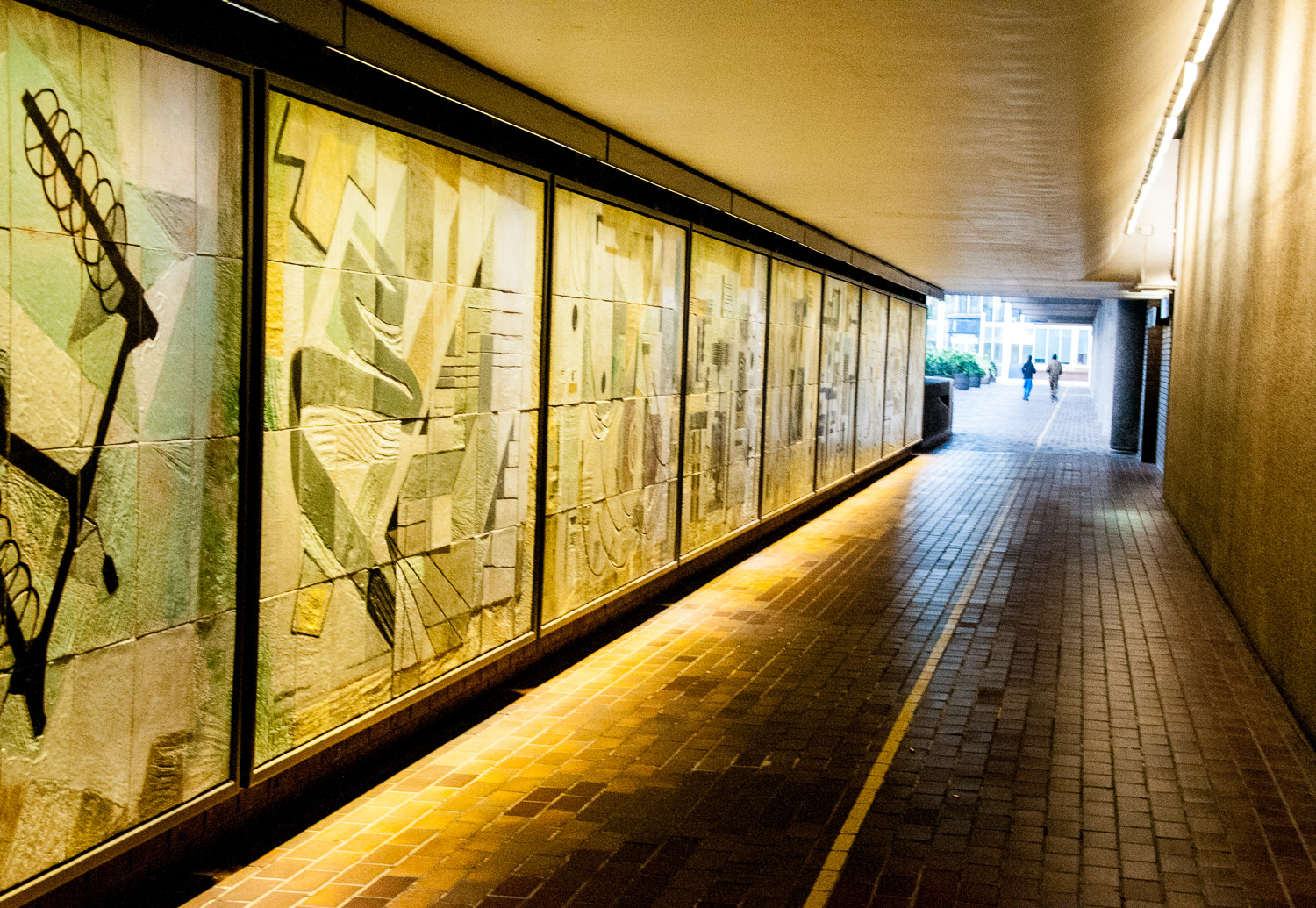
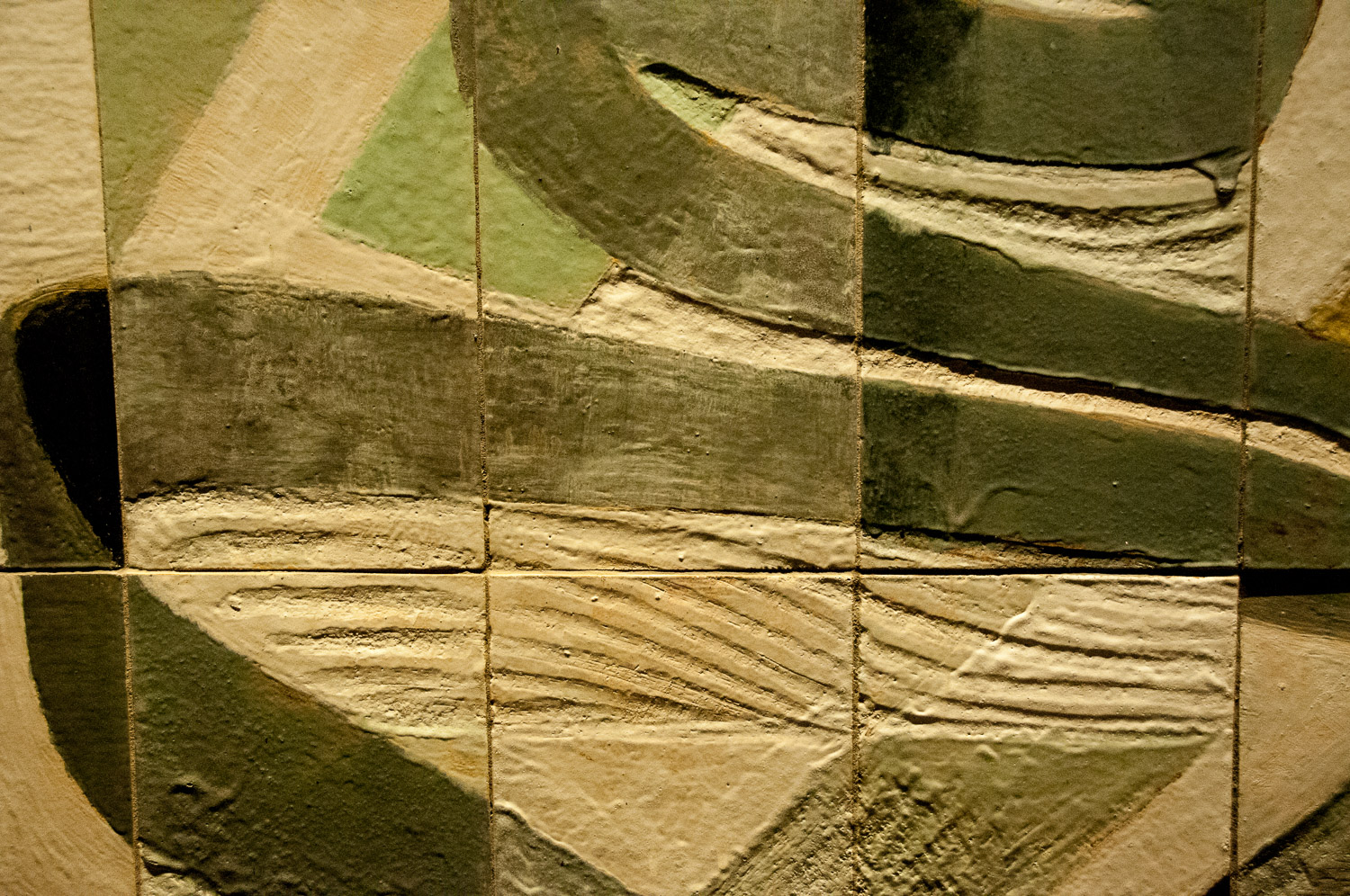
I have saved my favourite installation to last – Dorothy Annan’s magnificent murals on the Highwalk between the Centre and Speed House …

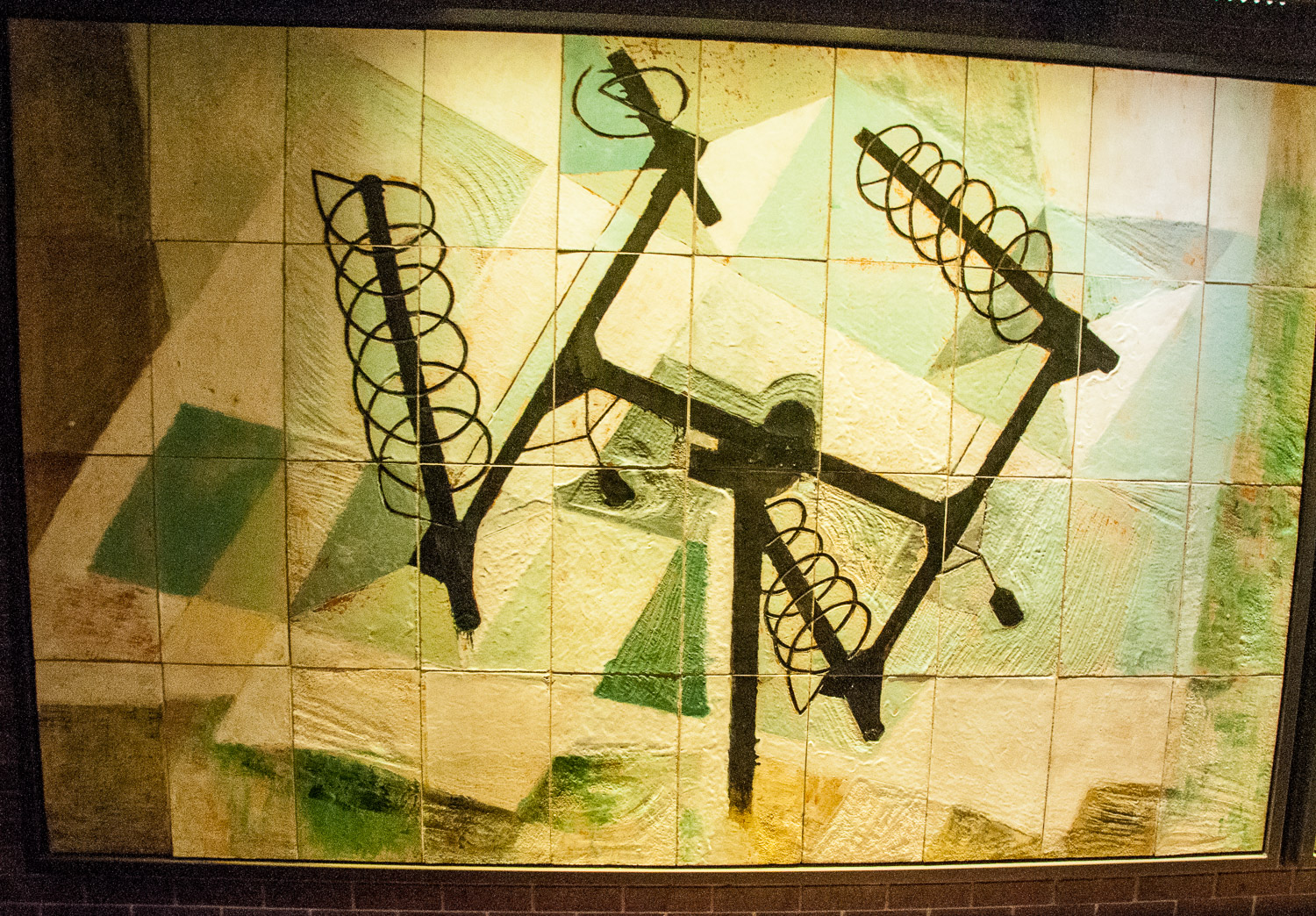
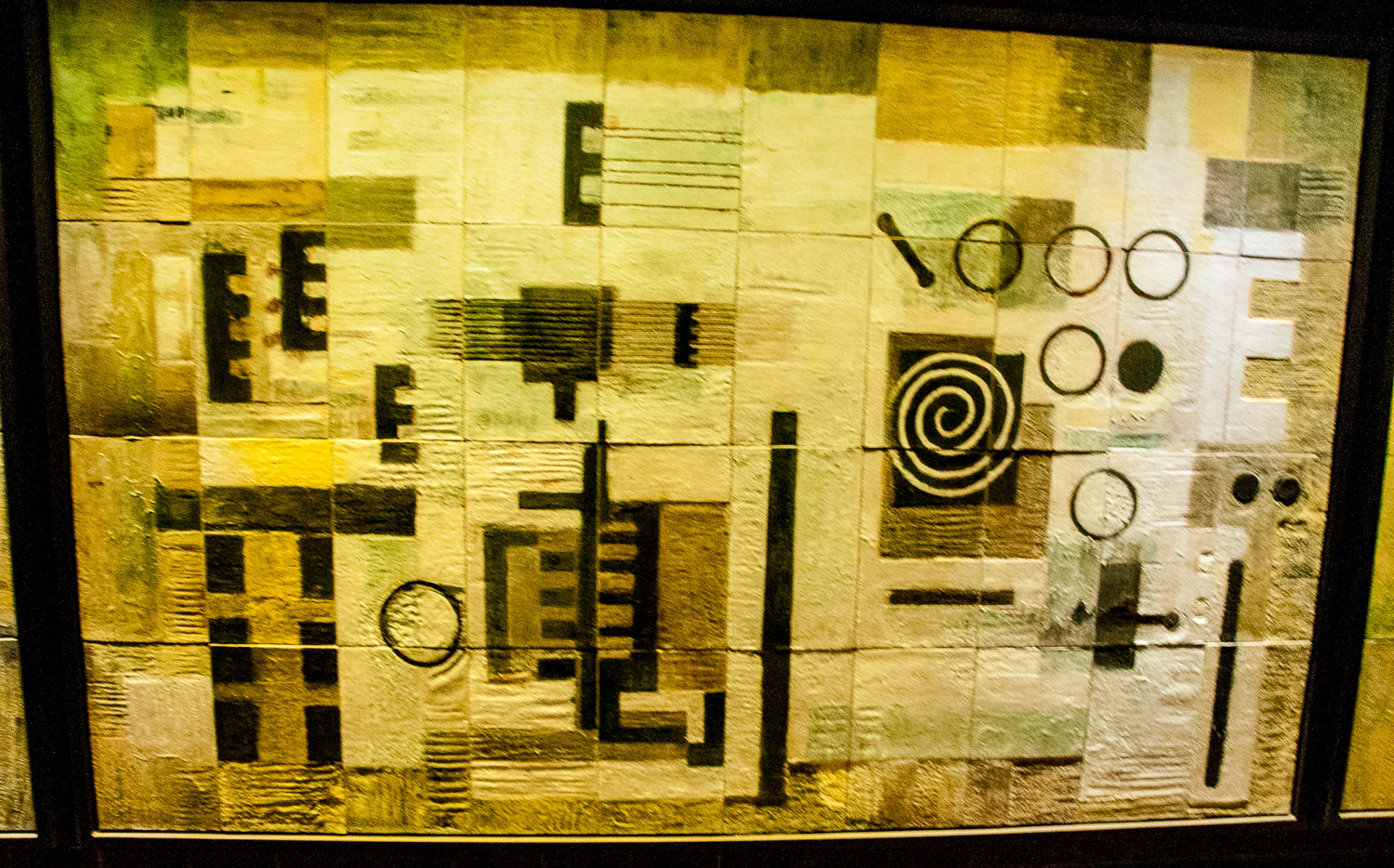
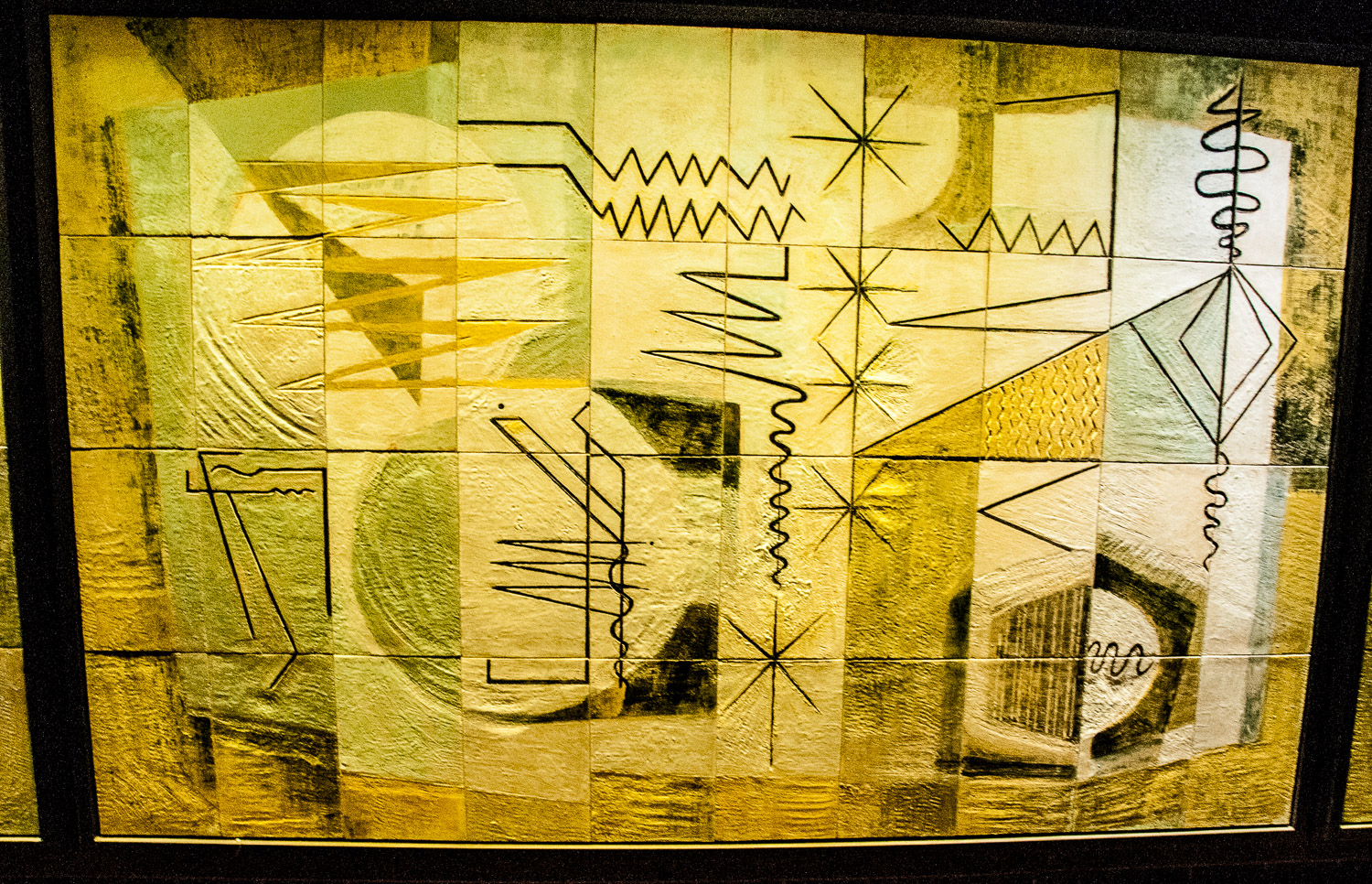
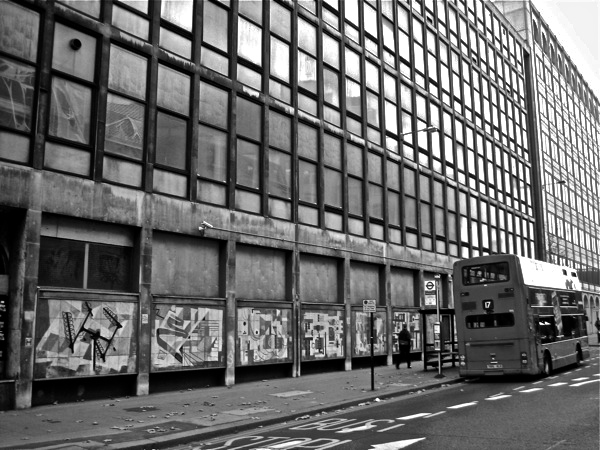
Commissioned by the Ministry of Works in 1960, they originally graced the largest telephone exchange in London, the Fleet Building on Farringdon Street. The panels feature stylistic images of telecommunications equipment and are a striking example of 1960s mural art. When the demolition of the building was planned the murals were granted Listed status and moved in 2013 to their present location.

Annan visited the Hathernware pottery in Loughborough and hand-scored her designs onto each wet clay tile. There are nine panels in all and here are three of them with their titles …

Radio Communications and Television.

Cable Chamber with Cables Entering from Street.

Impressions Derived from the Patterns Produced in Cathode Ray Oscilligraphs used in testing.

I love the creamy texture of the ceramic surfaces, their look much enhanced by carefully designed lighting …

Part of Cables and Communication in Buildings.

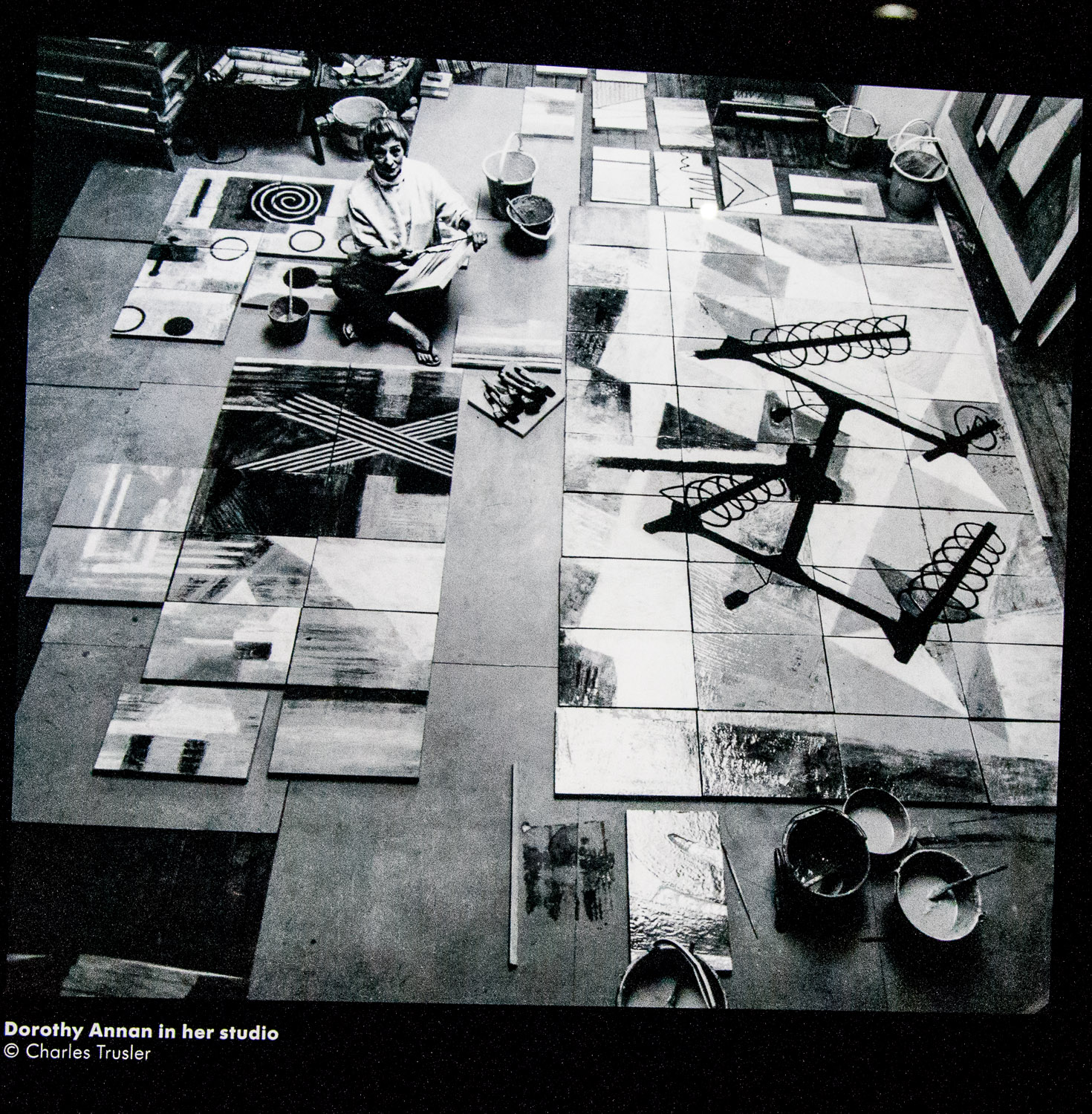
And here is the lady herself …

The murals’ original location photographed in 2011 …

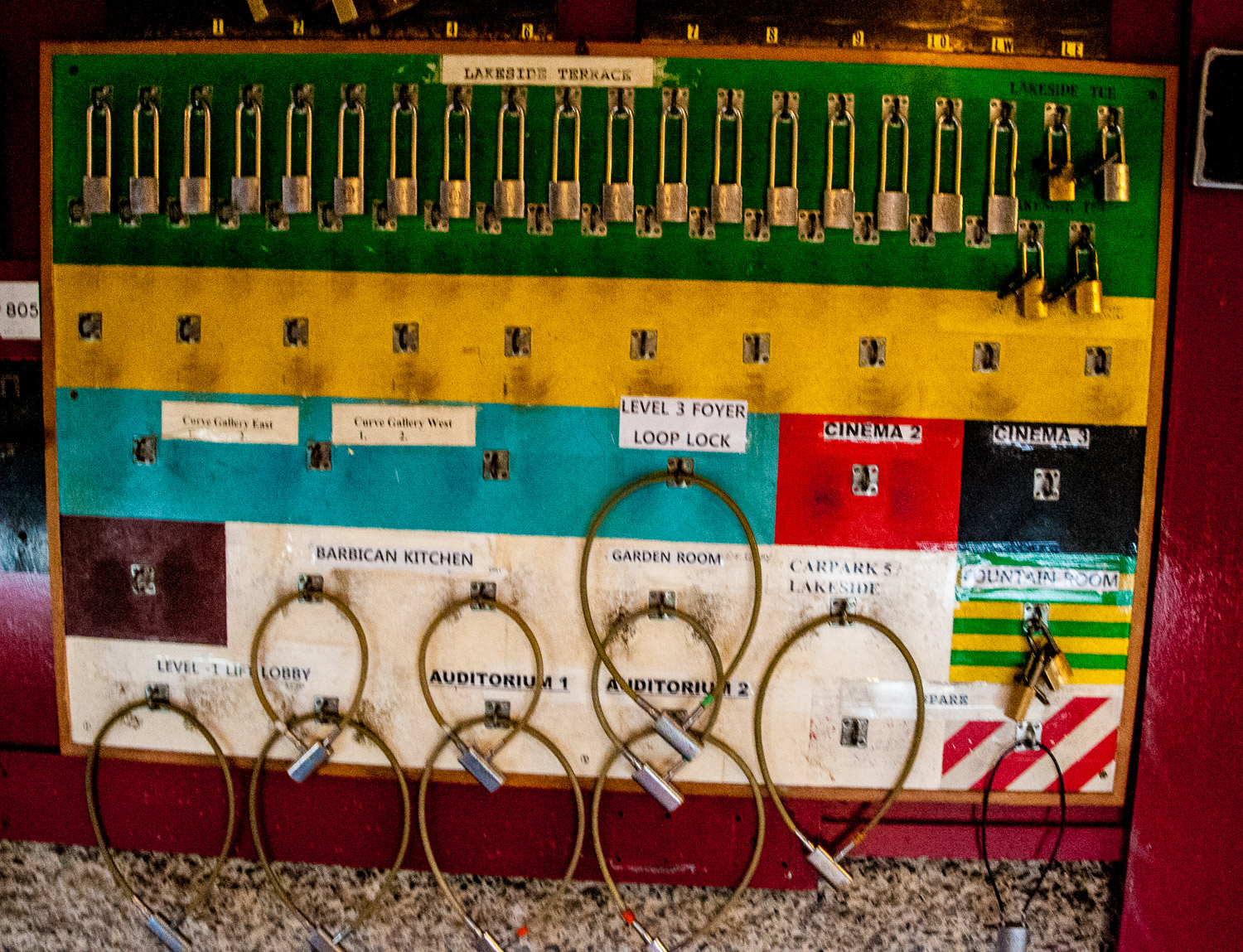
By the way, as you retrace your steps having looked at Gladiator, take a look at the wall on your left. Here are kept the various locking mechanisms for the Centre and, when I first glimpsed them, I honestly thought they were a Modern Art installation …

Well they could be, couldn’t they!


Fleet Street’s courts, lanes and alleys

A quiet suburb before the Great Fire of 1666, but a key route between the City and Westminster, Fleet Street subsequently developed quickly. As a result, it has a range of associations, from the Knights Templar to the newspaper industry, along with literary folk such as Dr Johnson. What are particularly evocative of the past are its intimate courts, lanes and alleys, particularly to the north.

I have been exploring a selection of them.

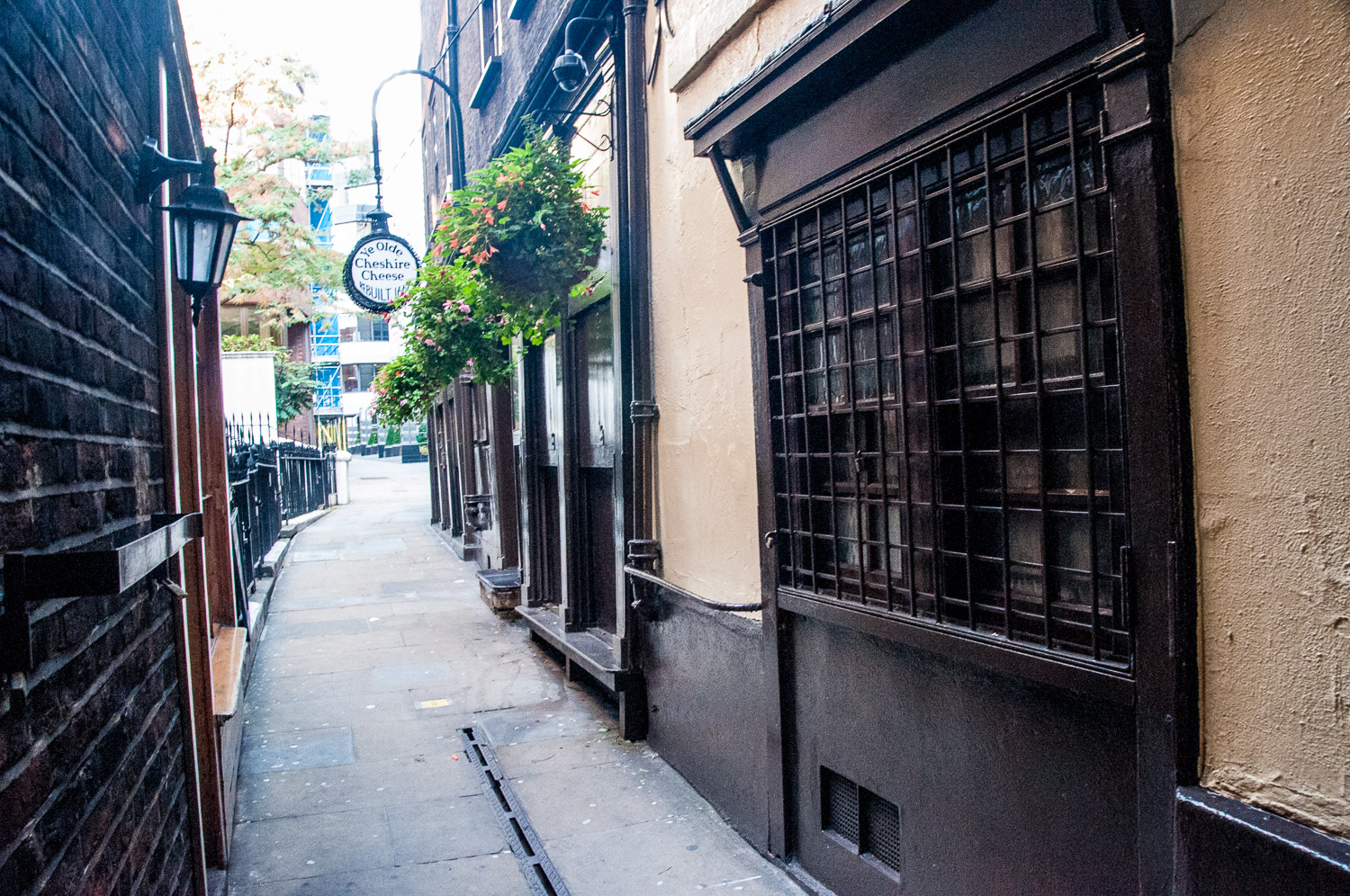
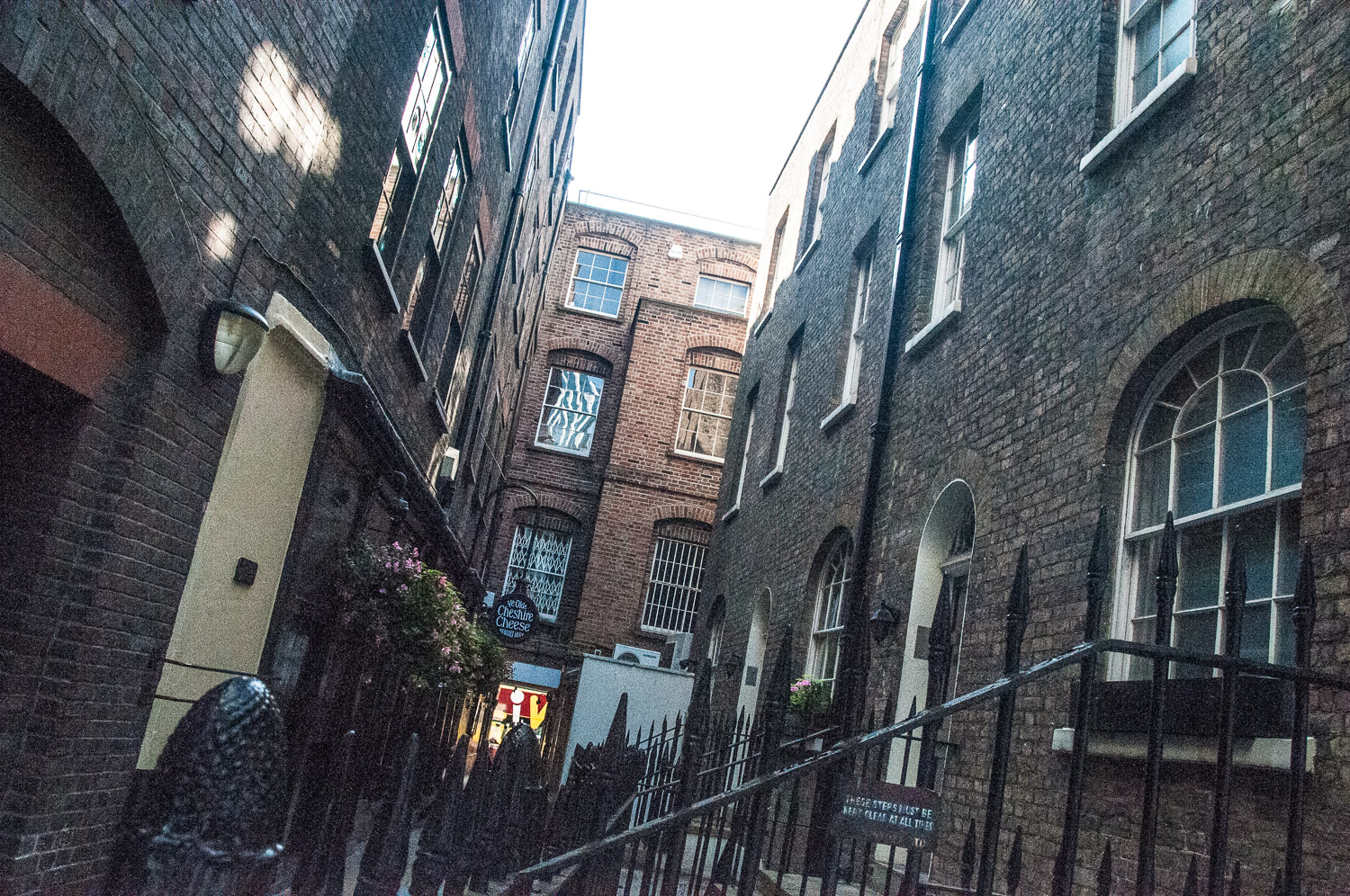
I have chosen Wine Office Court to begin with because it is home to the Ye Olde Cheshire Cheese pub, Ye Olde being an accurate description in this case since the pub dates from 1667. It also lives up to expectations inside, being spread over four floors with numerous nooks and crannies.

Looking north.

Looking south towards Fleet Street.

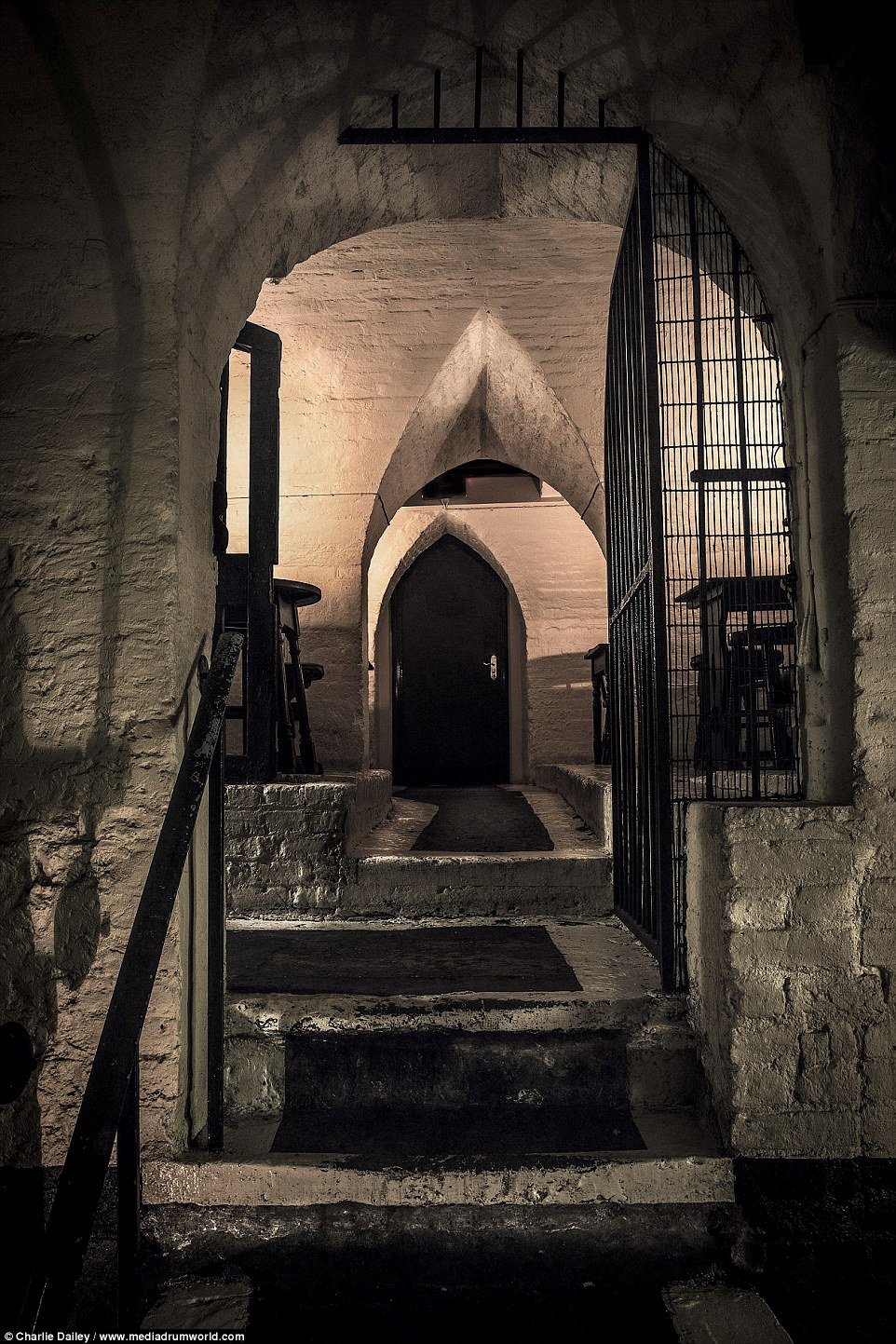
The pub cellar bars were once part of the Carmelite monastery, and look it …

Licenses to sell wine were issued from a building there, hence the ‘Wine Office’ name. Oliver Goldsmith, the Irish novelist, playwright and poet, lived at number 6 and enjoyed a drink at ‘The Cheese’ along with Johnson, Dickens, Carlyle, Teddy Roosevelt and me.

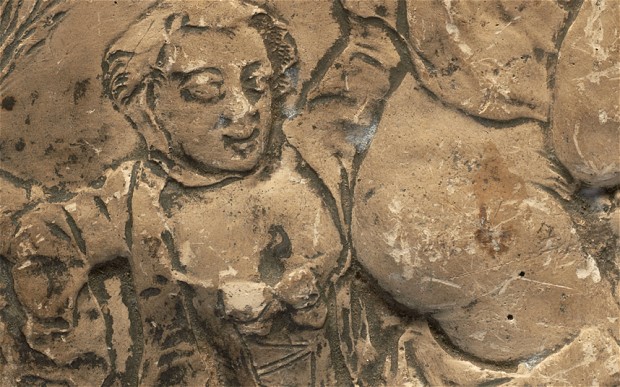
A fire at the pub in 1962 revealed some very naughty 18th century fireplace tiles. The are now in safe keeping at the Museum of London and are so naughty that I can only find a picture of one of them – a lady spanking a man’s bottom with a bunch of twigs. I wonder what the rest are like …

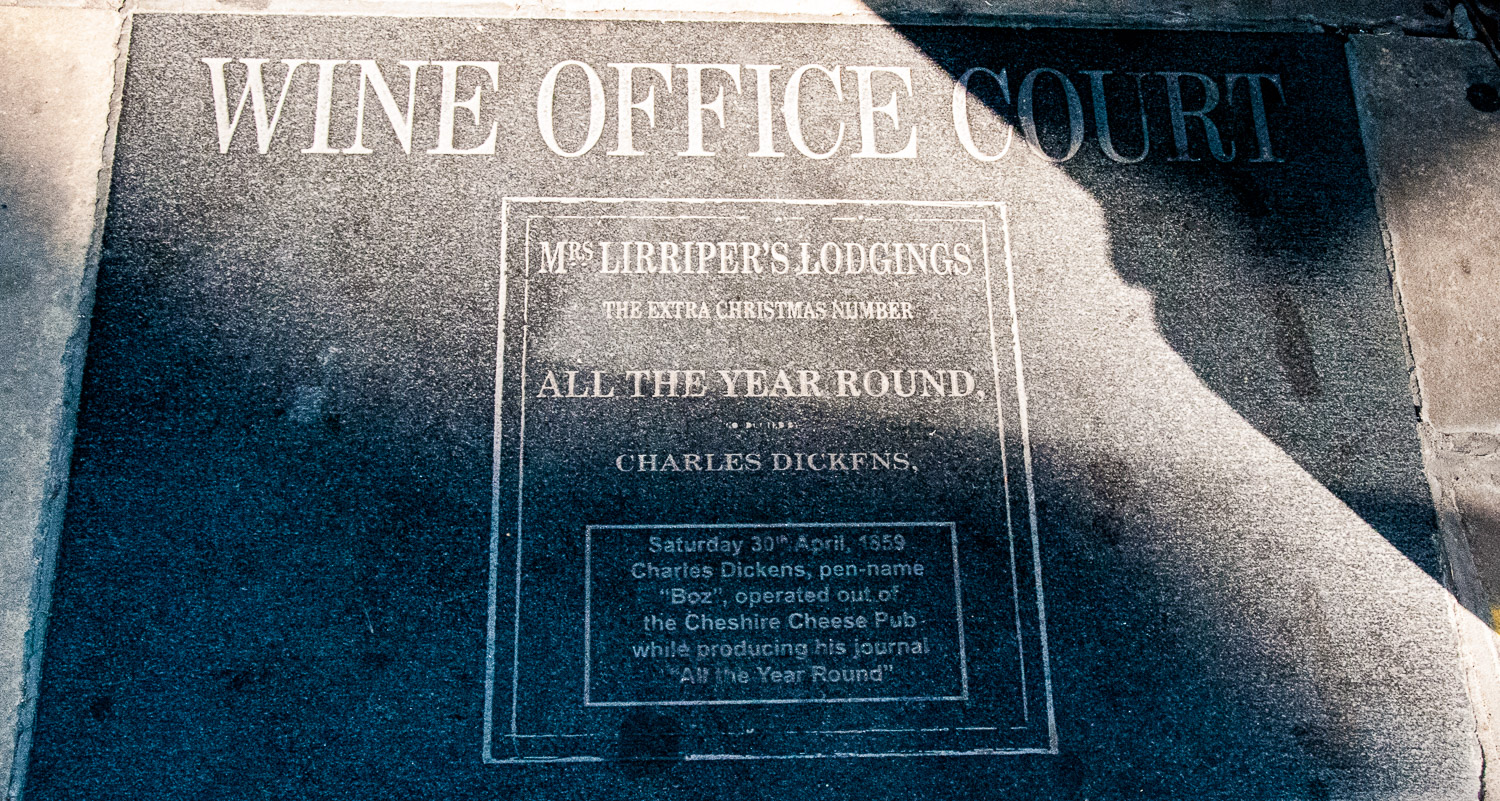
The plaque on the pavement at the Fleet Street entrance references the periodical All the Year Round which was founded by Dickens and published between 1859 and 1895 …

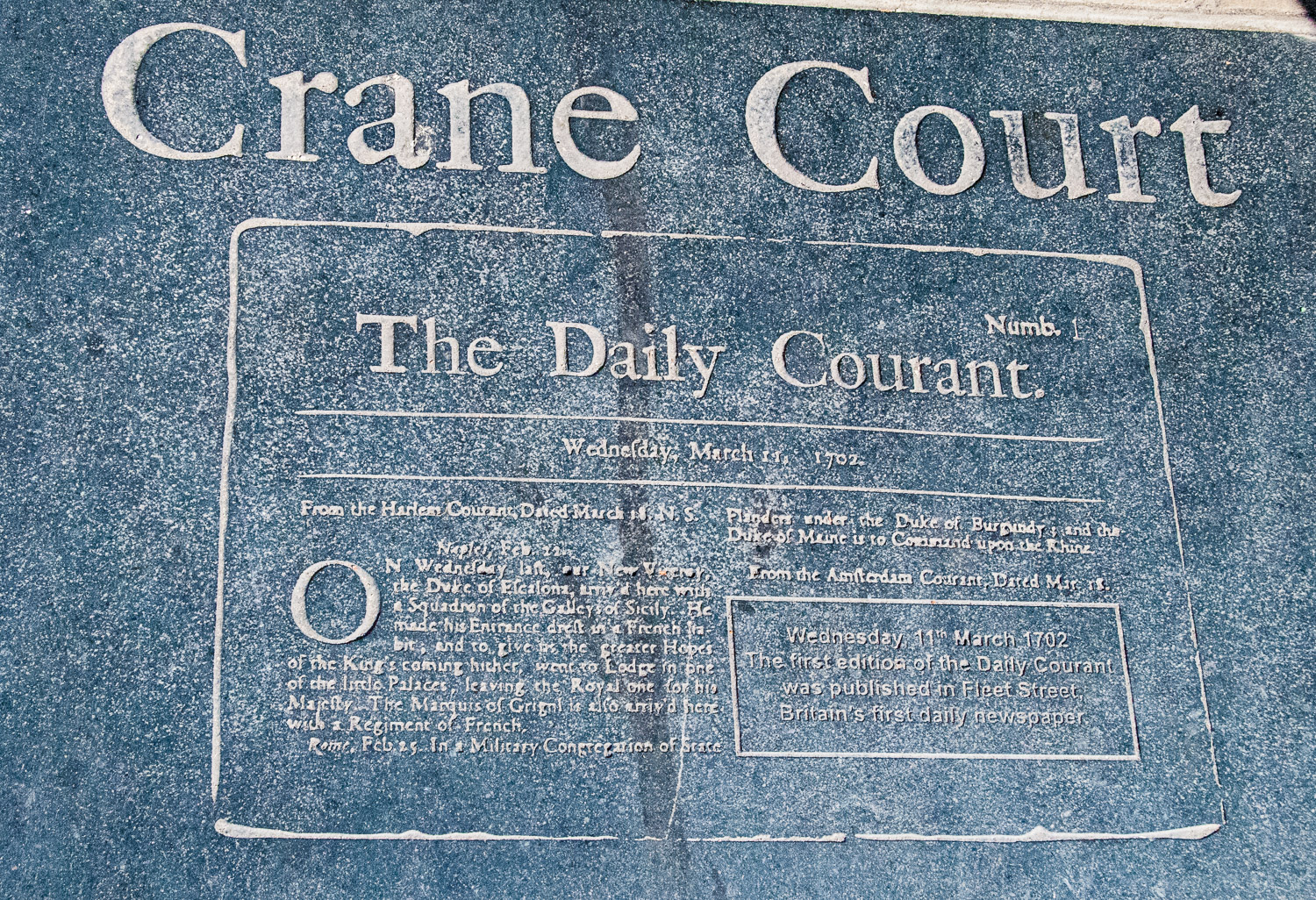
Here is the plaque for Crane Court …

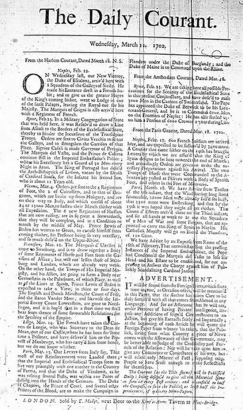
The plaque here is arguably the most significant because it commemorates the Daily Courant and its edition of 11 March 1702 made it the first daily paper in Britain. Here is the first edition – one page with news on the front and advertisements on the reverse …

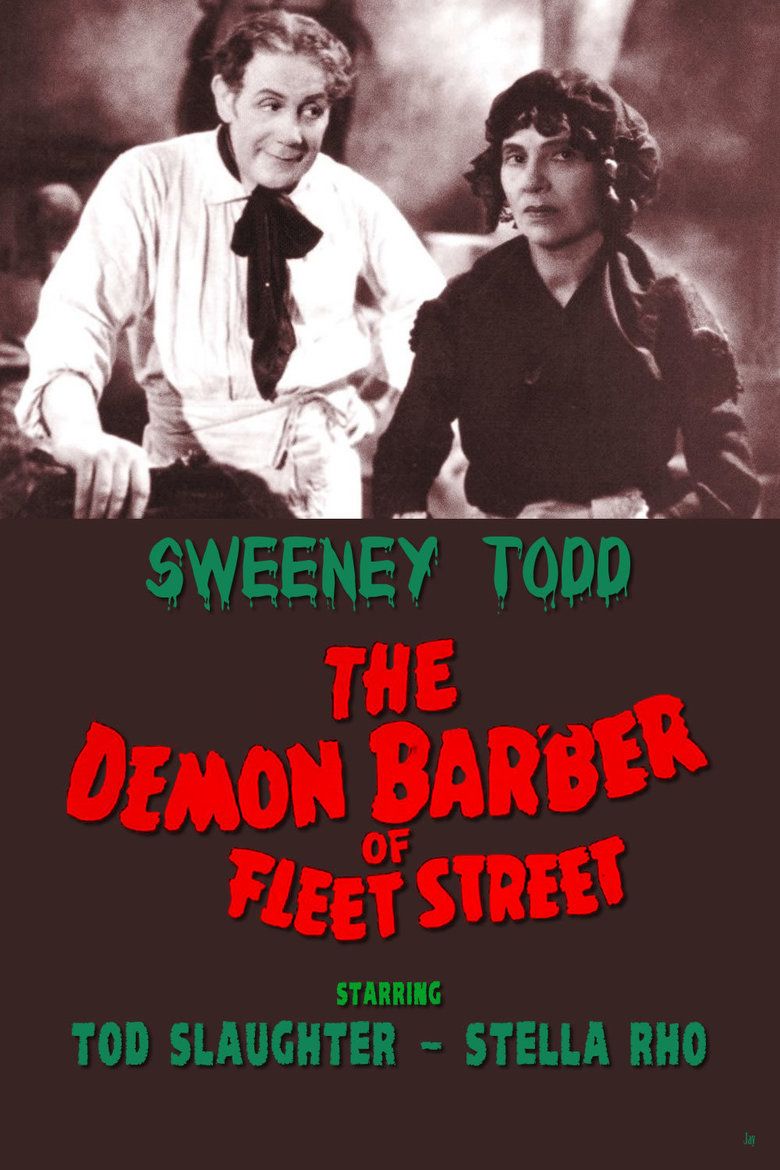
 On 14 April 1785 it ran a story about a man murdered after a visit to the barber. Some claim that this was the inspiration behind Victorian penny dreadful Sweeney Todd (allegedly a resident of 183 Fleet St) and the spawning of lots of movies …
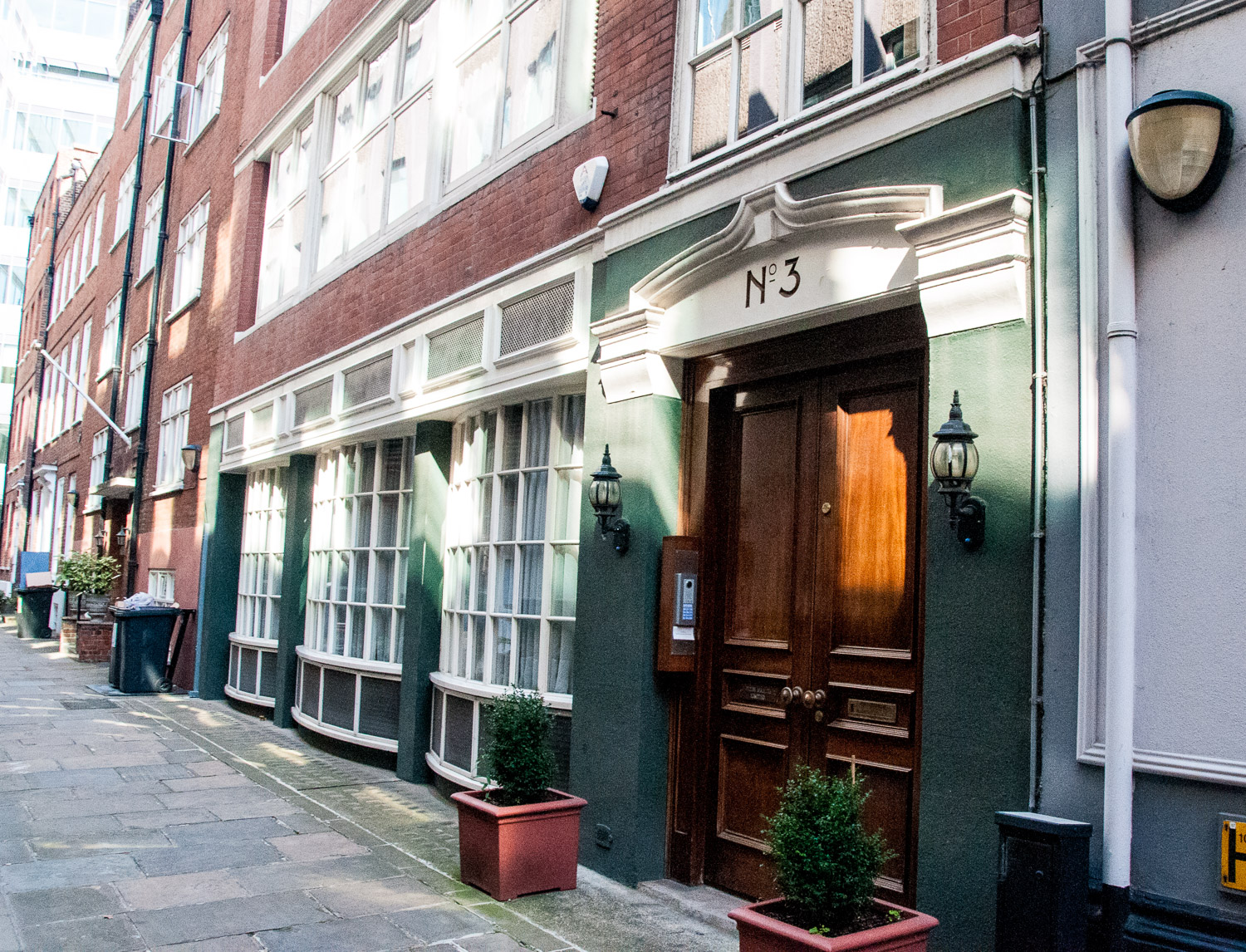
It’s worth taking a walk through Crane Court and seeing how it opens up into an area full of character where development has been careful and restrained …

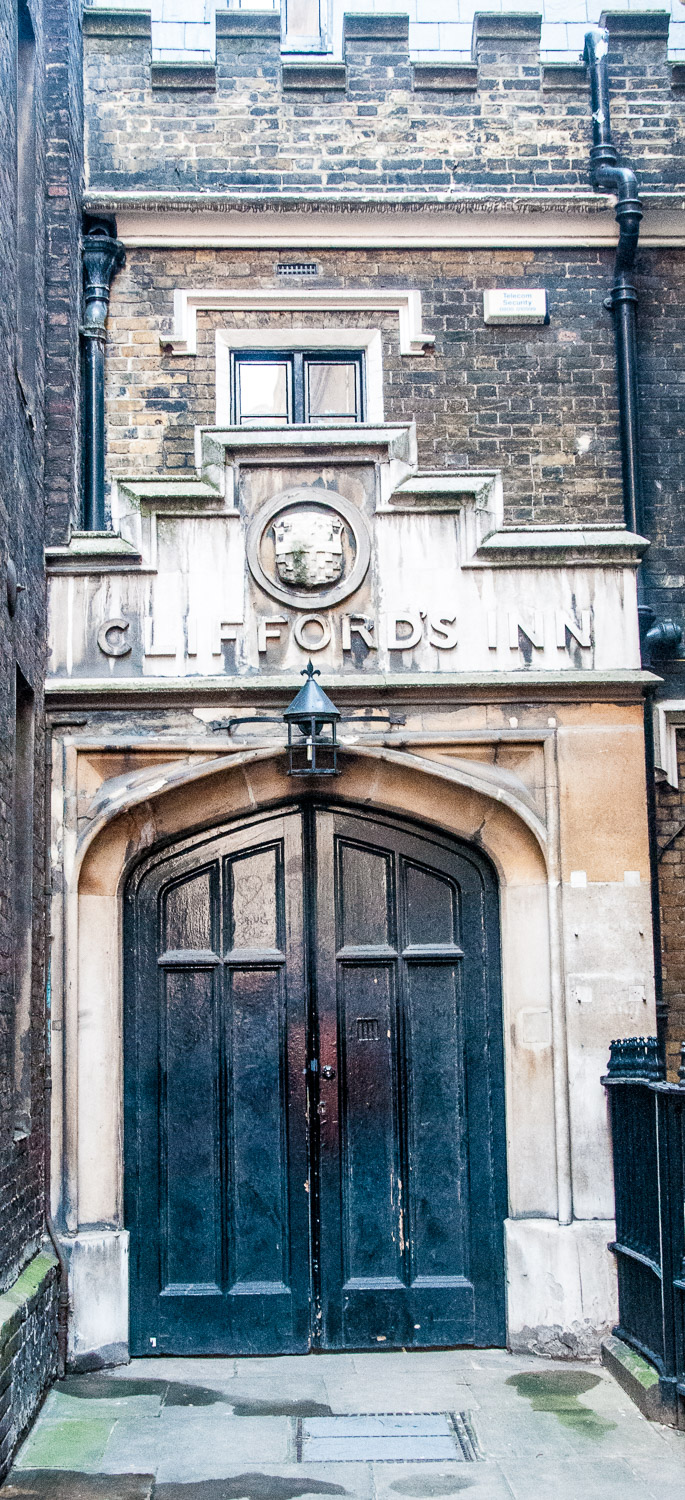
For slightly sinister atmosphere it is hard to beat Clifford’s Inn Passage with this door at the end …

Here is some history, courtesy of the blog Alleys and Courtyards of London …

In 1307 Robert Clifford was granted the lease on a substantial house and a plot of land towards the northern end of the passage. At that time lawyers had not settled into any particular area of London and it was completely by chance that when Clifford died in 1343 his widow leased the house to a number of law students. Clifford’s Inn, or Clifford’s House as it was called, was the first established Inn of Chancery and from this beginning the long history of legal London started. Clifford’s Inn ceased to function as a legal establishment in 1802 and one by one the buildings were demolished.

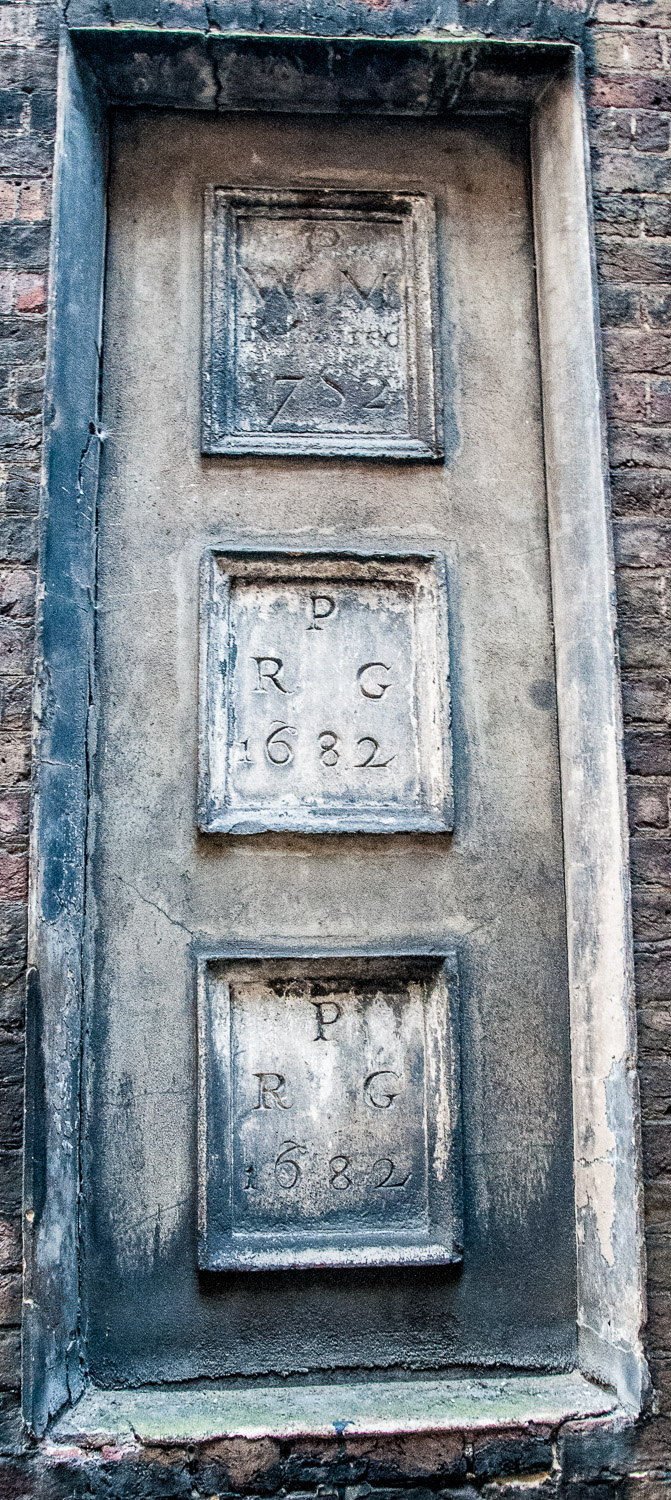
There are some interesting boundary marks to the left of the door …

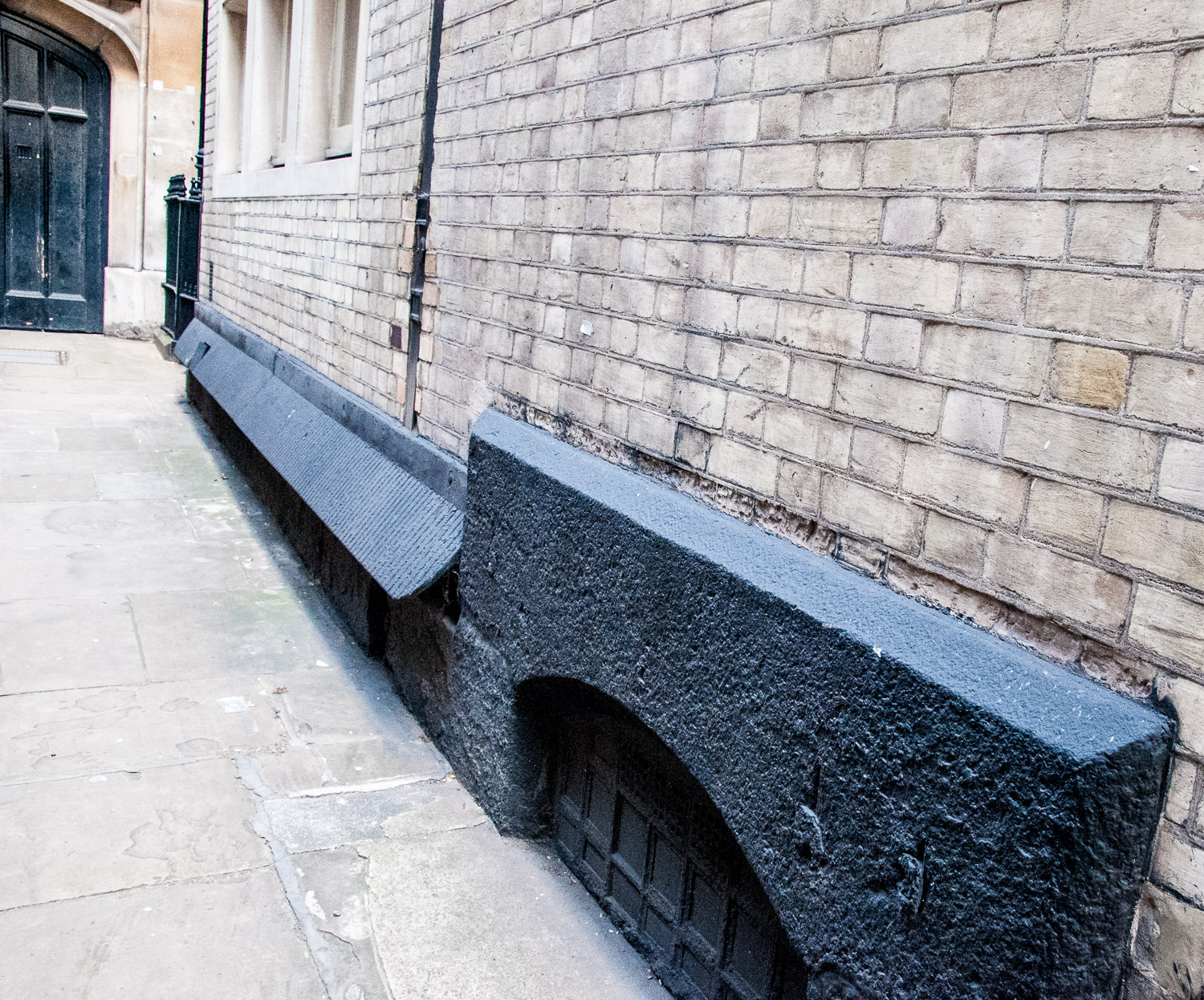
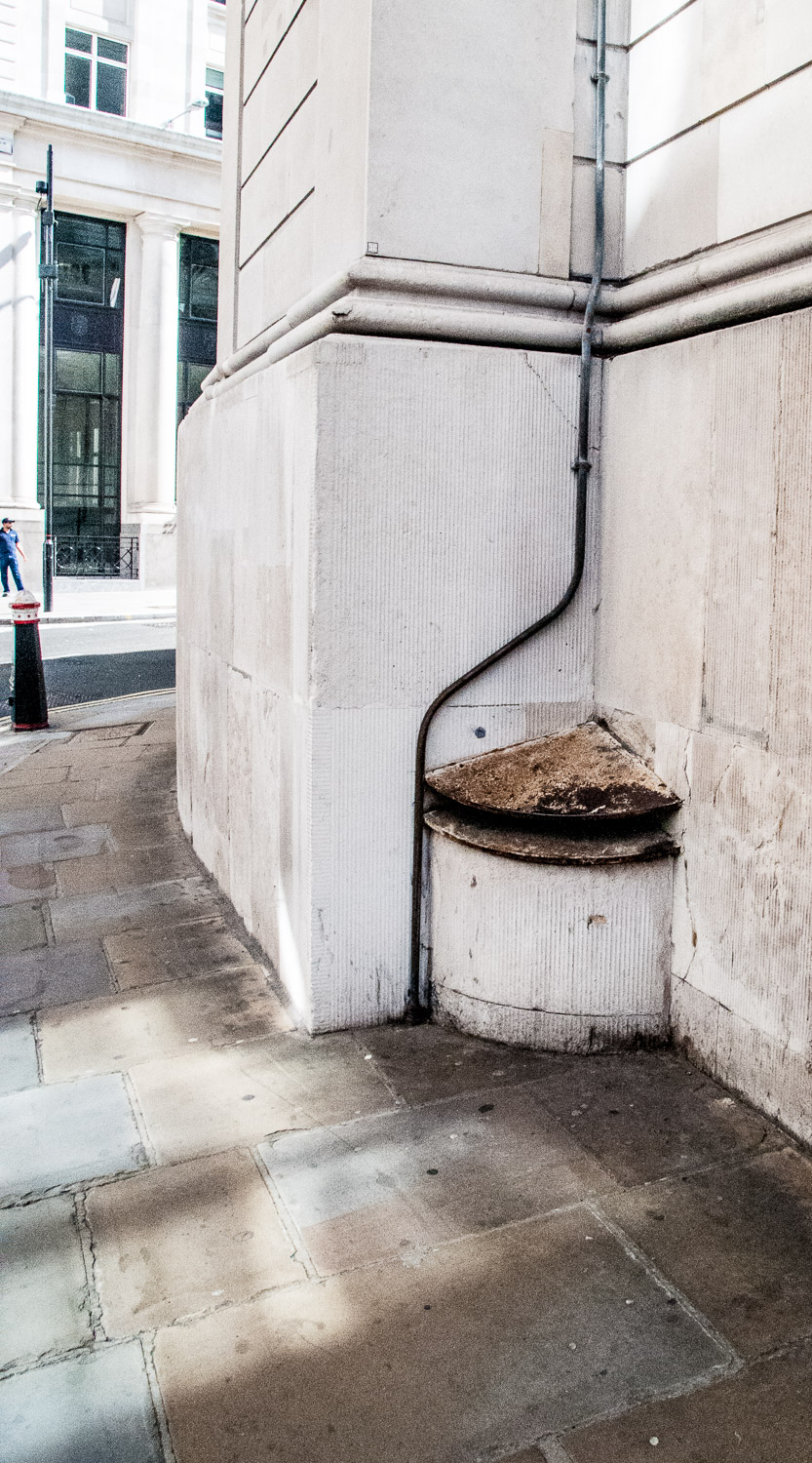
Also in Clifford’s Inn Passage, near the door and also at the entrance, are some rare examples of ‘deflectors’ …

Before public toilets were readily available, men would often slip away down alleys like this to urinate (unfortunately some still do). Building owners fitted these devices so that the stream would be deflected back onto the perpetrators’ feet and act as a deterrent.

There is another one outside the Bank of England in Lothbury …


You’ll be relieved to hear that these are the only ones I have found.

Page 25 of 26

Powered by WordPress & Theme by Anders Norén

Symbols & Secrets
Privacy Overview

This website uses cookies so that we can provide you with the best user experience possible. Cookie information is stored in your browser and performs functions such as recognising you when you return to our website and helping our team to understand which sections of the website you find most interesting and useful.