Walking the City of London

Category: Memorials Page 34 of 36

Some interesting faces – from a handsome poet to the ‘ugliest man in England’

Over the last few weeks I have been exploring the City looking at how people have been portrayed in busts, statues and other varieties of portraits. There are a remarkable number of them, particularly if you venture into the churches, so I have just picked some of the ones that I found most interesting.

I will start on a rather sombre note.

This is the beautiful marble war memorial above the concourse at Liverpool Street Station. It contains 1,108 names in alphabetical order and the panel at the top reads as follows:

To the glory of God and in grateful memory of those members of the Great Eastern Railway staff who, in response to the call of their King and Country, sacrificed their lives during the Great War.
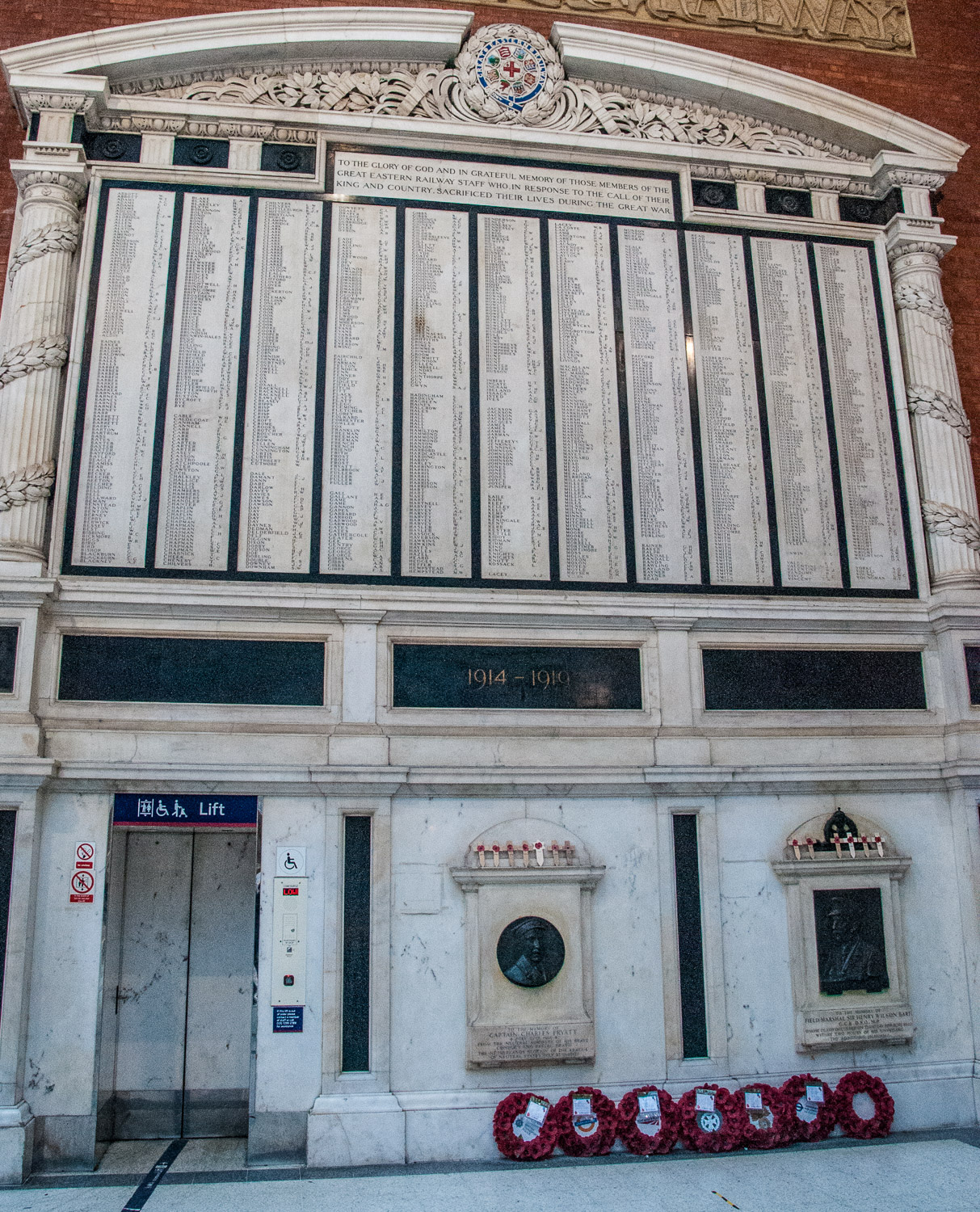
If you look beneath it, you will see two individual memorials containing bronze portraits.

This is the one on the right …
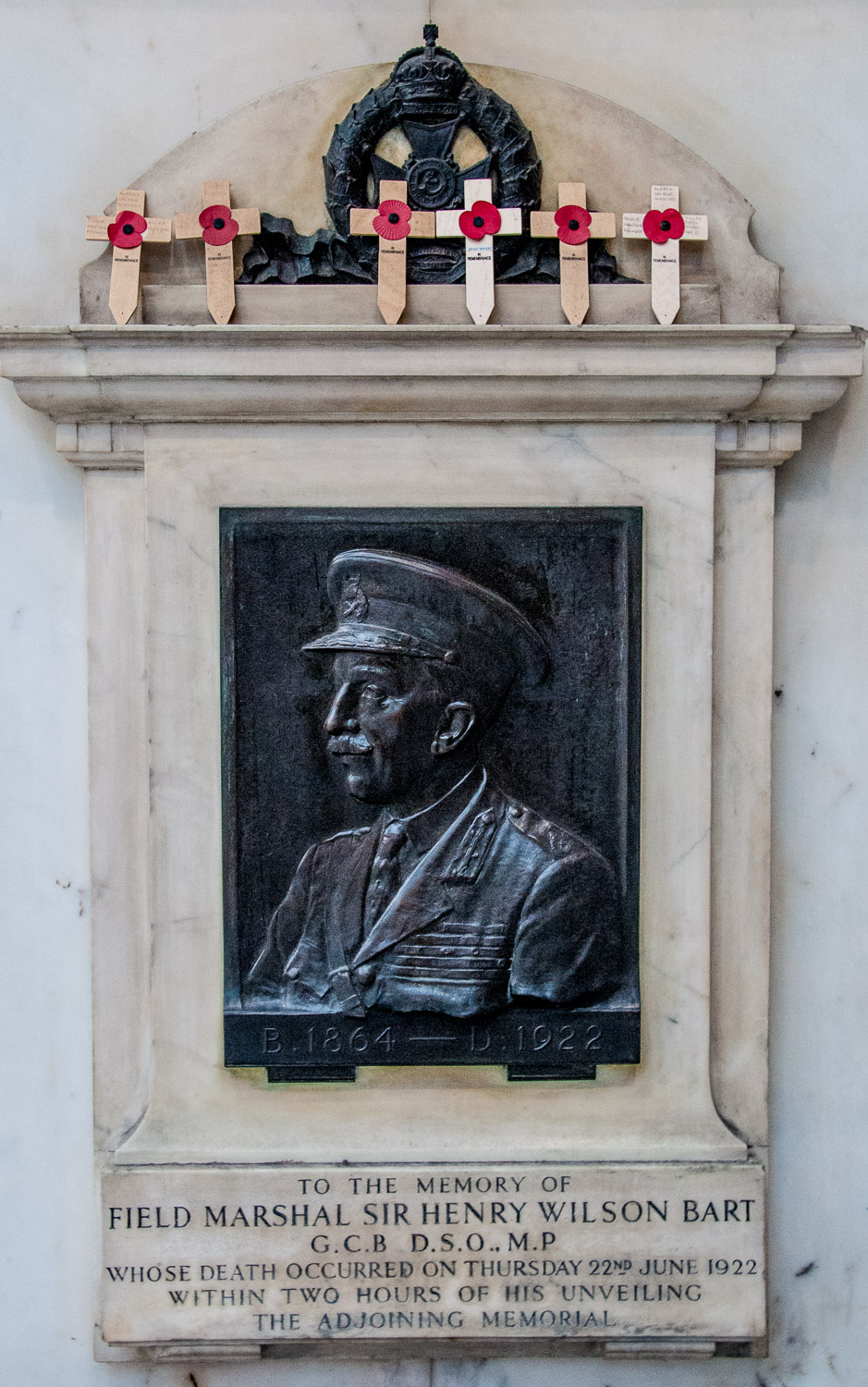
Wilson was assassinated outside his house in Eaton Place at about 2:20 pm. Still in full uniform, he was shot six times, two bullets in the chest proving fatal. The two perpetrators, IRA volunteers Reginald Dunne and Joseph O’Sullivan, shot two police officers and a chauffeur as they attempted to escape but were surrounded by a hostile crowd and arrested after a struggle. Interestingly both were former British army officers and O’Sullivan had lost a leg at Ypres, his subsequent disability hindering their escape. After a trial lasting just three hours they were convicted of murder and hanged at Wandsworth gaol on 10 August that year – justice was certainly delivered swiftly in those days. No organisation claimed responsibility for Wilson’s murder.

This magnificent bust of William Shakespeare is in St Mary Aldermanbury Garden, Love Lane EC2 …
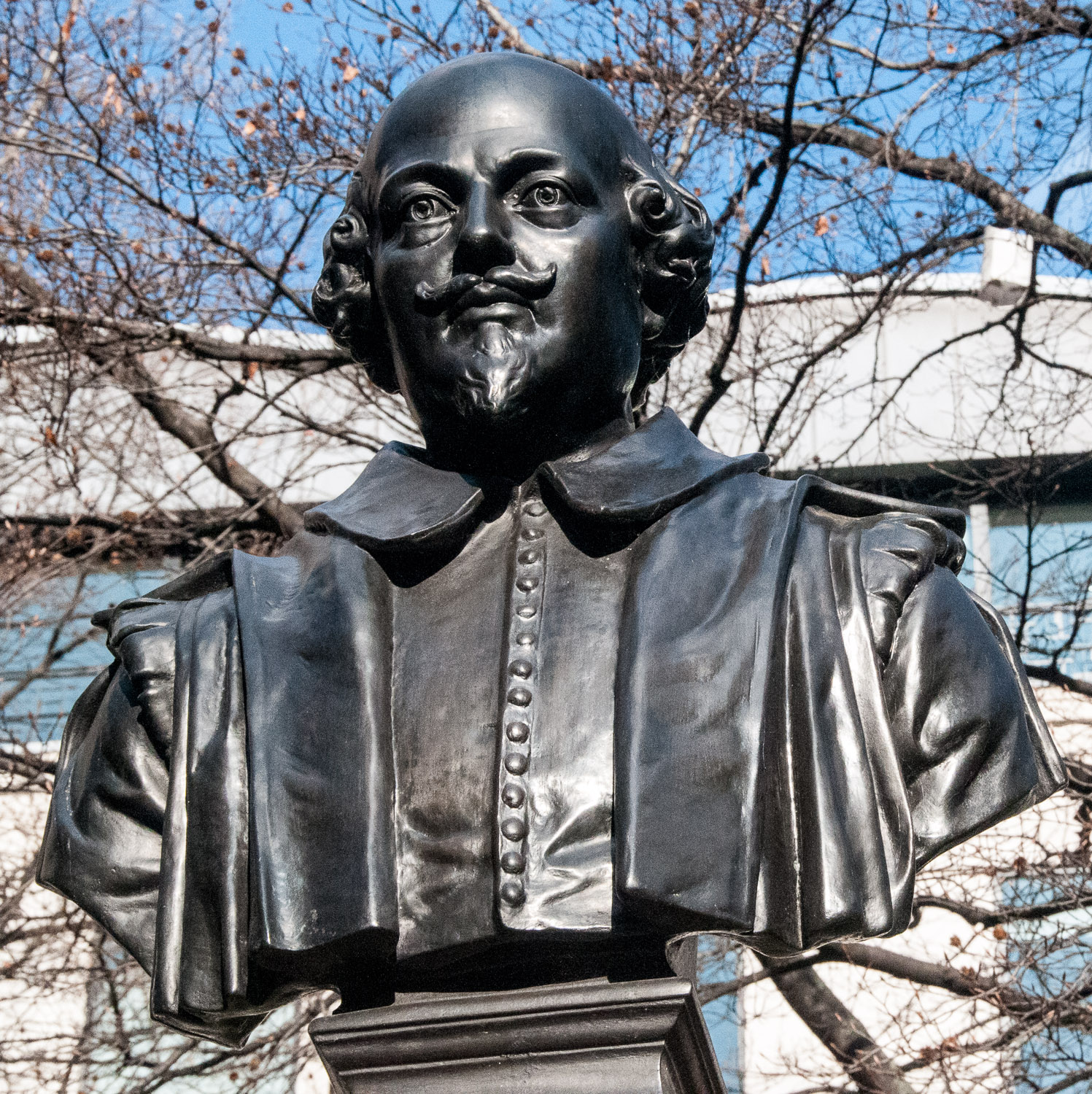
Designed by Charles Clement Walker and sculpted in 1896 by Charles John Allen.

A Wren church gutted in the Blitz, the remains of St Mary Aldermanbury were shipped to Fulton, Missouri, USA in 1966. The restored church now is now a memorial to Winston Churchill’s ‘Iron Curtain’ speech made at Westminster College, Fulton, in 1946.

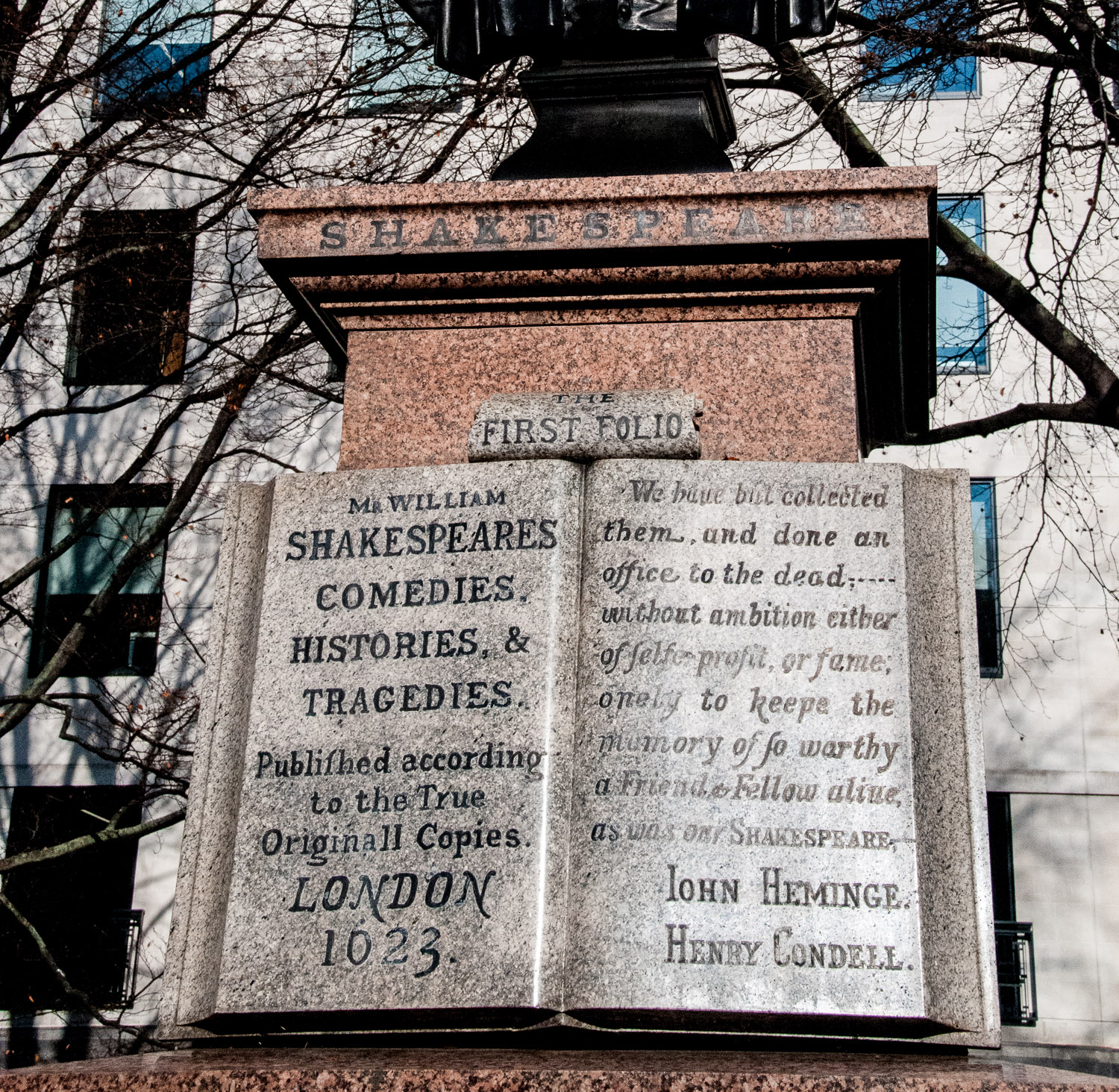
The Shakespeare bust in the garden stands as a memorial to his fellow actors Henry Condell and John Heminge who were key figures in the printing of the playwright’s First Folio of works seven years after his death. There are almost twenty plays by Shakespeare, including The Tempest, Julius Caesar, Macbeth and Antony and Cleopatra, which we would not have at all if it were not for their efforts. Both of them were buried at St Mary’s.
Outside the south side of St Paul’s Cathedral is this rather handsome bearded gentleman …
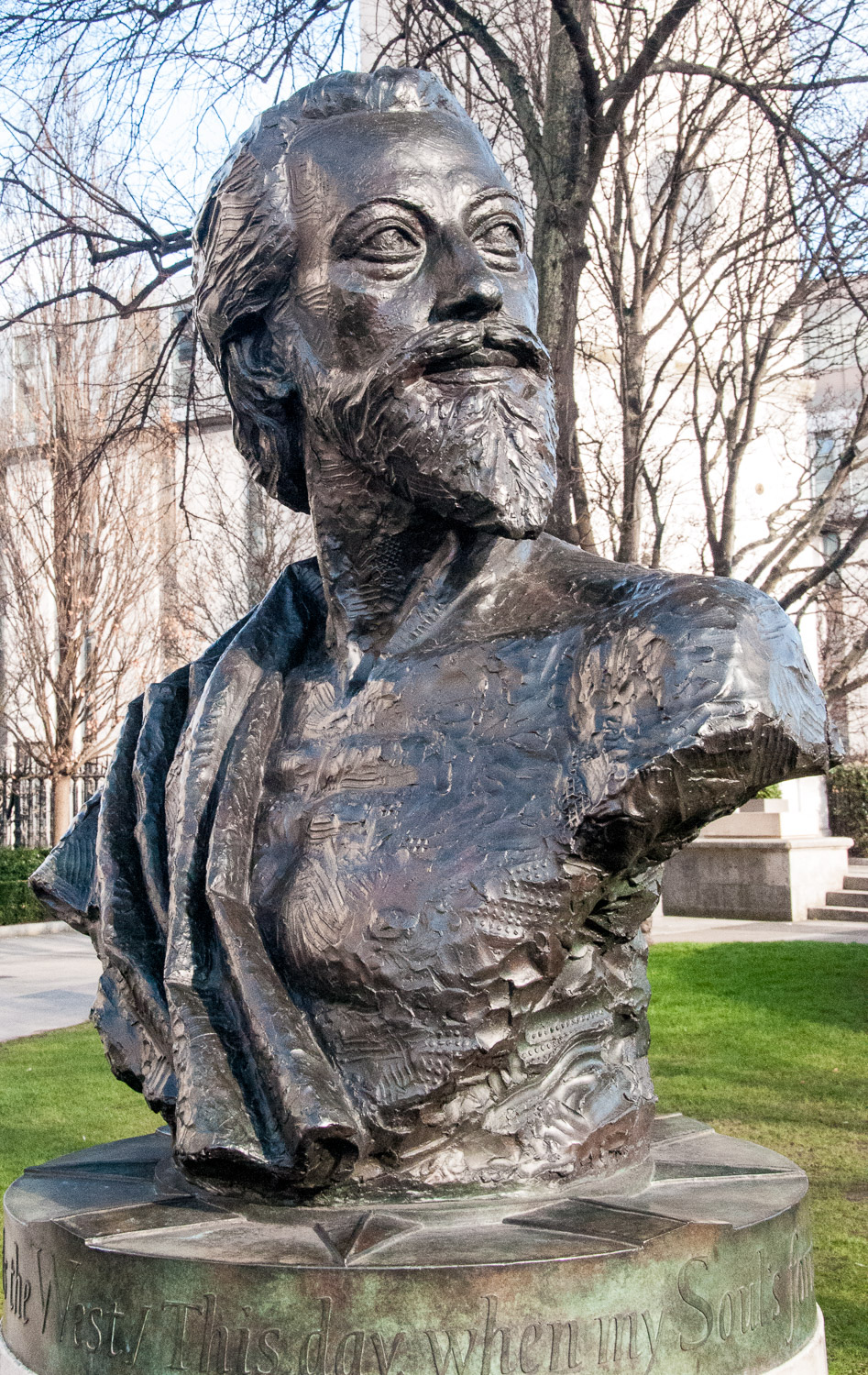
John Donne 1572-1631 by Nigel Boonham (2012).

In 1617, two years after his ordination, Donne’s wife died at age 33 after giving birth to a stillborn child, their twelfth. Grief-stricken at having lost his emotional anchor, Donne vowed never to marry again, even though he was left with the task of raising his ten surviving children in modest financial circumstances. His bereavement turned him fully to his vocation as an Anglican divine and, on November 22, 1621, Donne was installed as Dean of St. Paul’s Cathedral. The power and eloquence of his sermons soon secured for him a reputation as the foremost preacher in the England of his day, and he became a favourite of both Kings James I and Charles I.

His bust points almost due west but shows him turning to the east towards his birthplace on Bread Street. The directions of the compass were important to Donne in his metaphysical work: east is the Rising Sun, the Holy Land and Christ, while west is the place of decline and death. Underneath the bust are inscribed words from his poem Good Friday – Riding Westward :

Hence is’t that I am carried towards the west, This day when my soul’s form bends to the east

The most familiar quotation from Donne comes from his Meditation XVII – Devotions upon Emergent Occasions published in 1624:

‘No man is an island, entire of itself; every man is a piece of the continent, a part of the main … and therefore never send to know for whom the bell tolls, it tolls for thee.’

Donne is also famous for the fact that his effigy in St Paul’s Cathedral was the only one to survive the Great Fire of 1666 almost intact (you can still see scorch marks on the urn).  You have to enter the cathedral to see it.
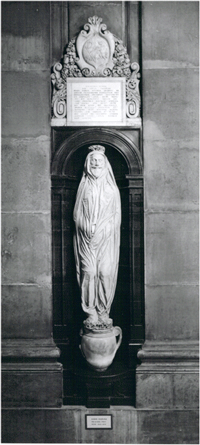
The effigy by Nicholas Stone
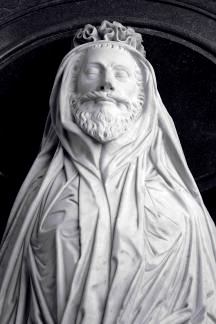
Dr Philip Cottrell of University College Dublin describes it as follows:

Donne is shown standing, perched on a funerary urn, and enveloped in a body-hugging burial shroud which has been gathered into two decorative ruffs at the head and feet … The clean, moist appearance of the drapery and the softly-nuanced modelling of the features testify to Stone’s position as the finest sculptor of the English Baroque.

The inscription on this statue of John Wilkes in Fetter Lane EC4 reads as follows:

A champion of English freedom, John Wilkes 1727-1797, Member of Parliament, Lord Mayor.
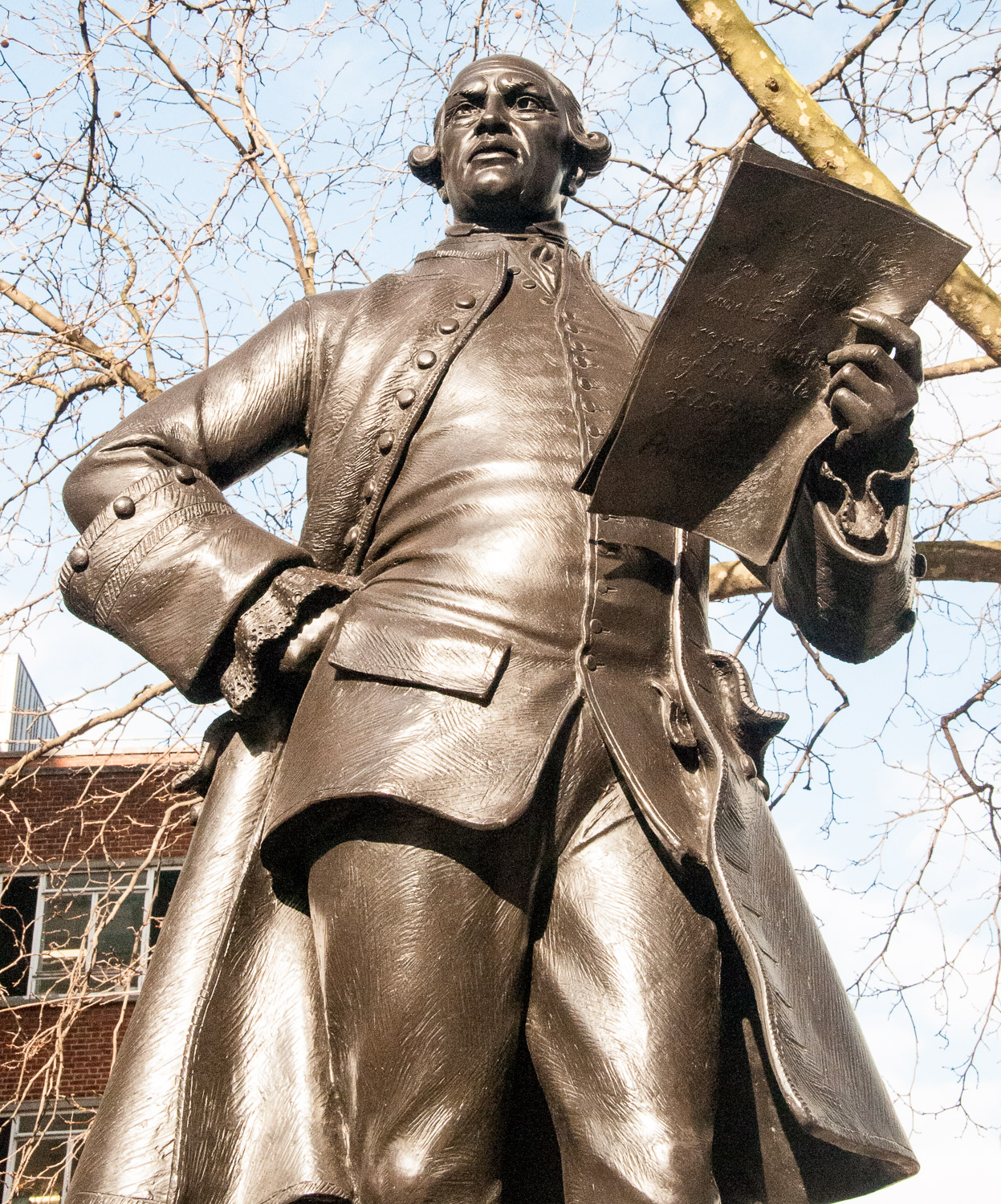
The inscription on the back of the document he is holding reads ‘A bill for a just and equal representation of the people of England in Parliament’.

English History Online writes of him:

In 1774 that clever rascal, John Wilkes, ascended the civic throne … Young Wilkes grew up a man of pleasure, squandered his wife’s fortune in gambling and other fashionable vices, and became a notorious member of the Hell Fire Club

Wilkes’ career is so extraordinary that I gave up trying to devise edited highlights – please forgive me for cheating and quoting this summary from The Geograph website …

The remarkable Mr Wilkes was a radical, politician, wit, rake, journalist, Lord Mayor of London, prankster and member of The Hellfire Club.

He was repeatedly expelled from The House of Commons and even once declared an outlaw. He is described on the plinth as a “Champion of English freedom” though he was disparagingly known as “the ugliest man in England” by some …. ‘he could woo any woman in competition with any man, provided he was given a month’s start on account of his ugliness.’

Reputedly, John Montagu, the 4th Earl of Sandwich said to Wilkes “Sir, I do not know whether you will die on the gallows or of the pox,” Wilkes replied, “That depends, my lord, on whether I embrace your lordship’s principles or your mistress.”
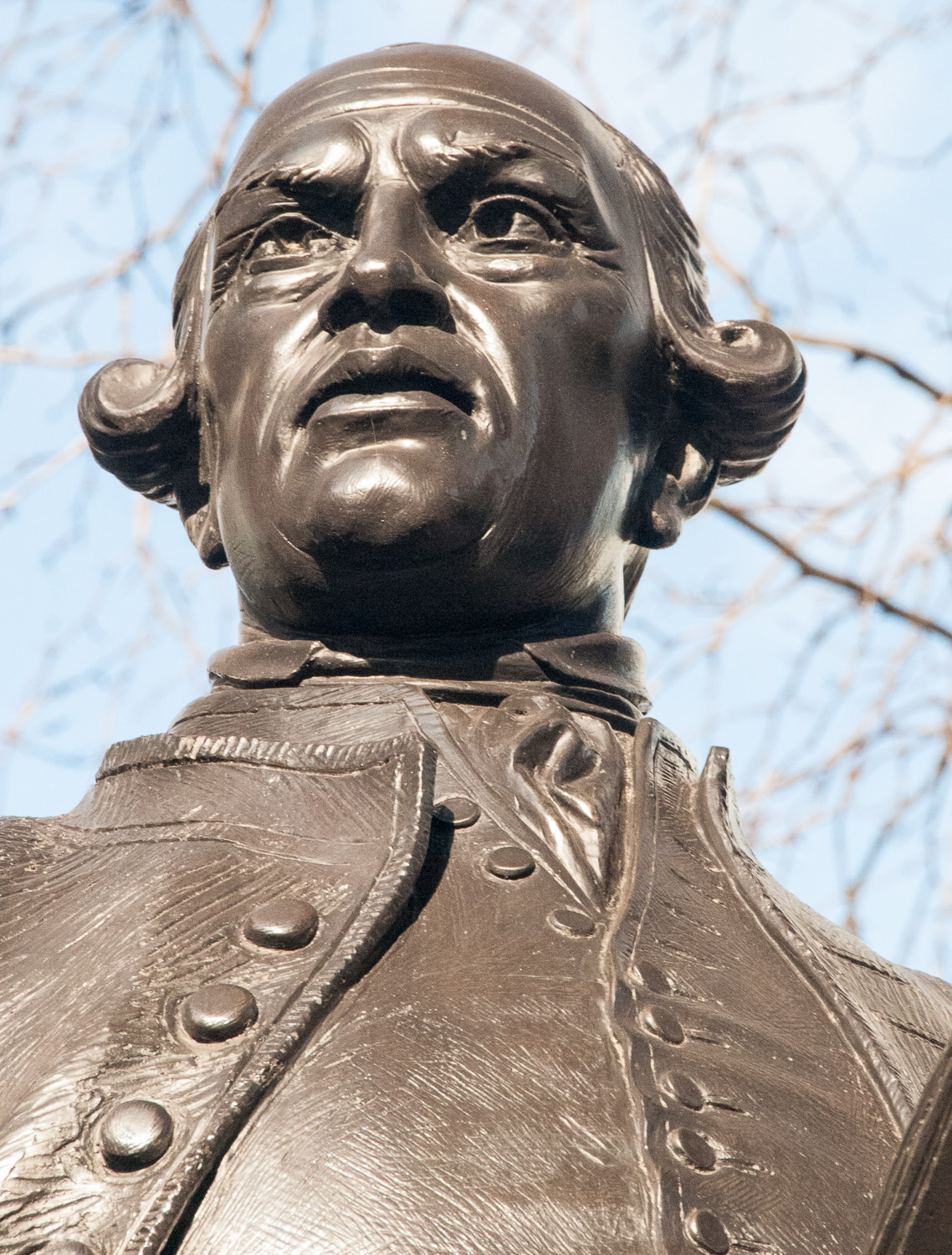
Wilkes’ famous squint has been honestly represented by the sculptor, James Butler RA

Although hated by some, Wilkes has also been described as …

The father of the political system we have today and a major influence on that adopted by America: he established freedom of the press as we know it, argued for yearly elections and the abolition of rotten boroughs, and was the first MP to propose universal suffrage in the Commons.

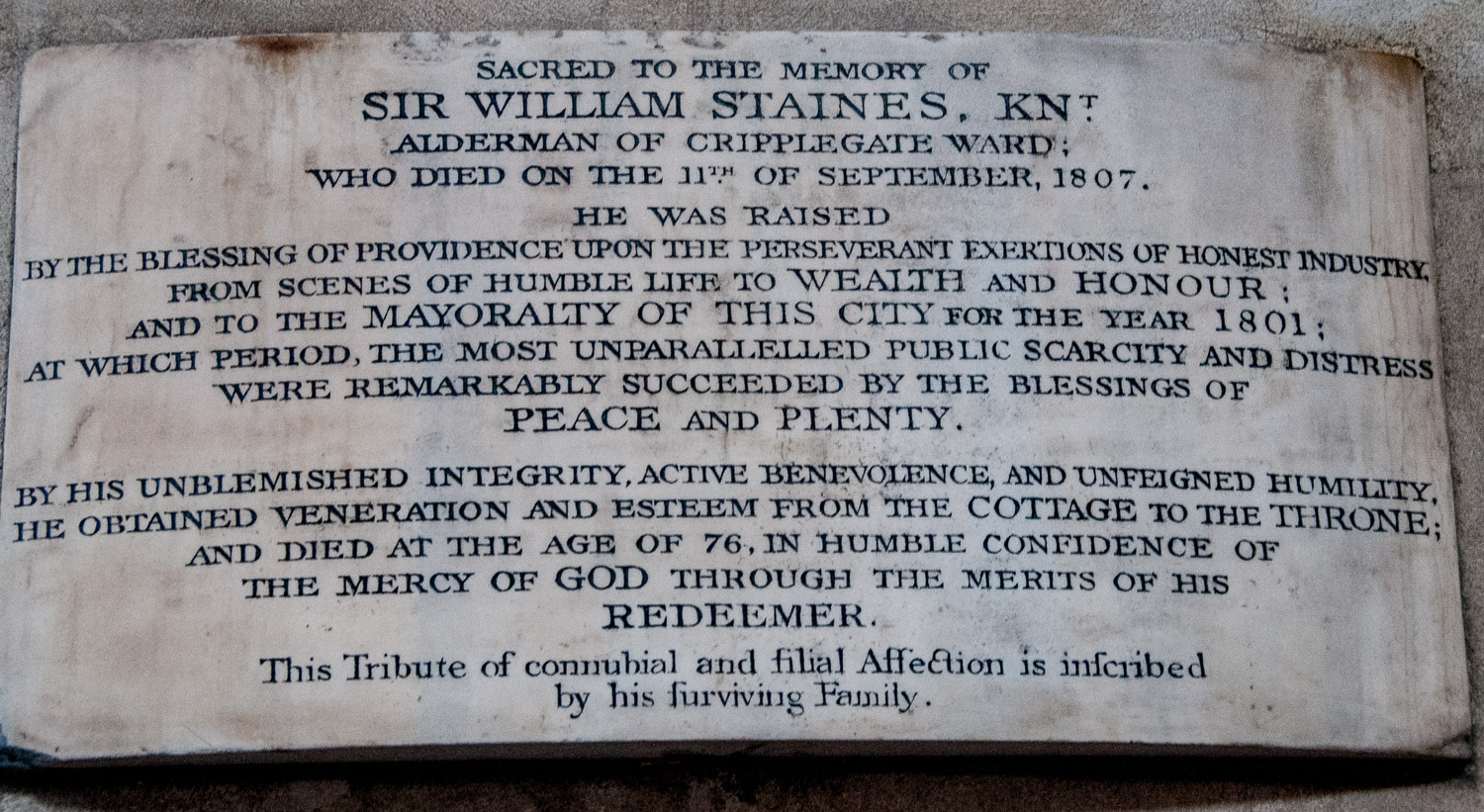
And finally, in my local church, St Giles-without-Cripplegate, there is this touching memorial to Sir William Staines …
And here is the man himself …
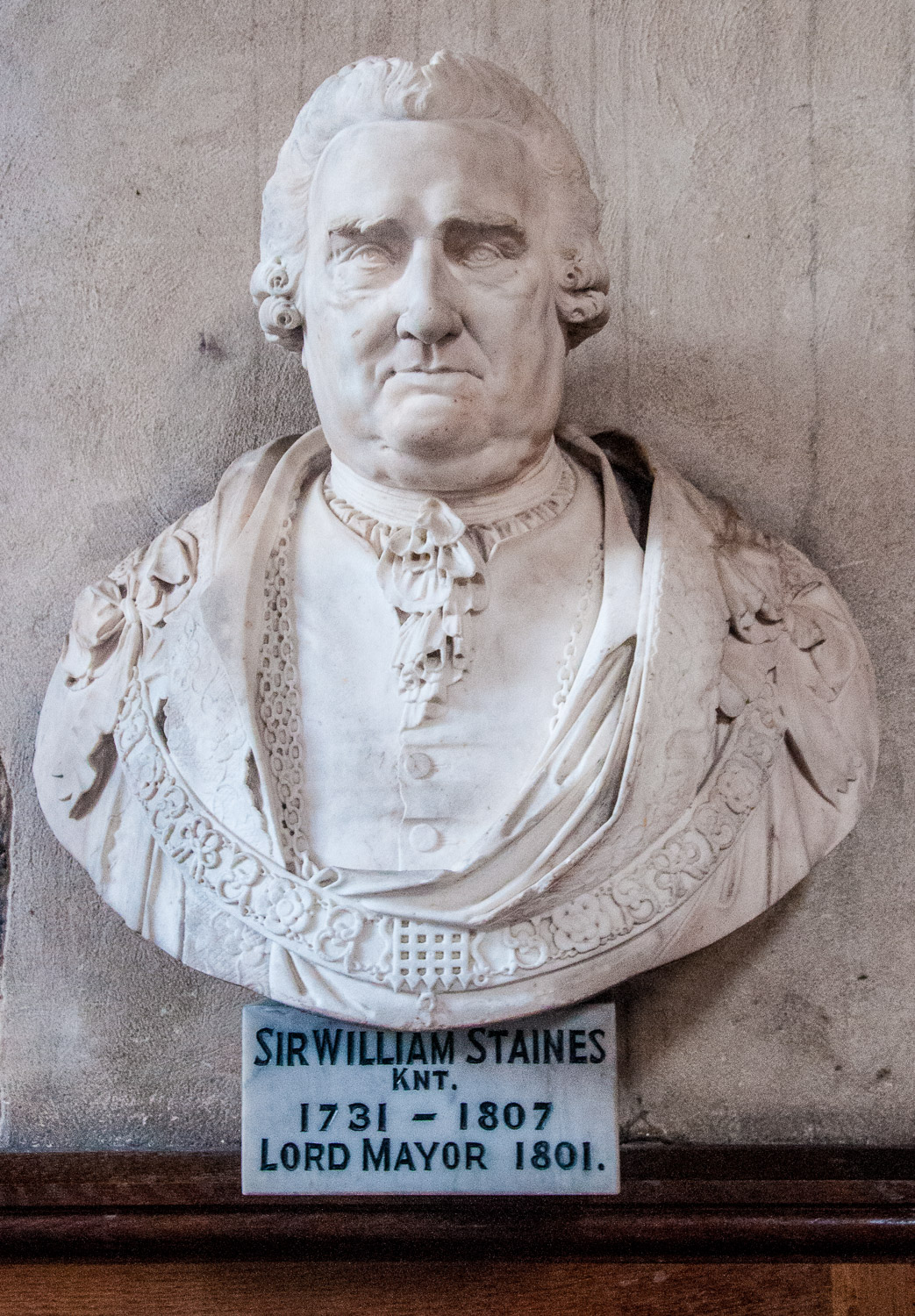
Staines had extremely humble beginnings working as a bricklayer’s labourer, but eventually accumulated a large fortune which he generously used for philanthropic purposes. He seemed to recall his own earlier penury when he ensured that the houses he built for ‘aged and indigent’ folk would have ‘nothing to distinguish them from the other dwelling-houses … to denote the poverty of the inhabitant’.

British History Online records an encounter he had with the notorious Wilkes who referred rather rudely to Staines’ original occupation …

The alderman was an illiterate man, and was a sort of butt amongst his brethren. At one of the Old Bailey dinners, after a sumptuous repast of turtle and venison, Sir William was eating a great quantity of butter with his cheese. “Why, brother,” said Wilkes, “you lay it on with a trowel!”
 

City Churches and Churchyards – more tales of the unexpected

City churches and their churchyards have so much to offer, and after all these years I am still discovering new quirky items and treasures to write about in my blog. Two church interiors and two churchyards will feature today. I know many of my readers are immensely knowledgeable in this area but I hope there will be something new here even for them.

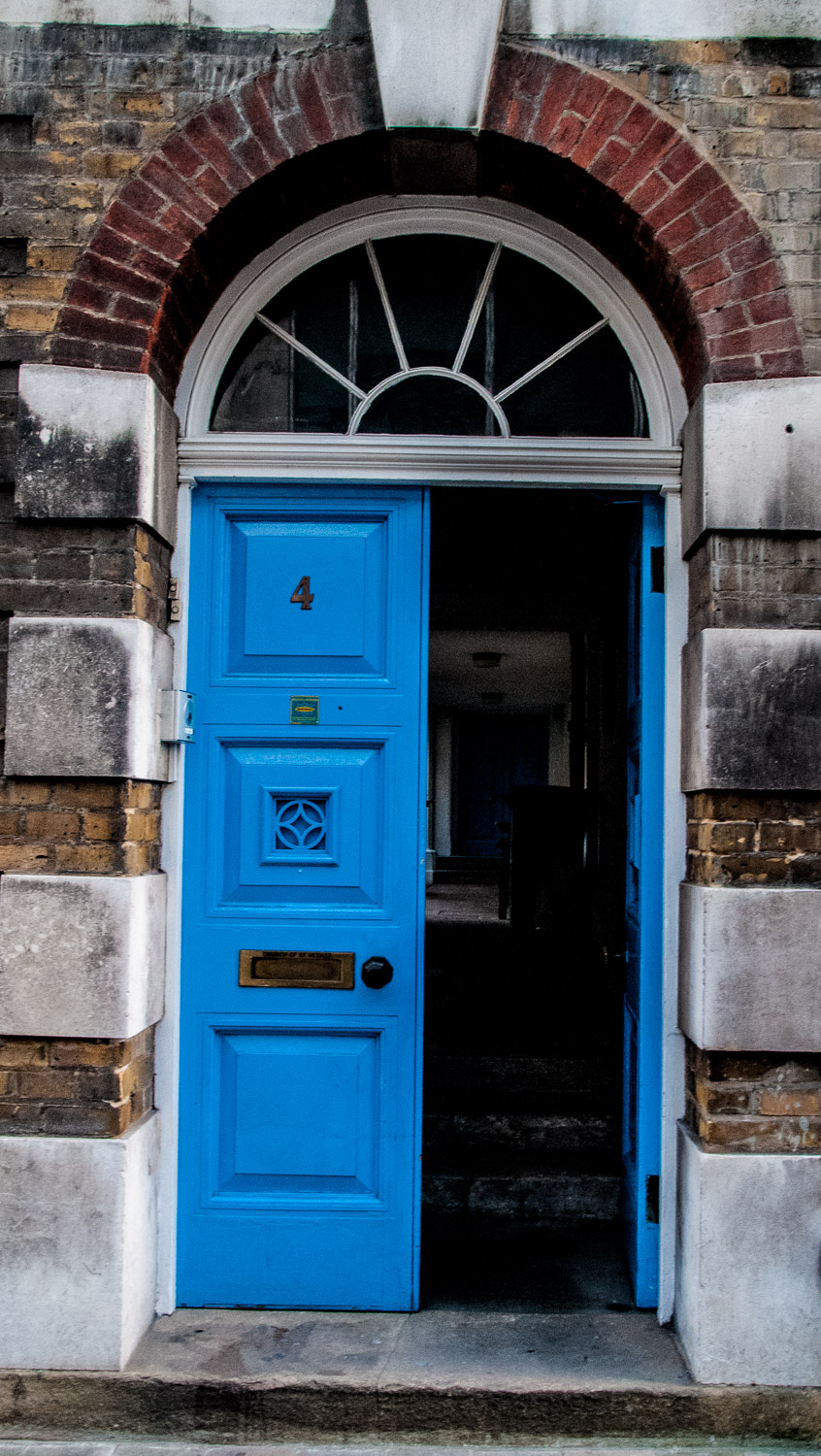
Once again I suggest you pass through the blue doors at 4 Foster Lane …

Entrance to St Vedast Fountain Courtyard and Cloister

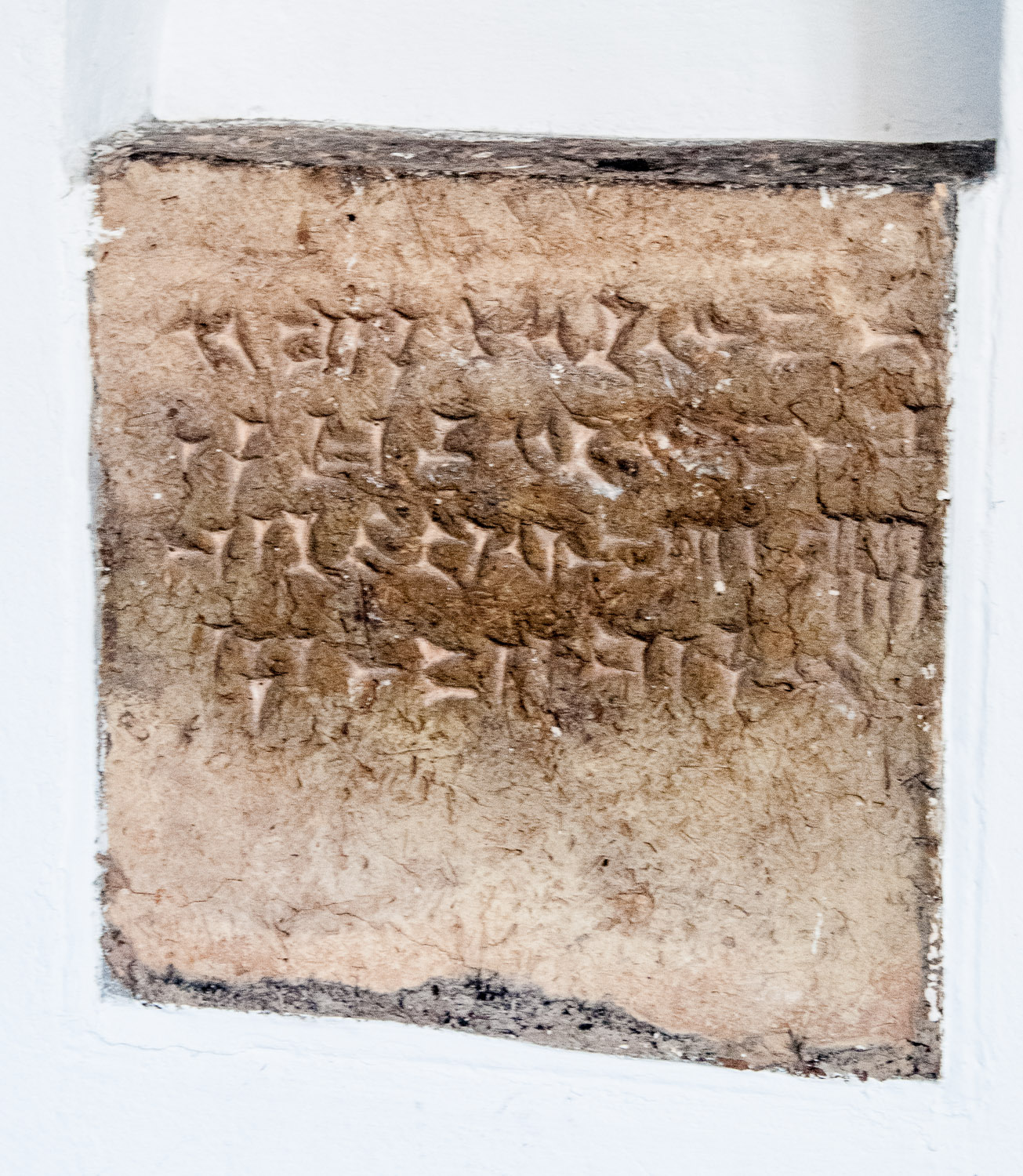
Near the piece of Roman pavement I discussed in an earlier blog (The Romans in London and Two Roman Ladies) you will see displayed in a niche a tablet with cuneiform writing.

It comes from a 9 BC Iraqi Ziggurat and was given to the Rector, Canon Mortlock, by Agatha Christie’s husband, the archaeologist Sir Max Mallowan. He discovered the brick during a 1950-65 dig and apparently it includes the name of Shalmaneser who ruled from 858 to 834 BC.

Just down the road from Pudding Lane, the source of the Great Fire, St Magnus the Martyr on Lower Thames Street was the second church to be destroyed in 1666. It was rebuilt by Wren circa 1671-84 and, despite being damaged in the Blitz, it has a great atmosphere – especially on a Sunday when lots of incense has been deployed.

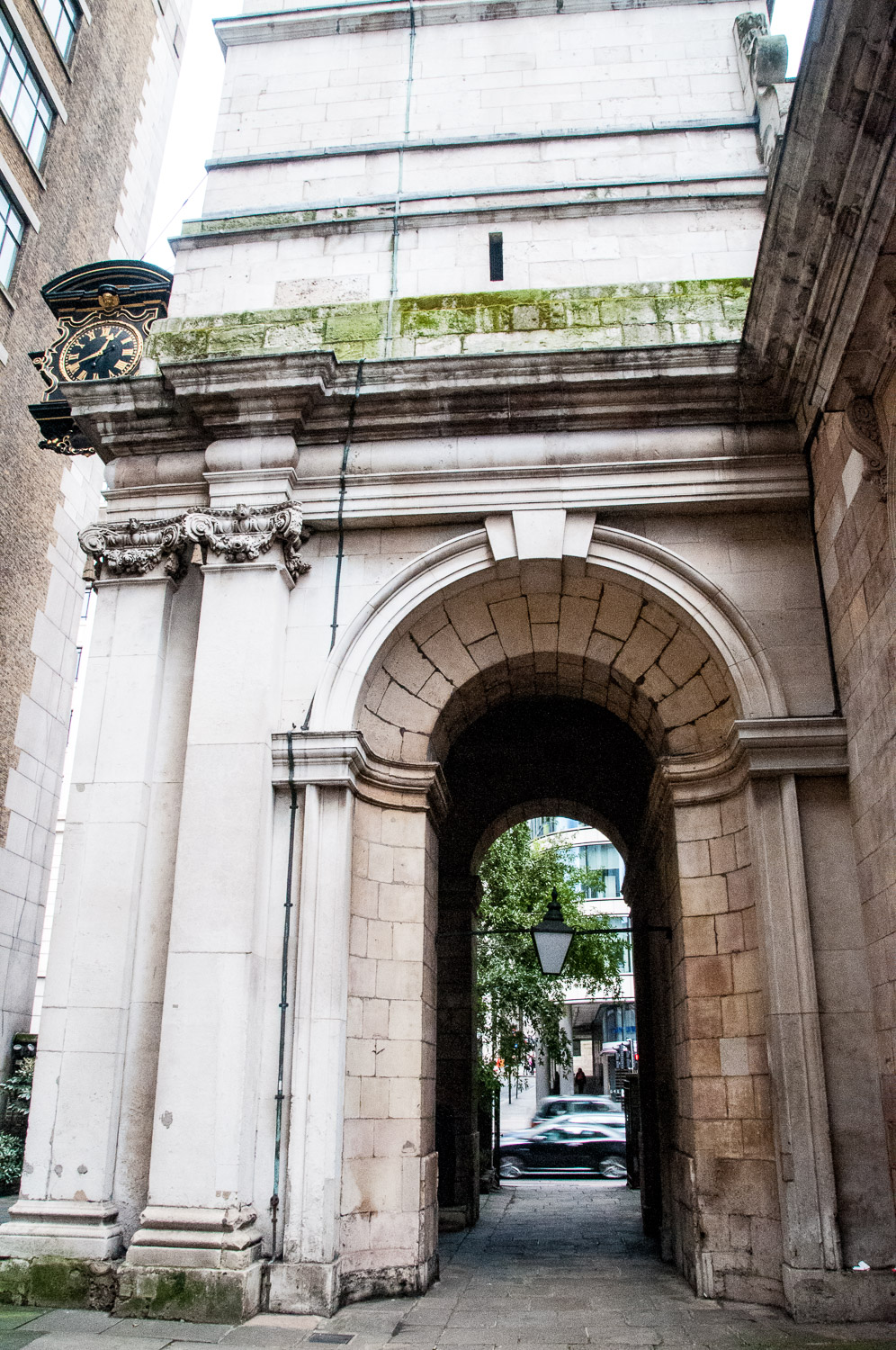
It is worthy of an entire blog all to itself, but for today I will be writing about just a few of its fascinating features. First of all there is the portico you walk through to enter the church …

The view towards Lower Thames Street

Between 1176 and 1831 the churchyard formed part of the roadway approach to Old London Bridge. I found it easy to imagine the tens of thousands who passed through here, since it was the only bridge across the Thames until Westminster Bridge was opened in 1750. Despite the heavy passing traffic, and the lavatorial white tiles on the nearby buildings, this is an atmospheric place and I paused there thinking of all those forgotten souls who had walked these flagstones before me.

The clock (top left in the picture) was presented in 1709 by Sir Charles Duncombe when he was Lord Mayor. One legend tells us that, as a poor saddler’s apprentice living south of the river, he was often severely reprimanded by his master for being late because he had no way of telling the time. Now immensely wealthy, he gifted the clock for the benefit of other folk who could not afford a timepiece.

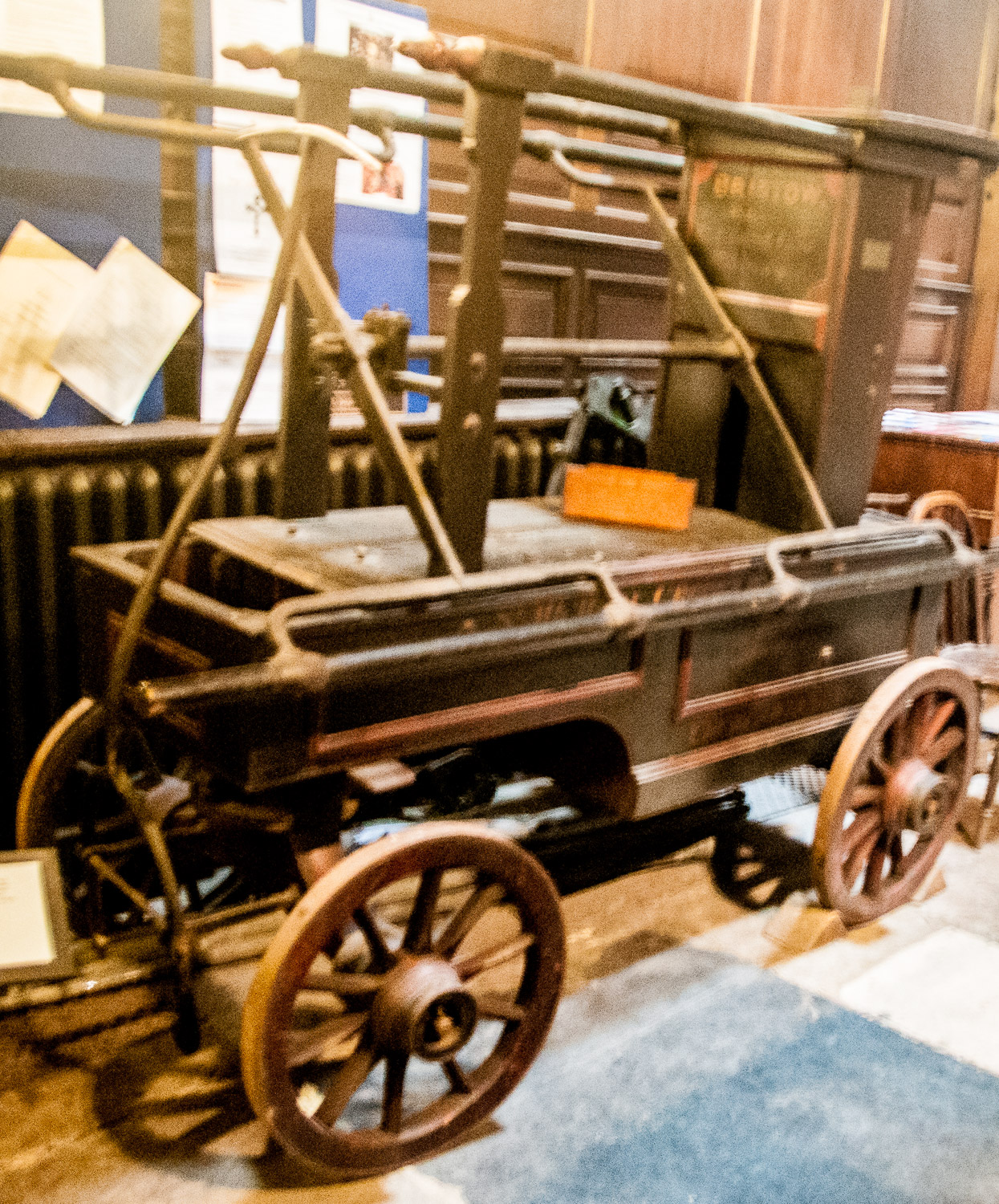
Right inside the door is a lovely surprise – a 17th century fire engine …

It once belonged to St Michael Crooked Lane. It has only recently been displayed in the narthex having been in store with the Museum of London since 1945.

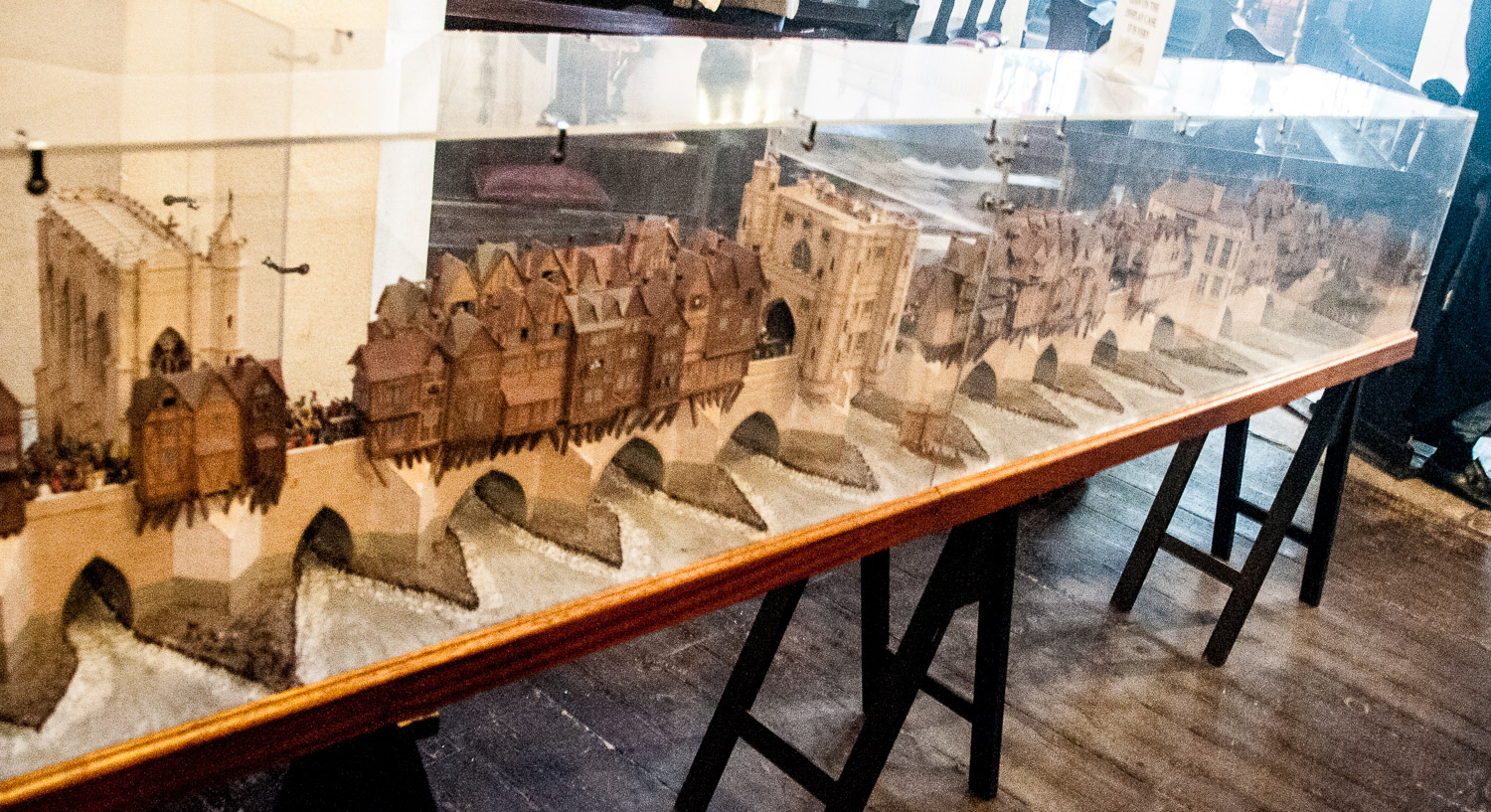
And if the fire engine wasn’t enough to prompt a visit, what about this extraordinary model of the Old London Bridge …

My picture really does not do it justice – it is four metres long and portrays the bridge at the start of the 15th century

It was created in 1987 by David T Aggett, a liveryman of the Worshipful Company of Plumbers. The detail is superb, from the individual tiles on the lead roofing, to the countless  individuals crushing into the roadway or hanging out of windows. Over nine hundred tiny people are crammed onto the bridge, amongst them a miniature King Henry V, who can be seen processing towards the City of London from the Southwark side of the bridge. No wonder it is estimated that the bridge usually took more than an hour to cross.

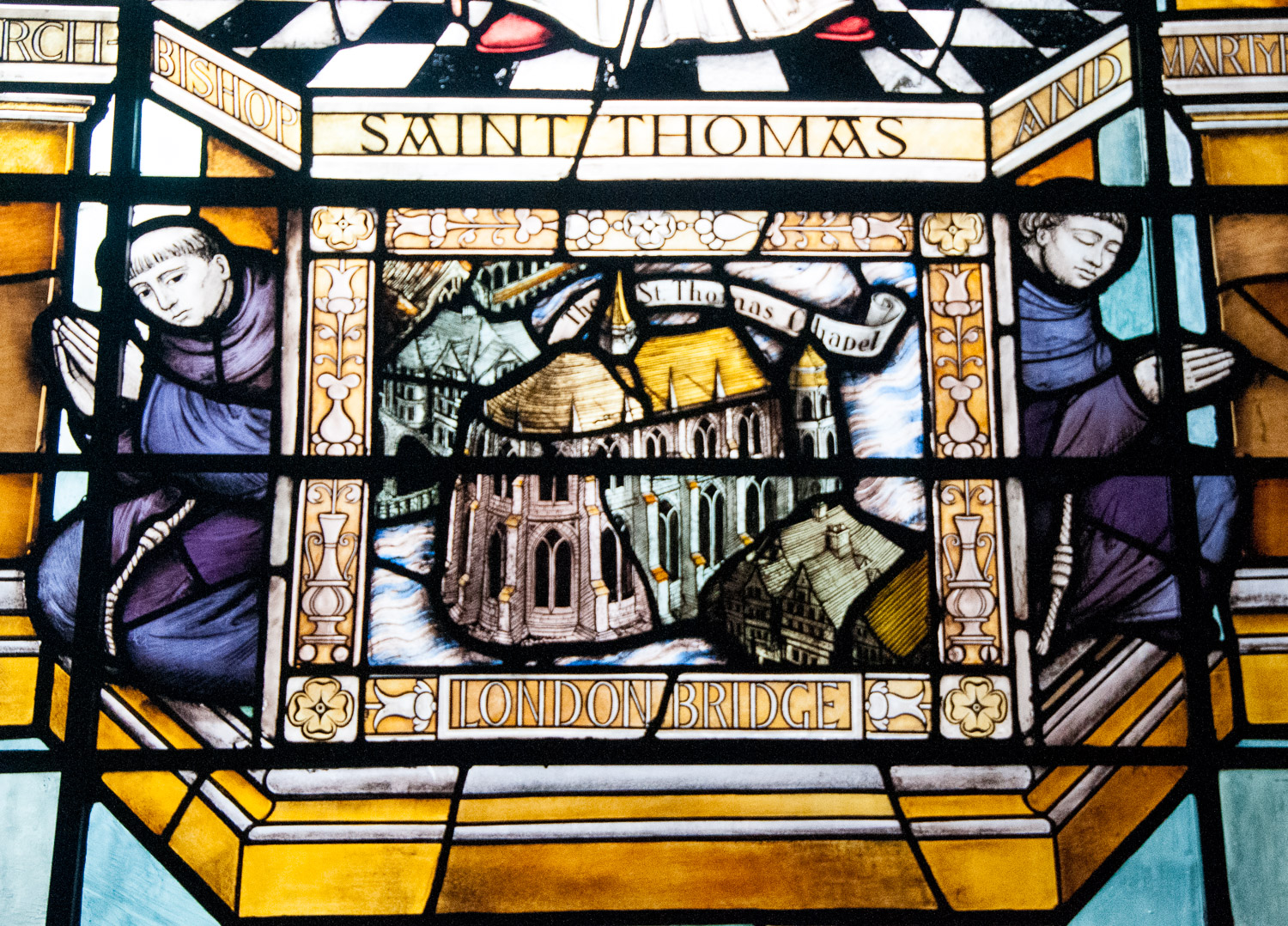
This window on the south side remembers the St Thomas a Becket chapel which was situated near the centre of the bridge …

See if you can find the Chapel on the model

The chapel paid a levy to St Magnus from the fees received from travellers crossing the river.

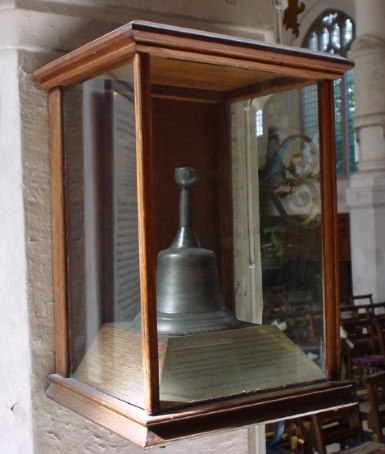
I paid another visit to St Sepulchre-without-Newgate at the junction of Holborn Viaduct and Snow Hill. Housed there, in a glass case, is a macabre relic – the Newgate Execution Bell

Photo by Lonpicman

Between the 17th and 19th centuries, the clerk of St Sepulchre’s was responsible for ringing a handbell outside the condemned person’s cell in Newgate Prison, just across the road where the Old Bailey court is now. A tunnel linked the church to the prison and at midnight, on the night before their execution, the bell would be rung twelve times and the following ‘wholesome advice’ delivered …

“All you that in the condemned hole do lie,
Prepare you, for tomorrow you shall die.
Watch all, and pray, the hour is drawing near,
That you before Almighty God will appear.
Examine well yourselves, in time repent,
That you not to eternal flames be sent,
And when St Sepulcher’s bell tomorrow tolls,
The Lord above have mercy on your souls.”

The tradition of ringing the bell apparently dates from 1605 and has its origins in a bequest of £50 made by one Robert Dow(e), a prominent member of the Worshipful Company of Merchant Taylors. Dow had apparently wanted a clergyman to be the one to ring the bell but £50 was insufficient to cover the extra cost.

On the day of execution, the condemned were ‘carted away’ and ‘went west’ from Newgate to the Tyburn gallows (near today’s Marble Arch), the death cart pausing outside St Sepulchre’s for the prisoners to be presented with a nosegay. The distance between Newgate and Tyburn was approximately three miles, but due to streets often being crowded with onlookers, the journey could last up to three hours. A usual stop of the cart was at the Bowl Inn in St Giles where the condemned were allowed to drink ‘strong liquors or wine’.

The tremendous disruption caused by the thousands who came to watch eventually became too much for the authorities and the last execution at Tyburn took place on Friday the 7th of November 1783 when John Austin was hanged for highway robbery. Public executions continued outside Newgate Gaol until 1868 and still attracted vast crowds, the last person dispatched being the Fenian Michael Barrett on the 28th May that year.

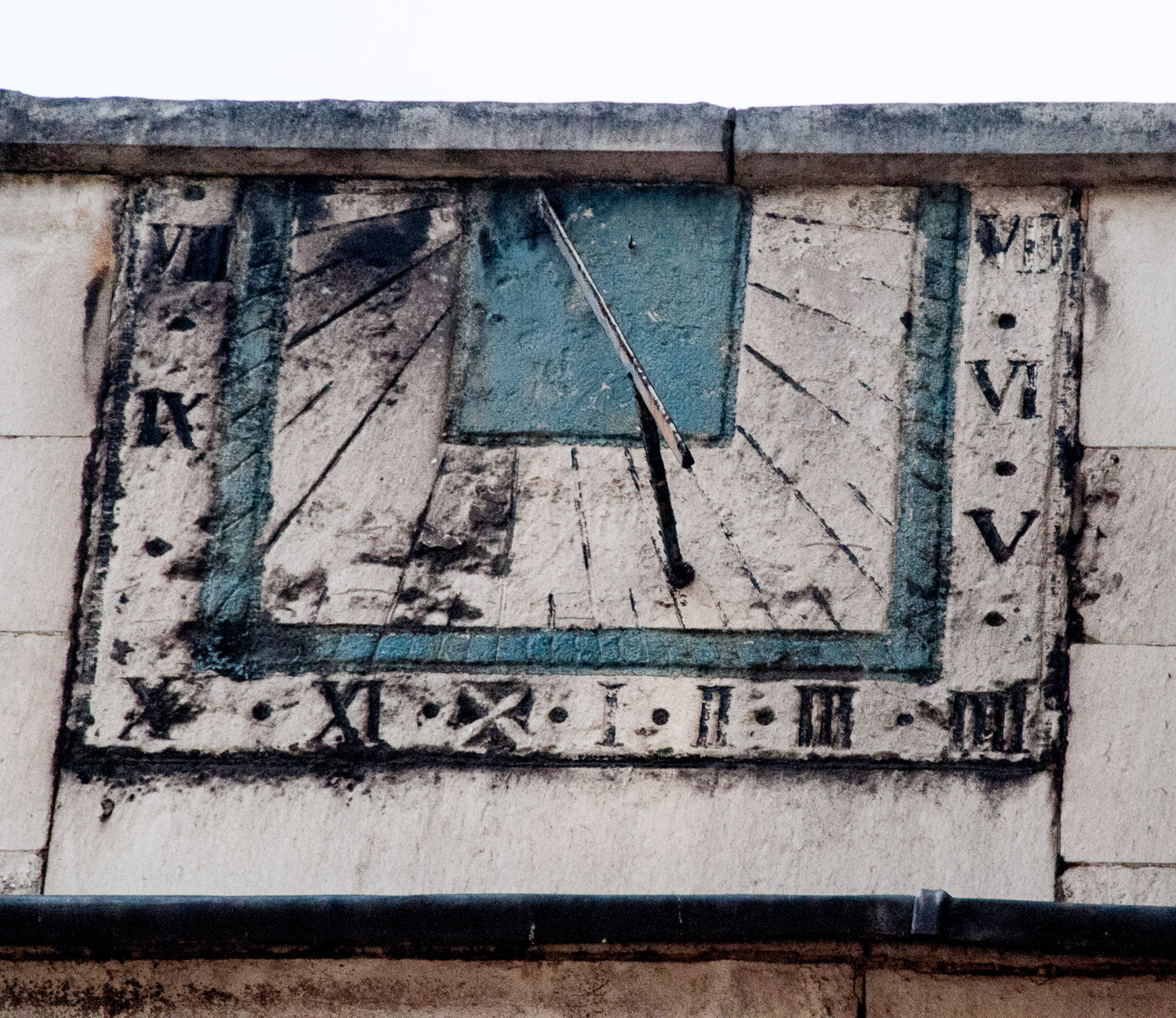
Looking down from St Sepulchre’s is this sundial. Dating from 1681 it will have witnessed many of the sad events associated with the old prison. You can read more about it, and other dials, in my blog We are but shadows – City Sundials.

The dial is made of stone painted blue and white with noon marked by an engraved ‘X’ and dots marking the half hours.


The City’s lone church towers and the Blitz

William Sanson, a London auxiliary fireman, thought 7th September 1940 ‘one of the fairest days of the century, a day of clean warm air and high blue skies’. At 4:00 pm that afternoon, just across the Channel at Cap Blanc Nez, the commander-in-chief of the Luftwaffe Hermann Göring was also enjoying the sunshine. From there he watched as 348 German bombers headed for London accompanied by an escort of 617 fighters. Looking up, Londoners who had not taken shelter could see this vast force some two miles high and 20 miles wide – they seemed to blot out the sun. London was pounded until 6:00 pm. Two hours later, guided by the fires set by the first assault, a second group of raiders commenced another attack that lasted until 4:30 the following morning. The  raids continued for 56 out of the following 57 days and nights. Sanson and his brave colleagues were no longer mocked as ‘army dodgers’ (who restaurants often refused to serve) but were re-christened as ‘heroes with grimy faces’.

Thanks to the efforts of the fire services and volunteers, many City churches survived the Blitz although some, such as St. Mary-le-Bow, had to be substantially rebuilt. Others were effectively lost apart from their towers and today’s blog visits the four of them that were originally designed by Sir Christopher Wren, assisted by  Nicholas Hawksmoor.

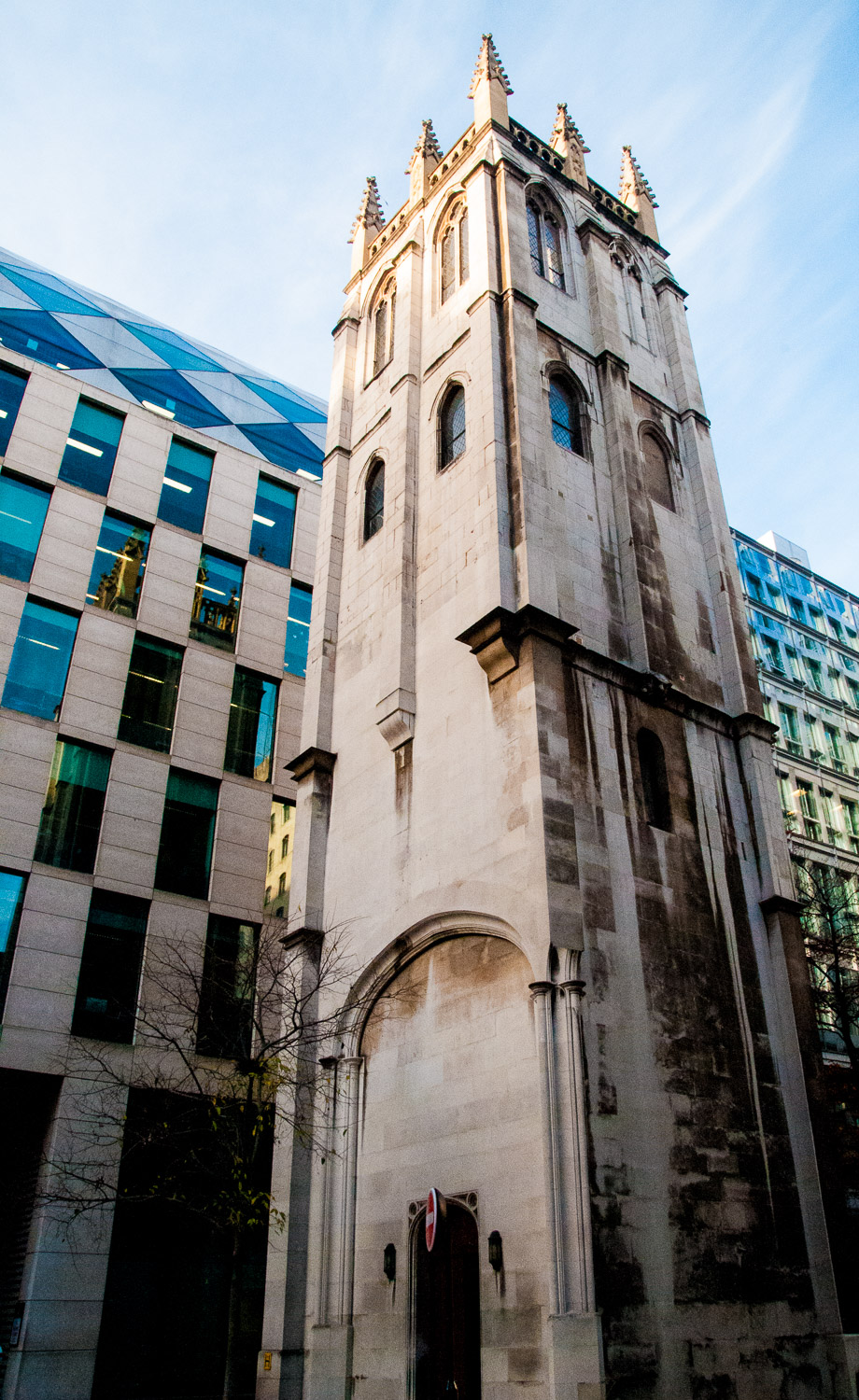
In Wood Street, just opposite the police station, stands the tower of St Alban’s. It’s a church designed by Wren in a late Perpendicular Gothic style and completed in 1685 to replace a previous structure destroyed in the 1666 Great Fire.

St Alban, Wood street

The church was restored in 1858-9 by George Gilbert Scott, who added an apse, and the tower pinnacles were added in the 1890s. It was destroyed on a terrible night, 29 December 1940, when the bombing also claimed another eighteen churches and a number of livery halls. Some of St Alban’s walls survived but they  were demolished in 1954 and now nothing remains apart from the tower – not even a little garden to give it some cover from the traffic passing on both sides. I’ve often been told someone lives there but I have never seen any evidence of it.

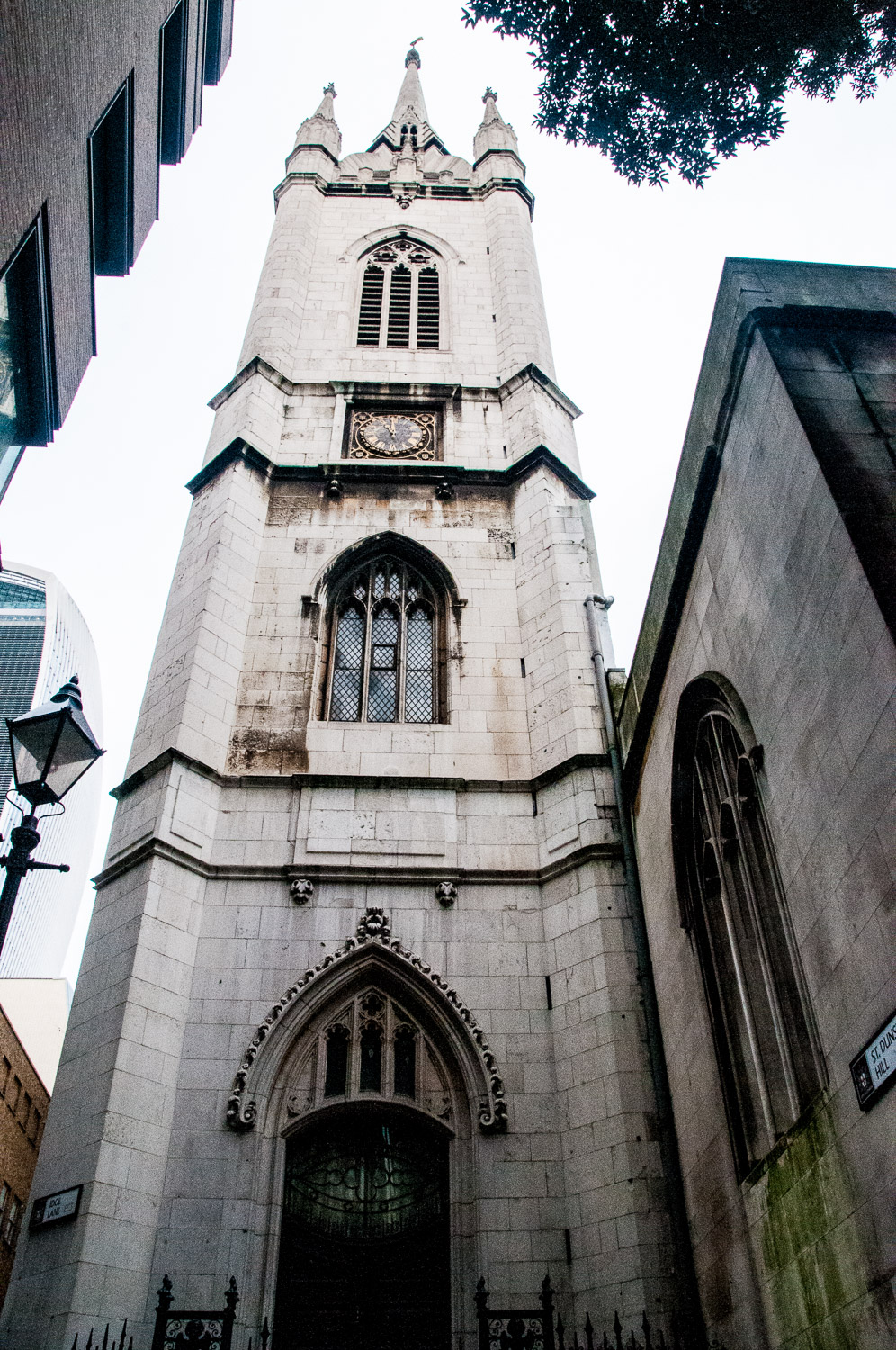
This is St Dunstan-in-the-East on St Dunstan’s Hill, just off Great Tower Street.

The body of the church had been rebuilt in 1821 but the Wren tower was retained and it survived the Blitz whereas the church did not. It is said that Wren had such confidence in its construction that, when told the steeples of every City church had been damaged in a hurricane that hit London in 1703, he replied ‘Not St Dunstan’s, I am sure’.

Where the church stood is now a lovely secluded public garden which is well worth a visit. Horror film aficionados will recognise the tower as the setting for the final scenes of the 1965 movie Children of the Damned when it, and the children, are wiped out by the military.

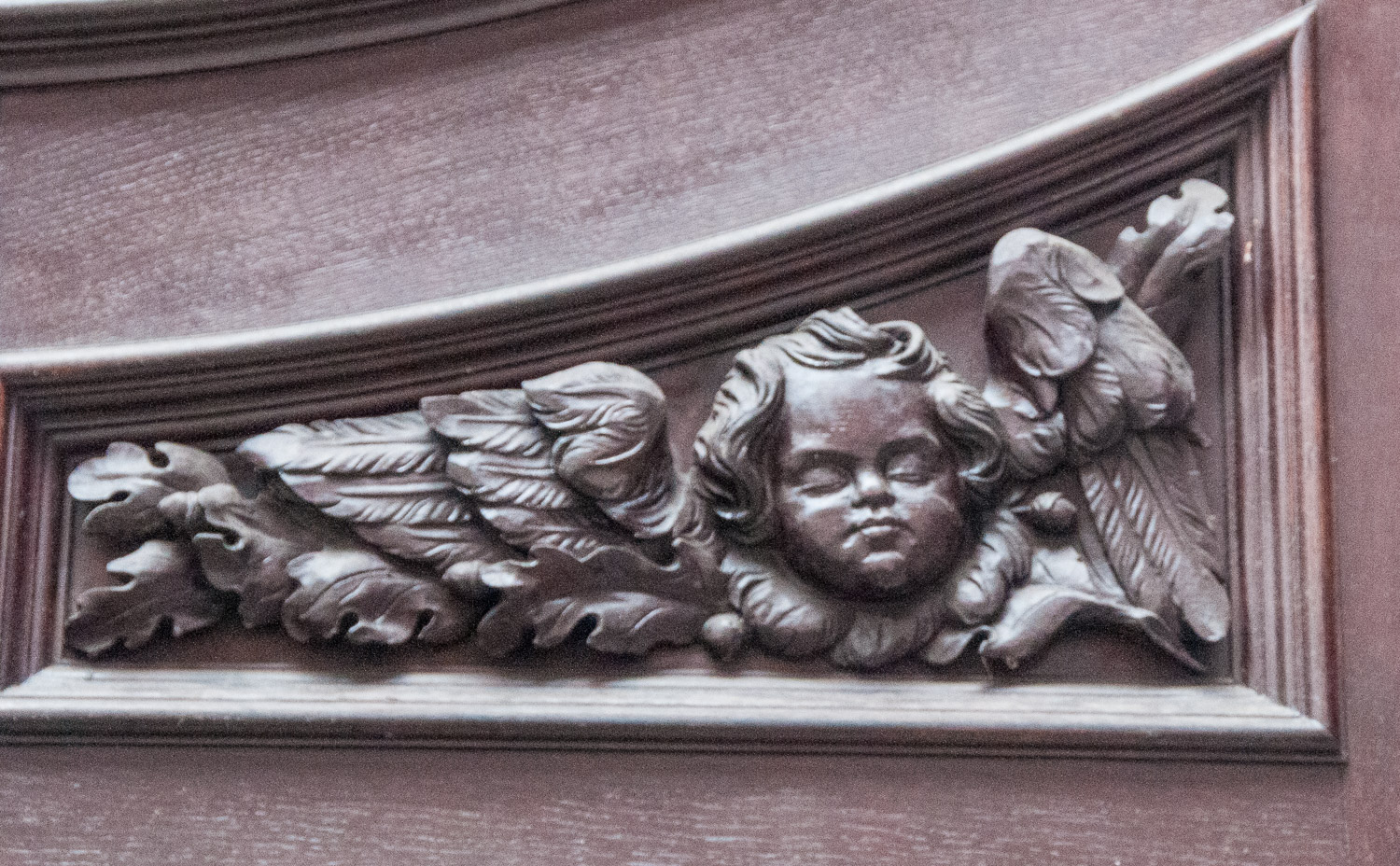
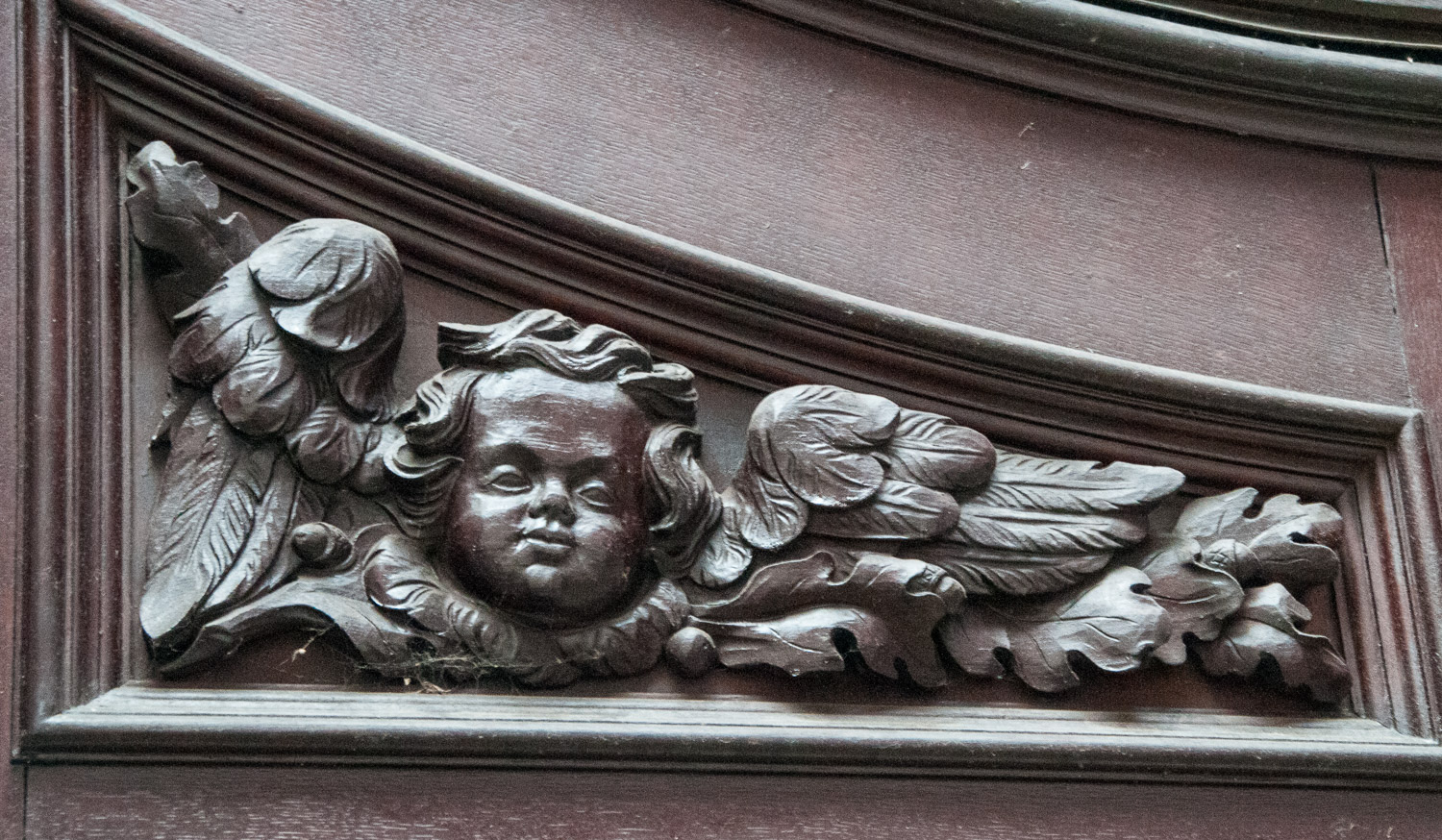
There are some cute cherubs on the west door, one of them fast asleep …

‘Wakey-wakey!’

The St Dunstan cherubs

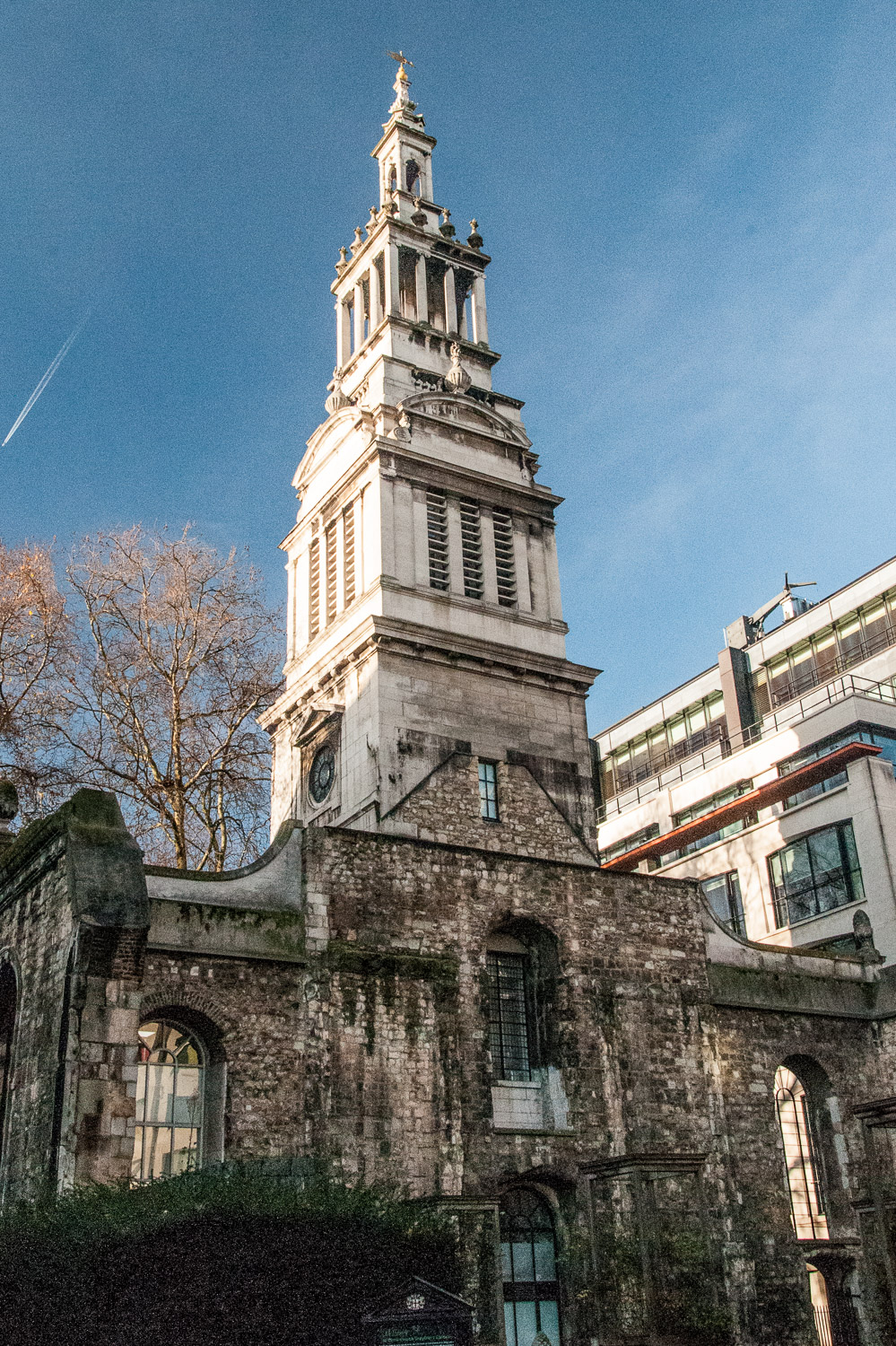
These walls and the tower are all that remain of Christchurch Greyfriars on the corner of Newgate Street and King Edward Street …

Scorch marks are still visible on the walls. The substantial steeple consists of triple-tiered squares.

The site of the Franciscan church of Greyfriars was established in 1225. Those considered to be significant enough to be buried in the medieval church included  four queens: Joan de la Tour, Queen of Scotland and daughter of Edward II; Margaret of France, second wife of Edward I and one of the church’s original benefactors; Eleanor of Provence, wife of Henry III (her heart is said to have been interred under the altar); and Queen Isabella, daughter of King Philip IV of France and wife of Edward II (nicknamed ‘the She-Wolf of France’ on account of her plots against her husband). Also buried here, despite having been given a ‘traitor’s death’, was Elizabeth Barton, who was hanged in 1534 for prophesying the death of Henry VIII when he planned to marry Anne Boleyn. The old church was destroyed in the Great Fire and a new church, designed by Wren, was completed in 1704.

Like St Alban Wood street, his church was another victim of the night of 29 December when incendiary bombs created the ‘Second Great Fire of London’ and only the west tower now stands. Incredibly, though, its wooden font is said to have been saved from the flames by a postman and it now stands a few hundred yards away in St Sepulchre-without-Newgate.

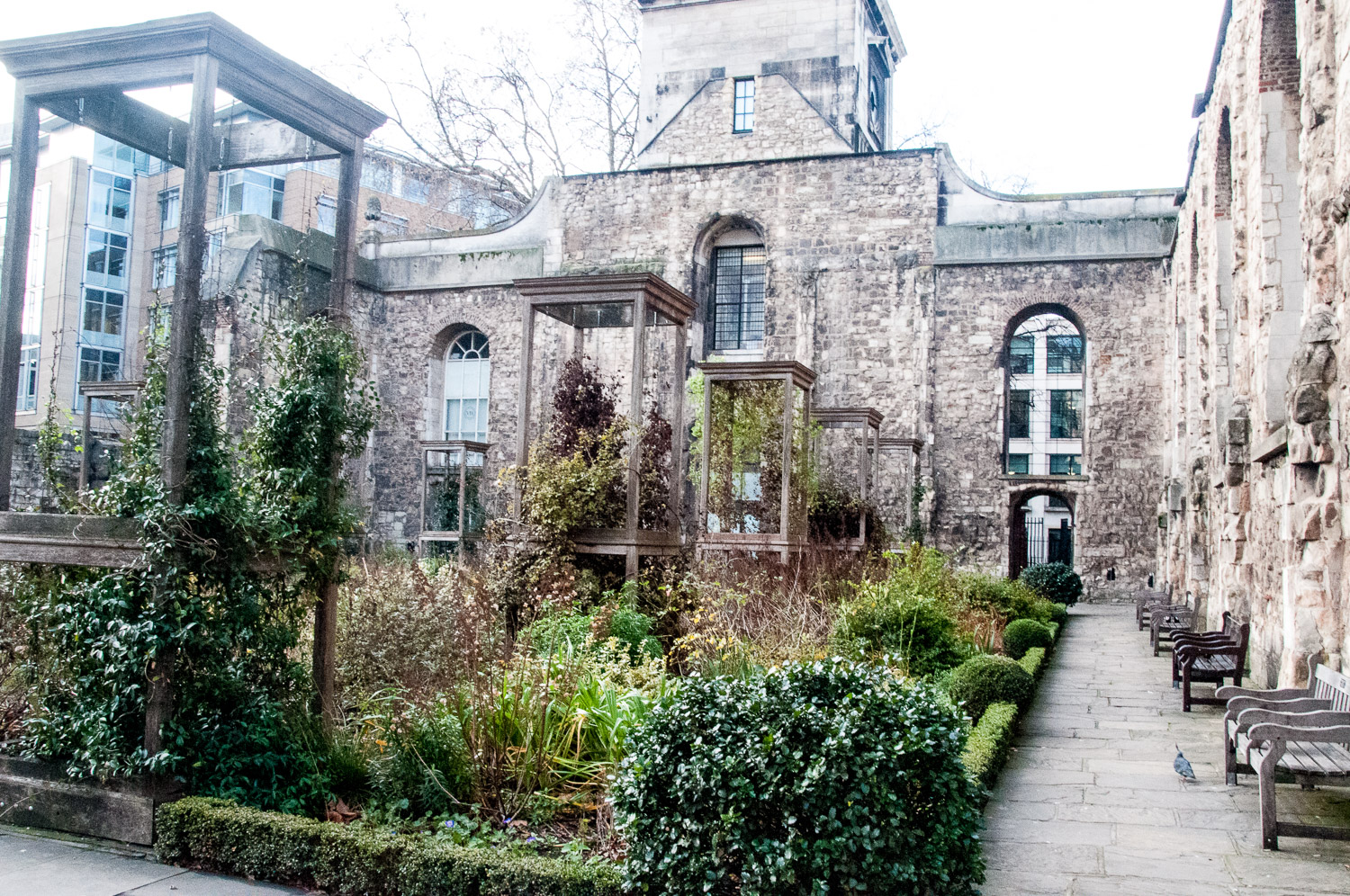
Where the main body of the church once was is now a very attractive garden consisting of heavily planted herbaceous borders including a variety of modern repeat-flowering shrub roses and climbers. The wooden towers within the planting replicate the original church towers and host a variety of climbing plants.

The pretty garden at Christchurch Greyfriars

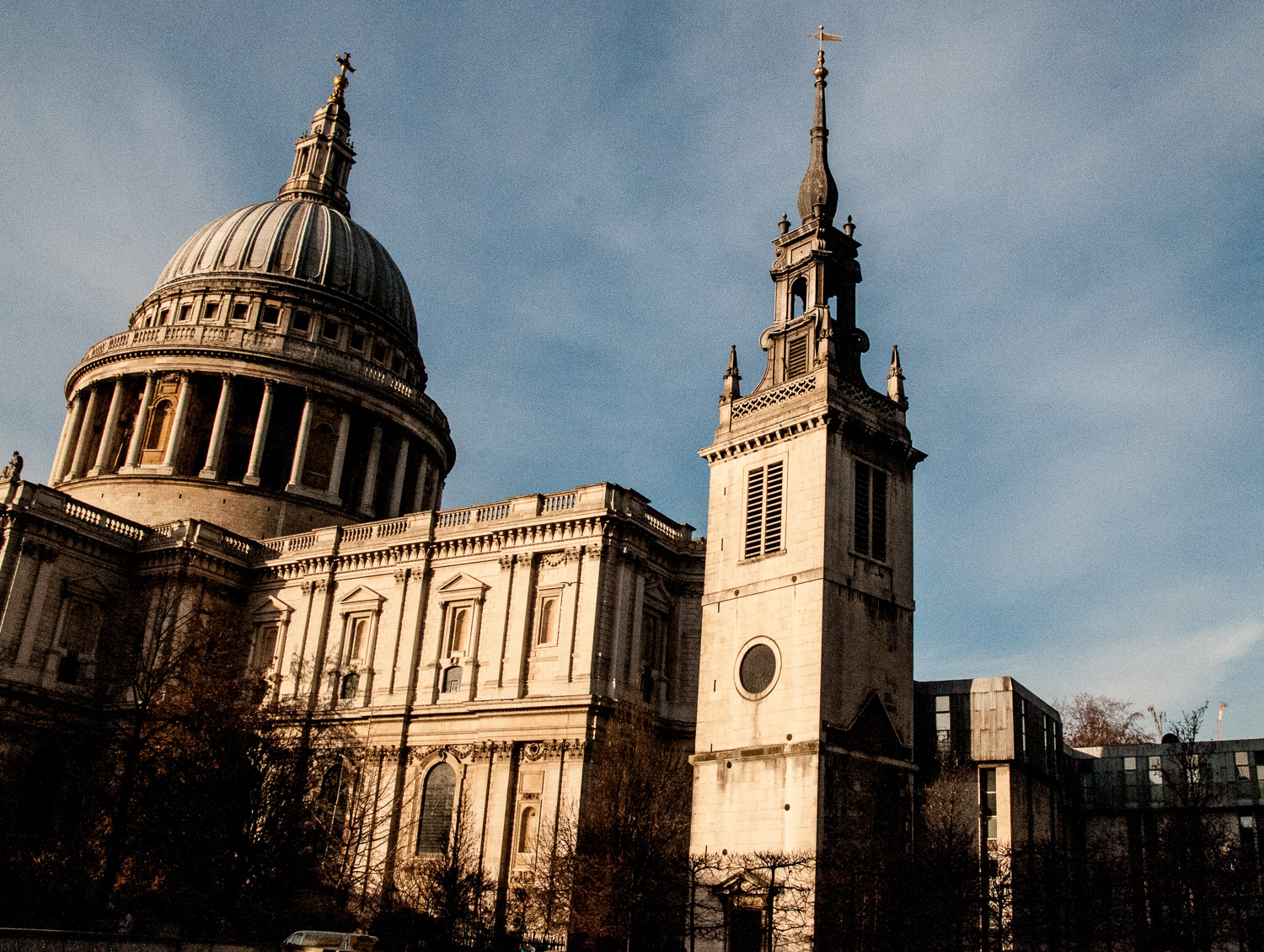
Situated slightly to the east of St Paul’s Cathedral is the tower of St Augustine with St Faith, Watling Street …

I like this view very much – the Cathedral and church tower complement one another beautifully

Rebuilt by Wren in 1682-3 the tower and spire were added in 1695 and are probably by Hawksmoor. The church was bombed to destruction on 9th September 1940 but you will no doubt be pleased to learn that Faith, the church cat, survived and became very well known. Days before she was seen moving her kitten, Panda, to a basement area. Despite being brought back several times, Faith insisted on returning Panda to her refuge. On the morning after the air raid the rector searched through the dangerous ruins for the missing animals, and eventually found Faith, surrounded by smouldering rubble and debris but still guarding the kitten in the spot she had selected three days earlier. Her story reached Maria Dickin, the founder of the People’s Dispensary for Sick Animals, and for her courage and devotion Faith was awarded a specially-made silver medal. Her death in 1948 was reported around the world. For the full story of Faith I suggest you visit the wonderfully named purr-n-furr UK website and search for Faith, The London Church Cat. There is even a photograph of the famous moggie.

The surviving tower now forms part of the St Paul’s choir school. The new building was awarded the RIBA Architecture Award for London in 1968, being commended particularly for sensitive and intelligent handling of the context.

The Evening News reports on the bombing …

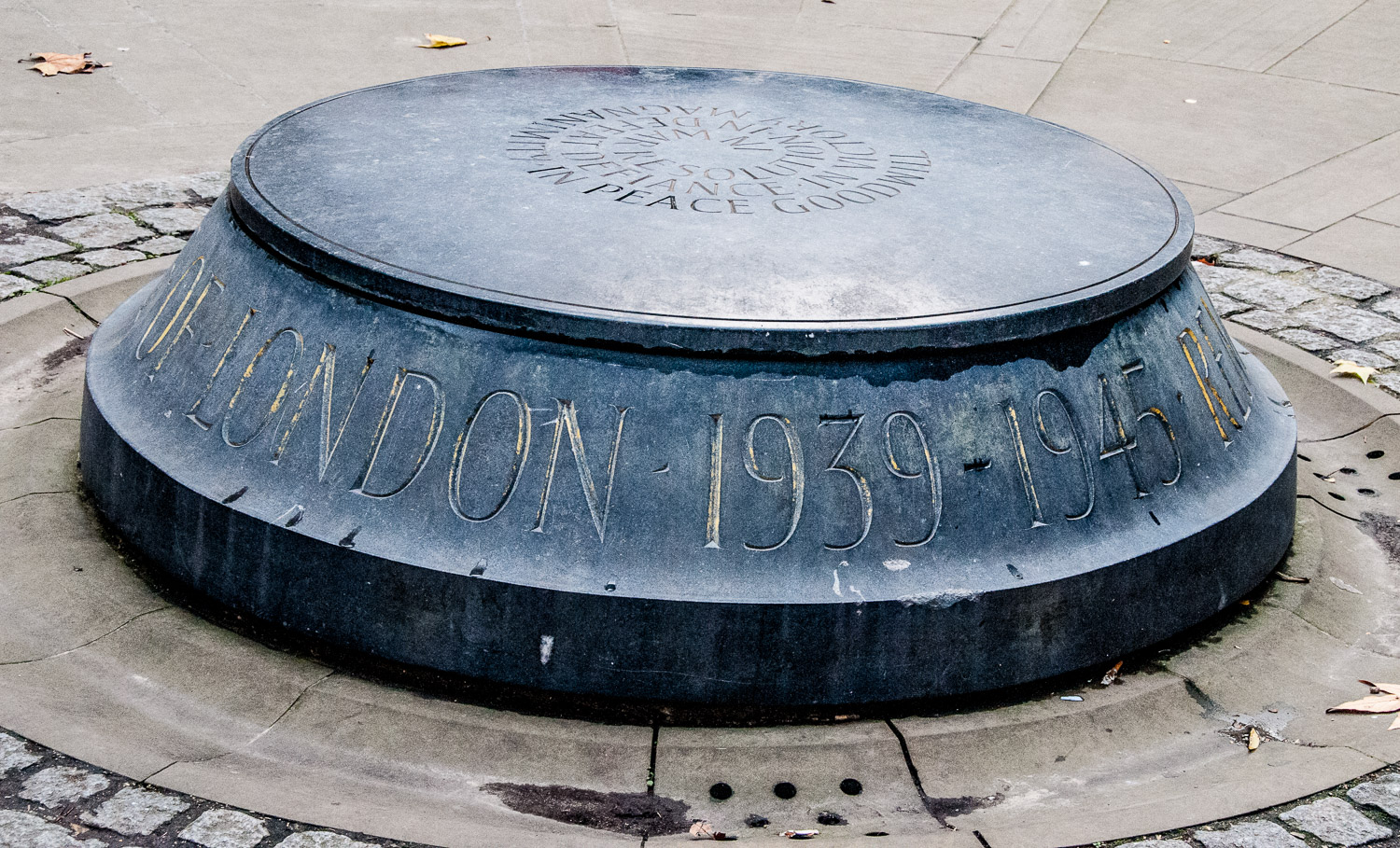
Over 30,000 Londoners died in the World War II air raids and they are commemorated by this understated monument outside the north transept of St Paul’s Cathedral. It was paid for by public funds raised following an appeal in the Evening Standard newspaper, launched in connection with the 50th anniversary of VE Day. The Queen Mother made a personal donation and carried out the unveiling on 11 May 1999.

It is a single piece of Irish limestone sculpted by Sir Richard Kindersley. The words on top, written in a spiral, are taken from Sir Edmund Marsh writing after the Great War, but quoted again by Winston Churchill in his history of the Second World War.

They read as follows

‘In War, Resolution: In Defeat, Defiance: In Victory, Magnanimity: In Peace: Goodwill’

And around the sides

REMEMBER BEFORE GOD, THE PEOPLE OF LONDON 1939-1945

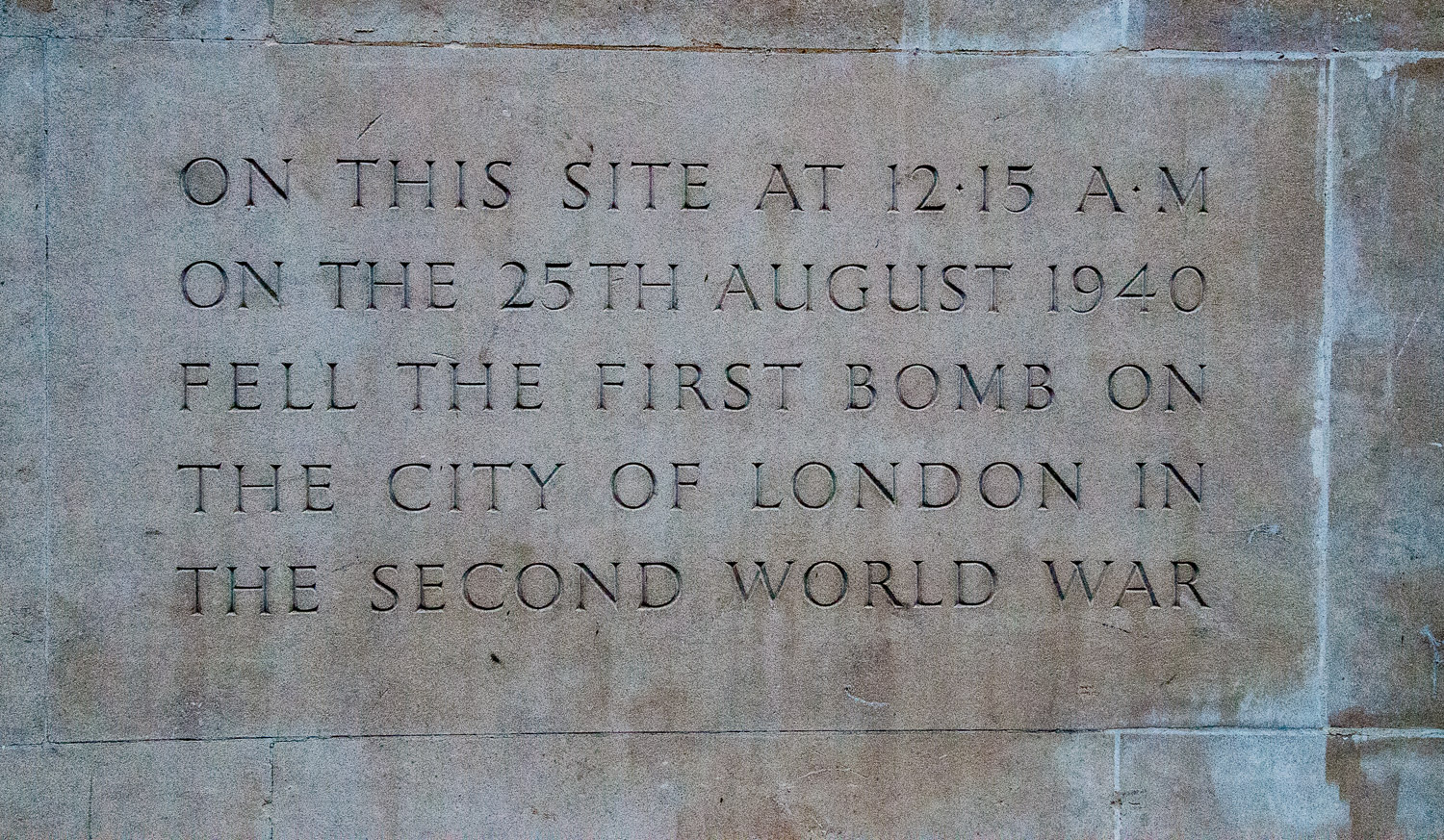
Before the terrible onslaught of the Blitz, the first bomb actually fell on the City early in the morning of 25th August 1940. The event is commemorated by this engraved stone on Roman House at the corner of Wood Street and Fore Street. I only know about this because I can see it from my window in the Barbican!

Page 34 of 36

Powered by WordPress & Theme by Anders Norén

Symbols & Secrets
Privacy Overview

This website uses cookies so that we can provide you with the best user experience possible. Cookie information is stored in your browser and performs functions such as recognising you when you return to our website and helping our team to understand which sections of the website you find most interesting and useful.