Walking the City of London

Category: Memorials Page 20 of 36

Some of my favourite tombs, gravestones and memorials

Since I started this blog almost four years ago I must have looked at hundreds of tombs, gravestones and memorials and I have been out again recently adding to my collection. These are some of my favourites with my reason for choosing them. I know times are tough at the moment but although this week’s blog is about dead people I will try to keep it interesting, positive and even maybe a little upbeat!

First up is this stone in the Bow Lane churchyard of St Mary Aldermary. It wins my award for attention to detail. I have never seen actual time of death recorded before …

There is a well preserved coat of arms which seems to include four beavers suggesting involvement in the fur trade which was flourishing at the time.

Under the coat of arms the inscription reads as follows …

Mrs Anna Catharina Schneider. Died 15th of June 1798 at half past Six O’clock in the Evening. Aged 57 Years, 3 months and 9 Days

Her husband’s details, also on the stone, are more basic …

Also John Henry Schneider, Husband of the above Anna Catharina, Died 6th of October 1824 in the 82nd year of his age

I have been trying to find out a bit more about them and I came across a few tantalising details. The London Metropolitan Archives of the City of London have a record of a John Henry Schneider & Company, Merchants, in Bow Lane – surely the same person. It records the company insuring its premises on 29th October 1791. A Wikipedia search throws up a John Henry Powell Schneider (circa 1768 – 1862) and describes him as a ‘merchant of Swiss origin’. I can’t help but speculate that he was Catharina and John Henry’s son. He certainly enjoyed a long life.

From a memorial displaying extraordinary accuracy to one where the date of death is not recorded at all. This gets my ‘oh dear, what happened there’ award.

The earliest memorial in the church of St Dunstan-in-the-West consists of these two brass kneeling figures commemorating Henry Dacres and his wife Elizabeth …

Elizabeth died in 1530 and Henry nine years later. His will tells us that the brass was already made before he died and ‘made at myn owne costes to the honour of almighty god and the blessed sacrament’. Unfortunately it seems he made no arrangement for his actual date of death to be included later and so the date on the plaque is blank and it reads …

Here lyeth buryed the body of Henry Dacres, Cetezen and Marchant Taylor and Sumtyme Alderman of London, and Elizabeth his Wyffe, the whych Henry decessed the … day of … the yere of our Lord God … and the said Elizabeth decessed the xxii day of Apryll the yere of our Lord God MD and XXX.

My award for the most interesting medical history must go to Dame Mary Page who has one of the most impressive tombs in Bunhill Fields Burial Ground

It appears that Mary Page suffered from what is now known as Meigs’ Syndrome and her body had to be ‘tap’d’ to relieve the pressure. She had to undergo this treatment for over five years and was so justifiably proud of her bravery and endurance she left instructions in her will that her tombstone should tell her story. And it does …

When I pointed this out to a friend he remarked ‘for me, that’s a bit too much information’.

Again located in Bunhill, my award for the most uplifting gravestone story goes to the Blake Society. Until recently the only stone recording the last resting place of William Blake was the one below …

It was originally placed over his actual grave by The Blake Society on the centenary of his death (1927) but it was moved in 1965 when the area was cleared to create a more public open space. Considered mad by many of his contemporaries, he is now regarded as one of Britain’s greatest artists and poets, his most famous work probably being the short poem And did those feet in ancient time. It is now best known as the anthem Jerusalem and includes the words that  are often cited when people refer to workplaces of the Industrial Revolution …

And did the Countenance Divine,
Shine forth upon our clouded hills?
And was Jerusalem builded here,
Among these dark Satanic Mills?

The present day Blake Society finally traced again where he was actually buried and in August 2018 a beautiful stone was placed over his final resting place exactly 191 years after his death …

Lots of memorials attempt to draw attention to the key characteristics and achievements of the person immortalised. My award for most interesting life history goes to this gentleman commemorated in the church St Mary Woolnoth where he served as rector, John Newton …

Born the son of a master mariner in Wapping, he spent the early part of his career as a slave trader. From 1745-1754 he worked on slave ships, serving as captain on three voyages. He was involved in every aspect of the slaver’s trade, and his log books record the torture of rebellious slaves. Following his conversion to devout Christianity in 1748 he eventually became rector at St Mary’s in 1780. In the church is his memorial tablet, which he wrote himself beginning …

John Newton, Clerk, once an infidel and libertine, a servant of slaves in Africa …

In 1785, he became a friend and counsellor to William Wilberforce and was very influential himself in the abolition of slavery. He lived just long enough to see the Abolition Act passed into law. Think of him also when you hear the hymn Amazing Grace, which he co-wrote with the poet William Cowper in 1773.

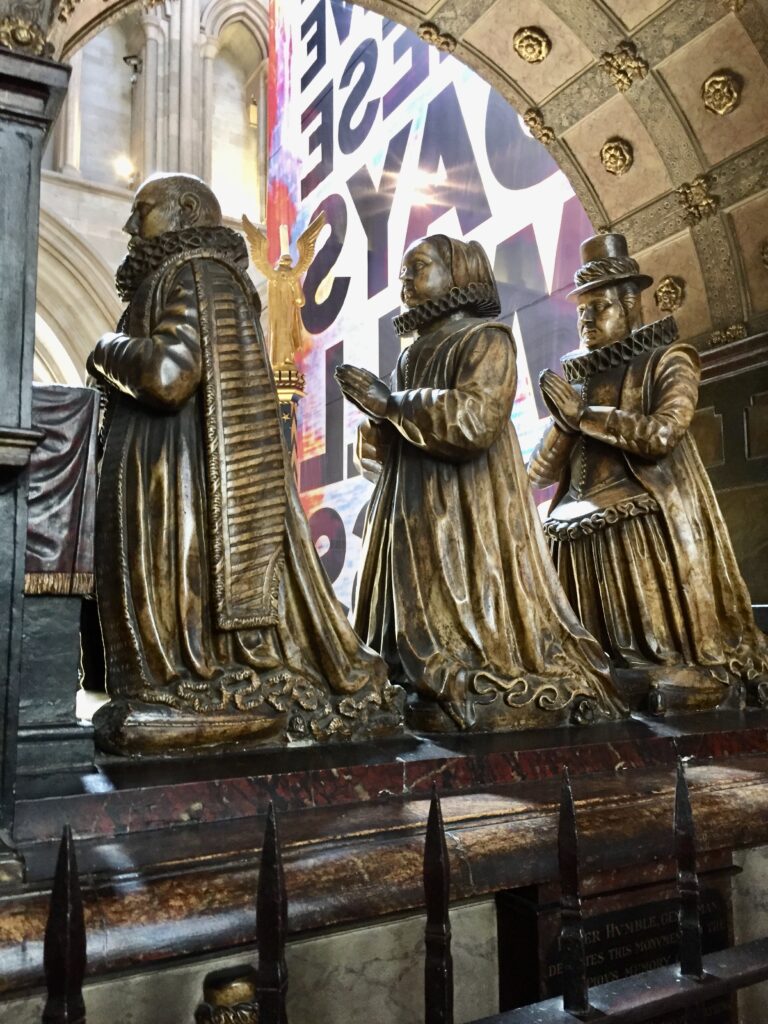
My award for being absolutely spectacular must go to Thomas Sutton’s tomb in the chapel at the Charterhouse

A relief panel shows the Poor Brothers in their gowns and a body of pious men and boys (perhaps scholars) listening to a sermon …

I love the plump figure, Vanitas, blowing bubbles and representing the ephemeral quality of worldly pleasure. The figure with the scythe is, of course, Time

The man himself …

His body rests in a vault beneath the monument

Incidentally, by way of contrast we can also see, in a darkened room lit by candles, this poor soul. Uncovered during the Crossrail tunneling, archeologists found it belonged to a man in the prime of his life, in his mid-twenties, when he was struck down by the Black Death. It’s believed he died at some point between 1348 and 1349, at the height of the pandemic …

Many memorials state the occupation of the deceased and my award for one of the most interesting as a reflection of the times is the tombstone of the hair merchant Mr Jonathan Thornell in St Bartholomew the Great

To be buried inside the church indicated that he was a wealthy man and this was no doubt because, in the 18th century, wigs of all varieties were tremendously fashionable. Good hair was seen as a sign of health, youth and beauty and merchants like Mr Thornell often travelled the country looking for supplies (even buying it off the head of those needy enough to sell it).

Finally, lots of brave deeds are recorded in city churches but one of the people I most admire is commemorated in St Stephen Walbrook, Dr Nathaniel Hodges …

His memorial is on the north wall and this is a translation from the Latin …

Learn to number thy days, for age advances with furtive step, the shadow never truly rests. Seeking mortals born that they might succumb, the executioner [comes] from behind. While you breathe [you are] a victim of death; you know not the hour which your faith will call you. While you look at monuments, time passes irrevocably. In this tomb is laid the physician Nathaniel Hodges in the hope of Heaven; now a son of earth, who was once [a son] of Oxford. May you survive the plague [by] his writings. Born: September 13, AD 1629 Died, 1o June 1688

Unlike many physicians, Dr Hodges stayed in London throughout the time of the terrible plague of 1665.

First thing every morning before breakfast he spent two or three hours with his patients. He wrote later …

Some (had) ulcers yet uncured and others … under the first symptoms of seizure all of which I endeavoured to dispatch with all possible care …

hardly any children escaped; and it was not uncommon to see an Inheritance pass successively to three or four Heirs in as many Days.

After hours of visiting victims where they lived he walked home and, after dinner, saw more patients until nine at night and sometimes later.

He survived the epidemic and wrote two learned works on the plague. The first, in 1666, he called An Account of the first Rise, Progress, Symptoms and Cure of the Plague being a Letter from Dr Hodges to a Person of Quality. The second was Loimologia, published six years later …

Above is a later edition of Dr Hodges’ work, translated from the original Latin and published when the plague had broken out in France.

It seems particularly sad to report that his life ended in personal tragedy when, in his early fifties, his practice dwindled and fell away. Finally he was arrested as a debtor, committed to Ludgate Prison, and died there, a broken man, in 1688.

If you would like to follow me on Instagram here is the link …
https://www.instagram.com/london_city_gent/

A hair merchant, a weeping statue and a Damien Hirst – my visit to St Bartholomew the Great

You approach the church via the Tudor Gatehouse. It dates from 1595 and was fortuitously revealed when a bomb dropped by a Zeppelin in 1915 tore off later accretions as these ‘before’ and ‘after’ images illustrate …

Much of the late 19th and early 20th century church restoration work was carried out by Sir Aston Webb (1849-1930). His son, Philip, was killed in action on 25th September 1916 and his name appears on the memorial to the right of the entrance …

There is a plaque just behind the gate commemorating Sir Aston Webb’s work. It includes his coat of arms (which incorporates a spider, a playful reference to his name) …

You get a nice view of the flint and Portland Stone western facade of the church from the raised churchyard. An old barrel tomb rests in the foreground …

Bear in mind that the original church was vast and also covered the area now occupied by the graveyard and the path. This used to be the nave, as illustrated in this plan on display in the church …

Stepping into the church seems to transport you to another time and place …

The patchworked exterior gives no hint of the stunning Romanesque interior, with its characteristic round arches and sturdy pillars. It’s a rare sight in London; indeed, this is reckoned to be the best preserved and finest Romanesque church interior in the City.

Just to shock you back into the present, the south transept contains this sculpture …

Entitled Exquisite Pain, as well as his skin St Bartholomew also holds a scalpel in one hand and a pair of scissors in the other. The second surprise, to me anyway, was that this work was by Damien Hirst, the modern artist known particularly for his spot paintings and the shark swimming in formaldehyde. St Bartholomew is the patron saint of Doctors and Surgeons and Hirst has said that this 2006 work ‘acts as a reminder that the strict demarcation between art, religion and science is a relatively recent development and that depictions of Saint Bartholomew were often used by medics to aid in anatomy studies’. He went on to say that the scissors were inspired by Tim Burton’s film ‘Edward Scissorhands’ (1990) to imply that ‘his exposure and pain is seemingly self- inflicted. It’s kind of beautiful yet tragic’. The work is on long-term loan from the artist …

Just behind Hirst’s work is a rare pre-Reformation font (1404) in which William Hogarth was baptised on 28 November 1697 …

I paused at the monument to Edward Cooke who died in 1652 and read the curious rhyme inscribed on it …

Vnsluce yor briny floods, what can yee keepe

Yor eyes from teares, & see the marble weepe

Burst out for shame: or if yee find noe vent

For teares, yet stay, and see the stones relent.

It was known as the ‘weeping statue’ because the moisture in the atmosphere used to be soaked up by the soft marble and miraculously released again as ‘tears’ from time to time. Alas, the Victorians installed a radiator under the monument which put a stop to the moisture releasing properties of the stone and, sadly, it wept no more.

This is the spectacular tomb of Sir Walter and Lady Mary Mildmay. He was the Chancellor of the Exchequer to Queen Elizabeth I and the founder of Emmanuel College, Cambridge. His wife was the sister of the Queen’s ‘spymaster’, Sir Francis Walsingham. Sir Walter died in 1589 and Mary in 1576 …

It’s thought that the tomb does not contain religious figures or Christian symbols because Sir Walter had strong Puritan leanings.

This is the monument to James Rivers who died of the plague in 1641 …

The inscription refers to a disease as malignant as the time referring, no doubt, to the English Civil War. Rivers was a prominent Puritan MP and took his seat in Parliament in 1640.

In a number of places around the church you will find these beautiful sculptures in glass by Sophie Arkette …

They are entitled Colloquy and are etched with literary or poetical text. These are illuminated and distorted by the effects of light (from either candles within the work or from around the building) and water (included within parts of the work).

Under the oriel window there is a nice example of a rebus, in this case a representation of a person’s name using a picture. Here Prior Bolton’s name is neatly implied by a crossbow bolt piercing a tun (a type of cask). Bolton was Prior of St Bartholomew the Great between 1505 and 1532 and carried out repair and construction work across the church …

There is also a version in 16th century stained glass at the eastern end of the church …

I was intrigued by this tombstone in the north transept …

To be buried inside the church indicated that he was a wealthy man and this was no doubt because, in the 18th century, wigs of all varieties were tremendously fashionable. Good hair was seen as a sign of health, youth and beauty and merchants like Mr Thornell often travelled the country looking for supplies (even buying it off the head of those needy enough to sell it).

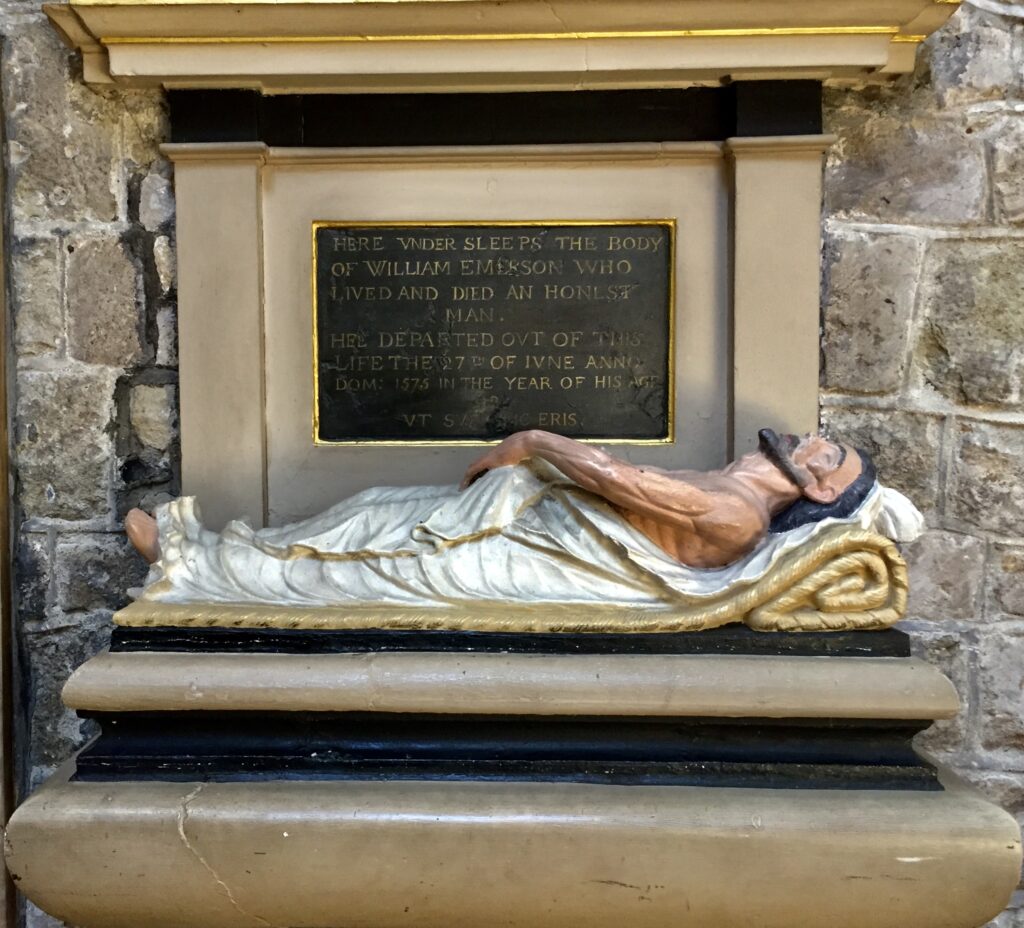
As I walked down the transept I glanced to my left and glimpsed this reclining figure …

It is of course, the tomb of Prior Rahere, the founder of the Priory and hospital …

He wears the habit of an Augustinian canon and the angel carries a shield with the arms of the priory.

Rahere was a courtier and favourite at the court of Henry I who reigned from 1100 to 1135. After falling dangerously ill whilst on pilgrimage to Rome, Rahere had a vision of St Bartholomew, who told him to found a hospital. He duly got better, and when he returned to London he founded a hospital and an Augustinian priory in 1123 (dedicating them to St Bartholomew to give thanks for his recovery). He was the institution’s first prior and remained in this role until his death in 1144 (the tomb is later and dates from 1405). You can still see some of the original paintwork …

Incidentally, I came across this great 1915 picture of how the tomb was protected during wartime bombing …

There is much more to see in this beautiful place and so I strongly recommend a visit. Entrance is free but the church has been hit hard by the pandemic so, if you can afford it, do make a donation to help support it. Opening times are on the website which you can access here.

If you would like to follow me on Instagram here is the link …

https://www.instagram.com/london_city_gent/

A few more things that made me smile

In these difficult times, I’d like to share some miscellaneous things I have encountered recently that cheered me up.

I am going to start with the extraordinary, eccentric Stanley Green, ‘the protein man’, who regularly patrolled Oxford Street with his billboard. This may seem strange since he died in 1993, but I have chosen him as my first story because I came across his billboard last week at the Museum of London …

Copyright Andrew Lawson.

He began his mission in June 1968, initially in Harrow on Saturdays, becoming a full-time human billboard six months later on Oxford Street. He cycled there from Northolt with his board attached to his bicycle, a journey that could take up to two hours, until he was given a bus pass when he turned 65. From Monday to Saturday he walked up and down the street until 6:30 pm, reduced to four days a week from 1985. Saturday evenings were spent with the cinema crowds in Leicester Square. He would go to bed at 12:30am after saying a prayer. ‘Quite a good prayer, unselfish too’, he told the Sunday Times in 1985. ‘It is a sort of acknowledgment of God, just in case there happens to be one’. He was 78 when he died in December 1993 and, presumably because he distrusted ‘passion’, he never married.

The Museum’s decision to put his message on display introduces him to a new audience …

His self-published and printed booklet, Eight Passion Proteins, went through 84 editions and the Museum holds 36 of them. You can read more about him here and here.

You will no doubt be pleased to know that Royal Wedding teabags are still available in a Ludgate Hill tourist gift shop – hurry, hurry while stocks last …

Don’t they look lovely.

By way of contrast, I thought these models in a shop on Eastcheap were decidedly spooky …

Like creatures out of a Dr Who episode.

Covid humour at the pharmacy …

Covid humour at the wine bar …

Cocktail Bar humour …

A less complicated message …

Pretty camera camouflage on Holloway Road …

Street art meets spinal column in Hoxton …

Sadly over-optimistic signage …

Finally caught the reflection I wanted – street sculpture with red London bus and St Paul’s …

When construction workers use their imagination to brighten up the site – good for them …

What a positive message …

A great hero of mine and one of my favourite London statues – Sir John Betjeman at St Pancras International Station …

Many of Pimlico Plumbers’ vans have ‘witty’ number plates …

Even the scooters are wearing masks around here …

City pigeons simply don’t believe this statement …

We spent a really nice few days in Norfolk recently and here are some of the pictures I took.

Local delicacies – rabbit and pigs ears, giant trotters and chicken feet …

Sow and buffalo ears …

Houghton Hall has a stunning collection of work by Anish Kapoor. Some are in the grounds like this one, Sky Mirror

Others are in the house …

Kings Lynn is a lovely, interesting town. I even caught a glimpse of Bad King John …

At the charming and incredibly interesting True’s Yard Fisherfolk Museum, a Victorian seafarer struggles to come to terms with the pandemic …

And the place has a Wimpy! I thought they had disappeared decades ago. I didn’t pop in for a ‘Bender’ though (fellow Baby Boomers will know what I am referring to) …

There is some beautiful architecture to enjoy as well …

Now that going abroad is problematic it’s great to be exploring England again.

And finally to the Sandringham Estate where we came across these poignant little headstones commemorating the last resting place of three of Her Majesty’s corgis. Heather’s inscription tells us she was the great granddaughter of Susan (on the far left) …

I’ll be back walking the City again next week but hope you enjoyed this little excursion.

If you would like to follow me on Instagram here is the link …
https://www.instagram.com/london_city_gent/

Page 20 of 36

Powered by WordPress & Theme by Anders Norén

Symbols & Secrets
Privacy Overview

This website uses cookies so that we can provide you with the best user experience possible. Cookie information is stored in your browser and performs functions such as recognising you when you return to our website and helping our team to understand which sections of the website you find most interesting and useful.