Walking the City of London

Category: Art Page 24 of 30

Skip discoveries, ducks, bunnies and other miscellany.

Some weeks I can’t think of a unifying theme for the blog so I just allow myself to ramble on.

I don’t know about you, but when I walk past a skip I’m always tempted to have a look inside. I believe searching for retrievable items discarded in skips is called ‘skip diving’ (or in America ‘dumpster diving’) . I haven’t done any actual diving but I have come across some weird items.

How about this …

‘This lockdown has really played havoc with my hair!’.

For quite a few months now a succession of skips have been positioned outside the Barbican Theatre where they are obviously having a clear out of redundant stage props.

Last week there was another unfortunate skip candidate …

‘Hey, come back, don’t leave me here!’.

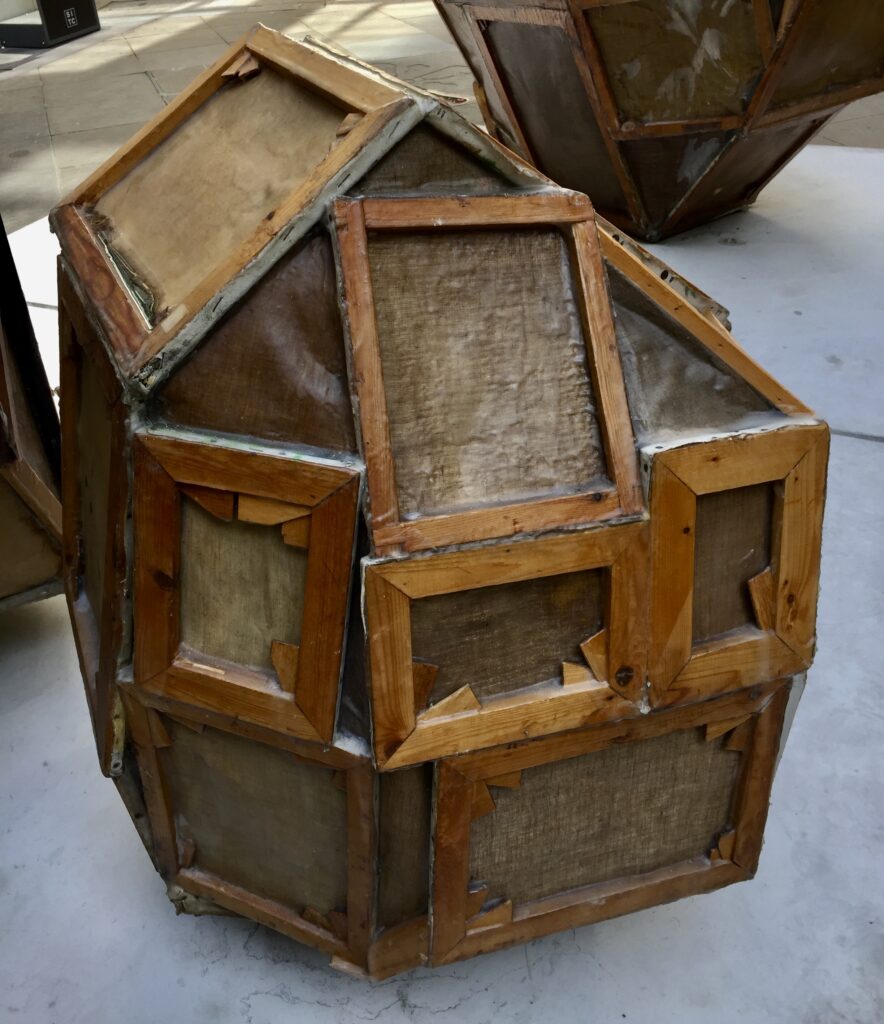
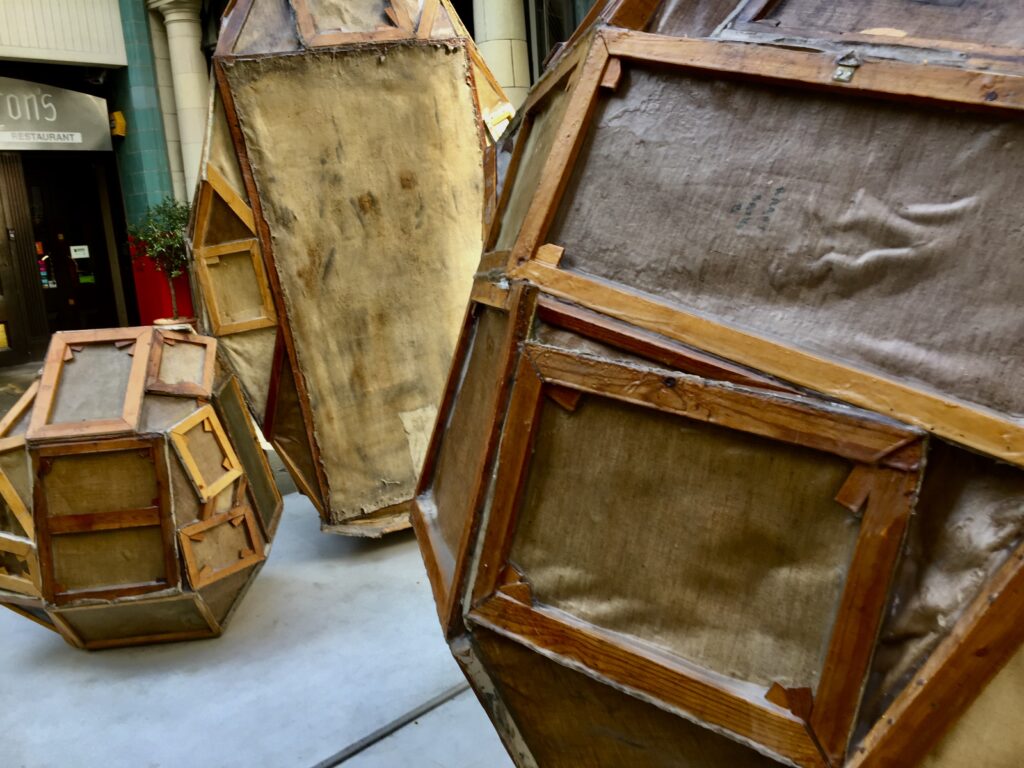
At first I thought this was an old-fashioned oven but it’s actually made of wood …

Scarily realistic missile. It was there at 9:30 in the morning but gone by 2:00 pm so somebody must have taken a fancy to it …

Yummy, Christmas turkey …

Furry fun – what colour fur would you like for your collar …

And what’s this ‘warning’ all about? Surely a ‘Digital Safe’ doesn’t have a key. It doesn’t seem to be a prop – it’s made of metal and is very heavy …

Whilst on the subject of skips, some of you may remember this weird scenario from last year …

How did three quad bikes end up in a City of London skip?

I loved this Easter bunny collection …

Lady duck frantically running away from two avid suitors …

This tailors in Well Court just off Bow Lane has in the window a full set of uniforms worn by Pikemen in the Lord Mayor’s parade …

There are also some pictures of them in action …

The Company of Pikemen and Musketeers is a ceremonial unit of the Honourable Artillery Company and you can read more about them here.

Also off Bow Lane in Groveland Court is the Williamson’s Tavern. The beautiful listed 18th century gates are said to have been completed to commemorate a visit by King William and Queen Mary. On top in a circle, is the dual cipher of the King and Queen which are fashioned, like the gates, out of curled wrought iron …

Some sources state that the gates were a gift from William and Mary after being entertained there by the Lord Mayor who lived in the building at the time. However, this us not mentioned in the Bow Lane Conservation Area document which I use as a trusted source.

Lots of padlocks for extra security …

The City Gardening team are always working hard to brighten the place up …

London Wall.
Postman’s Park.
Postman’s Park.

I think someone has nicked a few plants from this display, shame on them …

London Wall.

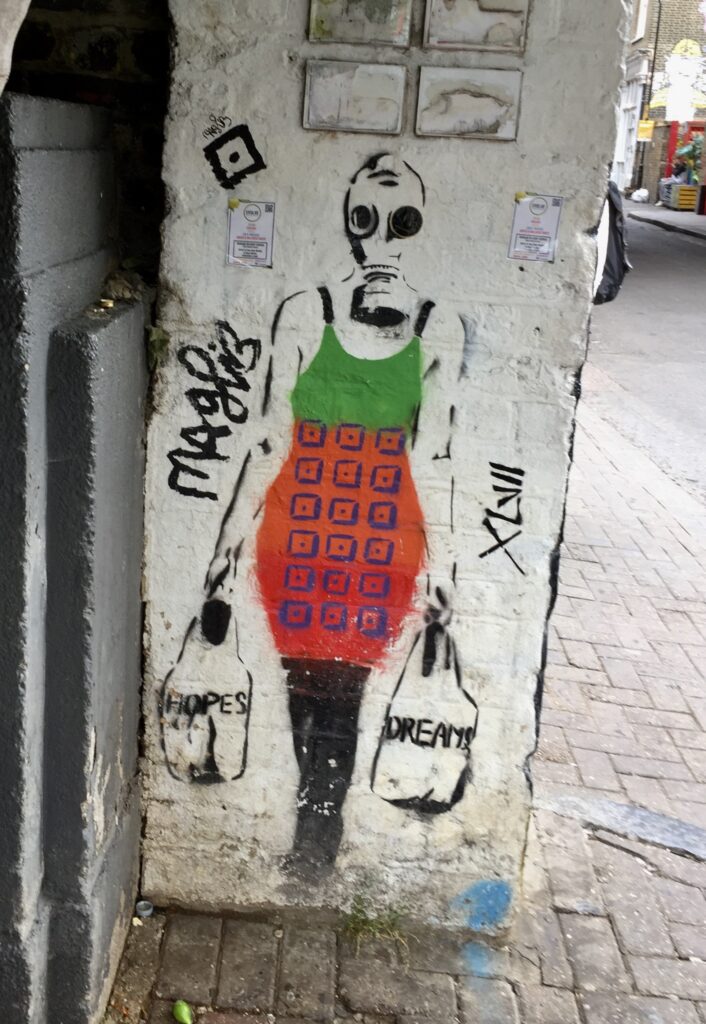
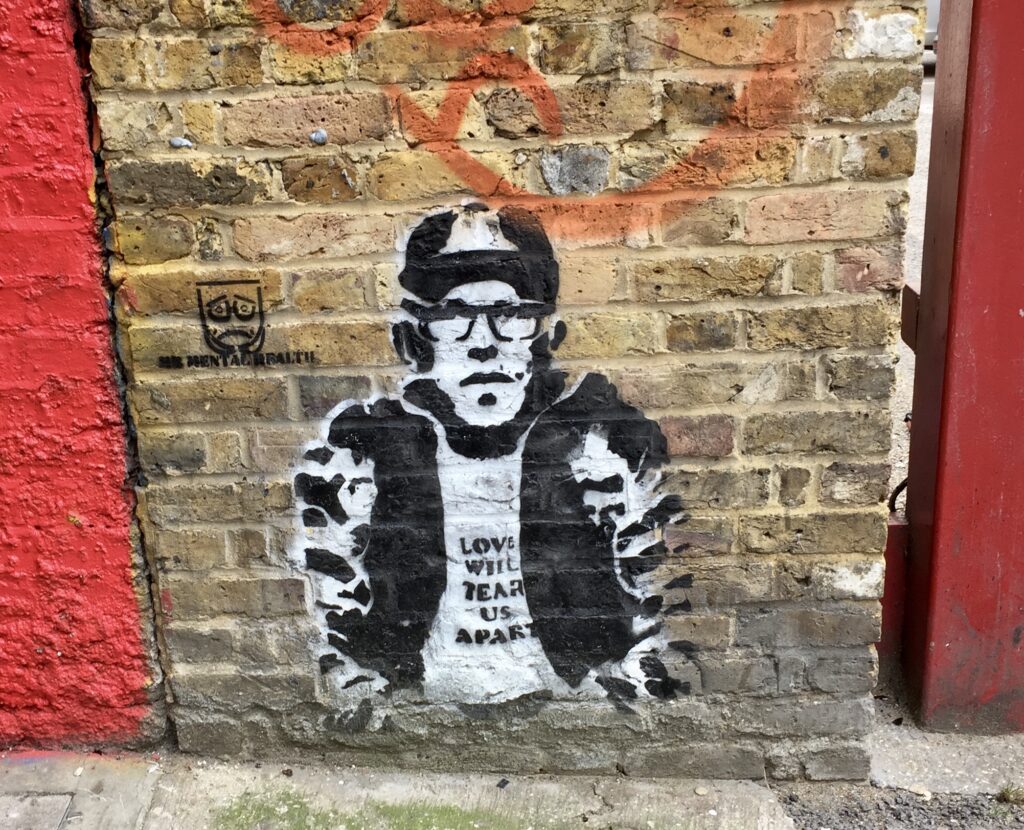
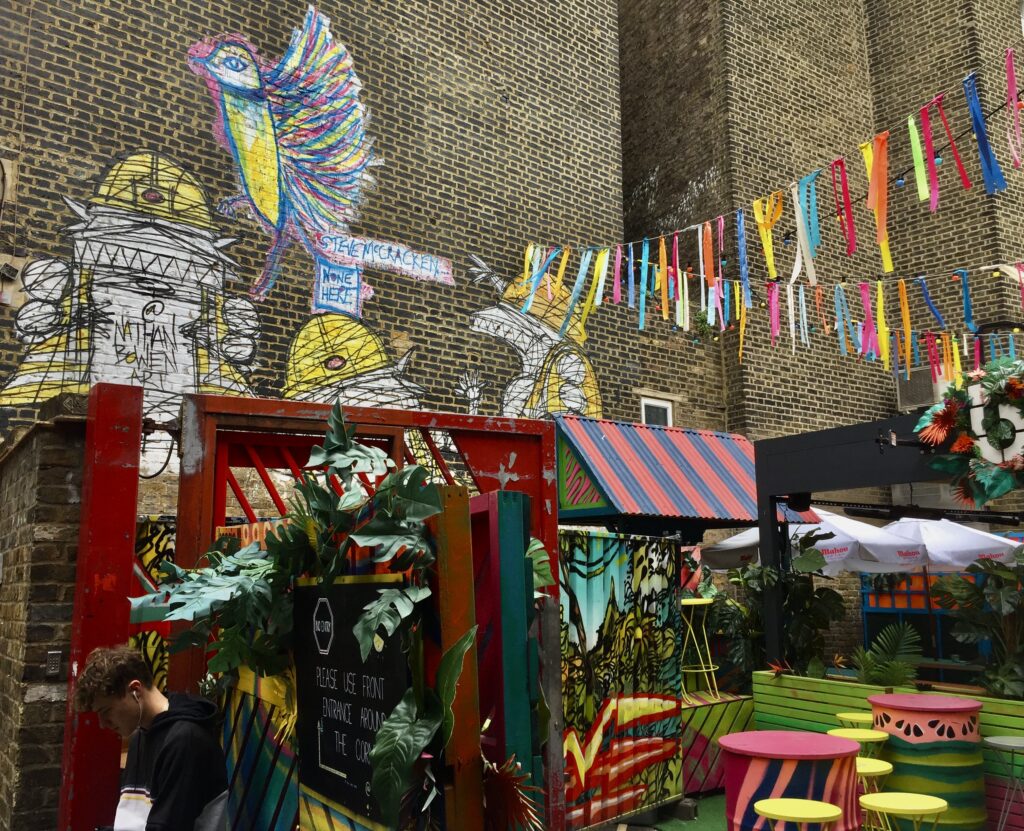
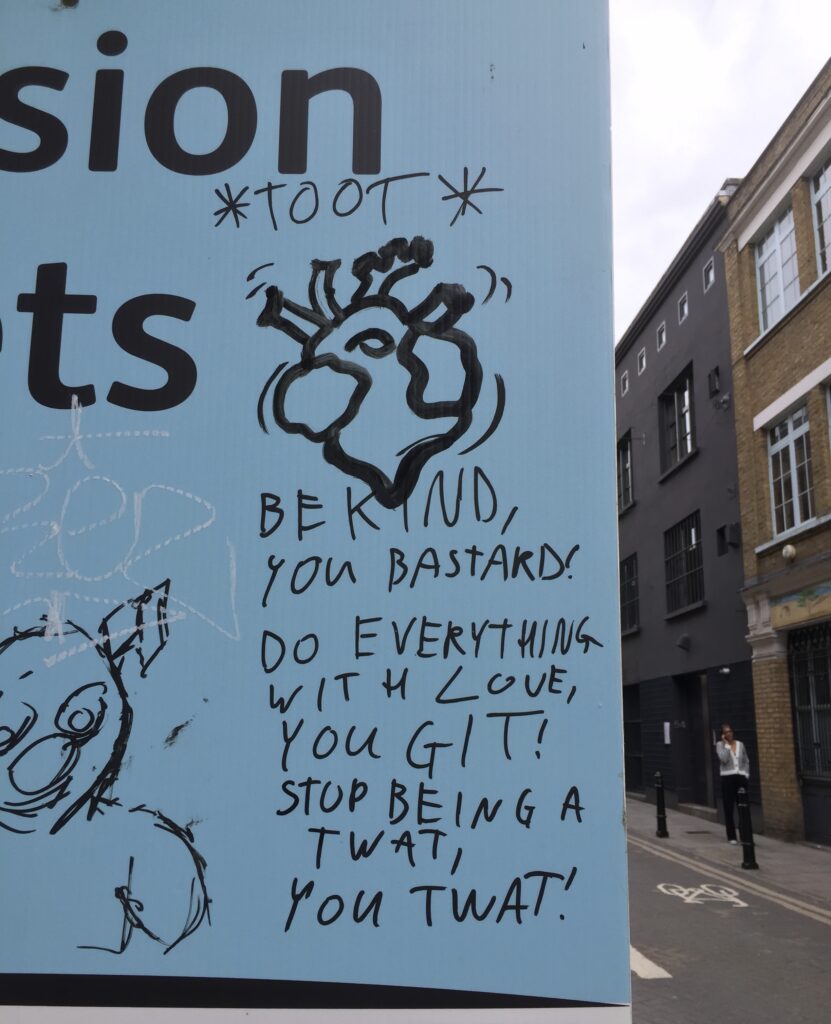
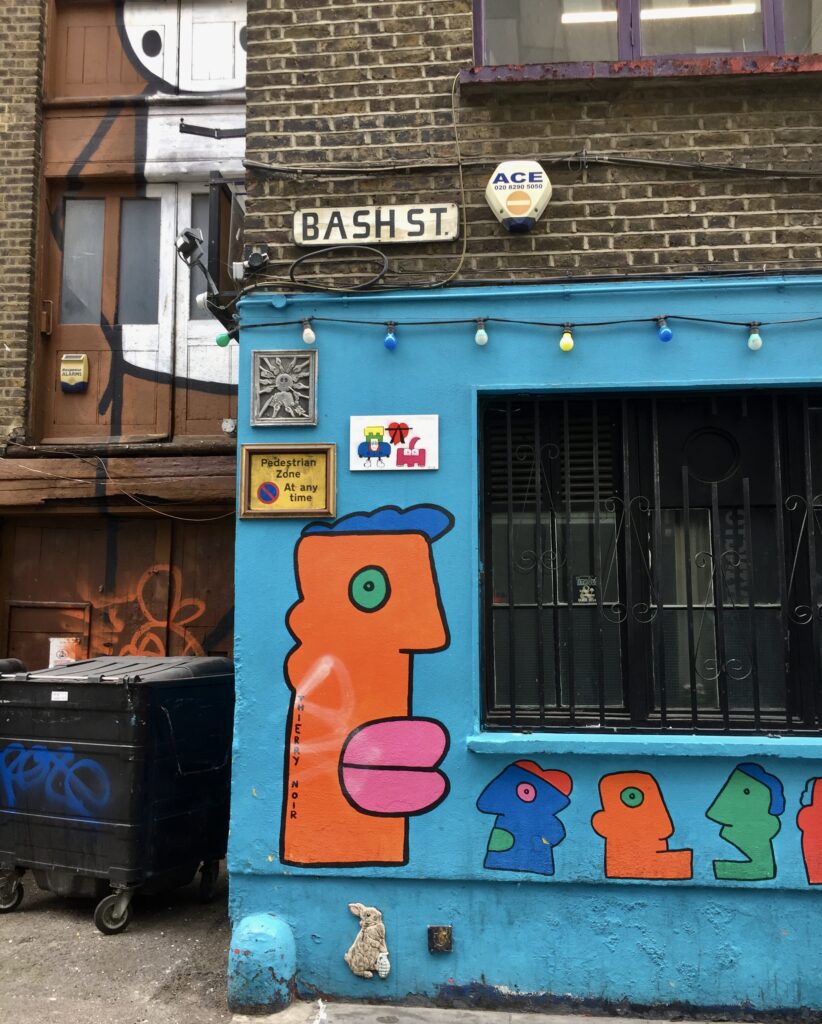
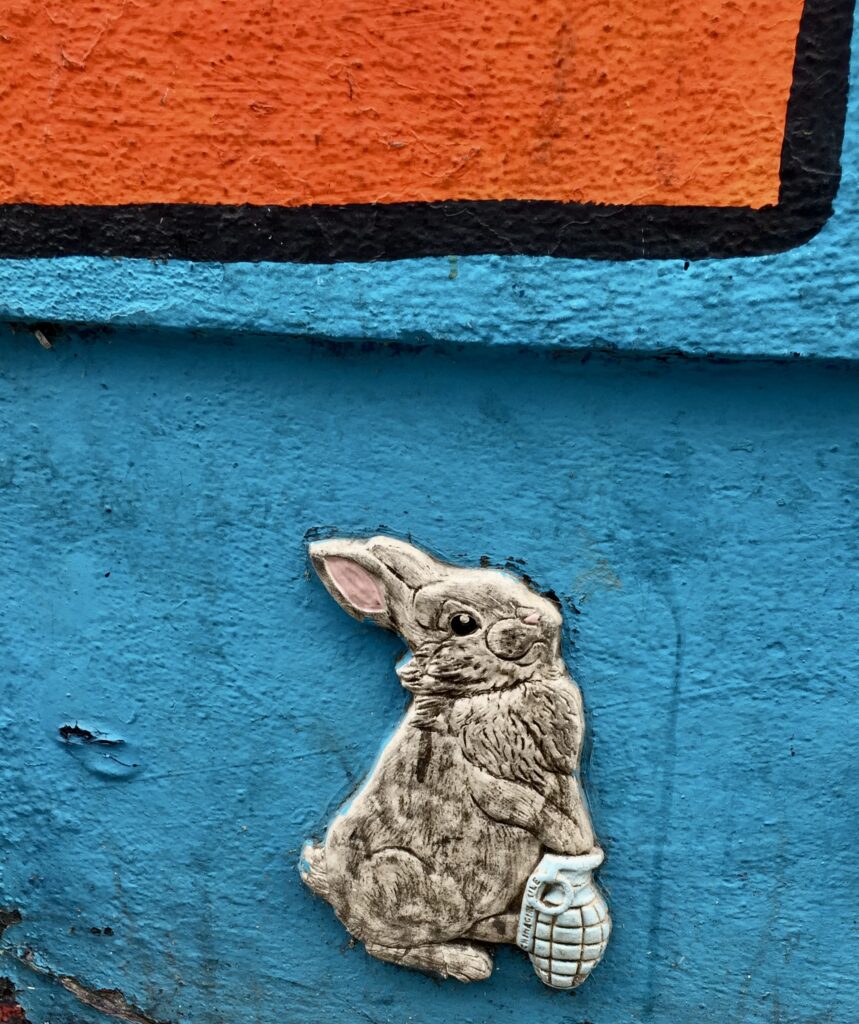
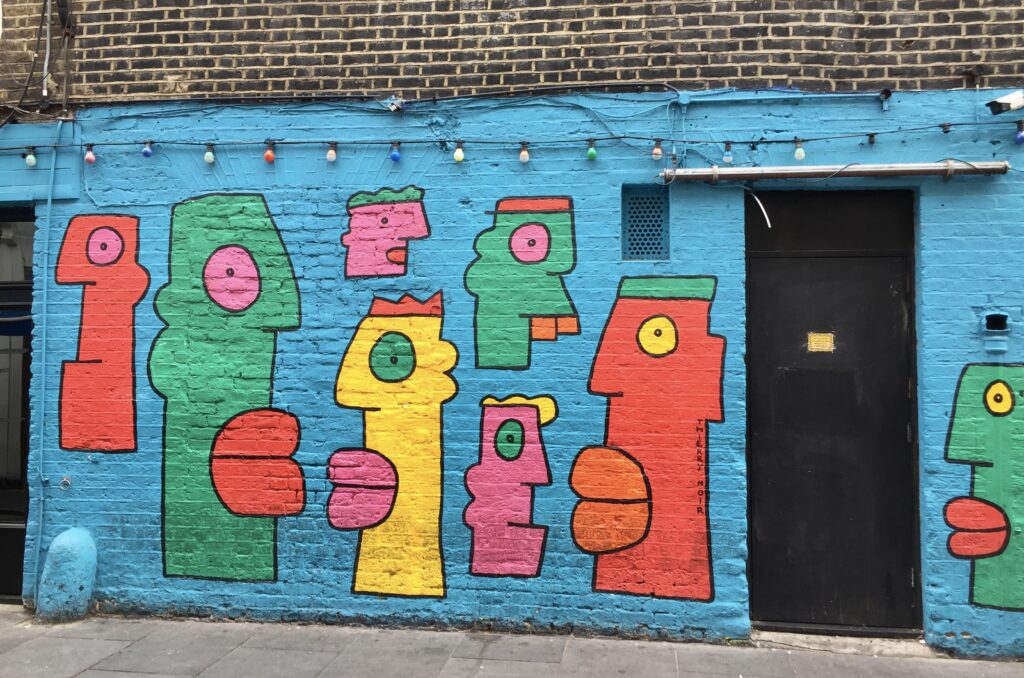
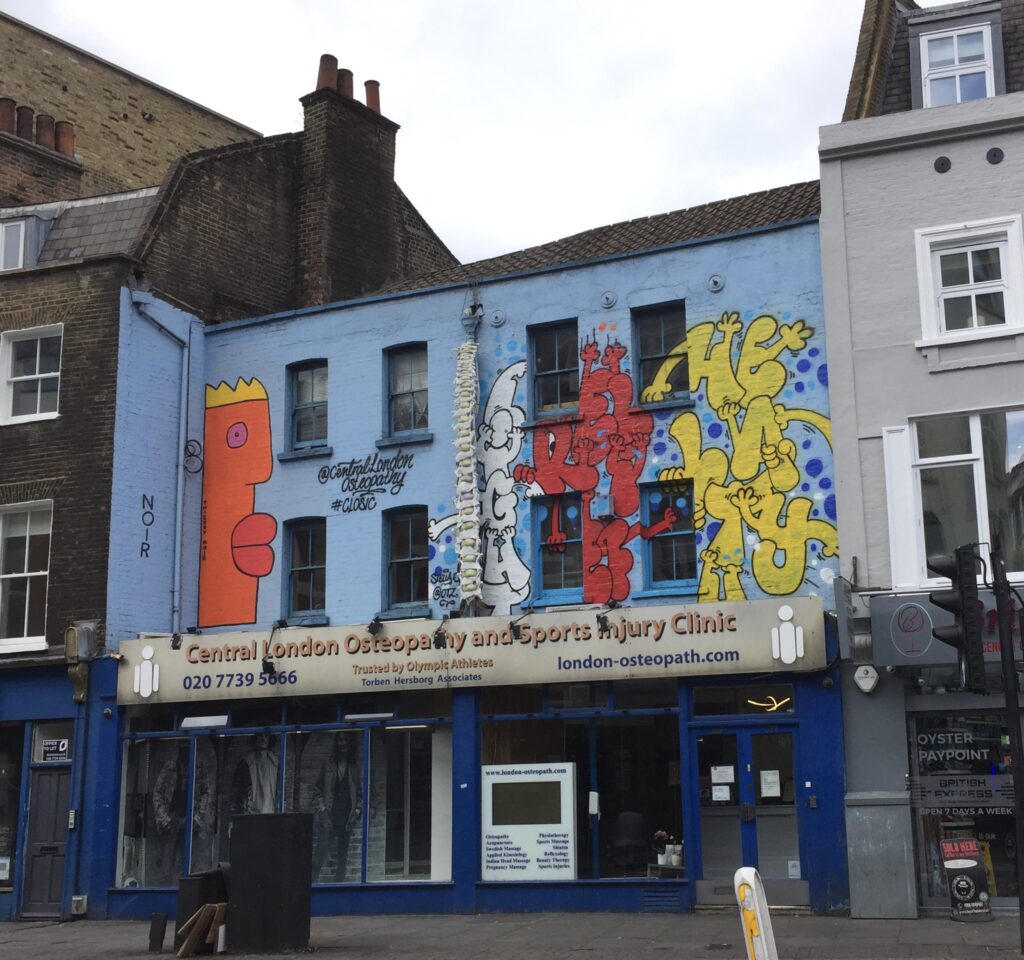
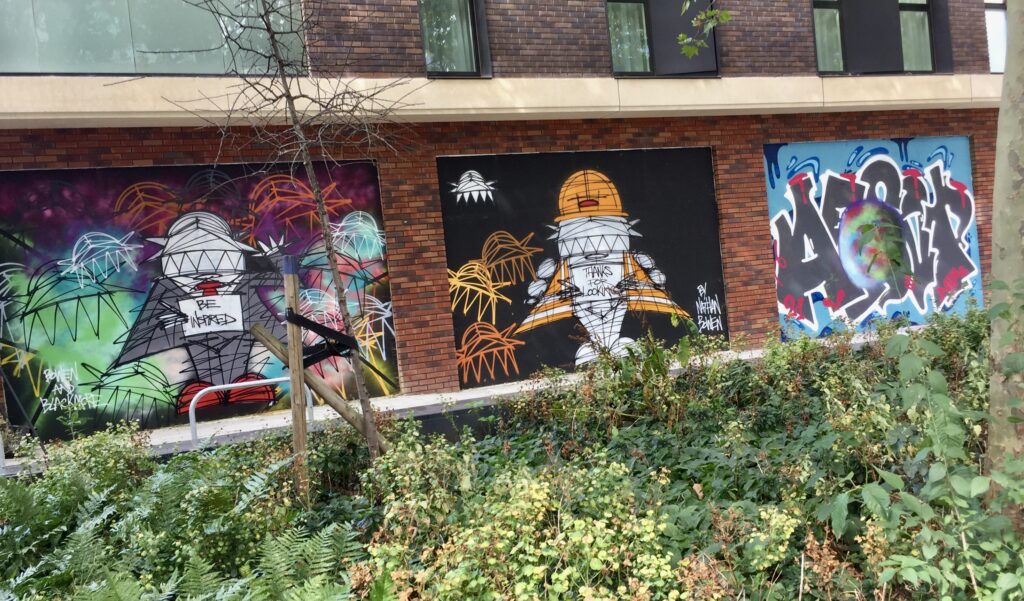
Some more Brick Lane artwork …

If you would like to follow me on Instagram here is the link …
https://www.instagram.com/london_city_gent/

Street art in and around Brick Lane.

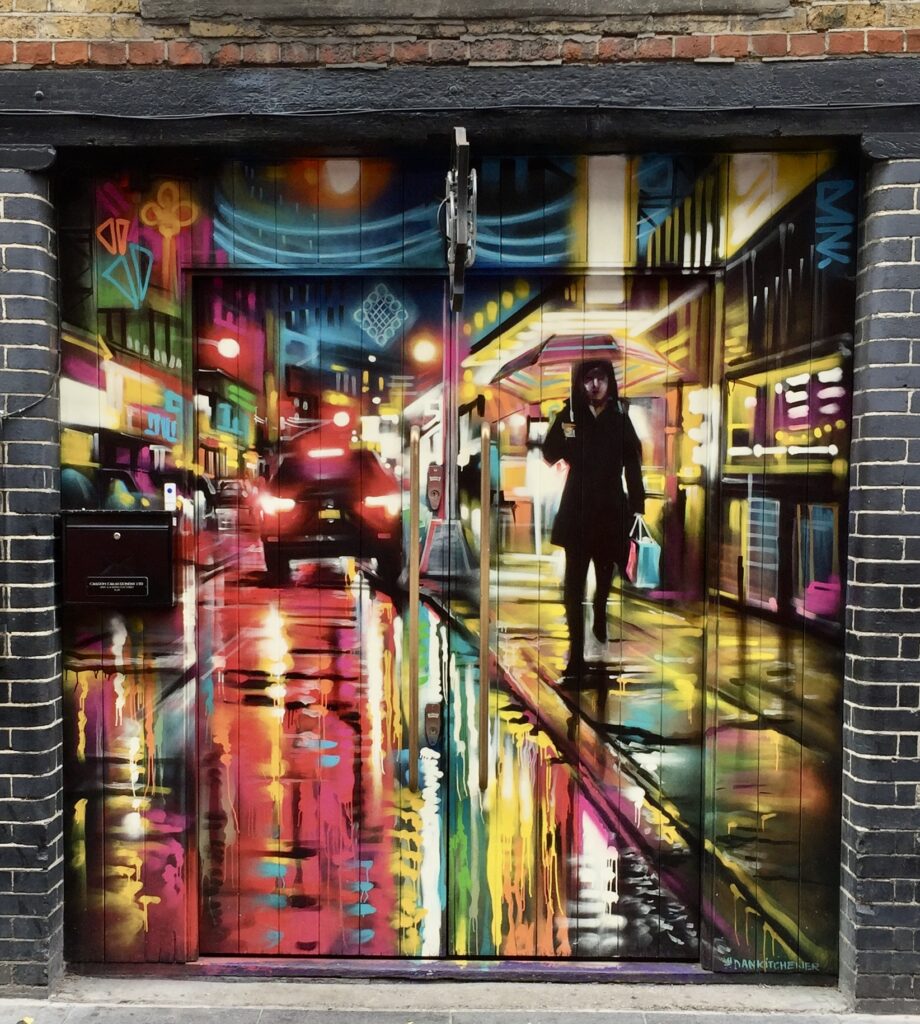
In my blog a few weeks ago some of you will remember that I wrote about this pair of doors in Fournier Street …

Much street art is constantly being painted or pasted over. For example, this is what the doors looked like in April 2018 …

I was inspired to go in search of what else had been created nearby and these pictures are the result of my wanderings.

I’ll start in Princelet Street with a work by the famous street artist Stik …

Entitled A Couple Hold Hands in the Street, it shows a woman in a niqab holding hands with a second stick figure. It was painted in 2010 and you can read more about the artist in this fascinating article in Christie’s magazine.

Local people are also very fond of this Hanbury Street bird …

The work is by the Belgian street artist Roa. His intention had been to paint a heron but, after being asked if it was a crane by Bengali people – for whom the crane is a sacred bird – he morphed his bird into a crane to best complement its location on the wall of an Indian restaurant. Read more here about The Return of Roa by The Gentle Author.

To the left of the crane is a bearskin-hatted guardsman break dancing …

Here he is ‘right’ way up …

It’s by the Argentinian painter Martin Ron who is based in Buenos Aires.

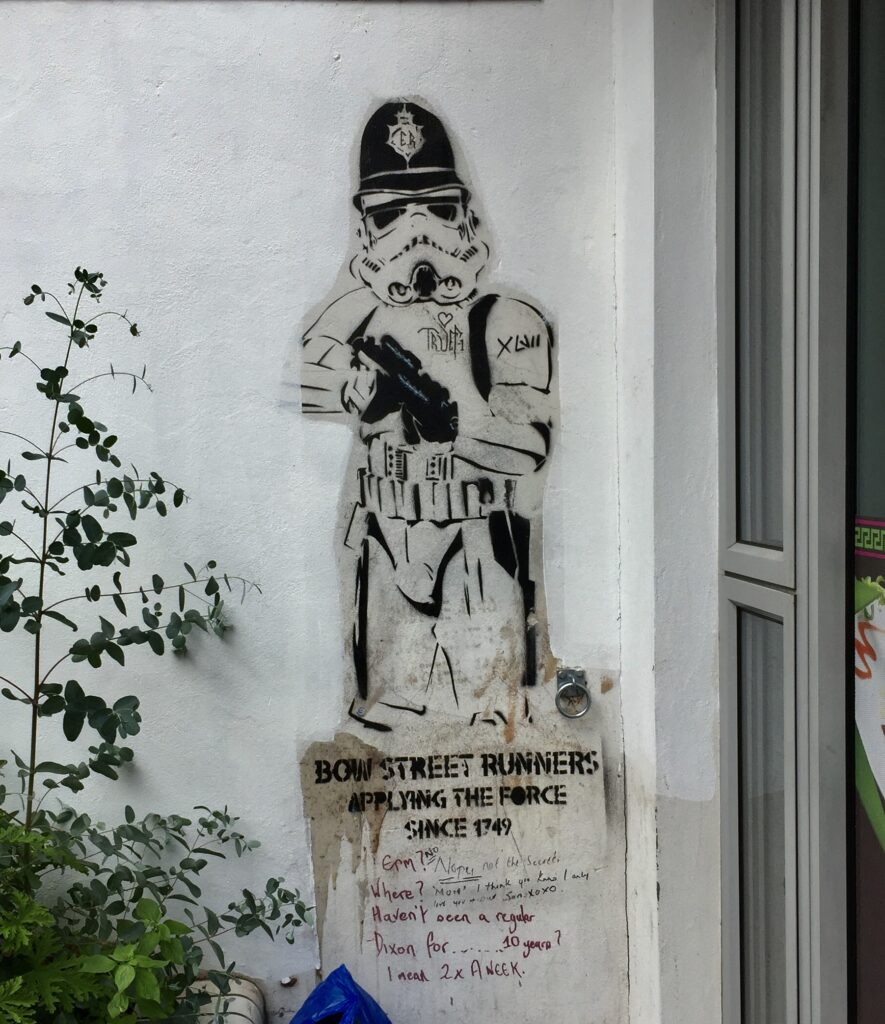
There were bound to be a few political points being made …

This made me laugh – could it be Tintin and his dog Snowy doing some clandestine paint spraying? …

The ‘No place for hate’ rabbit pops up a lot …

Layers and layers of street artist paste-ups cover walls …

Picking out individual works is fun and quite absorbing …

I have been trying to identify all the artists but still have some research to do with regard to these distinctive portraits …

Brick Lane looks a bit sad at the moment with the restaurants either closed or open for take-away orders only but the art certainly brightens everything up and I shall be going back to watch it continually develop.

If you would like to follow me on Instagram here is the link …
https://www.instagram.com/london_city_gent/

Potato Heads on Whitecross Street (and some Street history)

It was a lovely sunny day last Saturday so I wandered along Whitecross Street to gaze at some of the wonderful art works. Many of these have been produced over the years at the famous Whitecross Street Party. Who wouldn’t smile at this splendid pair of potato heads …

Work by Keith Jive.

Then there’s a crazy cat with a bird standing on his paw tweeting his love …

Work by Roo.

A pretty green-eyed lady being created …

And now finished and ‘hung’ …

Laughing heads … Ho ho ho ho ho!

I love the colours in this abstract work …

Spot the bee …

A young girl holding a spirit animal over her head and shoulders by Goya Torres (based on her Children of the Sun series). Read more about this fascinating artist here

Not sure what this represents but I still like it, dynamic and colourful …

Work by Will Vibes.

Looking north up the street you get a good view on the right of a mural by Conor Harrington, an Irish artist living and working in London. Incidentally, the church in the background is St Luke Old Street and the unusual obelisk spire is by Nicholas Hawksmoor …

Here is Harrington’s work in more detail. It has weathered quite well considering it was created in 2012 …

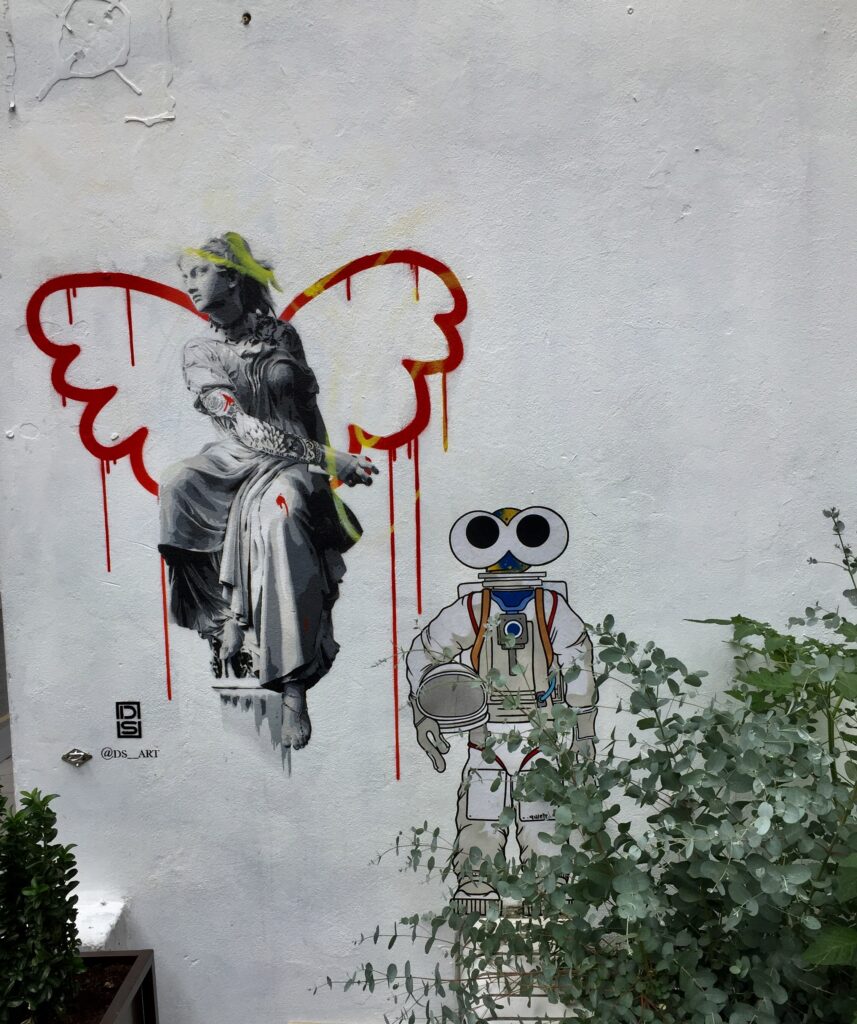
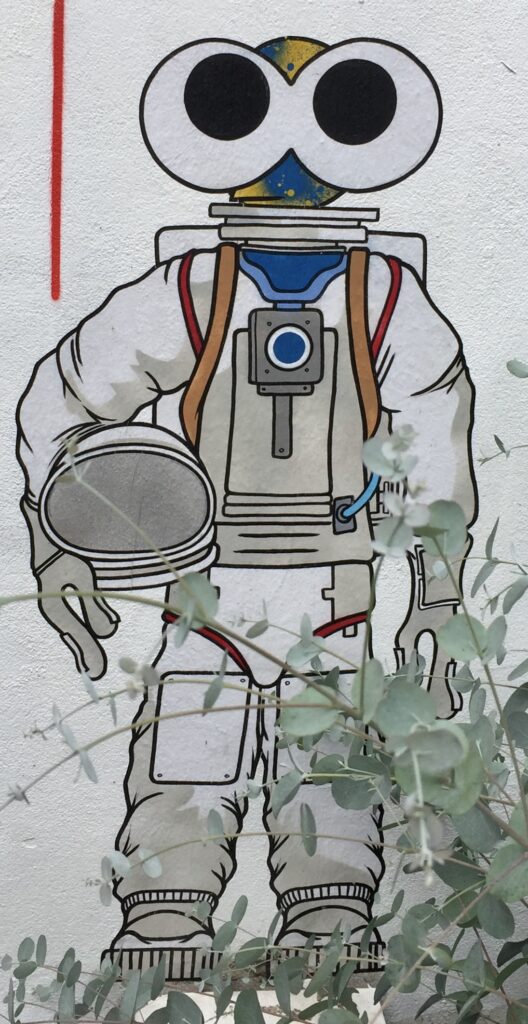
Below is a pretty, tattooed winged angel

Stencil by DS Art.

‘Oi, are you lookin’ at my bird?’ …

You can view more pictures and activity here on Instagram.

This year’s party is scheduled for 10th and 11th July, mid-day to 6:00 pm. Read more on the official website.

The street boasts a number of blue plaques placed there by ‘English Hedonists’ and ‘Mad in England’ …

I have written about the Debtors Prison before but here it is again for those of you who missed it the first time around.

British History Online confirms the Nell Gwynne story mentioned on the plaque but I cannot find another source. It also tells us that …

A man may exist in the prison who has been accustomed to good living, though he cannot live well. All kinds of luxuries are prohibited, as are also spirituous drinks. Each man may have a pint of wine a day, but not more; and dice, cards, and all other instruments for gaming, are strictly vetoed.”

A pint of wine a day doesn’t sound too bad.

The prison was capable of holding up to 500 prisoners and Wyld’s map of London produced during the 1790s shows how extensive the premises were …

Prisoners would often take their families with them, which meant that entire communities sprang up inside the debtors’ jails, which were run as private enterprises. The community created its own economy, with jailers charging for room, food, drink and furniture, or selling concessions to others, and attorneys charging fees in fruitless efforts to get the debtors out. Prisoners’ families, including children, often had to find employment simply to cover the cost of the imprisonment. Here is a view of the inside of the Whitecross Street prison with people meeting and promenading quite normally …

‘Inside the Debtors’ Prison, Whitecross Street, London’ by an unknown artist : City of London Corporation, Guildhall Art Gallery.

Creditors were able to imprison debtors without trial until they paid what they owed or died and in the 18th century debtors comprised over half the prison population. Prisoners were by no means all poor but often middle class people in small amounts of debt. One of the largest groups was made up of shopkeepers (about 20% of prisoners) though male and female prisoners came from across society with gentlemen, cheesemongers, lawyers, wigmakers and professors rubbing shoulders.

It’s over two years since I wrote about this second plaque so here it is again.

It tells us that there once lived here a lady called Priss Fotheringham who had been ranked ‘the second best whore in the City’. This description appeared in 1660 in a serial publication called The Wandring Whore by John Garfield, which described in some detail the antics of London’s prostitutes.

Described when young as a ‘cat-eyed gypsy, pleasing to the eye’, Priscilla Fotheringham (nee Carswell) was a colourful character very famous in her time. It is thought she was born in Scotland around 1615 and little is known of her early life. What we do know is that in 1652 she was sent to Newgate Gaol having been found in a house of ill-repute …

… sitting between two Dutchmen with her breasts naked to the waist and without stockings, drinking and singing in a very uncivil manner.

In 1658 she was still misbehaving and was bound over by a Middlesex Justice of the Peace for …

… being a notorious strumpet … that had undone several men by giving them the foul disease … and for keeping the husband of Susan Slaughter from her and for also threatening to stab said Susan Slaughter … and also for several notorious wickedness which is not fit to be named among the heathen.

She had married Edward Fotheringham, an odious character from a brothel-owning family, in 1656 and he set her up as a madam at the Jack-a-Newberry Tavern on the corner where her plaque now stands. As her looks faded with time she became more ‘creative’ in the way customers were entertained – you can read more detail in her Wikipedia entry. She made enough money to set up her own brothel and died (of syphilis) a wealthy woman around 1668.

The Whitecross Street area was at one time rather notorious, as this 17th century ballad records …


In Whitecross Street and Golden Lane
Do strapping lasses dwell,
And so there do in every street
‘Twixt that and Clerkenwell.
At Cowcross and at Smithfield
I have much pleasure found,
Where wenches like to fairies
Did often trace the ground.

Nowadays the big attraction is Waitrose.

If you would like to follow me on Instagram here is the link …
https://www.instagram.com/london_city_gent/

Page 24 of 30

Powered by WordPress & Theme by Anders Norén

Symbols & Secrets
Privacy Overview

This website uses cookies so that we can provide you with the best user experience possible. Cookie information is stored in your browser and performs functions such as recognising you when you return to our website and helping our team to understand which sections of the website you find most interesting and useful.