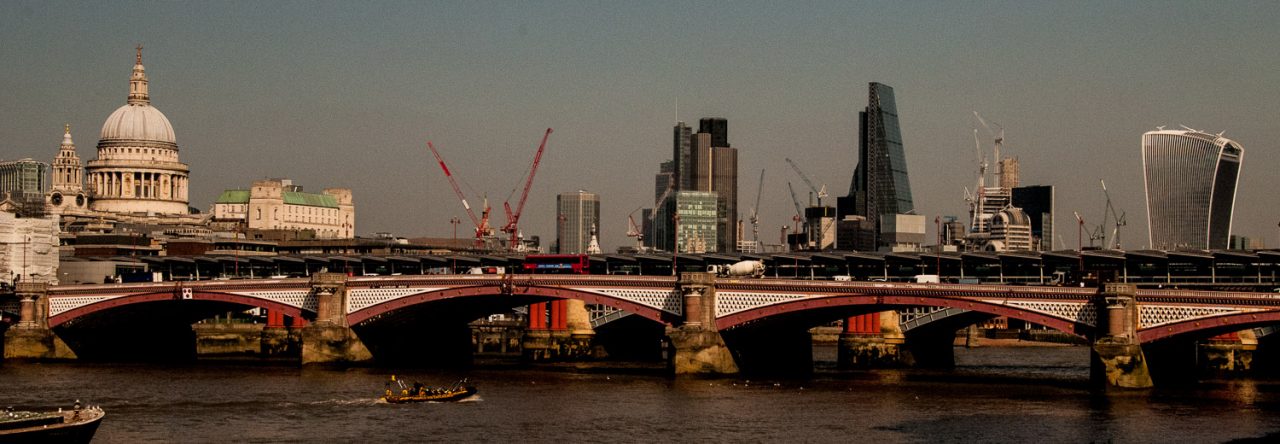
Walking the City of London

Category: Architecture Page 49 of 92

Reasons to be optimistic

Occasionally, when I feel the dark, heavy hand of doom tapping me on the shoulder (Covid, Lockdowns, Brexit, Trump etc) I cheer myself up by looking back at times past when things looked very grim but from which we eventually recovered. One way I do this is to look at some of the images of the terrifying days of the early 1940s and compare them to the same scene today.

The following Aerofilms photo from before the war shows how St. Paul’s was surrounded by the dense city streets with buildings much closer to the cathedral than they are now. These were not only offices, but also plenty of warehouses with one of the major publishers / book distributors having their office and warehouse just north of St. Paul’s in Paternoster Square. The spires of the city churches still stood clear of their surroundings, but St. Paul’s dominated the area …
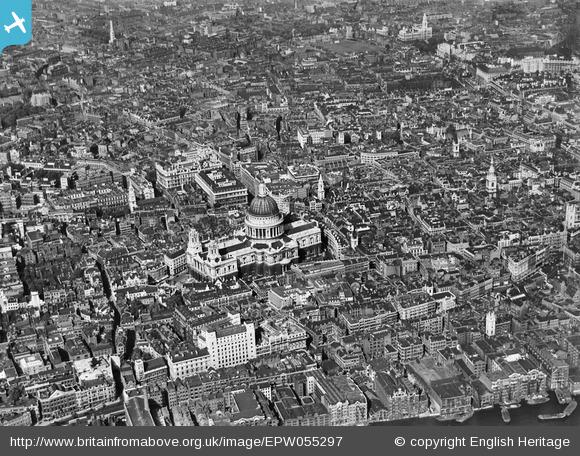
EPW055297

Christmas 1940 had been relatively quiet, however on the evening of the 29th December a large bomber force appeared over the City just after 6pm and for just over the next three hours incendiary bombs rained down on the City along with high explosive bombs. This combination caused maximum damage. High explosive bombs would rip buildings apart, exposing their contents to the impact of the incendiaries. During the peak of the raid over 300 incendiary bombs a minute were falling across the City and St. Paul’s quickly became surrounded by a sea of flame, fire crossing over the small streets and debris falling all around. These pictures show what was considered to be the almost miraculous survival of St Paul’s Cathedral …
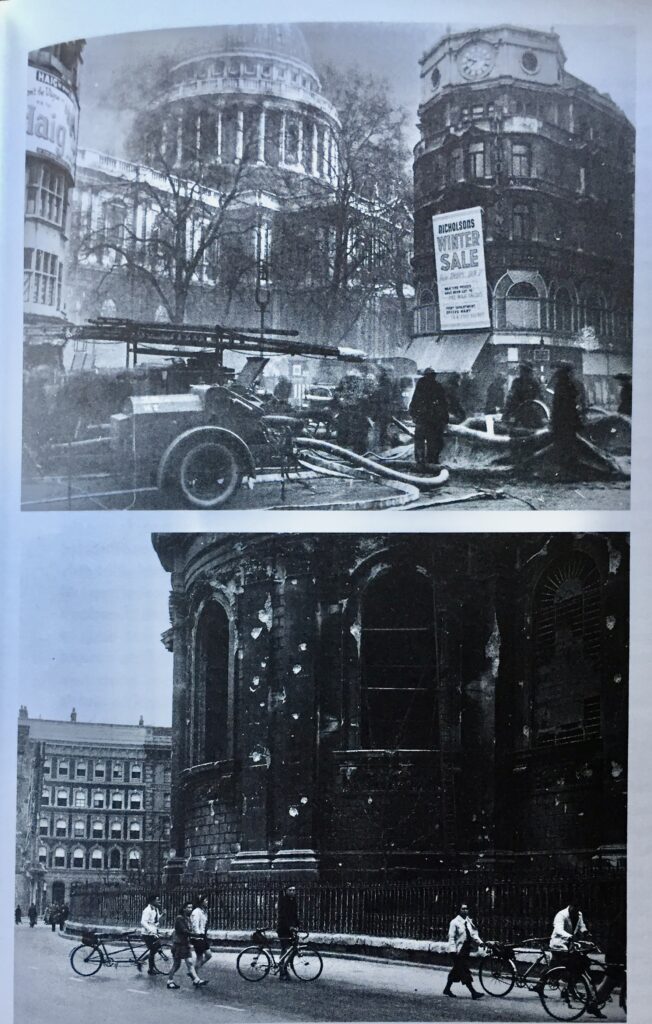
Two things strike me about the lower photograph. Firstly how dirty the cathedral stonework had become after over 300 years of London pollution. Secondly, two of those shrapnel marks that stand out so clearly against the soot-stained cathedral are still preserved today …
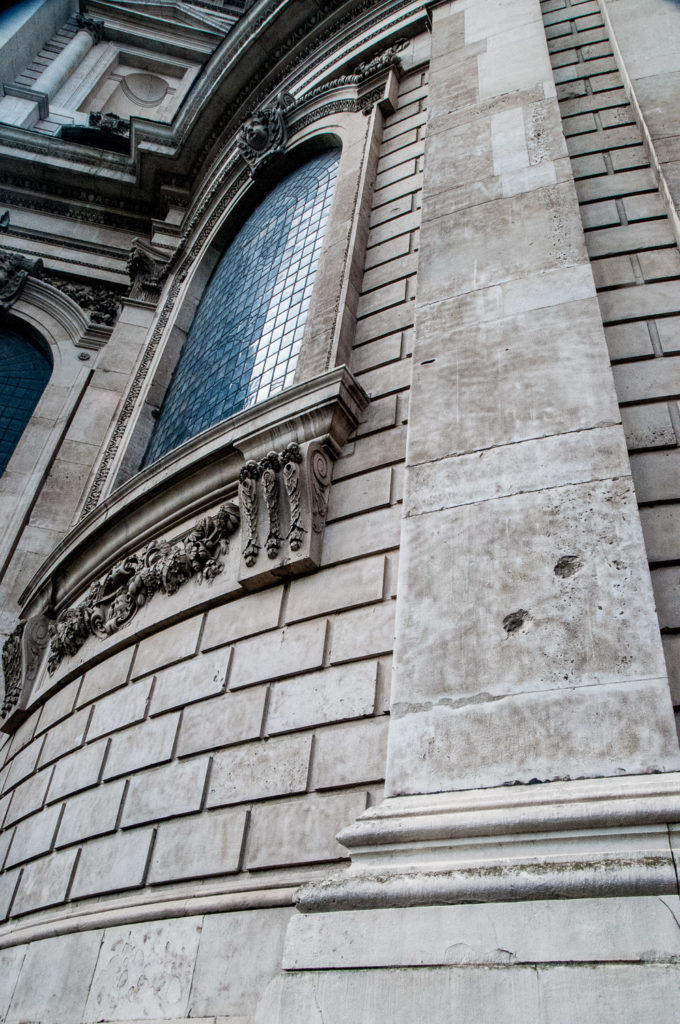
You can see where other scars from the bombing have been repaired.

This aerial view shows how close the Cathedral came to destruction …
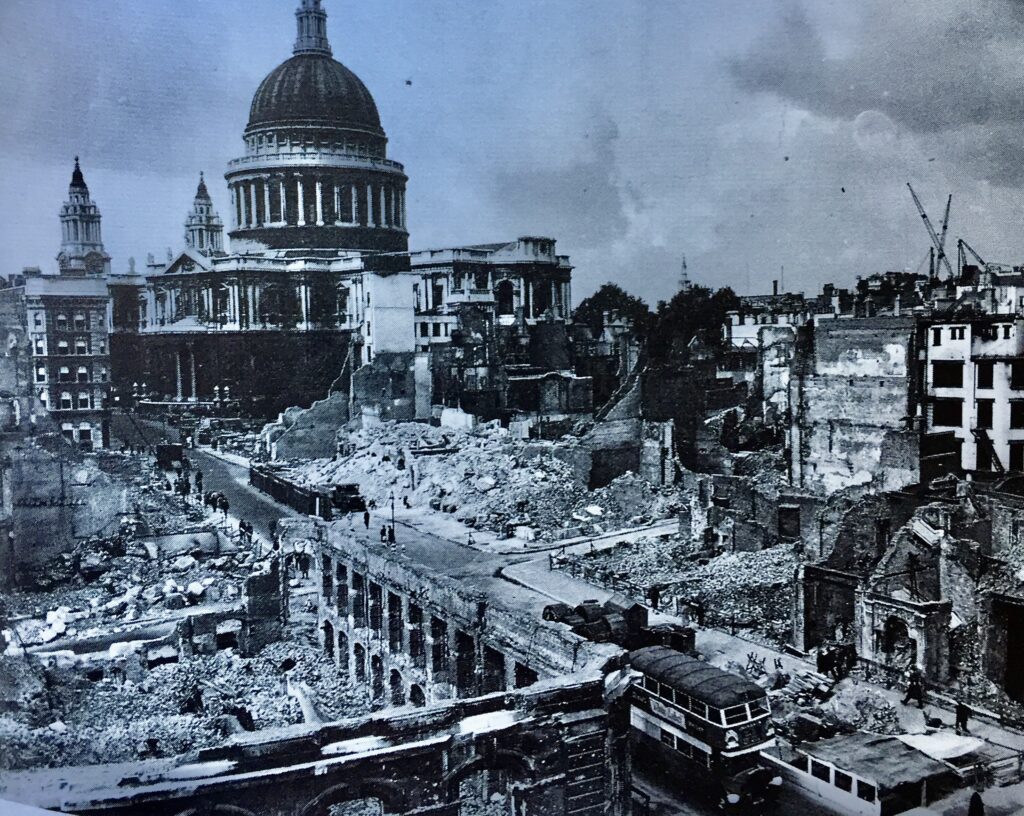
Copyright : Popperfoto – Getty Images.

The view today …

As a result of the bombing, many of the narrow alleys nearby dating from medieval times simply disappeared as did Paternoster Row (although the name still lives on) …
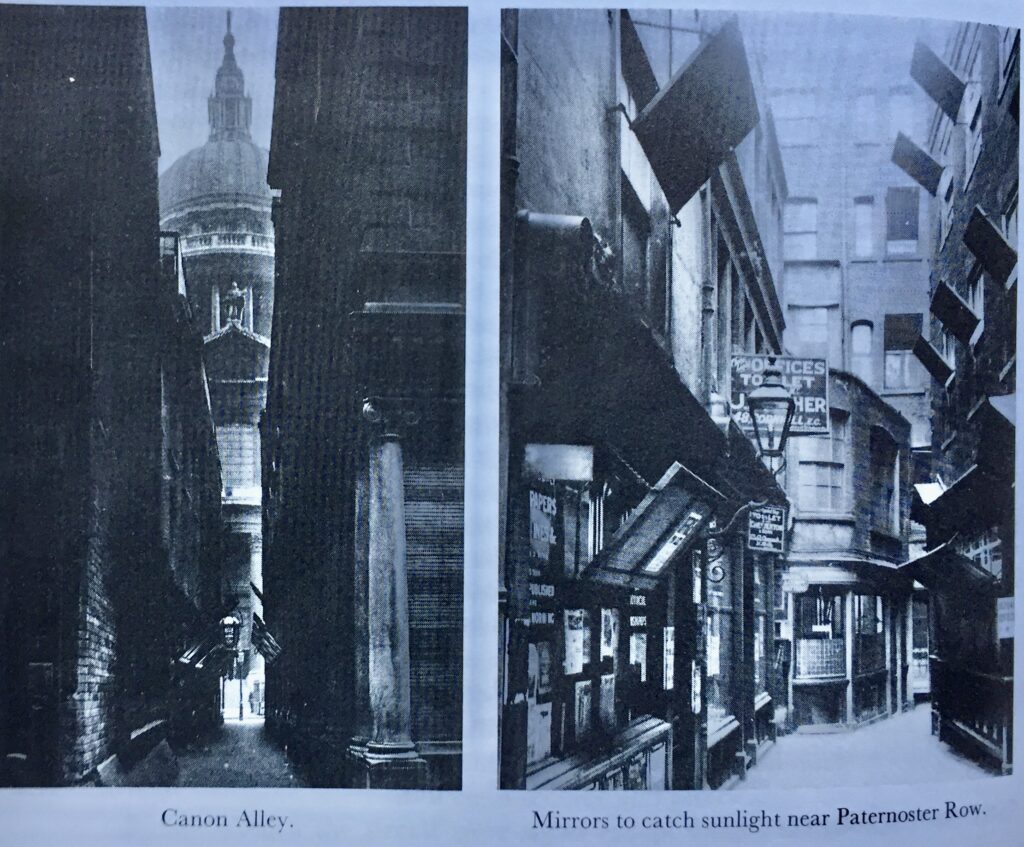
Copyright : Guildhall Library.

This picture is entitled ‘Prince Albert raises his hat as Holborn Circus burns behind him‘ …
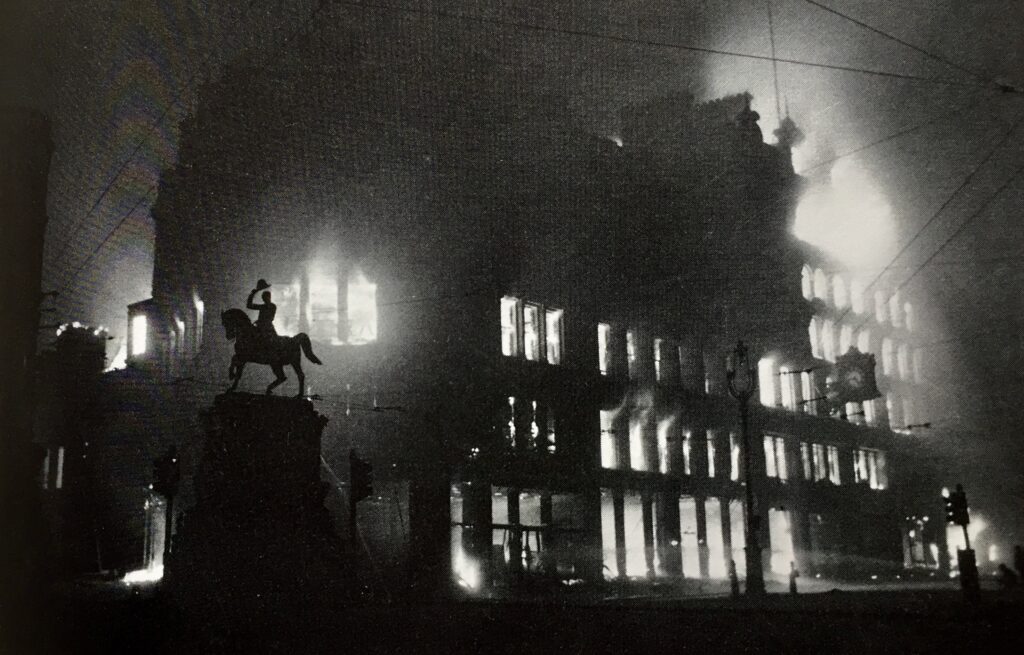
Copyright : Guildhall Library.

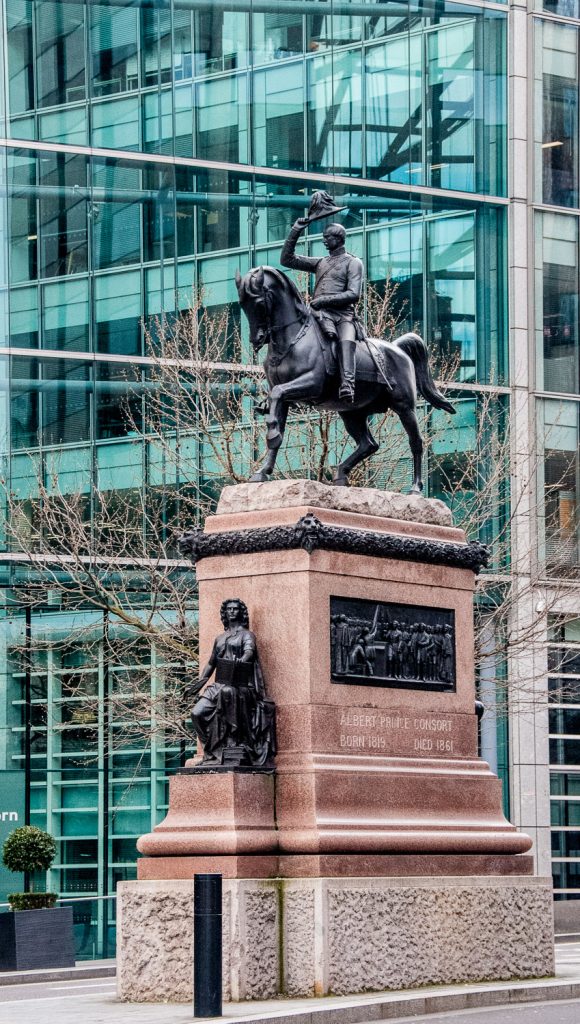
And he is still there in the same jaunty pose, albeit relocated a few yards to the east. You can read more about the statue here …
St Clement Danes was seriously damaged …
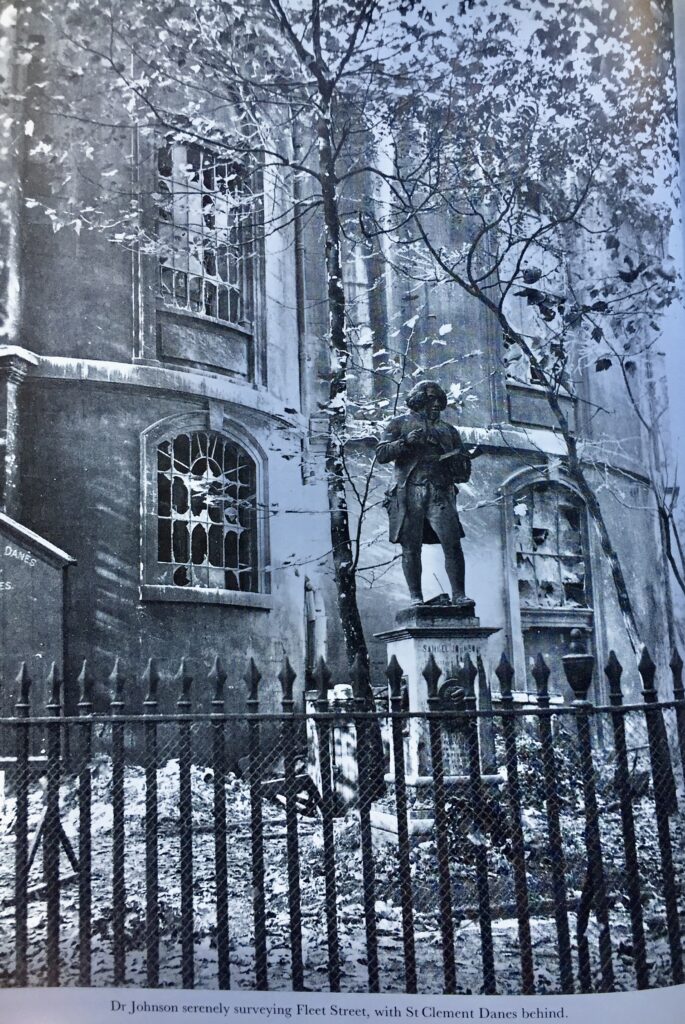
Copyright : Associated Press.

But eighty years later Dr Johnson carries on nonchalantly reading his book. He is no longer imprisoned behind railings and has a fully restored church behind him …
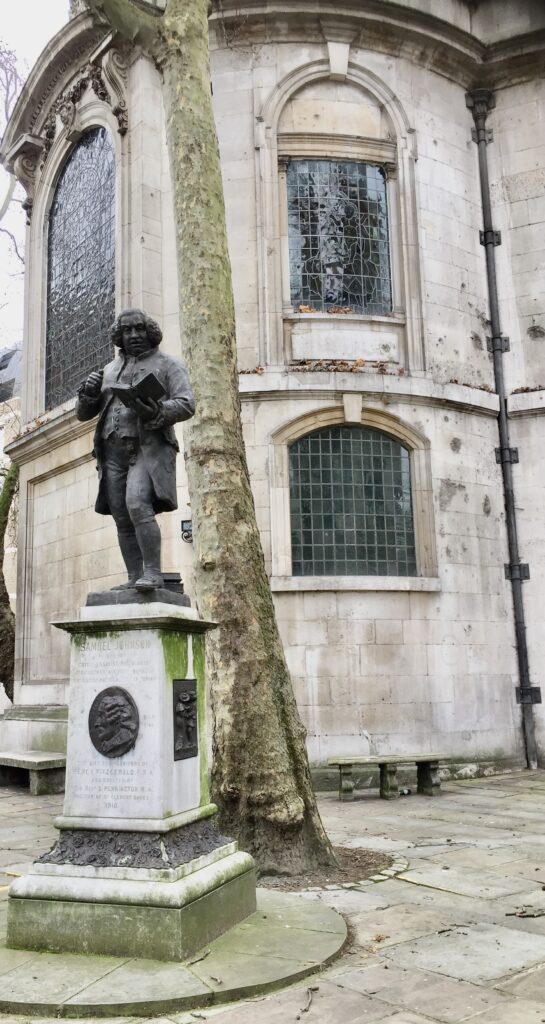
The building still bears its Second World War scars …
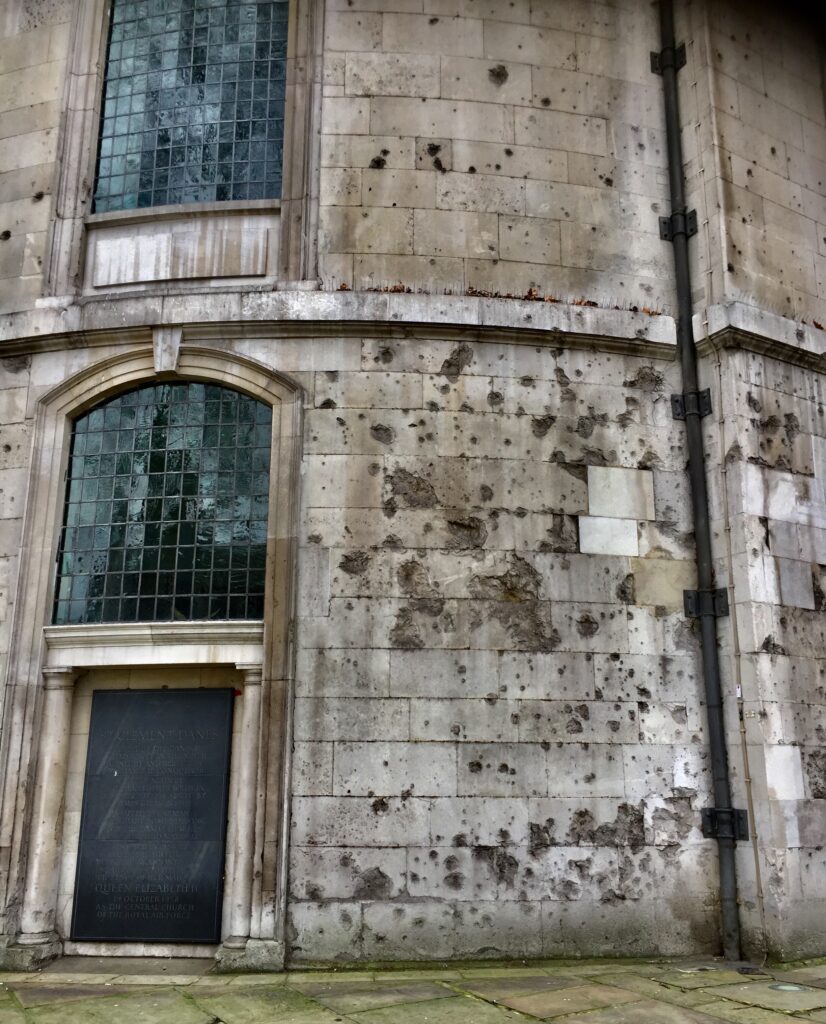
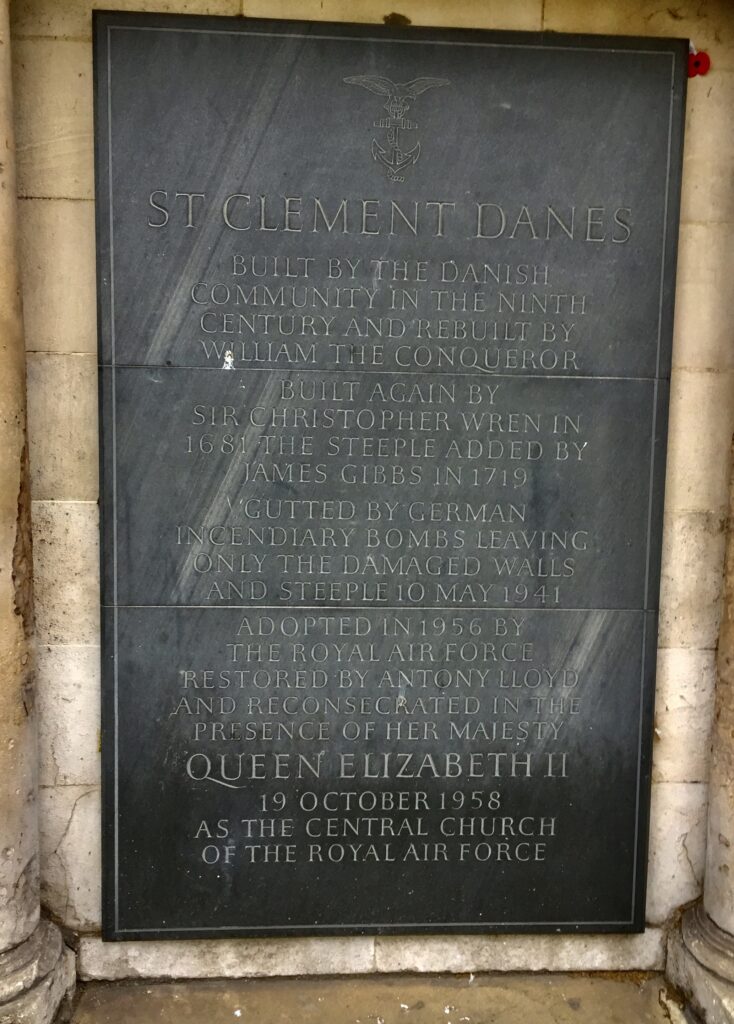
In the book I consulted for these photographs the good Doctor gets a further mention …
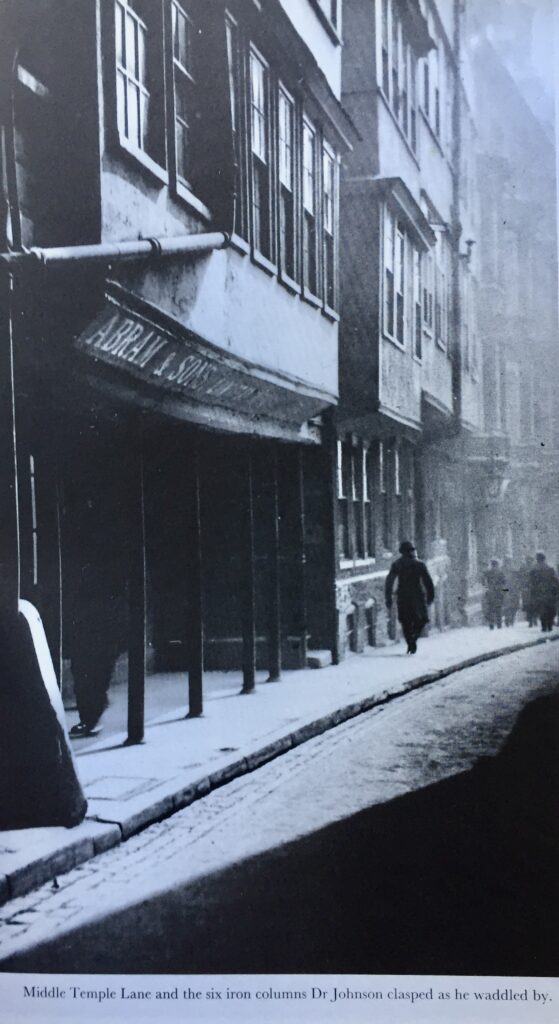
Copyright : Guildhall Library.

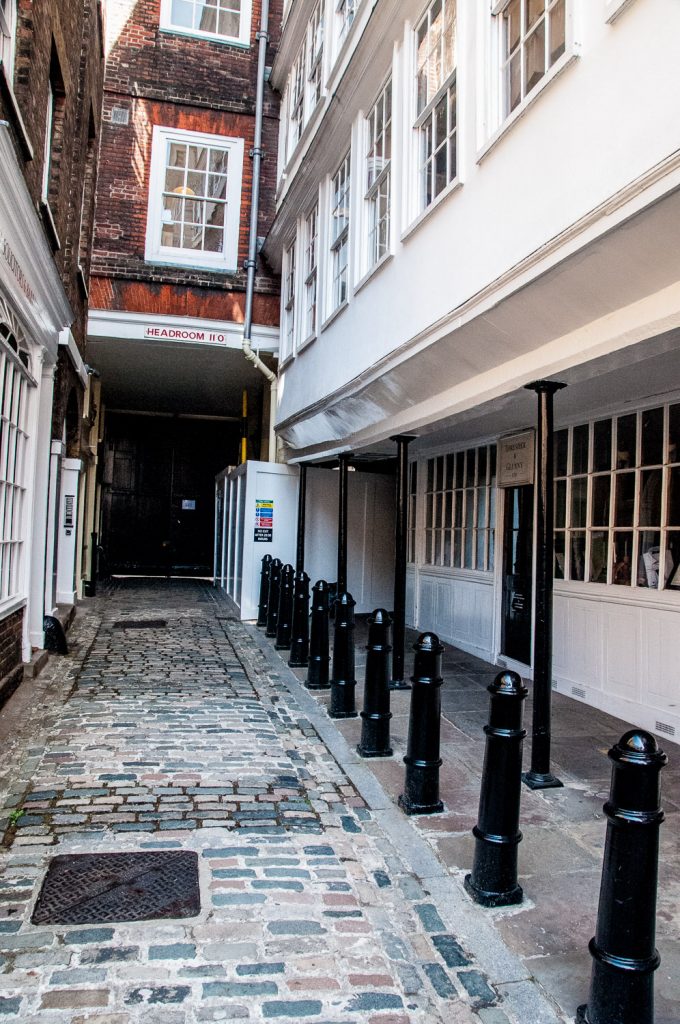
Nothing much has changed. The photograph above is looking south from Fleet Street, this is the view today looking north …
St Mary-le-Bow was completely gutted. I was moved by this poignant picture of a service being conducted in the roofless building in 1941 …
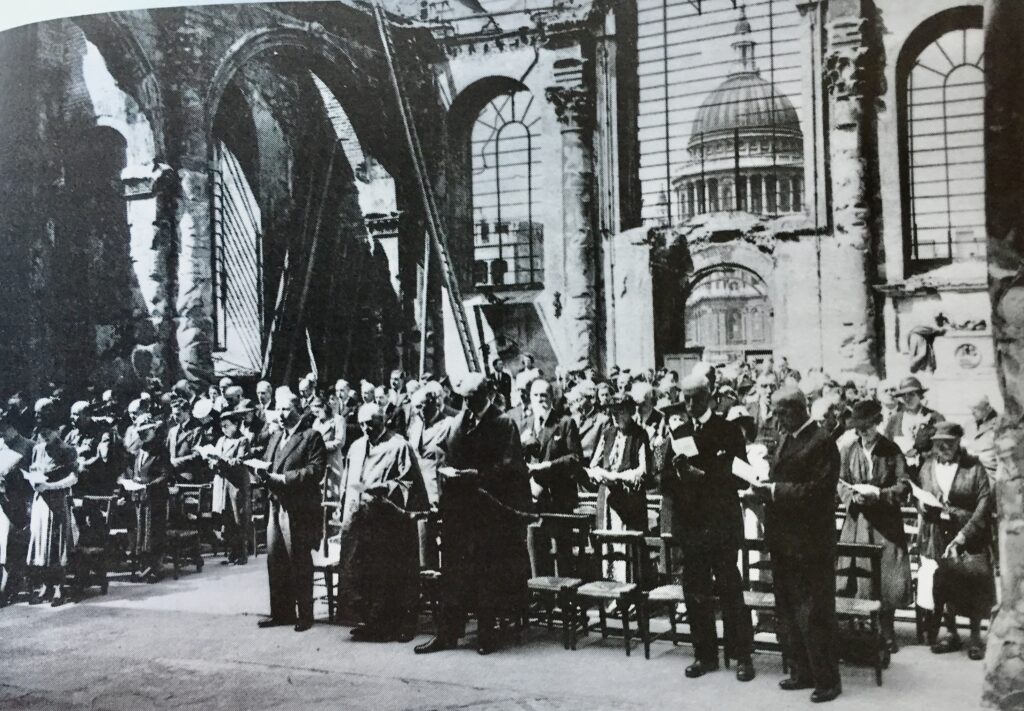
Copyright : Popperfoto – Getty Images.

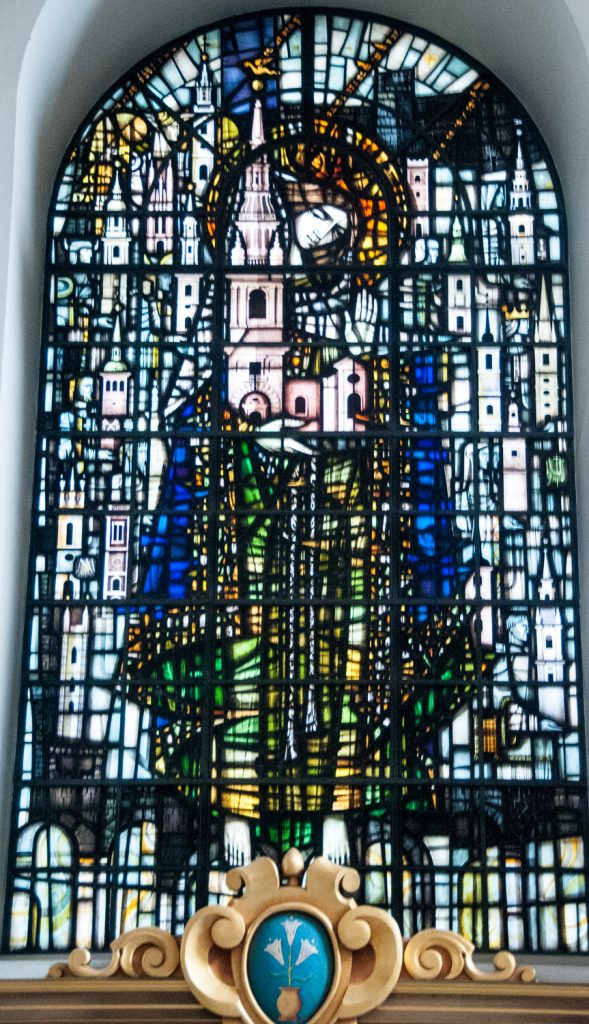
I am pretty sure that the window behind them that gives the unusual view of St Paul’s has now been filled with this beautiful stained glass work by John Hayward. Here the Virgin Mary cradles the church named after her as if it were a child, surrounded by church spires that survived the Blitz …
St Lawrence Jewry was also terribly damaged with only the walls and steeple remaining. This picture was taken on 30th December 1940 …
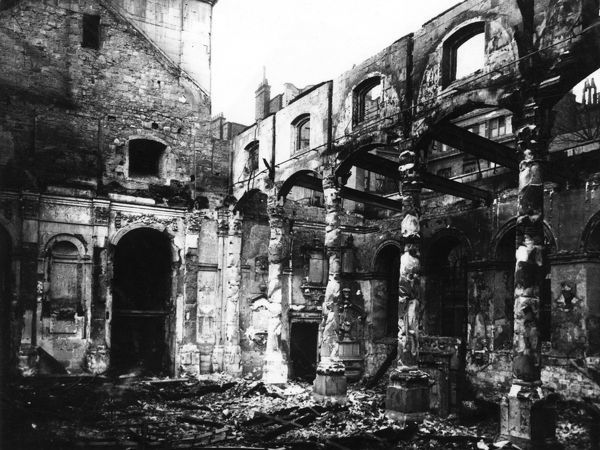
Copyright : Media Storehouse.

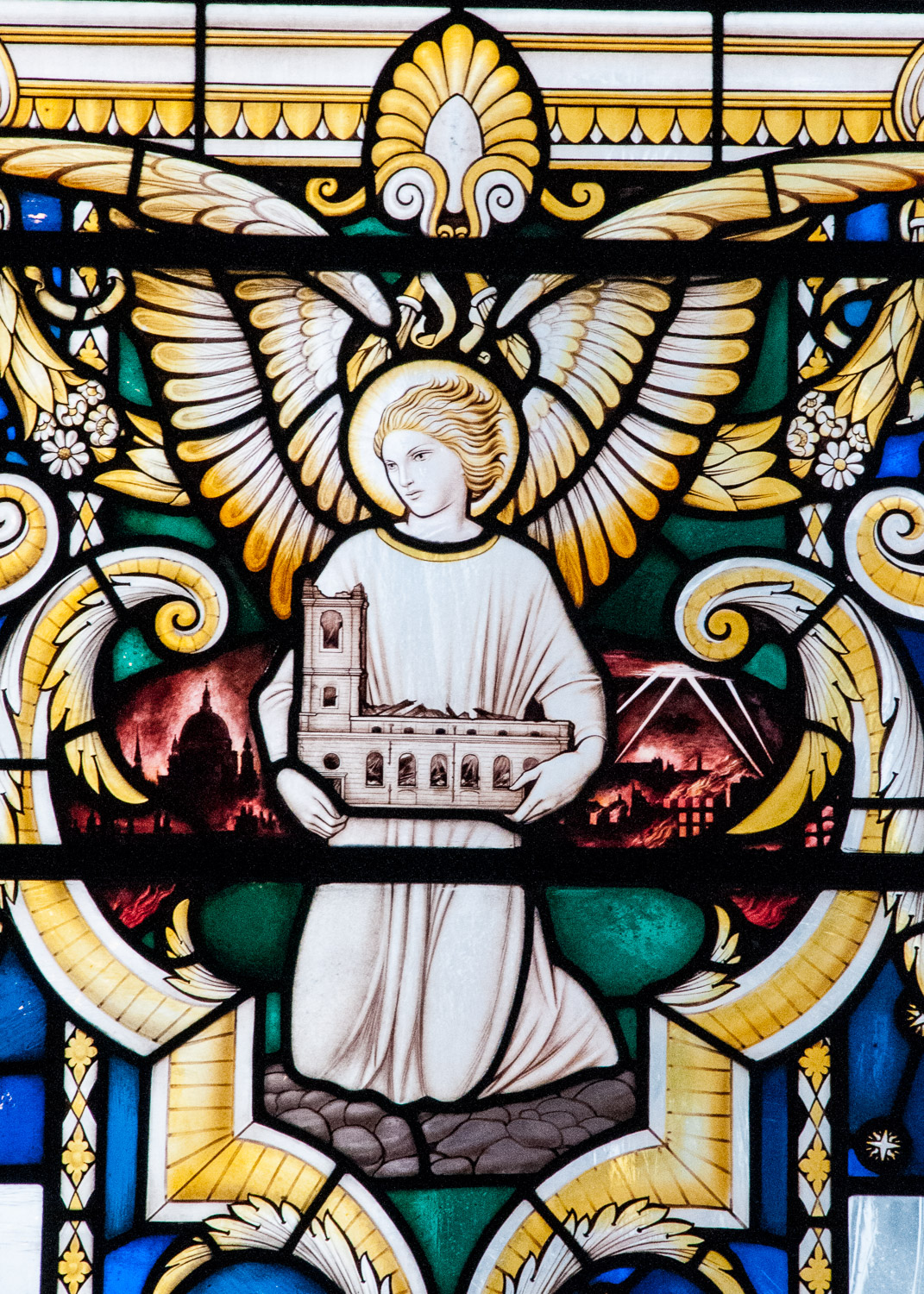
Now fully restored, it contains some of my favourite stained glass by Christopher Webb. In one window an angel holds the roofless, windowless church filled with rubble. In the background St Paul’s is illuminated by flames and searchlights pierce the sky as buildings burn …
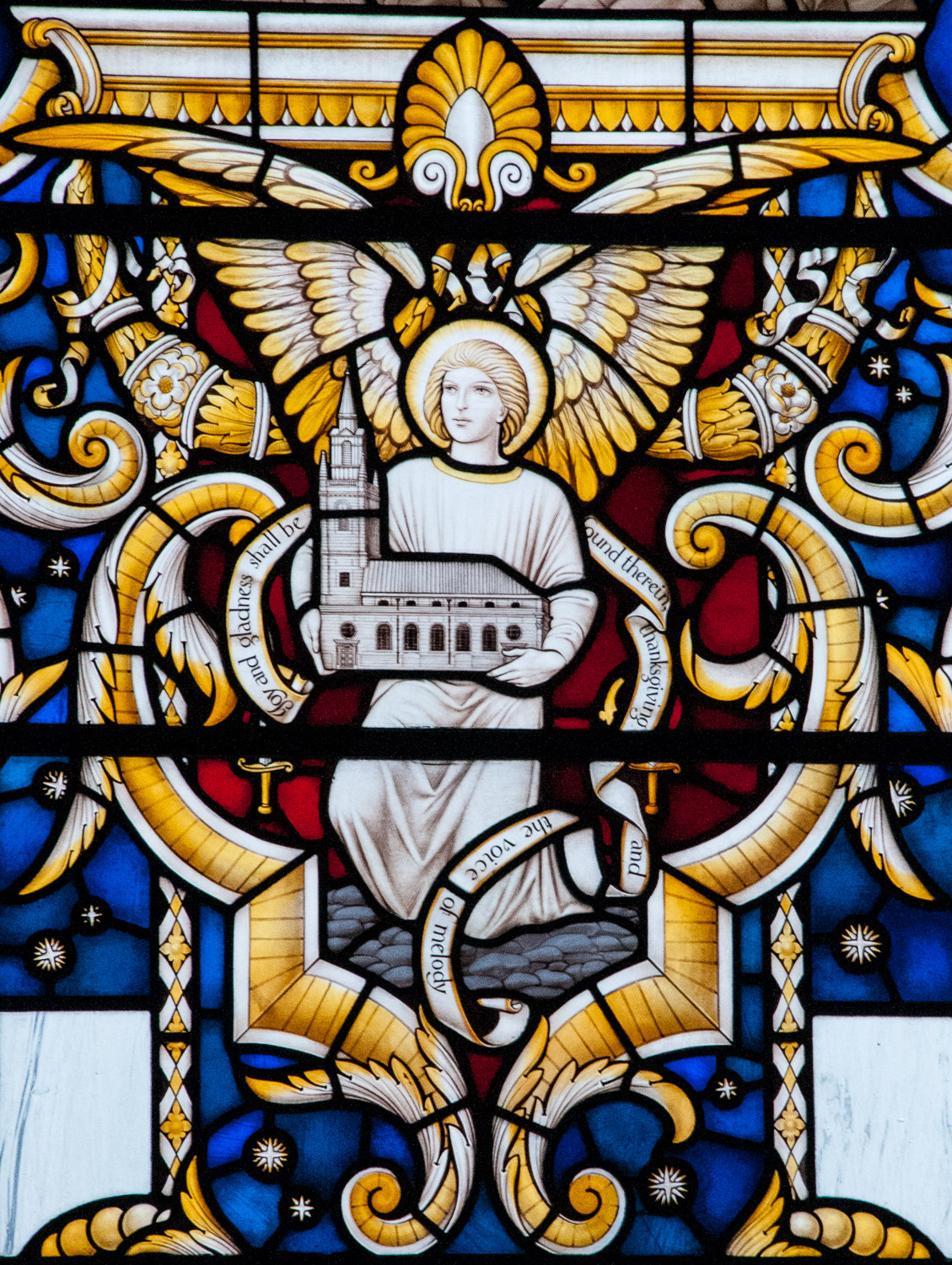
In another the angel holds the restored building …
I have written previously about the lovely stained glass that can be found in the City and you can access the blog here : Dick Whittington, Hipster, City Stained Glass.

London Wall on the morning after the big December 1940 attack …
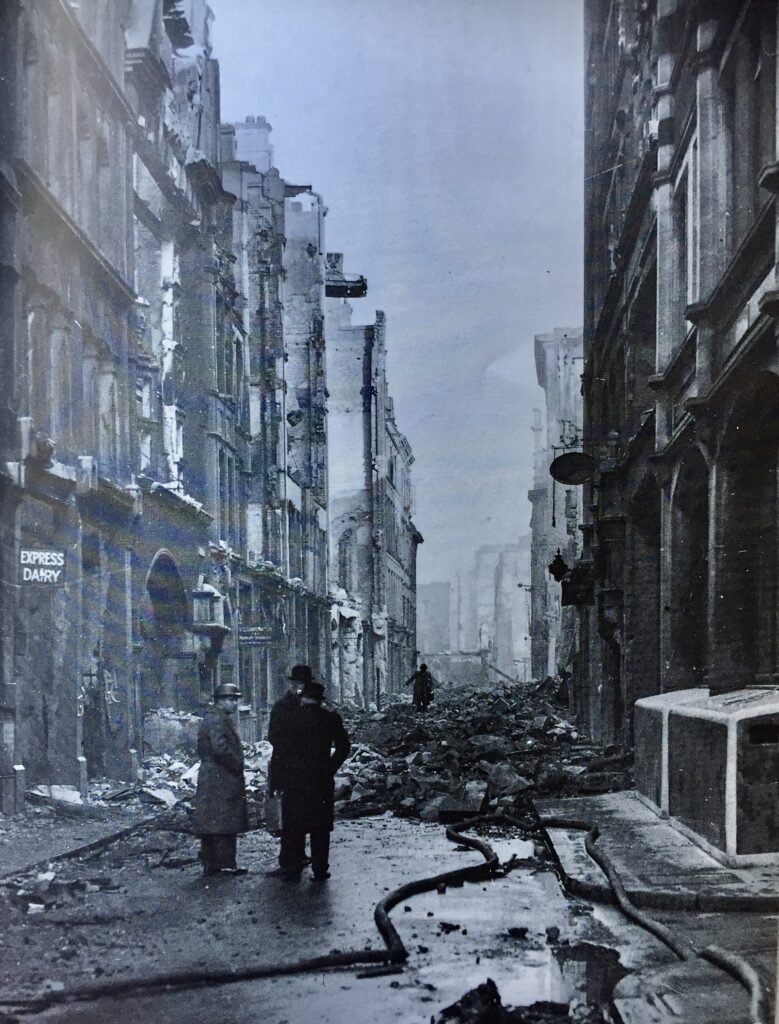
Copyright : Popperfoto – Getty Images.

A scene typical of what Londoners faced on returning to work after an air raid. Fire hoses snake across the rubble filled street.

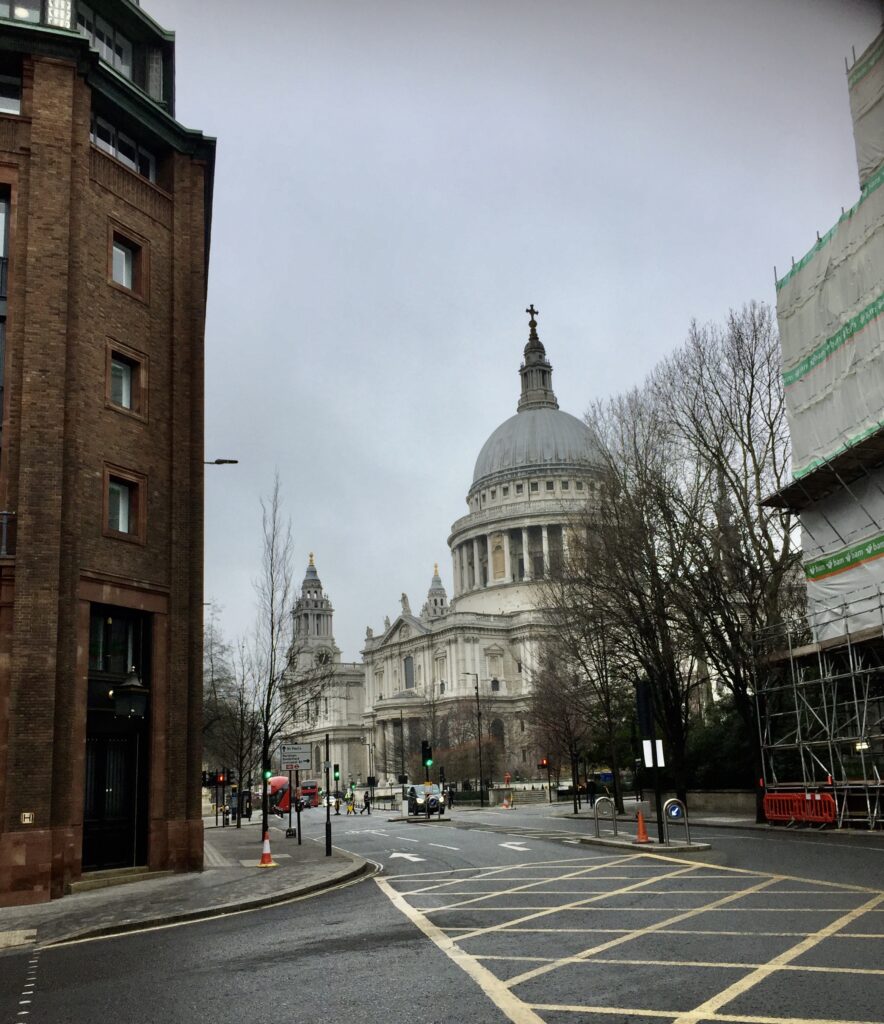
In this image a War Artist records the damage in Cannon Street …
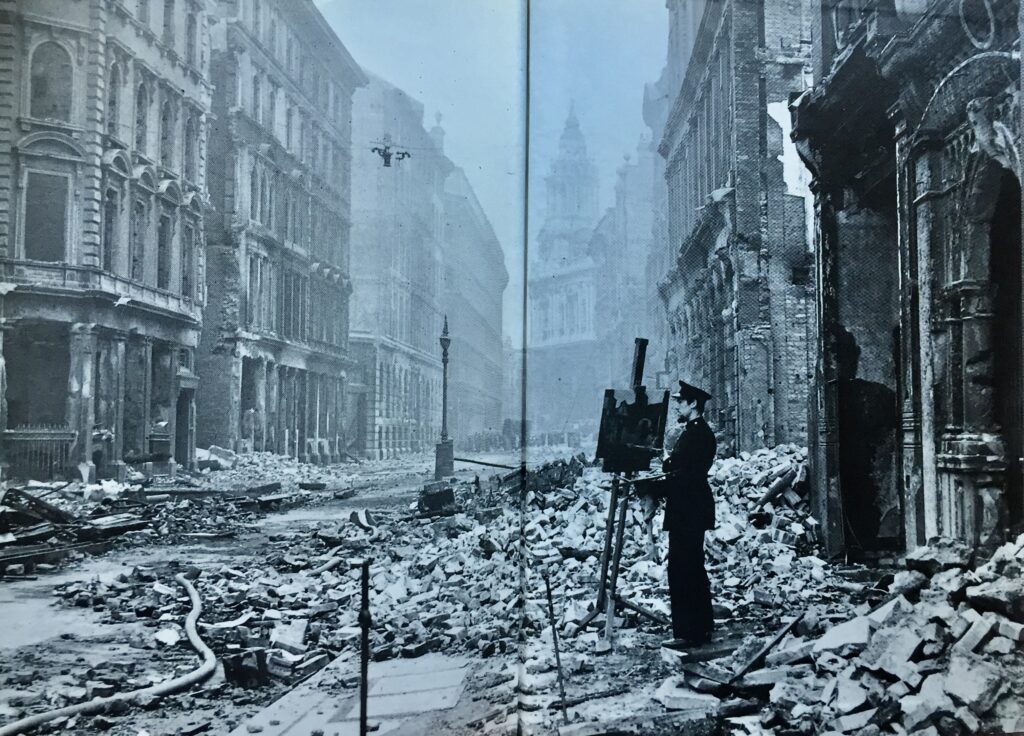
The view today, as close as I can get it without being run over …
Christ Church Greyfriars, Newgate Street, could not be saved …
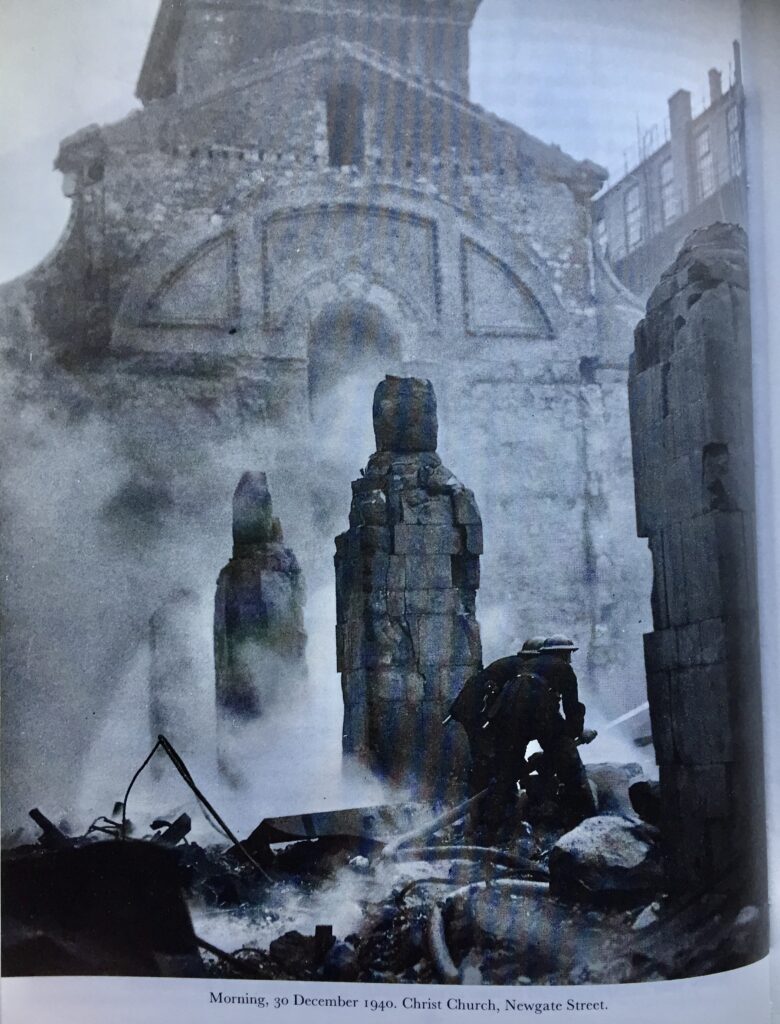
Copyright : Popperfoto – Getty Images.

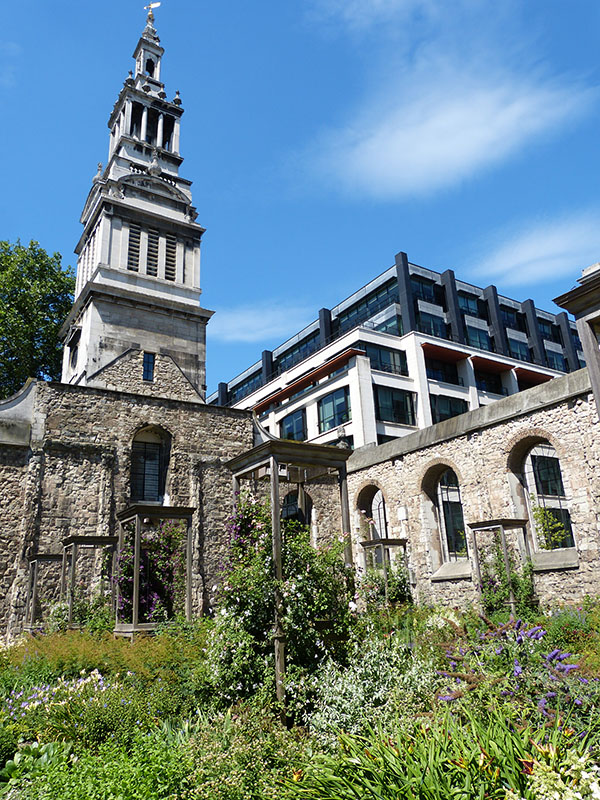
It’s now laid out as a garden …

Image courtesy of Jenikya’s Blog.

It’s impossible to consider the history of London without referencing some of the great disasters which have befallen it in the past and last year, living in Covid times, I published a piece about the terrible pestilence of 1665 : Samuel Pepys and the Plague – ‘God preserve us all‘.

I’m not making direct comparisons between these past disasters and the current pandemic – just reminding myself that even after terrible events a kind of normality usually returns, although life is never exactly the same as before. What seems to be unchanging, however, is people’s resilience and a spirit of helping others that I find positively uplifting.

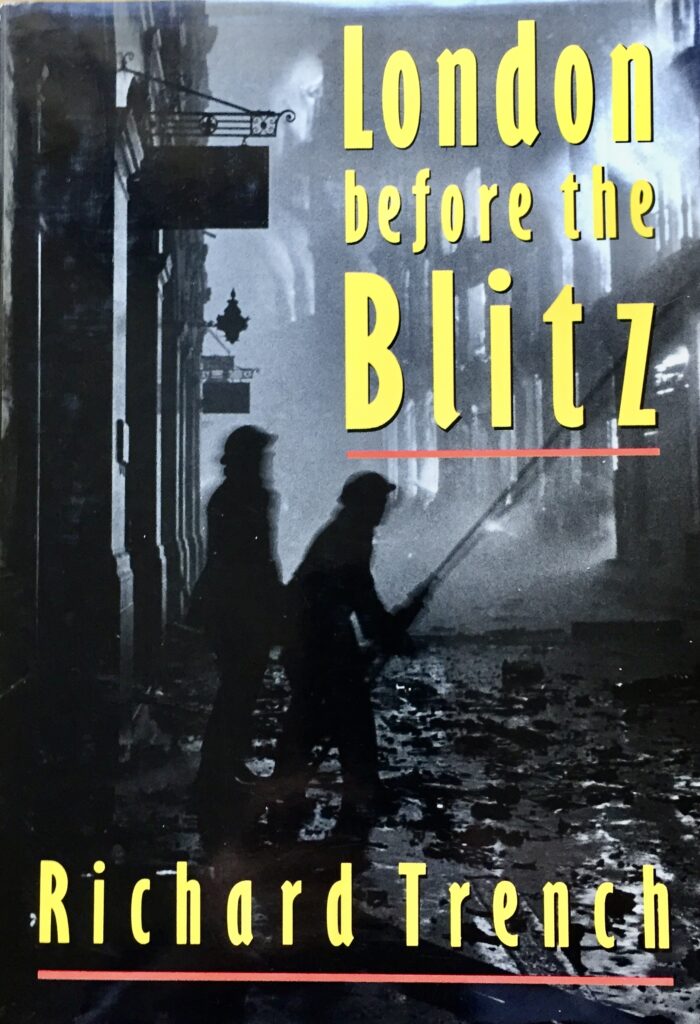
I am indebted to the author of this book for some of the wartime photographs. It also contains a fascinating commentary …
I have also used quotations and pictures from from the excellent London Inheritance blog which you can access here.

If you would like to follow me on Instagram here is the link …

https://www.instagram.com/london_city_gent/

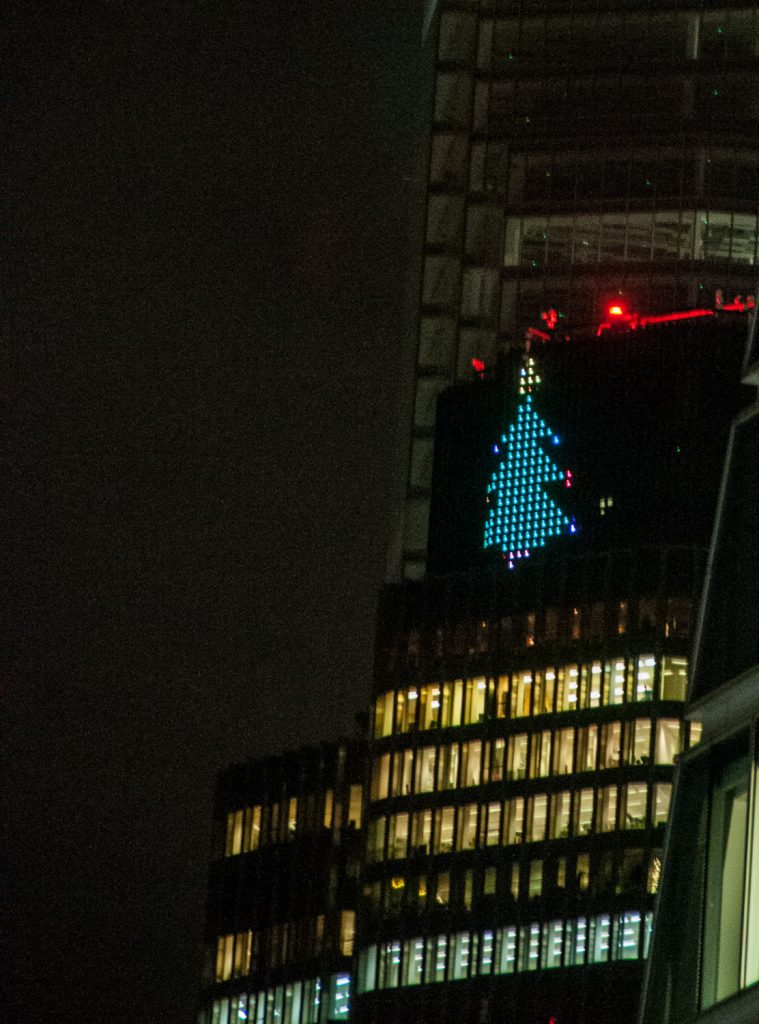
The Shard and Tower 42 at Christmas plus some nice costumes

Both buildings are putting on their Christmas displays and I thought you might enjoy seeing the one from Tower 42 and the Shard sequence.

Merry Christmas and a Happy New Year to all my readers – thank you so much for following the blog.

Tower 42 has gone for a Christmas tree …

I think this year’s tree is better than last year’s which looked like this …

The Shard display sequence is great again, still images don’t really do it justice …

I have a great camera but it is a bit heavy and in these final two pictures my hand wobble is evident!

If you are interested here’s a link to my last Christmas blog about the lights. London Wall Place didn’t put up any this year which is a great shame.

And finally, I liked these costumes from a production of Grease on display at the Guildhall School of Music and Drama in Silk Street …

Greetings from our home to your home. Keep well and stay safe …

If you would like to follow me on Instagram here is the link …
https://www.instagram.com/london_city_gent/

City ladies, a magic square and some gentle amusement

Women feature on many City sculptures (often in an allegorical role) and I have been on another sculpture safari to see how many I can identify. I have written about female sculptures twice before and you can find links here and here.

In quite a few cases they are located high up on buildings and so are easily missed.

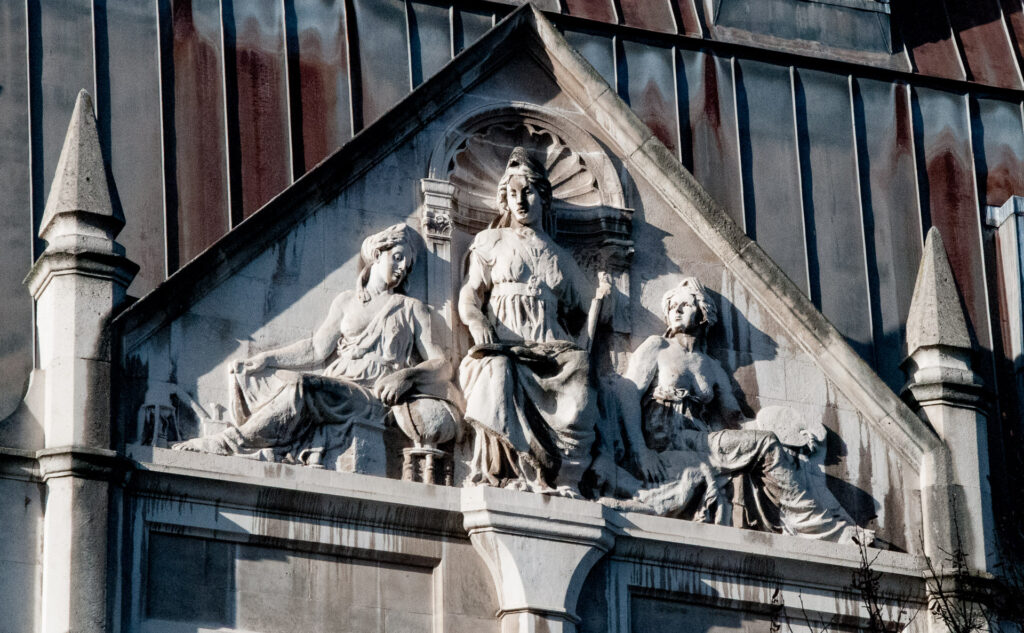
A good example is this pediment group on what once was the Cripplegate Institute building on Golden Lane (EC1Y 0RR) …

Education is seated in the centre, whilst Art and Science recline at either side. Although the building opened in 1896 the pediment was only added in 1910-11 when the upper stories were modified to provide, among other facilities, a rifle range.

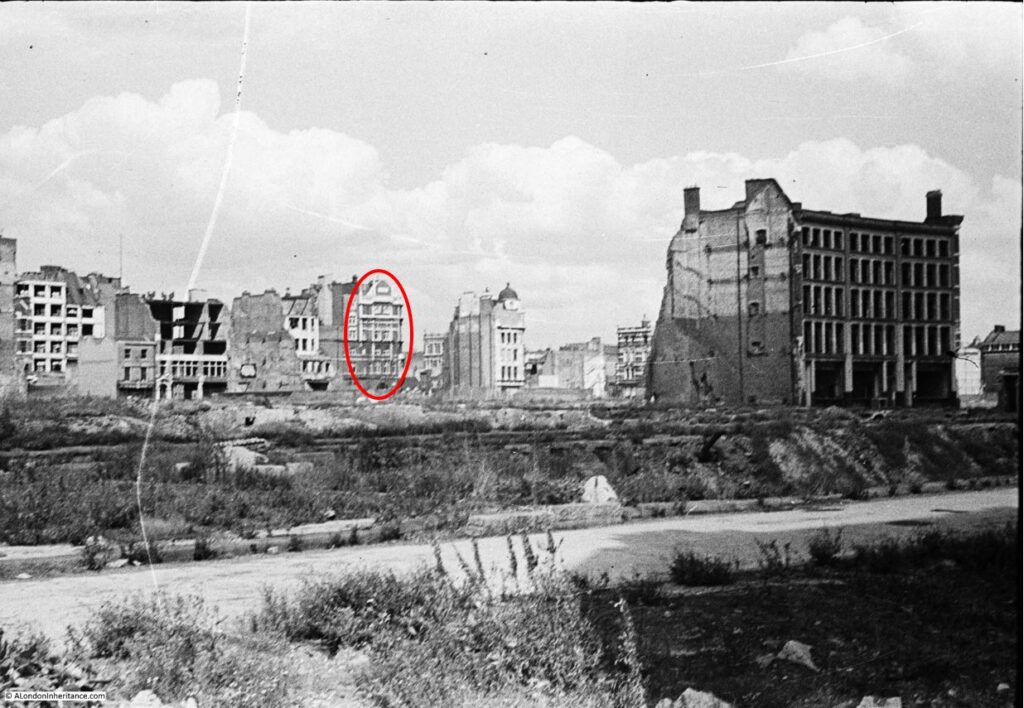
You can read much more about the Institute in the excellent London Inheritance blog which also contains this 1947 photograph highlighting the vast extent of the wartime bomb damage. The Institute building is circled in red …

If you stand outside the Royal Exchange you will be rewarded with two more female figures along with the mysterious Magic Square, but again you have to look up.

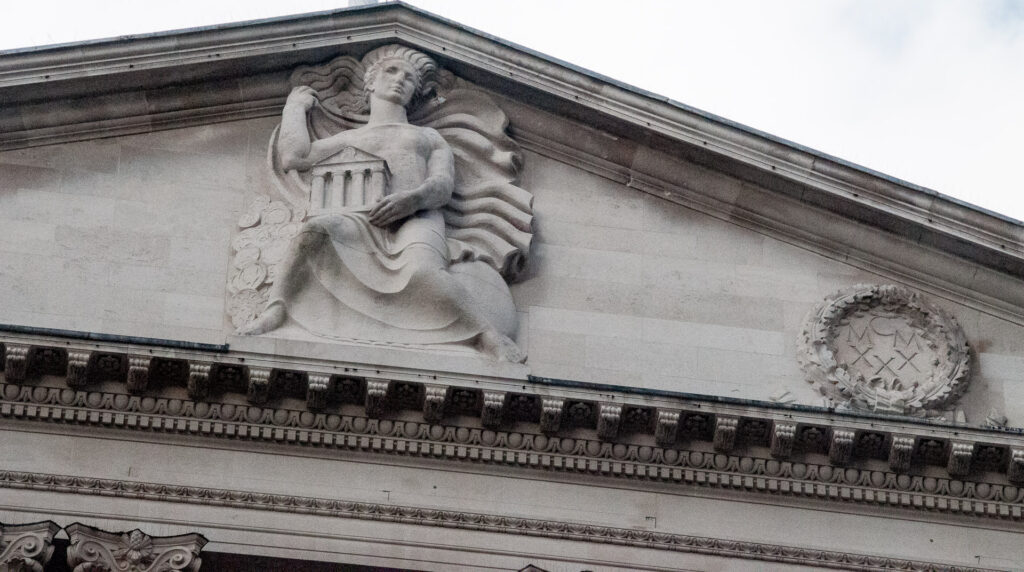
The first lady is sited in a pediment above the Bank of England and is known as The Lady of the Bank …

Sculptor Charles Wheeler 1929-1930.

She is seated on a globe and her right hand holds a cloak which billows out to her left. Her left hand holds a temple-like building which contains a miniature relief of the Lady herself and beside her right leg is a cascade of coins. She is a replacement for the original ‘Old Lady of Threadneedle Street’, which resembled Britannia, since it was considered stylistically incompatible with the new building. She is intended to represent ‘the stability and security of the Bank of England’. Inside the wreath on the right is the date of construction in Roman numerals, MCMXXX.

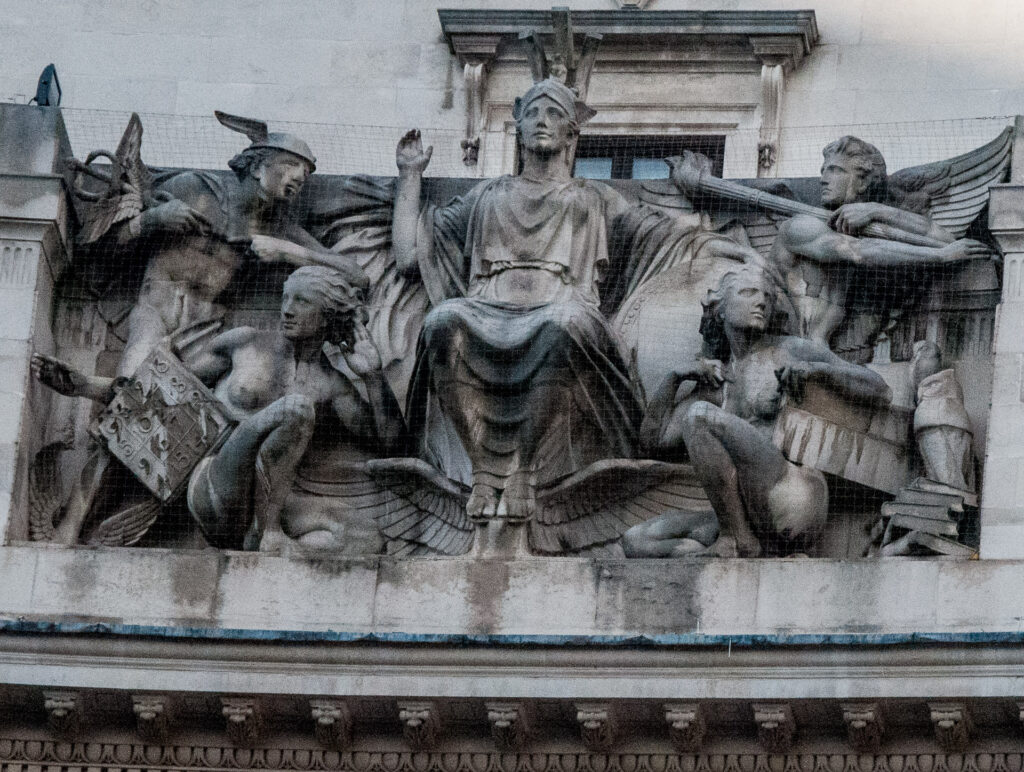
On the corner across Bank junction is the impressive NatWest building and if you look up you will see this (rather grubby) allegorical group …

Sculptor Ernest Gillick – 1931-2.

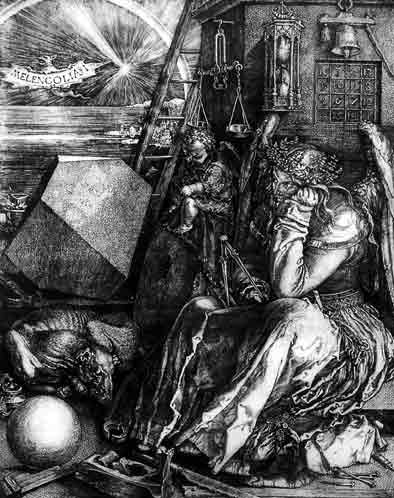
Britannia rises on a winged seat, flanked by Mercury (representing Commerce) and Truth with his torch. At Britannia’s knees are crouching nude females representing Higher and Lower Mathematics. Higher Mathematics, on the left, holds a carved version of Dürer’s Magic Square, a numerical acrostic whose numbers add up to 34 when added horizontally, vertically or diagonally. Lower mathematics holds a pen and a book whilst beside her two owls sit on piles of books.

The square is not very clear now due to the dirt on the carving so here are the numbers it contains …

Innovation Factory — Magic Squares

Dürer included it in an engraving entitled Melancholia I …

It can be seen in the top right hand corner and you can read more about it here and here.

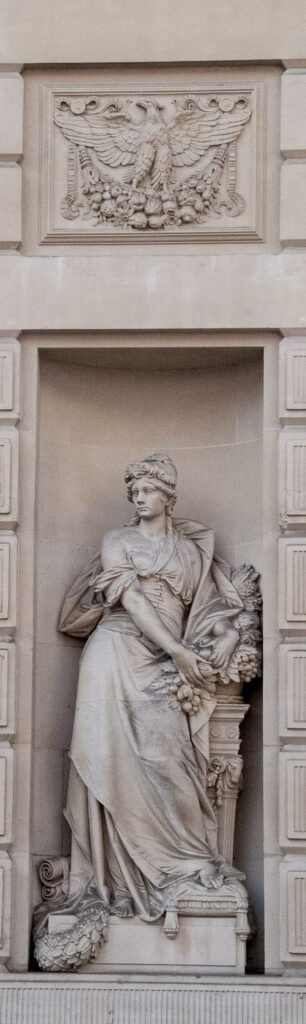
Nearby in Prince’s Street, on the same building, you can view this elegant lady at street level …

Sculptor Charles Doman – 1931.

Representing Prosperity, she holds a basket with a rich assortment of fruit and corn.

You have to stretch your neck if you want to examine this relief sculpture at 7 Lothbury (EC2R 7HH) …

Sculptor James Redfern – 1866.

It is rather unusual and is intended as a pastiche of a late medieval Venetian palace. A crowned female figure at the centre sits on a padlocked strong-box and writes in a ledger held up for her by a standing woman with a bunch of large keys suspended from her girdle. Other figures include a woman holding a model steam engine and another figure holding a model boat.

It’s a fascinating building and you can read more about it here.

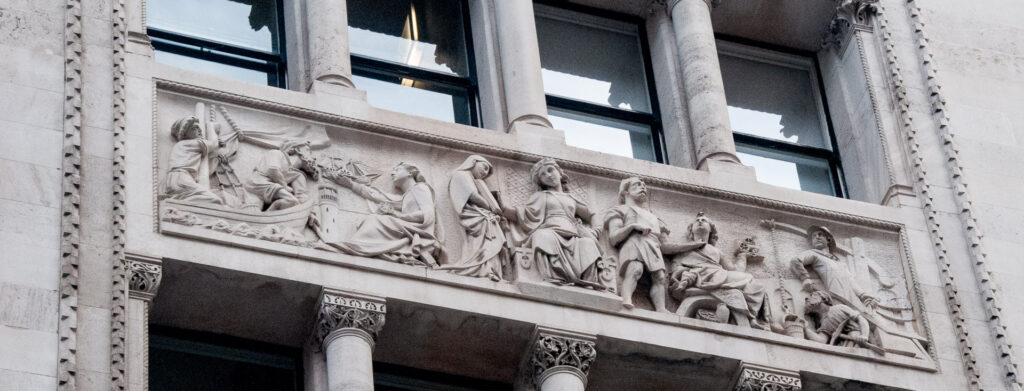
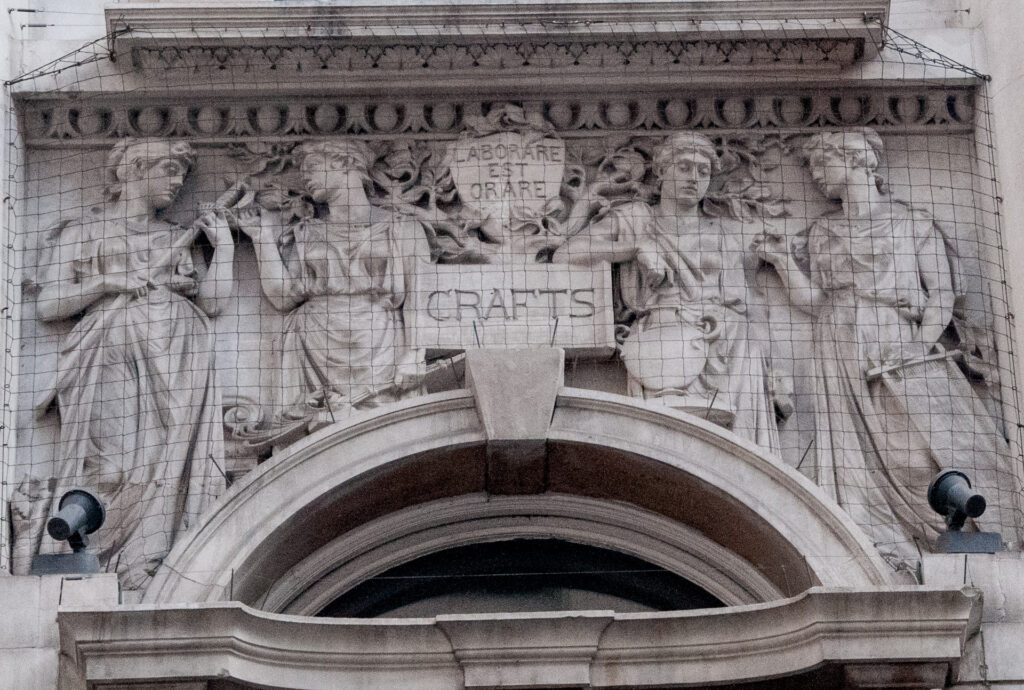
The frieze on the Institute of Chartered Accountants is magnificent and was intended as a grand symbolic depiction of all the areas of human activity which have benefited from the services of accountants (EC2R 7EF). Groups of figures represent the arts, science, crafts, education, commerce, manufactures, agriculture, mining, railways, shipping and India and the Colonies. I have chosen a few with female figures and the first is entitled ‘Crafts’ …

The shield in the tree is inscribed Laborare est Orare – to work is to pray. To the left, two women represent ‘workers in metal’, the one on the left is holding a sword. On the other side of the panel are ‘Pottery’, a woman with a two-handled vase, and ‘Textiles’, a woman with a weaving frame.

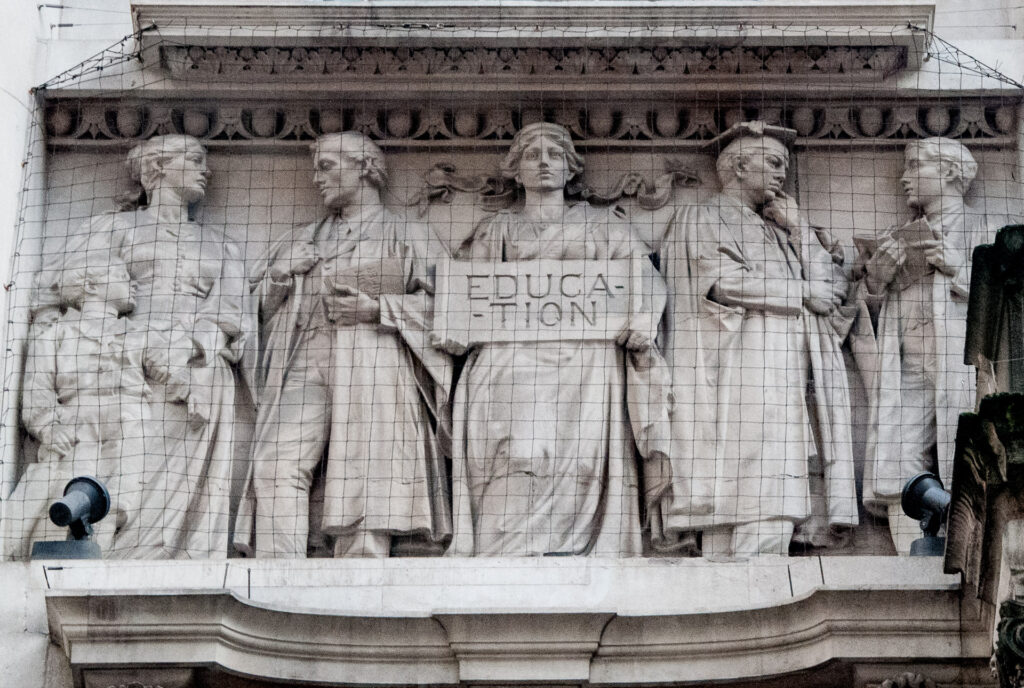
Next is ‘Education’ …

The group on the left represents ‘Early Training’. A mother leads her son, who is carrying a cricket bat, towards a schoolmaster wearing a gown and carrying a textbook. On the other side is a student ‘in collegiate dress’ and holding a book, and a ‘College Don’ wearing a mortar-board and gown.

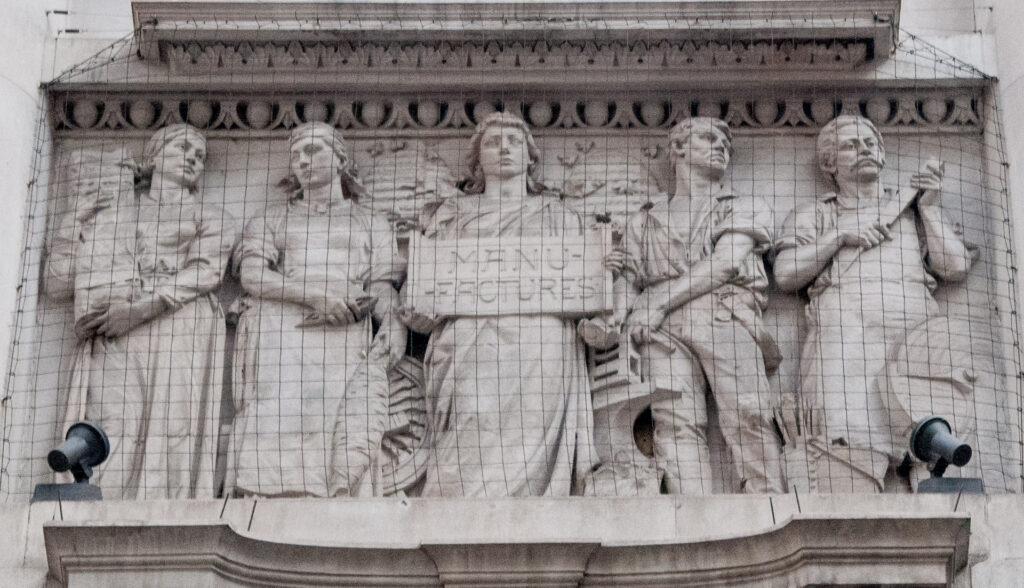
Onward to ‘Manufactures’ …

Behind the allegorical lady, and just about visible, are beehives ‘betokening industry’. The two women on the left represent ‘Fabrics’ – one holds a bolt of cloth and the other a shuttle and a spool of yarn. The two men on the right represent ‘Hardware goods’. The smith has his shirt open and stands next to an anvil. The other is ‘a Sheffield Knife Grinder’ feeling a chisel blade.

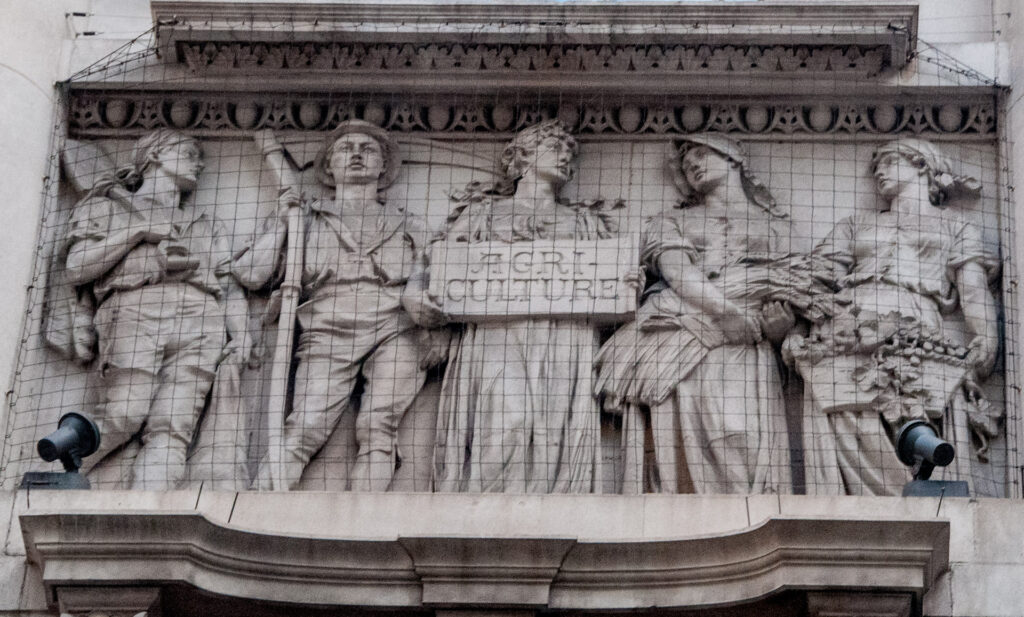
Another example is ‘Agriculture’ …

On the left are two men – a sower and a mower. On the other side are two girls – one reaping and the other carrying a basket of fruit.

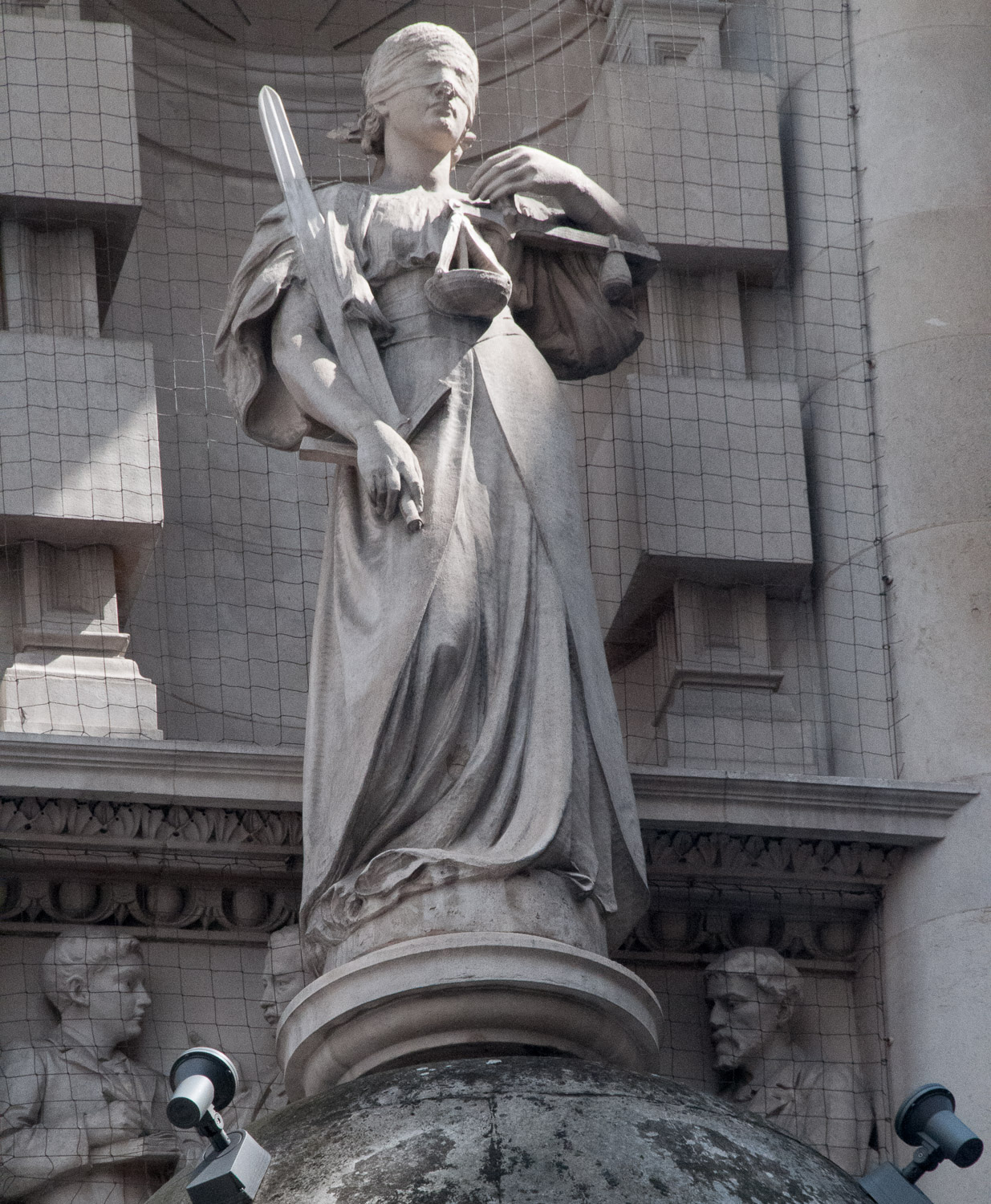
In my favourite sculpture from the building Lady Justice looks like she has stepped out of her niche in order to upstage the accountants number-crunching away behind her …

She appears frequently in allegorical representations around the City and I have written about them before. If you are interested you can find my blog here.

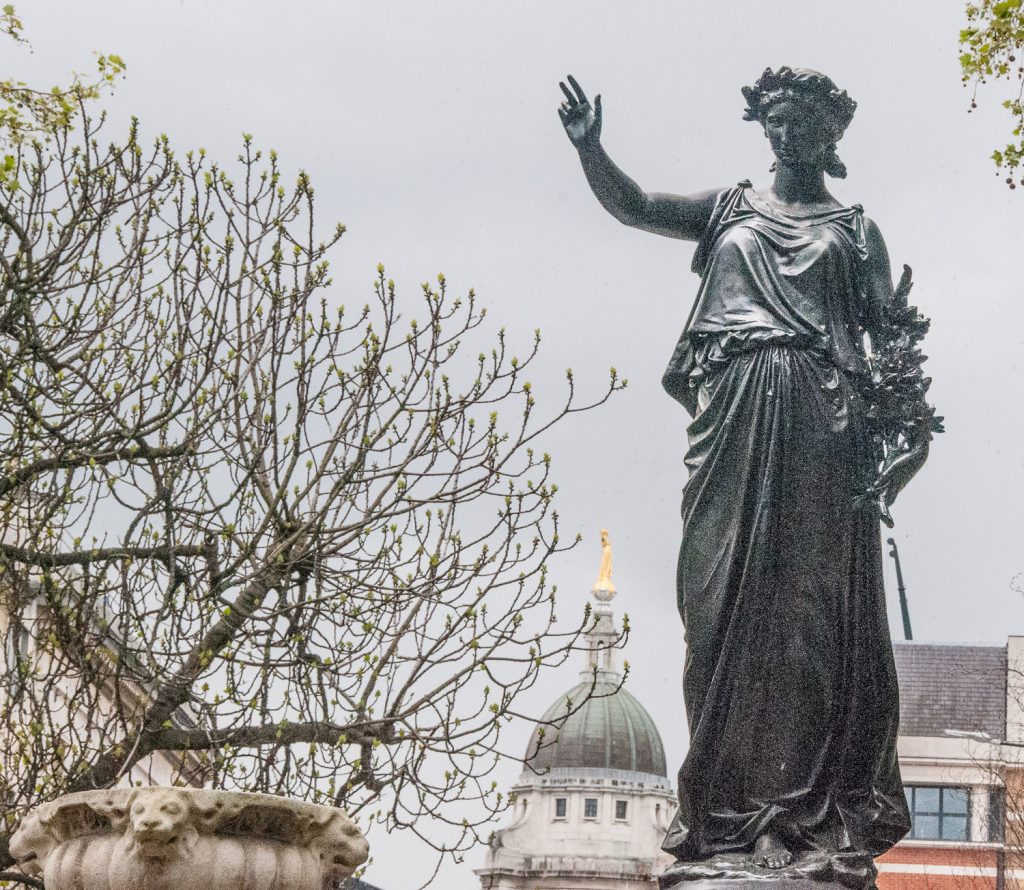
You can see her again on the Old Bailey behind my final sculpture, the Peace drinking fountain in the Smithfield Rotunda Garden (EC1A 9DY). She is depicted with her right hand raised in a gesture of blessing while her left holds an olive branch …

Sculptors John Birnie Philip and Farmer & Brindley – 1871-3.

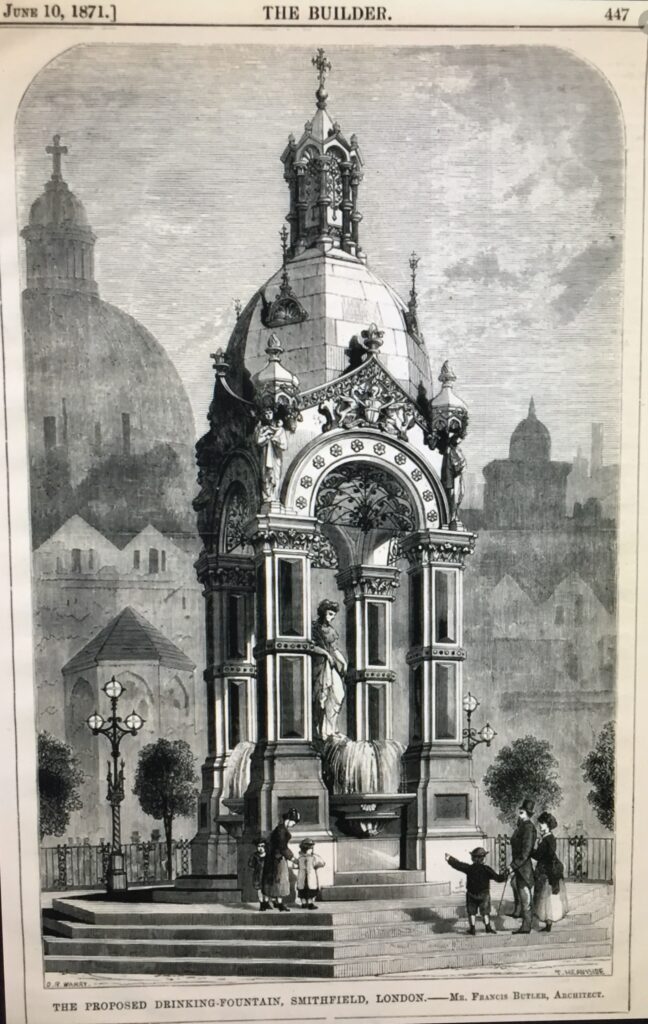
The structure was erected by the Corporation’s Market Improvement Committee in 1873 a few years after the armistice between France and Prussia was signed in 1871. The 11m-high fountain originally comprised a huge stone canopy in an eclectic style with four corner figures of Temperance, Hope, Faith and Charity but the structure fell into disrepair and was taken down. The illustration below appeared in The Builder magazine in 1871 …

I thought I’d add some light relief in these difficult times.

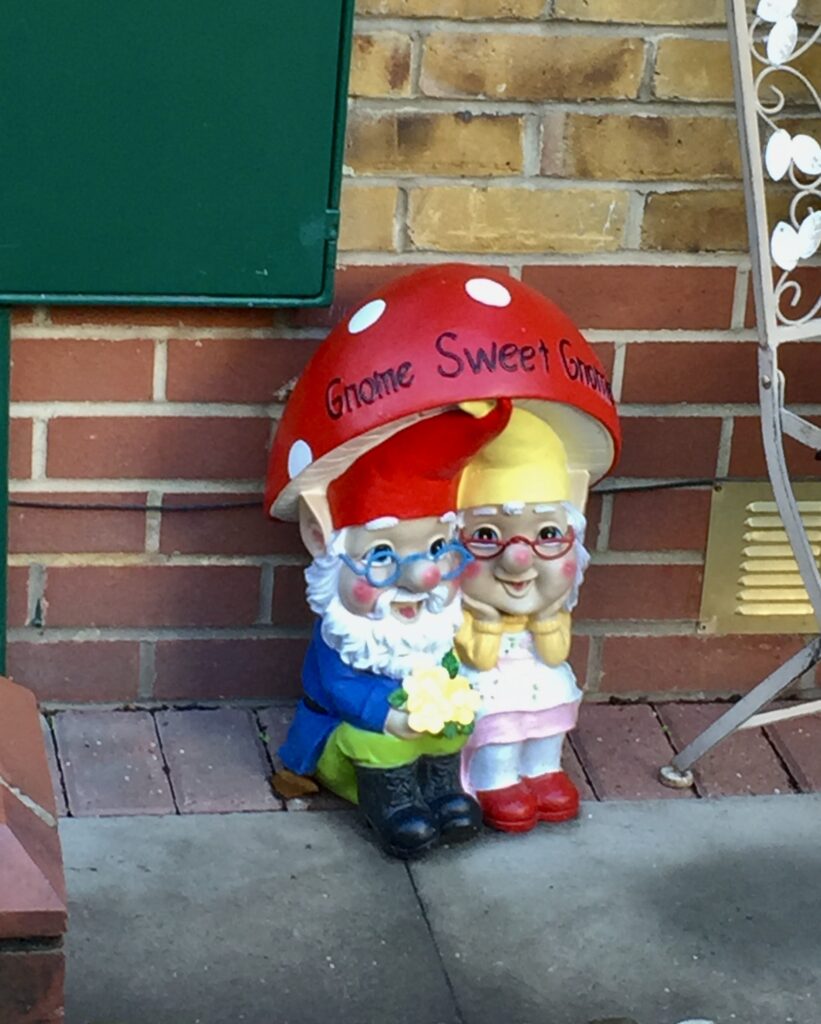
Happy Clerkenwell gnomes …

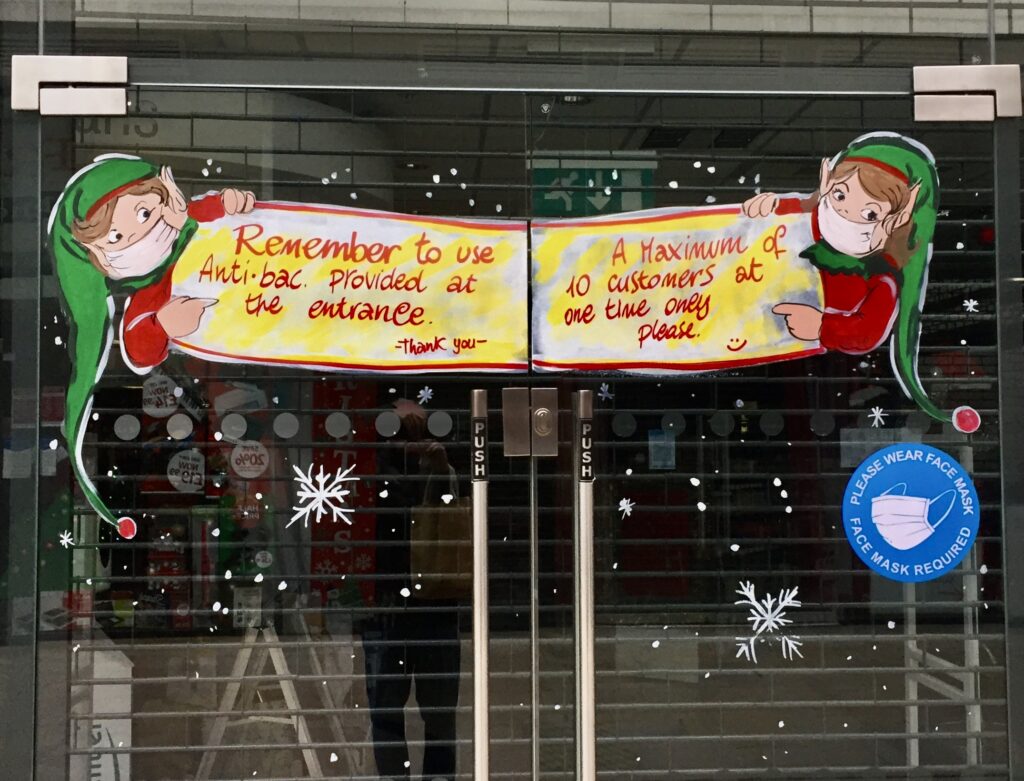
Santa’s elves, with appropriate face coverings, seconded for Covid prevention duty …

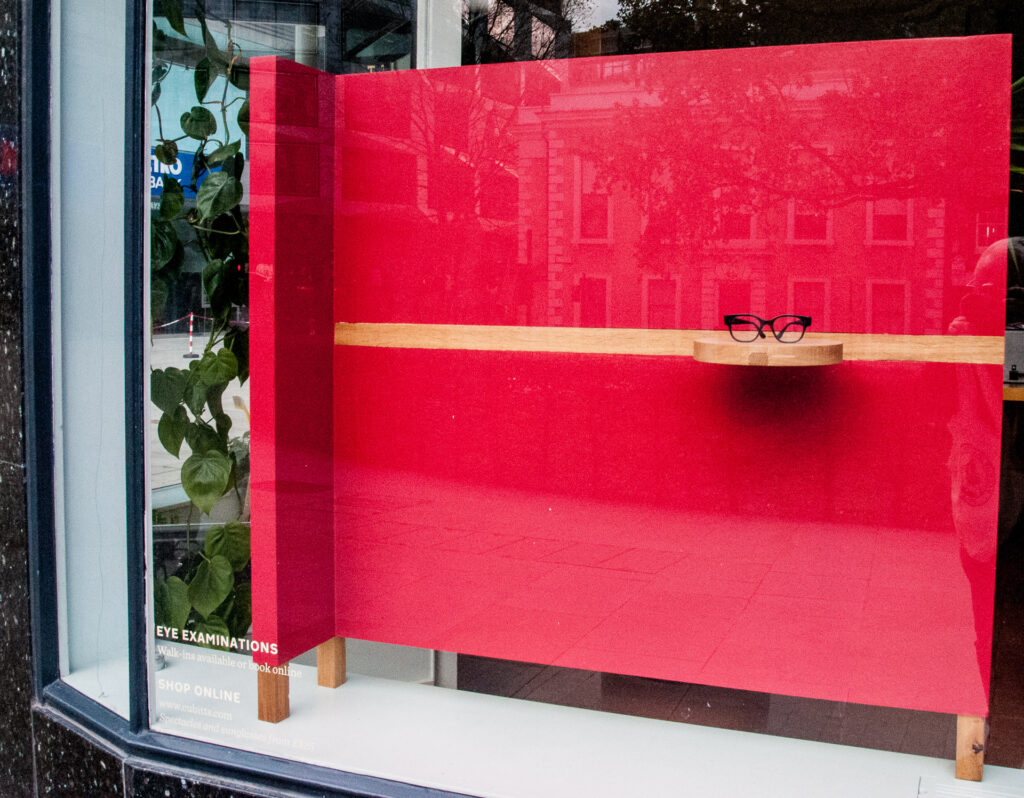
An optician on London Wall goes for the ‘minimalist’ window display approach …

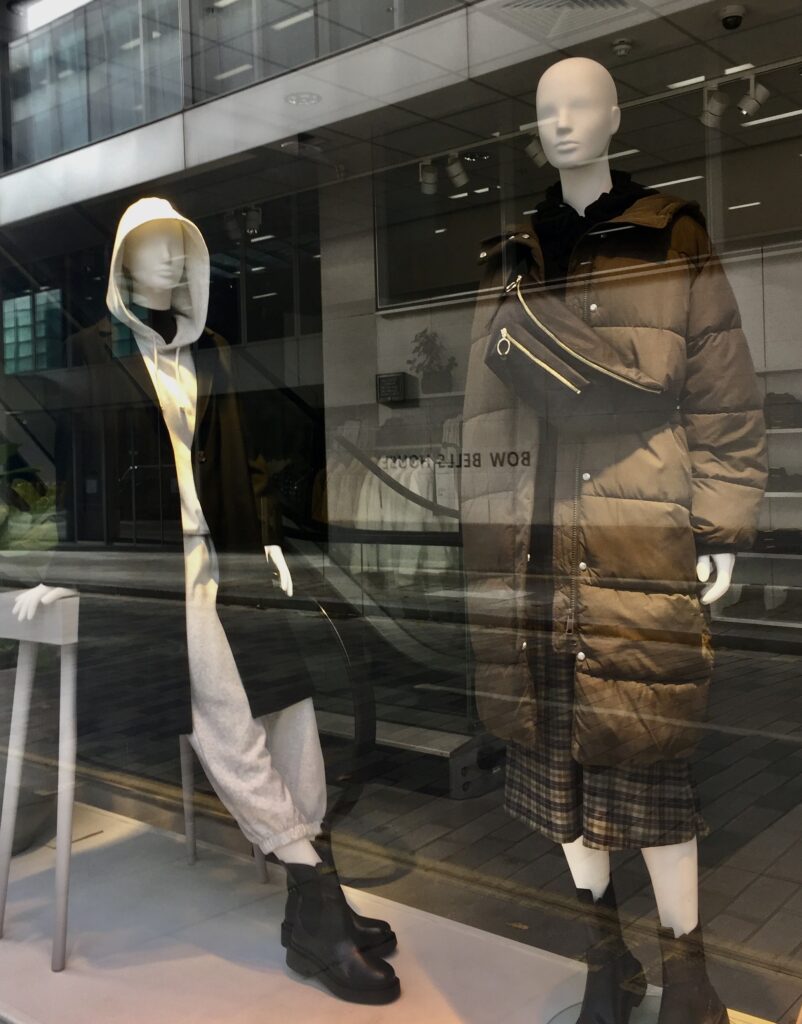
And finally, more spooky clothes models to add to the collection …

If you would like to follow me on Instagram here is the link …

https://www.instagram.com/london_city_gent/

Page 49 of 92

Powered by WordPress & Theme by Anders Norén

Symbols & Secrets
Privacy Overview

This website uses cookies so that we can provide you with the best user experience possible. Cookie information is stored in your browser and performs functions such as recognising you when you return to our website and helping our team to understand which sections of the website you find most interesting and useful.