Walking the City of London

Category: Architecture Page 43 of 92

Old Street – from spinal columns to record players. A walk along Old Street.

I do enjoy a wander along Old Street – remembering as I walk that it is, as its name suggests, an ancient thoroughfare that probably even pre-dates Roman times. The earliest records of the name are Ealdestrate around 1200, Eldestrete in 1275, and le Oldestrete in 1373. In other words, it was already known as the ‘old street’ when Edward I sat on the throne.

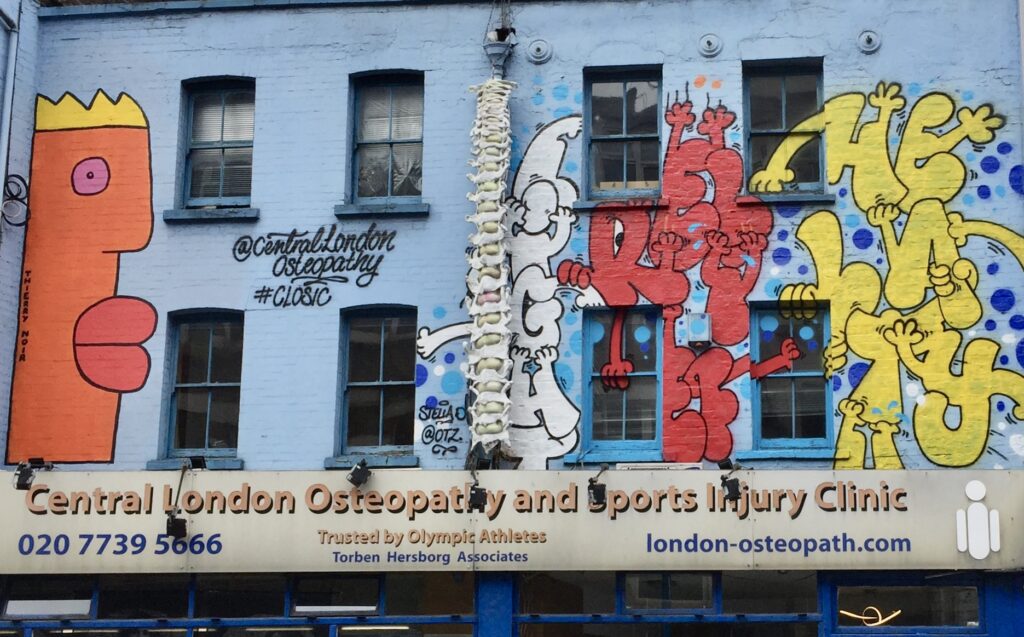
Starting at its Shoreditch end, I always admire the street art surrounding the gigantic spinal column that graces the Osteopathy and Sports clinic …
Across the road is some ‘work’ by the notorious ’10 foot’ character (or someone impersonating him) …
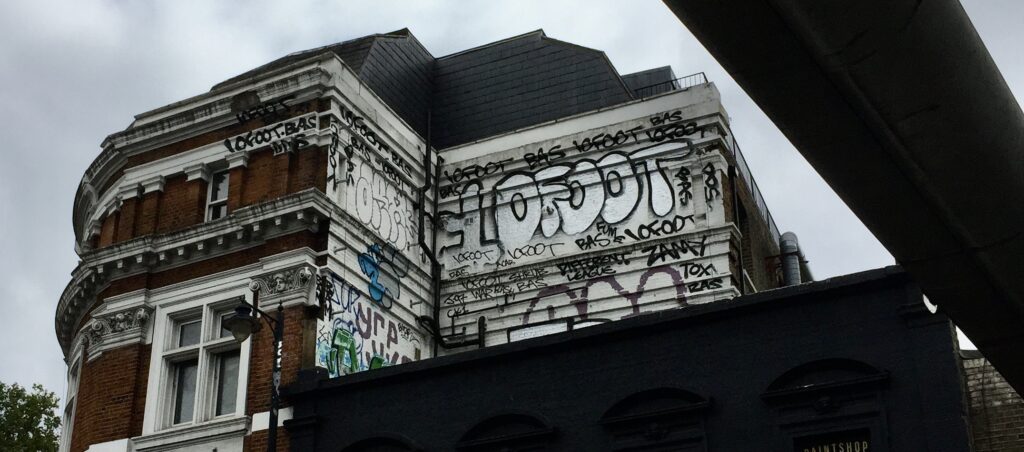
According to the My London blog the guy’s real name is Samuel Moore. In 2010 he was arrested over his work and bailed, but continued to create artwork in public places. He was eventually convicted for committing over £100,000 worth of criminal damage and sent to prison for 26 months.

I love the beautiful civic building that is the old Shoreditch Town Hall …
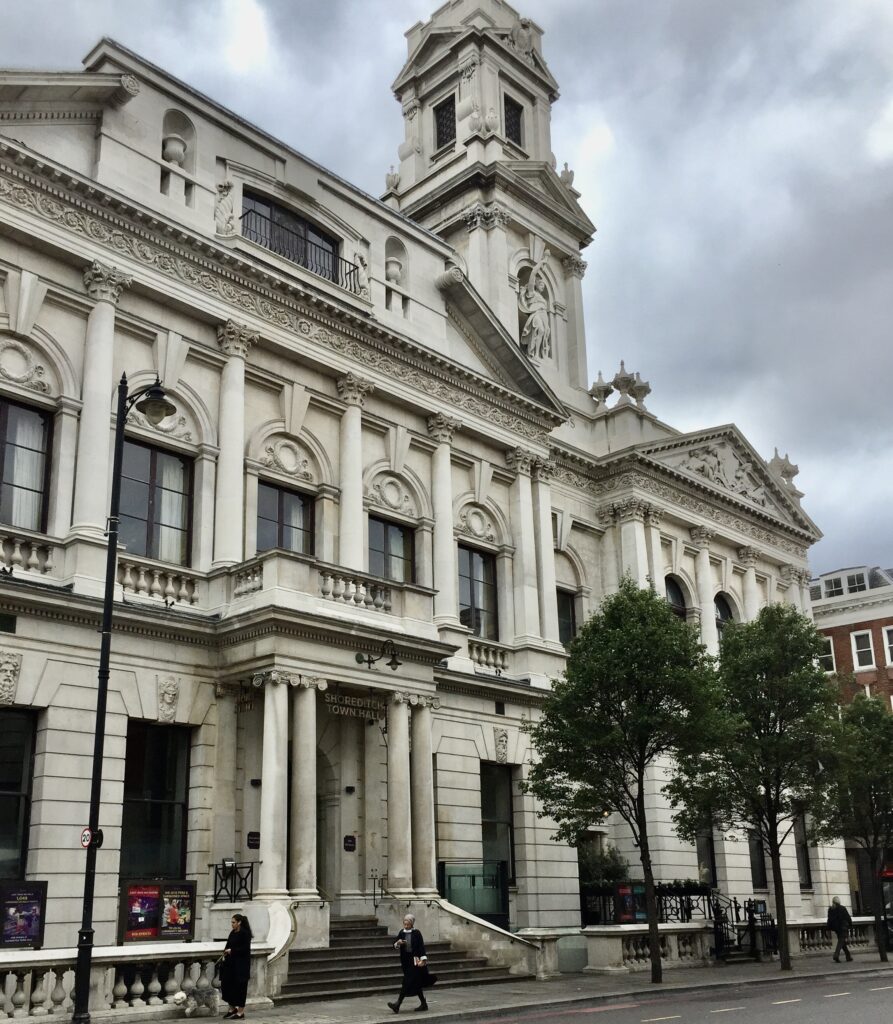
When it opened in 1866 it was one of the grandest Vestry Halls of its time and its ambitious founders wanted the building to embody their progressive values. Until the 1960s, the Town Hall operated as the centre of local democracy and civic life in the borough and now, after a somewhat rocky time when it was seriously at risk, it is a thriving event venue and community space.
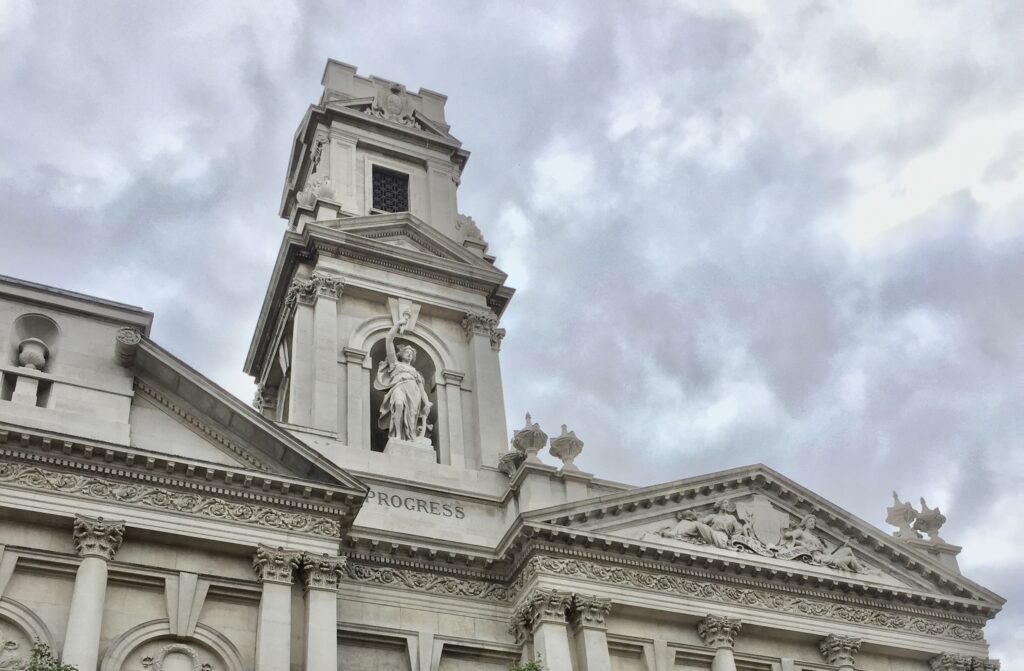
Throughout the building the motto ‘More Light, More Power’ can be seen beneath the crest of Shoreditch. This motto, together with the statue of Progress on the front of the tower, commemorates the borough’s reputation for pioneering bold ideas such as the building’s revolutionary 1897 Refuse Destructor, which generated electricity and powered street lighting in the borough. You can read more about this extraordinary invention here.

Old Street Magistrates Court was transformed into a hotel in 2016 (previous temporary visitors included Reggie and Ronnie Kray) …
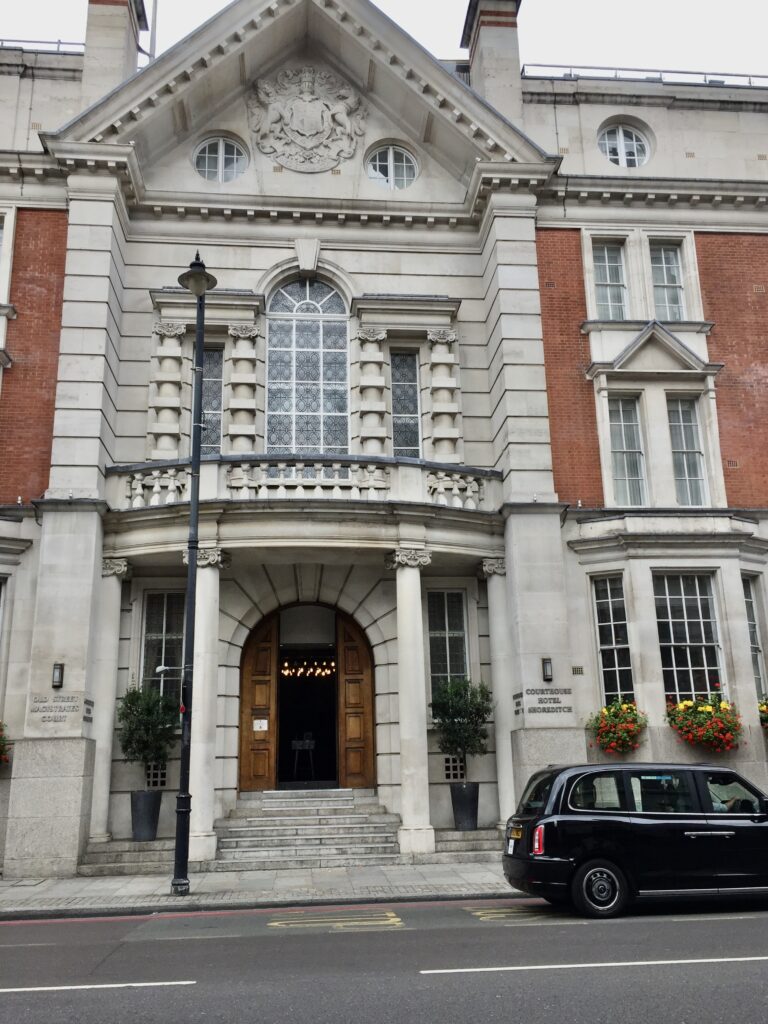
Originally known as a Police Court, it dealt with a wide range of business coming under the general heading of ‘summary jurisdiction’, i.e. trial without a jury. The cases heard were largely criminal and of the less serious kind. Examples included: drunk and disorderly conduct, assault, theft, begging, possessing stolen goods, cruelty to animals, desertion from the armed forces, betting, soliciting, loitering with intent, obstructing highways, and motoring offences. Non-criminal matters included small debts concerning income tax and local rates, landlord and tenant matters, matrimonial problems and bastardy (for example, fathers of illegitimate children failing to pay maintenance). There is a fascinating account of bastardy, and its associated tragedies, in the London Lives blog.

The eastern half of the building contained a police station …
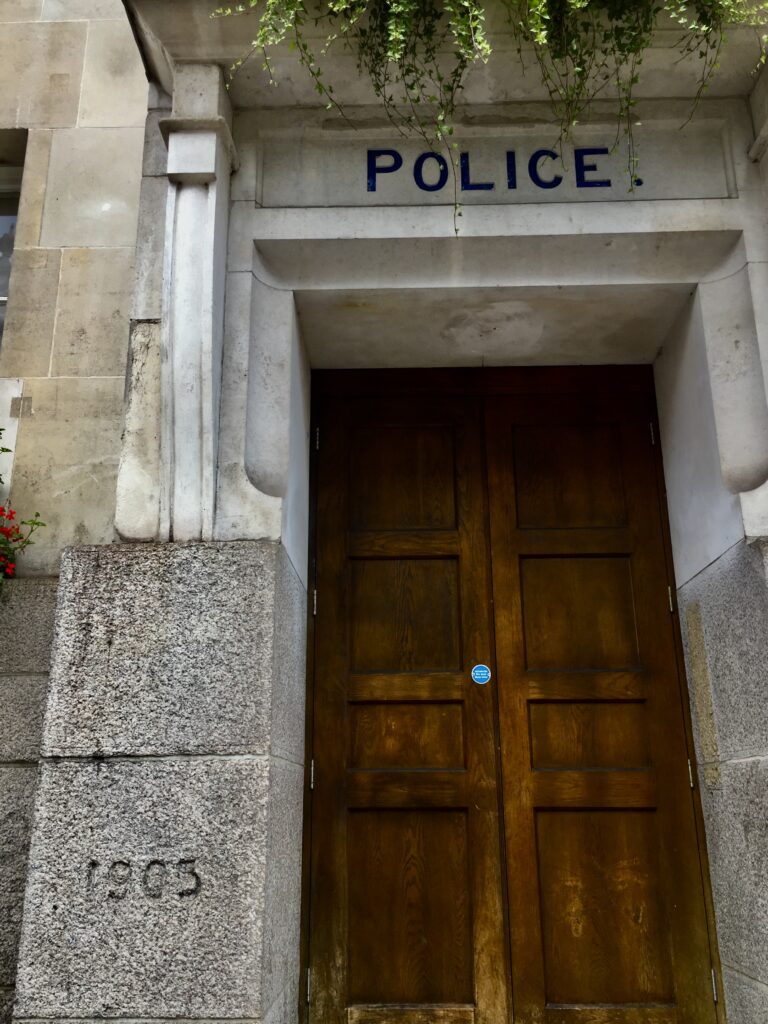
It included accommodation for a married inspector on the first floor and for 40 single men on the second and third floors. There was a kitchen and mess room along with rooms for storing, drying and brushing clothes and boots. You really could say there was a ‘police presence’ in those days.

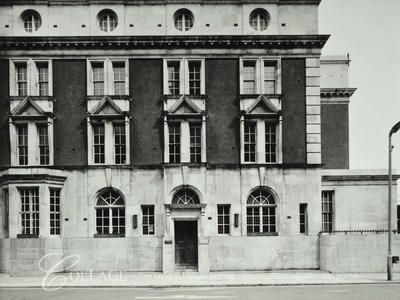
The building in 1974 …
I paused at the Old Street roundabout to admire the Bezier Building …
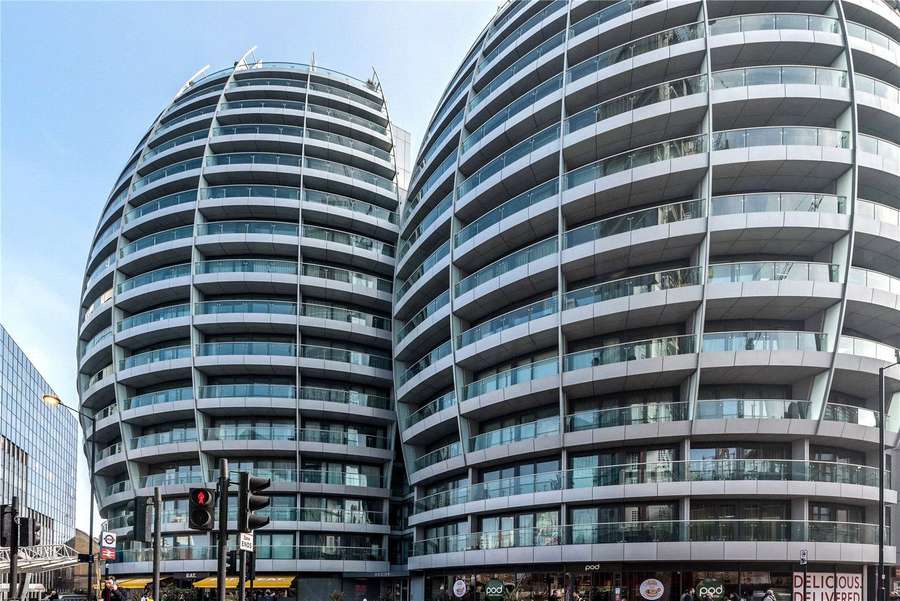
Unfortunately, I can’t get out of my mind the Gentle Author’s assertion that it looks like a pair of buttocks.

I have written about the west end of the street before, but I hope readers won’t mind if I revisit a few of the buildings again.

Look up and you will see the old Salvation Army Hostel ghost sign …
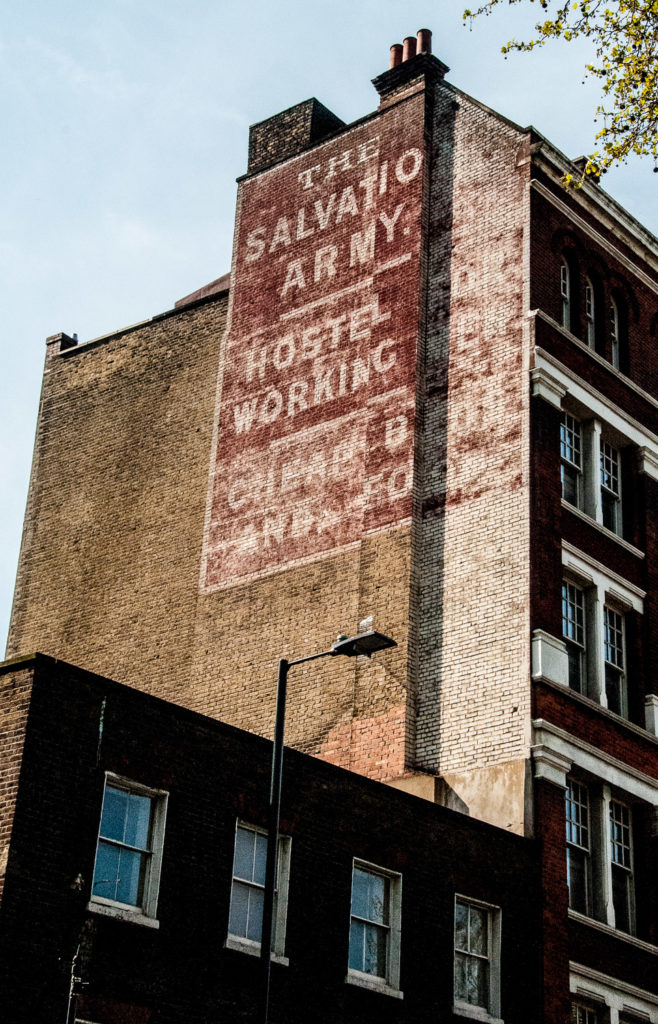
‘Hostel for working men. Cheap beds and food’.

Number 116 used to be the Margolin Gramophone Company factory (the place is now called Stylus … get it?) …
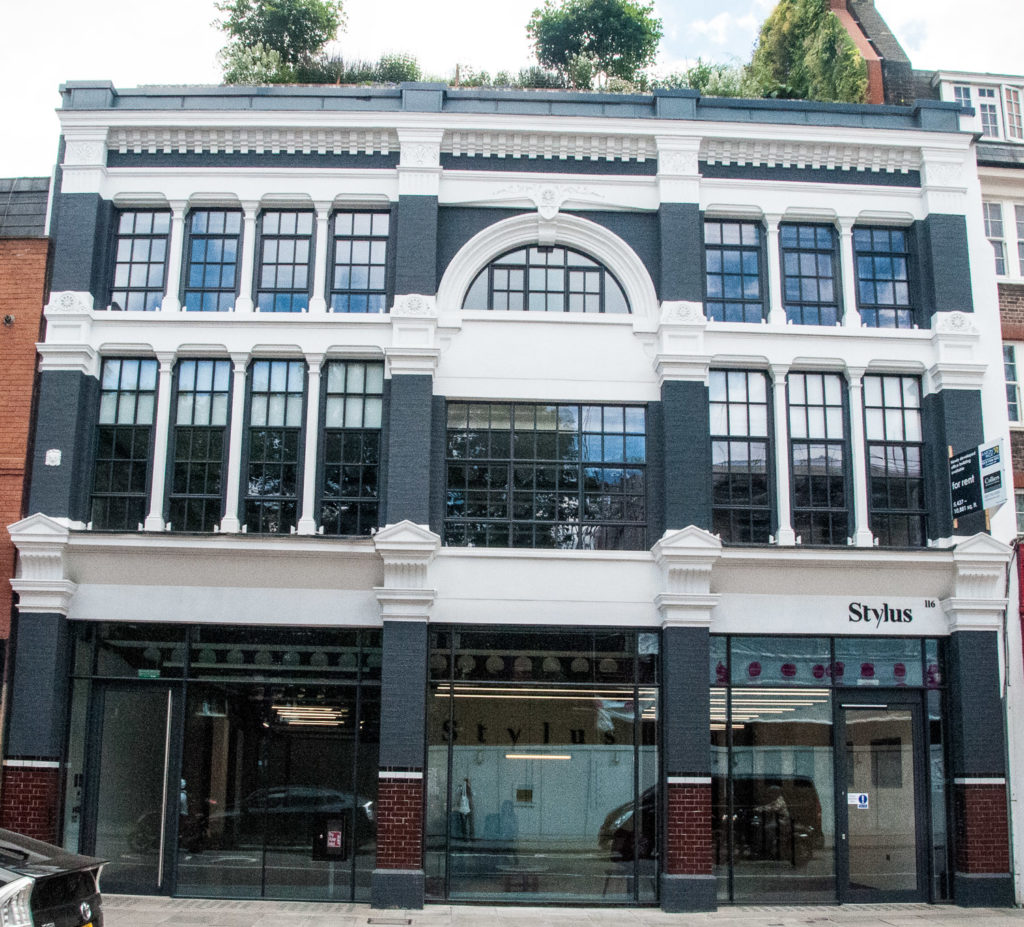
They manufactured the Dansette record player – a name very familiar to us baby-boomers. During the years 1950-70 over one million were sold …
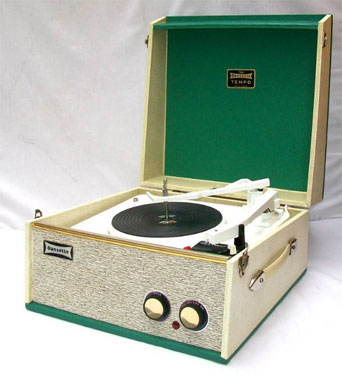
You could even buy a portable one!

Dansette production ended in December 1969, following the introduction of relatively cheap and efficient Japanese and other Far Eastern imported Hi-Fi equipment. Margolin subsequently went into liquidation.

Look out for the now de-consecrated St Luke’s church. It was designed by John James, though the obelisk spire, a most unusual feature for an Anglican church, the west tower and the flanking staircase wings were by Nicholas Hawksmoor …
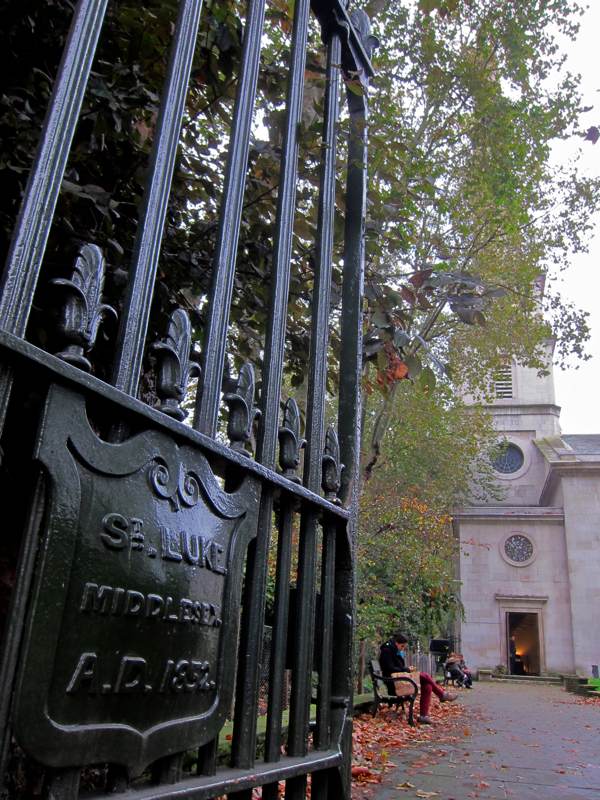
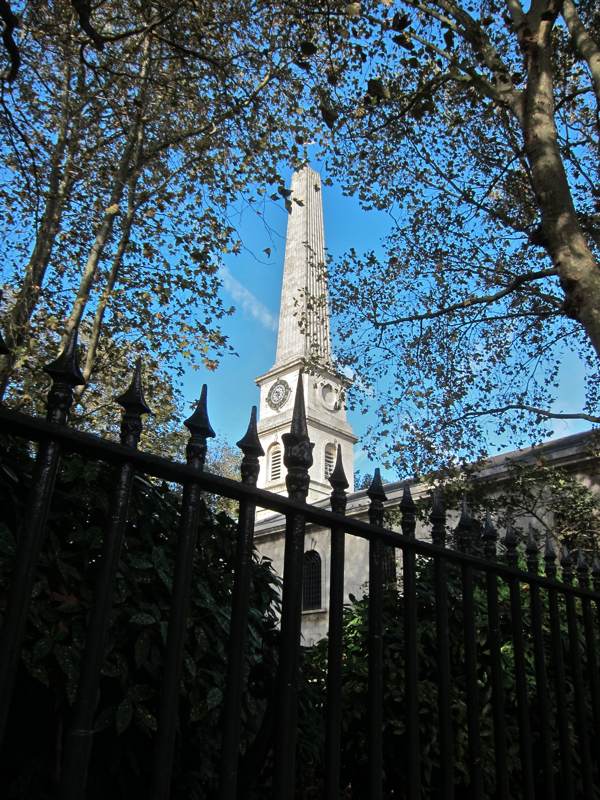
It was built between 1727-1733 to meet St Giles Without Cripplegate’s booming population.

The weathervane is actually a red-eyed dragon but for some reason locals thought it resembled a louse and nicknamed the church Lousy St Luke’s …
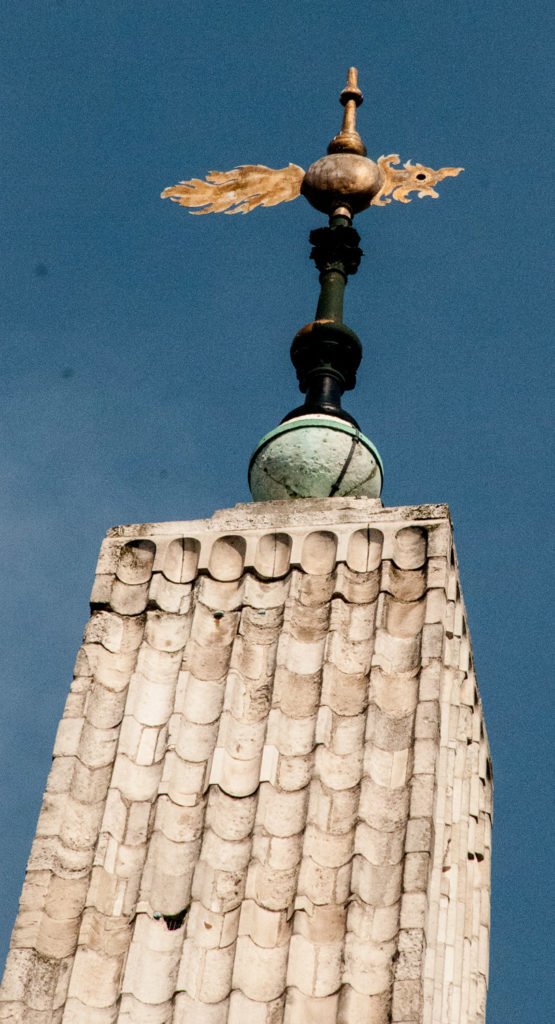
The church was closed in 1964 due to subsidence, but the previously derelict building has now been restored by the London Symphony Orchestra as a beautiful space for performances, rehearsals, recording and educational purposes.

William Caslon the Elder is buried in the churchyard. …
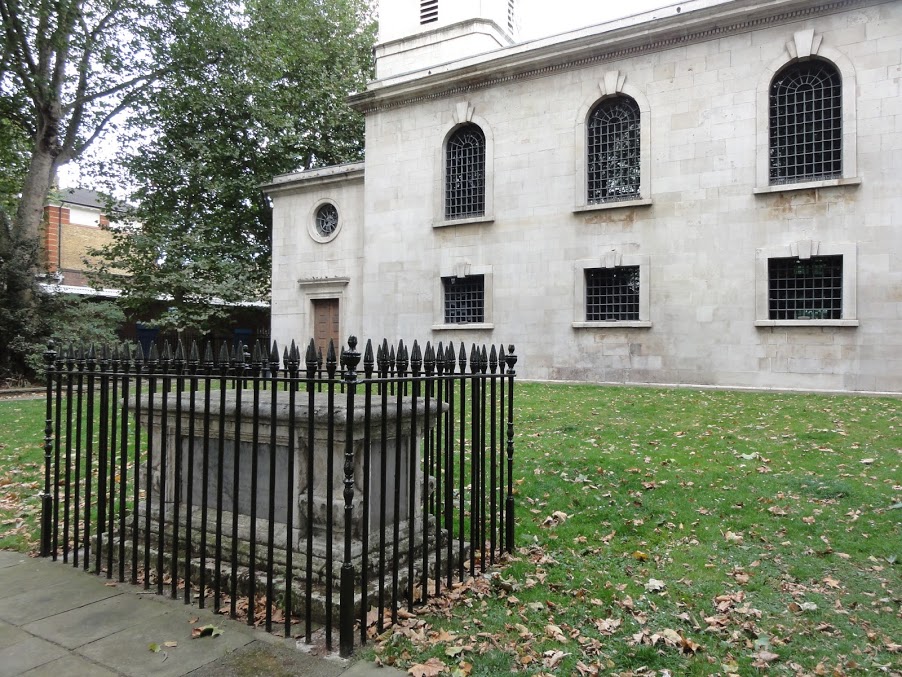
Caslon’s family grave. He died in 1766.

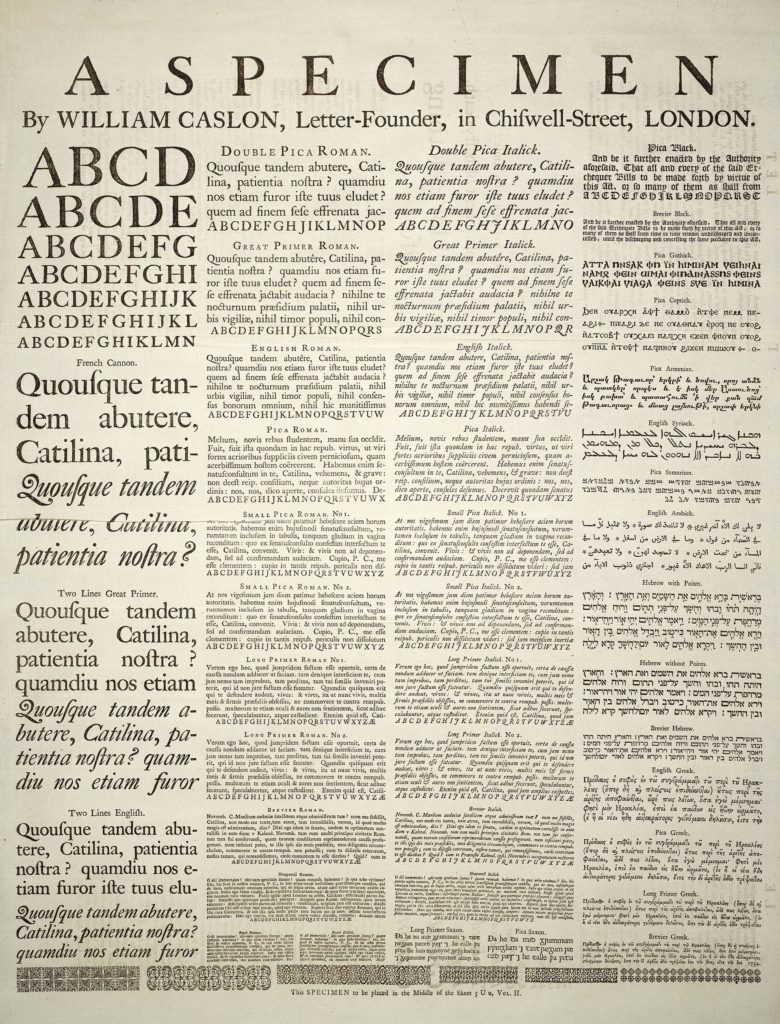
A typefounder, the distinction and legibility of his type secured him the patronage of the leading printers of the day in England and on the continent. His typefaces transformed English type design and first established an English national typographic style. Here is a specimen sheet of his typefaces from 1728. In its own way I think it is beautiful …
Caslon’s first workshop was in Helmet Row, next to the church. It has some Grade II listed early 19th century terraced houses, a few of which later had their ground floors converted into shops …
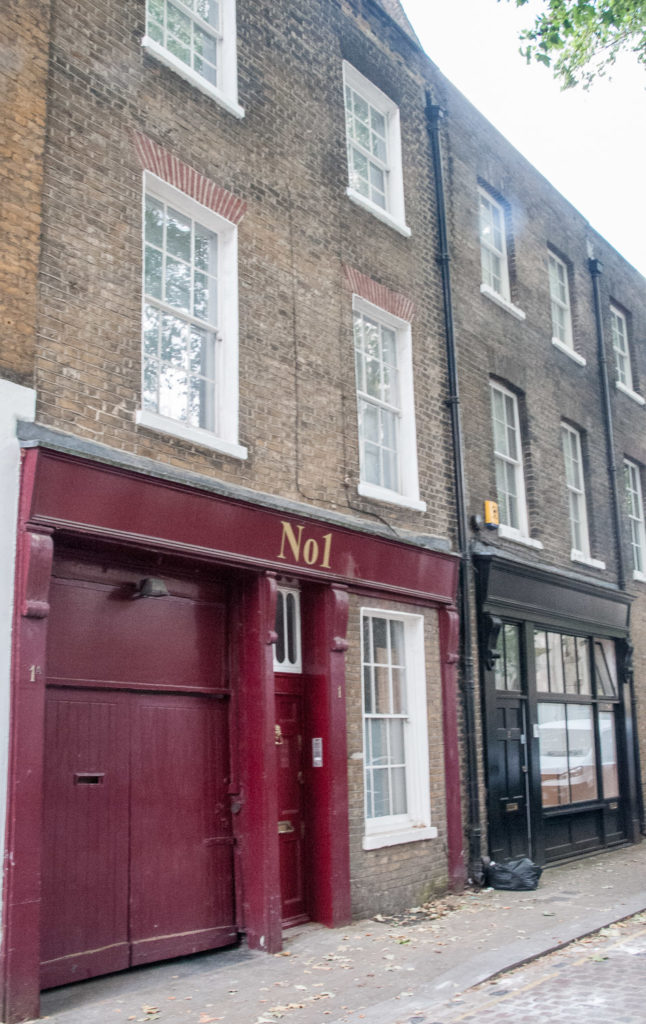
At 12 Old Street is the building that once housed The Old Rodney’s Head public house …
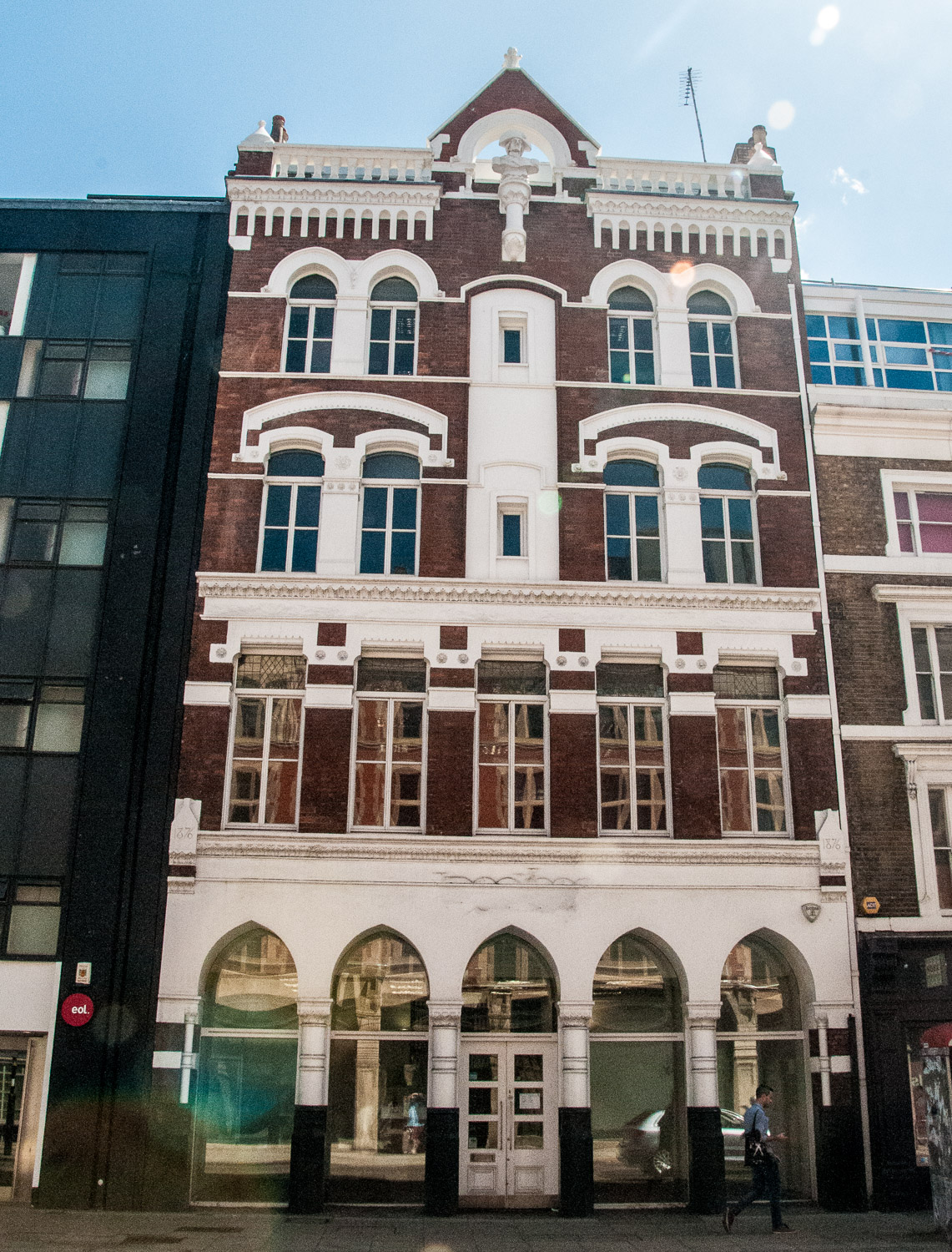
George Brydges Rodney, 1st Baron Rodney (1718-1792) was a famous Admiral best known for his victory over the French at the Battle of the Saintes in 1782 which ended the French threat to Jamaica. The building dates from 1876 and Rodney still gazes down on Old Street …
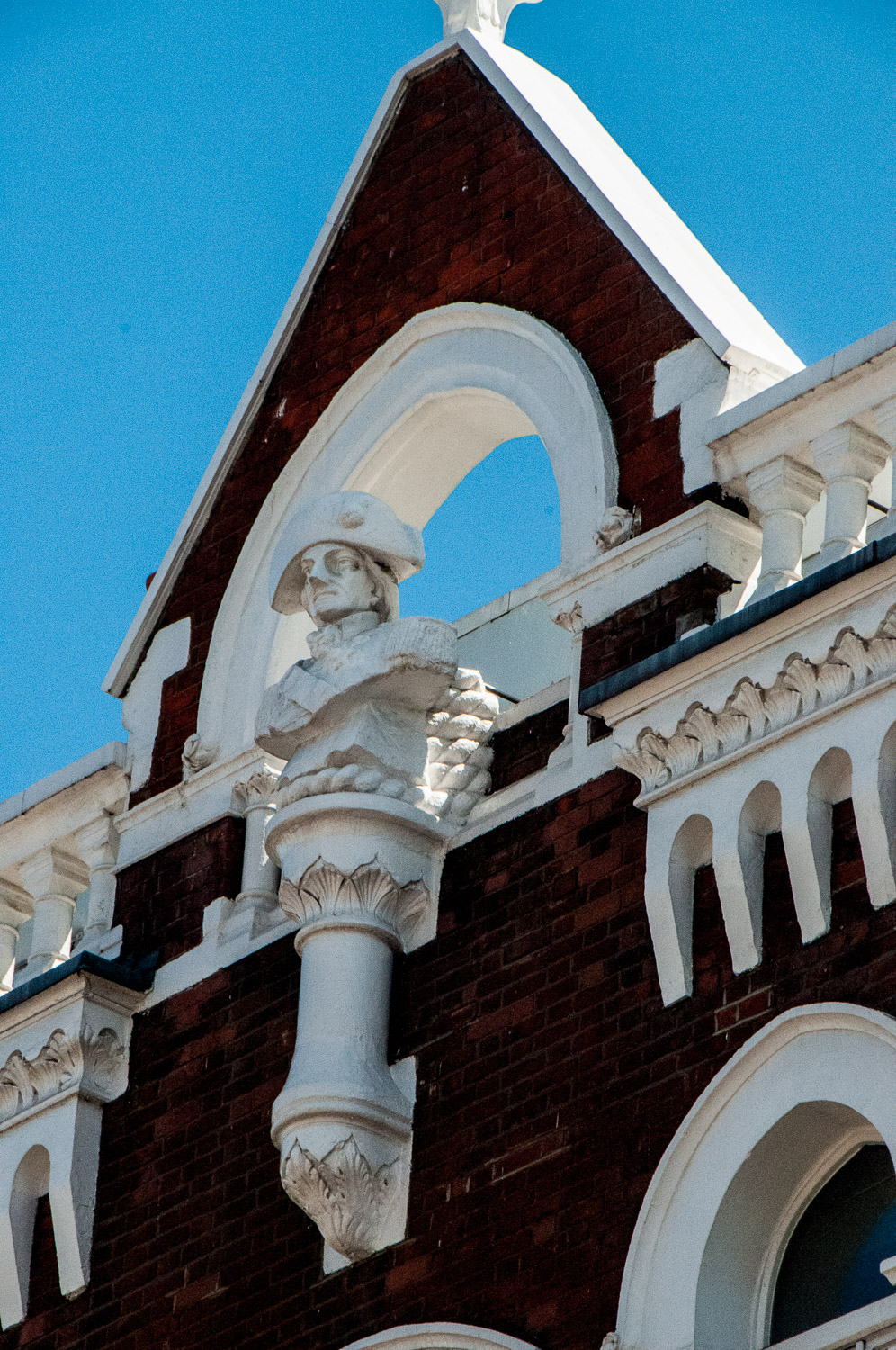
Some commentators mistakenly attribute the likeness to Lord Nelson.

Sadly the Hat and Feathers, on the corner of Clerkenwell Road, has not reopened after a short time operating as a restaurant …
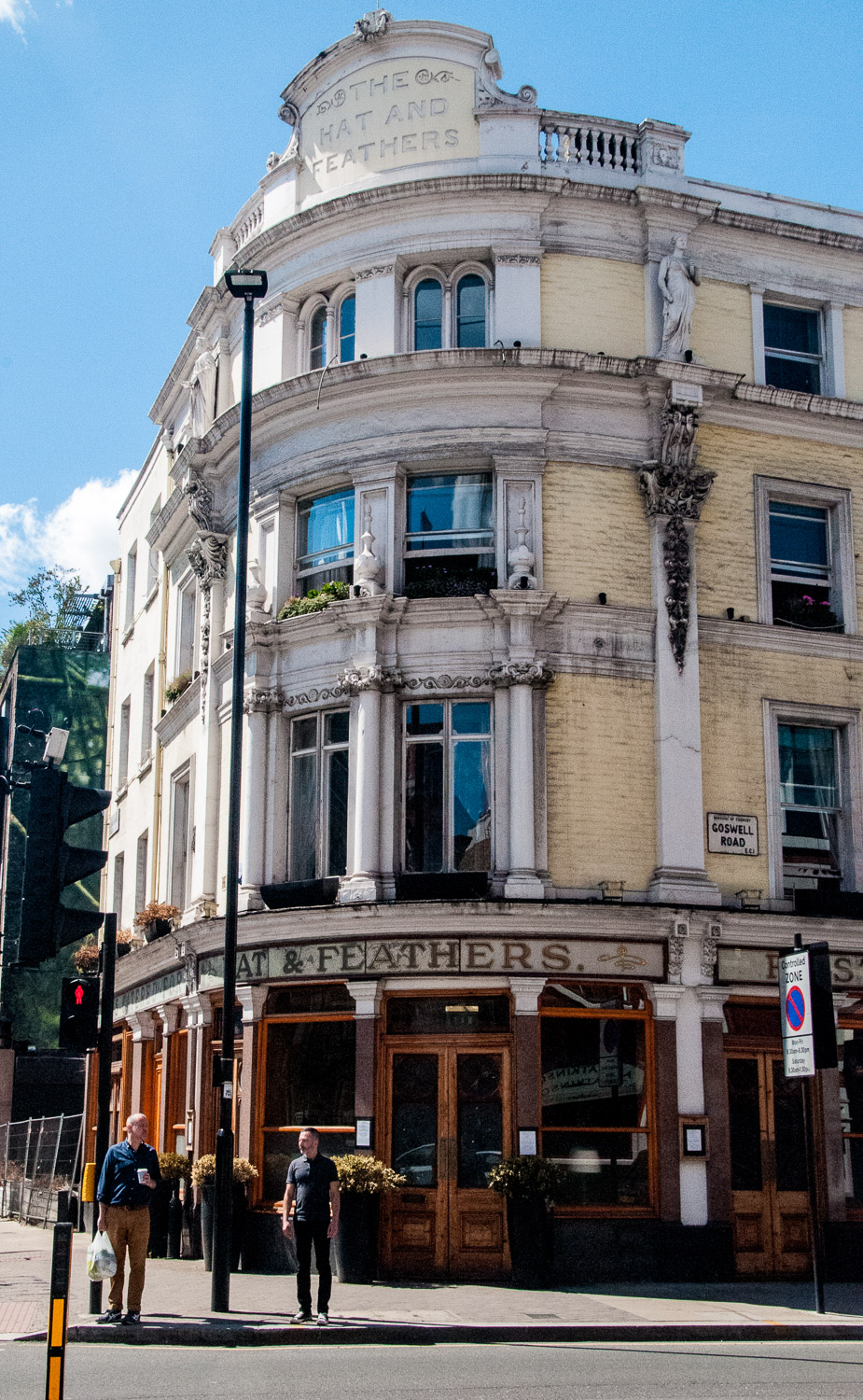
British History Online tells us that the building dates from 1860 and the facade – ‘gay without being crude’ – is decorated with classical statues, urns and richly ornate capitals and consoles. There are quite a few ghost pubs in the City and you can read more about them here.

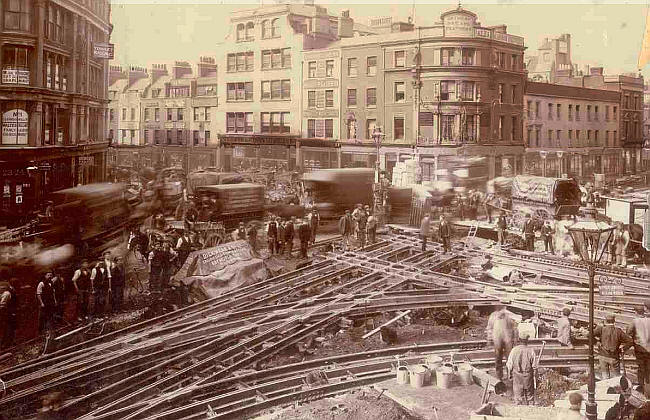
I love this old photograph of tram lines being laid at the same junction …
You can find out more about Old Street and its history using the following links:

The Londonist : How old is Old Street?

The Gentle Author : Along Old Street

My earlier blog : Secrets of Old Street – who remembers the Dansette record player?

Don’t forget, there’s an exciting new installation created by my friend Natalie Robinson now set up for you to visit. The display is based on her body of work  ‘Reflection: what lies beneath – new maps’  and will be part of the Totally Thames 2021 Festival until the 30th.

You’ll find Natalie’s banners on the Thames Path at Walbrook Wharf. Here are a few images to whet your appetite …
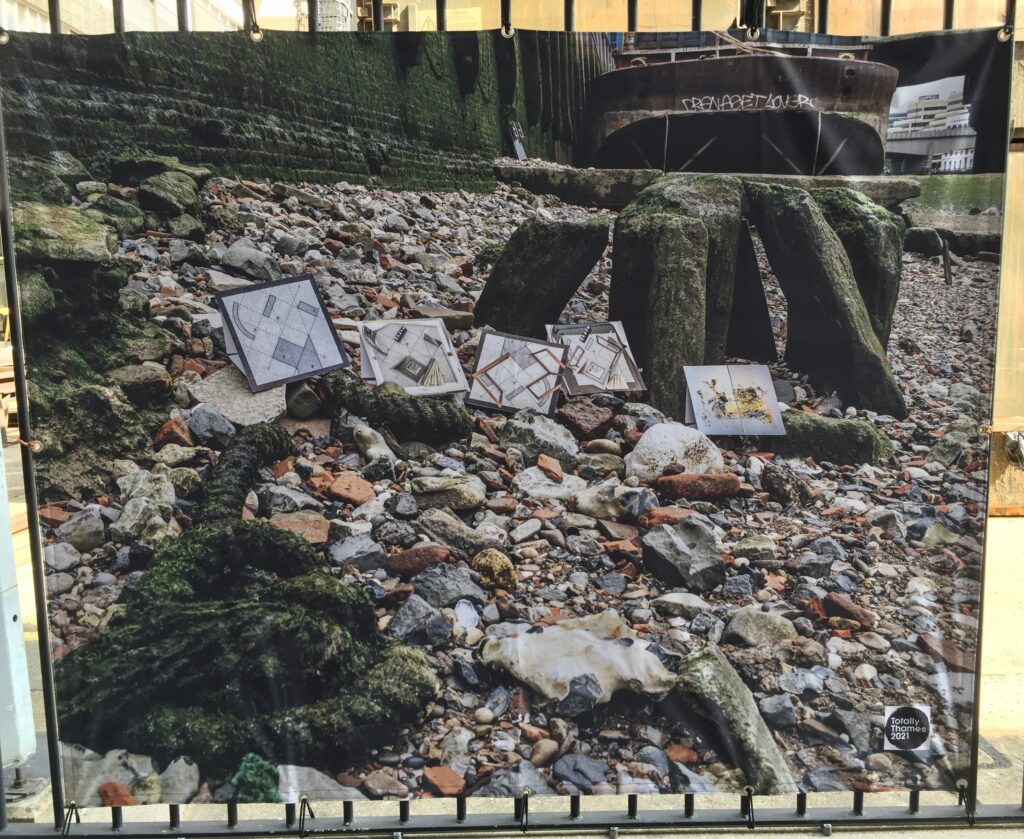
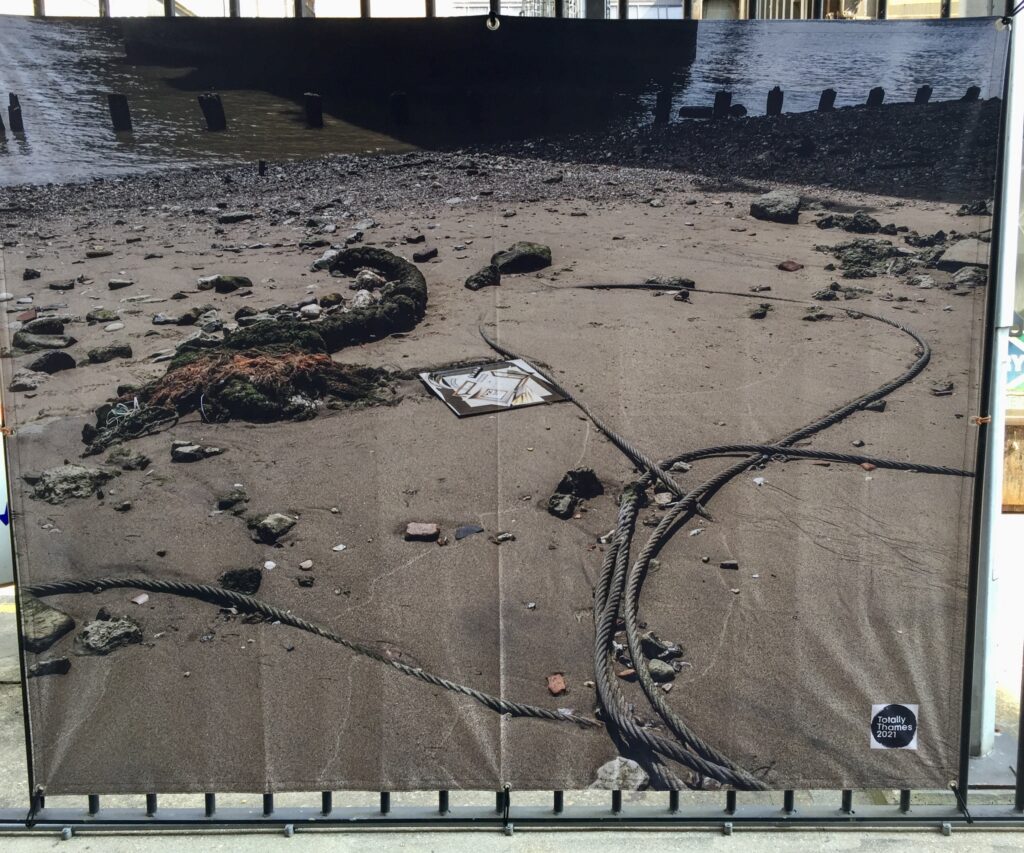
You can find more details of her display here and its digital counterpart here

If you would like to follow me on Instagram here is the link …
https://www.instagram.com/london_city_gent/

What is a wazzbaffle? And why was a soldier brutally stabbed in Church Entry?

More alleys this week.

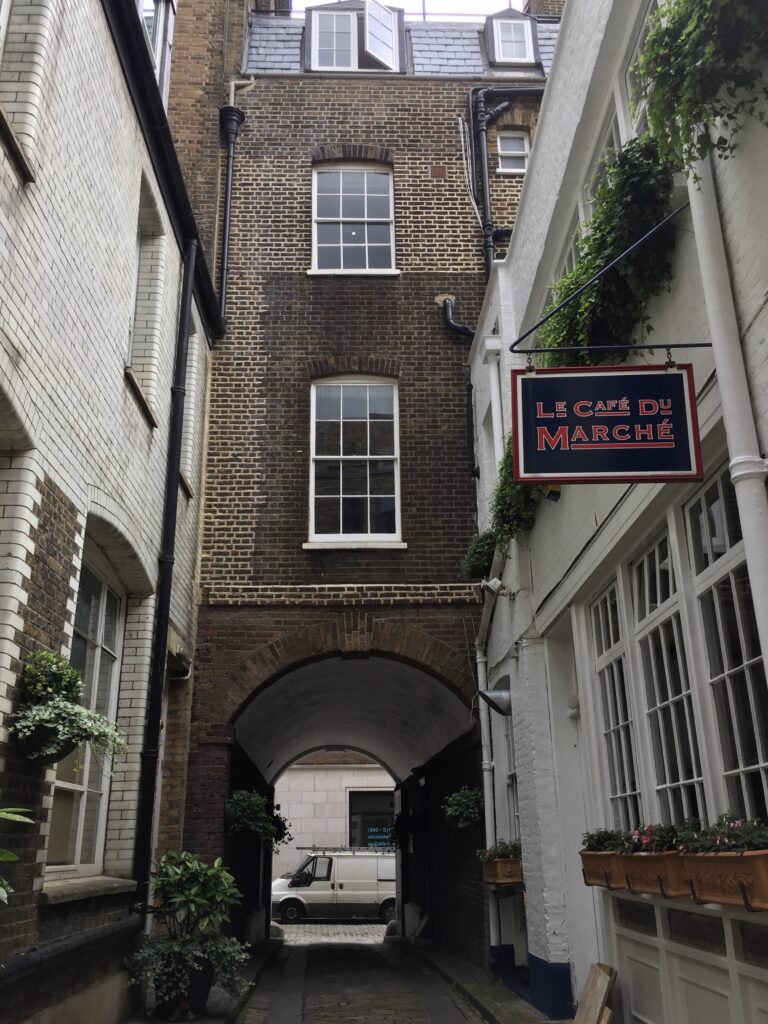
My first visit is to Charterhouse Mews (EC1M 6BB). I have visited the Charterhouse itself before, so if you would like to read more about the fascinating history of this area and the building itself just go to the blog At the Charterhouse.

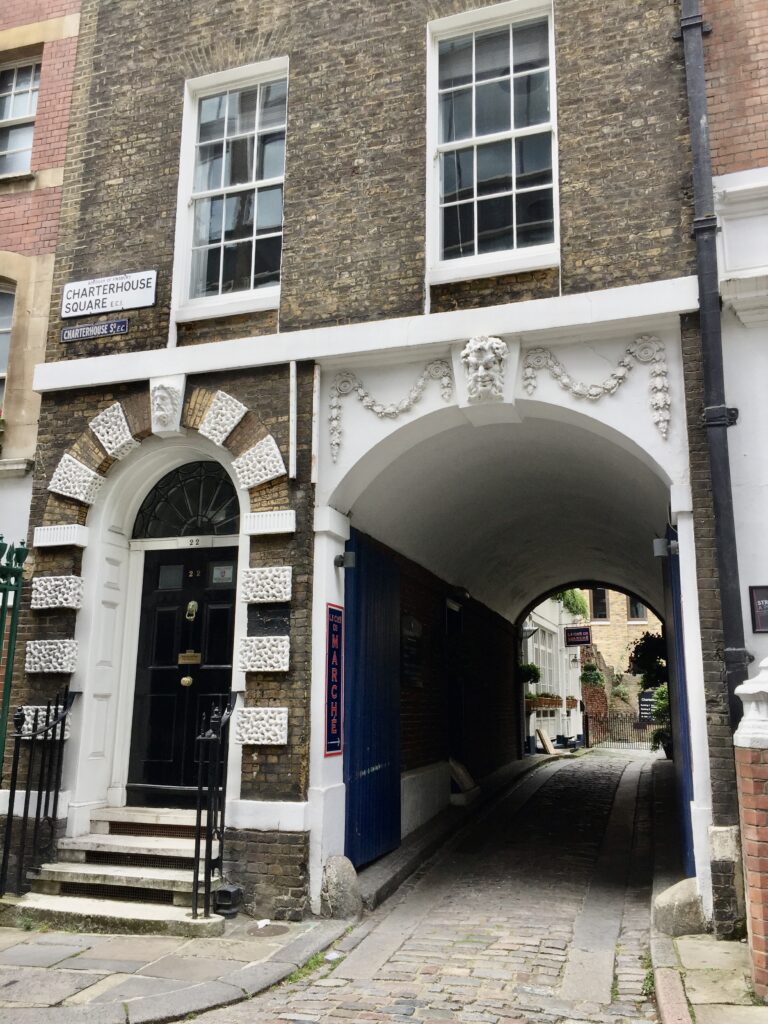
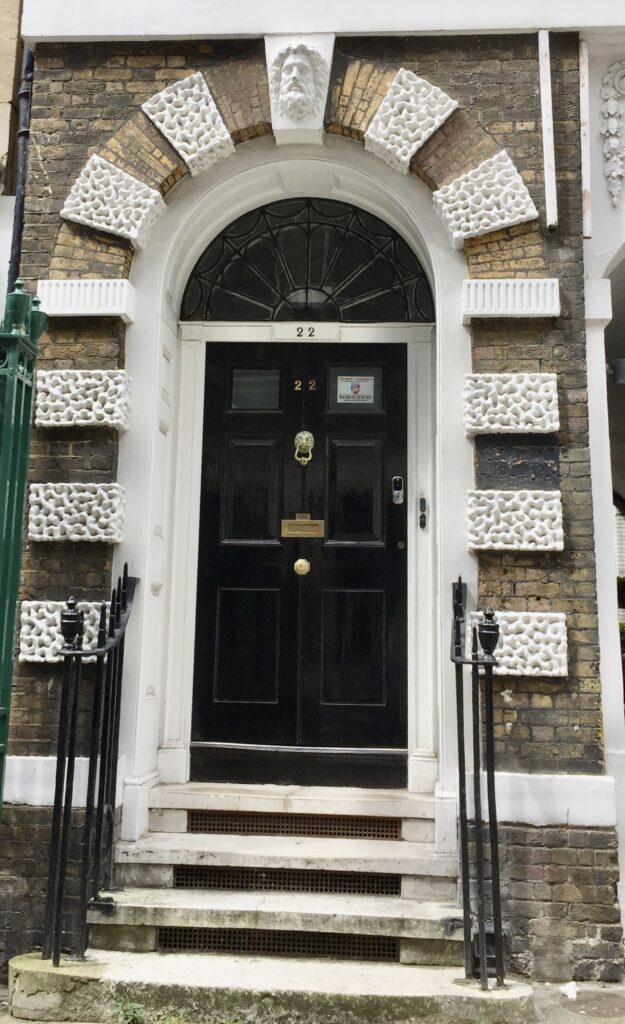
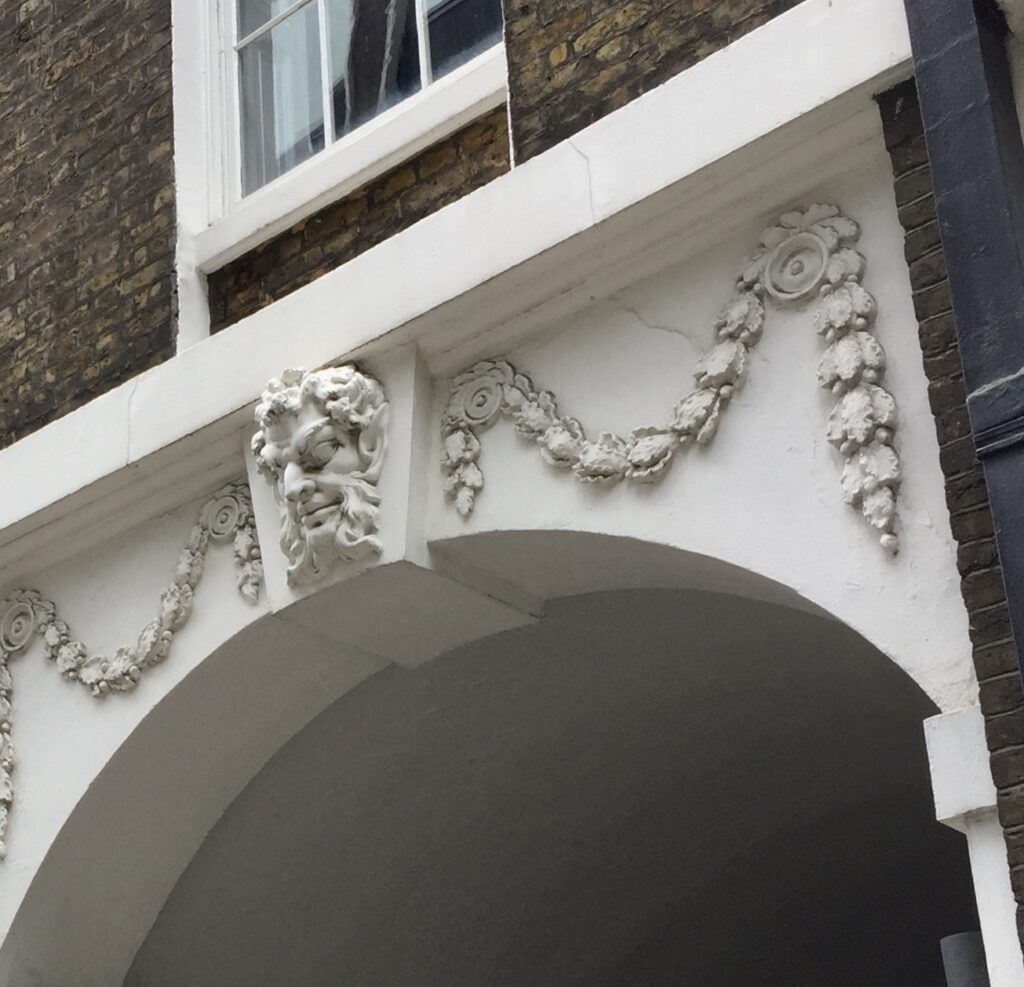
The most distinctive feature as you approach the alley is the Georgian townhouse, built in 1786, that sits astride the passage. First occupied by the artist Thomas Stowers, who is thought to have decorated the interior ceilings with art that is still conserved within. The building is now rented out as offices …

It displays some very nice Coade stone dressings.

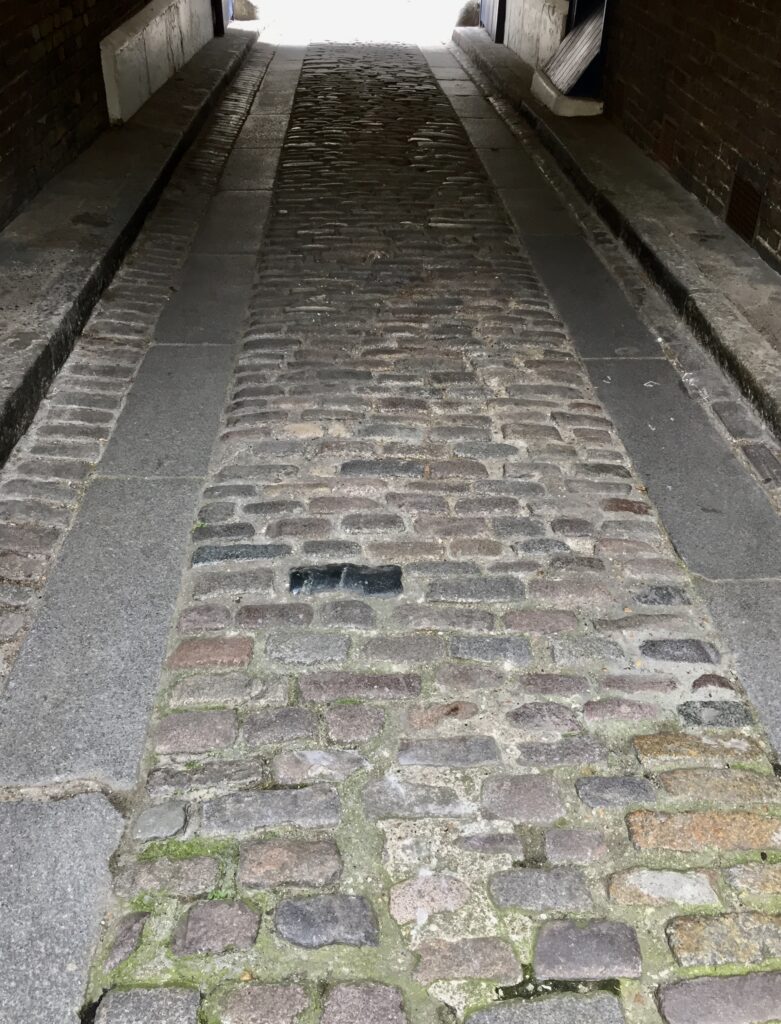
Look down the covered passage and you will notice the stone setts on the ground with solid lines for carriage wheels to make it more comfortable for passengers …

Further along is the French restaurant, Le Cafe du Marche, which was founded in 1986 by Charlie Graham-Wood in what is a converted bookbinders warehouse. Opposite the restaurant is the hotel building, with the walls lined with classic Edwardian white tiles to bring light down into the alley and curved window recesses. …

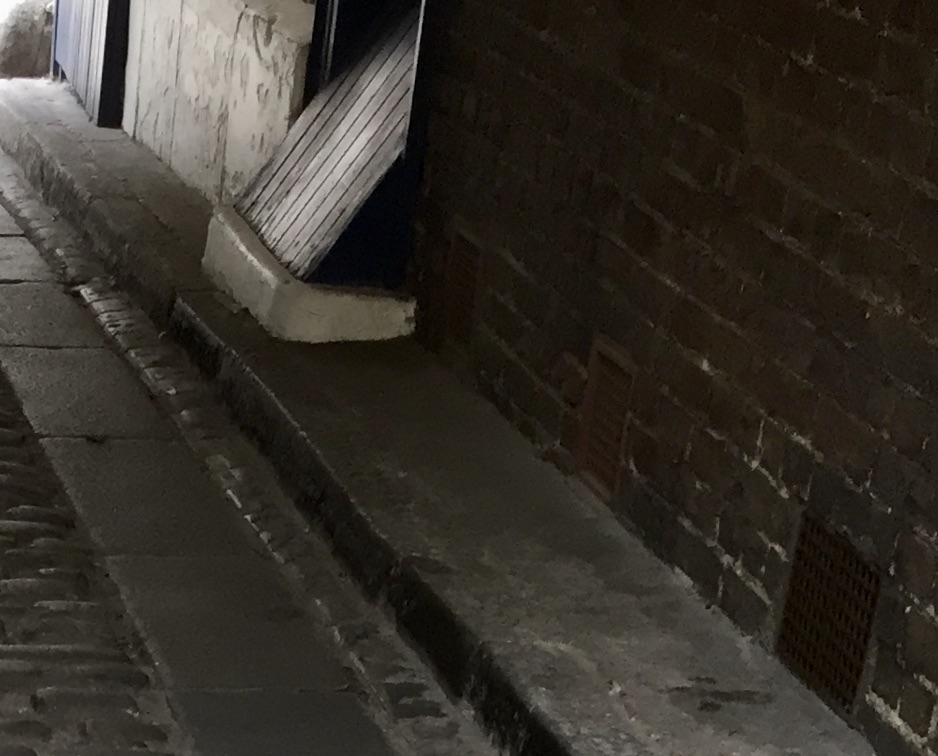
The darkest area contains a urine deflector, also known as a wazzbaffle, which ensured that any men seeking to relieve themselves in the recess will get very wet feet as a reward …

You can find my blog identifying the few other examples that remain in the City here.

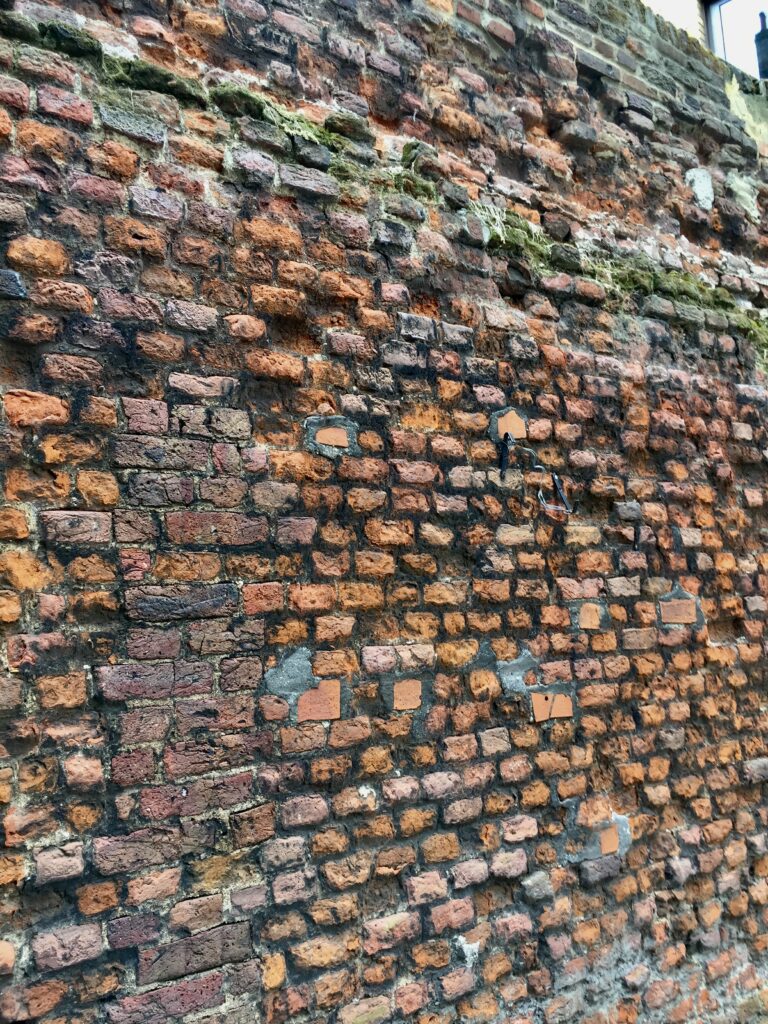
The mews is quite short and ends in private property just past the entrance to the restaurant. Here I paused and admired this rather nice old brick wall …

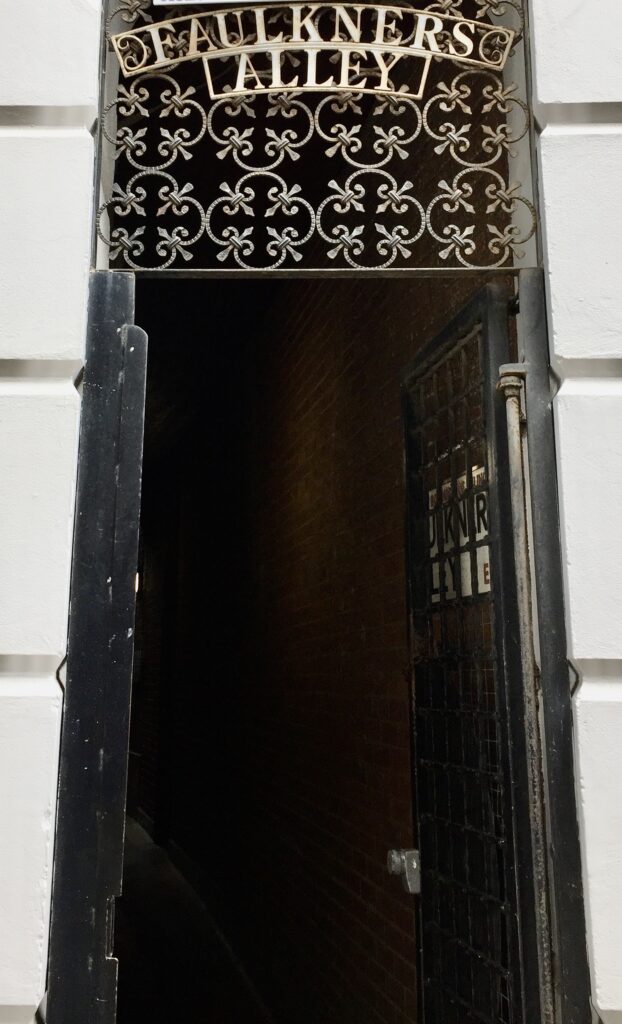
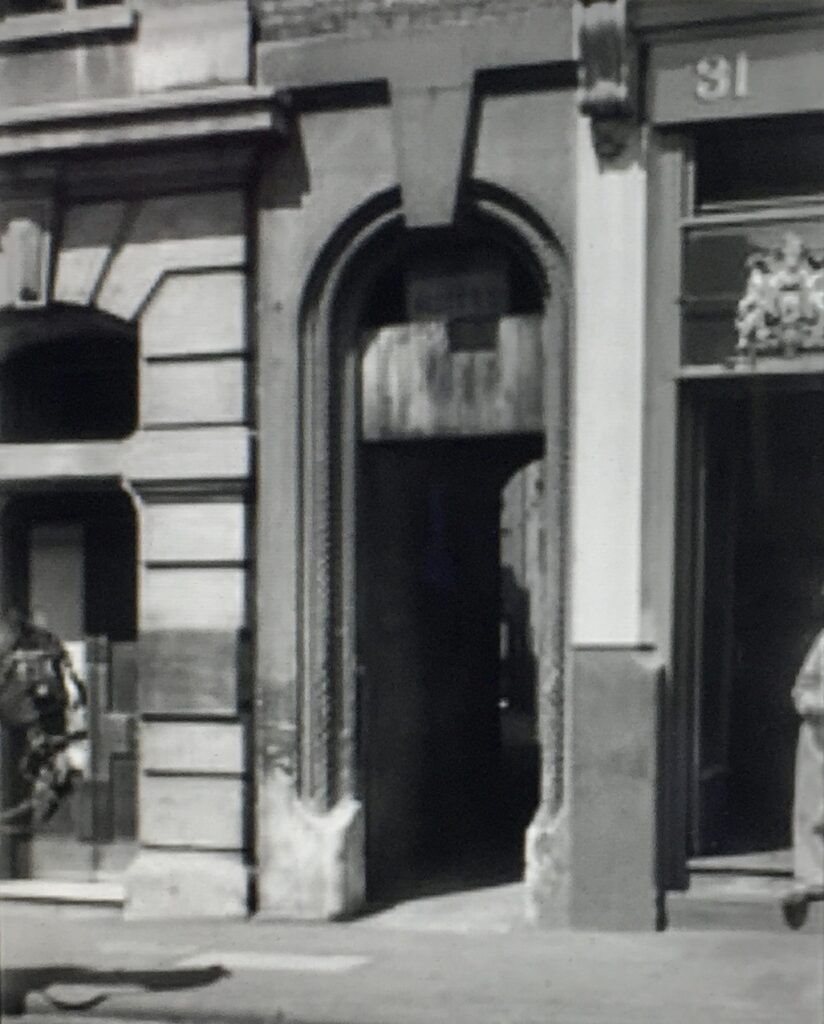
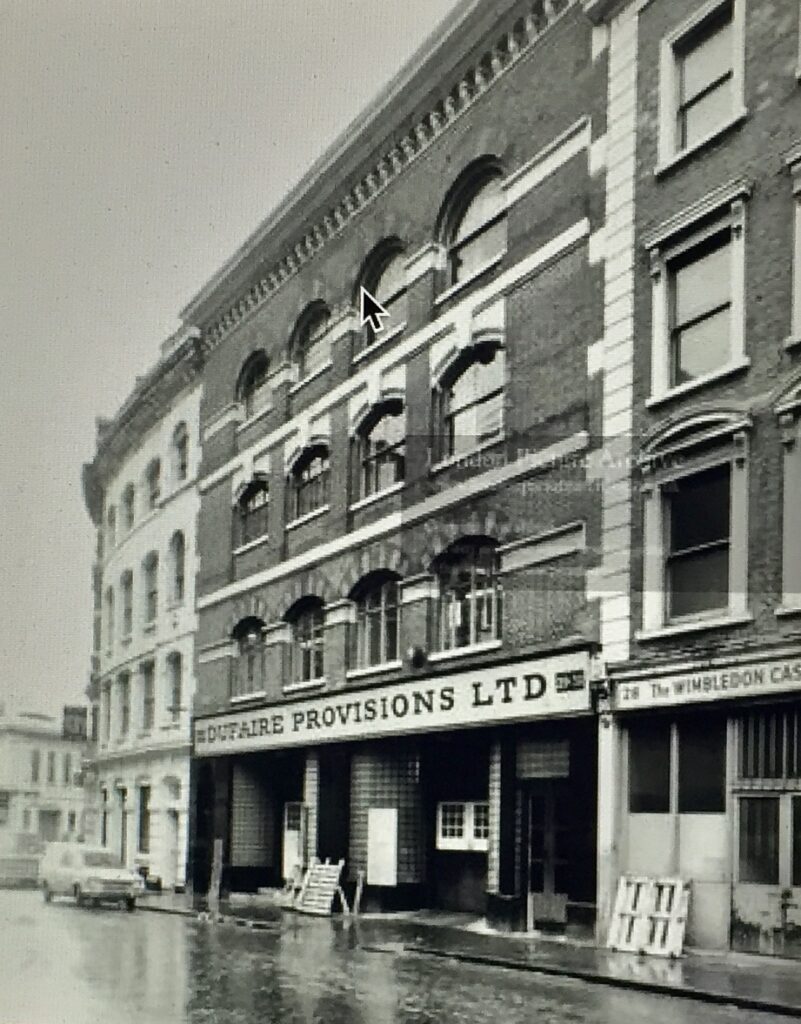
The entrance to Faulkner’s Alley is a great example of things architectural not being quite as they seem. Running between Cowcross Street and Benjamin Street, its ornate metal gate is not as old as it looks …

It wasn’t there in the 1930s …

Picture: Historic England.

Or in 1976 (the entrance is just below the letters LTD) …

Picture: London Picture Archive

The Cowcross Street entrance is not exactly welcoming …

No one seems to know who Faulkner was or why an alley was named after him (or her).

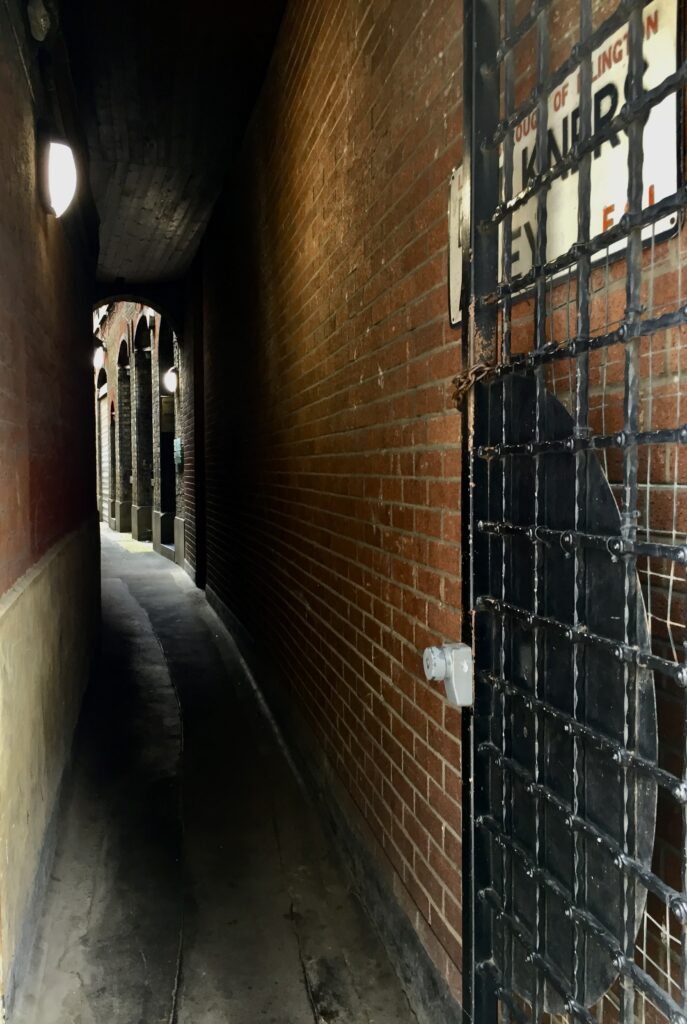
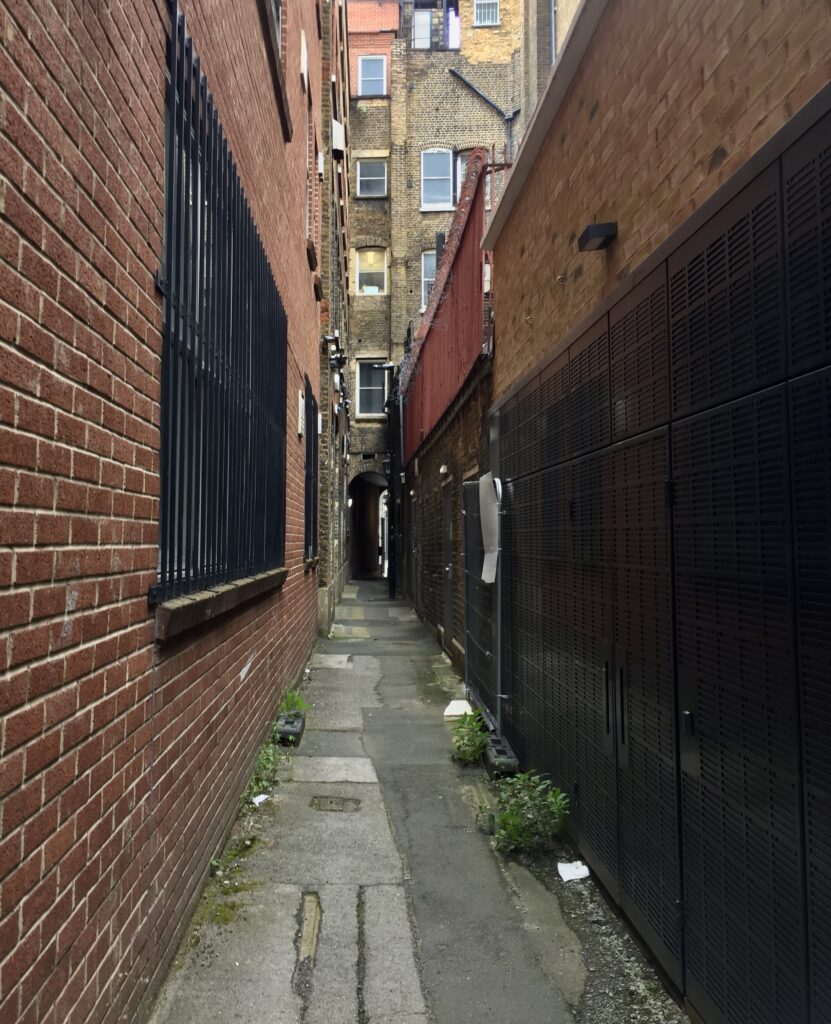
Inside is narrow and a bit spooky. One of those places where you wouldn’t like to hear footsteps behind you …

But there are some encouraging signs of life as you approach the Benjamin Street end …

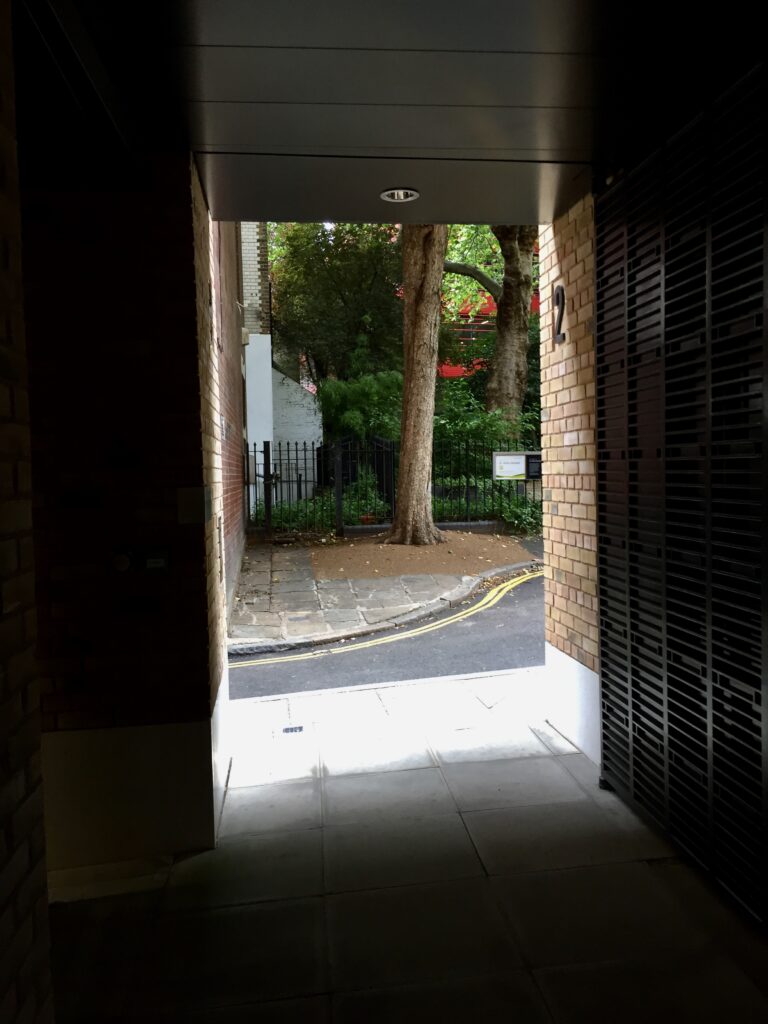
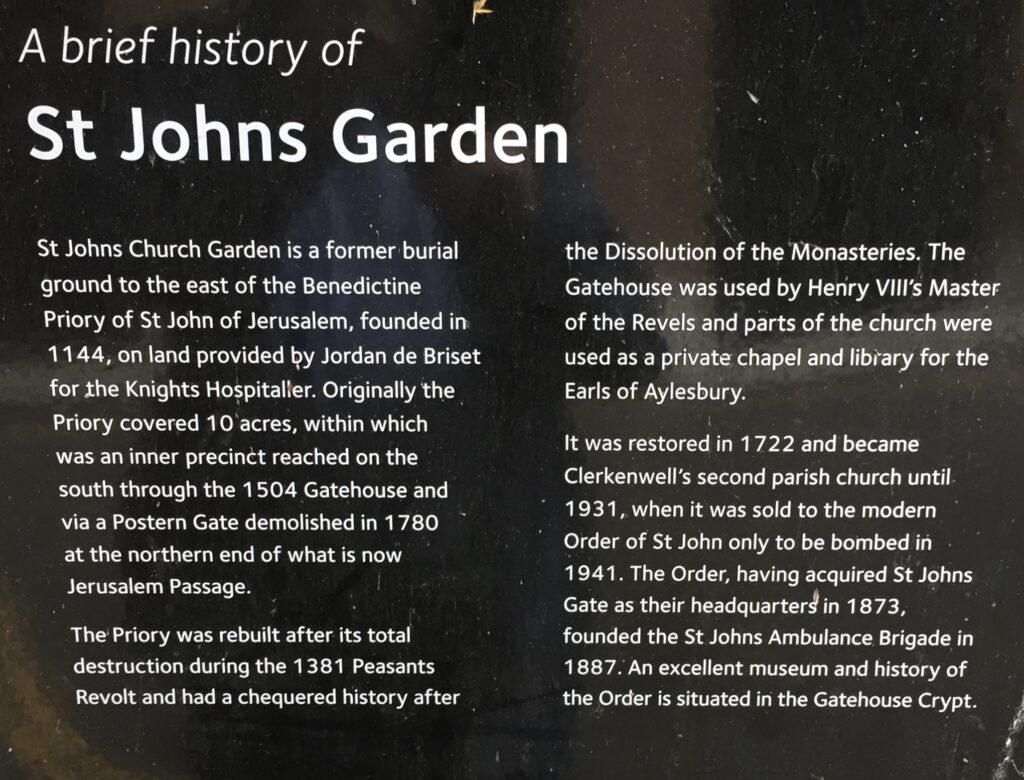
Across the road is St Johns Garden along with this very helpful signage …

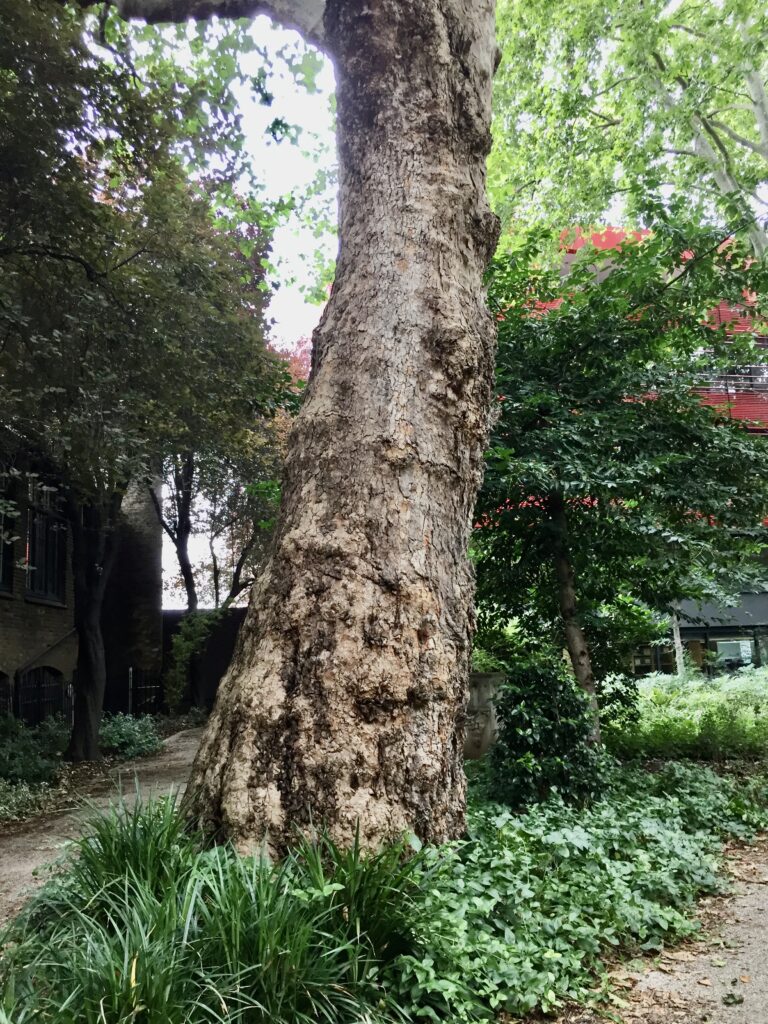
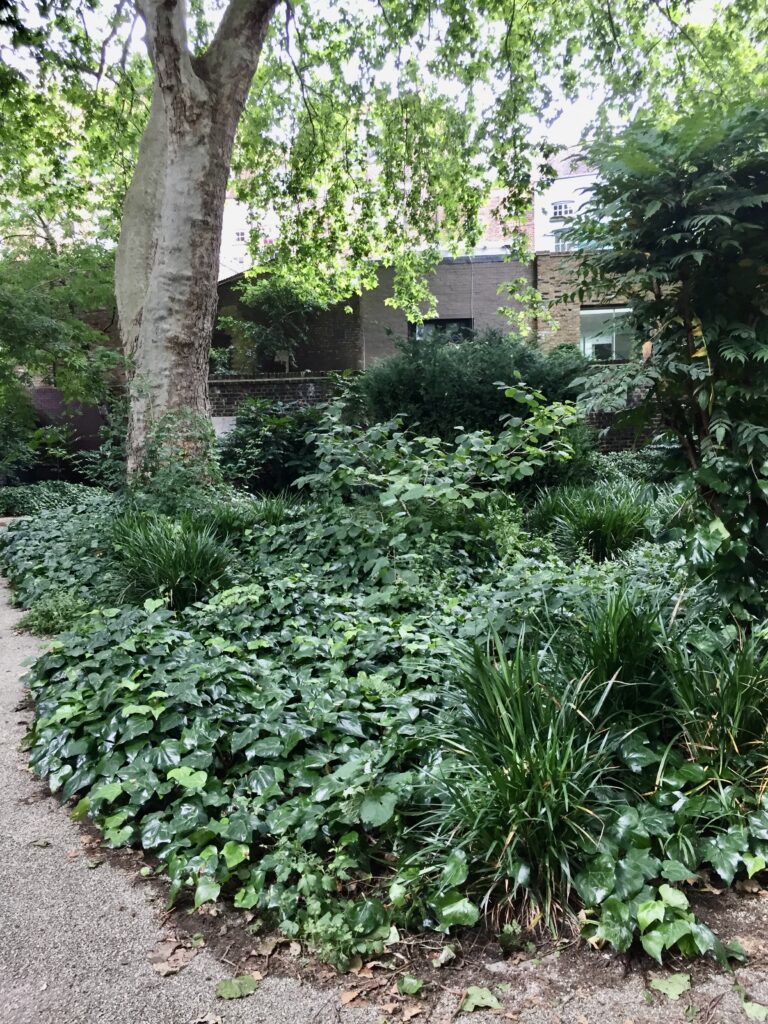
It’s one of those nice surprises you get – a little shaded oasis of calm in the bustling City …

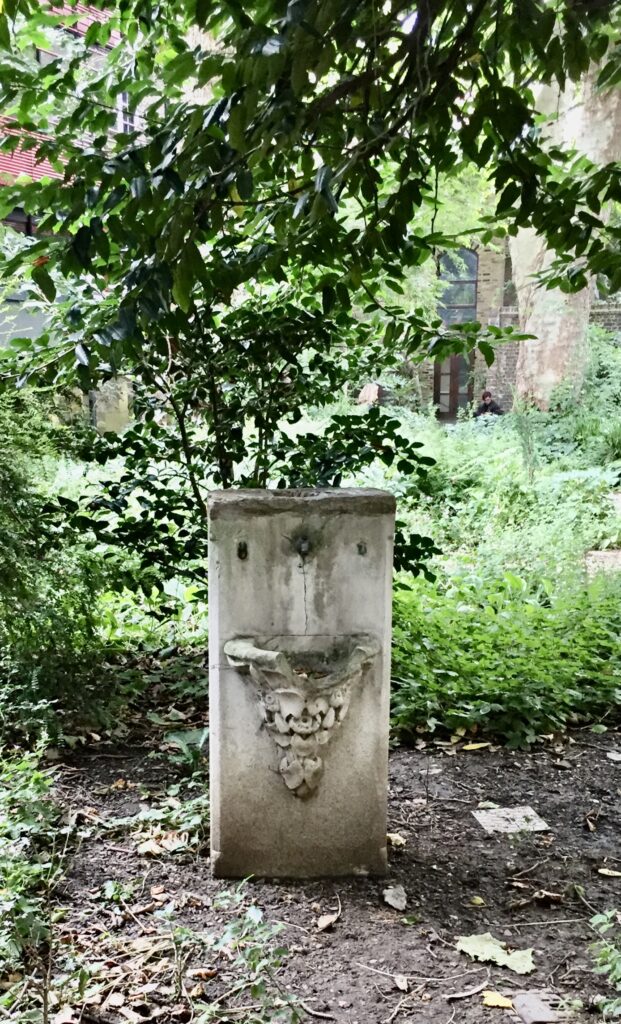
It’s a shame this little water feature is broken.

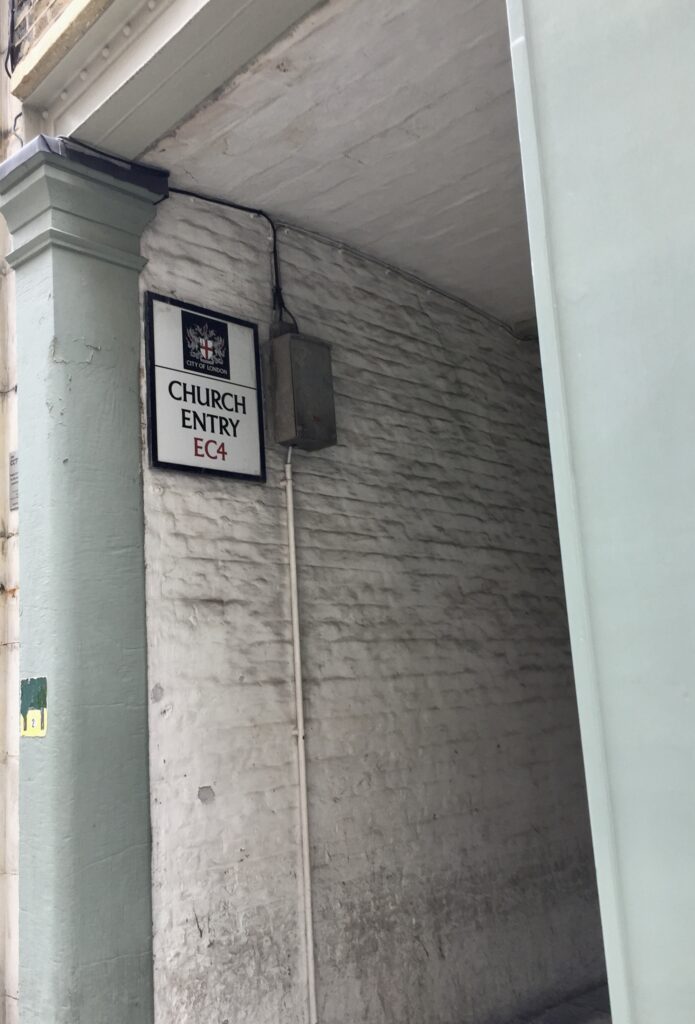
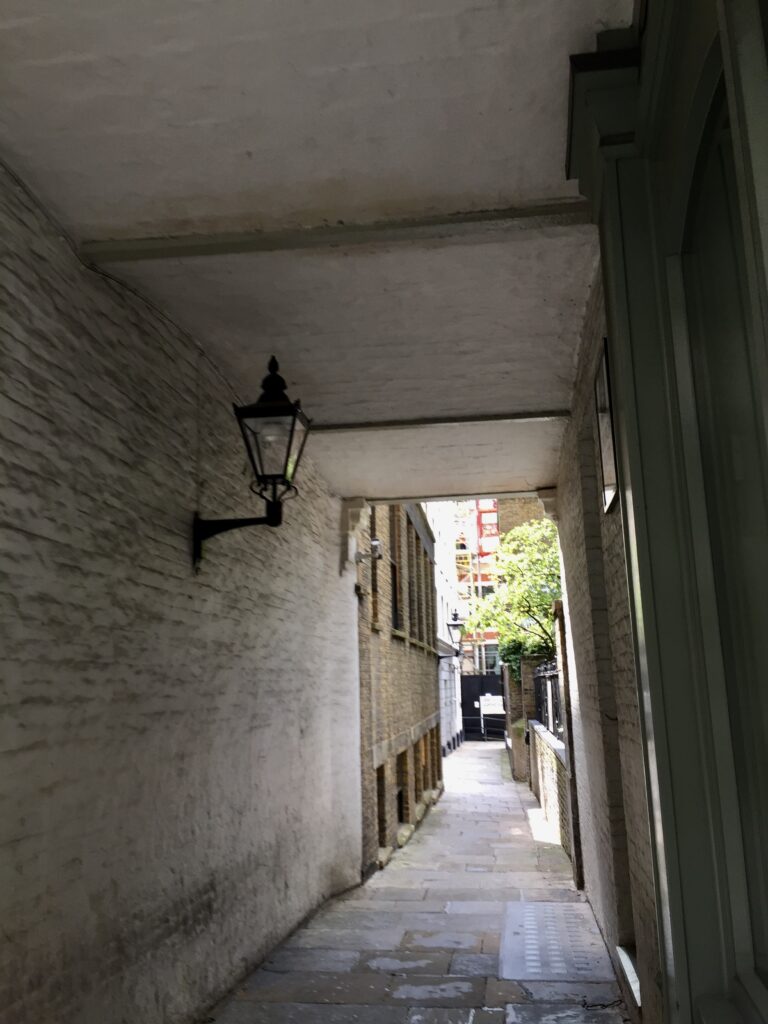
And now, finally, to the interestingly-named Church Entry (EC4V 5EU) and a nasty incident that occurred there in 1763.

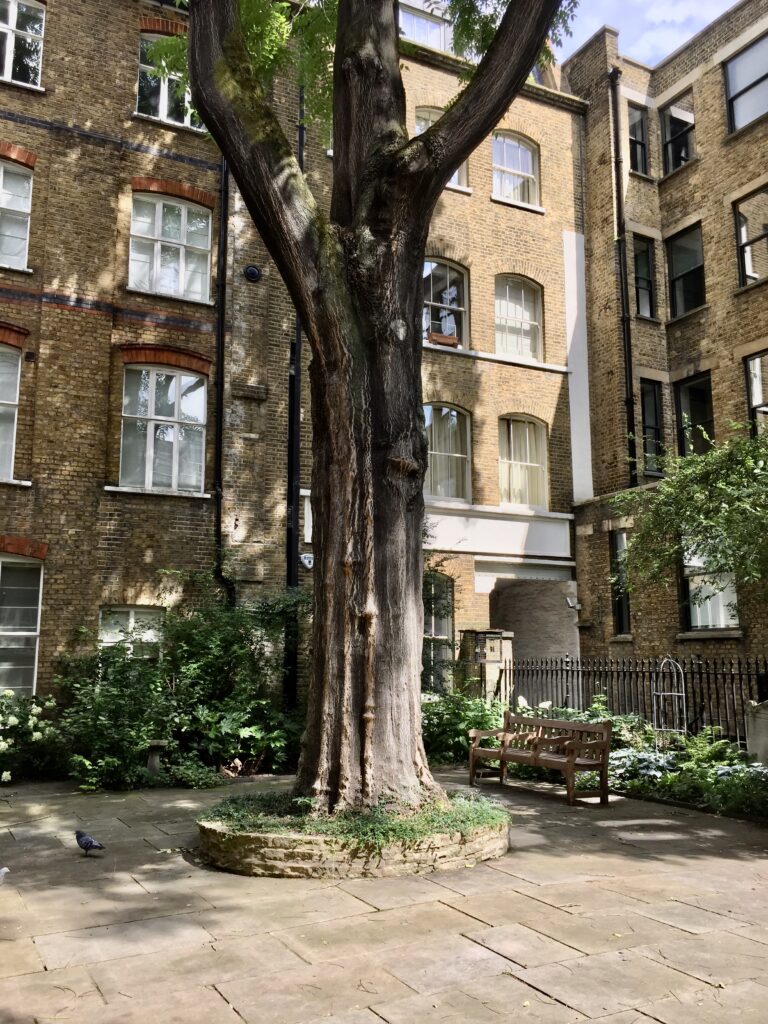
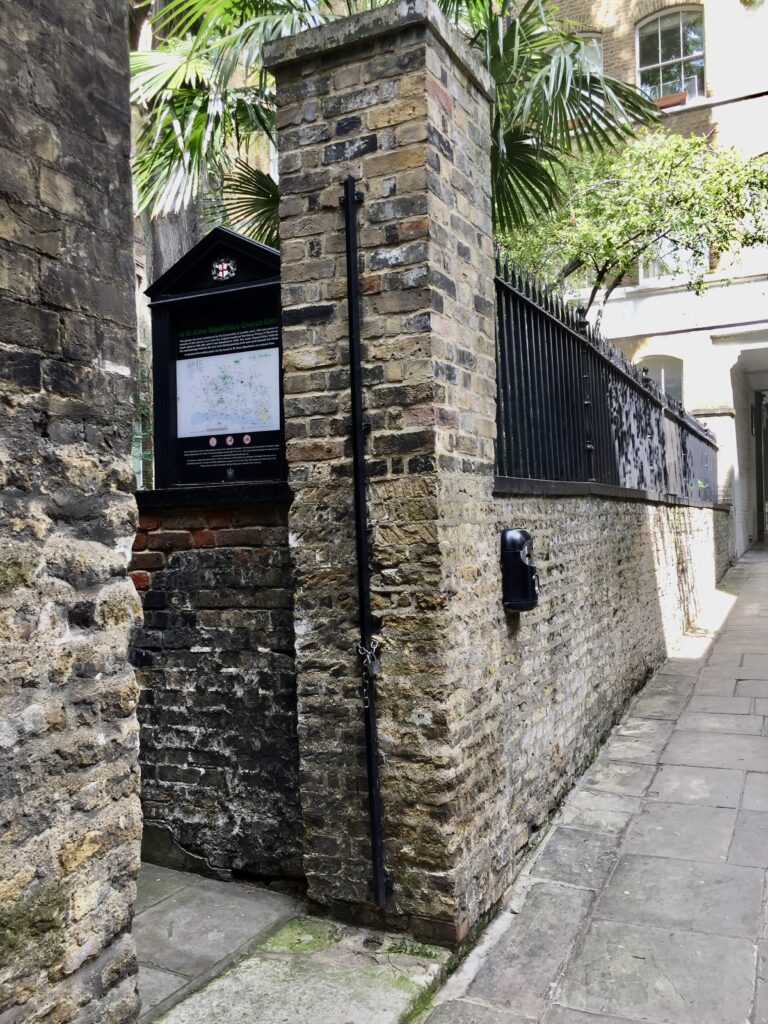
Here you will find another little haven of peace …

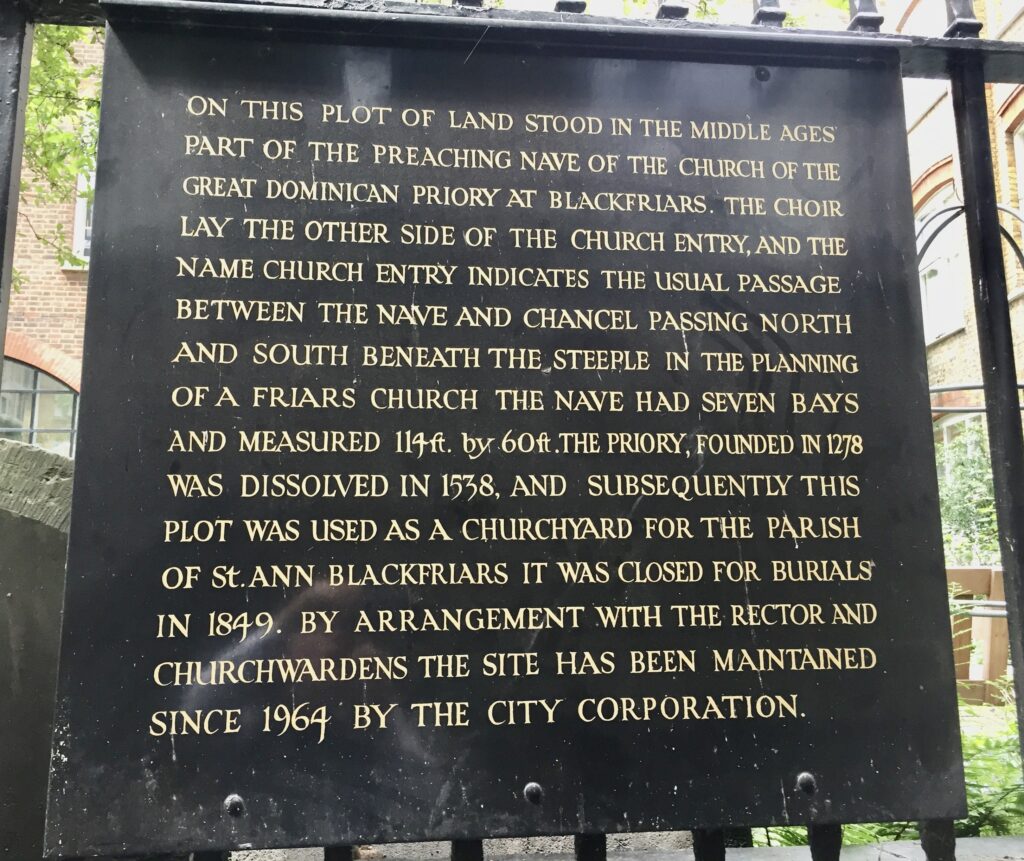
There is a sign giving a brief history …

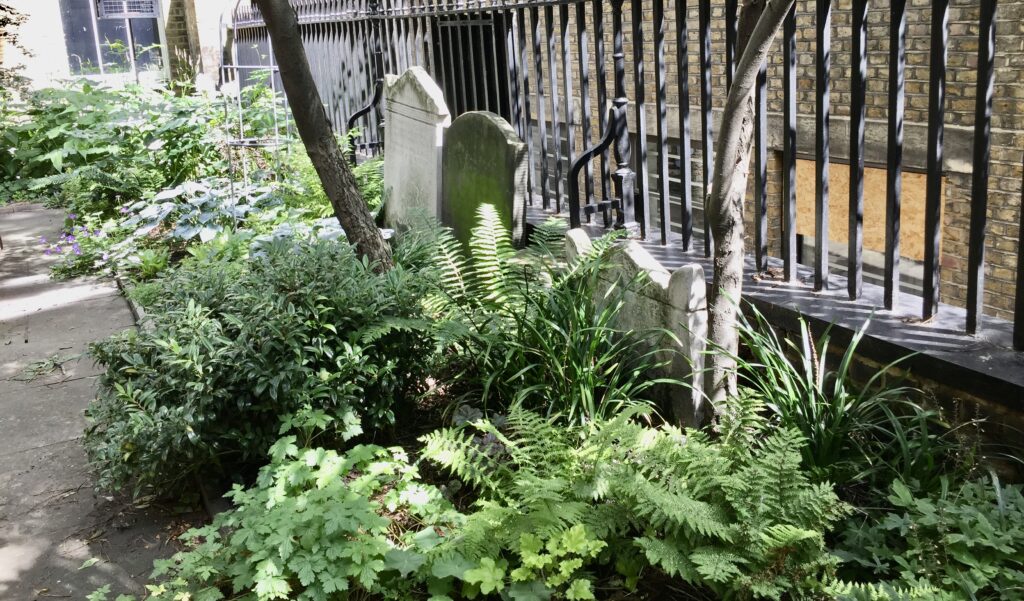
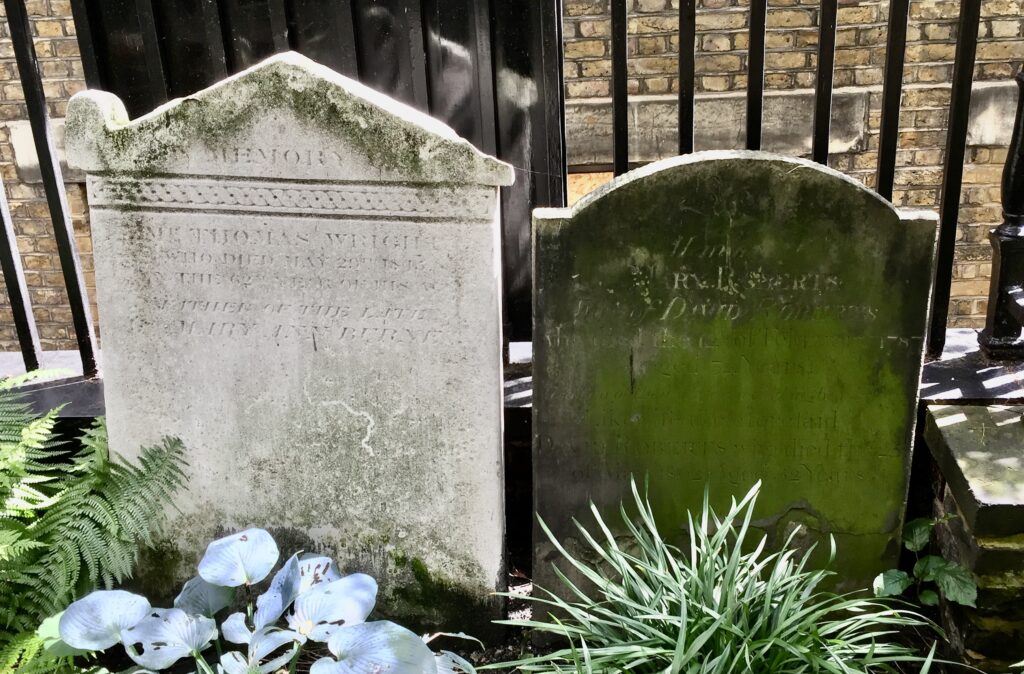
There is a mystery associated with these two gravestones which I shall explore in a future blog …

Like some other City churchyards, its ground level is much higher than the pavement, indicating the large number of burials crammed in before it was closed in 1849 …

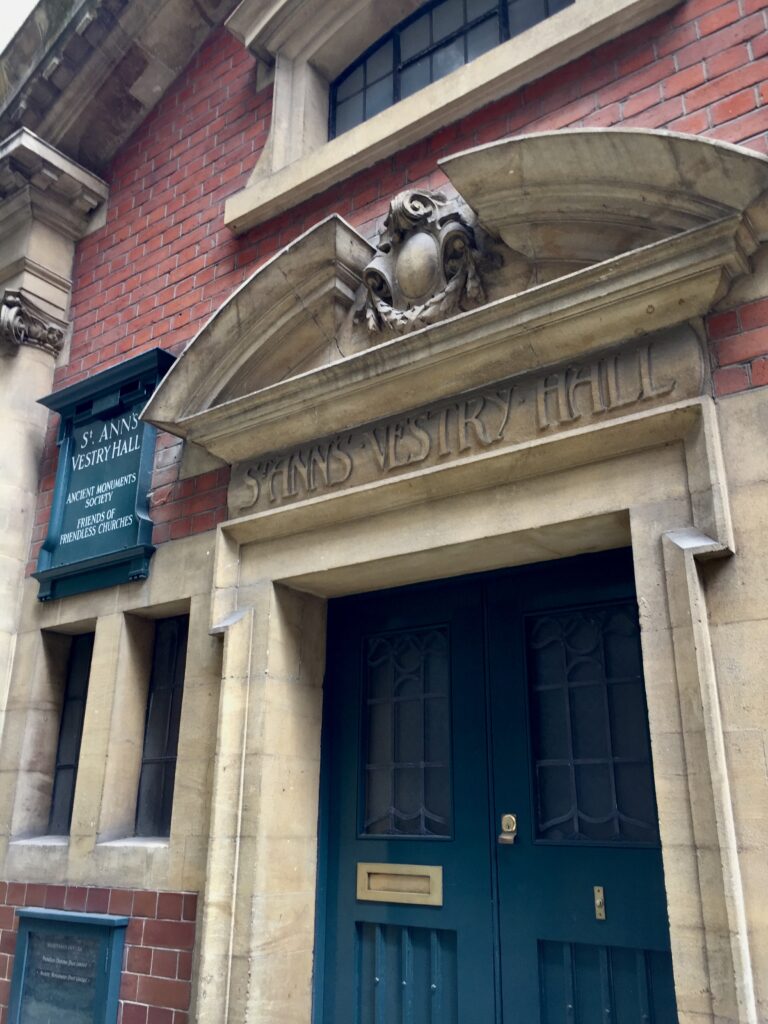
Opposite is St Ann’s Vestry Hall which, despite its architecture, only dates from 1923 …

It’s the home of the estimable Friends of Friendless Churches.

Finally, a dreadful incident that occurred in Church Entry as reported in Pope’s Bath Chronicle and Weekly Gazette on the 9th June 1763:

“Yesterday morning, about Three o’Clock, two young men, one a Peruke-maker, the other a Watch-maker, went into a House of ill Fame in Church Entry, Black-friars, when a Dispute arose about paying the Reckoning; on which the old Bawd gave the Barber a violent blow on the Head with a Poker, and called a soldier, who was then in the House, to her Assistance, who fell upon them with the aforesaid Weapon; the Watch-maker, in his Defence, drew a Knife and cut the Soldier cross the Belly, who was carried to St Batholomew’s Hospital, where he lies dangerously ill. The Barber has received a most dreadful Blow on his Head, several inches in length, quite to his Brain; and, with the Mistress of the House and one of the prostitutes, is committed to Clerkenwell Bridewell; and the Watch-maker, who is charged with wounding the Soldier, is committed to New Prison, Clerkenwell”.

Those were the days!

Thanks to A London Inheritance for that story and also to the Ian Visits blog for background on both Faulkner’s Alley and Charterhouse Mews.

If you would like to follow me on Instagram here is the link …
https://www.instagram.com/london_city_gent/

A couple of great surprises – exploring alleys and courts.

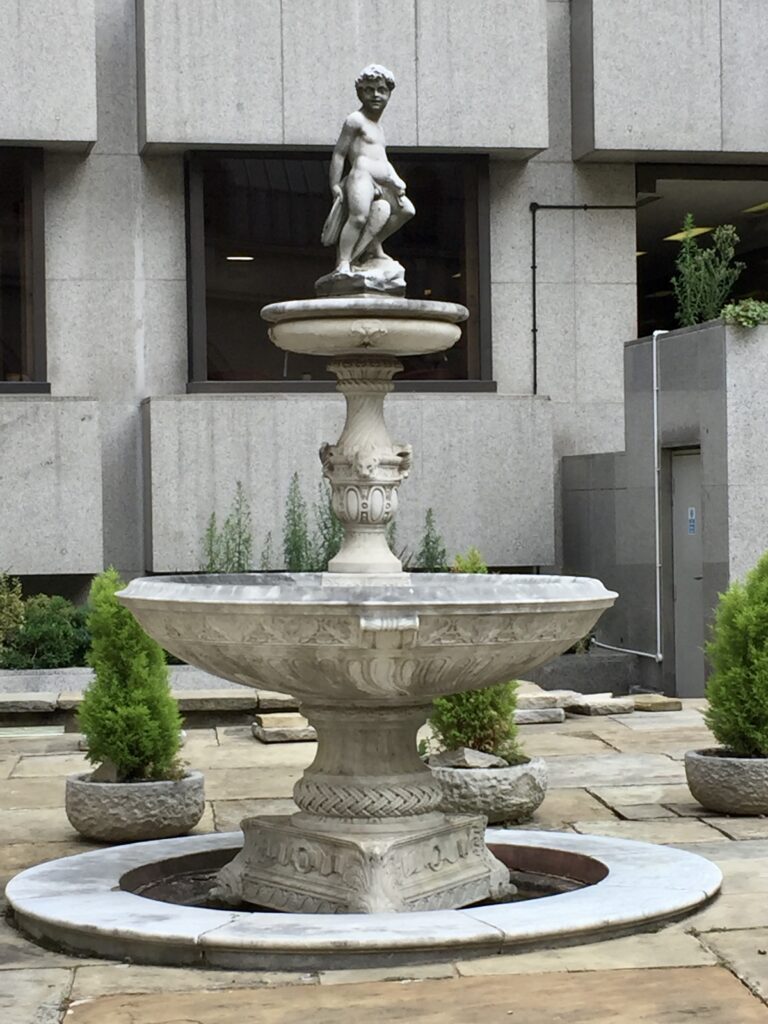
Where do you think this pretty marble fountain is located?

And Italian piazza? A rather posh park? A country house garden?

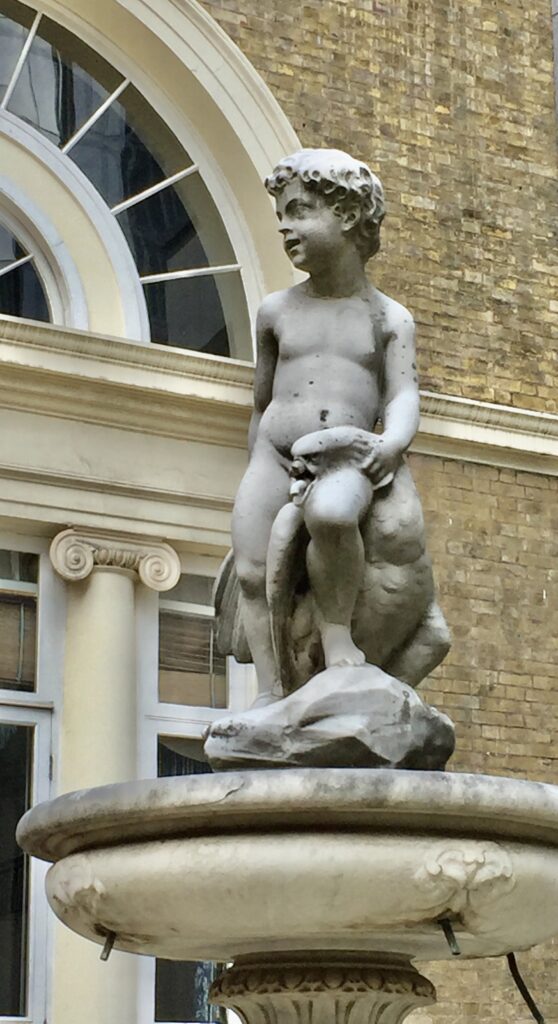
A little boy holds a goose’s neck from whose mouth water would flow if the fountain was working …

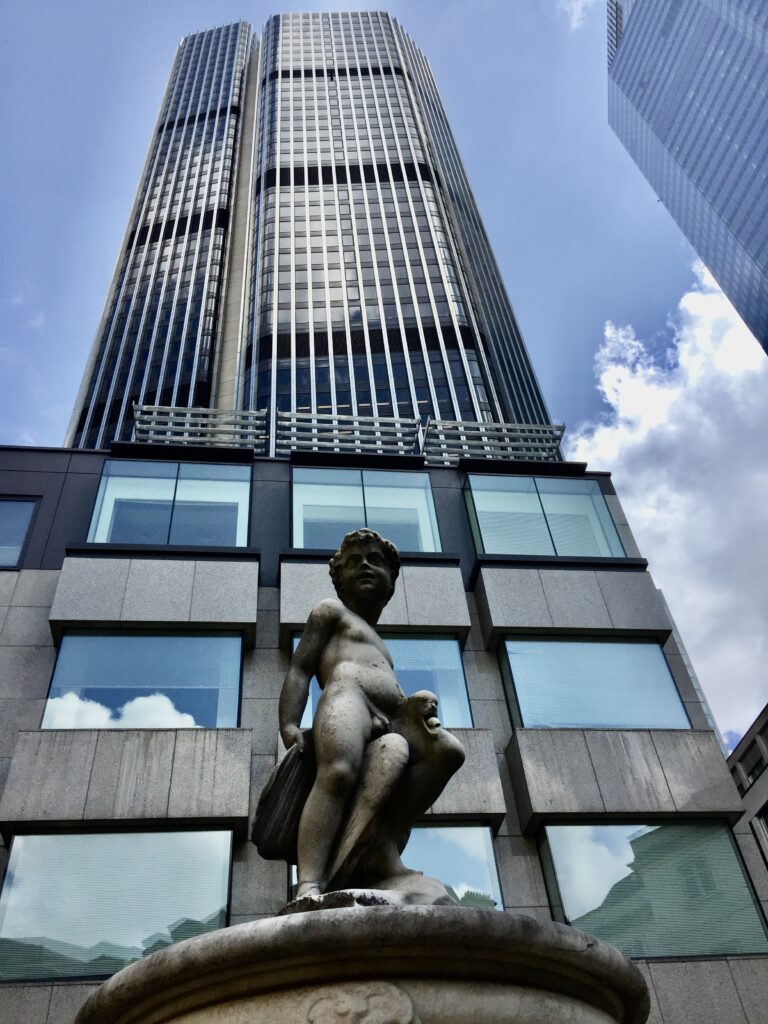
The big surprise about its location is apparent when you gaze upwards …

Looming over you is the 600ft Tower 42, previously the NatWest Tower.

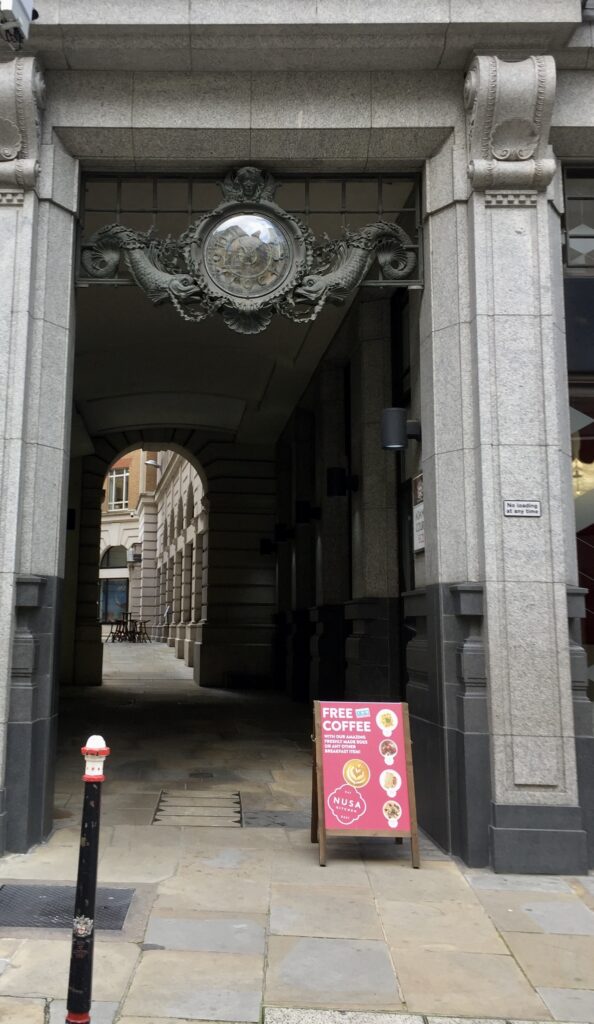
This is Adam’s Court and you gain entrance from either Old Broad Street or Threadneedle Street. This is the entrance from the former …

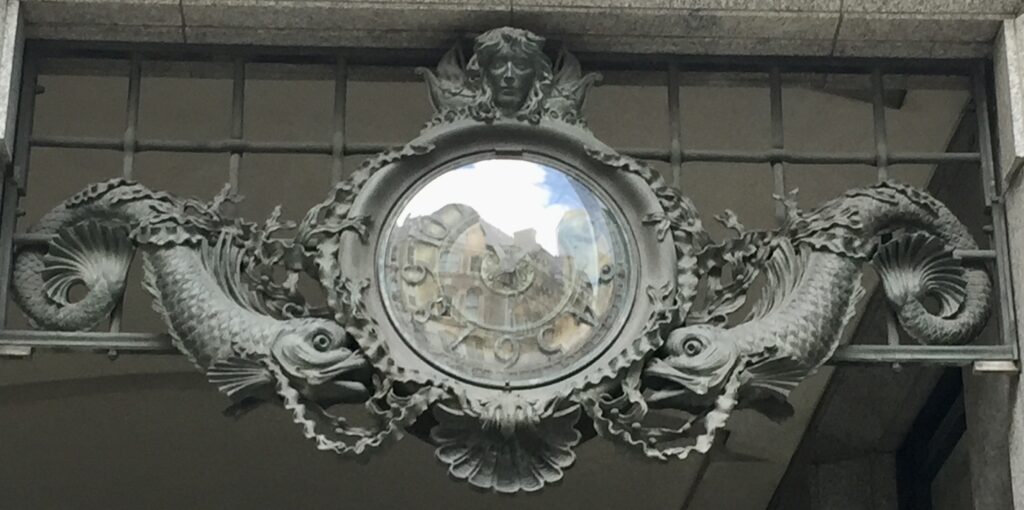
The elegant clock above the entrance is supported by two fishes. Unfortunately it’s not working and the glass has got rather grubby …

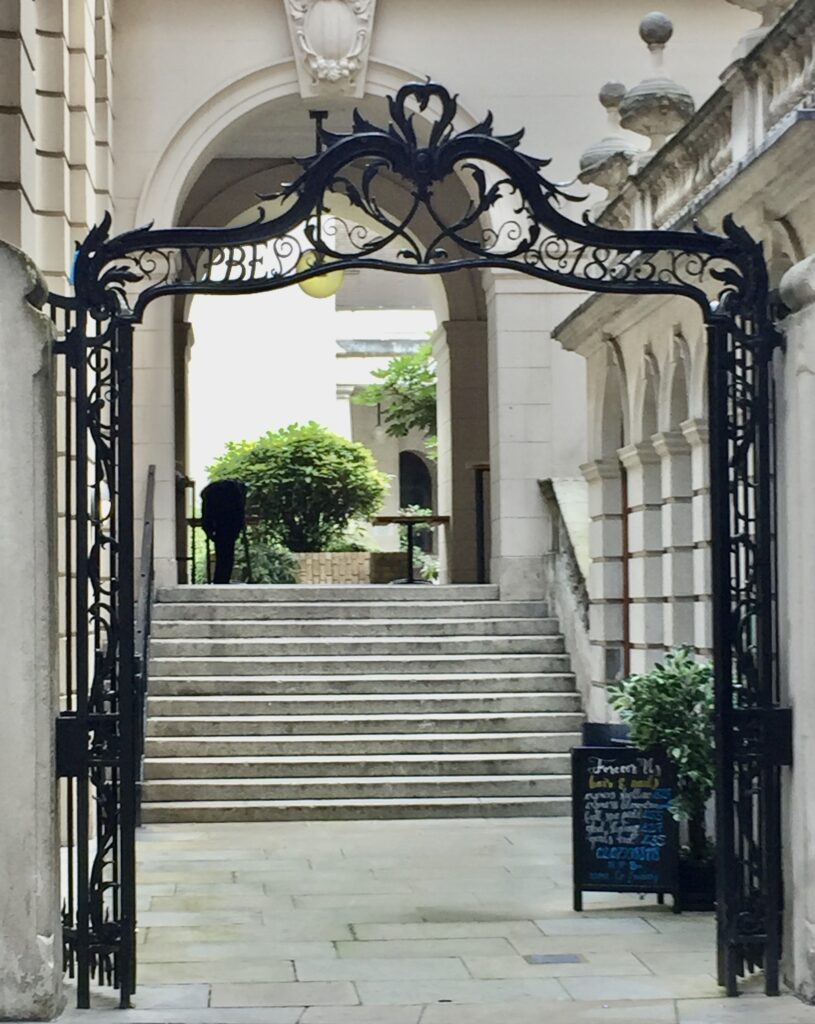
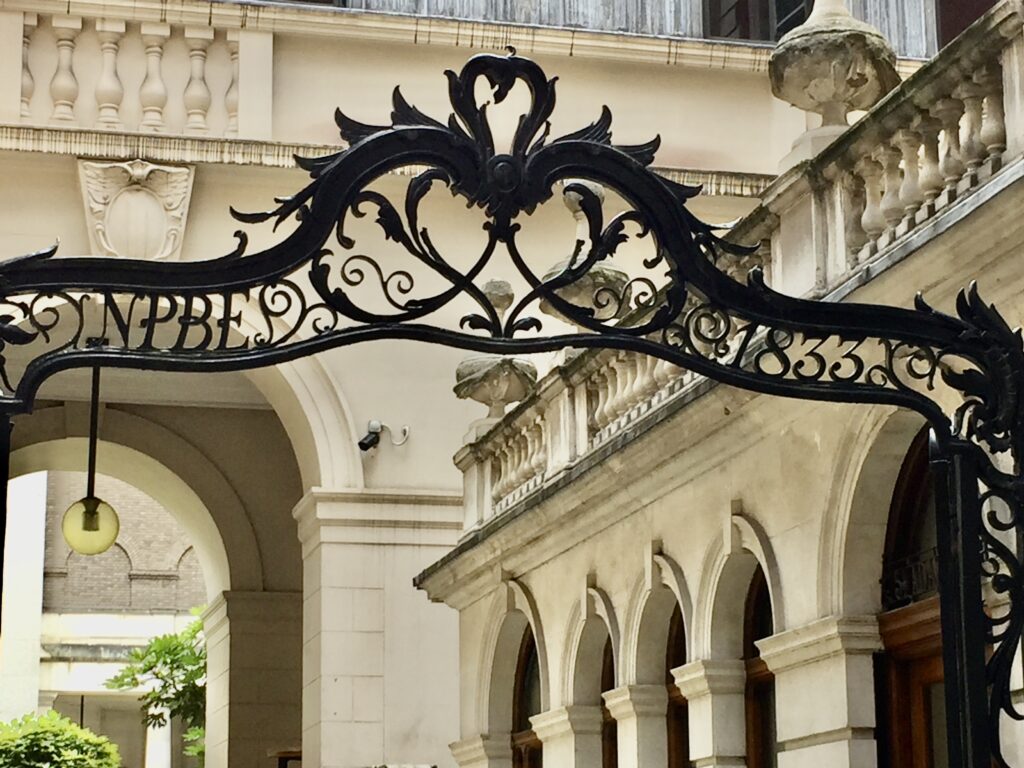
Shortly after entering you will see these attractive wrought iron gates bearing the initials NPBE and the date 1833. The initials refer to the National Provincial Bank of England which was founded in that year …

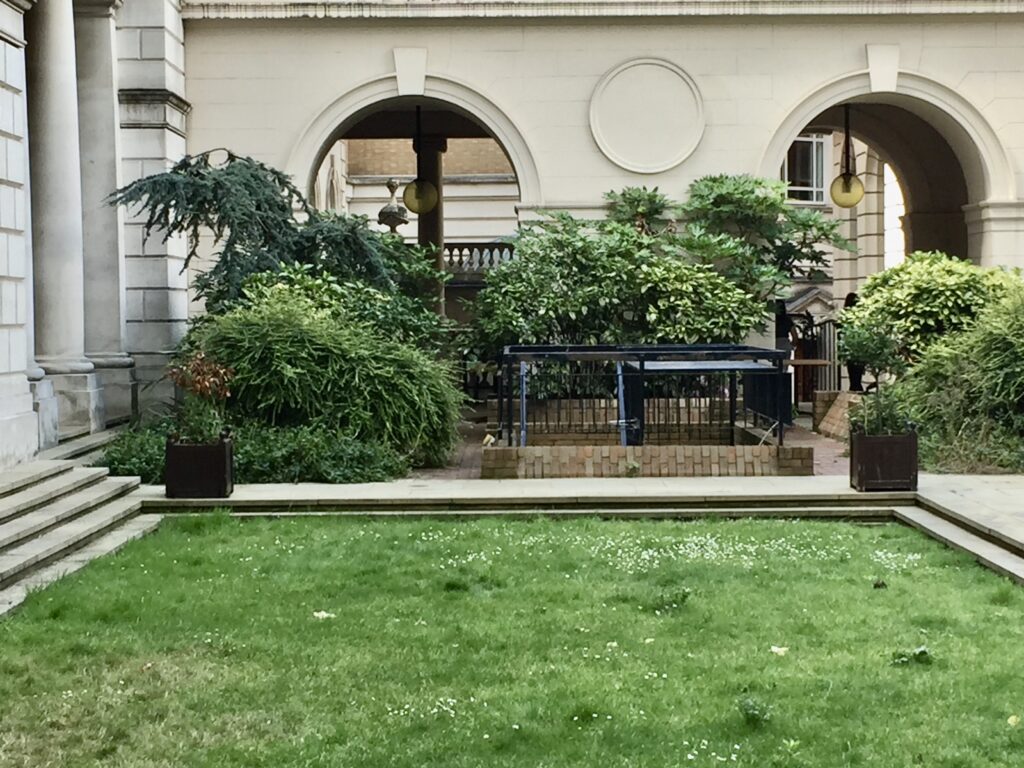
Further on is a totally unexpected green open space (alongside which is the little boy’s fountain) …

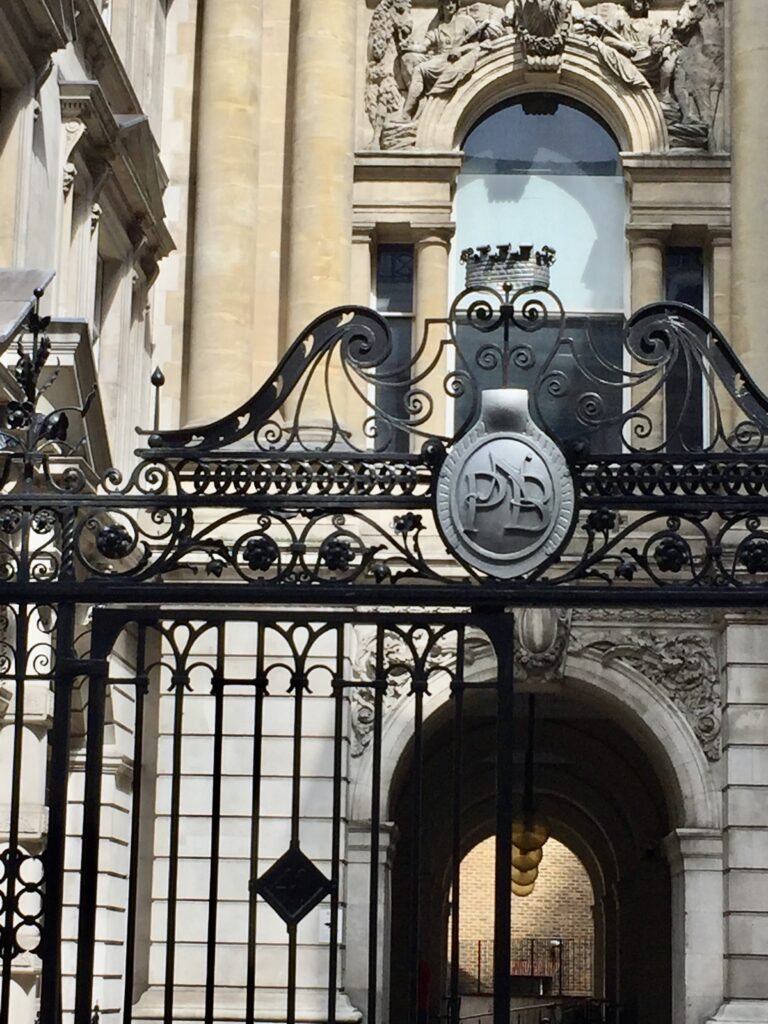
If you carry on and exit on to Threadneedle Street and look back you will see another set of ornate gates …

These are 19th-century, and were originally for the Oriental Bank. The grand building with the arch in the background was also part of the Bank, but the building was later taken over by the neighbouring National Provincial Bank, and their monogram added.

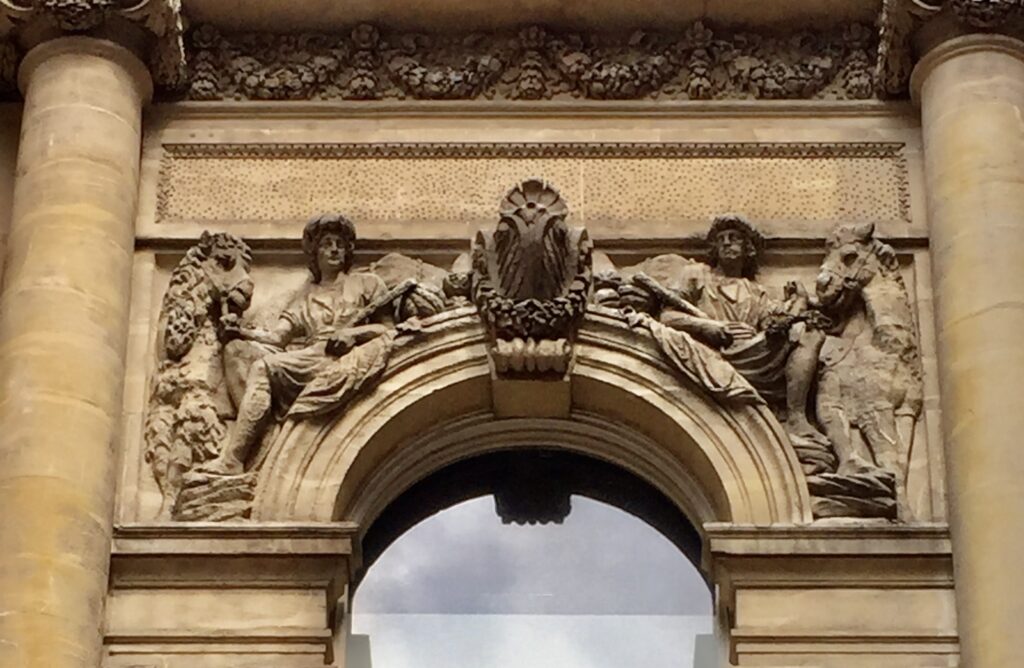
Look at the spandrels above the window … …

Two men are holding the reins of two camels.

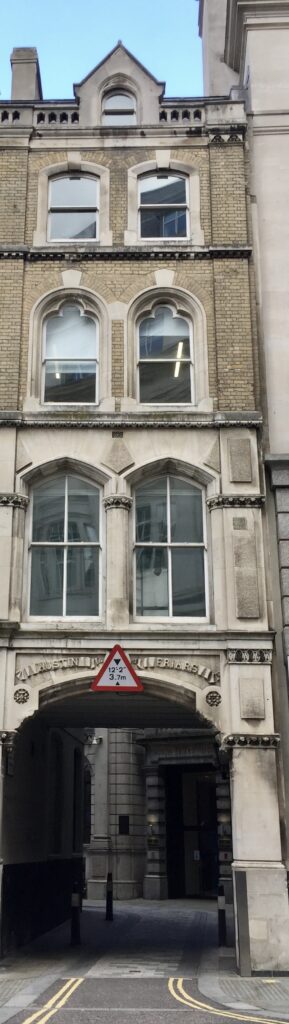
Across the road from Adam’s Court on Old Broad Street is the enticing entrance to Austin Friars …

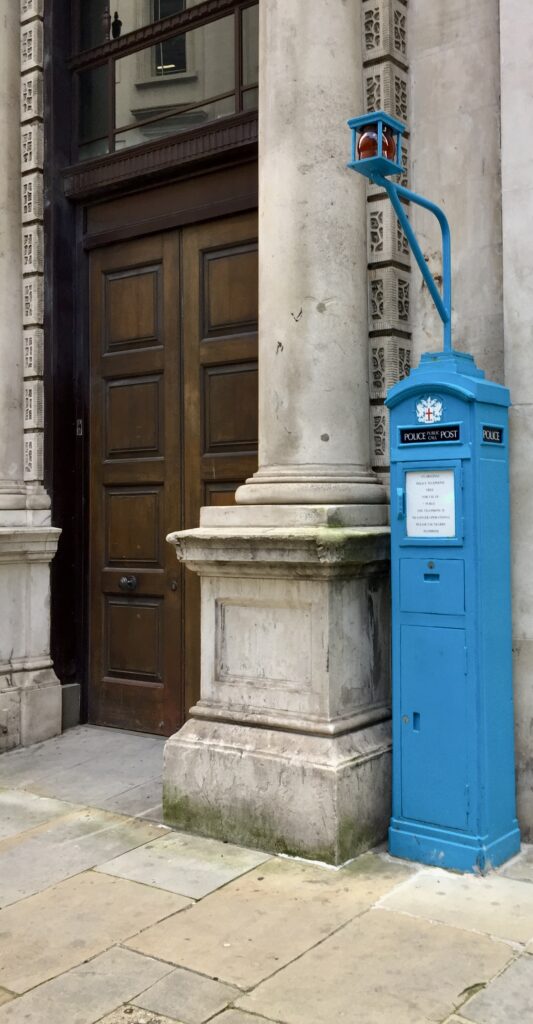
Before you cross the road, look right and admire the old City of London Police call box which has retained its flashing light indicating a caller was in need of help …

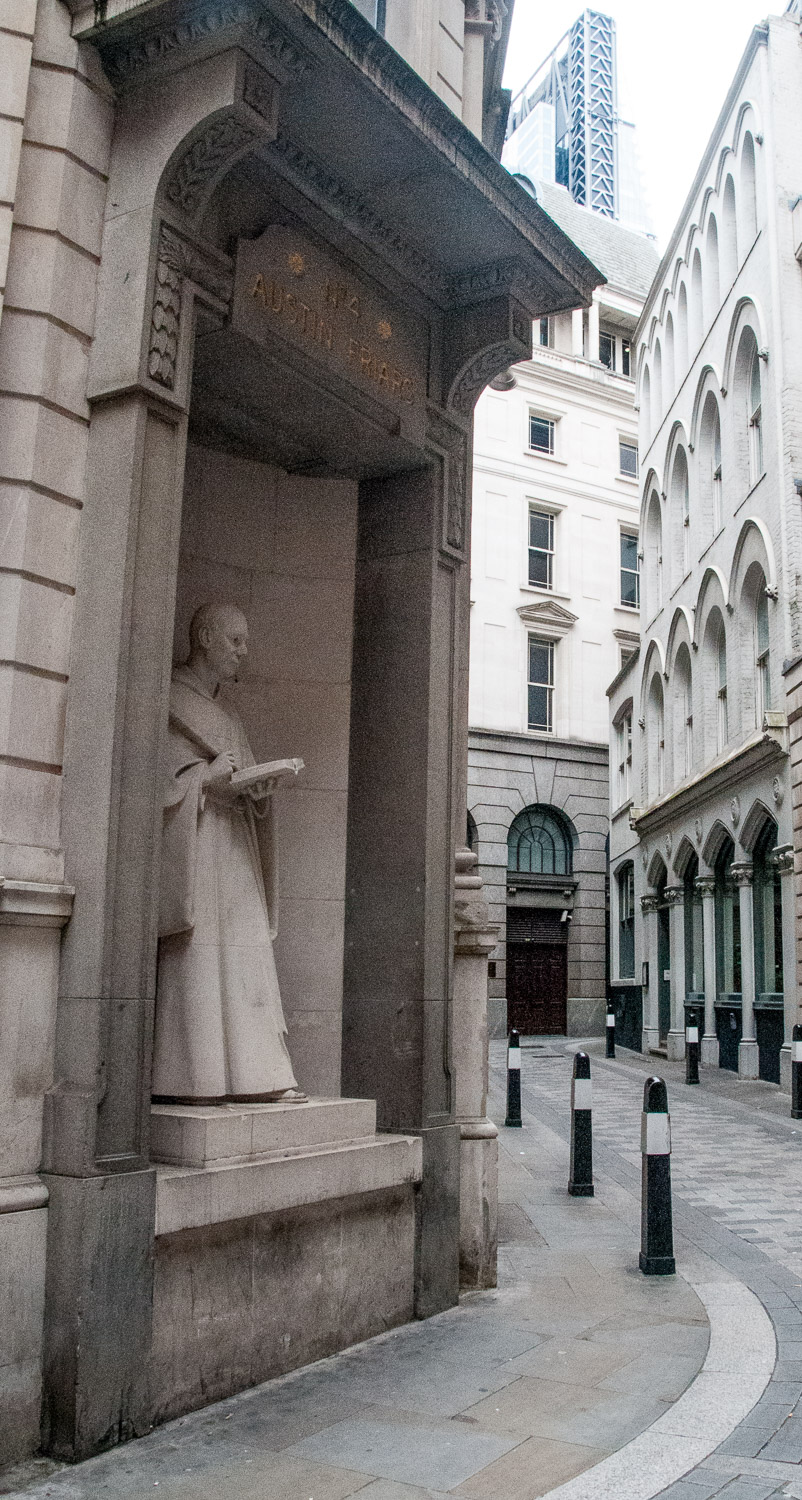
Walking through Austin Friars you pass a studious monk, writing in a book with his quill pen …

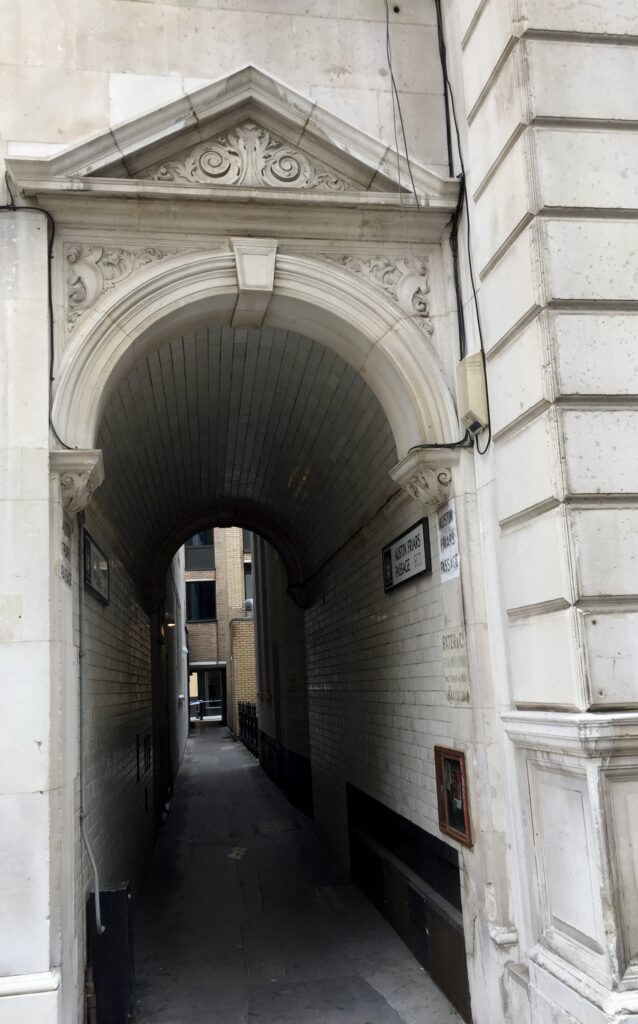
Eventually in front of you is the tucked away entrance to the atmospheric Austin Friars Passage, where I came across my next big surprise …

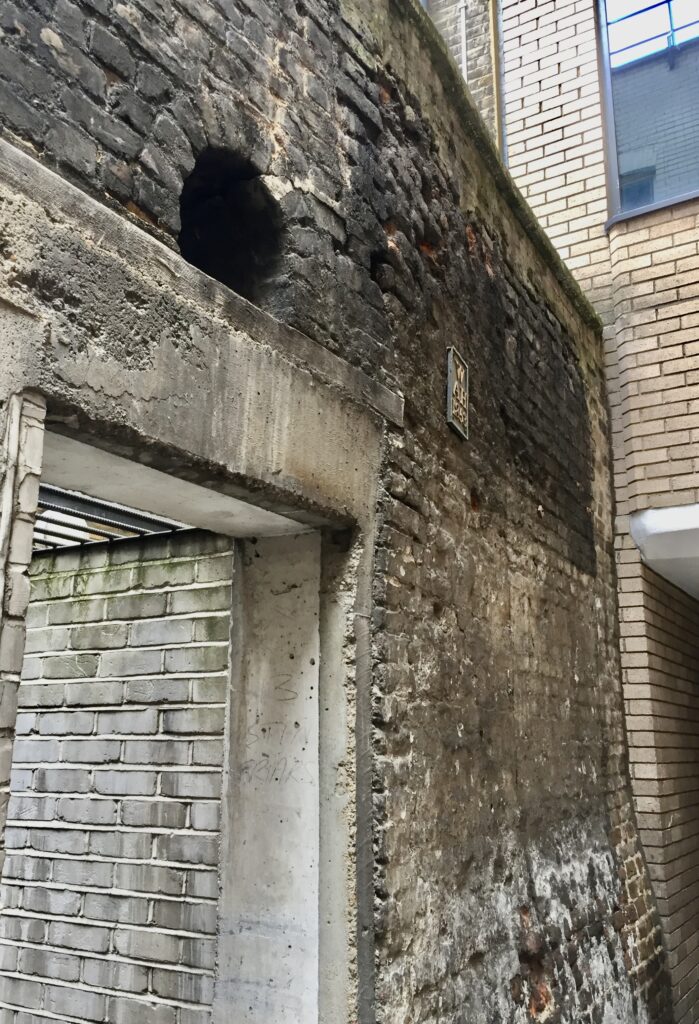
Almost at the end I encountered an extraordinary sight, a bulging, sagging wall that was clearly very old …

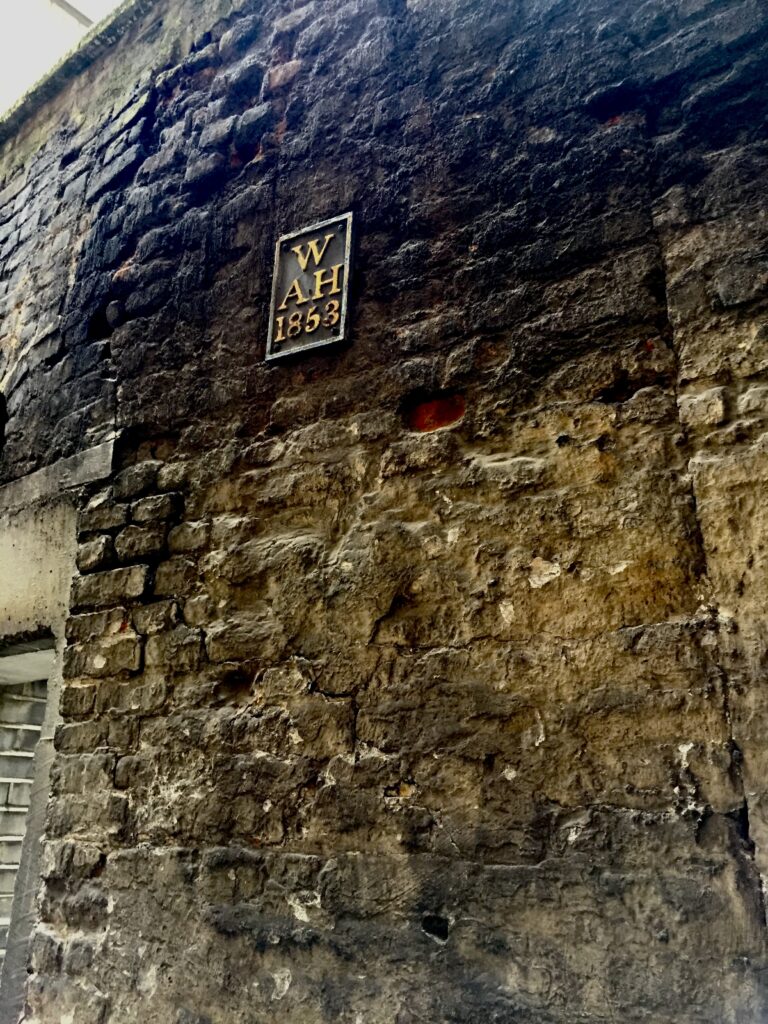
Up high is a parish marker for All Hallows-on-the-Wall, dating to 1853 …

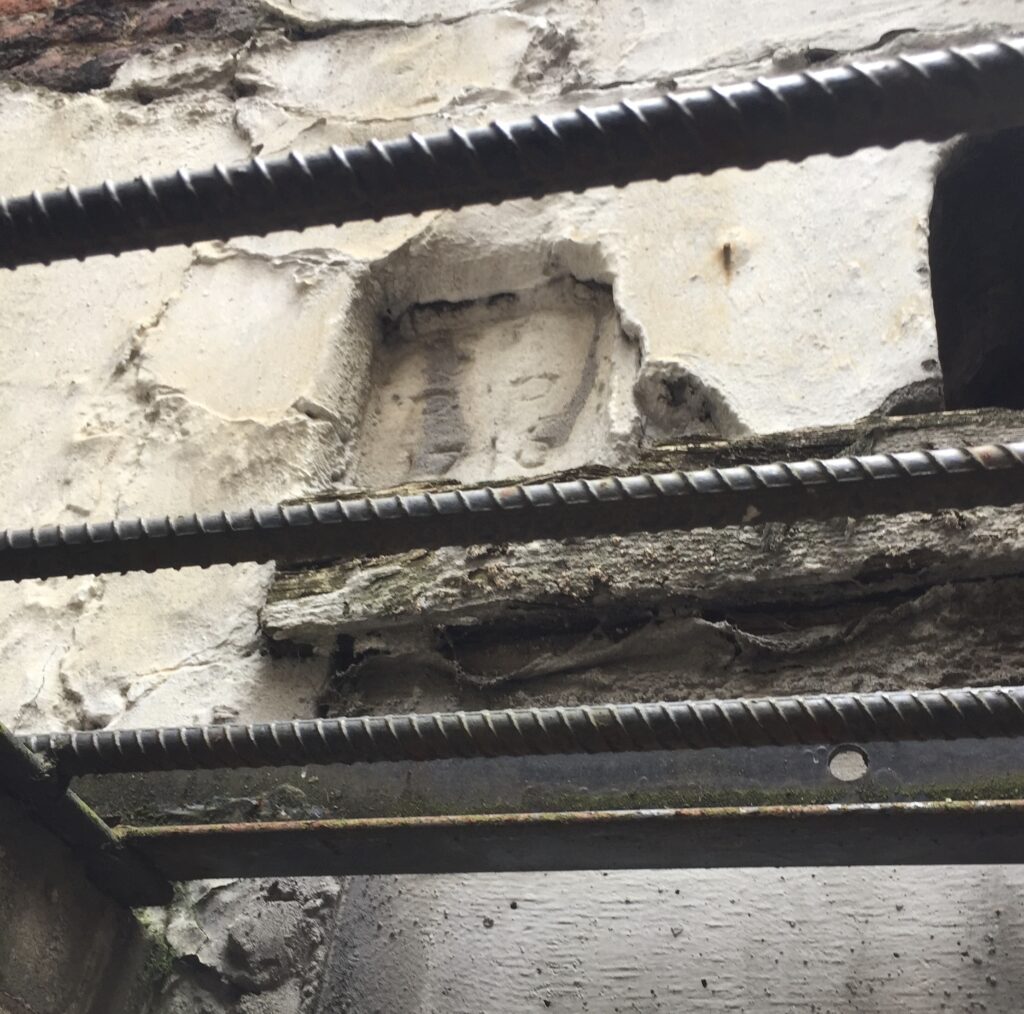
But the wall looks even older and, sure enough, standing in the alcove that leads to the other side and looking up, I saw this …

Another parish marker dating from 1715 – from the since-demolished church of St Peter le Poer. What a miracle that this old wall (which is not listed) has survived for over 3oo years as new buildings have sprung up all around it.

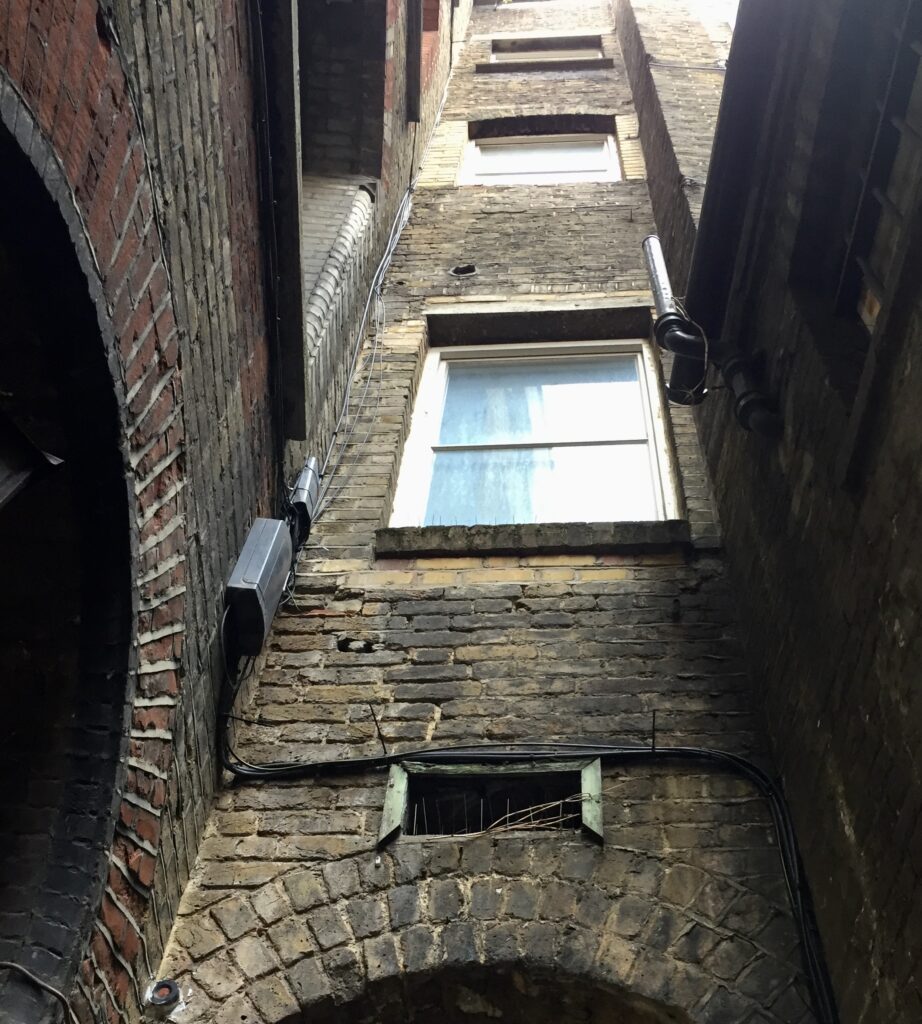
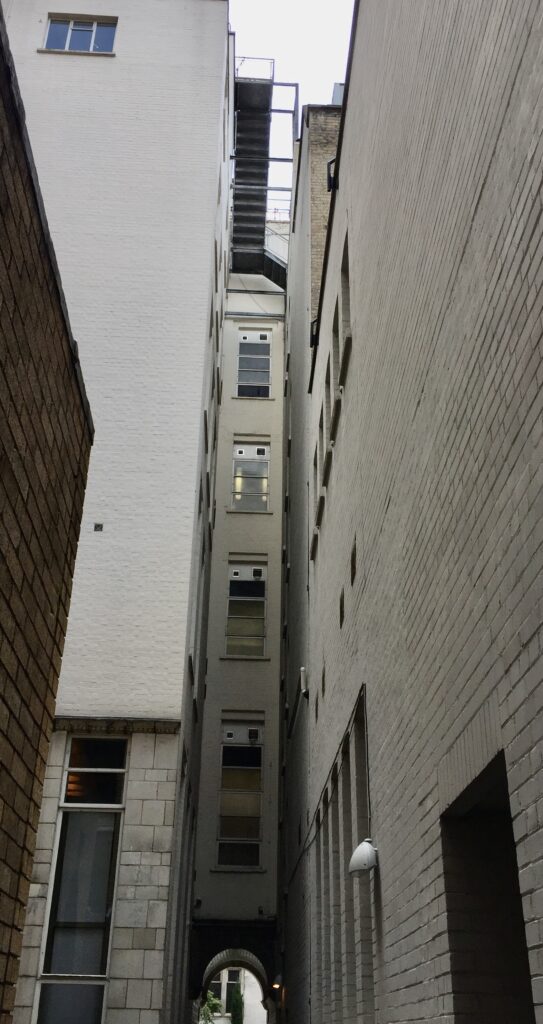
Look up and you’ll see that one of those buildings has a particularly scary fire escape. I wouldn’t fancy running down that in a panic …

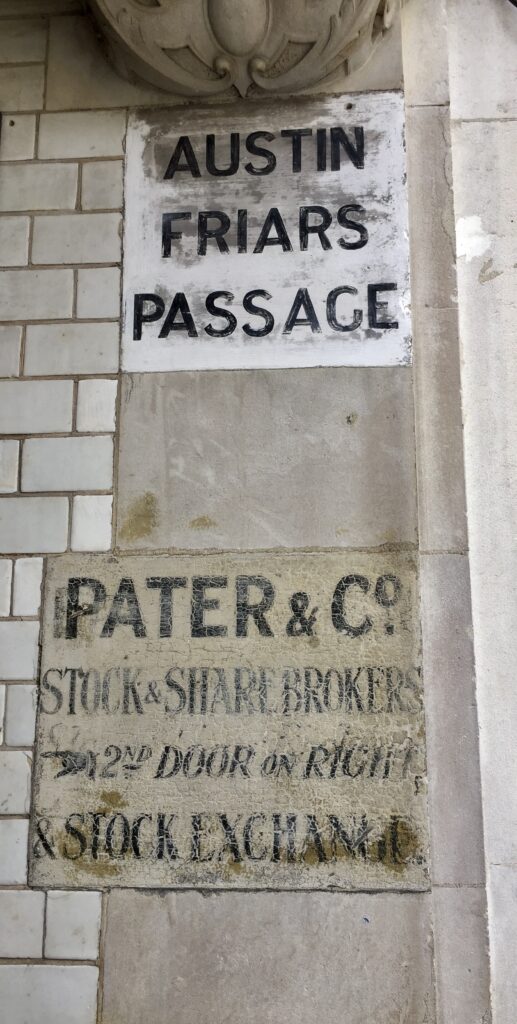
As you leave you can admire the charming ghost sign for Pater & Co …

The company was run by Arthur Long and Edgar John Blackburn Pater and traded from the 1860s to 1923 when Long retired and Pater continued on his own.

As is often the case I am indebted to the excellent Ian Visits blog for some of my background information. Here are links to Ian’s comments on Adam’s Court and Austin Friars Passage.

My earlier blogs on courtyards and alleys can be found here and here.

If you would like to follow me on Instagram here is the link …
https://www.instagram.com/london_city_gent/

Page 43 of 92

Powered by WordPress & Theme by Anders Norén

Symbols & Secrets
Privacy Overview

This website uses cookies so that we can provide you with the best user experience possible. Cookie information is stored in your browser and performs functions such as recognising you when you return to our website and helping our team to understand which sections of the website you find most interesting and useful.