Walking the City of London

Category: Water Page 7 of 9

Fun and Miscellany – my 100th blog!

Thank you so much for subscribing to my little publication – especially those of you who have been with me since the very beginning almost two years ago.

For the first anniversary I included things that I had come across that had made me smile and I want to do that again this week. I want as well, however, to include a few items that I thought were interesting but didn’t fit under any broad heading.

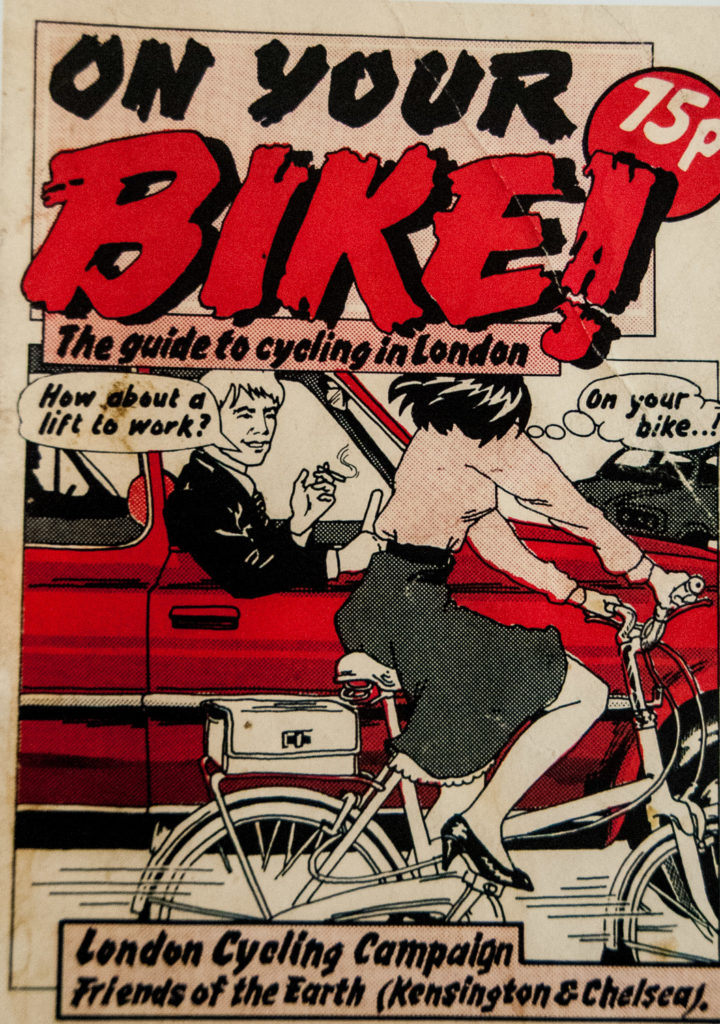
One of the great pleasures of doing research is the occasional joy of serendipity. I recently discovered that encouraging people to cycle to work is nothing new and magazines were being published almost 40 years ago which included maps to help cyclists navigate.

I came across this persuasive cover of On your bike! magazine from 1982 …
And now something a bit more surreal, a piece of art that was on display at the Guildhall art Gallery until a few weeks ago …
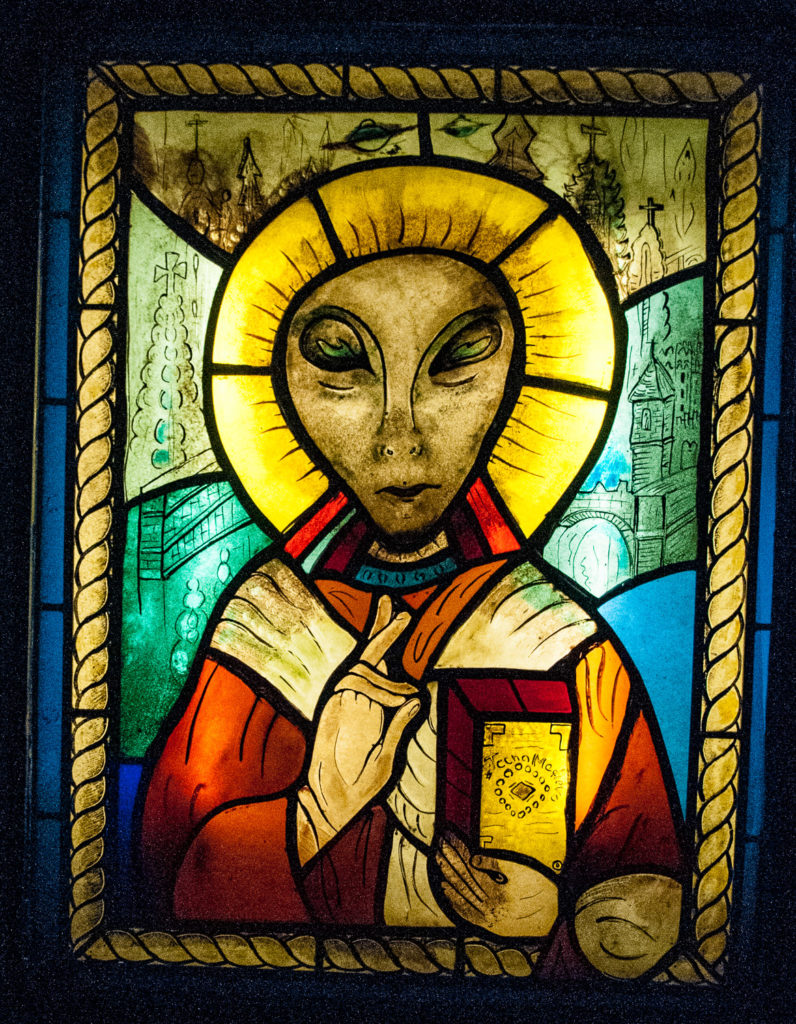
Marcello Pecchioli’s eye-catching stained glass Alien Priest was part of the Gallery’s ‘Visionary Artists’ exhibition. I like the flying saucers in the background.

Next up is this picture in the Gallery entitled Garden of Eden by Hugh Goldwin Riviere (1860-1956). Painted in 1901, it depicts a young man and girl walking in a misty, wet park with a horse-drawn cab rank in the background.

I like it because to me it’s one of those pictures that immediately gets you making up a back story to the characters. Surely this is an assignation – a secret lovers meeting, he clasping her hand and she gazing lovingly into his face. Then it struck me: Garden of Eden! A place of dangerous temptation and banishment!
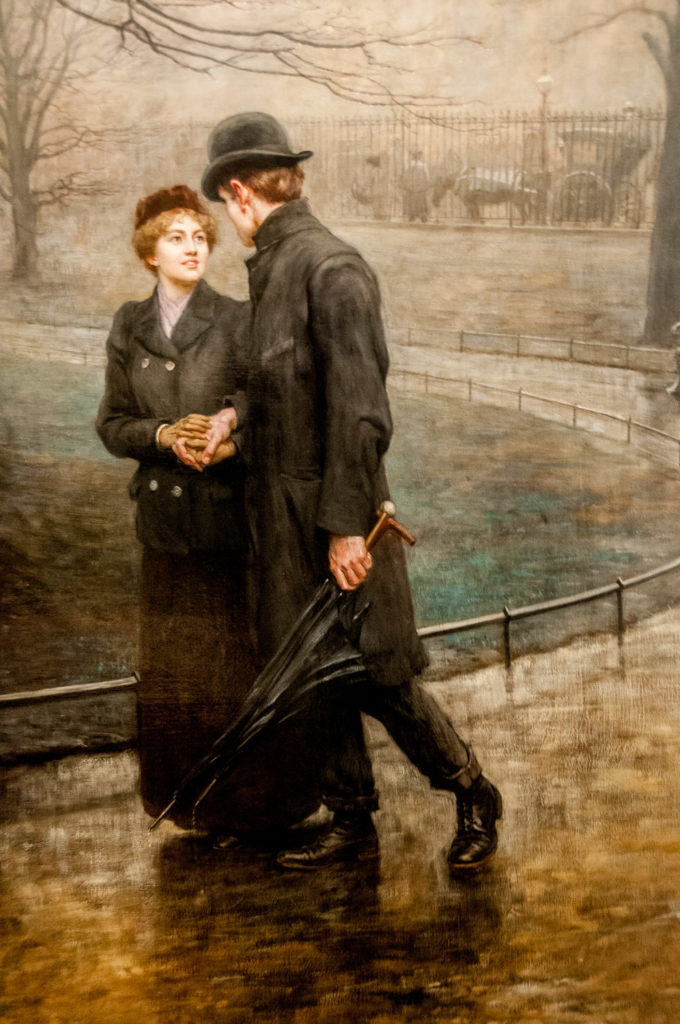
Apparently guides point out that this picture is actually about a mismatch between a wealthy woman who has fallen for a man much below her station: note his clumpy shoes, lack of gloves and his rolled up trouser bottoms. Also the way he’s carrying not one but two umbrellas, intertwined like the two lovers. There are tiny raindrops hanging from the black branches. Surely they represent tears to come? Or am I getting completely carried away? Another commentator has said that she is simply a smartly dressed maidservant on her day off, out walking with her beau.

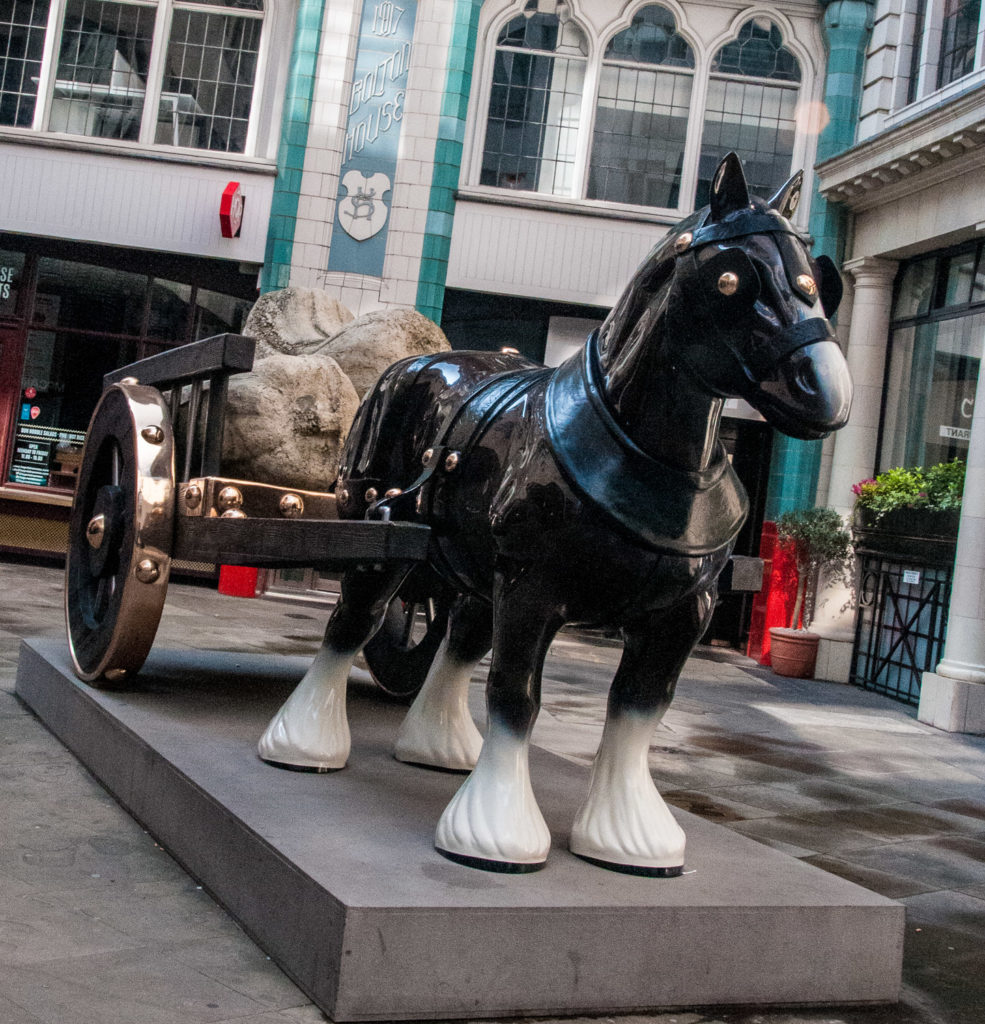
In Cullum Street I was stopped in my tracks by this stunning sculpture by Sarah Lucas entitled Perceval

Part of the ‘Sculpture in the City’ initiative – EC3M 7JJ

It’s a large-scale replica of a traditional china ornament of the kind that took pride of place on many British mantelpieces forty years ago. Perceval was a knight of the Round Table and apparently there is fertility symbolism in the giant concrete marrows on the cart. You can read more about this work here.

Also for us to admire as part of the Sculpture in the City project is this example entitled Crocodylius Philodendrus by Nancy Rubins at 1 Undershaft (EC3A 6HX). I love it because it’s completely bonkers …
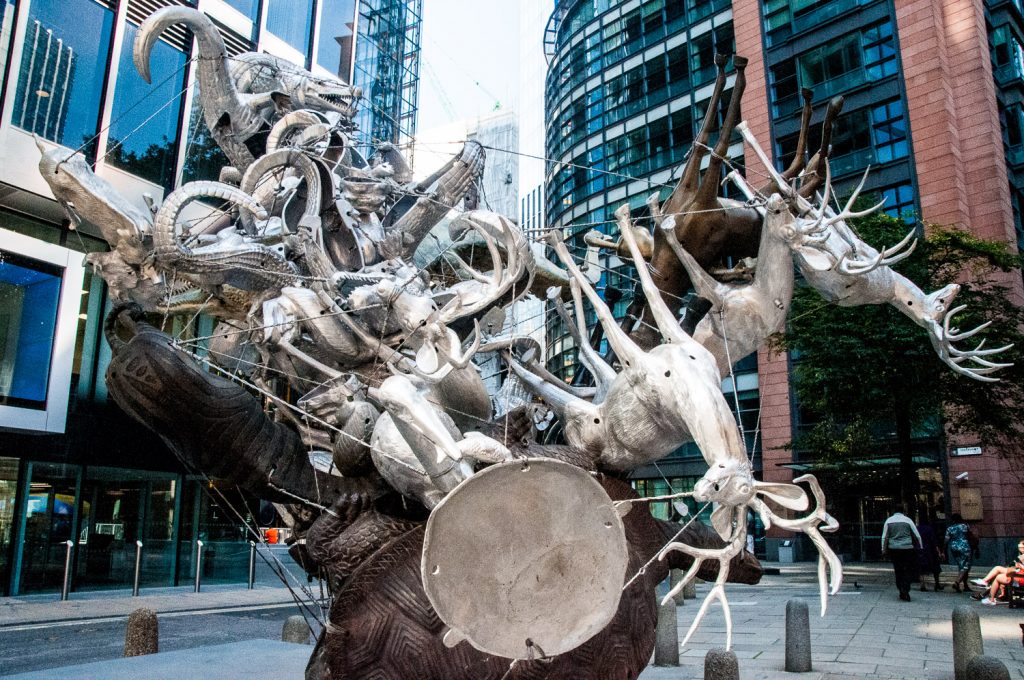
See how many animals you can spot

I keep meaning to spend some time in the Blackfriar pub on Queen Victoria Street recording the brilliant brasses there (EC4V 4EG) but I still haven’t got around to it. So in the meantime, here is the advice on one of them …
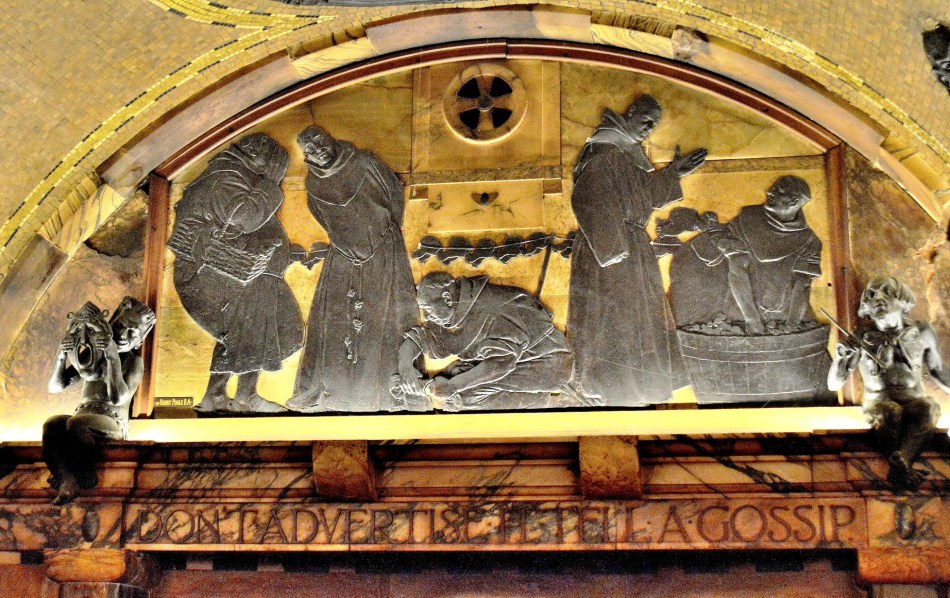
‘Don‘t advertise – tell a gossip

Don’t forget to look down when crossing the Millennium (‘Wobbly’) Bridge and see if you can spot some of the witty work by the artist Ben Wilson. He has painstakingly painted literally dozens of pieces of discarded chewing gum …
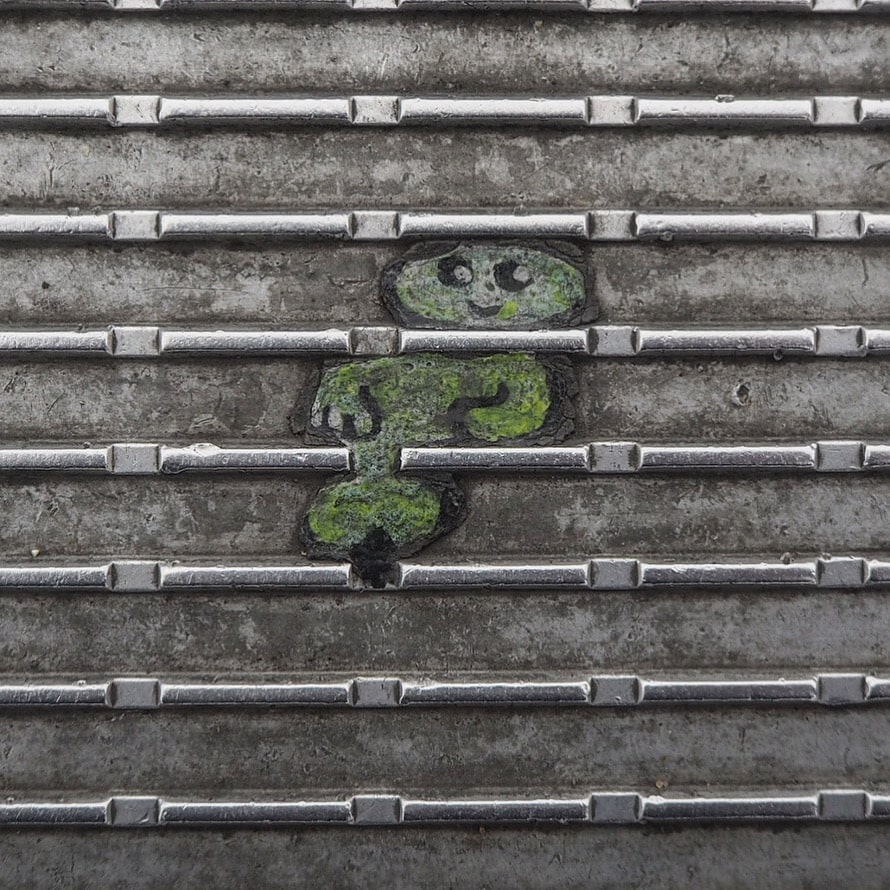
I have written more about him in my earlier blog Tales from City Bridges.

There is a Banksy rat painting in Chiswell Street that has been altered by another artist. Banksy’s piece originally depicted a stencilled ghetto rat holding a placard which read ‘London doesn’t work’ …
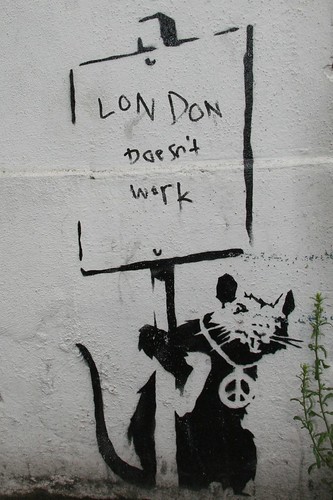
Photograph taken by ‘Noodlefish’ 26 August 2006

However, Robbo, Banksy’s rival graffiti artist, reworked the placard by adding his name in red letters. Robbo was known for leaving his mark on many Banksy pieces but I read in the interesting Londonist blog that Robbo died in 2014, bringing the rivalry to an end.
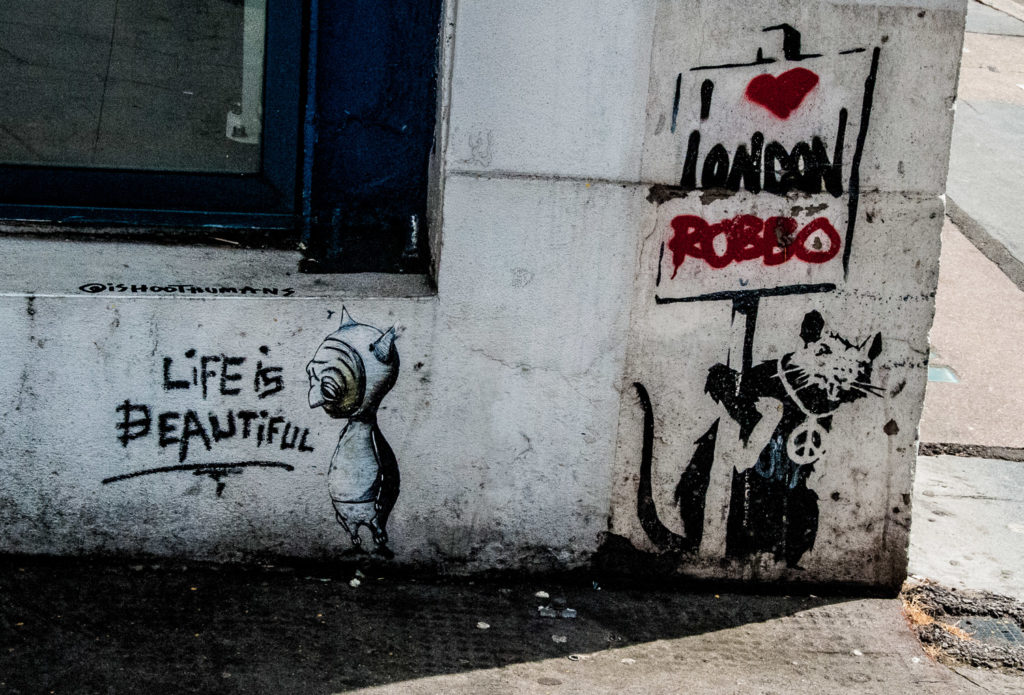
I haven’t been able to find out more about the strange ‘Life is beautiful’ figure next to it.

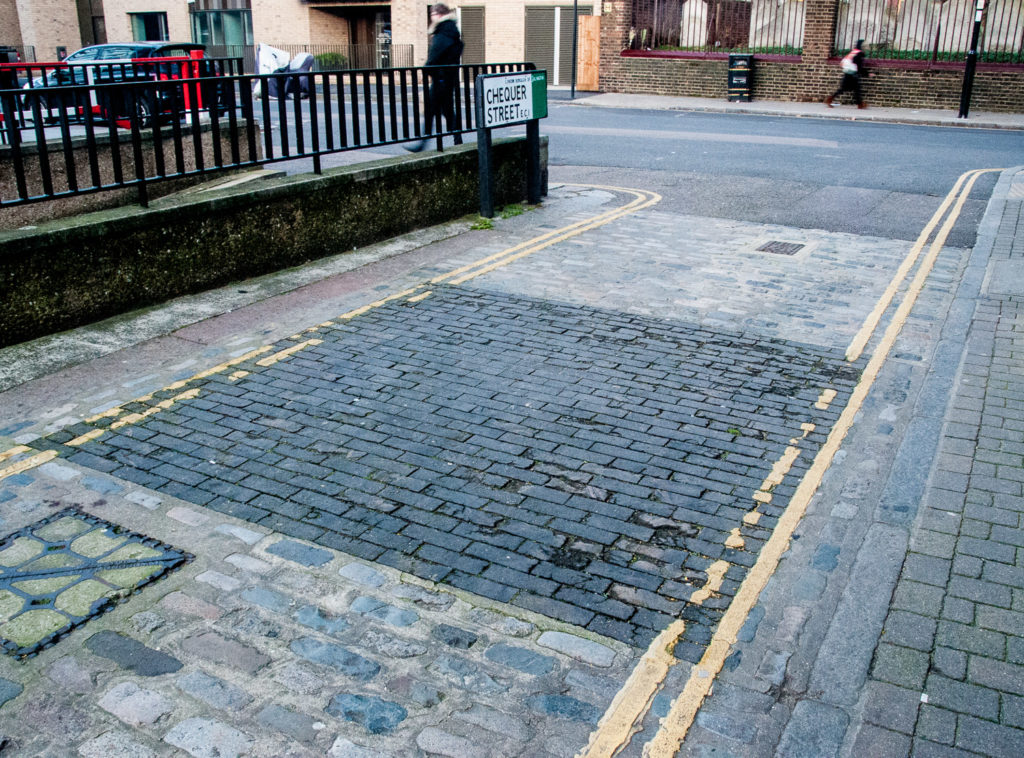
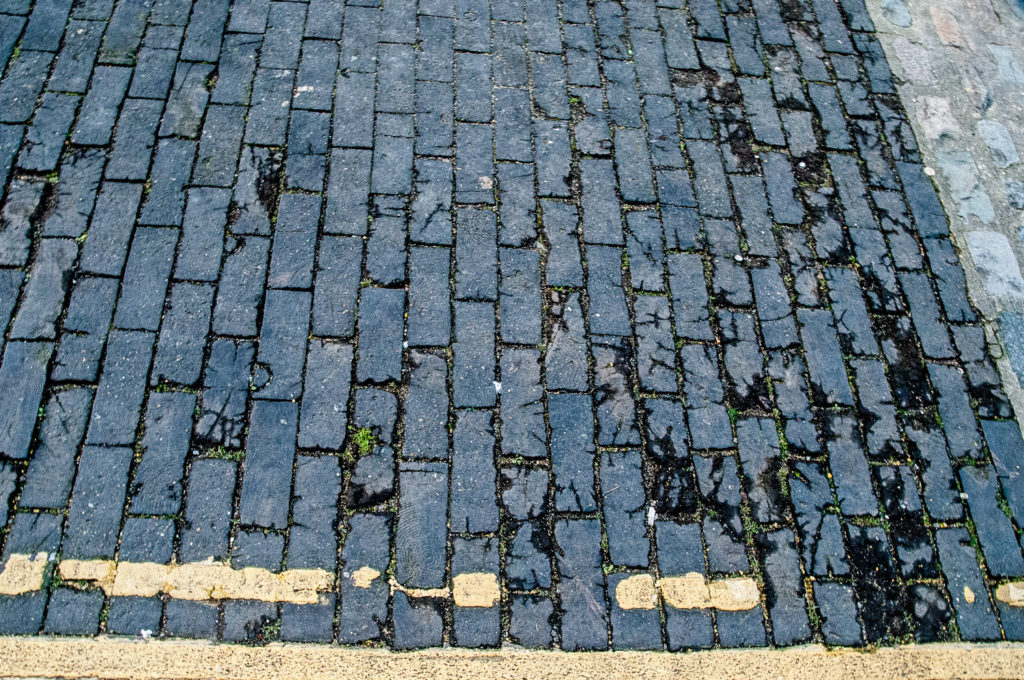
It is hard to imagine now but many of London’s roads were once paved with wood. However a map of London by Bartholomew’s in 1928 shows clearly the expansive reach of the wooden block road paving method. In the map excerpt below, the yellow roads are all paved with wooden blocks …
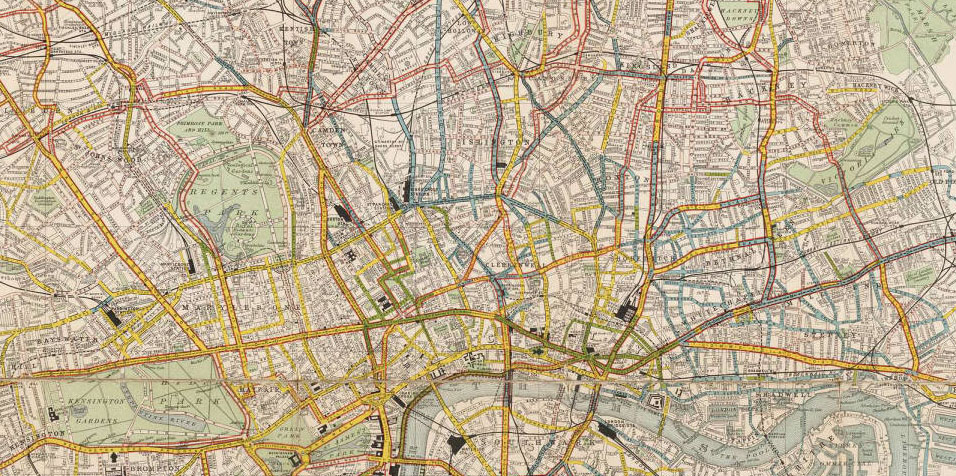
Read more in the excellent blog ‘Ian Visits’

Many were destroyed in wartime bombing and many also dug up by local residents for burning as heating. Since they were impregnated with tar they burnt furiously and, of course, made a major contribution to London’s filthy air.

For some people this was an entrepreneurial opportunity. This is Alan Sugar being interviewed for the Daily Express in 2010 about when he noticed old blocks being uncovered when roads were being resurfaced …

The workers showed me the blocks, which were impregnated with tar, and they chucked a couple onto the fire – they burned like a rocket. Bingo! It occurred to me that these discarded wooden blocks could be made into fire-lighting sticks. I could cut them up into bundles of sticks and flog them.

And you can still see a section of wooden road today at the junction of Chequer Street and Bunhill Row EC1 …
Looking over the wall on the Embankment one day I noticed these lions heads with mooring rings …
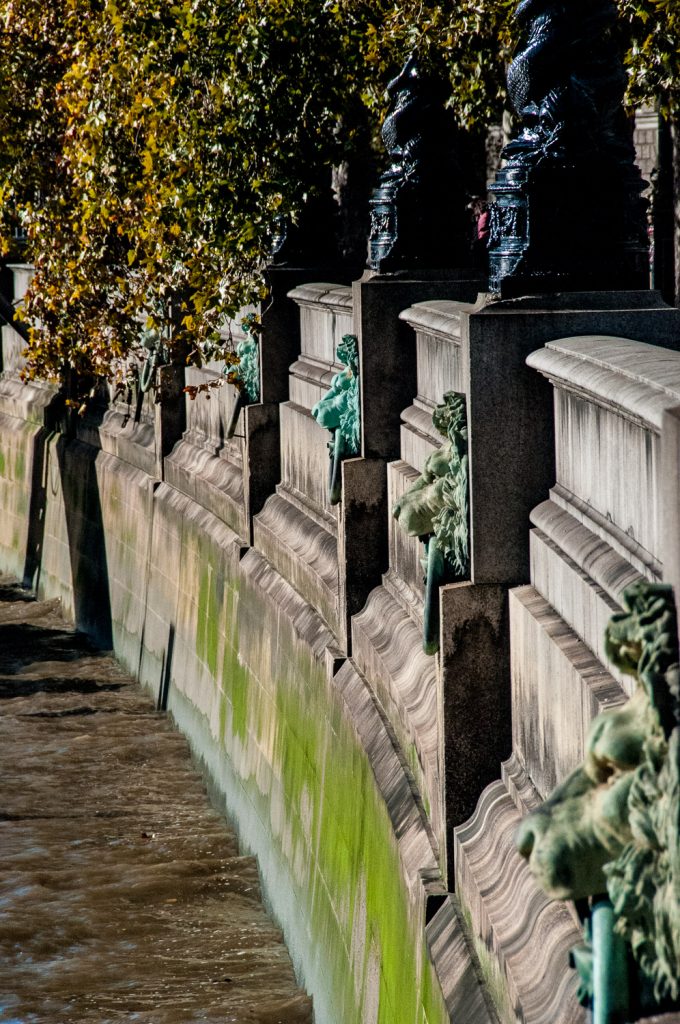
They were sculpted by Timothy Butler for Bazalgette’s great sewage works in 1868-70 and it is said that, if the lions drink, London will flood.

And to end with, two more items with watery themes that make me smile.

Firstly, a famous satire on the quality of the Metropolitan water supply in 1828. An elderly lady displays her horror and shock on looking at a speck of Thames water through a microscope …
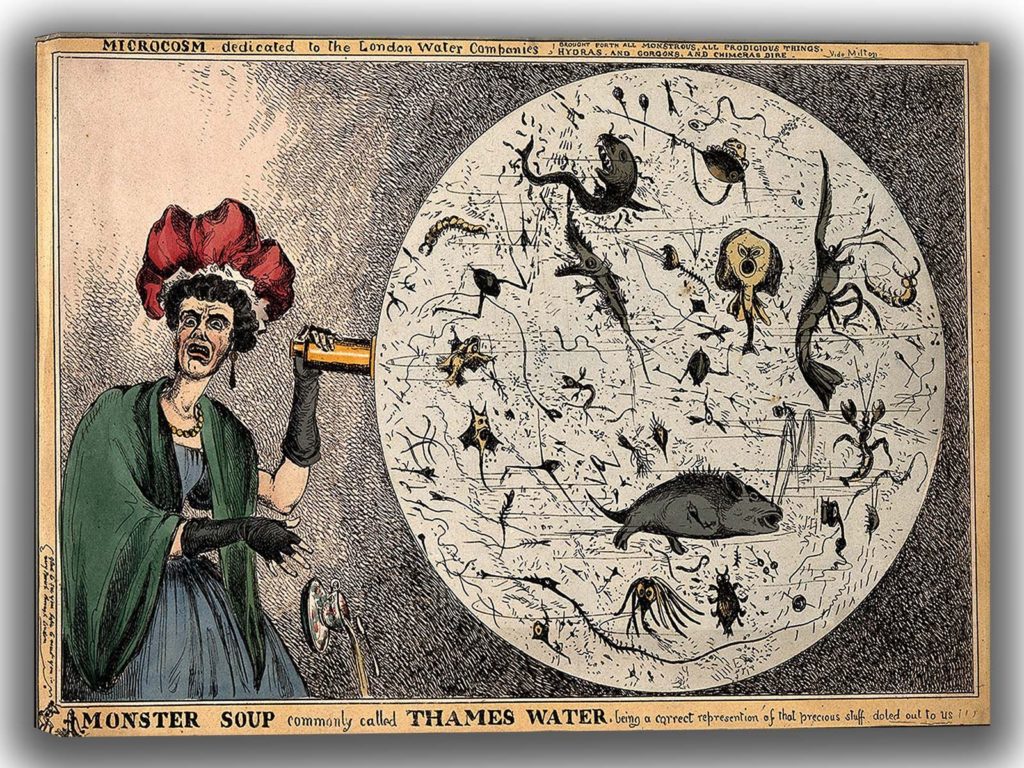
Copyright: British museum

It’s by the artist and caricaturist William Heath (1795-1840) and is entitled Monster Soup commonly called Thames Water being a correct representation of that precious stuff doled out to us! You can read more about the efforts made to get fresh water to Londoners in my blog Philanthropic Fountains.

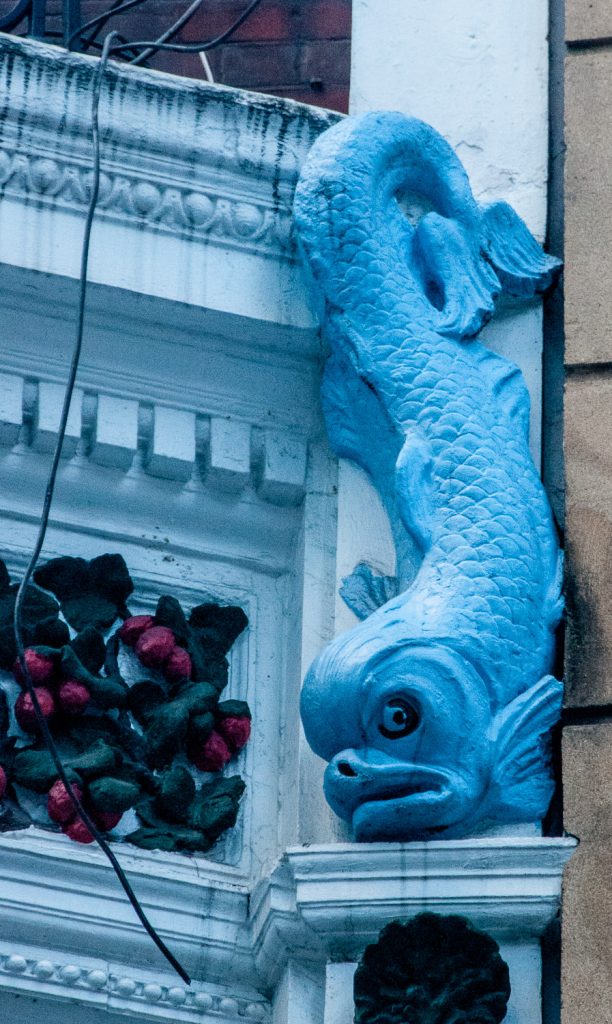
And finally I always say hello to this miserable dolphin on The Ship pub in Hart Street (EC3R 7NB). I also tell him to cheer up – the pub is a listed building and therefore so is he …
Thanks again for subscribing!
Sculptures with striking poses

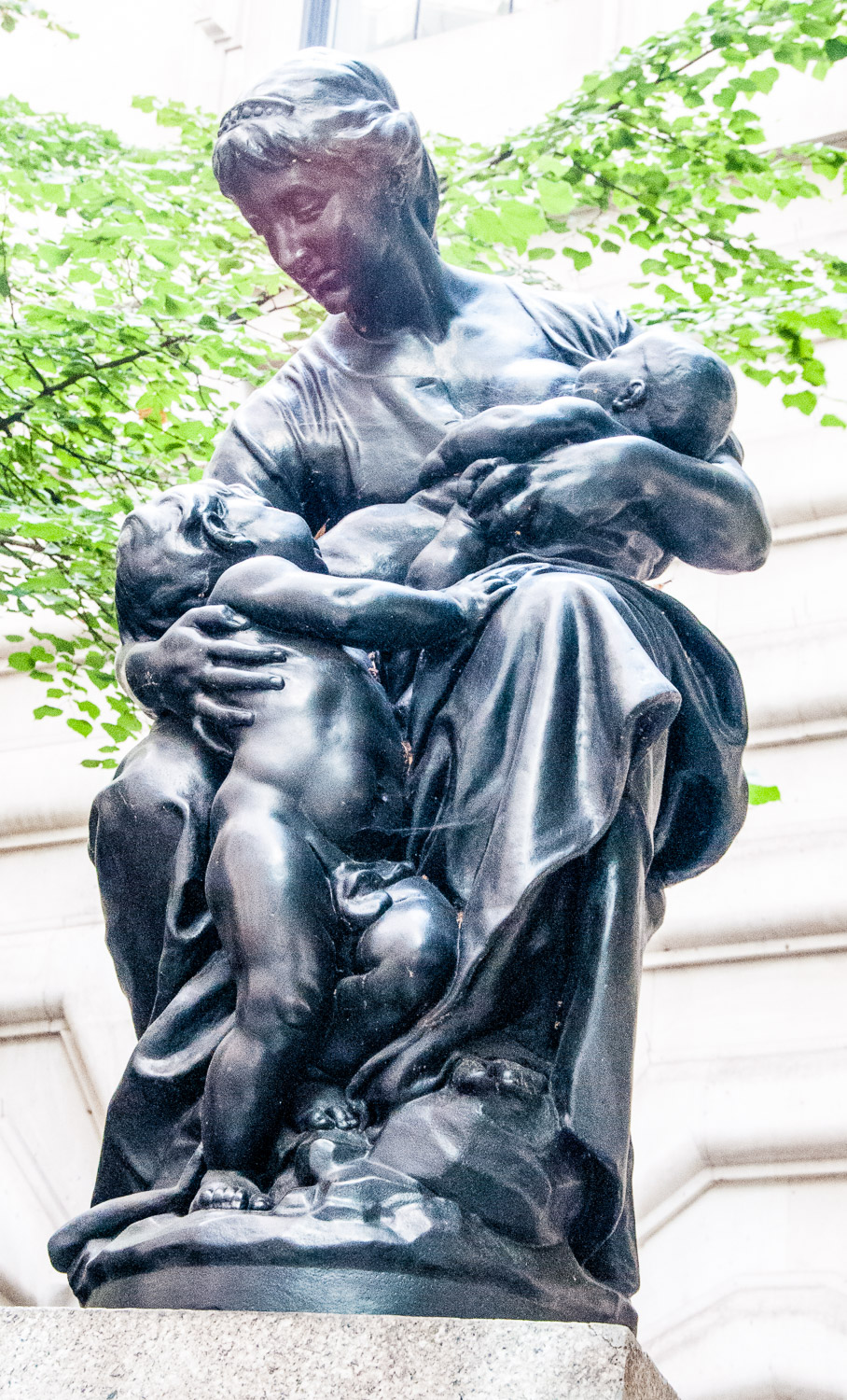
I’ll start with a work that caused some controversy, the Charity Drinking Fountain (also known as La Maternité) by Aimé-Jules Dalou (1877-9).

In his book Public Sculpture of the City of London, Philip Ward-Jackson describes the lady as follows:

Despite her casual garb she has a diadem or tiara on her head. With her left arm she enfolds a baby, who she is suckling, whilst with her right she draws to her knee a naked boy, who gazes up at her.

She is outside Royal Exchange Buildings EC3V 3NL.

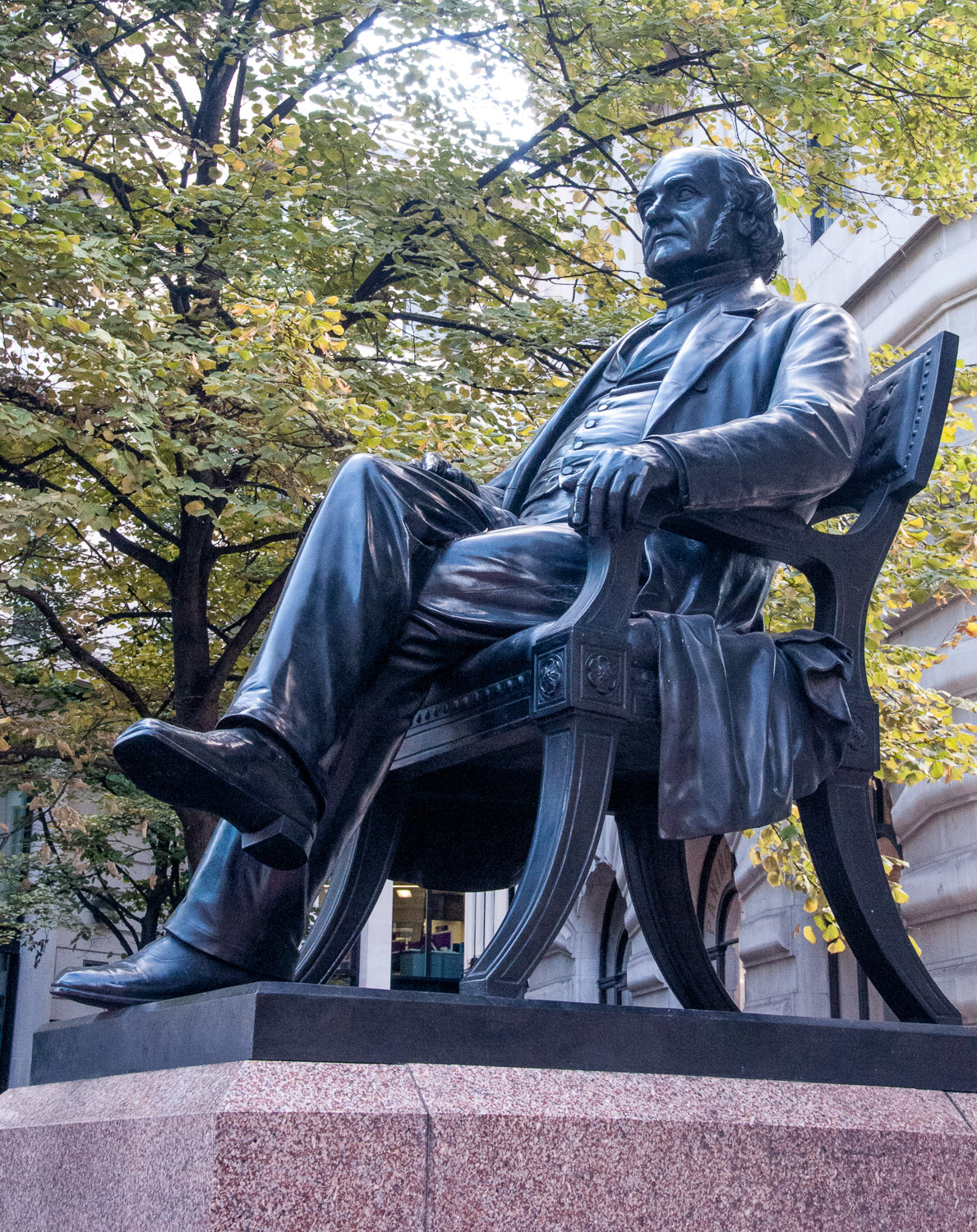
Nearby is a very relaxed George Peabody who I have written about in an earlier blog

Ward-Jackson tells us that the suckling lady’s very authentic exposed breast produced at least one letter of protest to the editor of The Globe. The correspondent urged that ‘common decency’ should be observed and went on …

Do you not think, Sir, that Mr Peabody’s chair should be turned, at least until the delicate operation of ‘lacteal sustenation’ be concluded … or the young woman and youngsters provided with the requisite clothing.

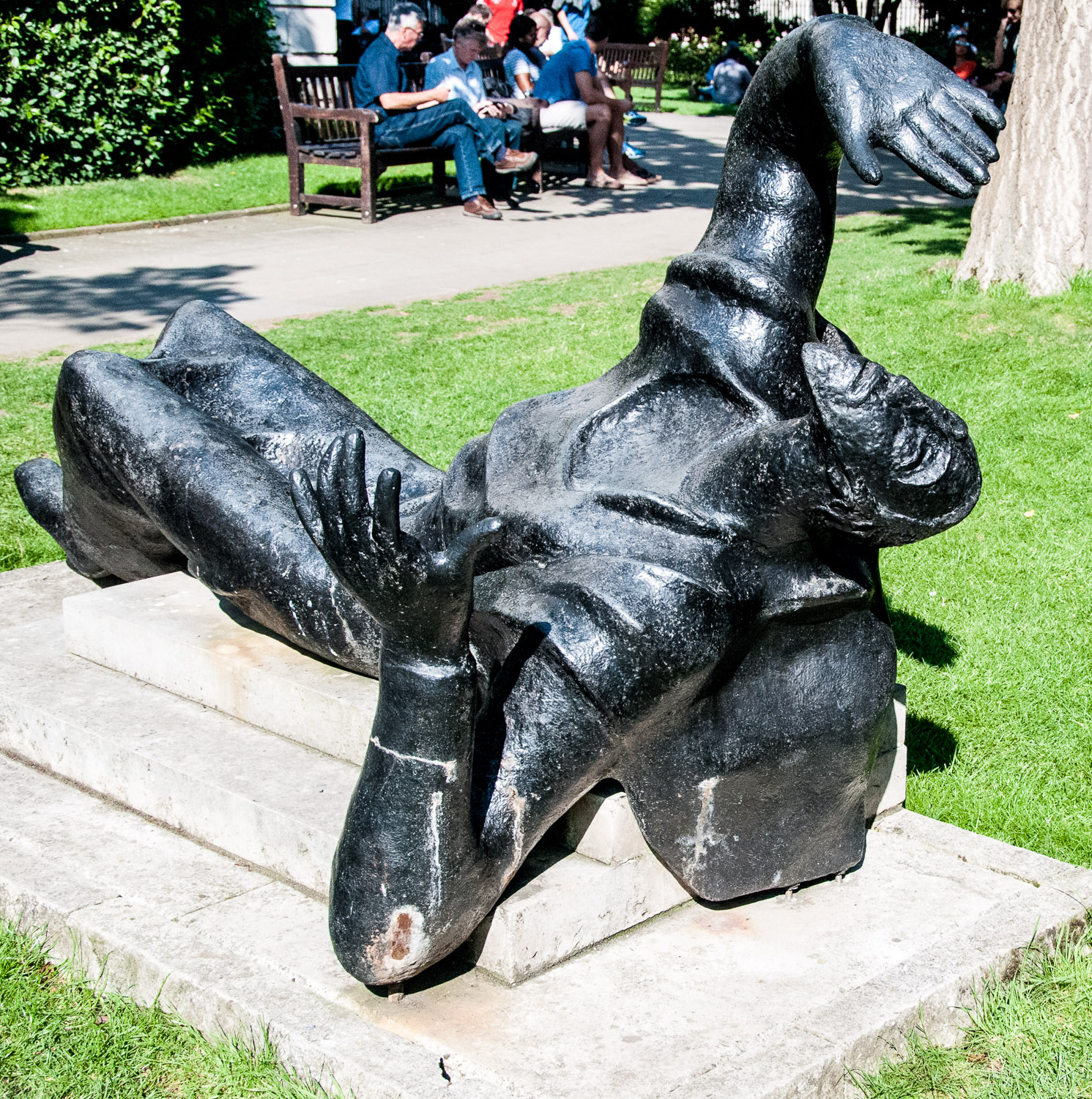
On a more serious theme, St Thomas à Becket lies in agony in St Paul’s Churchyard on the south side of St Paul’s Cathedral (EC4M 8AD) …

‘Becket’ by Edward Bainbridge Copnall (1970-71).

The Ornamental Passions website gives the following description :

(The sculptor) depicts the Archbishop in the agony of death, his right hand extended as if to ward off the blows of his knightly assassins. The plinth is stepped to recall the steps into the choir of Canterbury Cathedral … This memorable image was created in 1970 as part of the commemorations of the saint’s martyrdom.
The material looks like bronze but is in fact resin coloured to look like bronze.

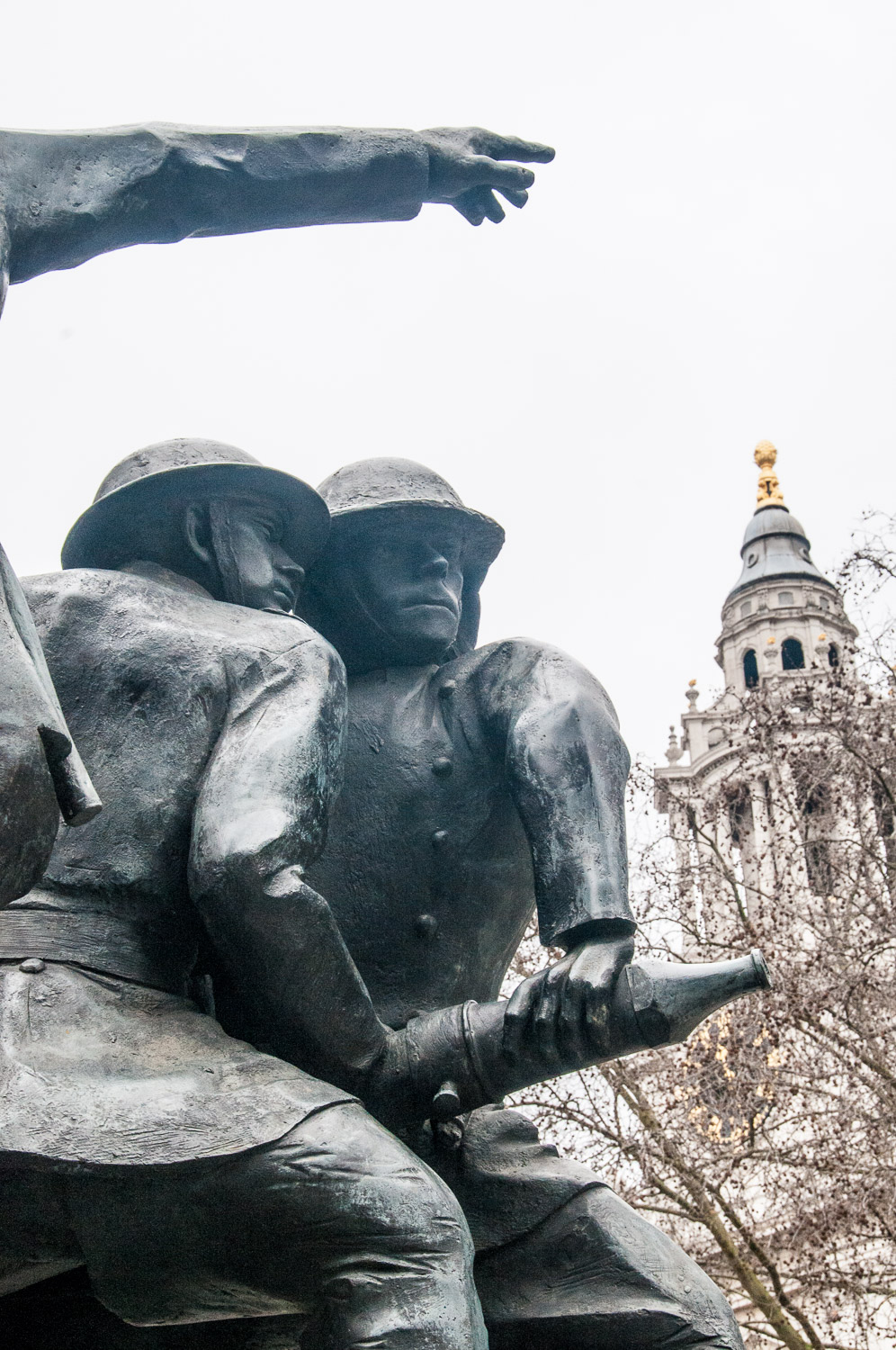
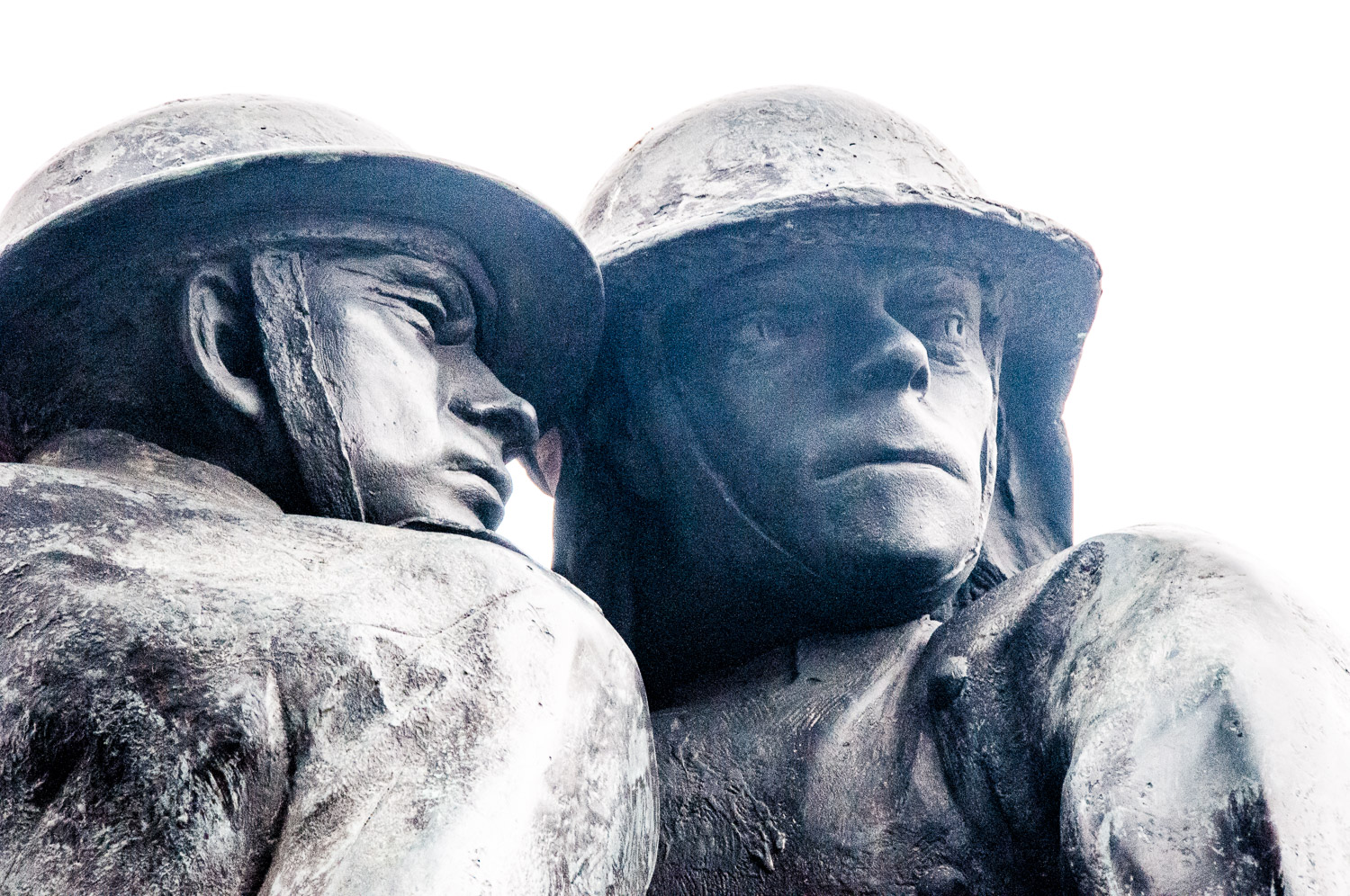
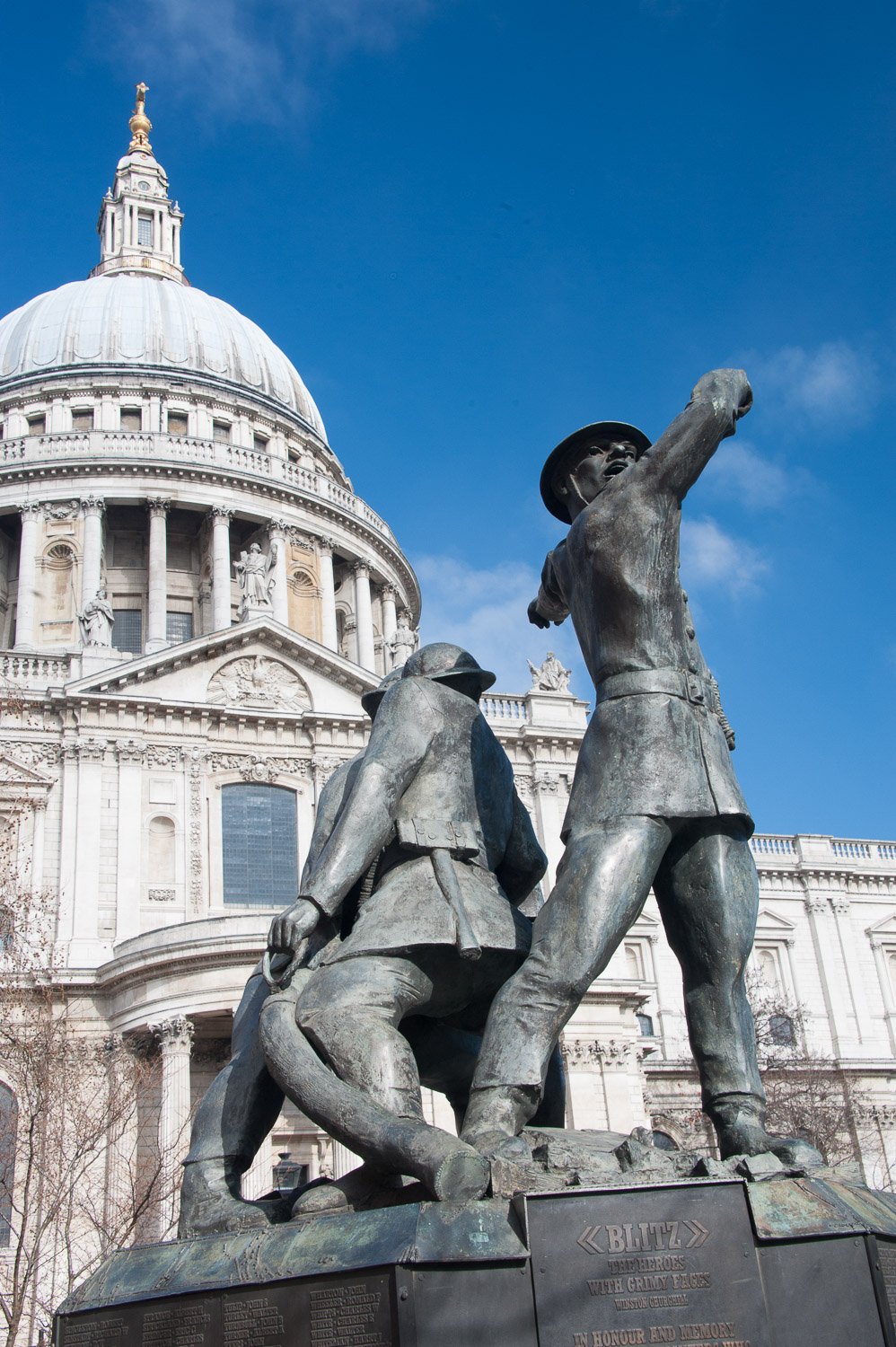
Just across the road from St Paul’s, on the right as you approach the Millennium Bridge, you will see the National Firefighters Memorial (EC4M 8BX) which depicts a Fire Officer and two Firemen, cast in bronze engaged in firefighting duties. Unveiled by the Queen Mother in 1991, it was originally called ‘Blitz’ and was dedicated to the men and women of the Fire Service who lost their lives as a result of their duties during World War II.  In 2000 it was renamed the Firefighters Memorial in order to commemorate all firefighters killed whilst in service and a new raised plinth now records almost 2,300 names.

Two of the men are ‘working a branch’, their legs braced to take the strain …

Churchill memorably called them ‘Heroes with grimy faces’.

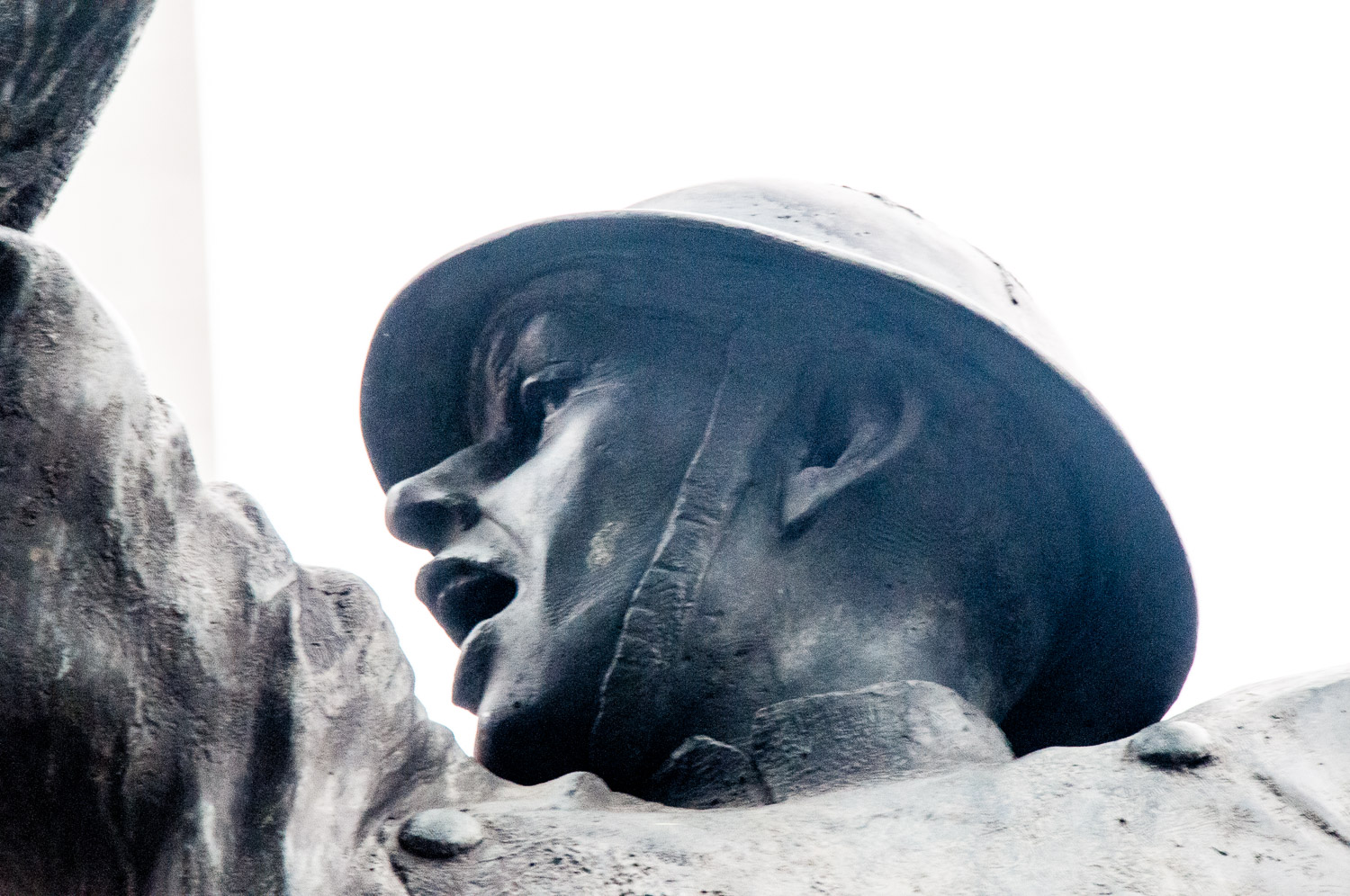
The Officer below looking over his shoulder, possibly calling up reinforcements, is Cyril Demarne OBE who provided photographs to help the sculptor (who also happened to be his son-in-law) …

According to Philip Ward-Jackson, Demarne’s initials CTD are scattered among the brickwork on which the men stand but his old colleagues needed no such clues. One stated in an interview …

You can tell it’s Cyril by the way he’s standing … He always waved his arms about like that when he was ordering us about.

Officer Demarne in full flow …

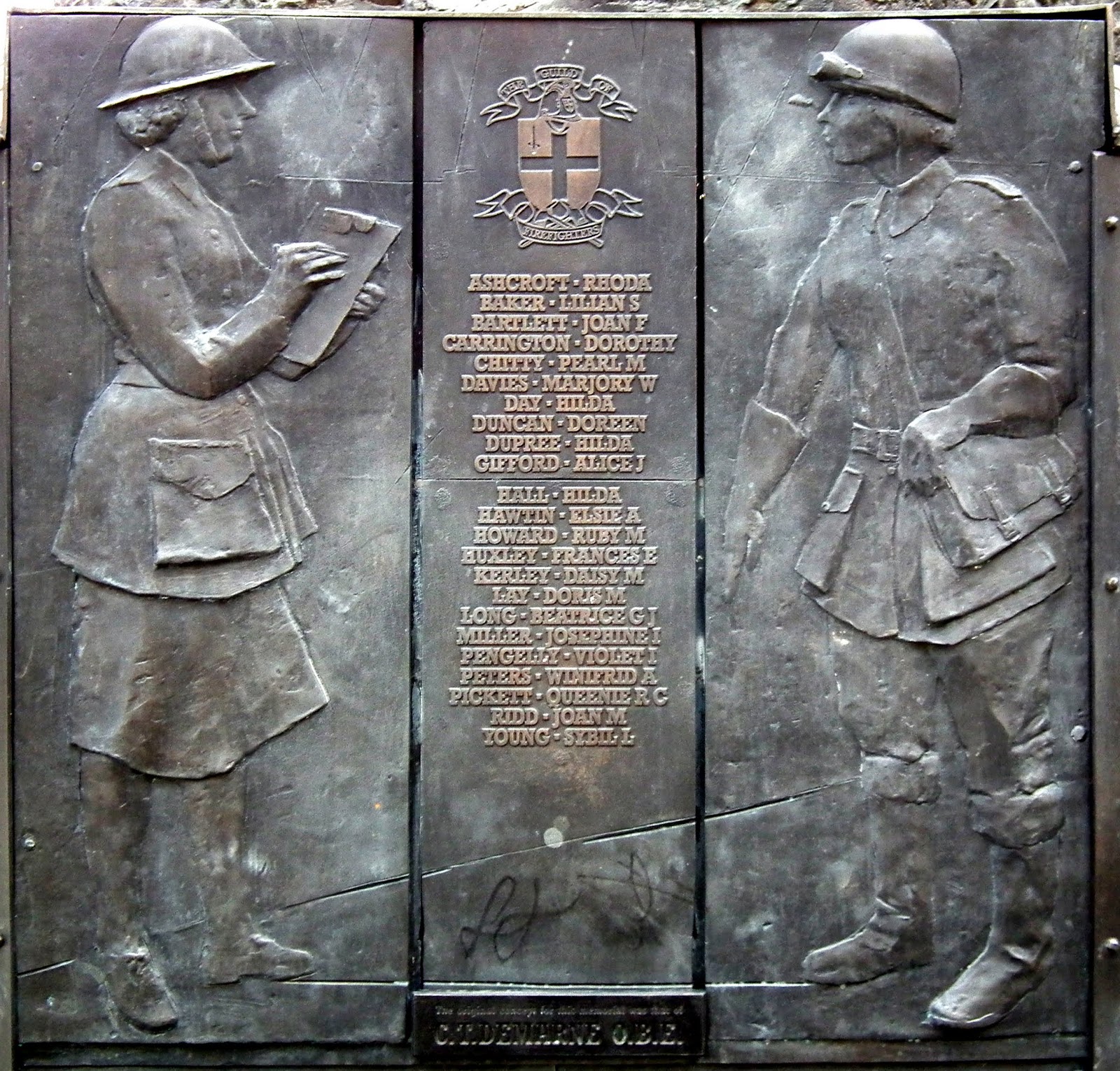
By 1943 over 70,00 women had enrolled in the National Fire Service in the United Kingdom. This memorial commemorates those who lost their lives in the London Blitz …

The lady on the left is an incident recorder and the one on the right a despatch rider.

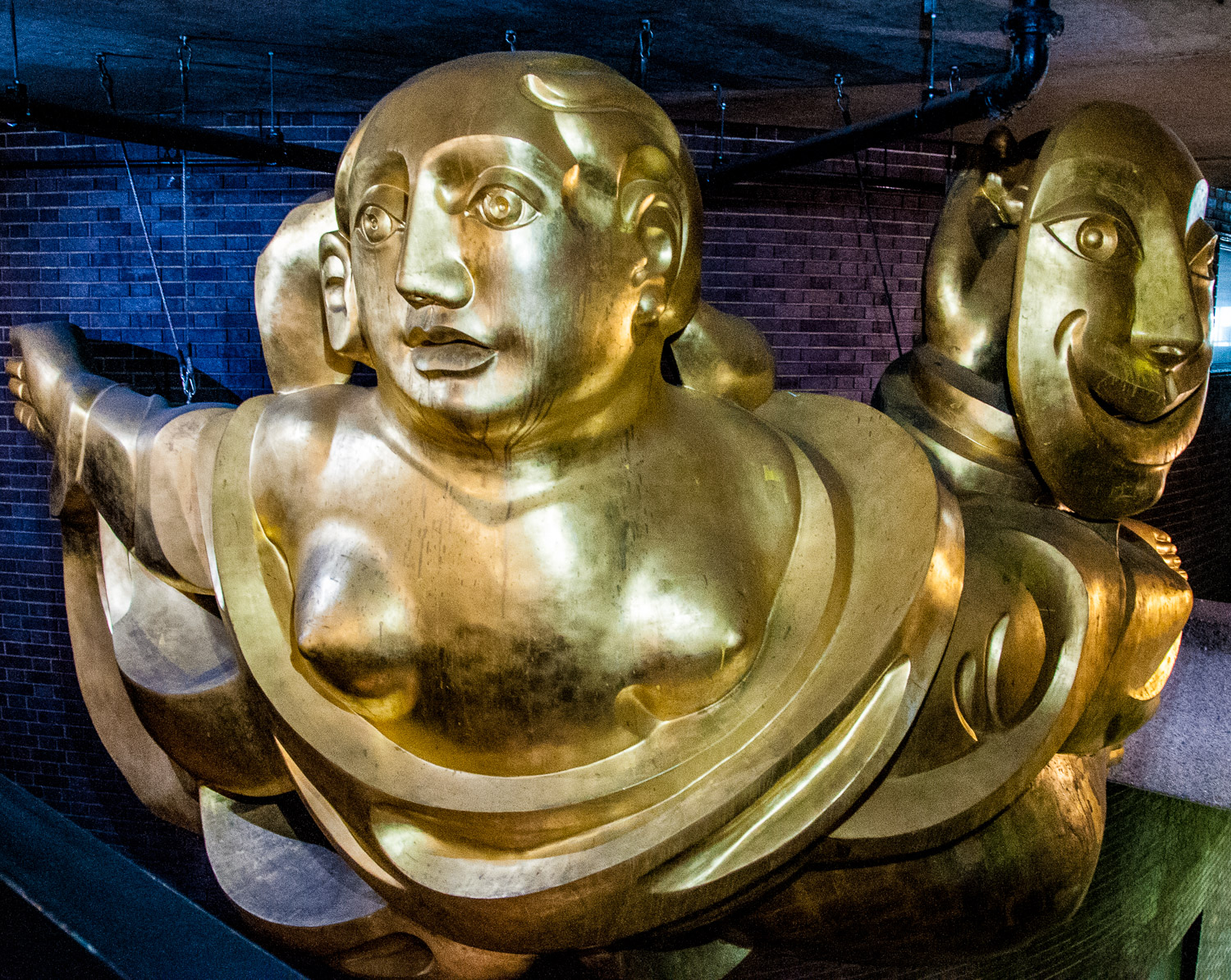
Finally, would you like to see Zoe, the floating Barbican Muse? If so, make your way to the Barbican Library on the second floor of the Centre, stand with your back to it, and walk through the automatic doors. She’s a few yards ahead on your left …

Sculpted by Matthew Spender in 1993-4, she is made of polyurethane and glass fibre and finished in gold leaf. She holds in her left hand the masks of Comedy and Tragedy whilst her right hand points the way to the entrance to the Centre (hopefully assisting folk lost in the highwalk system). She’s nicknamed Zoe after the Cambridge student who had posed for the sculptor.


City of London Ships (and a few boats)

Last year London was voted ‘the world’s leading financial maritime city’. The City, the judges said, ‘is home to world leading institutions such as Lloyd’s for insurance, and English law is the most widely applied in shipping disputes.’ The maritime connection does, of course, go back centuries and I have found some of the ways it has been represented for this week’s blog.

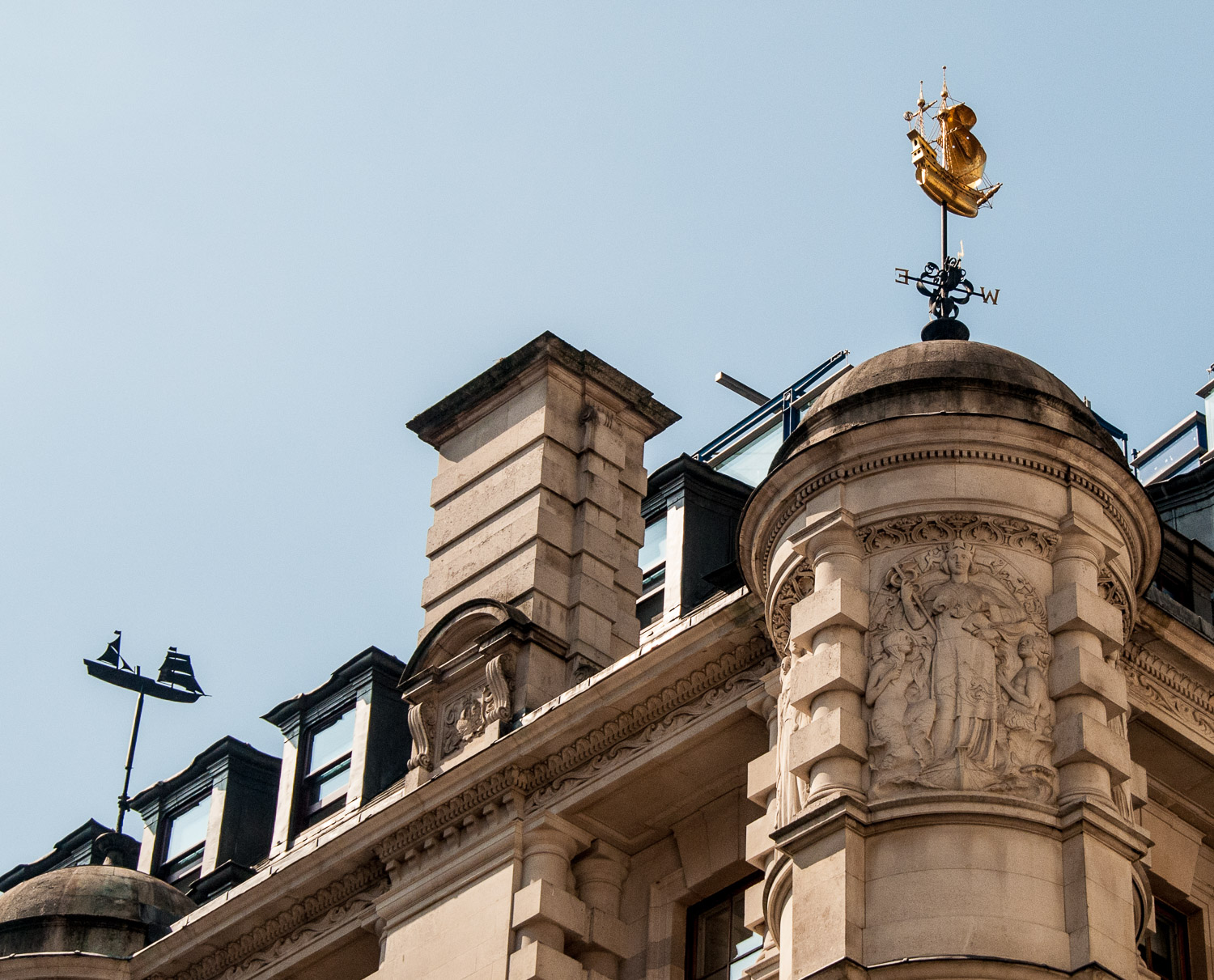
What better place to start than the Lloyd’s Register building at 71 Fenchurch Street EC3M 4BS.

It became apparent as the 17th century progressed that a central register of ships was needed to record their size, condition and other qualities. As Lloyd’s of London flourished this information would be valuable not only for underwriters but also merchants. Original regularly published ‘ship lists’ eventually became Lloyd’s Register of Ships in 1760 and, when a ship owners list merged with it, Lloyd’s Register of Shipping was formed in 1834 (and still exists today). The building, by acclaimed architect Thomas Colcutt (1840-1924), was completed in December 1901 and has been described as an ‘impressive classical stone palazzo in the 16th Century Italian manner’.

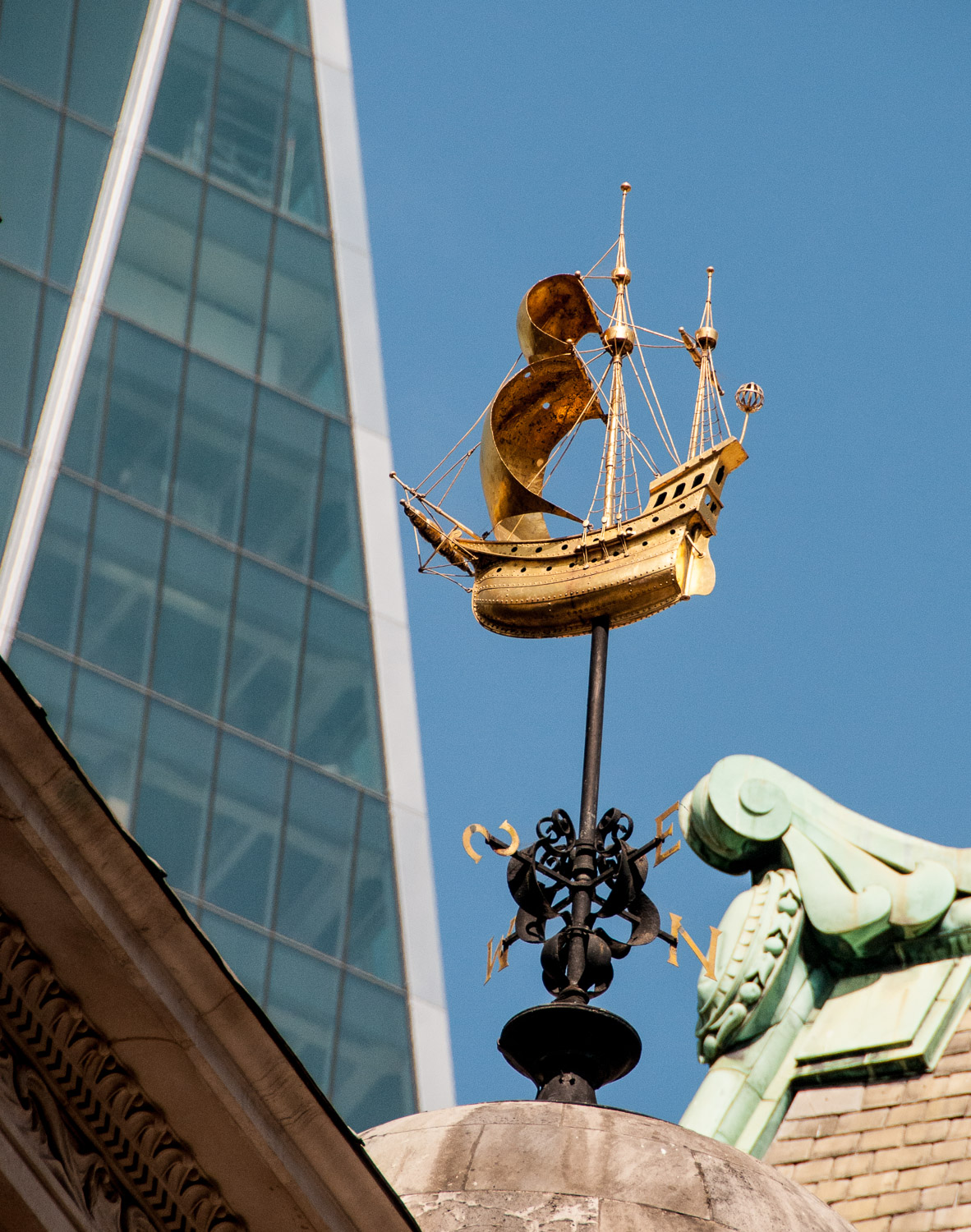
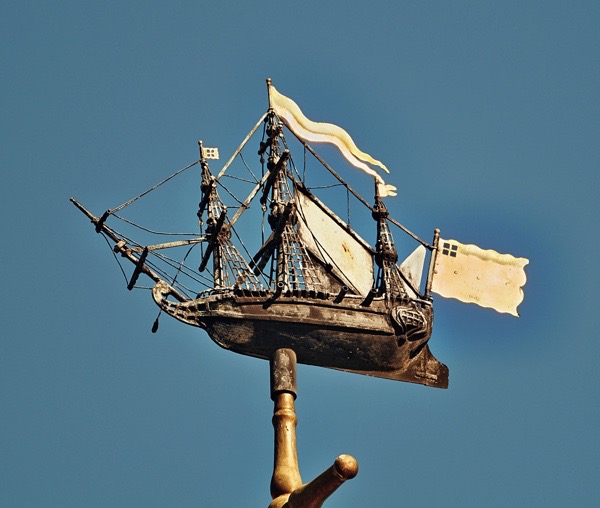
The building boasts not one but two ship weathervanes.

Galleon under sail.

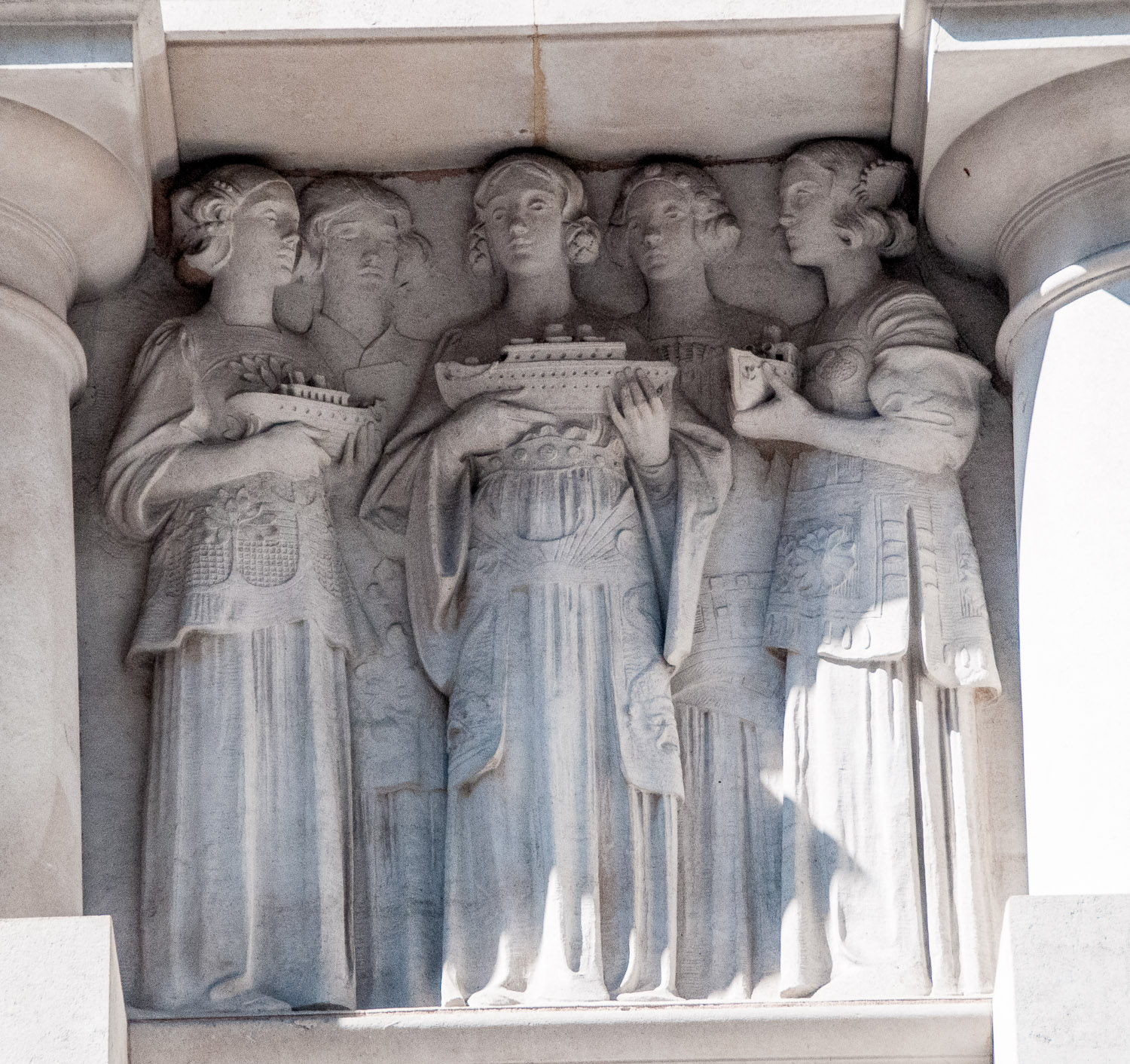
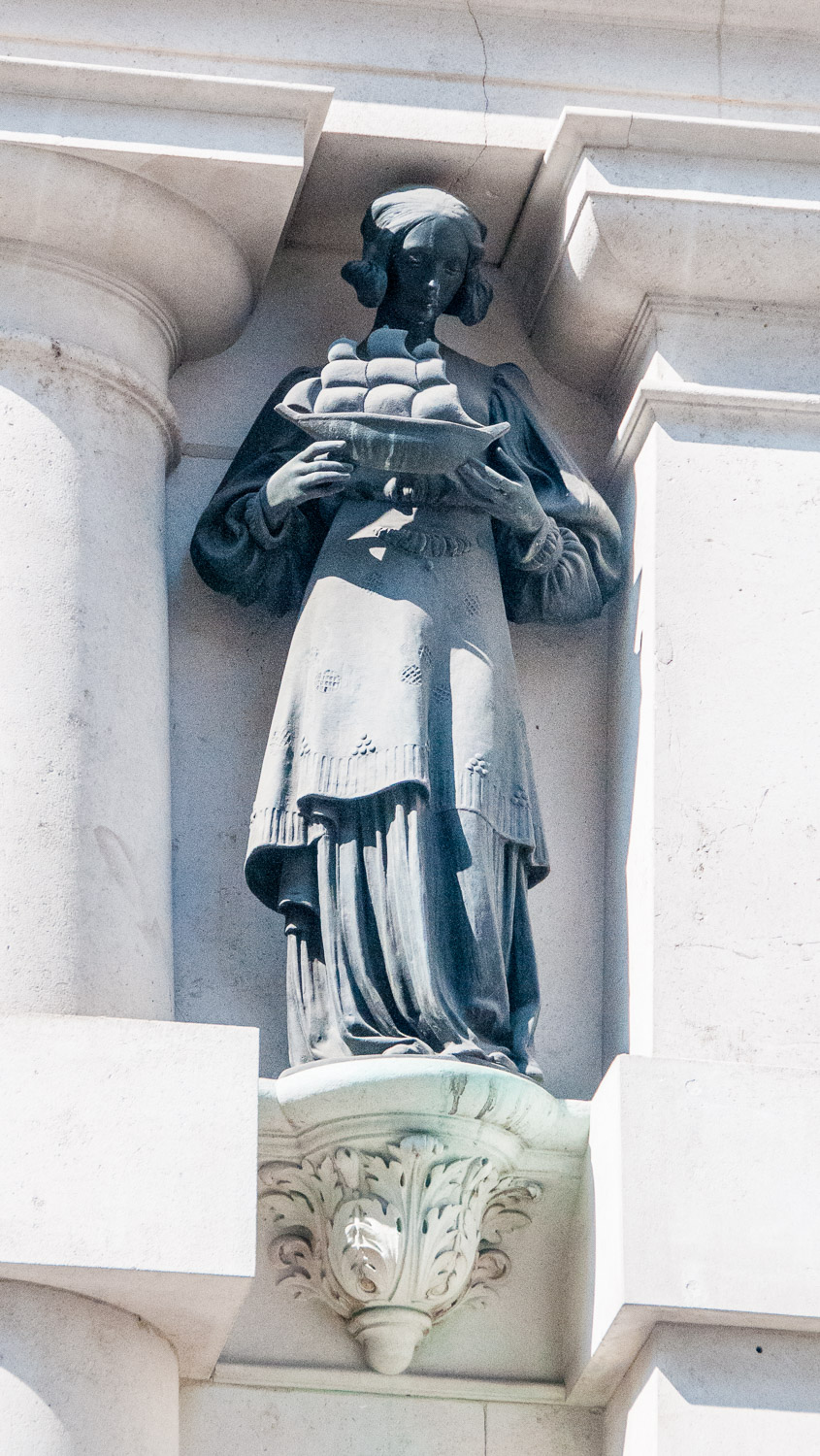
Around the building elegant ladies protectively support various vessels …


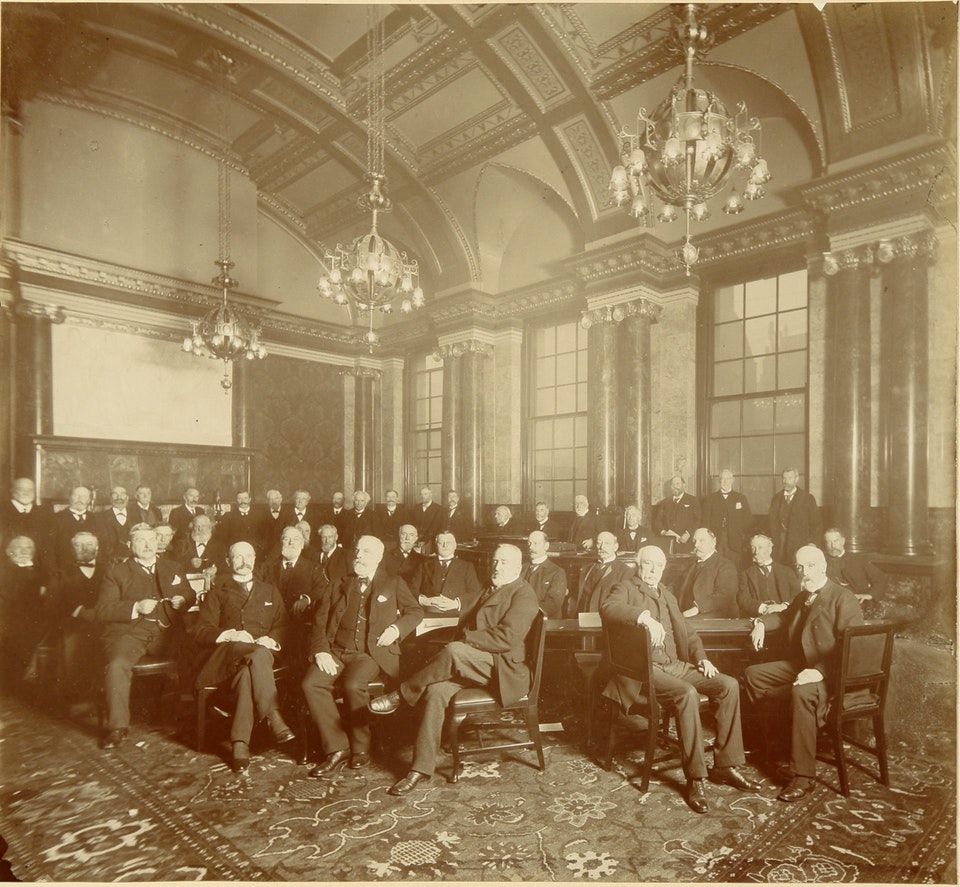
The interior was also designed to impress. I love this picture of the General Committee meeting in what was then their brand new building …

The great and the good of Lloyd’s Register.

The Union of Benefices Act 1860 was considered a necessary piece of legislation to reduce the number of parishes in the City of London as the residential population declined. Between 1872 and 1926 twenty churches (some by Sir Christopher Wren) were demolished and the land sold for construction projects.

Artifacts from some of these churches were moved elsewhere and the pretty galleon weathervane from St Michael Queenhithe (demolished in 1875) can now be seen on St Nicholas Cole Abbey …

114 Queen Victoria Street EC4V 4BJ .

This picture, along with many others, appears in Hornak’s book After the Fire and more details are available here on the Spitalfield’s Life blog.

This square rigged ship once sailed above St Mildred’s Poultry (demolished in 1872) and can now be seen atop St Olave’s Old Jewry, now inhabited by a firm of lawyers …

St Olave’s Court EC2V 8EX. Photo again by Hornak.

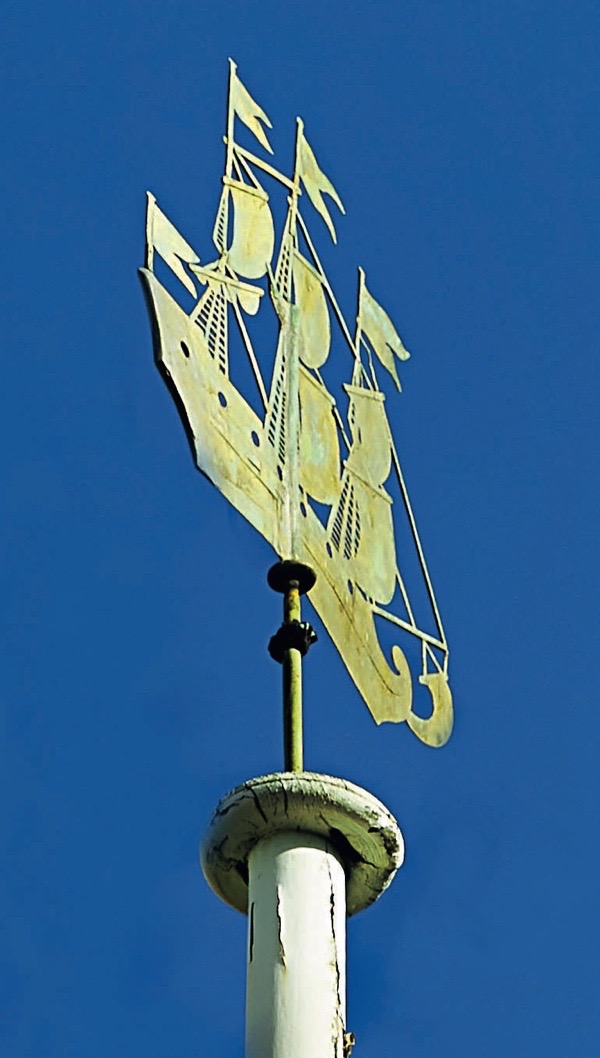
The Corporation of Trinity House was founded in 1514 and is now responsible for navigational aids (such as lighthouses), deep sea pilotage and a seafarers charity. The building was seriously damaged in the war but was beautifully restored in the 1950s and in the process acquired this elegant weathervane …

Trinity House, Trinity Square EC3N 4DH.

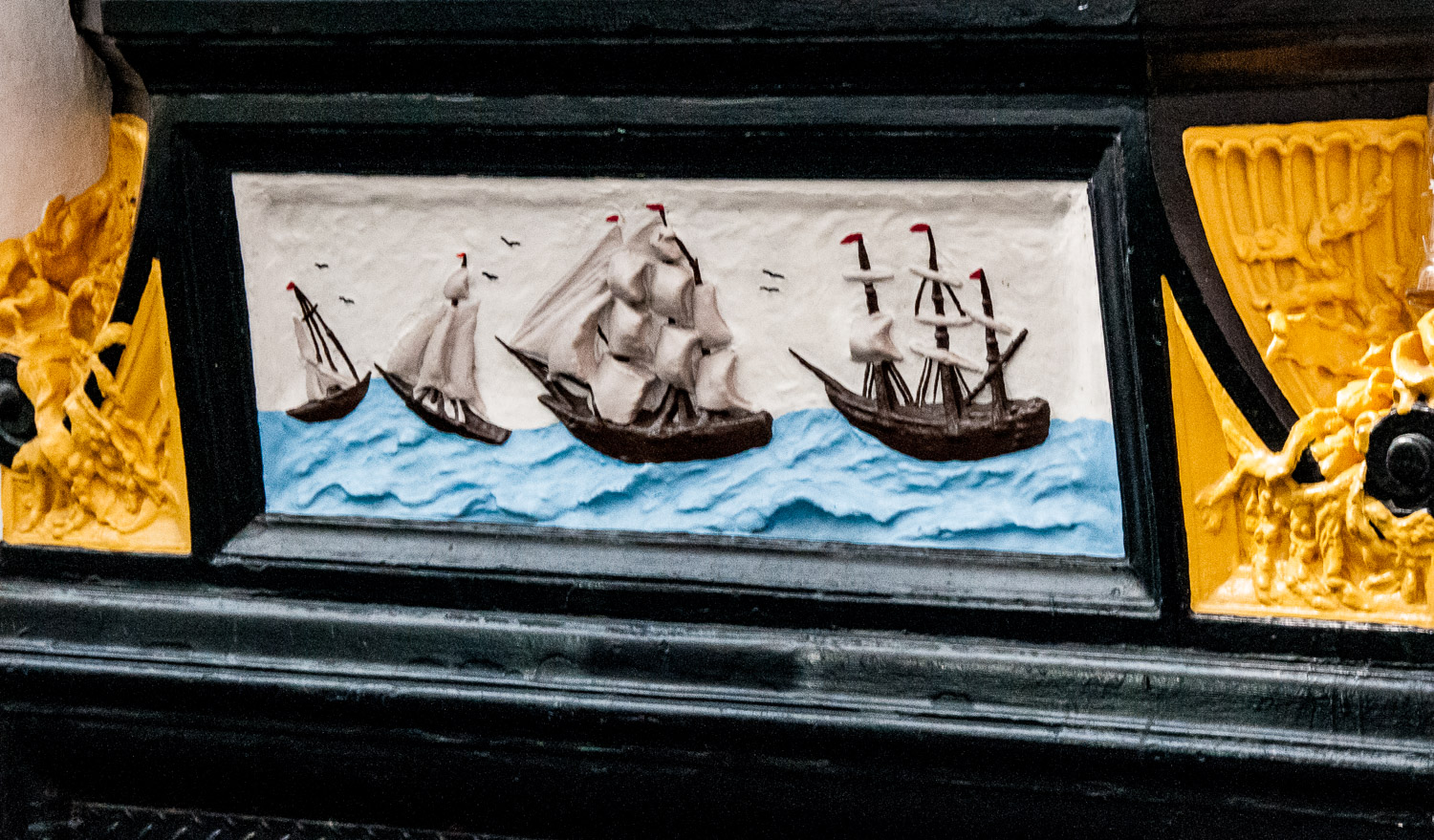
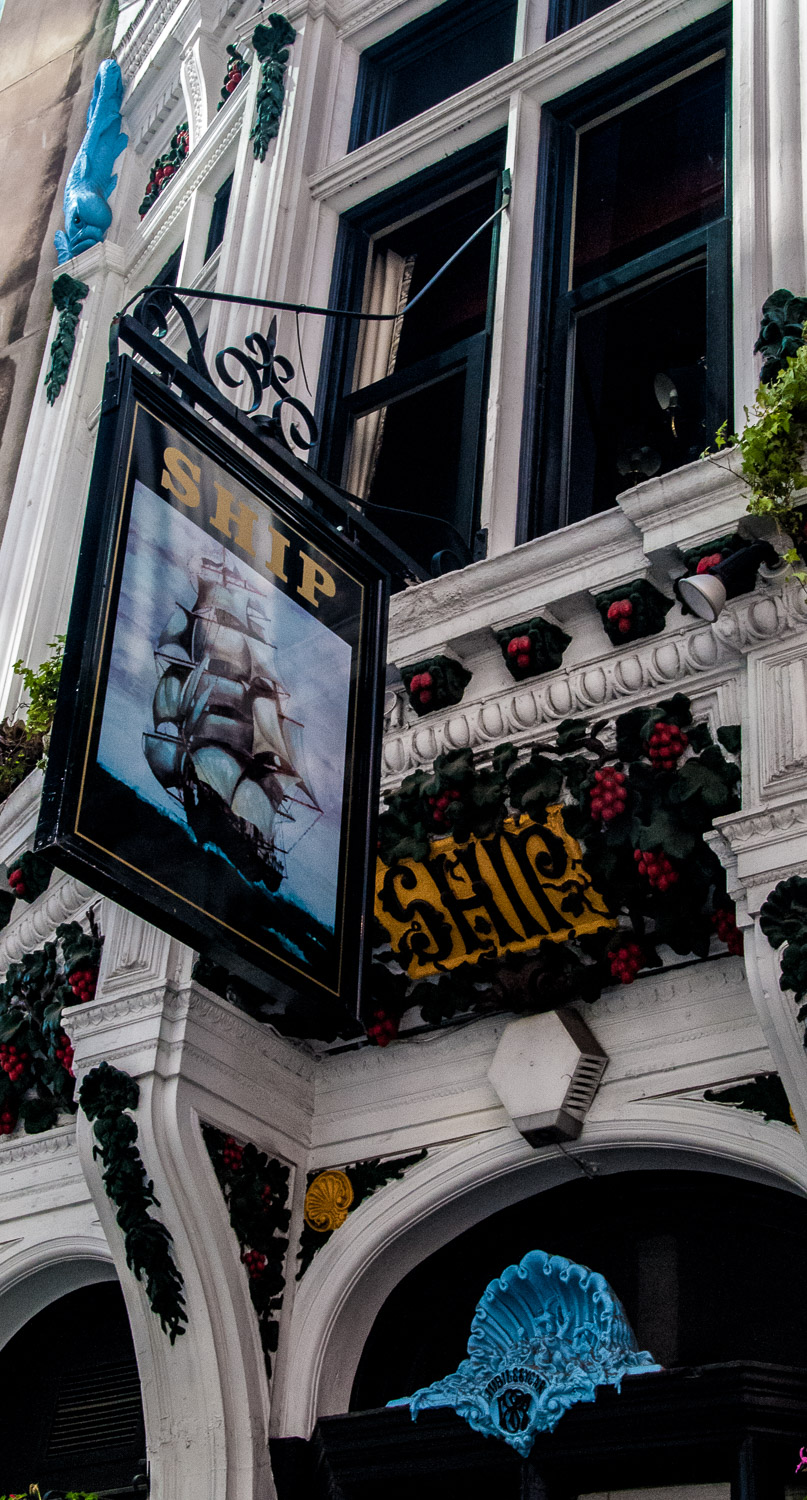
What about these jolly ships bouncing around in choppy seas on the front of The Ship pub in Hart Street (EC3R 7NB) …

The facade includes a rather grumpy looking blue dolphin …

And now a few boats. If you want to know the difference between a ship and a boat I suggest you access Professor Google since there seem to be a number of definitions.

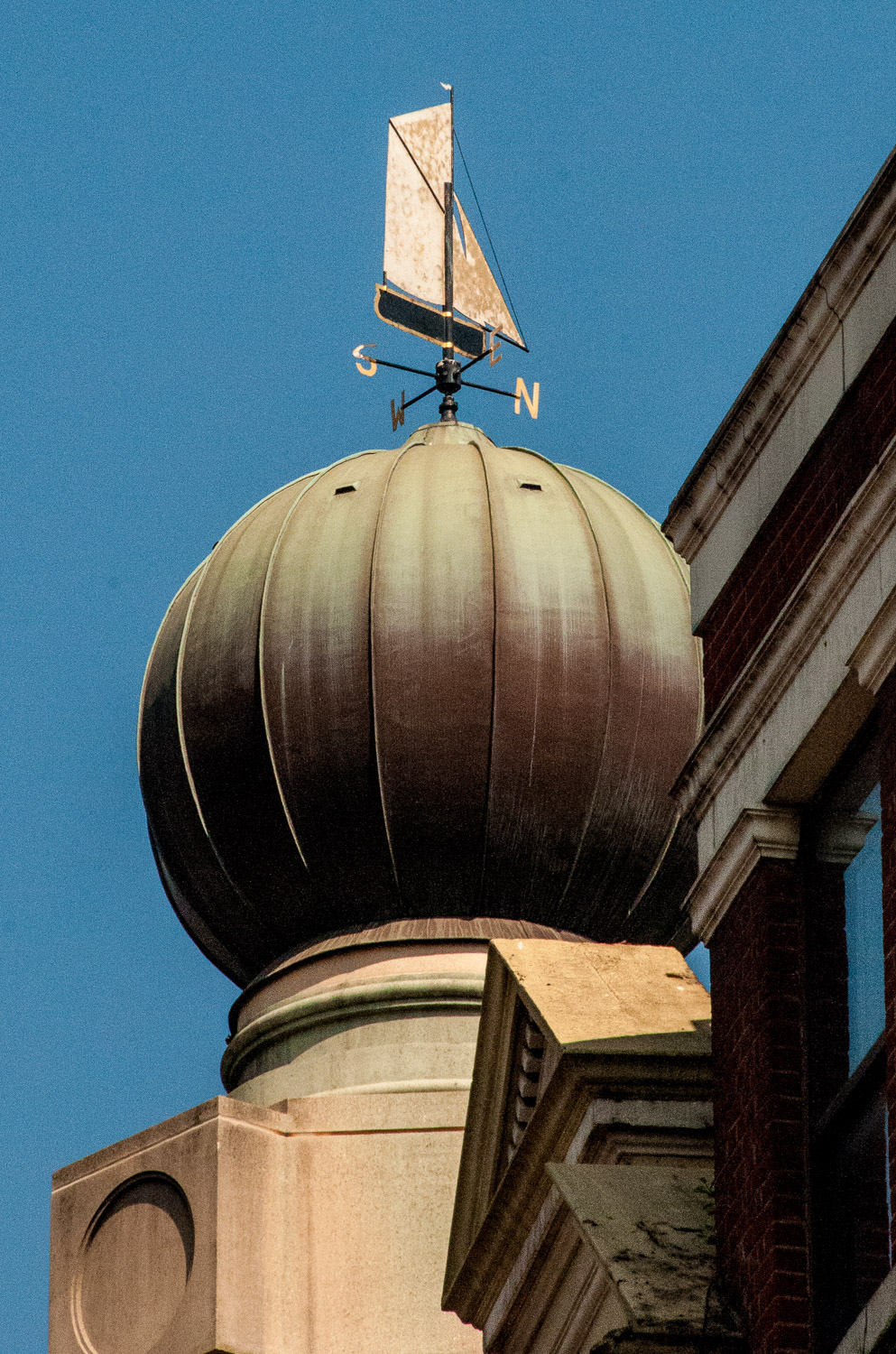
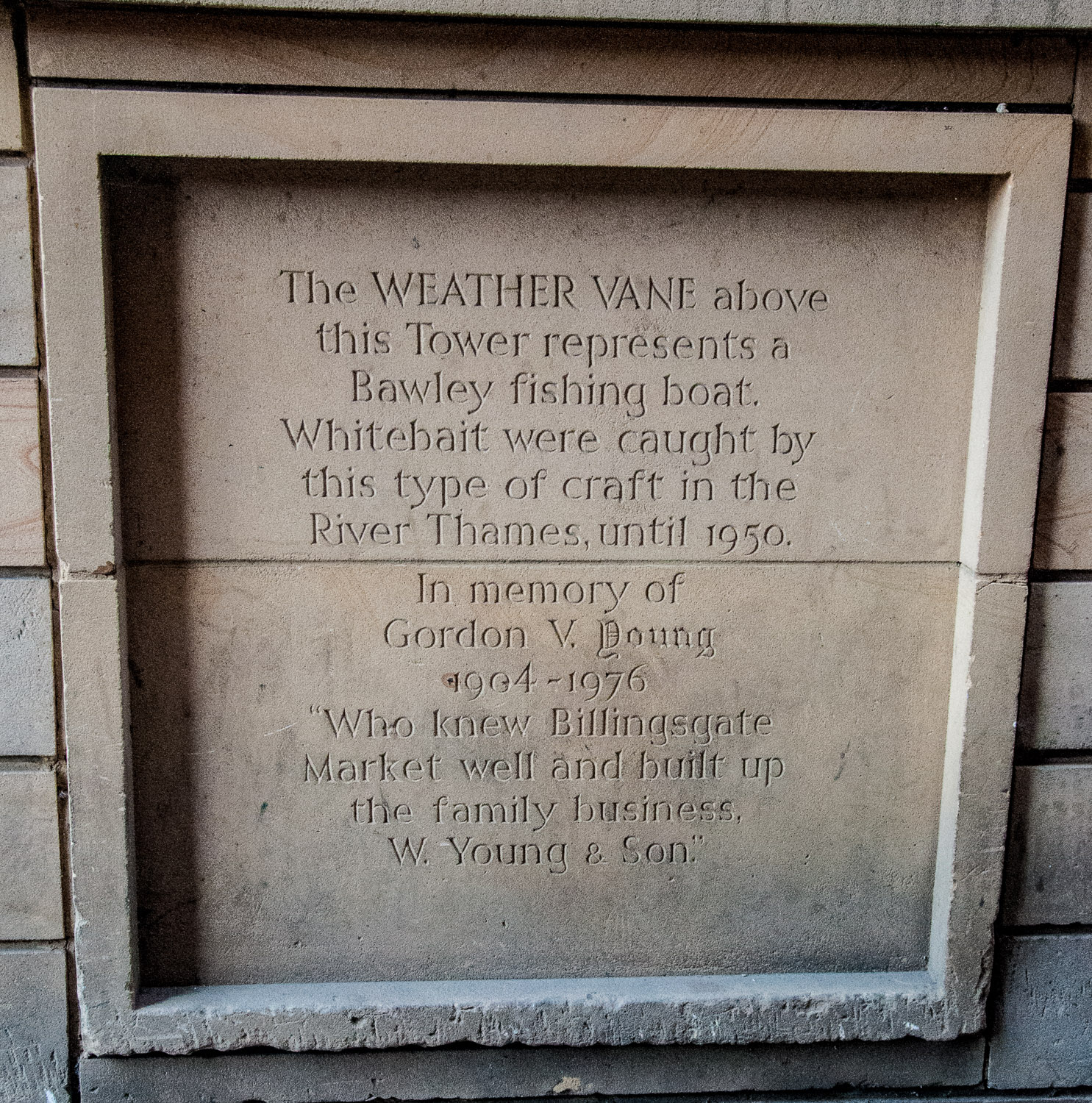
This Bawley fishing boat  is situated across the road from the old Billingsgate fish market (EC3R 6DX) and commemorates Gordon V. Young, a well-known Billingsgate trader …

A plaque gives more information …

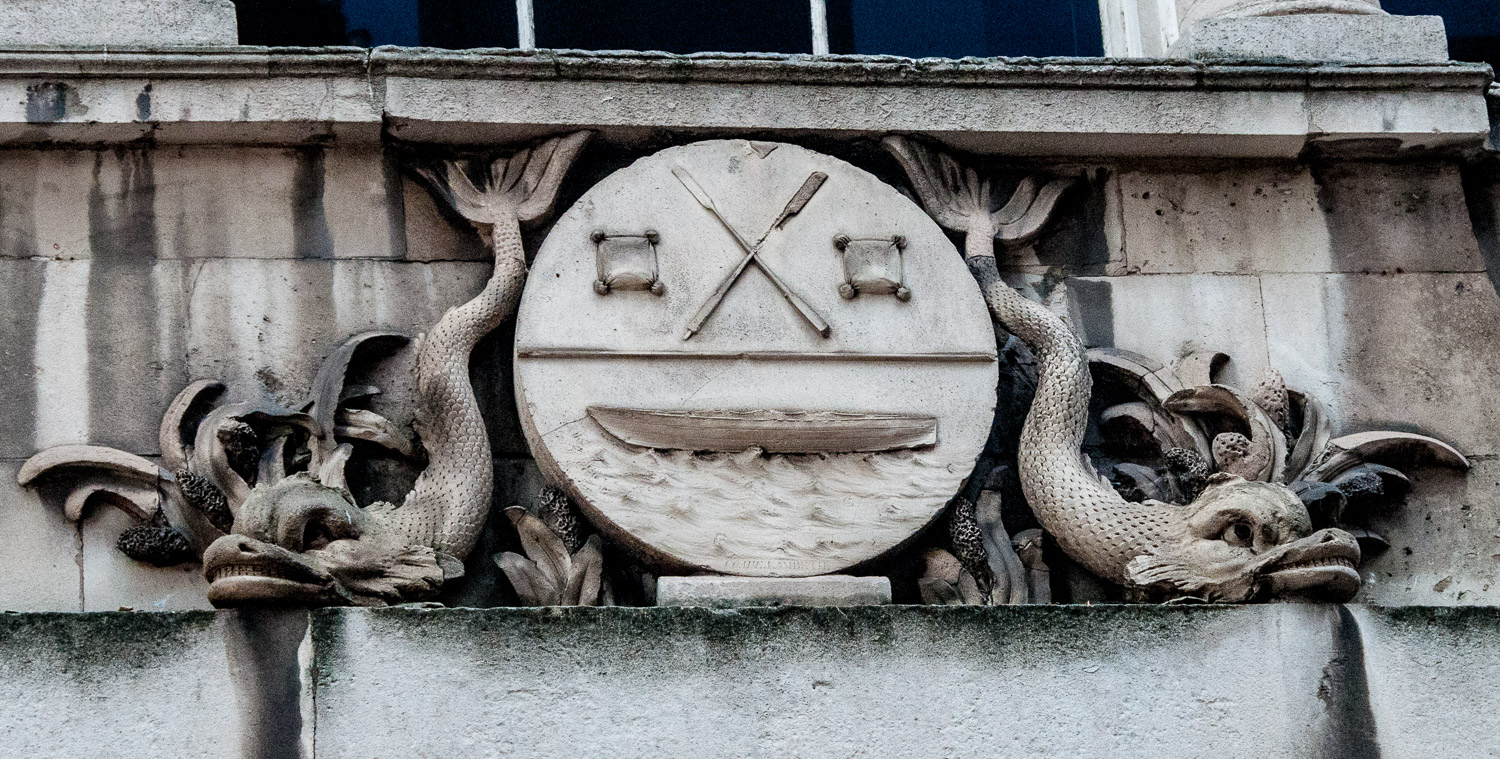
The Company of Watermen and Lightermen was formed in 1555 – watermen carry passengers whilst lightermen carry goods and cargo. Tucked away down St Mary at Hill (EC3R 8EF) is their hall, the only original Georgian Livery Hall in the City. Their coat of arms portrays a skiff (a light rowing boat), crossed oars and two cushions for the comfort of passengers. And more dolphins …

I have written about this ship before. If you go to Holland House in Bury Street (EC3A 5AW), just opposite the Gherkin, just walk around to the south east corner of the building, step back and admire this brave vessel plunging through the waves towards you, the funnel smoking impressively …

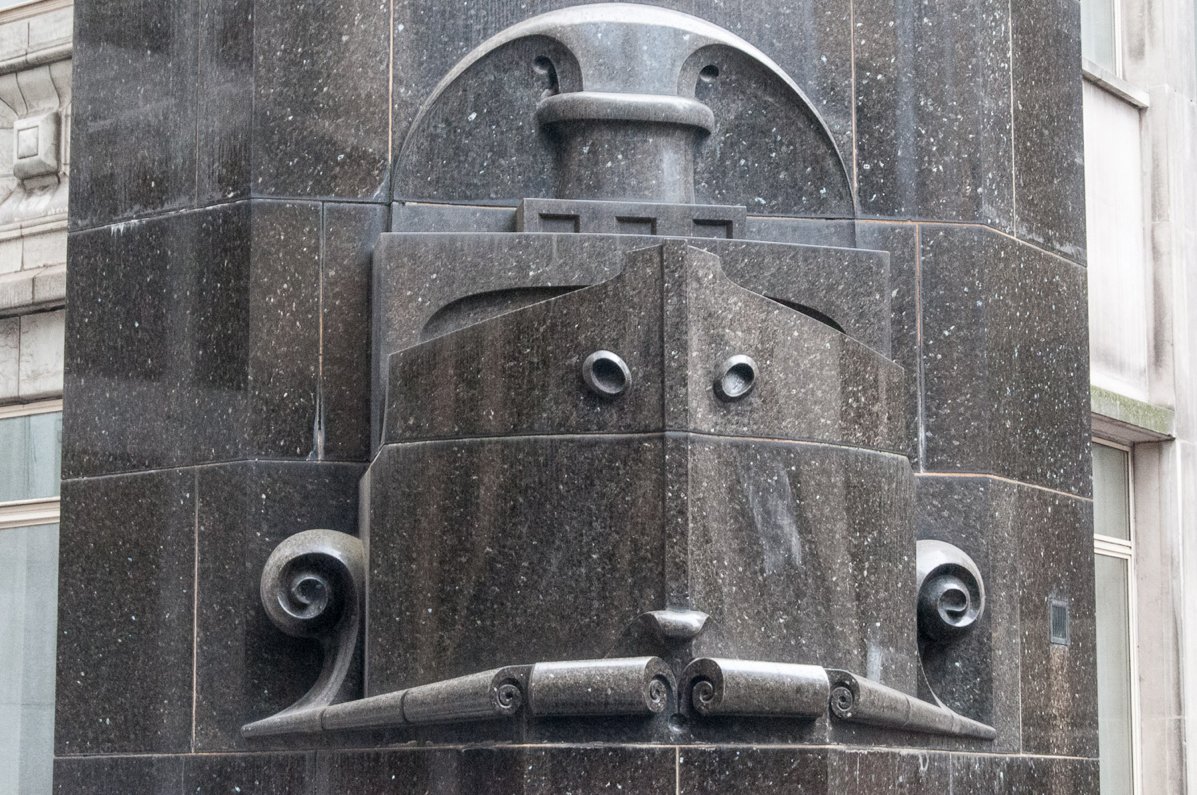
It’s a granite structure by the Dutch artist J. Mendes da Costa.

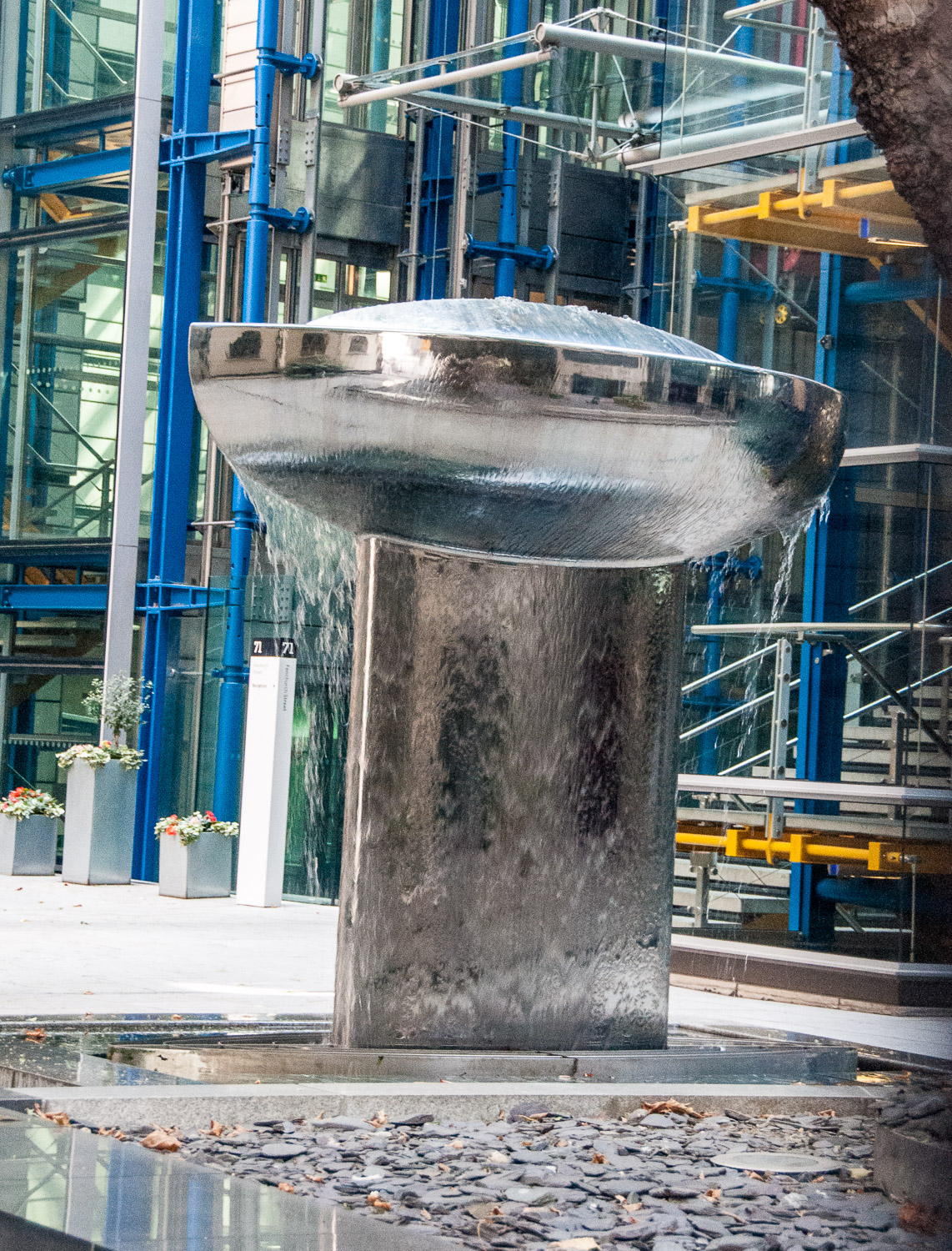
When Lloyd’s Register outgrew their old building at 71 Fenchurch Street a stunning new extension was build alongside and this sculpture, called Argosy, is in the front courtyard. The website tells us that ‘the water action of the sculpture adopts the Coanda principle where water clings to overhanging surfaces, moving downwards over the reflective surfaces in rollwave patterns. The shape is suggestive of a ship’s hull and has been conceived to be seen and enjoyed from both below and above from the nearby building’. It is very different from Mendes da Costa’s work, isn’t it?

Sculpture by William Pye (2009).

Incidentally, the courtyard it is in used to be the churchyard of St Catherine Coleman which was the last church to be demolished under the Union of Benefices Act (in 1926) – the old church railings are still there.

Finally, let’s not forget the brave souls who protected the City and the country in time of war and the monuments to their memory.

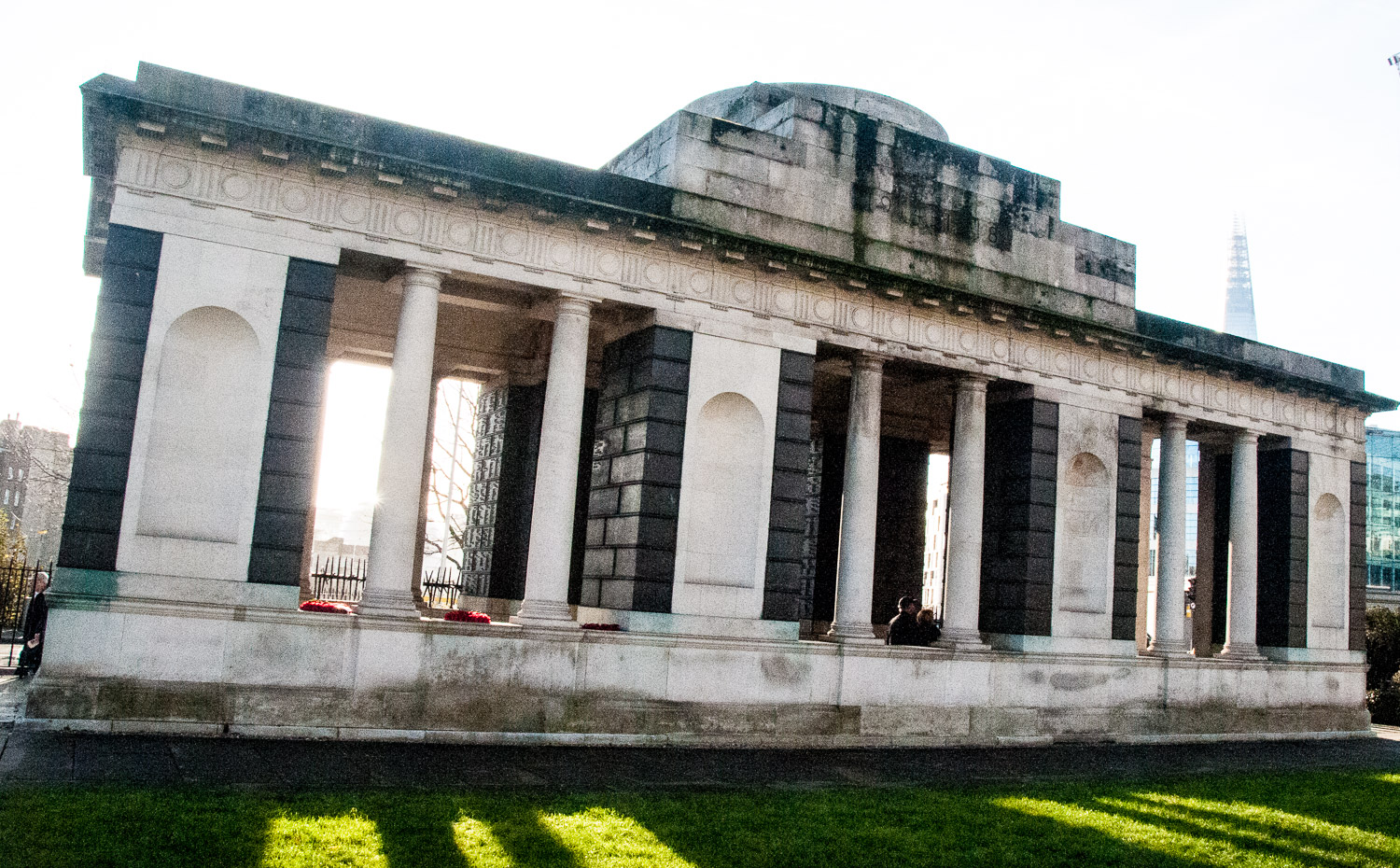
On Tower Hill there are two memorials. The first, the Mercantile Marine War Memorial, was designed by Sir Edwin Lutyens and was for the the First World War …

The Lutyens Memorial, opposite Trinity House, EC3N 4DH.

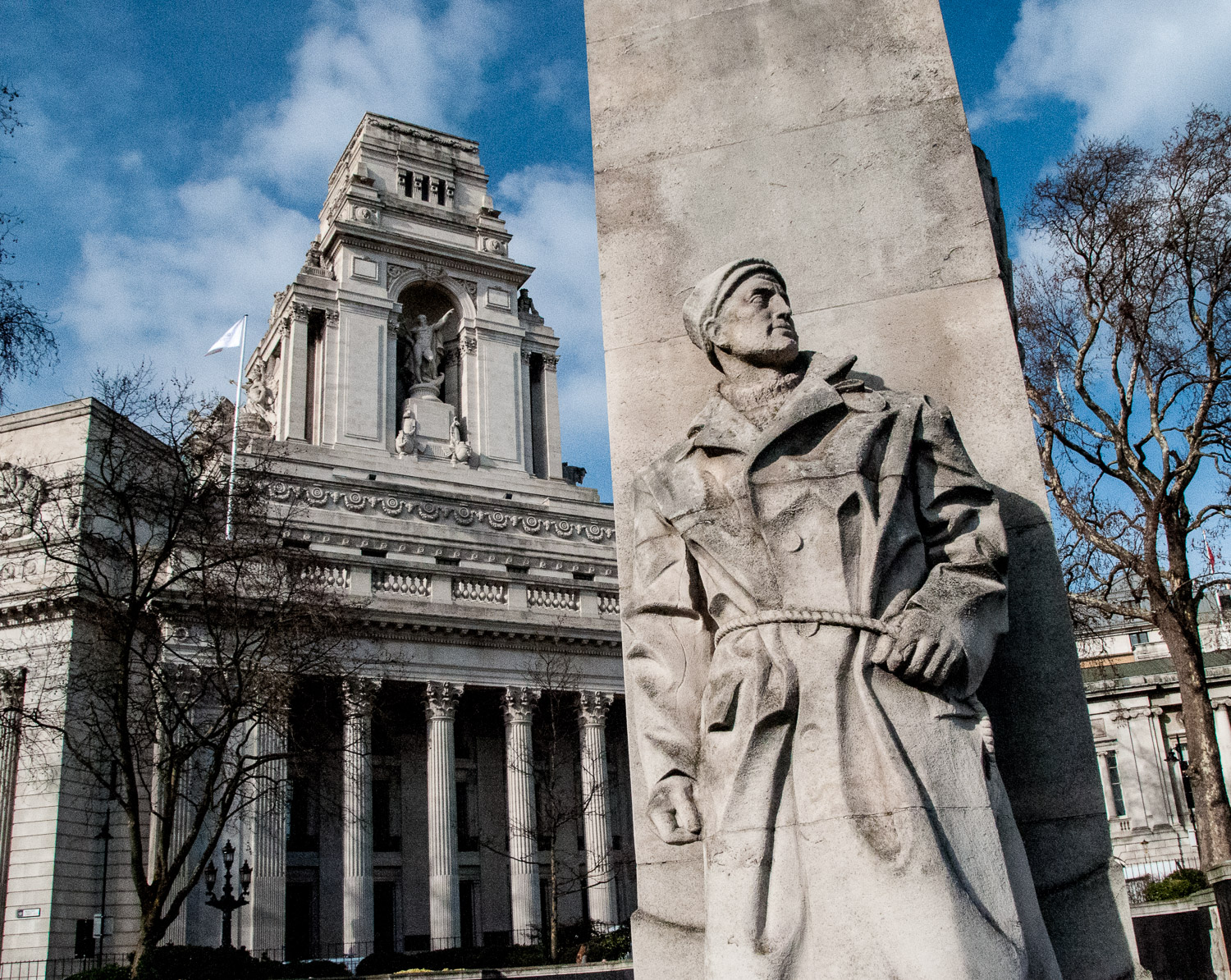
Alongside is the second, the Merchant Seamen’s Memorial. It was designed by Sir Edward Maufe and was for the Second World War. This is a feature from it …

In both wars more than 50,700 Commonwealth merchant seamen lost their lives  and on Tower Hill are commemorated the more than 35,800 casualties who have no known grave.

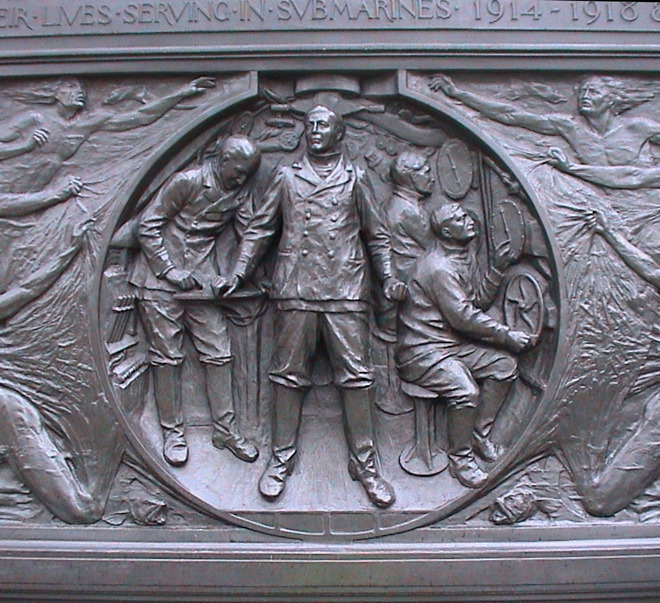
The National Submariners’ War Memorial is on Victoria Embankment (EC4Y 0HJ) and the bas relief shows the claustrophobic interior of a submarine. On the left hand side is a list of 50 submarines lost during the First World War, and on the right a list of 82 submarines lost during the Second World War. A photograph really does not do it justice …

The monument was designed by the architect A H R Tenison and the bronze sculpture is by F B Hitch.

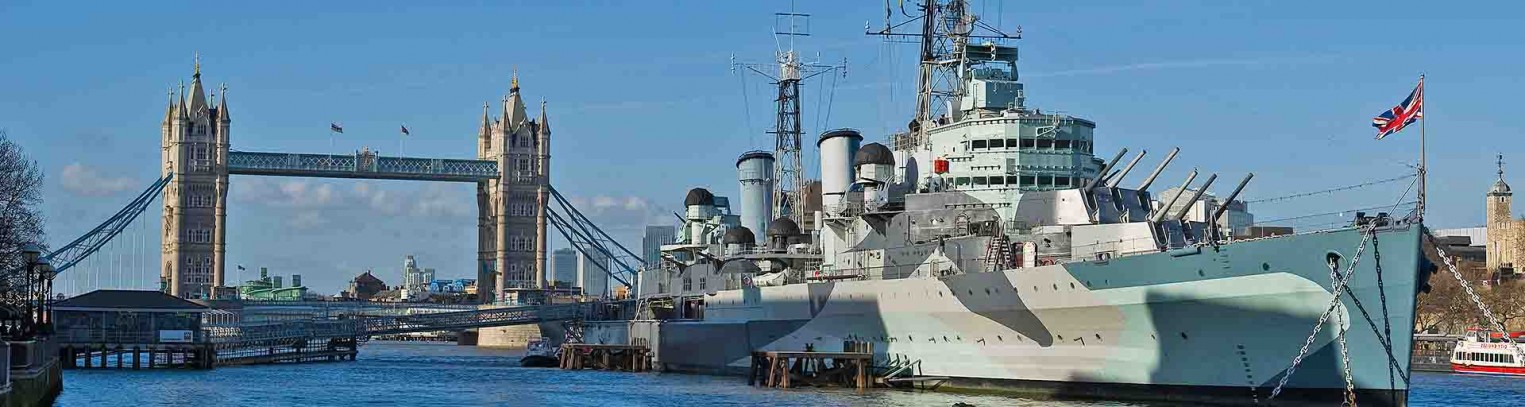
And as we all know, a real ship now stands guard over the City. The most significant surviving Second World War Royal Navy warship, HMS Belfast played a key role in the Arctic Convoys, the Battle of North Cape and D-Day …

You get a great view of her from the north bank.


Page 7 of 9

Powered by WordPress & Theme by Anders Norén