Walking the City of London

Category: Social History Page 8 of 24

Mudlarking! A treasure of an exhibition at the London Museum Docklands.

I always enjoy a visit to this museum since an extra special treat is ‘driving’ the Docklands Light Railway train all the way to Canary Wharf …

Plus, near the museum, there are often glimpses of Thames wildlife, in this case cute young swans and their mum taking a nap …

The foreshore of the Thames is an internationally important archaeological site. Millions of prople have lived in and passed through London, leaving traces of their lives in the river mud. The mud is anaerobic (oxygen-free) and therefrore preserves objects in excellent condition. The exhibition showcases over 350 mudlarked objects, including personal items and historical relics, and explores the history of mudlarking from its origins as a means of survival to its modern-day practice as a hobby and form of historical exploration.

So I knew a visit would give me something to really get my teeth into …
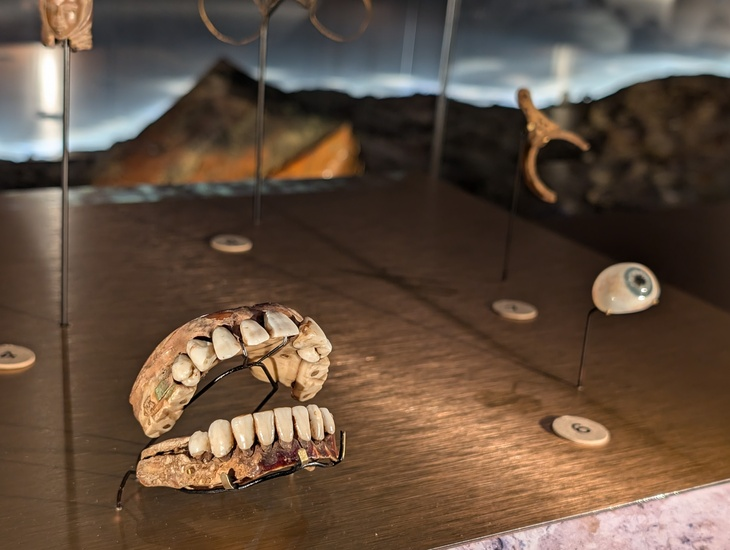
Apologies for that!

The gnashers illustrated above date from the 1700s and are made from real human teeth, probably collected from the dead. A goldsmith or watchmaker would have set them into ivory plates, held in place with gold pins. They were bespoke, made to fit a wealthy client’s mouth. And imagine what it must have been like to see the false eye on the right peering up at you out of the mud.

Here are some further examples of what is on show.

The early accounts of mudlarks describe them as mostly children aged 8 to 15, older women and sometimes also men. They lived in poverty and scavenged to earn whatever money they could. In 1851 Henry Mayhew, a journalist and author, wrote three books on London’s poor. This is an illustration of a mudlark he met who used his hat to carry his finds …

Peggy Jones, the ‘Well known Mud Lark’, is illustrated here in a book published in 1805. Aged around 40 with red hair, she dressed in short, ragged petticoats and went barefoot. She wore a strong apron folded like a bag around her …

Peggy would wade waist-deep into the water and use her feet to feel for lumps of coal to collect in her apron. She disappeared without a trace around February 1805. You can read more about her and her sad life here.

Large scale works in the 1800s to construct river walls and bridges, alongside dredging of the Thames, led to remarkable discoveries. This is a modern replica of the head of a statue of Hadian, 117-138 CE …

The Waterloo Helmet is from the Iron Age, 150-50 BCE. It was discovered by workers dredging the Thames near Waterloo Bridge …

It is the only Iron Age helmet found in southern England, and the only one with horns ever found in Europe. It is made from bronze with a scrolling decoration and red enamel around the cap. When new, the bronze would have shone like the Sun, clearly telling everone nearby about the status of the person wearing it.

The Battersea Shield (Iron Age again) was found by a labourer at Battersea in 1857 …

It was made more than 2,000 years ago by many different craft specialists in Britain. Originally strenthened with wood, it protected from weapon blows and could also be used to push back, choke or bruise.

Onward to the 800s when the Vikings battled the Saxons to seize their wealth, enslave their people, control resources and access river routes.

This Viking battle axe has a distinctive shape with a curving blade. A number have been found in the river …

This tiny silver pendant was worn around a Viking neck. It is a mini version of Thor’s hammer. Thor was the god of war and fertility. He could control thunder and lightning, had unparalleled physical strength and owned a magical hammer called Mjolnir …

For centuries ship’s orders were communicated using a boatswain’s whistle. This example is decorated with a lion …

The boatswain, a senior crewman, could communicate a lot of information by varying the pitch and length of the notes. The tone could be heard across the ship over the sound of wind and waves.

The three tiny shoes were lost hundreds of years apart, one perhaps kicked off by a Victorian baby (17). The other two (18) were possibly lost by chilren on the foreshore in the 1400s and 1500s. The miniature pair from a badge (19) shows the 1300s trend for extremely long pointed toes, while the gentlemen’s shoe (20) from the 1600s is heeled and decorated with hearts and crescent moons …

“Am I not a man?’ – 1787-1830. By the 1800s an increasing number of voices campaigned against the British trade in enslaved Africans. Campaign imagery was placed onto many products including sugar pots and tobacco pipes to make consumers more aware of the enslaved lives that were feeding their habit.

This tobacco pipe shows an enslaved African. It copied a medallion with the inscription ‘Am I not a man and brother?’ produced by Josiah Wedgwood for the Society for the Abolition of Slavery in 1787.

These lead badges were worn on hats and coats and carried rude hidden messages (1300-1500) …

The badge in the middle portrays a purse with a phallus tucked inside. Purses were a symbol of good fortune and a metaphor for a vagina. Cockerel badges, like the one on the left, were worn by young male Londoners to advertise their virility, the cock being recognised as a symbol for lust. The badge shaped like a hair comb is decorated with dancing phalluses.

More sinister is this ball and chain (1600s-1700s) …

Ball and chains, also known as leg irons, were used in England from the late 1600s on some people convicted of a criminal offence. The weight of the ball and the long spike on the lock hindered movement and helped prevent escape.

Pottery abounds …

There is also a tribute to two enterprising mudlarks, Willam Smith and Charlie Eaton, known fondly as Billy and Charlie, who were forgers of small artifacts who did their sneaky work between the years of 1845 and 1870. You can read more about these two scoundrels here and see some of their work displayed in the exhibition …

The Visit London blog review concludes: Just when you think you’ve seen it all, the exhibition hits you with a showstopper – a glowing, giant moon suspended in the dark, echoing the glow that once guided night-foraging mudlarks. Luke Jerram’s Museum of the Moon closes the exhibition on a breathtaking finale. I was completely struck by its scale, bathed in a celestial light that quietly reminds us of the moon’s vital role in a mudlark’s life.

And here it is …

Mudlarking is strictly regulated by the Port of London Authority (PLA), which issues permits to would-be treasure hunters. With interest soaring, the PLA has paused new licence applications – over 10,000 people are currently on the waiting list.

I am very fortunate in that my very good friend Penny is one of the few who possess a licence and she kindly shared some of her treasured finds with me this week. At some point in the future I will write about them in more detail …

The item of pottery on the top right retained the finger impressions of the person who created it centuries ago. Holding it sent a shiver down my spine.

You can read more about the London Museum Docklands here.

If you would like to follow me on Instagram here is the link …

https://www.instagram.com/london_city_gent

The King’s Birthday flypast and a new exhibition at the Guildhall Heritage Gallery.

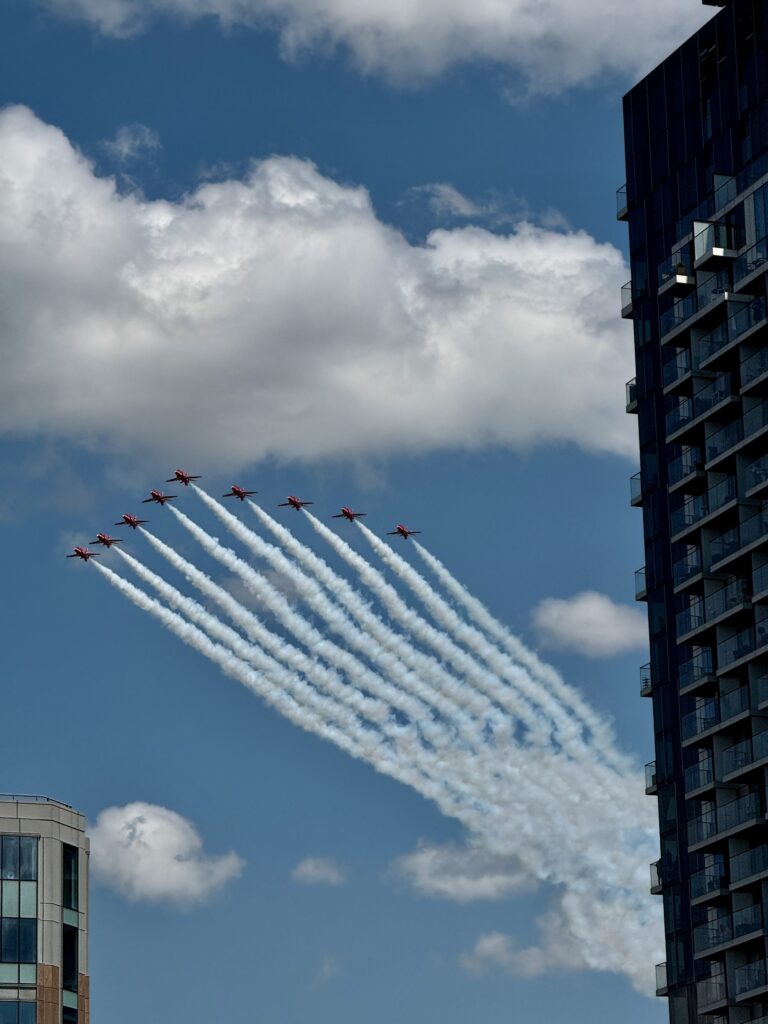
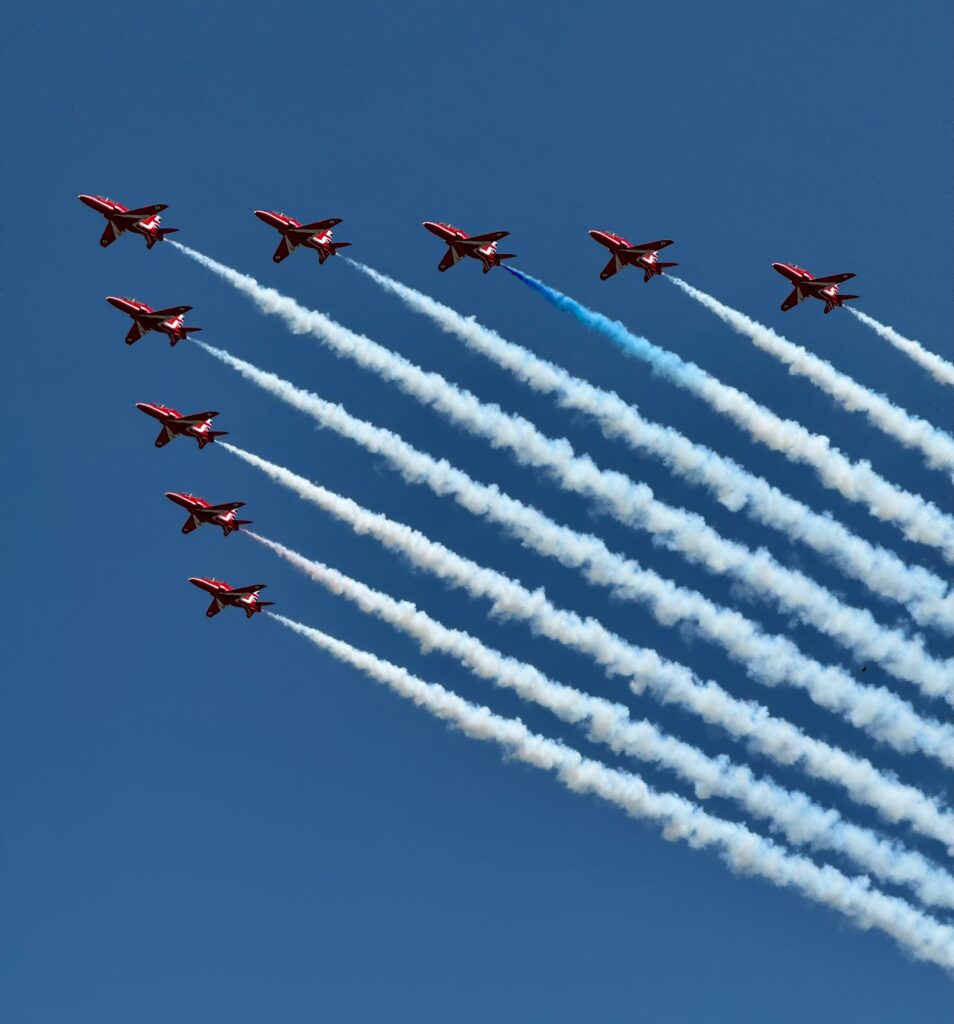
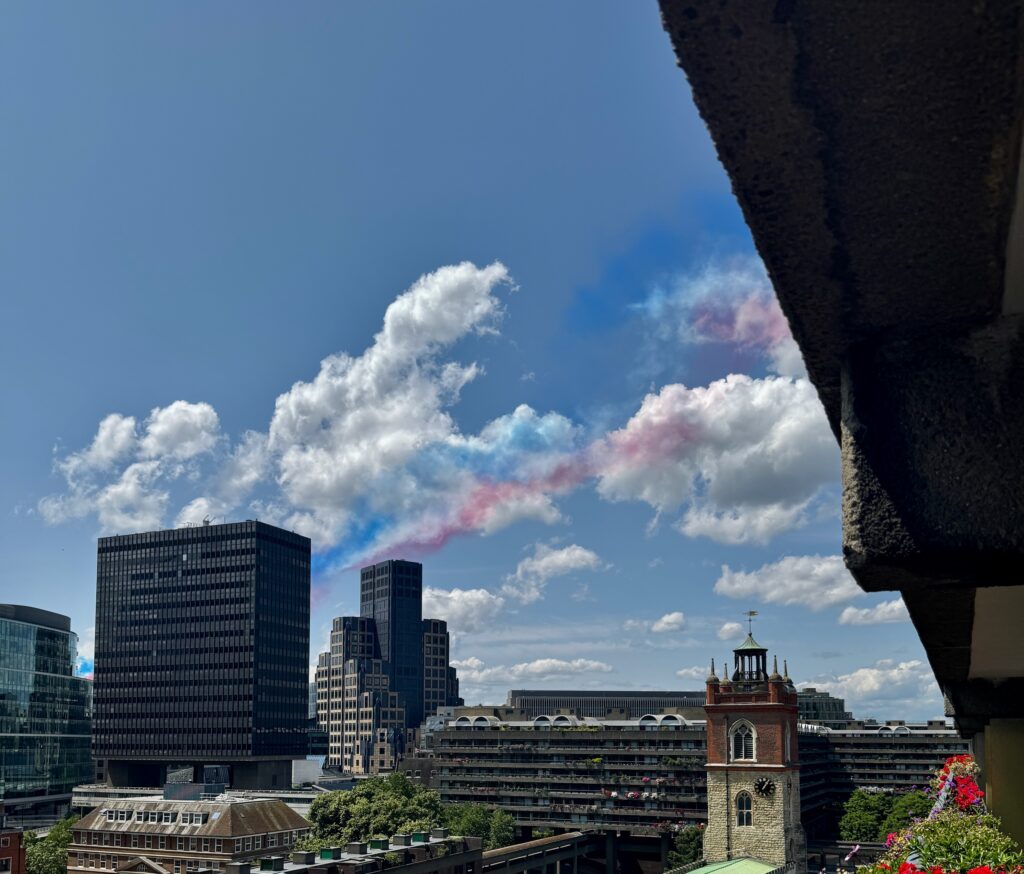
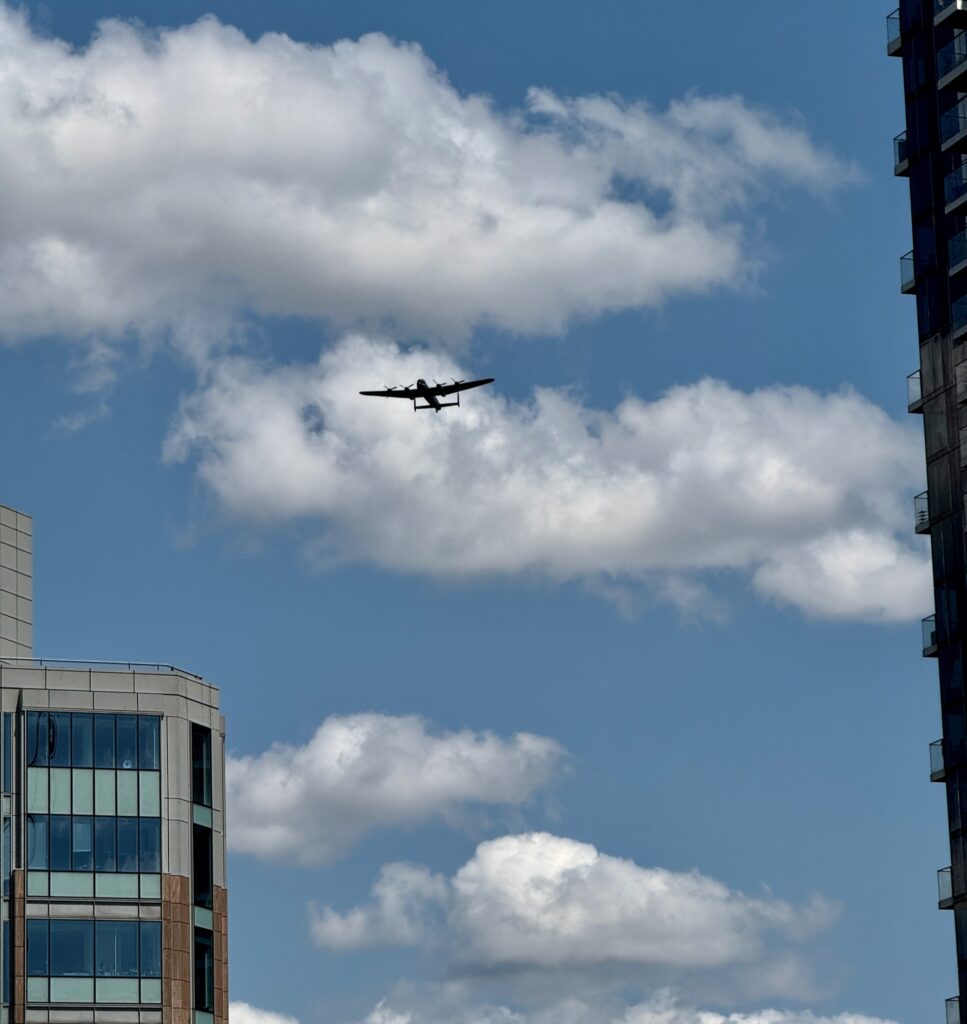
Our flat is ideally placed to see planes as they cross London towards Buckingham Palace. Here are images from this year’s display.

Four Chinooks in a box formation …

A World War Two Lancaster bomber …

One Phenom and two Texan

An A 400 Airbus

One Voyager and two Typhoons

One P8

A C17 and two F35s

Four Typhoons …

And finally, of course, The Red Arrows …

‘Goodbye’ …

You can read more about the flypast and see more images here.

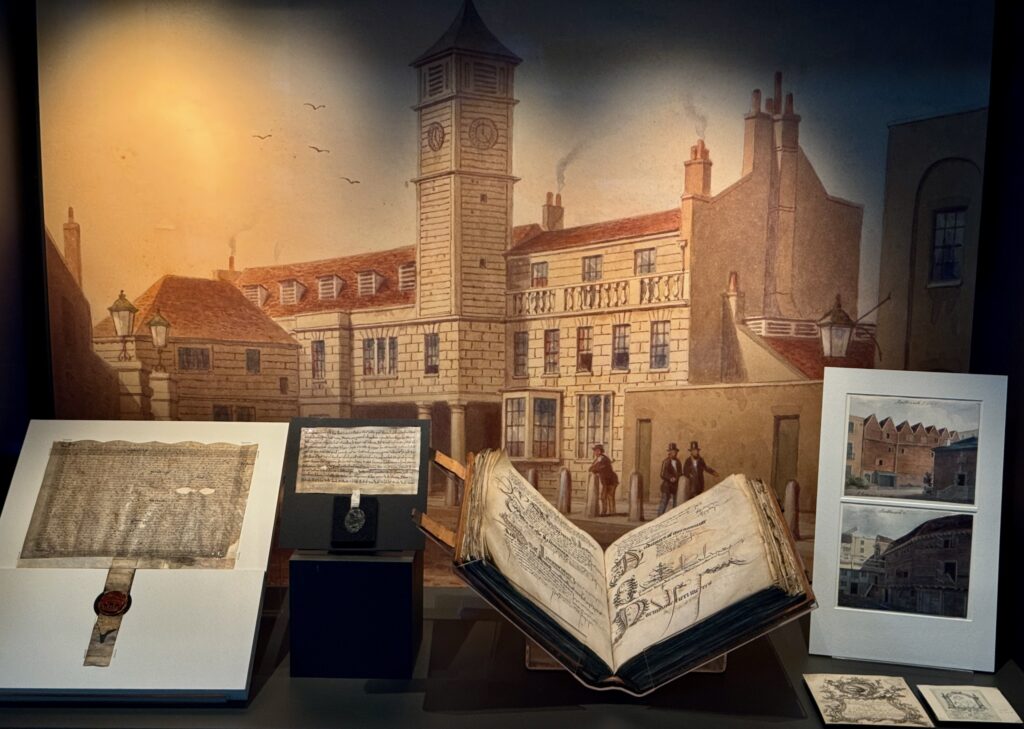
I was delighted to see that there is a new exhibition at the Guildhall Heritage Gallery dedicated to the City Bridge Foundation, a historic charity whose origins date back to the twelfth century …

Originally known as Bridge House Estates, a name which reflected the use of the term ‘Bridge House’ for the administrative headquarters on Tooley Street, Southwark. These were the offices, gardens and warehouses which were used to keep the huge quantities of supplies needed to maintain the first stone London Bridge. The charity acquired funds for its work from bequests by pious Londoners, gifts of land and property as well as from rental income from the houses that were built on London Bridge.

Today the charity is responsible for the upkeep of not only London Bridge but also Blackfriars Bridge, Southwark Bridge, Tower Bridge and the Millennium Bridge. Since 1995 they have also invested income into charitable causes across London.

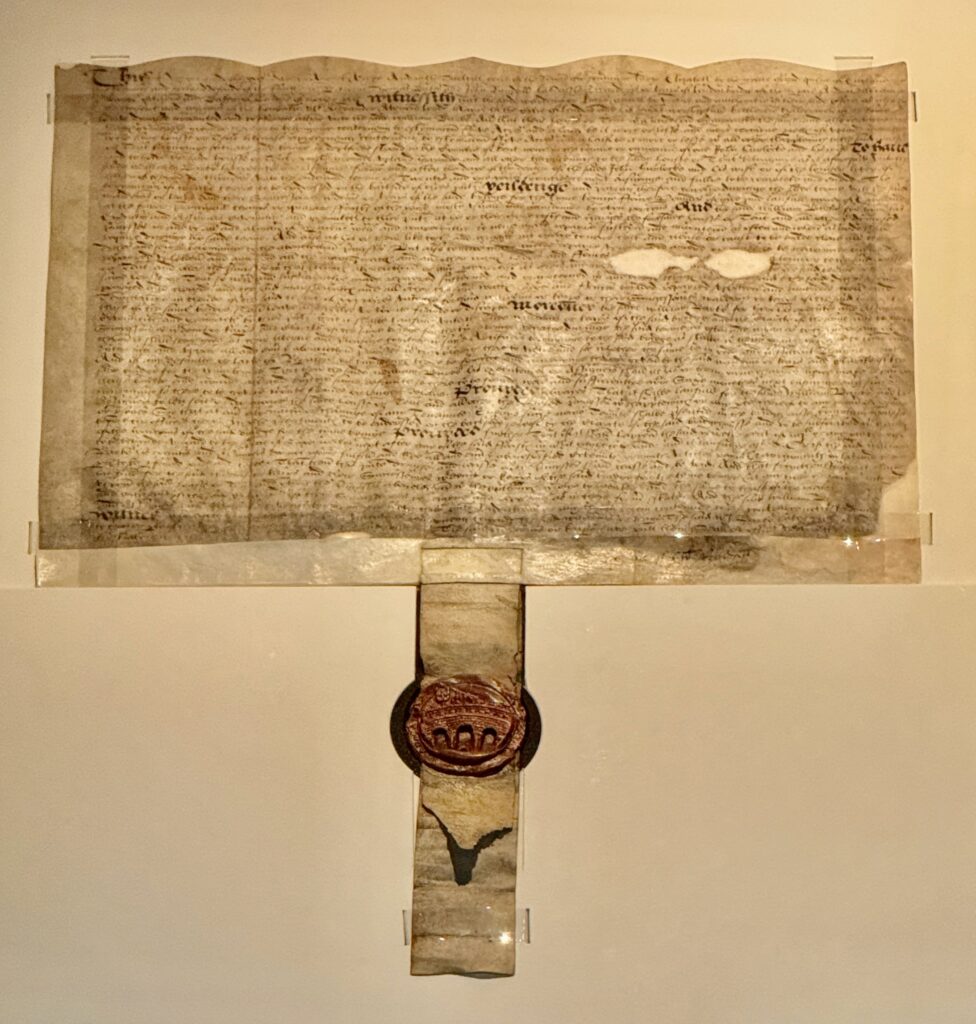
The management of land and estates was formalised by a charter of 1319 which declared that ‘custody of the London Bridge and the rents and profits belonging thereto, were committed to be kept by two honest and sufficient men of the City’. These men would seal any deeds or agreements with the seal of the Bridge House, seen here in its third form …

This seal was only in use between 1542 and 1592. In 1592 the City Lands and Bridge House Estates Committee was established to manage the land, property and the revenue from rentals and tolls from the bridge; thereafter the Bridgemasters used the Common Seal of the City.

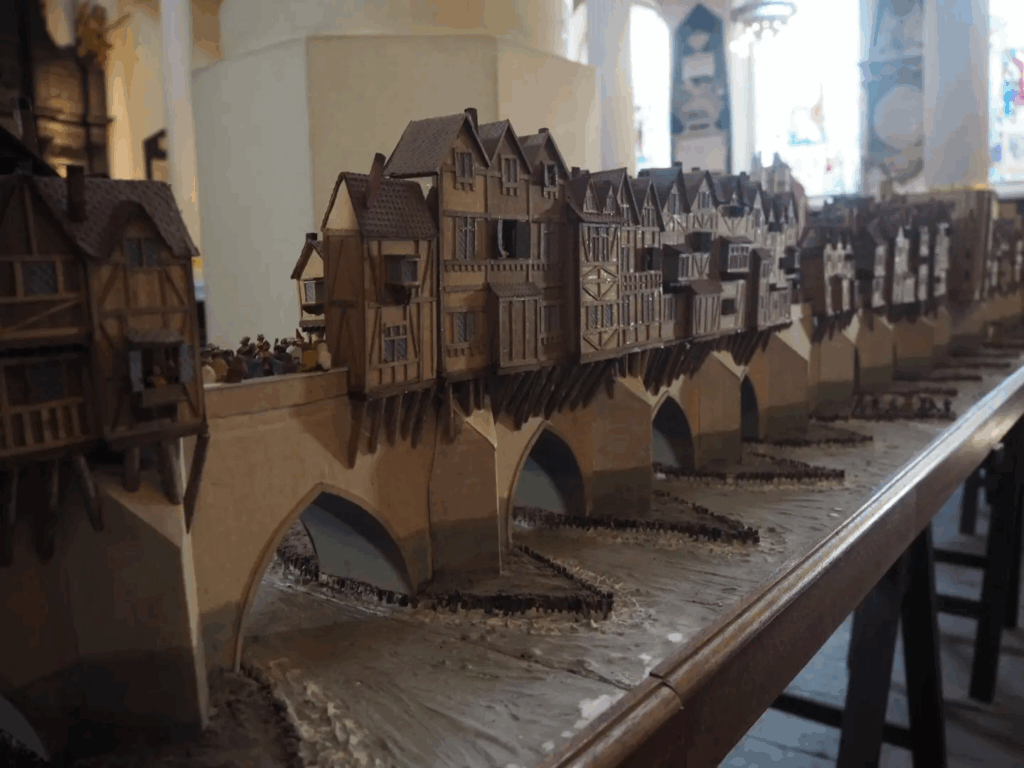
There is a fantastic model of the old London Bridge, with its houses, on display at St Magnus the Martyr Church on Lower Thames Street (EC3R 6DN) …

You can read more about it here in the excellent Look up London blog. And click here for a very interesting interactive exploration of the old bridge based on a painting by Claude de Jonge – highly recommended.

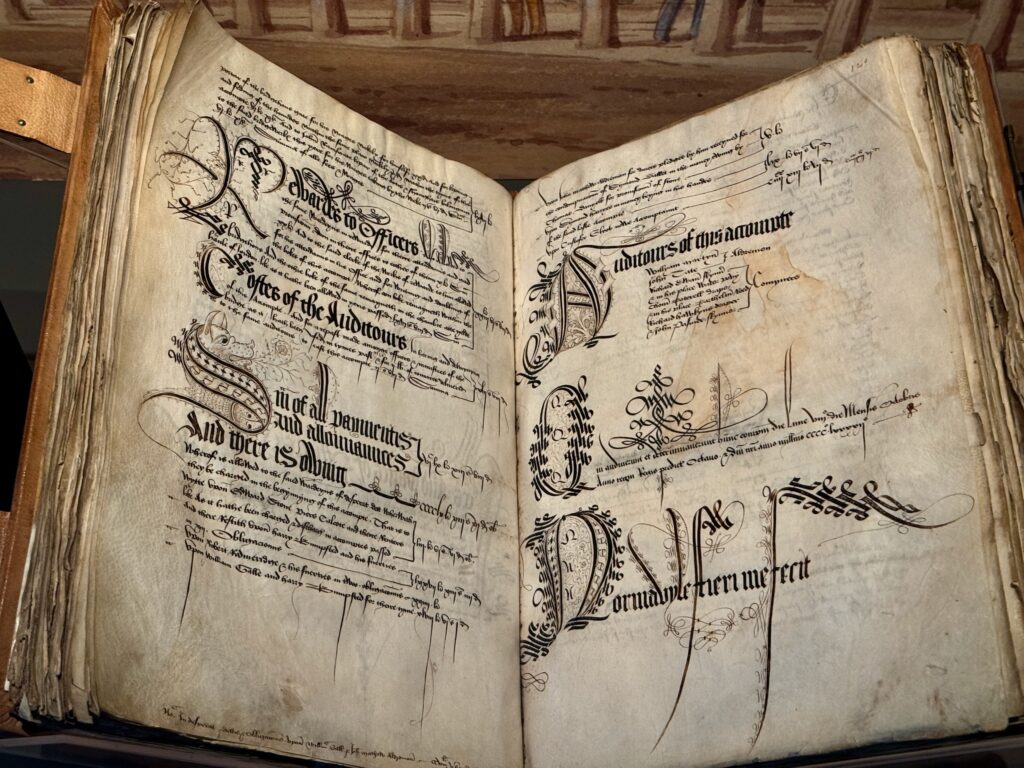
The Bridgemasters kept meticulous accounts and the volume on display is particularly ornate and includes the accounts from 1484 to 1509. It was compiled by John Normanvyle, Clerk of the Works of Bridge House Estates – obviously a man with artistic flair …

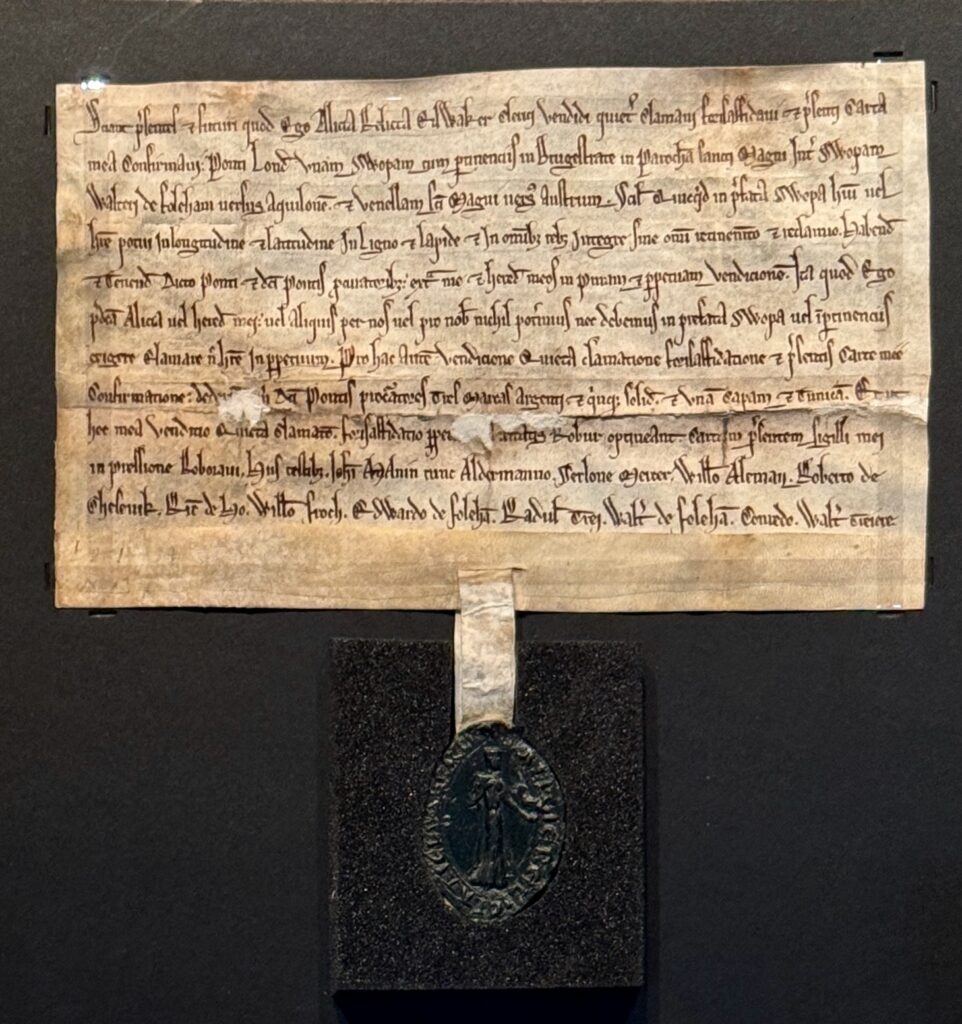
On display is a small document granting a shop to the Bridge House Estates in circa 1215 by a lady called Alice …

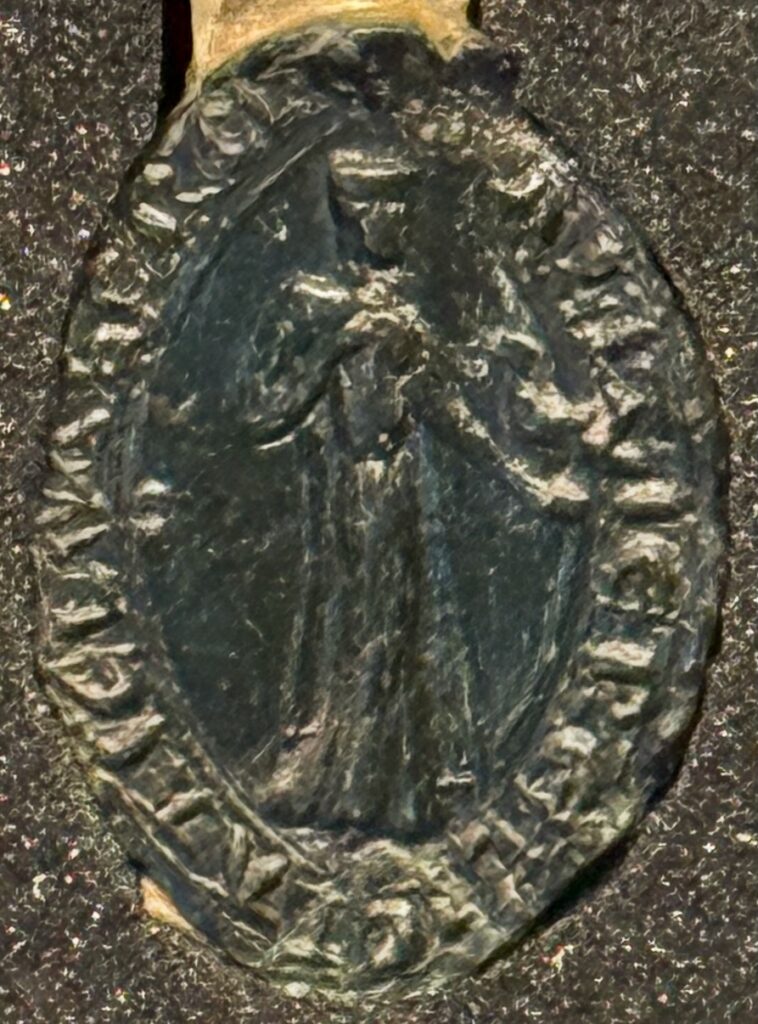
Attached is the seal of Alice which depicts a lady wearing a long flowing dress and mantle along with a bird …

I have tried very hard to find out more about her but have not been successful.

Also to be seen are trade cards from individuals who were amongst the last tenants of houses situated on London Bridge. They were demolished in the 1760s in order to widen the road …

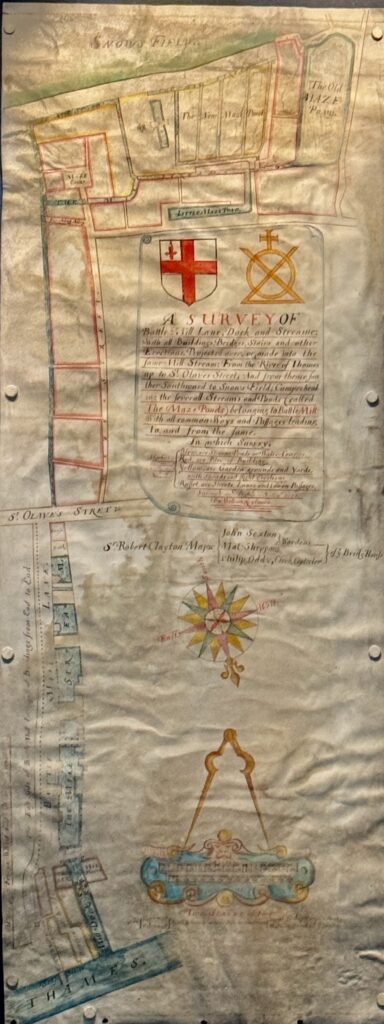
You can view a pen and wash map on parchment surveyed and made by William Leybourn …

This highly decorative item is notable not only for its clear depiction of an area known as Battle Bridge Mills (Southwark) but also for the drawing of the ‘Bridge House’ mark. This is believed to be the first depiction of the mark in its modern form.

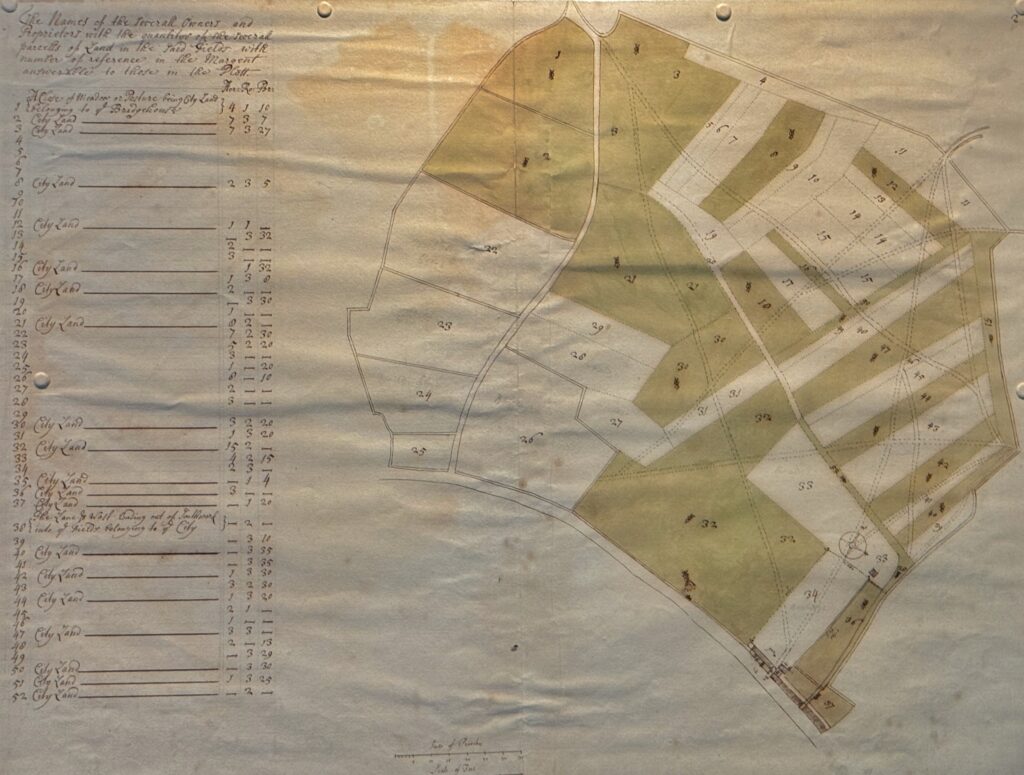
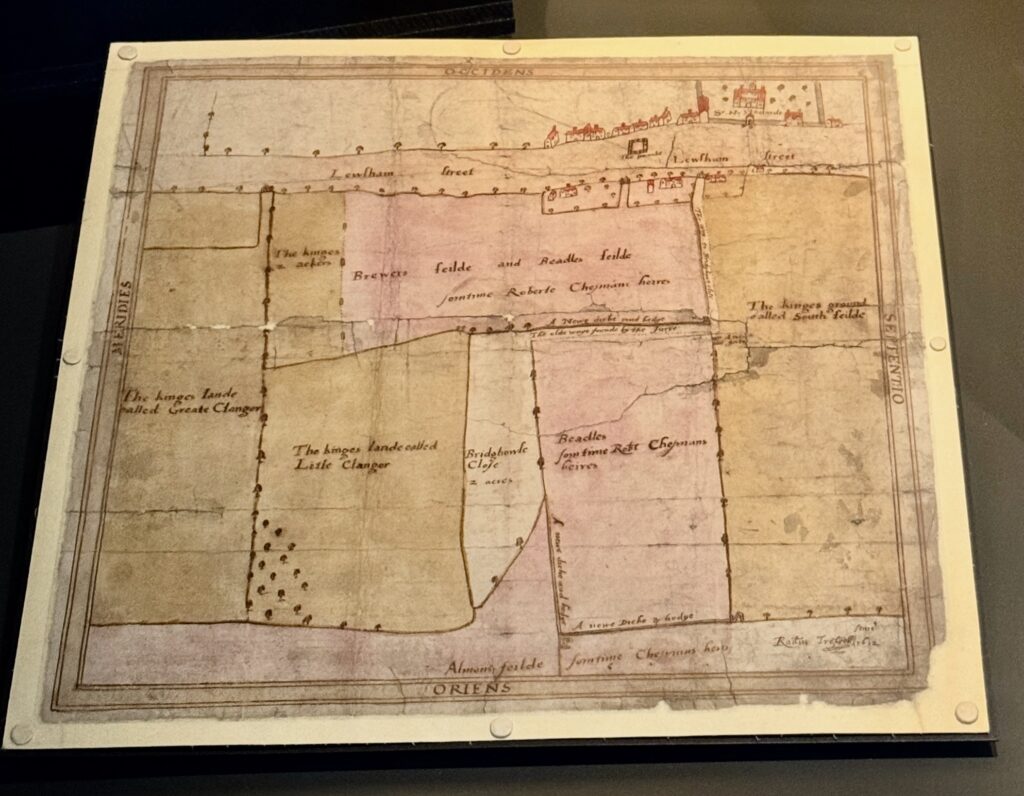
You’ll see the Mark being deployed on a plan of St. George’s Fields where it is used to show which plots of land in the area were property of the Bridge House …

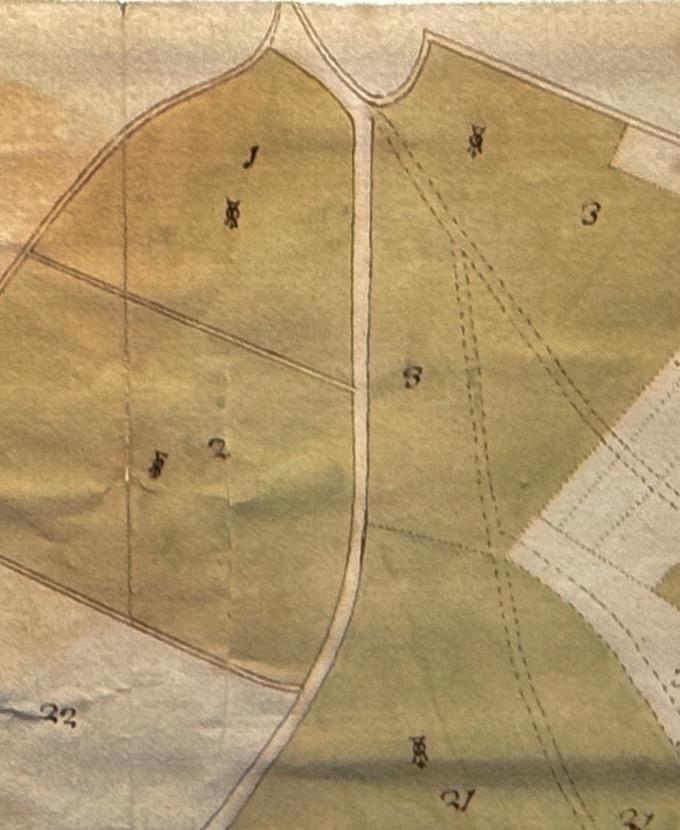
In close up …

I love the field names ‘Little Clanger’ and ‘Greate Clanger’ …

On 1 June 2023 the charity obtained a supplemental Royal Charter. This is the fourth charter granted to the charity and will allow for the modernisation of the charity’s governance as well as enabling them to maximise the impact of the funds it manages …

This charter is decorated with images of the five city bridges and was signed by King Charles III. However, as the charter was granted to the charity by Queen Elizabeth II, it is her image which is depicted on the seal

It’s always a pleasure to visit the Guildhall Gallery. Remember that the beautiful Evelyn De Morgan exhibition is still on and admission is ‘Pay What You Can’. You can pay as much or as little as you like for your ticket or visit for free.

If you would like to follow me on Instagram here is the link …
https://www.instagram.com/london_city_gent

A visit to Dr Johnson’s House.

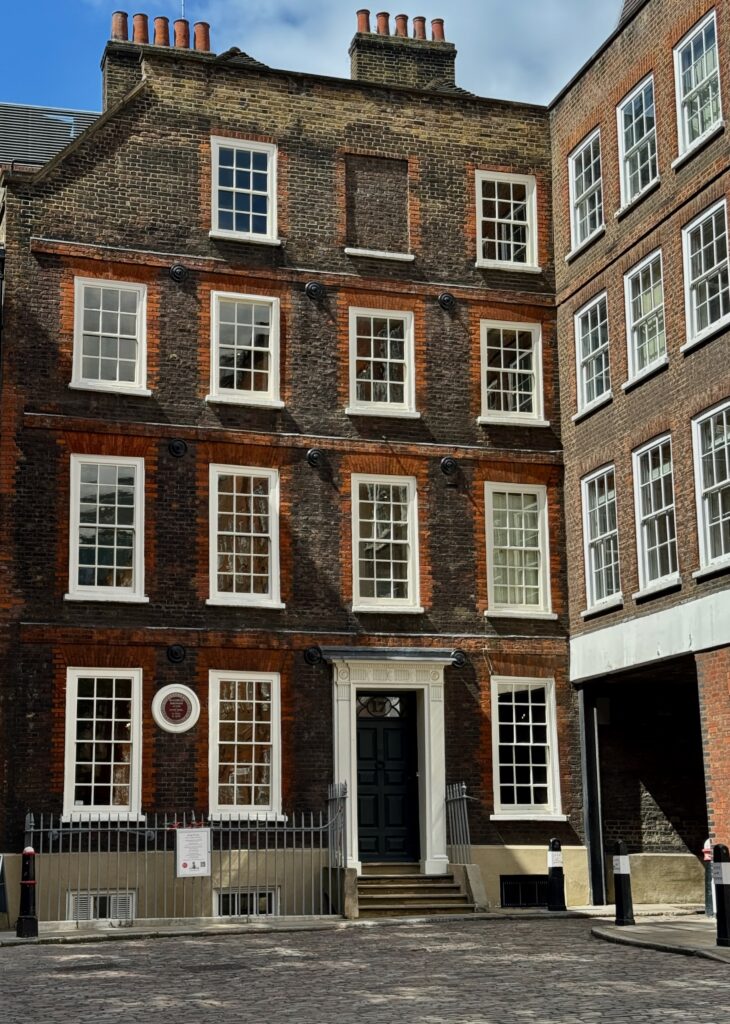
Once surrounded by the throbbing printing presses of Fleet Street newspapers, Gough Square is today a quiet haven off the noisy main road. Now known as Dr Johnson’s House, 17 Gough Square was built by one Richard Gough, a City wool merchant, at the end of the seventeenth century. It is the only survivor from a larger development and Dr Johnson lived here from 1748 to 1759 whilst compiling his famous dictionary. It has been open to the public for many years but for some reason I’ve only just got around to visiting it …

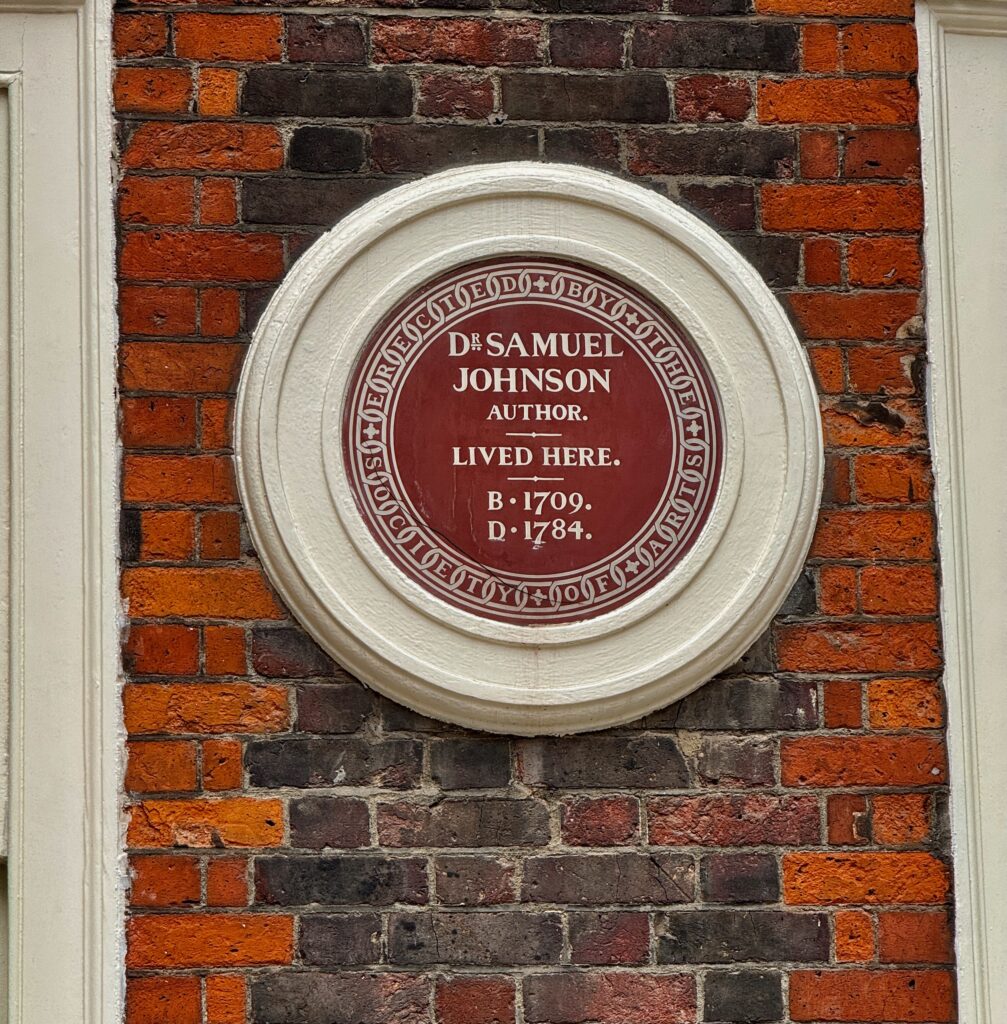
The house has the first example of a Royal Society of Arts terracotta plaque (installed in 1898) commemorating Samuel Johnson’s residence here …

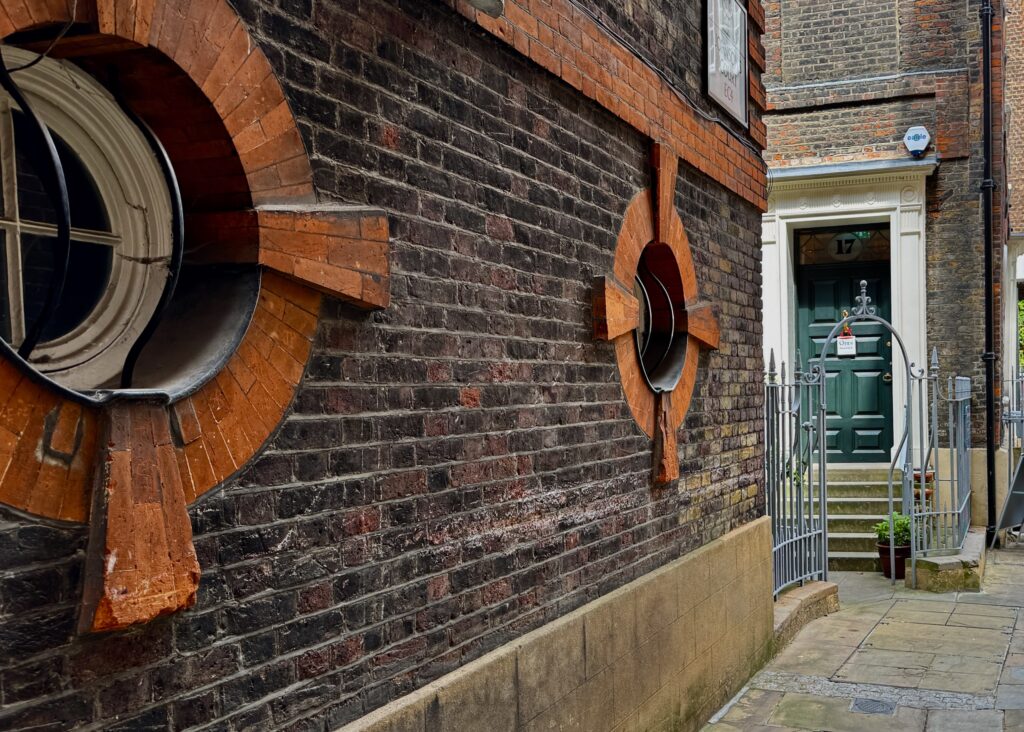
The way in …

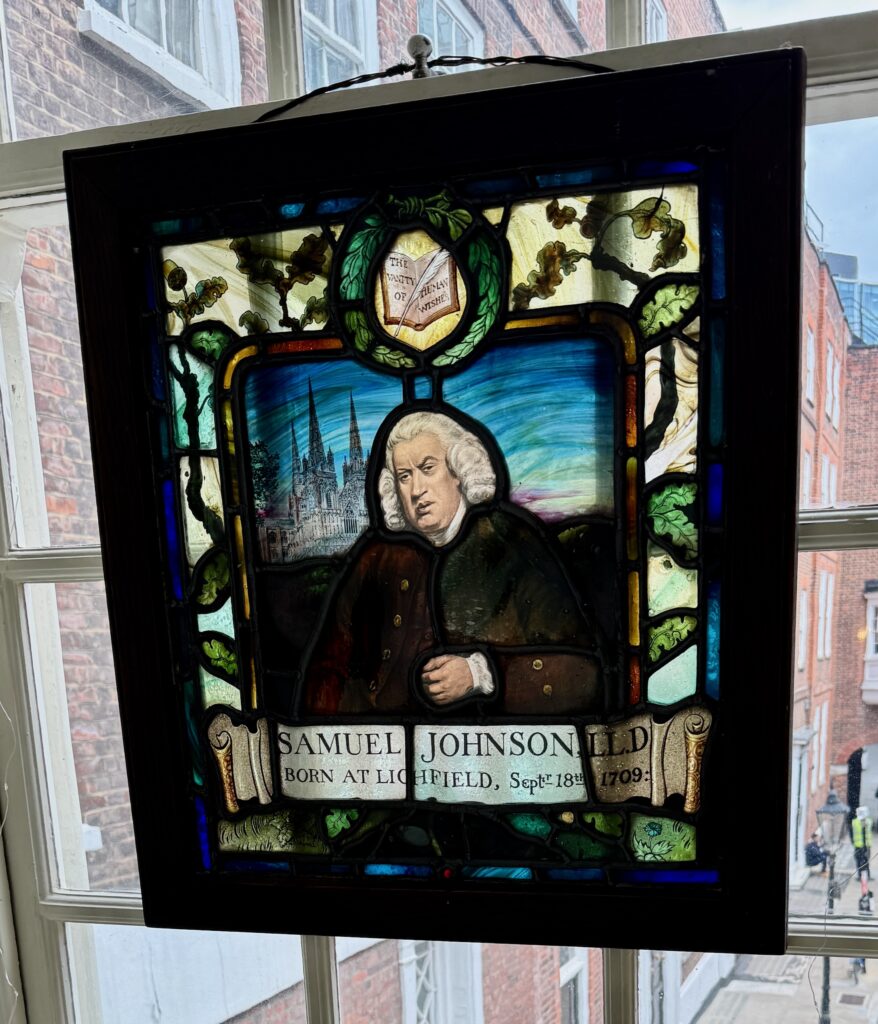
Dr. Samuel Johnson (1709–1784) was an English writer, lexicographer, critic, and moralist, widely regarded as one of the most influential figures in 18th-century English literature. Born in Lichfield, Staffordshire, on September 18, 1709, he was the son of a bookseller. Despite battling poor health and financial hardship, he developed a voracious appetite for reading and classical learning.

Johnson attended Pembroke College, Oxford, in 1728, but was forced to leave after a year due to lack of funds. Although he did not complete a degree, his academic brilliance left a lasting impression. He moved to London in 1737 with his friend and former pupil David Garrick, who would later become a renowned actor. There, Johnson began his literary career with essays, translations, and poetry, steadily gaining recognition.

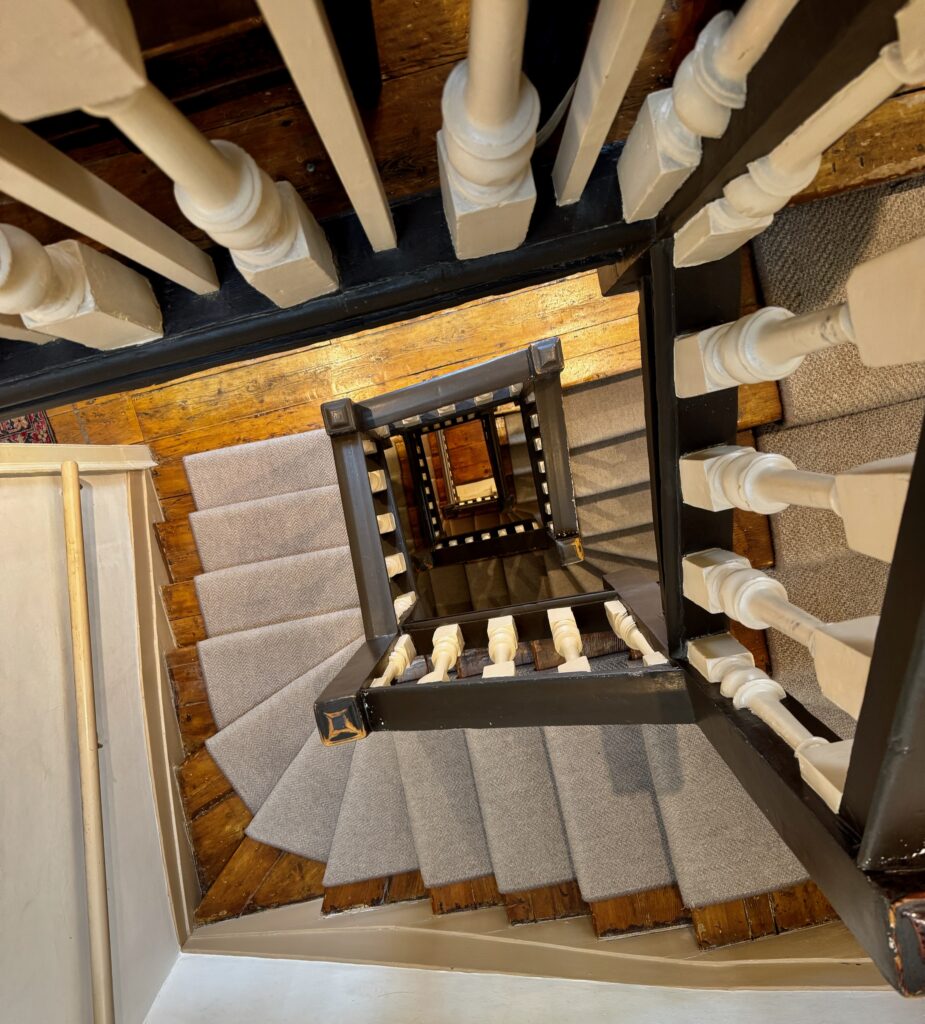
His most monumental achievement came in 1755 with the publication of A Dictionary of the English Language. A massive undertaking completed almost single-handedly, the dictionary was the most comprehensive English lexicon of its time and remained a standard reference for over a century. It established Johnson’s reputation as a leading intellectual so I head first to the top floor garrett where the great man worked. I can’t help but think of him grabbing the banister as he climbed the rickety, narrow staircase to the top floor …

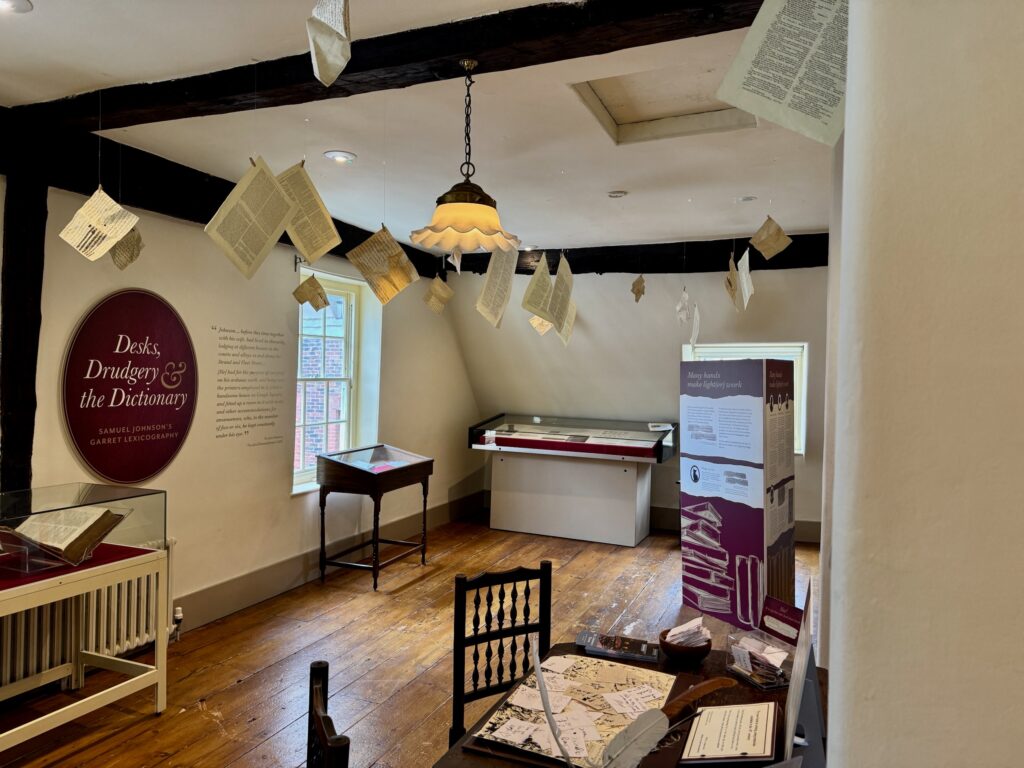
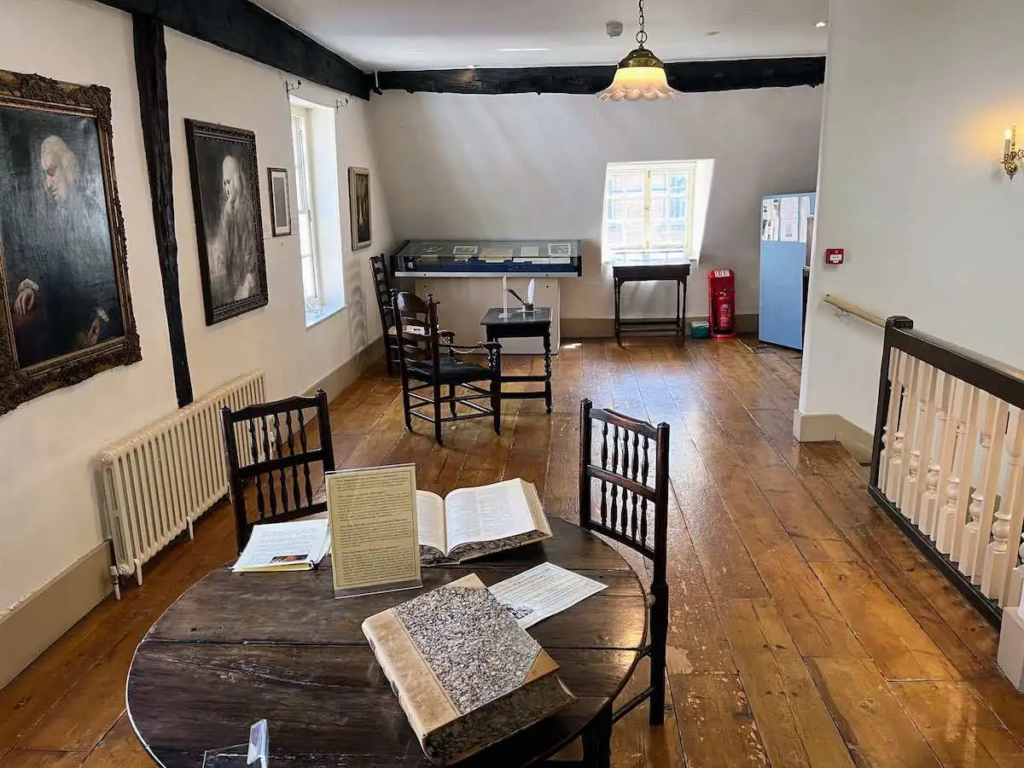
The room where he worked. He was originally contracted to complete the project in just three years but in the end it took him just over eight to complete, with six helpers …

On the table is a facsimile of the final version which visitors can leaf through …

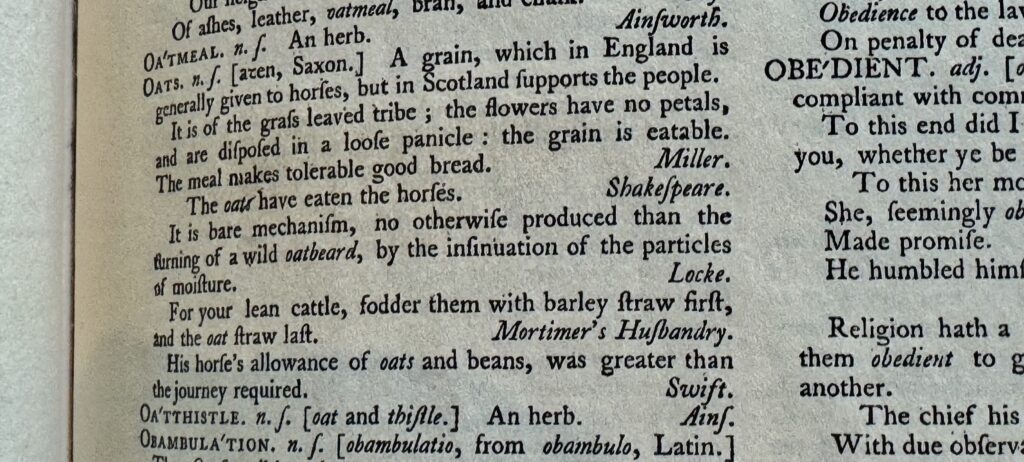
I made a point of looking up his famous (or infamous) definition of the word ‘Oats’ : ‘… grain, which in England is generally given to horses, but in Scotland supports the people’.

Note that he not only defines the word but also alludes to other examples of it in context quoting Shakespeare, Locke, Mortimer’s Husbandry and Swift …

Other fascinating definitions include his own occupation as lexicographer: ‘a writer of dictionaries; a harmless drudge, that busies himself in tracing the original, and detailing the signification of words’.

I also like Mouth-friend: ‘One who professes friendship without intending it.’

And what about this elegant, succinct definition of History: ‘A narration of events and facts delivered with dignity’.

Other interesting sights I encountered as I wandered from floor to floor.

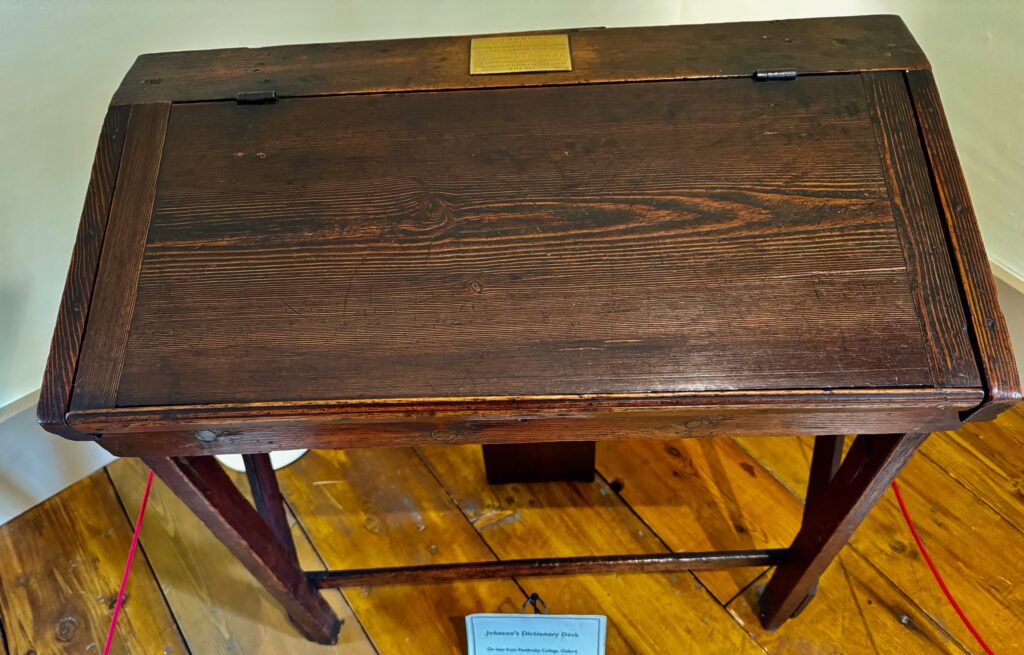
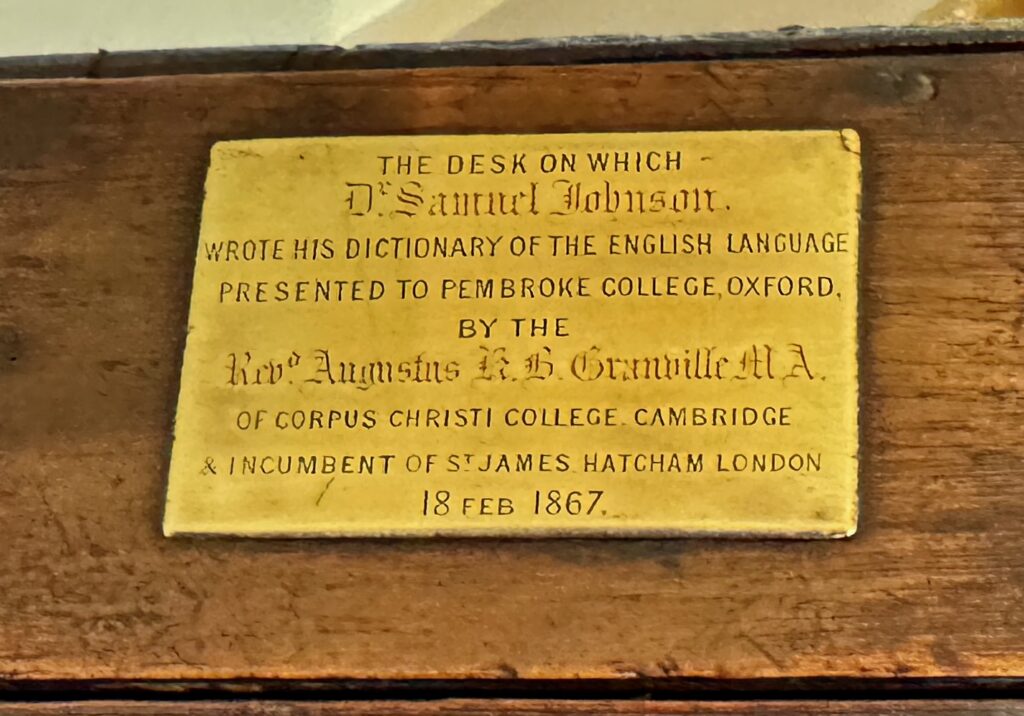
Dr Johnson’s dictionary desk on loan from Pembroke College …

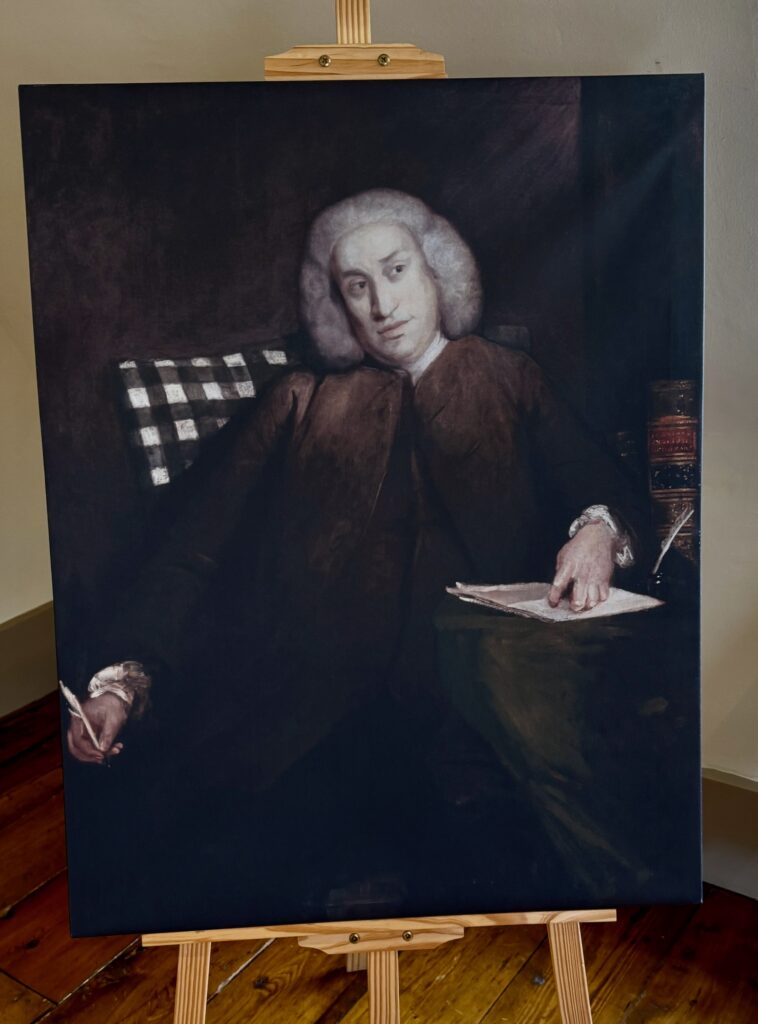
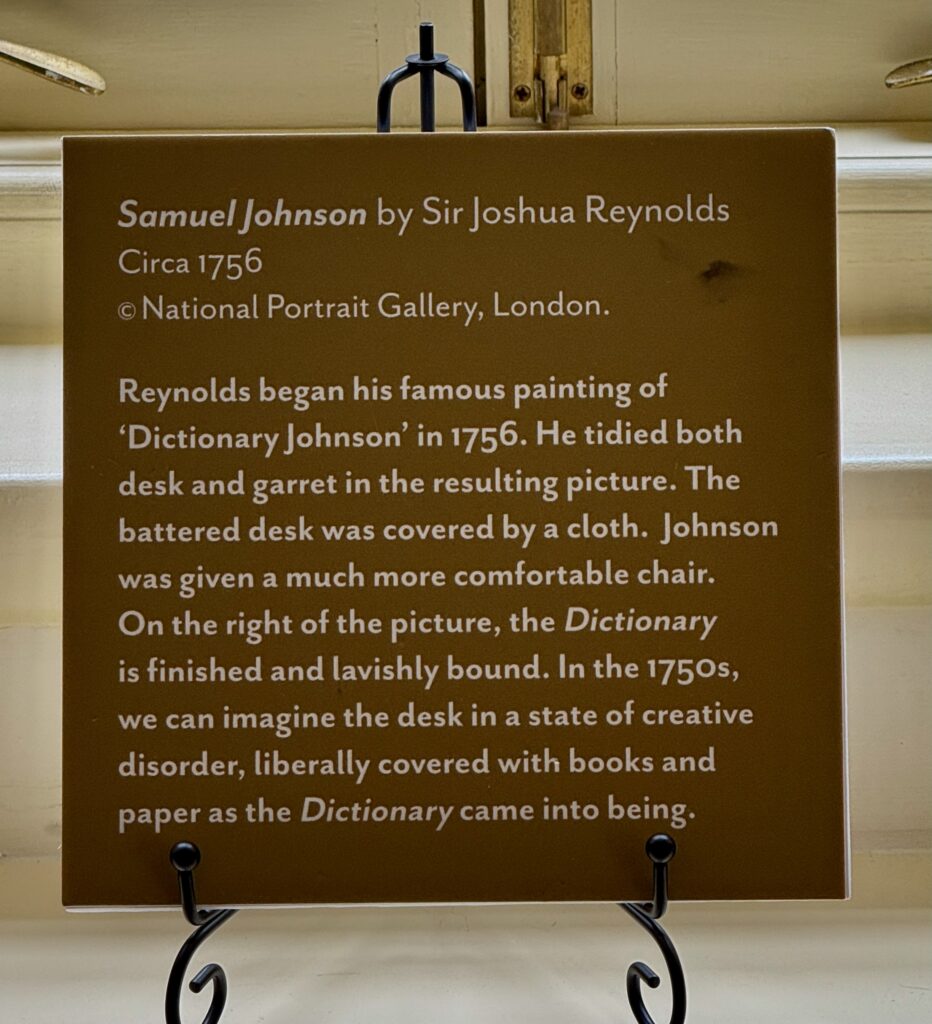
A famous portrait …

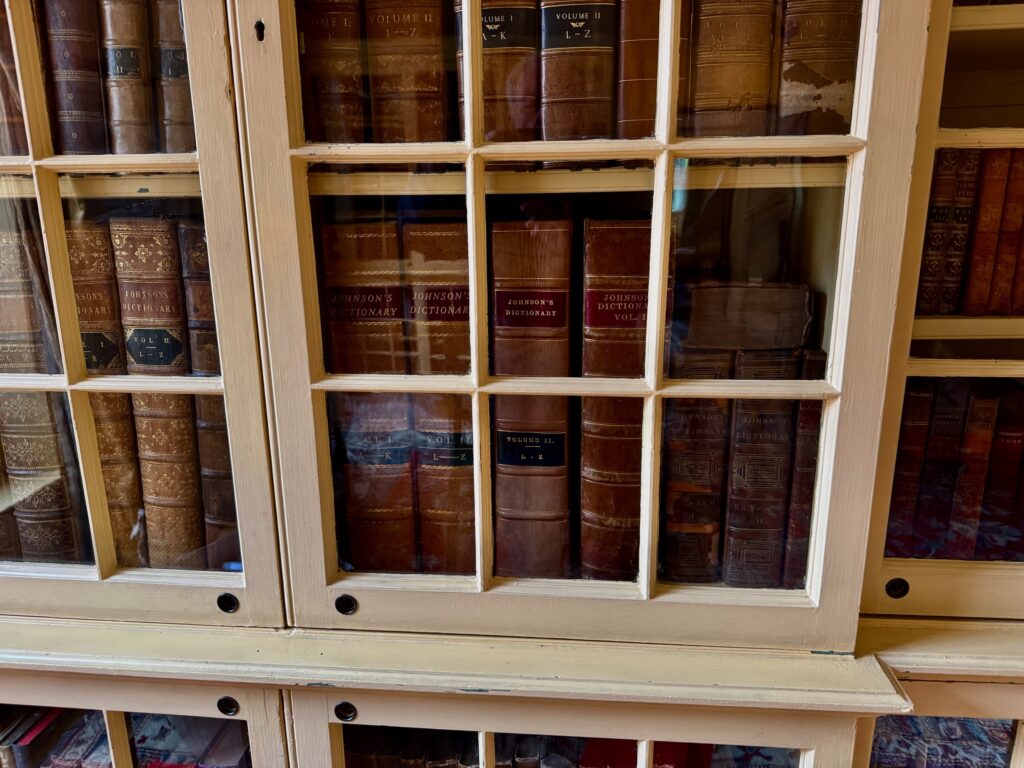
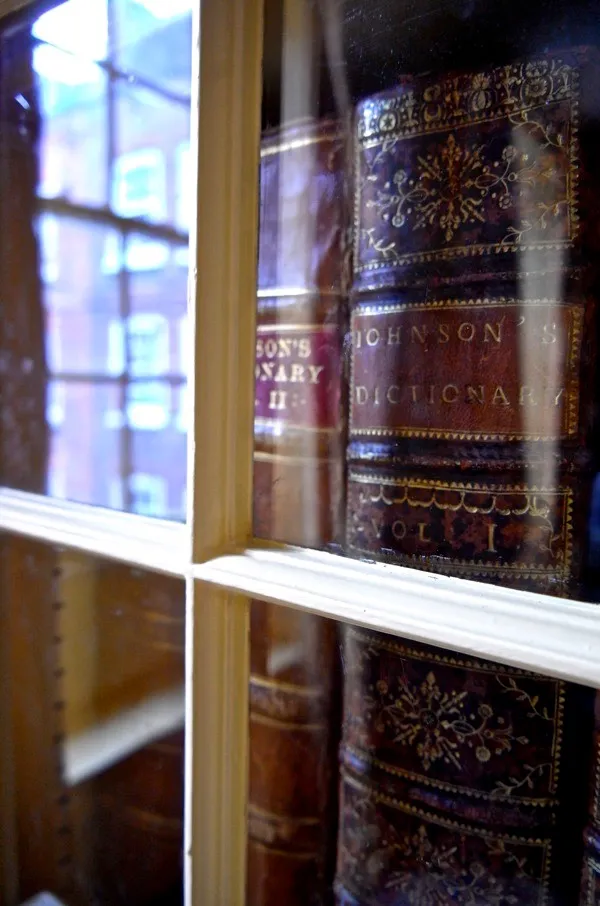
Bookcase with various editions of the work …

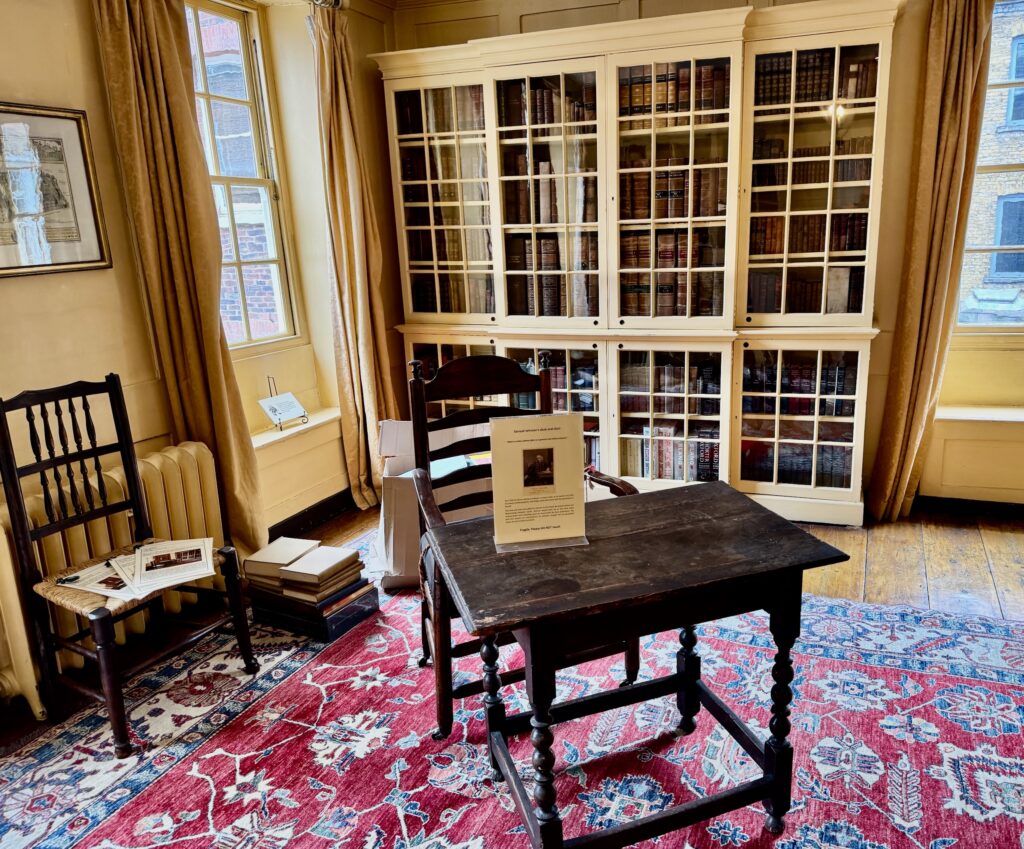
Johnson’s desk and chair …

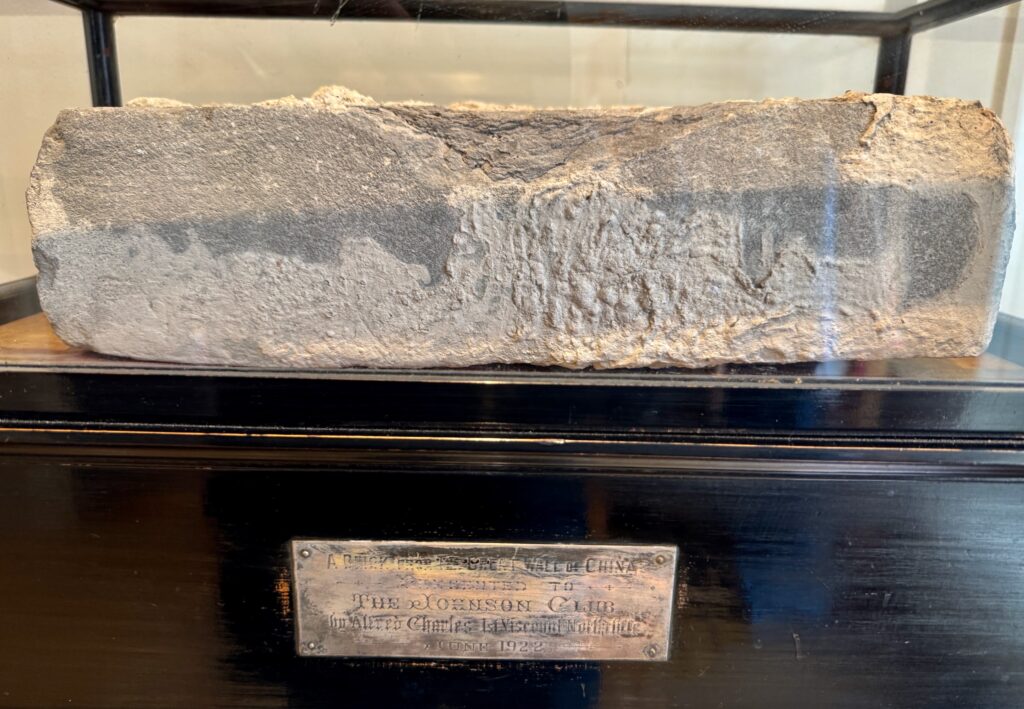
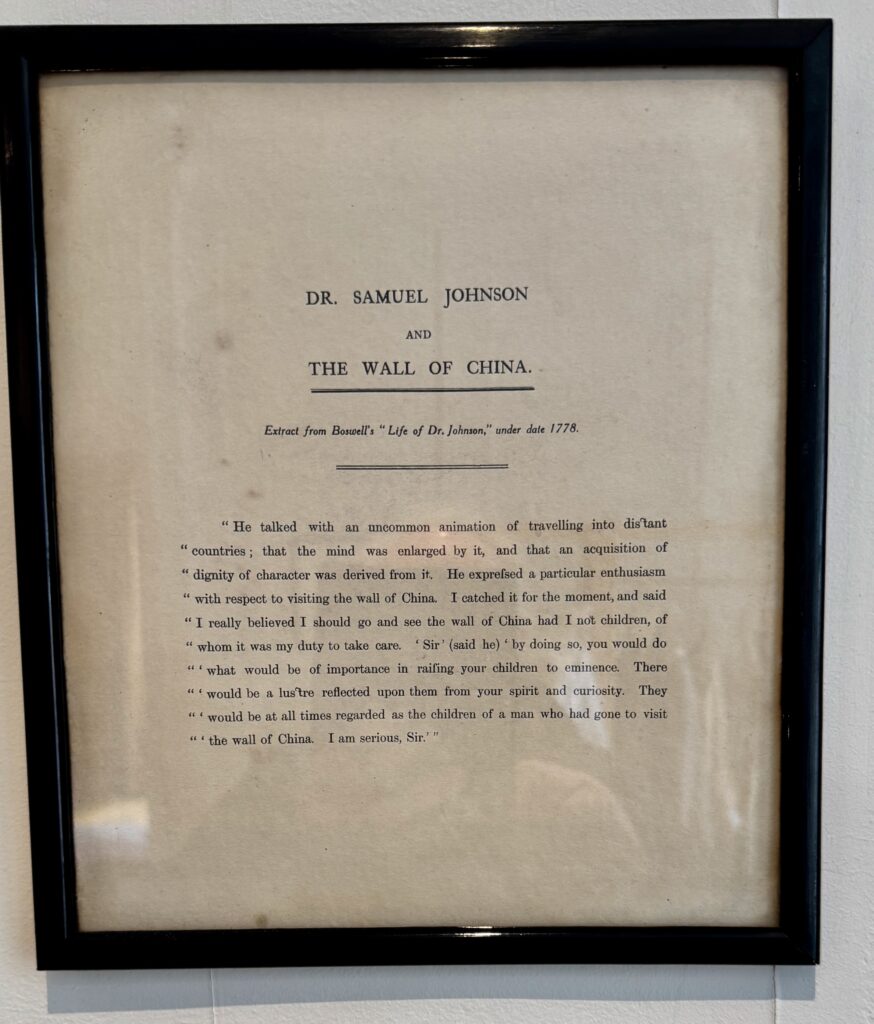
An odd piece of memorabilia from the Johnson Club (1922). A brick from the Great Wall of China …

The reason for its acquisition …

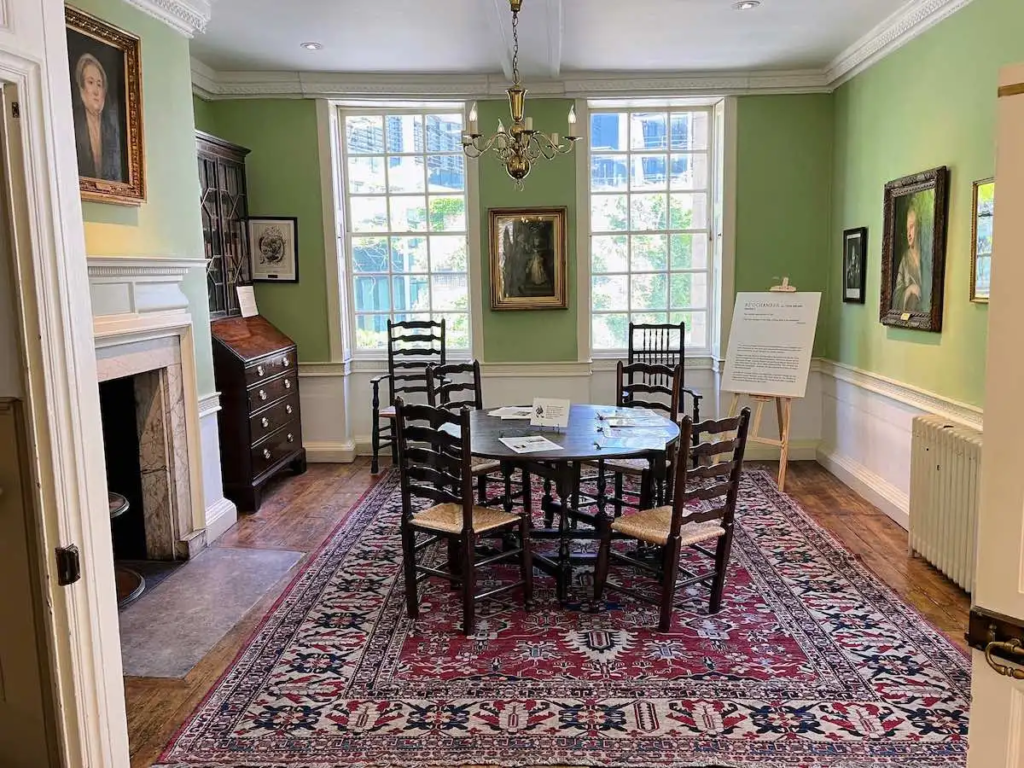
Note the portrait above the fireplace …

‘This portrait of Anna Williams was painted by Frances Reynolds, sister of the more renowned portraitist, Sir Joshua Reynolds. All were friends with Samuel Johnson. The sitter, Anna Williams, was a friend and housekeeper to Johnson from the early 1750s until her death in 1783. Johnson supported the impoverished Williams, the daughter of a failed inventor, for many decades and helped publish a miscellany of literary works for her benefit. Frances Reynolds has created a sensitive portrayal of Williams who, at an early age, was blinded by untreatable cataracts in both her eyes’ …

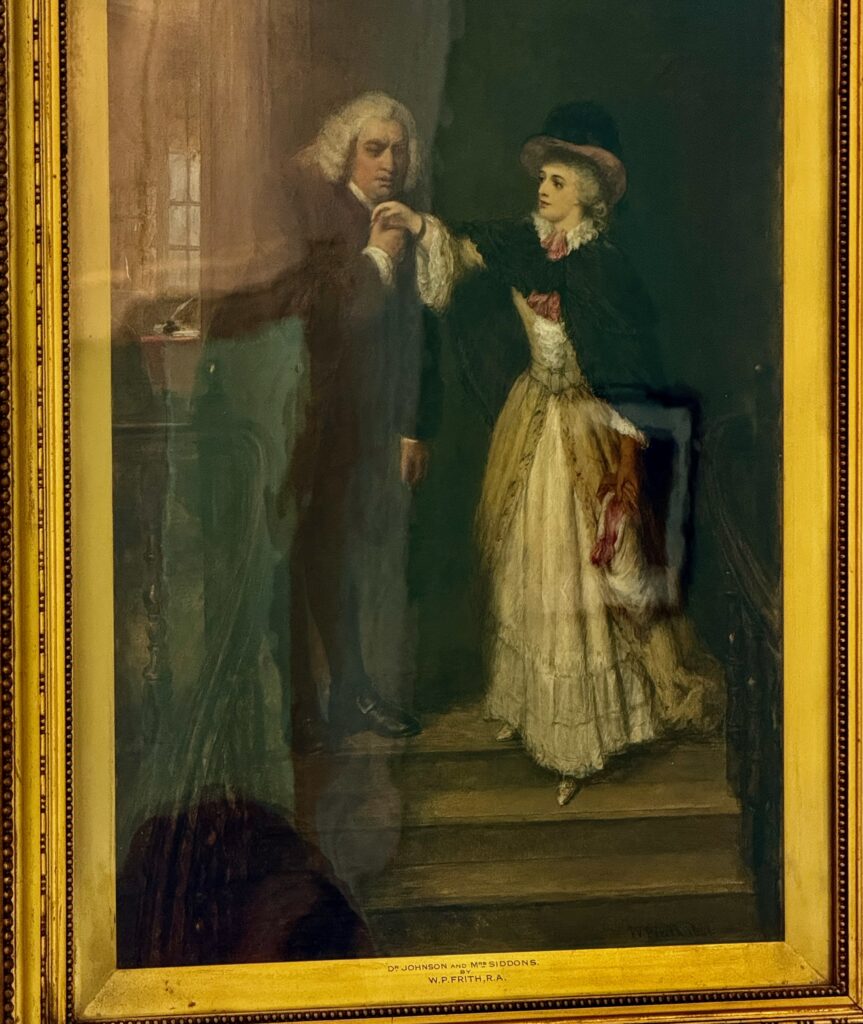
Dr Johnson and Mrs Siddons …

‘The celebrated actress Sarah Siddons specialised in tragic roles, which helped her maintain a dignity and good reputation. She met … Johnson near the end of his life and the episode was the inspiration for this painting by Frith. When there was no chair in Johnson’s house for the actress he remarked with charm: ‘Madam, you who so often occasion a want of seats to other people, will the more easily excuse the want of one yourself.’

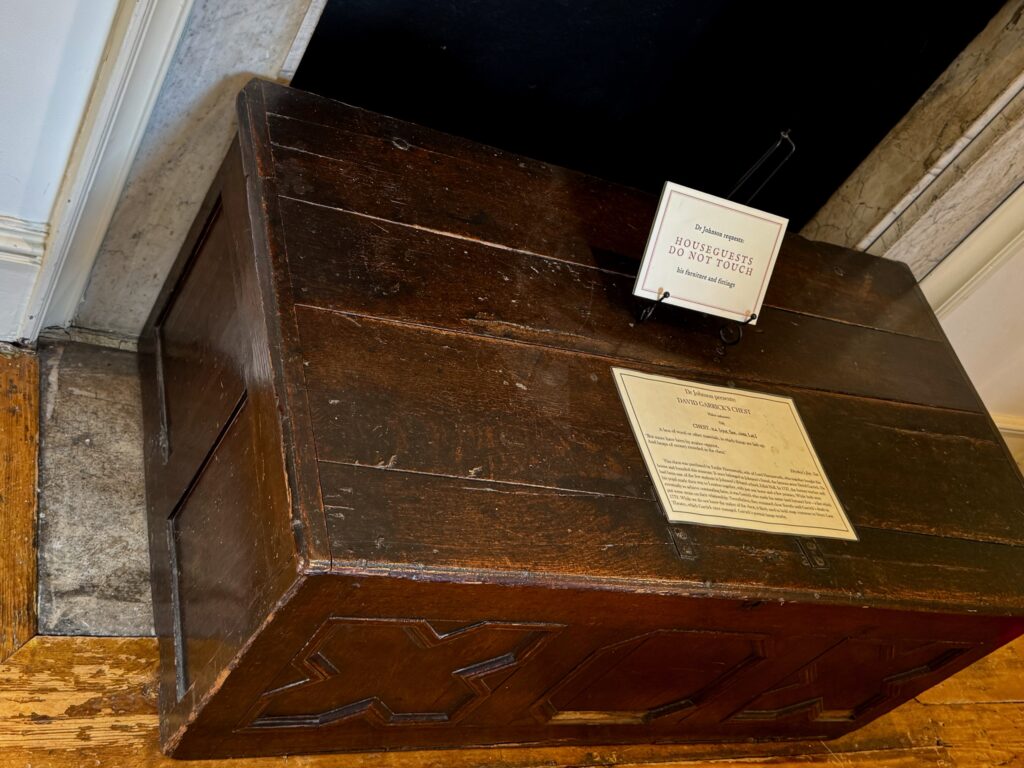
David Garrick’s chest used for storing his costumes …

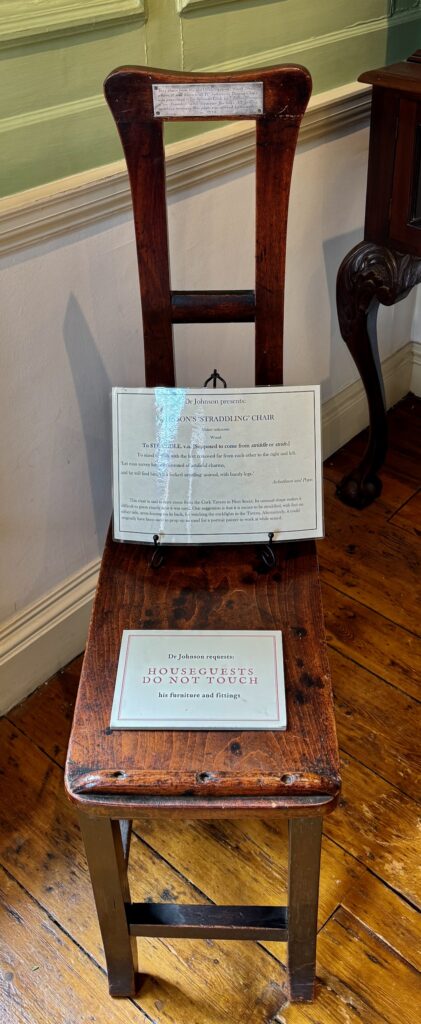
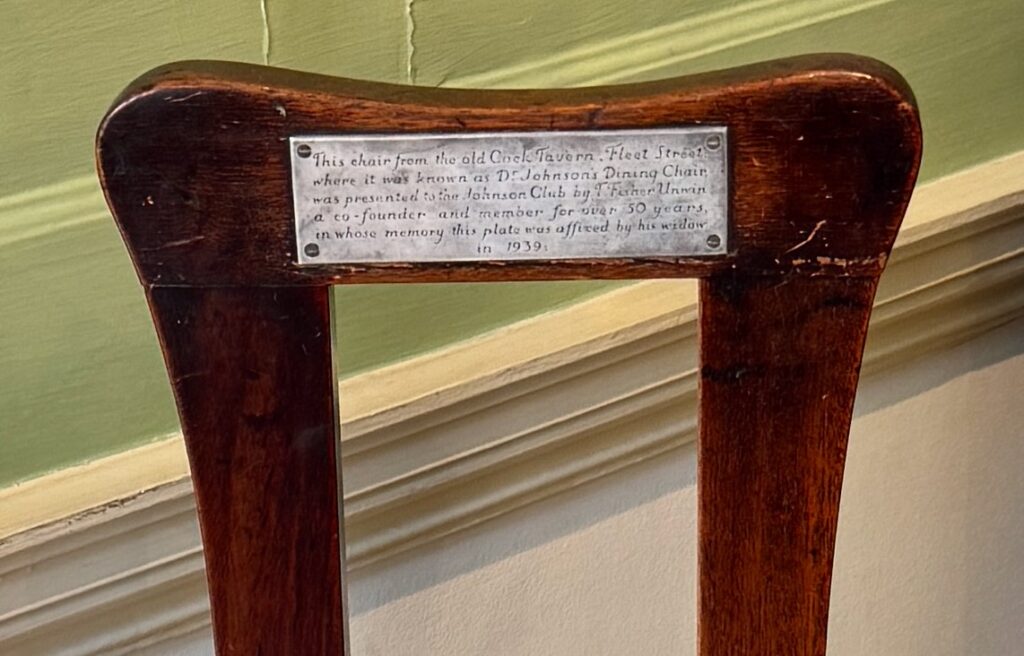
Dr Johnson’s straddling chair …

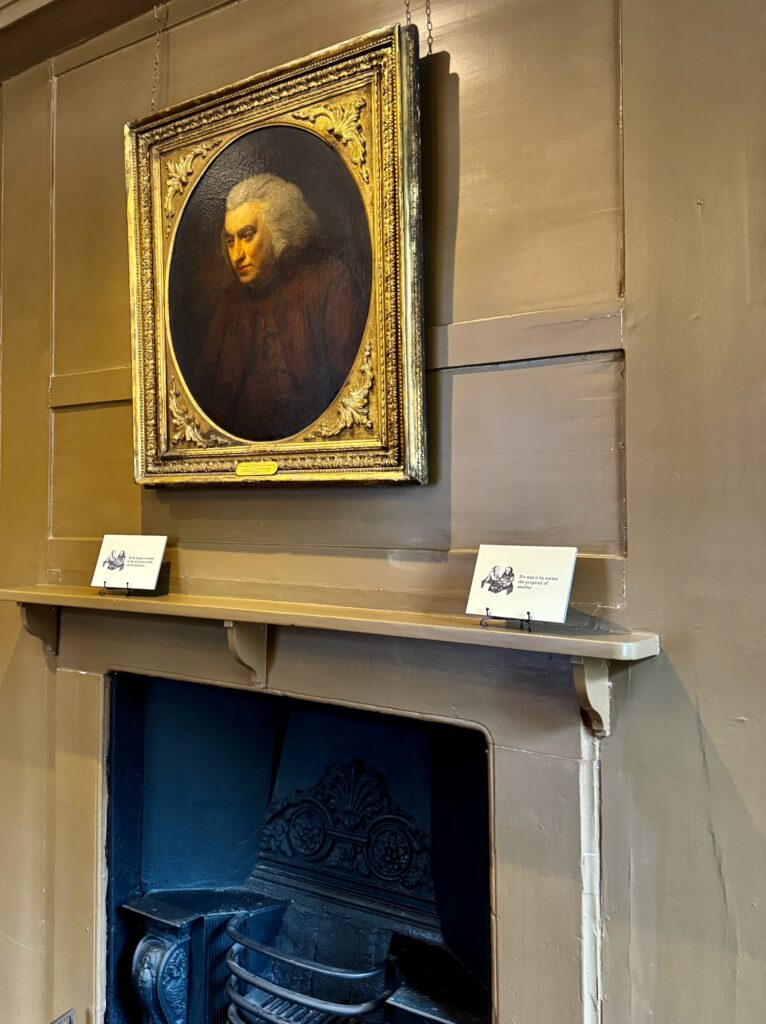
A portriat of Johnson by John Opie (17611807). ‘It depicts Johnson with a “brooding intensity” and “uncompromising directness,” reflecting his character as a prominent figure in English literary criticism. Opie’s work, particularly his portrait of Johnson, is valued for its portrayal of the lexicographer’s character and influence. The portrait, while possibly idealized, stands in contrast to the more realistic depictions by other artists like Sir Joshua Reynolds’ …

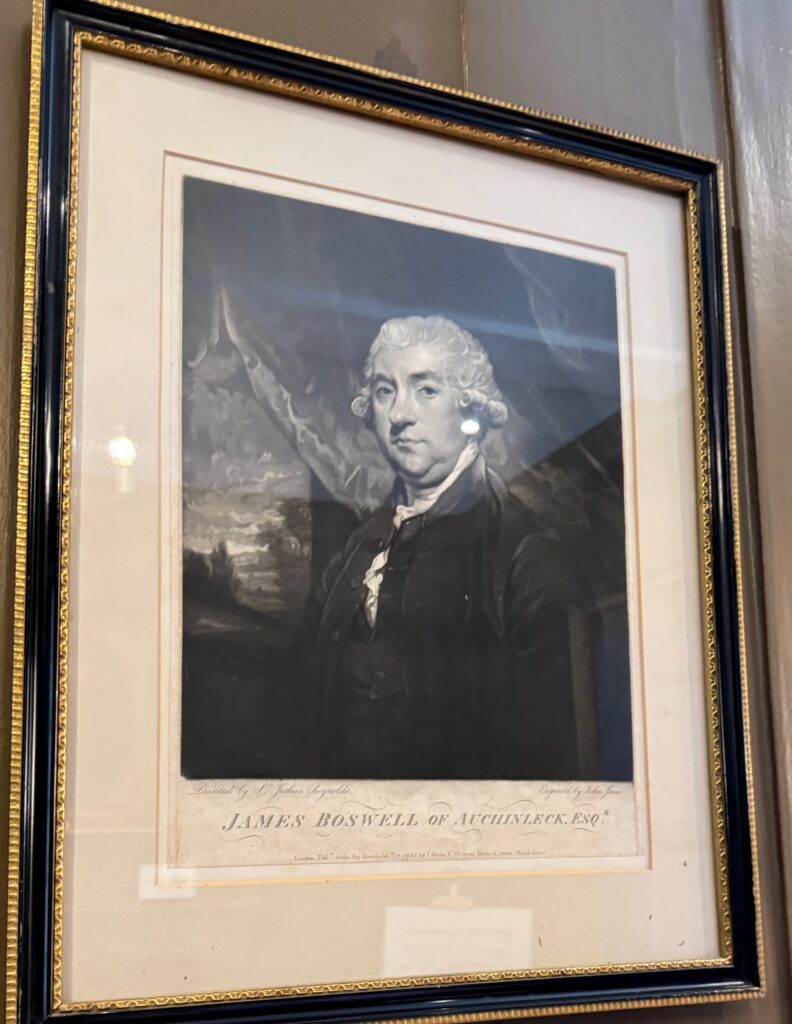
James Boswell, whose Life of Samuel Johnson is commonly said to be the greatest biography written in the English language …

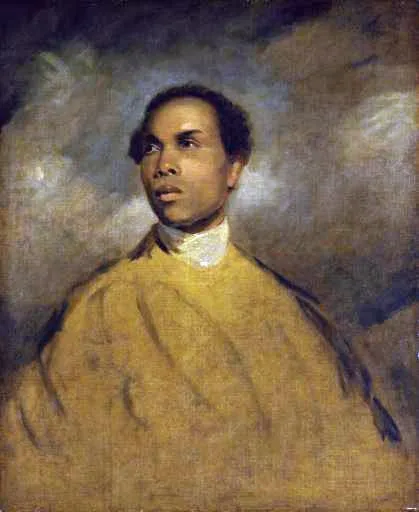
In the front room you will find this portrait, possibly depicting Francis Barber …

Barber was an enslaved Jamaican who arrived at the house, to be Dr Johnson’s servant, in 1752 aged ten. Johnson showed Barber great affection, paid for his education and also remarkably made him his heir. They were friends really rather than master and servant.

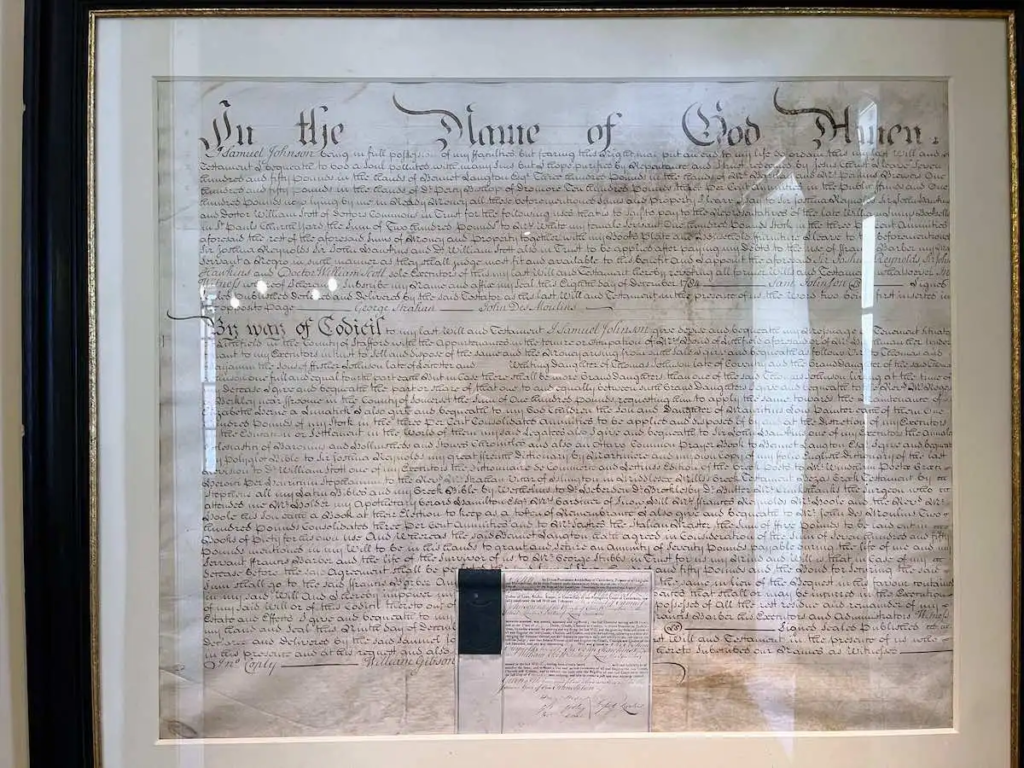
Johnson’s will leaving his trust to Francis Barber, Johnson himself had no direct descendants …

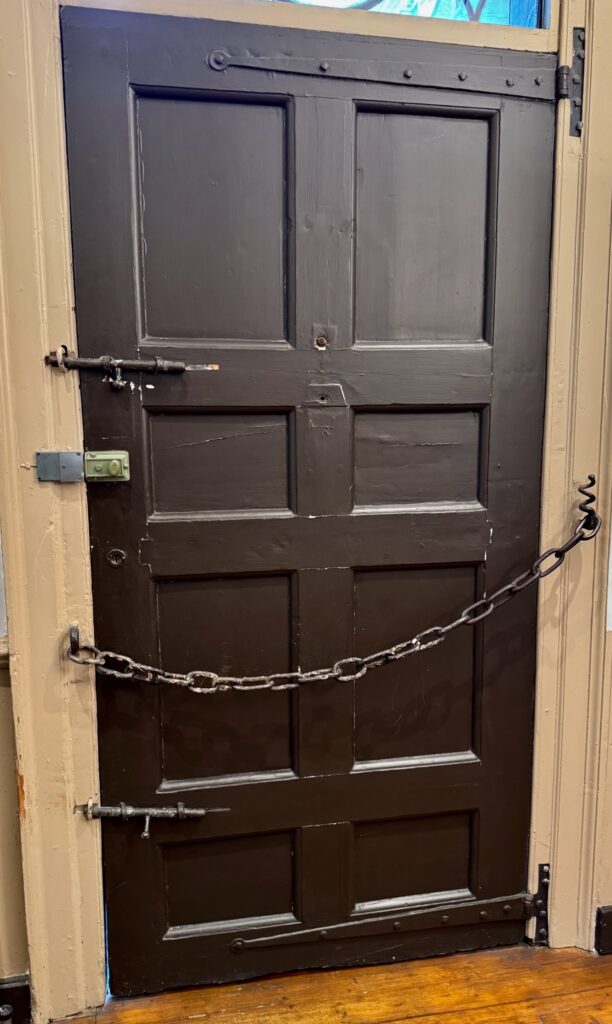
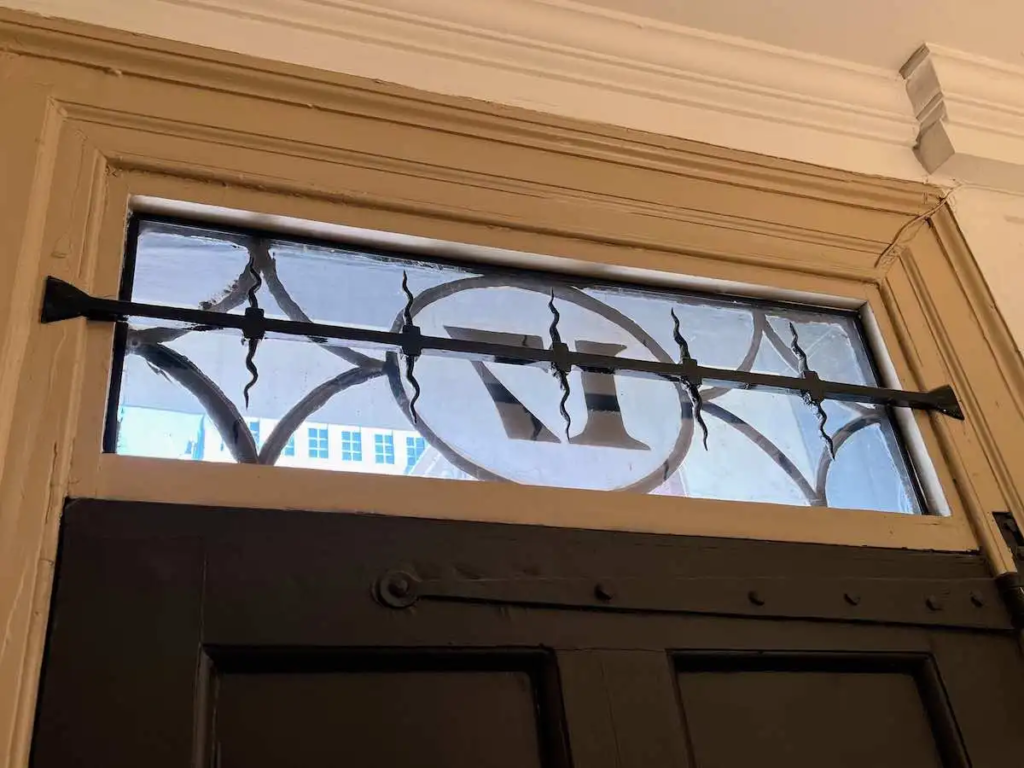
The fine front door (c.1775) complete with anti-burglary devices: a large chain with corkscrew latch, a spiked bar across the fanlight window and two large bolts …

The house is packed with fascinating items telling the story of the great man, his endeavours and the people who knew and worked with him. A highly recommended visit.

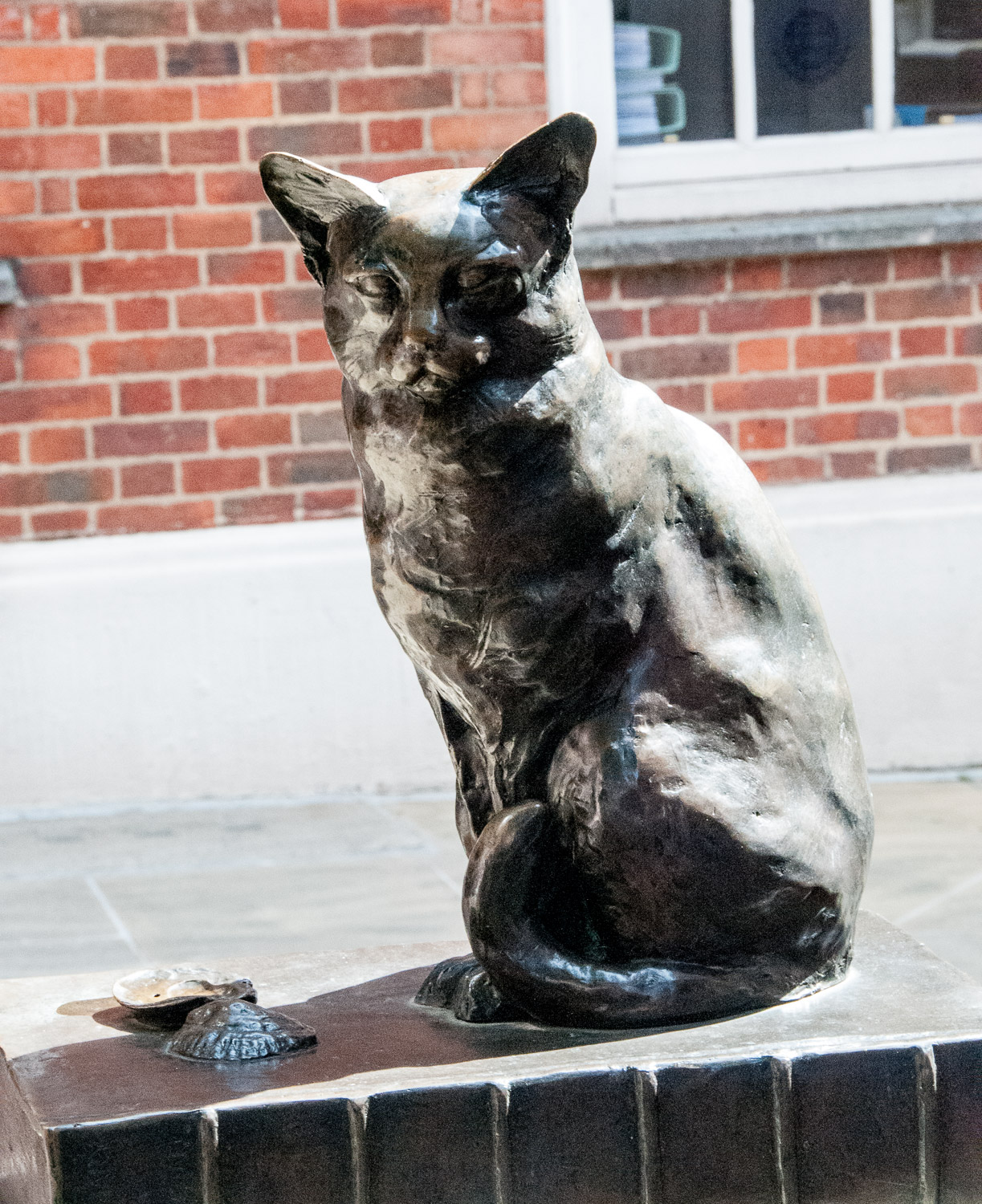
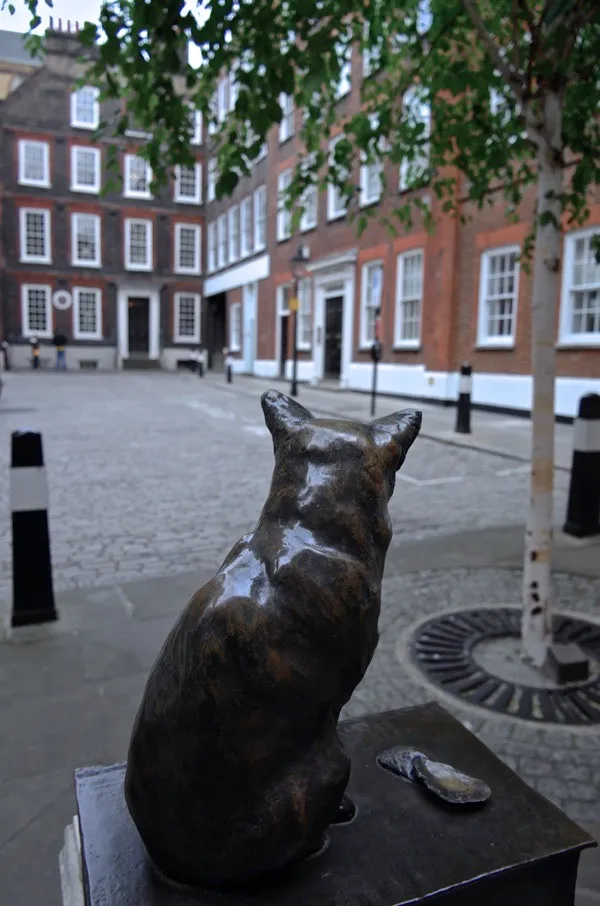
At the other side of the square, facing the house, is Johnson’s most famous cat, Hodge. Here he is remembered by this attractive bronze by John Bickley which was unveiled by the Lord Mayor, no less, in 1997. Hodge sits atop a copy of the dictionary and alongside a pair of empty oyster shells. Oysters were very affordable then and Johnson would buy them for Hodge himself. James Boswell, in his Life of Johnson, explained why:

I never shall forget the indulgence with which he treated Hodge, his cat: for whom he himself used to go out and buy oysters, lest the servants having that trouble should take a dislike to the poor creature

People occasionally put coins in the shell for luck and every now and then Hodge is given a smart bow tie of pink lawyers’ ribbon.

‘A very fine cat, a very fine cat indeed’, said Johnson

If you would like to follow me on Instagram here is the link …

https://www.instagram.com/london_city_gent

Page 8 of 24

Powered by WordPress & Theme by Anders Norén

Symbols & Secrets
Privacy Overview

This website uses cookies so that we can provide you with the best user experience possible. Cookie information is stored in your browser and performs functions such as recognising you when you return to our website and helping our team to understand which sections of the website you find most interesting and useful.