Walking the City of London

Category: Sculpture Page 40 of 41

City Churches – more unusual discoveries

Last week I thought it was time to take another stroll around the City churches to see what I would discover. After researching last week’s blog, I was particularly interested in artifacts that had been moved from one church to another and why.

I was very lucky in the first church I visited, St Martin within Ludgate, on Ludgate Hill (EC4M 7DE) inside which I found both a fascinating chandelier and a very unusual font. There is a large entrance lobby (designed to reduce traffic noise inside the church) and you then enter one of Sir Christopher Wren’s least altered interiors (1677-1686) with fine dark woodwork which largely escaped the Blitz.

Look up and you will see this beautiful chandelier or candelabrum …
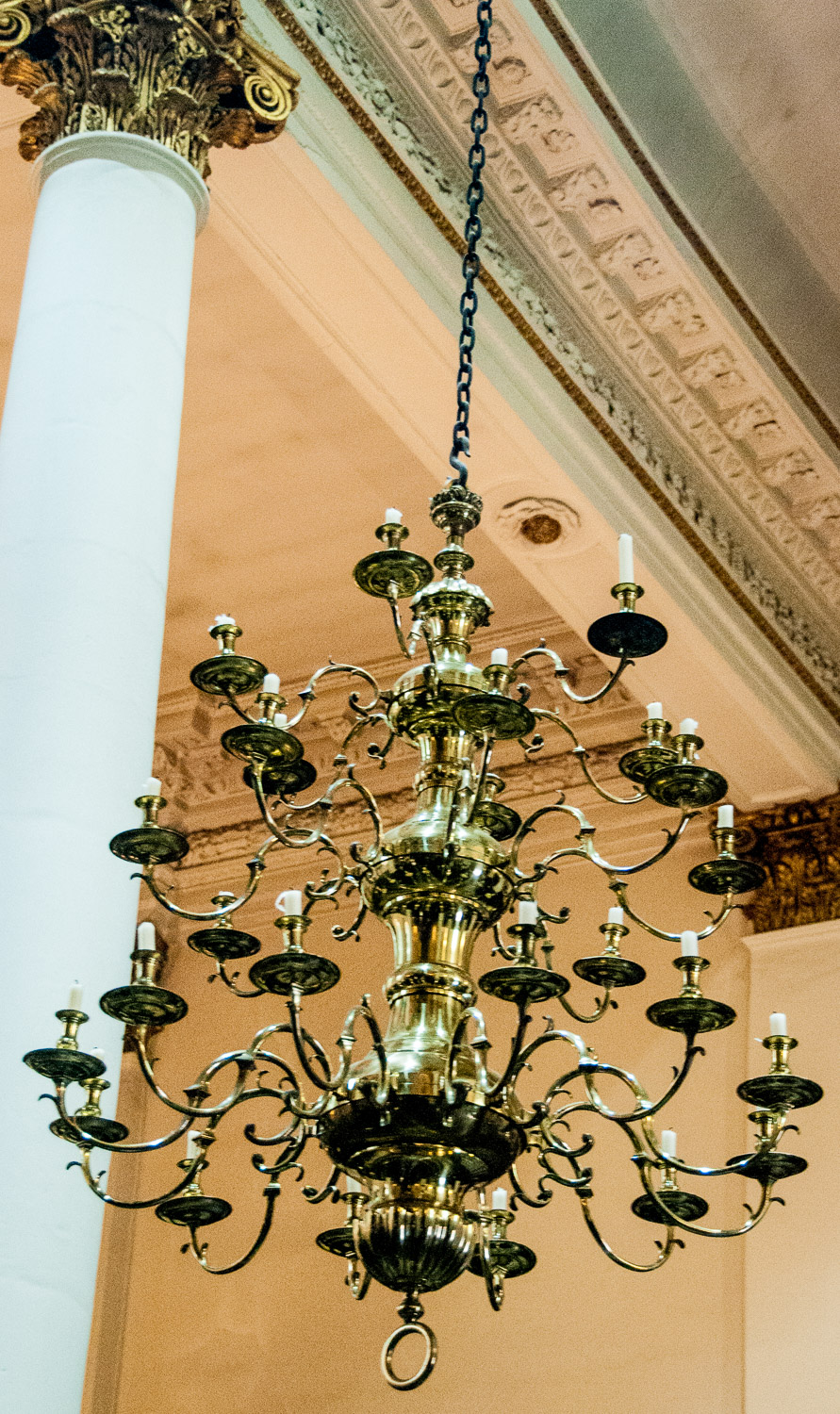
It’s still lit by candles.

As one commentator has noticed, it looks more like something you would find in a country house or a ballroom. The candles were not lit when I visited but I am sure that when they are, on a dark morning or evening, one must get a real feel for what it was like to worship here in earlier centuries. It came to the church via St Vincent’s Cathedral in the West Indies, probably in 1777: a reminder of the links between the City’s trading economy and the British Empire overseas.

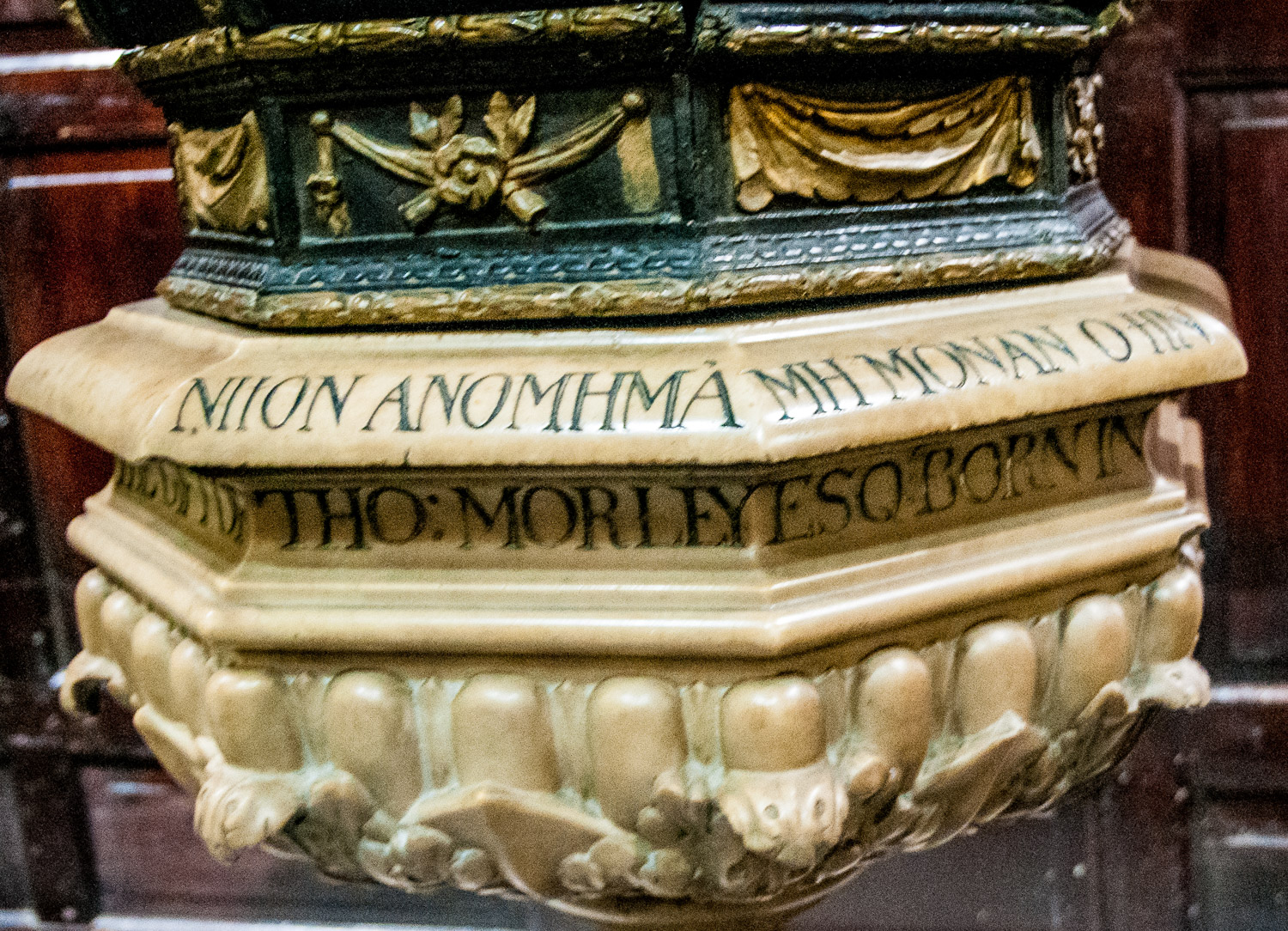
And now to the very unusual font …
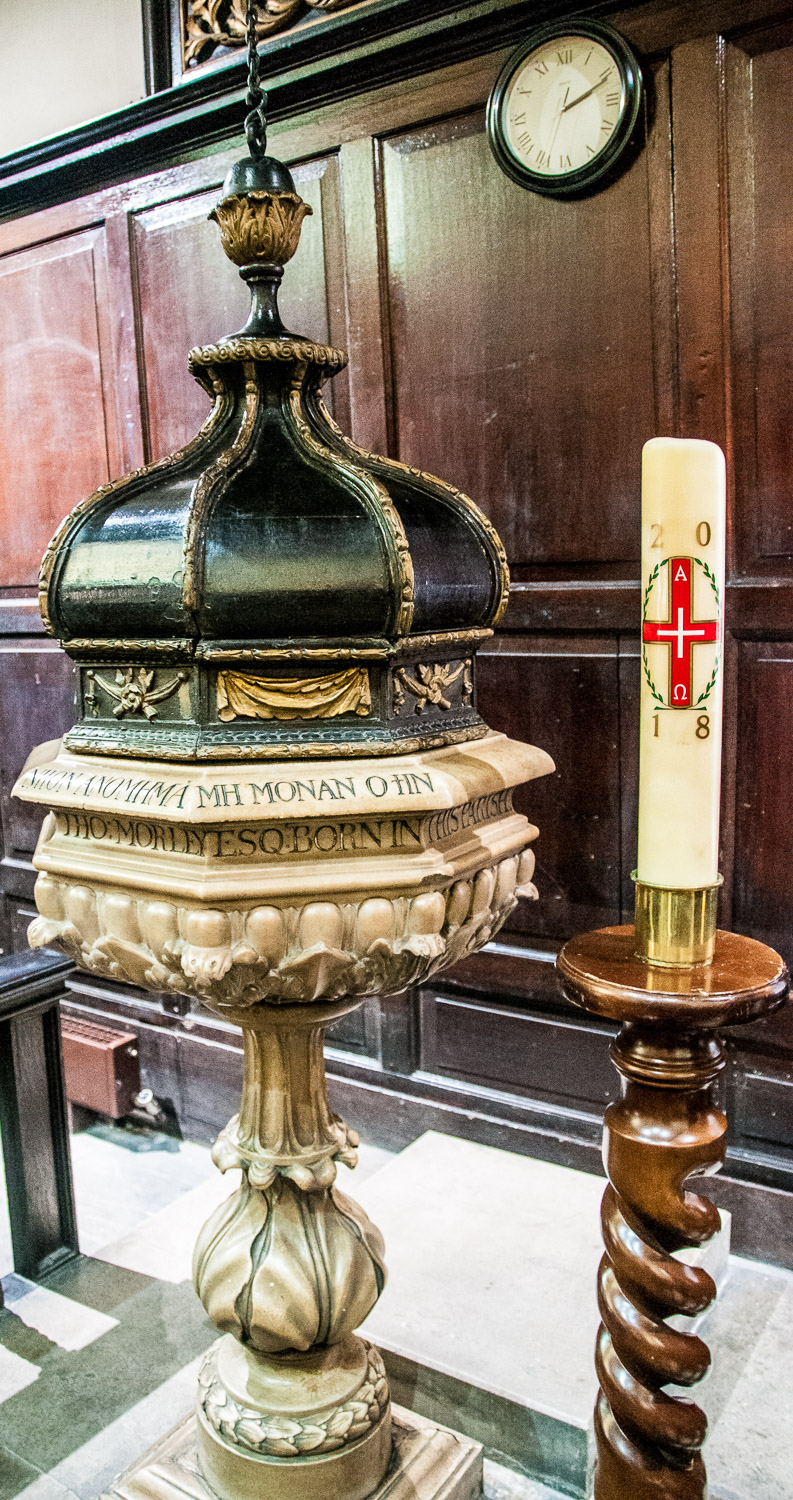
The bowl is white marble and the wooden supporting plinth is painted to look like stone. It dates from 1673, predating the church, and was previously located in a ‘tabernacle’ used by the congregation during the rebuilding.

It contains a Greek palindrome copied from the Cathedral of St Sophia in Constantinople:

Niyon anomhma mh monan oyin

(Cleanse my sin and not my face only)
No church blog of mine would be complete if it didn’t contain a reference one of my favourite churches, St Vedast Foster Lane (EC2V 6HH) …
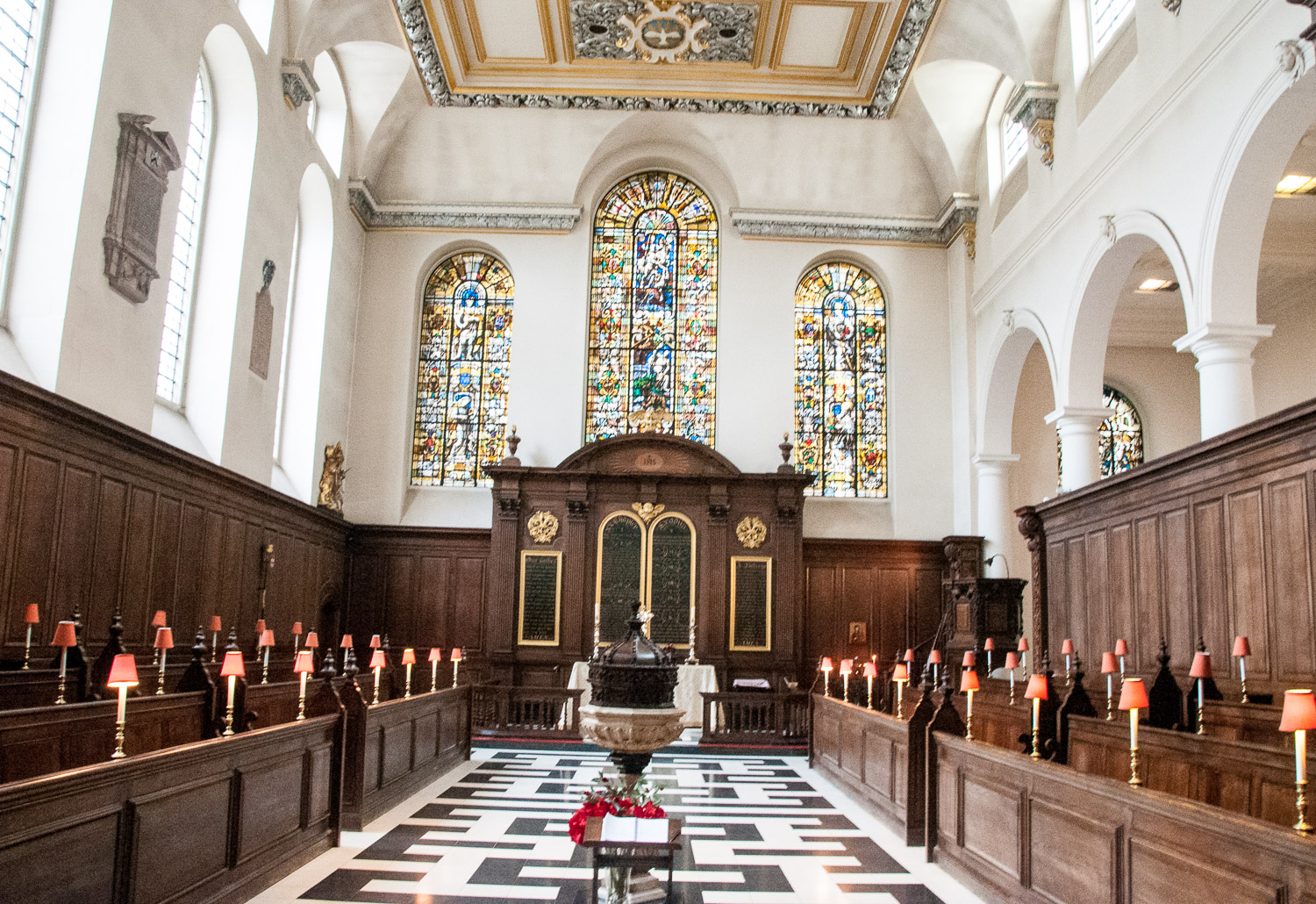
The interior looking east.

Here there are a few features that have come from other churches.
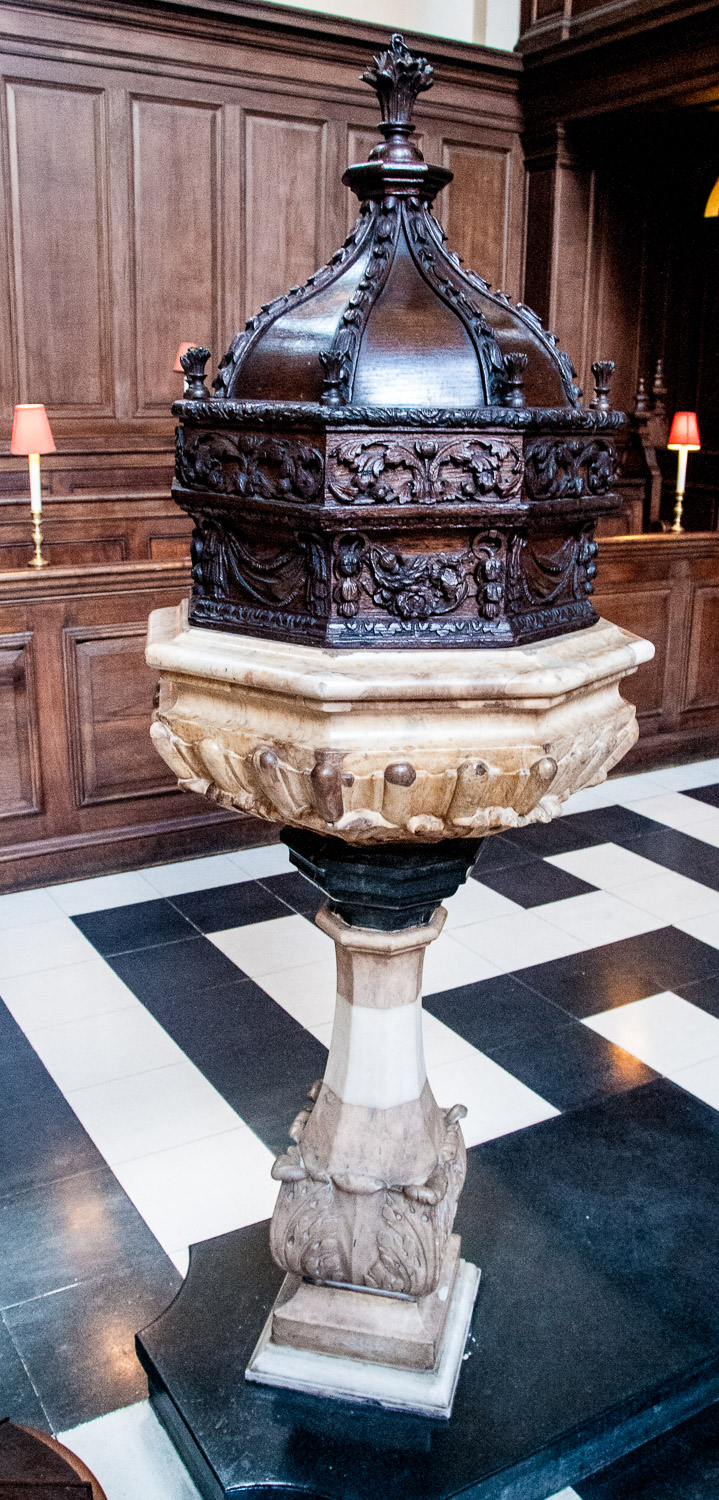
The font and its cover both date from the late 17th century. The font itself was designed by Christopher Wren and the cover is by the most celebrated woodcarver of the 17th century, Grinling Gibbons. Both were rescued from St Anne & St Agnes in Gresham Street after the Blitz.

The reredos behind the altar came from the ‘lost’ church of St Christopher le Stocks …
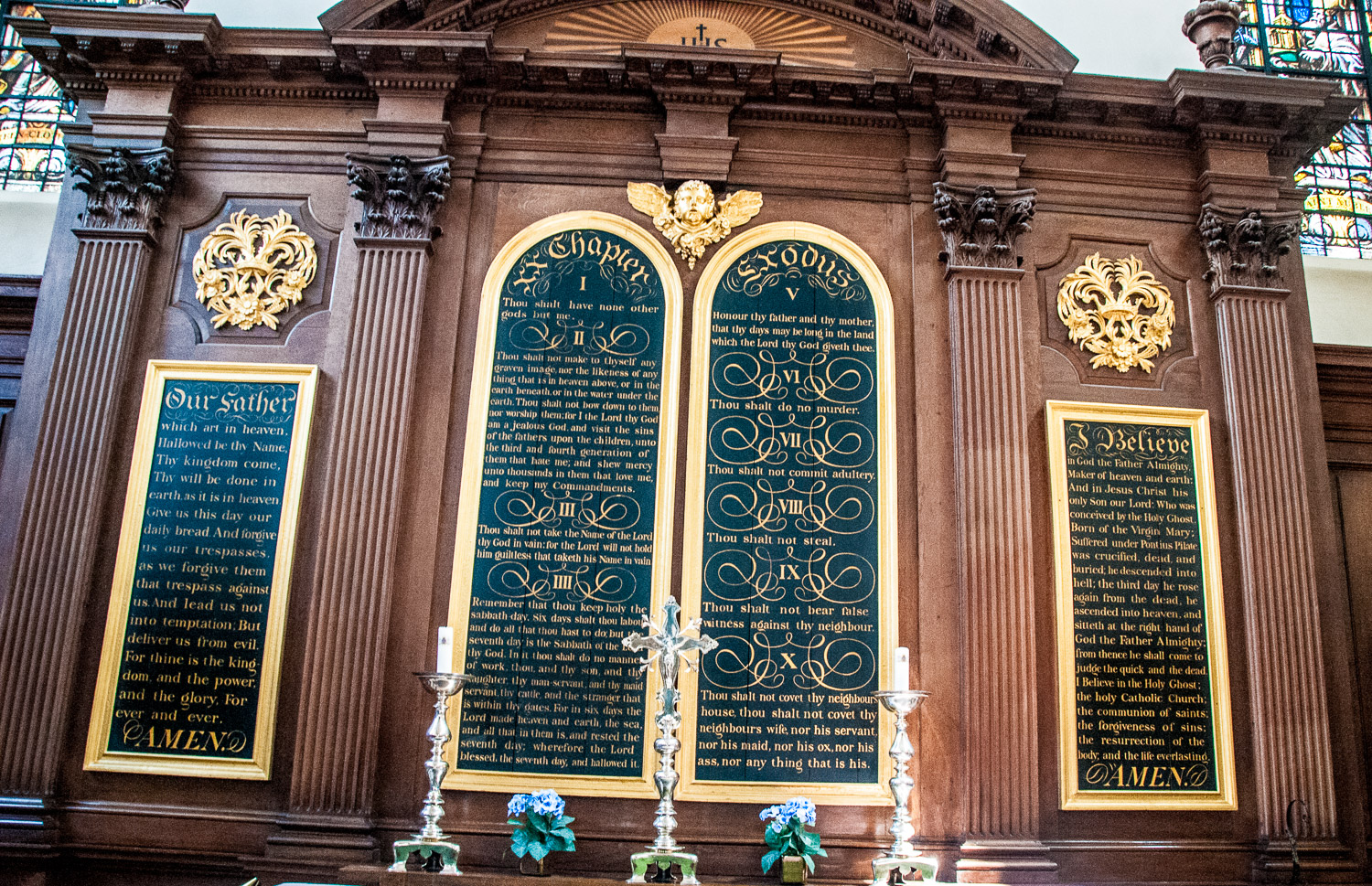
The original St Christopher le Stocks was destroyed in the Great Fire, rebuilt by Wren in 1671 and situated in Threadneedle Street. During the 18th century, the Bank of England gradually bought up adjoining properties, extending its site into the parish. In 1781 it came to an agreement with the rector of St Christopher’s, and its patron, the Bishop of London, allowing it to demolish the church itself. This was not only motivated by a desire to build on the land, but also by a fear that rioters might use the church as a platform to attack the bank, a concern sparked by the Gordon Riots of 1780.

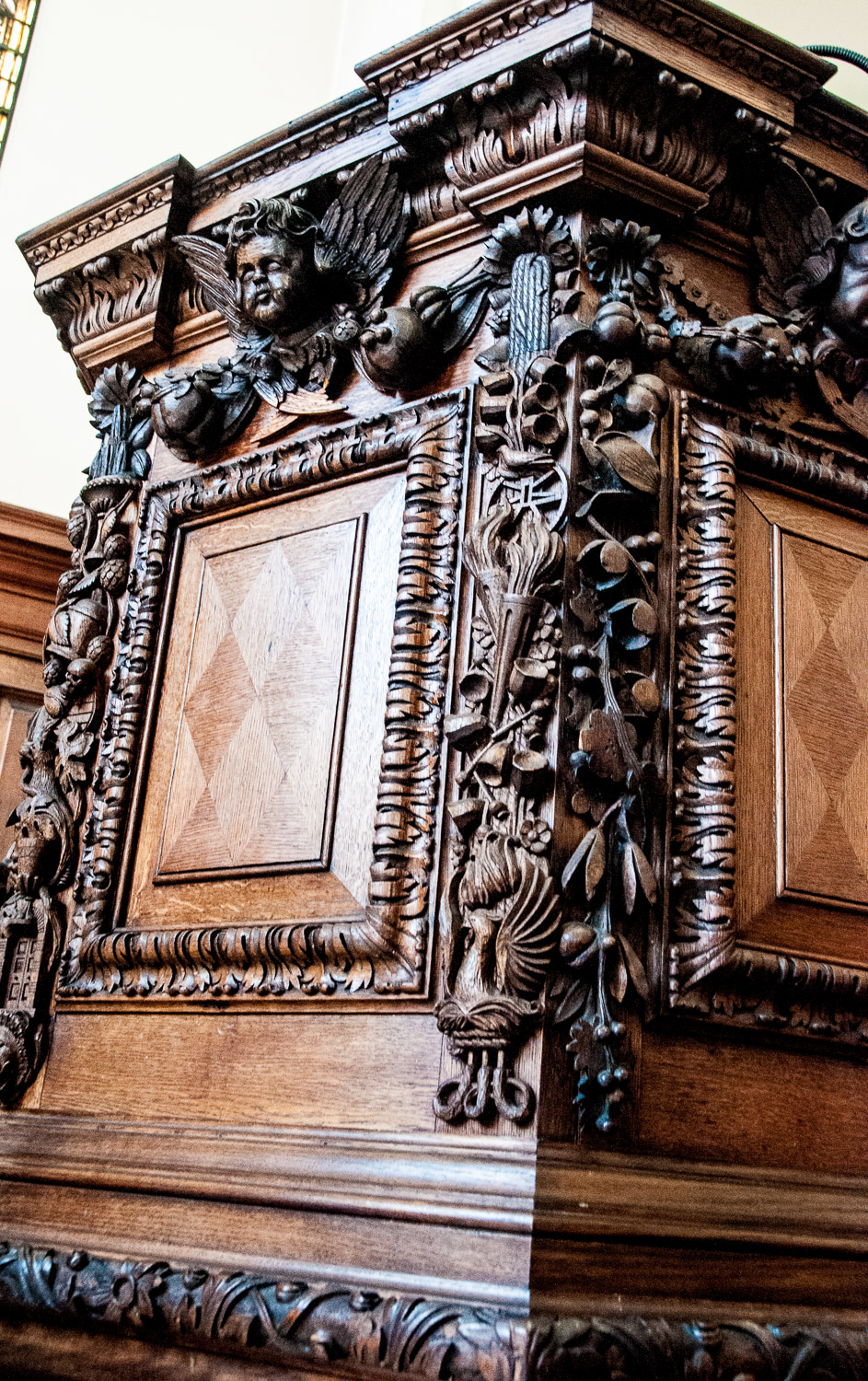
The richly carved pulpit came from All Hallows Bread Street, demolished in 1878 under the Union of Benefices Act 1860 which I also mentioned in last week’s blog

For my last visit of the day I thought I would take a look at St Anne & St Agnes (mentioned above) and see what I could find there (Gresham Street EC2V 7BX).

The Royal Arms of Charles II on the west wall is one of the best examples in England …
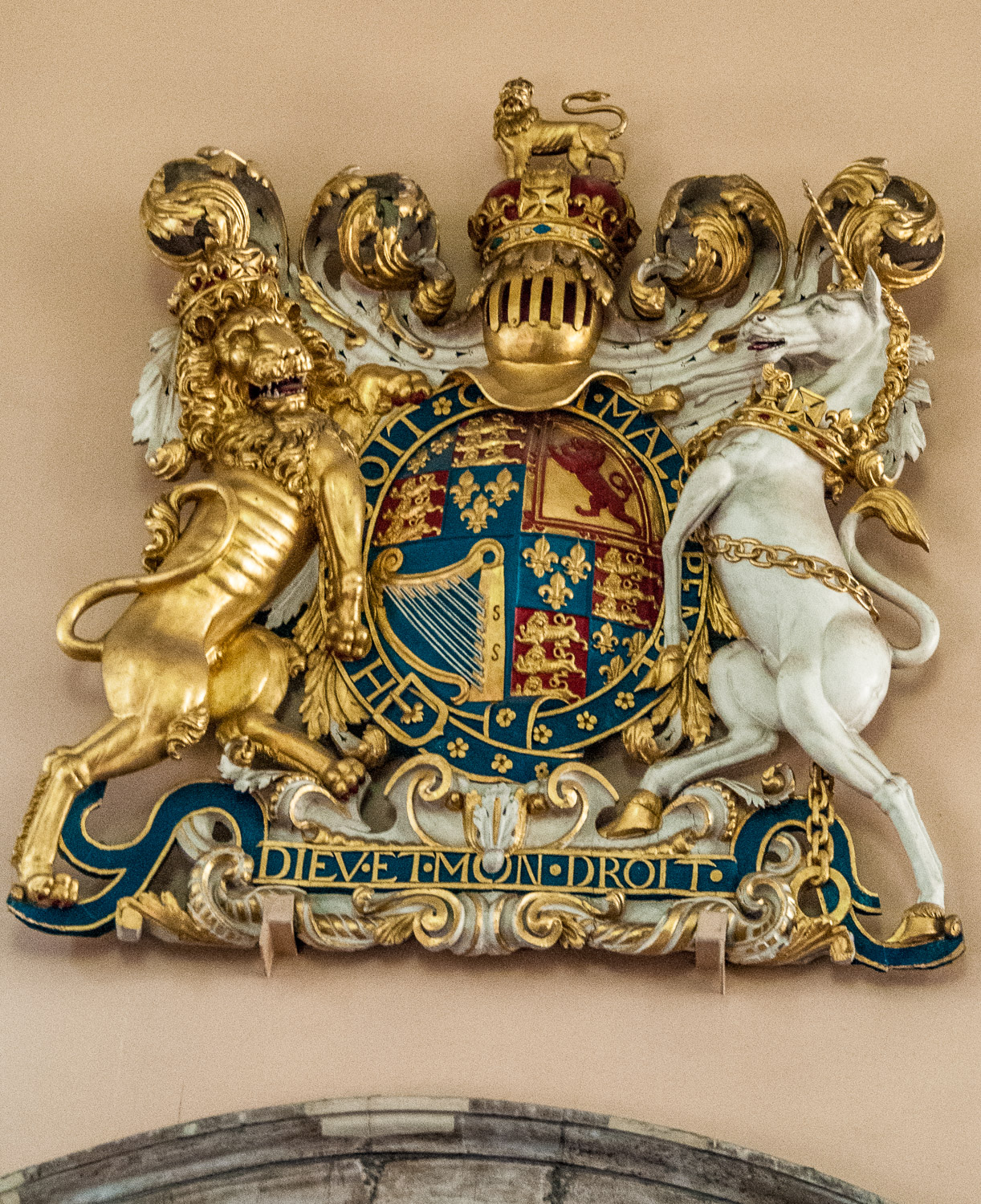
In 1649 the vicar was beheaded for protesting against the execution of King Charles I.

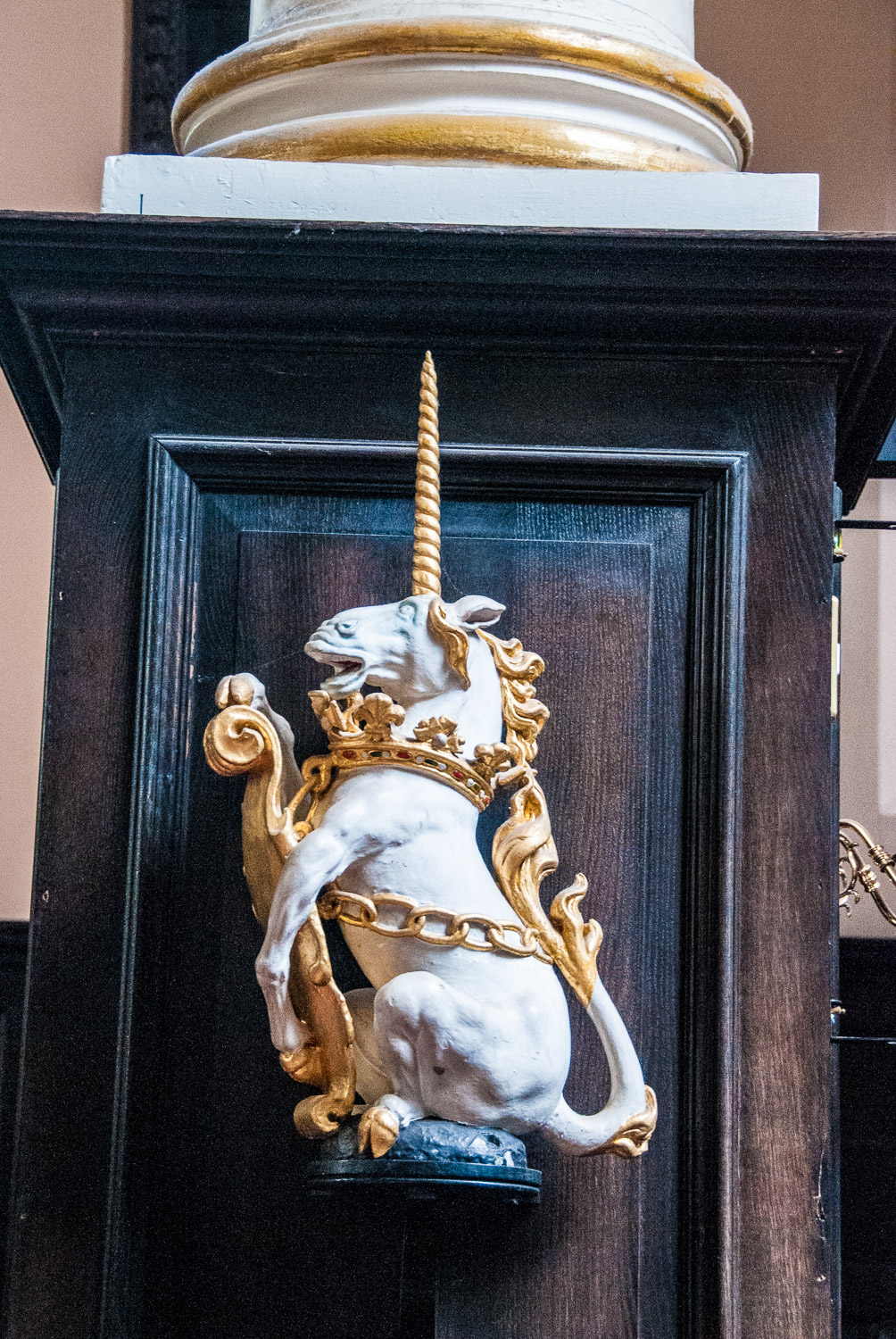
The central dome is supported by four handsome Corinthian columns two of which contain heraldic representations, one being this unicorn …
High up on the south wall are busts of Sir James Drax (died 1662) and his son John (died 1682). They come from the ‘lost’ church of St John Zachary which was destroyed in the Great Fire and not rebuilt …
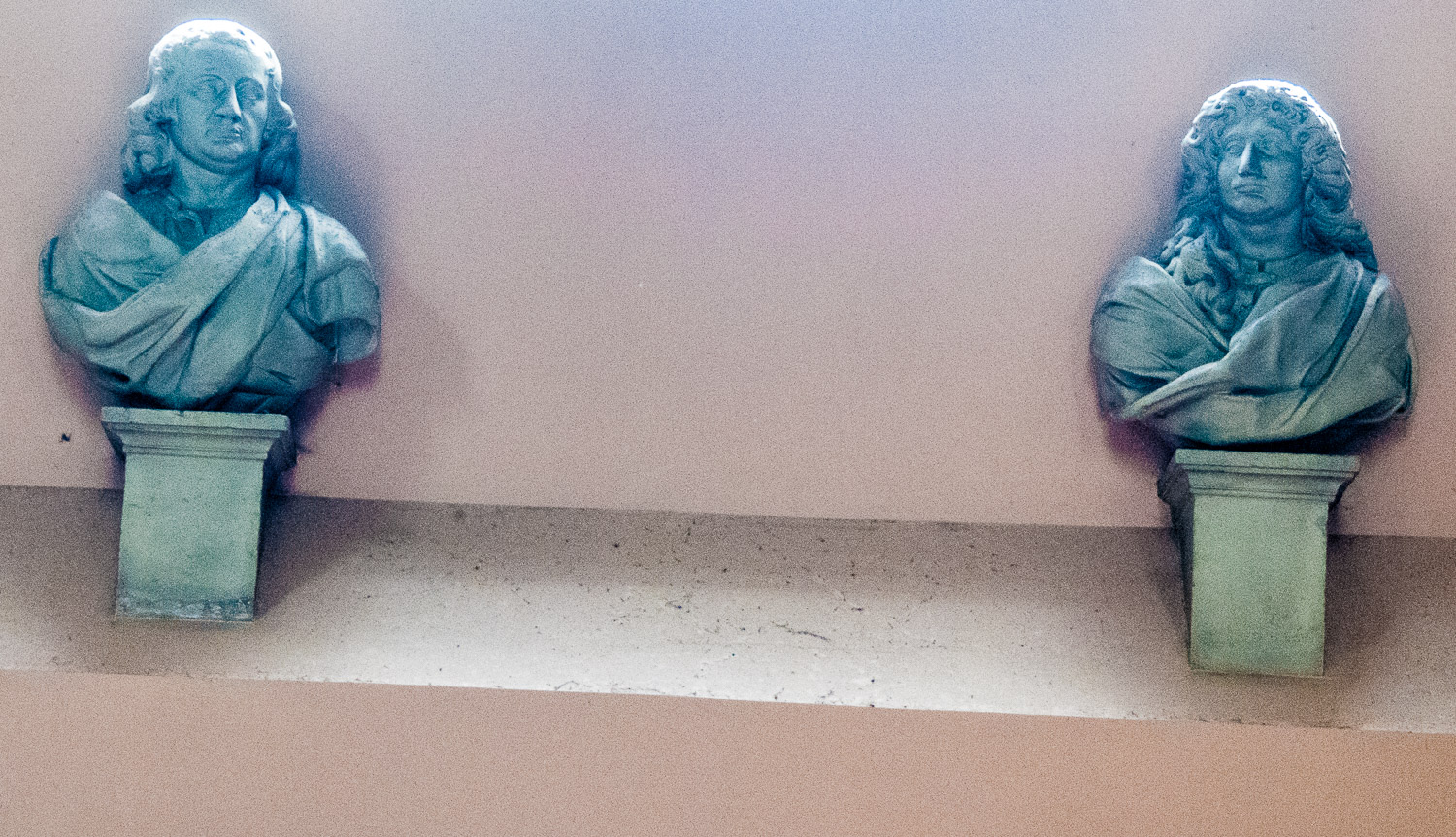
The Drax family were pioneers of the sugar industry (and slavery) in Barbados and apparently Drax Hall Plantation in St George, Barbados is the oldest surviving Jacobean mansion in the western hemisphere.

St John Zachary may be no more but there is now very attractive and quiet garden where the church used to stand …
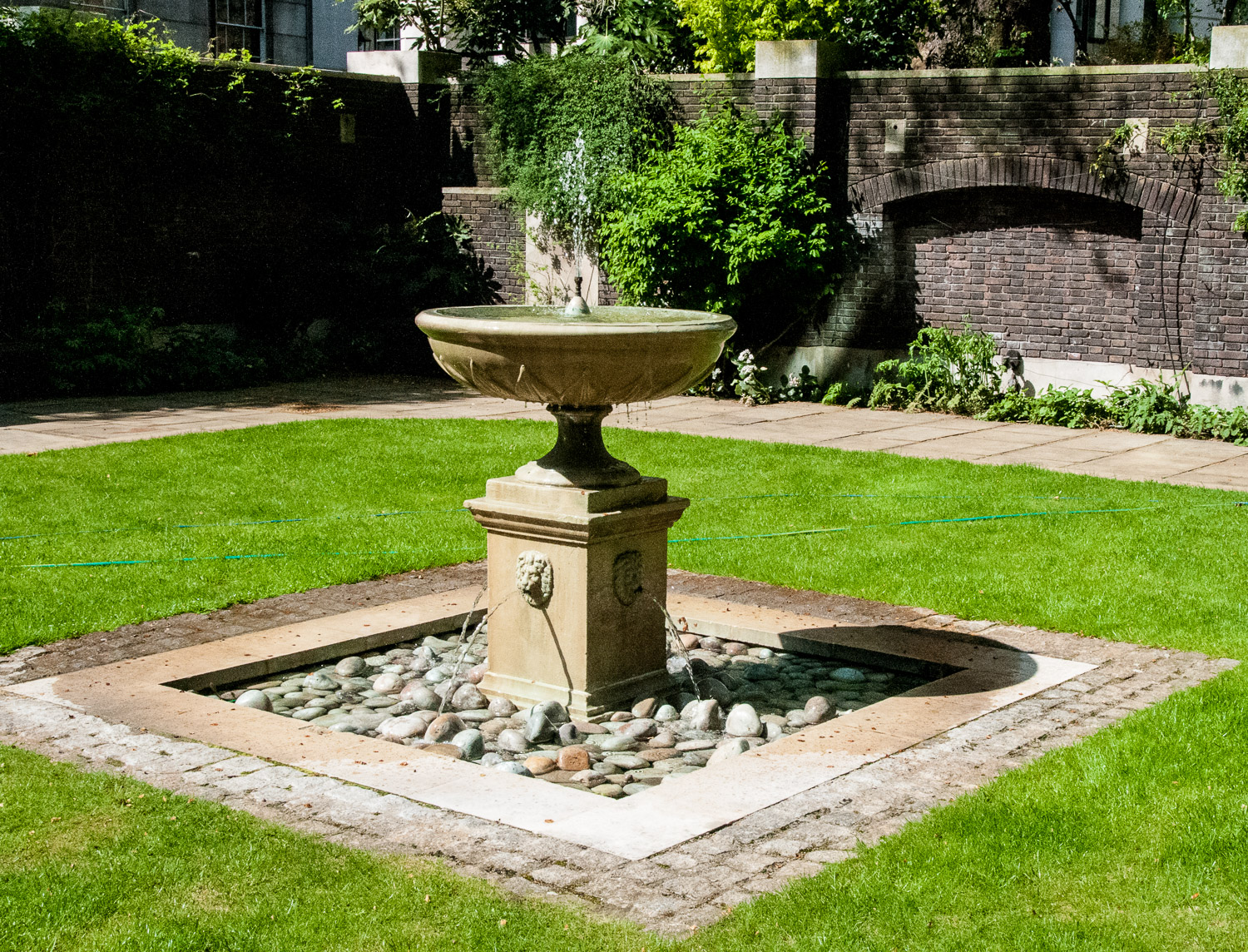
You can read more about it here.


Terminus tales – Blackfriars Station

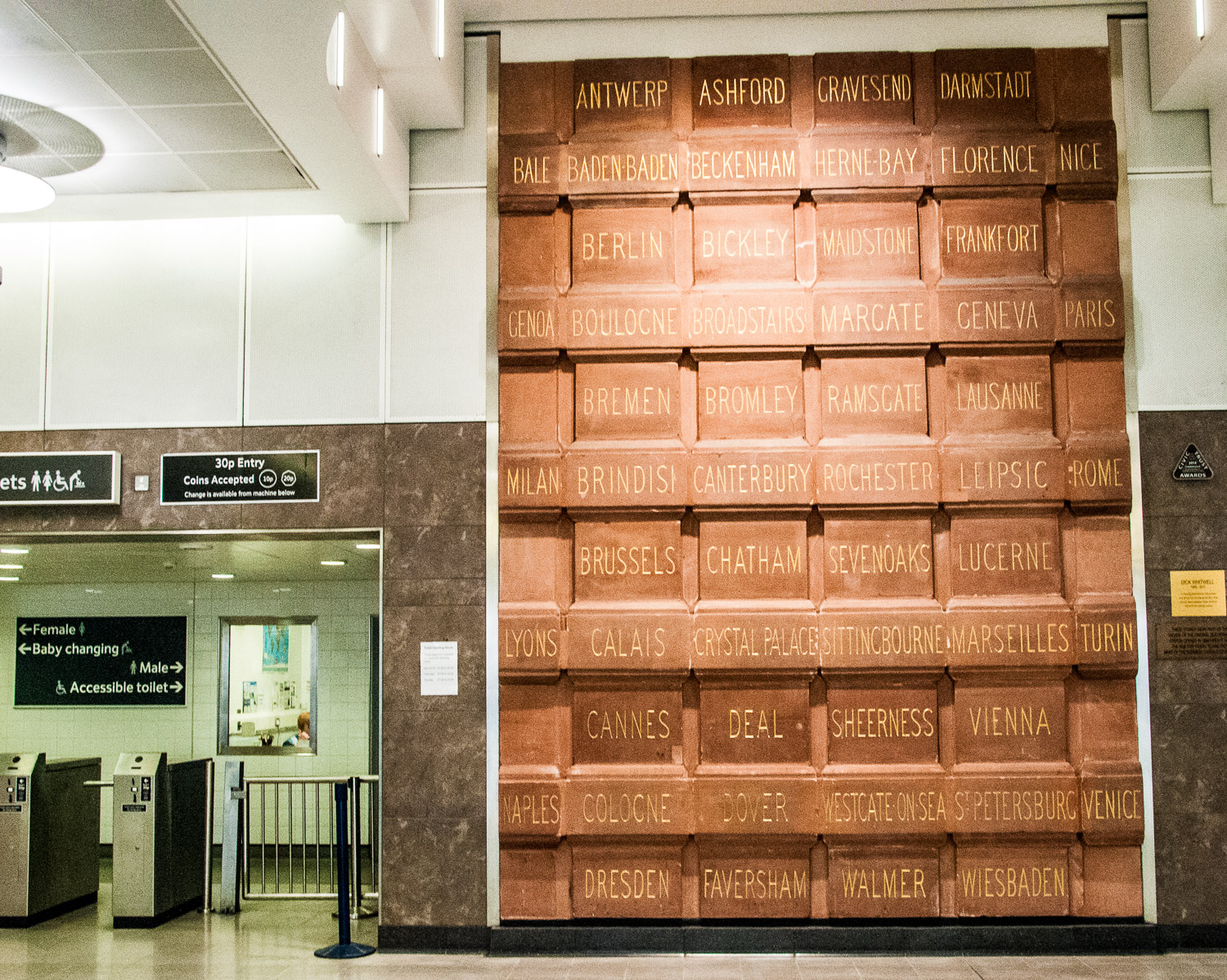
Nowadays, if you want to travel by rail to Continental Europe, you head for St Pancras International and Eurostar. Once upon a time though, your gateway to the Continent was Blackfriars Station in the City.

The station was badly damaged during the Second World War but the wall displaying a selection of the locations you could catch a train to survived and you can see it today in the ticket hall. It was part of the original façade of the 1886  station (originally known as St Paul’s) and features the names of 54 destinations – each painstakingly carved into separate sandstone blocks.

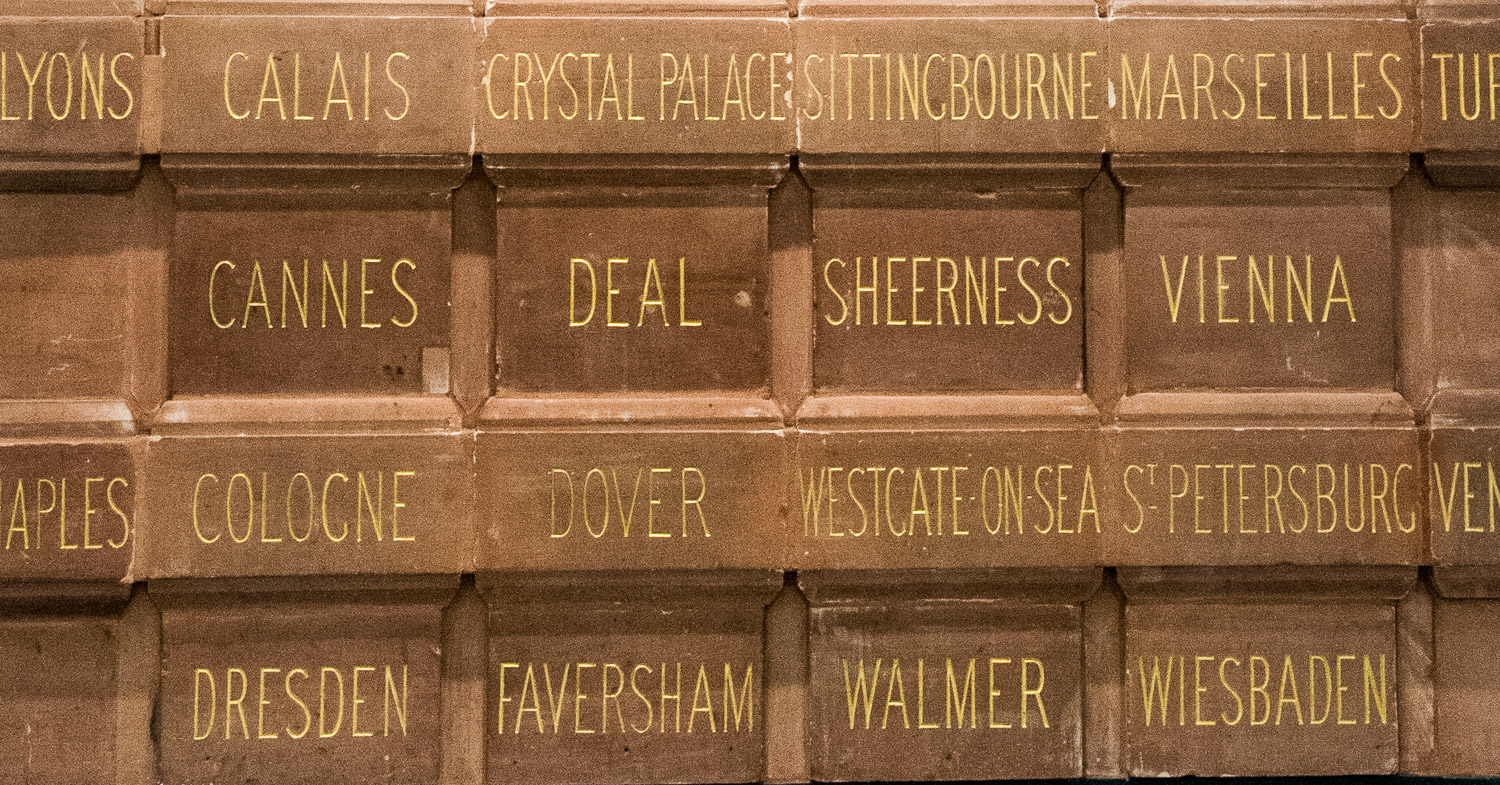
The destinations are gilded in 24 carat gold leaf …

‘Where shall we buy a ticket to today? Crystal Palace or Marseilles? Westgate-on-Sea or St Petersburg? Tough choices!’

The new station gave the London Chatham & Dover Railway an important foothold in the City of London.

If you leave the station and turn left you can walk across Blackfriars Bridge and take in a few more interesting sights.

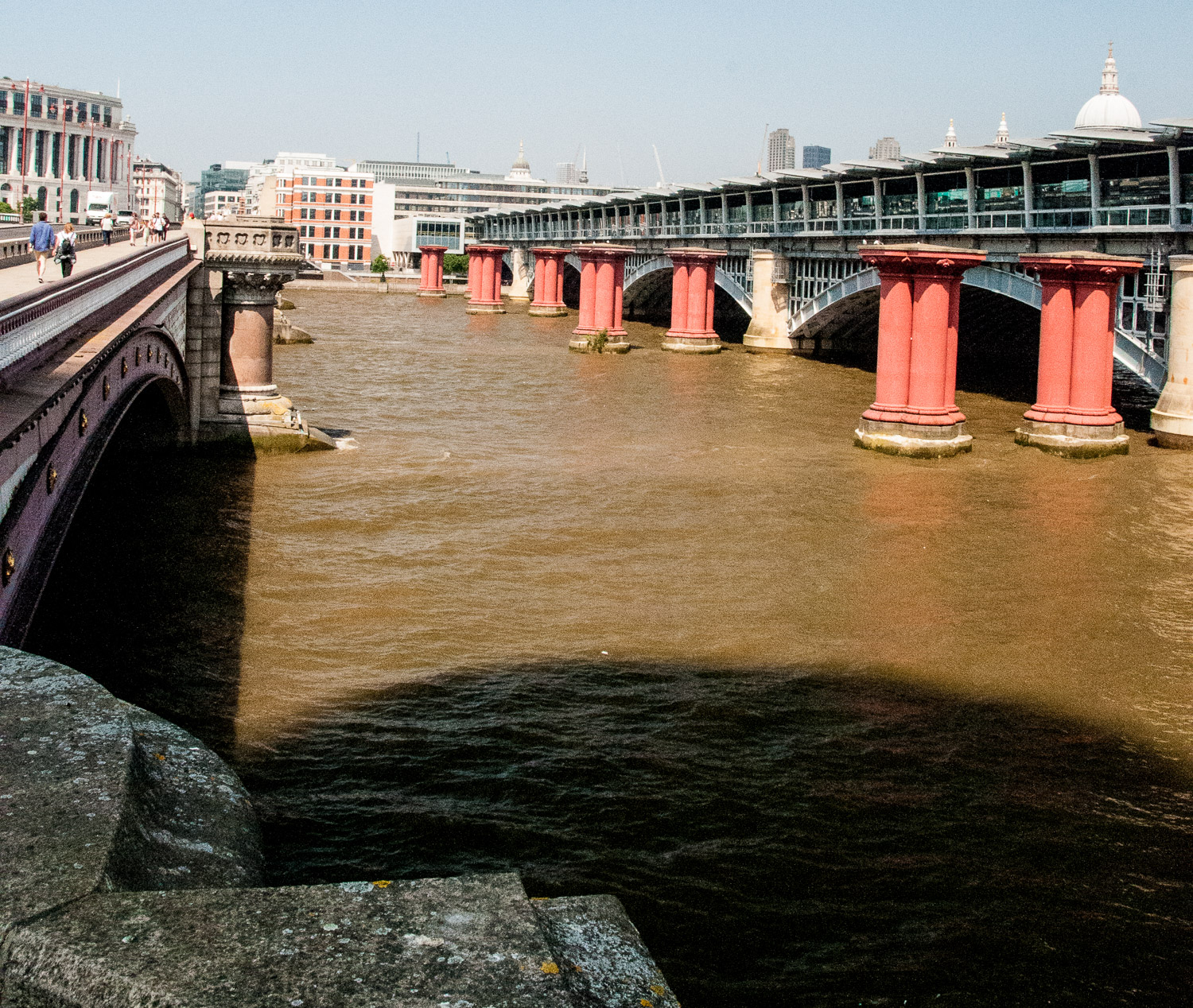
There are these columns rising out of the river …

In 1862-64 a bridge was built to accommodate four trains at one time. John Wolfe-Barry and H M Brunel built a second bridge to increase the number of trains coming into St Paul’s. The columns are the remains of the original bridge, which was removed in 1985 as it was deemed too weak for modern trains.

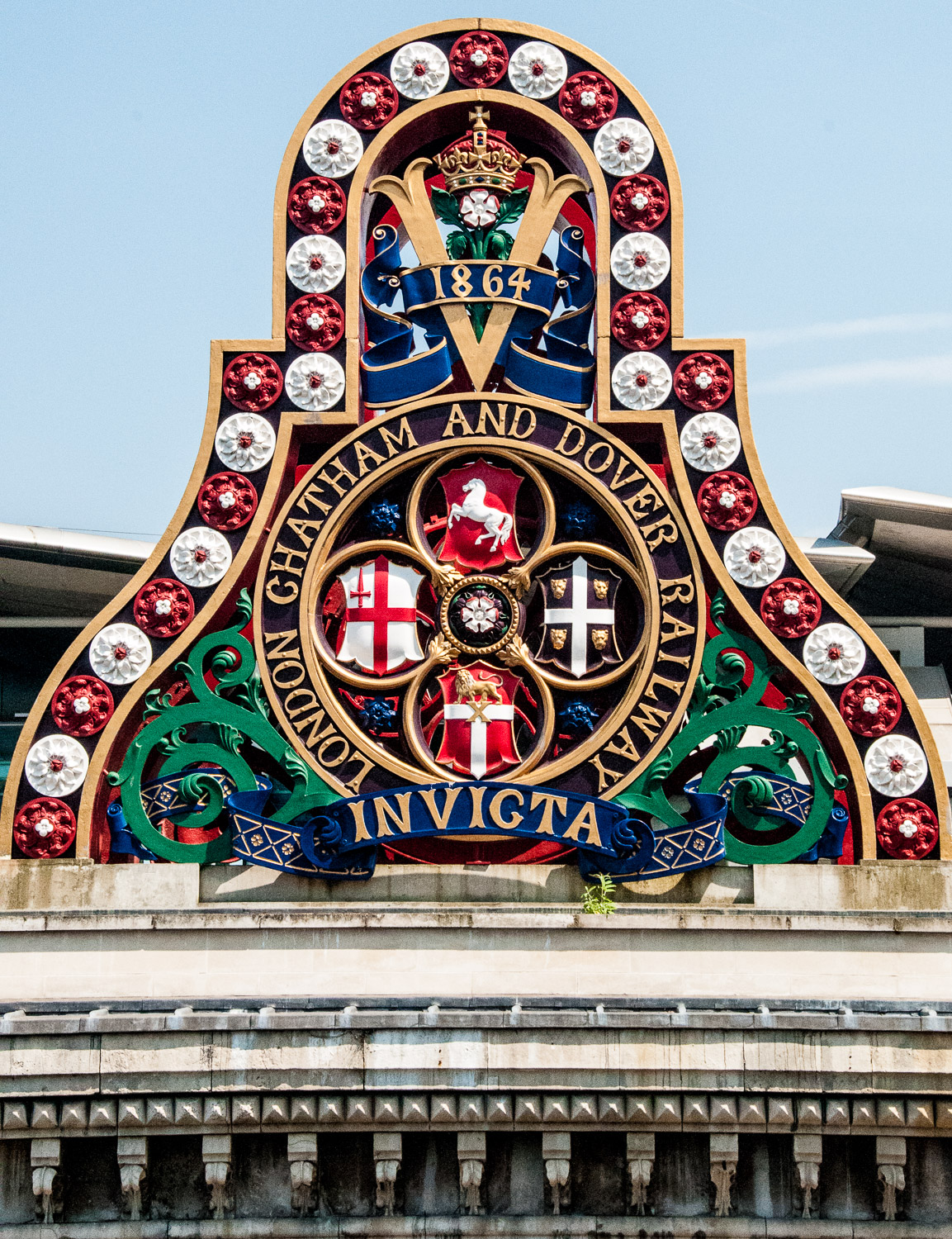
On the south side is the beautifully restored coat of arms of the London Chatham & Dover Railway …

Note the white horse rampant, symbol of Kent, and the county motto ‘Invicta’ meaning ‘undefeated’ or ‘unconquered’.

And now features not everyone notices. They are not related to the station but if you have ventured onto the bridge they are worth looking out for.

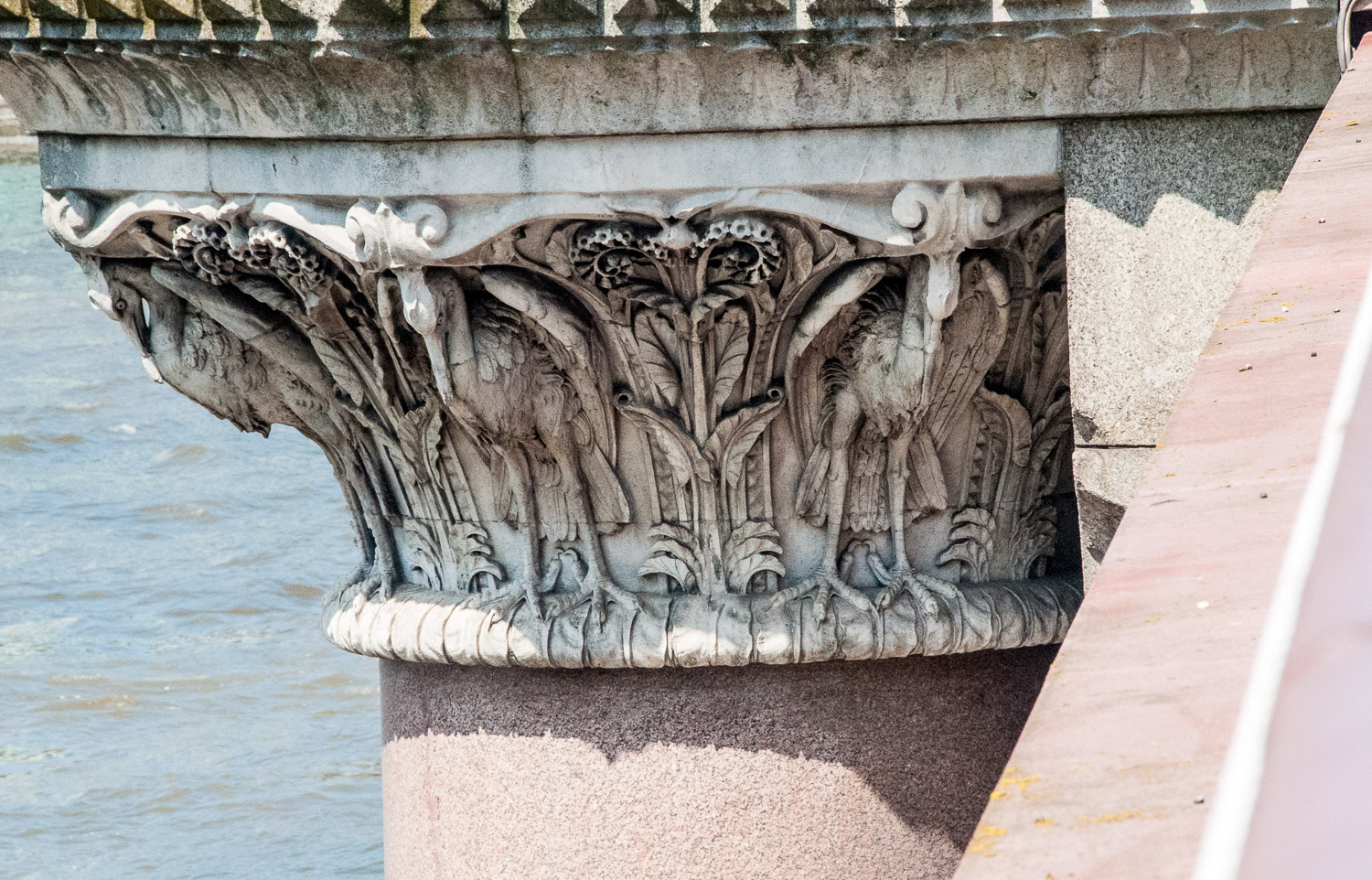
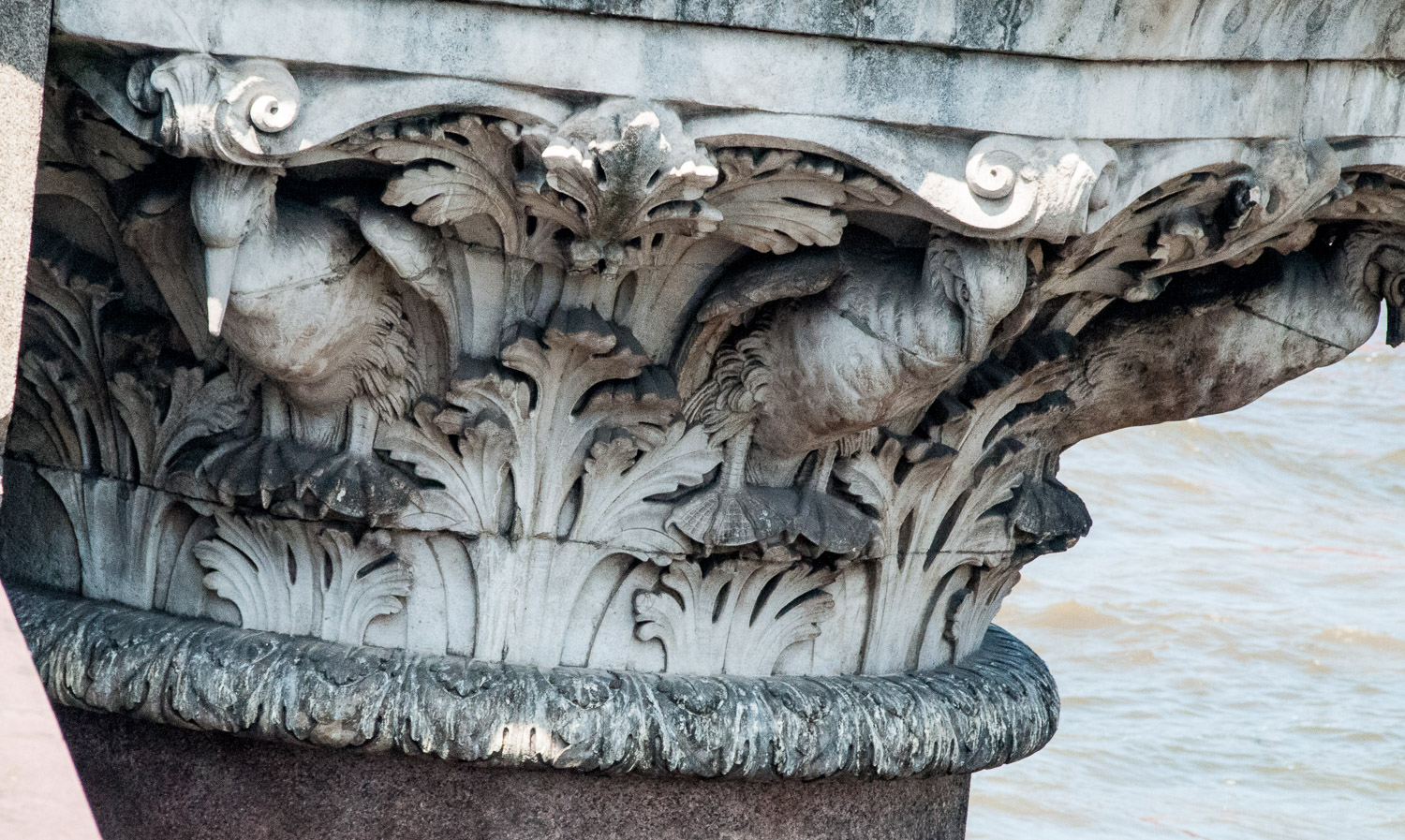
Peer over the parapet and on either side you will see some birds on the capitals of the bridge supports, beautifully carved in Portland stone by J.B.Philip.

The birds on the west side are fresh water birds and plants to be found on the upper reaches of the river …

And on the east side, sea birds and seaweeds to be found at the mouth of the Thames …

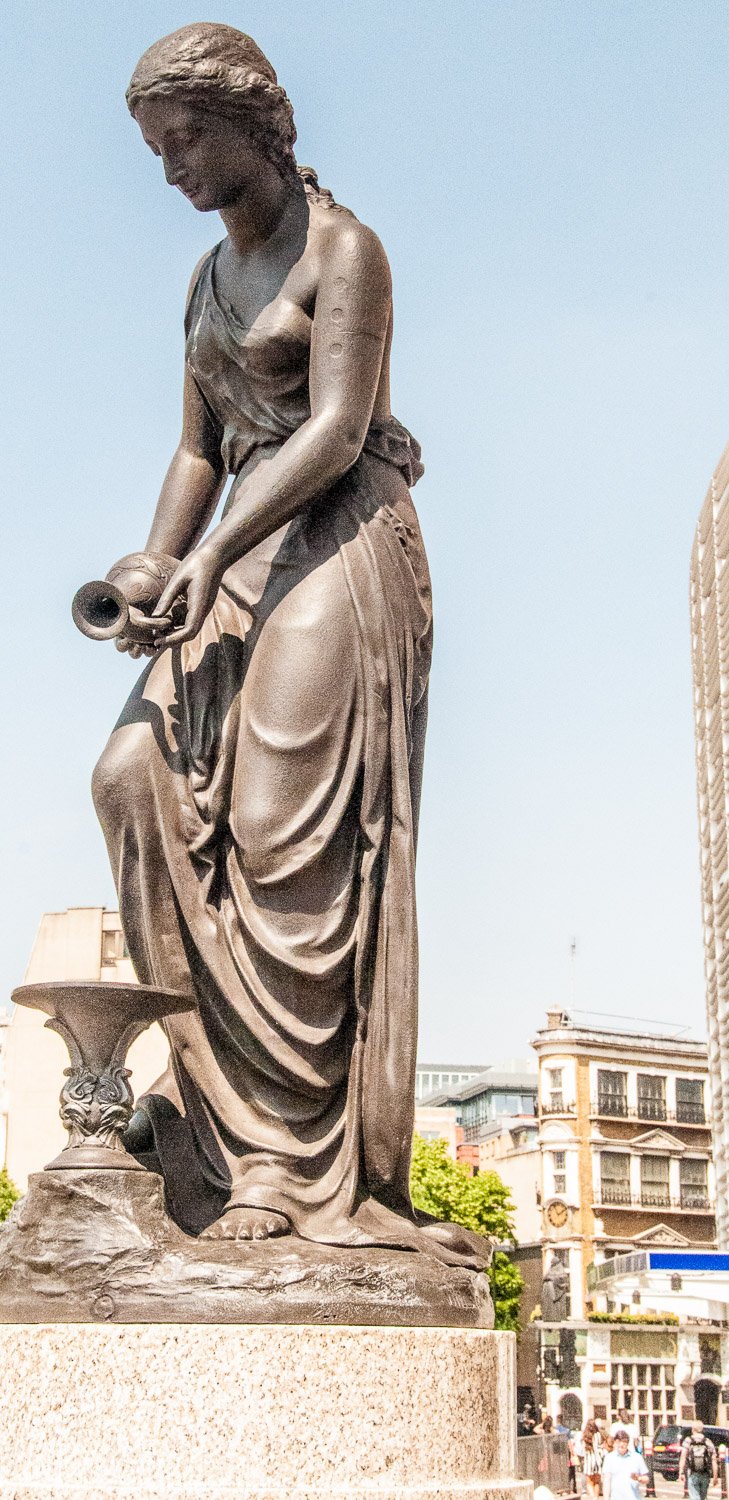
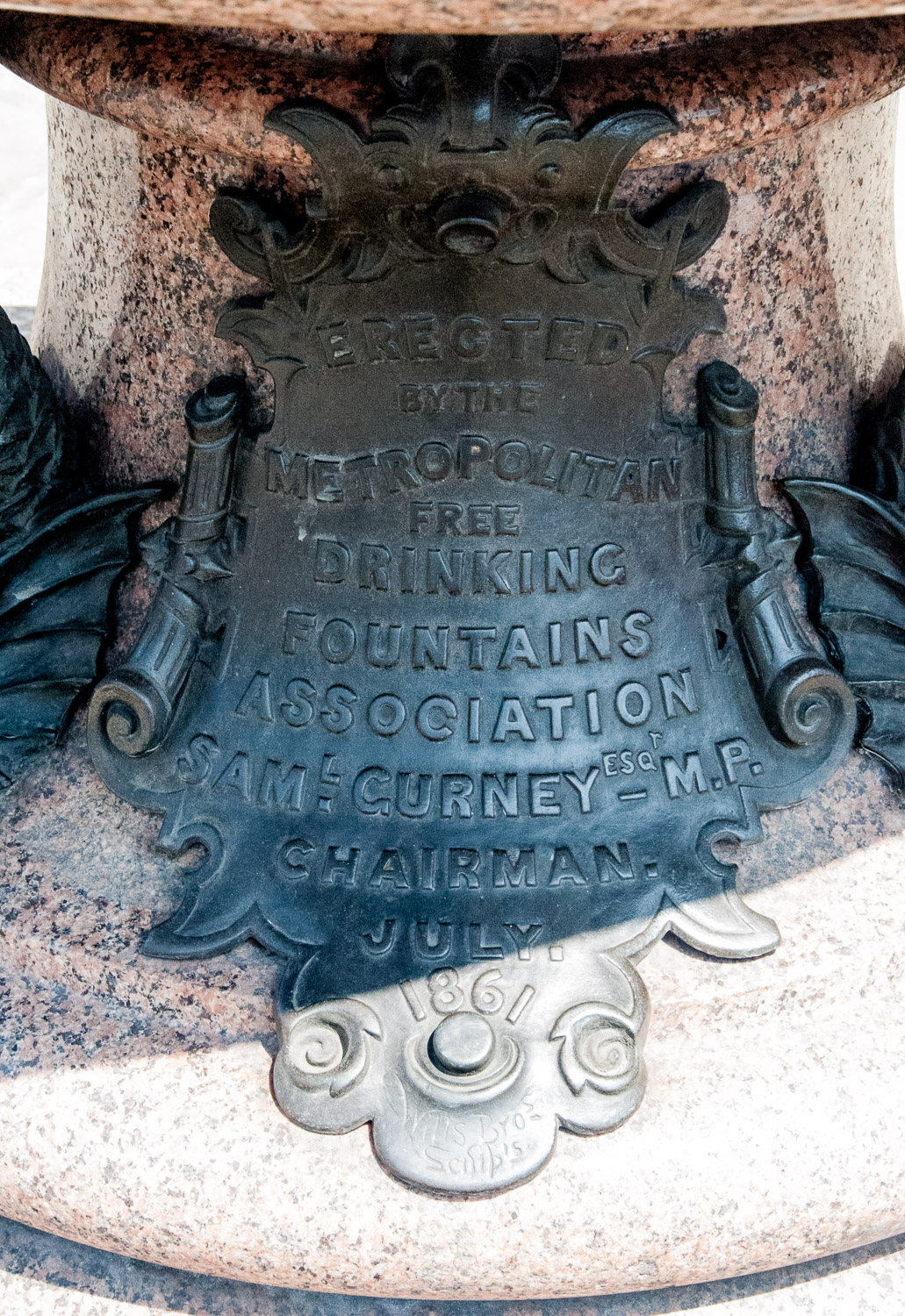
Just after you turn left outside the station you will see one of my favourite water fountains, recently liberated from behind hoardings and nicely restored.

Sculptor Wills Bros.

The pretty lady represents ‘Temperance’ and she originally stood outside the Royal Exchange.

The fountain was inaugurated by Samuel Gurney, MP, the Chairman of the Metropolitan Free Drinking Fountains Association, on 27 July 1861 and you can read more about him, and the Association, in my earlier blog Philanthropic Fountains.

St Stephen Walbrook: the Samaritans, Henry Moore and a brave doctor.

One day in 1936 a young priest officiated at his first funeral – a 14 year old girl who had killed herself because, when her periods started, she thought it was a sign of a sexually transmitted disease. That there seemed to have been no one she could talk to had a profound effect on him, but it was not until 18 years later that, as he put it,

I read somewhere there were three suicides a day in Greater London. What were they supposed to do if they didn’t want a Doctor or Social Worker … ? What sort of a someone might they want?

He looked at his phone, ‘DIAL 999 for Fire, Police or Ambulance’ it said …

There ought to be an emergency number for suicidal people, I thought. Then I said to God, be reasonable! Don’t look at me… I’m possibly the busiest person in the Church of England.

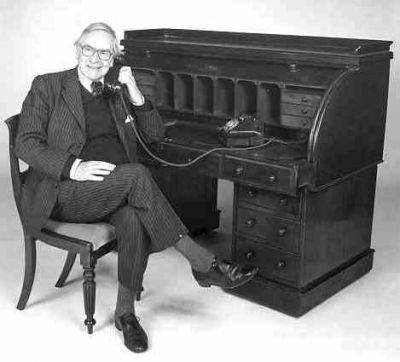
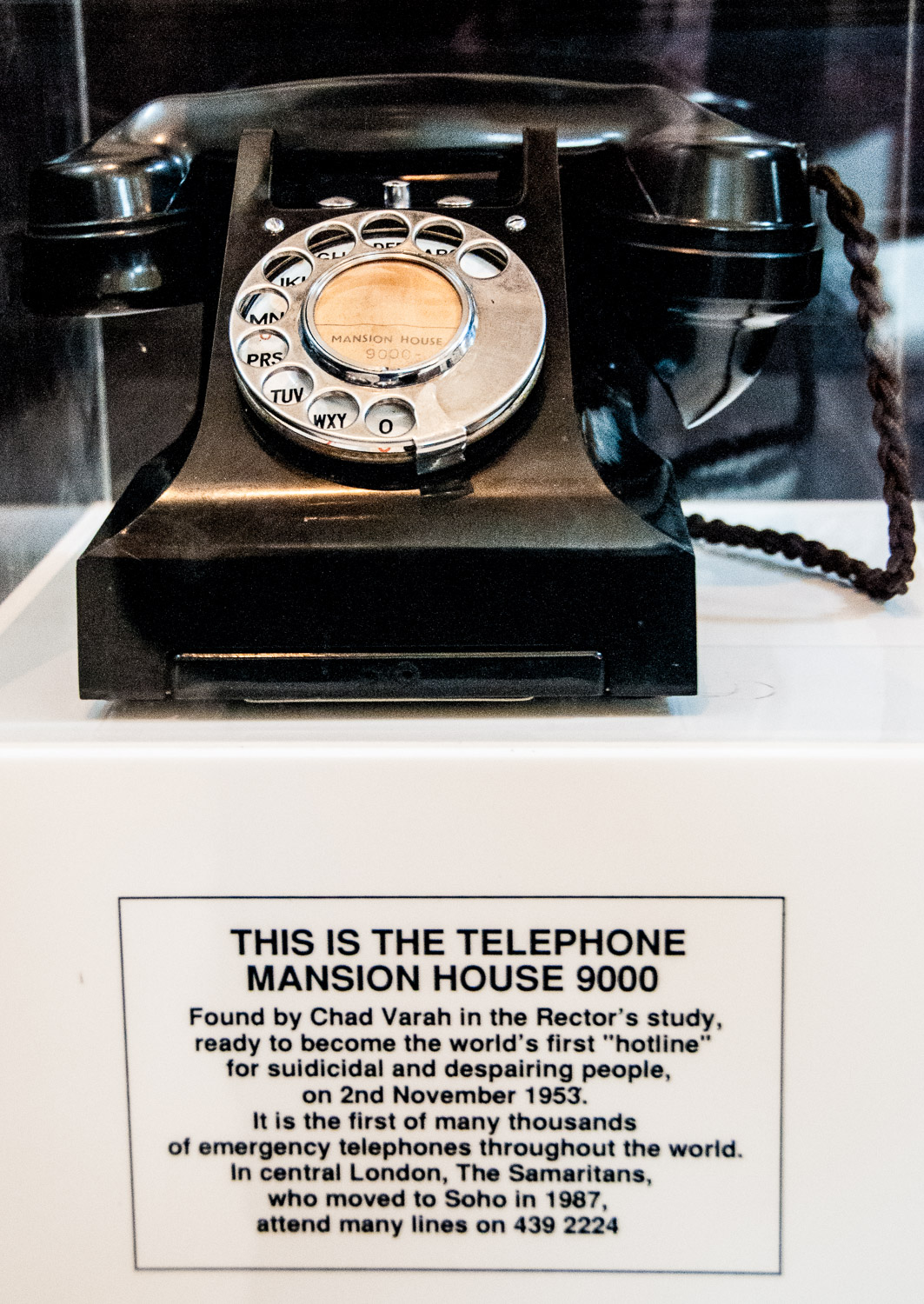
When the priest, Chad Varah, was offered charge of the parish of St Stephen in the summer of 1953 he knew that the time was right for him to launch what he called a ‘999 for the suicidal’. He was, in his own words, ‘a man willing to listen, with a base and an emergency telephone’. The first call to the new service was made on 2nd November 1953 and this date is recognised as Samaritans’ official birthday.

The Reverend Dr Chad Varah at his telephone – you just had to dial MAN 9000.

It soon became obvious that the volunteers, who used to keep people company whilst they were waiting to speak to Chad, were also capable of helping in their own right and in February 1954 he officially handed over the task of supporting the callers to them.

If you visit the church you can see the phone itself …

St Stephen Walbrook (rebuilt 1672-80) was one of Wren’s largest and earliest churches and the meticulous care taken with it might, some suggest, be because Sir Christopher lived next door. Incidentally, Mr Pollixifen, who lived on the other side, bitterly complained about the building taking his light. Maybe he was mollified when the the church’s internal beauty was revealed.

Views towards St Stephen’s have opened up since completion of the new development on Walbrook, which also houses a meticulously restored Temple of Mithras (see my 25th January blog: The Romans in London – Mithras, Walbrook and the Games).

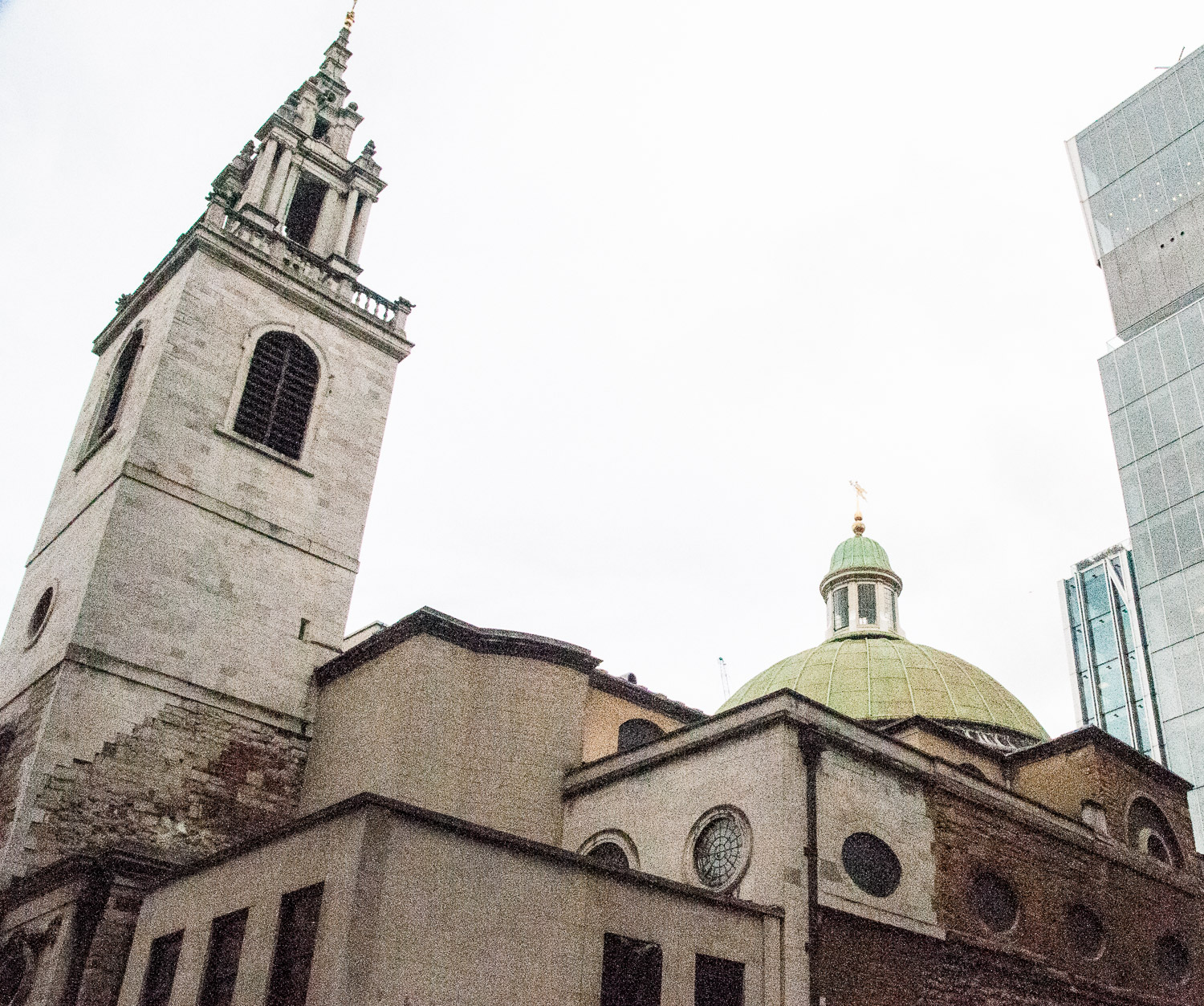
Looking at the exterior one can see the lovely green Byzantine style dome …

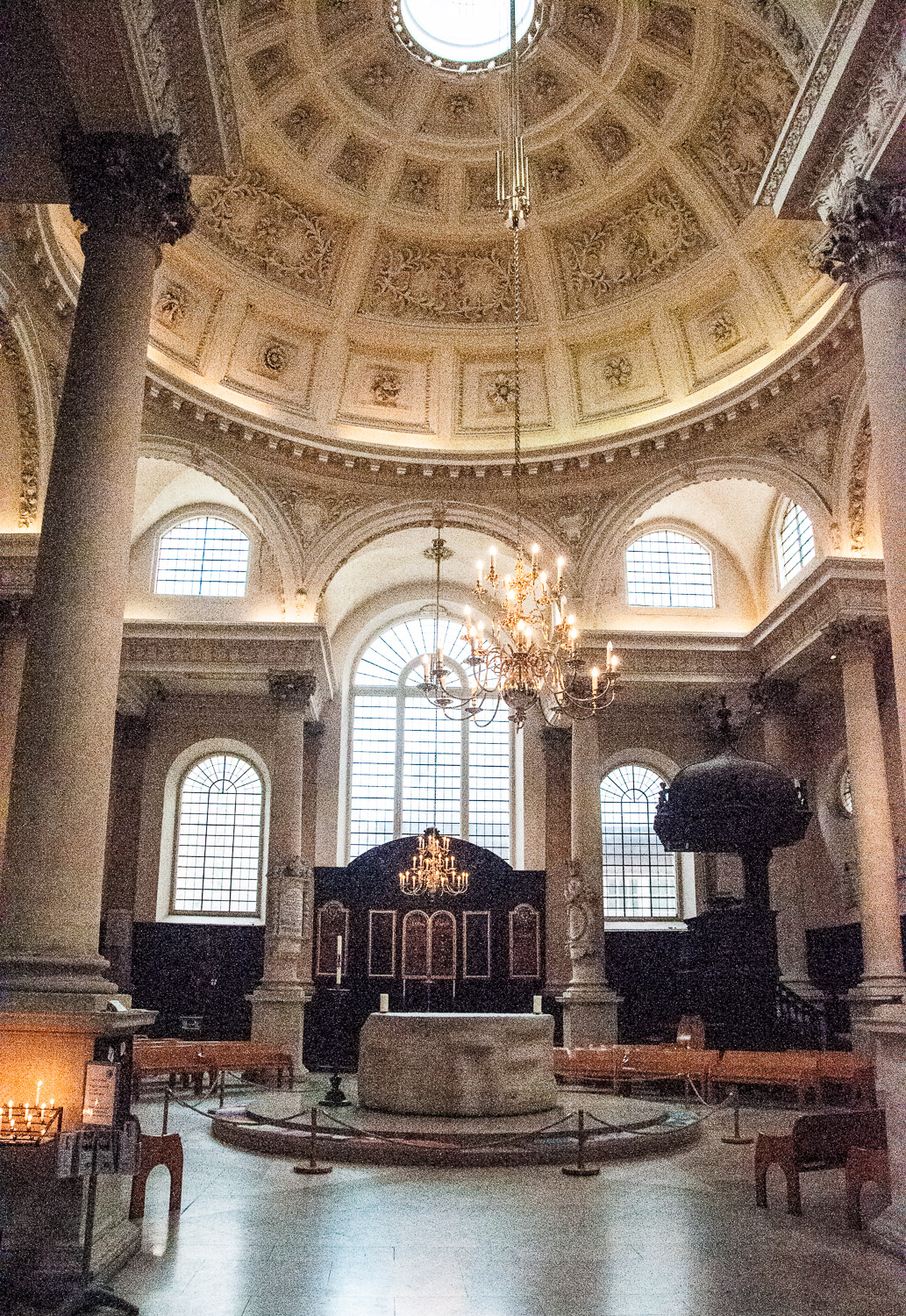
The interior is bright, intimate and stunning, old Victorian stained glass having been removed …

Wren’s dome and Sir Henry Moore’s altar

The dome was the first of its kind in any English church and a forerunner of Wren’s work on St Paul’s Cathedral. After being damaged in the Blitz the church was restored by Godfrey Allen in 1951-52. Controversy broke out when, between 1978 and 1987, the church was re-ordered under the sponsorship of churchwarden Peter (later Lord) Palumbo and a striking ten tonne altar by Sir Henry Moore was placed at its centre.

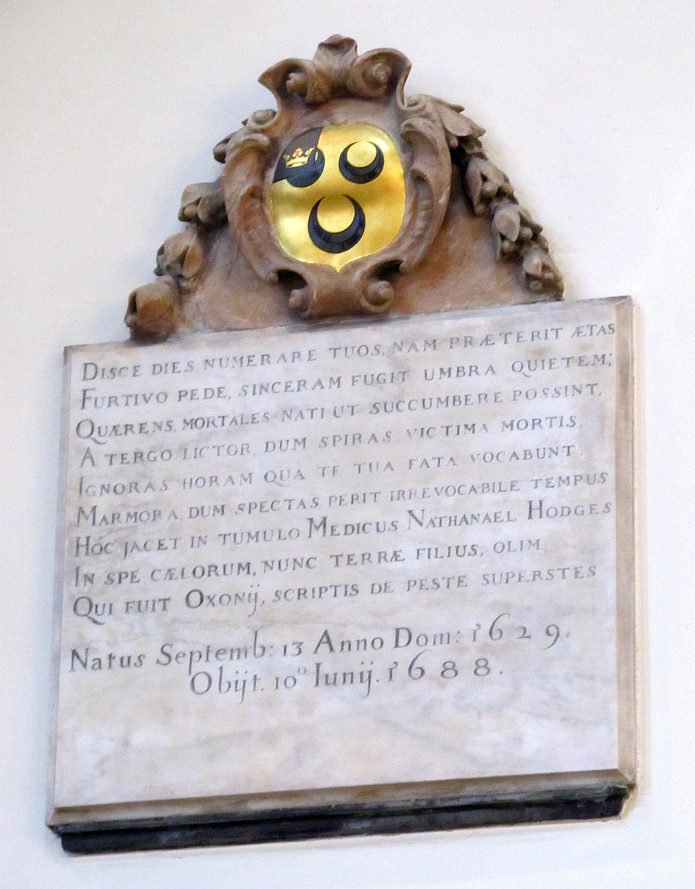
Sometimes I look at church memorial plaques and, if they are entirely in Latin, just rather lazily move on. In this case it was a big mistake since I was ignoring a tribute to a very brave man …

Dr Nathaniel Hodges’ memorial on the north wall. Photograph: Bob Speel.

Unlike many physicians, Dr Hodges stayed in London throughout the time of the terrible plague of 1665.

First thing every morning before breakfast he spent two or three hours with his patients. He wrote later …

Some (had) ulcers yet uncured and others … under the first symptoms of seizure all of which I endeavoured to dispatch with all possible care …

hardly any children escaped; and it was not uncommon to see an Inheritance pass successively to three or four Heirs in as many Days.

After hours of visiting victims where they lived he walked home and, after dinner, saw more patients until nine at night and sometimes later.

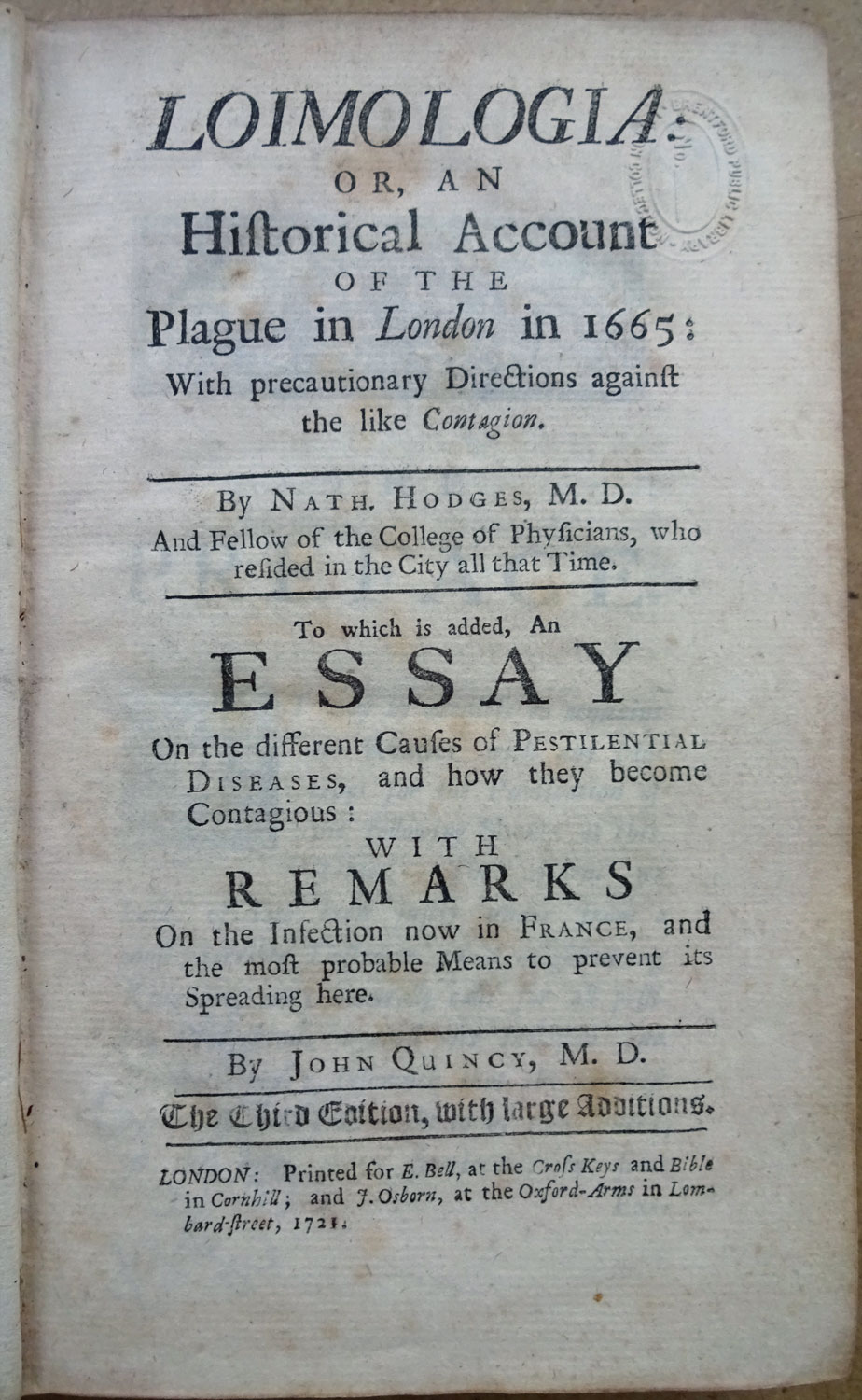
He survived the epidemic and wrote two learned works on the plague. The first, in 1666, he called An Account of the first Rise, Progress, Symptoms and Cure of the Plague being a Letter from Dr Hodges to a Person of Quality. The second was Loimologia, published six years later …

A later edition of Dr Hodges’ work, translated from the original Latin and published when the plague had broken out in France.

It seems particularly sad to report that his life ended in personal tragedy when, in his early fifties, his practice dwindled and fell away. Finally he was arrested as a debtor, committed to Ludgate Prison, and died there, a broken man, in 1688.


Page 40 of 41

Powered by WordPress & Theme by Anders Norén

Symbols & Secrets
Privacy Overview

This website uses cookies so that we can provide you with the best user experience possible. Cookie information is stored in your browser and performs functions such as recognising you when you return to our website and helping our team to understand which sections of the website you find most interesting and useful.