Walking the City of London

Category: Sculpture Page 39 of 41

City work and public sculpture

I thought it would be interesting to explore how public sculpture has been used to illustrate some of occupations that have been undertaken in the City over the centuries.

First up is one of my favourite pieces, The Cordwainer. Here on Watling Street (EC4N 1SR) you are in the Ward of Cordwainer which in medieval times was the centre of shoe-making in the City of London. The finest leather from Cordoba in Spain was used which gave rise to the name of the craftsmen and the Ward. In the background is the wall of St Mary Aldermary church …

Sculpted by Alma Boyes (2002). You can visit her website here.

I love the detail in the work, the craftsman’s face and particularly the hands straining with effort. The statue’s shoes are very beautifully represented too – but then they would have to be.

It’s a bit of an over-simplification but, basically, cordwainers made shoes (and were not allowed to repair them) and cobblers repaired shoes (and were not allowed to make them). Cobblers got around this injunction by salvaging old leather and making ‘new’ shoes out of that, but in the end a pragmatic solution evolved and the two professions merged under the Cordwainers Company auspices. But if you want your shoes repaired today you still go to a cobbler.

Beside the slope in Aldersgate Street that leads up to the Barbican Estate is this frieze (EC2Y 8AF). It used to be above the premises of W. Bryer & Sons who were gold refiners and assayers at numbers 53 and 54 Barbican. Having survived the Blitz the building was demolished in 1962 and the frieze re-erected here.

‘Gold Smelters’ – Made in Portland stone by J Daymond & Son (1901).

The photographs are mine but I am indebted to The Victorian Web for the descriptions of what is happening.

The left side of the frieze depicts the arrival, weighing, recording the results (by man with the quill pen), and melting the ore. The man with the quill pen, a superviser rather than a workman, is the only one in this part of the scene whose clothes obviously date to the seventeenth century or earlier …

The middle portion of the frieze depicts men working at the smelter: the man at left, whom we have already seen in the previous detail, holds a vessel with tongs while the man to his right stirs the fire, shielding his face from the heat with his right arm. The next man either rests or supervises the work, and the young man kneeling behind him most likely feeds the furnace …

The right side of the frieze shows a worker pouring the refined gold into a mould, and the man behind him examines a small ingot. Outside the workshop, which a curtain divides from the smelting operation, a seated man presents the refined gold to a customer. Here the figures all wear clothing from earlier periods …

What a shame that the friendly shop cat rubbing himself up against the table leg has been damaged.

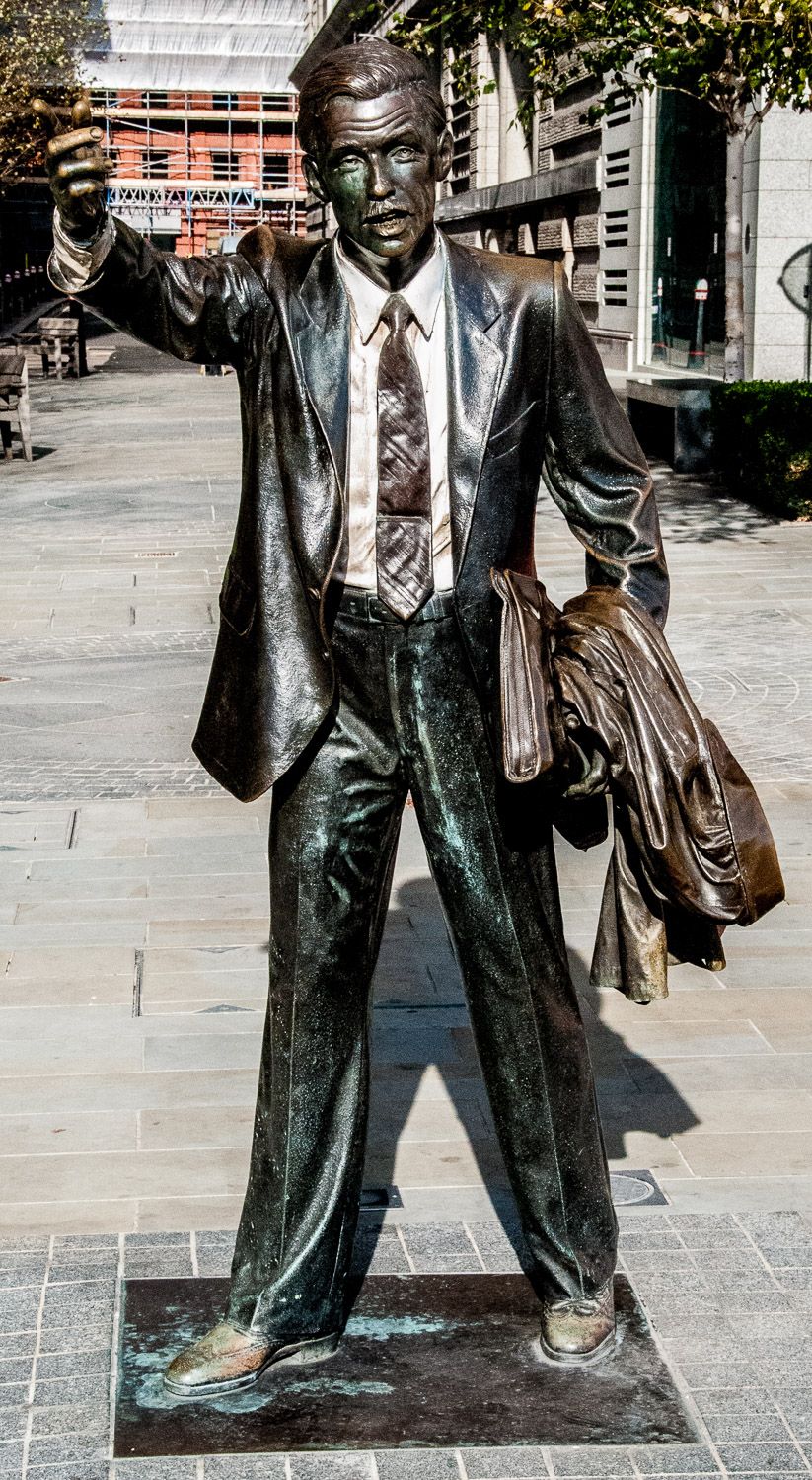
James Henry Greathead was a South African engineer (note the hat) who invented what was to become known as the Greathead Shield. He came to be here on Cornhill because a new ventilation shaft was needed for Bank Underground Station and it was decided that he should be honoured on the plinth covering the shaft …

Designed by James Butler (1994) – Cornhill EC3V 3NR.

The Shield enabled the London Underground to be constructed at greater depths through the London clay. The miners doing the tunneling, using pneumatic spades and hand shovels, would create a cavity in the earth where the Shield would be inserted to hold back the walls whilst the miners installed cast-iron segments to create a ring. The process would be repeated until a tunnel had formed in the shape of a ‘tube’, which is where we get the nickname for the network today. A plaque on the side of the plinth shows the men at work …

Would you like to see a Greathead Shield? It’s easier than you might think since Shields were often abandoned when work was completed. Take the Northern Line to Bank and (without leaving the station) follow the signs for the Waterloo and City Line. This is what you will come across …

Here is some detail …

The plaque underneath explains all …

In next week’s blog I will be looking at some 20th century occupations and the way they have been celebrated in sculpture.


City Animals 5

It has been quite a while since I sought out animals in the City and so last weekend I took advantage of the sunny weather and went on another safari.

I always like to visit the Tower Hill memorial to the merchant navy and fishing fleet seafarers who lost their lives in both World Wars and have no grave but the sea. It’s a peaceful place on a weekend as virtually all the visitors to London have their eyes focused on the Tower of London across the road.

There are two memorials alongside one another and these pictures come from the one commemorating the almost 24,000 casualties of the Second World War (Trinity Square EC3N 4DH).

Dolphins feature highly in the allegorical sculptures by Sir Charles Wheeler representing the Seven Seas.

Here a boy is seen riding one surrounded by fishes and sea horses, above his head is a thorny snail …

A dolphin leaps through the legs of this figure who is creating the wind …

You can’t miss Neptune with a spider conch above his head and accompanied by another dolphin …

Across the road from Trinity Square is the church of All Hallows-by-the-Tower (EC3R 6BJ).

Substantially damaged in the War it was restored and reopened in 1957 with a new cockerel weathervane …

The beaver above 64 Bishopsgate (EC2N 4AW) is a reminder of the Hudson’s Bay company which once dominated the fur trade and was based nearby. Beaver fur was much sought after, particularly in the making of hats …

A golden rodent looks out across Bishopsgate.

Wander down to the end of New Street off Bishopsgate (EC2M 4TP) and you will find this ram over the gateway leading to Cock Hill …

It’s by an unknown sculptor, dates from the 186os and used to stand over the entrance to Cooper’s wool warehouse.

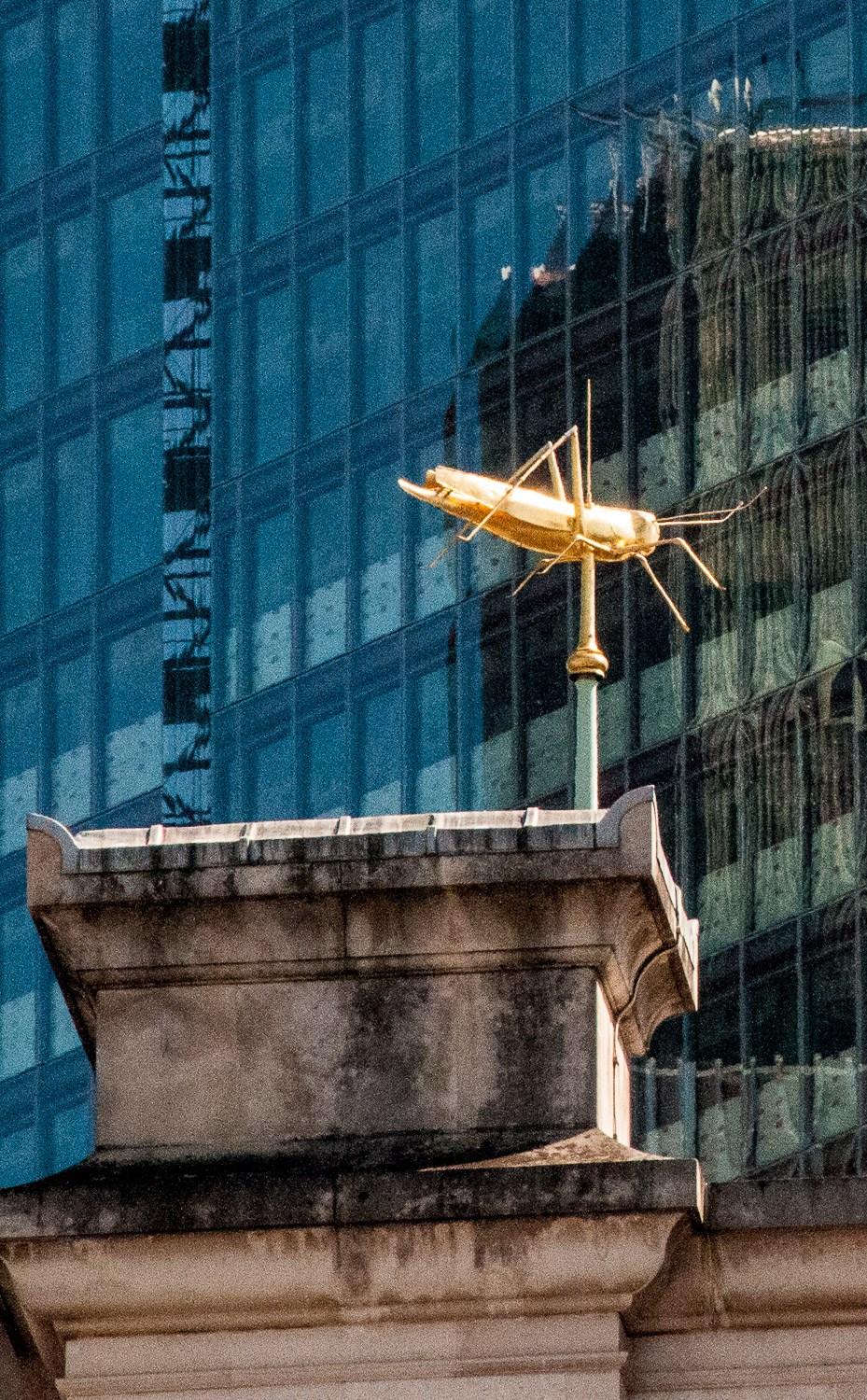
Outside 68 Lombard Street there hangs an astonishing five foot long grasshopper (EC3V 9LJ) the insect being derived from the coat of arms of the Gresham family. Buildings in Lombard Street were not numbered until 1770 and so when the Greshams lived and worked there a similar sign would have been used to mark their residence …

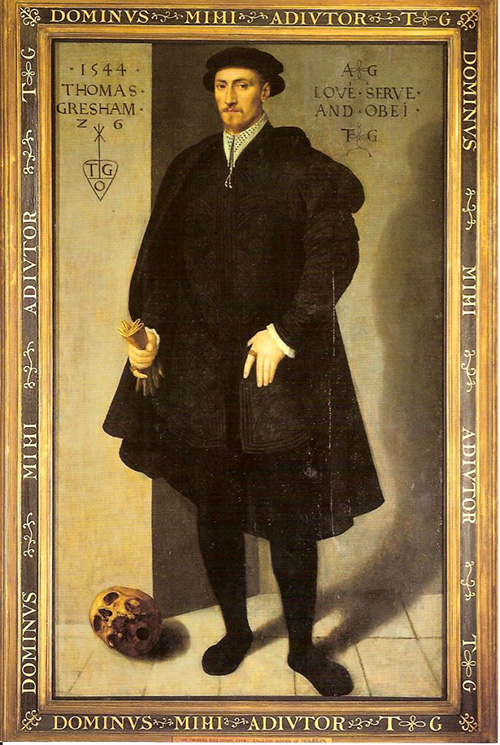
The year 1563 refers to the year Thomas Gresham (TG on the sign) set up his business here.

The present building dates from 1930 when it was destined to become the City office of Martin’s Bank (whose coat of arms included a grasshopper). The original family sign disappeared at the time of Charles II when such advertisements were banned after numerous serious accidents. They had a tendency to become detached in high winds and on one occasion pulled down the entire frontage of a building. This grasshopper dates from 1902 when a host of signs were recreated to celebrate the coronation of Edward VII.

And finally, the Sculpture in the City event has brought us this extraordinary work by Nancy Rubins. It’s called Crocodylius Philodendrus and you can view it at 1 Undershaft (EC3A 6HX).

See how many animals you can spot …

In there somewhere you will find crocodiles, hogs, deer, tortoises and a zebra.


A walk around the Barbican

Last week I had the pleasure of joining the photographer Anthony Palmer as he conducted a walk around the Barbican. For those of you who have never visited the estate, or who have only come to attend a performance, I hope my pictures will encourage you to come for the first time, or linger longer and explore.

First of all, I want to show you some views that may not look like they are from the Barbican at all.

First up is Frobisher Crescent …

Frobisher Crescent shutters as seen from the Sculpture Court.

One of the lakes contain what are affectionately known as the ‘igloos’ …

View looking down from the Andrewes Highwalk.

Beech Gardens (on the highwalk over the Beech Street ‘tunnel’) were designed by Nigel Dunnett and on his website there is a terrific description of how he achieved the transformation of the area.

Here is a picture I took looking towards Bryer Court …

A water feature gives the opportunity to photograph some reflections …

Nearby in Ben Jonson Place, two small dolphins stand on their tails and twist in opposite directions …

The sculpture is by John Ravera and dates from 1990.

The estate contains two gardens for the use of residents only. This is the Thomas More Garden as seen from the Thomas More highwalk …

The second biggest conservatory in London after Kew is one of the Barbican’s best kept secrets. It is usually open on Sundays, but is sometimes shut for private events, so if you are thinking of visiting it is best to consult the website first. Here are a few of the pictures I took last week …

A long time conservatory resident …

This is just a tiny part of the cactus garden …

Gilbert Bridge gives you a good view of one of the lakes and the terrace, which is open to the public …

The water lilies are doing well this year …

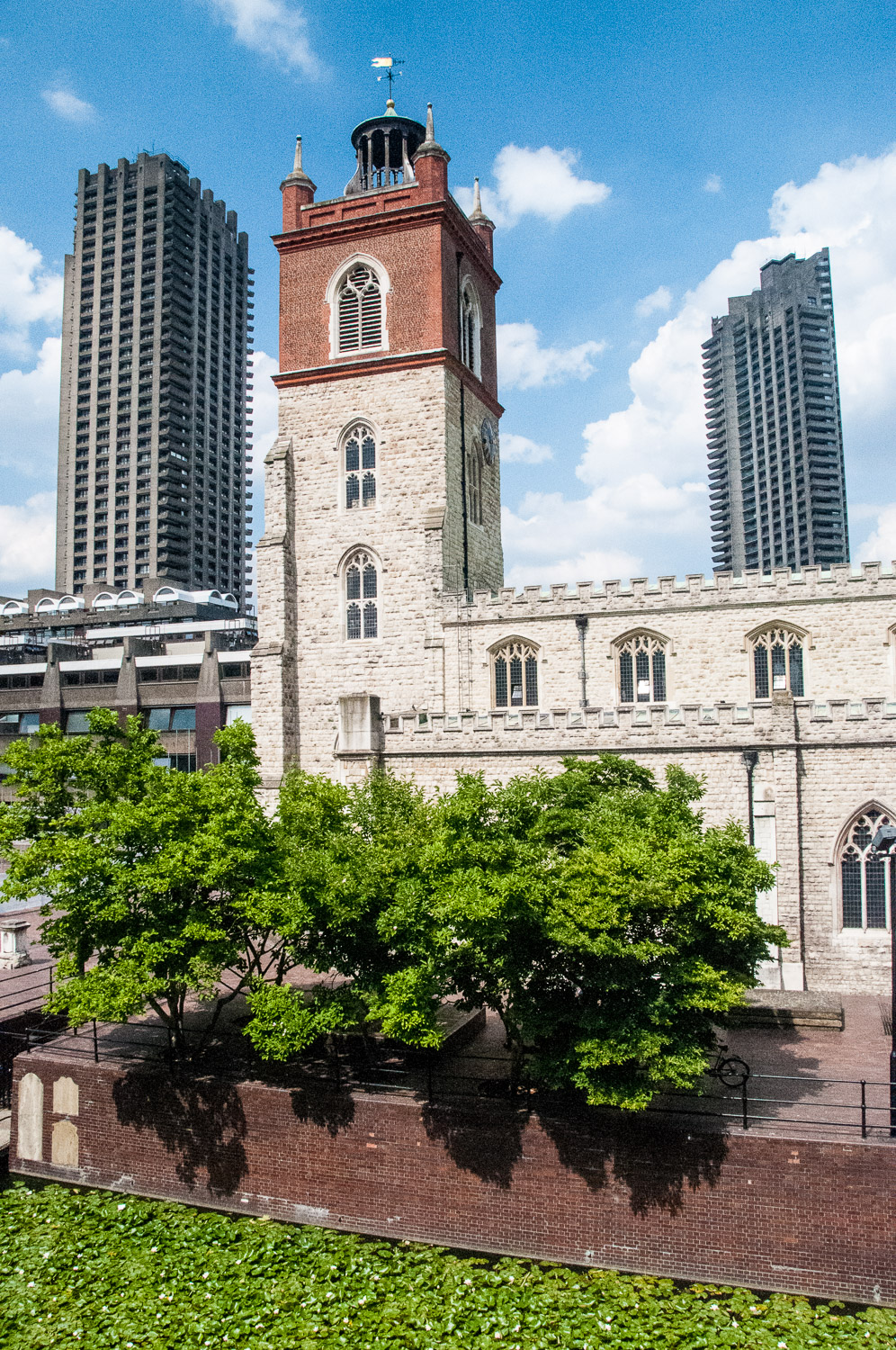
Standing on the Wallside highwalk you can see how the 17th century tower of St Giles-without-Cripplegate contrasts with two of the three Barbican residential blocks. Shakespeare Tower is on the left and Cromwell Tower on the right and they were until recently the highest residential towers in Europe …

To the left of the church you can see a line of very old barrel tombs. They formed part of the St Giles cemetery before its destruction in the Second World war. I have written before about this churchyard, and others, in an earlier blog which can be found here.

I took this picture of the magnolia tree earlier this year when it was in flower …

The Barbican also encloses parts of the old Roman/Medieval wall, occasionally used as a perch by a visiting Heron …

Alongside the Wallside highwalk.

People visit from all over the world to explore the iconic Barbican architecture by Chamberlin, Powell and Bon.

In this picture Shakespeare tower looms over Frobisher crescent …

As you walk through the estate interesting shapes and shadows emerge …

This view along Seddon Highwalk made me think of the slits used by medieval archers …

A little further on, an elegant column at the base of Lauderdale Tower illustrates the Barbican’s distinctive tooled-concrete finish. It was incredibly labour intensive. After the concrete had dried for at least 21 days, workers used handheld pick-hammers or wider bush-hammers to tool the surface and expose the coarse granite aggregate …

The column is next to the entrance to the ThaoV hair salon. The previous salon was called Scissors Palace which I though was a splendid name and was sorry to see it disappear.

New highwalks have just opened with their support structure itself looking like a piece of sculpture …

The entrance to the St Alphage Highwalk.

Around 4,000 people live on the Barbican estate and every now and then you get a glimpse of their decor. These little green creatures live in one of the houses on the estate and always make me smile when I see them peeping out the window …

I hope you have enjoyed this short tour and that it will inspire you to visit and explore. Ending the day with a cocktail at the Martini Bar is highly recommended.


Page 39 of 41

Powered by WordPress & Theme by Anders Norén

Symbols & Secrets
Privacy Overview

This website uses cookies so that we can provide you with the best user experience possible. Cookie information is stored in your browser and performs functions such as recognising you when you return to our website and helping our team to understand which sections of the website you find most interesting and useful.