Walking the City of London

Category: Sculpture Page 38 of 41

Sir Thomas Gresham and The Royal Exchange

The Royal Exchange will forever be associated with Sir Thomas Gresham (1519-1579). Here he is, portrayed as a confident young man in his mid-twenties:

Portrait – Gresham College.

Apprenticed for seven years in the Mercer trade, he spent much of his time on the continent, learning French and Flemish in the process. His astuteness with finance came to the attention of Thomas Cromwell who started putting royal work his way, and Gresham’s connection with royalty continued under Elizabeth I. As well as managing his family’s trading interests (primarily clothing, guns and ammunition) as a royal agent he was charged with reducing the royal debt held by Antwerp merchants. When he took over this task the debt stood at £250,000 but by 1565, applying a combination of shrewd trading and interest rate speculation, he had reduced it to only £20,000 (earning himself a knighthood). These skills increased his own wealth considerably as well, and this was further enhanced on the death of his father.

By the late 1560s he was reputed to be the richest commoner in the country. Having no heir (his only son died in 1564), in his later years he used some of his vast wealth to produce two lasting legacies – Gresham College and the first Royal Exchange. The College was established at his house in Bishopsgate where lectures were given on a wide range of subjects including astronomy, geography, medicine and music. The College still offers lectures today at its Holborn premises. The Royal Exchange, based on the Antwerp model, was his gift to the City’s merchant negotiators who up to that time ‘had done their business in the wind and weather of the public street’.

Queen Elizabeth formally opened the Exchange on 23 January 1571, giving the building its Royal title along with a licence to sell alcohol. The building was lost in the Great Fire of 1666 and its successor also burned down in 1838. The third building which stands today was opened in 1844 with much ceremony by Queen Victoria herself, Prince Albert having laid the foundation stone two years earlier.

In this blog I will be looking at some of the features of the present building that perpetuate Gresham’s memory and I will deal with other aspects in a later blog.

Let’s start with the main gates that face Bank junction …

Best observed when closed, they incorporate an image of the great man himself. Above his head are the arms of Gresham College with the sword and mace representing the City …

The gates were supplied by the firm of H. and M.D. Grissell whose foundry also produced the railings for Buckingham Palace and the British Museum. Henry Grissell (nicknamed ‘Iron Henry’) was famous not only for the quality of his work but also his attention to detail, evident here in the entrance to the Exchange in Threadneedle Street …

If you look closely you will see that the ironwork incorporates Gresham’s initials:

Along with a Mercer Maiden …

I have written about the Maidens in more detail in an earlier blog and their use as a symbol denoting property owned by the Worshipful Company of Mercers of which Gresham was a member. They still own the land on which the Exchange stands.

Look up at the Exchange and you will see several grasshoppers, the symbol of the Gresham family …

Facing Threadneedle Street.

And the weathervane on the roof, which was saved from the fire that destroyed the second Exchange in 1838 …

The story goes that one of Thomas’s ancestors, Roger de Gresham, was abandoned as an infant in the marshlands of Norfolk and would have perished had not a passing woman been attracted to the child by a chirruping grasshopper. Heraldic spoilsports assert that it is more likely a ‘canting heraldic crest’ playing on the sound ‘grassh’ and ‘gresh’.

There is, course, also a statue of Gresham himself on the building but it is so high up you can only view it from practically underneath …

The Ornamental Passions’ website tells us the following about the sculptor William Behnes. He was, apparently …

… a half-English Irish-educated artist whose financial profligacy had reduced him to penury. He was declared bankrupt half way through the commission but he successfully completed it and was paid £550 (roughly £50,000 today).

Incidentally, the Exchange was lucky to survive the wartime bombing especially when, on 11 January 1941, a direct hit on Bank Station killed 111 people. These pictures show the aftermath then and the view today …


The view at Bank on a quiet Sunday.


Sculptures with striking poses

I’ll start with a work that caused some controversy, the Charity Drinking Fountain (also known as La Maternité) by Aimé-Jules Dalou (1877-9).

In his book Public Sculpture of the City of London, Philip Ward-Jackson describes the lady as follows:

Despite her casual garb she has a diadem or tiara on her head. With her left arm she enfolds a baby, who she is suckling, whilst with her right she draws to her knee a naked boy, who gazes up at her.

She is outside Royal Exchange Buildings EC3V 3NL.

Nearby is a very relaxed George Peabody who I have written about in an earlier blog

Ward-Jackson tells us that the suckling lady’s very authentic exposed breast produced at least one letter of protest to the editor of The Globe. The correspondent urged that ‘common decency’ should be observed and went on …

Do you not think, Sir, that Mr Peabody’s chair should be turned, at least until the delicate operation of ‘lacteal sustenation’ be concluded … or the young woman and youngsters provided with the requisite clothing.

On a more serious theme, St Thomas à Becket lies in agony in St Paul’s Churchyard on the south side of St Paul’s Cathedral (EC4M 8AD) …

‘Becket’ by Edward Bainbridge Copnall (1970-71).

The Ornamental Passions website gives the following description :

(The sculptor) depicts the Archbishop in the agony of death, his right hand extended as if to ward off the blows of his knightly assassins. The plinth is stepped to recall the steps into the choir of Canterbury Cathedral … This memorable image was created in 1970 as part of the commemorations of the saint’s martyrdom.
The material looks like bronze but is in fact resin coloured to look like bronze.

Just across the road from St Paul’s, on the right as you approach the Millennium Bridge, you will see the National Firefighters Memorial (EC4M 8BX) which depicts a Fire Officer and two Firemen, cast in bronze engaged in firefighting duties. Unveiled by the Queen Mother in 1991, it was originally called ‘Blitz’ and was dedicated to the men and women of the Fire Service who lost their lives as a result of their duties during World War II.  In 2000 it was renamed the Firefighters Memorial in order to commemorate all firefighters killed whilst in service and a new raised plinth now records almost 2,300 names.

Two of the men are ‘working a branch’, their legs braced to take the strain …

Churchill memorably called them ‘Heroes with grimy faces’.

The Officer below looking over his shoulder, possibly calling up reinforcements, is Cyril Demarne OBE who provided photographs to help the sculptor (who also happened to be his son-in-law) …

According to Philip Ward-Jackson, Demarne’s initials CTD are scattered among the brickwork on which the men stand but his old colleagues needed no such clues. One stated in an interview …

You can tell it’s Cyril by the way he’s standing … He always waved his arms about like that when he was ordering us about.

Officer Demarne in full flow …

By 1943 over 70,00 women had enrolled in the National Fire Service in the United Kingdom. This memorial commemorates those who lost their lives in the London Blitz …

The lady on the left is an incident recorder and the one on the right a despatch rider.

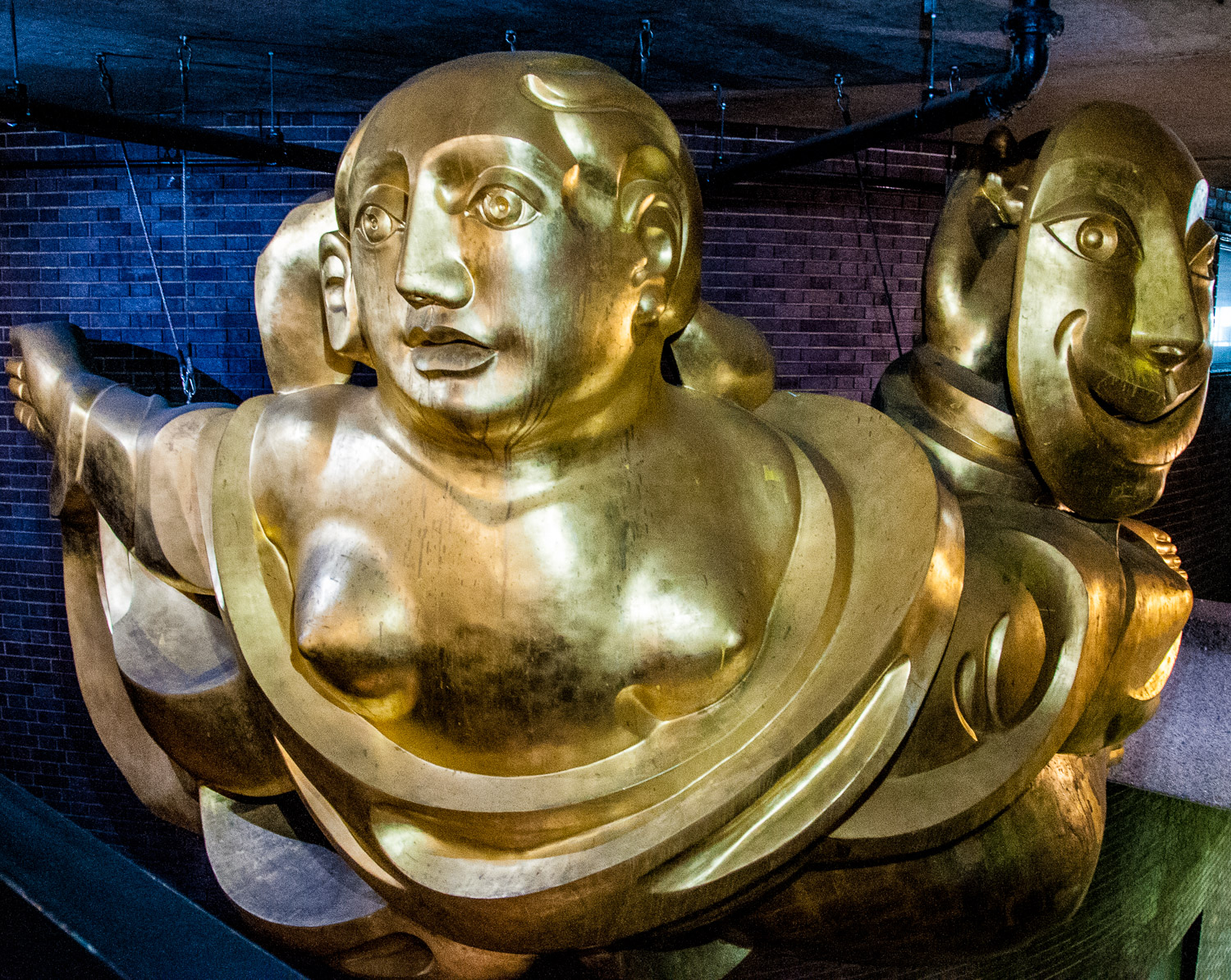
Finally, would you like to see Zoe, the floating Barbican Muse? If so, make your way to the Barbican Library on the second floor of the Centre, stand with your back to it, and walk through the automatic doors. She’s a few yards ahead on your left …

Sculpted by Matthew Spender in 1993-4, she is made of polyurethane and glass fibre and finished in gold leaf. She holds in her left hand the masks of Comedy and Tragedy whilst her right hand points the way to the entrance to the Centre (hopefully assisting folk lost in the highwalk system). She’s nicknamed Zoe after the Cambridge student who had posed for the sculptor.


City work and public sculpture 2

This week I am looking at sculptures representing work in the City in the 20th Century.

Although I mentioned them in an earlier blog I wanted to show these figures again because they are so unusual …

Old churchyard of St John Zachary, 25 Gresham Street EC2V 7HN.

Wilfred Dudeney’s monument Three Printers (1954) has been here since 2009. Commissioned by the Westminster Press Group, it represents the newspaper process with a newsboy (sales), printer and editor (or proprietor), and used to stand by their offices in New Street Square. When the square was redeveloped the Goldsmiths’ Company, as the freeholders of the square, relocated the sculpture here (they had to rescue it from a demolition yard). Look closely, the printer is grasping a ‘stick’ for holding metal type, and Dudeney’s name is in ‘mirror writing’ just as it would have been when typeset the old-fashioned way.

This sculpture reminded me of words from Auden’s The Waste Land:

 Unreal City,
Under the brown fog of a winter dawn,
A crowd flowed over London Bridge, so many,
I had not thought death had undone so many.
Sighs, short and infrequent, were exhaled,
And each man fixed his eyes before his feet.

It is entitled Rush Hour by George Segal (1983-7) and is in Broadgate (EC2M 3WA) …

Trudging wearily off home in the rain …

Segal created this sculpture from live models, encasing them in wire mesh and plaster bandages, before cutting each cast open to free the model, rejoining the mould and casting bronze figures from the plaster versions. You will notice that all their eyes are closed …

And now something a bit more cheerful …

Philip Ward-Jackson, in his book Public Sculpture of the City of London, tells us of the Trees, Gardens and Open Spaces Committee of the Corporation which was chaired by Frederick Cleary. In his autobiography Cleary recorded that Jonzen’s figure below was intended as a tribute to the efforts of his committee but Ward-Jackson feels that ‘it might have been better described as a symbol of the ‘greening’ of the City in the post-war period’. Most appropriately, Mr Cleary has a garden named after him, and you can read about it in my earlier blog about City gardens generally.

‘The Gardener’ by Karin Jonzen FBS (1971) – Brewers’ Hall Gardens, London Wall EC2V 7HR.

Apparently Jonzen, on being given the subject by the Corporation …

… decided on a kneeling figure of a young man, who, having planted a bulb, was gently stroking over the earth.

Easy to miss but worth seeking out is The Building Worker, a bronze statue of a building worker in a pose based on Michelangelo’s David, but in working clothes and wearing a hard hat and carrying a spirit level. He is on Tower Hill EC3 just across the road from the station outside the Tower of London …

The sculptor was Alan Wilson (2006).

It commemorates the ‘thousands of workers who have lost their lives at work … (and) workers who are today building and rebuilding towns and cities across the United Kingdom.’ Wreaths are laid here each year on April 28, International Workers Memorial Day, and a two minute silence is observed at noon in memory of those who have suffered fatal injuries in accidents at work.

The Plumbers’ Hall was compulsorily purchased in 1863 to make way for the expansion of Cannon Street Railway station and this statue on the concourse is a reminder of that connection …

The Plumber’s Apprentice by Mark Jennings (2011).

The inscription reads ‘This statue was erected on the site of its last Livery Hall by The Worshipful Company of Plumbers to celebrate the 400th anniversary of the granting of its Charter by King James I in 1611 and to recognise the support given by the Company to the training of apprentices.’

To round off my day I went looking for a statue I personally remember being erected on Cannon Street in 1996 – The LIFFE Trader (LIFFE standing for the London International Financial Futures Exchange). But he has been moved and tucked away behind glass at the Guildhall Yard in a corridor that the public cannot access …

Please let him go outside, or at least turn him around.

Here he is in his glory days at Cannon Street – a bit of a character with his loosened tie, no doubt doing a deal on his then fashionable clamshell mobile phone …

Photograph copyright Loïc Brohard.


Page 38 of 41

Powered by WordPress & Theme by Anders Norén

Symbols & Secrets
Privacy Overview

This website uses cookies so that we can provide you with the best user experience possible. Cookie information is stored in your browser and performs functions such as recognising you when you return to our website and helping our team to understand which sections of the website you find most interesting and useful.