Walking the City of London

Category: Religion Page 13 of 20

Resurrection Stones – spiritual optimism in frightening times?

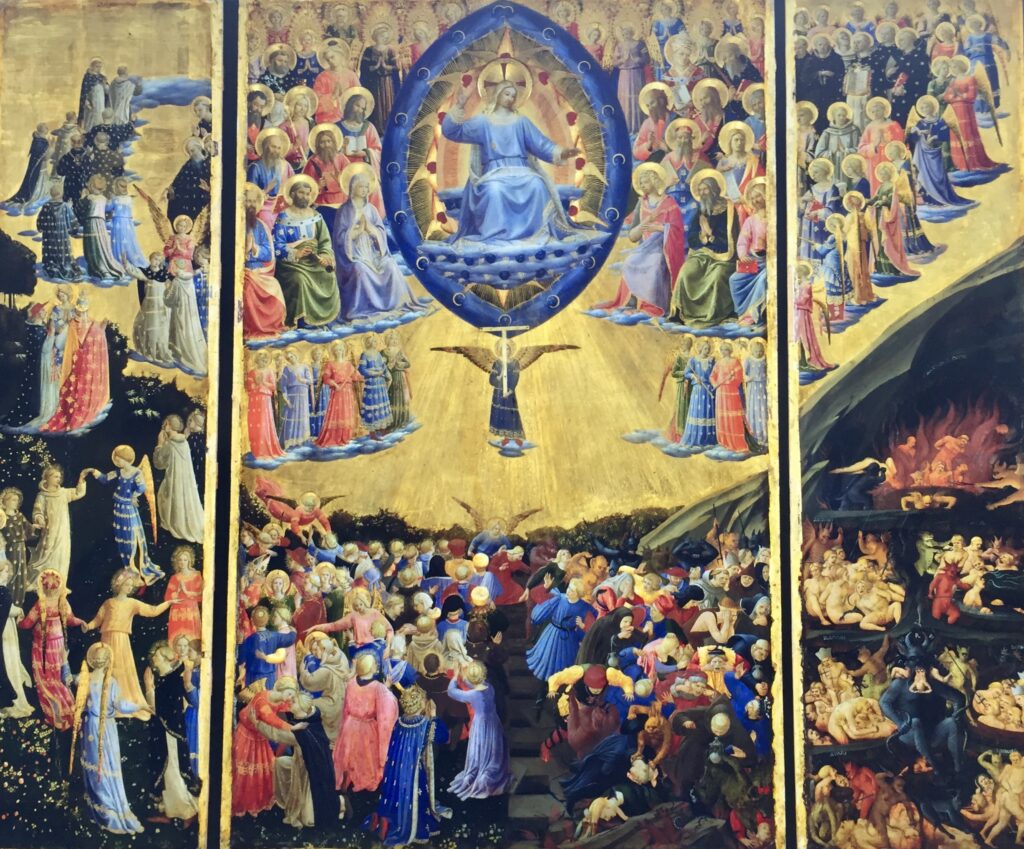
For centuries images of The Last Judgment were commonplace – particularly on church walls and in paintings. This is a typical example by Fra Angelico which is thought to have been painted between 1435 and 1440 …

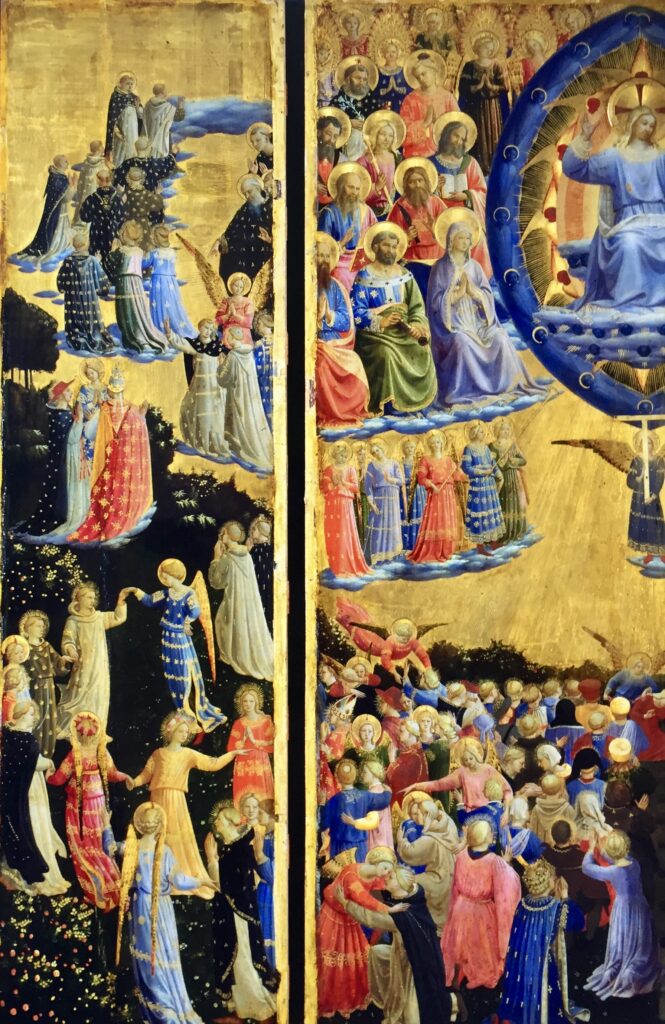
Jesus sits enthroned in glory calling up the dead for judgment. He is surrounded by Saints and Apostles, his right hand pointing towards Heaven and his left to Hell. On one side people wearing their everyday clothes are led up to Heaven by winged angels …

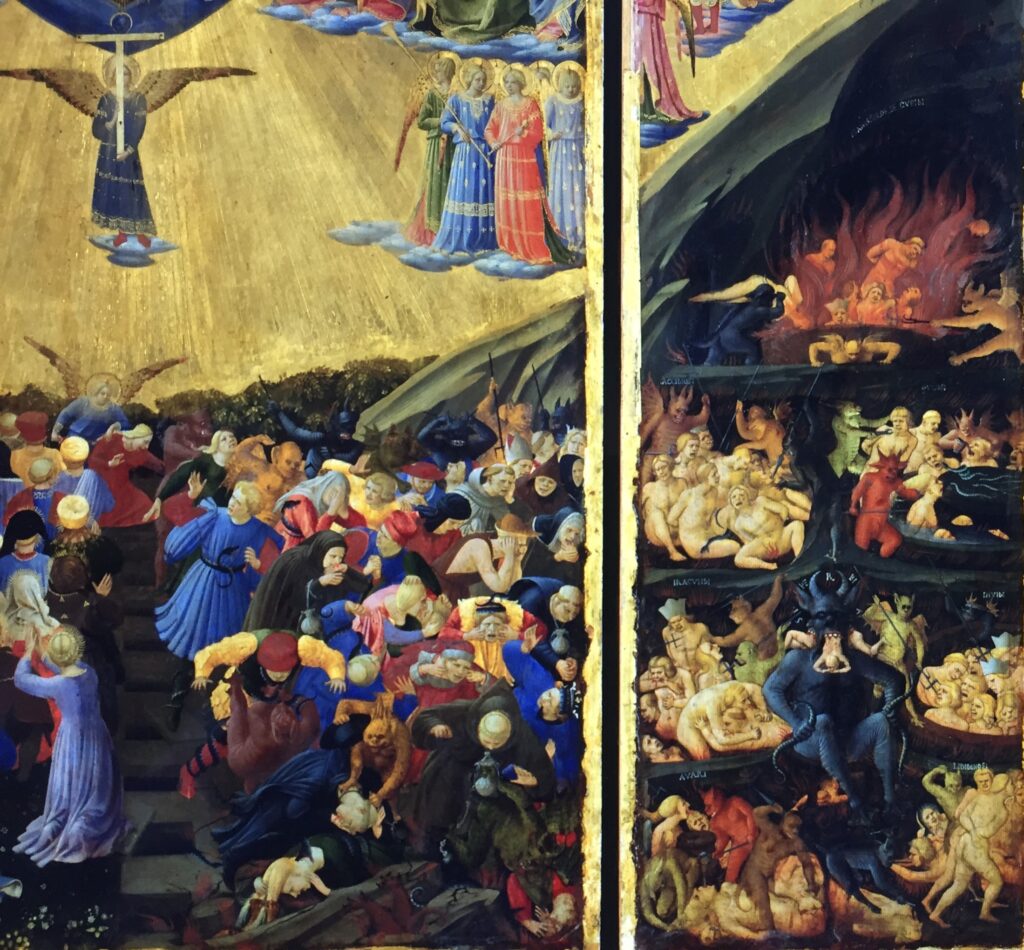
But things are a bit grim on the bottom right. Demons prod and drag the condemned off to Hell where a horned Satan supervises a variety of terrible punishments. Look closely at the damned and you’ll see at least two monks and a bishop wearing a mitre …

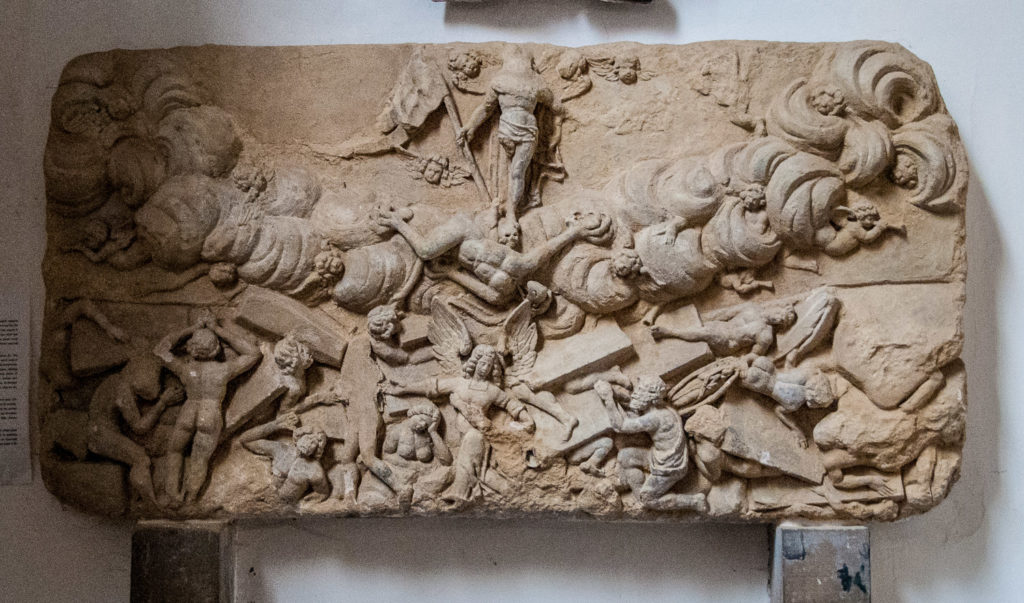
The depictions of the Last Judgment I am going to write about are carved in stone and differ from the Fra Angelico composition in a number of ways. The first is in the narthex of St Mary-at-Hill on Lovat Lane (EC3R 8EE) …

Christ holding a banner stands amidst clouds. Satan, a figure with large claws, is being trampled under his feet.

It most likely dates from the 1670s. Its carver is unknown, but it is known that the prominent City mason Joshua Marshall was responsible for the rebuilding of the church in 1670-74 and his workshop may have produced the relief. Exactly where it was originally positioned is uncertain; most likely it stood over the entrance to the parish burial ground and was brought inside more recently.

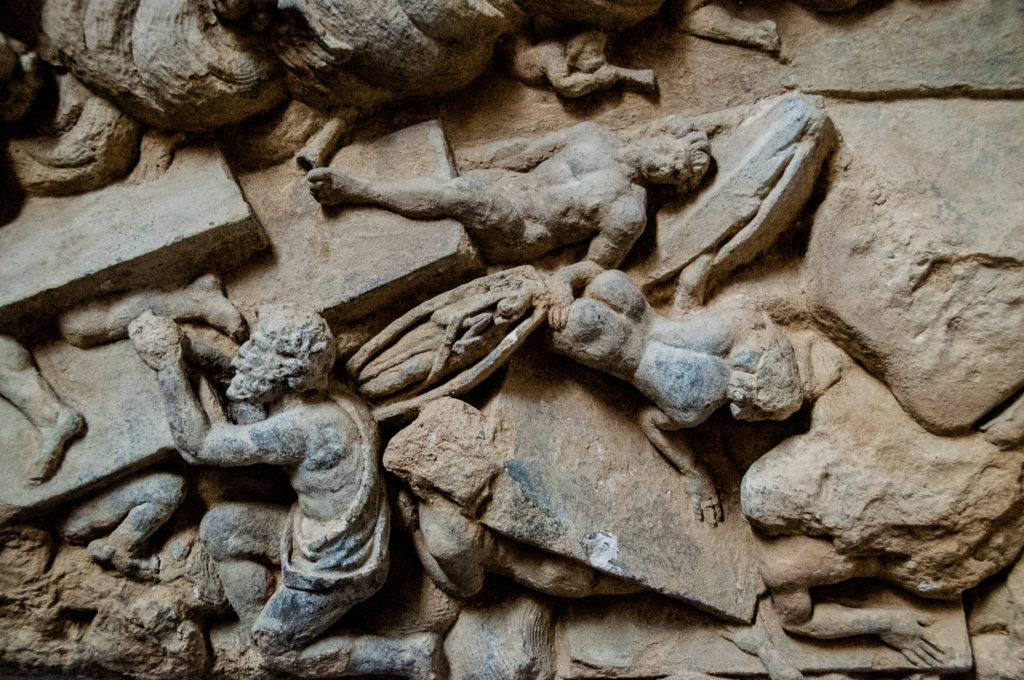
In close up …

You can see open coffins as individuals respond to the call.
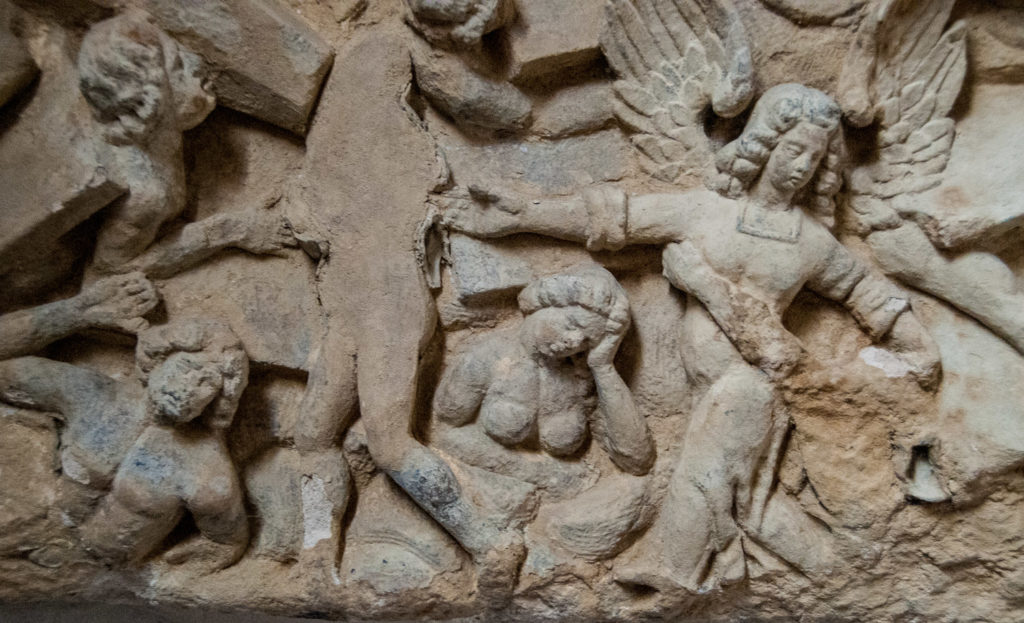
The winged Archangel Michael helps people rise again.

The main difference here from the traditional representations is the absence of Hell, so it’s a more optimistic portrayal. Also, people appear naked or just wrapped in a shroud rather than being differentiated by their clothing. Perhaps this signifies everyone is equal when the last judgment comes.

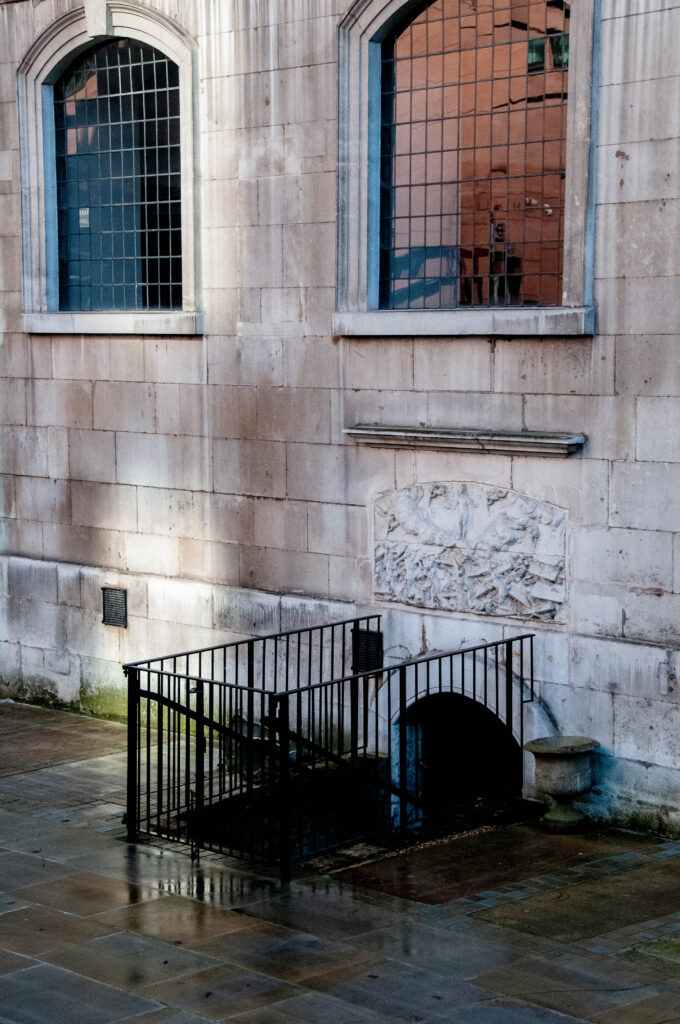
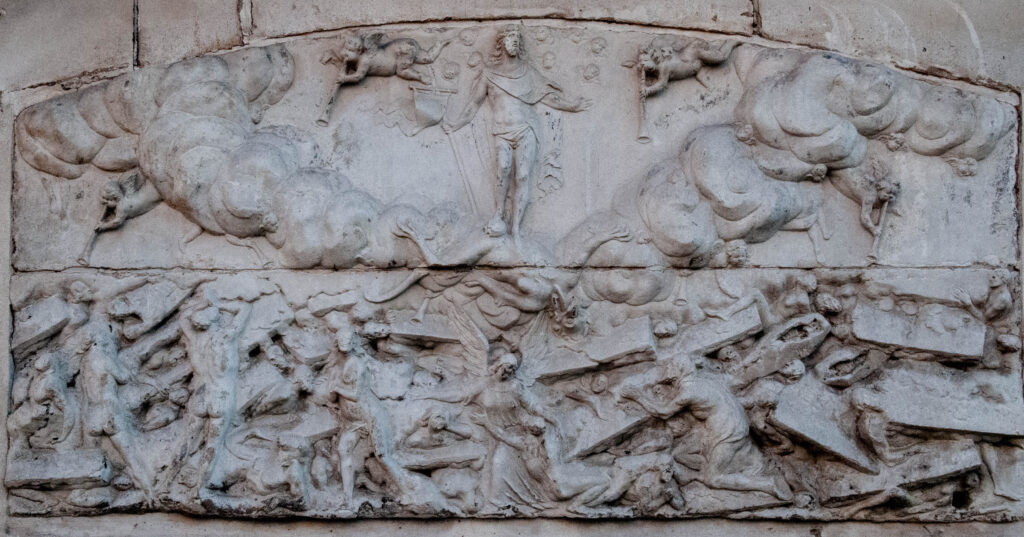
The second stone is just visible from Holborn Viaduct if you look down the steps of the church of St Andrew Holborn (EC4A 3AF) …

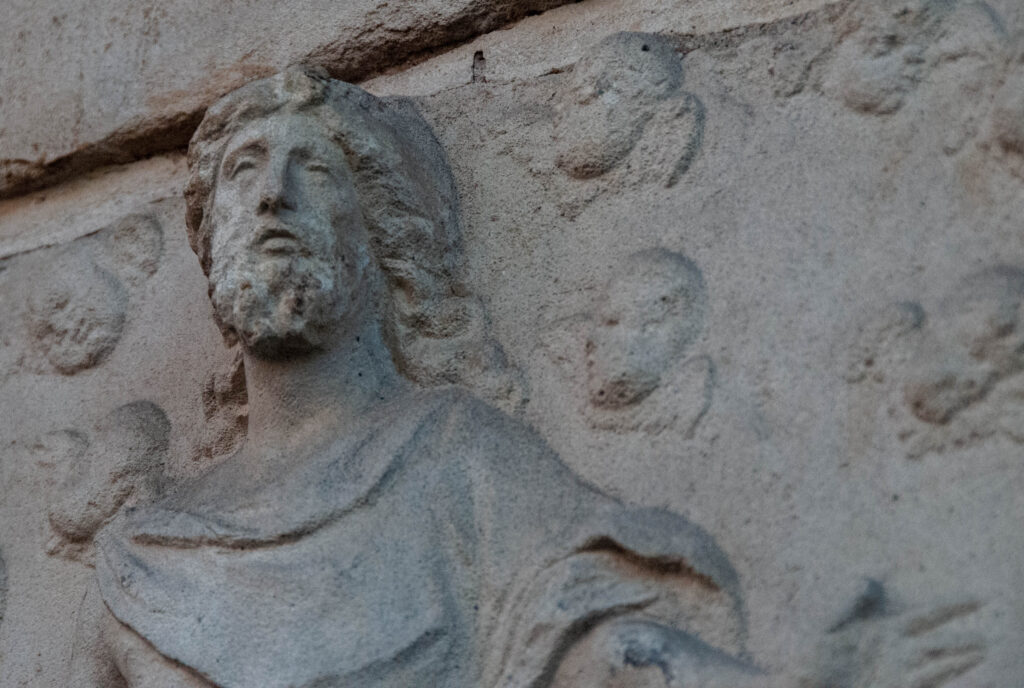
Although a bit more weather-beaten that the St Mary-at-Hill version, the figure of Christ’s head has not been damaged and he gazes serenely down as angels sound trumpets to summon the dead. He’s surrounded by little winged figures or putti …

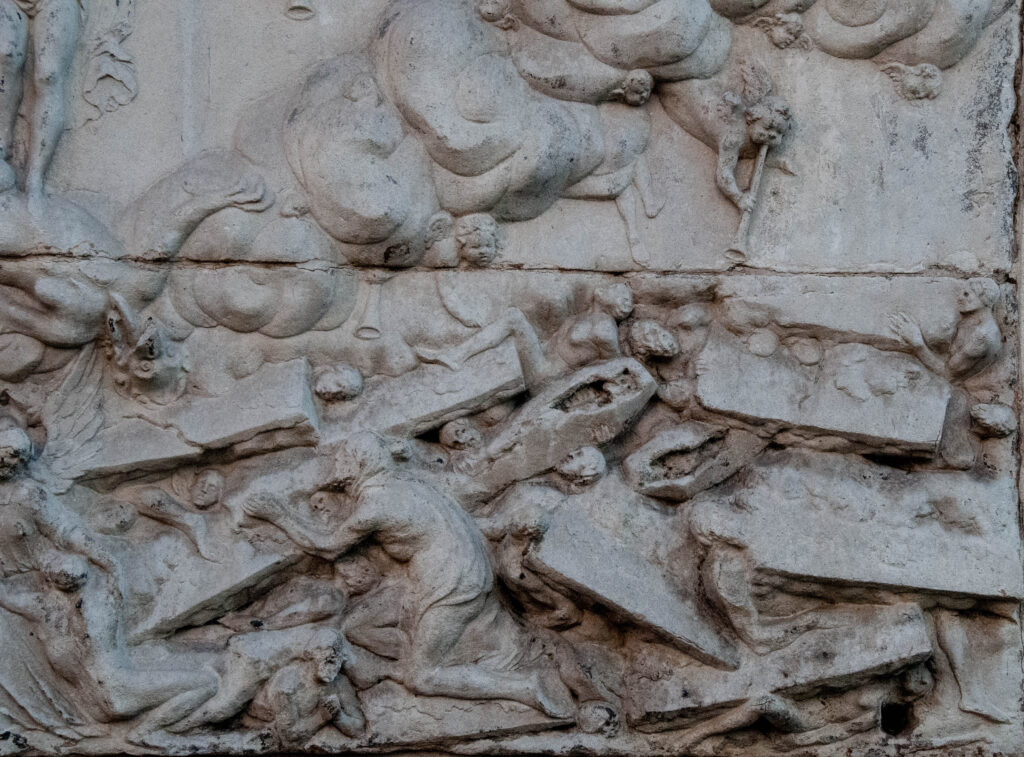
Open coffins lie amongst the chaos as the angels do their work. Under his feet Christ is crushing a dragon-like creature with a long tail, again probably representing Satan …

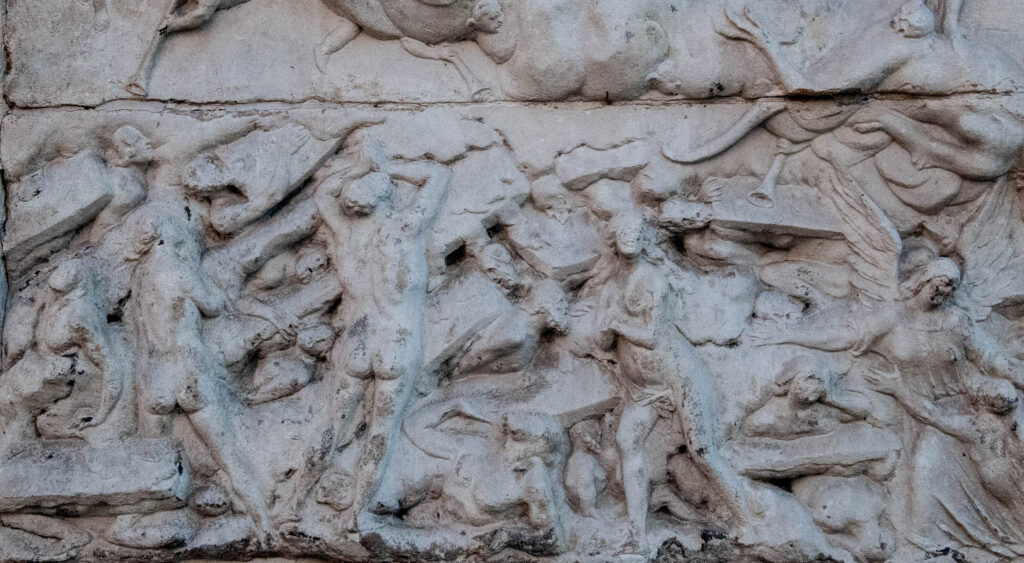
People emerge, crawling towards the light …

One of the figures here is clinging to an angel and another holds his hands in prayer or supplication …

Once again, apart from Christ and the angels, everyone is naked and there is no representation of Hell. The stone once stood over the paupers’ cemetery in Shoe Lane and was maybe intended to give some succour and hope to those attending the burial of loved ones. It’s thought that this stone also dates from the 1670s but again the carver is unknown.

I am tempted to assume that, after the horrors of the plague of 1665 and the Great Fire of 1666, portrayals of the resurrection were represented more positively by removing threats of Hell and damnation.

I’m always looking out for great London blogs and my publication this week was inspired by the Flickering Lamps blogger Caroline who has written on the same subject. Click here for a link to her website.

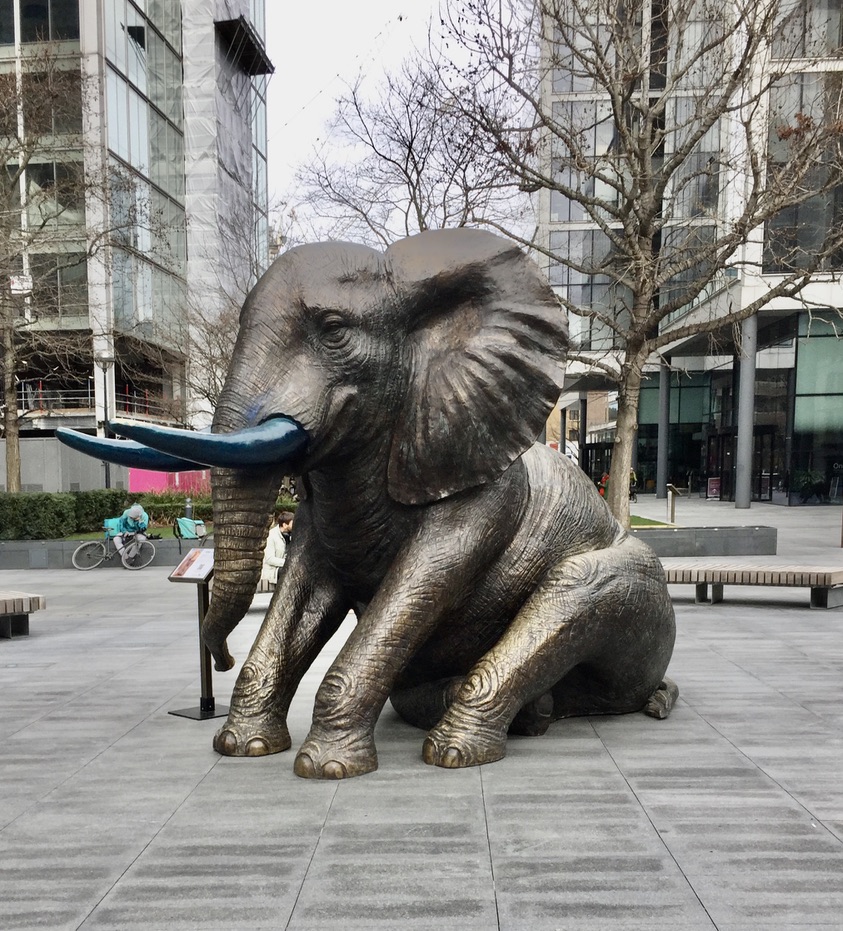
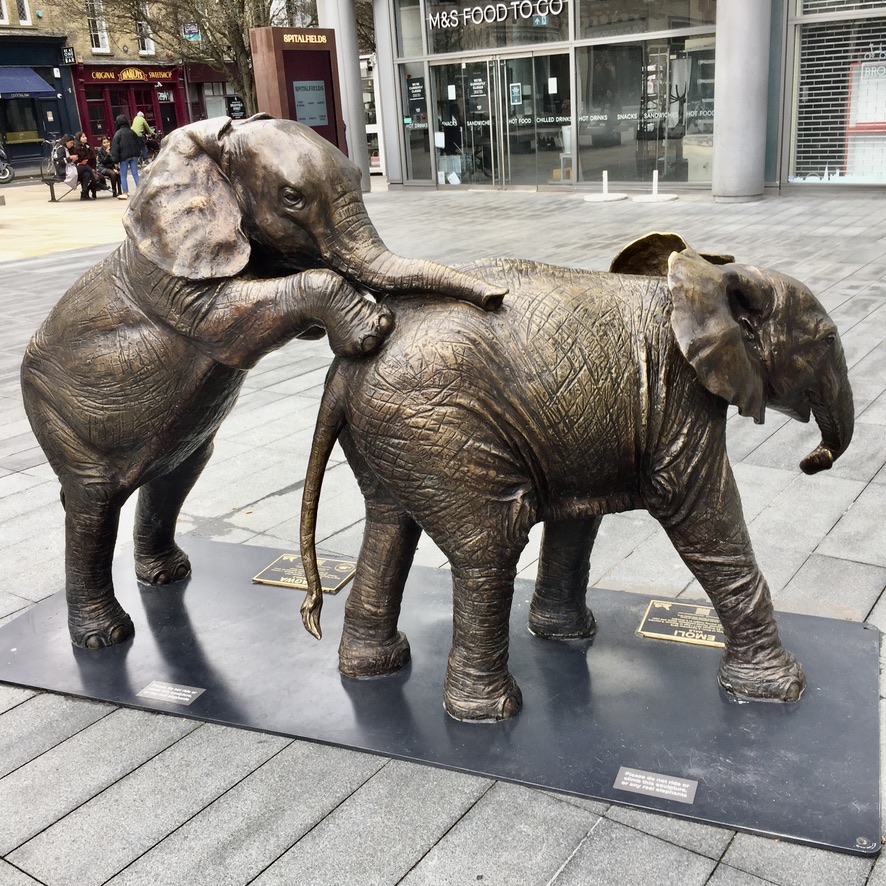
By way of light relief in our own difficult times, if you have the chance check out the Herd of Hope elephants at Spitalfields Market …

If you would like to follow me on Instagram here is the link …
https://www.instagram.com/london_city_gent/

City churches – 100 years ago and now.

The black and white pictures in today’s blog are old glass slides and were taken for the London & Middlesex Archaeological Society. They are held at the Bishopsgate Institute.

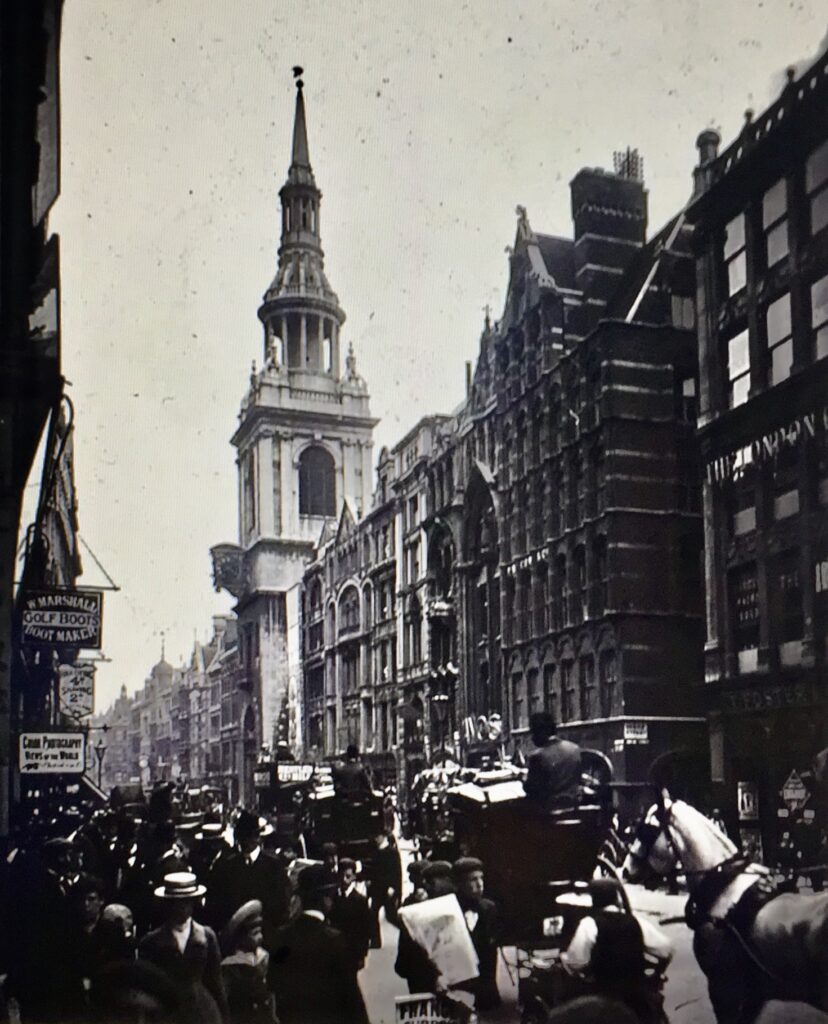
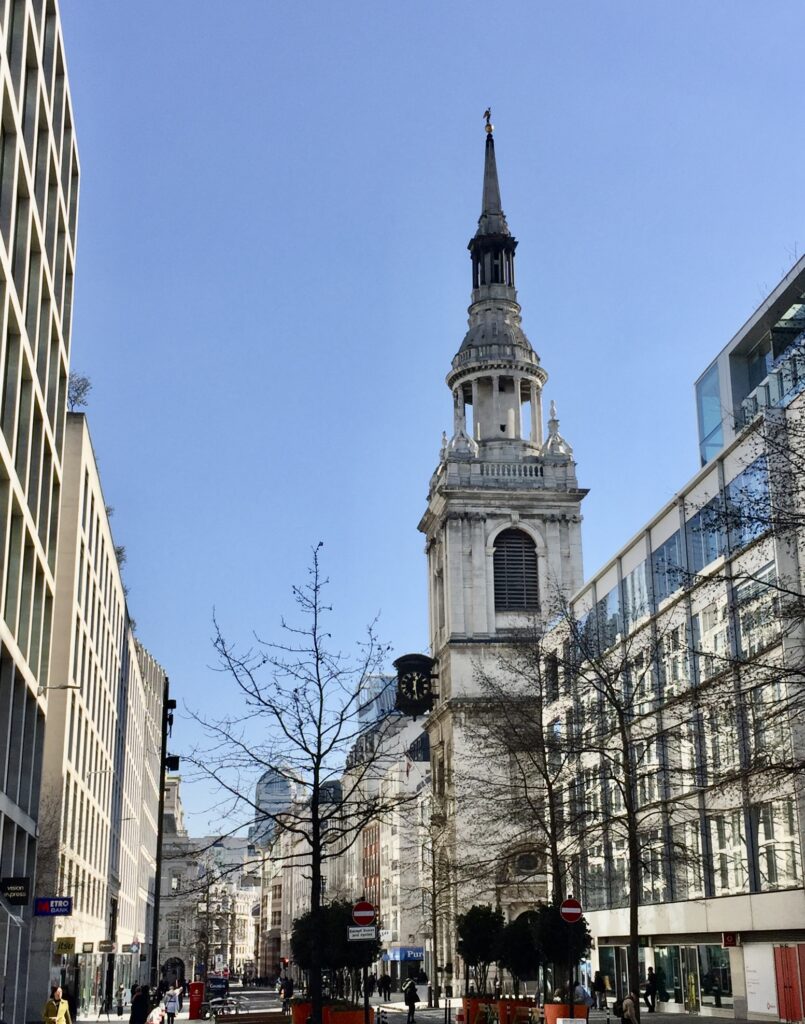
First up is St Mary-le-Bow, built by Christopher Wren between 1670 and 1680 after its predecessor was destroyed in the Great Fire of 1666. It was gutted in the Second World War bombing (all that remained was the bell tower and the walls) but was rebuilt between 1956 and 1964. Incidentally, the church’s predecessor witnessed other dramas, apart from the catastrophic Great Fire.

In 1091 the roof blew off and in 1271 the steeple collapsed, in each case killing several parishioners. In 1284 Lawrence Duckett, an alleged murderer, sought sanctuary in the church, but a mob burst in and lynched him. In punishment for this act of sacrilege, sixteen men were hanged, drawn and quartered and one woman was burned at the stake. In 1331 a balcony collapsed during a jousting tournament casting Queen Philippa and her attendants into the street. Wren placed an iron balcony on the tower to celebrate the event. Next time you walk down Cheapside think of jousting horses galloping past and the rattle of knights’ armour.

Here’s the church in 1910 …

And the present day …

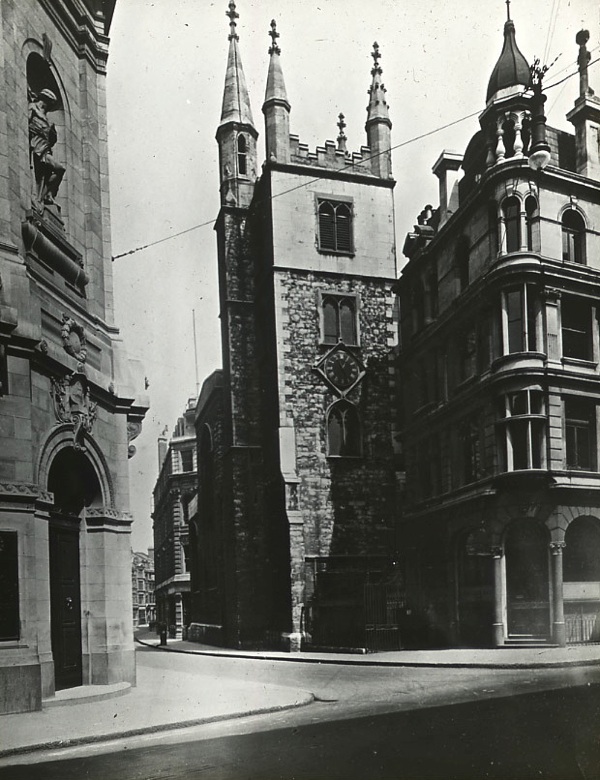
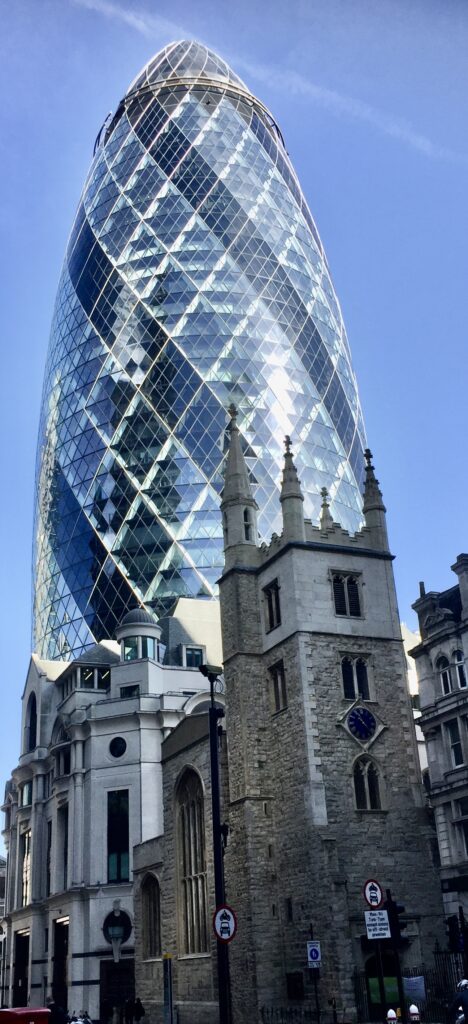
St Andrew Undershaft was so called because the maypole alongside it was taller than the church. The pole was set up opposite the church every year until Mayday 1517 when the tradition was suspended after the City apprentices (always a volatile bunch) rioted against foreign workers. Public gatherings on Mayday were therefore to be discouraged and the pole was hung up nearby in the appropriately named Shaft Alley. In 1549 the vicar of St Catharine Cree denounced the maypole as a pagan symbol and got his listeners so agitated they pulled the pole from its moorings, cut it up and burned it.

Here is a picture of the church around 1910 …

The view today, literally in the shadow of the Gherkin …

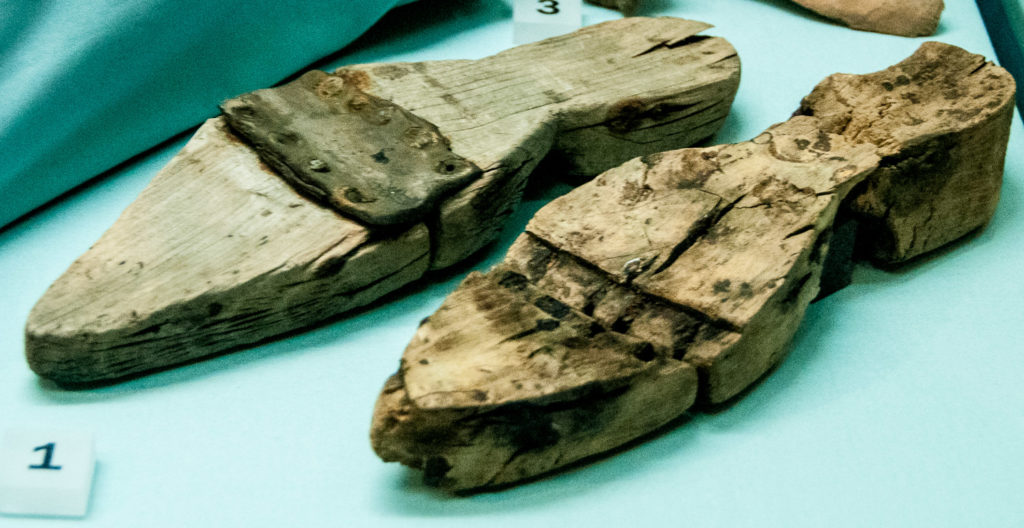
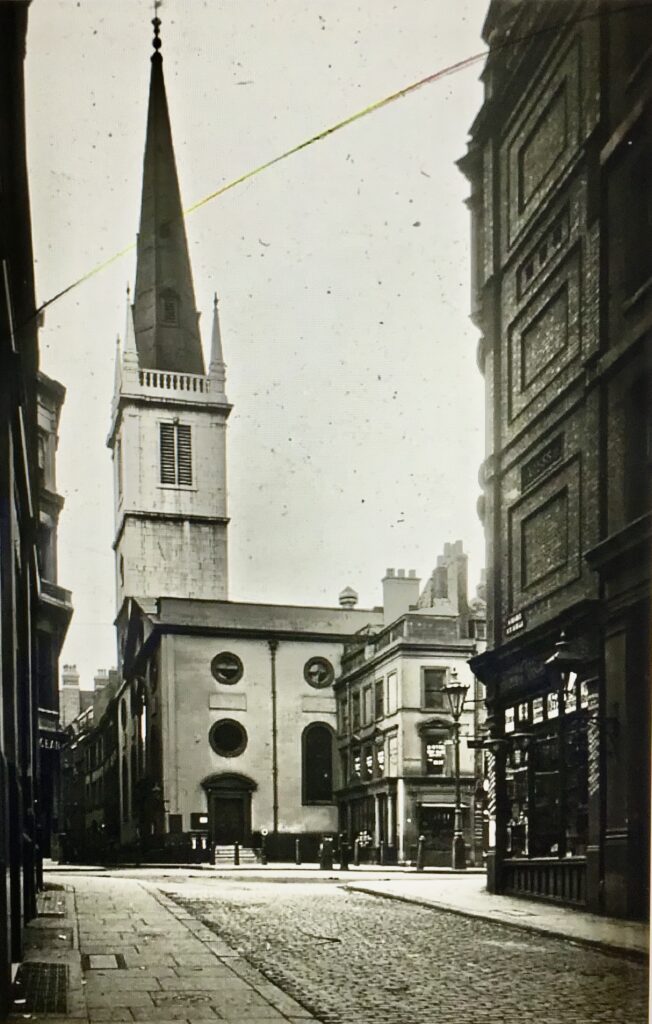
St Margaret Pattens is another Wren church, completed in 1702. The dedication is to St Margaret of Antioch and ‘pattens’ refers to wooden clog-like footwear which, strapped to the feet of medieval Londoners, enabled them to wade through the debris of the City with minimal damage to their shoes. The artisans who made them worked nearby in Rood Lane and a pair of pattens were on display at the Museum of London Secret Rivers exhibition in 2019 …

Here’s the church in 1920 …

And today …

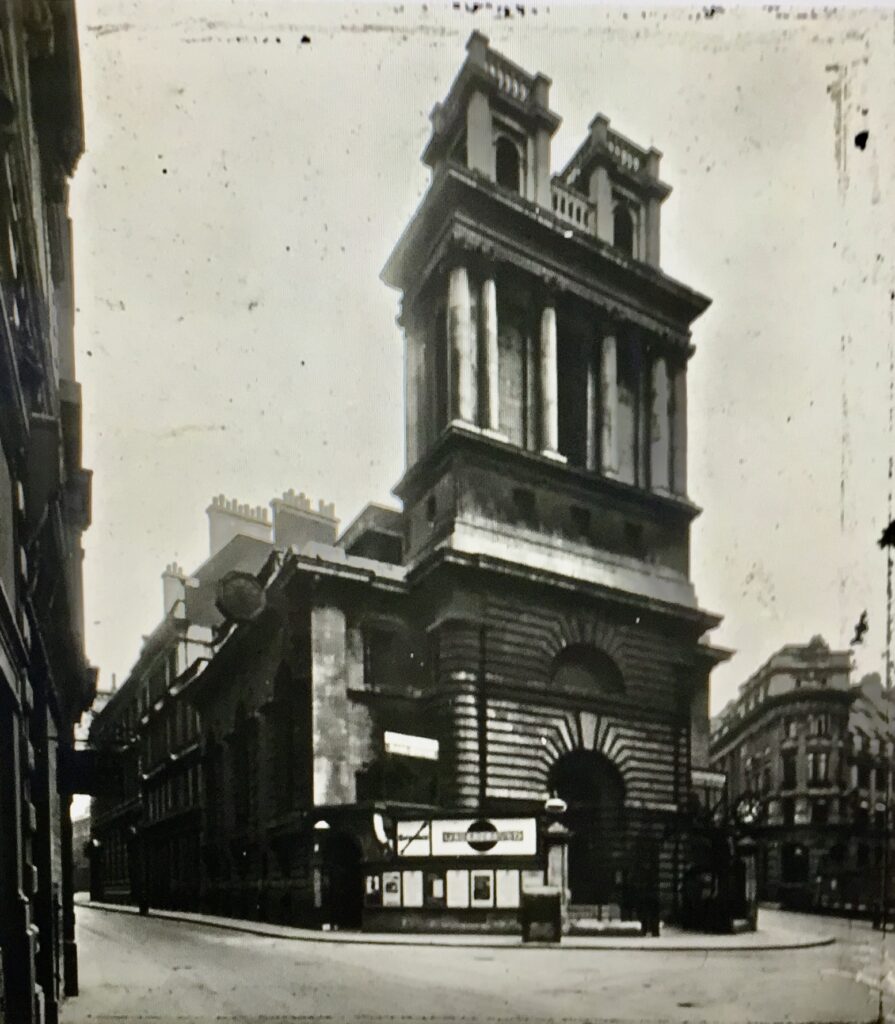
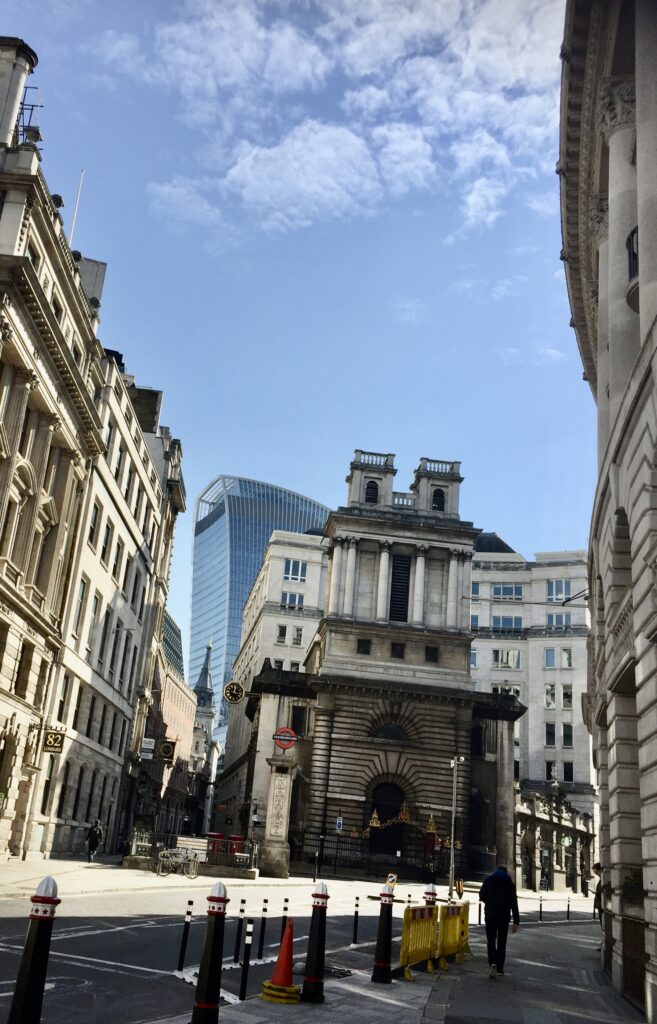
St Mary Woolnoth is the only remaining complete City church by Wren’s gifted assistant, Nicholas Hawksmoor. It is also the only City church to have survived the Second World War unscathed. Built between 1716 and 1727 its exterior, with its flat topped turrets, is often regarded as being the most original in the City. Definitely worth visiting if only to see the memorial to the reformed slave trader John Newton whose preaching (from the pulpit still in the church) inspired William Wilberforce. You can read more about him and the church here.

This picture was taken around 1920 …

And here’s how it looks today …

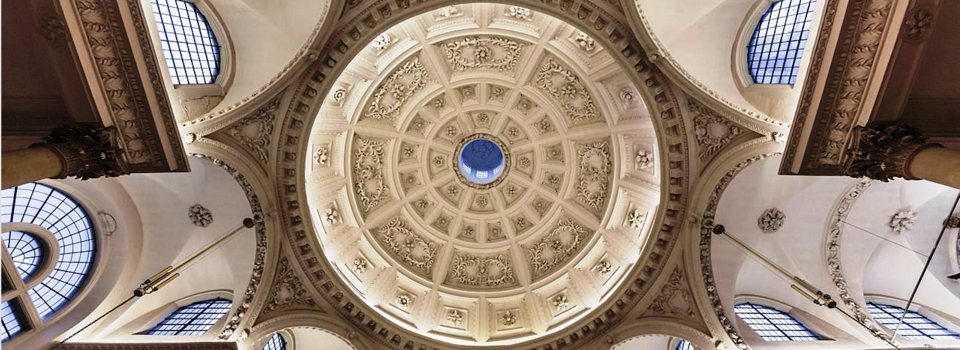
St Stephen Walbrook was rebuilt by Wren in 1672-80 and was one of his earliest and largest City churches. The pains taken with the church are perhaps partly explained by the fact that he used to live next door. The beautiful dome was one of the first of its kind in any English church – a forerunner of Wren’s work on St Paul’s Cathedral. It is not known whether the wonderfully named Mr Pollixifen, who lived beside the church, was placated by the beauty of the building having, during its construction, complained bitterly that it was obstructing the light to his property. You can read more about what can be found inside the church here.

In 1917, when this picture was taken, a bookshop abutted the building …

The same view today from outside the Mansion House …

The dome – a Wren masterpiece …

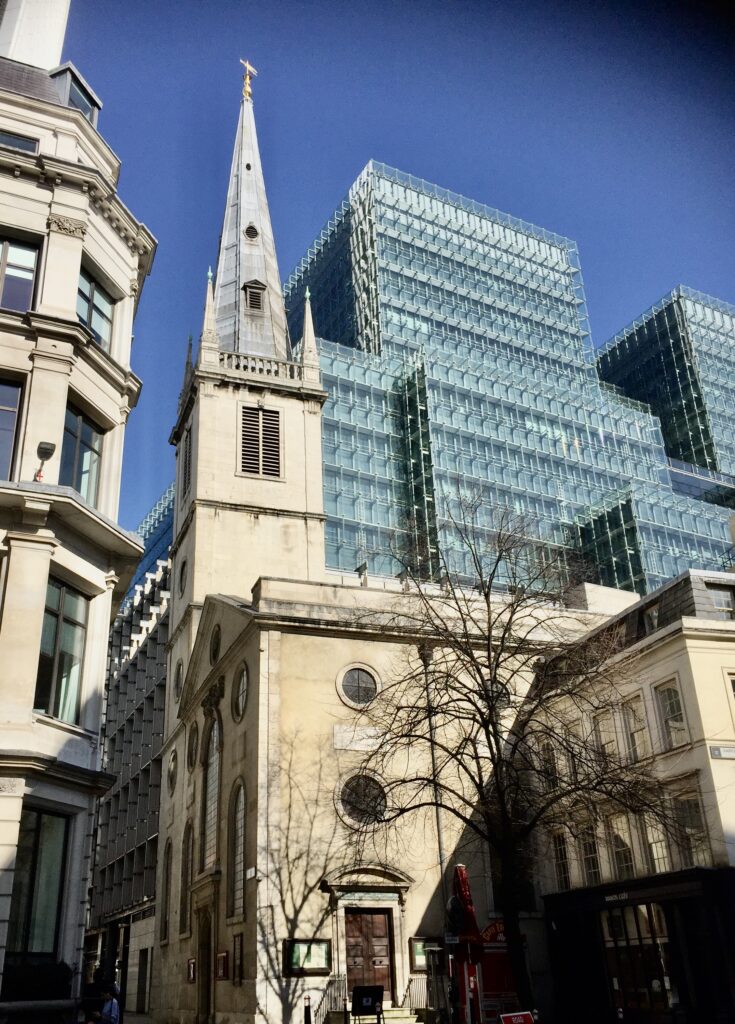
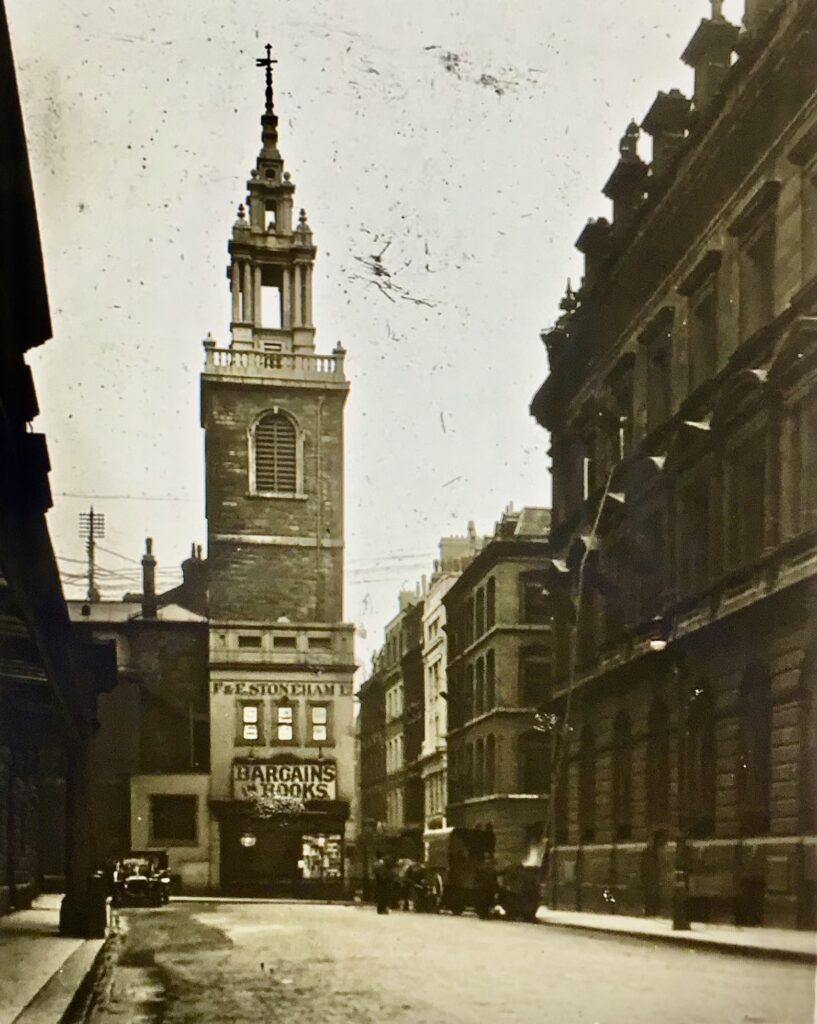
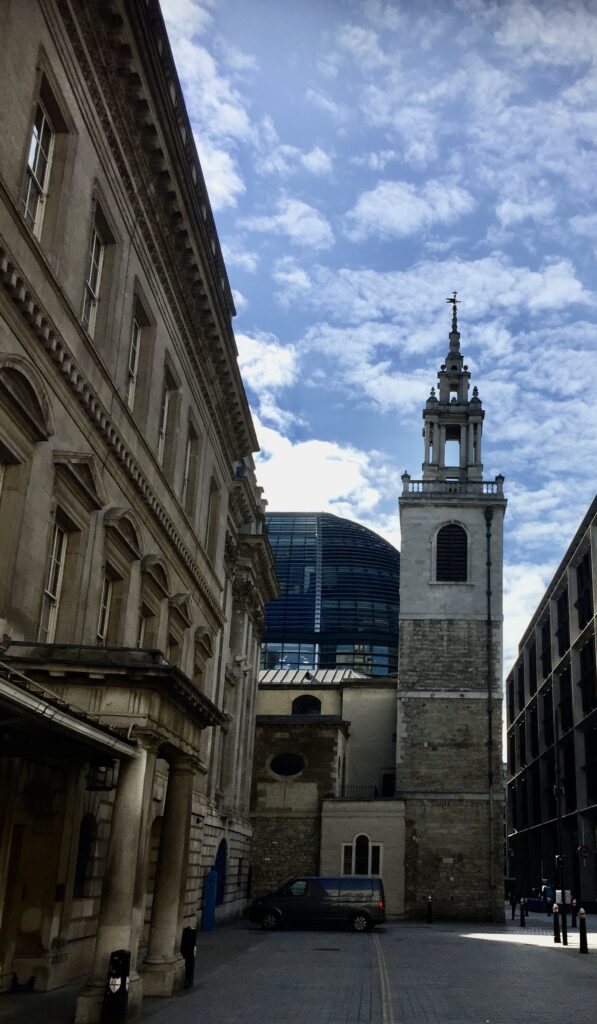
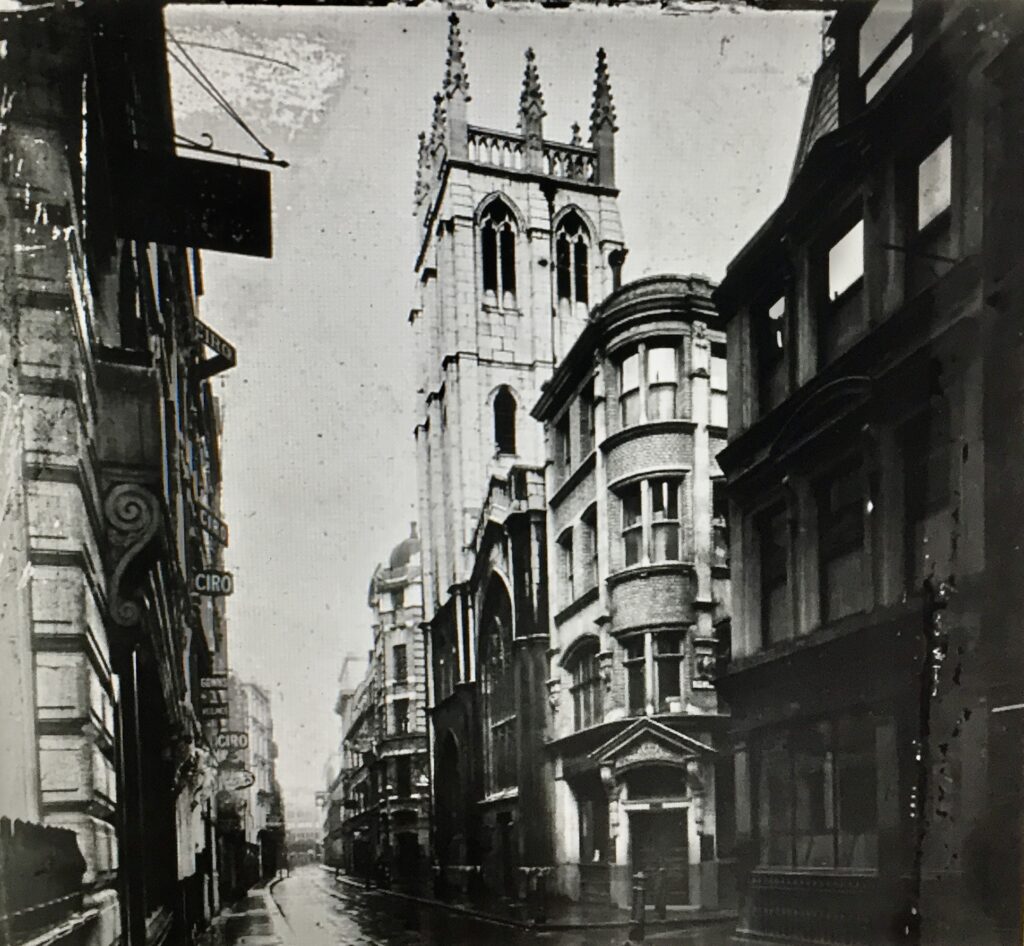
St Alban Wood street was dedicated to the first English martyr who died in the fourth century. By the 17th century the original medieval church was in a very poor state of repair and was demolished and rebuilt in 1634 only to be destroyed in the Great Fire of 1666. Christopher Wren undertook its second rebuilding which was completed in 1685.

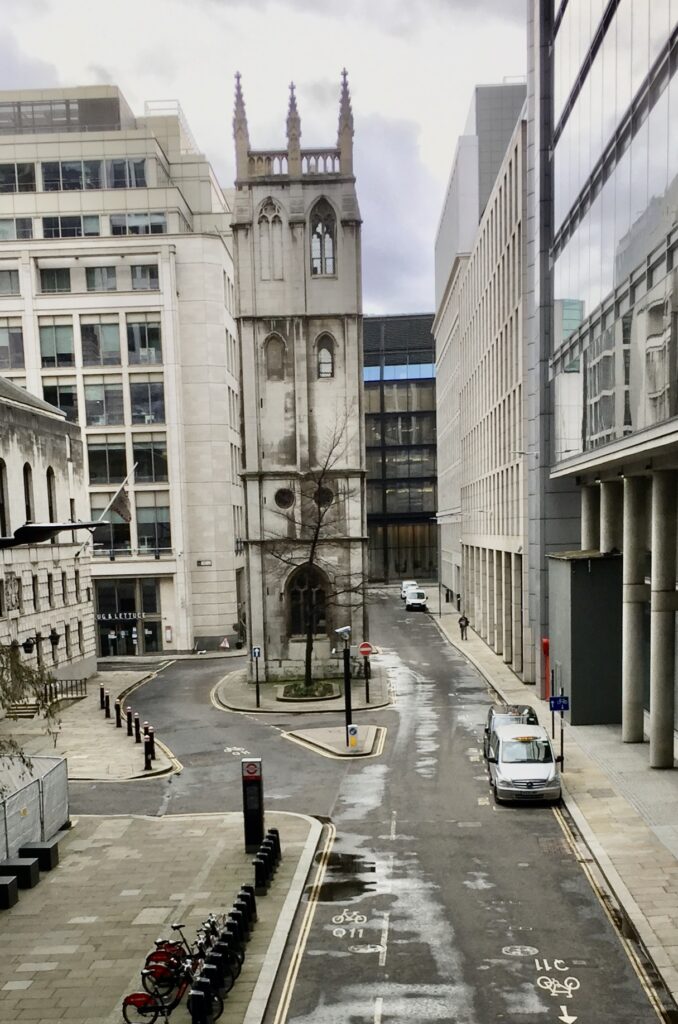
The church was restored in 1858-9 by George Gilbert Scott, who added an apse, and the tower pinnacles were added in the 1890s. It was destroyed on a terrible night, 29 December 1940, when the bombing also claimed another eighteen churches and a number of livery halls. Some of St Alban’s walls survived but they were demolished in 1954 and now nothing remains apart from the tower – not even a little garden to give it some cover from the traffic passing on both sides. I’ve often been told someone lives there but I have never seen any evidence of it.

Here’s the church in its Wood Street setting around 1875 …

And in splendid isolation today …

I think that’s probably enough for the time being. I will return to the ‘then and now’ theme in a future blog. I am indebted to the wonderful little book London’s City Churches by Stephen Millar for the source of much of today’s information. Many thanks also to the Spitalfields Life blog for the old pictures – you can see them and more here.

Finally, some ‘reasons to be cheerful’.

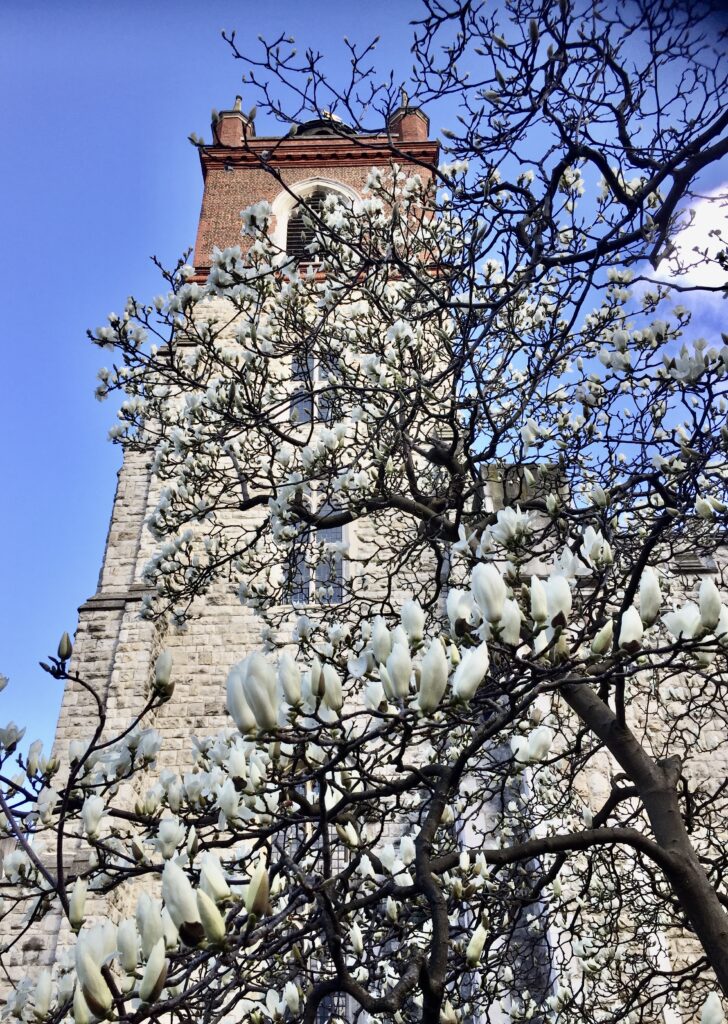
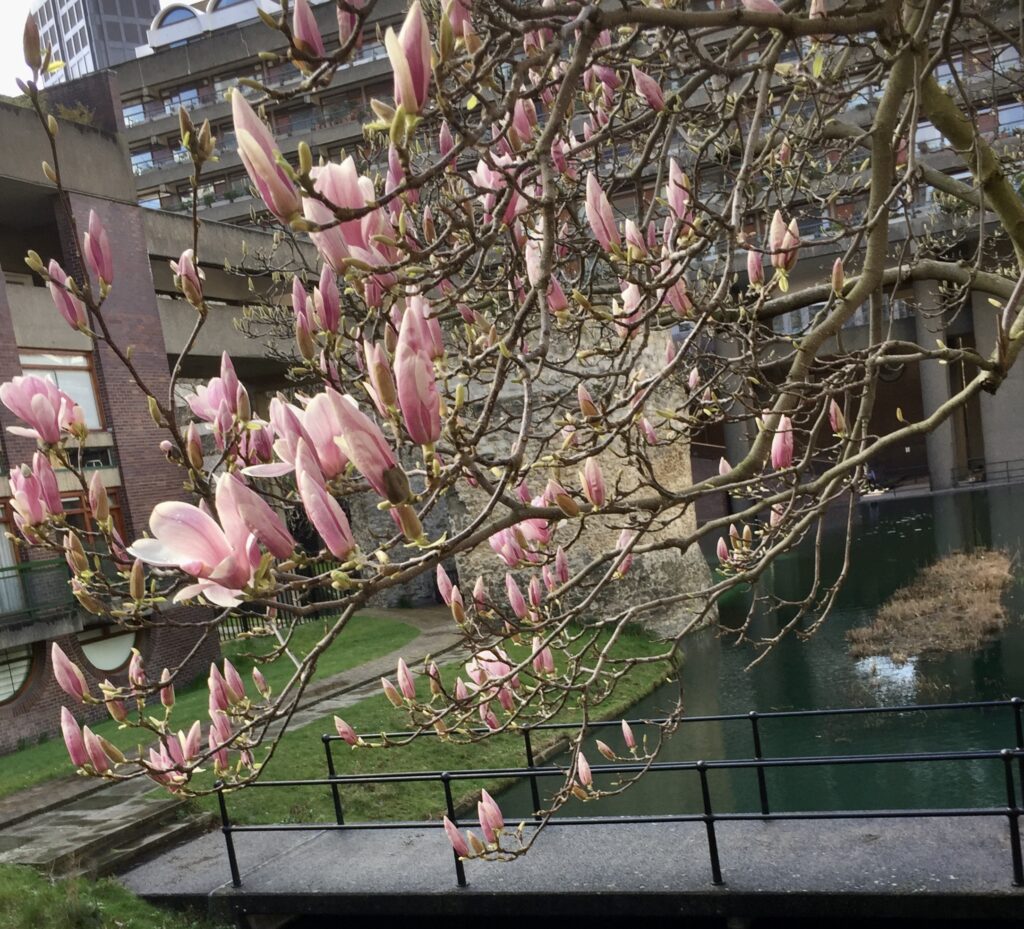
The Magnolia is in bloom at St Giles …

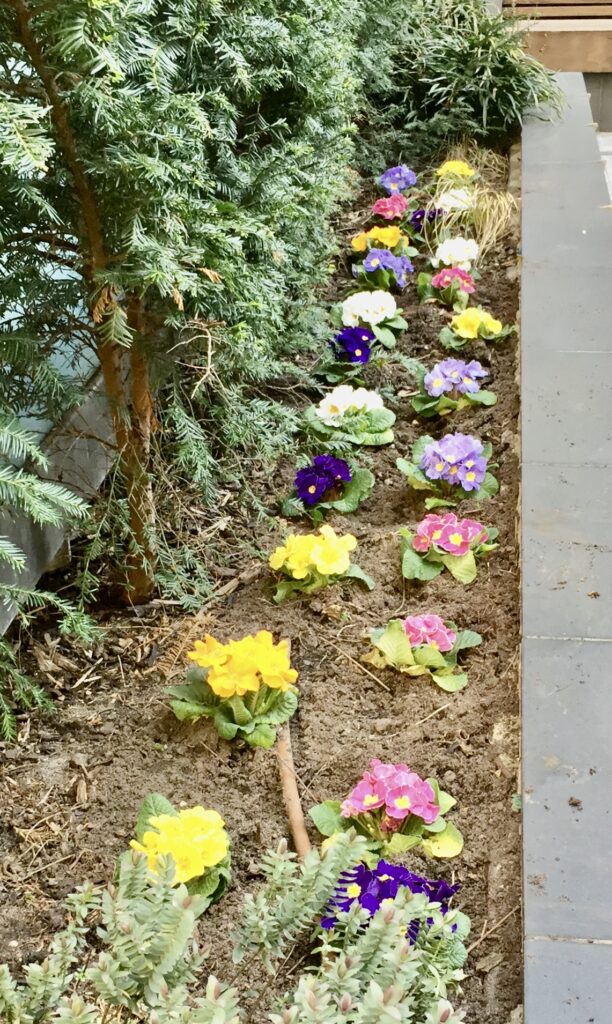
And the wonderful City gardeners have continued to work tirelessly to keep the City looking its best …

If you would like to follow me on Instagram here is the link …
https://www.instagram.com/london_city_gent/

A hair merchant, a weeping statue and a Damien Hirst – my visit to St Bartholomew the Great

You approach the church via the Tudor Gatehouse. It dates from 1595 and was fortuitously revealed when a bomb dropped by a Zeppelin in 1915 tore off later accretions as these ‘before’ and ‘after’ images illustrate …

Much of the late 19th and early 20th century church restoration work was carried out by Sir Aston Webb (1849-1930). His son, Philip, was killed in action on 25th September 1916 and his name appears on the memorial to the right of the entrance …

There is a plaque just behind the gate commemorating Sir Aston Webb’s work. It includes his coat of arms (which incorporates a spider, a playful reference to his name) …

You get a nice view of the flint and Portland Stone western facade of the church from the raised churchyard. An old barrel tomb rests in the foreground …

Bear in mind that the original church was vast and also covered the area now occupied by the graveyard and the path. This used to be the nave, as illustrated in this plan on display in the church …

Stepping into the church seems to transport you to another time and place …

The patchworked exterior gives no hint of the stunning Romanesque interior, with its characteristic round arches and sturdy pillars. It’s a rare sight in London; indeed, this is reckoned to be the best preserved and finest Romanesque church interior in the City.

Just to shock you back into the present, the south transept contains this sculpture …

Entitled Exquisite Pain, as well as his skin St Bartholomew also holds a scalpel in one hand and a pair of scissors in the other. The second surprise, to me anyway, was that this work was by Damien Hirst, the modern artist known particularly for his spot paintings and the shark swimming in formaldehyde. St Bartholomew is the patron saint of Doctors and Surgeons and Hirst has said that this 2006 work ‘acts as a reminder that the strict demarcation between art, religion and science is a relatively recent development and that depictions of Saint Bartholomew were often used by medics to aid in anatomy studies’. He went on to say that the scissors were inspired by Tim Burton’s film ‘Edward Scissorhands’ (1990) to imply that ‘his exposure and pain is seemingly self- inflicted. It’s kind of beautiful yet tragic’. The work is on long-term loan from the artist …

Just behind Hirst’s work is a rare pre-Reformation font (1404) in which William Hogarth was baptised on 28 November 1697 …

I paused at the monument to Edward Cooke who died in 1652 and read the curious rhyme inscribed on it …

Vnsluce yor briny floods, what can yee keepe

Yor eyes from teares, & see the marble weepe

Burst out for shame: or if yee find noe vent

For teares, yet stay, and see the stones relent.

It was known as the ‘weeping statue’ because the moisture in the atmosphere used to be soaked up by the soft marble and miraculously released again as ‘tears’ from time to time. Alas, the Victorians installed a radiator under the monument which put a stop to the moisture releasing properties of the stone and, sadly, it wept no more.

This is the spectacular tomb of Sir Walter and Lady Mary Mildmay. He was the Chancellor of the Exchequer to Queen Elizabeth I and the founder of Emmanuel College, Cambridge. His wife was the sister of the Queen’s ‘spymaster’, Sir Francis Walsingham. Sir Walter died in 1589 and Mary in 1576 …

It’s thought that the tomb does not contain religious figures or Christian symbols because Sir Walter had strong Puritan leanings.

This is the monument to James Rivers who died of the plague in 1641 …

The inscription refers to a disease as malignant as the time referring, no doubt, to the English Civil War. Rivers was a prominent Puritan MP and took his seat in Parliament in 1640.

In a number of places around the church you will find these beautiful sculptures in glass by Sophie Arkette …

They are entitled Colloquy and are etched with literary or poetical text. These are illuminated and distorted by the effects of light (from either candles within the work or from around the building) and water (included within parts of the work).

Under the oriel window there is a nice example of a rebus, in this case a representation of a person’s name using a picture. Here Prior Bolton’s name is neatly implied by a crossbow bolt piercing a tun (a type of cask). Bolton was Prior of St Bartholomew the Great between 1505 and 1532 and carried out repair and construction work across the church …

There is also a version in 16th century stained glass at the eastern end of the church …

I was intrigued by this tombstone in the north transept …

To be buried inside the church indicated that he was a wealthy man and this was no doubt because, in the 18th century, wigs of all varieties were tremendously fashionable. Good hair was seen as a sign of health, youth and beauty and merchants like Mr Thornell often travelled the country looking for supplies (even buying it off the head of those needy enough to sell it).

As I walked down the transept I glanced to my left and glimpsed this reclining figure …

It is of course, the tomb of Prior Rahere, the founder of the Priory and hospital …

He wears the habit of an Augustinian canon and the angel carries a shield with the arms of the priory.

Rahere was a courtier and favourite at the court of Henry I who reigned from 1100 to 1135. After falling dangerously ill whilst on pilgrimage to Rome, Rahere had a vision of St Bartholomew, who told him to found a hospital. He duly got better, and when he returned to London he founded a hospital and an Augustinian priory in 1123 (dedicating them to St Bartholomew to give thanks for his recovery). He was the institution’s first prior and remained in this role until his death in 1144 (the tomb is later and dates from 1405). You can still see some of the original paintwork …

Incidentally, I came across this great 1915 picture of how the tomb was protected during wartime bombing …

There is much more to see in this beautiful place and so I strongly recommend a visit. Entrance is free but the church has been hit hard by the pandemic so, if you can afford it, do make a donation to help support it. Opening times are on the website which you can access here.

If you would like to follow me on Instagram here is the link …
https://www.instagram.com/london_city_gent/

Page 13 of 20

Powered by WordPress & Theme by Anders Norén

Symbols & Secrets
Privacy Overview

This website uses cookies so that we can provide you with the best user experience possible. Cookie information is stored in your browser and performs functions such as recognising you when you return to our website and helping our team to understand which sections of the website you find most interesting and useful.