Walking the City of London

Category: Art Page 28 of 30

Broadgate sculptures (Part 2)

I have visited Broadgate and its sculptures in an earlier blog and I went back again last weekend to photograph some more.

First up is Rush Hour, a patinated bronze by George Segal (1982) situated in the Broadgate Circle (EC2M 2QS) …
We’ve all been there, haven’t we, heads down, not exactly rushing to get to the office. Or maybe just starting the long slog home on a rainy day (knowing there are train cancellations on our line).

Segal was renowned for casting his figures directly from life – usually friends and family – using plaster bandages to create human scale moulds from which his bronze sculptures could be cast. As a result, all the figures have their eyes closed …
This is Cascade in Exchange Square (EC2A 2EH). It was created by Skidmore, Owings and Merrill (whose Chicago office designed much of Broadgate) and Stephen Cox RA (1991) …

‘Energising and restorative, this water cascade creates a natural oasis within Exchange Square. Calmed within the basin, the water develops circles of stillness around the enduring Indian granite stones, placed at measured intervals as if to signify the passage of time. The perfect place to pause and reflect on the day’s events’. Or maybe a place to chill out after a really horrific commute.

On Finsbury Avenue (EC2M 2PA) you will find Bellerophon Taming Pegasus by Jacques Lipchitz (1966) …

A half-size cast of Lipchitz’s final sculpture (which resides in Columbia University, New York), this is a representation of the epic moment in which Greek hero Bellerophon tames the winged horse Pegasus. This tangle seems to balance rather precariously on its pedestal with hooves, wings and tail radiating in all directions. For Lipchitz, this work demonstrated the ultimate dominance of man over nature, stating ‘You observe nature, make conclusions, and from these you make rules’.

On Broadgate Plaza (EC2M 3AB), Ganapathi and Devi (1988) is another work by Stephen Cox. Apart-yet-together, Ganapathi and Devi alludes to sculptural torsos and ancient themes; Devi refers to the female Hindu goddess, while Ganapathi is the Tamil name for Ganesha, the popular elephant god. Fusing power and sensuality, the stones combine historical and contempoary references, from the quarry to the executed forms …

The stone was sourced from the quarries of Mahabalipuram in Tamil Nadu, India …

Peering through the entrance to 155 Bishopsgate I spotted this spectacular piece of art (EC2M 3YD) …

It’s The Mechanics Institute II (1991) by William Tillyer. The notes say: ‘A carefully balanced composition of architecture, cloud, sky and foliage, Tillyer represents the notion of man’s presence via geometric patterns while the contrasting colours suggest the force of natural elements (flashes of warm sun, rushes of air currents, dappled blue light and gentle sea tides)’. The foyer is marketed to movie makers looking for locations as ‘a New York style atrium space’ and it certainly looks the part.

I wandered away from Broadgate, a hundred yards or so north up Bishopsgate, and came across Principal Place (EC2A 2BA) along with this interesting work entitled In Anticipation by James Burke (2018). Do have a look at the website.

Meanwhile, back in Broadgate, Venus still gazes skywards …

Read more about her and other sculptures here.

Fun and Miscellany – my 100th blog!

Thank you so much for subscribing to my little publication – especially those of you who have been with me since the very beginning almost two years ago.

For the first anniversary I included things that I had come across that had made me smile and I want to do that again this week. I want as well, however, to include a few items that I thought were interesting but didn’t fit under any broad heading.

One of the great pleasures of doing research is the occasional joy of serendipity. I recently discovered that encouraging people to cycle to work is nothing new and magazines were being published almost 40 years ago which included maps to help cyclists navigate.

I came across this persuasive cover of On your bike! magazine from 1982 …

And now something a bit more surreal, a piece of art that was on display at the Guildhall art Gallery until a few weeks ago …

Marcello Pecchioli’s eye-catching stained glass Alien Priest was part of the Gallery’s ‘Visionary Artists’ exhibition. I like the flying saucers in the background.

Next up is this picture in the Gallery entitled Garden of Eden by Hugh Goldwin Riviere (1860-1956). Painted in 1901, it depicts a young man and girl walking in a misty, wet park with a horse-drawn cab rank in the background.

I like it because to me it’s one of those pictures that immediately gets you making up a back story to the characters. Surely this is an assignation – a secret lovers meeting, he clasping her hand and she gazing lovingly into his face. Then it struck me: Garden of Eden! A place of dangerous temptation and banishment!

Apparently guides point out that this picture is actually about a mismatch between a wealthy woman who has fallen for a man much below her station: note his clumpy shoes, lack of gloves and his rolled up trouser bottoms. Also the way he’s carrying not one but two umbrellas, intertwined like the two lovers. There are tiny raindrops hanging from the black branches. Surely they represent tears to come? Or am I getting completely carried away? Another commentator has said that she is simply a smartly dressed maidservant on her day off, out walking with her beau.

In Cullum Street I was stopped in my tracks by this stunning sculpture by Sarah Lucas entitled Perceval

Part of the ‘Sculpture in the City’ initiative – EC3M 7JJ

It’s a large-scale replica of a traditional china ornament of the kind that took pride of place on many British mantelpieces forty years ago. Perceval was a knight of the Round Table and apparently there is fertility symbolism in the giant concrete marrows on the cart. You can read more about this work here.

Also for us to admire as part of the Sculpture in the City project is this example entitled Crocodylius Philodendrus by Nancy Rubins at 1 Undershaft (EC3A 6HX). I love it because it’s completely bonkers …

See how many animals you can spot

I keep meaning to spend some time in the Blackfriar pub on Queen Victoria Street recording the brilliant brasses there (EC4V 4EG) but I still haven’t got around to it. So in the meantime, here is the advice on one of them …

‘Don‘t advertise – tell a gossip

Don’t forget to look down when crossing the Millennium (‘Wobbly’) Bridge and see if you can spot some of the witty work by the artist Ben Wilson. He has painstakingly painted literally dozens of pieces of discarded chewing gum …

I have written more about him in my earlier blog Tales from City Bridges.

There is a Banksy rat painting in Chiswell Street that has been altered by another artist. Banksy’s piece originally depicted a stencilled ghetto rat holding a placard which read ‘London doesn’t work’ …

Photograph taken by ‘Noodlefish’ 26 August 2006

However, Robbo, Banksy’s rival graffiti artist, reworked the placard by adding his name in red letters. Robbo was known for leaving his mark on many Banksy pieces but I read in the interesting Londonist blog that Robbo died in 2014, bringing the rivalry to an end.

I haven’t been able to find out more about the strange ‘Life is beautiful’ figure next to it.

It is hard to imagine now but many of London’s roads were once paved with wood. However a map of London by Bartholomew’s in 1928 shows clearly the expansive reach of the wooden block road paving method. In the map excerpt below, the yellow roads are all paved with wooden blocks …

Read more in the excellent blog ‘Ian Visits’

Many were destroyed in wartime bombing and many also dug up by local residents for burning as heating. Since they were impregnated with tar they burnt furiously and, of course, made a major contribution to London’s filthy air.

For some people this was an entrepreneurial opportunity. This is Alan Sugar being interviewed for the Daily Express in 2010 about when he noticed old blocks being uncovered when roads were being resurfaced …

The workers showed me the blocks, which were impregnated with tar, and they chucked a couple onto the fire – they burned like a rocket. Bingo! It occurred to me that these discarded wooden blocks could be made into fire-lighting sticks. I could cut them up into bundles of sticks and flog them.

And you can still see a section of wooden road today at the junction of Chequer Street and Bunhill Row EC1 …

Looking over the wall on the Embankment one day I noticed these lions heads with mooring rings …

They were sculpted by Timothy Butler for Bazalgette’s great sewage works in 1868-70 and it is said that, if the lions drink, London will flood.

And to end with, two more items with watery themes that make me smile.

Firstly, a famous satire on the quality of the Metropolitan water supply in 1828. An elderly lady displays her horror and shock on looking at a speck of Thames water through a microscope …

Copyright: British museum

It’s by the artist and caricaturist William Heath (1795-1840) and is entitled Monster Soup commonly called Thames Water being a correct representation of that precious stuff doled out to us! You can read more about the efforts made to get fresh water to Londoners in my blog Philanthropic Fountains.

And finally I always say hello to this miserable dolphin on The Ship pub in Hart Street (EC3R 7NB). I also tell him to cheer up – the pub is a listed building and therefore so is he …

Thanks again for subscribing!

City of London – Then and Now

In some respects, parts of the City of today look remarkably like they did decades ago whilst others are changed almost beyond recognition.

I shall start with the entrance to the Guildhall as painted in 1905 and attributed to William Luker Junior (1867-1947). I like the intimate family group with the little girl glancing back at the authentic flapping pigeons …

I felt I just had to write a few words about the painter.

The son of a famous artist who fell on hard times, young William (‘Willie’ to his doting mother) caused consternation when, in 1888 at the age of 21, he made a family servant pregnant. He did the honourable thing and married her, albeit secretly, which caused even more anguish to his poor mum. Records of the period show his new wife to be Margaret Stadowicka, a Polish immigrant eight years his senior. The greater responsibility seems to have prompted him to mature quickly as an artist and he became a very successful painter of animals.

This is the Guildhall entrance today …

The view from Fleet Street to St Paul’s Cathedral was slightly improved by the removal in 1990 of the London Chatham & Dover Railway bridge that used to span Ludgate Hill. Here is the view at the turn of the last century …

This view (from Gillian Tindall’s book A Tunnel Through Time) shows the railway bridge in more detail …

And here is a more recent image. The bridge may have gone but modern buildings do intrude …

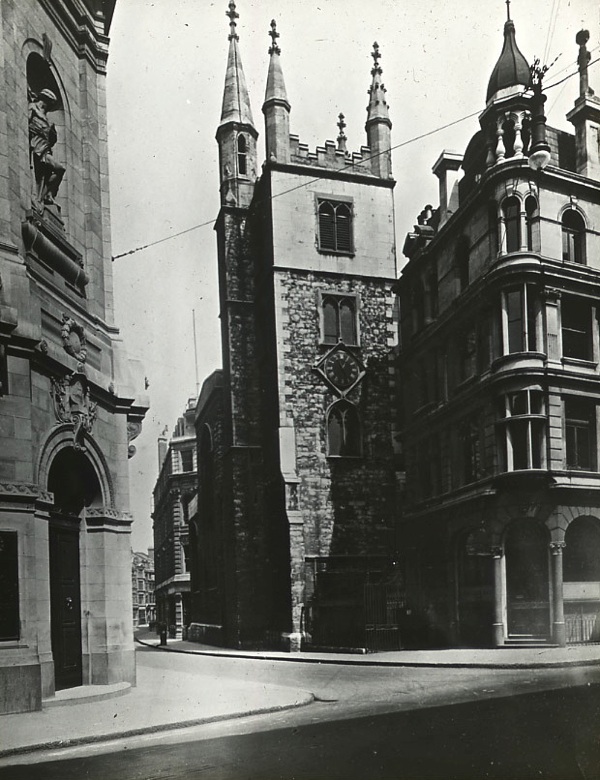
This is a photograph of the Wren church of St Alban Wood Street circa 1875 …

Picture taken for the London & Middlesex Archaeological Society and now held at the Bishopsgate Institute.

And here is the view today. Only the church tower remains as the area was devastated by Second World War bombing …

The name Cheapside comes from the old English term for a market (ceapan – ‘to buy’) and the a street with this name was here long before the Great Fire of 1666. Here is a picture taken around 1890 looking east when there were about 11,000 hansom cabs and 500 horse-drawn buses in London. By 1910 they had all virtually disappeared to be replaced by taxis and motor buses …

Picture taken for the London & Middlesex Archaeological Society and now held at the Bishopsgate Institute.

And here is a view from about the same point taken in May 2019 …

Apart from the tower of St Mary-le-Bow, the south side of Cheapside has changed dramatically with the construction of the office and retail space One New Change. On the north side at the junction with Wood Street, however, stands a little treasure …

The shop on the corner in an anonymous drawing from the 1860s

The rebuilding of the City after the Great Fire took over forty years, but the little shop on Cheapside, along with its three neighbours to the west, were some of the earliest new structures to be built as the City recovered. The site is small and each of the shops in the row consists of a single storey above and a box front below.

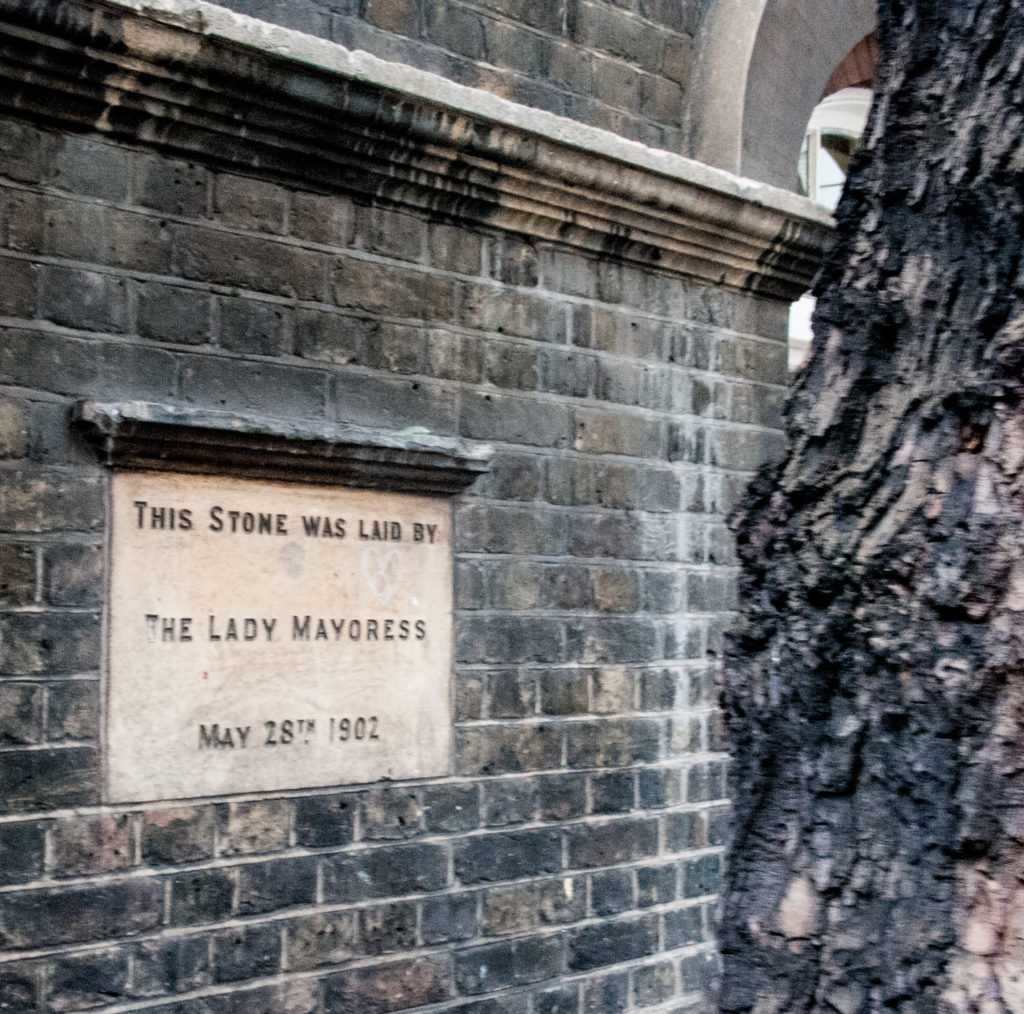
The plaque in the churchyard attached to the Cheapside shop’s northern wall confirms the age of the building …

This is how the corner looks today …

Copyright Katie at ‘Look up London’

You can read lots more about the little shop and its fascinating immediate surroundings in my earlier blog: A Shop, a Tree and a Poem. And even more here: Hidden Gems.

Some of Fleet Street has hardly changed at all. Here is a view of St Dunstan-in -the-West around 1910 …

Picture taken for the London & Middlesex Archaeological Society and held at the Bishopsgate Institute

And here is a picture taken in May this year. Some of the Journals changed their names – the Dundee Advertiser becoming the Dundee Courier and the Sunday Hours becoming the Sunday Post. The Post has now become famous as the last newspaper to leave Fleet Street. They turned off the lights for the final time on 5th August 2016.

I came across this fascinating picture whilst doing my research. It was published in 1975 in the book The City at War by Ian Grant and Nicholas Maddren. Looking west along Fleet Street towards the Strand, it was taken in 1944 and shows the smoke arising in the distance from a recent hit by a V2 rocket …

The caption in the book reads: ‘Passengers getting off the bus hardly break their stride’.

And finally, I am publishing again this painting by Harold Workman now on display at the Guildhall Art Gallery and entitled Chaos on London Bridge. It was probably painted some time in the 1930s or 1940s …

And here is a picture I found of London Bridge circa 1870 …

Taken from a stereocard in the B E C Howarth-Loomes Collection [Ref BB83/05717B]

I think London Bridge and its history might be worth a blog on its own and I shall explore this idea.

You can find more great ‘Then and Now’ pictures (including some of the above) here on the Spitalfields Life blog.

Page 28 of 30

Powered by WordPress & Theme by Anders Norén

Symbols & Secrets
Privacy Overview

This website uses cookies so that we can provide you with the best user experience possible. Cookie information is stored in your browser and performs functions such as recognising you when you return to our website and helping our team to understand which sections of the website you find most interesting and useful.