Although born in Stratford-upon-Avon, Shakespeare spent much of his working life in London and I’ve been searching for any traces of his time here that might still exist.
My interest was prompted by my chance visit to the site of the now-disappeared church of St Olave Silver Street (EC2V 7EE) …

There is a little font-like pool that I rather liked …

A 1540 Act of Parliament was most concerned with the professionalisation of surgeons, granting their Livery Company four bodies of executed criminals from Tyburn each year for the purpose of dissection for anatomical teaching. St Olave’s churchyard was notable as the place where the bodies of those dissected at the nearby Barber-Surgeons Hall would be buried.
There are three interesting plaques. This one displays a skull and crossbones and reads as follows: This was the parish church of St. Olave Silver Street, destroyed by the dreadfull fire in the year 1666 …

This one commemorates a road widening and reads: St. Olave’s Silver Street. This churchyard was thrown back and the road widened eight feet by the Commissioners of Sewers at the request of the Vestry Anno Dommini 1865. H.J. Cummings – Rector, F.A. Harris & C.E. Wilson – church wardens …

But this is the plaque that really caught my eye …

In May and June 1612, Shakespeare was a witness in a legal dispute involving the Mountjoys and the case has become famous because the legal documents contain his signature. Only six examples of his signature have so far been discovered and some of these are disputed. Here they are:

For more details on the Mountjoy case, have a look at the excellent London Inheritance blog which you will find here. For an academic discussion about the signatures’ authenticity (or otherwise) I refer you to the article entitled Six Shaky Signatures: What’s the Proof That Shakespeare Wrote Them? which you will find here in the Shakespeare Oxford Fellowship Newsletter of February 24th 2023.
The area around the old churchyard was utterly devastated in the Blitz. Here’s what it looks like now from the north side of London Wall …

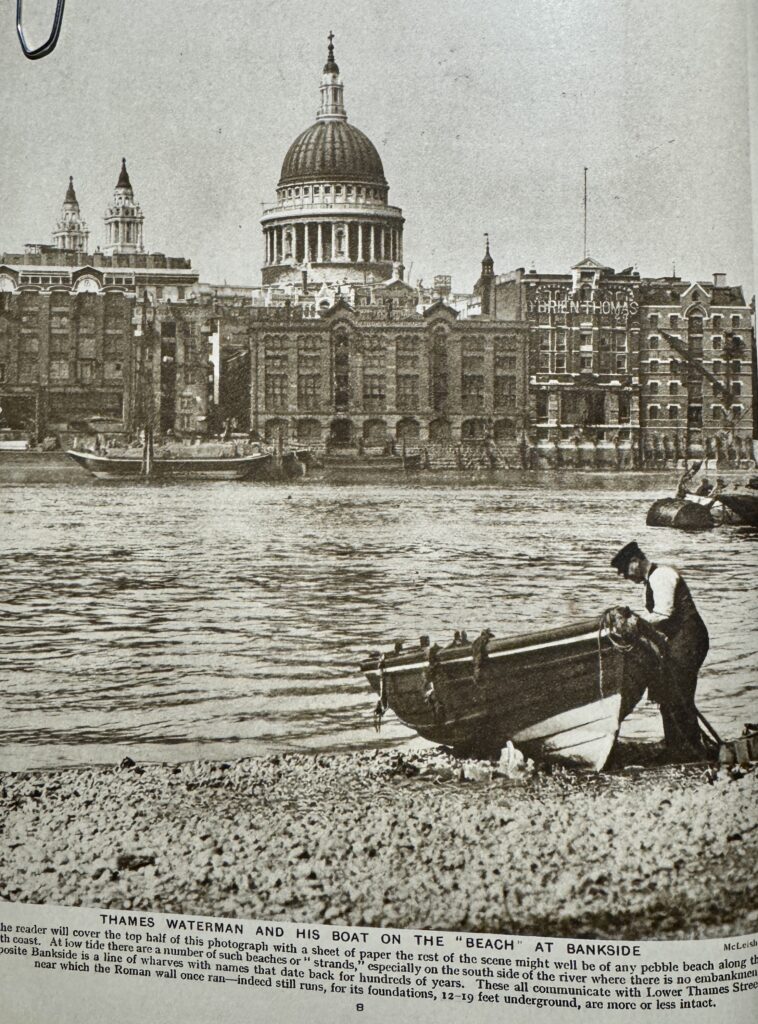
And here’s what it looked like in the 1920s (an image from my latest treasured old book Wonderful London) …

Mountjoy’s house was on the corner of Silver Street and Monkwell Street – two streets that disappeared during the rebuilding of the area following the bombing of the last war. Here’s an image of The Coopers Arms – Silver Street to the right, Monkwell Street disappearing to the left. The road called London Wall now runs through this scene …

In nearby Noble Street, some remains of buildings destroyed in the war have been preserved – the St Olave garden is at the end of this road on the right …


Still on the subject of Shakespeare signatures, on 10 March 1613 he bought the Old Priory Gatehouse from Henry Walker ‘citizen and minstrel (musician)’ for £140. The deed for purchase with his signature still exists and the property is particularly significant because it is the only property he is known to have owned in London. Given its convenient proximity to the Blackfriars Playhouse and The Globe, Shakespeare may have intended to make it his home, yet no evidence suggests he lived here in the three years prior to his death in 1616.
The mortgage deed bearing his signature …

The Cockpit pub marks the approximate site of the Gatehouse …

I once owned a flat in the building on the right overlooking the pub so it truly was my ‘local’. It’s a terrific, authentic old-fashioned boozer designed inside to make reference to the popular medieval sport of cockfighting, with a gallery looking down on the ‘pit’. It is still great, check out the reviews on Tripadvisor …

Those were the days …

The Cockpit, by William Hogarth, November 1759.
Shakespeare’s Blackfriars Playhouse stood in Playhouse Yard …

The Playhouse is regarded as one of the most important sites in English Theatre History. Richard Burbage formed a syndicate with Shakespeare, Henry Condell and John Heminge, among others, and together they purchased the Playhouse in 1608. It is widely believed that The Winter’s Tale and Cymbeline were written with the Blackfriars Playhouse in mind. There’s more about Messrs Condell and Heminge later in this blog.
Blackfriars Priory was one of the most magnificent religious institutions in Medieval London. Henry VIII dissolved the monastery in 1538 and many of its buildings were pulled down or converted into expensive residential apartments. It’s rather sad, isn’t it, that these few bits of stone tucked away in an old churchyard in Ireland Yard are seemingly all that remain of the great priory itself …

However, if you feel bold enough to venture out of the City, do visit St Dominic’s Priory Church in Belsize Park (NW5 4LB), one of the largest Catholic churches in England. Tucked away in the north west corner of the nave you will find this pillar next to a representation of St George slaying the dragon …
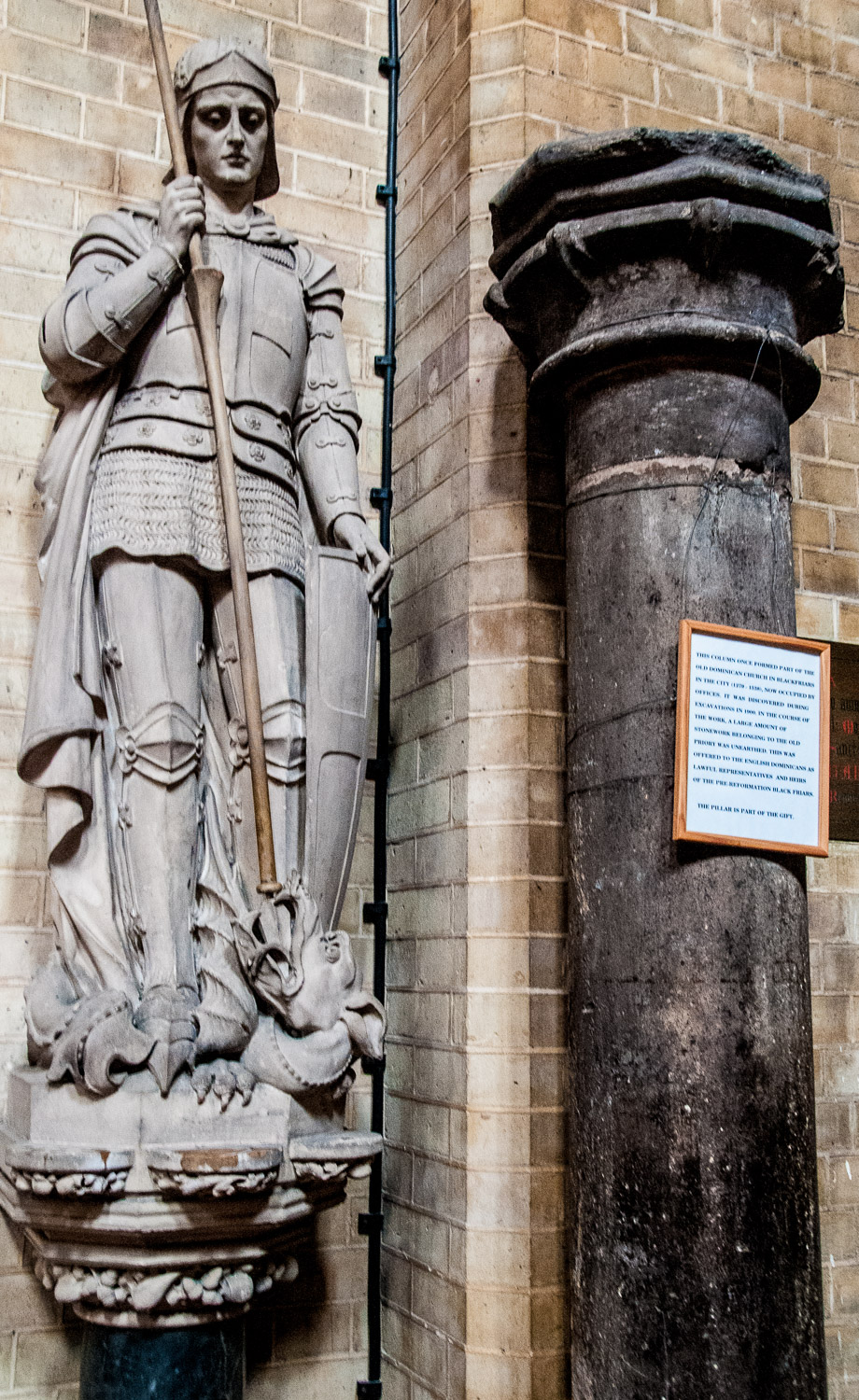
The notice attached to it tells its story …
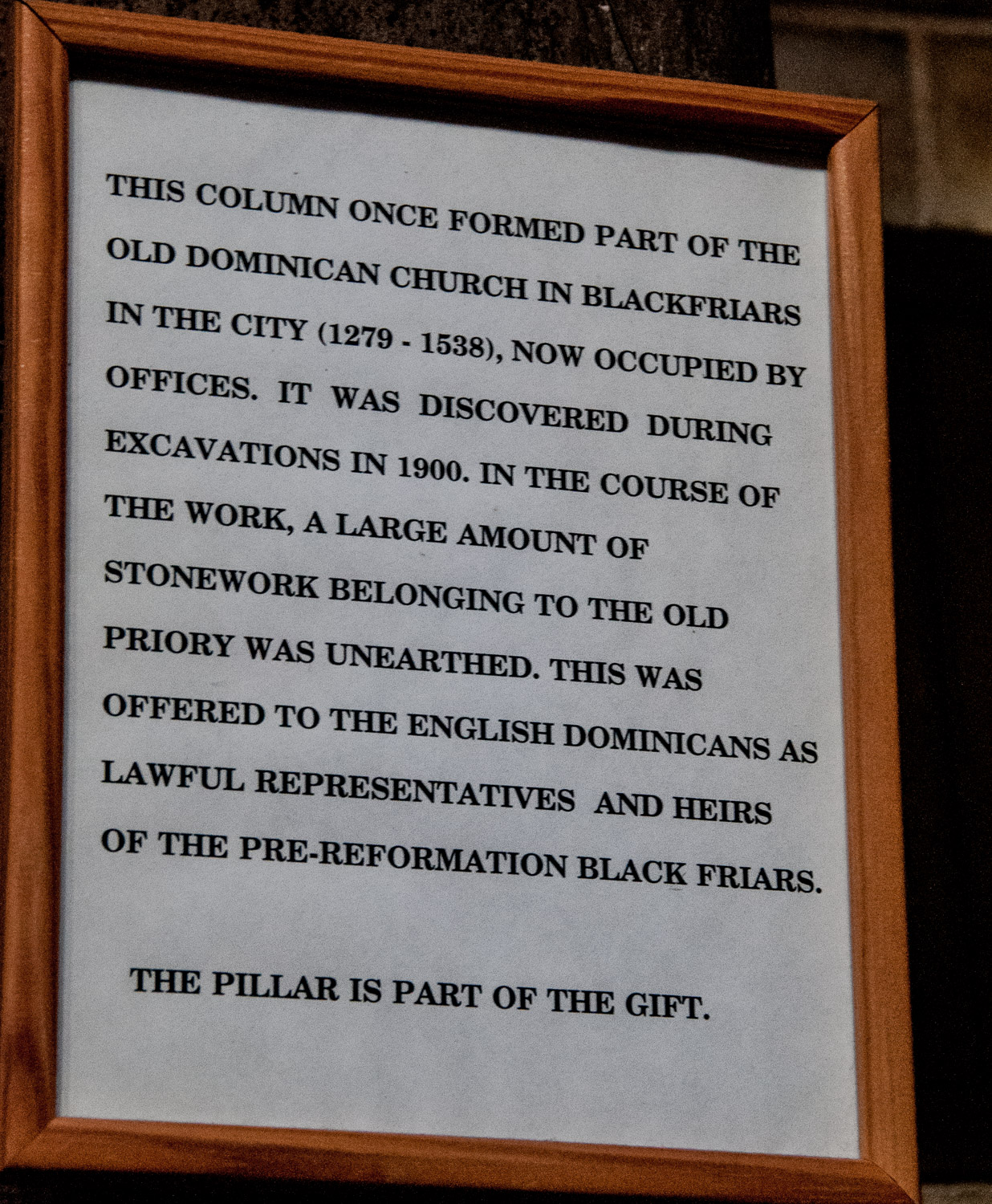
Today the alley called Church Entry stands on the site of the entrance to the priory which was traditionally under the tower of the church. The view looking north up Church Entry …


As the notice says, the churchyard was closed for burials in 1849. You can see how full it was by the difference in height between the churchyard and the footpath …

On 2 February 1602, the first recorded performance of Twelfth Night took place in Middle Temple Hall. Sadly the Hall was severely damaged in the blitz as illustrated in this painting by Frank E. Beresford entitled Armistice Day 1940 …

Before the bombing …


The Hall today …

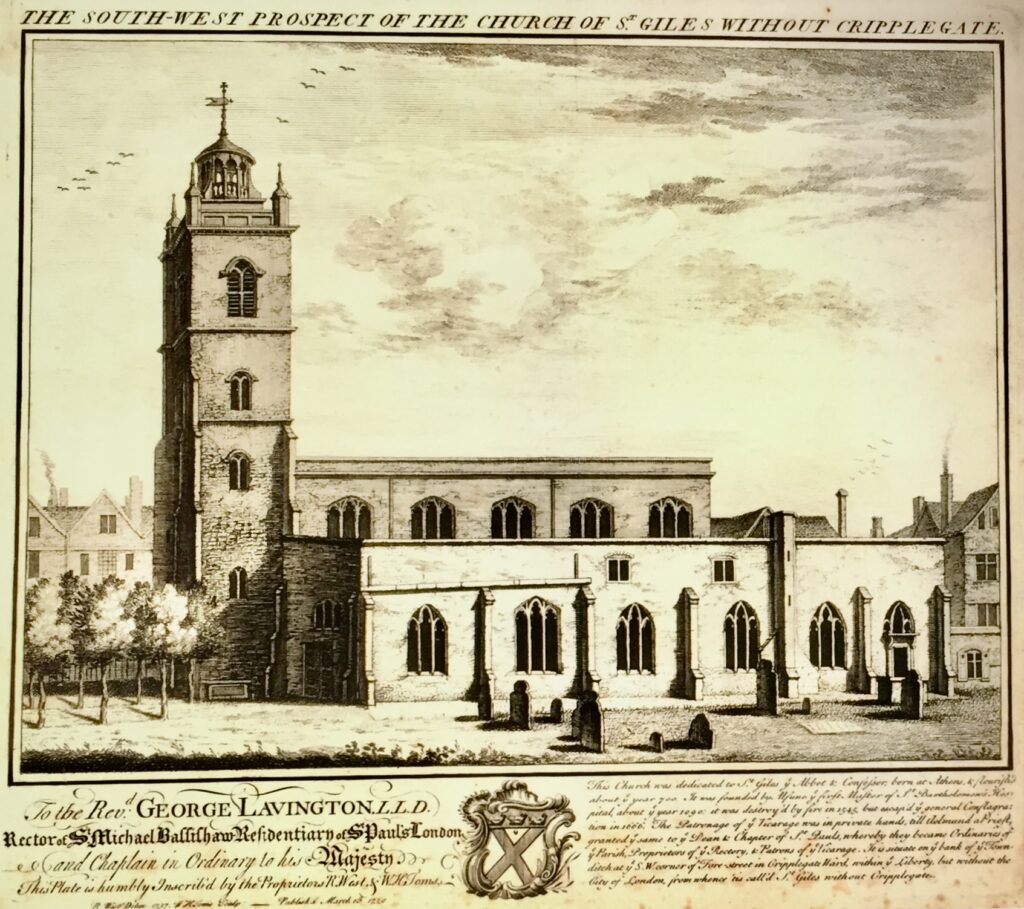
St Giles without Cripplegate survived the Great Fire and it is here where Edward, Shakespeare’s nephew and the illegitimate son of his brother Edmund, was buried in 1607.
Here it is in 1739 in a picture from the British Museum archive described as: View of the church from the graveyard; one of the churches to escape the Great Fire. 1739. Etching and engraving …
The church today …

The Fortune Playhouse once stood in the St Giles parish. In 1600 an Elizabethan entrepreneur, Philip Henslowe, and his leading actor, Edward Alleyn, decided to build a new outdoor Playhouse to the north of the river near Whitecross Street. Although square in shape, the Playhouse was otherwise modelled on the polygonal Globe and built by the same carpenter, Peter Street …

Reconstruction of the theatre, drawn by Walter Godfrey in 1911 based on the builder’s contract …

There is a commemorative plaque in Fortune Street, just off Whitecross Street …

On the north wall of the church is this splendid memorial window …

The design is the work of John Lawson of stained glass studio Goddard & Gibbs and depicts Alleyn in the centre, the Fortune Theatre and St Luke’s Church, Old Street. He holds in his right hand a model of the almshouses which he built in the parish and which were destroyed in the Second World War.
Now to the St Mary Aldermanbury garden (EC2P 2NQ) …
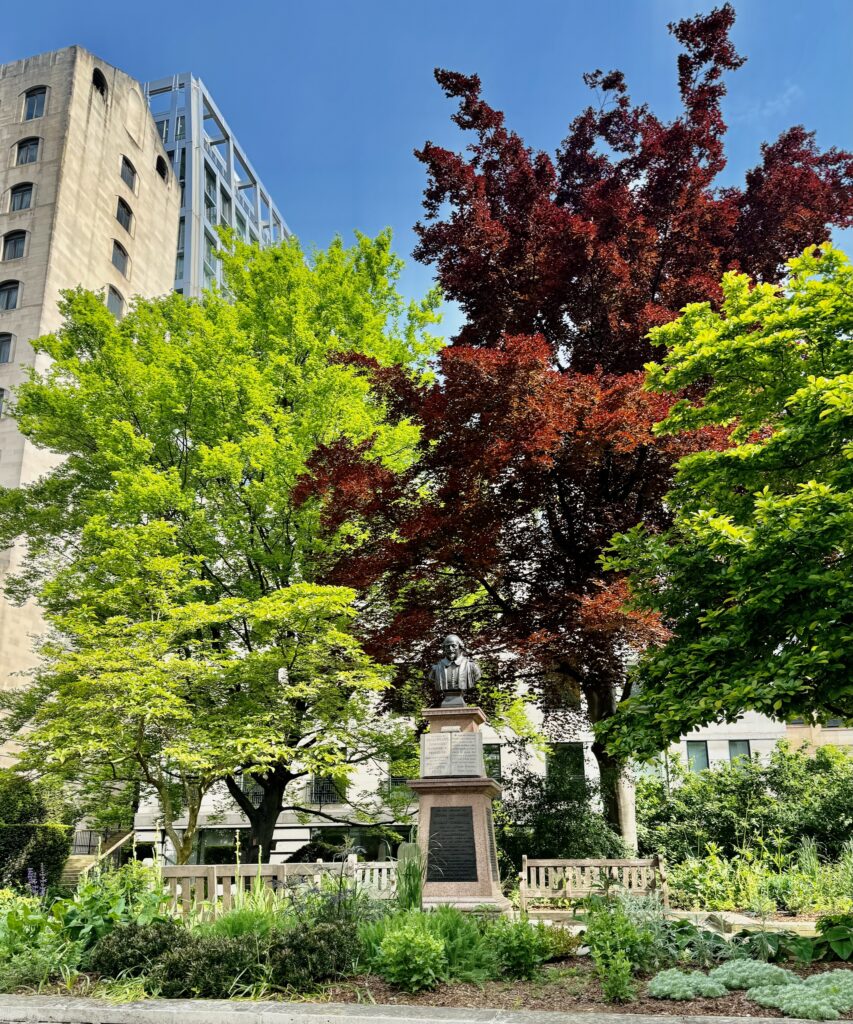
Constructed in 1896, this pink granite monument stands within the former churchyard of St Mary Aldermanbury. Its primary purpose is to honour the First Folio of Shakespeare’s plays, but it also serves as a tribute to Henry Condell and John Heminge, two associates of the Bard who worked with him at the Globe …
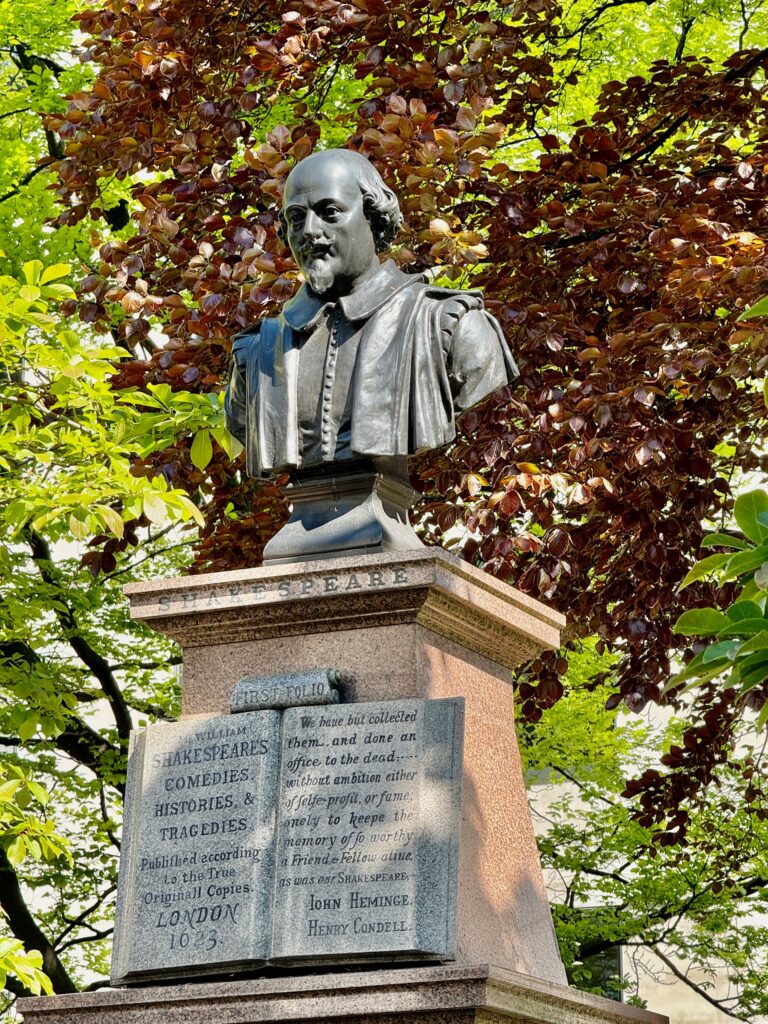
They played a cucial role in compiling and printing the First Folio after his death in 1616 …
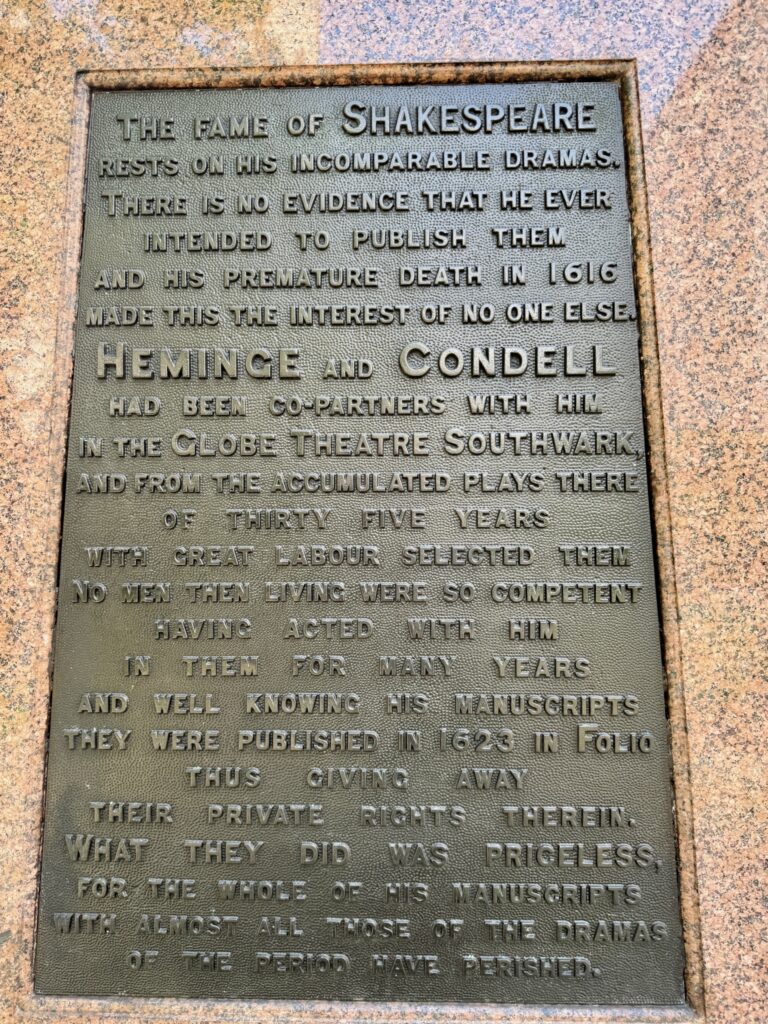
Both lived nearby and were buried in this churchyard …
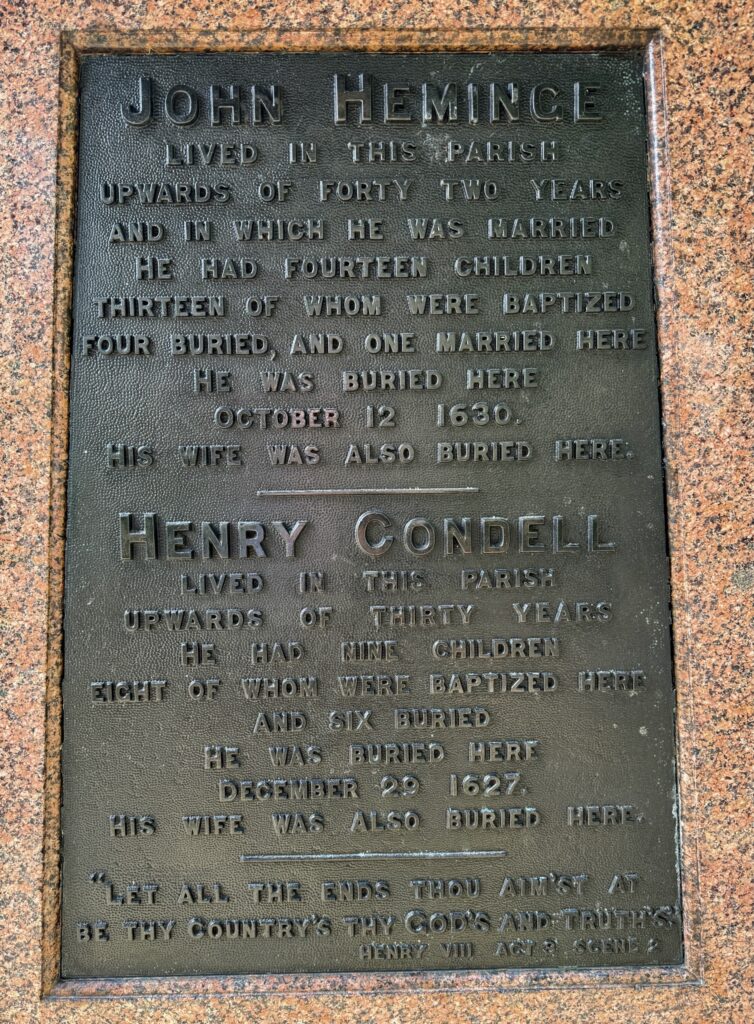
The church was gutted in the Blitz with only the walls remaining standing. The stones were subsequently transported to Fulton, Missouri in 1966 and rebuilt in the grounds of Westminster College as a memorial to Winston Churchill who had made his Sinews of Peace, “Iron Curtain” speech in the College gymnasium in 1946.
Finally, to Eascheap and this masterpiece of a building at numbers 33-35. Designed by R L Roumieu and built 1868, today the facade is grade II* listed …

Pevsner describes it as ‘one of the maddest displays in London of gabled Gothic’ and he quotes from Ian Nairn – architectural critic – who calls it ‘the scream that you wake on at the end of a nightmare’.
Look out for the boar’s head peeping out from the foliage …

The animal is a reference to The Boar’s Head Tavern in Eastcheap where Shakespeare set the meetings of Sir John Falstaff and Prince Hal in his Henry IV plays. And see if you can spot the medieval head representing the Prince …

If you want to explore Shakespeare’s London more fully you will find this City of London self-guided walk brilliant and comprehensive (much of this blog is based on it!)
If you would like to read more about the Medieval City Monasteries you can access my blog on the subject here. Similarly, here is my blog about St Giles without Cripplegate. An interesting history of St Olave Silver Street can be found on the Lost London Churches Project website.
If you would like to follow me on Instagram here is the link …