Walking the City of London

Category: Sculpture Page 36 of 41

Broadgate sculpture (and a rusty nail near St Paul’s)

I always find it a bit weird when I see a building being demolished that I remember being built in the first place – especially when it was deemed at the time to be the epitome of modern design. This is what is happening to the Broadgate development at the moment, and when I went to look at progress I thought I would take the opportunity to photograph the nearby sculptures.

I would like to start with my favourite, Barry Flanagan’s Leaping Hare on Crescent Bell (2008) which can be found in the Broadgate Circle (EC2M 2QS) …

The base which contains the bell was difficult to photograph the day I went (intrusive fast food vans) but the magnificent soaring hare is flying free above the distractions. Exuberance and playfulness are features of much of Flanagan’s work but sadly he passed away due to motor neurone disease in 2009 at the age of 68.

Here is another example of his work at the National Gallery of Art in Washington DC. Entitled Thinker on a Rock it substitutes a hare for Rodin’s Thinker. The picture is from the Artcurious blog …

You can’t miss the Broadgate Venus in nearby Exchange Square (EC2A 2EH) …

Patinated bronze by Fernando Botero (1989)

The note on the sculpture website tells us she was ‘specially commissioned for Broadgate. At five tonnes, she is one of Botero’s most voluptuous pieces and her generous curves have made her a long-standing favourite across the neighbourhood. She’s all-encompassing love personified’. I wouldn’t argue with that.

Living in the Appold Street entrance to Exchange Square are The Broad Family

Basalt stone sculpture by the Catalan sculptor Xavier Corberó (1935-2017)

Notes on the work say that if you look at it long enough the abstract forms slowly-but-surely evolve into a family portrait. Having done this, I can confirm it’s true – there are parents, a child, the family dog and a ball. And two highly polished shoes can be seen peeking out from under the child’s clothes …

More detail from one of the faces …

In nearby Sun Street (EC3M 2PA) is David Batchelor’s Chromorama

This 20-metre stack of 35 steel boxes faces in all directions and acts as a beacon at the intersection of several streets and pedestrian pathways. It’s also very pretty when illuminated at night.

Out on Bishopsgate is the eye-catching EYE-1 …

Sculptor Bruce MacLean – Painted steel (1993)

Just like The Broad Family, MacLean’s work rewards you if you look long enough at it. You will begin to see the outline of a female face.

There is more sculpture to see in and around Broadgate and I shall return to write about it in a future blog.

In the meantime, next time you are walking through One New Change look towards St Paul’s Cathedral and then take some time to check out this extraordinary work …

Unsurprisingly the work is entitled ‘Nail’

Both comic and provocative, Nail is a 40 foot bronze sculpture, treated as the title implies, to appear like a giant rusty nail. On the one hand, it’s a nostalgic recollection of tools traditionally used by the construction industry. On the other, the rustiness, underscores the uselessness of this once useful object.

The artist, Gavin Turk, has been described as a ‘maverick’ and first gained some notoriety when he failed his MA having offered as his exhibition an English Heritage style blue plaque which read ‘Gavin Turk, sculptor, worked here’.

Of Nail he said …

Partly it’s a tribute to a tiny tool in a development that probably contains no nails at all, but it pins the bottom of the building down to the pavement. Also, I didn’t want to spoil the view and stop sightlines through to the cathedral. And it brings to mind Christ on the cross.

You can read a very interesting interview with the artist in which he discusses Nail here on his website.

Fun and Miscellany – my 100th blog!

Thank you so much for subscribing to my little publication – especially those of you who have been with me since the very beginning almost two years ago.

For the first anniversary I included things that I had come across that had made me smile and I want to do that again this week. I want as well, however, to include a few items that I thought were interesting but didn’t fit under any broad heading.

One of the great pleasures of doing research is the occasional joy of serendipity. I recently discovered that encouraging people to cycle to work is nothing new and magazines were being published almost 40 years ago which included maps to help cyclists navigate.

I came across this persuasive cover of On your bike! magazine from 1982 …

And now something a bit more surreal, a piece of art that was on display at the Guildhall art Gallery until a few weeks ago …

Marcello Pecchioli’s eye-catching stained glass Alien Priest was part of the Gallery’s ‘Visionary Artists’ exhibition. I like the flying saucers in the background.

Next up is this picture in the Gallery entitled Garden of Eden by Hugh Goldwin Riviere (1860-1956). Painted in 1901, it depicts a young man and girl walking in a misty, wet park with a horse-drawn cab rank in the background.

I like it because to me it’s one of those pictures that immediately gets you making up a back story to the characters. Surely this is an assignation – a secret lovers meeting, he clasping her hand and she gazing lovingly into his face. Then it struck me: Garden of Eden! A place of dangerous temptation and banishment!

Apparently guides point out that this picture is actually about a mismatch between a wealthy woman who has fallen for a man much below her station: note his clumpy shoes, lack of gloves and his rolled up trouser bottoms. Also the way he’s carrying not one but two umbrellas, intertwined like the two lovers. There are tiny raindrops hanging from the black branches. Surely they represent tears to come? Or am I getting completely carried away? Another commentator has said that she is simply a smartly dressed maidservant on her day off, out walking with her beau.

In Cullum Street I was stopped in my tracks by this stunning sculpture by Sarah Lucas entitled Perceval

Part of the ‘Sculpture in the City’ initiative – EC3M 7JJ

It’s a large-scale replica of a traditional china ornament of the kind that took pride of place on many British mantelpieces forty years ago. Perceval was a knight of the Round Table and apparently there is fertility symbolism in the giant concrete marrows on the cart. You can read more about this work here.

Also for us to admire as part of the Sculpture in the City project is this example entitled Crocodylius Philodendrus by Nancy Rubins at 1 Undershaft (EC3A 6HX). I love it because it’s completely bonkers …

See how many animals you can spot

I keep meaning to spend some time in the Blackfriar pub on Queen Victoria Street recording the brilliant brasses there (EC4V 4EG) but I still haven’t got around to it. So in the meantime, here is the advice on one of them …

‘Don‘t advertise – tell a gossip

Don’t forget to look down when crossing the Millennium (‘Wobbly’) Bridge and see if you can spot some of the witty work by the artist Ben Wilson. He has painstakingly painted literally dozens of pieces of discarded chewing gum …

I have written more about him in my earlier blog Tales from City Bridges.

There is a Banksy rat painting in Chiswell Street that has been altered by another artist. Banksy’s piece originally depicted a stencilled ghetto rat holding a placard which read ‘London doesn’t work’ …

Photograph taken by ‘Noodlefish’ 26 August 2006

However, Robbo, Banksy’s rival graffiti artist, reworked the placard by adding his name in red letters. Robbo was known for leaving his mark on many Banksy pieces but I read in the interesting Londonist blog that Robbo died in 2014, bringing the rivalry to an end.

I haven’t been able to find out more about the strange ‘Life is beautiful’ figure next to it.

It is hard to imagine now but many of London’s roads were once paved with wood. However a map of London by Bartholomew’s in 1928 shows clearly the expansive reach of the wooden block road paving method. In the map excerpt below, the yellow roads are all paved with wooden blocks …

Read more in the excellent blog ‘Ian Visits’

Many were destroyed in wartime bombing and many also dug up by local residents for burning as heating. Since they were impregnated with tar they burnt furiously and, of course, made a major contribution to London’s filthy air.

For some people this was an entrepreneurial opportunity. This is Alan Sugar being interviewed for the Daily Express in 2010 about when he noticed old blocks being uncovered when roads were being resurfaced …

The workers showed me the blocks, which were impregnated with tar, and they chucked a couple onto the fire – they burned like a rocket. Bingo! It occurred to me that these discarded wooden blocks could be made into fire-lighting sticks. I could cut them up into bundles of sticks and flog them.

And you can still see a section of wooden road today at the junction of Chequer Street and Bunhill Row EC1 …

Looking over the wall on the Embankment one day I noticed these lions heads with mooring rings …

They were sculpted by Timothy Butler for Bazalgette’s great sewage works in 1868-70 and it is said that, if the lions drink, London will flood.

And to end with, two more items with watery themes that make me smile.

Firstly, a famous satire on the quality of the Metropolitan water supply in 1828. An elderly lady displays her horror and shock on looking at a speck of Thames water through a microscope …

Copyright: British museum

It’s by the artist and caricaturist William Heath (1795-1840) and is entitled Monster Soup commonly called Thames Water being a correct representation of that precious stuff doled out to us! You can read more about the efforts made to get fresh water to Londoners in my blog Philanthropic Fountains.

And finally I always say hello to this miserable dolphin on The Ship pub in Hart Street (EC3R 7NB). I also tell him to cheer up – the pub is a listed building and therefore so is he …

Thanks again for subscribing!

On the Tiles again


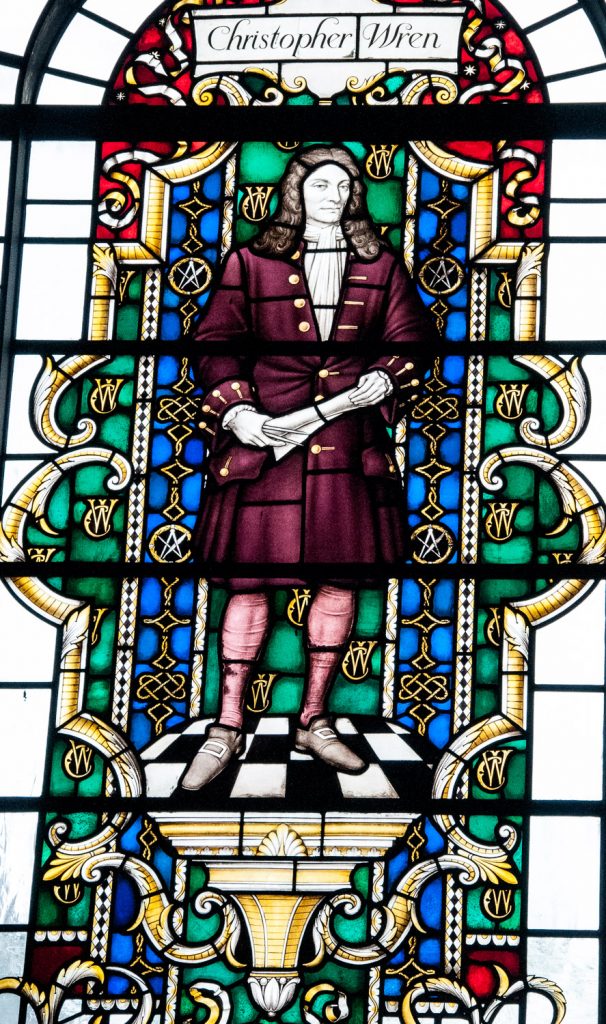
A few days ago I visited the Lamb Tavern in Leadenhall Market (EC4V 1LR) and came across these splendid tiles depicting Sir Christopher Wren. He is standing in front of The Monument (which still has scaffolding around it) holding up a drawing of how it will look when finished …

Just look at the characters gathered around him …

A lady holding a fan leans out of her carriage window to chat to the architect. A child (possibly her servant) stands nearby holding what looks like a pet King Charles spaniel. Some nearby gentlemen are also intrigued, but the chap with the red hat who looks like Errol Flynn might be more interested in the lady. Observe the elegant shoes of the man holding an eyeglass. Not really appropriate for the City’s muddy streets, so maybe he is her carriage companion. The carriage driver looks over his shoulder at the scene. The panel is by W.B. Simpson & Sons and is faintly dated 12th March 1882.

And now another wonderful new discovery for me, the exterior of the former Nordheim Model Bakery at 12-13 Widegate Street (E1 7HP), just off Middlesex Street near Liverpool Street Station. Here are the glazed faience reliefs as a group – they are a joy – showing the bread-making process in beautiful detail …

Hauling in the flour
Kneading the dough
Into the oven for baking
Triumphantly carrying the finished product

They date from 1926 and their creator was the sculptor Philip Lindsey Clark (1889-1977). Having joined up with the Artists’ Rifles in 1914, he had distinguished himself in the First World War having been awarded the Distinguished Service Order (DSO) for ‘ … conspicuous gallantry and devotion to duty when in command of the left flank of the Company of the Battalion’. Despite being severely wounded, he had fought on until relieved two days later. His work became more and more religious and he eventually entered a Carmelite order, retired to the West Country, and died there at the age of 88. The panels reminded the Gentle Author of the Stations of the Cross and you can read his posting about these works here.

I love this bright red high-relief terracotta frieze on the exterior of Cutlers’ Hall (1886-7) in Warwick Lane (EC3M 7BR). The ancient Cutlers’ Company’s origins go back to 1416, their business originally produced and traded in knives and swords but eventually expanding into household cutlery and domestic wares such as razors and scissors.

The work realistically depicts late Victorian cutlery production. This is not surprising since the sculptor, Benjamin Creswick (1853-1946) of Sheffield, was once a cutler himself. The frieze (containing 33 figures) was made by E. Goodall & Co of Manchester …

The detail is extraordinary

I had to smile when I noticed this plastic owl just above the terracotta on the right. He’s obviously intended to deter pigeons …

‘To-whit to-whoo!’

The Bishopsgate Institute (230 Bishopsgate EC2M 4QH) is a fascinating cultural centre in the City of London.

The website tells us that the architect for the building was decided by a design competition and Charles Harrison Townsend (1851-1928) was chosen as the winner. Townsend was an inspiring and original architect whose work was individual rather than adhering to any particular style or movement. The Grade II* listed building combines elements of the Arts and Crafts and Art Nouveau styles, but the influences of Townsend’s interest in Romanesque and Byzantine architecture can be seen in the broad semi-circular arched entrance, twin roof turrets and mosaic interior floors. Do go inside and visit the beautifully restored library.


The Tree of Life

And finally (for now) the flamboyant Bolton House at 14-16 Cullum Street EC3M 7JJ. Built in 1907, it has a white faience facade with green and turquoise decoration including the heraldic device of Prior Bolton, after whom the building was named. It’s another lovely example of Art Nouveau completed just before that style went out of fashion.

Incidentally, I have already written about the Prior in an earlier blog because of his connection with St Bartholomew the Great. Under the oriel window in the church there is a nice example of a rebus, in this case a representation of a person’s name using a picture. Here Prior Bolton’s name is neatly implied by a crossbow bolt piercing a tun (a type of cask). Bolton was Prior of St Bartholomew the Great between 1505 and 1532 and carried out repair and construction work across the church.

Prior Bolton’s rebus

I am indebted to the Tiles & Architectural Ceramics Society for the source of much of today’s blog. They published a special Gazetteer on the City of London and I have used it for reference. The photographs are my own. My thanks also to Richard Jones of London Walking Tours.


Page 36 of 41

Powered by WordPress & Theme by Anders Norén

Symbols & Secrets
Privacy Overview

This website uses cookies so that we can provide you with the best user experience possible. Cookie information is stored in your browser and performs functions such as recognising you when you return to our website and helping our team to understand which sections of the website you find most interesting and useful.