Walking the City of London

Category: Sculpture Page 22 of 41

Sculptures in the City (including some with a clever disguised purpose).

I thought it would be interesting to revisit the Sculpture in the City project again having written about it a few weeks ago. There are also some sculptures that I have come across over the years that are not quite what they seem so I have included them as well.

First up from the project is Rough Neck Business by Mike Ballard …

100 Bishopsgate, EC2M 1GT.

The work is made up of hoardings sourced from several sites across London which have seen great changes over recent years and have been surrounded by hoardings for quite some time. Ballard is interested in taking this material, that normally represents a threshold of ownership and protection of property, and transforming it from sheet form into a 3d structure of its own, to be admired for its un-painterly qualities and the ‘witness marks’ of the time it stood on the street.

This is Murmurs of the Deep by Laura Arminda Kingsley …

Installed on the escalators of the Leadenhall Building, EC3V 4AB.

The notes tell us that ‘here she creates a pictorial world in which our communion with the cosmos and nature is unmediated by cultural valuations or static ideas of identity. To accomplish this, Kingsley looks at the world through the lens of deep time, giving equal importance to; the microscopic and the macroscopic; folklore and science; and the archaic and the new, to offer the viewer a non-hierarchical perspective in which to reconsider their place in the world’.

Tatiana Wolska creates her sculptures using recycled plastic bottles. By cutting, perforating and thermo-welding them, she achieves sprawling, modular biomorphic forms …

‘Untitled’ : Leadenhall Market, EC3V 1LT.

‘By being light-weight these arresting forms can be placed within the environment in ways defying the laws of gravity. They can evoke floating islands of plastic waste or hold a strong poetic charge, appearing to be mysteriously suspended from the buildings or trees as if infecting the environment.’

The RedHead Sunset Stack captures a bit of the awe that seeing a beautiful sunset inspires in Almuth Tebbenhoff – reduced to the form of a large toy-tower …

Mitre Square, EC3A 5DH

‘At the centre the artist put a ragged and unstable human experience in pink and orange which is sandwiched between the steady blue earth and the red sun cubes. The earth and sun may be the only constants we have and even here we are at the mercy of incomprehensible forces.’

This work is my favourite and I make no excuses for showing it again …

The nearby notes tell us that the sculptor Jun T. Lai ‘created Bloom Paradise to symbolize hope and love. The artist’s intention was to bring greater positivity into the pandemic stricken world and release healing energy. The bright and colorful flowers call to an imaginative world, leading the visitor into a fantasy wonderland. Through this work, the artist hopes to bring positive energy and joy, a gift of life, to everyone’.

I think she has succeeded brilliantly. What a lovely vision to encounter as you leave Fenchurch Street Station on your way to work.

By way of further light relief, there are benches around the city with ‘memorial’ plaques devised by Oliver Bragg. This one made me laugh …

‘This project focuses on the everyman, the natural environment and memories to place and memory itself. A series of engraved brass bench plaques have been installed to existing benches around the City of London. The plaques have been created to mimic the plaques that often adorn benches to memorialise or pay homage to a specific person. These, however, are fabricated: in loving memory of a ‘made up’ person or place or abstract idea’.

I thought that, since we are on the subject of public sculpture, I’d take this opportunity to share with you a few examples of works that perform another function apart from the purely aesthetic.

This is Angel’s Wings on Paternoster Square by Thomas Heatherwick. The sculpture is actually a ventilator for an underground electrical substation …

The makers of the vents, the Heatherwick Studio, say that ‘the aesthetic design is derived from experiments with folded paper, scaled up to 11m in height; the vents retain the proportions of the A4-size paper used in these experiments. The Vents are fabricated from 63 identical, 8mm thick, stainless steel isosceles triangles welded together and finished by glass bead blasting’.

Paternoster Square also hosts this elegant column that has a striking resemblance to The Monument commemorating the Great Fire …

In fact it is based on Inigo Jones’ corinthian columns for St Paul’s West Portico, destroyed in favour of Wren’s design we see today. Look closely and you’ll spot grates under the base, a ventilation system for the car park underneath your feet.

The flaming urn at the top refers not only the 1666 fire but also the Blitz that destroyed most of the surrounding area …

I took this picture to illustrate its position relative to St Paul’s, although the weather was not ideal for photography …

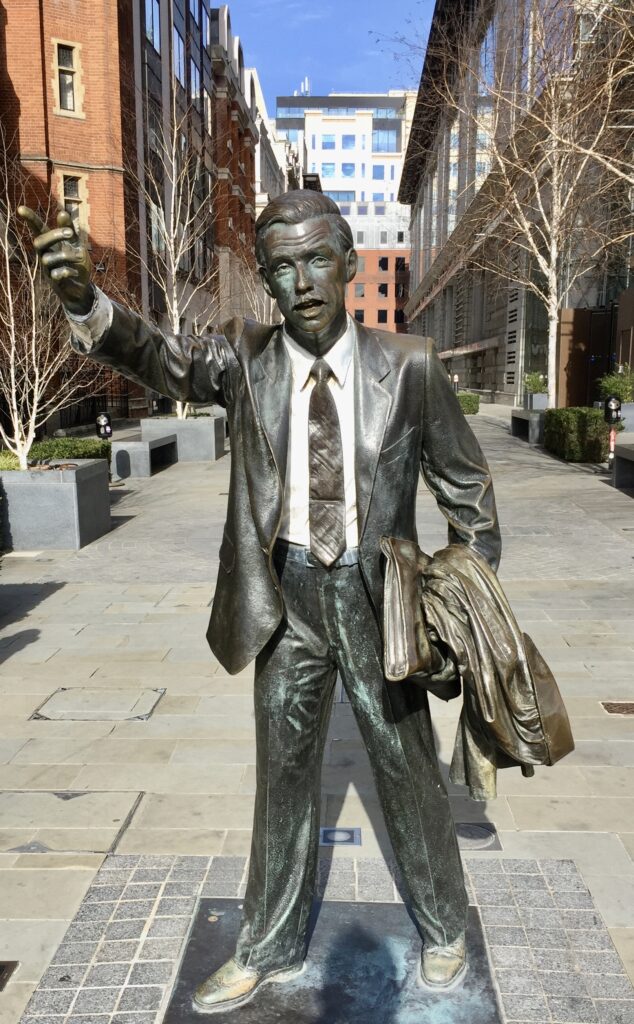
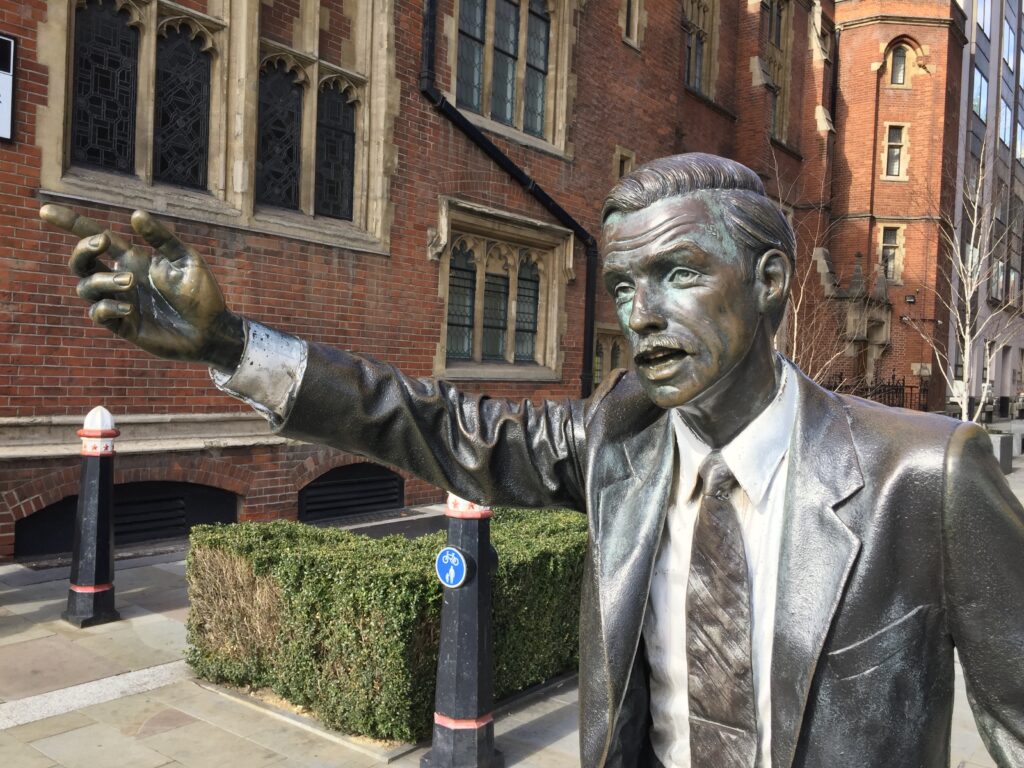
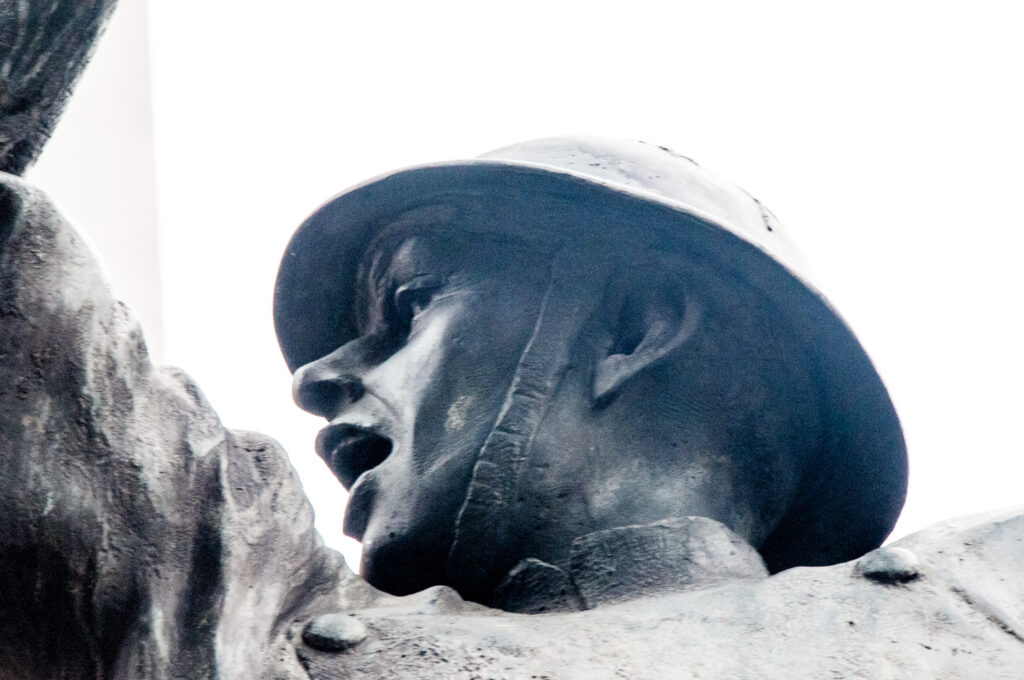
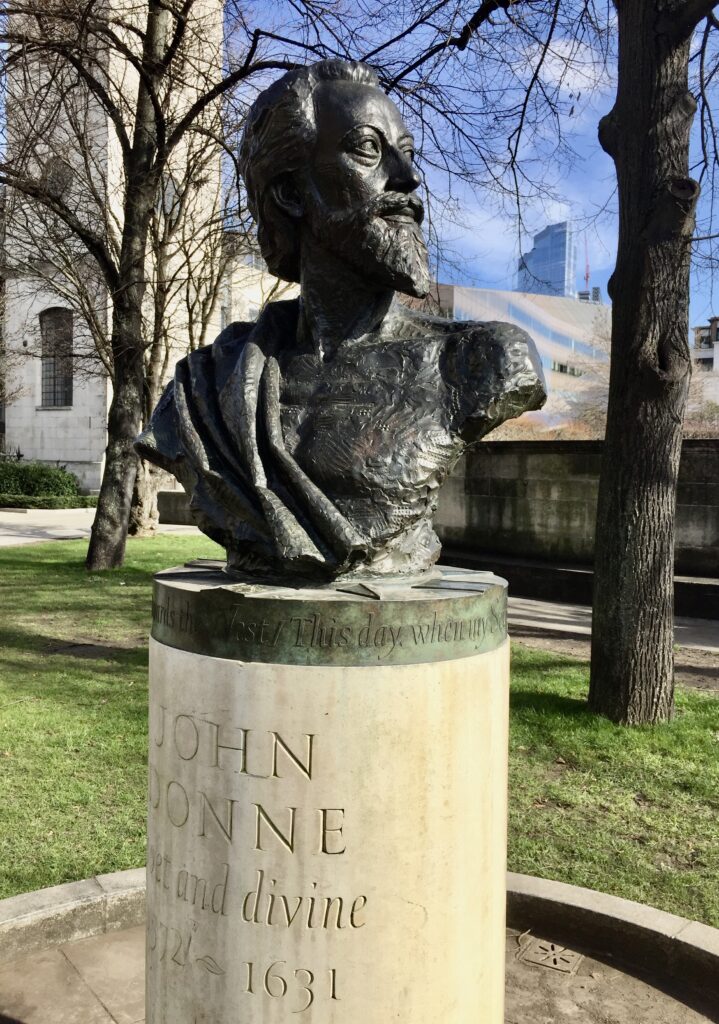
And finally, another ventilation shaft. James Henry Greathead was a South African engineer (note the hat) who invented what was to become known as the Greathead Shield. He came to be here on Cornhill because a new shaft was needed for Bank Underground Station and it was decided that he should be honoured on the plinth covering it …

Designed by James Butler (1994) – Cornhill EC3V 3NR.

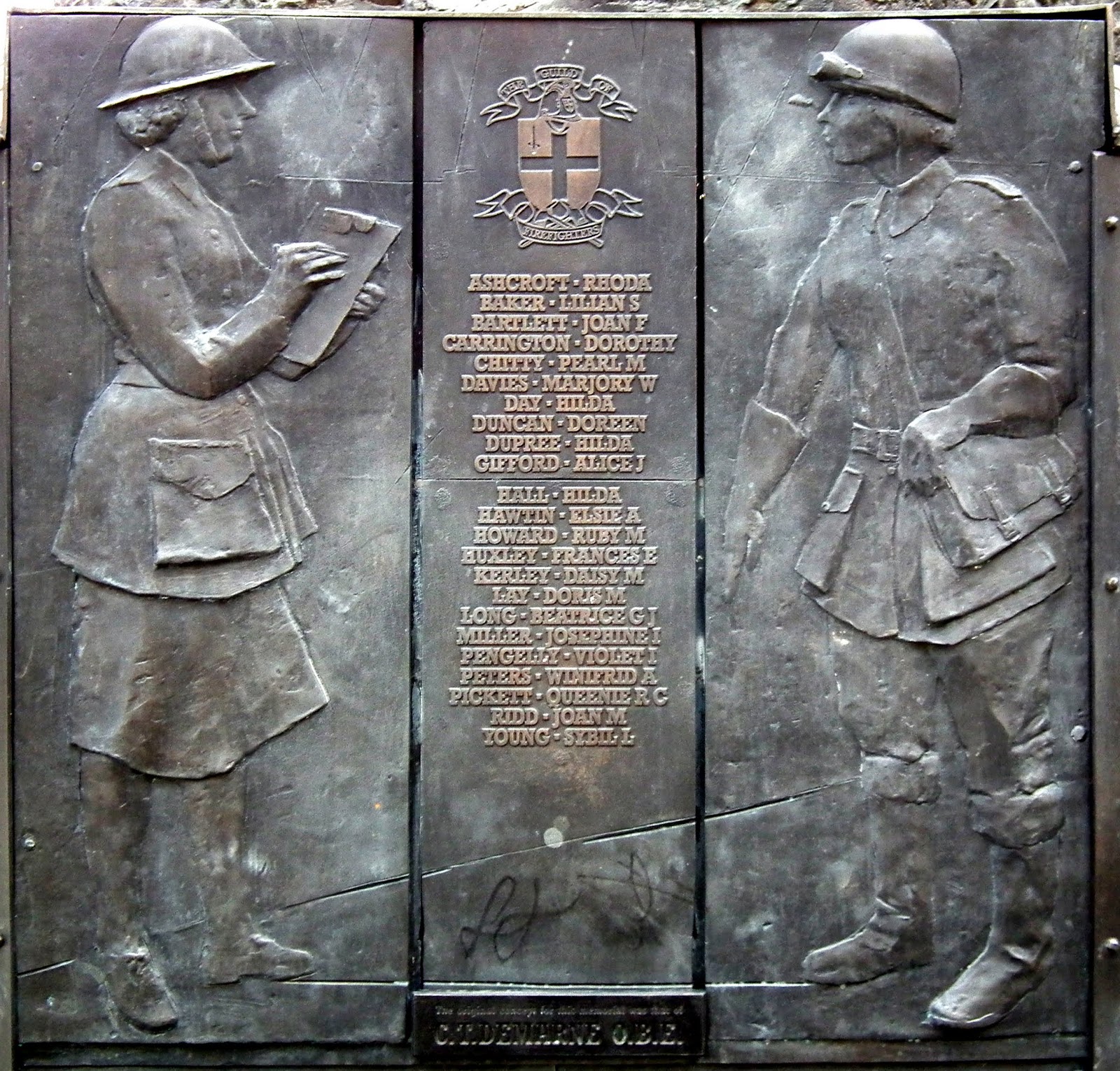
The Shield enabled the London Underground to be constructed at greater depths through the London clay. The miners doing the tunneling, using pneumatic spades and hand shovels, would create a cavity in the earth where the Shield would be inserted to hold back the walls whilst the miners installed cast-iron segments to create a ring. The process would be repeated until a tunnel had formed in the shape of a ‘tube’, which is where we get the nickname for the network today. A plaque on the side of the plinth shows the men at work …

If you would like to follow me on Instagram here is the link …
https://www.instagram.com/london_city_gent/

Sculpture in the City – from the joyous to the rather poignant.

Sculpture in the City is an annual sculpture exhibition that uses the City as a rotating gallery space. This is its 10th edition and will be in place until spring 2022.

I’m going to start with my absolute favourite …

The nearby notes tell us that the sculptor Jun T. Lai ‘created Bloom Paradise to symbolize hope and love. The artist’s intention was to bring greater positivity into the pandemic stricken world and release healing energy. The bright and colorful flowers call to an imaginative world, leading the visitor into a fantasy wonderland. Through this work, the artist hopes to bring positive energy and joy, a gift of life, to everyone’.

I think she has succeeded brilliantly. What a lovely vision to encounter as you leave Fenchurch Street Station on your way to work.

When I first caught a glimpse of this clock on the Corner of Bishopsgate and Wormwood Street (EC2M 3XD) I was rather puzzled …

Now I know that Silent Agitator by Ruth Ewan is a large clock based upon a detail of an illustration produced by Ralph Chaplin in 1917 for the Industrial Workers of the World union (the IWW). Chaplin’s illustration, bearing the inscription ‘What time is it? Time to organize!’, was reproduced on millions of gummed stickers, known as ‘silent agitators’, that were distributed by union members in workplaces and public spaces across the US. The clock hands bear workers’ clogs or, in French, sabots from which the word sabotage is derived (sabotage was originally used in English to specifically mean disruption instigated by workers).

At Undershaft, EC3A 8AH (Next to St Helen’s Church) is Harlequin Four By Mark Handforth

The descriptive notes state: ‘There is much symbolism in this number, for example it is considered a number of ‘being’, the number that connects mind-body-spirit with the physical world of structure and organisation’. Likewise, the use of lights is a commonality throughout his practice, in the form of candles, reflective neons and fluorescent lights. Handforth cites the way that the landscapes of artificial light that many of us live in, “means that night just becomes a different kind of day”.

Nearby at Undershaft, EC3P 3DQ (Between Aviva and the Leadenhall Building) is Cosmos by Eva Rothschild

The work is composed of three 3.5 metre-high slatted structures which lean into and support each other, painted black on the exterior and sprayed in a coloured gradient within. An imposing physical structure, the work encourages both a physical and aesthetic response. Says Rothschild: “The external piece is quite forbidding. Its black shiny surface is like a set of disruptive gates.”

In Beehive Passage, Leadenhall Market (EC3V 1LT) is Symbols by Guillaume Vandame

‘This is a sculptural installation consisting of 30 unique flags from the LGBTQ+ community. Spanning the original Pride Flag designed by Gilbert Baker in San Francisco in 1978 to its newest iteration by Daniel Quasar in 2018, the flags represent the diversity of gender, sexuality, and desire. The flags are standardised and ordinary, each five feet by three feet, and hang equidistant to represent the equal value and potential each community group has in the world today’.

And finally, Orphans, by Bram Ellens, a rather poignant work situated on Cullum Street (EC3M 7JJ) …

In Orphans, we see how the artist collected old paintings from deceased people to give them a new life …

Through undertakers and thrift stores, he managed to lay his hands on paintings that had become ‘orphaned’ after their owner died and the art was discarded by their heirs.

All of these paintings that ended up in damp storage basements longing for a new owner, contained both the energy of the original artist as well as the attachment of the deceased owner.

The above are only six of the sixteen works you can discover around the City. More details are available here.

If you would like to follow me on Instagram here is the link …
https://www.instagram.com/london_city_gent/

A couple of great surprises – exploring alleys and courts.

Where do you think this pretty marble fountain is located?

And Italian piazza? A rather posh park? A country house garden?

A little boy holds a goose’s neck from whose mouth water would flow if the fountain was working …

The big surprise about its location is apparent when you gaze upwards …

Looming over you is the 600ft Tower 42, previously the NatWest Tower.

This is Adam’s Court and you gain entrance from either Old Broad Street or Threadneedle Street. This is the entrance from the former …

The elegant clock above the entrance is supported by two fishes. Unfortunately it’s not working and the glass has got rather grubby …

Shortly after entering you will see these attractive wrought iron gates bearing the initials NPBE and the date 1833. The initials refer to the National Provincial Bank of England which was founded in that year …

Further on is a totally unexpected green open space (alongside which is the little boy’s fountain) …

If you carry on and exit on to Threadneedle Street and look back you will see another set of ornate gates …

These are 19th-century, and were originally for the Oriental Bank. The grand building with the arch in the background was also part of the Bank, but the building was later taken over by the neighbouring National Provincial Bank, and their monogram added.

Look at the spandrels above the window … …

Two men are holding the reins of two camels.

Across the road from Adam’s Court on Old Broad Street is the enticing entrance to Austin Friars …

Before you cross the road, look right and admire the old City of London Police call box which has retained its flashing light indicating a caller was in need of help …

Walking through Austin Friars you pass a studious monk, writing in a book with his quill pen …

Eventually in front of you is the tucked away entrance to the atmospheric Austin Friars Passage, where I came across my next big surprise …

Almost at the end I encountered an extraordinary sight, a bulging, sagging wall that was clearly very old …

Up high is a parish marker for All Hallows-on-the-Wall, dating to 1853 …

But the wall looks even older and, sure enough, standing in the alcove that leads to the other side and looking up, I saw this …

Another parish marker dating from 1715 – from the since-demolished church of St Peter le Poer. What a miracle that this old wall (which is not listed) has survived for over 3oo years as new buildings have sprung up all around it.

Look up and you’ll see that one of those buildings has a particularly scary fire escape. I wouldn’t fancy running down that in a panic …

As you leave you can admire the charming ghost sign for Pater & Co …

The company was run by Arthur Long and Edgar John Blackburn Pater and traded from the 1860s to 1923 when Long retired and Pater continued on his own.

As is often the case I am indebted to the excellent Ian Visits blog for some of my background information. Here are links to Ian’s comments on Adam’s Court and Austin Friars Passage.

My earlier blogs on courtyards and alleys can be found here and here.

If you would like to follow me on Instagram here is the link …
https://www.instagram.com/london_city_gent/

Page 22 of 41

Powered by WordPress & Theme by Anders Norén

Symbols & Secrets
Privacy Overview

This website uses cookies so that we can provide you with the best user experience possible. Cookie information is stored in your browser and performs functions such as recognising you when you return to our website and helping our team to understand which sections of the website you find most interesting and useful.