Walking the City of London

Category: Religion Page 10 of 19

Another stroll through Bunhill Burial Ground.

I was astonished to find that it has been well over four years since I wrote in detail about Bunhill so earlier this week, when the sun was in exactly the right place, I decided to take some pictures and write about it again.

I thought I’d show you the pictures first and then re-publish details of the area’s fascinating history. Around 120,000 people are believed to have been buried here and about 2,500 monuments survive.

The gentleman whose face is looking out from the obelisk is the Calvinistic Methodist minister, poet and Bible commentator James Hughes …

It’s a bit spooky sideways on …

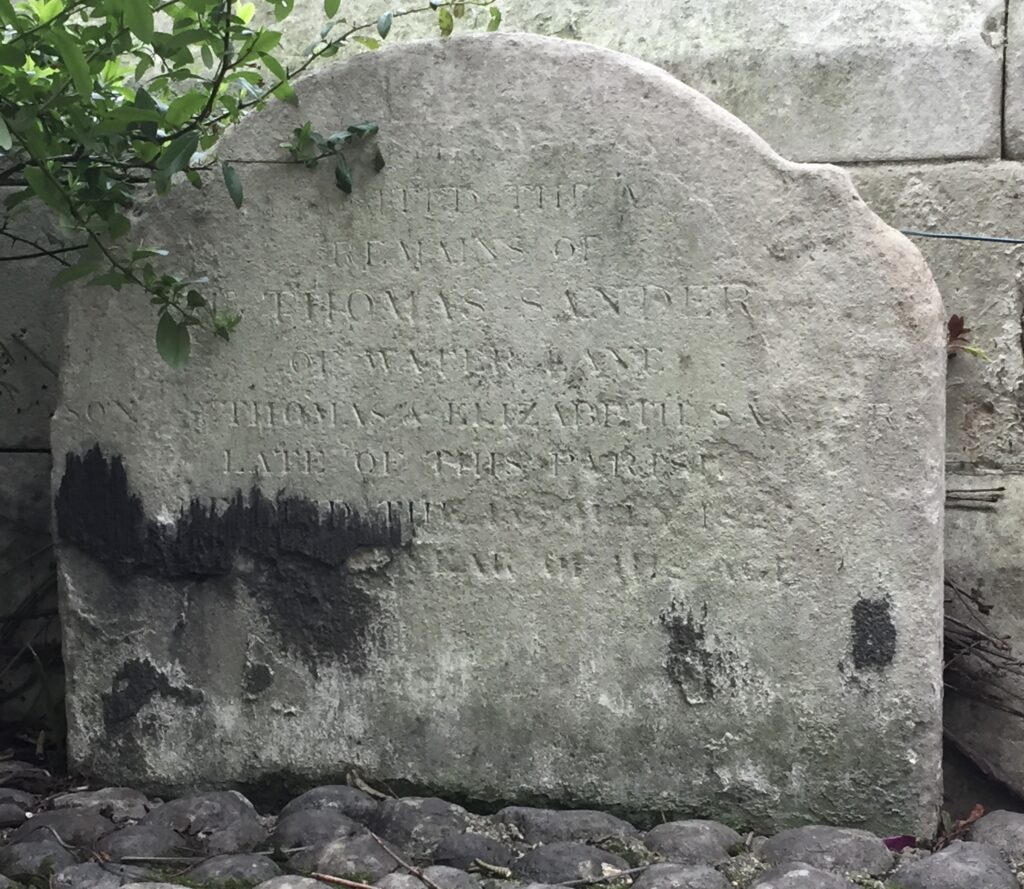
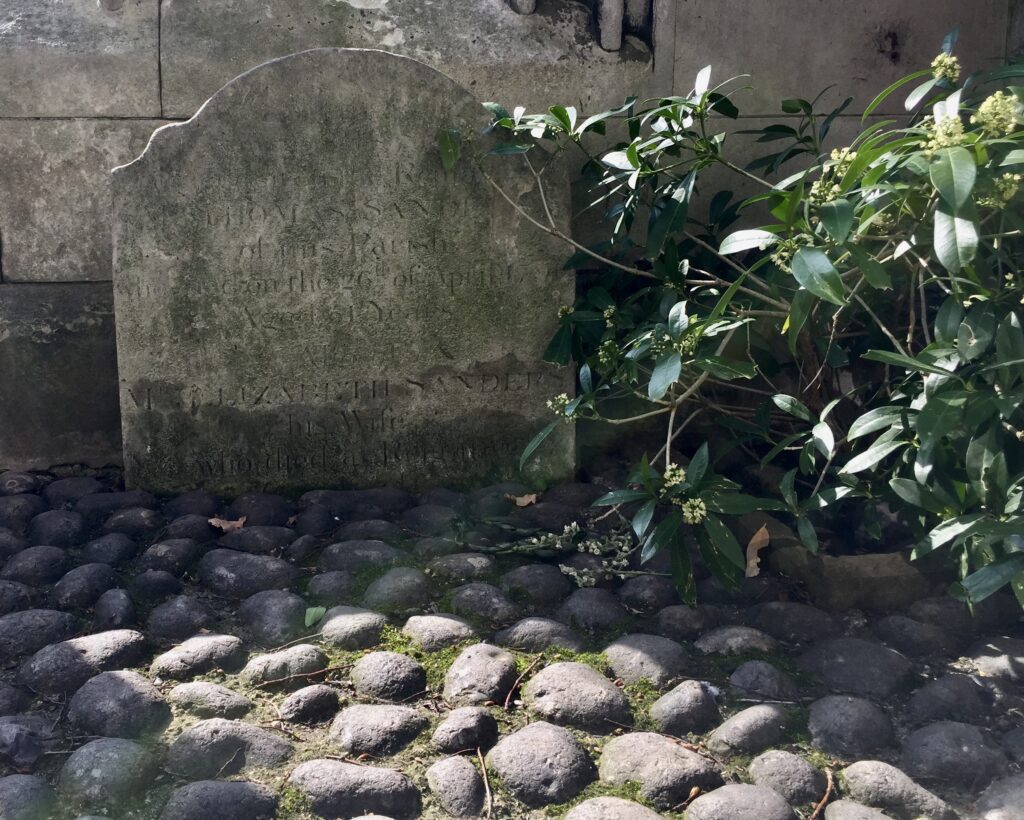
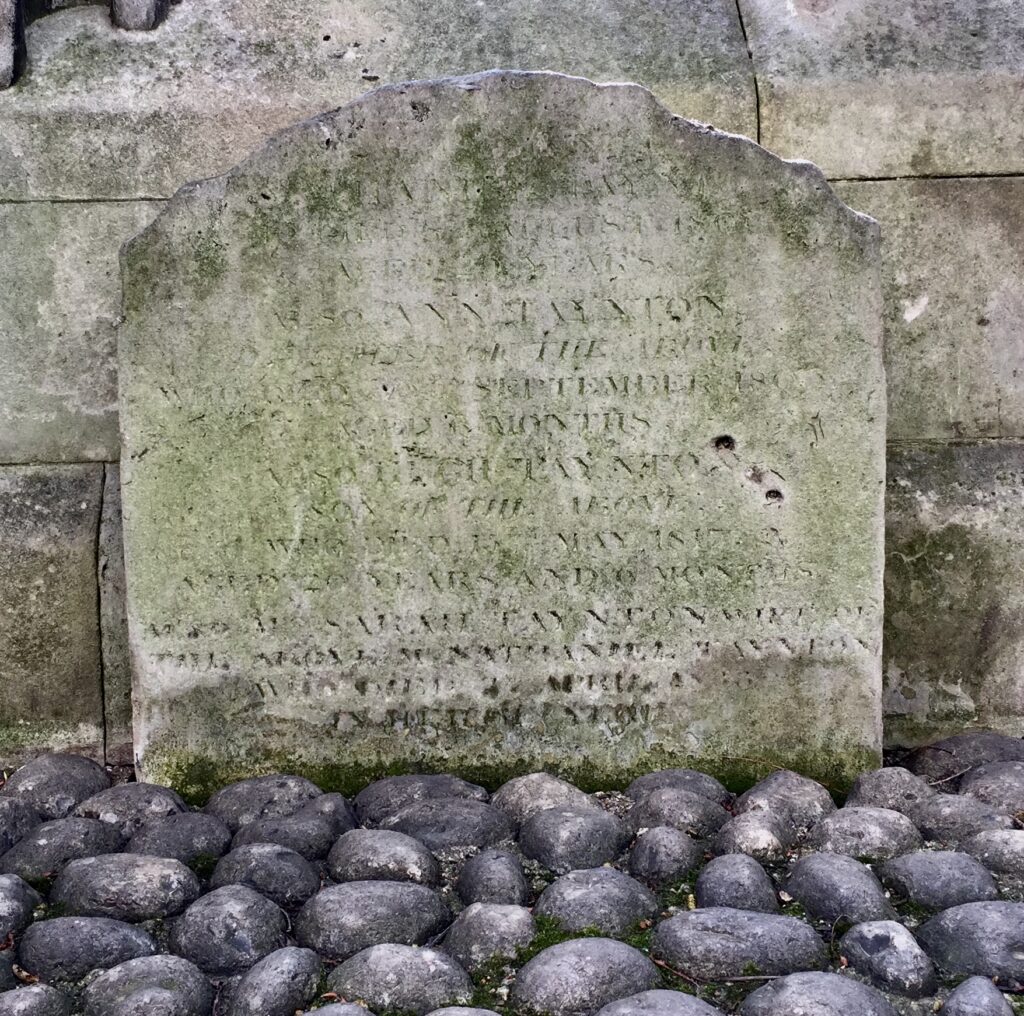
Sadly many of the memorials have deteriorated over the years due to wear and tear and pollution …

But some inscriptions survive. I was very taken with this marker for the grave of Reverend Joseph Cartwright who died on 5th November 1800 at the age of 72 …

It seems to me that he composed the poem engraved on the stone himself (sadly the last few lines are obliterated). Here it is …

What if death may sleep provide

Should I be of death afraid.

What if beams of opening day

Shine around my breathless clay.

Tender friends a while may mourn

Me from their embraces torn.

Dearer better friends I have

In the realm beneath the grave.

I have written before about some of the more famous memorials but here are a few of them again.

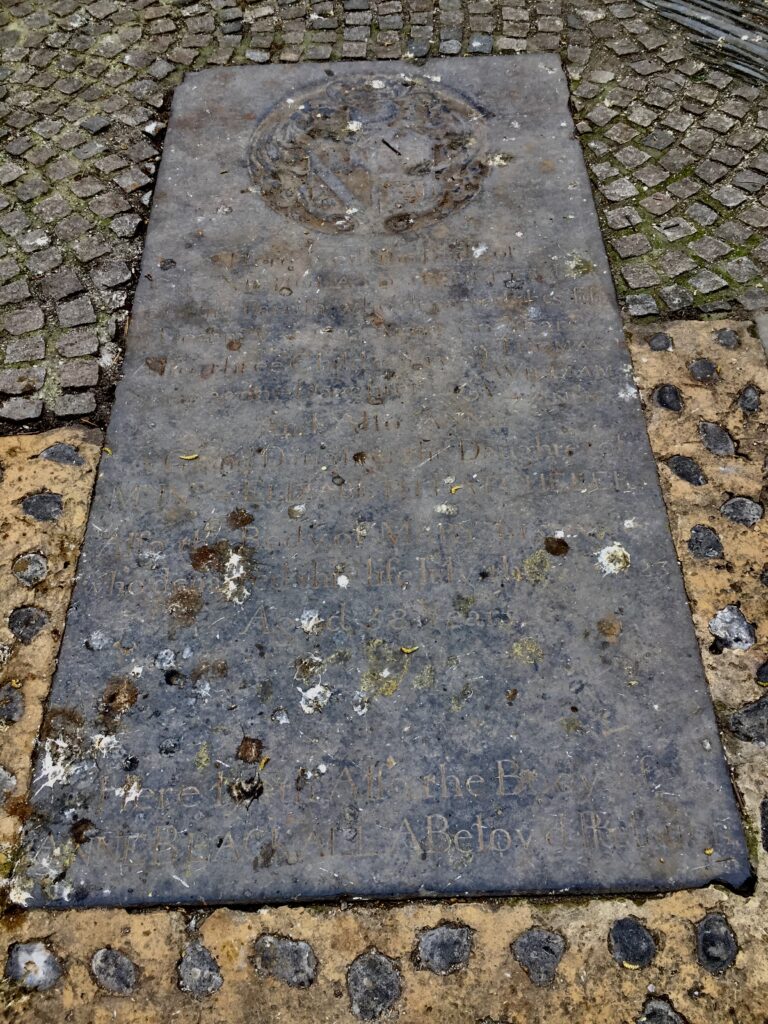
There is the extraordinary tomb of Dame Mary Page …

It appears that Mary Page suffered from what is now known as Meigs’ Syndrome and her body had to be ‘tap’d’ to relieve the pressure. She had to undergo this treatment for over five years and was so justifiably proud of her bravery and endurance she left instructions in her will that her tombstone should tell her story. And it does …

Further on is John Bunyan’s tomb of 1689. It is not quite what it seems since the effigy of the great man and the bas-reliefs (inspired by Pilgrim’s Progress) were only added in 1862 when the tomb was restored. A preacher who spent over a decade in jail for his beliefs, he holds the bible in his left hand. He started the Christian allegory Pilgrim’s Progress whilst imprisoned and it became one of the most published works in the English language.

Bunhill is a nice place for a quiet spot of lunch …

William Blake’s final resting place was once lost but the present day Blake Society finally traced where it was. In August 2018 a beautiful stone was placed there exactly 191 years after his death …

Here’s some Bunhill history for those of you who might be interested.

The history of the land is fascinating. Owned by the Dean & Chapter of St Paul’s Cathedral between 1514 and 1867, it was continuously leased to the City Corporation who themselves sub-leased it to others. The name Bunhill seems to have been a corruption of the word Bonehill.  Theories range from people being interred there during Saxon times to the suggestion that various types of refuse, including animal bones from Smithfield, were disposed of there. However, an extraordinary event in 1549 made the name literally true.

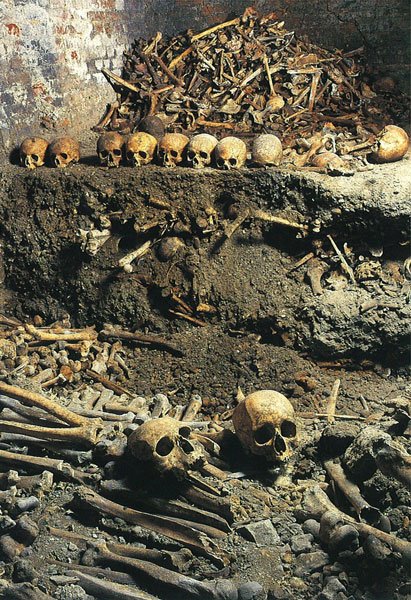
Since the 13th century corpses had been buried in St Paul’s churchyard just long enough for the flesh to rot away, after which the bones were placed in a nearby Charnel House ‘to await the resurrection of the dead’. After the Reformation this was seen as an unacceptable Popish practice, the Charnel House was demolished, and 1,000, yes 1,000, cartloads of bones were dumped at Bunhill. A City Golgotha, it is said the the resulting hill was high enough to accommodate three windmills.

In 1665 it was designated a possible ‘plague pit’ but there is no evidence that it was used as such. At the same time, however, a crisis arose concerning St Paul’s, the ‘noisome stench arising from the great number of dead’ buried there. Many other parishes had the same problem and the Mayor and Aldermen were forced to act quickly as a terrible smell of putrefaction was permeating the City. After negotiations with the existing tenants, the ‘new burial place in Bunhill Fields’ was created and had been walled in by the 19th October that year with gates being added in 1666.

The Act of Uniformity of 1663 had established the Church of England as the national church and at the same time established a distinct category of Christian believers who wished to remain outside the national church. These became known as the nonconformists or dissenters and Bunhill became for many of them the burial ground of choice due to its location outside the City boundary and its independence from any Established place of worship.

The last burial took place in January 1854 and the area was designated as a public park with some memorials being removed and some restored or relocated. Heavy bombing during the war resulted in major landscaping work and the northern part was cleared of memorials and laid out much as it is now with grassy areas and benches.

Across City Road you can see the house where the founder of Methodism, John Wesley, once lived. I hope to write about it soon …

If you would like to follow me on Instagram here is the link …
https://www.instagram.com/london_city_gent/

Smithfield stories (some a bit gruesome).

A few years ago I became intrigued by a particular pub name – the Bishops Finger …

This image has an empty alt attribute; its file name is IMG_9533-707x1024.jpeg

For a while, this was the signage …

This image has an empty alt attribute; its file name is 17324831_fDc-BxulVfnDD5kBjmGSJP-AIWamHWdNxv0Zfx0sjpk.jpg

But, after a bit of research, I realised that this wasn’t a very good representation of what people used to call ‘a bishop’s finger’.

It actually referred to the shape of the hand when giving a blessing. Here is a stained glass representation of Jesus Christ giving the gesture …

This image has an empty alt attribute; its file name is main-qimg-421cf00f2e9801f47cd1d01d81e050dc-c-683x1024.jpg

The present day sign gives the clue to its original slang meaning …

This image has an empty alt attribute; its file name is IMG_9536.jpeg

Yes, it’s a finger post indicating directions.

Not to be confused, of course, with the Vulcan Greeting …

This image has an empty alt attribute; its file name is vulcansalute-head-777x437-1.jpg

‘Live long and prosper!’

Incidentally, the Bishops Finger name dates from 1981. The pub had been purchased by Shepherd Neame in the 1970s, and the change in name was to name the pub after one of their leading beers. The pub had originally been called the Rutland and had also been the Rutland Hotel.

For centuries Smithfield (or smooth field) was a place of execution where many suffered terribly for their beliefs, one of the most famous being William Wallace, ‘Braveheart’ in the movie of that name. Two plaques commemorate him and his execution. This one is facing the street, its railings often adorned with flowers and Scottish flags …

This image has an empty alt attribute; its file name is IMG_9547-728x1024.jpeg
This image has an empty alt attribute; its file name is IMG_9547-2-1024x619.jpeg

Translations from the Latin: I tell you the truth. Freedom is what is best. Sons, never live life like slaves. And the Gaelic: Death and Victory, an old Scottish battle cry.

The other is quite discreet and you’ll find it on the wall just inside the entrance to the churchyard of St Bartholomew the Great …

This image has an empty alt attribute; its file name is IMG_9553-1024x792.jpeg

Wallace, manacled, stands upright and proud awaiting what looks like decapitation with an axe, a basket ready to catch his head when the deed is done. The noose that he glances at, however, indicates a different fate and decapitation would have been decidedly merciful. The plaque is, therefore, a little misleading.

Having been sentenced to be hanged, drawn and quartered, Wallace was first dragged naked behind a horse from the Tower of London to Smithfield, being jeered and booed by onlookers the whole way. He was hanged but cut down before dead after which the rest of the gruesome sentence was carried out. There is no record of any last words. Parts of his body were sent to Newcastle, Berwick, Perth and Stirling for public display. Wallace’s head, meanwhile, was dipped in tar and set on a spike on London bridge, ‘a grisly reminder of King Edward’s justice’.

No contemporary image of how he looked exists but we do know how Mel Gibson portrayed him …

This image has an empty alt attribute; its file name is 122C4Q3.jpg

There’s a great article in The Scotsman newspaper about Wallace and the myths surrounding him and you can read it here.

Almost adjacent to Wallace’s memorial is the one to Protestant martyrs, erected in 1870 by the Protestant Alliance London. …

A few feet from this spot, more than 60 Protestants were burned at the stake, mainly in the reign of Queen Mary (1553-1558), hence they are known as the Marian Martyrs …

Through Mary’s short reign at least 277 persons were burnt, including five bishops, twenty one clergymen, eight gentlemen, eighty four tradesmen, one hundred husband-men and servants, fifty five women, and four children.

Nearby, the Hand and Shears Pub boasts of offering ‘Last Ales before Newgate Public Executions’. The pub’s name relates to the cloth workers who would gather here ahead of the ancient Bartholomew Fair …

This image has an empty alt attribute; its file name is IMG_9558-768x1024.jpeg

Here it is in 1952 … …

This image has an empty alt attribute; its file name is City-of-London-Pubs-98.jpg

Here’s the signage in close up …

This image has an empty alt attribute; its file name is Hand-and-Shears-12-461x1024.jpg

The Justices Licence refers to the Alehouse Act of 1552 which defined in law that it was illegal to sell beer or ale without the consent of the local Justices of the Peace. This was the first time that a licence was required to sell beer and ale and was an attempt to address the drunkenness and disorder that was being caused by the widespread availability of alcohol.

The Act required that each person granted a licence was responsible for maintaining good behavior at their premises and any problems could result in a fine or loss of licence. From the sign it appears that the Hand and Shears was granted a licence in 1552.

This image has an empty alt attribute; its file name is Photo-6-2048x1536-1-1024x768.jpg

Here’s the pub in 1852, the year the present building dates from …

This image has an empty alt attribute; its file name is 758151001-810x1024.jpg

Its predecessor in 1811 …

This image has an empty alt attribute; its file name is 758163001-1024x897.jpg

As is often the case, you’ll find more fascinating detail about the pub and its history in the brilliant London Inheritance blog.

The lovely Sir John Betjeman lived nearby at 43 Cloth Fair …

This image has an empty alt attribute; its file name is Cloth-Fair-003-769x1024.jpg

Walk into the adjacent Cloth Court and look up. Near Sir John’s blue plaque you’ll see a wonderful Trompe-l’œil painting The Sailor’s Home Coming

This image has an empty alt attribute; its file name is IMG_9527-2-997x1024.jpeg

When the next door neighbours bought Betjeman’s flat, intending to rent it out, they had this window bricked up to give themselves more privacy. However, they found they didn’t like staring at a wall. So they got the mural and stained glass artist Brian Thomas (some of whose work can still be seen in St Paul’s Cathedral) to create the Sailor’s Home Coming Window in order to give them something to look at …

Unfortunately it’s rather difficult to see from the street but it has been described as follows : A happy re-union in which a ruddy faced sailor, freshly returned from his travels, is welcomed back into the bosom of his family. His children hug him enthusiastically, whilst an exotic songbird, perhaps a souvenir of an earlier voyage to some far flung corner of the Globe, wobbles unsteadily over the whole harmonious scene.

Sir John’s old flat is available to rent. You can find more details here.

Live long and prosper!

If you would like to follow me on Instagram here is the link …
https://www.instagram.com/london_city_gent/

A painful arrow wound and a ‘beloved’ pair of bankers. More tales from St Giles.

Last week I looked back at St Giles in the period immediately after the Second World war. Over the last few days I’ve been looking for much earlier images.

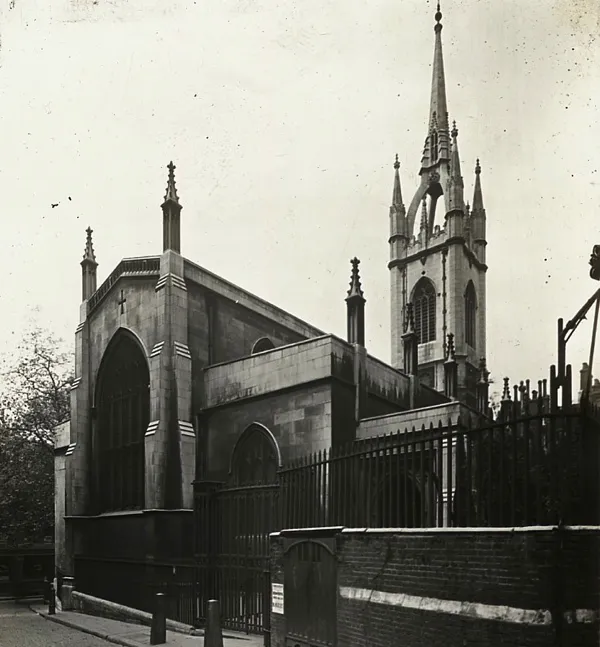
Here it is in 1739 in a picture from the British Museum archive described as: View of the church from the graveyard; one of the churches to escape the Great Fire. 1739. Etching and engraving

Now forward to 1815 in a painting by George Shepherd …

And another entitled St.Giles Cripplegate, Fore Street engraved by J.Henshall after a picture Shepherd (published in London in the Nineteenth Century, 1831) …

The church now (on a wet and windy day!) …

The churchyard and its graves suffered terribly in the Blitz and the old grave stones have been incorporated into low level seating

Some inscriptions still just about legible. For example, the deaths in the Williams family, recorded over the years 1802 to 1840, give typical examples of the high incidence of child mortality …

Let’s go inside now and have a look around.

There are a number of modern stained glass windows. In the baptistery is the Cripplegate Window, which celebrates the centenary of the Cripplegate Foundation www.cripplegate.org which gives grants, advice and support to local organisations. The Foundation was formally established in 1891 but its origins lie in gifts made to St Giles’ for the poor and the needy dating back centuries. John Sworder made the first recorded gift in his will, dated 2 April 1500, and the head at the top of the window represents him, the first of the pious donors of the parish that we know by name …

On the north wall is a memorial window to Edward Alleyn, the parish’s generous benefactor. The design is the work of John Lawson of stained glass studio Goddard & Gibbs and depicts Alleyn in the centre, as well as the Fortune Theatre (which he founded), almshouses (which he built in the parish and which were destroyed in the Second World War), and St Luke’s Church, Old Street …

Monuments include one to John Speed. He was born at Farndon in Cheshire in 1552 and followed his father’s trade as a tailor until nearly fifty. He lived in London (probably in Moorfields) and his wife Susanna bore him twelve sons and six daughters! His passion in life, however, was not tailoring; from his early years he was a keen amateur historian and map maker, producing maps for the Queen and the Merchant Tailors Company, of which he was a Freeman. He joined the Society of Antiquaries and in 1597 his interests came to the attention of Sir Fulke Greville, who subsequently gave Speed an allowance for his research. As a reward for his earlier efforts, Queen Elizabeth granted him the use of a room in the Custom House …

Here’s his map of England (note the Irish Sea, the British Sea and the German Ocean!)…

The oldest monument is that of Thomas Busby. A 19th century guide to the church describes him and his memorial as follows …

… a rich cooper who died in 1575. His painted figure shows him in a black coat, his face full of benevolence, and his epitaph tells us that he gave the poor of Cripplegate every year four loads of the best charcoal and 40 dozen loaves.

Alas the Blitz ensured that only his bust with its benevolent face remains …

In the main body of the church, attached to a pillar on the right, is a sword rest, replacing one destroyed during the Second World War. Its function is to house the ceremonial swords carried on state occasions. This one contains the coats-of-arms of the five Aldermen of Cripplegate who became Lord Mayors of London, including Sir John Baddeley, Sir Peter Studd and Sir Allan Davis …

Nearby there is also a lovely 19th century brass lectern created in memory of Lancelot Andrewes …..

The East Window was designed by Gerald Smith of the Nicholson Studios, a London-based stained glass studio, which made the window in 1960. The firm’s output covered the years of restoration following both World Wars.
The work follows the pattern of the medieval window, of which traces came to light as a result of war damage. The design incorporates many figures of historical significance to the church, as well as the instruments of the crucifixion at the top …

St Giles is there, of course. He is traditionally depicted with a hind and there are various stories as to why that should be so. According to a 10th-century biography, Giles was an Athenian from a wealthy family who gave away his inherited wealth, fled to France and made himself a hermitage in a forest near the mouth of the Rhone, where, we are told, he lived on herbs and the milk of a hind. This retreat was finally discovered by the hunters of the King of the Franks, who had pursued the hind to its place of refuge. An arrow shot at the deer wounded Giles instead, as he put out his hand to protect the deer and was himself speared by the arrow …

Part of the medieval church can be still be seen on the right of the window, where it has been deliberately exposed for visitors to see. Here is the sedilia, where the priests sat, and the piscine, used for washing communion vessels. The tiles in the arch here are of Roman origin …

The Roman tiles …

The west window was designed by the Faircraft Studios and installed in 1968. In the centre is the coat-of-arms of the City of London, which is flanked on its left by the coat-of-arms of the Archbishop of Canterbury, and on its right by that of the Bishop of London. In the lower frame, from left to right, are the coats-of-arms of Robert Glover, Somerset Herald of Arms in the reign of Henry VIII, who was buried in the church; of John Milton; of the Earls of Bridgewater; Oliver Cromwell, and Sir Martin Frobisher. There were ten Earls of Bridgewater and three Earls of Kent buried in the church …

Nearby is this plaque dedicated to a pair of twins ‘respected and beloved by all who knew them’ …

They were joint secretaries to the Cripplegate Savings Bank …

Established in 1819, it became the Cripplegate Bank Limited in 1879. Renamed again in 1900 as London, Commercial & Cripplegate Bank Ltd it was acquired by the Union Bank of London Limited later in the same year (and was eventually swallowed up by NatWest).

As you leave you can say ‘goodbye’ to St Giles. He’s just above the north door, hind at his side. You can also see the scorch marks from the incendiary bombs dropped during the Blitz when even the stone caught fire …

He is depicted with a crutch, as it is thought he was lame …

I am indebted to the really helpful History section of the St Giles website for much of the blog. I strongly recommend you visit it, if only to watch the fascinating YouTube film of the City ruins in 1956.

If you walk around to the south side of the church you will see this odd commemorative stone …

What was the mistake that had to be erased? Maybe it originally referred to the ‘west’ or ‘east’ front when it should correctly have referred to ‘the front’!

If you would like to follow me on Instagram here is the link …
https://www.instagram.com/london_city_gent/

Page 10 of 19

Powered by WordPress & Theme by Anders Norén

Symbols & Secrets
Privacy Overview

This website uses cookies so that we can provide you with the best user experience possible. Cookie information is stored in your browser and performs functions such as recognising you when you return to our website and helping our team to understand which sections of the website you find most interesting and useful.