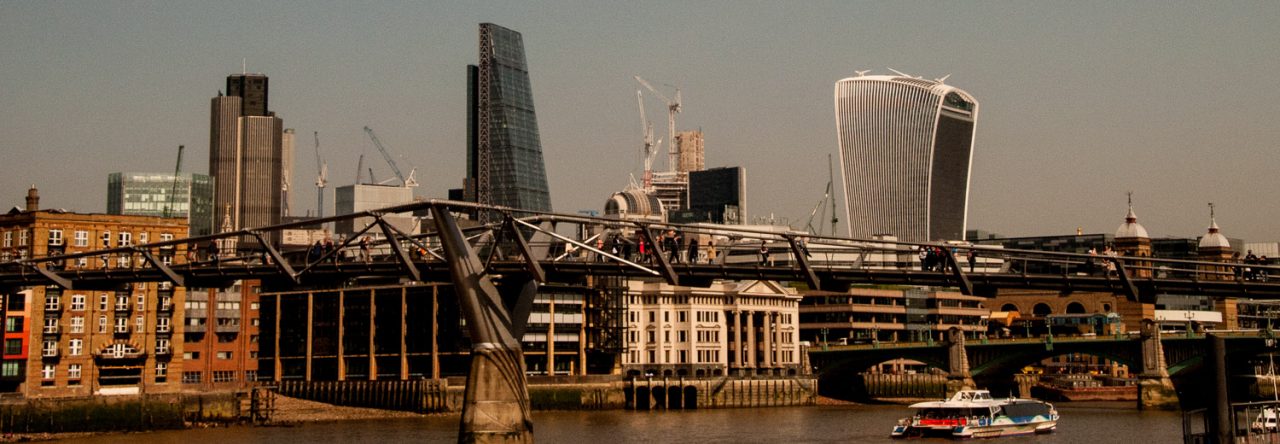
I really like The Gherkin a.k.a. 30 St Mary Axe and it’s interesting to recall that when it was completed in 2003 it dominated that part of the City. Now it’s sad to see soaring new office developments beginning to surround it so it’s unique shape is gradually being hidden from view. When it was finished it was for a while informally known as The Swiss Re building, after the company that commissioned it for their London headquarters, but some wag said it looked like ‘an erotic gherkin’ and the description stuck. It’s probably a shame for the company that their award-winning building had its name hijacked like this, even though they no longer own it.
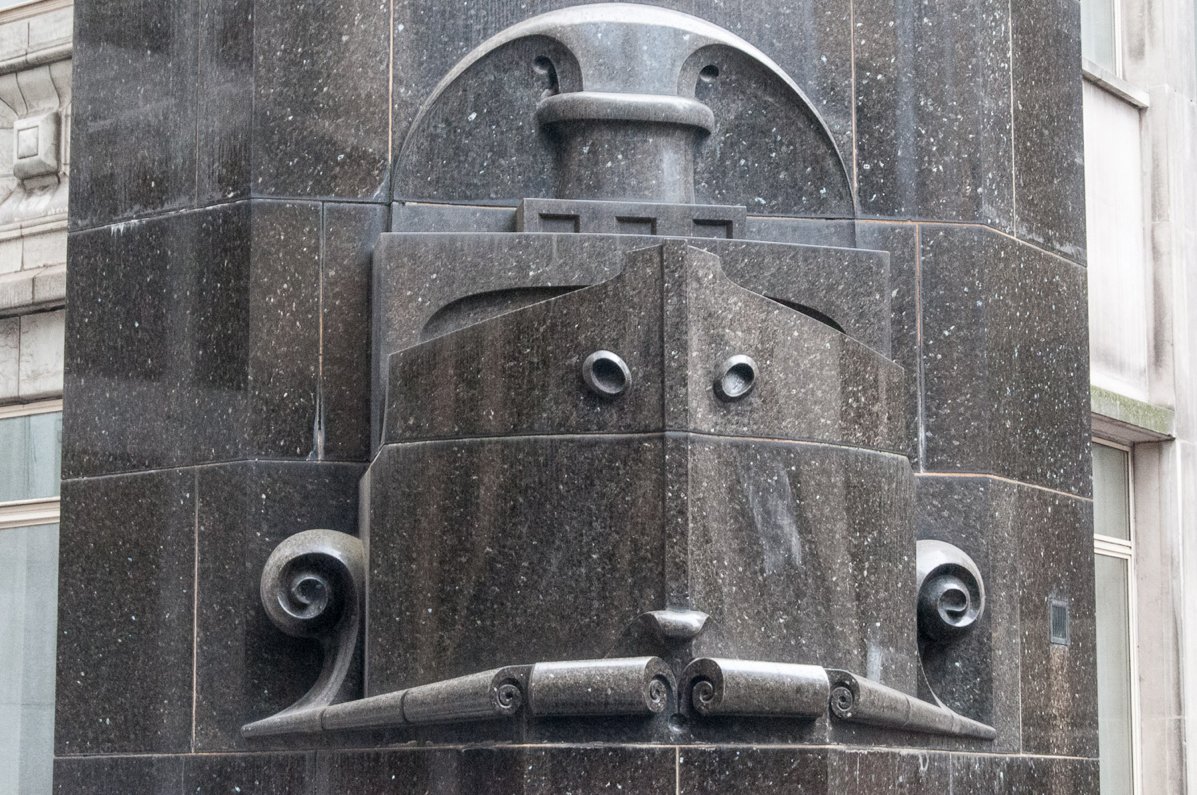
Ship’s prow in Bury Street
Anyway, you may be wondering what the connection is with the magnificent Art Deco ship’s prow in the photograph above. Bear with me.
The Gherkin is built on the site of the old Baltic Exchange, which was eventually demolished as a result of an IRA bomb in 1992. The clearing of the area to provide an open space around the Gherkin opened up for the first time a new view of Holland House in Bury Street. This was at one time one of the narrowest streets in the City but the west side was demolished to open up the Gherkin ‘piazzetta’ (the name for a little piazza, I’m told). So the Holland House architect originally designed the building to be viewed obliquely.
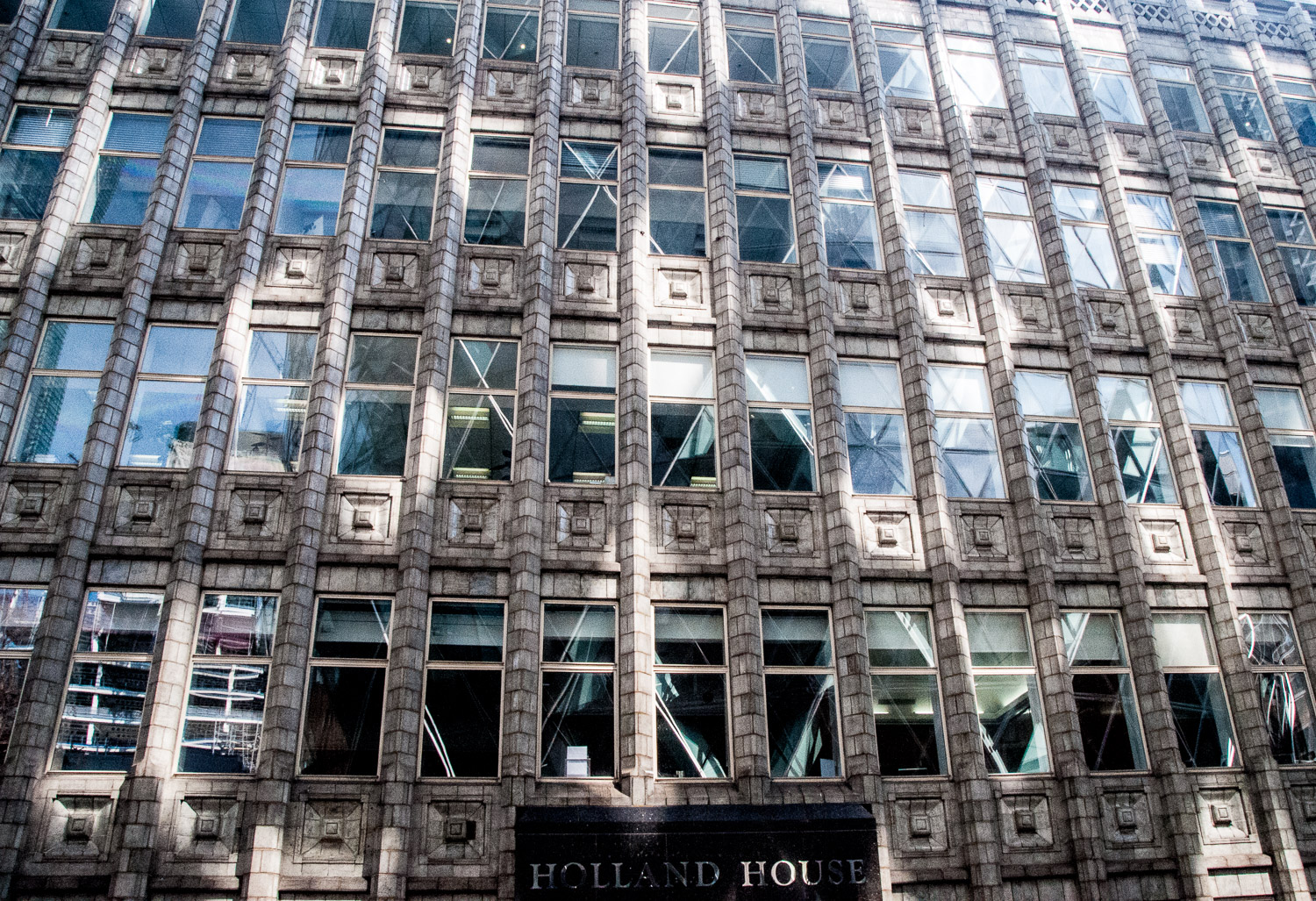
Holland House with the Gherkin reflected in its windows
Holland House is fascinating for a number of reasons. For example, it was built in 1916 right in the middle of the First World War and the year of the Somme. The Dutch company Wm. H. Müller who commissioned it were big in shipping, steel and mining. In its feature on the building, the journal Building Design comments as follows: ‘The company thrived in the neutrality of the Netherlands … and there were scarcely any British clients who could, or would, invest in such a large city building. The glazed terracotta bricks (made in Delft) were sent to London in the firm’s ships and given priority over other cargoes’. It is also the only building in London by Hendrik Petrus Bertage, the foremost Dutch architect of the 20th Century and is one of the first in London to have a steel framed structure.
But what about the ship!
Walk around to the south east corner of the building, step back and admire this brave vessel plunging through the waves towards you, the funnel smoking impressively. It’s a granite structure by the Dutch artist J. Mendes da Costa and reflects the company’s main business of shipping.
I love this story about the ship’s positioning.
Apparently the company owner, Helene Kröller-Müller, had wished to buy the whole of the Bury Street corner, but had been thwarted by the adjacent owners who refused to sell. As a consequence, Holland House is broken into two sections, and it has been suggested that the aggressive prow of the ship was intended to ‘cock a snook’ at the neighbours.
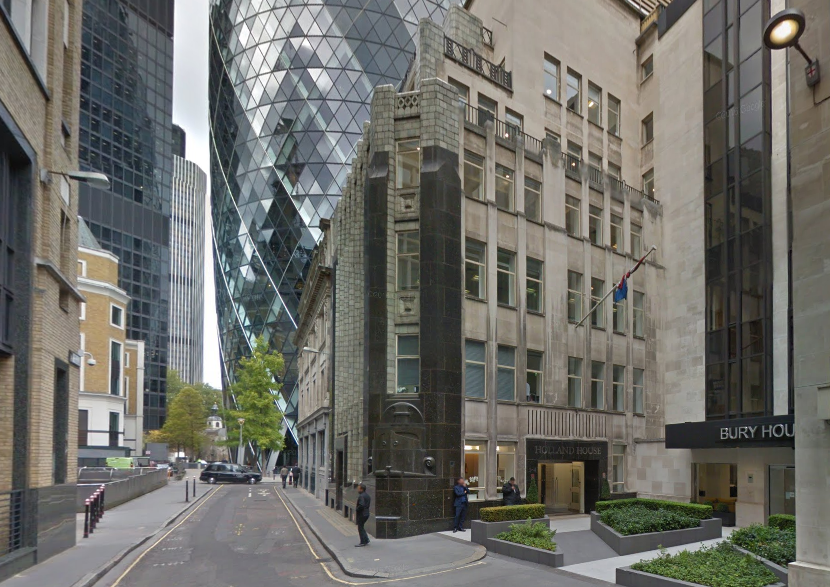
The ship’s prow with the Gherkin in the background