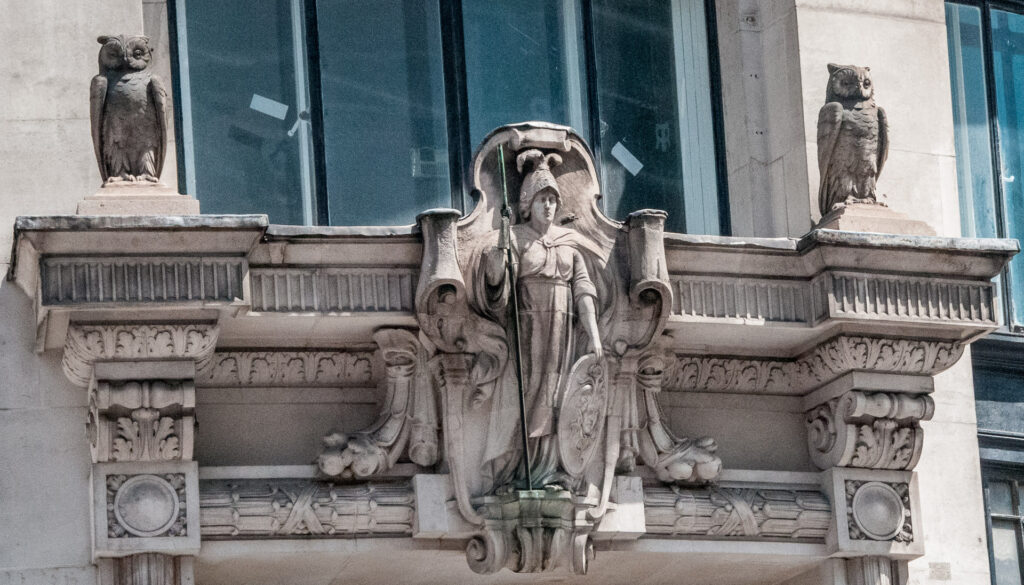
Walking the City of London

Category: Sculpture Page 30 of 41

Wine and Oxo cubes

It has been many years since I crossed Southwark Bridge and then I wasn’t taking much notice of the buildings in Queen Street Place as I headed towards the bridge and out of the City. When I took the trouble to look last week I was absolutely captivated by this delightful but rather strange Art Deco sculpture by H W Palliser …

One writer called it ‘the sexiest sculpture in London– I couldn’t possibly comment.

Built by the Vintners’ Company in 1928, at the centre stands a nude woman clutching to herself bunches of grapes which grow on vines at her side. She is a Bacchante, the ‘spirit of the harvest’, and two goats look up at her adoringly as four doves descend above her head. Two swans are also in attendance, reminding us that the Vintners’ Company is one of the three owners of all the swans on the upper Thames, the others being the Dyers and HM the Queen. The model for the woman was Leopoldine Avico who was also, I believe, the model for The Queen of Time above Selfridges.

You get a nice view of Vintners’ Hall from the Bridge …

Immediately next door is Thames House (1911-12). It was built for the Liebig Extract of Meat Company whose product was imported from a huge plant in Fray Bentos, Uruguay. There is a clue as to what they made over the central entrance …

Yes, the two stone horns symbolise the South American herds that provided the meat for the famous and successful Oxo cube (or ‘boiled up cow’, as one commentator rather unkindly called it). The other carvings represent Abundance – a nude youth pours water from a vase and a nude maiden pours flowers from a cornucopia.

In the pediment on the North Pavilion a pair of nude figures hold a strop to tame the winged horse Pegasus, who beats the cloud with his hooves in his struggle …

This may allude to the alleged energising qualities of the product.

On the South Pavilion pediment a female figure with fruit and flowers represents the fruits of the land with Neptune, holding his trident and a rope for his net, signifies the fruits of the water …

Between them is the figure of a boy standing on two winged wheels symbolising Trade..

Directly over the door is this group …

It’s a particularly lavish doorway surmounted by an arch over a circular window or oculus. The spandrels over the arch contain bas reliefs of women denoting Commerce (left) and Wisdom (right), by Richard Garbe. Commerce holds a caduceus and brandishes an oak branch, symbol of endurance and fortitude. Wisdom holds a torch and proffers a laurel branch, symbol of victory. Above, a dove with an olive branch in her beak brings peace.

In front of the window is a bronze galleon by the metalworker William Bainbridge Reynolds …

The ship is flanked by some rather grotesque fish which look like they are gasping for air. Maybe Neptune has just caught them.

Here’s the full frontal view …

Further along to the north I admired some elaborate doors …

The old doorway to Thames House at the junction with Upper Thames Street is now an entrance to Five Kings House, the interior of the building having now presumably been segmented in some way (EC4R 1QS) …

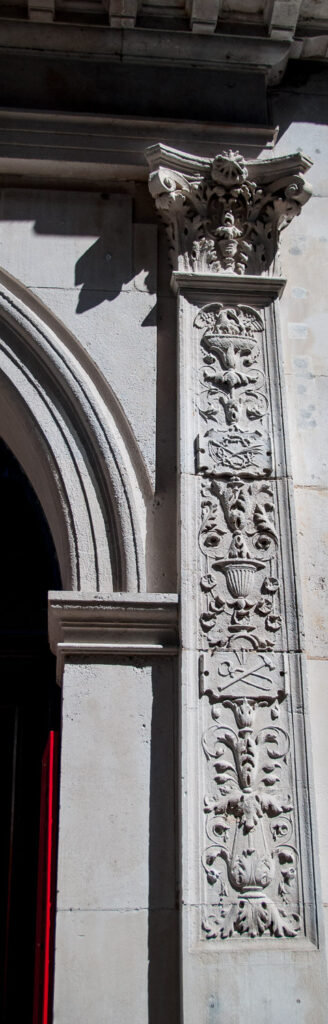
Above the door the male figure, with a helmet and wings at his heels, is clearly Mercury as God of Commerce. It’s not clear what the lady represents – possibly agriculture. Two seated putti support a cartouche

Queen Street Place was a wonderful surprise to me. I have often been asked if I am ever going to run out of things to write about but I can’t imagine this ever happening. The City seems to have something new to offer me every day I walk around it.

Remember you can follow me on Instagram :
https://www.instagram.com/london_city_gent/

Some great beards and a need for TLC – another visit to Holborn Viaduct

I know I’ve already written about the Viaduct twice this year but I found myself drawn back to it one more time since I hadn’t explored it from ground level in Farringdon Road.

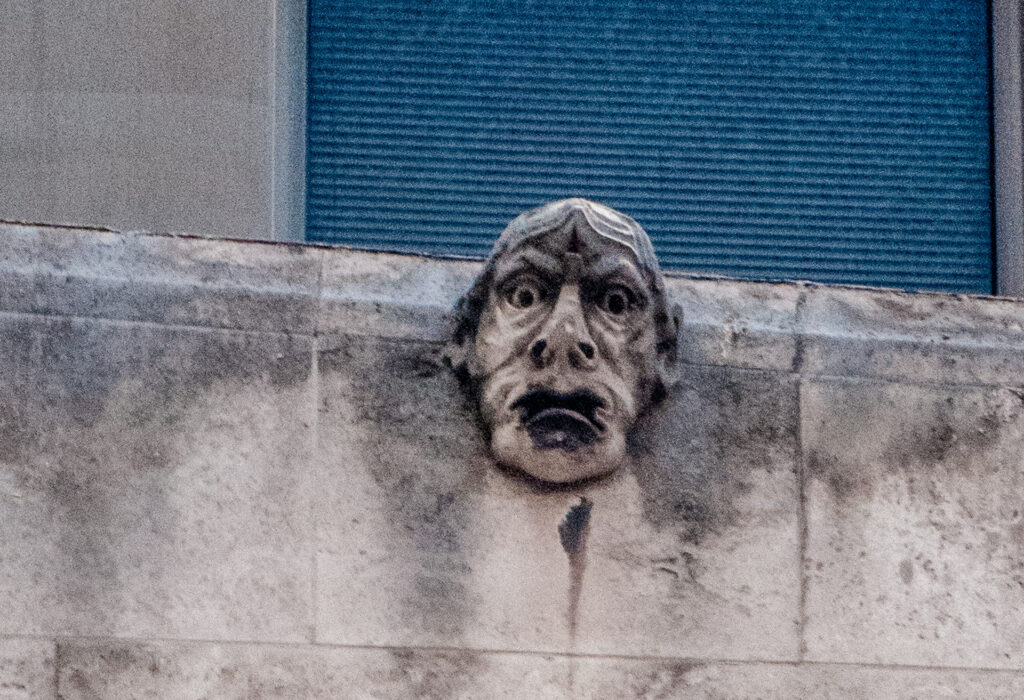
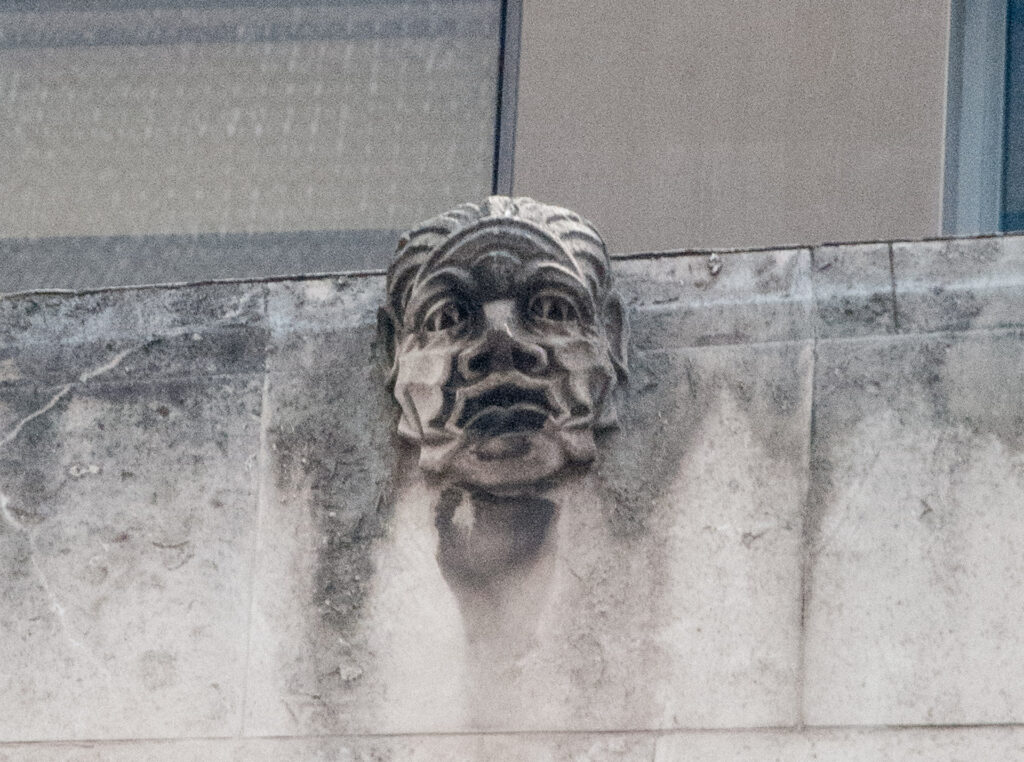
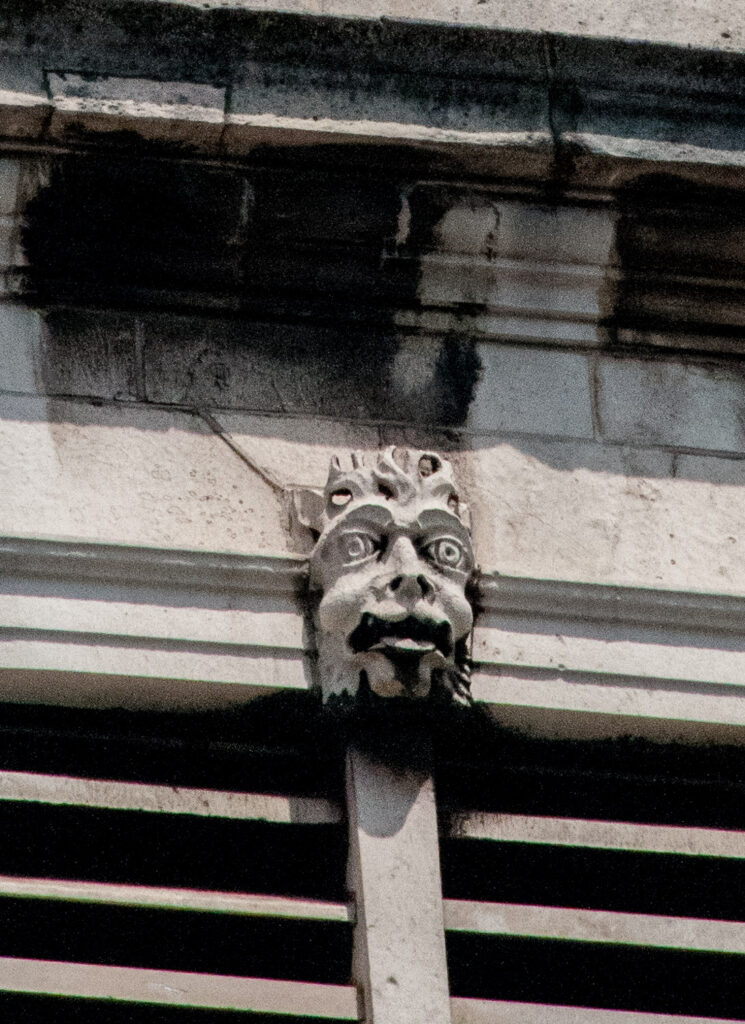
Looking up at the sky on the north east side there are some great beards on display …

And in close-up …

This is one of the Atlantes holding up the balcony. They date from 2014 when the north east pavilion was rebuilt …

In 2013 the Viaduct was repainted and re-gilded with, at the request of the City Conservation Officer, ‘maximum bling’.

You get an idea of how well this was accomplished in this picture. It shows the re-gilded base of one of the lamps, a knight’s helmet and a City dragon …

Here’s a view looking up from Farringdon Street …

There are also some elaborate metal gates …

Walking up the stairs, this old light has lost its top …

Four splendid City dragons …

This functioning light is in the rebuilt North East stair …

Attractive carvings at the South East entrance …

The North Western stair has a giant mural illustrating the Viaduct’s construction …

Work was started in 1863 and the mural reminded me of this photograph of the work in progress looking west …

Further west there is a smaller, more modest bridge over Shoe Lane and this is in grave need of some TLC. Compare this with the restored parts of the main bridge …

It illustrates what time, weather and pollution can do to the most robust of structures.

If you want to read my two previous blogs about Holborn Viaduct they can be found here and here.

Remember you can follow me on Instagram :
https://www.instagram.com/london_city_gent/

From a girl dressed as a pageboy to the Recording Angel – City Ladies in stone

Having written about City Children a few weeks ago I though it was time to look at some of the ladies portrayed in sculpture around the City. I found enough for several blogs so this is the first instalment!

Let’s start with this extraordinary statue at 193 Fleet Street now, sadly, somewhat weathered …

I always thought that it resembled a rather effeminate youth but it is in fact a woman disguised as a pageboy, her name, Kaled, appears just under her right foot.

It is by Giuseppe Grandi, and dates from 1872. The shop owner, George Attenborough, had a niche created specially for it over the front door. Kaled is the page of Count Lara in Bryon’s poetic story of a nobleman who returns to his ancestral lands to restore justice. He antagonises the neighbouring chieftains who attack and kill him. Kaled stays with his master and lover to the end, when it is revealed he is in fact a woman. She goes mad from grief and dies.

Walking further eastwards along the south side of Fleet Street you come across Serjeants’ Inn and these interesting keystones depicting a woman holding a baby, flowers and a bird (EC4Y 1AE) …

They date from 1958 and although the architects are known, Devereaux & Davis, the name of the sculptor is not (or, at least, I couldn’t discover it).

Over the original main door to the Old Bailey (EC4M 7EH) is a sinister figure, her face overshadowed by an ample hood. She is the Recording Angel, busy writing down all our deeds for God’s future reference …

To the left sits Fortitude, a female figure holding a massive and elaborate sword, and on the right Truth gazing into her mirror.

On the south pediment another woman holds a quill in one hand and in the other a closed book …

Both date from 1906 and are by the sculptor Frederick William Pomeroy as is Justice holding her symbolic sword and scales. She stands upon a globe because Justice straddles the world and although she is made of bronze not stone I couldn’t resist including her …

You may be surprised to see that she is not wearing a blindfold. I have written about her and the many other places she can be found in the City (often blindfolded) in an earlier blog entitled Lady Justice.

At 28-30 Cornhill can be found the old offices of the Scottish Widows Insurance Company (EC3V 3ND). High up the building, which dates from 1935, are two figures sculpted by William McMillan.

The one on the left holds a naked child between her knees …

… the other pours fruit and flowers from a cornucopia …

Dr Philip Ward-Jackson points out in his book Public Sculpture of the City of London that there is a striking resemblance both in iconography and style between these two figures and the so-called Lothbury Ladies. Charles Wheeler was sculpting them at the same time for the Lothbury front of the Bank of England. Here are two of them …

The children represent ‘the hope of the future of the renewed Bank and its ideals’.

The Lloyd’s Register of Shipping at 71 Fenchurch Street is worth a visit in its own right. I counted over two dozen female figures incorporated into the building’s design and here are just a few of them …

I can’t really do the sculptors justice in this blog so I will return at a later date.

Brewers’ Hall in Aldermanbury Square boasts a maiden keystone over its entrance (EC2V 7HR) …

She holds in either hand three ears of barley and forms the crest of the Brewers’ Company coat of arms. This is another work by Charles Wheeler and dates from 1960.

Walking around Finsbury Circus I looked up and saw this lady on the Lutyens designed Britannic House (EC2M 7EB). The building was originally the headquarters of the Anglo-Persian Oil Company …

Sculpted by Francis Derwent Wood in 1925, she’s a Persian Scarf Dancer.

Nearby is another work by him entitled Woman and Baby or Spring

My walk around the City looking for ladies in sculpture was really enlightening and I’ll return to the subject in a later blog.

Remember you can follow me on Instagram :
https://www.instagram.com/london_city_gent/

Page 30 of 41

Powered by WordPress & Theme by Anders Norén

Symbols & Secrets
Privacy Overview

This website uses cookies so that we can provide you with the best user experience possible. Cookie information is stored in your browser and performs functions such as recognising you when you return to our website and helping our team to understand which sections of the website you find most interesting and useful.