The latest exhibition in the Guildhall Library is well worth a visit. The first Guildhall Library was founded in 1425 with money left in the will of Richard Whittington so this year is its 600th anniversary. Over those six centuries the story of an astute late medieval merchant, politician and philanthropist evolved into a rags-to-riches tale of penniless orphan who came by wealth and fame with the help of his cat. This exhibition examines that transformation, featuring chapbooks, children’s books, works relating to pantomimes and of course cats …
Entry is free and you get, not only an excellent printed guide, but also a very informative booklet about the man and the myth written by Assistant Librarian Ann Martin …
The printed guides are complemented by panels which tell Whittington’s story in more detail along with helpful illustrations …
A cache of over 300 books, toys, puzzles, theatre programmes and lantern slides — themed around the man who was Lord Mayor of London four times — was bequeathed to the Guildhall by Ellery Yale Wood, the prolific children’s book collector. Wood had been collecting the items for decades, storing them in her home in Wisbech, Lincolnshire, which had a warehouse attached to house her staggering collection of children’s books. Most of the items in the exhibition come from this collection.
Here are some of the treasures on display.
‘An old ballad of Whittington and his cat’ printed between 1754 and 1780 in Aldermary Church-Yard …
Three histories of Whittington printed and sold c. 1790. The one on the right includes ‘… the adventures of his cat’ :
One of my favourites …
The cat case …
Such a diverse collection …
An ‘untearable’ children’s book from 1860 …
In Pantoland!
A shaped German book from the 1940s …
The story in three dimensions …
It’s a fabulous exhibition, my pictures illustrate only a tiny part of it. But hurry along if you want to visit, it closes in a few weeks on 21 August.
One of the great pleasures of writing this blog is that every now and again I get a nice surprise. In February of this year I wrote about the wonderful terracotta frieze on Cutlers Hall …
Subsequently, I received a kind invitation from Richard Herbert, a Past Master of the Cutlers’ Company, to visit the Hall and have a tour. We finally managed to get together last week and here’s my report.
At the front door I encoutered two of the literally hundreds of elephants that seem to occupy almost every corner of the building (including the soft furnishings!)
The cosy welcoming lobby …
Cutlers are known to have been practising their craft in London from at least the 2nd or 3rd century AD. Indeed, the word ‘cutler’ is derived from the Latin ‘cutellarius’ through the Old French ‘coutelier’ and signifies a maker or seller of knives and weapons with a cutting edge. Although cutlers traded in all manner of cutting instruments, it was their skill at producing fighting weapons that brought them wealth and prosperity. From earliest times until the end of the 16th century, with wars in France and internal civil wars, the demand for edged weapons was both constant and profitable. Only later did the emphasis shift from implements of war to cutlery and other domestic wares such as razors and scissors.
On 4th December 1416, the year following the battle of Agincourt, Henry V granted to the Company its first Royal Charter. This can be no coincidence, for the King had assembled his army in haste, and this was the only Livery Company to which he granted a Charter. One can speculate that the grant may have been made in part payment for arms supplied.
Stained glass in the entrance hall representing the granting of the Charter …
The Company continued to prosper, and in 1515 it was ordained that they should be placed 18th in the order of precedence of the City Companies, where they remain to this day. Over the years various monarchs have cancelled and reissued the Charter; the one under which the Company operates today was granted by James I in 1606 …
A ‘House of the Cutlers’ was recorded in 1285, just off Cheapside. By the early 15th century they had moved to a building on Cloak Lane, near Cannon Street. In 1660 their hall was in dire need of a rebuild, therefore the money was raised and the hall rebuilt on the same site. The final bills were paid in June 1666 only for the hall to be destroyed in the Great Fire of London three months later
Rebuilding started once again and the next hall was finished in 1670. Their bad luck continued however as, in 1882, the site was compulsorily acquired by the Metropolitan and District Railway Company and the hall was knocked down. This is when they moved to their current site and had their new hall built. The new Hall was designed by Mr. T. Tayler Smith, the Company’s Surveyor, and came into use on March 7th 1888. Above the door is the Cutlers’ Company French motto – To Succeed through good faith …
The coat of arms displays three sets of crossed swords, a reference to their trade …
At the top is an elephant with a castle on its back. This is a heraldic symbol representing strength, but also a nod to the ivory that would have once used in the handles of their cutlery. Thankfully, of course, the use of ivory today is illegal.
Their string of bad luck fortunately came to an end in World War Two. The Hall amazingly managed to survive the bombs of the Blitz that flattened much of the area around it. It was more or less just Cutlers’ Hall and St Paul’s Cathedral that survived in this corner of the City. A high explosive bomb did destroy the entire building next to it on the 10th May 1941, bringing down the hall’s North wall. The damage however was repaired and the hall brought back into use …
My tour of the building was conducted by Beadle Tiago Lucas whose enthusiasm and vast knowledge of the building and the Company made this a real treat. Space doesn’t allow me to repeat all I saw and learnt here so here are some highlights.
Every December brings the traditional ‘Feast of the Boar’s Head’, commemorated here in this painting …
… and by this chap who greets you on the way up the stairs …
At the foot of the stairs …
The Hall is home to a number of very interesting collections.
Graham duHeaume excavated nearly 900 knives from the foreshore of the River Thames between 1970 and 1986. He generously donated the bulk of his collection to the Company in 2020 …
Examples of beautifully carved handles and, in the drawers beneath, the Company also possesses a fine collection of City of London, Livery and Guild-related medals and badges from their origins in the 17th. century to the present day …
You can view the collections in detail online here.
Swords belonging to Viscount Montgomery of Alamein and The Duke of Cambridge …
Along with the latter’s interesting history …
A sword, said to have belonged to the son of King Edward III – Edward of Woodstock – better known as The Black Prince …
The magnificent Livery Hall, its main feature being its Victorian hammer beam roof …
Mounted high on the end wall above the canopy hangs a Barge Banner used for the Lord Mayor’s procession in 1763 when the Lord Mayor was Alderman Bridgen, a Cutler. The banner depicts the Arms of the Company and the City, Britannia, the Wand of Mercury, Roman Fasces and the Wand of Aesculapius …
The representation of the Stuart Arms is believed to date from about 1670-88 and to have been carved by a contemporary of Grinling Gibbons, who for a time resided in the Company’s premises at the ‘Belle Sauvage’ Inn on Ludgate Hill …
The hall has a fantastic selection of stained glass, for example cutlers going about their trade …
And Masters’ Coats of Arms from earlier Halls …
Right back to the seventeenth century, in fact …
Along with some vandalism, where an 18th century member has scratched his name on the glass, maybe using a diamond on a ring …
Not to be forgotten is the fact that charitable giving is an incredibly important part of the Company’s overall purpose and you can read more about this here. Also, you can use this link to read more about the annual Contemporary Cutlery Design competition along with images of winning designs. My favourite is the 2021 winner Hand by Anli Hou …
I enjoyed my visit enormously. The relatively small size of the Hall means it manages to perform a difficult trick. It is not only friendly and intimate, but also suitably impressive, representing the long and prestigious history of the Company.
You can read more about the Company and the Hall (which is available for hire) here.
If you would like to follow me on Instagram here is the link …
I first wrote briefly about this building in June 2020 saying that I would return later to write more and I have finally got around to it!
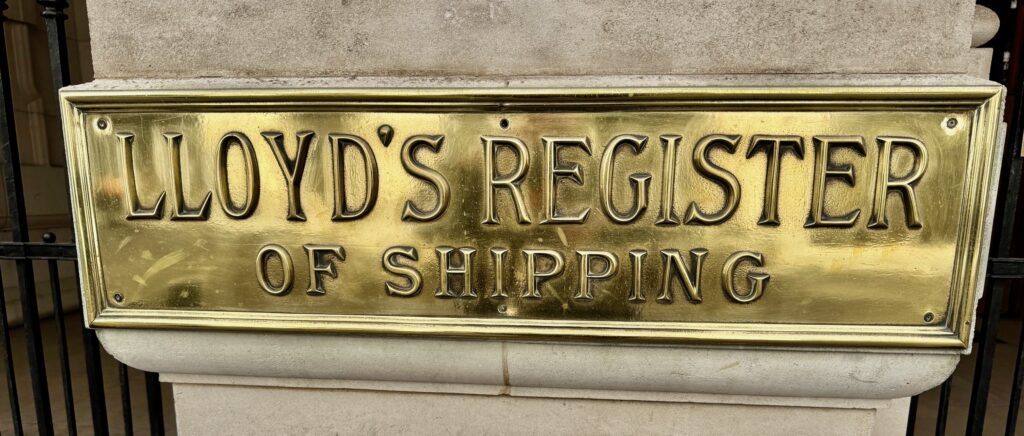
Lloyd’s Register began as The Society for the Registry of Shipping in 1760. In that year, eleven men met in Edward Lloyd’s coffee house to talk about publishing a list of ships, a register to define their quality and safeguard life and property carried on them. Much of the Register’s history, including its origins, has been preserved in the organisation’s Archives which contain over 1.1million digitised and catalogued assets including ship plans and surveys.
It has now eveolved into a charity, the Lloyd’s Register Foundation, whose objectives remain the same as those of Lloyd’s Register: to protect people from harm and to ensure the infrastructure that we depend on for day-to-day living is safe for society both now and in the future. The Foundation also strives to provide the right skills and education to achieve these objectives.
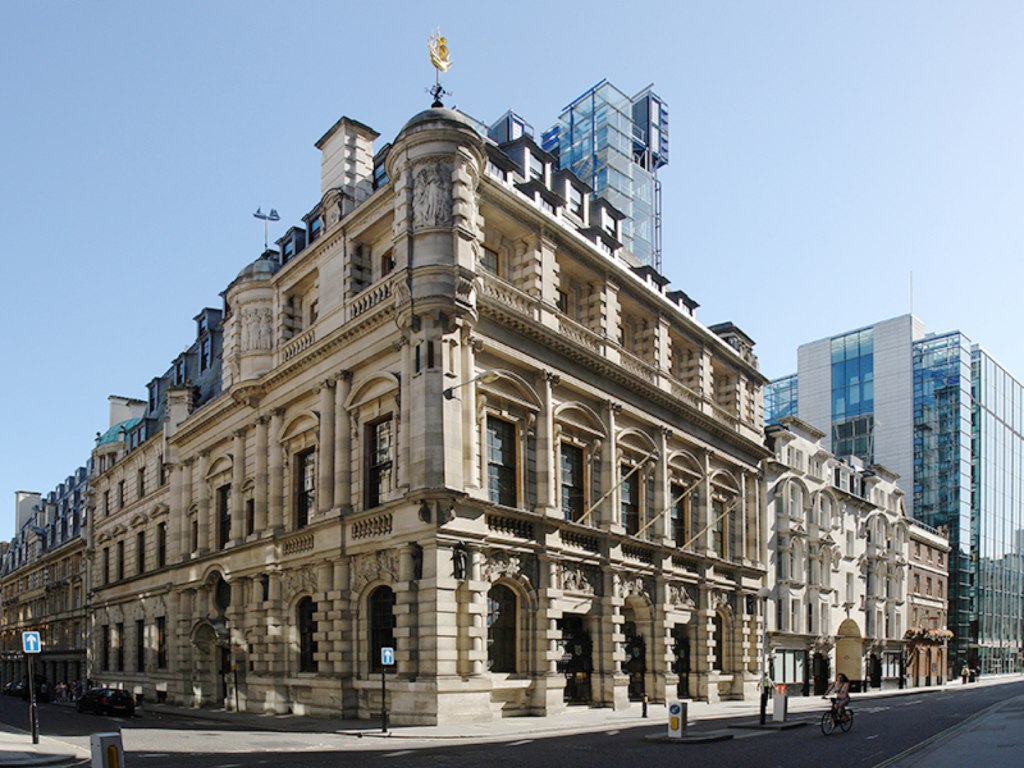
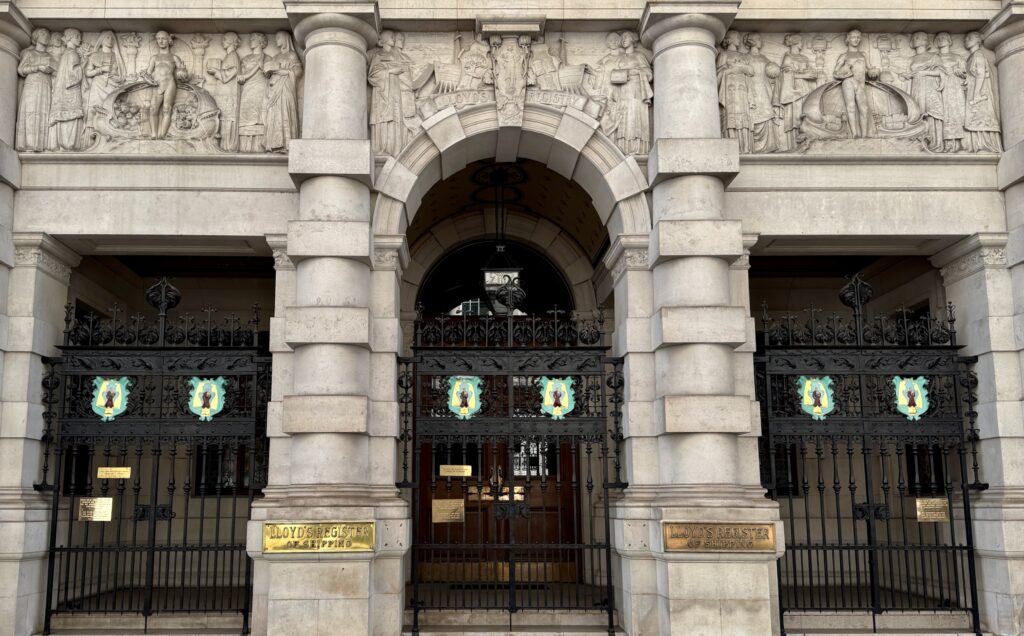
It can be found at 71 Fenchurch Street, EC3M 4BS on the corner with Lloyd’s Avenue …
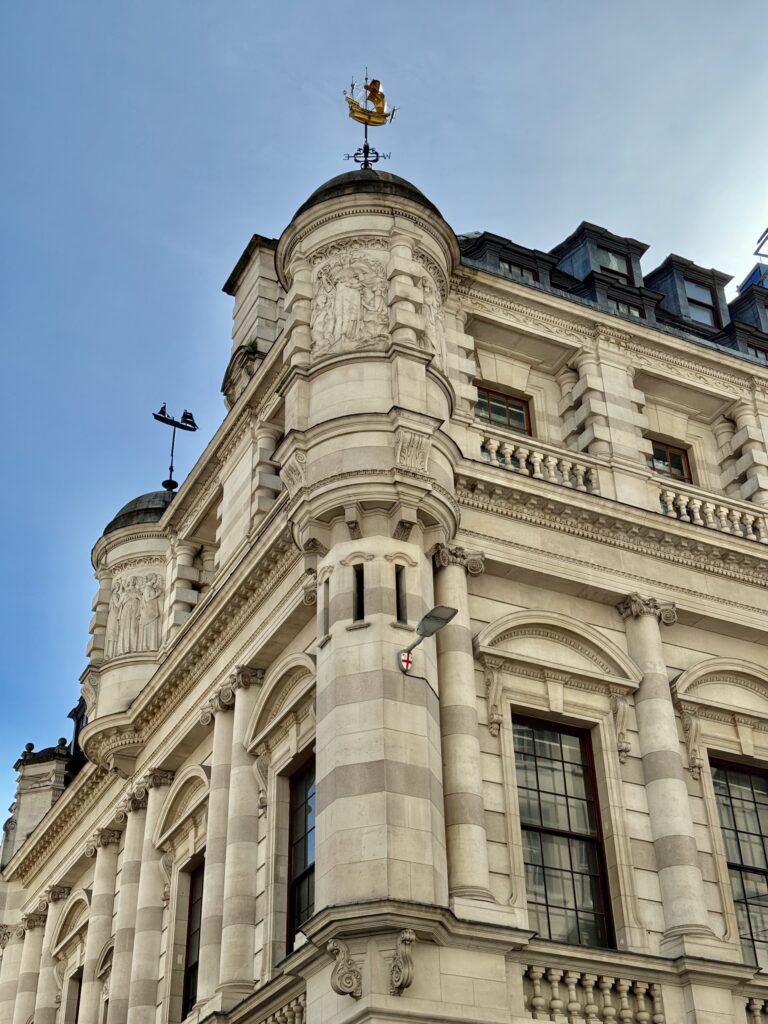
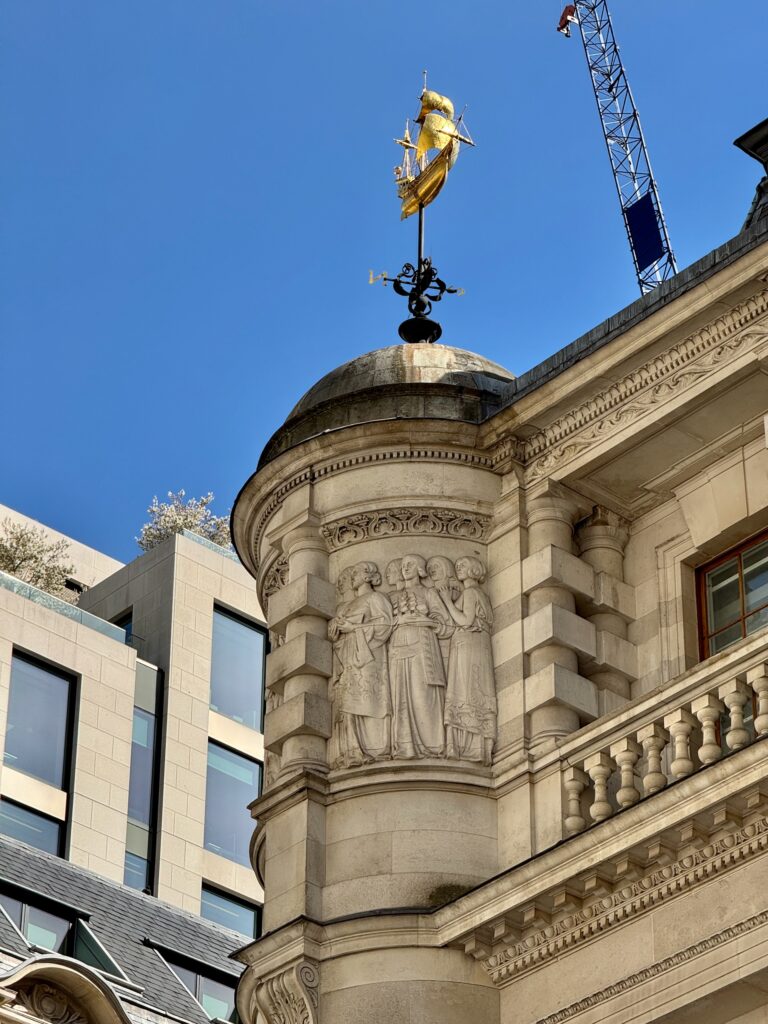
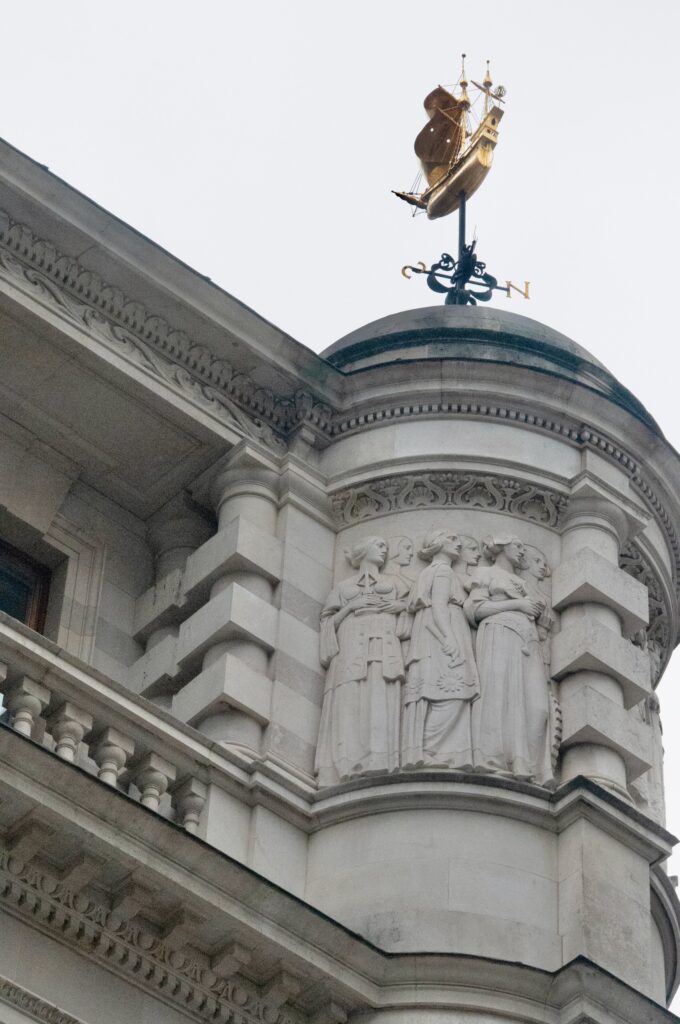
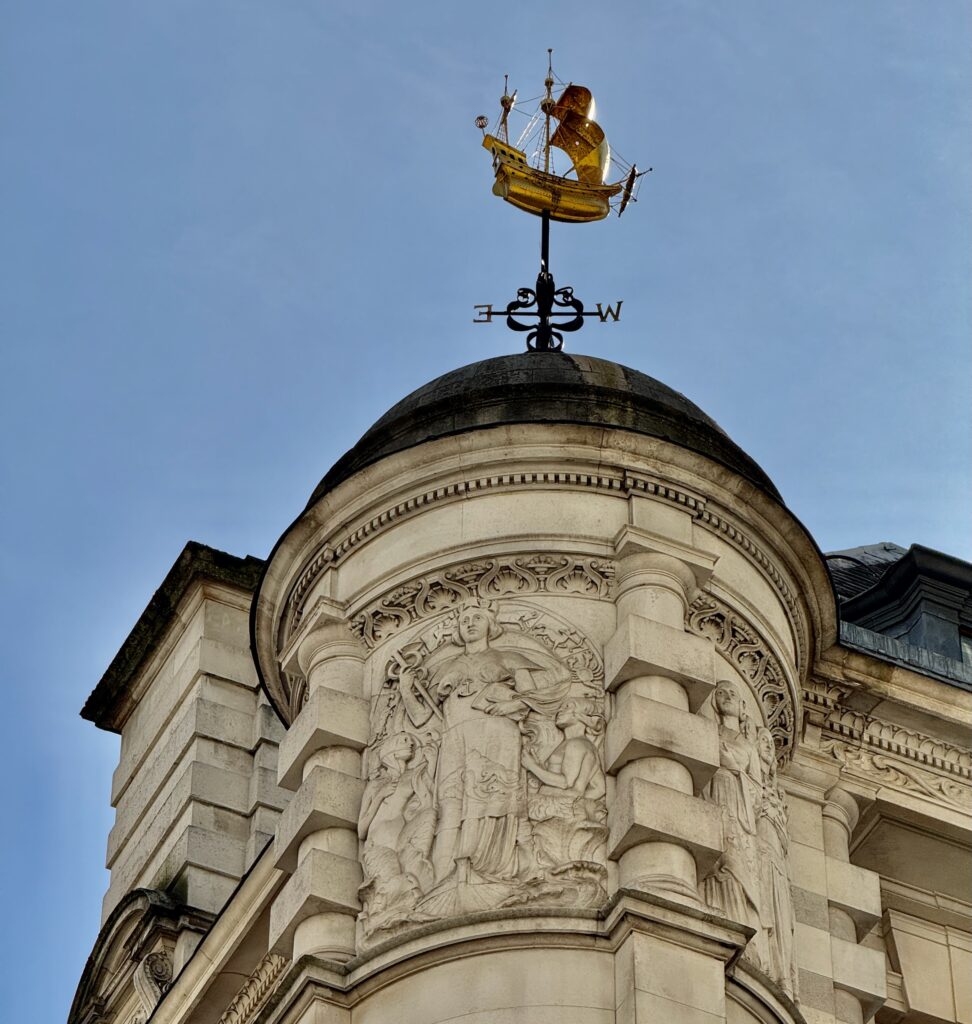
The north and south turrets …
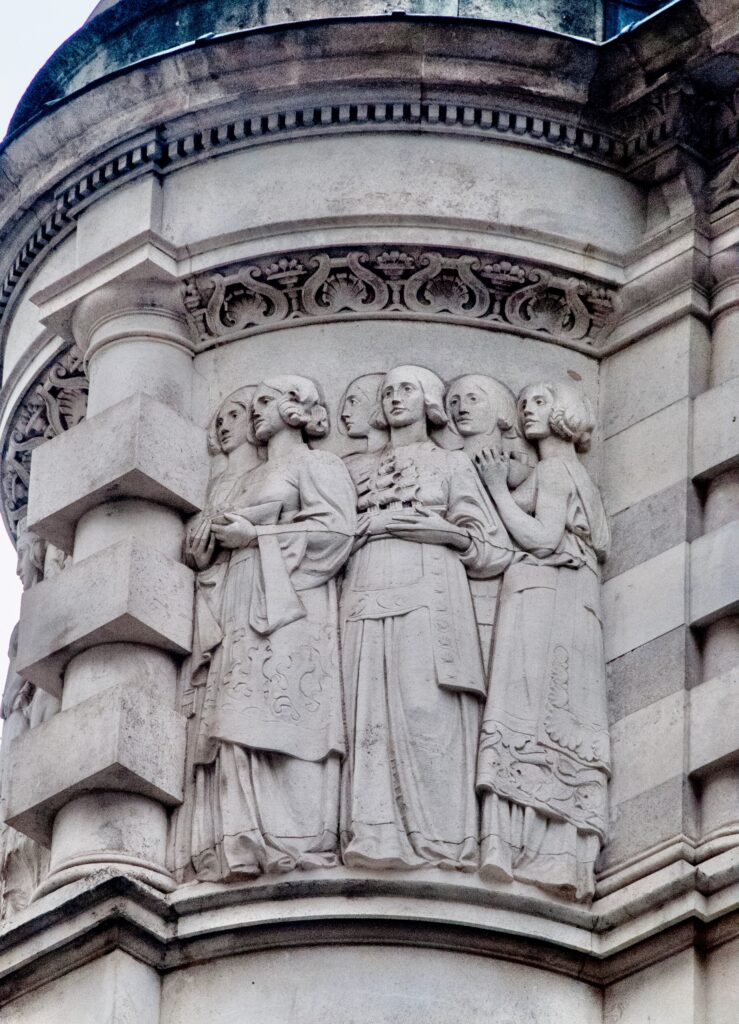
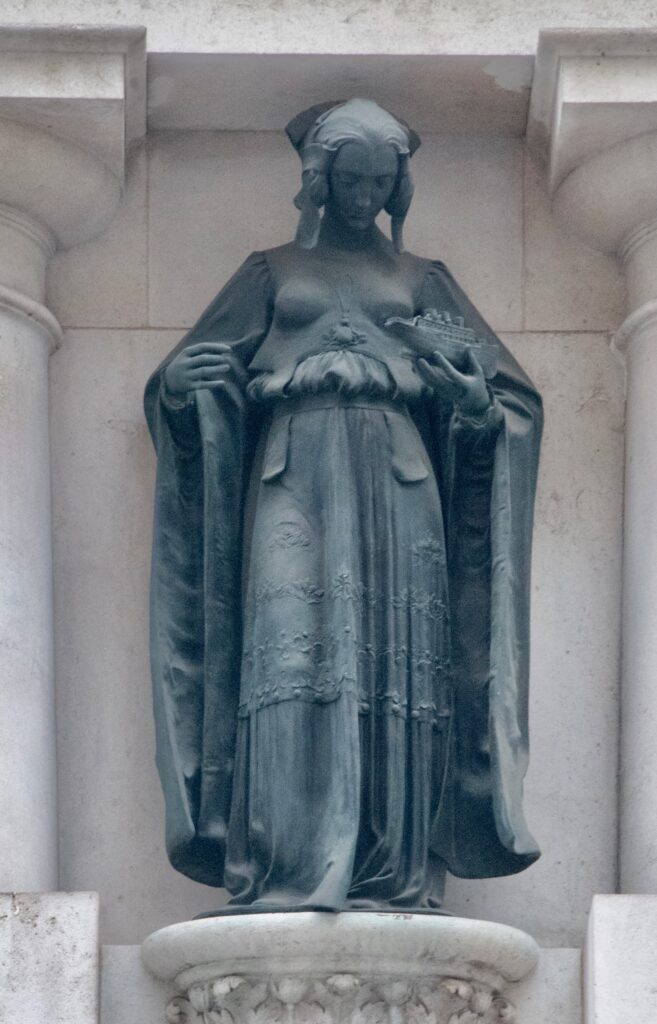
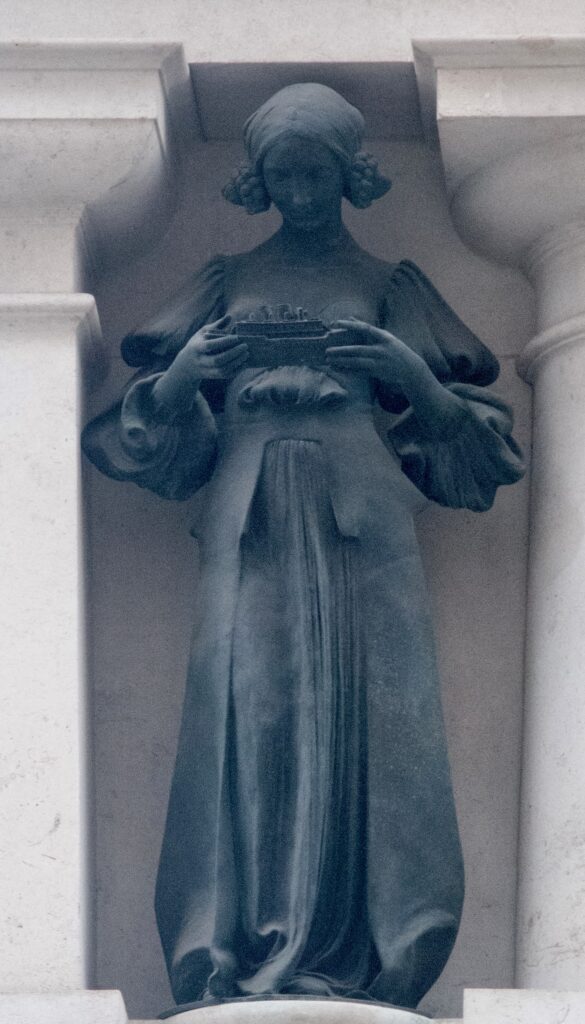
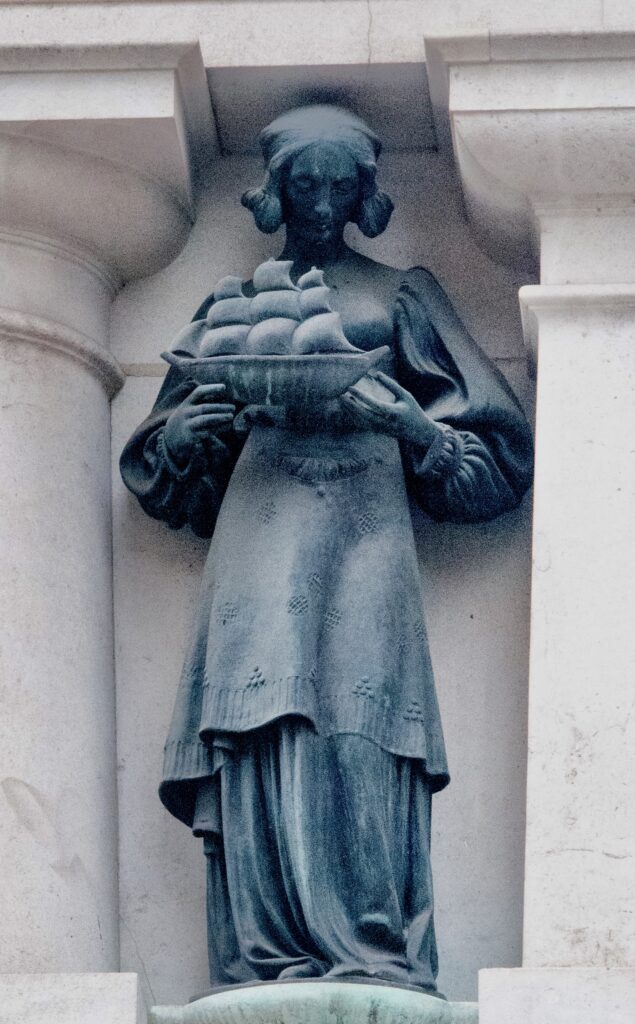
There are numerous maidens holding models of different types of vessels …
The second maiden from the left holds the model of a steamship whilst the figure immediatly behind her holds a model of a galleon …
This panel also contains six maidens. Those in the foreground hold a ship’s telegraph, a hammer and a propeller. A cog or ratchet wheel emerges behind the leg of the right-hand figure …
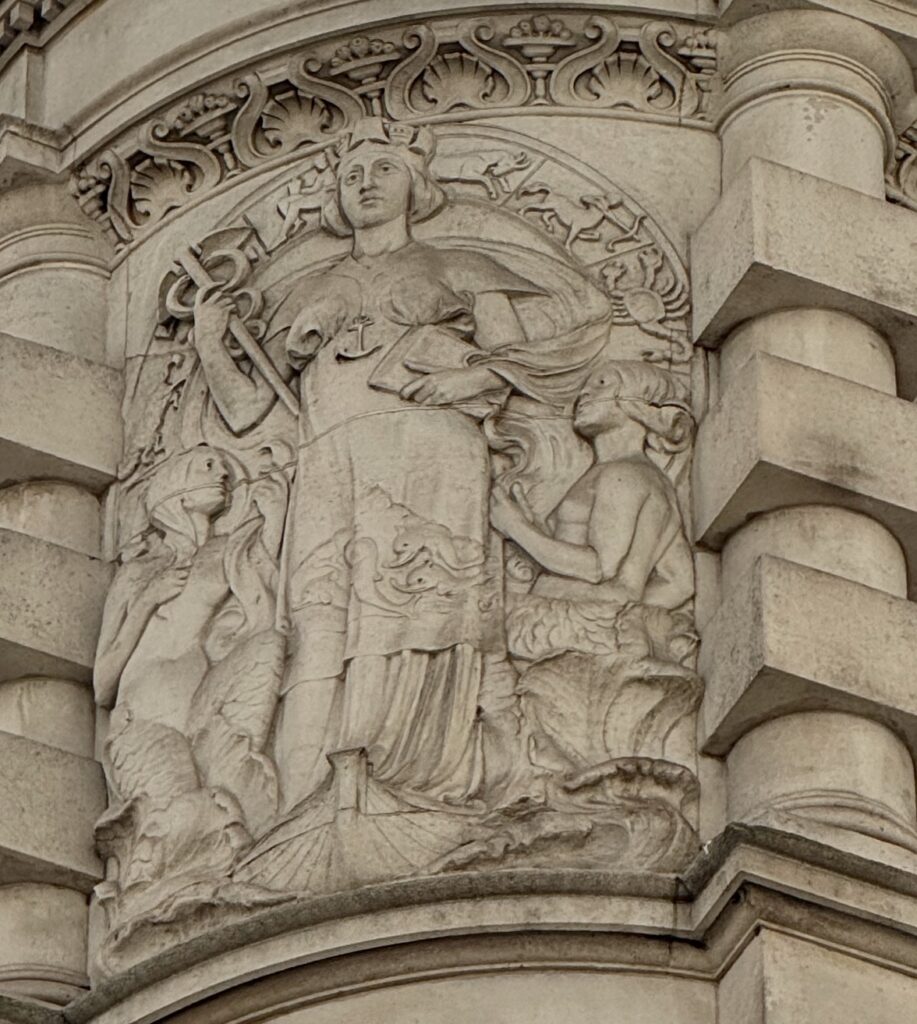
The central panel contains a standing female personifying Lloyd’s. She wears a crown of sails and stands on a ship’s prow, holding in one hand a caduceus, in the other a book. Behind her is a Zodiacal sphere, and to either side of her are two mermaids ..
A series of bronze maidens holding model ships …
The impressive entrance …
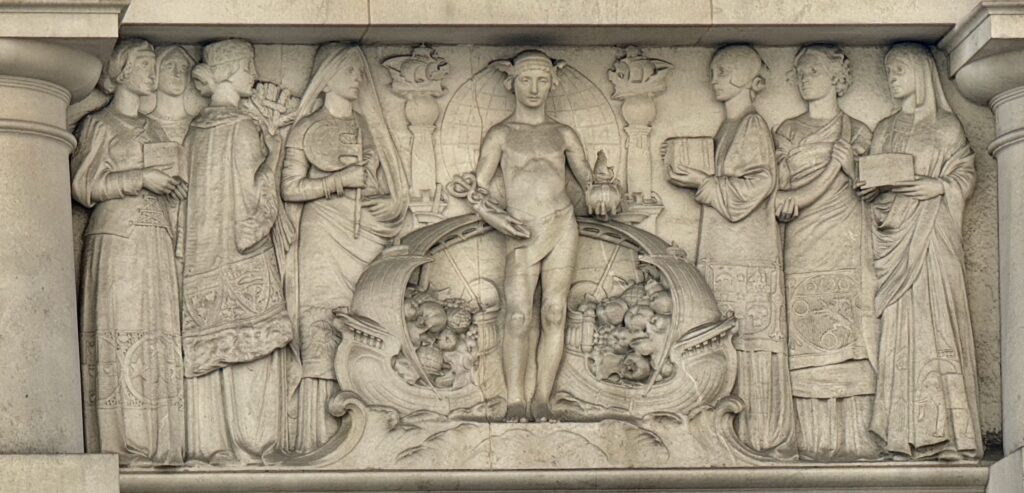
The panel on the left may represent ‘Trade’. At the centre stands a naked youth, wearing mercury’s winged bonnet and holding the caduceus in one hand and in the other an orb surmounted by a galleon …
At his feet are waves bearing a symmetrical arrangement of sailing-ships laden with exotic fruit. Behind the youth is a representation of the globe. Four maidens stand to the left and three to the right, some wearing ethnic costume. One holds an elephants tusk, another a sheaf of corn. An Indian woman holds a war axe whilst the remainder hold closed caskets.
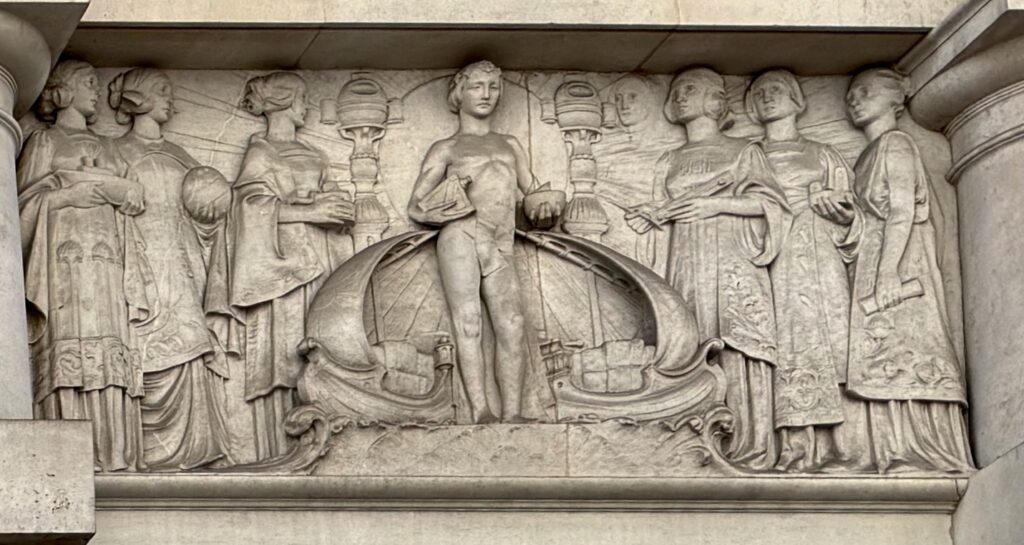
In the panel on the right there is at the centre another naked youth holding a sextant and a compass …
At his feet are waves bearing a symmetrical arrangement of sailing ships laden with packages. Behind the youth is the sun, its rays projecting to form a pattern in the background. The sun is flanked by ornamental columns, with compasses at the finials. There are three maidens on the left and four on the right, carrying navigational instruments, a globe and the model of a ship.
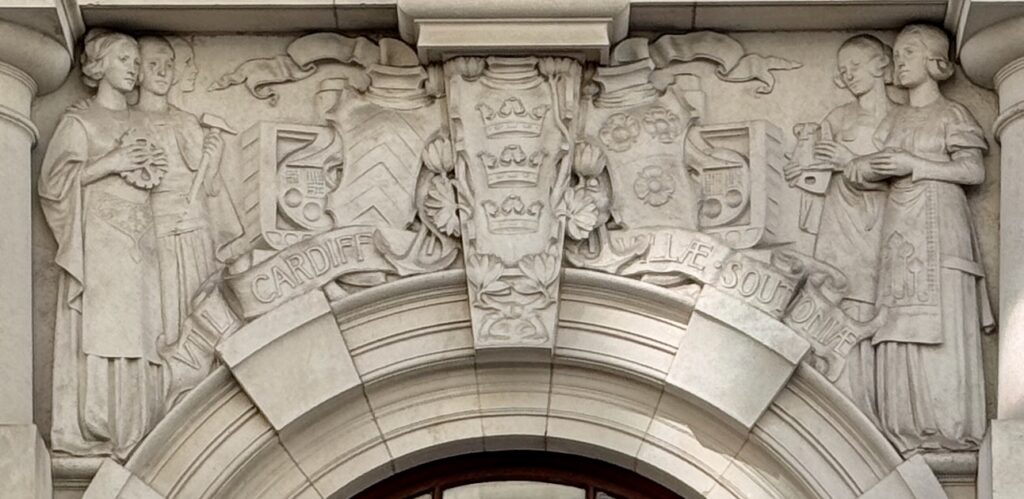
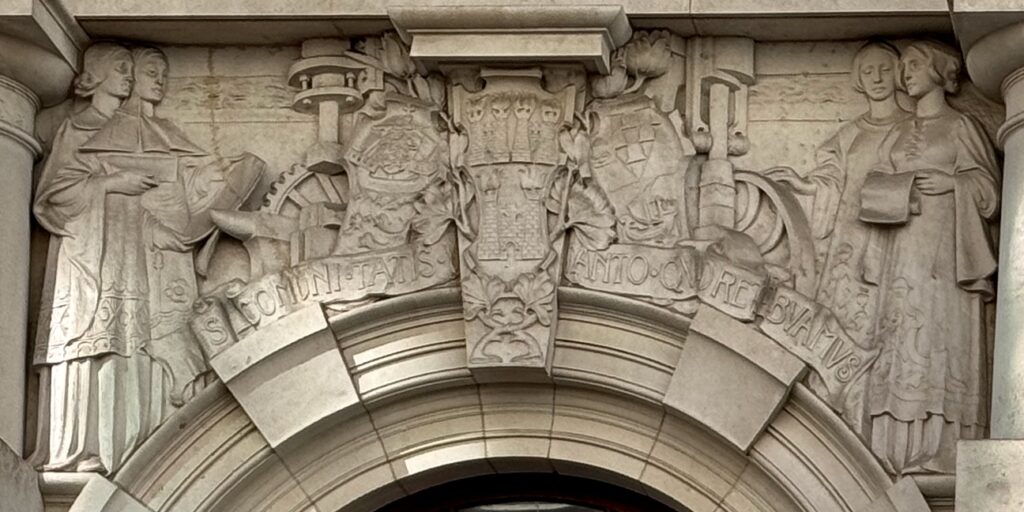
The spandrel above the right hand window on Lloyd’s Avenue. At the centre, from left to right, are the Arms of Cardiff and the words VILLÆ CARDIFF, the Arms of Hull, and the Arms of Southampton, with the words VILLÆ SOUT(HAMP)TONIÆ …
Flanking these are cross-sections of the engines of steamships and pairs of maidens to either side, holding tools and navigational instruments.
Above the left hand window …
At the centre, from left to right, the coat of arms of an unidentified towm, with motto …S…COMMUNI.TATIS V, followed by the Arms of Dublin and the Arms of Belfast with its motto (PRO) TANTO QUID RETRIBUAMUS, surrounded by a trophy of machinery connected with shipbuilding. Pairs of maidens to left and right hold plans and a model of a steamship.
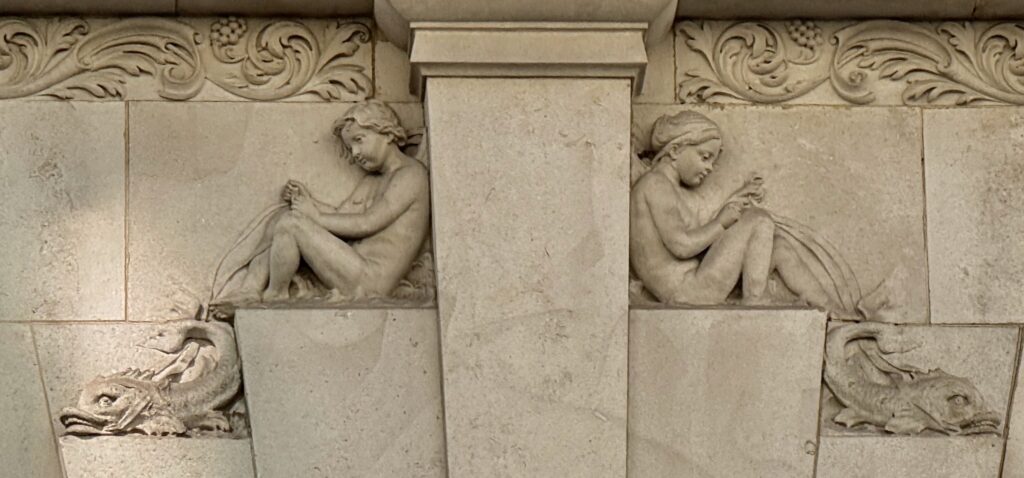
There are also some amusing figures nearby, children playing with dolphins on a leash …
I haven’t been able to capture all the great aspects of this building, so I do recommend a visit, particularly on a sunny day …
In my descriptions, I am extremely grateful to Dr Philip Ward-Jackson and his comprehensive guide Public Sculpture of the City of London from which I have quoted extensively.
Some miscellaneous news and images.
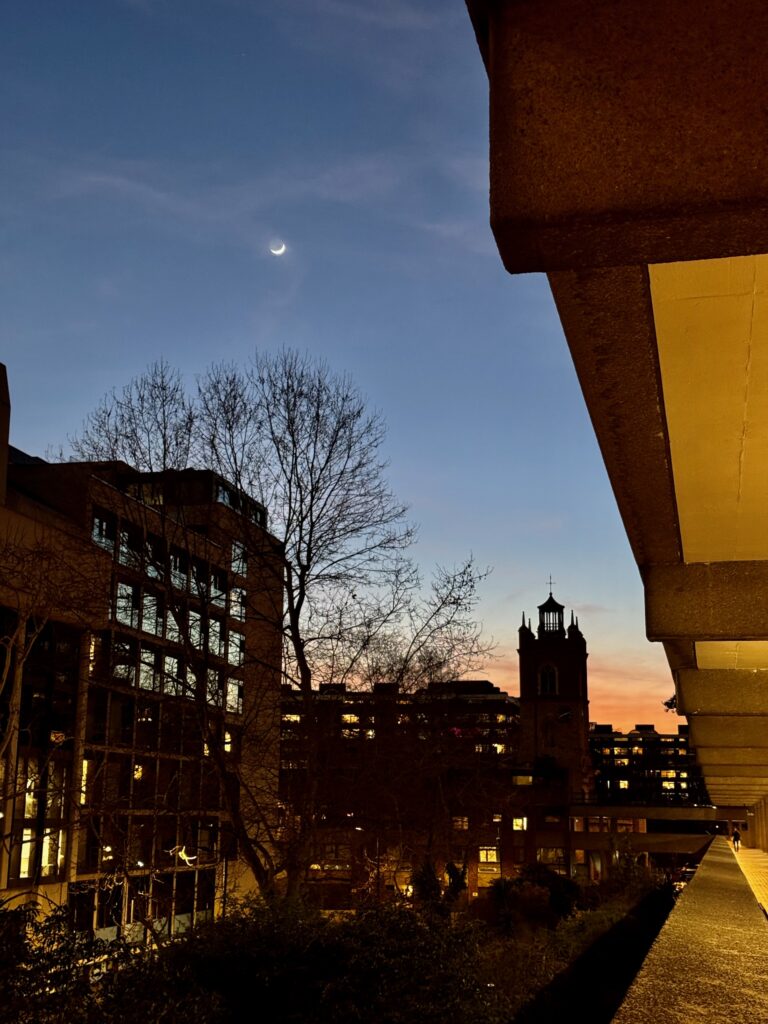
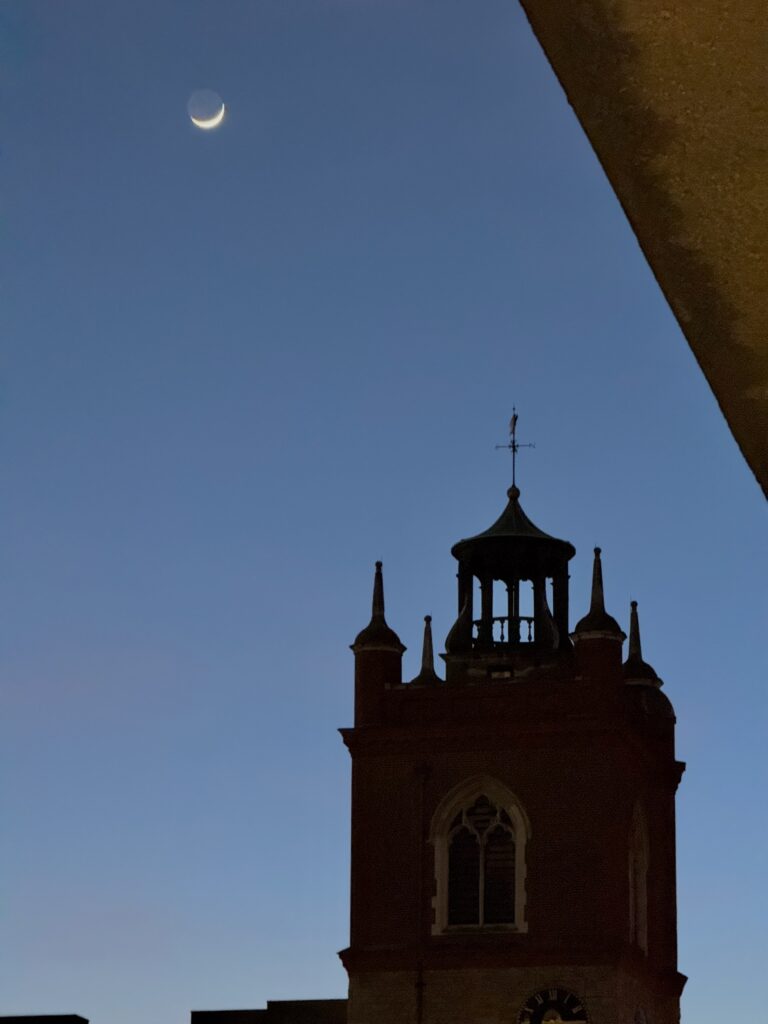
New Moon above St Giles …
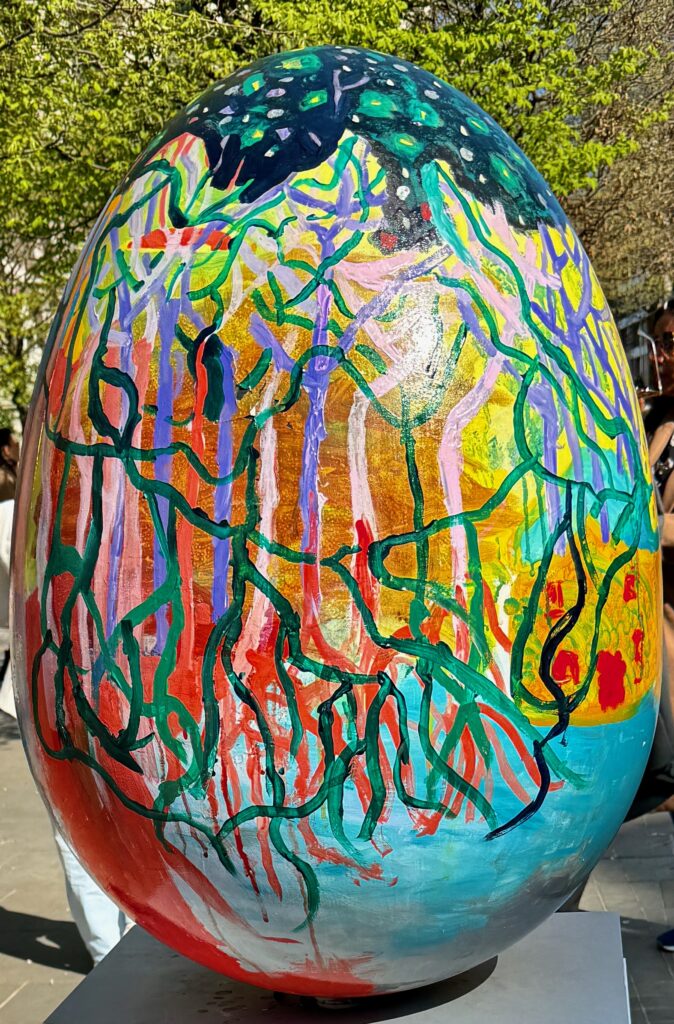
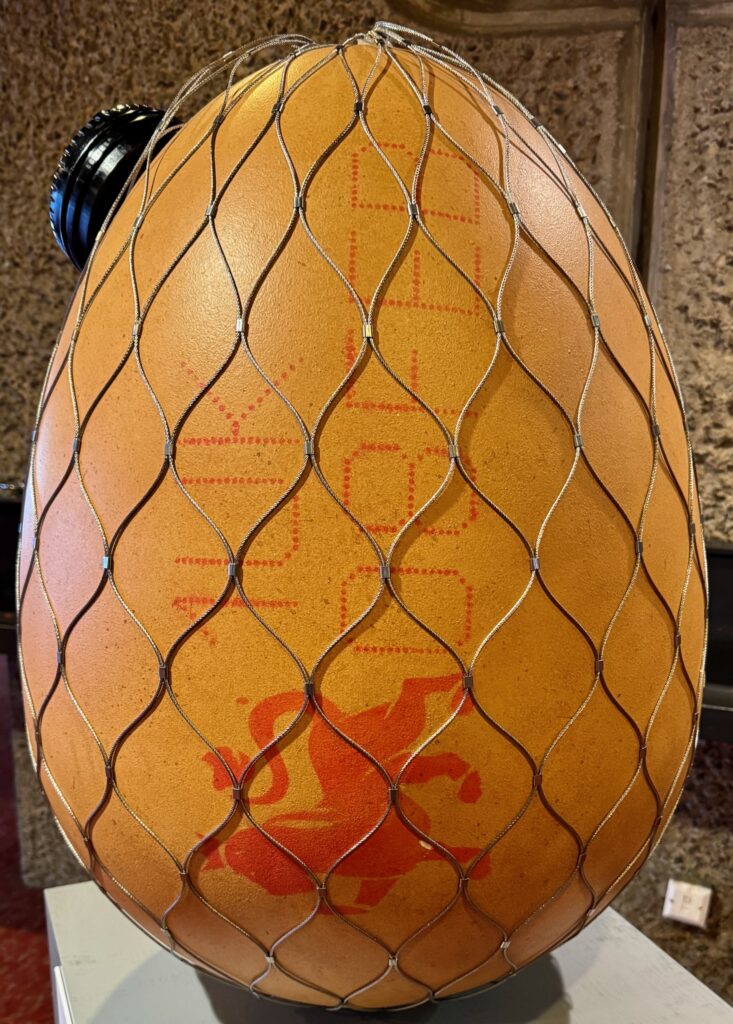
The Big Egg Hunt is on in the City (these two are at Aldgate and Barbican respectively) …
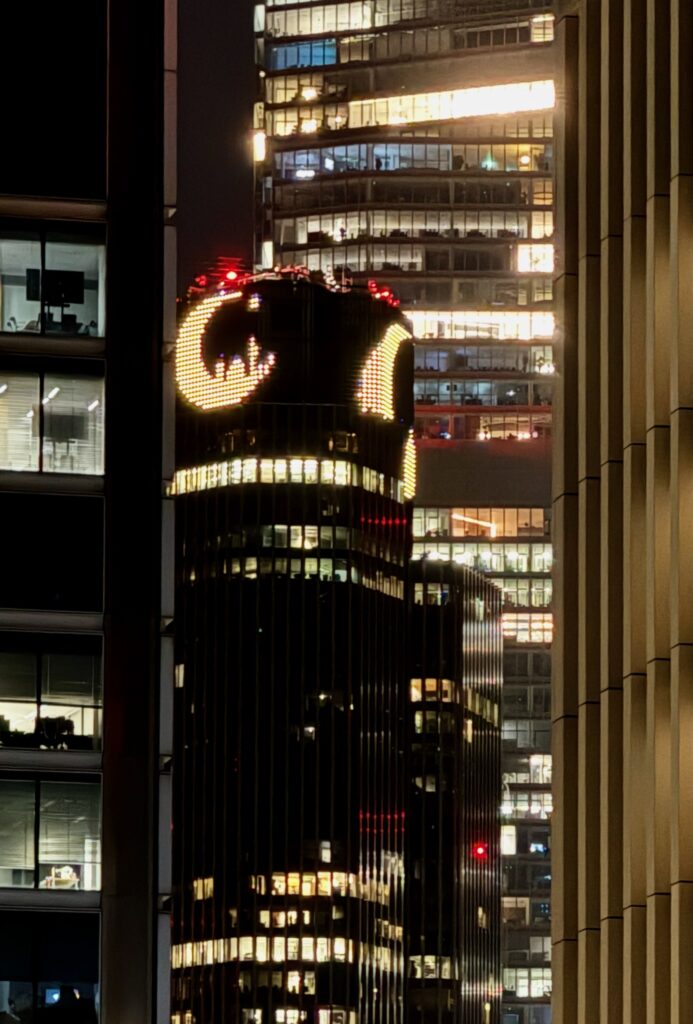
There’s a new image on the Tower 42 screen (but so far I haven’t been able to find out what it’s about – maybe something to do with Turkey?) …
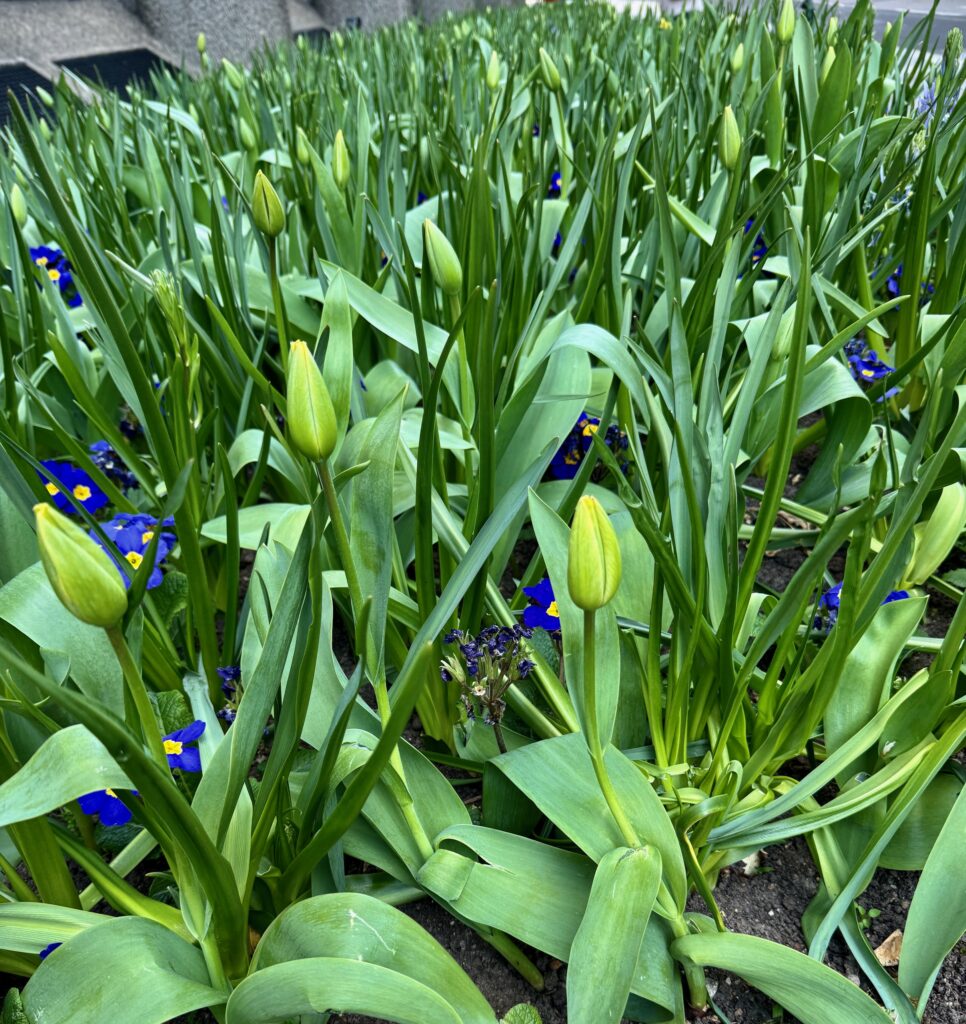
Tulips are emerging in the Silk Street beds, hooray …
And, in the middle of them, a Camassia. Maybe from last year …
If you would like to follow me on Instagram here is the link …