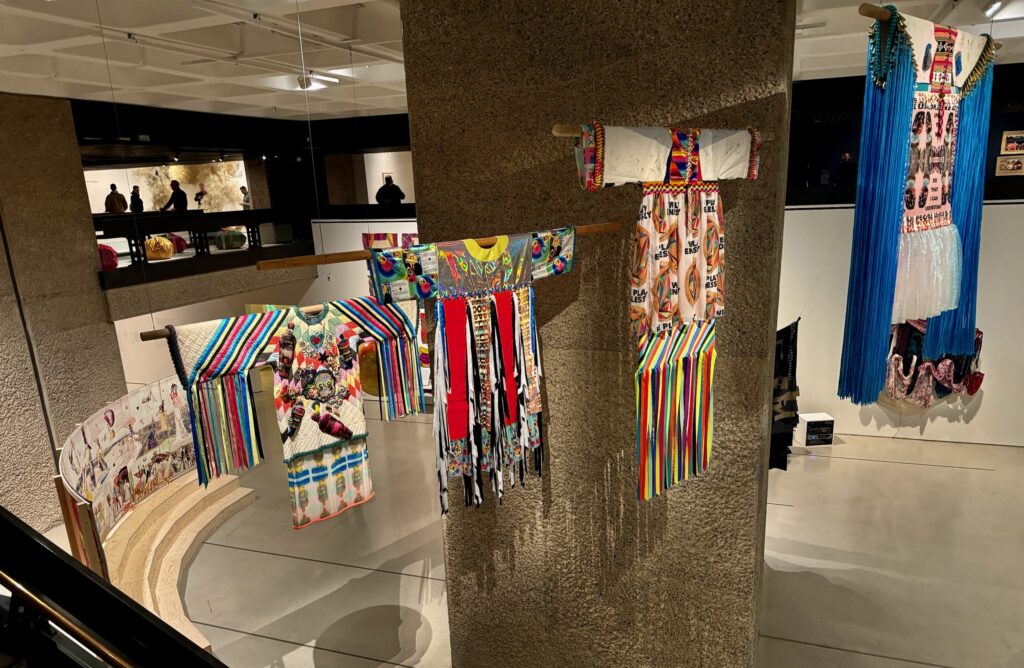
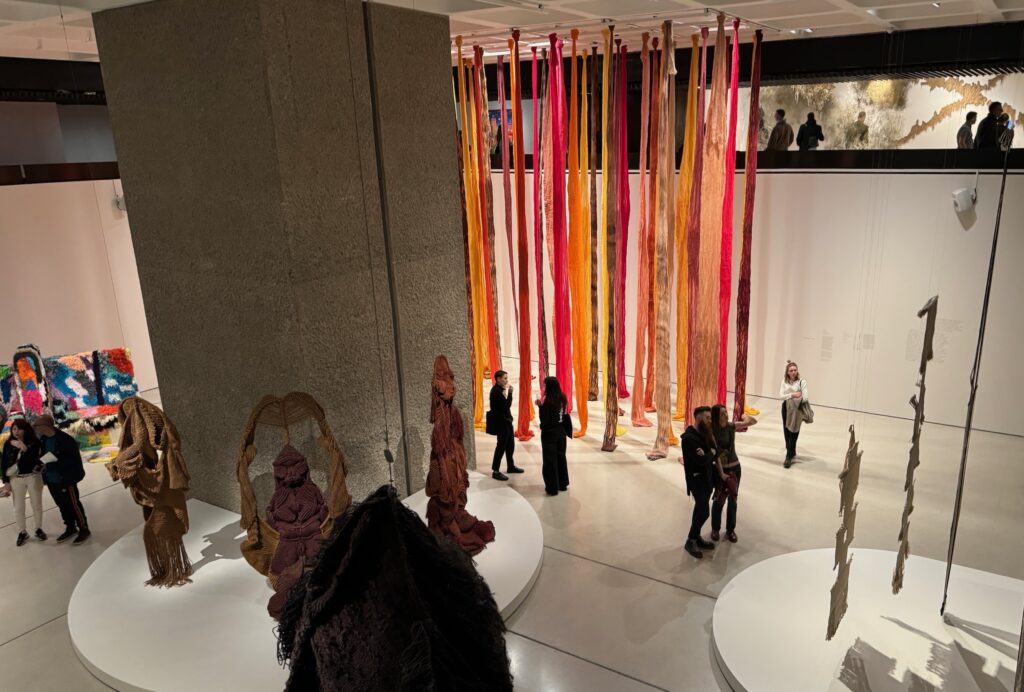
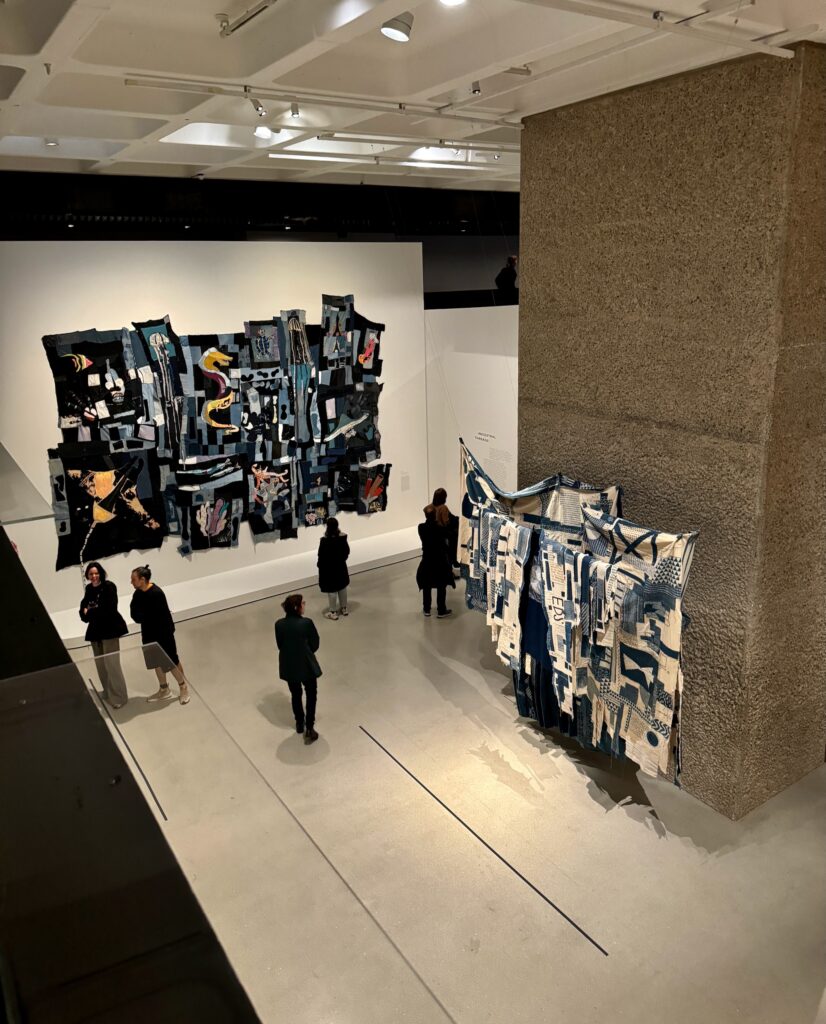
Until 26th May 2024, Unravel: The Power and Politics of Textiles in Artshines a light on artists from the 1960s to today who have explored the transformative and subversive potential of textiles, harnessing the medium to ask charged questions about power: who holds it, and how can it be challenged and reclaimed? Spanning intimate hand-crafted pieces to large-scale sculptural installations, this major exhibition brings together over 100 artworks by 50 international practitioners. Drawn to the tactile processes of stitching, weaving, braiding, beading and knotting, these artists have embraced fibre and thread to tell stories that challenge power structures, transgress boundaries and reimagine the world around them.
This review summed it up nicely for me -‘hybrid, heterodox, filled with strangeness and anger and beauty and horror, Unravel at the Barbican is often gorgeously excessive, at other moments quiet and private, not giving up its secrets until you linger’.
An extraordinary experience – not at all what I expected and highly recommended. I really wanted to ignore the ‘Do Not Touch’ signs!
Here are some of the images I took when I visited last Saturday.
Views from the upstairs gallery …
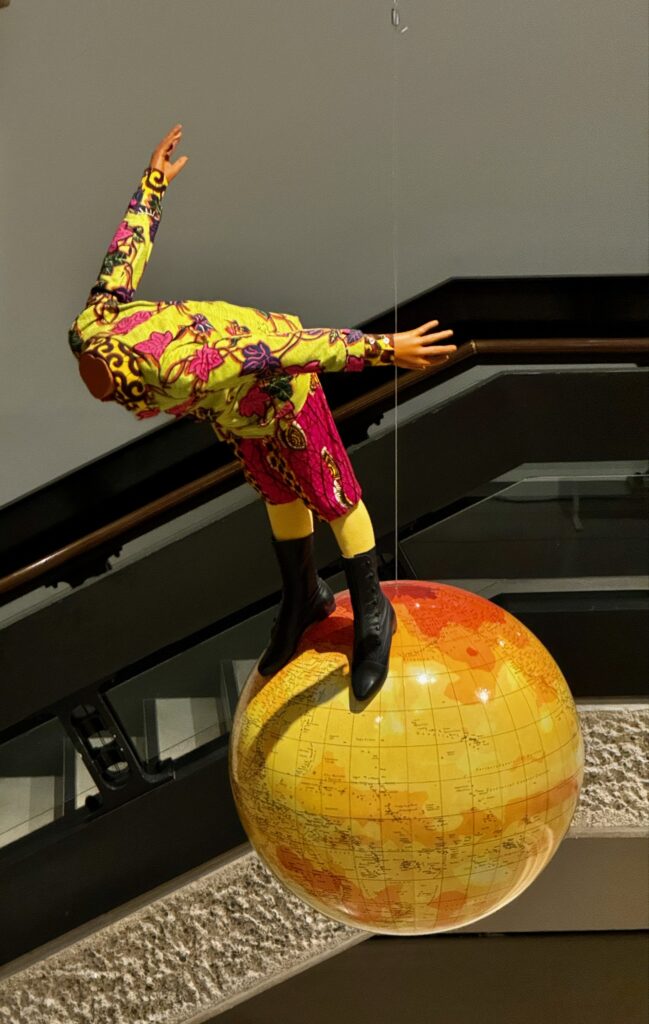
Yinka Shonibare’s figurative sculpture Boy On A Globe uses his signature Dutch Wax fabrics to address race, class and the legacy of imperialism by reflecting on colonial trade and the entangled economic histories embedded within fabrics …
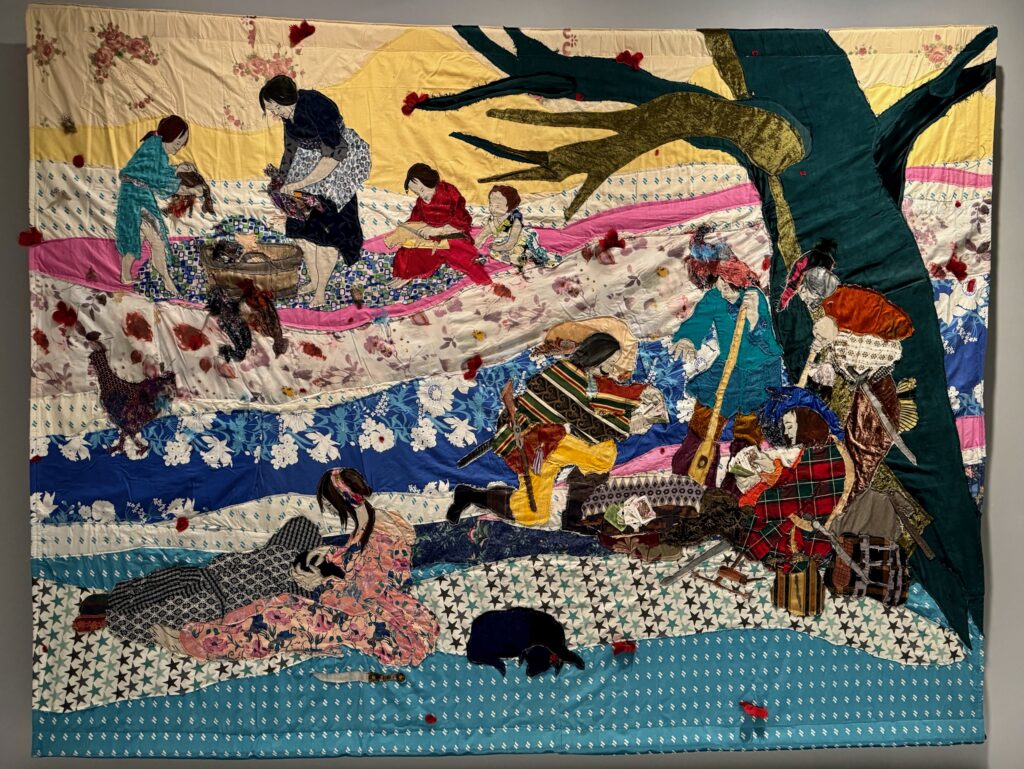
Hannah Ryggen’s Blut im Gras (Blood in the grass), 1966, protests against the US war in Vietnam. The then-US president Lyndon B. Johnson is depicted here nonchalantly wearing a cowboy hat …
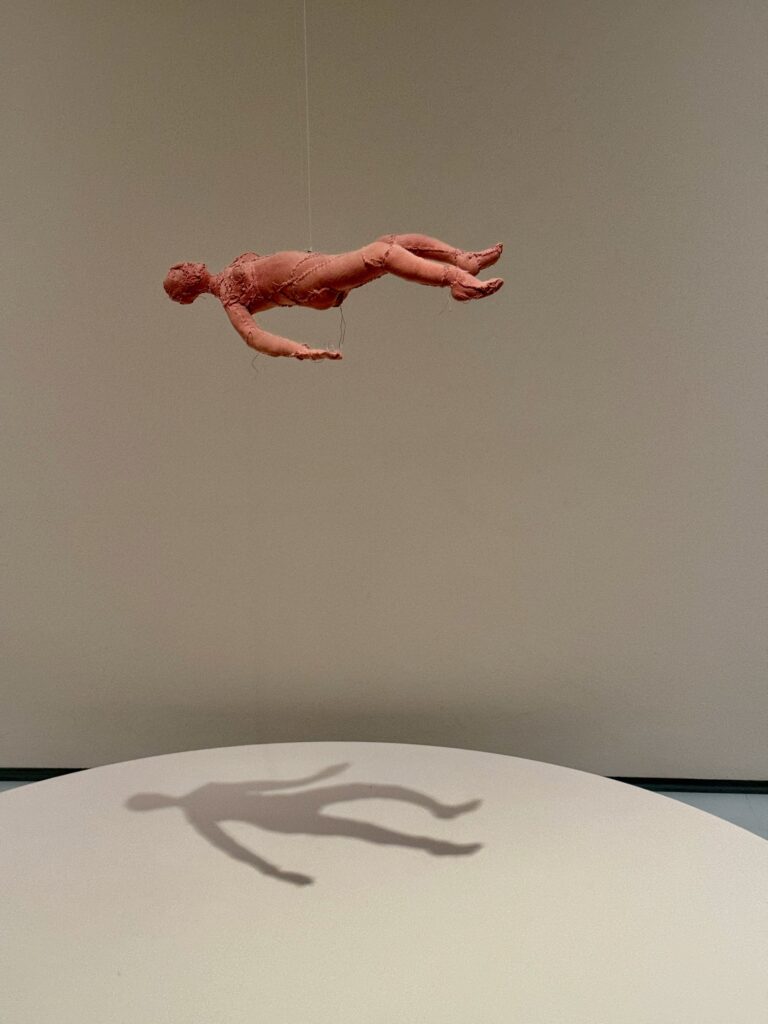
Arch of Hysteria by Louise Bourgeois uses a textile doll or model to convey a psychic experience of pain …
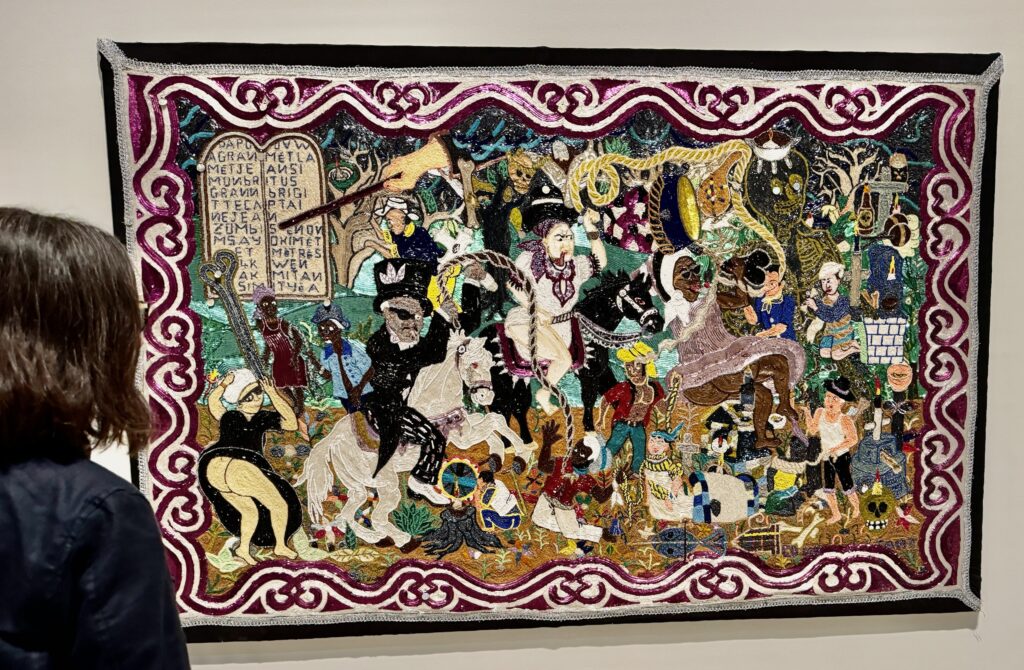
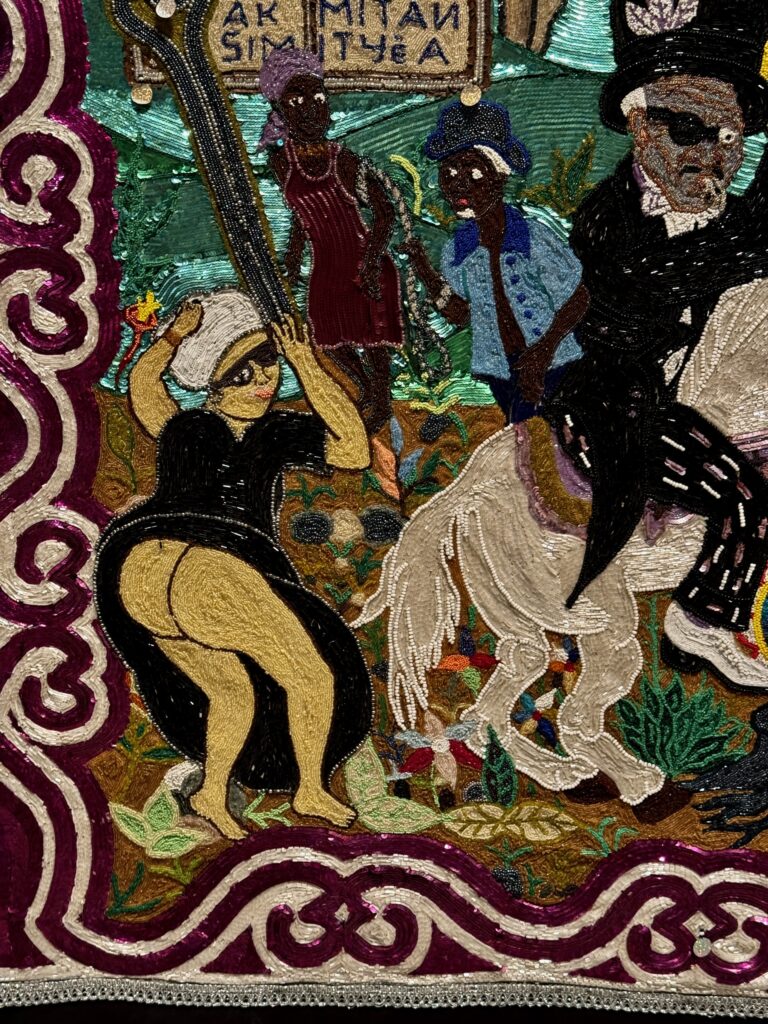
Myrlande Constant’s tapestries are drawn from Haitian Vodou traditions, her father was a Vodou priest …
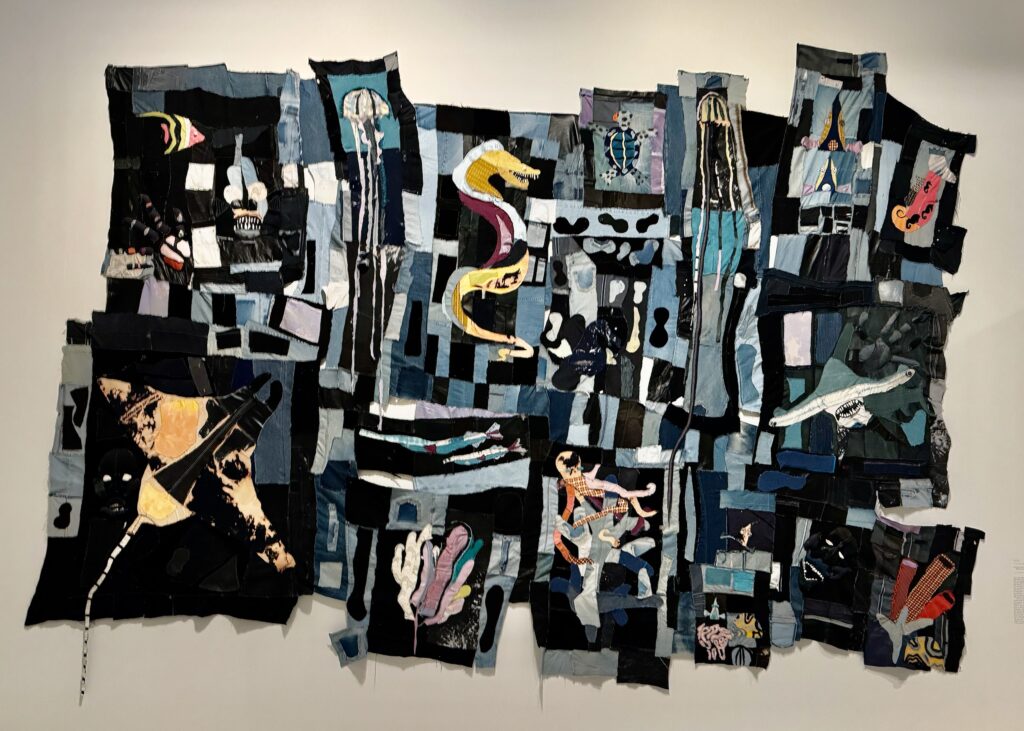
Tau Lewis uses recycled fabrics and seashells in The Coral Reef Preservation Society, partly in homage to enslaved people who lost their lives in the Middle Passage, a stage of the Atlantic slave trade …
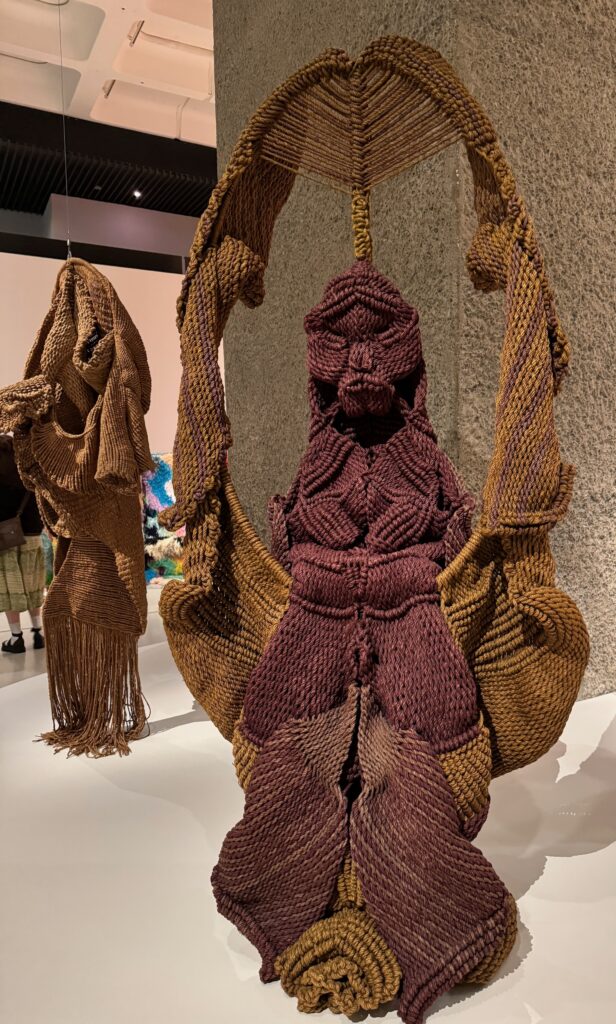
These larger-than-life, deity-like macramé sculptures by Mrinalini Mukherjee surge up from the ground as though organic beings. Drawing on nature and myriad artistic references, their knotted, rippling forms confound expectations of textiles as two-dimensional …
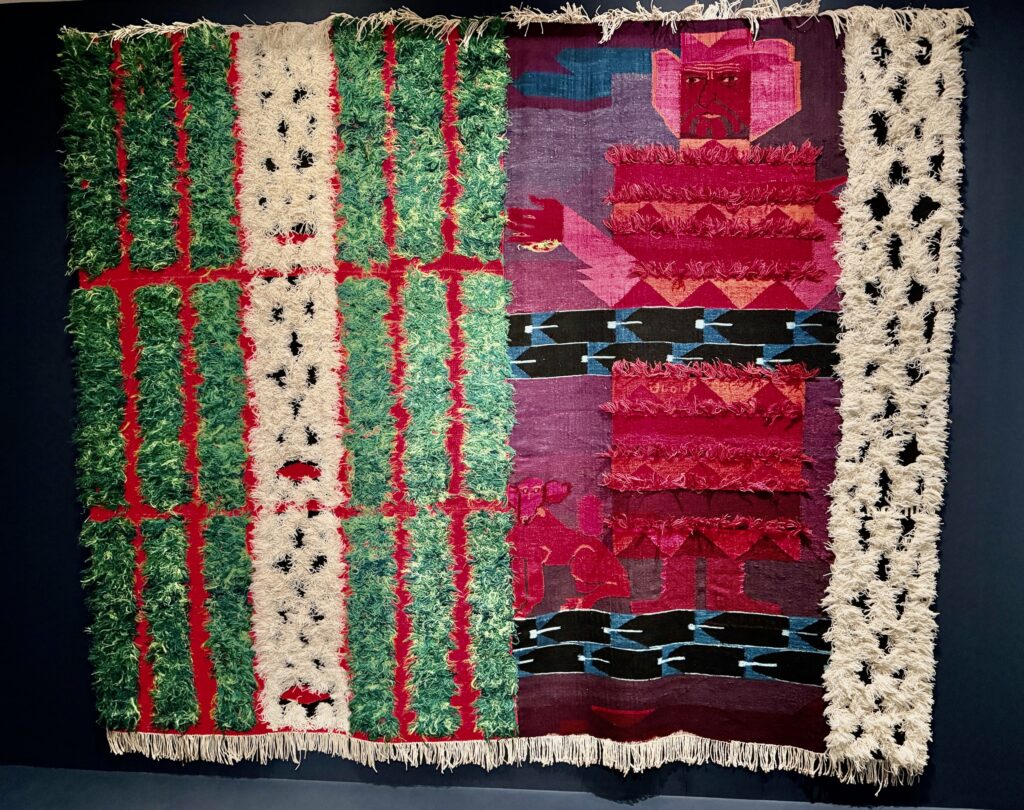
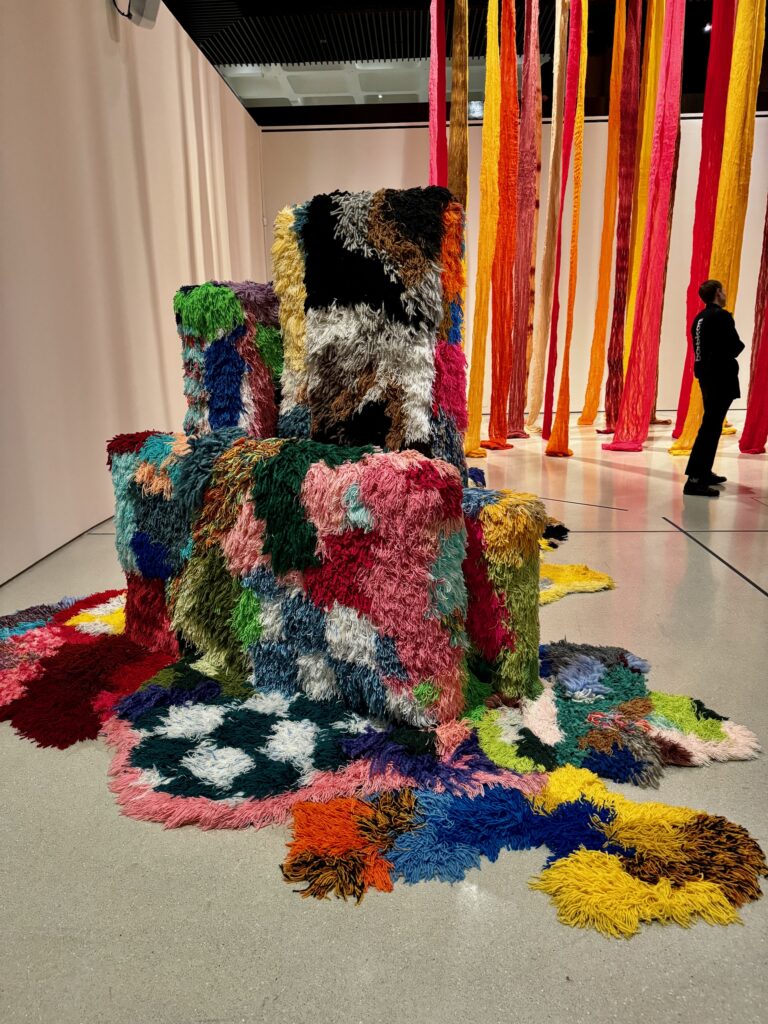
Sarah Zapata’s work embraces her identity as a Peruvian American – two cultures in which textiles are integral …
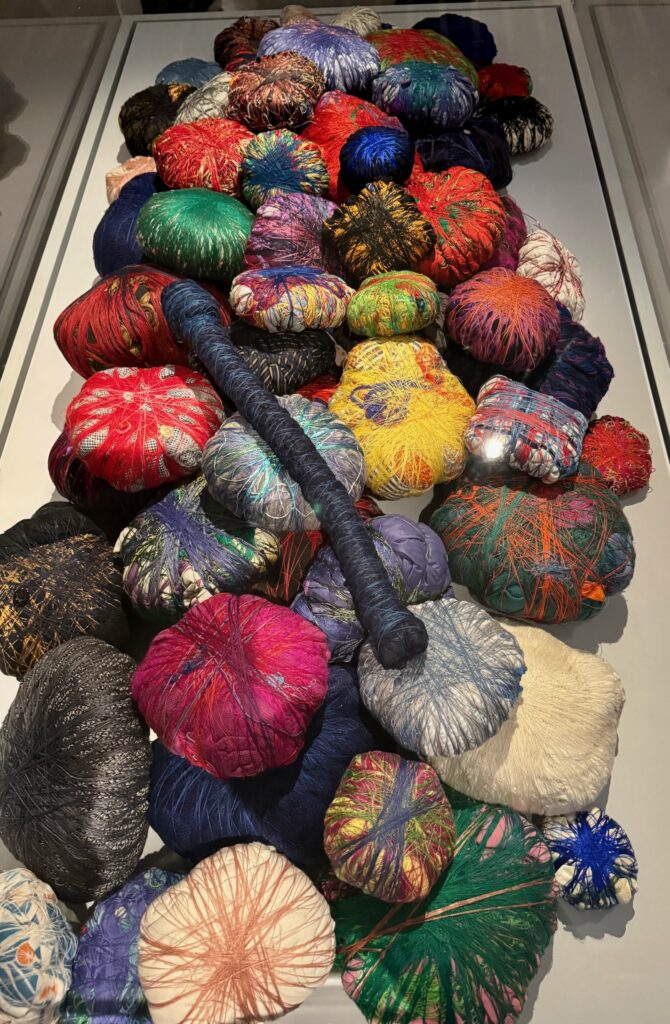
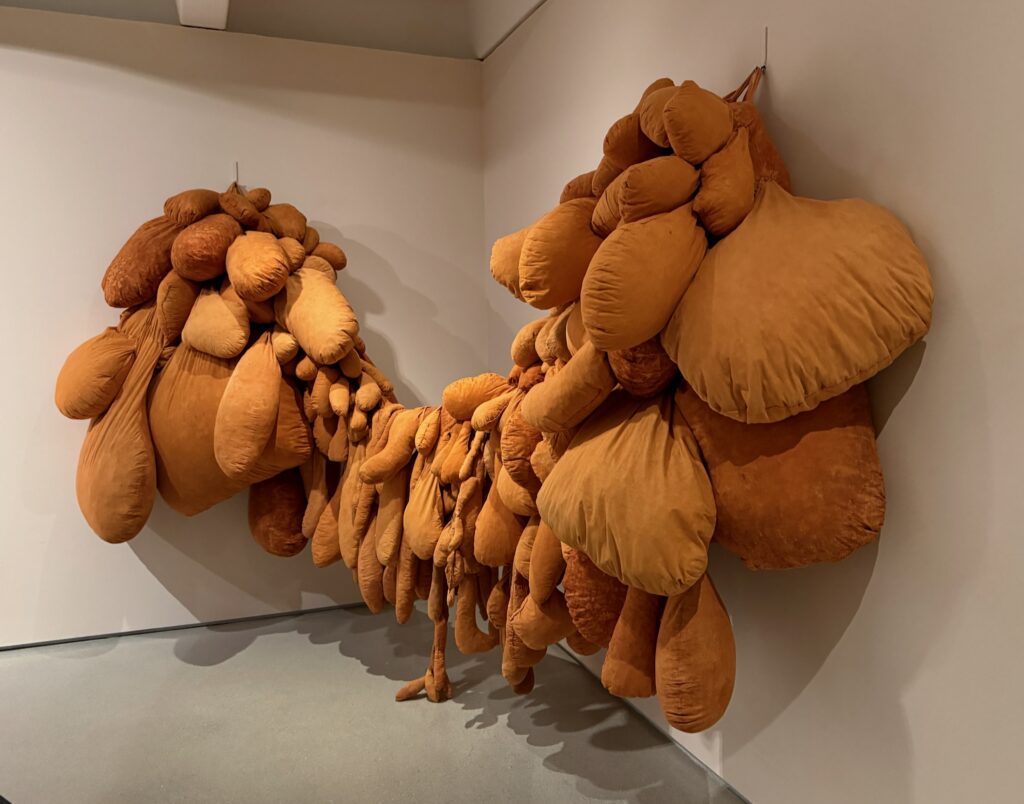
Solange Pessoa’s work, Hammock, was created in response to the land of Minas Gerais, Brazil, where she grew up. Textiles, in the form of rags and canvas, act as a carrier for living and decaying matter …
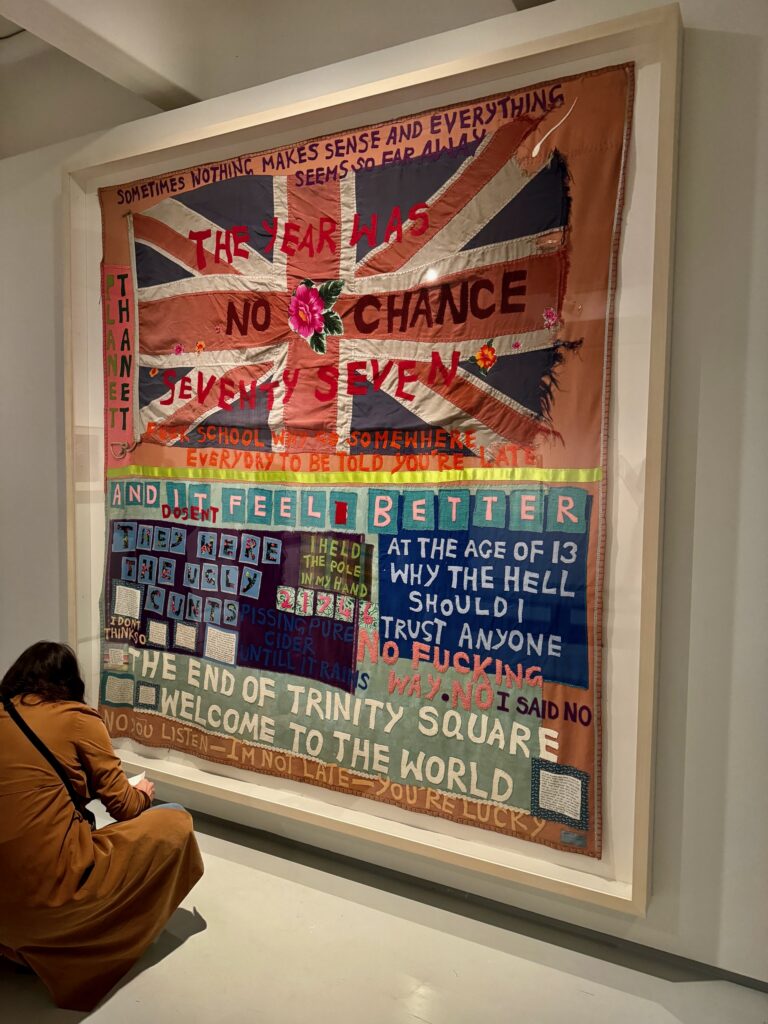
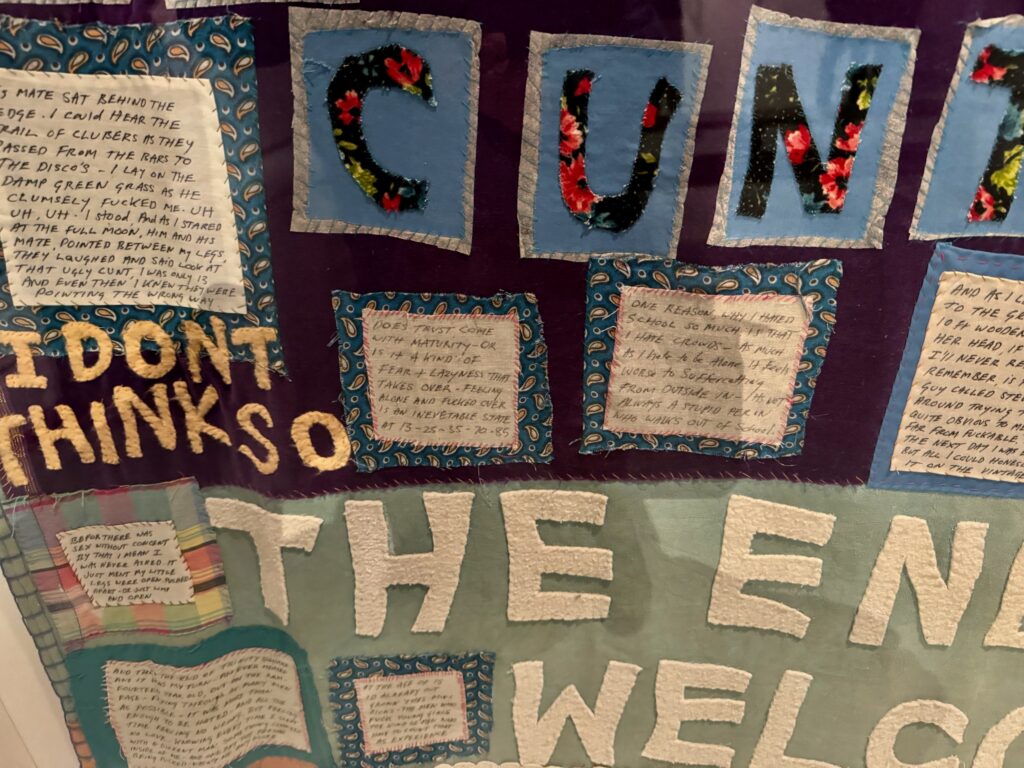
Tracey Emin is here too with a hard hitting work, No chance – WHAT A YEAR, about being raped when she was a thirteen-year-old girl (Content trigger warning) …
Regular readers will know that I love the Guildhall Art Gallery! It describes itself as one of the City’s best kept secrets and that certainly seems to be true since when I visit I often feel like I almost have the place to myself.
This week I popped in to see what was on display with particular reference to London. My usual favourites were there along with some interesting new additions.
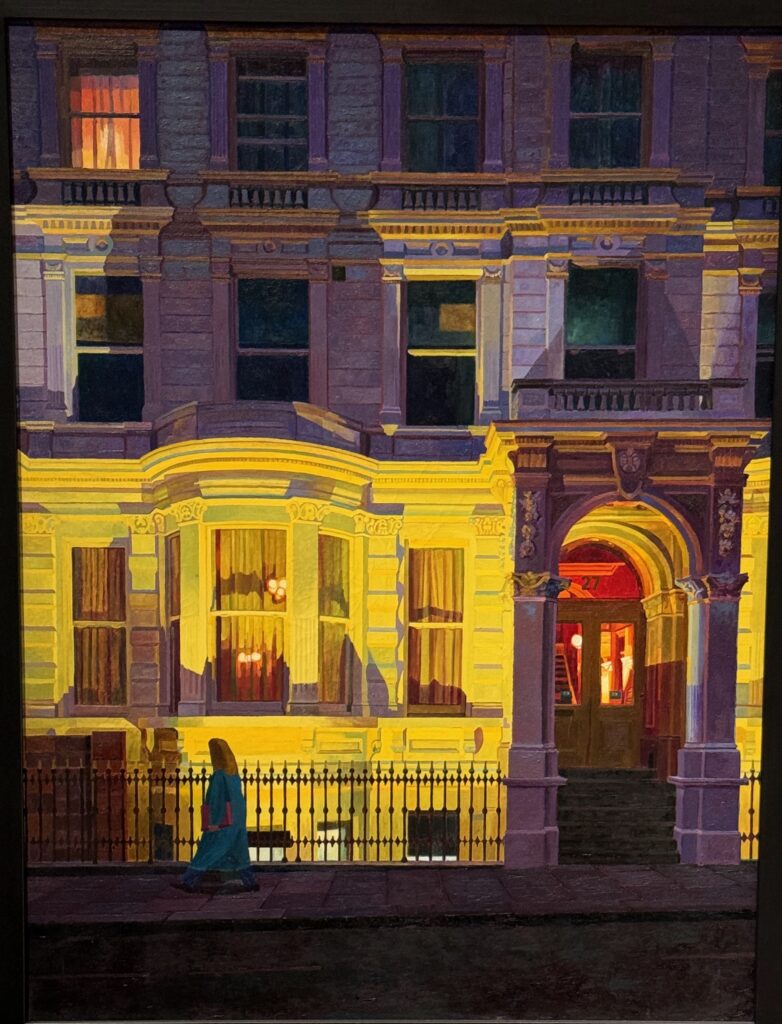
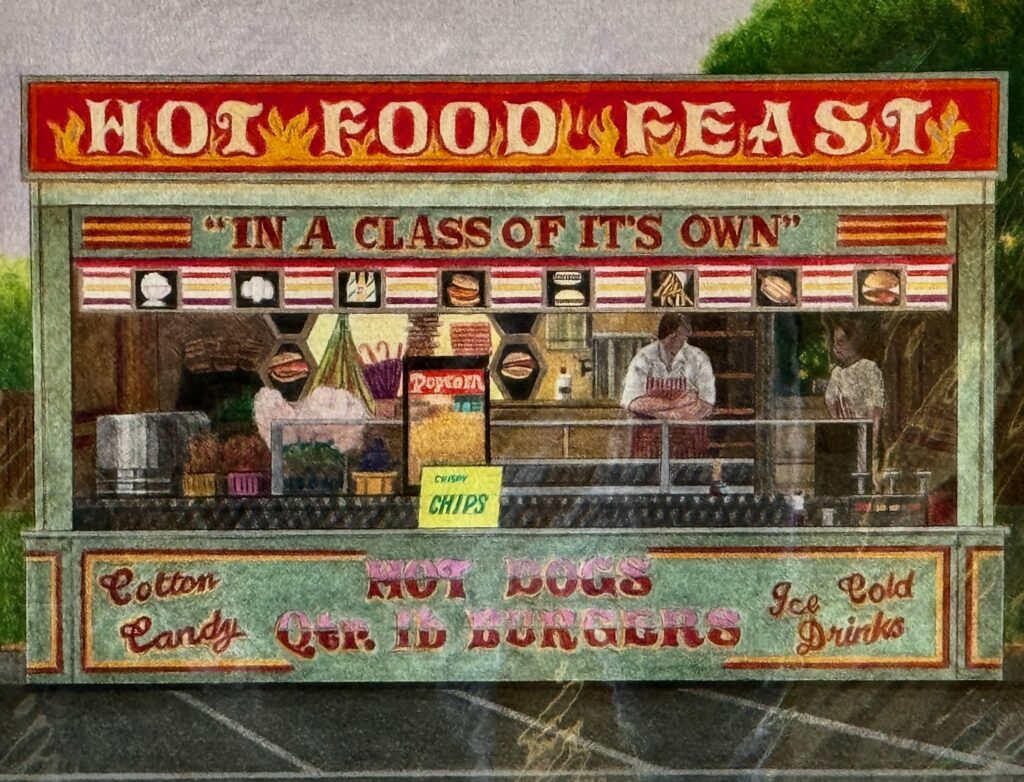
Among the new arrivals was this painting by Doreen Fletcher (b.1952) 0f the Carlyle Hotel, Bayswater, around 1981 …
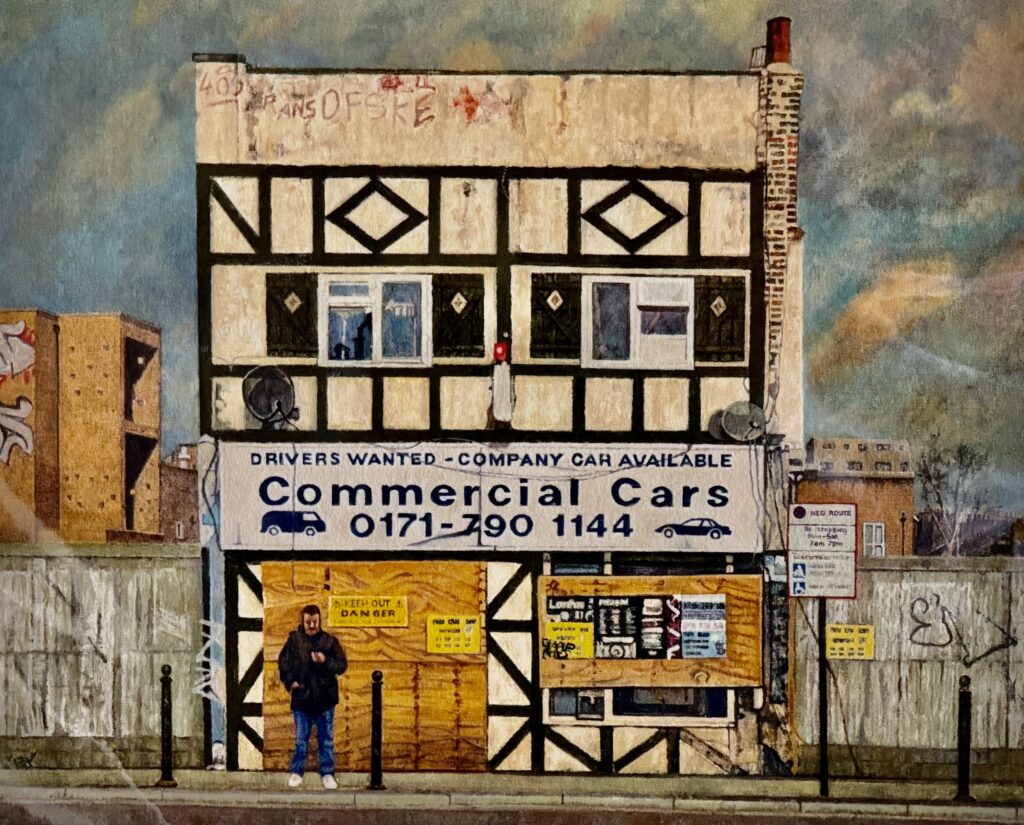
I think her paintings are fabulous and I am the proud owner of a signed copy of a book about her work published by The Gentle Author. I also own two of her prints, Still Standing – Commercial Road …
And Hot Dog Stand, Mile End …
You can read more about her here and here. The book I own is now out of print but you may be lucky and find a copy on eBay.
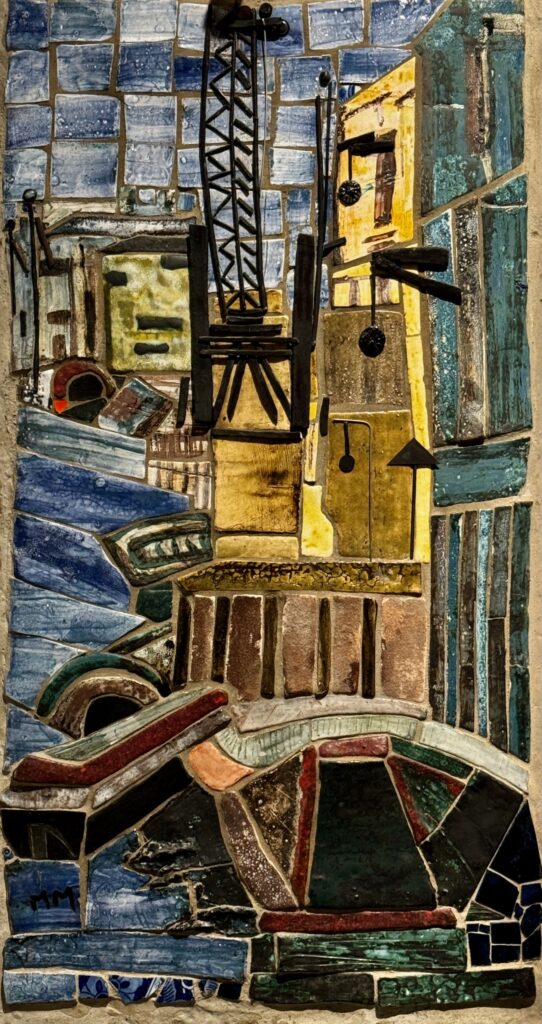
Another new arrival at the Gallery is this work by Grete Marks (1899-1990) entitled London Wharves (1972) …
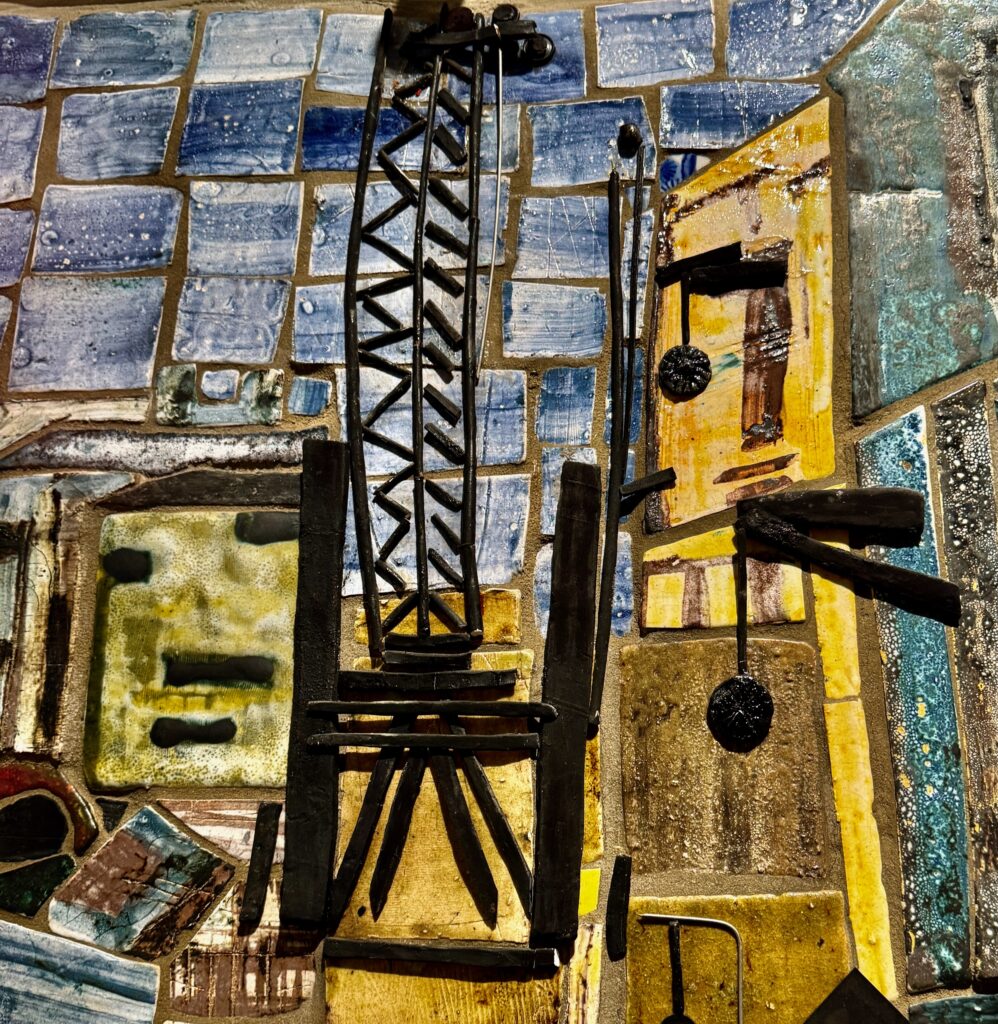
I really like the textures of the material she has incorporated …
Margarete or Grete Marks was born in Cologne, Germany, where she studied at the School of Arts and later at Dusseldorf Academy before entering the Bauhaus School of Arts in Weimar in November 1920. At this time the Bauhaus was in its first incarnation under Walter Gropius and enjoyed enormous influence over the fine and decorative arts throughout Europe.
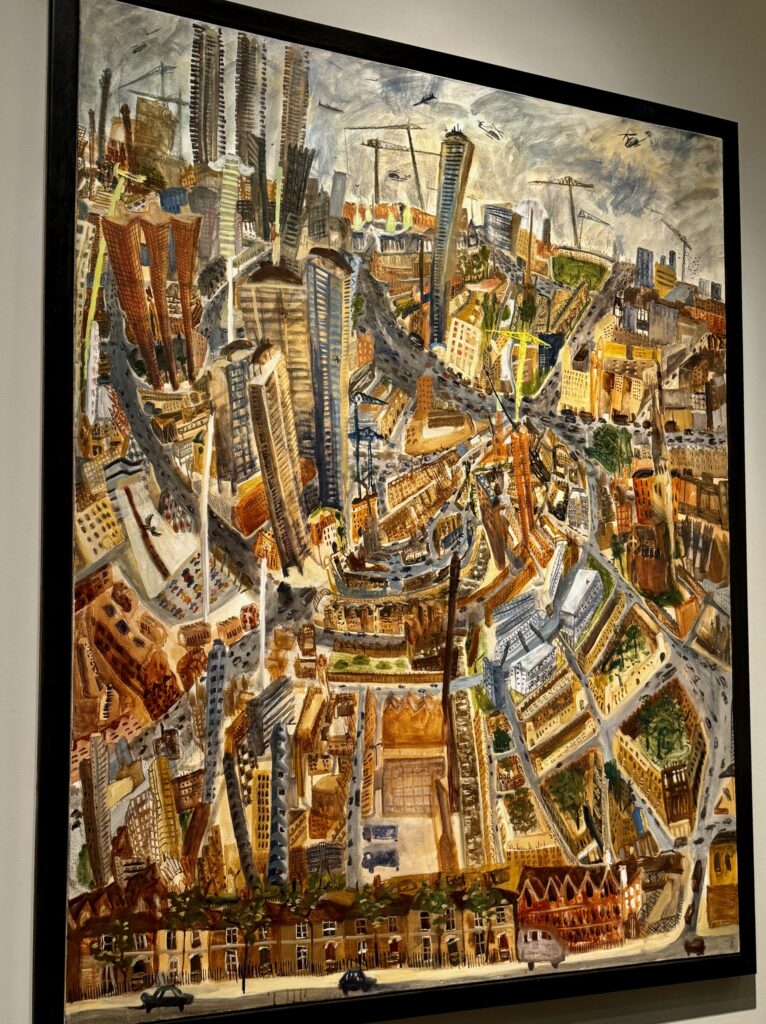
A painting by Sharon Beavan (b.1956) entitled View from Rotherfield Street to the Barbican (1989) …
I really get a sense of the higgledy piggledy that is London. You can read more about Sharon here.
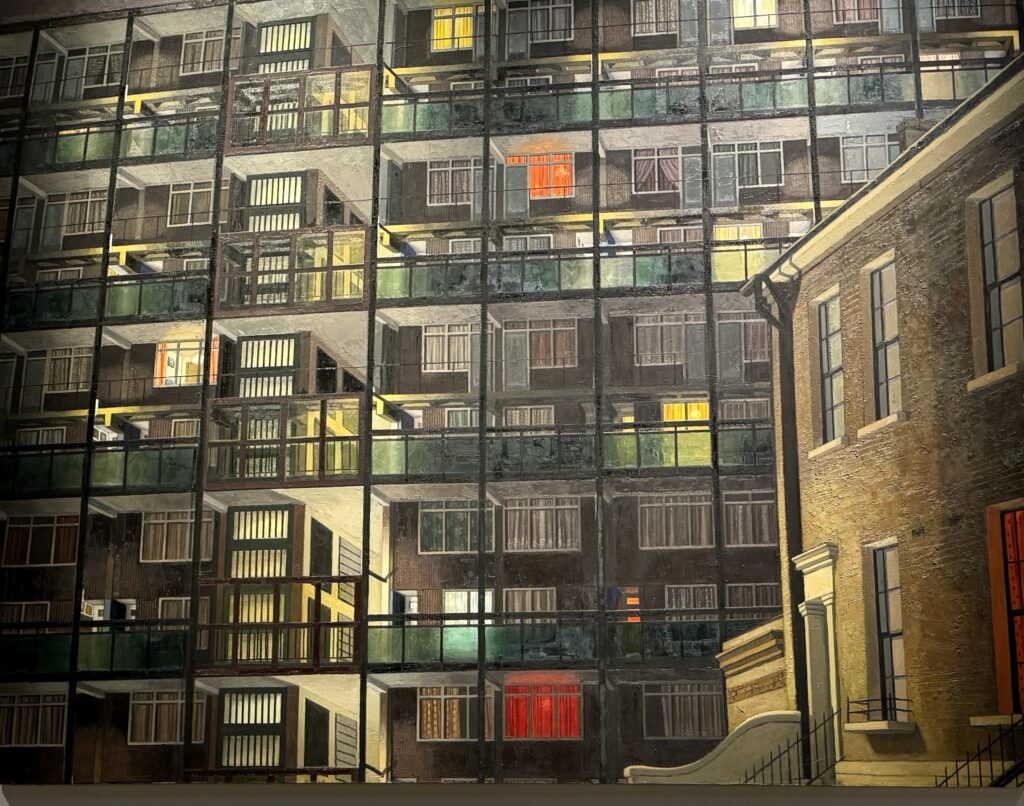
Another newcomer I like is this oil on canvas Camberwell Flats by Night (1983) by David Hepher (b.1935) …
Hepher first started painting South East London’s high-rise architecture in the 1970s, inspired by the scale and impact of the tower blocks on the London skyline. Camberwell Flats by Night reflects Hepher’s sustained focus on residential architecture, and the details of ordinary, everyday life. He refers to his architecturally-themed works as landscape paintings, equating the powerful effects of the built environment on human experience to those of the natural world. He has said, “I think of myself as a landscape painter; I live in the city, so I paint the urban landscape.”
The Gallery acquired the painting in 2022 and it required some conservation. You can read about what that entailed here.
I looked up a few old favourites as well.
Two examples of City pomp and ceremony.
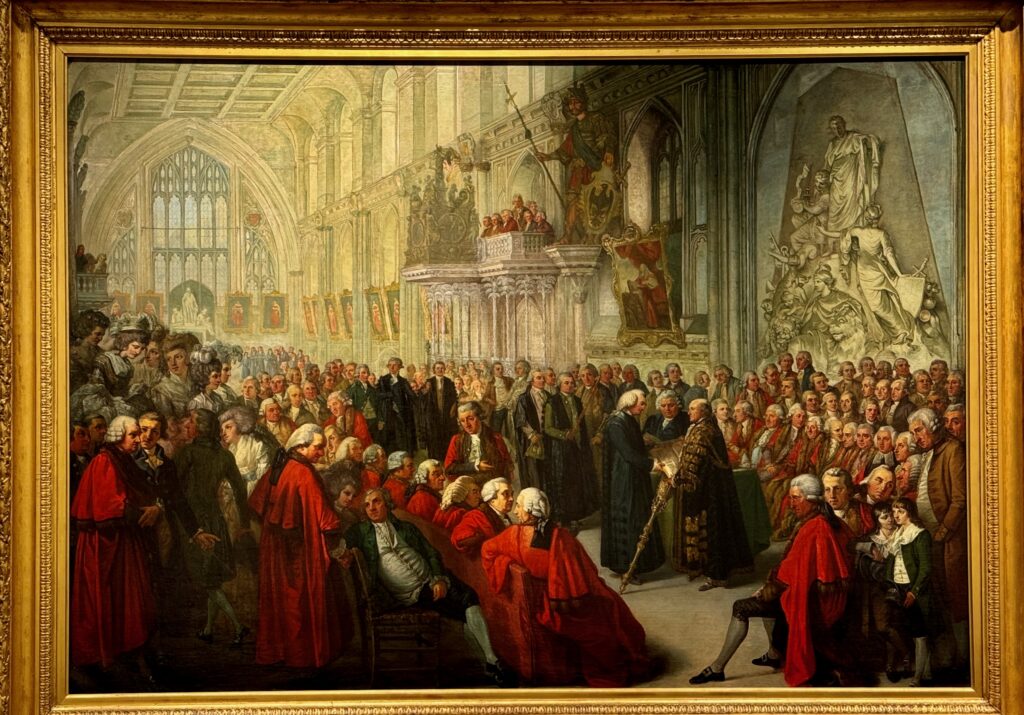
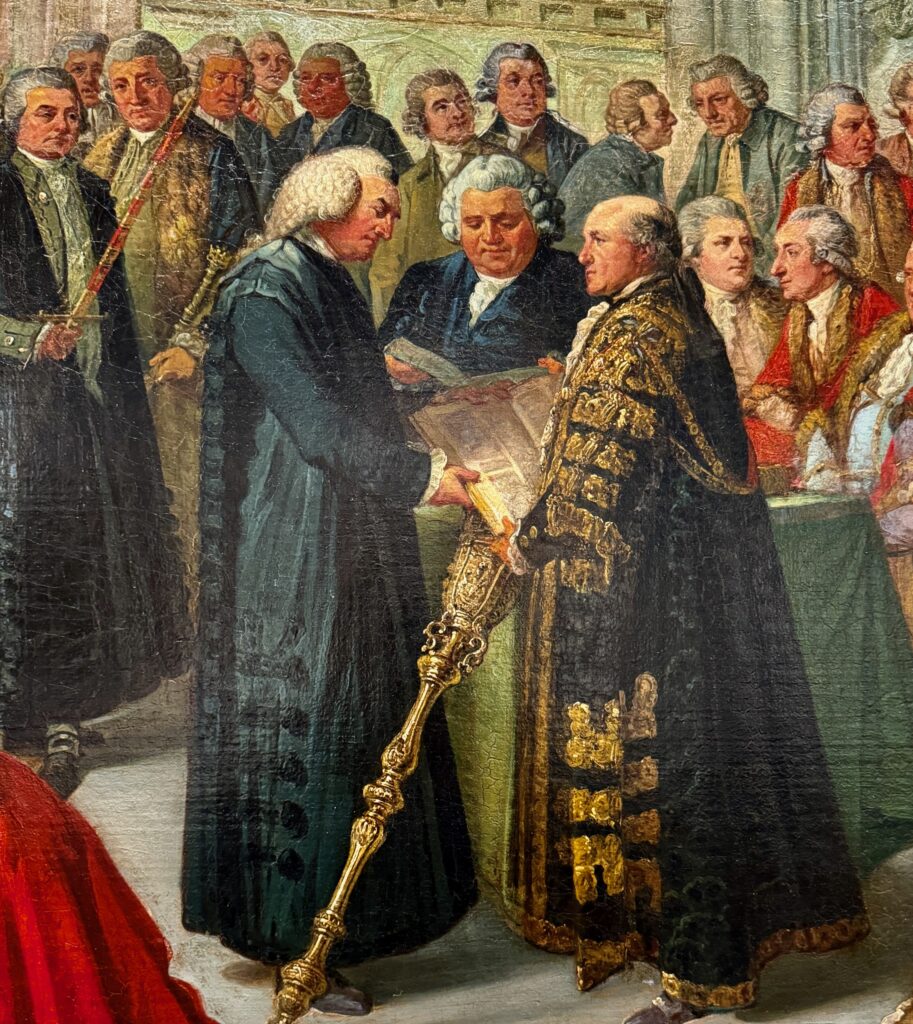
First, The Ceremony of Administering the Mayoralty Oath to Nathaniel Newnham, 8 November 1782. Nathaniel Newnham (before a sugar-baker and a founder of the private bank of Newnham) became Lord Mayor in 1782 and is seen here in his black and gold state robe being admitted in Guildhall on November 8 in the Silent Ceremony …
He faces William Bishop, the Common Cryer, who holds the book from which he reads his Oath with William Rix, the Town Clerk; behind stands Heron Powney, the Sword Bearer with the upraised Sword of State and beside him is William Montague, the Clerk of the Chamber of London …
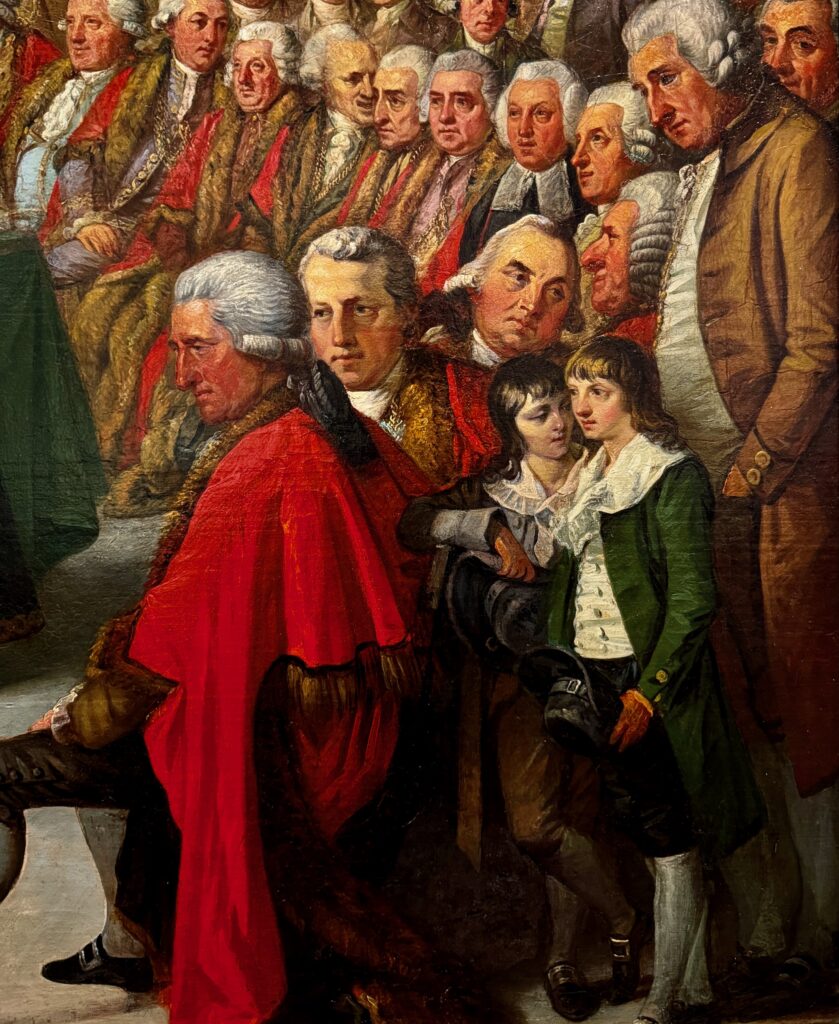
The two small boys at the bottom right are nephews of the Lord Mayor …
The other is one of my favourites, William Logsdail’s painting entitled The Ninth of November 1888 …
Although it’s the Lord Mayor’s procession in this picture he is nowhere to be seen and the artist has concentrated on the liveried beadles (who he actually painted in his studio)…
… and the people in the crowd …
There is a minstrel in blackface with his banjo and next to him a little boy is nicking an orange from the old lady’s basket. On the right of the picture the man in the brown hat, next to the soldier with the very pale face, is Logsdail’s friend the painter Sir James Whitehead.
Naughty boy!
It’s a sobering thought that, not far away in the East End that afternoon, police were discovering the body of Mary Kelly, believed to be the last of Jack the Ripper’s victims.
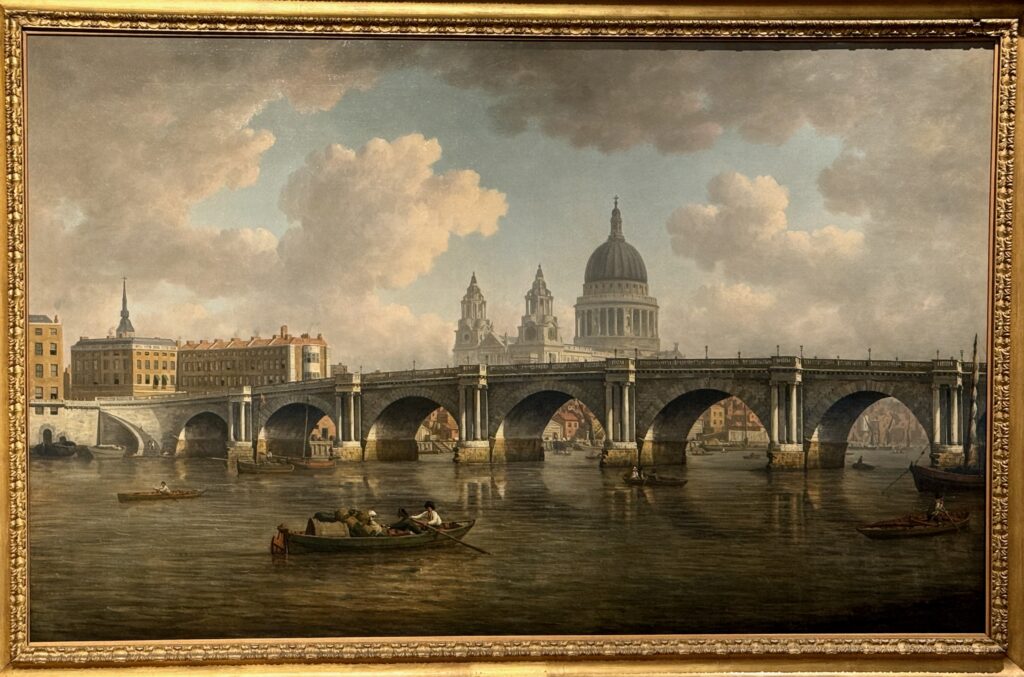
A view of Blackfriars Bridge and the City from Lambeth about 1762 by William Marlow (1740-1813) who was, as can be seen, very influenced by Canaletto. The City’s wharves are viewed through the Portland Stone elliptical arches while St Paul’s stands out in the background. At the north end are the buildings of New Bridge Street and the spire of St Martin Ludgate. In the centre of the picture, a wherry conveys passengers and their belongings downriver …
The demolition of old London Bridge increased the flow of the river under Blackfriars Bridge, weakening it. It therefore had to be replaced with the current iron and granite bridge built between 1860 and 1869.
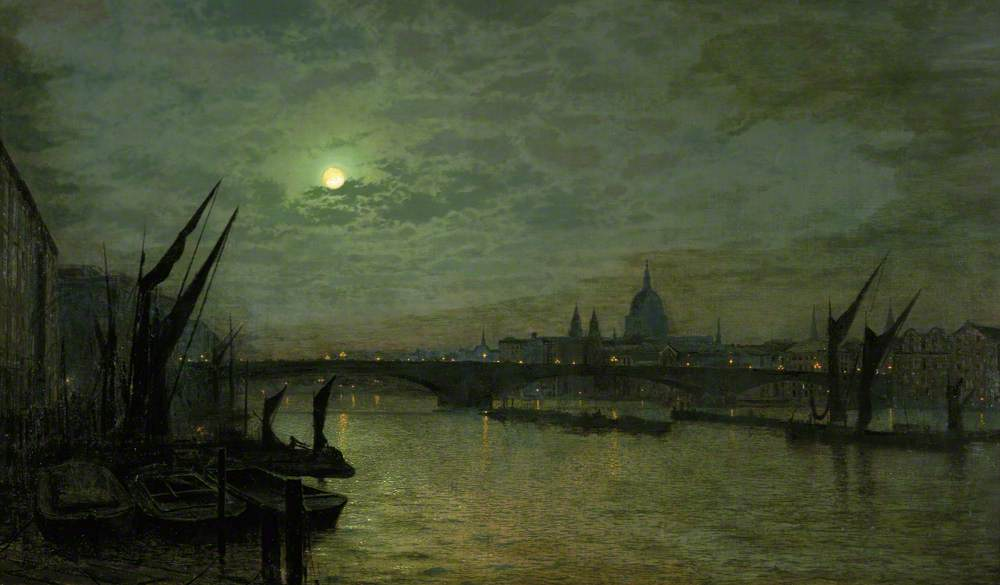
The Thames and Southwark Bridge in 1884 by John Atkinson Grimshaw (1836-1893) are represented here on a quiet night under the moonlight. St. Paul’s prominent dome is seen on the right side, along with the spires of St Augustine, St Mary-le-Bow and St Antholin. A few vessels are in the dark on the left. The river and the sky are open pathways for the flood of light …
John Atkinson Grimshaw began working as a railway clerk for Great Northern Railway and had no formal training. Despite parental opposition, he took up painting at the age of twenty-five. In the 1880s, he began to paint London views, concentrating on moonlight subjects. From 1885 to 1887 Grimshaw had a studio at Trafalgar Studios, Manresa Road, Chelsea and knew Whistler well. It is said that Whistler confessed he had regarded himself as the inventor of nocturnes until he saw Atkinson Grimshaw’s ‘moonlights’.
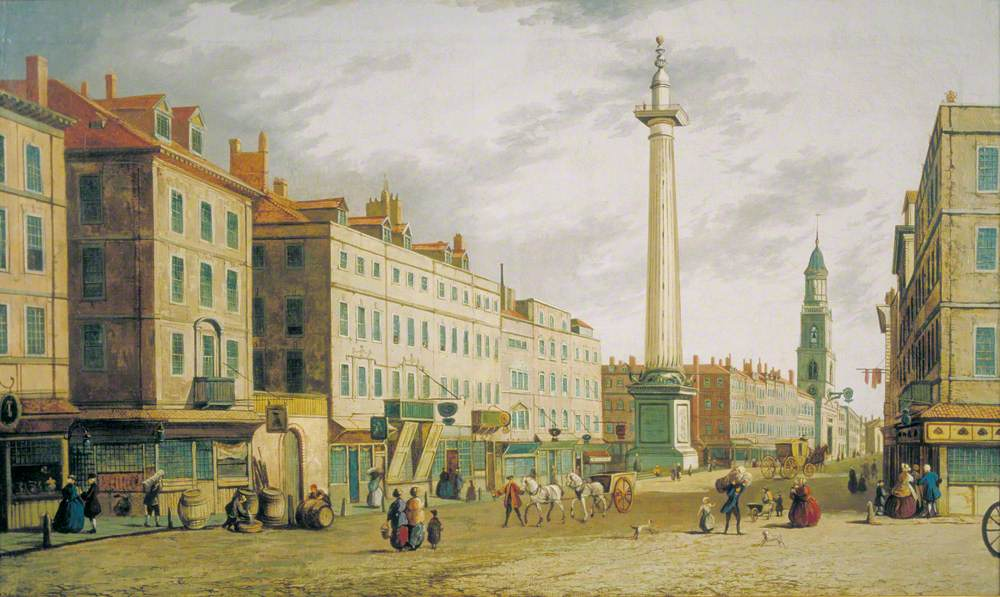
The Monument from Gracechurch Street after Canaletto (artist unknown). We are looking towards Fish Street Hill and old London Bridge, with the Church of St. Magnus the Martyr in the background. Many reproductions were made after Giovanni Antonio Canal, who was colloquially known as Canaletto. These were in high demand after various British nobles and even King George III started collecting them …
This painting shows the wide thoroughfares of eighteenth century London and the bustle of the city. The Monument, designed by Dr Robert Hooke and the architect Christopher Wren, was erected between 1671 and 1677 to commemorate the fire and the rebuilding of the City.
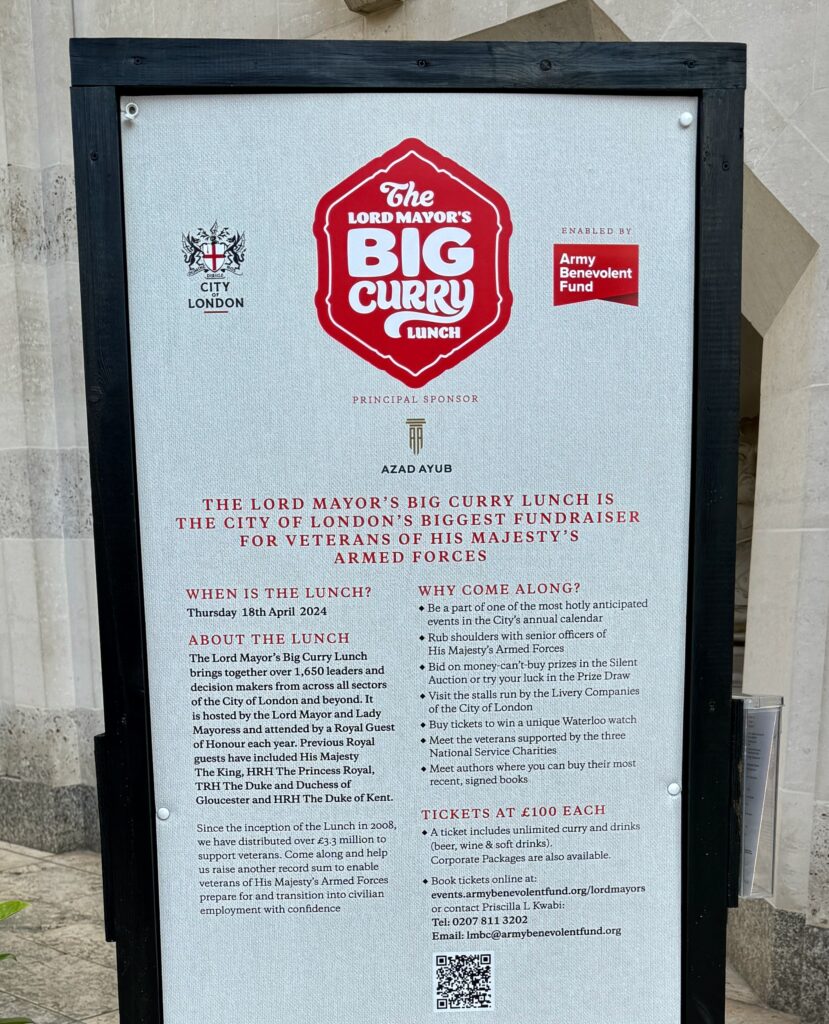
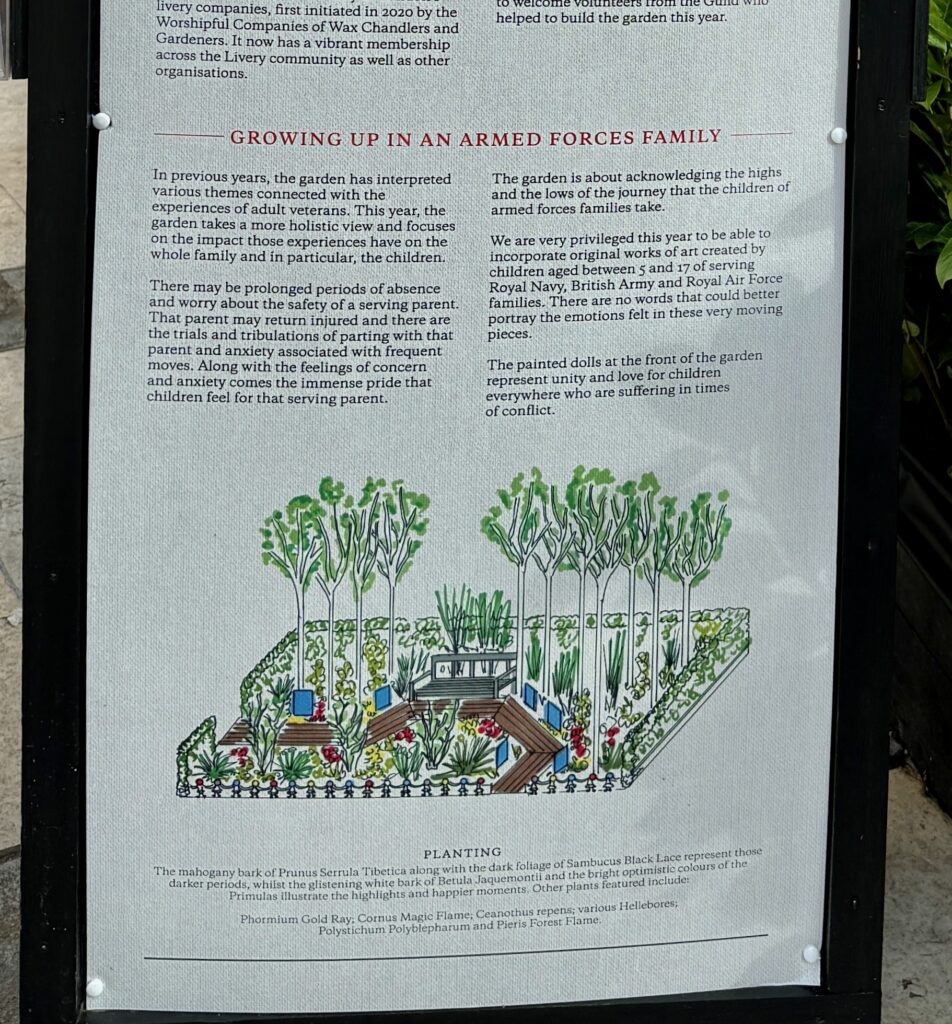
Finally, if you visit the Gallery now you will see a notice about the Lord Mayor’s Big Curry Lunch …
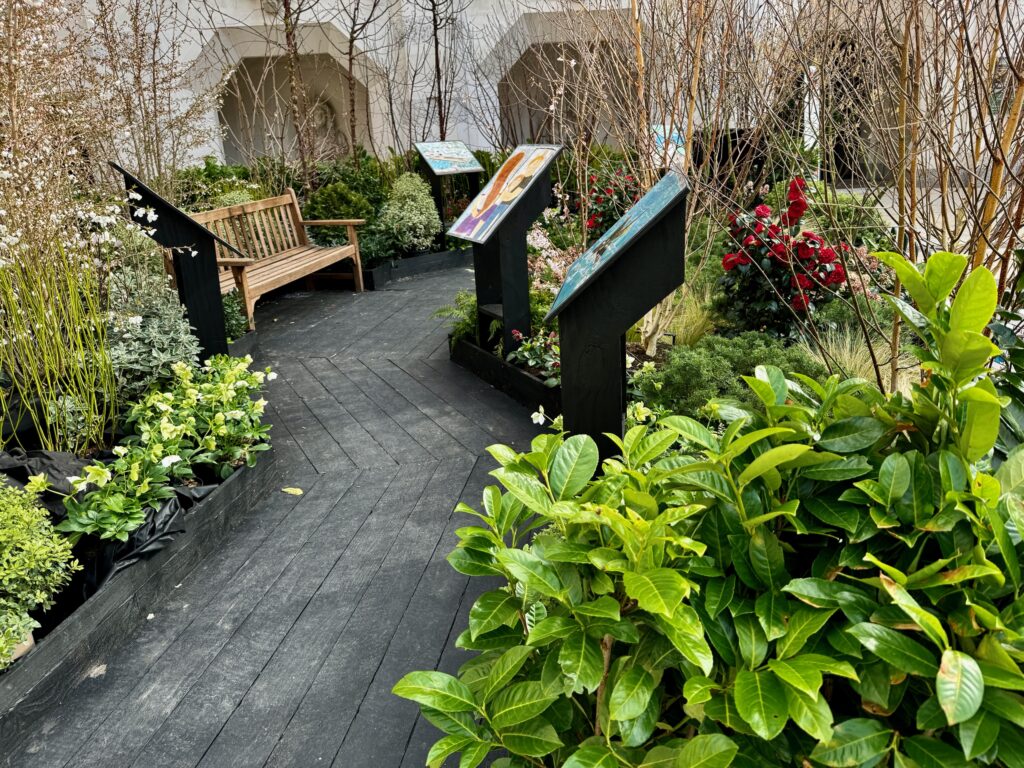
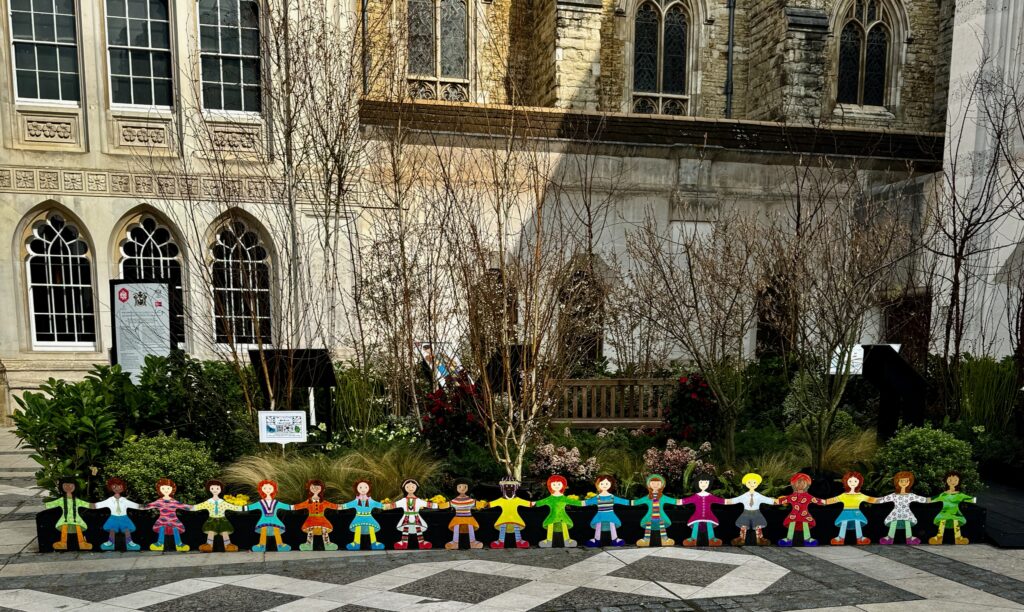
and the nearby garden …
It’s really nice to see some green space in the Guildhall courtyard …
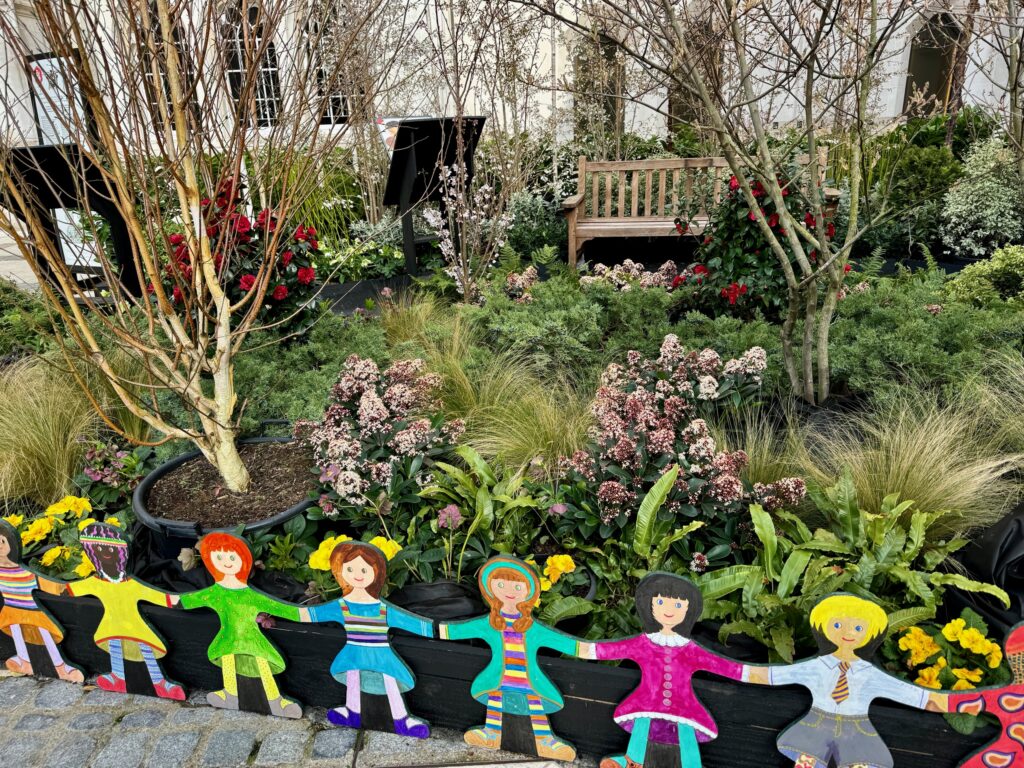
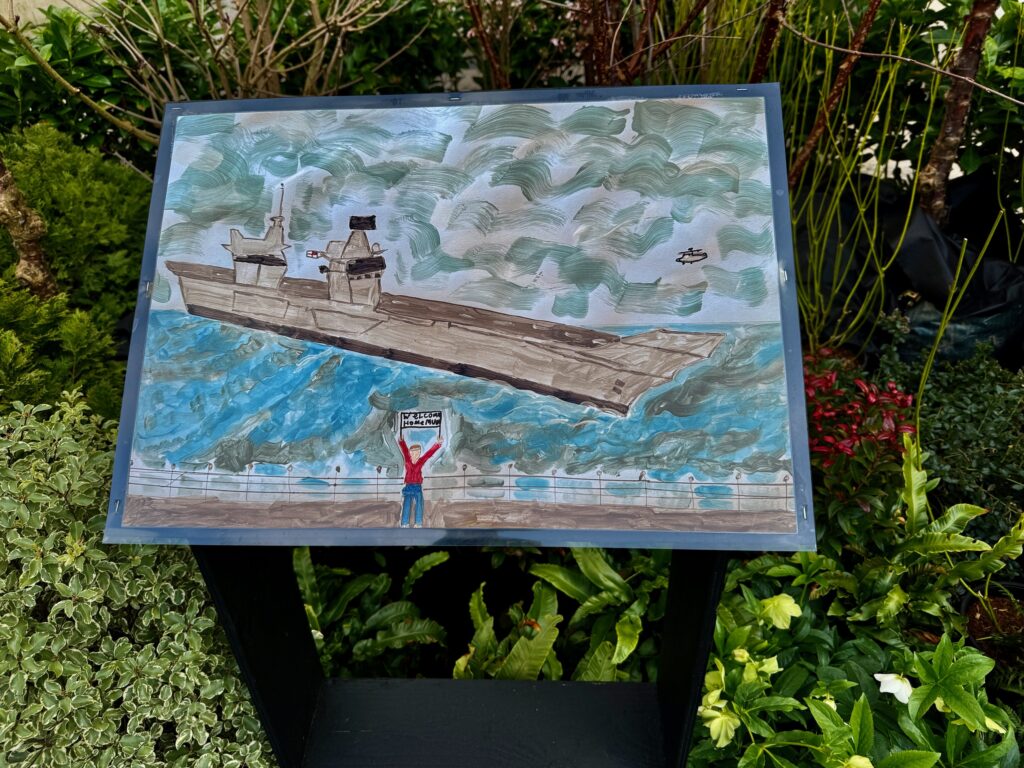
And art by the children of serving families …
As the notice says, the painted dolls at the front of the garden represent unity and love for children everywhere who are suffering in times of conflict …
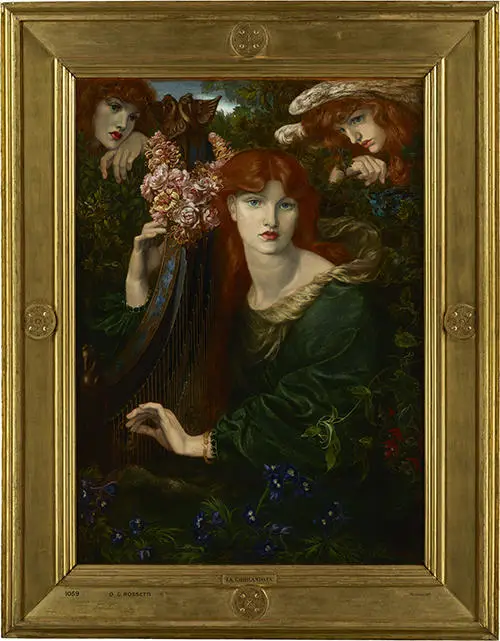
Oh, and by the way, one of Gallery’s most popular paintings is back on display after being featured in Tate Britain’s ‘The Rossettis’ exhibitions in London and the Delaware Art Museum. Described by the Pre-Raphaelite artist and poet Dante Gabriel Rossetti as “my very best picture”, ‘La Ghirlandata’ was acquired by the City of London Corporation in 1927 for its permanent art collection and is displayed in the gallery’s main Victorian exhibition space …
The 1873 oil on canvas depicts ‘the garlanded woman’ playing an arpanetta and looking directly at the viewer. The artist’s muse for the central figure was the actor and model, Alexa Wilding, with two ‘angels’ in the top corners posed by William and Jane Morris’ youngest daughter, May Morris.
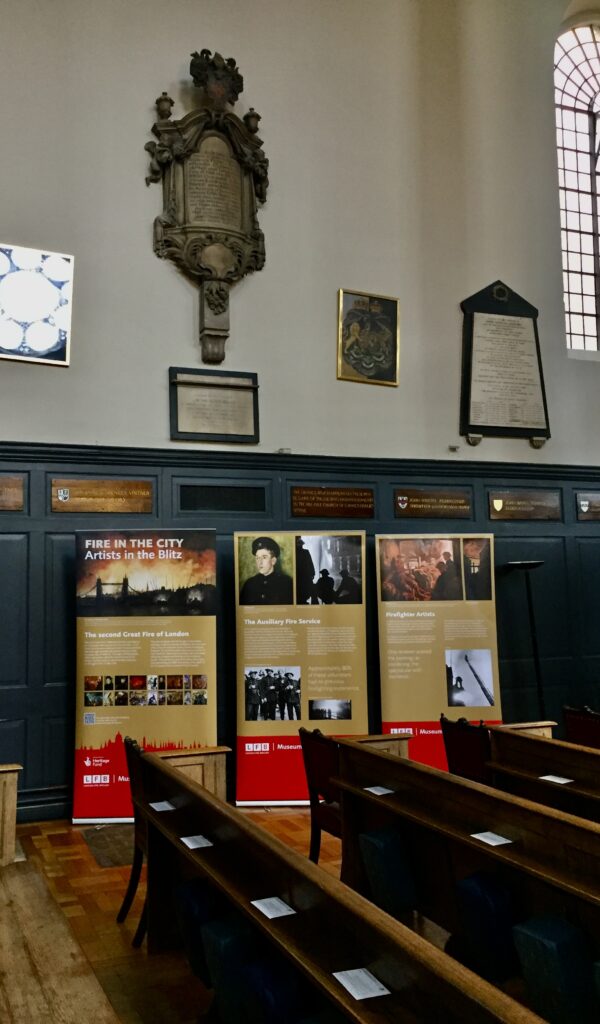
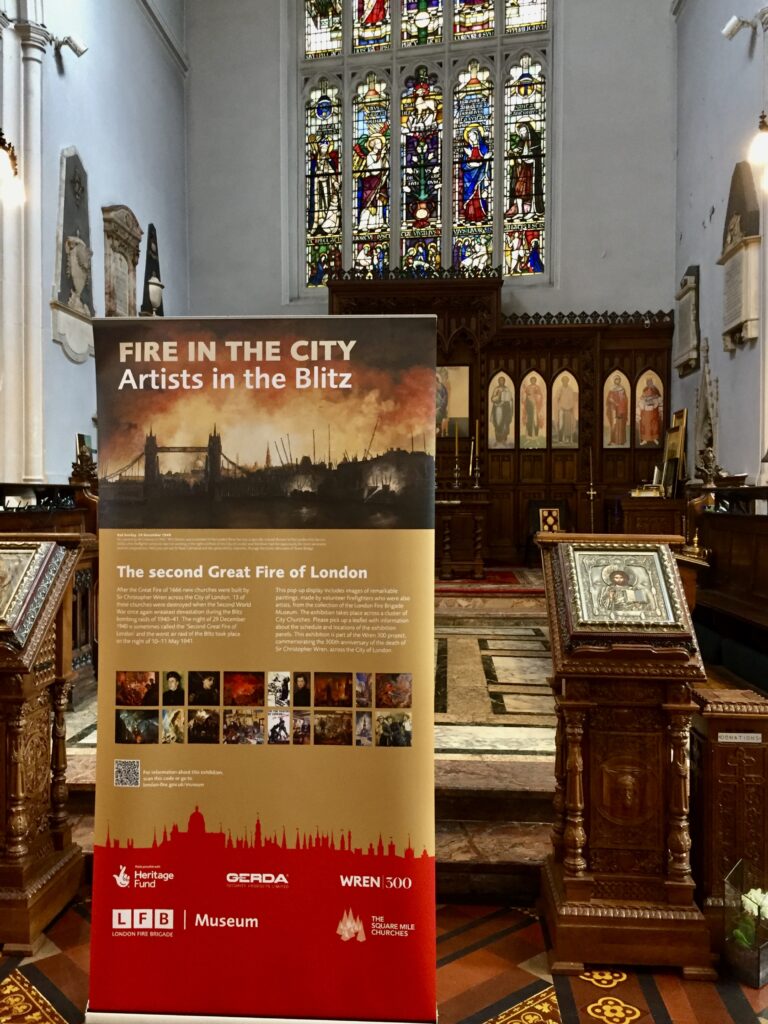
Five City churches are currently hosting an exhibition of reproductions of paintings by firefighter artists along with contemporary photographs from the London Fire Brigade archive.
The works are displayed on pop-up screens. For example, this one is at
You will find details of participating churches at the end of the blog along with opening times.
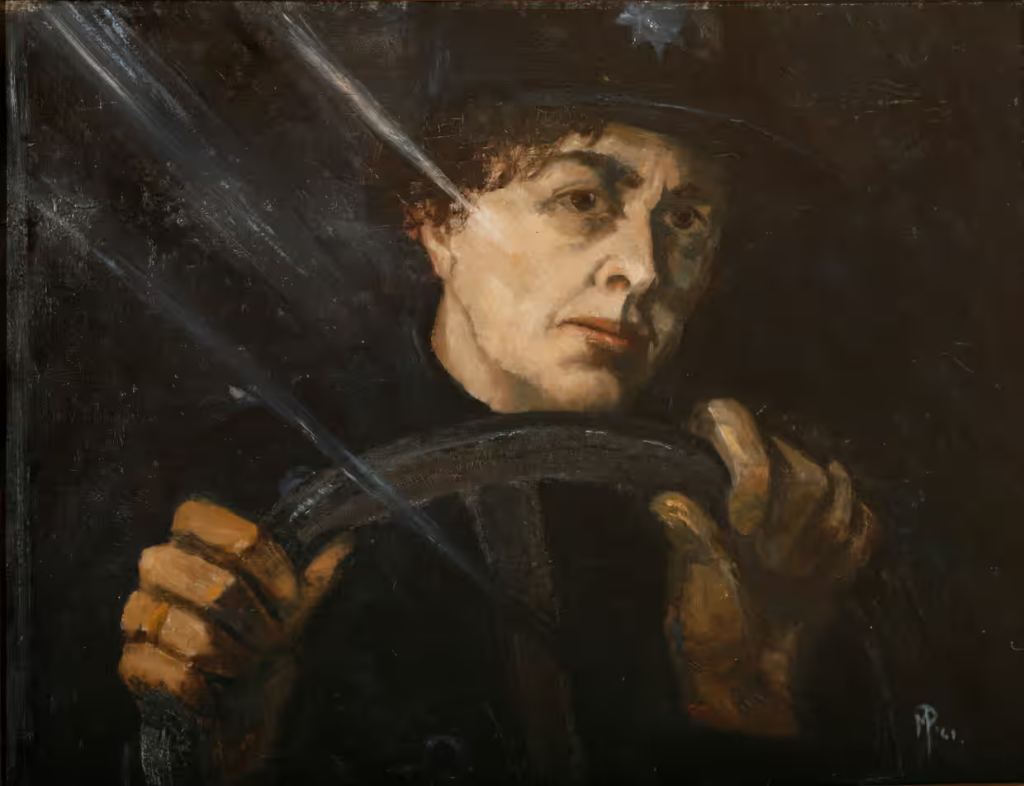
Here I am going to publish examples of some of the work on display, starting with my favourite, Driving by Moonlight, by Mary Pitcairn …
It depicts an AFS volunteer, Gillian “Bobbie” Tanner, at the wheel of a truck. She was awarded the George Medal for bravery and the citation read: ‘On the night of 20 September 1940, Auxiliary G.K.Tanner volunteered to drive a 30 cwt lorry loaded with 150 gallons of petrol. Six serious fires were in progress and for three hours Miss Tanner drove through intense bombing to the point at which the petrol was needed, showing coolness and courage throughout‘.
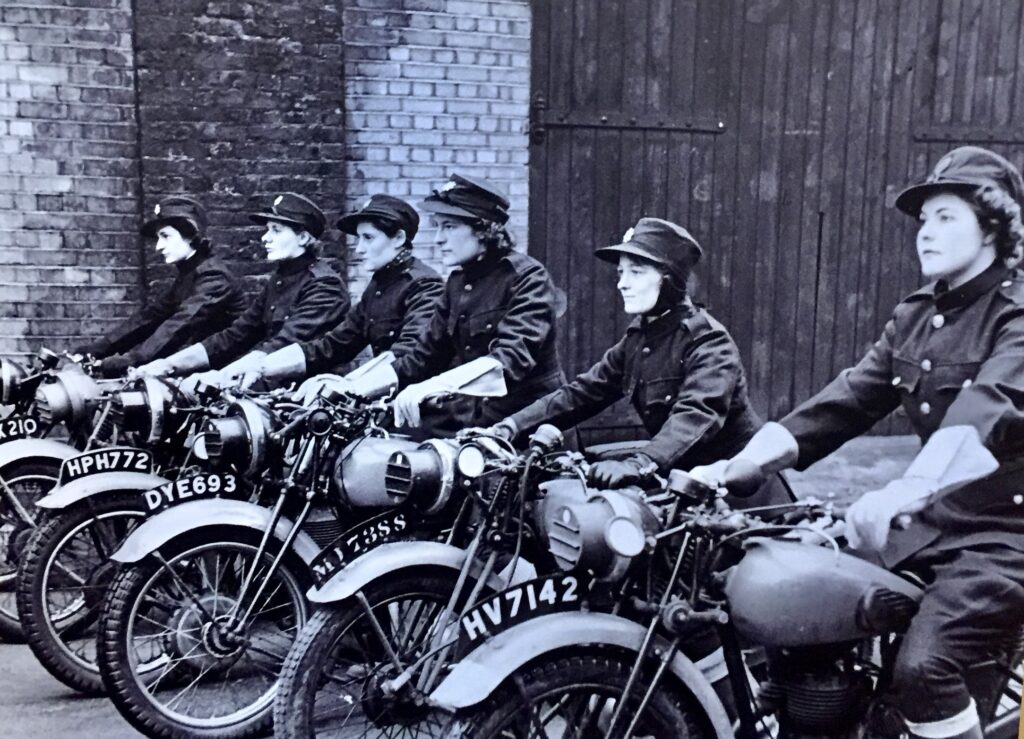
During the Second World War, women joined the fire service for the first time as volunteers in the AFS working in a variety of roles ranging from control operators to dispatch riders and delivery drivers.
AFS women despatch riders around 1940 …
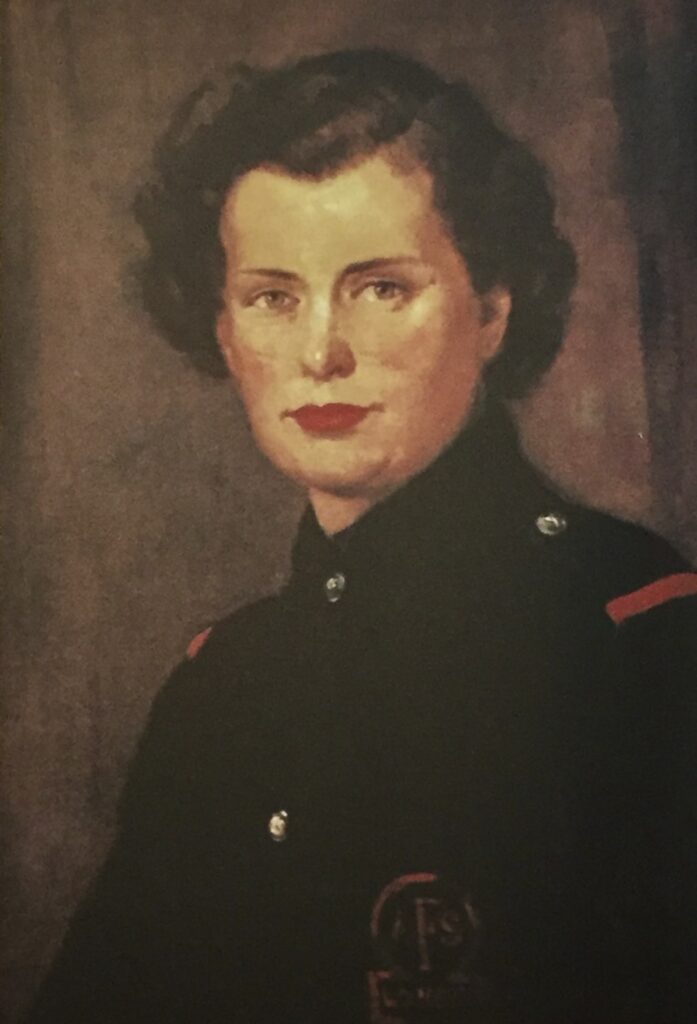
A 1941 oil painting by Reginald Mills of Mrs Kathleen Sayer an AFS Station Officer …
The Women’s Division of the AFS had its own leadership structure.
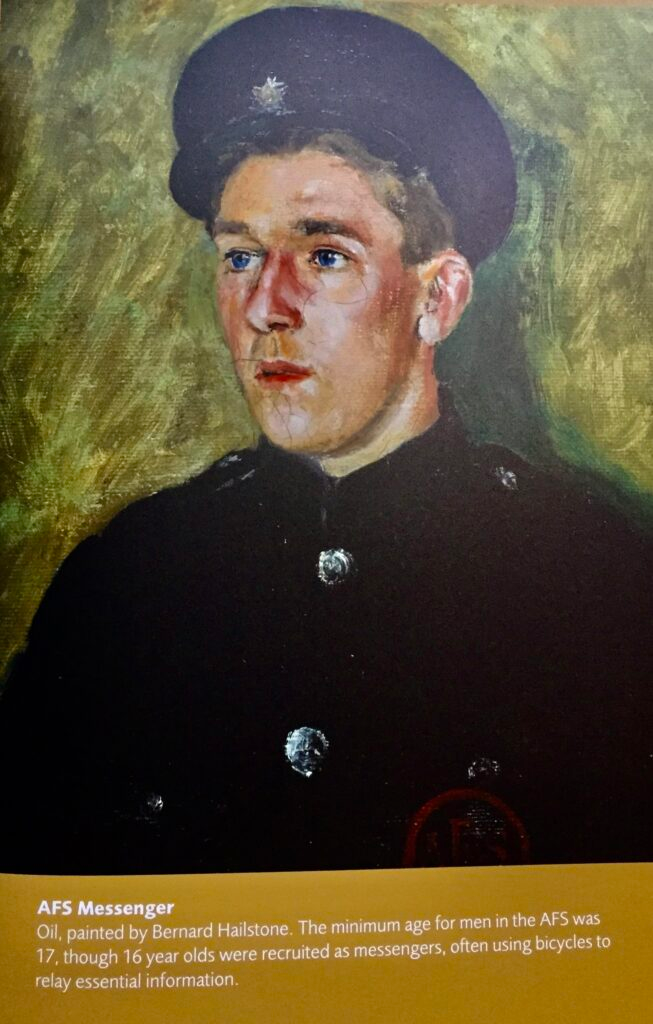
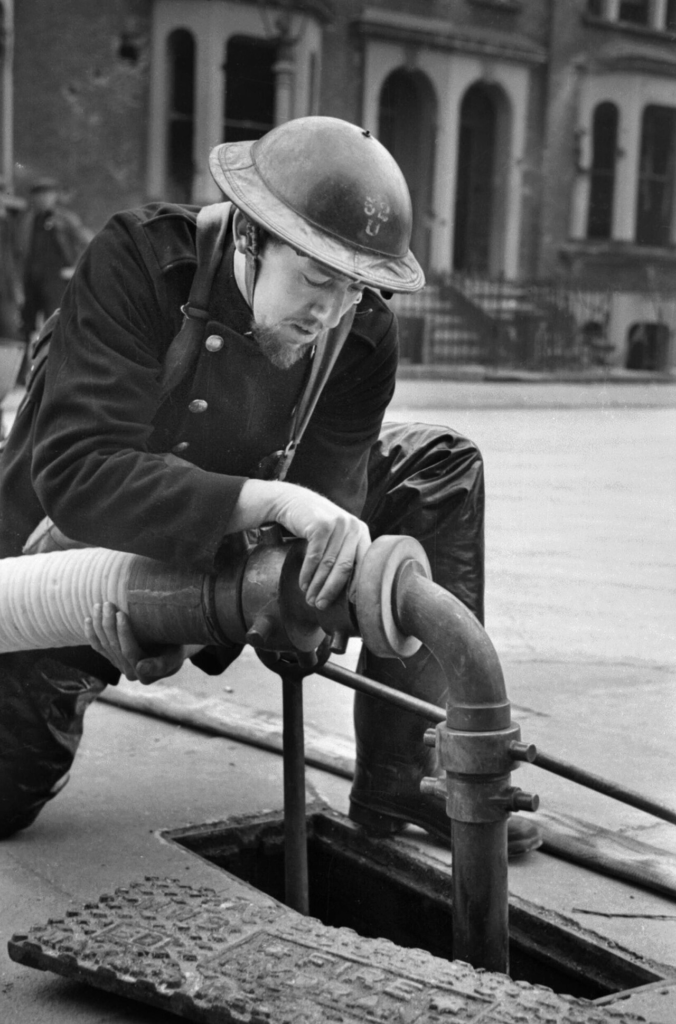
After the war Hailstone had a very successful career as a portrait painter. A gregarious, outgoing man, he went on to paint the last officially commissioned portrait of Sir Winston Churchill in 1955 and later members of the Royal family.
Here he is at work as a fireman circa 1940 attaching a hose to a fire hydrant …
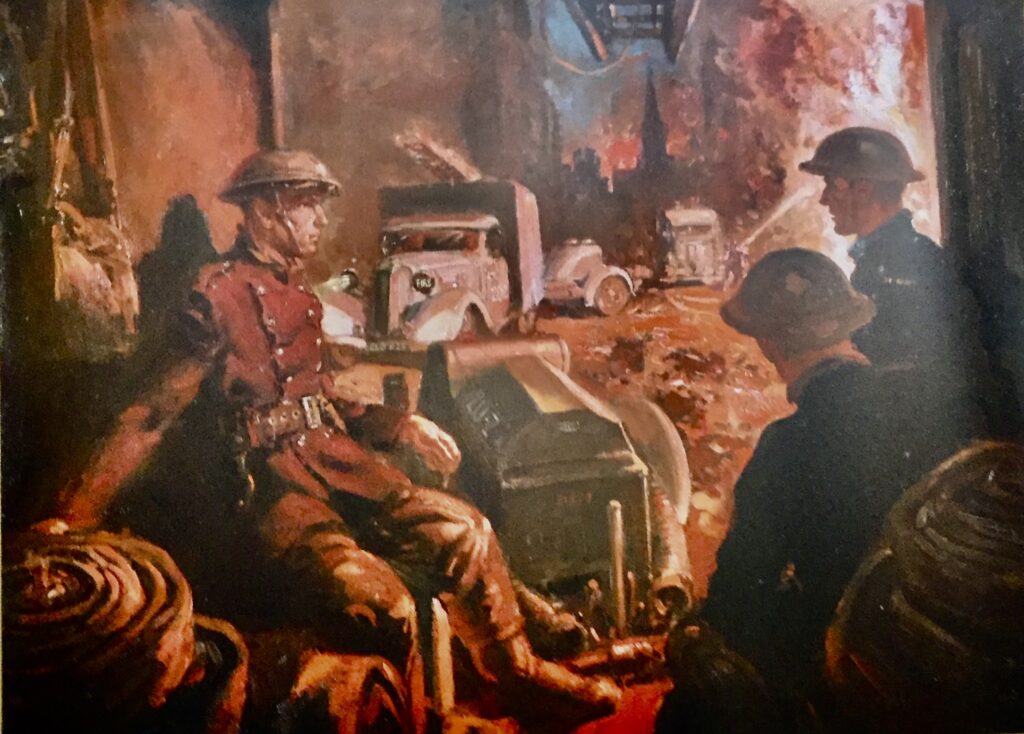
Resting at a Fire by Reginald Mills, around 1941 …
These AFS firefighters are surrounded by rolled up hose, resting in the back of an appliance vehicle which pulls a trailer pump, while their colleagues in the background continue to fight a fire. You can see a church spire in the background.
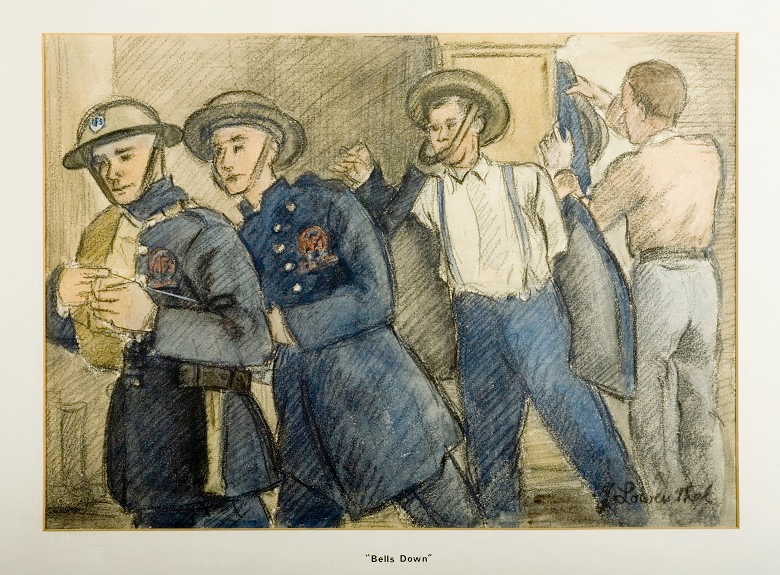
Bells Down by Julia Lowenthal …
Julia Lowenthal’s drawings and paintings gave remarkable insights into life inside the fire stations during the Blitz. Unlike most of her fellow firefighter artists she worked primarily in pencil and watercolour. Lowenthal was based in Kilburn and most of her surviving work is of colleagues in the station, and often at rest. Her watercolour sketch Bells Down refers to firefighters being called to action by bells in their fire station.
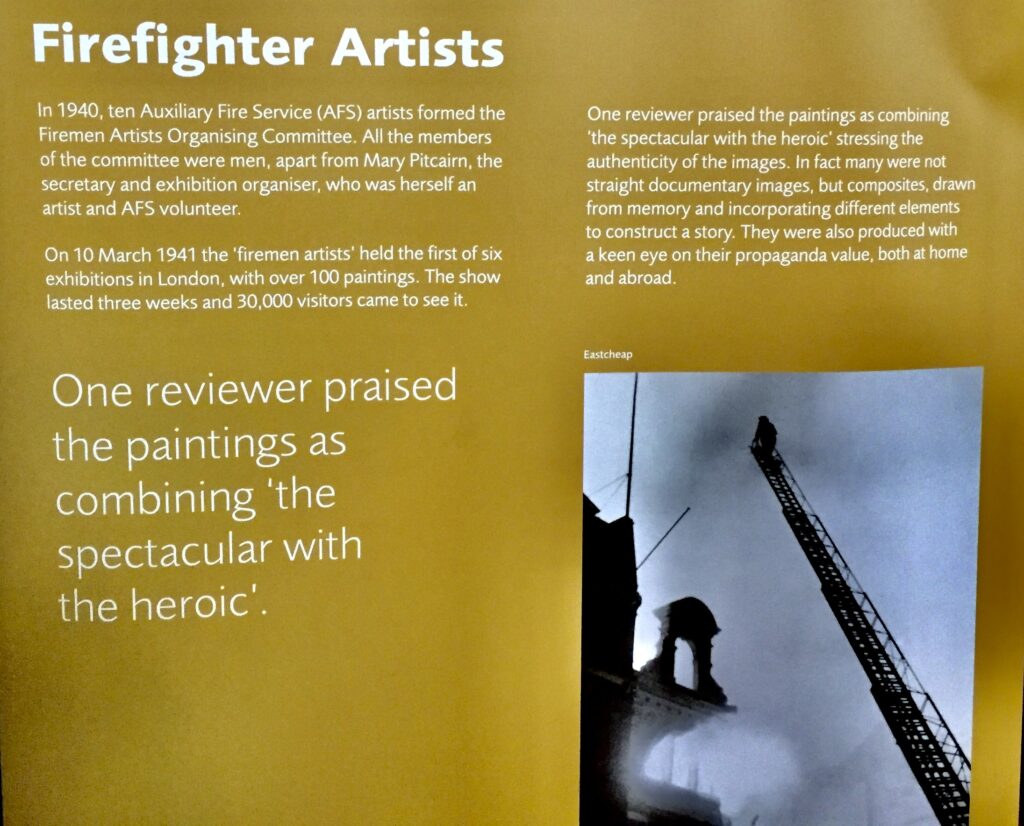
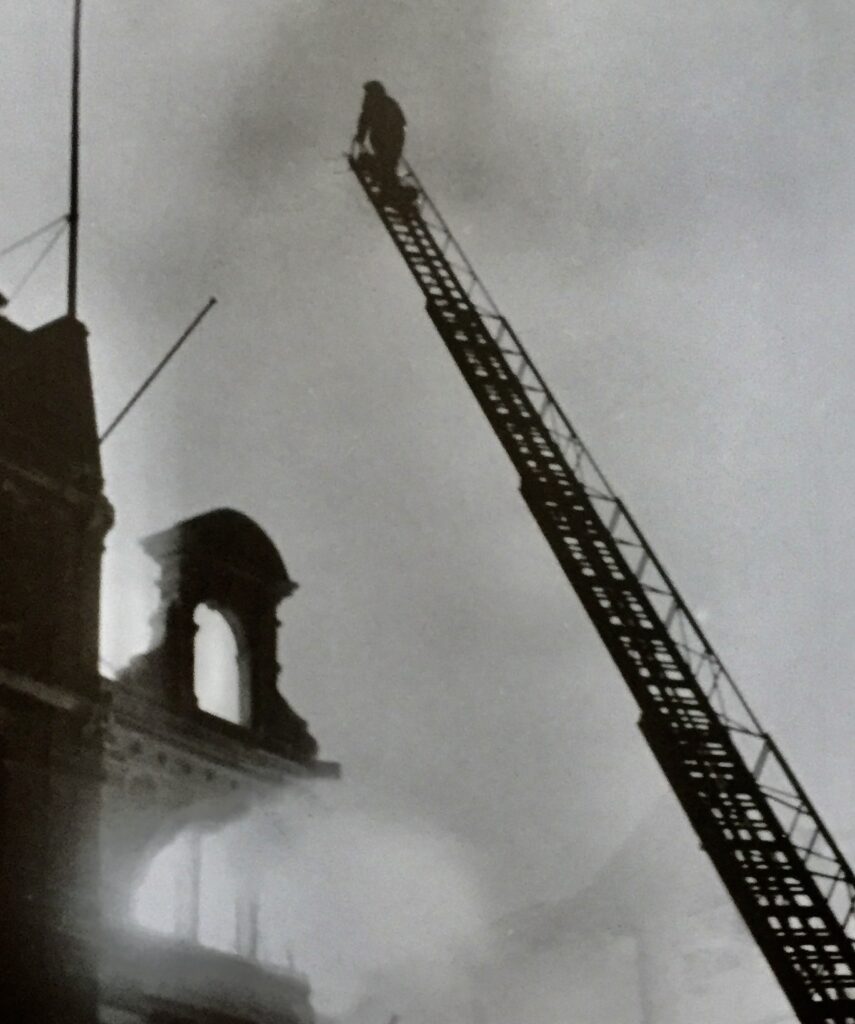
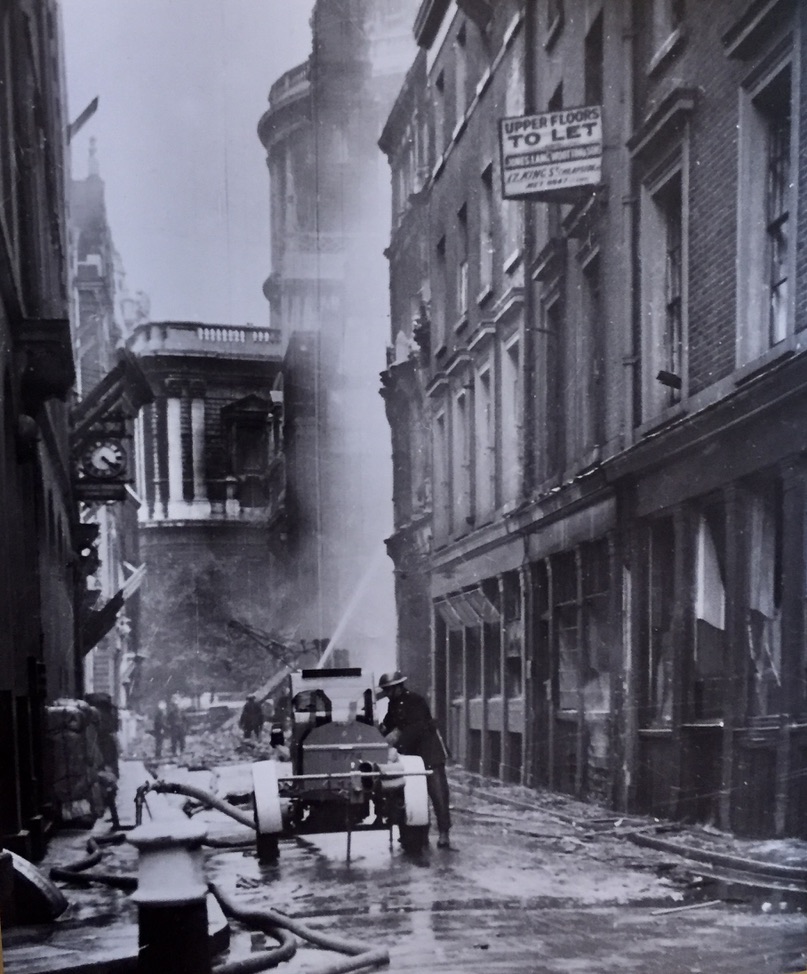
At the top of a turntable ladder in Eastcheap directing water into a blazing building, terrifying …
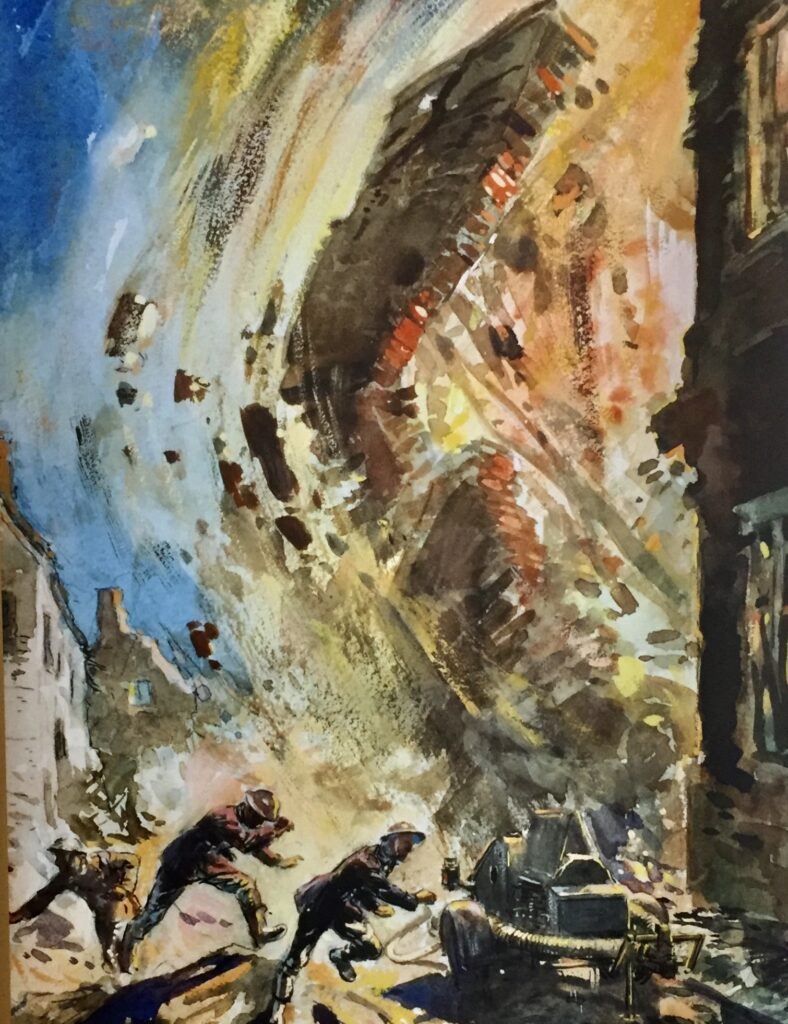
Also terrifying, Run! by Reginald Mills ..
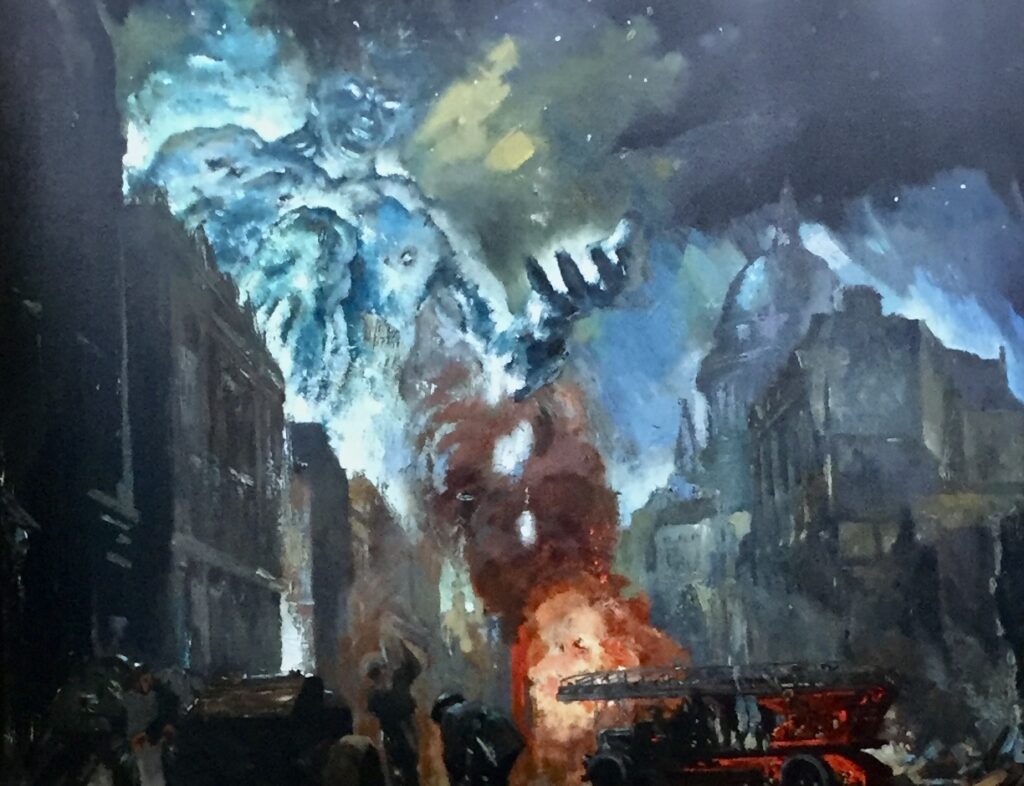
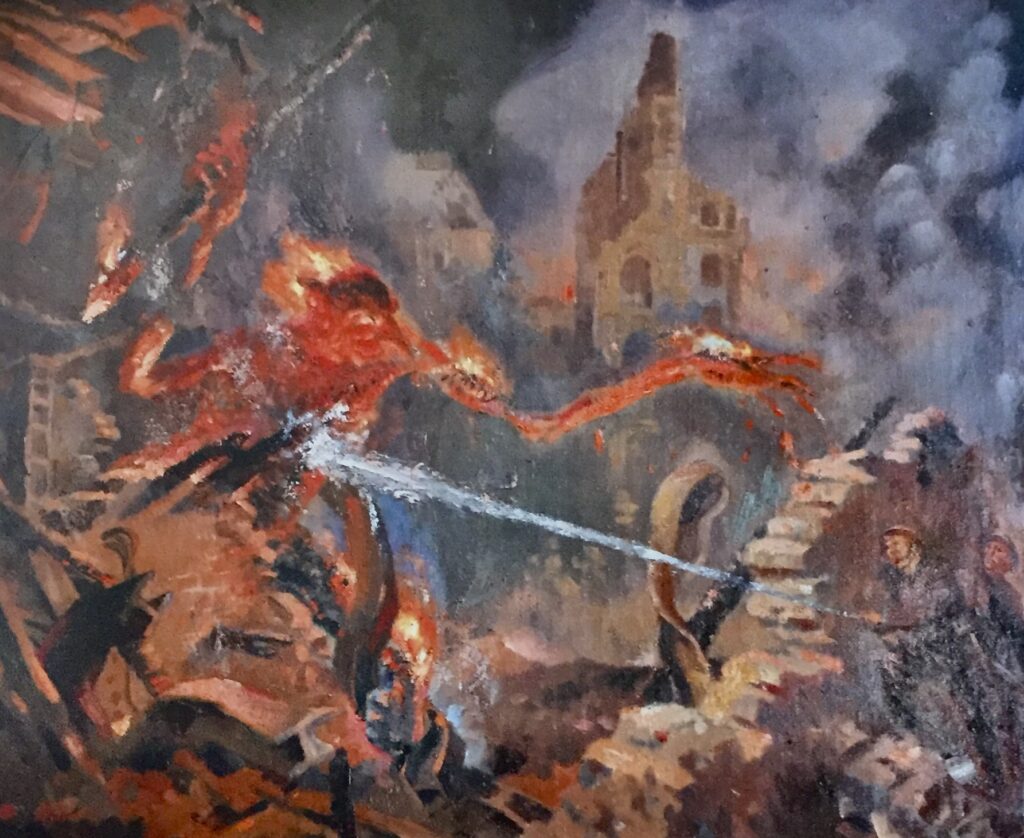
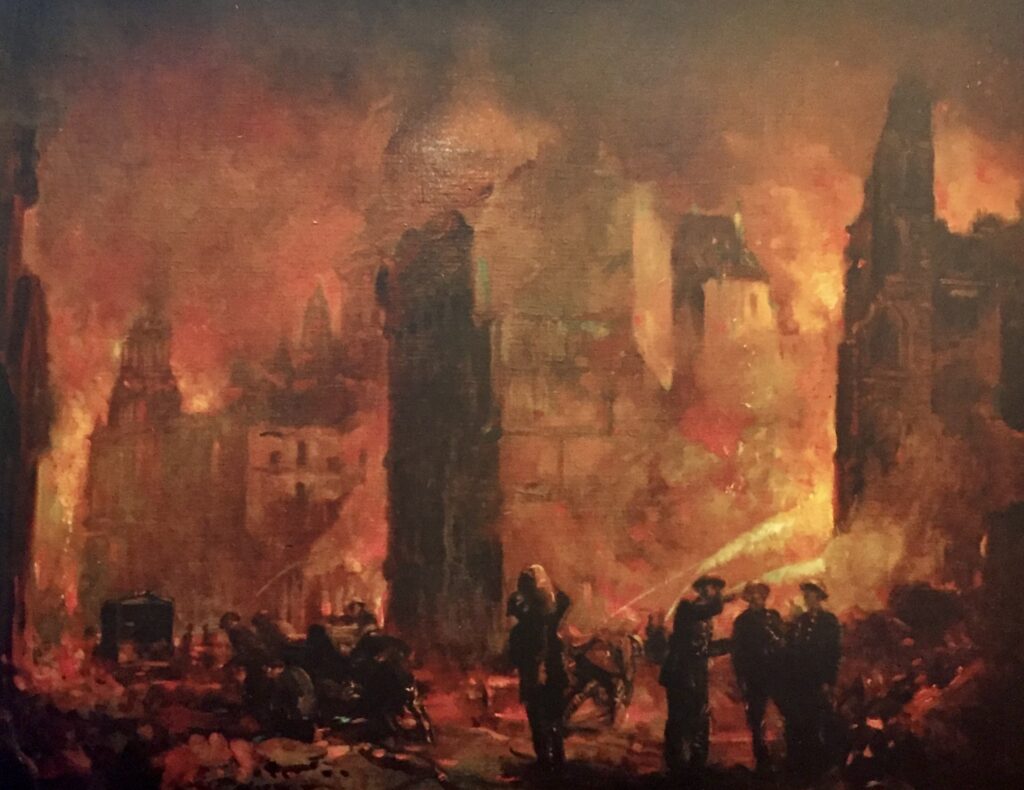
There are examples of extraordinary works by Paul Dessau. In one set, four scenes show different stages of the battle to conquer the flames, much in the style (if not the subject matter) of a Hogarth series. Look closely and you’ll see a monstrous form in each panel. In the first stage, termed Overture by the music-loving Dessau, the bombs begin to fall and a smokey menace looms large over the City …
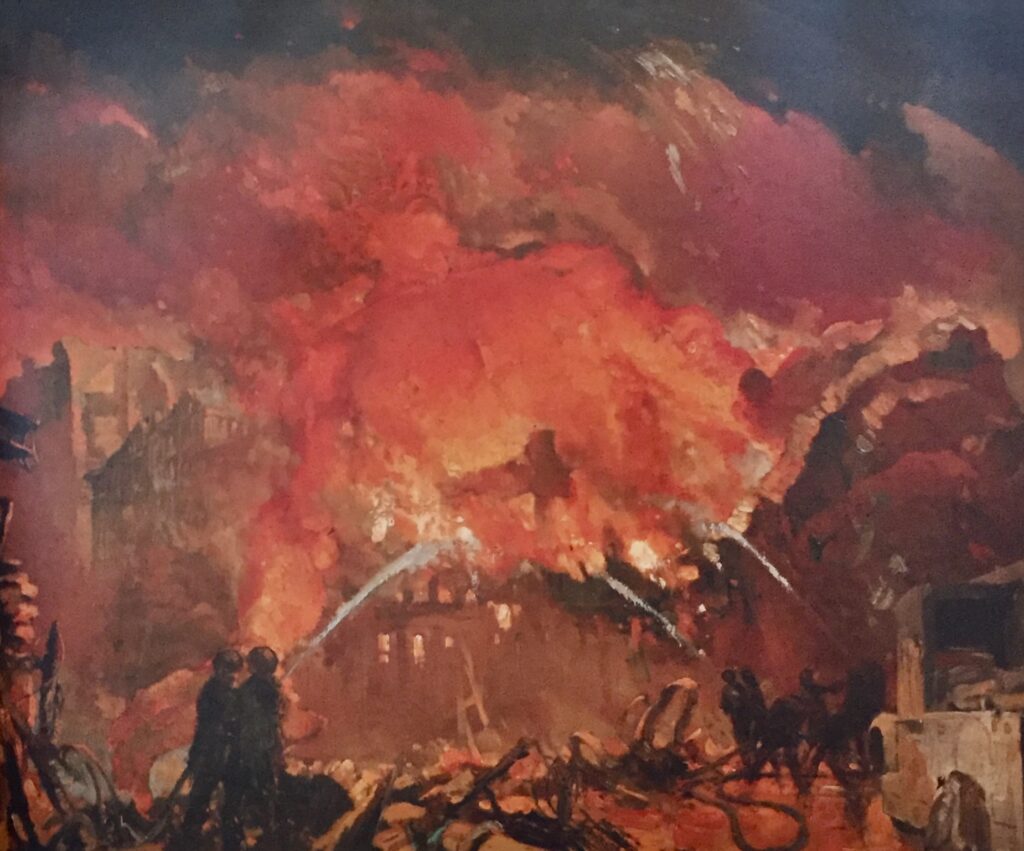
In Crescendo, the flames take hold as a fiery giant smashes down buildings …
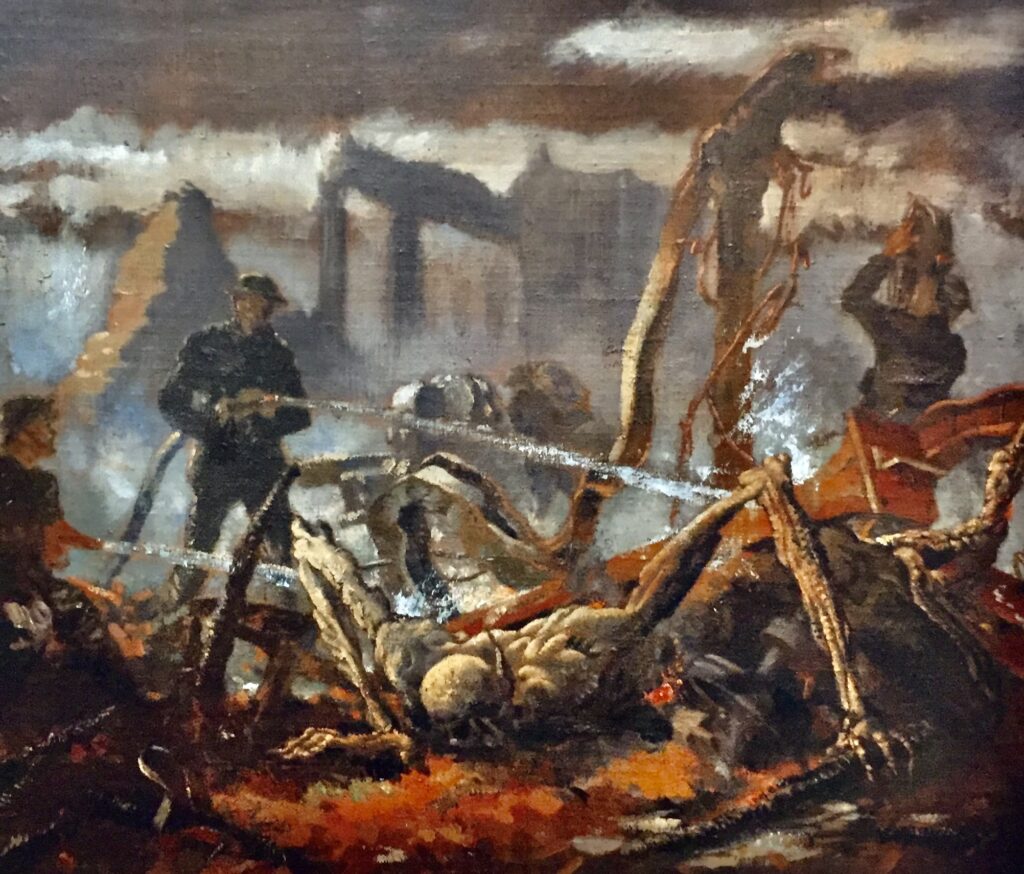
Rallentando, as the name suggest, shows the beast tempered, its infernal form withered but still intimidating …
In the final scene, Diminuendo, the foe lies vanquished amid the smoking rubble, the firemen victorious. Yet the creature has untold siblings who will return night after night to challenge the city’s protectors anew …
Cannon Street – also by Dessau …
Aftermath of a bombing raid near Cheapside with St Paul’s in the background …
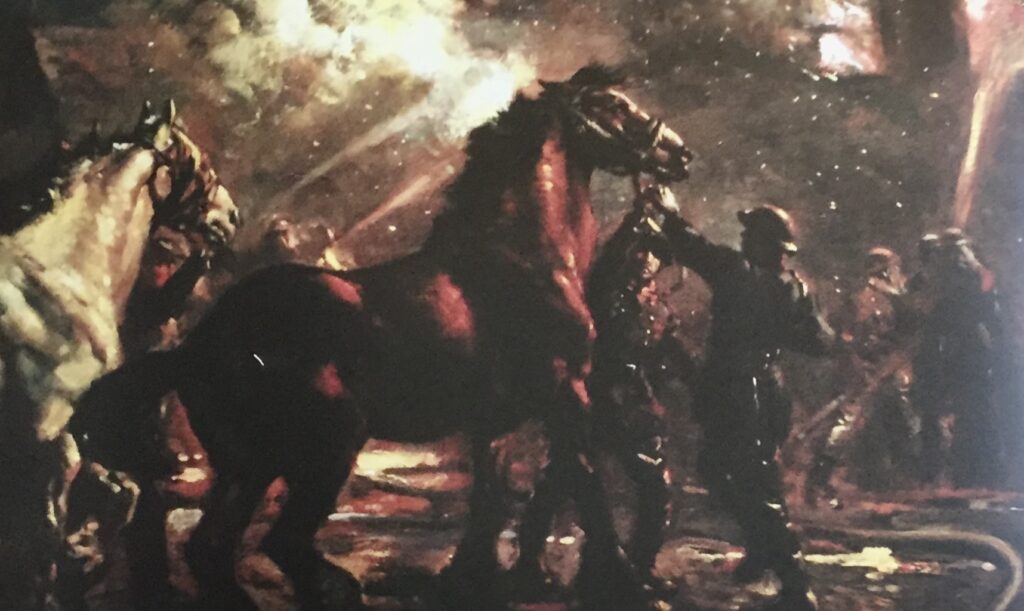
Rescuing Horses by Reginald Mills …
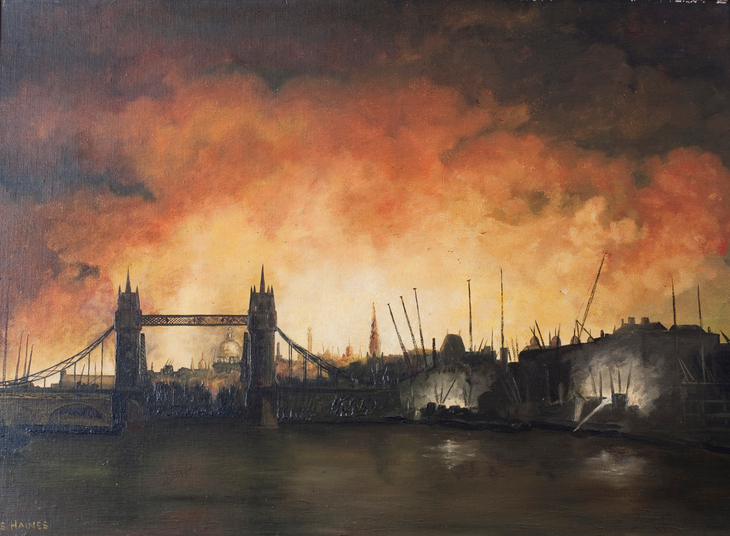
Red Sunday, 29 December 1940 by W.S.Haines. Haines was a member of the London River Service and unlike other firefighter artists he was not working in the tight confines of the City of London. This meant he had the opportunity for more panoramic pictorial compositions. Here you can see St Pauls Cathedral and the spires of City churches, through the iconic silhouette of Tower Bridge …
The London Blitz lasted from 7 September 1940 until 11 May 1941 and between 7 September and 2 November heavy bombing continued every night except one. More than 20,000 Londoners were killed including 327 men and women from the fire service with over 3,000 seriously injured. The Germans’ key weapon in the Blitz was the incendiary bomb, a device designed not to explode on impact, but able to burn at 2,500 degrees. Thousands of these were dropped creating fires that threatened to overwhelm the capital.
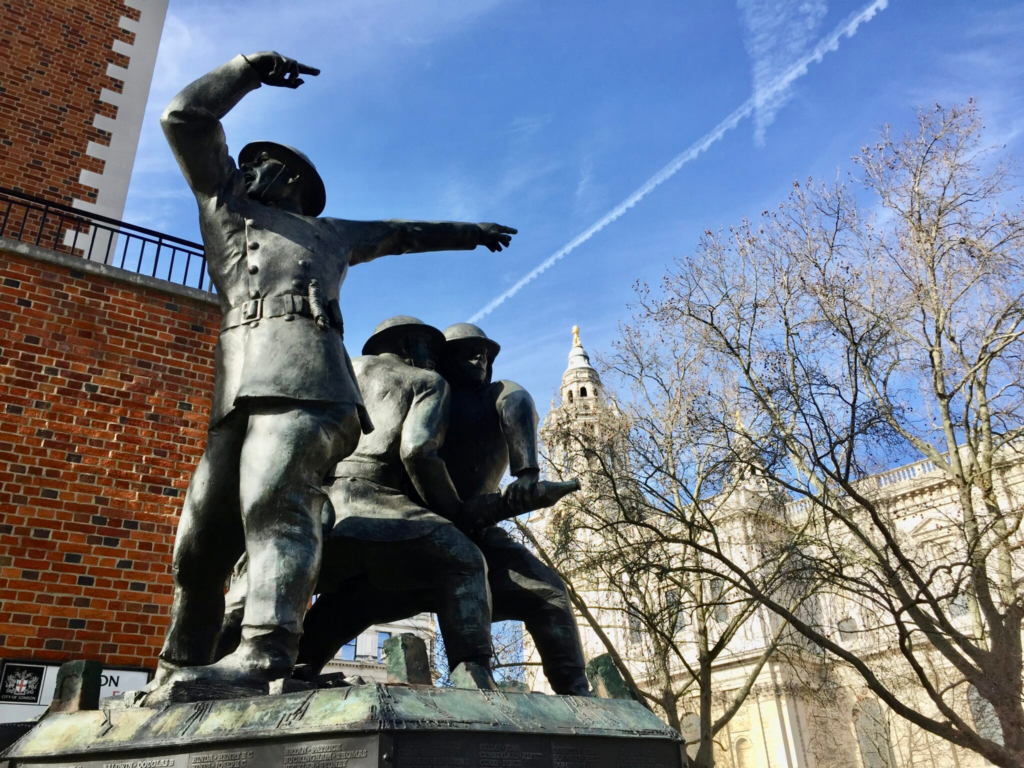
The firefighter memorial opposite St Paul’s Cathedral …
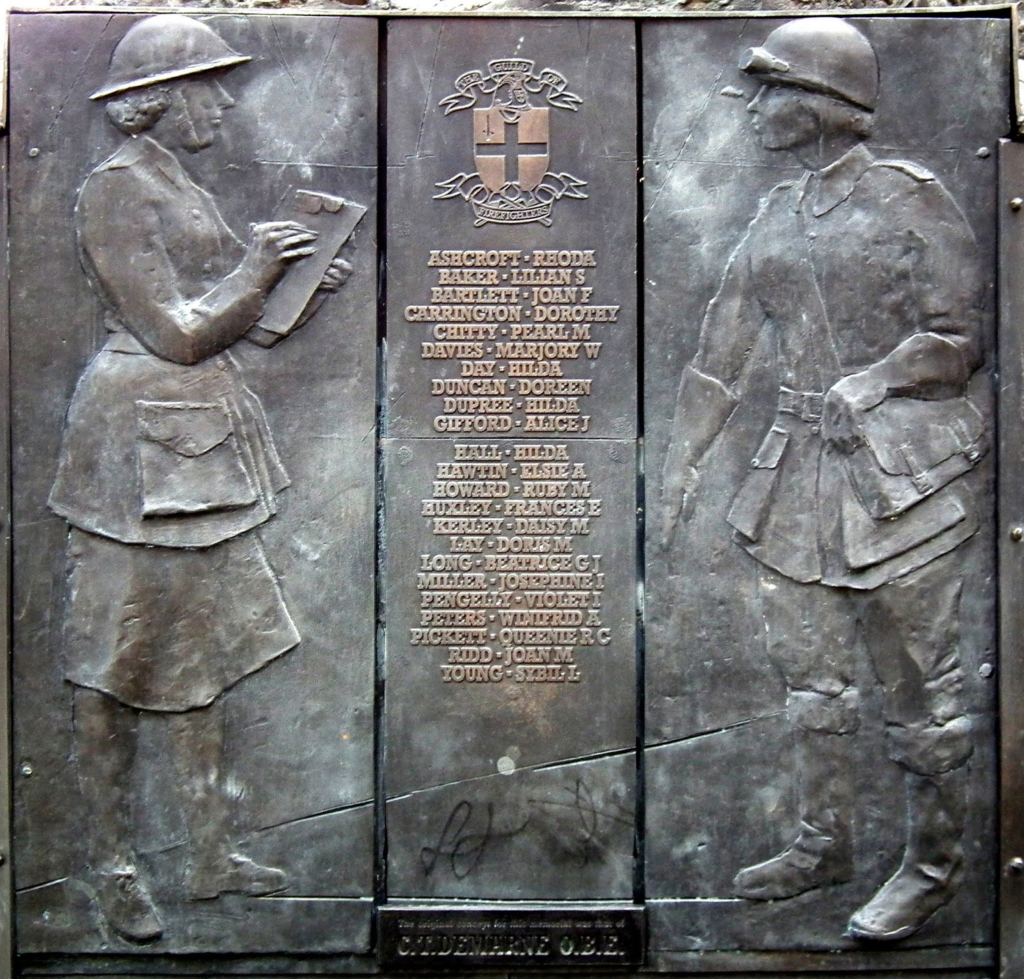
Part is dedicated to the women who died whilst serving in wartime. The lady on the left is an incident recorder and the one on the right a despatch rider …
Fire in the City is open now and can be seen in the following churches:
St Mary-le-Bow: Monday to Friday, 7.30am – 6.00pm. Open weekends on an informal basis.
St James Garlickhythe: Monday to Wednesday, 10.00am – 4.30pm, Thursday, 11.00am – 3.00pm, Sunday: 9.00am – 1.00pm. Friday & Saturday, Closed.
St Mary Aldermary: Tuesday to Friday, 7.30am – 4.00pm
St Magnus the Martyr: Tuesday to Friday, 10.00am – 4.00pm, Sunday, 10.00am – 1.00pm (Mass at 11am)
St Stephen Walbrook: Monday to Friday, 10.30am – 3.30pm
(Venue details may be subject to change so it is advised to check individual church websites for the latest information). The exhibition will move to a second cluster of churches from Monday 23 October until the end of November (with selected venues hosting displays into December).
If you would like to follow me on Instagram here is the link …