The Barbican is now presenting Encounters: Giacometti x Lynda Benglis, the third and final in a series of three exhibitions organised in collaboration with the Fondation Giacometti, Paris. Subtitled Back at Ya, the exhibition features a never before exhibited body of works by Lynda Benglis (b. 1941, Lake Charles, Louisiana) and historic works by Alberto Giacometti (b.1901-1966, Borgonovo, Switzerland), and will be a highlight of the Barbican’s Spring 2026 season.
I visited last Friday and was absolutely entranced by Benglis’s work, which I had never encountered before, so I enthusiastically recommend you come to see the exhibition too. You can find more detail here.
There follows some of the images I took but I suggest you first read a couple of reviews in order to give them context. Here’s a piece from the Pace Galleries and here’s one from East End Review.
There is a useful free guide to all the exhibits …
Here are some if the images I took. The first two are Giacometti’s Woman with Chariot, 1943-45 …
The Broadgate area near Liverpool Street has been substantially redeveloped so I popped in again for the first time in years to see if one of my favourite sculptures was still there. And hooray, it still is, and much more sympathetically sited than the last time I visited. Here it is, Leaping Hare on Crescent and Bell by Barry Flanagan (1941-2009) …
Barry tragically died from motor neurone disease at the age of 68. You can find a nice obituary from The Guardian newspaper here.
I came across the This Grief Thing pop up shop in the Barbican Centre last Saturday …
It’s in the Centre again this Saturday, 21st, and Sunday 22nd. You can read more on their website here.
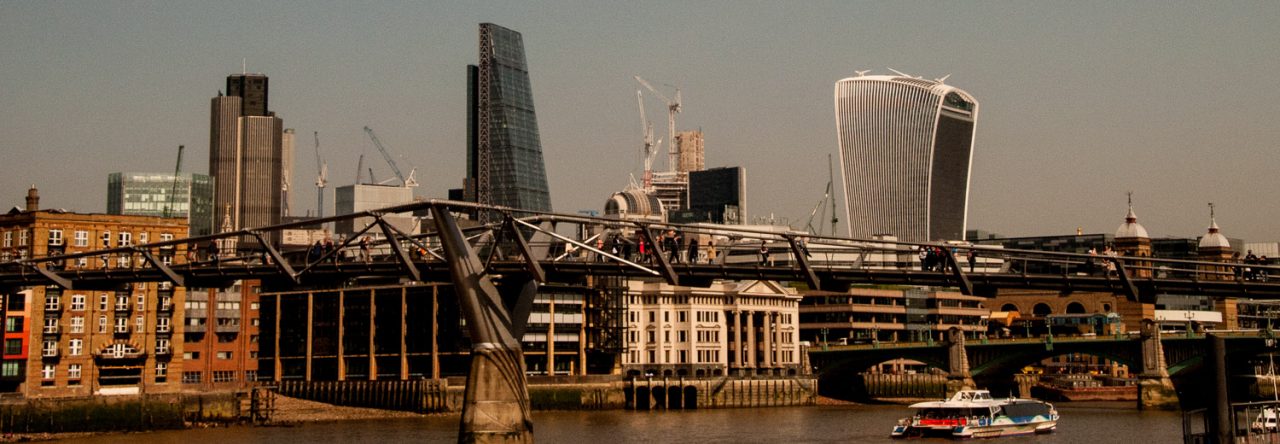
Tower 42 went romantic on St Valentine’s Day …
Finally, little yellow flowers always cheer me up when the weather is miserable …
If you would like to follow me on Instagram here is the link …
I love this picture from my recent exciting acquisition, First Editions of St John Adcock’s three volume Wonderful London …
The caption underneath reads as follows: THE LONDON STONE WHICH HAS LONG PUZZLED THE ANTIQUARIES Set in a stone casing in the wall of St Swithen’s Cannon Street is this block of oolite guarded by a grille. It was placed there in 1798,having been transferred from the other side of the road. Camden, the historian, 1551-1623, held that it was the millarium, or milestone, from which distances were calculated on the main roads in days when London was Londinium Augusta. There was a similar stone in the Forum at Rome. If Camden is right, Roman lictors may have stood, like this policeman, in front of the stone 1600 years ago.
So much to research!
It states this was a block of oolite, a type of stone I didn’t recognise. If you are curious too, you can read more here. However, studies undertaken in the 1960s revealed it was likely Clipsham limestone, probably extracted from the band of Jurassic-era rock that runs from Dorset in England’s south-west to Lincolnshire in the north-east. In 2016, results from tests conducted by the Museum of London Archaeology suggest London Stone could be from the Cotswolds, 160km west of London.
I’m ashamed to say that neither did I recognise ‘Camden the historian’, but he was a famous English antiquarian historian, topographer and herald, best known as author of Britannia, the first chronographical survey of the islands of Great Britain and Ireland and the Annales, the first detailed historical account of the reign of Elizabeth I. Here he is and you can read more about him here …
Finally, what on earth was a ‘Roman lictor’? According to Wiki, he was a bodyguard in ancient Rome, whose task it was to protect magistrates. The word lictor may be derived from the Latin verb ligare, which means “to bind”. This is sometimes said to refer to the fasces they carried, which were a set of rods that were bound in the form of a bundle, and contained an axe …
St Swithen, London Stone, to give it its full name, stood on the north side of Cannon Street, between Salters’ Hall Court and St Swithin’s Lane and was rebuilt after the Great Fire to designs by Sir Christopher Wren
The Stone used to be sited in the road but in 1742 it was moved from the south side of the street to a location beside the church door. Eventually in the 1820s it was placed in an alcove within a stone casing set into the south wall of the church.
The church with the London Stone housed at the front below the central window …
An 1831 engraving …
An engraving by Gustav Doré, 1872 …
I popped in to the Guildhall Art Gallery to consult the illuminated Agas map showing London in the 1560s and, sure enough, there was the London Stone outside St Swithen’s on Candlewick Street, the old name for Cannon Street. And it’s located in the road …
In 1578, L Grenade, a visiting Frenchman, described it as ‘3ft high, 2ft wide and 1ft thick’. What remains today is only a fraction of the original stone that was once embedded in the ground in the centre of the street. John Stow, a 16th-Century London historian, wrote in 1598: “It is so strongly set, that if carts do run against it through negligence, the wheels be broken, and the stone itself unshaken.” It was an entirely impractical position, no doubt, but bearing how much the topography has changed in London over the last millennium, it’s fair to assume that the streets were built around the stone. But that is all we can say definitively.
After the 1666 fire, as architects began reconstructing the city, surveyors found that much like an iceberg, the visible stone was only a small portion of a much larger structure. The ‘root’ of the stone extended around 3m down into the earth. It could have been “a kind of Obelisque,” noted Robert Hooke, from the Royal Society, the UK’s science academy, at the time of excavation. This theory was supported by 17th-Century architect Christopher Wren who, through his son, Christopher Wren Jr, later speculated that it could have been “in the manner of the Milliarium Aureum, at Rome”, an ancient monument from which all roads in the Roman Empire began and mileage throughout the empire was measured.
Maybe an image from the 1930s …
The demolition of the church in 1961/2 since it was so badly damaged by wartime bombing it couldn’t be repaired …
In 1962, the remains of the church were replaced by the office building at 111 Cannon Street – which included a specially designed place to keep the stone. When I started work in the City I walked past it every day and hardly noticed it, tucked away in the dark behind a rusting grille embedded in a bank’s wall.
The Stone in 2012, no wonder people just walked past it …
It looked pretty much the same when I photographed it in March 2016 …
The view from inside the building was better …
When the site was due for redevelopment in 2018 the stone was finally liberated from its prison and rested for a while at the Museum of London …
Another view …
It now has a wonderful new home of Portland Stone which does justice, I think, to its history …
For more about the legends surrounding the Stone have a look at the brilliant London Inheritance blog.
It includes the story of Jack Cade who led a rebellion in 1450, from the south east of the country, against the corruption, poor administration and the abuse of power by the King’s local representatives. The connection between Jack Cade and the London Stone comes from the rebellion’s entry into the City of London. Cade pretended to use the name of Mortimer, (the family name of ancestors of one of Henry VI’s main rivals), and on reaching the London Stone, he struck his sword on the stone and according to Holinshed (a 16th century English chronicler), he exclaimed “Now is Mortimer Lord of this City” …
You can read more stories about legends associated with the Stone here.
What is the true full story of the Stone? “Science just can’t explain it – this is one case where archaeology has failed,” said John Clark, curator emeritus at the Museum of London.
If you would like to follow me on Instagram here is the link …
There follows some images from the exhibition which you can read about in the Guide and decide if you want to visit in person.
Drainer III …
Harmonizer …
Inseminator …
Fertilizer …
Suspended Interior I …
Mediator III …
One reviewer has written: ‘Writers often use the term ‘visceral’ metaphorically, to signify raw, instinctive emotions: but as applied to the current exhibition at the Barbican Curve, Julia Phillips’s Inside, Before They Speak, the term is used quite literally. The exhibition focuses on the Chicago-based artist’s almost obsessive interest in the body, particularly its insides – or viscera – and human conception’.
I have to say that there were a couple of times when I felt a bit queasy! But I’m still pleased I went.